Death and grief are inevitable parts of our journey in this world. Yet, from the perspective of the Quran, we find profound comfort: the righteous do not truly die. They merely transition into a higher existence, continuing to enjoy eternal life with God. Meanwhile, those who reject righteousness face a continuous, self-imposed suffering. Below, we explore both of these realities, the stages of grief, and how to find meaning and healing when we lose a loved one.
Life as a Test
Our existence is a carefully designed test:
[2:155] “We will surely test you through some fear, hunger, and loss of money, lives, and crops. Give good news to the steadfast.”
We are not left to simply declare belief without enduring challenges. This life on earth is meant to test our conviction and belief in God. Do we hold fast to the rope of God under all circumstances? Or is our faith contingent upon certain conditions we set, e.g. no loss of family, no experience of poverty, perfect happiness etc.
When one proclaims that he/she believes in the absolute authority of God and that His judgement is just. How could that be tested? If losing a dog is enough for me to reject the existence of God, then what right do I have as a creation (or if you’re an evolutionist: an evolved blob), to claim faith. All evidence points to design.
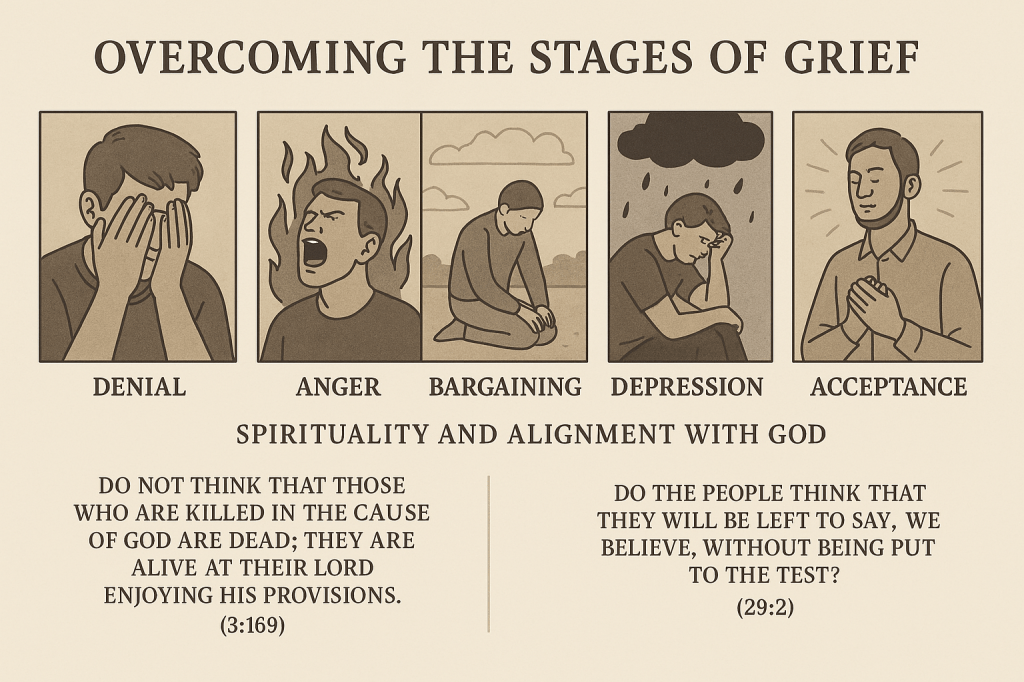
[29:2] “Do the people think that they will be left to say, ‘We believe,’ without being put to the test?”
Hardships—including the loss of loved ones—are part of this journey. They refine us, reveal our devotion to God, and remind us that there is more to life than our limited time on Earth.
This life is meant to be an exacting trial, every decision we make we will have to pay for. A righteous decision receives a righteous and good outcome, a sinful one will also be paid in kind.
[74:38] “Every soul is trapped by its sins.”
[45:22] “God created the heavens and the earth for a specific purpose, in order to pay each soul for whatever it earned, without the least injustice.”
Five Stages of Grief
Grief is often described through four general stages: denial, yearning, disorganization, and reorganization. Each stage comes with unique emotions and challenges:
- Numbness/Shock/Disbelief (Denial)
In the initial phase, we struggle to accept the reality of our loss. This is natural as someone you love by definition is embedded into your life, through various engagements, good and bad memories. It’s not so easy to “delete” them as if they never existed. Our psyche is deeply perturbed by significant changes. - Anger
In this phase, we lash out in anger at the unjust outcome. Even when everything points to the most gradual and best departure of the soul. This stage showcases our deep attachment to the mortal realm. - Yearning (Bargaining)
We feel the absence of our loved one and may attempt to “find” them in our memories or in the places they frequented:
[2:156] “When an affliction befalls them, they say, ‘We belong to God, and to Him we are returning.’” - Disorganization (Depression)
Daily life can feel off-balance without the departed. When significant disorientation has happened, finding a routine and a regular means to search purpose and value becomes difficult.
God reminds us:
[94:5] “With pain there is gain.”
[94:6] “Indeed, with pain there is gain.” - Reorganization (Acceptance)
Eventually, we learn to live without our loved one’s physical presence. We discover new purpose and acceptance:
[3:185] “Every person tastes death, then you receive your recompense on the Day of Resurrection. Whoever misses Hell, barely, and makes it to Paradise, has attained a great triumph. The life of this world is no more than an illusion.”
The Righteous Do Not Really Die
The Quran repeatedly confirms that the righteous enjoy a continuing life with God:
[44:56] “They do not taste death therein—beyond the first death—and He has spared them the retribution of Hell.”
[16:32] “The angels terminate their lives in a state of righteousness, saying, ‘Peace be upon you. Enter Paradise (now) as a reward for your works.’”
Physical death is like switching off a light in a room: the “room” (our spiritual reality) remains, but the physical body no longer illuminates our presence here. The soul of the righteous is gently extracted, entering a state of peace and heavenly reward.
[21:35] “Every soul will taste death, after we put you to the test through adversity and prosperity, then to us you ultimately return.”
For believers, physical death is a transition, not an end. They do not truly “die,” but rather continue thriving in a perfect existence granted by God.
The Suffering of the Unrighteous
In contrast, the unrighteous experience ongoing torment:
[40:46] “The Hell will be shown to them day and night, and on the Day of Resurrection: ‘Admit Pharaoh’s people into the worst retribution.’”
While the righteous enjoy immediate access to Paradise, those who reject righteousness endure perpetual suffering, disconnected from God’s grace.
Beyond the excrutiating loss, the point of this life is that it is impermanent, transitory. This life is our chance to redeem ourselves and prove that we care more about God than we do our earthly binds.
Those that fail this test, and resist God’s authority, reject His existence and Mercy must pay. Defiance is often met with retribution, and persistent defiance is met with permanent retribution. Some people will qualify this as unfair – why should God punish me for not wanting to believe in Him or His signs.
The issue isn’t whether you believe or not, the issue is that all the resources you have that are good, came from the Creator. Everything that works and works well is because He designed it so. So if these are all the things you don’t want (part and parcel of the rejection), your only option is to live an eternity without them.
Imagine a car that was designed to perform well and provides you all the means you need, gets you from A-B securely, gives heating/cooling, is comfortable and so on. Yet while in this car and using it, you persistently destroy each component within and with abject defiance, defile and insult the designer of the car and how poorly it’s manufactured.
Despite wanting more, you are unappreciative of what it does do. Therefore, you shouldn’t be complaining if from now, you have to brave the weather, without comfort and efficiency whenever you want to go to B.
[14:7] Your Lord has decreed: “The more you thank Me, the more I give you. But if you turn unappreciative, then My retribution is severe.”
Moving Forward and Finding Meaning
- Acceptance and Resilience
Recognize that physical death is only one stage in God’s plan. Our grief will transform us when we trust God’s promise and remain steadfast. - Mindfulness and Prayer
Grief can pull us into regrets about the past or fears about the future. By focusing on the present through prayer and remembrance of God, we find stability in turbulent times. - Adjusting to a World Without That Person
It is natural to feel disoriented when a loved one departs. Yet knowing their soul lives on in a state infinitely more blissful than our own can ease our hearts. We honor them by living righteously. - Finding Purpose After Loss
Eventually, we reconstruct our daily life and find renewed meaning. Though the physical presence of our loved one has faded, their memory, love, and lessons remain—and inspire us to serve and worship God wholeheartedly.
The Recovery
Grief is a normal human response to loss, but the Quranic perspective offers a hopeful reality: the righteous do not truly die. They pass beyond this physical plane and ascend to a better world. Our tests of loss and hardship refine our faith and remind us to keep our hearts turned toward God.
[2:156] “We belong to God, and to Him we are returning.”
For those who believe and persevere, death is not an end but a new beginning—eternal life with God. May these reassurances comfort our hearts, guide us through our pain, and lead us to a profound understanding of life, death, and the everlasting peace awaiting the righteous.
Grief is natural and facing that reality of losing someone reminds us of our own mortality. This is an incontrovertible fact, everyone must die. But having purpose and understanding that our role in this world, isn’t to maximise the feelings of pleasure and temporary gains. Instead we are to focus on the infinite journey, a higher purpose.
Losing someone you love reminds you, that life is with purpose, and you will be tested. Having the right orientation of beliefs, allows you to navigate those devastating emotions. God promises perfect peace and security for those who are in His kingdom.
[3:139] You shall not waver, nor shall you grieve, for you are the ultimate victors, if you are believers.
[3:169] “Do not think that those who are killed in the cause of God are dead; they are alive at their Lord, enjoying His provisions.”

 Quran Only Studies
Leave a comment