
There is ongoing debate among Quranists about the true nature of Salat. While some view it as a form of ritual worship, opinions differ widely on when it should be observed. A common view among Quranists is that there are three distinct Salat times, but even this point invites discussion—particularly around what time periods these prayers correspond to. More recently, some voices in the Quranist community have proposed a shift in understanding: that all three Salat take place at night, challenging the more conventional interpretations.
This article aims to clarify prayer timings based strictly on Quranic verses, critically evaluating claims about daytime and nighttime prayers.
[17:78] You shall observe the Contact Prayer (Salat) when the sun declines from its highest point at noon, as it moves towards sunset. You shall also observe (the recitation of) the Quran at dawn. (Reciting) the Quran at dawn is witnessed.
(٧٨) أَقِمِ ٱلصَّلَوٰةَ لِدُلُوكِ ٱلشَّمْسِ إِلَىٰ غَسَقِ ٱلَّيْلِ وَقُرْءَانَ ٱلْفَجْرِ إِنَّ قُرْءَانَ ٱلْفَجْرِ كَانَ مَشْهُودًا
According to authoritative classical dictionaries such as Lane’s Lexicon, ‘duluk‘ specifically denotes the movement of the sun away from its highest point (zenith), providing strong lexical evidence against alternative interpretations.
Instead of the typical understanding that “duluk” is the sun declining from its zenith, the argument is that the sun is “rubbing” the night, meaning this arabic is according to Quranists an argument that the first prayer starts effectively at maghrib (the duluk al-shams) towards the deepening of the night in “ila ghusuk al-layl”.

We can see here that the lexicon clearly highlights that “duluk” is specifically the decline of the sun from the meridian (the highest point).
There’s a fundamental issue with trying to fit the Quran to meet your needs. It doesn’t address the whole picture. We see in the Quran that there are several verses that deal with “as-salat” the contact prayers.
[24:58] O you who believe, permission must be requested by your servants and the children who have not attained puberty (before entering your rooms). This is to be done in three instances—before the Dawn Prayer, at noon when you change your clothes to rest, and after the Night Prayer. These are three private times for you. At other times, it is not wrong for you or them to mingle with one another. GOD thus clarifies the revelations for you. GOD is Omniscient, Most Wise.
(٥٨) يَـٰٓأَيُّهَا ٱلَّذِينَ ءَامَنُوا۟ لِيَسْتَـْٔذِنكُمُ ٱلَّذِينَ مَلَكَتْ أَيْمَـٰنُكُمْ وَٱلَّذِينَ لَمْ يَبْلُغُوا۟ ٱلْحُلُمَ مِنكُمْ ثَلَـٰثَ مَرَّٰتٍ مِّن قَبْلِ صَلَوٰةِ ٱلْفَجْرِ وَحِينَ تَضَعُونَ ثِيَابَكُم مِّنَ ٱلظَّهِيرَةِ وَمِنۢ بَعْدِ صَلَوٰةِ ٱلْعِشَآءِ ثَلَـٰثُ عَوْرَٰتٍ لَّكُمْ لَيْسَ عَلَيْكُمْ وَلَا عَلَيْهِمْ جُنَاحٌۢ بَعْدَهُنَّ طَوَّٰفُونَ عَلَيْكُم بَعْضُكُمْ عَلَىٰ بَعْضٍ كَذَٰلِكَ يُبَيِّنُ ٱللَّهُ لَكُمُ ٱلْـَٔايَـٰتِ وَٱللَّهُ عَلِيمٌ حَكِيمٌ
In this verse, the arabic points to 3 specific periods of the day for permission needed during private times. The first period is “kablatal fajr” before the dawn prayer. This verse names the dawn prayer specifically, it then continues to highlight the mid point where permission must be requested when you change your clothes during the zuhur period. This arabic word means noon. Finally, the final period of privacy is after the isha’ prayer “ba’dal ish’a”.
We can see from these 3 points that there is wisdom in why the 3 periods are defined after isha’ prayer until before the fajr prayer, then while you change your clothes during zuhur (noon). The figure below, highlights the range of privacy per 24:58

It’s clear the wisdom in this verse in not mentioning the before or after the zuhr prayer. Because the duration could not be bound or pivoted to any point.
If the verse instead says that the private time was after or before the zuhr prayer, then the duration of privacy would not be bound to anything specific. Which is why changing of the clothes is mentioned and the zuhr period is mentioned instead of the prayer itself.
Other verses for prayers
There are more verses that deal with the prayer periods.
[11:114] You shall observe the Contact Prayers (Salat) at both ends of the day, and during the night. The righteous works wipe out the evil works. This is a reminder for those who would take heed.
(١١٤) وَأَقِمِ ٱلصَّلَوٰةَ طَرَفَىِ ٱلنَّهَارِ وَزُلَفًا مِّنَ ٱلَّيْلِ إِنَّ ٱلْحَسَنَـٰتِ يُذْهِبْنَ ٱلسَّيِّـَٔاتِ ذَٰلِكَ ذِكْرَىٰ لِلذَّٰكِرِينَ
In this verse, “tarafay al-nahar” refers explicitly to “both ends of the day,” meaning sunrise and sunset. Given that the day begins at sunrise and concludes at sunset, prayers are defined at these two specific points.
And “zulafan minal layl” is the early part of the night. Here are all the possible configurations of this prayer given only the information present.

Scenario 1: If we assume only one prayer at each end of the day, ambiguity arises whether this refers to Asr or Maghrib. Additionally, uncertainty emerges about whether Maghrib or Isha’ qualifies as the early night prayer.
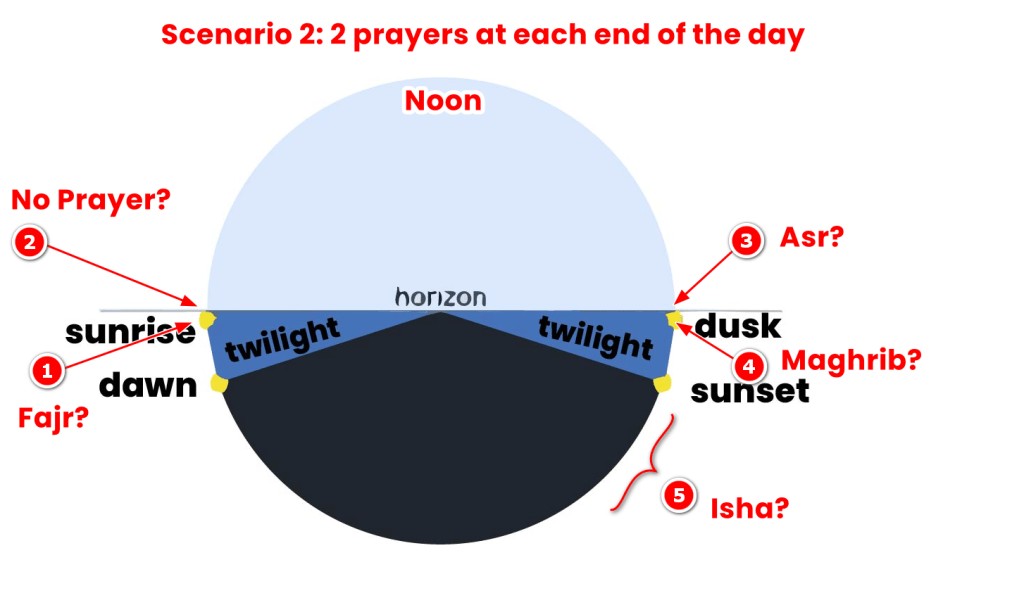
Scenario 2: Positing five prayers without one at noon introduces further complications. It raises a critical question: How do Quranists confidently exclude noon prayer without explicit Quranic prohibition?

Scenario 3: Only Fajr prayer occurring during daylight, which aligns logically with 62:10, but leaves unclear the exact distribution of evening prayers.
Given the 3 scenarios presented, it is clear that at best the verse in the Quran are nebulous but hinting at some form of prayers significant at the gradient point of the sunlight. That is, when the sun rises, a new period begins, and when the sun sets, another period begins.
It’s also worth noting that God clarifies in 62:10 that
[62:10] Once the prayer is completed, you may spread through the land to seek God’s bounties, and continue to remember God frequently, that you may succeed.
(١٠) فَإِذَا قُضِيَتِ ٱلصَّلَوٰةُ فَٱنتَشِرُوا۟ فِى ٱلْأَرْضِ وَٱبْتَغُوا۟ مِن فَضْلِ ٱللَّهِ وَٱذْكُرُوا۟ ٱللَّهَ كَثِيرًا لَّعَلَّكُمْ تُفْلِحُونَ
Here God clarifies that we are to spread through the land to seek God’s bounties, the word “as-salat” is used again which signifies that after this prayer you are to spread through the land. This highlights that scenario 3 is the closest match to these points as it is a singular salat form, meaning that you would not be spreading through the land after your maghrib/isha/fajr prayer, but only 1 of those prayers.
The reference to spreading out after prayer in 62:10 strongly suggests a daytime prayer, logically Fajr, since believers engage in daily activities post-Fajr, thus reinforcing scenario 3.
[20:130] Therefore, be patient in the face of their utterances, and praise and glorify your Lord before sunrise and before sunset. And during the night glorify Him, as well as at both ends of the day, that you may be happy.
(٢٠:١٣٠) فَٱصْبِرْ عَلَىٰ مَا يَقُولُونَ وَسَبِّحْ بِحَمْدِ رَبِّكَ قَبْلَ طُلُوعِ ٱلشَّمْسِ وَقَبْلَ غُرُوبِهَا وَمِنْ ءَانَآئِ ٱلَّيْلِ فَسَبِّحْ وَأَطْرَافَ ٱلنَّهَارِ لَعَلَّكَ تَرْضَىٰ
Verse 20:130 explicitly confirms prayer times around sunrise and sunset (‘before sunrise and before sunset’), directly clarifying 11:114’s vague wording of ‘both ends of the day,’ decisively invalidating interpretations that restrict prayers exclusively to nighttime.
The Noon Prayer and Zikr
[30:18] All praise is due to Him in the heavens and the earth, throughout the evening, as well as in the middle of your day.
(٣٠:١٨) وَلَهُ ٱلْحَمْدُ فِى ٱلسَّمَـٰوَٰتِ وَٱلْأَرْضِ وَعَشِيًّا وَحِينَ تُظْهِرُونَ
In this vers God is clarifying that when we reach noon (حين تظهرون – “Ḥīna tuẓhirūn”) we should be remembering God. It’s commonly understood that before we pray, we naturally think about God. Notice how the same period is mentioned (zuhr) as per 24:58 again giving a range of time during noon specifically where you should be remembering God. At a minimum, if you’re not commemorating God (by not praying or applying zikr) at noon, you are failing this commandment from God.
The Correct Prayers
If we are to use the argument that “duluk” is rubbing of the the sun with the night, we reach a contradiction of what qualifies as prayer at both ends of the day (see previous 11:114 and 20:130). But if we see “duluk” as the declination from the zenith of the sun (which is the lanes definition of the arabic) then we can resolve this conflict in full.

We can see here that “duluk” is the decline from the meridian which is the most logical explanation for this arabic word. And given this straightforward definition, we now have a full scope of the prayer, highlighted in the figure below.

Now we can see that 17:78 truly points to the noon prayer and that both ends of the day is qualified under 11:114. Furthermore, the Fajr and Isha prayer is mentioned by name in 24:58. With the period for Zuhr also mentioned in 24:58 though not the as-salat this is with its own wisdom.
And finally the missing piece is 2:238 which is the middle prayer or “solat al-wusta” and this is exactly between all 4 other prayers. In the 3 night prayer mode, the middle prayer is the Isha’ prayer, but there are two mid points between 2 points in a circle.
[2:238] You shall consistently observe the Contact Prayers, especially the middle prayer, and devote yourselves totally to God.
(٢:٢٣٨) حَـٰفِظُوا۟ عَلَى ٱلصَّلَوَٰتِ وَٱلصَّلَوٰةِ ٱلْوُسْطَىٰ وَقُومُوا۟ لِلَّهِ قَـٰنِتِينَ
There can only be 1 mid point between 4 points of on a circle. See graph below.
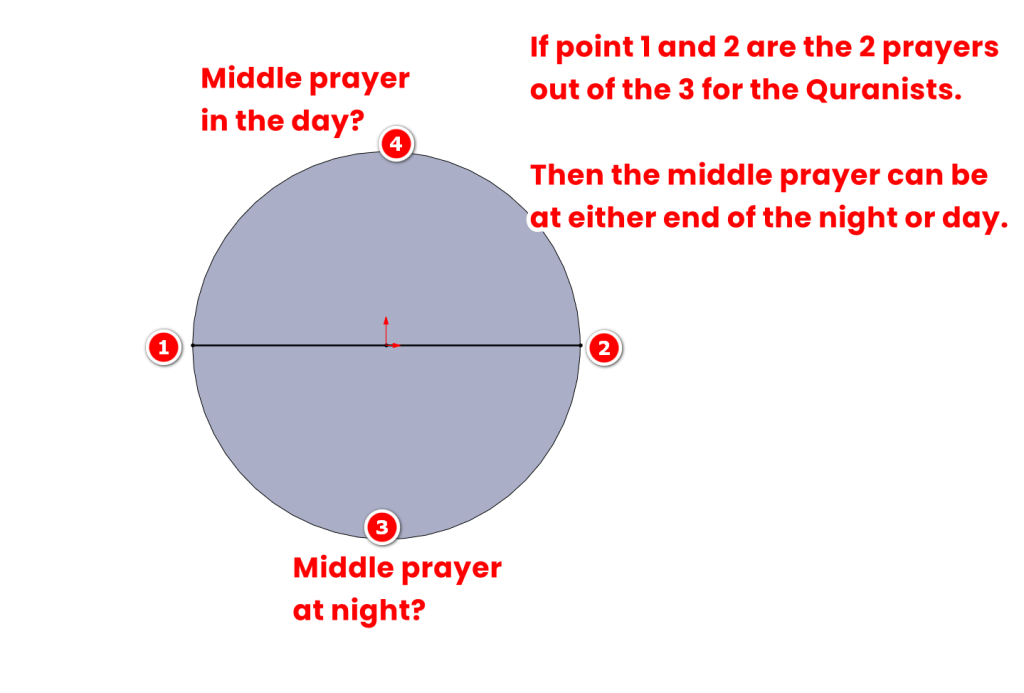
Here we can see that because the ends of the day are always mirror of one another, then the middle prayer can be at either ends of the circle, either in point 3 or 4.
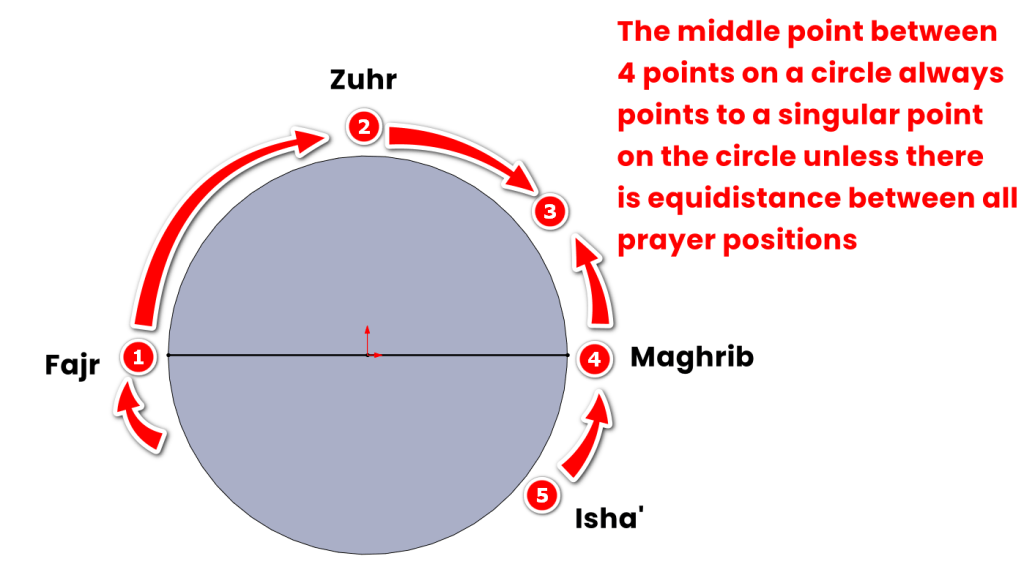
If, however, there are 4 defined points on a circle, then there is only 1 point that is a midpoint between all these points. You can never get a symmetrical 4 point circle as zuhr is by definition cutting up the fajr to asr period by 50%, whilst Isha is cutting up the period between Maghrib and Fajr by about 25%. Even if you are in the north pole during the summer solstice, the ratio of these points do not change, and the mid point is always singular; pointing towards Asr.
Expansions of prayer times
[4:101 ] When you travel (أَضْرَبْتُمْ فِي الْأَرْضِ) in the land, you commit no error by shortening the Contact Prayers (Salat), if you fear that the disbelievers may attack you, for the disbelievers are your ardent enemies.
[4:102] When you are with them, and you lead the Contact Prayer (Salat) for them, let some of them stand guard, holding their weapons. … Once they have prostrated, let the others stand guard in your place, and let them participate in the prayer with you…
The detailed strategic instructions provided in verses 4:101-102—shortening prayers, rotational guarding—strongly imply daylight conditions, as the risk of ambush or visibility is significantly greater during daytime than at night. Such practical considerations inherently affirm at least one daytime prayer.
Key Terms:
“Darabtum fil-arḍ” (ضَرَبْتُمْ فِي الْأَرْضِ) = traveling (“When you travel/strike out on the land”).
The verses explicitly mention shortening prayer (Salat) and include arrangements for guarding during possible daytime conflict.
Additionally, it is important to recognize that the Quran employs a different term specifically for “traveling at night” (أَسْرَى, Isra), highlighting that “Darabtum fil-arḍ” specifically denotes daytime travel. This linguistic distinction further underscores that the shortening of the prayer described in these verses pertains explicitly to daytime journeys or travel during daylight hours.

Why it indicates daytime prayers:
If prayers were exclusively conducted at night—as some Quranist perspectives suggest—the detailed instructions for guarding and rotating groups would be largely unnecessary. The complexity and urgency implied by these verses logically align with daytime scenarios, when the risk of ambush or attack is significantly heightened. Consequently, these verses strongly suggest the existence of at least one daytime prayer that can and should be shortened under circumstances of travel or potential warfare. This understanding directly challenges interpretations that limit all prayers solely to nighttime, asserting instead that multiple prayers occur throughout the day.
Imams of the Religion
Historically, the contact prayer (Salat) ritual was systematically preserved through continuous practice and communal transmission from Abraham’s time, making radical changes improbable. The exact forms—bowing, prostration, standing—were visually and practically conveyed, ensuring ritual accuracy independent of textual manipulation.
Prayer was the single most preserved rite of the religion, next to the Quran. If you memorised 7 verses in the Quran your whole life during the lifetime of the prophet; you would have likely prayed 250,000 rakaats during your lifetime. Meaning you’d have more than 35,000x practice over your preservation of the Quran.
[21:73] We made them imams who guided in accordance with our commandments, and we taught them how to work righteousness, and how to observe the Contact Prayers (Salat) and the obligatory charity (Zakat).* To us, they were devoted worshipers.
(٢١:٧٣) وَجَعَلْنَـٰهُمْ أَئِمَّةً يَهْدُونَ بِأَمْرِنَا وَأَوْحَيْنَآ إِلَيْهِمْ فِعْلَ ٱلْخَيْرَٰتِ وَإِقَامَ ٱلصَّلَوٰةِ وَإِيتَآءَ ٱلزَّكَوٰةِ وَكَانُوا۟ لَنَا عَـٰبِدِينَ
God made Abraham and his sons as imams of the religion to guide the believers in accordance to God’s commandments. We were taught righteousness, salat and zakat. These practices were passed down generation by generation, with no deviation whatsoever. This is more known than the verses of the Quran.
What was manipulated over time, however, was the injection of words and prayers during the prayer. This doesn’t change the method of prostration, bowing and various other forms that could not easily be prescribed in text. These are easier shown than written down.
One could write a whole thesis on how to drill a wall, but truth be told, if you’ve never used a drill, and have no idea whatsoever this process entails, no amount of text in the world is likely going to enlighten you from this process.
For someone that has done it before, it would take less than 5 minutes to elucidate, how to insert the drill bit, how to set it, drill positions and other minutae that cannot be expressed simply.
Considering Quranic verses comprehensively, lexical evidence, practical logic, historical continuity, and explicit timings, the clearest Quranic framework defines multiple prayer periods spanning both day and night. Specifically, Fajr (dawn), Zuhr (middayh), Asr (midpoint), Maghrib (sunset), and Isha’ (night) prayers form a coherent cycle supported firmly by textual and practical considerations.

 Quran Only Studies
Leave a comment