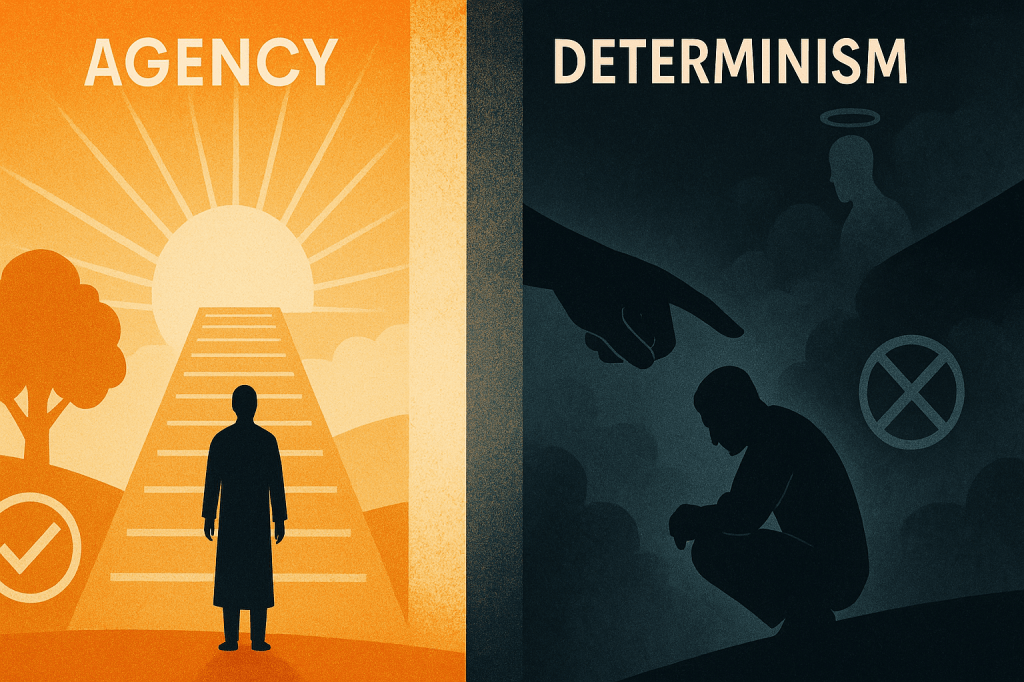
Human freedom and agency have long been debated in philosophy, science, and religion. Psychologists and neuroscientists study how much of our behavior is truly “free” versus determined by biology or environment. Physicists have discovered that space and time form a four-dimensional spacetime, and some theories (like string theory and M-theory) posit extra dimensions beyond human perception. In the worldview of Submission (as interpreted by Rashad Khalifa’s Final Testament), all power and knowledge belong to God – He is Omnipotent, owner of all sovereignty, and fully in control of every detail – yet humans are tested with choice. This article weaves together these perspectives to explore free will, determinism, and the idea that true freedom may lie in submitting to God’s will.
Psychological Perspectives on Free Will and Agency
In psychology and neuroscience, free will is often defined by three conditions:
- Ability to do otherwise – having more than one real option to choose.
- Control/agency – being the author of one’s actions without coercion.
- Reason-responsiveness – making choices for reasons (not by pure chance).
For example, if a person’s arm twitches involuntarily, they lack the ability to choose that movement, so it isn’t a “free” choice. Likewise, true agency requires that the decision-maker and the actor are the same person, and that actions are directed by one’s own motives, not outside forces. In this view, free will is tied to feeling responsible for our decisions. Indeed, legal and ethical systems assume people are generally “free” and accountable – if someone isn’t acting freely (say due to mental illness or force), they’re not blamed for those actions.
However, determinism – the idea that every event (including decisions) has prior causes – challenges this sense of freedom. Classical physics and neuroscience have shown that unconscious brain processes often precede conscious choices. Libet’s famous experiments found a brain readiness potential before people reported a decision. Libet interpreted this as limiting freedom, but later analyses suggest the measured signal might simply be random neural “noise,” not a hidden commander of our will.
Even so, most theorists agree that free will is hard to define and not absolute. People often act on impulse or habit, and the three ideal conditions above are rarely all met. Still, “the belief that usually people are free to act or not, and thus responsible for their actions” is deeply ingrained in ethics and law.
Physics of Spacetime and Higher Dimensions
Modern physics has revolutionized how we think about space, time, and reality. Einstein’s relativity treats time as a fourth dimension akin to spatial dimensions: an event in spacetime needs four coordinates (three for space, one for time). In this “block universe” view, all moments of time exist in a four-dimensional manifold – past, present, and future coexist in a geometric sense. This raises questions: if the future is “already there” in spacetime, do we truly have free choice, or is the cosmic history fixed?
Beyond four dimensions, string theory and M-theory hypothesize extra spatial dimensions. For example, superstring theory requires ten dimensions (nine of space plus one of time), and M-theory works in eleven. We do not perceive these extra dimensions because they are compactified or beyond our sensory capacity.
Physicist Michio Kaku uses the analogy of Flatland (a 2D world): a 3D being can perceive all of Flatland at once and manipulate objects there without entering it. Extending the analogy, a 4D being could see our entire 3D world in one glance, pluck people out of cells, or perform “surgery” by reaching into our bodies from outside our universe. In Kaku’s words, such higher-dimensional beings would have “powers similar to a god”: they could walk through walls, disappear and reappear, see through solid objects – in short, be omniscient and omnipotent.
M-theory also envisions our universe as one of many “branes” floating in a higher-dimensional “bulk.” Some speculative models even treat God metaphorically as a higher-dimensional presence – someone who can see and affect all points in space and time simultaneously. While physics does not address supernatural beings, these ideas highlight that our limited 3+1 dimensional view is not the only possible vantage point on reality.
Quranic Perspectives: Divine Omnipotence, Time, and Submission
The Quran (as translated by Rashad Khalifa) emphasizes that God is ultimate Reality. Many verses stress His all-powerful sovereignty and knowledge. For example:
[35:1] Praise be to GOD, Initiator of the heavens and the earth, and appointer of the angels to be messengers with wings… He is Omnipotent.
[5:120] To GOD belongs the sovereignty of the heavens and the earth, and everything in them, and He is Omnipotent.
The Quran also highlights God’s eternal nature beyond time:
[3:2] GOD: there is no god except He; the Living, the Eternal.
Human arguments and schemes mean little against His plan:
[39:36-37] Is GOD not sufficient for His servant? They frighten you with the idols they set up beside Him. Whomever GOD sends astray, nothing can guide him. And whomever GOD guides, nothing can send him astray.
Remarkably, while the Quran asserts God’s total sovereignty, it also teaches human moral responsibility. It repeats that those who act righteously will be recompensed, and those who disobey will face consequences:
[35:7] Those who disbelieve have incurred a severe retribution, and those who believe and lead a righteous life have deserved forgiveness and a great recompense.
The interplay is that God empowers us to choose, but He also enforces the outcomes:
[35:8] GOD thus sends astray whoever wills (to go astray), and He guides whoever wills (to be guided).
In Rashad Khalifa’s interpretation, submission to God is framed as the highest freedom. He explained in a lecture that the “highest form of freedom is declaring God is our master”. Likewise, the Quran itself equates true dignity and honor with recognizing God’s lordship:
[35:10] Anyone seeking dignity should know that to GOD belongs all dignity.
Integrating the Views: Time, Agency, and the Divine Perspective
When we put these threads together, a coherent picture emerges. Psychology tells us that humans feel like we have freedom (we experience agency) and bear responsibility for choices, even if many mental processes are unconscious. Physics suggests that time and space might be a fixed four-dimensional block or part of a larger multiverse, so that from a higher vantage (if such existed), all events could be “seen” at once. Analogously, the Quran portrays God as existing beyond our spacetime constraints: He knows the past, present, and future simultaneously and directs all events.
This raises the hard question: If God already knows and wills everything, do humans truly act freely? The Quranic answer is nuanced. On one hand, it asserts God’s complete knowledge and power:
[39:63] To Him belongs all sovereignty over the heavens and the earth. Those who disbelieve in GOD’s revelations are the real losers.
Nothing happens unless He wills it. On the other hand, it still instructs humans to choose good, obey God, and warns of consequences for disobedience. In effect, the Quranic view resembles a form of compatibilism: human choices are real and meaningful, but always within God’s overarching plan.
In practical terms, submission becomes the exercise of true agency. By submitting to God’s guidance, a person is said to regain the freedom that is otherwise usurped by ignorance, whims, or “false gods.” Surrendering one’s will to the Creator is seen not as slavery, but as liberation from lower dependencies. As Khalifa interpreted, abandoning one’s self-centered “lordship” in favor of God’s lordship is the highest freedom.
Conclusion
Modern thought and classical faith converge on this: humans operate with real (if limited) agency, but within a reality whose foundation is fixed by God. From psychology, we learn that free will may not be absolute, but we still navigate our choices and motives. From physics, we learn that a higher-dimensional or “block” view of time challenges our intuition of change and choice. And from the Quran, we learn that it is precisely through humbly submitting to the Omnipotent Creator that we exercise the fullest form of will – one aligned with the ultimate Truth of existence.
References
- Lavazza, A., & Inglese, S. (2015). Operationalizing and measuring (a kind of) free will (and responsibility). Towards a new framework for psychology, ethics, and law. Frontiers in Human Neuroscience, 9, 311. https://pmc.ncbi.nlm.nih.gov/articles/PMC4887467/
- Kaku, M. (n.d.). Hyperspace: A scientific odyssey. Retrieved from https://mkaku.org/home/articles/hyperspace-a-scientific-odyssey/
- Khalifa, R. (1992). Quran: The final testament (Authorized English version). Universal Unity.
- Khalifa, R. (n.d.). Quranic study sessions [Audio recordings]. Retrieved from https://submission.ws/listen-to-quranic-study-sessions-with-dr-rashad-khalifa/
- Khalifa, R. (n.d.). Quran: The Final Testament (Authorized English Version). Retrieved from https://www.masjidtucson.org/quran/

 Quran Only Studies
Leave a comment