
Are all food dedications forbidden in Submission? Many Submitters ponder whether foods—especially those “dedicated to other than God”—are always haram, or if the Quran’s dietary laws are more precise. This comprehensive article offers a deep Quranic analysis of the term uhilla, explores what constitutes true dedication, and clarifies the boundaries of lawful and unlawful foods. Drawing from linguistic sources, classical exegesis, and Rashad Khalifa’s translation (The Final Testament), we will clarify misconceptions about food prohibitions, intent, and idolatry. Whether you seek clarity for daily practice or scholarly understanding, this guide will help you uphold Submission dietary law in its true spirit.
- The Linguistic Meaning of Uhilla in the Quran
- The Mechanics of Dedication: Intent, Ownership, and Ritual
- Rashad Khalifa’s Perspective on Dietary Prohibitions
- Quranic Warnings Against Inventing Prohibitions
- Common Misconceptions: Can Plants or Fruits Be “Dedicated”?
- Conclusion: Upholding Quranic Dietary Law Without Excess or Neglect
- FAQ: Quranic Dietary Prohibitions Explained
The Linguistic Meaning of Uhilla in the Quran
What does “uhilla” actually mean? To answer this, we must delve into Arabic linguistics and how the term is used across the Quran.
The Root Meaning: H-L-L (ه ل ل)

- “Uhilla” is the passive form of the root h-l-l.
- Classically, it means “to raise one’s voice,” especially when invoking a name at the time of slaughter.
- The active form, “ahalla”, is linked to calling out a deity’s name during animal sacrifice.
(2:173) He only prohibits for you the eating of animals that die of themselves (without human interference), blood, the meat of pigs, and animals dedicated to other than God. If one is forced (to eat these), without being malicious or deliberate, he incurs no sin. God is Forgiver, Most Merciful.
In every occurrence—2:173, 5:3, 6:145, 16:115—the term refers specifically to meat from animals sacrificed by invoking a name other than God.
Usage in Other Contexts
- The root appears elsewhere in the Quran (e.g., 2:189 for new moons), underscoring its meaning as “raising a call.” In food law, this refers to naming another deity at slaughter.
- No classical usage extends uhilla to fruits or plants—only sacrificial animals.
6:145 Say, “I do not find in the revelations given to me any food that is prohibited for any eater except: (1) carrion, (2) running blood, (3) the meat* of pigs, for it is contaminated, and (4) the meat of animals blasphemously dedicated to other than God.” If one is forced (to eat these), without being deliberate or malicious, then your Lord is Forgiver, Most Merciful.
The Mechanics of Dedication: Intent, Ownership, and Ritual in Quranic Law

Understanding how food becomes forbidden through dedication requires examining the practical mechanics described in both the Quran and hadith literature.
Key Elements Required for Forbidden Dedication:
- Intent: The person performing the sacrifice must intend to dedicate the animal to another deity.
- Ownership/Agency: Only the owner/officiant can dedicate; someone else cannot make your food haram by uttering words after preparation.
- Ritual Action: The critical moment is during slaughter—invoking another name makes the meat forbidden.
5:3 Prohibited for you are animals that die of themselves, blood, the meat of pigs,* and animals dedicated to other than God. (Animals that die of themselves include those) strangled, struck with an object, fallen from a height, gored, attacked by a wild animal—unless you save your animal before it dies—and animals sacrificed on altars. Also prohibited is dividing the meat through a game of chance; this is an abomination. Today, the disbelievers have given up concerning (the eradication of) your religion; do not fear them and fear Me instead. Today, I have completed your religion, perfected My blessing upon you, and I have decreed Submission as the religion for you. If one is forced by famine (to eat prohibited food), without being deliberately sinful, then God is Forgiver, Merciful.
- The prohibition targets intentional acts during slaughter.
- If an animal is killed without invoking God’s name by mistake (not intent), it does not automatically become haram.
- Dedicating non-meat foods or simply pronouncing a saint’s name over cooked food does not meet Quranic criteria for haram status.
No after-the-fact verbal claim or ritual can retroactively render lawful food unlawful according to Quranic rules.
Rashad Khalifa’s Perspective on Dietary Prohibitions in The Final Testament
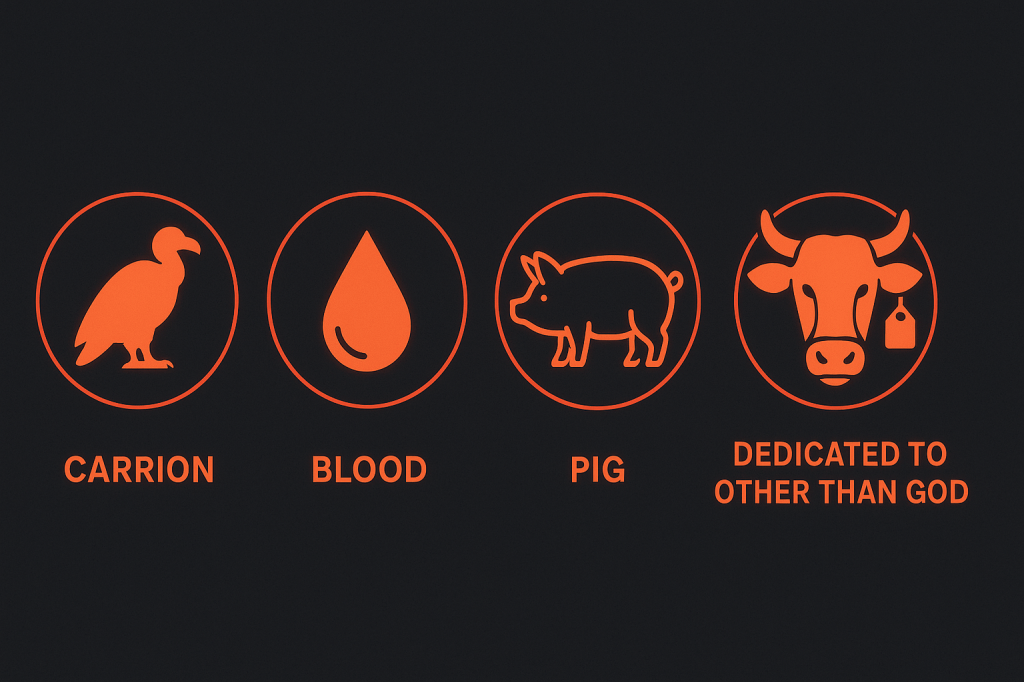
Rashad Khalifa’s translation (The Final Testament) and commentaries offer a modern yet strictly textualist approach—insisting that only four categories are prohibited:
- Carrion (dead animals)
- Blood
- Pork products
- Animal dedicated to other than God (“uhilla li-ghayrillah”)
(16:115) He only prohibits for you dead animals, blood, the meat of pigs,* and food which is dedicated to other than God. If one is forced (to eat these), without being deliberate or malicious, then God is Forgiver, Most Merciful.
Main Points:
Khalifa defines “dedicated” as actual sacrificial offering—never as a casual blessing over regular food.
At 1:18:40 Rashad says:
“Prohibition of items that are not prohibited by God, is idol worship (1:19:53) God said there are four meats prohibited. (1:19:57) Four, animals that of themselves without human interference, running blood, animals dedicated to others than God. (1:20:05) These are the four. (1:20:07) So, but they have a list of other foods. (1:20:13) You cannot buy milk with vitamin D3 added in. (1:20:16) How did they get this D3 thing?
- No extra bans are allowed; inventing new prohibitions amounts to “fabricating lies against God.” (see 16:116 below)
- If God’s name was not mentioned at slaughter out of forgetfulness—not idolatrous intent—the meat remains lawful (see his footnotes on 6:121).
- The food of People of the Book (Jews/Christians) is lawful unless explicitly dedicated to something else (5:5).
(16:116) You shall not utter lies with your own tongues stating: “This is lawful, and this is unlawful,” to fabricate lies and attribute them to God. Surely, those who fabricate lies and attribute them to God will never succeed.
Quranic Warnings Against Inventing Food Prohibitions – The Danger of Idolatry

The Quran delivers explicit warnings about inventing new religious laws—including unauthorized prohibitions on food:
(6:119) Why should you not eat from that upon which God’s name has been mentioned? He has detailed for you what is prohibited for you, unless you are forced. Indeed, many people mislead others with their personal opinions, without knowledge. Your Lord is fully aware of the transgressors.: “He has detailed for you what is prohibited for you … many people mislead others with their personal opinions.”
Only God details prohibitions; adding more misleads others.
(6:121) Do not eat from that upon which the name of God has not been mentioned, for it is an abomination. The devils inspire their allies to argue with you; if you obey them, you will be idol worshipers.
(42:21)They follow idols who decree for them religious laws never authorized by God. If it were not for the predetermined decision, they would have been judged immediately. Indeed, the transgressors have incurred a painful retribution.
(7:32-33) “Say: Who prohibited the nice things God has created… My Lord prohibits only evil deeds…and saying about God what you do not know.”
Saying something is haram without divine sanction is condemned as ignorance or worse.
(5:87-88): Do not prohibit good things made lawful by God; eat from His provisions.
Declaring a lawful item forbidden violates this direct command.
Bottom line:
- If someone claims that fruit or vegetables “dedicated” to saints are haram by God’s law—they are fabricating rules outside divine authority. This act itself falls under idol-worship as defined by multiple verses above.
- You may personally avoid such food out of caution—but cannot declare it religiously forbidden in God’s name without clear Quranic basis
Common Misconceptions Addressed:
Can Plants or Fruits Ever Be “Dedicated” According to the Quran?

A recurring argument suggests that since some English translations use “dedicated,” perhaps even fruits or plants could be made haram if offered in another’s name. However:
Linguistic Clarification:
- The Arabic word for hunting (fa-ṣṭādū – فَٱصْطَادُوا۟ ) applies exclusively to animals—not plants. Classical dictionaries confirm this restriction.
- No classical or scriptural evidence supports applying “uhilla” (ritual dedication) to fruits or plants. Terms used for harvesting plants are distinct (e.g., حصد – haṣada).
The Four Explicit Bans Are Fixed:
- Carrion (dead animals)
- Blood
- Pork products
- An animal sacrificed invoking a name other than God(“ma uhilla li-ghayrillah”) – see 2:173; 5:3; 6:145; 16:115
No mention exists regarding fruits/vegetables being similarly forbidden.
(16:115-116): “…and food dedicated to other than God … Do not utter lies with your tongues saying ‘This is lawful and this is unlawful,’ fabricating lies against God.”
Inventing any further ban—such as forbidding fruit “dedicated” outside God’s law—is condemned as fabrication and potentially idolatry.
Conclusion:
Upholding Quranic Dietary Law Without Excess or Neglect

The central teachings of the Quran on food law are clear—and limited in scope:
- The term “uhilla li-ghayrillah” refers specifically to meat from an animal sacrificed with explicit dedication (by word or ritual) to anyone besides Allah.
- This prohibition arises only when intent and ritual action coincide at slaughter; a mere utterance over finished food does not qualify.
- No classical source nor Quranic evidence supports extending these bans to fruits or vegetables—despite some cultural practices suggesting otherwise.
- Addition of any further prohibition—such as declaring fruit “dedicated” as haram—is warned against repeatedly in scripture as a form of idolatry (shirk/idol-worship – see verses above like 6:121; 16:116; 42:21).
As Submitters seeking truth:
- Avoid only what God has clearly forbidden—and do so out of worshipful obedience.
- Do not fall into excess by adding new bans—lest you commit exactly what Quran warns against (false attribution/idolatry).
- Enjoy all good things He provides—and mention His Name before eating (see also our article on remembering God before meals!)
FAQ:
Quranic Dietary Prohibitions Explained
What foods are explicitly prohibited by the Quran?
The Quran explicitly prohibits four types of foods:
1) Carrion (dead animals),
2) Blood,
3) Pork,
4) Animals sacrificed in someone else’s name.
See verses 2:173; 5:3; 6:145; 16:115.
If someone dedicates fruit or vegetables to an idol or saint, does it become haram?
No. The Arabic term “uhilla” refers strictly to animal sacrifice rituals—not plant foods. Declaring such produce haram invents a new rule outside God’s law—which the Quran condemns as a form of idolatry.
If I forget to mention God’s name at slaughter/eating—is my food now forbidden?
Forgetting God’s name out of error does not render meat unlawful unless there was intention to dedicate it elsewhere. Rashad Khalifa notes forgetting alone does not create new prohibitions.
What happens if someone invents extra food bans beyond what’s stated in the Quran?
The Quran warns that making up new prohibitions equals lying about God
(16:116) You shall not utter lies with your own tongues stating: “This is lawful, and this is unlawful,” to fabricate lies and attribute them to God. Surely, those who fabricate lies and attribute them to God will never succeed.
Following devilish suggestions
(6:121) Do not eat from that upon which the name of God has not been mentioned, for it is an abomination. The devils inspire their allies to argue with you; if you obey them, you will be idol worshipers.*
and committing idol-worship/shirk
(42:21) They follow idols who decree for them religious laws never authorized by God. If it were not for the predetermined decision, they would have been judged immediately. Indeed, the transgressors have incurred a painful retribution.*
Is eating food prepared by non-Submitters allowed?
Yes—as long as it doesn’t fall under one of four explicit bans. The food of Jews and Christians is permitted
(5:5) Today, all good food is made lawful for you. The food of the people of the scripture is lawful for you. Also, you may marry the chaste women among the believers, as well as the chaste women among the followers of previous scripture, provided you pay them their due dowries. You shall maintain chastity, not committing adultery, nor taking secret lovers. Anyone who rejects faith, all his work will be in vain, and in the Hereafter he will be with the losers.
provided it was not dedicated via sacrifice to other than God.

 Quran Only Studies
Leave a comment