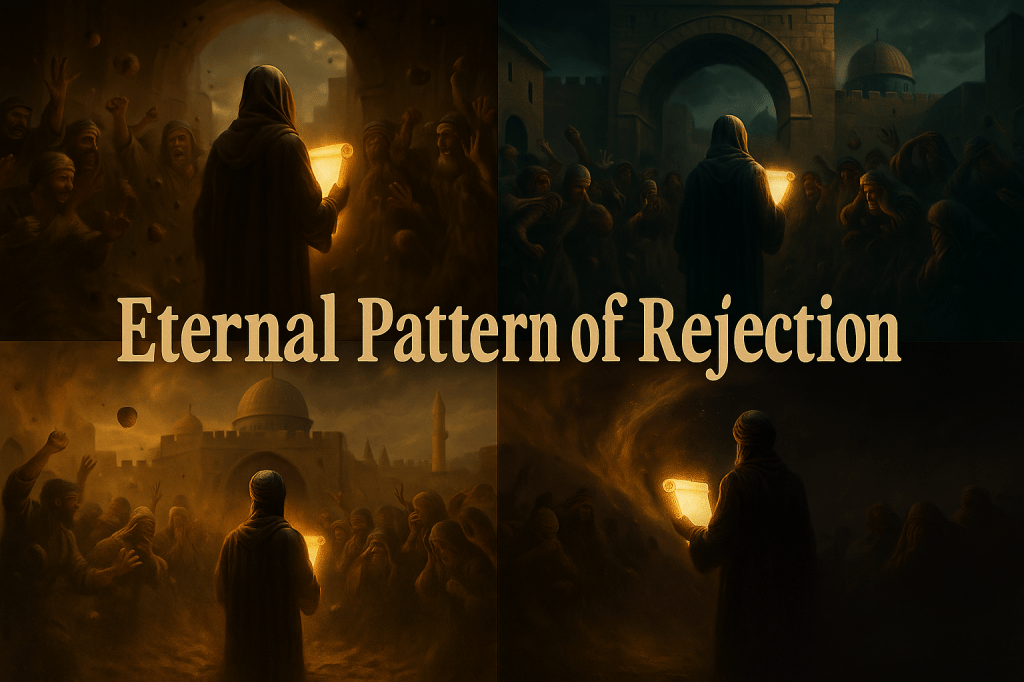
Throughout human history, a consistent pattern emerges with unwavering regularity: God sends a messenger (rasul) to guide humanity back to the straight path, and the people respond with mockery, rejection, and persecution. This is not an occasional occurrence or isolated incident – it is the universal human response to divine guidance. The Quran documents this pattern extensively, revealing that every single messenger faced the same accusations, the same resistance, and the same violent opposition from their communities.
This comprehensive analysis examines the Quranic evidence of how messengers have been repeatedly rejected, their sole duty to deliver the message, and the three unchanging criteria that define a true messenger of God. Understanding this pattern is crucial for recognizing truth in our own time and avoiding the mistakes of previous generations.
Part 1: The Unchanging Pattern – Every Messenger Faces Rejection
The Universal Declaration
The Quran makes an astonishing declaration about the consistency of human rejection:
[51:52] “Consistently, when a messenger went to the previous generations, they said, ‘Magician,’ or, ‘Crazy.’”
This verse reveals that EVERY messenger throughout history faced identical accusations. The Arabic “مَا أَتَى” (ma ata) means “never came” – indicating there was never an exception to this rule. Every single messenger was labeled either a magician (deceiver) or insane. This pattern is so consistent that God asks:
[51:53] “Did they make an agreement with each other? Indeed, they are transgressors.”
The rhetorical question highlights the absurdity – how could people across different times, places, and cultures all respond identically unless this rejection is embedded in human nature itself?
The Sequential Pattern of Destruction
[23:44] “Then we sent our messengers in succession. Every time a messenger went to his community, they disbelieved him. Consequently, we annihilated them, one after the other, and made them history. The people who disbelieved have perished.”
This verse establishes the tragic cycle: messenger sent → community rejects → community destroyed → becomes a historical lesson. The Arabic “تَتْرَا” (tatra) means “in succession, one after another,” emphasizing the repetitive nature of this pattern throughout history.
Mockery as the Standard Response
[36:30] “How sorry is the people’s condition! Every time a messenger went to them, they always ridiculed him.”
The phrase “يَا حَسْرَةً عَلَى الْعِبَادِ” (ya hasratan ‘ala al-‘ibad) expresses divine sorrow over humanity’s consistent failure. The verb “يَسْتَهْزِئُونَ” (yastahzi’un) means “they mock, ridicule, make fun of” – this was not mere disagreement but active mockery and humiliation of God’s messengers.
[6:10] “Messengers before you have been ridiculed. It is those who mocked them who suffered the consequences of their ridiculing.”
[13:32] “Messengers before you have been ridiculed; I permitted the disbelievers to carry on, then I punished them. How terrible was My retribution!”
Part 2: Historical Examples – The Consistent Pattern Across Time
Noah – 950 Years of Rejection
[29:14] “We sent Noah to his people, and he stayed with them one thousand years, less fifty. Subsequently, they incurred the flood because of their transgressions.”
Noah’s story represents the extreme of human stubbornness. Despite 950 years of patient preaching, his people remained obstinate:
[71:5-7] “He said, ‘My Lord, I have invited my people night and day. But my invitation only increased their aversion. Whenever I invited them to be forgiven by You, they placed their fingers in their ears, covered themselves with their clothes, insisted, and turned arrogant.’”
Moses – Rejection Despite Clear Miracles
[10:75] “Then we sent after them Moses and Aaron to Pharaoh and his group, with our proofs. But they turned arrogant; they were transgressing people.”
Despite witnessing nine profound miracles, Pharaoh and his people rejected Moses:
[7:132] “They said, ‘No matter what kind of sign you show us, to dupe us with your magic, we will not believe.’”
Jesus – Rejection by His Own People
[61:6] “Recall that Jesus, son of Mary, said, ‘O Children of Israel, I am God’s messenger to you, confirming the Torah and bringing good news of a messenger to come after me whose name will be Ahmad (most praised).’ Then, when he showed them the clear proofs, they said, ‘This is profound magic.’”
Even with the ability to heal the sick and raise the dead by God’s leave, Jesus faced rejection:
[5:110] “…I restrained the Children of Israel from harming you when you came to them with the clear proofs, and those who disbelieved among them said, ‘This is nothing but obvious magic.’”
Muhammad – Called Crazy, Magician, and Liar
[15:6] “They said, ‘O you who received this reminder, you are crazy.’”
[38:4] “They wondered that a warner should come to them, from among them. The disbelievers said, ‘A magician, a liar.’”
Rashad Khalifa – The Contemporary Example
In The Great Debate (December 1988), Rashad Khalifa explicitly addressed this pattern:
“Did they make an agreement with each other? Indeed they are transgressors. Every messenger we sent is always ridiculed by the people. This is a human trait. We are more comfortable with our little idols. We don’t want to exert any effort. We like things done on our behalf… By definition, a messenger brings something new. And he advocates the worship of God alone. And people do not want that. They want to hang on to their superstitions and traditions.”
Part 3: The Sole Duty of Messengers – Delivering the Message
Clear Delivery: The Only Responsibility
The Quran repeatedly emphasizes that messengers have one primary duty:
[5:99] “The sole duty of the messenger is to deliver the message, and God knows everything you declare and everything you conceal.”
[24:54] “Say: ‘Obey God, and obey the messenger.’ If they refuse, then he is responsible for his obligations, and you are responsible for your obligations. If you obey him, you will be guided. The sole duty of the messenger is to deliver (the message).”
The phrase “الْبَلَاغُ الْمُبِينُ” (al-balagh al-mubin) means “the clear delivery/conveyance.” Messengers are not responsible for:
- Converting people
- Forcing belief
- Performing miracles on demand
- Guaranteeing acceptance
No Control Over Guidance
[28:56] “You cannot guide the ones you love. God is the only One who guides in accordance with His will, and in accordance with His knowledge of those who deserve the guidance.”
This verse, revealed about Prophet Muhammad’s uncle Abu Talib, demonstrates that even messengers cannot guide those they love most. Their duty is delivery, not conversion.
Warning and Good News
[4:165] “Messengers to deliver good news, as well as warnings. Thus, the people will have no excuse when they face God, after all these messengers have come to them. God is Almighty, Most Wise.”
Messengers serve as “مُبَشِّرِينَ وَمُنذِرِينَ” (mubashshirin wa mundhirin) – bearers of good news and warners. They eliminate any excuse people might have on the Day of Judgment.
Part 4: The Three Criteria of God’s Messengers
The Quran establishes three unchanging criteria that distinguish true messengers from false claimants. These criteria are consistent across all messengers throughout history.
Criterion 1: Worship God Alone
Every messenger’s primary message is monotheism:
[21:25] “We did not send any messenger before you except with the inspiration: ‘There is no god except Me; you shall worship Me alone.’”
[16:36] “We have sent a messenger to every community, saying, ‘You shall worship God, and avoid idolatry.’ Subsequently, some were guided by God, while others were committed to straying.”
This is the fundamental message that never changes. Whether Noah, Abraham, Moses, Jesus, Muhammad, or Rashad Khalifa – the core message remains: “لَا إِلَٰهَ إِلَّا أَنَا فَاعْبُدُونِ” (There is no god except Me, so worship Me).
Criterion 2: Ask for No Wage
True messengers never seek personal benefit:
[36:21] “Follow those who do not ask you for any wage, and are guided.”
This criterion is repeated for every messenger mentioned in the Quran:
Noah:
[10:72] “If you turn away, then I have not asked you for any wage. My wage comes from God. I have been commanded to be a submitter.”
Hud:
[11:51] “O my people, I do not ask you for any wage. My wage comes only from the One who initiated me. Do you not understand?”
Saleh, Lot, and Shu’aib: Each declares in Sura 26:
[26:109, 127, 145, 164, 180] “I do not ask you for any wage; my wage comes only from the Lord of the universe.”
Muhammad:
[6:90] “These are the ones guided by God; you shall be guided in their footsteps. Say, ‘I do not ask you for any wage. This is but a message for all the people.’”
Criterion 3: Bring Divine Proof
Every messenger comes with clear evidence from God:
[57:25] “We sent our messengers supported by clear proofs, and we sent down to them the scripture and the law, that the people may uphold justice.”
The proofs vary according to the time and people:
- Noah: Warning of the flood
- Moses: Nine miracles including the staff and parting the sea
- Jesus: Healing and reviving the dead by God’s leave
- Muhammad: The Quran itself
- Rashad Khalifa: The mathematical miracle of the Quran
As Rashad Khalifa explained in Essentials of Submission (Video 15):
“The Quran teaches us that the proof is the most important thing. The messenger himself says ‘Don’t believe me because I am a good man, don’t believe me because I lead a righteous life… Believe me because I show you solid proof from God.’”
Part 5: The Psychology of Rejection – Why Humans Resist Divine Guidance
Fear of Change
[43:23] “Invariably, when we sent a warner to any community, the leaders of that community would say, ‘We found our parents following certain practices, and we will continue in their footsteps.’”
The phrase “إِنَّا وَجَدْنَا آبَاءَنَا عَلَىٰ أُمَّةٍ” (We found our fathers upon a way) reveals humanity’s attachment to tradition. People reject messengers because accepting them means abandoning inherited beliefs.
Pride and Arrogance
[23:24] “The leaders who disbelieved among his people said, ‘This is no more than a human being like you, who wants to gain prominence among you. Had God willed, He could have sent down angels. We have never heard of anything like this from our ancestors.’”
Leaders especially resist messengers because accepting them means acknowledging someone else’s spiritual authority. Their ego cannot accept that another human being could have access to divine revelation.
Comfort with Idol Worship
As Rashad Khalifa observed: “We are more comfortable with our little idols. We don’t want to exert any effort. We like things done on our behalf.” People prefer intermediaries because direct responsibility to God requires:
- Personal accountability
- Abandoning superstitions
- Giving up religious leaders as intermediaries
- Direct connection with God
Part 6: The Consequences of Rejection
Historical Destruction
[17:17] “Many a generation have we annihilated after Noah. Your Lord suffices as the Knower and the Seer of His servants’ sins.”
The Quran documents numerous civilizations destroyed for rejecting messengers:
- ‘Ad (People of Hud) – Destroyed by a violent wind
- Thamoud (People of Saleh) – Destroyed by the quake
- People of Lot – Destroyed by a storm of rocks
- People of Shu’aib – Destroyed by the quake
- Pharaoh and his troops – Drowned in the sea
Spiritual Death Before Physical Death
[6:122] “Is one who was dead and we granted him life, and provided him with light that enables him to move among the people, equal to one in total darkness from which he can never exit? The works of the disbelievers are thus adorned in their eyes.”
Rejecting messengers leads to spiritual death – living in darkness while thinking one is enlightened. This is the greatest tragedy: being spiritually dead while physically alive.
Part 7: Lessons for Our Time
The Pattern Continues
The rejection of Rashad Khalifa, the Messenger of the Covenant, follows the exact same pattern documented throughout the Quran:
- Called crazy and deluded
- Accused of fabricating the mathematical miracle
- Rejected by religious leaders protecting their authority
- Assassinated for preaching worship of God alone
His message fulfilled all three criteria:
- Worship God alone – Exposed and removed idol worship
- Asked for no wage – Never sought personal benefit
- Brought divine proof – The mathematical miracle of the Quran
Breaking the Cycle
To avoid repeating history’s mistakes:
- Examine the Evidence: Focus on the proof, not personality or tradition
- Apply the Criteria: Does the message advocate God alone? Is there personal gain? Is there divine proof?
- Overcome Ego: Accept truth regardless of its source
- Question Traditions: Just because “our fathers did it” doesn’t make it right
- Seek Direct Connection: Remove intermediaries between you and God
Part 8: The Tragic Irony – Honoring Dead Messengers While Rejecting Living Ones
[2:87] “We gave Moses the scripture, and subsequent to him we sent other messengers, and we gave Jesus, son of Mary, profound miracles and supported him with the Holy Spirit. Is it not a fact that every time a messenger went to you with anything you disliked, your ego caused you to be arrogant? Some of them you rejected, and some of them you killed.”
Perhaps the greatest irony in human religious behavior is how communities honor and revere messengers after their death while having rejected, persecuted, or killed them during their lifetime. Today:
- Christians worship Jesus – but his contemporaries crucified him
- Muslims revere Muhammad – but the Meccans drove him out
- Jews honor Moses – but the Israelites constantly rebelled against him
[5:70] “We have taken a covenant from the Children of Israel, and we sent to them messengers. Whenever a messenger went to them with anything they disliked, some of them they rejected, and some they killed.”
Conclusion: The Test That Never Changes
The pattern is clear, consistent, and undeniable: God sends messengers to guide humanity back to His path, and humanity responds with rejection, mockery, and violence. This is not ancient history – it is a living test that each generation faces. The messengers change, the languages change, the cultures change, but the test remains the same:
Will you recognize and accept God’s messenger when he comes to you?
The Quran’s extensive documentation of this pattern serves as both a warning and a guide. By understanding how previous generations failed, we can recognize the test when it comes to us. The three criteria remain constant – worship God alone, ask for no wage, bring divine proof. The duty of messengers never changes – deliver the message clearly. The human response rarely changes – rejection, mockery, persecution.
The question for every reader is simple yet profound: When faced with God’s truth delivered by His messenger, will you be among the few who accept, or among the majority who reject? Will you examine the evidence objectively, or will you follow your fathers’ footsteps? Will you overcome your ego and traditions, or will you become another tragic example in the eternal pattern of rejection?
[6:116] “If you obey the majority of people on earth, they will divert you from the path of God. They follow only conjecture; they only guess.”
The choice, as always, is yours. History has already shown us the consequences of both paths. The question is: which side of history will you choose?



 Quran Only Studies
Leave a comment