
Introduction: The Ultimate Test of Omnipotence
In the vast expanse of creation, from the smallest subatomic particle to the grandest galactic cluster, everything submits to God’s will without question. Stars burn at His command, planets orbit in perfect precision, and natural laws operate with unwavering consistency. Yet within this deterministic universe exists the most profound paradox: creatures who can choose to reject their Creator. This is not a flaw in the divine plan—it is the ultimate demonstration of God’s omnipotence.
The Quran reveals a stunning truth that philosophers have grappled with for millennia: true omnipotence isn’t just the ability to control everything, but the power to create beings capable of genuine choice, even the choice to reject the Omnipotent Himself. This comprehensive analysis will explore how free will and divine omniscience coexist as complementary attributes of God’s infinite power, not contradictory concepts as limited human logic might suggest.
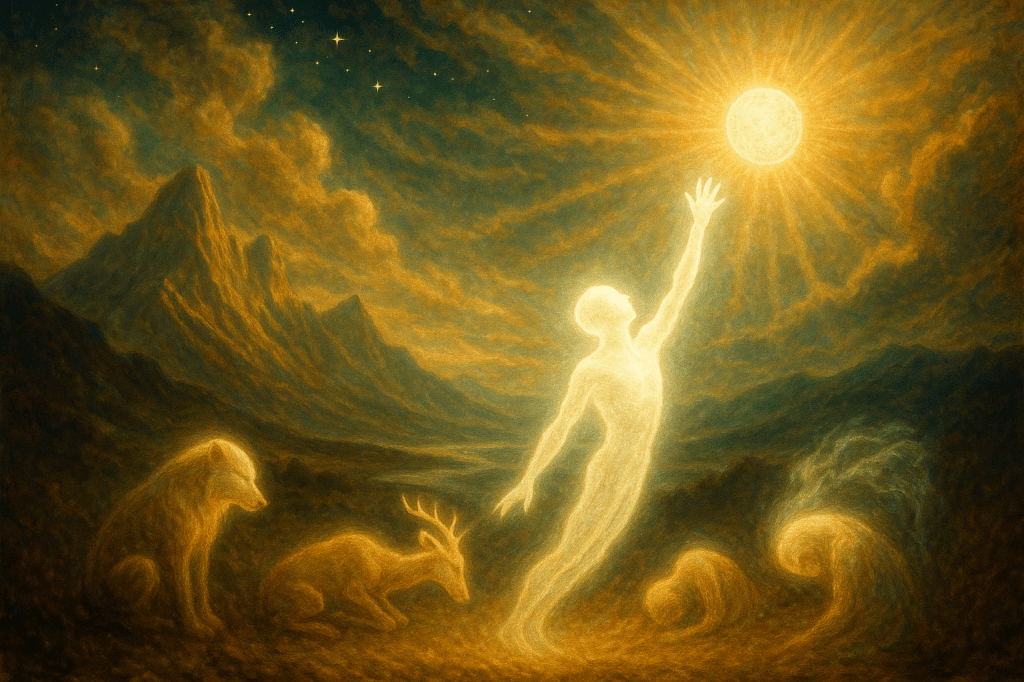
Part 1: The Cosmic Offer – When Mountains Said No
The Day Everything Was Given a Choice
Before time began its march, before the first atom formed, God made an unprecedented offer to all of creation:
[33:72] “We have offered the responsibility (freedom of choice) to the heavens and the earth, and the mountains, but they refused to bear it, and were afraid of it. But the human being accepted it; he was transgressing, ignorant.”
This verse reveals a cosmic moment when everything in existence was offered the gift—and burden—of free will. The heavens, in their vast majesty, declined. The earth, with all its might, refused. Even the mountains, symbols of strength and stability, were afraid to accept this responsibility. Why? Because they understood the weight of what was being offered: the ability to choose meant the possibility of choosing wrongly.
The animals, stars, planets, and all other creations chose the path of absolute submission. They would exist in perfect harmony with God’s will, never deviating, never questioning, never failing. Their submission would be complete but not chosen—programmed rather than preferred.
But the human being, in what the Quran calls transgression and ignorance, accepted this terrifying gift. We chose choice itself.
Part 2: The Nature of Divine Omniscience
God Knows, But We Still Choose
The human mind struggles with this concept: If God knows everything that will happen, how can our choices be free? The Quran provides a profound answer:
[57:22] “Anything that happens on earth, or to you, has already been recorded, even before the creation. This is easy for God to do.”
The footnote to this verse offers a striking analogy: “The video tape of your life, from birth to death, is already recorded.” But this recording doesn’t negate free will—it confirms it. God’s omniscience means He knows what we will freely choose, not that He forces our choices.
Consider this: A master chess player might know exactly how a novice will respond to certain moves. This knowledge doesn’t force the novice’s hand—they still make their own decisions. Now magnify this infinitely: God’s perfect knowledge encompasses all possible choices and their outcomes, yet each choice remains genuinely free at the moment of decision.

The Swimlanes of Divine Attributes
God’s attributes operate in perfect harmony, like parallel swimlanes in an infinite pool:
- Omniscience Lane: God knows all—past, present, future, and all possible variations
- Omnipotence Lane: God has power over all things and can intervene at will
- Justice Lane: God judges fairly based on free choices made
- Mercy Lane: God provides guidance and forgiveness for those who seek it
- Wisdom Lane: God allows free will to manifest for the ultimate good
These attributes don’t contradict—they complement. God’s omniscience doesn’t override His justice because He judges us on choices we freely make. His omnipotence doesn’t negate His mercy because He chooses to allow us space to choose, repent, and grow.

Part 3: The Mathematical Precision of Free Will
When Omnipotence Meets Choice
The Quran presents a mathematical truth about free will and divine power:
[10:99] “Had your Lord willed, all the people on earth would have believed. Do you want to force the people to become believers?”
This verse reveals the ultimate proof of God’s omnipotence: He could force universal belief, but He doesn’t. Why? Because forced belief isn’t belief at all—it’s programming. The very existence of disbelievers proves God’s power, not disproves it. Only an omnipotent God could create beings capable of rejecting Him.
Think of it mathematically:
- If God couldn’t create free will → He wouldn’t be omnipotent
- If God didn’t know our choices → He wouldn’t be omniscient
- If God forced all choices → There would be no justice
- If God prevented all evil → There would be no test
The equation balances perfectly: Omnipotence + Omniscience + Justice = Free Will + Accountability
Part 4: The Profound Truth of “God Does Everything”
Divine Action and Human Responsibility
One of the most challenging concepts in the Quran is expressed in:
[8:17] “It is not you who killed them; God is the One who killed them. It is not you who threw when you threw; God is the One who threw. But He thus gives the believers a chance to earn a great recompense.”
The footnote explains: “Believing in God necessitates believing in His qualities, one of which is that He is doing everything.” This doesn’t absolve human responsibility—it deepens it. We are responsible for our intentions and choices, while God is the executor of all actions.
Consider the profound example in the footnote to 4:78: “God created the fire to serve us, but you can decide to put your finger in it. We thus hurt ourselves. It is God’s law that if you put your finger in the fire, it will hurt.”
This perfectly illustrates the relationship:
- God creates the laws of nature (fire burns)
- Humans make choices (to touch or not touch fire)
- God executes the consequences (the burning occurs)
- Humans bear responsibility (for choosing to touch fire)

Part 5: The Incomprehensible Greatness of God
Why Our Minds Cannot Fully Grasp Him
The Quran makes it clear that our limited minds cannot fully comprehend God’s greatness:
[39:67] “They can never fathom the greatness of God. The whole earth is within His fist on the Day of Resurrection. In fact, the universes are folded within His right hand.”
The footnote adds perspective: “Our universe, with its billion galaxies, a billion trillion stars, uncountable decillions of heavenly bodies, spanning many billions of light-years, is the smallest and innermost of seven universes. This incomprehensible vastness of the seven universes is within God’s hand.”
If we cannot even comprehend the physical universe, how can we fully understand how free will and omniscience coexist? Yet God gives us enough understanding to make informed choices:
[2:255] “He knows their past, and their future. No one attains any knowledge, except as He wills.”
We are given sufficient knowledge to understand our responsibility, but not enough to comprehend the full mechanics of divine operation. This itself is mercy—full knowledge would overwhelm our limited capacity.
Part 6: The Purpose of the Test
Why an Omniscient God Tests Those Whose Results He Already Knows
Critics might ask: If God already knows everything, why test us? The answer reveals profound wisdom:
- Justice Requires Evidence: On Judgment Day, no soul can claim they weren’t given a fair chance. The test provides undeniable evidence of our choices.
- Growth Through Choice: The test isn’t for God’s knowledge—it’s for our development. Through making choices, we grow, learn, and develop our souls.
- Earning Our Destiny: God could create us directly in Heaven or Hell, but then our fate wouldn’t be earned. The test allows us to earn our eternal position through our own choices.
- Demonstrating God’s Attributes: Through the test, God’s mercy, justice, wisdom, and patience are demonstrated in ways that wouldn’t be possible without free will.
As the footnote to 57:22 states: “We are absolutely free to side with God, or with Satan.” This freedom is real, even though God knows what we will choose.
Part 7: The Ontological Reality of Good and Evil
Why Bad Things Come From Our Own Doing
The Quran establishes a fundamental principle about the source of good and evil:
[4:78] “Anything good that happens to you is from God, and anything bad that happens to you is from you.”
This isn’t a contradiction to God’s omnipotence—it’s a confirmation of it. God created a universe where:
- All good emanates from Him (light, guidance, blessings)
- Evil is the absence of good (darkness is absence of light)
- Bad consequences result from our choice to turn away from good
- We have the free will to choose between good and its absence
This ontological framework explains why:
- God doesn’t create evil—evil is choosing to reject God’s good
- Suffering exists—it’s the natural consequence of wrong choices
- Repentance works—it’s choosing to return to the source of good
- Hell exists—it’s the ultimate state of choosing separation from God
Part 8: The Perfect Balance of Freedom and Consequence
Natural Laws as Divine Boundaries
God sets limits and boundaries through natural and spiritual laws. These aren’t arbitrary restrictions but loving guidelines:
[2:256] “There shall be no compulsion in religion: the right way is now distinct from the wrong way.”
This verse embodies the perfect balance:
- Freedom: “No compulsion”—genuine choice must exist
- Clarity: “Right way is distinct”—we’re not left guessing
- Consequence: Implied in the distinction—choices matter
Every law of nature and divine command serves this balance. Just as gravity ensures physical order while allowing movement, divine laws ensure spiritual order while preserving free will.
Part 9: The Scientific Marvel of Consciousness and Choice
Quantum Mechanics and Free Will
Modern science offers fascinating parallels to Quranic truth. Quantum mechanics reveals that at the subatomic level, particles exist in states of probability until observed. The act of observation collapses the wave function, determining the outcome. Similarly:
- Our choices exist in probability until we make them
- God observes all probabilities simultaneously (omniscience)
- We collapse our own wave function through choice (free will)
- The outcome becomes fixed in spacetime (divine recording)
This isn’t mere analogy—it suggests the universe itself is structured to support free will at the most fundamental level. An omnipotent God created quantum uncertainty to ensure genuine choice could exist within a lawful universe.
Neuroscience and the Soul
While neuroscience can trace the chemical processes of decision-making, it cannot locate the “decider.” This gap points to the soul—the divine breath that animates our physical form and enables true choice. The brain is the instrument; the soul is the musician.
Part 10: The Redemptive Power of Recognition
When Humans Realize Their Error
The Quran shows that recognizing our error in accepting free will can lead to redemption:
[7:23] “They said, ‘Our Lord, we have wronged our souls, and unless You forgive us and have mercy on us, we will be losers.’”
Adam and Eve’s response after their mistake becomes the template for human redemption. We accepted free will in “transgression and ignorance,” but through that very free will, we can choose to return to God. The circle completes itself: the gift that allowed us to fall also enables us to rise.
This is the ultimate expression of God’s omnipotence—creating beings who can reject Him but also return to Him by choice, making their love and submission infinitely more valuable than programmed obedience.
Part 11: The Practical Implications
Living with Free Will Under Omnipotent Governance
Understanding this relationship between free will and divine omnipotence should transform how we live:
- Responsibility: We cannot blame fate for our choices. While God knows what we’ll choose, we are the ones choosing.
- Hope: No matter our past, we always have the freedom to choose differently. Predestination doesn’t mean predetermination of our choices.
- Humility: Recognizing we cannot fully understand God’s greatness while accepting our role in the cosmic test.
- Purpose: Every choice matters because it’s recorded and has eternal consequences.
- Trust: God’s omniscience means nothing surprises Him. He has already provided for every possible choice we might make.
The Daily Exercise of Free Will
Every day presents countless choices:
- Will we pray or neglect our spiritual duties?
- Will we speak truth or falsehood?
- Will we help others or focus only on ourselves?
- Will we seek knowledge or remain in ignorance?
- Will we repent for mistakes or persist in error?
Each choice is simultaneously free (from our perspective) and known (from God’s perspective). This isn’t a contradiction—it’s the miraculous nature of existing within God’s creation while possessing genuine agency.
Part 12: The Ultimate Demonstration of Power
Why Free Will Proves God’s Omnipotence
Consider what greater power could exist than this: creating beings who can say “no” to their Creator. Any earthly ruler can compel obedience through force. Only an omnipotent God can create genuine choice. This reveals several truths:
- Confidence: Only a God certain of His ultimate victory would allow rebellion
- Love: Only a God of love would want chosen relationship over forced submission
- Power: Only an omnipotent God could sustain rebels against Himself
- Wisdom: Only an omniscient God could manage infinite free choices toward ultimate good
- Justice: Only a perfect God could fairly judge freely made choices
Satan’s existence itself proves God’s omnipotence. What power maintains a being whose entire purpose is opposition to the Maintainer? Only infinite power could sustain its own opposition.
Part 13: The Resolution of the Paradox
How Omniscience and Free Will Unite
The apparent paradox resolves when we understand that God’s knowledge and our freedom exist in different dimensions:
- God’s Dimension: Outside time, seeing all moments simultaneously
- Human Dimension: Within time, experiencing moments sequentially
Imagine a author writing a story. The author knows how it ends, but the characters within the story experience genuine choice and consequence. Now infinitely magnify this: God authors reality itself while granting His characters true agency within the narrative.
This isn’t mere philosophy—it’s Quranic truth:
[85:21-22] “Indeed, it is a glorious Quran. In a preserved tablet.”
Everything is already written in the Preserved Tablet, yet we write our own pages through our choices. The book is complete from God’s perspective, but we’re still writing from ours.
Part 14: The Wisdom of Limited Understanding
Why We Cannot Fully Comprehend
Our inability to fully grasp how free will and omniscience coexist isn’t a flaw—it’s a feature. If we understood completely:
- The test would be meaningless—we’d simply calculate the best outcome
- Faith would be unnecessary—we’d have complete knowledge
- Growth would be impossible—we’d already know everything
- Choice would be mechanical—we’d simply process inputs to outputs
Our limited understanding preserves the genuineness of our choices and the validity of the test. We know enough to be responsible, but not enough to game the system.
Conclusion: The Symphony of Divine Attributes
Free will and divine omnipotence aren’t contradictory forces pulling against each other—they’re complementary notes in the symphony of God’s attributes. Like a master composer, God weaves together:
- Knowledge of all choices with allowance for genuine choosing
- Power over all things with restraint to permit freedom
- Perfect justice with infinite mercy
- Absolute control with authentic agency
- Predetermined outcomes with self-determined paths
We accepted the burden of free will in primordial ignorance, but through that very gift, we can achieve something creation without choice cannot: freely chosen love and submission to our Creator. Angels obey perfectly but cannot choose otherwise. Animals submit completely but cannot rebel. Only humans can look at the overwhelming evidence of God’s existence and power, understand the consequences of rejection, and still freely choose to submit—or refuse.
This is the ultimate proof of God’s omnipotence: not that He forces all to submit, but that He created beings capable of genuine choice while maintaining perfect knowledge and control. In the end, when all choices have been made and all tests completed, every soul will acknowledge the perfect justice of their freely chosen destiny.
The mountains were wise to refuse this gift—but humanity’s acceptance of it enables the greatest story ever told: the journey of souls who can choose their own ending in the cosmic narrative, while the Author knows every word before it’s written. Such is the miracle of existing as free agents within the dominion of the Omnipotent, Omniscient Creator.
[6:12] “Say, ‘To whom belongs everything in the heavens and the earth?’ Say, ‘To God.’ He has decreed that mercy is His attribute. He will surely summon you all on the Day of Resurrection, which is inevitable. The ones who lose their souls are those who disbelieve.”


 Quran Only Studies
Leave a comment