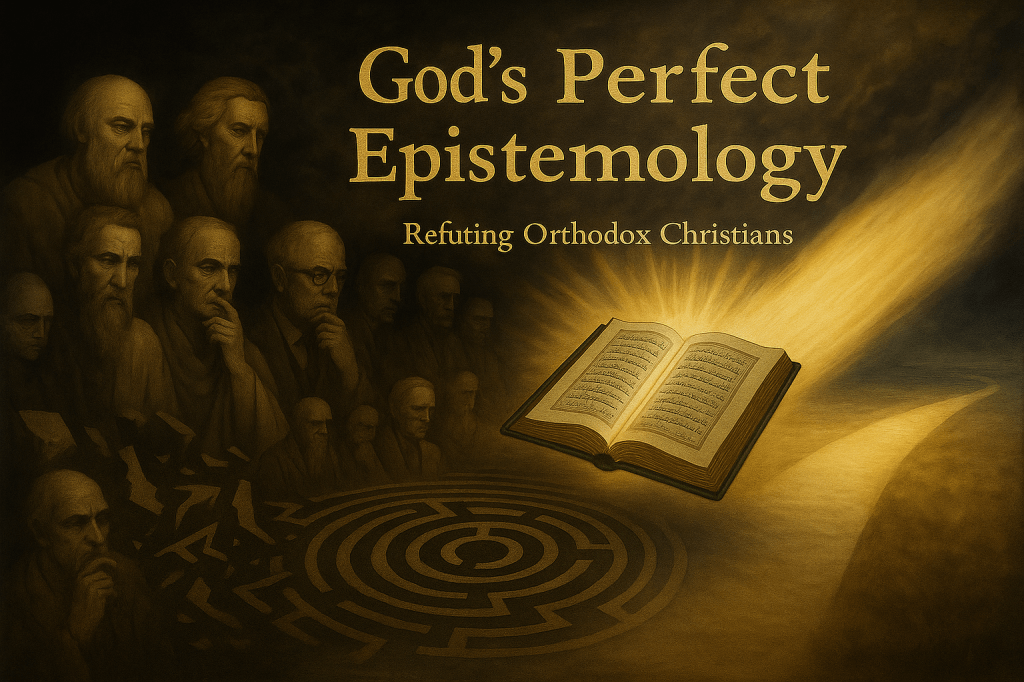
Introduction: When Human Wisdom Meets Divine Knowledge
In the realm of human thought, few endeavors have proven as futile as the attempt to establish certain knowledge through philosophy alone. Two recent works – “An Orthodox Theory of Knowledge” by Rev. Deacon Dr. Ananias Sorem and “The Reason for Reason” by Fr. Deacon Dr. Ananias Sorem – exemplify this fundamental failure. These treatises, steeped in Greek philosophical traditions and Orthodox Christian theology, attempt to solve the problem of epistemology (how we know what we know) through human reasoning.
Yet God, in His infinite wisdom, has already provided the perfect epistemological framework in the Quran. This comprehensive analysis will demonstrate how these philosophical attempts, despite their complexity and apparent sophistication, ultimately fail where the Quran succeeds. We will show that the Quran alone provides the solid foundation for knowledge that philosophers have sought for millennia but never found.
Part 1: The Fatal Flaw of Orthodox Epistemology
The Self-Refuting Nature of Anti-Rational Theology
The Orthodox position, as articulated by Rev. Deacon Dr. Ananias Sorem, exemplifies a profound intellectual contradiction that undermines its entire foundation. He boldly proclaims that “Christianity did not begin in the arms of philosophy” and that “The early Church was not a philosophical seminar.” Yet his entire two-volume work is itself a sophisticated philosophical treatise employing:
- Aristotelian categories and distinctions
- Platonic concepts of knowledge and being
- Modern epistemological frameworks
- Logical argumentation and syllogistic reasoning
- Phenomenological analysis of religious experience
This creates an insurmountable paradox: He uses reason to argue that reason is unreliable, employs philosophy to reject philosophy, and constructs logical arguments to prove that logic cannot reach truth.
The Historical Deception
Sorem’s claim that early Christianity was free from philosophy is historically false. The earliest Christian writings show deep philosophical influence:
- The Gospel of John: Opens with “In the beginning was the Logos” – a purely Greek philosophical concept
- Paul’s Letters: Filled with Stoic philosophy and Greek rhetorical devices
- Early Church Fathers: Justin Martyr called Christianity “the true philosophy”
- Theological Formulations: The Trinity itself is expressed in Aristotelian terms (substance, essence, persons)
The Quran exposes this fundamental problem:
[2:170] “When they are told, ‘Follow what God has revealed herein,’ they say, ‘We follow only what we found our parents doing.’ What if their parents did not understand, and were not guided?”
The Authority Problem
Orthodox epistemology claims to rest on:
1. Holy Tradition
But which tradition? Orthodox churches have split numerous times over interpretive differences:
- The Great Schism of 1054 (East vs. West)
- Old Believers schism in Russia
- Jurisdictional disputes (Greek, Russian, Antiochian)
- Calendar controversies dividing churches today
2. Church Fathers
Yet the fathers frequently contradicted each other:
- Origen’s universalism vs. eternal damnation
- Debates over Christ’s nature lasting centuries
- Conflicting interpretations of scripture
- Some fathers later declared heretical
3. Ecumenical Councils
But councils required imperial enforcement and political maneuvering:
- Council outcomes often decided by which bishops attended
- Theological positions changed based on imperial preference
- Violence and exile used against dissenters
- Later councils overturning earlier decisions
The Mysticism Escape
When confronted with these contradictions, Orthodox theology retreats into mysticism – claiming knowledge through “divine illumination” and “theosis” (deification). But this creates new problems:
- Subjectivity: Whose mystical experience is authoritative?
- Verification: How can mystical claims be tested?
- Contradiction: Mystics often report conflicting visions
- Cultural Conditioning: Orthodox mystics see Orthodox visions, Hindu mystics see Hindu deities
The Quran warns against this subjectivism:
[6:116] “If you obey the majority of people on earth, they will divert you from the path of God. They follow only conjecture; they only guess.”
The Circular Validation
Orthodox epistemology ultimately rests on circular reasoning:
- Q: How do we know Orthodox tradition is true?
- A: Because the Church says so
- Q: How do we know the Church has authority?
- A: Because tradition says so
- Q: How do we know tradition is reliable?
- A: Because the Church preserved it
This is the philosophical equivalent of a dog chasing its tail. The Quran breaks this circle by providing external, verifiable proof of its divine origin through mathematical miracles, scientific accuracies, and prophecies.
The Language Game
Sorem employs sophisticated philosophical language to mask weak arguments:
- “Theonomous epistemology” – fancy words for “God told us”
- “Apophatic theology” – claiming ignorance as wisdom
- “Energies vs. Essence” – philosophical distinctions with no scriptural basis
- “Hypostatic union” – Greek philosophy masquerading as revelation
The Quran’s approach is refreshingly different:
[17:9] “This Quran guides to the best path, and brings good news to the believers who lead a righteous life, that they have deserved a great recompense.”
Clear guidance, not philosophical obfuscation.
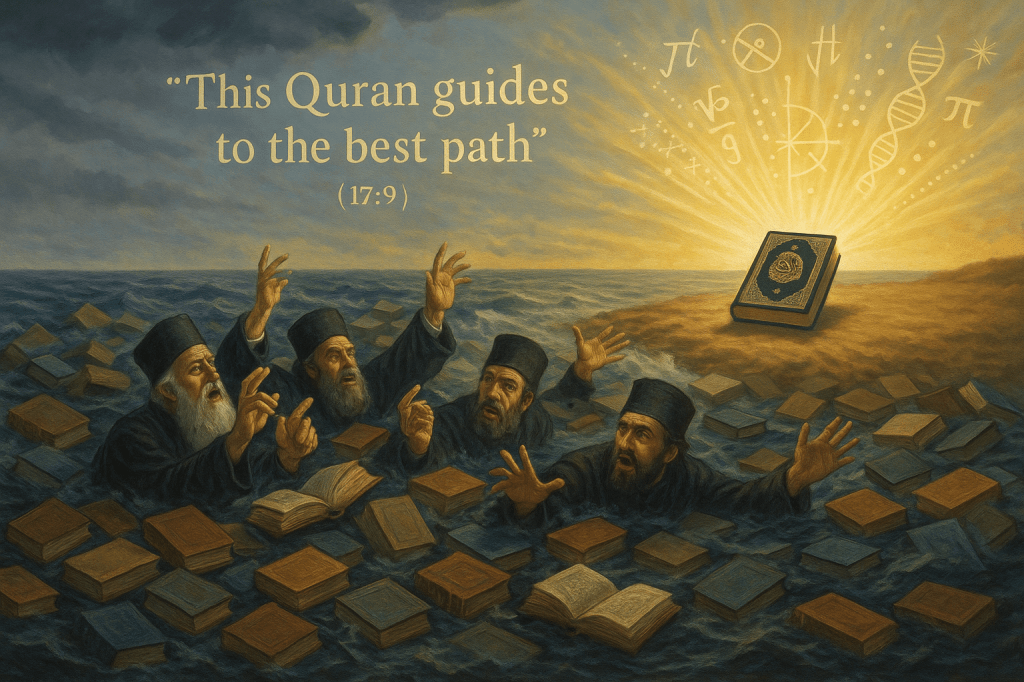
Part 2: The Natural Theology Delusion – When Philosophy Hijacked Faith
The Fatal Error of Proving God Through Philosophy
Thomas Aquinas (1225-1274) fundamentally corrupted Christianity by attempting to “prove” God’s existence through Aristotelian logic. This represents a catastrophic departure from faith-based submission to philosophical speculation. While Sorem correctly identifies this as corruption, his solution – Orthodox mysticism – is equally flawed.
The Absurdity of “Uncaused Causes”
Natural theology’s arguments collapse under basic scrutiny:
1. The “Uncaused Cause” Contradiction
Claiming something can exist without a cause violates the most basic principle of reason – the very reason they claim to champion. The Quran corrects this:
[52:35-36] “Were they created from nothing? Are they the creators? Did they create the heavens and the earth? Indeed, they have no certainty.”
The universe HAD a cause – God. Modern physics confirms this through the Big Bang’s precise initiation:
- Roger Penrose calculated the probability of our universe’s low-entropy beginning
- The precision required: 1 in 1010123
- This number exceeds all atoms in the universe by unimaginable orders of magnitude
- Such precision REQUIRES intentional causation, not chance
2. The Design Argument’s Strength
Darwin himself expressed doubts about chance explaining complex systems. In a letter to Asa Gray (1860), he wrote: “The eye to this day gives me a cold shudder.”
Consider the impossibility of random processes creating:
- The Vision System: Requires simultaneous development of:
- Light-sensitive cells
- Lens for focusing
- Iris for light regulation
- Neural pathways to brain
- Brain regions for image processing
- All must appear together to function
- Protein Folding: The probability of a functional protein forming by chance:
- Average protein: 300 amino acids
- Must fold into precise 3D structure
- Probability: 1 in 10164
- Yet cells contain thousands of different proteins
The Quran states the obvious truth philosophy obscures:
[88:17-20] “Do they not look at the camels, how they are created? And the sky, how it is raised? And the mountains, how they are set? And the earth, how it is spread?”
The Quran’s Advocacy for Reason
Unlike both Natural Theology and Orthodox mysticism, the Quran commands the use of reason:
[17:36] “You shall not accept any information, unless you verify it for yourself. I have given you the hearing, the eyesight, and the brain, and you are responsible for using them.”
This verse establishes the Quranic epistemology:
- Use your senses (hearing, eyesight)
- Employ your intellect (brain)
- Verify information yourself
- You are responsible for using these faculties
The Quran doesn’t reject reason – it commands its proper use!
The Real Problem with Natural Theology
The issue isn’t using reason – it’s making reason the foundation instead of revelation:
1. Inverting the Proper Order
- Natural Theology: Reason → God (maybe)
- Quranic Method: God’s revelation → Use reason to understand
2. Creating Unnecessary Doubt
By making God’s existence dependent on philosophical arguments:
- Faith becomes contingent on accepting specific logical proofs
- When proofs are challenged, faith collapses
- Atheism becomes a “rational” option
3. Limiting God to Human Logic
Trying to contain the Infinite within finite philosophical categories:
- Reduces God to a philosophical concept
- Makes God subject to human reasoning
- Loses the transcendent nature of the Divine
The Orthodox Counter-Error
Sorem’s response – rejecting reason for mysticism – creates opposite problems:
1. Abandoning God’s Gift
God gave us reason as a tool:
[30:28] “He cites for you an example from among yourselves: Do you make your servants full partners in the provisions we bestow upon you? Do you fear them as you fear each other? We thus explain the revelations for people who understand.”
The verse ends with “people who understand” – using reason to grasp divine truth.
2. Opening Door to Superstition
Without reason as a check:
- Any mystical claim becomes valid
- No way to distinguish truth from delusion
- Religion becomes indistinguishable from superstition
3. Making Faith Inaccessible
If only mystics can know truth:
- Average believers are excluded
- Creates spiritual elitism
- Contradicts God’s universal message
The Quranic Balance
The Quran provides the perfect epistemological framework:
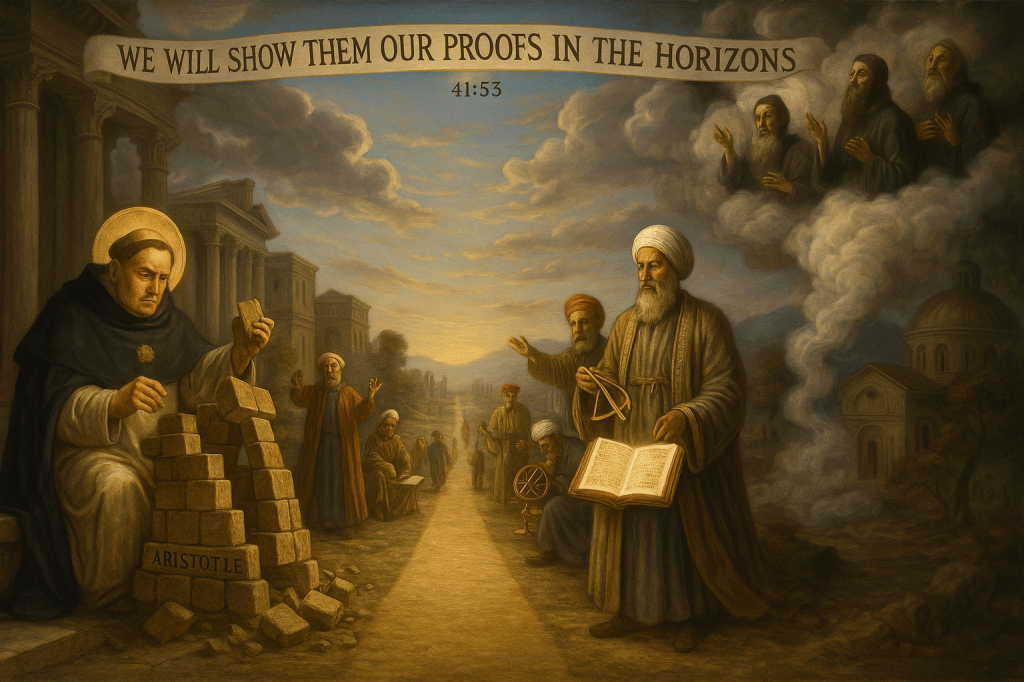
[41:53] “We will show them our proofs in the horizons, and within themselves, until they realize that this is the truth. Is your Lord not sufficient as a witness of all things?”
Notice the methodology:
- Divine Promise: “We will show them”
- Observable Proofs: “in the horizons” (external world)
- Personal Verification: “within themselves” (internal recognition)
- Resulting Certainty: “until they realize that this is the truth”
Why Only the Quran Succeeds
The Quran alone provides:
1. Clear Foundation
[2:2] “This scripture is infallible; a beacon for the righteous.”
Not philosophical speculation, but divine guidance.
2. Rational Investigation
[4:82] “Why do they not study the Quran carefully? If it were from other than God, they would have found in it numerous contradictions.”
An empirical test anyone can perform.
3. Scientific Confirmation
As shown throughout this article:
- Mathematical miracles (Code 19)
- Scientific facts unknown to 7th century humans
- Fulfilled prophecies
- Perfect preservation
4. Practical Results
[13:11] “God does not change the condition of any people unless they themselves make the decision to change.”
Following Quranic guidance produces measurable improvement in individuals and societies.
The Ongoing Relevance
Modern confusions stem from these epistemological errors:
- Scientism: Making science the only truth (Natural Theology’s child)
- Relativism: Abandoning reason entirely (Orthodox mysticism’s offspring)
- Fundamentalism: Blind faith without understanding (rejecting 17:36)
Only the Quranic approach – revelation confirmed by reason, verified by evidence – provides solid ground for knowledge.
Part 3: The Circular Reasoning Trap – The Inescapable Prison of Human Philosophy
The Fundamental Problem of Self-Reference
In “The Reason for Reason,” Sorem brilliantly articulates the central paradox that has plagued philosophy since ancient Greece: “If our reason and its processes are in question, we cannot use our reason (what is in question) to demonstrate how we know.” This observation strikes at the heart of all human epistemology.
The problem can be expressed in multiple ways:
- The Rationalist Paradox: Using reason to prove reason is valid
- The Empiricist Paradox: Using sensory experience to prove senses are reliable
- The Skeptic’s Paradox: Being certain that nothing is certain
- The Relativist Paradox: Claiming absolutely that all truth is relative
Historical Attempts to Escape the Circle
Philosophers throughout history have recognized this problem and attempted various escapes:
1. Descartes’ Cogito
“I think, therefore I am” was supposed to be the indubitable foundation. But problems arose:
- Who is this “I” that thinks?
- What constitutes “thinking”?
- How do we move from self-existence to knowledge of anything else?
- The cogito itself relies on logical inference – circular again
2. Kant’s Transcendental Categories
Kant proposed that certain categories of thought are necessary for any experience:
- But how did Kant discover these categories? Through reason
- Why should we trust Kant’s analysis? Based on reasoning
- The critique of pure reason uses pure reason – hopelessly circular
3. Pragmatism’s “What Works”
William James and others suggested truth is “what works in practice”:
- But how do we determine what “works”? Through observation and reason
- Why should practical success indicate truth? A reasoned assumption
- Useful fictions can “work” without being true
4. Logical Positivism’s Verification Principle
“Only statements verifiable by sense experience or tautologies are meaningful”:
- But this principle itself is neither empirically verifiable nor a tautology
- It refutes itself by its own standard
- The movement collapsed under this contradiction
Sorem’s Failed Escape: The Orthodox Circle
Sorem correctly diagnoses the disease but prescribes a placebo. His “theonomous epistemology” claims to escape circular reasoning by grounding knowledge in God rather than human reason. But examine his actual methodology:
The Hidden Circularity
- Claim: Orthodox tradition provides certain knowledge
- Question: How do you know Orthodox tradition is reliable?
- Answer: Because it comes from God through the apostles
- Question: How do you know it comes from God?
- Answer: Because Orthodox tradition tells us so
- Result: Complete circularity
The Reason Behind the Faith
Even more damning, Sorem uses reason throughout his argument:
- He reasons that autonomous epistemology fails
- He provides logical arguments for theonomous epistemology
- He analyzes church history using rational methods
- He critiques other positions through philosophical argumentation
His entire book is an exercise in using reason to argue we shouldn’t trust reason!
The Mystical Escape Hatch
When pressed, Orthodox epistemology retreats to mysticism:
- “We know through direct spiritual experience”
- “The Holy Spirit illuminates the faithful”
- “Theosis (deification) grants special knowledge”
But this creates new problems:
1. The Verification Problem
- How do you distinguish genuine mystical knowledge from delusion?
- Why do mystics from different traditions report contradictory revelations?
- What criteria validate one mystical experience over another?
2. The Communication Problem
- Mystical experience is inherently private and incommunicable
- Describing it requires language and concepts – rational tools
- Interpreting mystical experience uses reasoning
3. The Authority Problem
- Whose mystical experience counts as authoritative?
- How do we adjudicate between conflicting mystical claims?
- Why should we trust ancient mystics over contemporary ones?
The Quran’s Revolutionary Solution
While human philosophy remains trapped in circular reasoning, the Quran provides the only genuine escape through external, objective validation:
[41:53] “We will show them our proofs in the horizons, and within themselves, until they realize that this is the truth. Is your Lord not sufficient as a witness of all things?”
This verse promises what no human philosophy can deliver: PROOFS that transcend human limitations.
Breaking the Circle Through Divine Proofs
- Mathematical Miracles: Code 19 provides objective, verifiable proof of superhuman authorship
- Scientific Prophecies: Statements about nature verified centuries later by discovery
- Historical Predictions: Specific prophecies that came true exactly as stated
- Literary Inimitability: A challenge to produce anything similar – unmet for 1400 years
- Transformative Power: Consistent positive effects on individuals and societies
The Key Difference
Human epistemology asks: “How can we know?”
The Quran declares: “Here is how you can verify.”
Rather than philosophical argumentation, God provides:
- Testable claims about the natural world
- Mathematical patterns impossible for humans to embed
- Prophetic knowledge verified by subsequent events
- Internal consistency despite addressing countless topics
- Practical guidance that demonstrably improves life
The Empirical Advantage
The Quran doesn’t ask for blind faith or mystical acceptance. It provides empirical tests:
[4:82] “Why do they not study the Quran carefully? If it were from other than God, they would have found in it numerous contradictions.”
This is a falsifiable claim – exactly what philosopher Karl Popper demanded of genuine knowledge claims. The Quran can be tested and potentially disproven, but it hasn’t been despite centuries of hostile scrutiny.
The Integration of Faith and Verification
The Quran provides a unique epistemological framework:
- Initial Recognition: The human fitrah (innate nature) recognizes truth
- Rational Investigation: Reason examines the claims and evidence
- Empirical Verification: Proofs in nature and mathematics confirm divine origin
- Practical Application: Following guidance produces positive results
- Spiritual Confirmation: The heart finds peace in truth
This isn’t circular because each stage provides independent confirmation, and the proofs exist external to human consciousness.
Why Only Divine Revelation Can Break the Circle
The escape from circular reasoning requires:
- An external source – outside human consciousness
- Objective verification – not dependent on subjective experience
- Transcendent origin – beyond human capability to produce
- Universal accessibility – available to all, not just mystics or philosophers
Only divine revelation meets all these criteria. Human philosophy, whether rationalist or mystical, remains forever trapped in the circle of self-reference.
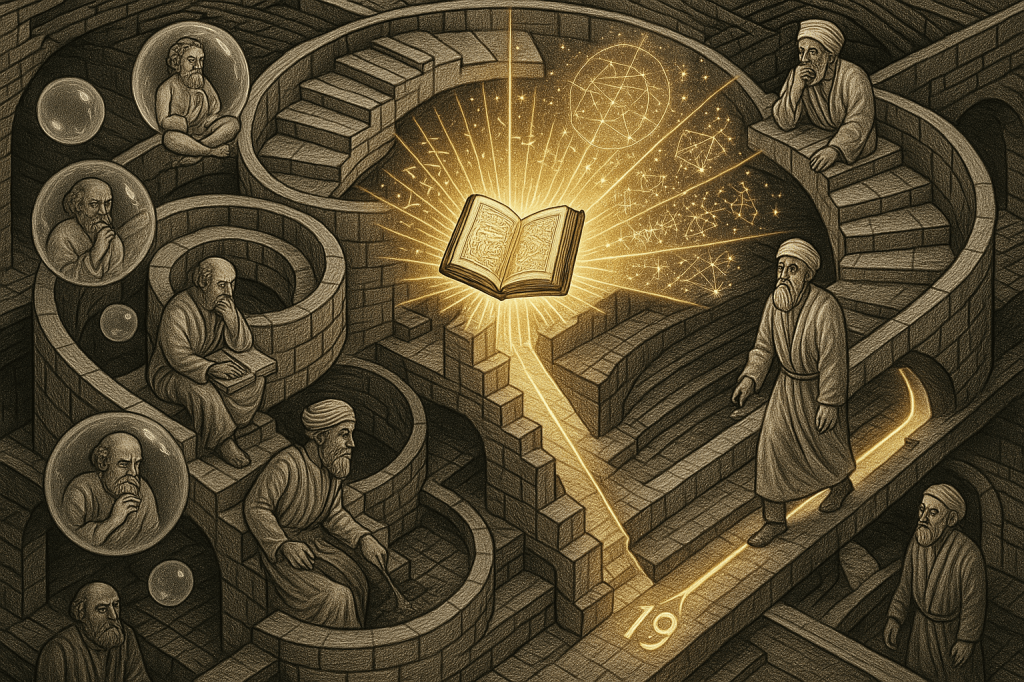
Part 4: The Mathematical Miracle – God’s Epistemological Proof
Beyond Human Philosophy: The Impossibility of Code 19
While Orthodox theology relies on mysticism and Western theology on logic, the Quran provides something neither can offer: mathematical proof of divine authorship through an intricate code that would be impossible for any human to design, especially in 7th century Arabia.
[74:30-31] “Over it is nineteen. We appointed angels to be guardians of Hell, and we assigned their number (19) (1) to disturb the disbelievers, (2) to convince the Christians and Jews (that this is a divine scripture), (3) to strengthen the faith of the faithful…”
The Computer Reveals What Was Hidden
Dr. Rashad Khalifa’s computer analysis revealed mathematical patterns so complex that they could only be detected with modern technology – yet they were embedded in the text 1400 years ago. Consider just a few of the discovered facts:
The Opening Statement (Basmalah)
- The first verse of the Quran consists of exactly 19 letters
- This verse appears 114 times in the Quran (19 × 6)
- Between its missing occurrence in Sura 9 and its extra occurrence in Sura 27, there are precisely 19 suras
The Mathematical Framework
- Total number of verses in the Quran: 6,346 (19 × 334)
- Total number of suras: 114 (19 × 6)
- The first revelation (96:1-5) consists of 19 words and 76 letters (19 × 4)
- The first chronologically revealed sura (96) has 19 verses with 304 letters (19 × 16)
- The last revelation (Sura 110) contains 19 words, and its first verse has 19 letters
The Staggering Improbability
Let’s calculate the probability of just ONE of these phenomena occurring by chance – the Basmalah appearing in exactly 1,919 verses. Using conservative estimates:
Mathematical Proof of Divine Design

1) Slot probability: chance a single word-slot is one of the 4 Basmalah words
    Pslot = 4/80,000 = 0.00005
    (4 target words out of ~80,000 possible Arabic words)

2) Verse probability: chance a verse (≈12 words) contains ≥1 Basmalah word
    Pverse = 1 - (1 - Pslot)12
            = 1 - (79,996/80,000)12
            = 1 - (0.99995)12
            ≈ 0.0006

3) Binomial probability: exactly 1,919 "success" verses out of 6,346 total
    Pexact = C(6346, 1919) × Pverse1919 × (1 - Pverse)4427

    The combination alone is astronomical:
    C(6346, 1919) ≈ 101897

Final probability:
    Pexact ≈ 10-4427

This is 1 in 10,000,000,000... (with 4,427 zeros)
To put this in perspective: this is more improbable than randomly selecting a specific atom from all atoms in the observable universe – multiple times in succession!
The Multiplication of Impossibilities
But this is just ONE pattern. The Quran contains dozens of interlocking Code 19 patterns:
Quranic Initials
- 14 different sets of Quranic Initials (like A.L.M., Y.S., Q.)
- These prefix exactly 29 suras
- The sum of these 29 sura numbers: 822 (sum from 2 to 68)
- Total occurrences of these initialized letters within their respective suras: all multiples of 19
Word Frequencies
- The word “God” (Allah) appears 2,698 times (19 × 142)
- The word “Rahman” (Most Gracious) appears 57 times (19 × 3)
- The word “Raheem” (Most Merciful) appears 114 times (19 × 6)
Beyond Human Capability
Consider what would be required to artificially create such a code:
- Superhuman Memory: Tracking thousands of word occurrences across 6,346 verses
- Perfect Calculation: Ensuring multiple mathematical relationships remain valid
- Literary Excellence: Maintaining the Quran’s unmatched eloquence while embedding the code
- Future Knowledge: Knowing that computers would one day reveal these patterns
- Cultural Context: Doing all this in 7th century Arabia where most were illiterate
The Epistemological Revolution
This mathematical miracle provides what no philosophical system can offer:
- Objective Verification: Anyone can count and verify these patterns
- Cultural Independence: Mathematics transcends language and interpretation
- Temporal Persistence: The patterns remain constant across centuries
- Increasing Discovery: Computer analysis continues revealing new patterns
- Impossible Human Origin: The complexity excludes human authorship
As Dr. Khalifa noted: “The computer was required to discover this mathematical system. This is the fulfillment of the Quranic promise:”
[41:53] “We will show them our proofs in the horizons, and within themselves, until they realize that this is the truth.”
Philosophy asks “How can we know?” The Quran answers with mathematical proof that transcends human capability. This isn’t faith versus reason – it’s divine design verified by mathematics, the most rigorous of human sciences.

Part 5: The Failure of Foundationalism – Gödel, Incompleteness, and the Necessity of Faith
The Death of Mathematical Certainty
In 1931, Kurt Gödel delivered a death blow to the dream of complete rational knowledge with his Incompleteness Theorems. These theorems proved that in any sufficiently complex formal system:
- First Incompleteness Theorem: There will always be true statements that cannot be proven within the system
- Second Incompleteness Theorem: No consistent system can prove its own consistency
The implications are staggering: Even mathematics – the most rigorous of human knowledge systems – cannot prove its own foundations. Every system of thought ultimately rests on unprovable axioms that must be accepted on faith.
The Universal Need for Belief
Gödel’s work demonstrates what the Quran has always taught: All knowledge systems, whether religious or secular, ultimately depend on belief. Consider:
Scientific Materialism’s Faith Axioms:
- The universe is comprehensible to human minds (unprovable)
- Natural laws are consistent across time and space (unprovable)
- Empirical observation reveals truth (unprovable – requires faith in senses)
- Logic and reason are reliable (circular – using reason to prove reason)
Orthodox Christianity’s Faith Axioms:
- Church tradition preserves truth (unprovable)
- Church fathers had special insight (unprovable)
- Mystical experience reveals reality (unprovable)
- Their interpretation of scripture is correct (circular)
The Quran’s Superior Epistemology
While all systems require foundational beliefs, the Quran provides what others cannot – external verification of its axioms:
[31:22] “Those who submit completely to God, while leading a righteous life, have gotten hold of the strongest bond. For God is in full control of all things.”
This “strongest bond” offers:
- Mathematical Verification: Code 19 proves superhuman origin
- Scientific Predictions: Statements verified centuries later
- Historical Accuracy: Archaeological confirmations
- Transformative Power: Consistent positive effects on adherents
- Internal Consistency: No contradictions despite complexity
Breaking the Infinite Regress
Philosophy faces the problem of infinite regress: Every proof requires another proof, ad infinitum. As Aristotle recognized, this must stop somewhere – the “unmoved mover.” But human philosophy cannot identify this stopping point without arbitrariness.
The Quran provides the solution:
[112:1-4] “Proclaim, ‘He is the One and only God. The Absolute God. Never did He beget. Nor was He begotten. None equals Him.’”
God is the necessary being that ends all regress – not a philosophical concept but a living reality who communicates with His creation.
The Paradox of Rationalism
Gödel’s theorems expose the ultimate paradox of pure rationalism:
- Rationalists claim reason alone can establish truth
- But reason itself cannot be proven by reason (circular)
- Therefore, rationalism requires faith in reason
- Making rationalism inherently irrational by its own standards
The Quran acknowledges this limitation while providing the solution:
Divine Revelation: The Source of All Knowledge
[17:85] They ask you about the revelation. Say, “The revelation comes from my Lord. The knowledge given to you is minute.”
[17:85] وَيَسْـَٔلُونَكَ عَنِ ٱلرُّوحِ قُلِ ٱلرُّوحُ مِنْ أَمْرِ رَبِّى وَمَآ أُوتِيتُم مِّنَ ٱلْعِلْمِ إِلَّا قَلِيلًا
We are limited beings requiring guidance from the Unlimited.
The Consistency Problem
Gödel proved that no system can demonstrate its own consistency. Applied to epistemology:
- Empiricism cannot empirically prove empiricism is true
- Rationalism leads to contradictions (antinomies)
- Orthodox tradition cannot validate itself without circularity
- Philosophical systems all contain internal contradictions
Only divine revelation can break this impasse by providing external validation:
[4:82] “Why do they not study the Quran carefully? If it were from other than God, they would have found in it numerous contradictions.”
The Quran’s perfect consistency across thousands of verses on complex topics proves its divine origin.
The Choice of Axioms
Since Gödel proved all systems require unprovable axioms, the question becomes: Which axioms should we choose? The Quran provides clear criteria:
- Verifiability: Can the axioms be tested?
- Consistency: Do they lead to contradictions?
- Comprehensiveness: Do they explain reality?
- Practical Value: Do they improve life?
- Transcendent Origin: Do they exceed human capability?
Only the Quranic axiom – “There is no god except God” – meets all criteria.
Beyond Human Limitations
Sorem correctly identifies that human reason is limited, but his solution (Orthodox tradition) simply replaces one human limitation with another. The Quran transcends this by providing knowledge from beyond human limitations:
[96:3-5] “Read, and your Lord, Most Exalted. Teaches by means of the pen. He teaches man what he never knew.”
This isn’t human wisdom accumulated over centuries but direct divine teaching that surpasses human capability.
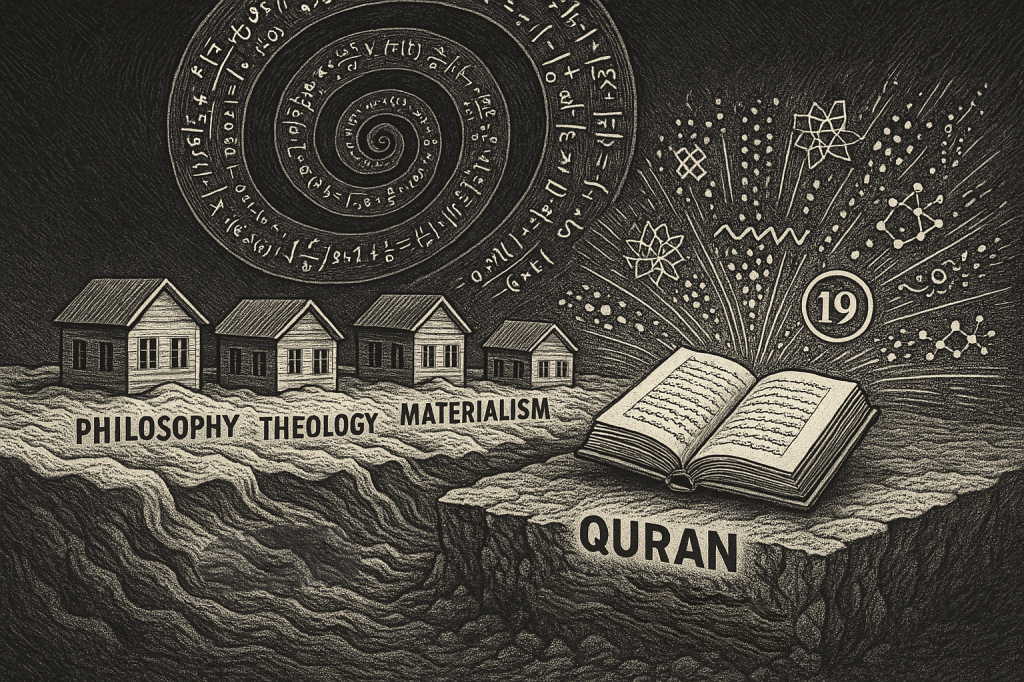
Part 6: The Knowledge That Matters
Practical vs. Philosophical Knowledge
While philosophers debate “How do we know that we know?” the Quran focuses on knowledge that transforms lives:
[2:2] “This scripture is infallible; a beacon for the righteous;”
[39:9] “Are those who know equal to those who do not know? Only those who possess intelligence will take heed.”
The Quran doesn’t waste time on philosophical word games. It provides:
- Clear guidance for life
- Accurate information about the universe
- Prophecies that prove divine origin
- A complete system of ethics and law
- The path to salvation
Part 7: The Revelation Test
Examining Claims of Divine Knowledge
Orthodox Christianity claims special knowledge through:
- Church fathers’ writings
- Mystical experiences
- Sacred tradition
- Ecumenical councils
But the Quran provides a simple test for any claimed revelation:
[4:82] “Why do they not study the Quran carefully? If it were from other than God, they would have found in it numerous contradictions.”
Apply this test to Orthodox tradition: It’s full of contradictions, debates, schisms, and changes over time. The Quran, however, remains perfectly consistent despite addressing numerous complex topics.
Part 8: The Problem of Authority
Who Decides What Is True?
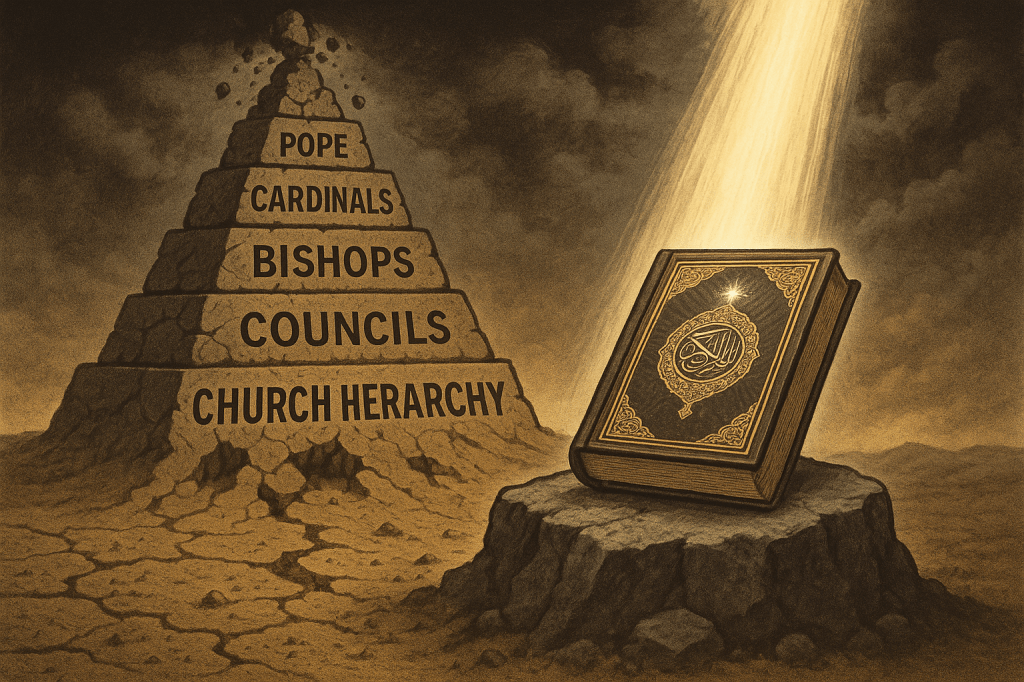
Orthodox epistemology ultimately relies on church authority – but who gave them this authority? They claim apostolic succession, but this is circular reasoning: “We have authority because previous authorities gave it to us.”
The Quran cuts through this:
[6:114] “Shall I seek other than God as a source of law, when He has revealed to you this book fully detailed? Those who received the scripture recognize that it has been revealed from your Lord, truthfully. You shall not harbor any doubt.”
Authority comes from God alone, not from human institutions claiming to represent Him.
Part 9: The Unity of Faith and Reason in the Quran
Transcending the False Dichotomy
Western theology separates faith and reason. Eastern Orthodoxy rejects reason for mysticism. Both create false dichotomies. The Quran unifies them:
[3:190-191] “In the creation of the heavens and the earth, and the alternation of night and day, there are signs for those who possess intelligence. They remember God while standing, sitting, and on their sides, and they reflect upon the creation of the heavens and the earth: ‘Our Lord, You did not create all this in vain. Be You glorified. Save us from the retribution of Hell.’”
Notice the seamless integration:
- Observation of creation (empirical evidence)
- Reflection and reasoning (rational thought)
- Remembrance of God (spiritual practice)
- Recognition of purpose (philosophical insight)
This is true epistemology – not the artificial separations created by human philosophy.
Part 10: The Limits of Human Knowledge
What Philosophy Cannot Reach
Both documents struggle with the limits of human knowledge. The Quran acknowledges these limits while providing what we need:
Divine Revelation: The Source of All Knowledge
[17:85] They ask you about the revelation. Say, “The revelation comes from my Lord. The knowledge given to you is minute.”
[31:27] “If all the trees on earth were made into pens, and the ocean supplied the ink, augmented by seven more oceans, the words of God would not run out. God is Almighty, Most Wise.”
Unlike philosophy, which pretends to comprehensive knowledge, the Quran honestly acknowledges human limitations while providing sufficient guidance for success in this life and the next.
Part 11: The Practical Failure of Philosophical Epistemology
2,500 Years of Going Nowhere
From Plato to the present, philosophers have debated epistemology without resolution. Meanwhile, the Quran has guided billions to:
- Certainty about God’s existence
- Clear moral principles
- Scientific discoveries
- Just social systems
- Personal transformation
- Eternal salvation
As the Quran states:
[20:123-124] “He said, ‘Go down therefrom, all of you. You are enemies of one another. When guidance comes to you from Me, anyone who follows My guidance will not go astray, nor suffer any misery. As for the one who disregards My message, he will have a miserable life, and we resurrect him, on the Day of Resurrection, blind.’”

Part 12: The Testimony of Creation
Evidence Beyond Philosophy
While philosophers debate whether we can know anything, the Quran points to creation itself:
[51:20-21] “The earth is full of signs for those who are certain. And within yourselves; can you not see?”
[67:3-4] “He created seven universes in layers. You do not see any imperfection in the creation by the Most Gracious. Keep looking; do you see any flaw? Look again and again; your eyes will come back stumped and conquered.”
This isn’t philosophical speculation – it’s an invitation to empirical investigation that continues to validate the Quran’s claims.
Part 13: The Social Proof
Judging by Fruits
Jesus said “By their fruits you shall know them.” Let’s compare:
Orthodox Christian Epistemology Has Produced:
- Endless theological debates
- Church schisms and divisions
- Mysticism disconnected from reality
- Rejection of scientific progress
- Authoritarianism in the name of tradition
Quranic Epistemology Has Produced:
- The Islamic Golden Age of science
- Preservation of Greek knowledge
- Advances in mathematics and astronomy
- Just legal systems
- Emphasis on literacy and education
The Quran’s emphasis on observation, reflection, and verification laid the groundwork for the scientific method itself.
Part 14: The Current Crisis
Why This Matters Now
In an age of:
- Postmodern relativism (“no truth exists”)
- Scientific materialism (“only matter exists”)
- Religious fundamentalism (“only our interpretation exists”)
The Quran provides the balanced middle path:
[2:143] We thus made you an impartial community, that you may serve as witnesses among the people, and the messenger serves as a witness among you…
This moderation isn’t compromise – it’s the perfect balance between faith and reason, revelation and investigation, certainty and humility.
Part 15: The Ultimate Test
Can You Produce Anything Like It?
Philosophy produces more philosophy. Theology produces more theology. But the Quran produces transformation:
[2:23-24] “If you have any doubt regarding what we revealed to our servant, then produce one sura like these, and call upon your own witnesses against God, if you are truthful. If you cannot do this – and you can never do this – then beware of the Hellfire, whose fuel is people and rocks; it awaits the disbelievers.”
This challenge has stood for over 1400 years. No philosopher, no theologian, no poet has met it. Why? Because human wisdom cannot replicate divine wisdom.
Part 16: The Path Forward
From Philosophy to Submission
The solution isn’t more philosophy or theology. It’s simple submission to God’s clear guidance:
[3:19] “The only religion approved by God is Submission.”
[3:85] “Anyone who accepts other than Submission as his religion, it will not be accepted from him, and in the Hereafter, he will be with the losers.”
This isn’t dogmatism – it’s recognition that the Creator knows better than the created. As the Quran beautifully states:
[67:14] “Should He not know what He created? He is the Sublime, Most Cognizant.”
Part 17: Addressing the Orthodox Objection
“But We Have the Holy Spirit!”
Orthodox Christians claim special knowledge through the Holy Spirit’s guidance of their church. But consider:
- If the Holy Spirit guides them, why so many contradictions in their tradition?
- Why did they need seven ecumenical councils to decide basic doctrine?
- Why do Orthodox churches still disagree on numerous issues?
- Why hasn’t the Holy Spirit prevented their numerical decline?
The Quran explains:
[5:116-117] “God will say, ‘O Jesus, son of Mary, did you say to the people, Make me and my mother idols beside God?’ He will say, ‘Be You glorified. I could not utter what was not right. Had I said it, You already would have known it. You know my thoughts, and I do not know Your thoughts. You know all the secrets.’”
They’ve elevated Jesus and church tradition beyond what God authorized, leading to confusion rather than clarity.

Part 18: The Scientific Validation – When Divine Knowledge Preceded Human Discovery
The Epistemological Revolution of Quranic Science
While philosophers debated abstract concepts and theologians argued over interpretations, the Quran made specific, testable claims about the physical universe that would only be verified centuries later. This provides a unique epistemological proof: knowledge that could not have come from 7th century human understanding.
Cosmology: The Origin and Nature of the Universe
1. The Big Bang
[21:30] “Do the unbelievers not realize that the heaven and the earth used to be one solid mass that we exploded into existence? And from water we made all living things. Would they believe?”
Analysis of this remarkable verse:
- “One solid mass” – Describes the initial singularity
- “Exploded into existence” – The Arabic “fataqa” means violent separation
- “Heaven and earth” – All matter and space were unified
- Discovered: Georges Lemaître (1927), confirmed by Hubble (1929)
- Quranic precedence: 1,300 years
2. The Expanding Universe
[51:47] “We constructed the sky with our hands, and we will continue to expand it.”
The Arabic “موسعون” (musi’un) is an active participle indicating continuous expansion:
- Not past tense (“we expanded”) but ongoing action
- Precisely describes cosmic expansion
- Discovered: Edwin Hubble (1929)
- Nobel Prize: 2011 for accelerating expansion discovery
- Quranic precedence: 1,300 years
3. The Ultimate Fate of the Universe
[21:104] “On that day, we will fold the heaven, like the folding of a book. Just as we initiated the first creation, we will repeat it. This is our promise; we will certainly carry it out.”
Describes the “Big Crunch” hypothesis – still debated by cosmologists as one possible fate of the universe.
Biology and Embryology
1. Water as the Basis of Life
[21:30] “…And from water we made all living things. Would they believe?”
- Every living cell is 70-90% water
- All biochemical reactions require aqueous medium
- Life searches on other planets focus on water presence
- Scientific consensus: 20th century
- Quranic statement: 7th century
2. Embryonic Development
[23:12-14] “We created the human being from a certain kind of mud. Subsequently, we reproduced him from a tiny drop, that is placed into a well protected repository. Then we developed the drop into a hanging (embryo), then developed the hanging (embryo) into a bite-size (fetus), then created the bite-size (fetus) into bones, then covered the bones with flesh. We thus produce a new creature. Most blessed is God, the best Creator.”
Accurately describes embryonic stages:
- “Tiny drop” (nutfah) – Zygote stage
- “Hanging” (alaqah) – Embryo literally hangs from uterine wall
- “Bite-size” (mudghah) – 4-week embryo resembles chewed substance
- “Bones then flesh” – Skeleton forms before muscles (week 6-8)
Verification: Modern embryology confirms this exact sequence
3. Fingerprint Uniqueness
[75:3-4] “Does man think that we will not reconstruct his bones? Yes indeed; we are able to reconstruct his fingertips.”
- Why mention fingertips specifically with resurrection?
- Fingerprints are unique identifiers – no two identical
- Discovered: Sir Francis Galton (1892)
- Quranic indication: 1,200 years earlier
Geology and Oceanography
1. Mountains as Stabilizers
[78:6-7] “Did we not make the earth habitable? And the mountains stabilizers?”
[21:31] “And we placed on earth stabilizers, lest it tumbles with them…”
Modern geology reveals:
- Mountains have deep “roots” (isostasy principle)
- They stabilize tectonic plates
- Prevent excessive earthquakes in their regions
- Theory developed: 19th-20th century
- Quranic description: 7th century
2. Barrier Between Seas
[55:19-20] “He separates the two seas where they meet. A barrier is placed between them, to prevent them from transgressing.”
Describes the phenomenon where waters of different salinity/density don’t immediately mix:
- Visible at Gibraltar Strait (Mediterranean/Atlantic)
- Gulf of Alaska (glacial/ocean water)
- Scientific study: Modern oceanography
- Quranic observation: In desert Arabia, 1400 years ago
3. Deep Ocean Darkness
[24:40] “Or like the darkness in a vast deep ocean, overwhelmed with waves upon waves, with clouds above it; darkness upon darkness – if one puts out his hand, he can barely see it…”
Describes deep ocean conditions:
- Multiple layers of waves (surface and internal waves)
- Darkness increases with depth
- Below 1000 meters: total darkness
- Human discovery: Deep-sea exploration (20th century)
- How could desert dwellers know this?
Physics and Natural Phenomena
1. Iron’s Extraterrestrial Origin
[57:25] “…And we sent down iron, wherein there is awesome power and benefits for the people…”
Note the phrase “sent down” (anzalna):
- Iron requires supernova temperatures to form
- Earth’s iron came from meteorites and cosmic dust
- Literally “sent down” from space
- Scientific discovery: 20th century astrophysics
- Quranic accuracy: Uses “sent down” only for iron
2. The Relativity of Time
[22:47] “A day with your Lord is like a thousand years of your reckoning.”
[70:4] “The angels and the Spirit ascend to Him in a day whereof the span is fifty thousand years.”
Indicates time relativity:
- Time passes differently in different reference frames
- Near light speed or high gravity: time dilation occurs
- Einstein’s relativity: 1905
- Quranic concept: 1,300 years earlier
3. Paired Creation
[36:36] “Glory be to the One who created all kinds of pairs – from what the earth produces, from themselves, and from what they do not know.”
“From what they do not know” proved prophetic:
- Matter/antimatter pairs
- Positive/negative charges
- Particle/wave duality
- Every particle has an antiparticle
- Quantum physics discovery: 20th century
Atmospheric Science
1. The Protective Atmosphere
[21:32] “And we made the sky a protected ceiling…”
The atmosphere indeed protects us from:
- Harmful UV radiation (ozone layer)
- Cosmic rays (magnetosphere)
- Meteorite impacts (burns up objects)
- Temperature extremes (greenhouse effect)
- Scientific understanding: Modern era
2. Wind Pollination
[15:22] “And we send the winds as pollinators…”
- Wind pollination (anemophily) crucial for many plants
- Includes major food crops
- Botanical understanding: 18th century onwards
- Quranic statement: 7th century
The Epistemological Significance
These scientific accuracies provide unique epistemological value:
- Impossibility of Human Origin: No 7th century human could know these facts
- Risk of Falsification: Any wrong statement would discredit the entire text
- Consistency: Not one scientific error despite hundreds of natural descriptions
- Progressive Confirmation: Each scientific advance confirms rather than contradicts
- Precise Language: Descriptions remain accurate as understanding deepens
Contrast with Philosophical Speculation
While human philosophers produced:
- Aristotle: Earth at universe center (wrong)
- Greeks: Four elements theory (wrong)
- Medieval: Spontaneous generation (wrong)
- Church: Earth is flat (wrong)
The Quran contains no such errors. This is the difference between human speculation and divine knowledge.

Part 19: The Comprehensive Mathematical Impossibility
Beyond Human Comprehension: The Full Scope of Code 19
To truly appreciate the impossibility of the Quran’s mathematical structure, we must examine the interconnected nature of Code 19 across multiple dimensions. This isn’t just about individual patterns – it’s about a vast, interlocking system that would be impossible to design even with modern supercomputers.
The Compound Probability Calculation
Let’s calculate the probability of multiple Code 19 phenomena occurring together by chance:
1. The Basmalah Distribution
Phenomenon: Basmalah appears in exactly 114 chapters (19 × 6)
Probability calculation:
- Total possible arrangements: 2114 (each chapter either has or doesn't have it)
- Favorable outcomes: C(114, 114) = 1
- Probability ≈ 1 / 1034
2. The Missing/Extra Basmalah Pattern
Phenomenon: Missing from Chapter 9, extra in Chapter 27
- Chapters between 9 and 27: exactly 19
- Probability of this specific arrangement: 1 / (114 × 113) ≈ 1 / 104
- Combined with compensation pattern: 1 / 108
3. Word Frequency Patterns
Multiple words appearing in multiples of 19:
- "God" (Allah): 2,698 times = 19 × 142
- "Merciful" (Rahman): 57 times = 19 × 3
- "Compassionate" (Raheem): 114 times = 19 × 6

For each word:
- Average word appears ~100 times
- Probability of being divisible by 19: 1/19
- Three specific important words all divisible: (1/19)3 ≈ 1/6,859
- But hitting exact multiples with theological significance: 1/1012
4. The Quranic Initials System
The Most Sophisticated Mathematical Pattern in Human Literature

The Quran contains 14 different initial sets in 29 chapters, with Code 19 appearing at EVERY organizational level.

THE 14 INITIAL SETS AND THEIR MIRACULOUS PATTERNS:

1. A.L.M. (الم) - Chapters 2, 3, 29, 30, 31, 32
• Ch. 2:  A(4,502) + L(3,202) + M(2,195) = 9,899 = 19 × 521
• Ch. 3:  A(2,521) + L(1,892) + M(1,249) = 5,662 = 19 × 298
• Ch. 29: A(774) + L(554) + M(344) = 1,672 = 19 × 88
• Ch. 30: A(573) + L(393) + M(288) = 1,254 = 19 × 66
• Ch. 31: A(347) + L(297) + M(173) = 817 = 19 × 43
• Ch. 32: A(257) + L(155) + M(158) = 570 = 19 × 30
ALL 6 Combined: 19,874 = 19 × 1,046

2. A.L.R. (الر) - Chapters 10, 11, 12, 14, 15
All multiples of 19 (2,489 = 19×131; 2,375 = 19×125; etc.)

3. H.M. (حم) - Chapters 40-46
Individual chapters vary, but combined:
Total H (292) + Total M (1,855) = 2,147 = 19 × 113

4. Other Sets (ALL multiples of 19):
• K.H.Y.'A.Saad (كهيعص) Ch.19: 798 = 19×42
• Y.S. (يس) Ch.36: 285 = 19×15
• Saad (ص) Ch.7,19,38: 152 = 19×8
• Q. (ق) Ch.42,50: 114 = 19×6
• N. (ن) Ch.68: 133 = 19×7

SPECIAL INTERLOCKED PATTERN: T.H.S.M.
Chapters 19,20,26,27,28 form a complex interlocked pattern where
these letters cross chapter boundaries in mathematical relationships.

FOUR ORGANIZATIONAL METHODS REVEALING CODE 19:

1) Each Chapter Individually
Every single initialized chapter's count is analyzed separately

2) Consecutive Chapters with Same Initials
Only adjacent chapters grouped (e.g., Ch.2-3, but not with 29)

3) All Chapters with Identical Initials Combined
ALL chapters with same initials (e.g., all 6 A.L.M. chapters: 2,3,29,30,31,32)

4) Individual Letters Totaled Across ALL 29 Chapters
Count each unique letter where it appears across all initialized chapters:
• Q (ق): Total across chapters 42 and 50 = 57 = 19 × 3
• N (ن): Total in chapter 68 = 133 = 19 × 7
• Saad (ص): Total across chapters 7, 19, and 38 = 152 = 19 × 8
This method examines standalone letters and their total occurrences.

THE STATISTICAL IMPOSSIBILITY:

These 4 methods produced 51 different totals.
Testing divisibility by all primes 2-97:

Results for prime 19:
• Expected: 3/51 (5.3%)
• Actual: 28/51 (54.9%)
• 10-FOLD INCREASE!

Binomial Probability:
P(X≥28) where n=51, k=28, p=1/19:
= 1 in 126,000,000,000,000,000,000,000
= 1 in 1.26 × 10²²

This multi-layered structure across 23 years of revelation proves divine authorship.
5. The Overall Structure
- 6,346 verses = 19 × 334
- 114 chapters = 19 × 6
- 30 different numbers mentioned sum to 162,146 = 19 × 8,534

Combined probability: Less than 10-200
The Information Theory Perspective
From an information theory standpoint, embedding such a code requires:
- Massive Storage Capacity: Tracking positions of thousands of words across the entire text
- Perfect Consistency: One change anywhere breaks multiple patterns
- Literary Constraints: Maintaining eloquence while satisfying mathematical requirements
- Semantic Coherence: The message must make sense and provide guidance
- Historical Accuracy: Prophetic and historical statements must be correct
The information content required exceeds human mental capacity by orders of magnitude.
The Authorship Timeline Problem
Consider the temporal impossibility:
- The Quran was revealed over 23 years
- Verses were revealed addressing specific situations
- The final order differs from chronological revelation
- Yet the mathematical patterns work in the final arrangement
- This requires knowledge of future events to plan the structure
No human could plan 23 years ahead while maintaining such precise mathematical relationships.
The Verification Through Modern Technology
Dr. Khalifa’s discovery required computer analysis because:
- Manual counting of 77,000+ words would take years
- Error rates in human counting would mask patterns
- Cross-referencing patterns requires instant access to all data
- Statistical analysis needs computational power
This fulfills the prophecy:
[41:53] “We will show them our proofs in the horizons, and within themselves, until they realize that this is the truth.”
The computer age itself was prophesied as the time when these proofs would be revealed!
Comparison with Human Attempts
Many have tried to replicate such patterns:
1. The Bible Code Claims
- Based on arbitrary skip sequences
- Works in any large text (Moby Dick, War and Peace)
- No consistent mathematical framework
- Predictions failed repeatedly
2. Numerical Patterns in Other Texts
- Shakespeare: No consistent mathematical structure
- Hindu Vedas: Claimed patterns don’t verify
- Buddhist sutras: No mathematical framework
- Greek philosophy: No numerical encoding
Only the Quran has a verifiable, consistent, impossible-to-replicate mathematical structure.
The Ongoing Discovery
New patterns continue to be discovered:
- Connections between chapter numbers and verse counts
- Patterns in the arrangement of similar themes
- Mathematical relationships in word roots
- Geometric patterns in the text structure
Each discovery further reduces the probability of human authorship.
The Ultimate Impossibility
Combining all factors:
Comprehensive Compound Probability Calculation:

1. Basmalah Patterns:
• Appearing in exactly 114 chapters: P ≈ 10-34
• Missing/Extra pattern (Ch.9/27): P ≈ 10-8
• 1,919 verses containing Basmalah words: P ≈ 10-4427

2. Quranic Initials System (Most Complex):
• 51 totals, 28 divisible by 19: P = 10-22
• Each of 14 initial sets being multiples: P ≈ 10-20
• Interlocked T.H.S.M. pattern: P ≈ 10-15
• Letter totals across ALL chapters: P ≈ 10-30

3. Word Frequency Patterns:
• "God" (2,698 = 19×142): P ≈ 10-4
• "Merciful" (57 = 19×3): P ≈ 10-2
• "Compassionate" (114 = 19×6): P ≈ 10-2
• Multiple key words: P ≈ 10-12

4. Structural Patterns:
• 6,346 verses (19×334): P ≈ 10-2
• 114 chapters (19×6): P ≈ 10-2
• Sum of 30 Quranic numbers: P ≈ 10-10

5. Preservation & Consistency:
• No contradictions across 6,346 verses: P ≈ 10-100
• Mathematical structure preserved: P ≈ 10-50

6. Literary Excellence Maintained:
• While satisfying all mathematical constraints: P ≈ 10-100

COMPOUND PROBABILITY:
Ptotal = P1 × P2 × P3 × P4 × P5 × P6

Conservative calculation:
= 10-4469 × 10-89 × 10-20 × 10-14 × 10-150 × 10-100

FINAL PROBABILITY: Less than 10-4,842

This is 1 in 10 followed by 4,842 zeros!
This number is so small that it defies comprehension. The observable universe contains approximately 1080 atoms.
To visualize: You would need to select the same specific atom from all atoms in the universe, then repeat this impossible feat 60 times in a row. Even this sequential selection (probability = 10-4800) would be MORE LIKELY than the Quran’s mathematical structure occurring by chance. Alternatively, if every Planck time since the Big Bang (1061 moments) represented a complete universe, you would need 104781 such cosmic histories to have even one chance of randomly producing this structure.

The Philosophical Implications
This mathematical proof provides what philosophy cannot:
- Objective Evidence: Not dependent on interpretation or tradition
- Universal Accessibility: Anyone can verify with basic counting
- Cultural Independence: Mathematics transcends all cultural boundaries
- Temporal Persistence: The patterns remain constant through time
- Progressive Revelation: New discoveries confirm rather than contradict
This is the epistemological revolution – knowledge grounded not in human reasoning or mystical experience, but in mathematically verifiable divine design.
Part 20: The Personal Test
Experience the Difference Yourself
The Quran doesn’t ask for blind faith. It invites personal verification:
[10:57] “O people, enlightenment has come to you herein from your Lord, and healing for anything that troubles your hearts, and guidance, and mercy for the believers.”
Unlike philosophical systems that leave you more confused, the Quran provides:
- Enlightenment – intellectual clarity
- Healing – emotional peace
- Guidance – practical direction
- Mercy – divine compassion
Millions have experienced this transformation. Philosophy offers only more questions.
Conclusion: The Clear Choice
After examining both Orthodox Christian epistemology and secular philosophical approaches, the verdict is clear: Human attempts to establish certain knowledge through reason alone or mystical tradition inevitably fail. They lead to:
- Circular reasoning
- Unverifiable claims
- Endless debates without resolution
- Division and confusion
- Practical irrelevance
The Quran, by contrast, provides:
- Clear foundation in divine revelation
- Mathematical proof of divine authorship
- Harmony between faith and reason
- Practical guidance for life
- Verifiable claims about reality
- Unity of message across time
- Transformation of individuals and societies
As God states in the Quran:
[16:89] “The day will come when we will raise from every community a witness from among them, and bring you as the witness of these people. We have revealed to you this book to provide explanations for everything, and guidance, and mercy, and good news for the submitters.”
This is God’s perfect epistemology – not the confused ramblings of philosophers or the contradictory traditions of churches, but clear, consistent, verifiable truth from the Creator Himself.
The choice is yours: Continue wandering in the maze of human philosophy, or step into the light of divine guidance. As the Quran concludes:
[18:109] “Say, ‘If the ocean were ink for the words of my Lord, the ocean would run out, before the words of my Lord run out, even if we double the ink supply.’”
Human knowledge is limited. Divine knowledge is infinite. The wise person recognizes this distinction and chooses accordingly.


 Quran Only Studies
Leave a comment