
Introduction: The Selective Outrage of a Distracted World
In an age of instant communication and global awareness, humanity has developed a peculiar blindness – the ability to focus intensely on certain conflicts while completely ignoring far greater catastrophes. While headlines scream about Palestinian children in Israeli detention, claiming “increasingly violent conditions,” the world turns a deaf ear to the screams of millions of children dying from starvation in Sudan, being blown apart in Syria, wasting away from malnutrition in Yemen, and suffering the highest mortality rates on Earth in Afghanistan.
This article isn’t written to minimize any child’s suffering – for every child deserves protection and compassion. Rather, it’s to expose the hypocrisy of selective outrage and, more importantly, to remind humanity that our obsession with worldly conflicts distracts us from our true purpose: submission to God and preparation for the eternal life. As we’ll demonstrate through statistics, evidence, and divine guidance from the Quran, the disproportionate attention given to certain conflicts while ignoring others reveals not genuine humanitarian concern, but political manipulation that keeps humanity trapped in cycles of hatred rather than turning to God.
The numbers tell a story that should shake every conscience: While Save the Children reports on detention conditions affecting hundreds of Palestinian children, over 222,000 severely malnourished children in Sudan are likely to die in the coming months. While activists organize protests about Gaza, 100 Sudanese civilians die from starvation every single day. While social media influencers post about one conflict, 473 million children worldwide live in conflict zones, with 2024 being declared “one of the worst years in history for children in conflict.” Yet where are the protests for them? Where are the hashtags? Where is the outrage?
Part 1: Sudan – The Apocalypse the World Ignores
A Famine of Biblical Proportions
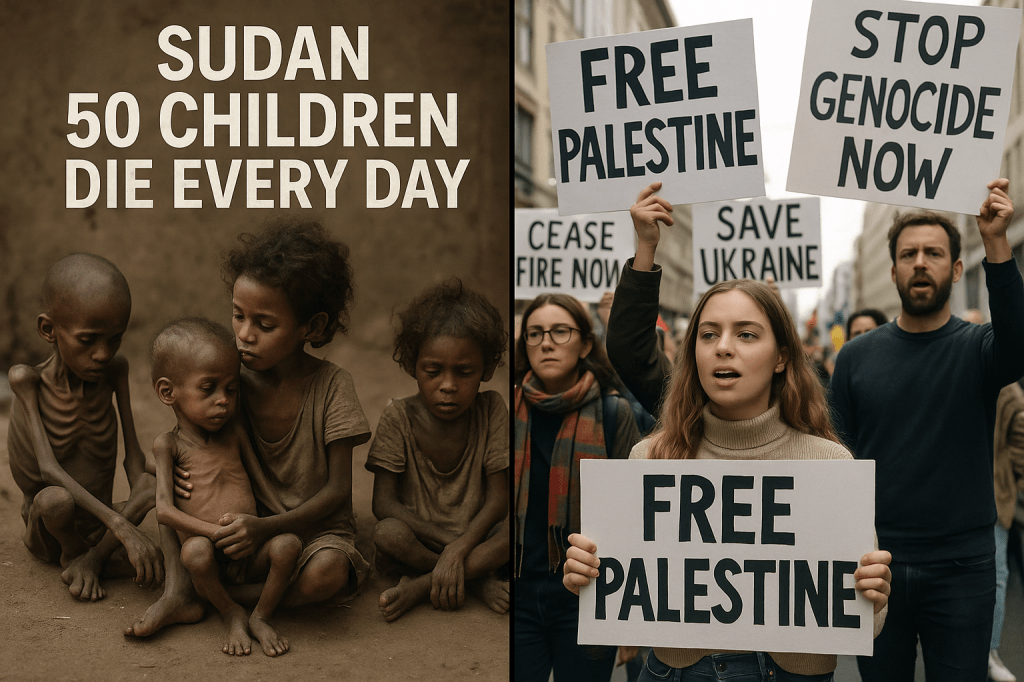
While the world’s attention fixates on Gaza, Sudan experiences what the UN calls “the world’s most severe humanitarian crisis.” The numbers are so staggering they seem almost incomprehensible: 25.6 million people suffering from acute food shortages, with 637,000 facing catastrophic levels of hunger – the highest anywhere in the world. But these aren’t just statistics – they represent human beings, primarily children, dying in agony while the world looks away.
The Integrated Food Security Phase Classification (IPC) declared a state of famine over multiple regions of Sudan in December 2024, including the Abu Shouk and El Salam IDP camps in North Darfur and parts of the Nuba Mountains. This represents the first famine declaration since 2017, yet it barely made international headlines. In these areas, two people out of every 10,000 are dying each day from starvation or malnutrition-related diseases. To put this in perspective, that’s a death rate that would eliminate entire communities within months.
The suffering of Sudan’s children defies comprehension. At least 3.6 million children are acutely malnourished, with over 700,000 having faced acute levels of malnutrition since the start of the war. Recent surveys show Global Acute Malnutrition (GAM) rates exceeding 30% of the under-5 population in multiple areas, with some localities like Tawila reporting a catastrophic 35.5% GAM rate. These children don’t just die – they waste away slowly, their bodies consuming themselves, their cries growing weaker until silence falls.
The Daily Death Toll No One Counts
According to UN officials, 100 Sudanese civilians die from starvation every single day. Let that number sink in – every day, the equivalent of a small village disappears, not from bombs or bullets, but from the preventable horror of starvation. In just the Kalma refugee camp alone, 28 children died of malnutrition coupled with disease in a mere two weeks in May 2024. By October 2024, at least 646 people had died from malnutrition in the Nuba Mountains, while 404 others died in New Fung, Blue Nile State.
The projections for the immediate future are even more horrifying. About 222,000 severely malnourished children and more than 7,000 new mothers are likely to die in the coming months if nutritional support is not provided. This means that while activists spend months organizing protests about detention conditions affecting hundreds, nearly a quarter of a million children face imminent death from starvation. Where are the college campus protests for them? Where are the social media campaigns? Where are the celebrity statements?
Sudan has become “home to the largest child displacement crisis in the world,” yet this dubious distinction brings no international solidarity movements, no boycott campaigns, no viral hashtags. The silence is deafening, and it speaks volumes about how political agendas, not genuine humanitarian concern, drive global attention.
Part 2: Syria – Thirteen Years of Child Slaughter
The Forgotten Graveyard of Childhood
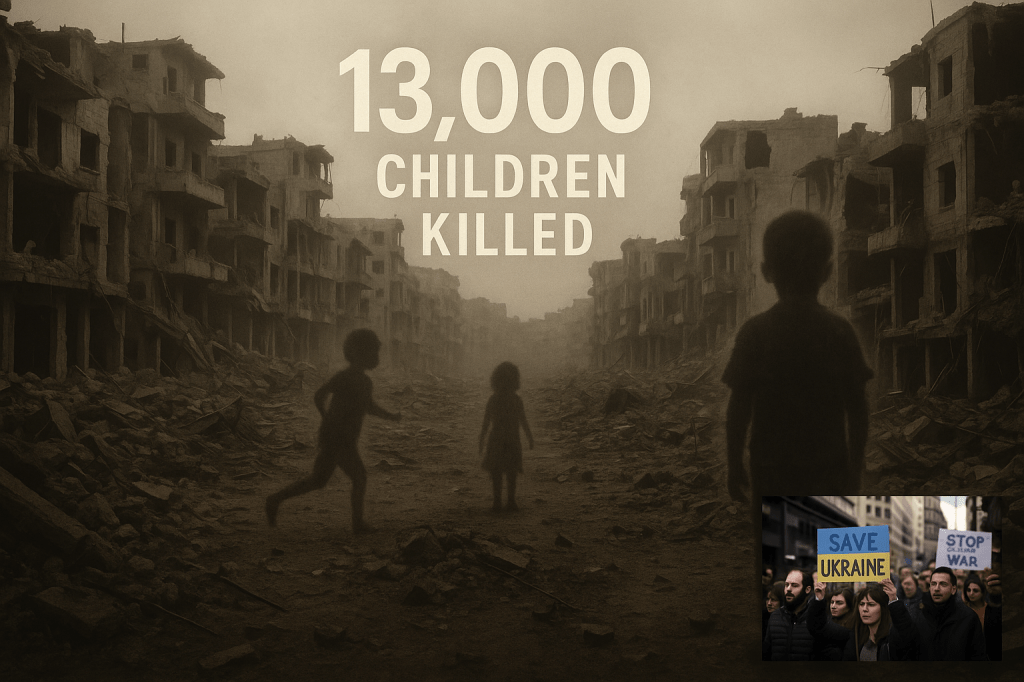
Syria’s children have endured thirteen years of unrelenting horror, yet their suffering has faded from global consciousness like a half-remembered nightmare. In 2024 alone, 1,264 civilians were killed in Syria, including 242 children. These aren’t just numbers – each represents a child with dreams, fears, and potential, snuffed out while the world’s attention drifted elsewhere. The Syrian Network for Human Rights meticulously documents each death, each name, each story, yet these reports generate no trending hashtags, no campus protests, no corporate boycotts.
The scale of violence against Syrian children in 2024 reveals a systematic pattern of targeting the most vulnerable. In just the first half of the year, 65 children were killed. By October, another 25 children had been added to the death toll. Then came the horrific escalation in December, when 503 civilians were killed, including 96 children – representing nearly 20% of all civilian deaths. During one particularly brutal week between November 27 and December 3, 35 children were killed in northwestern Syria, with the Syrian regime responsible for 33 of these child deaths.
What makes Syria’s tragedy even more poignant is the diversity of perpetrators. The Assad regime forces killed 92 children in 2024, Russian forces killed 9 children, Syrian Democratic Forces killed 23 children, and various other parties killed 111 children. This represents a child being killed or maimed on average every eight hours for over a decade – an entire generation growing up where death is more familiar than peace.
The Mathematics of Forgotten Suffering
Consider the grotesque mathematics of global attention: When reports emerge of Palestinian children facing “violent conditions” in detention – conditions that, while concerning, involve temporary incarceration – it generates weeks of media coverage, UN resolutions, and global protests. Meanwhile, Syrian children aren’t detained; they’re directly killed. They’re not facing “increasingly violent conditions”; they’re facing immediate death from barrel bombs, chemical weapons, and targeted strikes on schools and hospitals.
Aleppo governorate, once Syria’s largest city and economic hub, accounted for 27% of all civilian deaths in 2024. Entire neighborhoods that once echoed with children’s laughter now stand as silent monuments to global indifference. Schools that should be filled with learning instead serve as mass graves. Yet where are the university protests for Aleppo’s children? Where are the boycott movements? Where are the social media influencers using their platforms to demand justice?
The December 2024 escalation saw opposition forces launch offensives that resulted in 503 civilian deaths in a single month, with children comprising nearly 20% of victims. Israeli airstrikes across the region killed at least 101 Syrian refugees between September and October 2024, including 36 children. These children weren’t “detained” – they were obliterated. They weren’t facing “harsh conditions” – they faced death. Yet their stories remain untold, their names unspoken in the halls of power where selective outrage determines which children deserve global sympathy.
Part 3: Yemen – The Starvation Capital of the World
Where Childhood Goes to Die
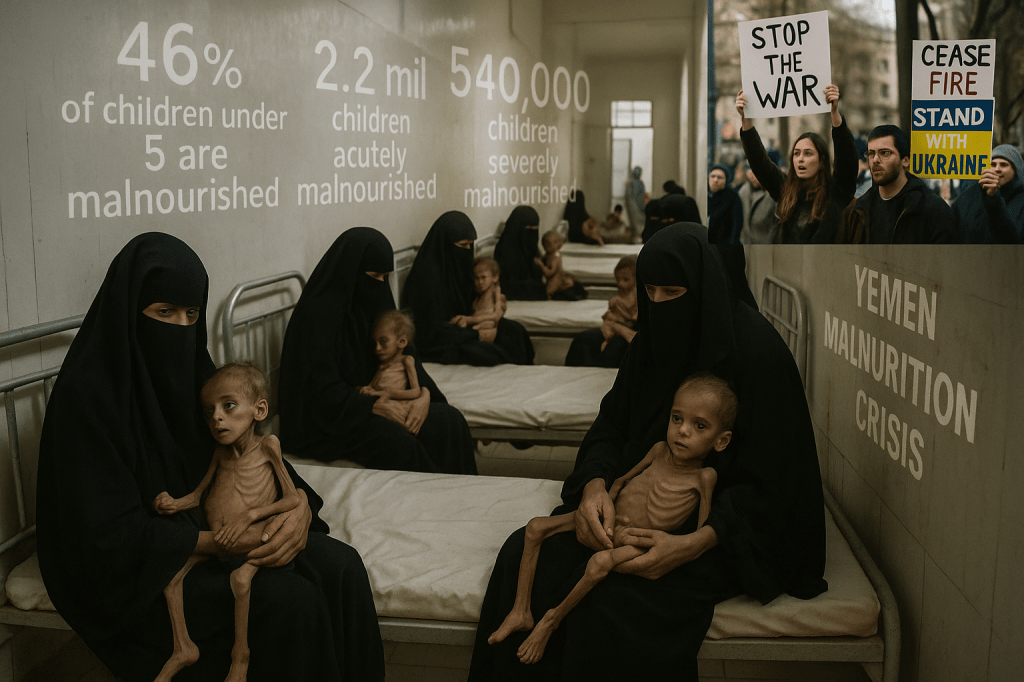
Yemen represents perhaps the cruelest irony in the hierarchy of global attention. Here, in what was already the Arab world’s poorest nation, children don’t face “violent conditions” in detention – they face the slow, agonizing death of starvation in their own homes. The statistics for 2024 paint a picture of suffering so vast it challenges human comprehension: over 600,000 children under five suffering from acute malnutrition, including 120,000 with severe malnutrition. These numbers represent a 34% increase from 2023, meaning the crisis isn’t improving – it’s accelerating while the world looks away.
The Integrated Food Security Phase Classification (IPC) reports reveal that by the end of 2024, an estimated 609,808 children will be acutely malnourished, with 118,570 projected to suffer from severe acute malnutrition. To understand what “severe acute malnutrition” means, imagine a child’s body literally consuming itself – muscle tissue breaking down, organs failing, the immune system collapsing. These children don’t have the energy to cry anymore. They lie still, their enlarged eyes the only sign of life in skeletal frames that barely resemble human children.
The geographic distribution of Yemen’s child starvation crisis reveals systematic suffering across the nation. Two districts in Hodeidah and one in Taiz have reached IPC Phase 5 – the worst possible classification, where famine conditions mean at least 20% of the population faces extreme food shortages, acute malnutrition rates exceed 30%, and two out of every 1,000 people die from starvation daily. Four additional districts are expected to reach this catastrophic phase by late 2024. Yet these apocalyptic conditions generate no emergency UN Security Council sessions, no global days of action, no celebrity fundraising concerts.
The Silent Holocaust
The long-term impact of Yemen’s crisis extends beyond immediate deaths. According to the World Food Programme, 1.3 million pregnant or nursing women and 2.2 million children under five – nearly half of Yemen’s young children – suffer from acute malnutrition. Additionally, around 222,918 pregnant and breastfeeding women are expected to be malnourished, meaning the next generation is being destroyed before they’re even born. These mothers watch their children waste away while their own bodies fail to produce breast milk due to malnutrition – a cruel cycle of starvation passed from mother to child.
The UN estimates that by the end of 2021, Yemen’s conflict had claimed more than 377,000 lives, with 60% resulting from hunger, disease, and lack of healthcare facilities rather than direct violence. Using UN data, Save the Children calculated that approximately 84,701 children with Severe Acute Malnutrition may have died between April 2015 and October 2018 alone. These deaths didn’t occur in detention facilities or during military operations – they happened in homes, in refugee camps, in hospitals without medicine, where children simply faded away while the world debated other conflicts.
Yemen’s children face what experts call “the world’s worst humanitarian crisis,” yet this designation brings no mass mobilization of global conscience. While protesters fill streets over detention conditions affecting hundreds, over 2.7 million Yemeni children suffer from acute malnutrition and 49% of children are stunted – permanent physical and mental damage that will affect them for life, assuming they survive at all. The fragility of Yemen’s children is so severe that a simple case of diarrhea becomes a death sentence, a minor infection becomes fatal, a cut that won’t heal becomes gangrene. This is the reality for millions, yet their suffering remains invisible to a world obsessed with more politically convenient narratives.
Part 4: Afghanistan – Where Being Born Is a Death Sentence
The Graveyard of Innocence
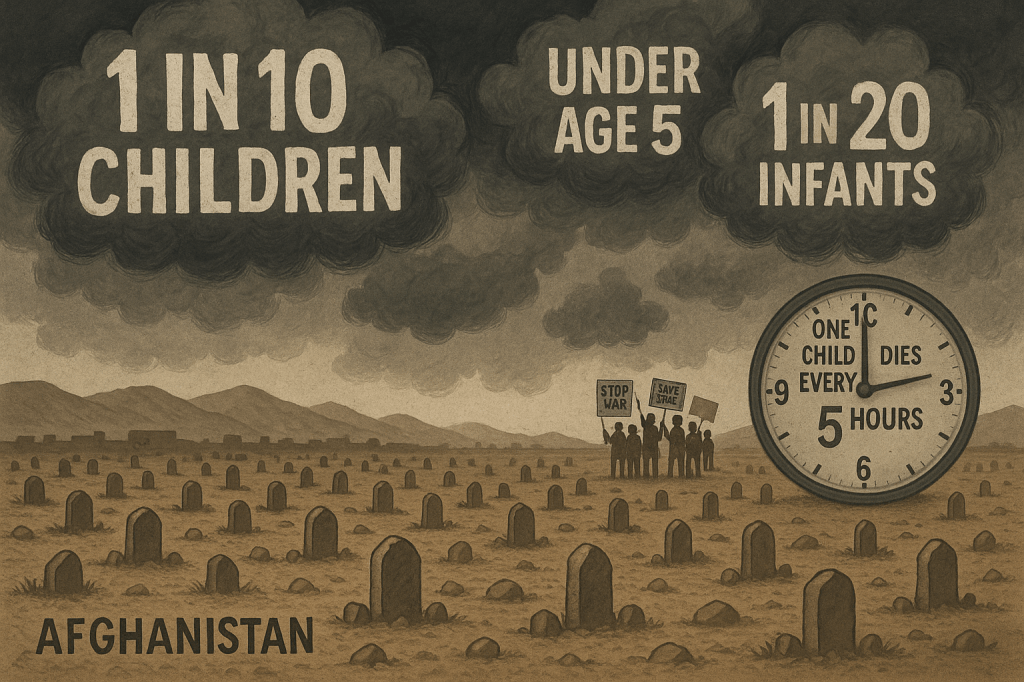
Afghanistan holds a distinction no nation should bear: it has the highest child and infant mortality rates globally, with 43 deaths per 1,000 live births. This means that in Afghanistan, simply being born is often a death sentence. While the world debates detention conditions, Afghan children don’t live long enough to be detained – they die in their mothers’ arms, in mud-brick homes, in camps scattered across a land that has known nothing but war for generations. This represents not just a humanitarian crisis but a complete collapse of human civilization’s most basic function: protecting its young.
The 2024 research published on Afghanistan’s child mortality crisis reveals a horror show of contributing factors: birth defects from decades of chemical exposure, preterm births with no neonatal care, malnutrition so severe it prevents normal development, sudden infant death syndrome in families sleeping in freezing conditions, traumatic injuries from unexploded ordinance, fatal infections with no antibiotics available, and even infanticide and abuse in communities pushed beyond the breaking point by perpetual crisis. Each factor alone would constitute a emergency; together, they create an apocalypse for children.
The statistics paint a picture of systematic extinction: 45% of deaths among children under 5 in lower and middle-income Afghan families are linked to undernutrition. With 95% of households having inadequate intake of nutritious food, at least 1 million children were expected to die in 2021 alone from severe malnutrition. By 2024, 92% of the population faces some level of food insecurity, and 3 million children are at risk of acute malnutrition. These aren’t projections or estimates – they’re real children dying real deaths while the world’s attention remains fixated elsewhere.
Twenty Years of Slaughter
The historical context makes Afghanistan’s current crisis even more damning for global conscience. Over the past 20 years, almost 33,000 children have been killed or maimed in Afghanistan – an average of one child every five hours for two decades. As of May 2023, more than 7.6 million children under five in post-9/11 war zones suffered from acute malnutrition. This represents not just a humanitarian failure but a complete abandonment of an entire generation of children.
Afghanistan remains one of the most dangerous places in the world to be born, to be a child, or to be a mother. Access to hospitals or health facilities is beyond the reach of most Afghans, with thousands of women dying yearly from pregnancy-related causes that would be easily preventable with basic medical care. The country’s healthcare system hasn’t just collapsed – in many areas, it never existed. Children die from conditions that haven’t killed children in developed nations for a century: measles, diarrhea, pneumonia, malnutrition.
Yet where is the global outrage for Afghanistan’s children? Where are the UN emergency sessions? Where are the college students camping on lawns demanding action? The silence is deafening. While activists mobilize over detention conditions affecting hundreds, a million Afghan children face death from starvation. While social media campaigns trend over temporary incarcerations, Afghan children are permanently incarcerated in a cycle of death that claims one every five hours. This selective blindness reveals that global humanitarian concern is driven not by the scale of suffering but by political convenience and media manipulation.
Part 5: Democratic Republic of Congo – The Invisible Holocaust
Six Million Dead in Media Silence
Perhaps no conflict better illustrates the selective nature of global outrage than the Democratic Republic of Congo, where 6 million people have died in conflict since 1998 – a death toll exceeding the Holocaust – yet it remains virtually invisible in international consciousness. In 2024 alone, ongoing violence killed at least 1,211 civilians in just Ituri province between January and October, including countless children, while the world’s attention remained fixated on conflicts that fit more convenient political narratives.
The scale of suffering in the DRC defies comprehension: 7.3 million people internally displaced by conflict as of April 2024, making it one of the largest displacement crises in the world. 21 million people need humanitarian aid – the highest figure globally according to the UN. 400,000 women are raped each year, the highest rate of sexual violence in the world, with victims as young as nine years old. Yet where are the protests? Where are the boycotts? Where are the viral social media campaigns?
The violence against children in the DRC encompasses every possible horror: militia fighters targeting camps for displaced people, killing women and children indiscriminately; mass rapes with victims as young as nine; forced recruitment of child soldiers; entire families fleeing into forests where children die from exposure and starvation. The Allied Democratic Forces alone killed 1,000 civilians in eastern DRC in 2023, many of them children, yet these deaths generate no international solidarity movements.
The Perfect Storm of Suffering
What makes the DRC’s crisis particularly tragic is its combination with other catastrophes. Forced displacement in 2024 worsened an already dire humanitarian emergency, with 27 million people needing support due to conflict, food insecurity, climate impacts, and epidemics. Children don’t just face one threat – they face all of them simultaneously: fleeing violence only to die from preventable diseases in overcrowded camps, escaping militias only to face starvation, surviving sexual violence only to die from lack of medical care.
Between January and March 2024 alone, fighting displaced over 738,000 people, many of them children who lost their homes, schools, and any semblance of normal childhood. These children don’t make headlines because their suffering doesn’t fit convenient political narratives. They die in silence because their deaths can’t be weaponized for ideological purposes. They suffer in darkness because shedding light on their plight would reveal the hypocrisy of selective humanitarian concern.
The international community’s abandonment of the DRC’s children represents perhaps the clearest evidence that global humanitarian concern is driven by politics, not compassion. Six million dead generates less outrage than detention conditions affecting hundreds. 400,000 rapes annually creates fewer protests than temporary incarcerations. 27 million people needing humanitarian aid attracts less attention than conflicts that serve political agendas. This isn’t humanitarianism – it’s theatrical performance using human suffering as props.

Part 6: The Mathematics of Selective Outrage
When Numbers Don’t Matter
Let’s engage in a simple mathematical exercise that exposes the grotesque nature of selective humanitarian concern. According to Save the Children’s report that sparked this discussion, Palestinian children in Israeli detention face “increasingly violent conditions.” Let’s generously assume this affects 1,000 children (likely an overestimate). Now let’s compare this to the ignored catastrophes:
Sudan: 222,000 children likely to die from starvation in coming months – that’s 222 times more children facing death, not detention. Yemen: 609,808 children acutely malnourished by end of 2024 – that’s 610 times more children suffering life-threatening conditions. Afghanistan: 3 million children at risk of acute malnutrition – that’s 3,000 times more children in mortal danger. Syria: 242 children killed in 2024 alone – these children aren’t detained, they’re dead. DRC: 6 million total conflict deaths since 1998 – a Holocaust-level catastrophe that generates no comparable outrage.
If humanitarian concern were genuine, if child welfare were truly the priority, these numbers would drive global action. The fact that they don’t reveals an uncomfortable truth: the intensity of global outrage is inversely proportional to the scale of suffering when that suffering doesn’t serve political purposes. A detained child in one conflict generates more activism than a thousand starving children in another. This isn’t humanitarianism – it’s political theater performed on the graves of ignored children.
The Currency of Attention
In our modern attention economy, outrage has become currency, and like all currencies, it’s subject to manipulation. The Palestinian cause, regardless of one’s position on it, has become a profitable brand in the activism marketplace. It generates clicks, engagement, and social capital. Supporting it signals tribal belonging and ideological purity in certain circles. This isn’t to diminish Palestinian suffering but to highlight how even genuine grievances can be commodified while greater suffering remains unmarketable.
Consider the infrastructure of selective outrage: Palestinian solidarity generates conferences, academic departments, NGO funding, and career opportunities. It produces bestselling books, viral content, and speaking engagements. Meanwhile, advocating for Sudanese children dying of starvation generates… nothing. No tenure track positions for Sudan Studies. No viral hashtags for Yemen’s starving children. No celebrity endorsements for Afghanistan’s dying infants. No corporate diversity statements about Congolese suffering. The economic incentives align entirely with selective rather than proportional humanitarian concern.
This commodification of suffering creates a perverse hierarchy where a child’s value is determined not by their humanity but by their political utility. A detained Palestinian child becomes a symbol worthy of global campaigns, while a starving Sudanese child remains a statistic. A child facing “violent conditions” in detention generates UN resolutions, while a Yemeni child dying of malnutrition generates silence. This isn’t justice – it’s the weaponization of compassion for political gain.

Part 7: The Spiritual Crisis Behind Selective Outrage
When Politics Replaces Piety
The Quran provides profound insight into why humanity falls into these patterns of selective outrage and misplaced priorities. We’ve replaced worship of God with worship of causes, substituted political activism for spiritual development, and exchanged eternal perspective for temporal obsessions. This spiritual crisis manifests in how we respond to human suffering – not with universal compassion guided by divine wisdom, but with selective outrage driven by worldly agendas.
Consider this fundamental Quranic principle:
[9:24] “Say, ‘If your parents, your children, your siblings, your spouses, your family, the money you have earned, a business you worry about, and the homes you cherish are more beloved to you than God and His messenger, and striving in His cause, then wait until God brings His judgment. God does not guide the wicked people.’”
This verse exposes the root problem: we’ve made worldly attachments – including political causes – more beloved than God. We spend more time protesting for earthly justice than praying for divine guidance. We’re more passionate about temporal conflicts than eternal salvation. This misalignment of priorities doesn’t just affect our spiritual state – it corrupts our humanitarian impulses, making them selective and politically motivated rather than universal and divinely inspired.
The Quran repeatedly warns against becoming overly attached to worldly matters:
[57:20] “Know that this worldly life is nothing but play and games, and boasting among you, and an increase in wealth and children. It is like a rain that produces plants and pleases the disbelievers. But then it withers and you see it turn yellow, then it becomes useless hay. And in the Hereafter there is severe retribution, and forgiveness from God, and approval. This worldly life is nothing but a deceitful illusion.”
Our obsession with certain conflicts while ignoring others reveals that we’ve been deceived by this worldly illusion. We’ve turned humanitarian concern into a competitive sport where teams are chosen based on political ideology rather than human need. This isn’t the universal compassion God commands – it’s the selective tribalism He condemns.
The Idolatry of Causes
Modern activism has become a form of idolatry where causes replace God as objects of worship. People derive their identity, purpose, and community from political movements rather than divine submission. They perform rituals of protest with more devotion than prayer, study political theory with more dedication than scripture, and evangelize for causes with more zeal than for God. This replacement of divine worship with cause worship explains why humanitarian concern becomes selective – idols, unlike God, demand exclusive loyalty.
The Quran addresses this directly:
[25:43] “Have you seen the one whose god is his own ego? Will you be his advocate?”
When causes become gods and egos drive activism, humanitarian concern inevitably becomes selective. We champion suffering that flatters our ideological egos while ignoring suffering that doesn’t. We protest injustices that elevate our social status while overlooking injustices that don’t generate social capital. This isn’t righteousness – it’s narcissism disguised as compassion.
The solution isn’t to abandon humanitarian concern but to ground it in divine guidance rather than political ideology. When we truly submit to God, our compassion becomes universal because God’s mercy encompasses all. When we prioritize eternal perspective over temporal politics, we see all suffering as worthy of attention, not just suffering that serves our agendas.

Part 8: The Quranic Prescription – Focusing on What Truly Matters
Divine Priorities Versus Human Obsessions
The Quran provides clear guidance on where our focus should lie, and it’s not on endlessly debating worldly conflicts while neglecting our spiritual obligations. God reminds us repeatedly that this earthly life is temporary and that our obsession with it distracts from our true purpose:
[29:64] “This worldly life is nothing but vanity and play, while the abode of the Hereafter is the real life, if they only knew.”
While people exhaust themselves in political battles, sharing conflict videos, organizing protests, and engaging in endless debates about worldly justice, they neglect the very purpose of their existence – worshiping God and preparing for eternal life. The hours spent on social media arguing about conflicts could be spent in prayer. The energy devoted to political activism could be channeled into spiritual development. The passion for earthly causes could be redirected toward the cause of God.
The Quran warns specifically about becoming distracted by worldly concerns:
[63:9] “O you who believe, do not let your money and your children divert you from remembering God. If they do, then you are the losers.”
If money and children – legitimate concerns – can become distractions from God, how much more so can political obsessions? How many believers check conflict updates more than they recite Quran? How many know more about military operations than divine revelations? How many can name political leaders but not prophets? This misalignment of knowledge reveals misaligned priorities.
The Eternal Perspective
The Quran consistently calls us to maintain eternal perspective in the face of worldly trials:
[2:155-157] “We will surely test you through some fear, hunger, and loss of money, lives, and crops. Give good news to the steadfast. When an affliction befalls them, they say, ‘We belong to God, and to Him we are returning.’ The steadfast will have blessings and mercy from their Lord; they are the guided ones.”
Notice how this passage frames suffering – not as political injustice requiring endless activism, but as tests requiring steadfast faith. The response to affliction isn’t organizing protests but remembering our return to God. This doesn’t mean accepting injustice passively, but it means maintaining proper perspective: all earthly suffering is temporary, while our relationship with God is eternal.
The Quran provides the ultimate reality check:
[3:185] “Every soul will taste death, then to us you will be ultimately returned. The righteous among you we will surely admit into gardens with flowing streams; they abide therein forever. What a beautiful reward for the workers.”
Every child suffering in Sudan, Syria, Yemen, Afghanistan, DRC, Palestine, and everywhere else will ultimately return to God. The question isn’t which earthly cause we championed but whether we maintained our faith and righteousness. The activists who spent their lives fighting for political causes while neglecting prayer will face the same judgment as those they opposed. Only those who maintained their focus on God while showing universal compassion will find true success.

Part 9: The Danger of Making Politics Your Religion
When Activism Becomes Apostasy
Perhaps the greatest danger in our obsession with worldly conflicts is how it subtly replaces religion itself. Modern political movements demand the same total devotion, community belonging, and identity formation that religion provides. They have their own prophets (political leaders), scriptures (ideological texts), rituals (protests and campaigns), communities (activist groups), and even promise of salvation (political utopia). This isn’t coincidental – it’s replacement theology where politics becomes the new religion.
The Quran warns explicitly about this replacement:
[45:23] “Have you noted the one whose god is his ego? Consequently, God sends him astray, despite his knowledge, seals his hearing and his mind, and places a veil on his eyes. Who then can guide him, after God? Would you not take heed?”
When political ideology becomes our god, we become blind to truth that contradicts our narrative. We seal our hearing to suffering that doesn’t serve our agenda. We veil our eyes from atrocities that complicate our worldview. This is why activists can ignore millions dying in Sudan while obsessing over hundreds detained elsewhere – their political god demands selective vision.
The Quran describes the fate of those who prioritize worldly matters over divine guidance:
[18:103-104] “Say, ‘Shall I tell you who the worst losers are? They are the ones whose efforts in this life are totally astray, but they think that they are doing good.’”
How perfectly this describes modern political activists who believe their selective outrage and biased humanitarianism constitute righteousness! They exhaust themselves in political battles while their prayers are abandoned, their scripture is unread, and their souls are empty. They think they’re doing good by championing certain causes while ignoring greater suffering elsewhere. They’ve replaced universal divine compassion with tribal political loyalty.
The Test of True Faith
God tests our faith not through easy choices but through challenges that reveal our true priorities:
[2:214] “Do you expect to enter Paradise without being tested like those before you? They were tested with hardship and adversity, and were shaken up, until the messenger and those who believed with him said, ‘Where is God’s victory?’ God’s victory is near.”
The test isn’t whether we can identify injustice – even Satan recognizes injustice. The test is whether we maintain divine perspective in the face of worldly trials. Do we respond to suffering with universal compassion guided by God, or with selective outrage guided by politics? Do we seek God’s victory through submission and prayer, or worldly victory through endless conflict?
The modern obsession with political causes, particularly the selective focus on certain conflicts while ignoring others, represents a failure of this test. It reveals hearts more attached to worldly tribes than divine truth, more passionate about temporal justice than eternal judgment, more devoted to political movements than divine commandments. This isn’t the path of believers – it’s the path of those who’ve made politics their religion.

Part 10: Returning to God – The Only Solution
Breaking Free from the Cycle
The solution to selective outrage and misplaced priorities isn’t more activism or better politics – it’s returning to God. The Quran provides the prescription for humanity’s ailments, including our distorted response to human suffering:
[13:28] “They are the ones whose hearts find comfort in remembering God. Absolutely, by remembering God, the hearts find comfort.”
Hearts that find comfort in God don’t need to seek validation through political causes. They don’t require the dopamine hit of social media outrage. They don’t derive identity from tribal conflicts. When we truly remember God, our hearts find the comfort that political activism falsely promises but never delivers. This comfort then enables universal compassion rather than selective outrage.
The Quran commands us to maintain proper priorities:
[2:177] “Righteousness is not turning your faces towards the east or the west. Righteous are those who believe in God, the Last Day, the angels, the scripture, and the prophets; and they give the money, cheerfully, to the relatives, the orphans, the needy, the traveler, the beggars, and to free the slaves; and they observe the Contact Prayers (Salat) and give the obligatory charity (Zakat); and they keep their promises whenever they make a promise; and they steadfastly persevere in the face of persecution, hardship, and war. These are the truthful; these are the righteous.”
Notice the comprehensive nature of true righteousness – it includes helping all categories of needy people, not just those who belong to our political tribe. It emphasizes prayer and charity as fundamental practices, not optional additions to political activism. It values keeping promises and persevering through hardship over winning political battles. This is the balanced, divinely guided approach that modern humanity has abandoned.
The Universal Compassion of Divine Guidance
When we truly submit to God, our compassion naturally becomes universal because we’re reflecting divine attributes:
[21:107] “We have sent you as a mercy to all the worlds.”
God’s mercy isn’t selective – it encompasses all worlds, all peoples, all children. When we align ourselves with divine will rather than political ideology, our compassion similarly expands. We mourn for the Sudanese child dying of starvation as deeply as any other. We ache for the Syrian child killed by bombs regardless of who dropped them. We grieve for the Yemeni child wasting away without asking about their tribe. We suffer with the Afghan child facing impossible odds without checking their politics. This is the universal compassion that comes from divine guidance rather than political programming.
The Quran provides the ultimate guidance for our times:
[3:31] “Say, ‘If you love God, then follow me; God will then love you and forgive your sins. God is Forgiver, Most Merciful.’”
The path forward isn’t through more sophisticated political analysis or better organized protests – it’s through following divine guidance with complete submission. When we love God truly, we naturally develop proper priorities. When God loves us in return, we receive the guidance to navigate worldly trials without losing eternal perspective. When our sins are forgiven, we’re freed from the ego-driven activism that creates selective outrage.
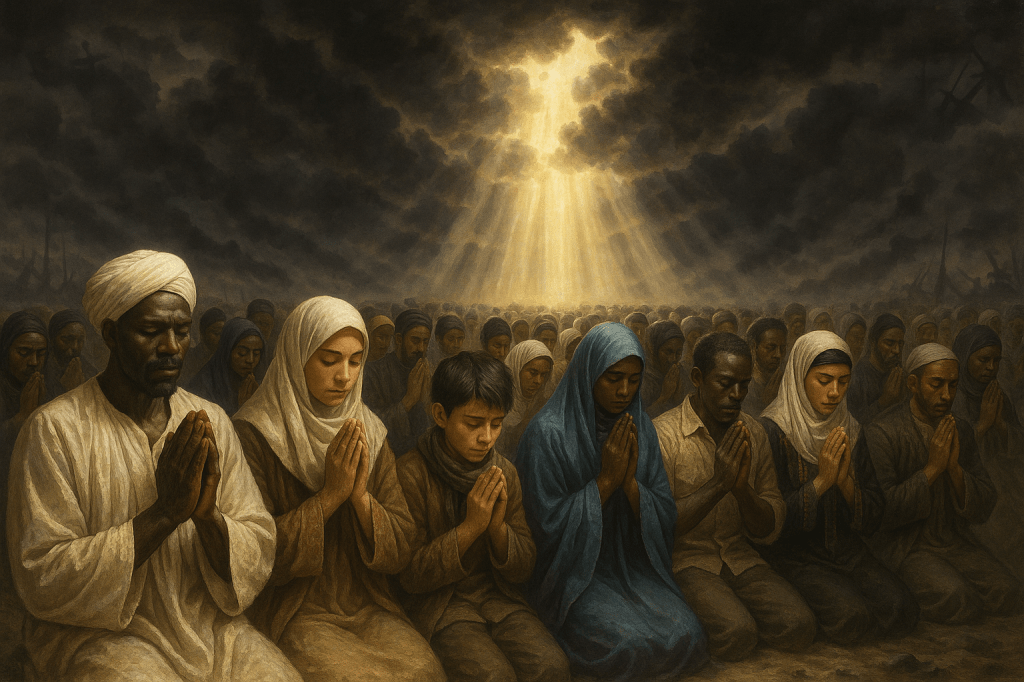
Conclusion: The Choice Before Humanity
The evidence presented in this analysis leads to an undeniable conclusion: humanity’s selective outrage over certain conflicts while ignoring far greater catastrophes reveals not genuine humanitarian concern but political manipulation of human suffering. While hundreds of Palestinian children in detention generate global protests, 222,000 Sudanese children face imminent death from starvation in silence. While activists organize boycotts over Gaza, 100 Sudanese die daily from hunger without a single trending hashtag. While social media floods with content about one conflict, 473 million children worldwide suffer in conflict zones with 2024 being one of history’s worst years for children in war.
The numbers speak truth that propaganda cannot hide: Sudan’s 3.6 million malnourished children, Yemen’s 609,808 acutely malnourished children, Afghanistan’s highest global child mortality rate, Syria’s 242 children killed in 2024 alone, and DRC’s 6 million conflict deaths represent catastrophes that dwarf the situations that dominate global attention. Yet these children die in media darkness because their suffering doesn’t serve political agendas, doesn’t generate social capital, and doesn’t fit convenient narratives.
But the deeper tragedy isn’t just selective humanitarian concern – it’s how this obsession with worldly conflicts has replaced our relationship with God. We’ve made political causes our religion, protests our prayers, and activism our worship. We check conflict updates more than we read scripture, know more about military operations than divine revelations, and show more passion for earthly justice than eternal salvation. This is the idolatry of our age – not golden calves but golden causes that demand our total devotion while leading us away from God.
The Quran’s guidance is clear: this worldly life is temporary illusion, and our obsession with it distracts from our true purpose. Every soul will taste death and return to God, where the only questions that matter are whether we maintained our faith, showed universal compassion as God commands, and prioritized eternal life over temporal conflicts. The activists exhausting themselves in political battles while neglecting prayer will face the same judgment as those they oppose. Only those who maintained divine perspective while helping all who suffer – not just those who serve their agenda – will find true success.
The choice before humanity is stark: continue down the path of selective outrage, political idolatry, and spiritual emptiness, or return to God with sincere submission, universal compassion, and proper priorities. The millions of children suffering in ignored conflicts don’t need more selective activism – they need humanity to rediscover divine guidance that commands helping all who suffer. They don’t need political movements that use their pain for ideological purposes – they need believers who see all suffering as worthy of compassion because all souls return to the same Creator.
As this analysis concludes, the call to action isn’t for more protests, better organized campaigns, or sophisticated political strategies. The call is for something far more radical: return to God. Put down the protest signs and pick up the prayer mat. Stop scrolling through conflict updates and start reading divine revelation. Cease the endless political debates and begin the eternal spiritual journey. Transform selective outrage into universal compassion guided by the One who created all children equally deserving of our concern.
The path forward isn’t through winning political battles but through winning divine pleasure. Not through championing certain causes while ignoring others but through submitting to the Cause of all causes. Not through tribal loyalty but through universal brotherhood under God. This is the message humanity desperately needs but stubbornly resists: that our obsession with worldly conflicts blinds us to eternal realities, our selective outrage reveals spiritual sickness, and our only cure is returning to God with complete submission.
Let the millions of ignored children – starving in Sudan, dying in Syria, wasting away in Yemen, perishing in Afghanistan, suffering in DRC – serve not as pawns in political games but as reminders of our universal obligation to show mercy as God shows mercy, to care for all as God cares for all, and to maintain eternal perspective in the face of temporary trials. Their suffering calls us not to selective activism but to universal compassion. Their pain points us not to political solutions but to divine guidance. Their cries reach not to earthly powers but to the heavenly throne where true justice resides.
The final message is simple yet profound: Stop making worldly conflicts your religion. Return to making God your only deity, His guidance your only ideology, and His pleasure your only goal. In this return lies the solution not just to selective outrage but to all of humanity’s ailments. For when we truly submit to God, we naturally develop the universal compassion, proper priorities, and eternal perspective that our fractured world desperately needs.
[3:160] “If God supports you, none can defeat you. And if He abandons you, who else can support you? In God the believers shall trust.”


 Quran Only Studies
Leave a comment