Introduction: The Fatal Transformation from Behavior to Identity
In the divine architecture of human salvation, God establishes a precise hierarchy that determines eternal destiny. This hierarchy is not based on tribal affiliation, religious labels, or outward rituals, but on the fundamental orientation of the soul – whether it maintains integrity or fragments into duplicity. The Quran presents a devastating truth: while believers who sin can repent and return, hypocrites undergo a transformation so complete that their very identity becomes corrupted, placing them in the lowest pit of Hell, below even those who openly reject faith.
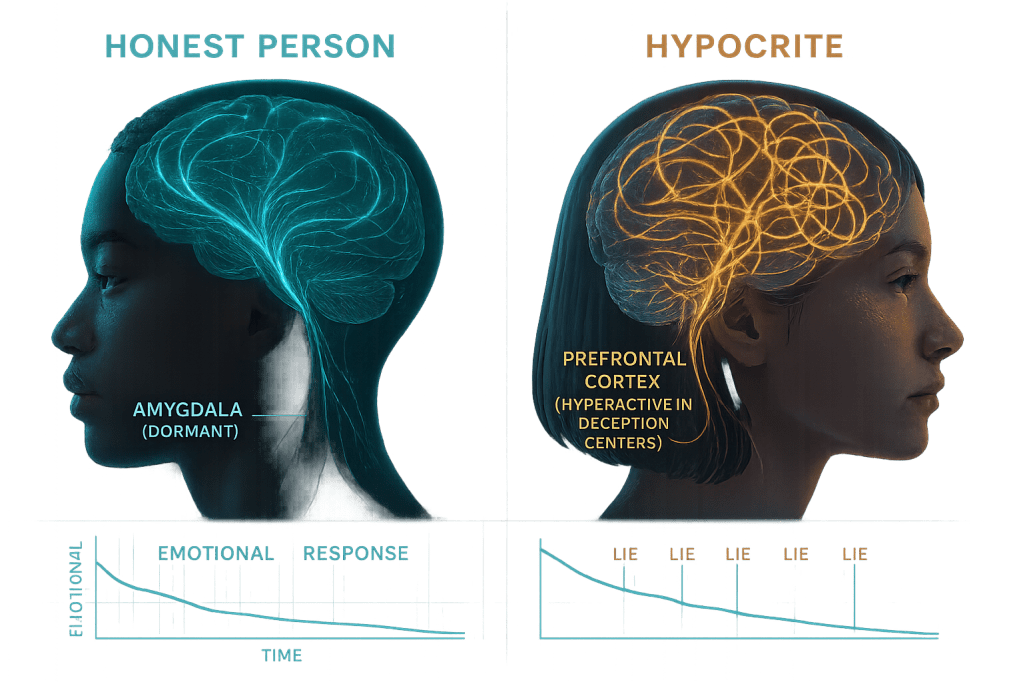
The distinction between hypocrite identity and hypocrite behavior represents one of the most critical differentiations in scripture. A believer may lie, may fail, may sin – these are behaviors subject to repentance and forgiveness. But when duplicity penetrates so deeply that it rewires the neural architecture of consciousness, when maintaining dual allegiances becomes the core operating system of existence, the person transforms from someone who commits hypocrisy into someone who IS a hypocrite. This metamorphosis from action to essence, from behavior to being, determines not just spiritual rank but eternal destiny.
The core question: What transforms someone from a believer who fails into a hypocrite who cannot return? The answer lies not in the severity of sins but in the fundamental orientation of identity. When duplicity shifts from occasional failure to core essence, when ego worship replaces God worship, when doubt becomes entrenched rather than transitional – the person crosses from behavior into identity.
Part 1: The False Witness – When Truth Becomes Lie
The Impossibility of Their Testimony
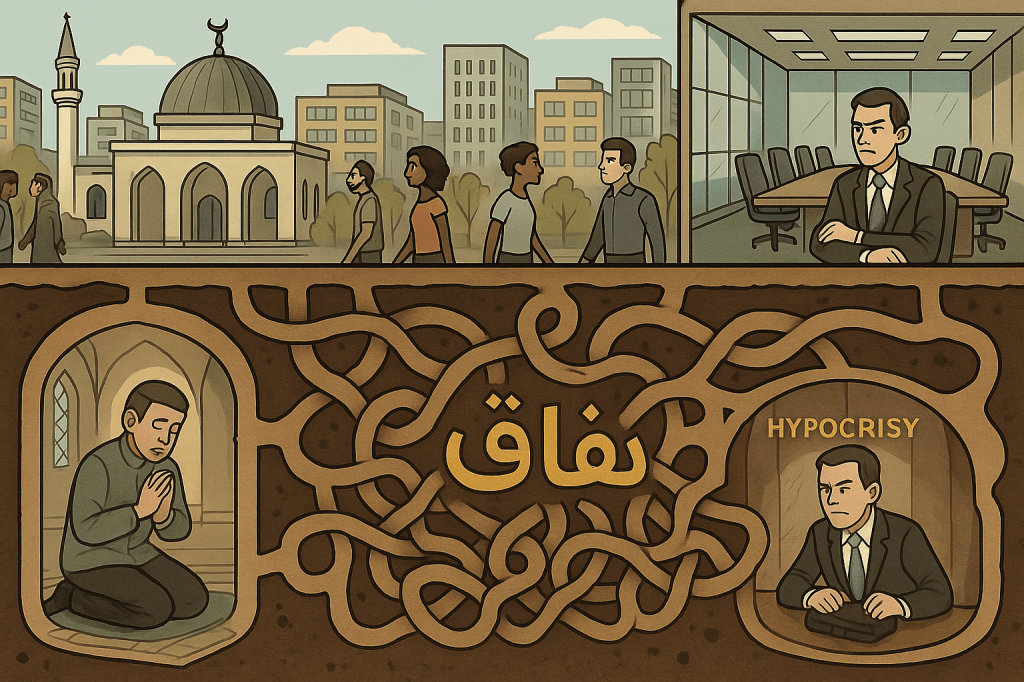
The Arabic root ن-ف-ق (n-f-q) describes a tunnel with two openings – the hypocrite maintains secret passages between incompatible worlds. The form munāfiq (مُنَافِق) indicates active, continuous duplicity, not passive failure.
[63:1] “When the hypocrites come to you they say, ‘We bear witness that you are the messenger of God.’ God knows that you are His messenger, and God bears witness that the hypocrites are liars.”
The hypocrites claim to “bear witness” (nash-hadu) – but this is impossible. To bear witness means to testify to something you’ve observed directly. They weren’t present when Gabriel pulled the revelations from Muhammad’s memory. They didn’t witness the divine appointment. They cannot testify to what they haven’t seen. Their use of “witness” exposes their fundamental lie – they adopt religious language without genuine experience, performing testimony without actual observation. God calls them liars not because the content is false (Muhammad is indeed the messenger) but because they claim witness to what they never witnessed, revealing their core duplicity.
Part 2: The Hierarchy Revealed – Five Levels of Human Destiny
Understanding the Divine Classification
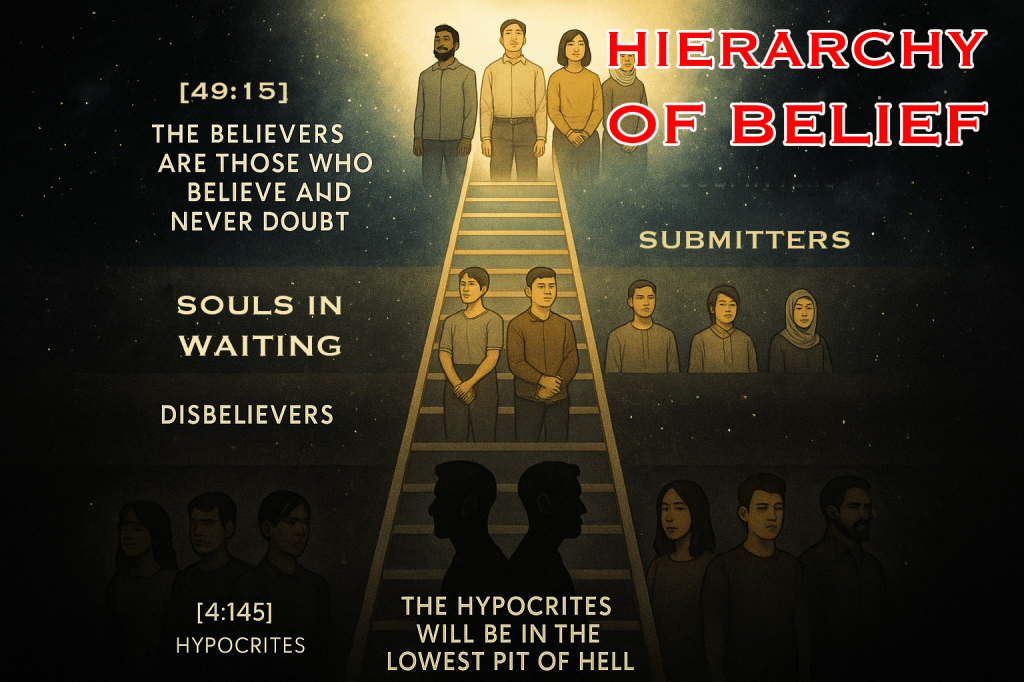
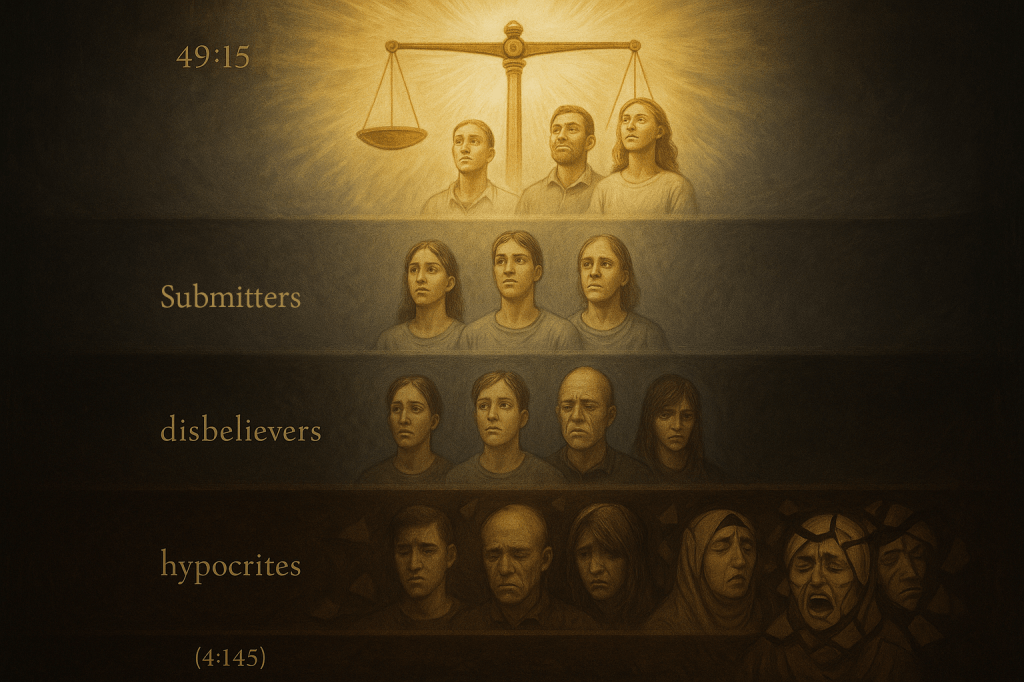
God establishes a clear hierarchy of human spiritual states, each with distinct characteristics and eternal consequences. This is not arbitrary categorization but reflects fundamental orientations of the soul:
[49:14-15] “The Arabs said, ‘We are mu’mins (believers).’ Say, ‘You have not believed; what you should say is, “We are muslims (submitters),” until belief enters your hearts.’ If you obey God and His messenger, He will not put any of your works to waste. God is Forgiver, Most Merciful. Mu’mins (believers) are those who believe in God and His messenger, then attain the status of having no doubt whatsoever, and strive with their money and their lives in the cause of God. These are the truthful ones.”
This passage establishes the crucial distinction between muslims (submitters) and mu’mins (believers). The hierarchy descends as follows:
Level 1: Al-Mu’minūn (The Believers) – Those who have achieved certainty, who never doubt, who strive with their wealth and lives. Their faith has penetrated their hearts completely. They represent the highest spiritual achievement, where submission transforms into unshakeable conviction. Neuroscientific studies on deep meditators and those with profound spiritual conviction show increased grey matter density in regions associated with emotional regulation and self-awareness – their brains literally restructure around their faith.
Level 2: Al-Muslimūn (The Submitters) – Those who submit to God’s will but haven’t yet achieved the certainty of believers. They follow commandments, perform rituals, live righteously, but belief hasn’t fully penetrated their hearts. They represent the majority of religious practitioners – sincere but still developing, committed but still questioning. This is not a shameful state but a recognized stage of spiritual development.
Level 3: Minimum Requirements for Salvation – The Quran repeatedly emphasizes three requirements that transcend religious labels:
[2:62] “Surely, those who believe, those who are Jewish, the Christians, and the converts; anyone who (1) believes in God, and (2) believes in the Last Day, and (3) leads a righteous life, will receive their recompense from their Lord. They have nothing to fear, nor will they grieve.”
These three criteria – belief in God, belief in accountability, and righteous action – constitute the minimum for salvation. This includes those who never received clear scripture, those who followed previous revelations sincerely, and those whose souls haven’t grown enough for the full test, as explained in Appendix 11 of The Final Testament.
Level 4: Al-Kāfirūn (The Disbelievers) – Those who consciously reject faith after receiving clear evidence. Their disbelief stems from arrogance, ego worship, or attachment to worldly systems that conflict with divine command. They choose their path with open eyes, preferring temporary gains over eternal truth. Recent studies on decision-making show that those who consistently choose immediate gratification over long-term benefit develop weakened prefrontal cortex activity – the brain’s executive control center.
Level 5: Al-Munāfiqūn (The Hypocrites) – The lowest level, below even open disbelievers:
[4:145] “The hypocrites will be committed to the lowest pit of Hell, and you will find no one to help them.”
Why are hypocrites placed below disbelievers? Because disbelievers at least maintain integrity in their rejection. Hypocrites corrupt the very concept of truth, creating cognitive tunnels that damage not only themselves but entire communities. They spread doubt among believers, provide comfort to disbelievers, and create confusion about divine truth.
Part 3: The Core Identity Markers of a Hypocrite
What Makes Someone a Hypocrite vs. a Failing Believer
Marker 1: They Worship Their Own Ego
[25:43] “Have you seen the one whose god is his own ego? Will you be his advocate?”
[45:23] “Have you noted the one whose god is his ego? Consequently, God sends him astray, despite his knowledge, seals his hearing and his mind, and places a veil on his eyes.”
The hypocrite’s fundamental identity: ego worship. Their own desires, image, and benefit become their deity. Every religious act serves self-interest. This differs fundamentally from believers who fail – believers worship God imperfectly; hypocrites worship themselves perfectly.
Marker 2: They Harbor Persistent Doubt
[9:45] “The only people who wish to be excused are those who do not really believe in God and the Last Day. Their hearts are full of doubt, and their doubts cause them to waver.”
Not the honest questioning of seekers, but entrenched doubt that refuses resolution. They maintain skepticism as shield against commitment.
Marker 3: They Have Disease in Their Hearts
[2:10] “In their hearts is a disease. Consequently, God augments their disease. They have incurred a painful retribution for their lying.”
[74:31] “Those who harbor doubt in their hearts, and the disbelievers, will say, ‘What did God mean by this allegory?’ God thus sends astray whomever He wills, and guides whomever He wills.”
This disease isn’t temporary illness but chronic condition – a fundamental corruption that God augments as consequence of their choices.
Marker 4: They Turn Back After Receiving Clear Guidance
[63:3] “This is because they believed, then disbelieved. Hence, their hearts were sealed; they do not understand.”
[47:25] “Surely, those who slide back, after the guidance has been manifested to them, the devil has enticed them and led them on.”
They had truth, understood it, then consciously rejected it. This apostasy after knowledge transforms them from ignorant to hypocrite.
Part 4: The Fatal Response – When Failure Becomes Identity
The Difference Between Repentance and Justification
The Quran distinguishes believers who fail from hypocrites who deceive:
[61:2-3] “O you who believe, why do you say what you do not do? Most abominable in the sight of God is that you say what you do not do.”
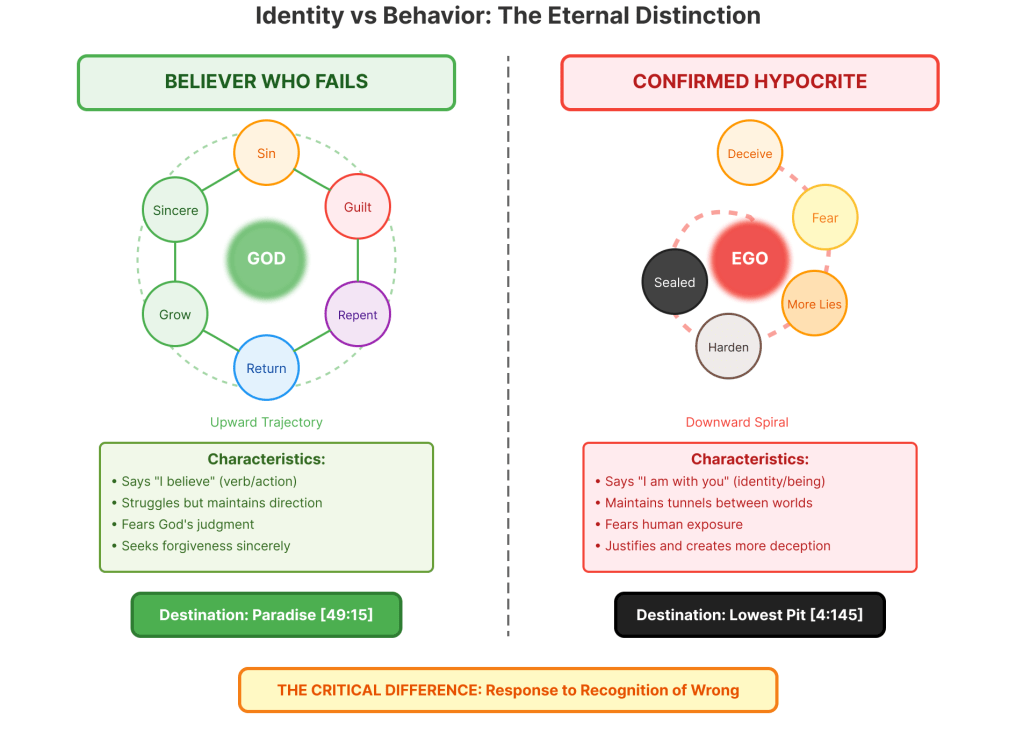
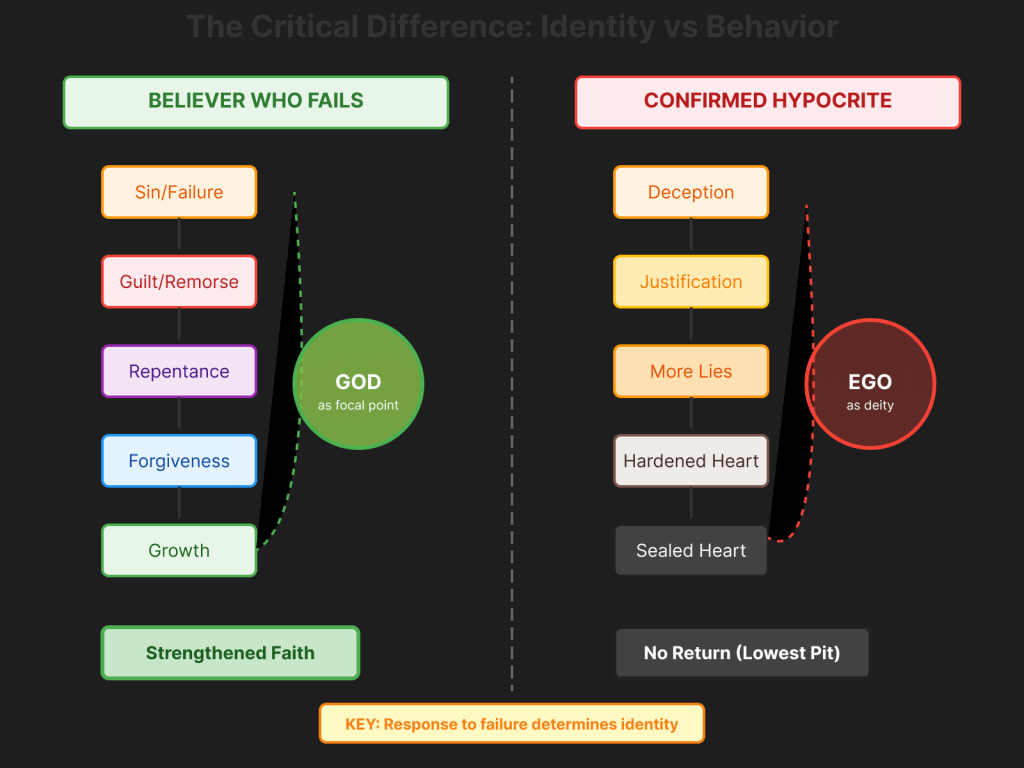
This addresses BELIEVERS who fail – not hypocrites. The critical difference: response to failure.
[9:75-77] “Some of them even pledged: ‘If God showered us with His grace, we would be charitable, and would lead a righteous life.’ But when He did shower them with His provisions, they became stingy, and turned away in aversion. Consequently, He plagued them with hypocrisy in their hearts.”
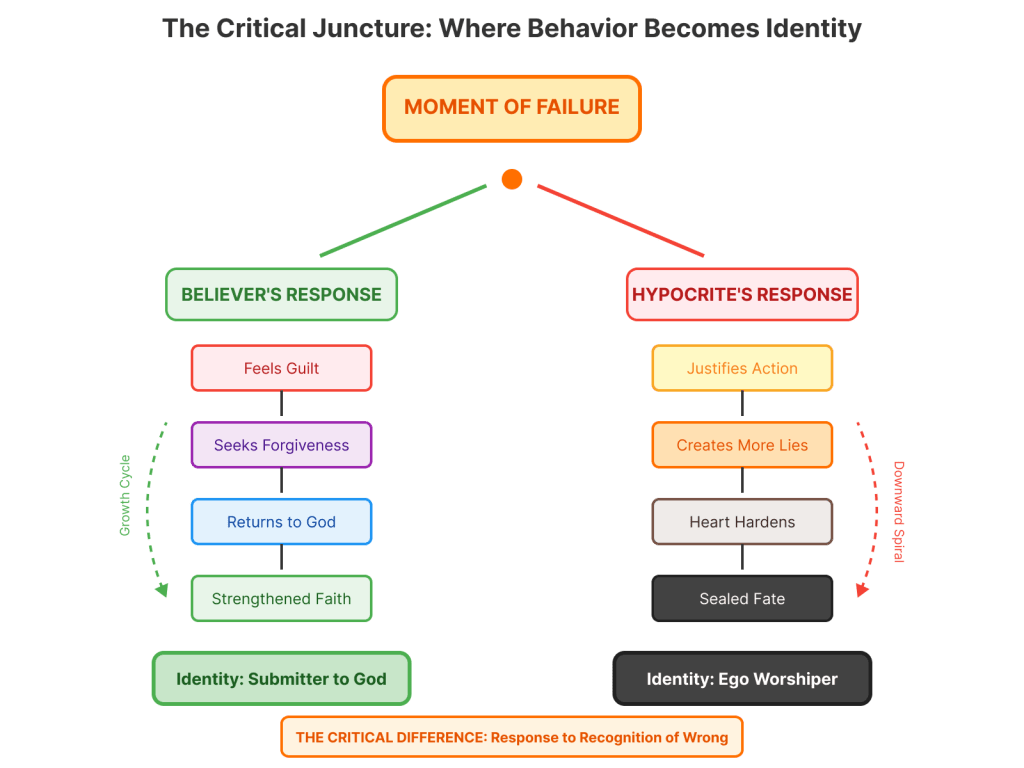
The progression: Promise → Betrayal → Justification → Hypocrisy plagued in hearts. The broken promise didn’t create hypocrites; their response did. Believers repent; hypocrites justify. Believers admit failure; hypocrites create elaborate deceptions. This pattern of doubling down transforms behavior into identity.
Part 5: The Behavioral Manifestations – How Identity Shows Itself
Consistent Patterns That Reveal the Hypocrite
They Fear Exposure Above All
[63:4] “When you see them, you may be impressed by their physical appearance. And when they speak, you may listen to their eloquence. They are like standing logs. They think that every call is intended against them. These are the enemies; beware of them.”
[9:64] “The hypocrites worry that a sura may be revealed exposing what is inside their hearts. Say, ‘Go ahead and mock. God will expose exactly what you are afraid of.’”
Paranoia about exposure defines them. Every announcement terrifies them. Unlike believers who fear God’s judgment, hypocrites fear human discovery.
They Are Cowardly in Face of Sacrifice
[9:81] “The sedentary rejoiced in their staying behind the messenger of God, and hated to strive with their money and their lives in the cause of God.”
[33:12-13] “The hypocrites and those with doubts in their hearts said, ‘What God and His messenger promised us was no more than an illusion!’ A group of them said, ‘O people of Yathrib, you cannot attain victory; go back.’ Others made up excuses to the prophet: ‘Our homes are vulnerable,’ when they were not vulnerable. They just wanted to flee.”
They Are Stingy Despite Wealth
[9:75-77] “Some of them even pledged: ‘If God showered us with His grace, we would be charitable, and would lead a righteous life.’ But when He did shower them with His provisions, they became stingy, and turned away in aversion. Consequently, He plagued them with hypocrisy in their hearts.”
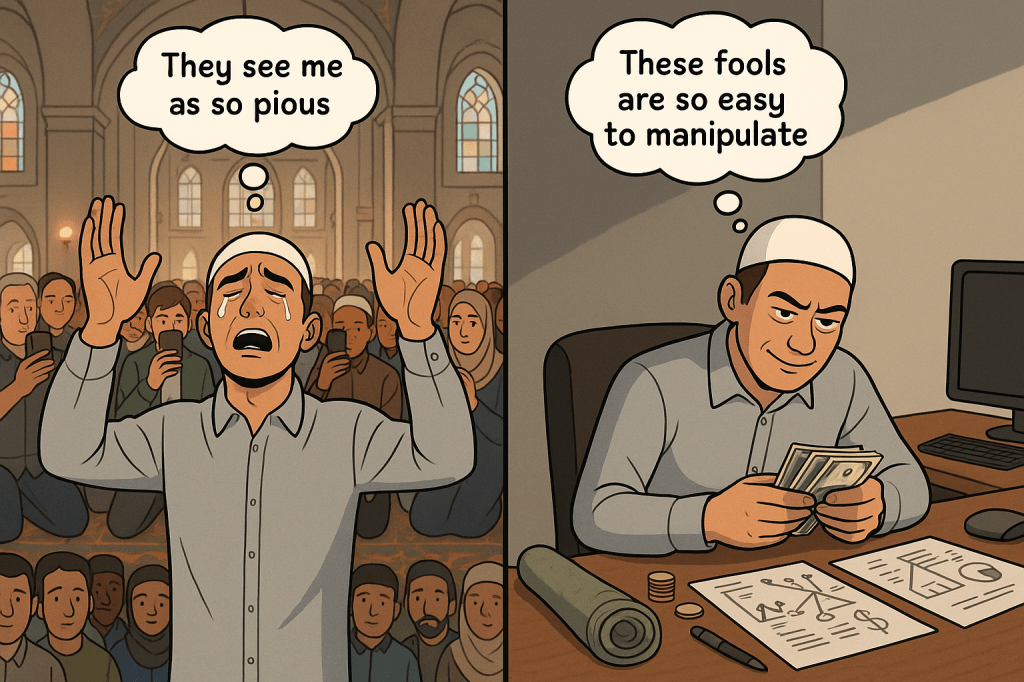
Their Prayer Is Lazy Performance
[4:142] “When they get up for the Contact Prayer (Salat), they get up lazily. That is because they only show off in front of the people, and rarely do they think of God.”
[107:4-6] “And woe to those who observe the contact prayers (Salat)—who are totally heedless of their prayers. They only show off.”
Part 6: The Complete Profile – Who Are These People?
Comprehensive Identification from the Quran
God provides a complete profile of hypocrites through multiple verses:
Their Social Behavior:
[4:89] “They wish that you disbelieve as they have disbelieved, then you become equal.”
[5:51] “O you who believe, do not take certain Jews and Christians as allies; these are allies of one another. Those among you who ally themselves with these belong with them.”
They actively work to corrupt believers, seeking to drag others to their level.
Their Economic Behavior:
[9:67] “The hypocrite men and the hypocrite women belong with each other. They advocate evil and prohibit righteousness, and they are stingy.”
[57:24] “They are stingy, and enjoin the people to be stingy.”
Their Response to Commands:
[24:47-48] “They say, ‘We believe in God and in the messenger, and we obey,’ but then some of them slide back afterwards. These are not believers. When they are invited to God and His messenger to judge among them, some of them get upset.”
Selective obedience – accepting only what benefits them, rejecting what challenges them.
Their Ultimate Allegiance:
[4:60] “Have you noted those who claim that they believe in what was revealed to you, and in what was revealed before you, then uphold the unjust laws of their idols?”
They claim faith while their true allegiance lies with systems opposing God.
Part 7: The Critical Distinction – Sincerity Is Not Enough
Why Even Idol Worshipers Can Be Sincere
The Quran reveals a profound truth that destroys the argument “but they’re sincere in their belief”:
[31:32] “When violent waves surround them, they implore God, sincerely devoting their prayers to Him alone. But as soon as He saves them to the shore, some of them revert. None discards our revelations except those who are betrayers, unappreciative.”
Even idol worshipers can be sincere when facing death. Sincerity in desperation doesn’t define identity. What matters is consistent orientation – who do they worship when safe? The hypocrite differs from even the idol worshiper because the hypocrite lacks sincerity even in desperation. They calculate even when drowning.
[47:29-30] “Did those who harbor disease in their hearts think that God would not bring out their evil thoughts? If we will, we can expose them for you, so that you can recognize them just by looking at them. However, you can recognize them by their utterances.”
Recognition comes through their speech patterns – not what they say but how they say it. The calculated nature of every utterance, the performative quality that never drops, the inability to speak without agenda.
Part 8: The Sealed Heart – Point of No Return
When God Confirms Their Choice
[63:3] “This is because they believed, then disbelieved. Hence, their hearts were sealed; they do not understand.”
[2:7] “God seals their hearts and their hearing, and their eyes are veiled. They have incurred severe retribution.”
[47:16] “Some of them listen to you, then as soon as they leave they ask those who were enlightened, ‘What did he just say?’ God has sealed their hearts, and they are following their opinions.”
The sealing is not arbitrary punishment but divine confirmation of their choice. After persistent rejection of truth, God grants their wish – permanent separation from guidance. They wanted tunnels between worlds; God ensures they can never leave those tunnels.
This differs fundamentally from temporary spiritual blindness that believers might experience. Believers’ confusion comes from weakness; hypocrites’ sealing comes from willful rejection after receiving clarity.
Part 9: The Tragedy of Lost Potential
From Possible Believer to Confirmed Hypocrite
Perhaps the greatest tragedy of hypocrisy is the waste of human potential. These individuals often possess intelligence, charisma, and leadership abilities that could serve righteousness. Instead, they corrupt these gifts in service of ego:
[2:204-206] “Among the people, one may impress you with his utterances concerning this life, and may even call upon God to witness his innermost thoughts, while he is a most ardent opponent. As soon as he leaves, he roams the earth corruptingly, destroying properties and lives. God does not love corruption. When he is told, ‘Observe God,’ he becomes arrogantly indignant. Consequently, his only destiny is Hell; what a miserable abode.”
This describes someone with genuine talents – impressive speech, apparent sincerity, ability to influence. Yet these gifts become tools of corruption. Studies on corporate psychopathy show that many successful executives display hypocritical traits – superficial charm, grandiose self-worth, pathological lying, and lack of empathy. Their intelligence serves deception rather than truth.
The messenger explained this principle clearly: those who use God’s religion for personal gain commit the ultimate betrayal. They had access to truth, understood its power, yet chose to weaponize it for ego gratification. This conscious corruption of divine guidance earns them the lowest pit of Hell – below those who never had such opportunity.
Part 10: The Collective Damage
How Hypocrites Destroy Communities
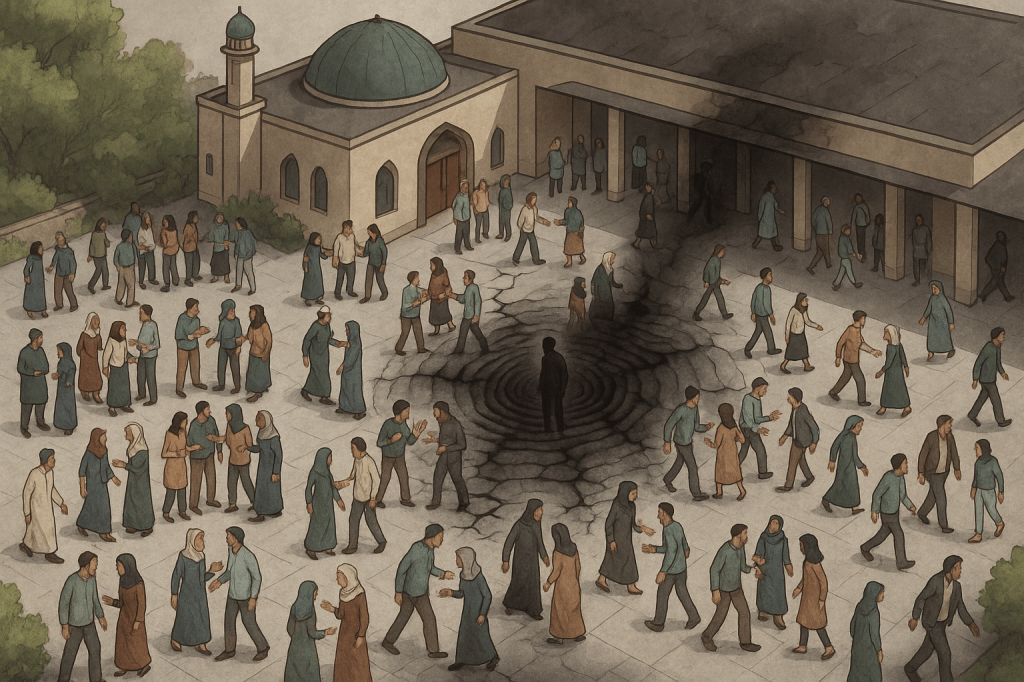
Individual hypocrisy metastasizes into collective corruption. The Quran warns repeatedly about hypocrites’ community-destroying potential:
[9:47] “Had they mobilized with you, they would have created confusion, and would have caused disputes and divisions among you. Some of you were apt to listen to them. God is fully aware of the transgressors.”
Social psychology research confirms this “bad apple” effect. Studies by Dr. Will Felps show that a single toxic individual can reduce team performance by 30-40%. Hypocrites don’t just fail personally; they create doubt, division, and demoralization throughout communities. Their presence forces others to question sincerity, making genuine trust impossible.
Modern examples include religious communities torn apart by leadership scandals, where a single hypocritical leader’s exposure destroys faith for thousands. The damage spreads like infection – those hurt by religious hypocrites often abandon faith entirely, unable to distinguish between corrupted representatives and divine truth.
[4:88] “Why should you divide yourselves into two groups regarding hypocrites? God is the one who condemned them because of their own behavior. Do you want to guide those who are sent astray by God? Whomever God sends astray, you can never find a way to guide them.”
This verse addresses a critical error: trying to reform confirmed hypocrites. Communities waste enormous energy attempting to rehabilitate those whose hearts are sealed, resources better spent supporting sincere seekers. The attempt to accommodate hypocrites weakens the entire community’s spiritual immune system.
Part 11: The Prevention Protocol
Protecting Against Identity Corruption
Understanding how behavior transforms into identity enables prevention. The Quran provides clear protocols for maintaining spiritual integrity:
Protocol 1: Immediate Repentance After Failure
[3:135] “If they fall in sin or wrong their souls, they remember God and ask forgiveness for their sins – and who forgives the sins except God – and they do not persist in sins, knowingly.”
The key phrase: “do not persist.” Immediate acknowledgment and correction prevent neural pathway formation. Neuroscience shows that interrupting pattern formation within 66 days (average habit formation time) prevents permanent restructuring. Quick repentance is literally brain protection.
Protocol 2: Consistent Private Practice
[7:205] “You shall remember your Lord within yourself, publicly, privately, and quietly, day and night; do not be unaware.”
Private spiritual practice prevents performance-based religion. When worship occurs without audience, it maintains authenticity. Brain imaging of long-term meditators shows increased grey matter in regions associated with self-awareness and emotional regulation – consistent private practice literally builds cognitive infrastructure for integrity.
Protocol 3: Avoiding Dual Allegiances
[4:89] “They wish that you disbelieve as they have disbelieved, then you become equal. Do not consider them friends, unless they mobilize along with you in the cause of God.”
Clear boundaries prevent tunnel construction. Research on social influence shows that humans unconsciously mirror those they spend time with. Regular association with hypocrites creates neural patterns that facilitate duplicity. Protection requires conscious limitation of such exposure.
Part 12: The Hope for the Sincere Struggler
Why Imperfection Doesn’t Equal Hypocrisy
Crucial distinction: struggling believers who fail repeatedly are not hypocrites. The Quran acknowledges human weakness while maintaining hope for sincere strivers:
[39:53] “Proclaim: ‘O My servants who exceeded the limits, never despair of God’s mercy. For God forgives all sins. He is the Forgiver, Most Merciful.’”
This verse specifically addresses those who “exceeded the limits” – serious sinners, not minor offenders. Yet redemption remains available for those maintaining sincere intention. The difference between a struggling believer and a hypocrite lies not in the number or severity of failures but in the response to those failures.
Research on moral emotions by Dr. June Tangney shows that guilt (feeling bad about actions) motivates behavioral change, while shame (feeling bad about self) causes withdrawal and continued negative behavior. Believers experience guilt that drives repentance; hypocrites transform guilt into elaborate justification systems that prevent change.
The messenger emphasized this distinction repeatedly. He taught that God’s mercy encompasses all sincere seekers, regardless of their failures. The door closes only when someone consciously chooses duplicity as their core identity, when they stop struggling against their lower nature and instead embrace it while maintaining religious facade.
Part 13: God’s Commands Regarding Hypocrites
Our Divine Instructions Are Clear
God doesn’t leave us confused about how to deal with hypocrites. The commands are explicit and non-negotiable:
DO NOT OBEY THEM
[33:1] “O you prophet, you shall reverence God and do not obey the disbelievers and the hypocrites.”
[33:48] “Do not obey the disbelievers and the hypocrites, disregard their insults, and put your trust in God.”
BE STERN WITH THEM
[9:73] “O you prophet, strive against the disbelievers and the hypocrites, and be stern in dealing with them.”
[66:9] “O prophet, struggle against the disbelievers and the hypocrites and be stern with them.”
DISREGARD THEM
[4:63] “God is fully aware of their innermost intentions. You shall ignore them, enlighten them, and give them good advice that may save their souls.”
[9:95] “Do disregard them. They are polluted, and their destiny is Hell.”
REMIND THEM OF THEIR FATE
[4:138] “Inform the hypocrites that they have incurred painful retribution.”
[4:145] “The hypocrites will be committed to the lowest pit of Hell.”
These aren’t suggestions but divine commands. We cannot compromise with those God commands us to oppose.
Part 14: The Ultimate Test – Response to Truth
How Reactions Reveal Identity
The definitive test distinguishing believers from hypocrites is their response to truth, especially when it challenges them:
[24:47-50] “They say, ‘We believe in God and in the messenger, and we obey,’ but then some of them slide back afterwards. These are not believers. When they are invited to God and His messenger to judge among them, some of them get upset. However, if the judgment is in their favor, they readily accept it! Is there a disease in their hearts? Are they doubtful? Are they afraid that God and His messenger may treat them unfairly? In fact, it is they who are unjust.”
This describes selective acceptance – embracing truth when convenient, rejecting it when challenging. Cognitive dissonance research by Dr. Leon Festinger shows that when confronted with information contradicting deep beliefs, people either change beliefs (growth) or rationalize contradictions (cognitive protection). Hypocrites consistently choose rationalization over growth.
Believers also experience discomfort when truth challenges them, but their response differs fundamentally. They struggle, question, sometimes resist, but ultimately submit. Their identity as “submitters to God” overrides personal preference. Hypocrites’ identity as “self-servers” causes them to reinterpret or reject inconvenient truth.
Modern social media provides perfect laboratories for observing these responses. When religious leaders are exposed for wrongdoing, watch the reactions: believers express disappointment but maintain faith in God; hypocrites attack the exposers, create elaborate justifications, or suddenly discover reasons why the exposed behavior wasn’t actually wrong. Their response reveals their core identity.
Part 15: The Messenger’s Warning – Satan’s Most Valuable Agents
Why Hypocrites Are Worse Than Disbelievers
The messenger explained clearly why hypocrites occupy the lowest pit of Hell (at 24:03): “It is in my best interest that people go through the test and the hypocrites are sifted away.” He understood that hypocrites are Satan’s most valuable agents because they destroy faith from within. An open enemy can be recognized and resisted. But when corruption comes wearing religious garments, speaking religious language, leading religious rituals, the damage is catastrophic. They make sincere seekers flee from God, thinking they’re fleeing from God’s representatives.
He particularly warned about religious scholars and leaders who monetize faith:
[9:31] “They have set up their religious leaders and scholars as lords, instead of God. Others deified the Messiah, son of Mary. They were all commanded to worship only one god. There is no god except He. Be He glorified, high above having any partners.”
Contemporary examples validate these warnings. Studies on religious trauma show that spiritual abuse by religious leaders creates deeper psychological wounds than secular trauma. The betrayal of spiritual trust damages the very foundation of meaning-making, often leading to complex PTSD that affects victims for decades.

Part 16: Before the Seal – The Narrow Window
When Return Is Still Possible
[4:146] “Only those who repent, reform, hold fast to God, and devote their religion absolutely to God alone, will be counted with the believers.”
Before hearts are sealed, a narrow window exists. The requirements are severe:
1. Repent – acknowledge the duplicity completely
2. Reform – change all hypocritical behaviors
3. Hold fast – maintain consistent commitment
4. Absolute devotion – eliminate all dual allegiances
This isn’t casual return but complete identity reconstruction. Most never achieve it because it requires admitting the very thing they’ve spent years hiding – that their entire religious life has been performance.
Conclusion: Identifying the Enemy Within
Why God Commands Us to Oppose Them
The evidence is conclusive. A hypocrite is not someone who occasionally fails, lies, or sins. A hypocrite is someone whose core identity has transformed into duplicity itself. They are:
– Ego worshipers who have made themselves god [25:43, 45:23]
– Harbor persistent doubt that refuses resolution [9:45]
– Have disease in their hearts that God augments [2:10]
– Turn back after receiving guidance [63:3, 47:25]
– Fear exposure above all else [63:4, 9:64]
– Are cowardly when sacrifice is required [9:81, 33:12-13]
– Are stingy despite having wealth [9:75-77]
– Perform lazy, showy prayers [4:142, 107:4-6]
– Wish believers would disbelieve [4:89]
– Belong with other hypocrites [9:67]
This is who God commands us to be stern with, to disregard, to not obey, to inform of their painful retribution. They are not confused believers needing gentle guidance – they are confirmed enemies who have chosen ego worship over God worship, who maintain elaborate deceptions while corrupting communities from within.
The distinction between hypocrite identity and believer behavior is absolute. A believer says “I believe” and struggles to live it. A hypocrite says “I am with you” while maintaining tunnels to opposing worlds. A believer fails and repents. A hypocrite fails and justifies. A believer fears God’s judgment. A hypocrite fears human discovery.
Even idol worshipers can be sincere in desperation [31:32], but hypocrites calculate even when drowning. Their duplicity isn’t behavioral but existential. They haven’t just committed hypocrisy; they have BECOME hypocrisy.
On the Day of Judgment, we will be raised with our imam – our chosen identity [17:71]. Those who followed hypocrites will share their fate in the lowest pit of Hell [4:145]. But those who recognized and opposed them, who obeyed God’s clear commands regarding these enemies, will be among the believers who never doubted [49:15].
The choice is clear: Will we obey God’s explicit commands about hypocrites, or will we compromise for comfort? Will we be stern with those God identifies as enemies, or will we enable their corruption through misplaced mercy? The hypocrite is not a struggling soul needing patience – they are Satan’s most valuable agents, as the messenger warned, destroying faith from within.
God has identified the enemy. Our duty is to recognize them by their markers, oppose them as commanded, and protect our communities from their poison. This isn’t harsh judgment but divine instruction. We cannot save those whose hearts God has sealed. We can only obey the clear commands: Do not follow them. Do not obey them. Be stern with them. Inform them of their fate. And trust in God alone.

 Quran Only Studies
Leave a comment