Introduction: Refuting the Greatest Historical Deception – “The Same People Gave Us Both”
When Sunni Muslims are confronted with the Quran-alone position, they invariably ask: “How did you get the Quran? Didn’t the same people who gave us the Quran also give us the Hadith?” This question reveals a fundamental historical ignorance that has been deliberately cultivated for centuries. The historical facts are clear and irrefutable: the Quran was preserved through a completely different process, by completely different people, using completely different methods than the Hadith. This article will definitively prove, using historical evidence and primary sources, that the Quran came from Muhammad and his literate scribes through written records, while the Hadith are fabrications attributed to Muhammad by people who lived centuries after his death.
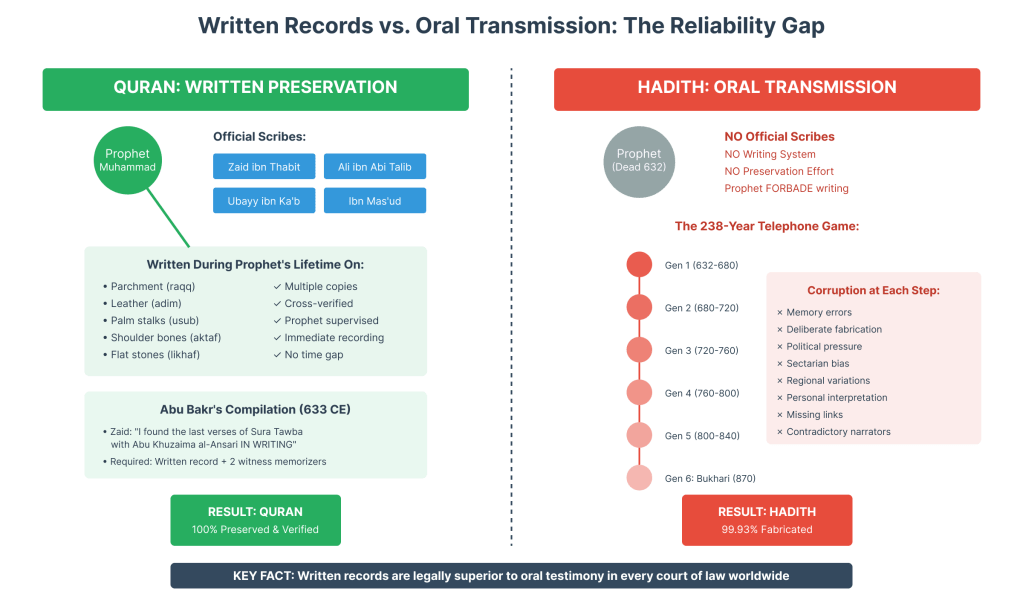
The first revelation itself destroys the myth of an illiterate prophet. [96:1] “Read, in the name of your Lord, who created” contains an alif in the Arabic word “Bismi” (in the name of). This alif can only be placed by someone who knows how to spell—it’s not phonetically necessary but orthographically required. An illiterate person couldn’t have known to insert this silent letter. Furthermore, the historical record shows Muhammad had multiple official scribes who wrote the Quran during his lifetime: Zaid ibn Thabit, Ali ibn Abi Talib, Ubayy ibn Ka’b, and Abdullah ibn Mas’ud, among others. These scribes wrote on parchment, leather, palm stalks, shoulder bones, and flat stones—creating multiple written records that were later compiled.
Part 1: The Historical Reality – Who Actually Preserved the Quran?
The Written Record During Muhammad’s Lifetime (610-632 CE)
The Quran’s preservation began immediately with its revelation. Historical sources, including Sahih Bukhari 4986 ironically, confirm that Muhammad had official scribes who wrote down revelations as they came. The primary scribe was Zaid ibn Thabit, who later stated: “I used to write the revelation for the Prophet. When revelation came to him, he would feel intense heat and drops of sweat would fall from him like pearls. When this state left him, I would write on shoulder bones, palm stalks, and parchment.” This contemporary written documentation stands in stark contrast to the Hadith, which had zero written records for over 200 years.
The evidence for written preservation is overwhelming. According to “The History of the Qur’anic Text” by Muhammad Mustafa Al-Azami, at least 65 companions served as scribes for Quranic revelation. The Prophet would call for a scribe immediately upon receiving revelation and dictate the verses. He would then have the scribe read back what was written to ensure accuracy. This process created multiple written copies distributed among the Muslim community during Muhammad’s lifetime.
Compare this to the Hadith: The Prophet explicitly forbade writing his sayings: “Do not write down anything from me except the Quran. Whoever has written down anything from me other than the Quran, let him erase it.” (Sahih Muslim 3004). This prohibition alone destroys the claim that “the same people gave us both.” How could the same people give us both when one was meticulously written and the other was forbidden to be written?
Abu Bakr’s Compilation (633 CE) – From Written Records, Not Memory
After Muhammad’s death, Abu Bakr ordered the first official compilation. The crucial historical fact that destroys the Sunni narrative is found in their own sources. According to Sahih Bukhari 4986, Zaid ibn Thabit said: “I started looking for the Quran and collecting it from parchments, scapula bones, palm stalks, and from the memories of men.” Notice the order: written materials first, memory as backup. Zaid further stated: “I found the last verses of Sura Tawba with Abu Khuzaima al-Ansari and with none other than him.” The key phrase is “I found” (wajadtu in Arabic)—meaning he found it IN WRITING, not that Abu Khuzaima recited it from memory.
The compilation required two conditions: (1) The verse must exist in written form from Muhammad’s time, and (2) Two witnesses must confirm they heard it directly from the Prophet. This dual verification system—written record plus oral confirmation—ensured absolute accuracy. No verse entered the Quran based on memory alone. This stands in complete contrast to Hadith, which were purely oral transmissions with no written verification for centuries.
Uthman’s Standardization (650 CE) – The Written Manuscript Tradition
The third Caliph Uthman’s standardization provides irrefutable proof of written preservation. According to Islamic historical sources, Uthman gathered all written Quranic manuscripts from across the Muslim empire. He formed a committee led by Zaid ibn Thabit (the same scribe who served Muhammad) to compare these written documents. They didn’t gather people to recite from memory—they gathered WRITTEN MANUSCRIPTS. The committee produced a master copy from these written sources and sent official copies to major cities: Mecca, Damascus, Kufa, Basra, and kept one in Medina.
The Birmingham Quran manuscript, carbon-dated to 568-645 CE (overlapping Muhammad’s lifetime), proves these early written records exist. The Sana’a manuscripts from Yemen, dated to before 671 CE, further confirm the written tradition. These physical manuscripts—not oral claims—prove the Quran’s preservation. Where are the Hadith manuscripts from the 7th century? They don’t exist because Hadith were forbidden to be written.
Part 2: The Companions Who “Gave Us the Quran” REJECTED Hadith
Abu Bakr: Burned His 500 Hadith Collection
The most devastating evidence against the claim that “the same people gave us both” comes from the actions of the Rightly-Guided Caliphs themselves. According to Tadhkirat al-Huffaz by al-Dhahabi, Abu Bakr—the first Caliph and closest companion of Muhammad—initially collected 500 Hadith. But after a sleepless night, he ordered his daughter Aisha: “Bring me the collection of Hadith.” When she brought them, he burned them all, saying: “I feared I would die while these were with me, containing narrations from men I trusted but who might have erred.”
This is the same Abu Bakr who meticulously preserved the Quran in written form. How can Sunnis claim “the same people gave us both” when Abu Bakr preserved one and burned the other? The answer is obvious: he knew the Quran was divine revelation worthy of preservation, while Hadith were human narrations prone to error.
Umar ibn al-Khattab: Imprisoned Hadith Narrators
Umar, the second Caliph, took even stronger action. According to Ibn Sa’d’s Tabaqat and multiple historical sources, Umar imprisoned prominent companions including Ibn Mas’ud, Abu Darda, and Abu Mas’ud al-Ansari for narrating Hadith. He declared: “Reduce narrations from the Prophet except those concerning halal and haram.” He told his governors: “Be exclusively devoted to the Quran, and diminish the narrations from Muhammad.”
Most tellingly, when Muhammad was on his deathbed and asked for writing materials, Sahih Bukhari 114 records that Umar prevented it, saying: “The Book of Allah is sufficient for us.” Even Abu Hurayra, who later became the most prolific Hadith narrator (with 5,374 narrations), admitted: “We could not narrate from the Prophet during Umar’s time. He would have beaten us with his stick.”
Uthman and Ali: Continued the Prohibition
Uthman, the third Caliph who standardized the Quran, showed zero interest in collecting Hadith. He spent enormous effort gathering Quranic manuscripts from across the empire but never once attempted to gather Hadith. Ali, the fourth Caliph and Muhammad’s cousin/son-in-law, explicitly stated according to Nahjul Balagha: “The Book of Allah is sufficient for us.” If anyone would have had authentic knowledge of Muhammad’s sayings, it would be Ali. Yet he, too, rejected the need for Hadith.
These are the four Rightly-Guided Caliphs that Sunnis claim to follow. All four either burned, prohibited, or ignored Hadith while carefully preserving the Quran. How then can anyone claim “the same people gave us both”? The historical record is clear: the people who gave us the Quran explicitly rejected Hadith.
Part 5: The Quran Itself Warned This Would Happen
God explicitly warned in multiple verses that people would abandon the Quran for other sources. These aren’t vague prophecies but specific condemnations using the exact word “Hadith”:
[31:6] “Among the people, there are those who uphold baseless Hadith, and thus divert others from the path of God without knowledge.”
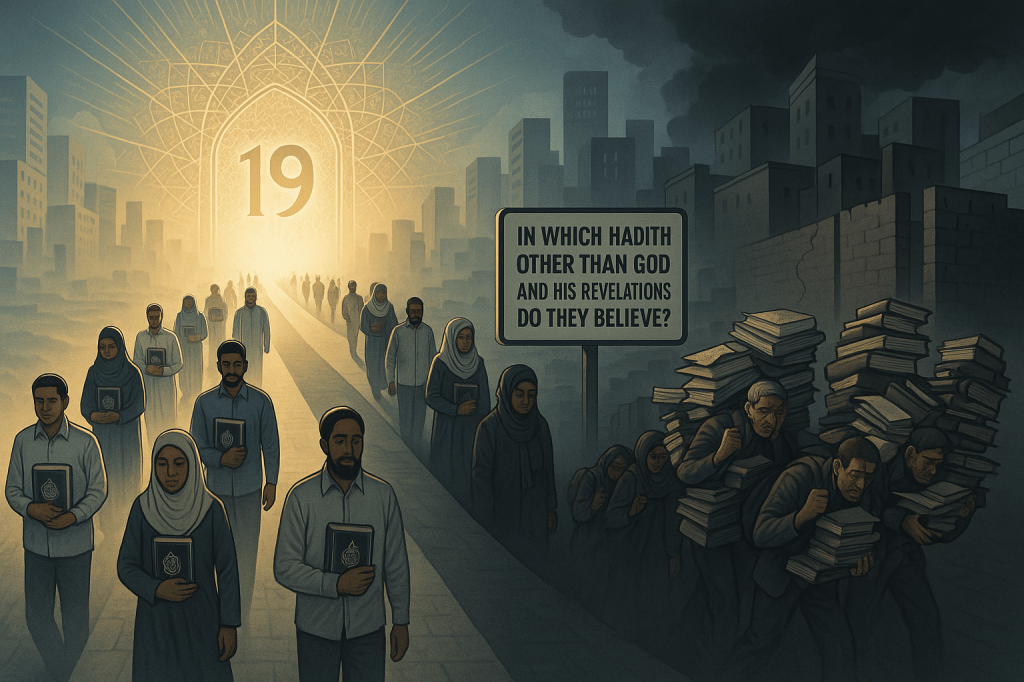
[45:6] “These are God’s revelations that we recite to you truthfully. In which Hadith other than God and His revelations do they believe?”
[77:50] “Which Hadith, other than this, do they uphold?”
The Arabic word is “Hadith” itself—the same word Bukhari and Muslim used for their collections. God didn’t use a different word that scholars could reinterpret. He used the exact term, making it impossible to misunderstand. Yet Muslims did exactly what God warned against: they upheld other Hadith besides the Quran.
Part 3: Joshua Little’s Academic Demolition – “21 Reasons Why Hadith Are Unusually Unreliable”
Western Academic Scholarship Confirms What We Already Know
Dr. Joshua Little, a non-Muslim academic scholar at Oxford, has provided devastating evidence against Hadith reliability in his paper “The Hadith in Recent Western Academic Research”. His 21 reasons why Hadith are “unusually unreliable” include:
1. Anachronisms: Hadith contain historical impossibilities, like Muhammad discussing events that occurred after his death.
2. Contradictions: Mutually exclusive narrations about the same event, proving at least one must be false.
3. Back-projections: Later theological positions projected back onto Muhammad.
4. Literary borrowing: Stories copied from Jewish and Christian sources.
5. Statistical impossibilities: Single narrators allegedly transmitting thousands of Hadith.
6. Sectarian fabrication: Each sect created Hadith to support their positions.
7. Legal fabrication: Hadith invented to justify existing practices.
8. Political fabrication: Rulers commissioned Hadith for political legitimacy.
9. Narrator criticism contradictions: The same narrator deemed reliable by some, unreliable by others.
10. The spreading isnad: Earlier sources have shorter chains than later ones—the opposite of what should occur.
11. Common links: Statistical analysis shows single narrators as suspicious bottlenecks.
12. Matn variations: The same Hadith exists with dramatically different wordings.
13. Geographic clustering: Hadith concentrate in specific regions, suggesting local fabrication.
14. Family isnads: Suspiciously high transmission within single families.
15. Student-teacher ratios: Impossible numbers of students per teacher.
16. Chronological problems: Narrators meeting when historically impossible.
17. Artificial systematization: Too-perfect legal categorization suggesting later organization.
18. Quranic contradiction: Hadith that directly contradict clear Quranic verses.
19. Historical silence: Major “events” in Hadith absent from contemporary histories.
20. Linguistic anachronisms: Language patterns from later periods.
21. The living tradition problem: If practices were continuous, why the need for Hadith?
The Timeline That Destroys the Sunni Narrative
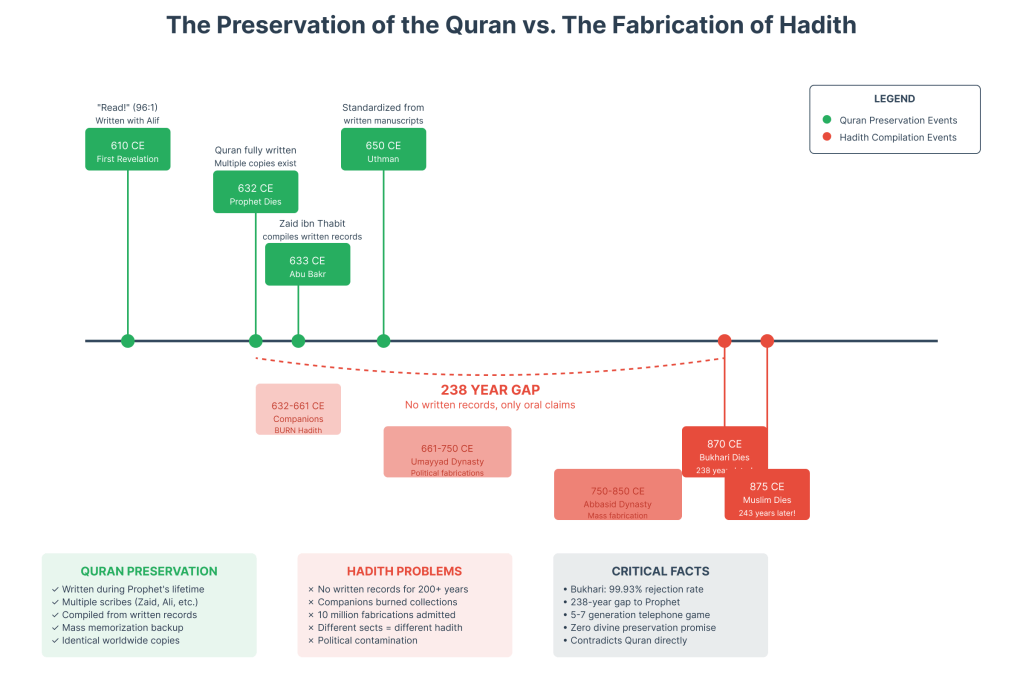
632 CE: Muhammad dies. The Quran exists in multiple written copies across the Muslim community.
633 CE: Abu Bakr compiles the Quran from WRITTEN sources. Burns his Hadith collection.
634-644 CE: Umar’s caliphate. Imprisons Hadith narrators. Quran continues to be copied and distributed.
644-656 CE: Uthman standardizes the Quran from written manuscripts. Shows zero interest in Hadith.
656-661 CE: Ali’s caliphate. Relies solely on Quran. No Hadith compilation attempted.
661-750 CE: Umayyad Dynasty. Mass fabrication of Hadith for political purposes. No written collections.
750-850 CE: Abbasid Dynasty. Hadith fabrication industry flourishes. Still no authorized written collections.
810-870 CE: Bukhari’s lifetime. First major written Hadith collection, 238 years after Muhammad.
815-875 CE: Muslim’s lifetime. Second major collection, 243 years after Muhammad.
The same people DID NOT give us both. The Quran came from Muhammad’s generation through written records. The Hadith came from Persians living in Central Asia (Bukhari from Bukhara, Muslim from Nishapur) who never met anyone who met Muhammad, working from oral claims transmitted through 6-7 generations of a broken telephone game.
Part 4: The Legal Principle – Written Records Override Oral Claims
Every Legal System on Earth Recognizes This Hierarchy
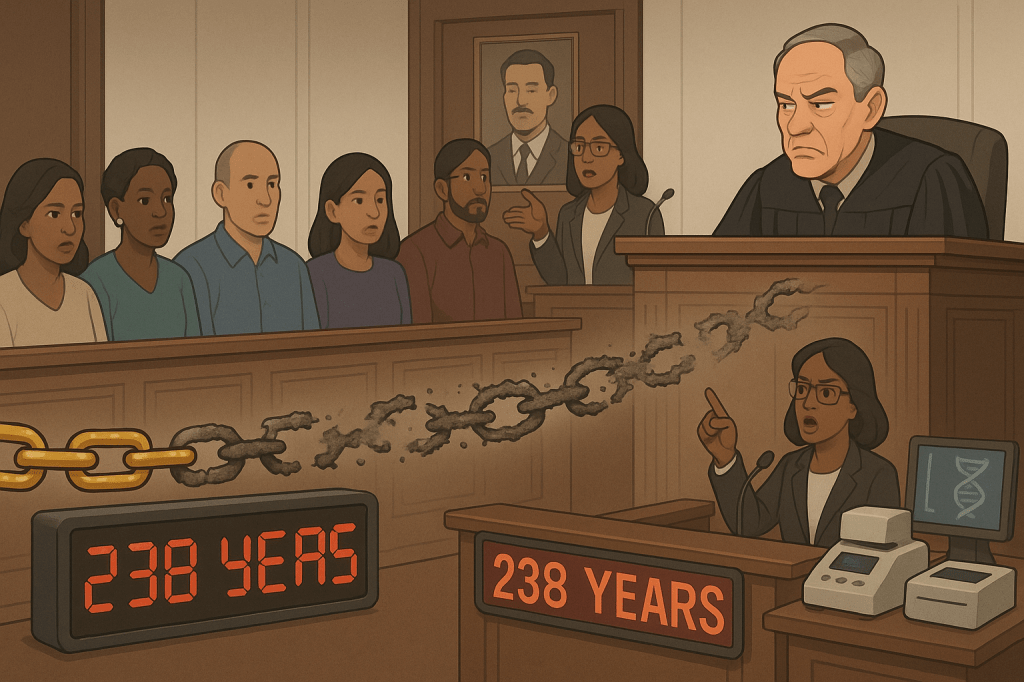
In every court of law worldwide—whether Islamic, Western, Eastern, or secular—written documentation takes precedence over oral testimony. This is based on fundamental principles of evidence that transcend culture and religion. According to Federal Rules of Evidence 1002 (the “Best Evidence Rule”), original written documents are required to prove content. Oral testimony about what a document says is inadmissible when the document itself is available.
Why do all legal systems prioritize written evidence? Studies on memory reliability show that:
• Human memory degrades 50% within one hour of an event
• After one week, accuracy drops to 30%
• After one month, witnesses contradict their own earlier testimony 60% of the time
• Each retelling introduces an average 5-10% distortion
• Over 6 generations (the Hadith chain), distortion compounds to near-total unreliability
The Quran has written documentation from Day 1. Multiple manuscripts, carbon-dated to Muhammad’s lifetime, exist in museums today. The Hadith have ZERO written documentation for 238 years—only oral claims passed through a demonstrated fabrication mill. By every legal standard on Earth, the Quran’s written evidence infinitely outweighs Hadith oral claims. Yet Muslims reversed this, elevating oral hearsay above written documentation.
The Industrial-Scale Fabrication: Documented Confessions
The scale of Hadith fabrication is documented by the fabricators themselves. According to Ibn al-Jawzi’s “Al-Mawdu’at” (The Fabricated Hadith):
• Abd al-Karim Abu al-Awja: Confessed to fabricating 4,000 Hadith before execution
• Muhammad ibn Sa’id al-Maslub: Admitted creating 4,000 Hadith with complete chains
• Ahmad al-Marwazi: Confessed to fabricating 70,000 Hadith
• Ghulam Khalil: Admitted to 12,000 fabrications
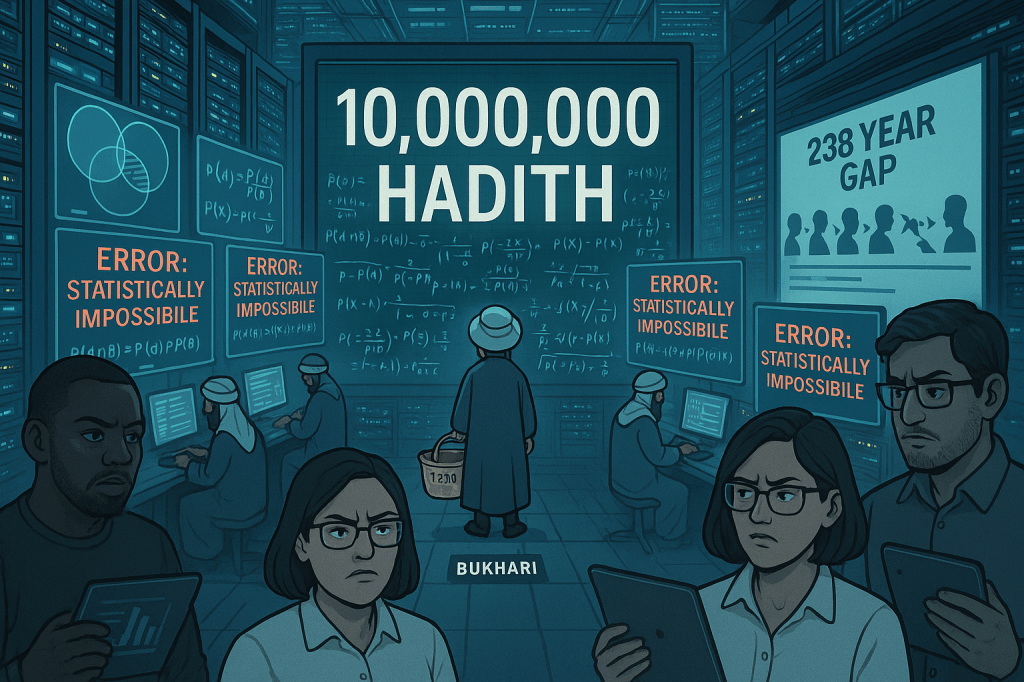
These are just the ones who confessed. Al-Dhahabi’s “Tadhkirat al-Huffaz” documents that by the 3rd century AH, there were over 100,000 known fabricators. If we conservatively estimate each fabricator created 100 false Hadith, that’s 10 million fabrications—exactly what Bukhari had to sift through. The fabricators were sophisticated, creating complete chains of narration that appeared authentic. They knew which narrators to cite, which companions to attribute to, and how to make their lies believable.
Part 5: The Mathematical Proof of Divine Origin
The Miracle of 19
In 1974, God unveiled through Dr. Rashad Khalifa the mathematical miracle that had been embedded in the Quran for 1400 years. This intricate mathematical system, based on the number 19, proves beyond any doubt that the Quran comes from a divine source while simultaneously exposing human texts like Hadith as lacking any such divine signature.
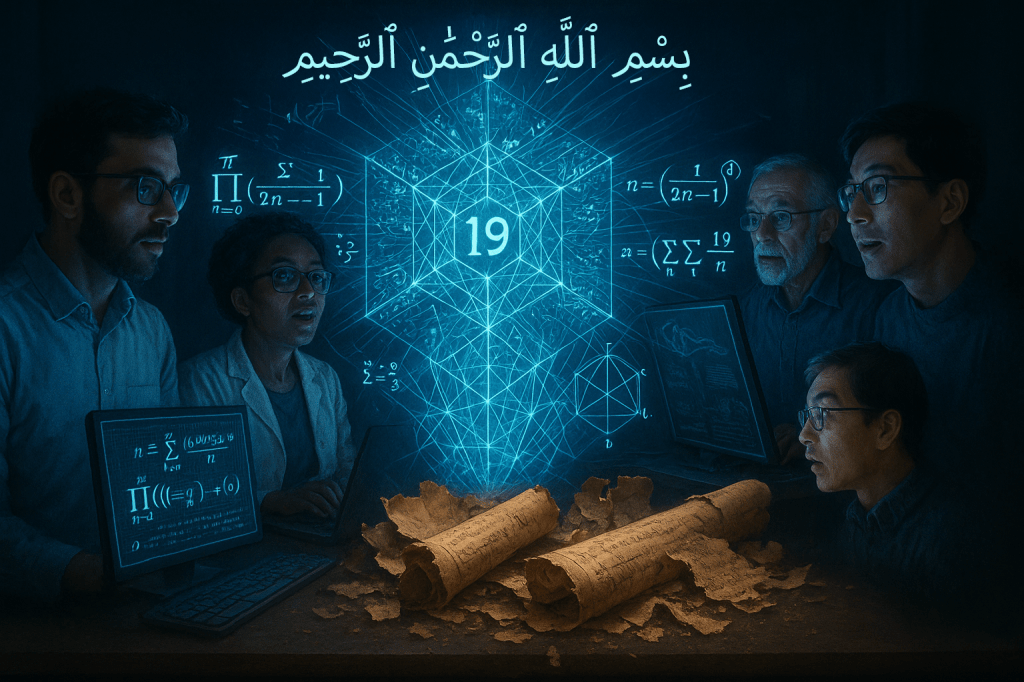
The number 19 is literally written in the Quran in Sura 74:30, and the subsequent verses explain that it serves as a punishment for disbelievers, a test for humans, and a strengthener of faith for believers. The mathematical patterns are so complex and comprehensive that they could not have been planned by a human in the 7th century—or even today without computer assistance. Every element of the Quran—its chapters, verses, words, letters, and even the frequencies of specific letters—is mathematically composed in multiples of 19.
For example, the first verse “In the name of God, Most Gracious, Most Merciful” consists of 19 Arabic letters. It occurs 114 times in the Quran (19 x 6). The word “God” (Allah) occurs 2,698 times (19 x 142). The word “Quran” appears 57 times (19 x 3). These patterns continue throughout the entire text, creating an intricate mathematical web that proves divine authorship and protects every letter from alteration.
Now examine the Hadith collections. Do they contain any mathematical miracle? Any divine code? Any protective system that prevents alteration? Nothing. They are ordinary human texts, filled with contradictions, historical errors, and variations between different versions. While the Quran’s mathematical composition proves it comes from the Creator of mathematics itself, the Hadith’s chaos proves they come from fallible humans.
Part 6: The Corruption of Pure Monotheism
From Worship of God Alone to Prophet Idolization
The Quran’s central message is pure monotheism—worship of God alone without any partners or intermediaries. The shahada (testimony of faith) in the Quran is simply “There is no god except God” (La ilaha illa Allah). This appears multiple times throughout the Quran as the essential declaration of faith. Yet the Hadith have corrupted this pure monotheism by adding “Muhammad is the messenger of God” to the shahada, making it a dual testimony that the Quran never mandates.
[3:18] “God bears witness that there is no god except He, and so do the angels and those who possess knowledge. Truthfully and equitably, He is the absolute god; there is no god but He, the Almighty, Most Wise.”
Notice that even God’s own testimony of faith mentions only Himself—no prophet, no messenger, no human being shares in this declaration. The angels and those who possess knowledge also witness that there is no god except God—period. They don’t add any human names to their testimony. Yet Muslims worldwide, following Hadith-based traditions, have modified God’s prescribed testimony to include a human being.
This corruption extends far beyond the shahada. Through Hadith, Muslims have elevated Muhammad to a semi-divine status that he himself would have found blasphemous. They claim he had supernatural knowledge, could intercede for sinners, had his name written on God’s throne, and was created from divine light. They send blessings upon him in every prayer, mention his name alongside God’s in their mosques, and seek his intercession on Judgment Day. All of this directly contradicts the Quran’s repeated assertions that Muhammad was simply a human messenger with no power to benefit or harm anyone, including himself.
[18:110] “Say, ‘I am no more than a human like you, being inspired that your god is one god. Those who hope to meet their Lord shall work righteousness, and never worship any other god beside his Lord.’”
The Addition of Unauthorized Religious Laws
Through Hadith, religious leaders have added countless laws, prohibitions, and obligations that God never authorized. The Quran warns explicitly against this practice, identifying it as a form of idolatry:
[42:21] “They follow idols who decree for them religious laws never authorized by God. If it were not for the predetermined decision, they would have been judged immediately. Indeed, the transgressors have incurred a painful retribution.”
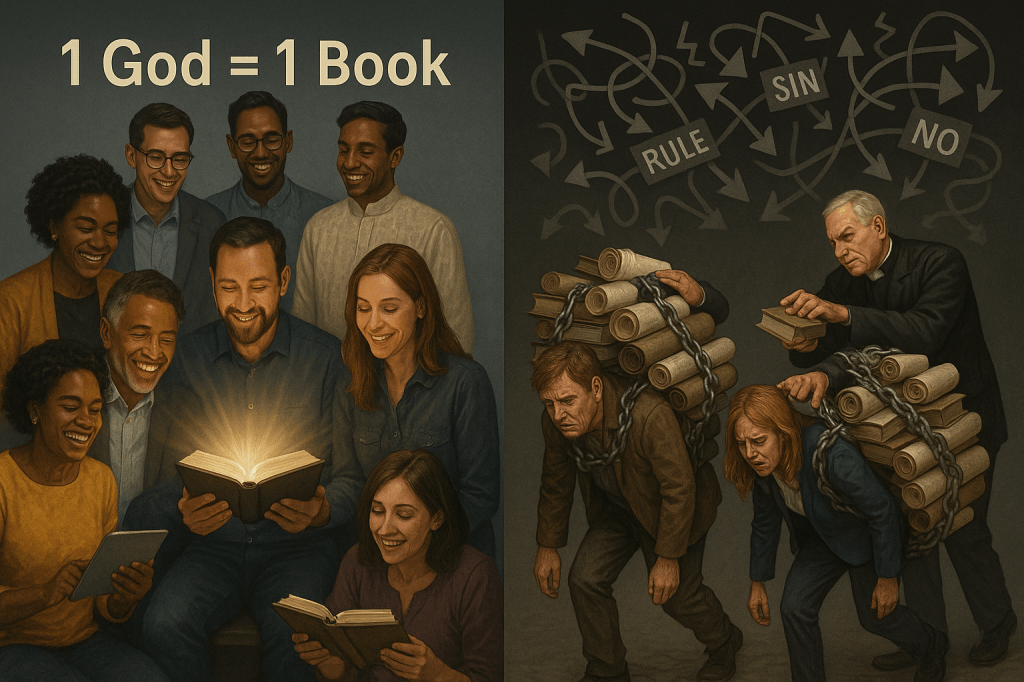
Yet examine what Hadith have added to Islam: stoning for adultery (the Quran prescribes lashing), killing apostates (the Quran guarantees freedom of religion), prohibiting music, art, and dogs as pets, regulating beard length and pants length, and thousands of other rules that appear nowhere in the Quran. These additions haven’t made Muslims more righteous—they’ve made the religion a burden that drives people away from God’s mercy.
Part 7: The Practical Consequences of Following Hadith
The Destruction of Islam’s Universal Message
The Quran presents a universal message for all humanity—a religion of reason, justice, and mercy that transcends cultural boundaries. The Hadith have transformed this into an Arab-centric, 7th-century tribal code that appears backward and barbaric to the modern world. While the Quran speaks to eternal human values and spiritual truths, the Hadith trap Muslims in medieval Arabian customs that have no relevance to contemporary life.
Consider how Hadith have affected women’s status in Islam. The Quran grants women equal spiritual status, property rights, divorce rights, and participation in public life. It nowhere mandates face covering, segregation, or exclusion from mosques. Yet Hadith claim women are mentally deficient, that most hell’s inhabitants are women, that women’s leadership dooms nations, and impose countless restrictions that effectively imprison half of humanity. These fabrications have made Islam appear misogynistic when the Quran itself was revolutionary in establishing women’s rights.
The Hadith have also corrupted Islam’s intellectual tradition. While the Quran repeatedly commands believers to think, reflect, and use reason, Hadith promote blind following of scholars, discourage questioning religious authorities, and claim that innovation in religion leads to hellfire. This anti-intellectual stance, derived from Hadith not Quran, has contributed to the Muslim world’s decline from scientific leadership to educational backwardness.
The Sectarian Divisions
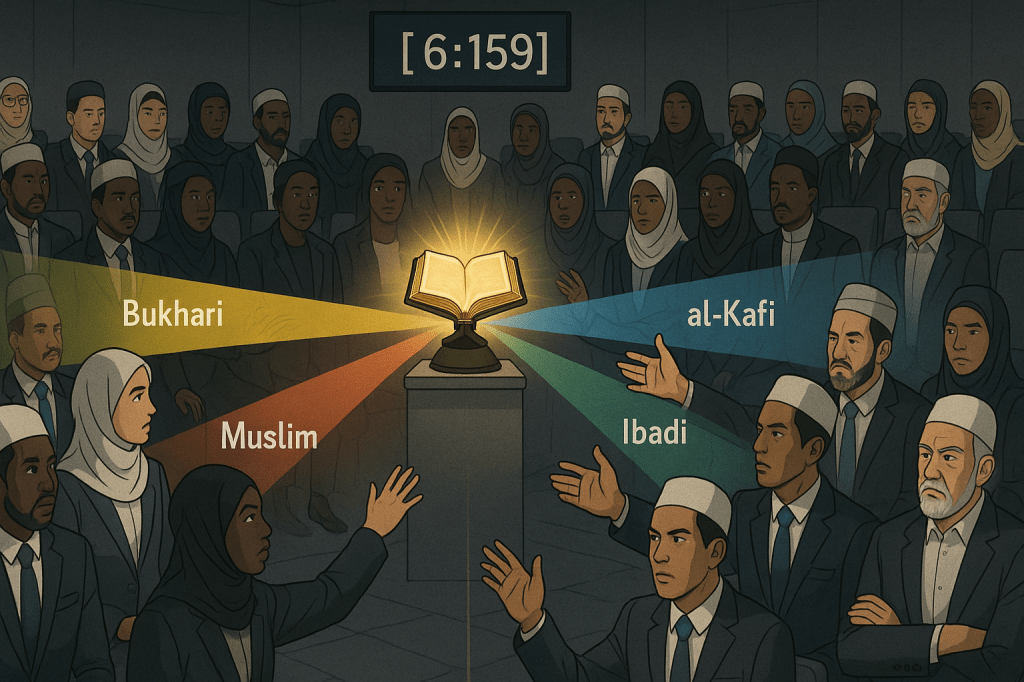
Perhaps nothing demonstrates the human origin of Hadith more clearly than their role in dividing Muslims into hostile sects. The Quran explicitly forbids sectarianism and commands Muslim unity. Yet different Hadith collections have created Sunni, Shi’a, Sufi, Salafi, and dozens of other sects, each claiming their Hadith are authentic while others’ are fabricated.
[6:159] “Those who divide themselves into sects do not belong with you. Their judgment rests with God, then He will inform them of everything they had done.”
Sunnis and Shi’as have been killing each other for centuries, each citing their own Hadith to justify violence against fellow Muslims. Sunnis rely on Bukhari and Muslim; Shi’as have al-Kafi and Bihar al-Anwar. Both claim to follow the same Quran, yet their different Hadith collections have created virtually different religions. If Hadith came from the same divine source as the Quran, why would they divide rather than unite believers?
Part 8: The Early Suppression of Hadith
The Prophet’s Own Position
According to historically documented events, Prophet Muhammad himself forbade the writing of Hadith. Multiple sources, ironically including some Hadith collections themselves, record that he said: “Do not write anything from me except the Quran. Whoever wrote anything other than the Quran shall erase it.” This command makes perfect sense given the Quran’s emphasis on its own completeness and sufficiency.
The Prophet understood the danger of supplementary texts. He had witnessed how previous communities corrupted their religions through human additions—the Talmud in Judaism, the Trinity in Christianity. He knew that allowing human narrations to stand alongside divine revelation would inevitably lead to the same corruption. That’s why he insisted on the Quran alone as the source of religious law and guidance.
Even more tellingly, the Prophet never established any system for preserving Hadith. He ensured the Quran was written down, memorized, and carefully preserved. He had scribes specifically designated for recording Quranic revelations. But for his own sayings? Nothing. No scribes, no memorization system, no preservation effort. If his personal sayings were meant to be part of the religion, wouldn’t he have ensured their preservation with the same care he showed for the Quran?
The First Four Caliphs’ Unanimous Opposition
The evidence becomes overwhelming when we examine the position of the first four Caliphs—Abu Bakr, Umar, Uthman, and Ali—all of whom opposed Hadith collection and transmission. These weren’t marginal figures but the leaders personally chosen by the Muslim community, men who had spent years with the Prophet and understood his mission better than anyone.
We’ve already discussed Abu Bakr burning his Hadith collection and Umar imprisoning Hadith narrators. Uthman, the third Caliph, continued this policy, focusing exclusively on Quran preservation and standardization. He gathered all Quranic manuscripts, verified them against multiple memorizers, and produced the standard copy still used today. But for Hadith? He showed no interest in collecting or preserving them.
Ali, the fourth Caliph and the Prophet’s cousin and son-in-law, also opposed Hadith. Despite Shi’a claims that he possessed special knowledge from the Prophet, historical records show he relied on the Quran alone for religious rulings. He famously said: “The Book of God is sufficient for us.” If anyone had authentic access to the Prophet’s personal teachings, it would have been Ali. Yet he, too, rejected the need for Hadith alongside the Quran.
Part 9: The Statistical Impossibility of Hadith Authenticity
The Numbers Don’t Lie
Let’s examine the mathematical impossibility of Hadith authenticity through pure statistics. Bukhari examined over 10 million Hadith and accepted roughly 7,275—a rejection rate of 99.93%. This means that for every potentially authentic saying, there were approximately 1,400 fabrications. But here’s the critical question: if 99.93% were false, what magical methodology allowed Bukhari to identify the 0.07% that were supposedly true?
The situation becomes more absurd when we consider that Bukhari was working 238 years after the Prophet’s death. He had no direct witnesses, no recordings, no contemporary written records—only oral traditions that had passed through multiple generations in an environment flooded with admitted fabrications. It’s like trying to find 7,275 specific drops of pure water in an ocean of pollution, blindfolded, using only taste, 238 years after the pure water was added.
Furthermore, different Hadith scholars accepted different narrations. Muslim’s collection differs from Bukhari’s. Abu Dawud, al-Tirmidhi, al-Nasa’i, and Ibn Majah all have different collections with different standards. If these scholars were all identifying the same authentic sayings through reliable methodology, their collections should be identical. Instead, they vary significantly, with some scholars accepting what others reject. This variation proves that their authentication methods were subjective human judgments, not divine guidance.
The Fabrication Industry
Historical records reveal that Hadith fabrication became an actual industry in the Muslim world. Professional fabricators would create Hadith for money, inventing complete chains of narration. Different groups fabricated Hadith for their purposes: rulers for political control, merchants for commercial benefit, preachers for dramatic effect, and sectarians for theological arguments.
Some fabricators confessed on their deathbeds to inventing thousands of Hadith. One famous case involves Muhammad ibn Sa’id al-Maslub, who admitted to fabricating over 4,000 Hadith before his execution. Another, Abd al-Karim Abu al-Auja, confessed to creating 4,000 Hadith, specifically designing them to corrupt Muslim practices. He boasted: “You have my 4,000 Hadith making what is halal into haram and what is haram into halal.”
If known fabricators could successfully inject thousands of false Hadith into circulation, and these Hadith were transmitted alongside supposedly authentic ones, how could anyone centuries later distinguish between them? The fabricators were often learned men who knew how to construct believable chains of narration and content that seemed plausible. Their lies mixed indistinguishably with whatever truth might have existed, contaminating the entire corpus beyond redemption.
Part 10: The Quranic Prophecy About Following Other Sources
God Knew This Would Happen
The Quran contains numerous prophecies, and among the most striking are its predictions about Muslims abandoning the Quran for other sources. God knew that Muslims would follow the path of previous communities, corrupting their religion through human additions. That’s why He included such explicit warnings against following any Hadith besides the Quran.
[25:30] “The messenger said, ‘My Lord, my people have deserted this Quran.’”
This verse prophesies that the messenger will complain on Judgment Day about his people deserting the Quran. How have Muslims deserted the Quran? By elevating Hadith to equal or greater status, by claiming the Quran is incomplete without Hadith, by spending more time studying Bukhari and Muslim than the Book of God, and by deriving their religious practices from narrations rather than revelation.
Traditional Muslims might argue they haven’t deserted the Quran since they still read it. But reading without following is indeed desertion. When Muslims turn to Hadith for their religious laws, their prayer details, their social customs, and their daily practices, while treating the Quran as a book for mere recitation and blessing, they have effectively deserted it as their guide.
[6:112-113] “We have permitted the enemies of every prophet—human and jinn devils—to inspire in each other fancy words, in order to deceive. Had your Lord willed, they would not have done it. You shall disregard them and their fabrications. This is to let the minds of those who do not believe in the Hereafter listen to such fabrications, and accept them, and thus expose their real convictions.”
These verses reveal that God permitted enemies to fabricate fancy words attributed to prophets as a test. The Hadith literature, with its elaborate chains of narration and volumes of detailed narrations, fits this description perfectly. Those whose hearts don’t truly believe in the Hereafter—despite their claims of faith—are attracted to these fabrications because they provide worldly authority, detailed control over others, and escape routes from the Quran’s demanding moral standards.
Part 11: The Messenger’s True Mission
Delivering the Quran, Nothing More
The Quran repeatedly defines the messenger’s mission with crystal clarity: to deliver the message. Not to explain it with supplementary texts, not to add his personal opinions as religious law, not to create a parallel body of literature—simply to deliver what God revealed.
[5:99] “The sole duty of the messenger is to deliver the message, and God knows everything you declare and everything you conceal.”
[24:54] “Say, ‘Obey God, and obey the messenger.’ If they turn away, then he is responsible for his obligations, and you are responsible for your obligations. If you obey him, you will be guided. The sole duty of the messenger is to deliver the clear message.”
Notice that obeying the messenger means obeying the message he delivered—the Quran. The verse doesn’t say his duty is to deliver the Quran plus thousands of personal instructions. It says his SOLE duty is delivering the message. The word “sole” excludes any additional religious authority beyond transmitting God’s revelation.
The Quran also clarifies that the messenger himself followed only what was revealed to him:
[46:9] “Say, ‘I am not different from other messengers. I have no idea what will happen to me or to you. I only follow what is revealed to me. I am no more than a profound warner.’”
If the messenger himself only followed what was revealed (the Quran), how can his followers claim they need additional sources he never authorized? If he didn’t know what would happen to him or others, how can Hadith claim he had detailed knowledge of the future, the unseen, and everyone’s fate?

Part 12: The Testimony of Converted Scholars
When Hadith Experts Discover the Truth
Some of the most powerful testimonies against Hadith come from former traditional scholars who spent years studying and teaching Hadith before discovering their falsehood. These individuals, trained in classical Islamic sciences, familiar with Arabic and the traditional methodology, provide insider perspectives on why the Hadith system cannot be divine.
Dr. Rashad Khalifa himself began as a traditional Muslim who accepted Hadith. His discovery of the Quran’s mathematical miracle led him to realize that only the mathematically composed Quran could be from God, while the mathematically chaotic Hadith must be human fabrications. His journey from tradition to truth cost him his life—he was assassinated in 1990 by those who couldn’t refute his evidence but could silence his voice.
Numerous contemporary scholars have followed similar paths. They describe the cognitive dissonance of trying to reconcile contradictory Hadith, the mental gymnastics required to explain away absurdities, and the relief of finally accepting the Quran alone. Their testimonies reveal a consistent pattern: deep study of Hadith leads sincere seekers to recognize their human origin, while only superficial acceptance maintains belief in their authenticity.
These scholars report that the traditional Islamic establishment responds to their evidence not with counter-arguments but with excommunication, death threats, and violence. If the Hadith defenders had truth on their side, they would welcome debate and easily refute the Quran-alone position. Instead, they resort to force—the refuge of those who know their position is indefensible.
Part 13: The Liberation of Following Quran Alone
Returning to Pure Monotheism
When Muslims abandon Hadith and follow the Quran alone, they experience a profound spiritual and intellectual liberation. The confusion disappears, the contradictions vanish, and the beauty of pure monotheism shines through. Instead of wrestling with thousands of contradictory narrations, they have one consistent, clear message from God.
The Quran-alone approach resolves every major controversy in Islam. Women’s rights? The Quran grants them full equality and dignity. Religious freedom? The Quran guarantees it absolutely. Relations with non-Muslims? The Quran commands justice and kindness unless they fight you for your religion. Punishment for apostasy? The Quran prescribes none, affirming freedom of belief. Every issue that makes Islam appear backward or cruel stems from Hadith, not from God’s revelation.
This liberation extends to worship practices. The Quran provides the essential elements of prayer, charity, fasting, and pilgrimage without the suffocating details that Hadith impose. Believers can fulfill their obligations to God without worrying about which foot to enter the bathroom with, how long their beards should be, or whether their prayers are invalidated by passing women, dogs, or donkeys (all actual Hadith claims).
[2:256] “There shall be no compulsion in religion: the right way is now distinct from the wrong way. Anyone who denounces the devil and believes in God has grasped the strongest bond; one that never breaks. God is Hearer, Omniscient.”
This verse epitomizes the Quranic approach: clear distinction between right and wrong, freedom of choice, and direct connection to God without intermediaries. No clergy class interpreting thousands of Hadith, no scholars declaring what God supposedly forgot to mention, no human authorities standing between believers and their Creator.

Part 14: Answering Common Objections
“How Do We Know How to Pray Without Hadith?”
This is the most common objection raised by Hadith followers, and it reveals their fundamental misunderstanding. The Quran does provide the essential elements of prayer: the times, the ablution, the standing, bowing, prostrating, and the importance of reverence and remembrance of God. What it doesn’t provide are the nitpicking details that vary between Hadith collections anyway.
More importantly, the prayer (Salat) existed before Muhammad. Abraham prayed, Jesus prayed, and all messengers prayed. The Quran came to reform and purify existing practices, not to introduce an entirely new prayer unknown to anyone. The basic form of prayer was already known and practiced; the Quran corrected innovations and emphasized its spiritual significance over ritualistic details.
If Hadith were necessary for prayer, why do different sects pray differently despite all claiming to follow authentic Hadith? Sunnis and Shi’as have different prayer methods, both citing their Hadith. Even within Sunni Islam, the four schools have variations, each claiming Hadith support. This variation proves that Hadith don’t provide clarity but confusion.
“The Quran Says ‘Obey God and Obey the Messenger’”
Yes, and obeying the messenger means obeying the message he brought—the Quran. The messenger’s message IS the Quran. He had no authority to legislate beyond what God revealed. The Quran itself clarifies this:
[69:44-47] “Had he uttered any other teachings. We would have punished him. We would have stopped the revelations to him. None of you could have helped him.”
These verses explicitly state that if the messenger had taught anything besides the Quran as religion, God would have punished him severely. This destroys the entire foundation of Hadith, which claim to preserve the messenger’s additional religious teachings. Either the Hadith are false, or God’s threat in these verses is false—and we know which option believers must choose.
“Hadith Explain the Quran”
This claim directly contradicts God’s description of the Quran as “fully detailed,” “clear,” and “explained.” If God’s book needs human explanation, then God failed in His communication—an impossibility for the All-Knowing, Most Wise. The Quran explains itself through its internal consistency, repetition of important themes, and clear language.
[75:19] “Then it is we who will explain it.”
God Himself promises to explain the Quran—not through Bukhari or Muslim, but through the Quran itself. When we let the Quran explain itself, using its own verses to understand its message, clarity emerges. When we impose Hadith interpretations, confusion and contradiction reign.
Part 15: The Path Forward
A Call to Return to God’s Pure Message
The evidence is overwhelming, undeniable, and accessible to anyone willing to examine it honestly. The Quran came from God—divinely revealed, mathematically coded, perfectly preserved, and completely detailed. The Hadith came from humans—collected centuries later, swimming in fabrications, contradicting both the Quran and each other, and varying by sect and school. These two sources cannot possibly originate from the same divine fountain.
For Muslims trapped in traditional Islam, the path forward is clear but requires courage. Question what you’ve been taught. Read the Quran without Hadith-colored glasses. Ask yourself: if God says His book is complete, who are you to say it needs supplementation? If God condemns following Hadith besides His, who are you to uphold what He condemned? If the Prophet’s companions rejected Hadith, who are you to embrace what they rejected?
The return to Quran alone doesn’t mean abandoning Islam—it means rediscovering its pure, original message. It means worshipping God alone without human partners, following divine revelation without human corruption, and embracing the universal message of submission to the Creator without cultural contamination. It means joining the ranks of true monotheists throughout history who refused to let human beings share in God’s authority.
The Ultimate Test
This issue represents the ultimate test of faith in our era. Will you believe God when He says His book is complete, or will you believe scholars who say it isn’t? Will you follow what God revealed, or what humans attributed? Will you stand with divine revelation, or human fabrication? Your answer determines not just your understanding of Islam, but your fundamental relationship with your Creator.
The Quran promises that truth stands clear from falsehood. The evidence presented here—from the Quran’s own verses, from historical facts, from mathematical analysis, from logical examination—all points to one conclusion: the Quran alone is God’s authorized guidance for humanity. The Hadith, regardless of their classification as “authentic” by human scholars, represent the corruption that God warned would come, the test that would distinguish true believers from those who prefer human authority to divine guidance.
[17:46] “When you preach your Lord, using the Quran alone, they run away in aversion.”
This verse predicts exactly what we see today: when believers preach using the Quran alone, traditional Muslims run away in aversion. They cannot stand to hear God’s words without their Hadith filters. They’ve become so attached to human narrations that pure divine revelation disturbs them. This reaction itself proves which source comes from God and which from His enemies.
Conclusion: The Historical Verdict Is Undeniable
The question “How did you get the Quran?” has been definitively answered with historical documentation, manuscript evidence, and the testimony of the companions themselves. The Quran came through:
1. Written preservation during Muhammad’s lifetime by literate scribes
2. Compilation from written sources by Zaid ibn Thabit under Abu Bakr
3. Standardization from manuscripts by Uthman’s committee
4. Physical manuscripts that still exist today, carbon-dated to the 7th century
5. The same companions who preserved the Quran REJECTED and BURNED Hadith
The Hadith came through:
1. Oral transmission across 238 years with no written records
2. Persian collectors (Bukhari, Muslim) who never met anyone who met Muhammad
3. Admitted fabricators who confessed to creating hundreds of thousands of false narrations
4. Political dynasties (Umayyad, Abbasid) who commissioned Hadith for legitimacy
5. A 99.93% rejection rate even by their own collectors
The claim that “the same people gave us both” is not just false—it’s the opposite of the truth. The people who gave us the Quran (Muhammad, his scribes, the Rightly-Guided Caliphs) explicitly forbade, burned, and imprisoned people for Hadith. The people who gave us Hadith (Bukhari, Muslim, and other Persian scholars) lived centuries later in Central Asia, never met the Prophet or his companions, and worked from a sea of admitted fabrications.
As Professor John Burton concluded in his academic study: “The Quran is the only Islamic text we can be certain dates to Muhammad’s lifetime.” Every court of law, every academic institution, every rational evaluation leads to the same conclusion: Written records from contemporary witnesses infinitely outweigh oral claims from centuries later. The Quran alone represents authentic Islam. The Hadith represent the corruption God warned would come.
The next time someone asks, “How did you get the Quran without Hadith?” show them this article. Show them the manuscripts. Show them the historical timeline. Show them that their own sources prove the Quran came from completely different people, through completely different methods, at completely different times than the Hadith. The truth fears no examination. Only falsehood requires blind faith.

 Quran Only Studies
Leave a comment