
Introduction: The Critical Verse That Changes Everything
When examining whether feeding pork to Christians constitutes facilitating sin, one verse provides the definitive answer that overrides all human reasoning and interfaith accommodation theories. [5:48] commands us unequivocally: “You shall rule among them in accordance with God’s revelations, and do not follow their wishes if they differ from the truth that came to you.” This divine command establishes that our actions must be guided by the truth revealed in the Quran—the final scripture that supersedes all previous revelations—not by what others believe or wish based on their corrupted or abrogated scriptures.
The question isn’t whether Christians consider pork sinful according to their altered texts. The question is whether God, in His final revelation, has declared pork contaminated (rijs) and prohibited. Since He has, and since we are commanded not to cooperate in sin [5:2] and warned that facilitators of evil bear a portion of its burden [4:85], the answer becomes clear: providing pork to anyone constitutes facilitating sin, regardless of their personal beliefs.
Part 1: The Supremacy of the Final Scripture
Verse 5:48 – The Command to Follow Truth Over Others’ Wishes
[5:48] “Then we revealed to you this scripture, truthfully, confirming previous scriptures, and superseding them. You shall rule among them in accordance with God’s revelations, and do not follow their wishes if they differ from the truth that came to you. For each of you, we have decreed laws and different rites. Had God willed, He could have made you one congregation. But He thus puts you to the test through the revelations He has given each of you. You shall compete in righteousness. To God is your final destiny—all of you—then He will inform you of everything you had disputed.”
This verse contains several crucial points that definitively answer our question:
1. The Quran supersedes previous scriptures: The word “muhaymin” (superseding) means the Quran has authority over all previous revelations. What the Bible says about dietary laws is irrelevant when the Quran has spoken.
2. We must rule by God’s revelations to us: We are commanded to judge and act according to what God revealed in the Quran, not according to what others believe based on their scriptures.
3. Do not follow their wishes if they differ from truth: This is the key command—when others’ desires or beliefs contradict the truth revealed to us, we must not accommodate them. Their wish to eat pork contradicts God’s declaration that it is contaminated.
4. Different communities have different tests: While God gave different laws to different communities as tests, we are bound by the law given to us—the final, complete law of the Quran.
Part 2: The Nature of Pork’s Prohibition – Contamination, Not Preference
Understanding “Rijs” – Inherent Contamination
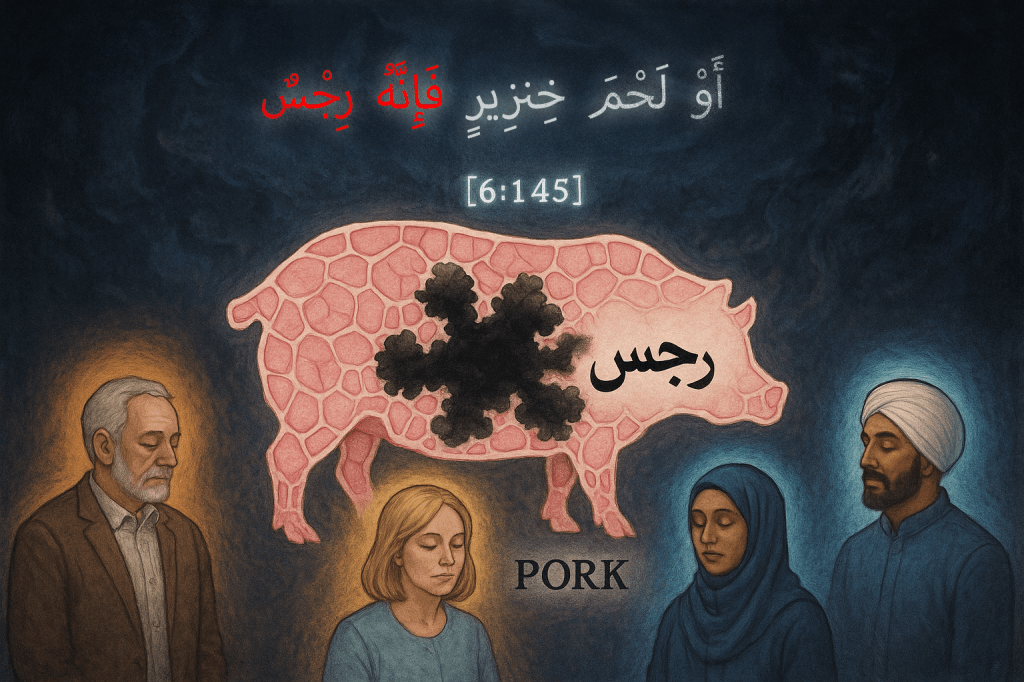
[6:145] “Say, ‘I do not find in the revelations given to me any food that is prohibited for any eater except: (1) carrion, (2) running blood, (3) the meat of pigs, for it is contaminated (rijs), and (4) the meat of animals blasphemously dedicated to other than God.’”
The Quran doesn’t describe pork as merely “forbidden for Muslims” or as a “ritual restriction.” It declares pork inherently contaminated—”rijs.” This Arabic term indicates something that is fundamentally impure, polluted, or contaminated. This isn’t about religious identity or cultural practice; it’s about the inherent nature of the substance itself.
When God declares something contaminated, that contamination doesn’t disappear based on the consumer’s beliefs. Poison remains poison whether the person ingesting it believes it’s harmful or not. Similarly, pork remains rijs whether consumed by a Muslim, Christian, Hindu, or atheist.
Part 3: The Clear Prohibition Against Facilitating Sin
Cooperating in Sin and Bearing Its Burden
[5:2] “…You shall cooperate in matters of righteousness and piety; do not cooperate in matters that are sinful and evil. You shall observe God; God is strict in enforcing retribution.”
This verse establishes a fundamental principle: we must not cooperate in sin. The Arabic “ta’awanu” (cooperate) includes any form of assistance, facilitation, or enablement. Providing, preparing, or serving pork—which God has declared contaminated—constitutes cooperation in consuming contaminated food, which is sinful.
[4:85] “Whoever mediates a good deed receives a share of the credit thereof, and whoever mediates an evil work, incurs a share thereof. God controls all things.”
This verse warns that those who mediate or facilitate evil bear a portion of its burden. The word “shafa’a” (mediate/intercede) includes any action that enables or facilitates another’s action. By providing pork, we become mediators of its consumption, thereby incurring a share of the sin.
Part 4: The Libertarian Principle and Its Limits
Freedom to Choose, Not Freedom to Facilitate
While the Quran establishes religious freedom with “There shall be no compulsion in religion” [2:256], this freedom refers to the individual’s right to choose their path, not our obligation to facilitate their wrong choices. A Submitter government wouldn’t forcibly prohibit pork for non-believers, but it also wouldn’t endorse or facilitate its consumption.
The article on modern slavery and libertarian principles emphasizes creating environments where following God’s laws is easy. A Submitter community should structure itself to make avoiding prohibited substances simple, not to accommodate their consumption. Just as we wouldn’t facilitate theft because someone doesn’t believe in property rights, we shouldn’t facilitate consuming contaminated food because someone doesn’t accept God’s declaration of its contamination.
Part 5: Why Others’ Beliefs Don’t Change Our Responsibility
Truth Is Not Relative
The modern tendency toward religious relativism—”what’s true for you may not be true for me”—contradicts the Quran’s clear position. When God declares something contaminated and prohibited, that’s an absolute truth, not a subjective opinion. Our responsibility is to act according to this truth, not to accommodate others’ rejection of it.
Consider parallel scenarios:
• If someone doesn’t believe in gravity, do we help them jump off a cliff?
• If someone doesn’t believe poison is harmful, do we serve it to them?
• If someone doesn’t believe in property rights, do we help them steal?
In each case, the answer is no—we don’t facilitate harmful actions just because someone doesn’t acknowledge the harm. Similarly, we don’t facilitate consuming contaminated food just because someone doesn’t acknowledge the contamination.

Part 6: The Practical Application in Modern Society
Living in a Pluralistic World Without Compromising Truth
The question arises: How do we function in diverse societies while maintaining this principle? The answer lies in understanding the difference between respecting others’ freedom to choose and actively facilitating their wrong choices.
Scenario 1: Muslim Restaurant Worker
A Muslim who chooses to work in an establishment serving pork faces a clear choice: either find alternative employment that doesn’t require handling contaminated substances, or request accommodation to avoid pork-related tasks. Many workplaces accommodate religious restrictions. If accommodation isn’t possible, the principle from [5:48] is clear—don’t follow their wishes when they contradict the truth revealed to you.
Scenario 2: Muslim Business Owner
A Muslim who owns a restaurant or grocery store should not stock or serve pork. This isn’t forcing beliefs on others—customers are free to shop elsewhere. It’s maintaining personal adherence to God’s law. Just as a vegan restaurant doesn’t serve meat without “forcing” veganism on anyone, a Muslim establishment need not serve contaminated food.
Scenario 3: Hosting Non-Muslim Guests
When hosting, provide abundant halal options. If guests insist on pork, they’re free to eat elsewhere. Hospitality doesn’t require violating God’s commands. True respect means being honest about our convictions, not compromising them.
Part 7: The Emergency Exception Doesn’t Apply Here
Understanding When Prohibition Is Lifted
[2:173] “He only prohibits for you the eating of animals that die of themselves (without human interference), blood, the meat of pigs, and animals dedicated to other than God. If one is forced (to eat these), without being malicious or deliberate, he incurs no sin. God is Forgiver, Most Merciful.”
The emergency exception (“if one is forced”) applies to the person consuming under duress, not to someone facilitating consumption for others who have alternatives. Christians in modern society aren’t forced to eat pork—they have countless other food options. Therefore, the exception doesn’t apply, and the prohibition remains absolute.
Even if someone claims they’re “forced” by their beliefs to eat pork, this isn’t the type of compulsion the verse addresses. The verse refers to literal starvation or threat to life, not ideological preference. We wouldn’t accept “my beliefs force me to steal” as justification for facilitating theft.
Part 8: The Difference Between Personal Sin and Facilitated Sin
Why Facilitation Can Be Worse Than Direct Commission
In some ways, facilitating sin can be worse than committing it directly. When we sin personally, we harm ourselves. When we facilitate others’ sins, we potentially harm multiple people and normalize the prohibited behavior. A drug dealer who doesn’t use drugs but supplies others arguably commits a greater evil than an individual user.
Similarly, by providing pork to others, we:
• Enable consumption of contaminated food
• Normalize what God has prohibited
• Potentially influence others to view it as acceptable
• Bear responsibility for each instance of consumption we facilitate
The Quran’s warning in [4:85] about bearing a portion of facilitated evil isn’t arbitrary—it reflects the multiplied harm that comes from enabling others’ wrong actions.

Part 9: Addressing Common Counterarguments
“But the Quran Says Their Food Is Lawful”
Some cite [5:5]: “The food of those who received the scripture is lawful for you.” However, this refers to properly slaughtered meat from animals that are themselves lawful. It doesn’t make pork lawful just because a Christian prepares it. Pork remains contaminated regardless of who handles it. The verse permits eating their lawful food, not their unlawful food.
“This Creates Unnecessary Hardship”
Following God’s commands sometimes requires sacrifice and standing apart from societal norms. The Quran acknowledges this:
[29:2] “Do the people think that they will be left to say, ‘We believe,’ without being put to the test?”
The test includes maintaining our principles even when it’s professionally or socially inconvenient. The hardship of finding alternative employment or losing customers pales compared to the spiritual harm of facilitating sin.
“Judge Not Lest Ye Be Judged”
We’re not judging people; we’re recognizing God’s judgment about pork being contaminated. There’s a difference between condemning individuals (which we shouldn’t do) and refusing to facilitate actions God has prohibited (which we must do). We can respect people while refusing to enable their wrong choices.
Part 10: The Wholesome Environment Principle
Creating Spaces Where Righteousness Thrives
The concept of creating wholesome environments where following God’s law is easy to abide by is crucial. This doesn’t mean forcing compliance but structuring our communities and businesses to naturally support righteous choices. Consider how different environments affect behavior:
Environment A: A community where pork is readily available, widely advertised, and socially normalized. Even believers struggle to avoid it, and children grow up seeing it as acceptable.
Environment B: A community where pork isn’t sold or served, where restaurants proudly advertise “No Contaminated Food,” where the absence of pork is normal. Following God’s law becomes effortless.
We’re responsible for contributing to Environment B, not accommodating Environment A. This isn’t about compulsion—people remain free to seek pork elsewhere—but about creating spaces where righteousness is the path of least resistance.
Part 11: The Individual’s Ultimate Right and Our Ultimate Responsibility
Balancing Freedom with Truth
Yes, [2:256] establishes “no compulsion in religion,” and individuals have the ultimate right to choose their course of action. However, this verse protects their right to choose, not our obligation to enable their choices. The distinction is crucial:
Their Right: To believe what they choose, to seek and consume what they prefer
Not Their Right: To demand we facilitate their consumption of contaminated food
Our Right: To follow God’s commands and refuse to facilitate sin
Our Responsibility: To stand for truth even when others choose falsehood
Religious freedom means they can seek pork from willing providers, not that we must become those providers. Our responsibility to God supersedes any social obligation to accommodate others’ desires that contradict His commands.

Part 12: Historical Lessons from Previous Communities
How Accommodation Led to Corruption
The Quran provides numerous examples of how previous communities corrupted their religions by accommodating desires that contradicted God’s commands:
[9:31] “They have set up their religious leaders and scholars as lords, instead of God. Others deified the Messiah, son of Mary. They were all commanded to worship only one god. There is no god except He. Be He glorified, high above having any partners.”
These communities didn’t suddenly abandon God; they gradually accommodated human desires and interpretations until the original message was lost. The Jews made lawful what God prohibited and prohibited what God made lawful. The Christians abandoned dietary laws entirely, claiming all foods are clean contrary to God’s declaration.
We must learn from their mistakes. Accommodating others’ wishes to consume what God declared contaminated is the first step on the slippery slope to corrupting our religion. Today it’s serving pork; tomorrow it might be declaring it lawful; eventually, the entire structure of divine law collapses.
Part 13: The Messenger’s Example and Modern Application
Standing for Truth in a Hostile Environment
Prophet Muhammad lived in a society where most people opposed his message. He maintained cordial relations with non-believers, engaged in trade, and signed treaties. However, he never compromised on fundamental prohibitions. He didn’t serve wine to pagans who enjoyed it or facilitate idol worship for those who practiced it.
The Constitution of Medina guaranteed religious freedom for different communities, but this meant they could practice their own religions separately, not that Muslims would facilitate practices God prohibited. Each community maintained its own standards while coexisting peacefully.
In our modern context, this means:
• We can work alongside non-Muslims without handling prohibited items
• We can maintain friendships without facilitating prohibited consumption
• We can run businesses that serve the public without serving contaminated food
• We can participate in society without participating in sin
Part 14: The Economic Argument and Its Flaws
When Financial Pressure Isn’t True Compulsion
Some argue that economic necessity forces Muslims to handle pork—restaurant workers need jobs, business owners need customers. However, the Quran’s emergency exception requires genuine compulsion, not mere inconvenience or financial preference.
Throughout history, believers have sacrificed economically for their principles:
• Early Muslims in Mecca faced economic boycotts rather than compromise
• Jewish communities maintained kosher laws despite economic disadvantages
• Many modern Muslims successfully run halal-only businesses
If Muslims in Muslim-minority countries can maintain halal businesses profitably, the economic argument fails. Yes, excluding pork might reduce potential customers, but integrity has value beyond monetary gain. As the Quran reminds us:
[9:24] “Proclaim: ‘If your parents, your children, your siblings, your spouses, your family, the money you have earned, a business you worry about, and the homes you cherish are more beloved to you than God and His messenger, and the striving in His cause, then just wait until God brings His judgment.’ God does not guide the wicked people.”
Part 15: The Ultimate Test of Submission
Will We Follow God’s Truth or People’s Wishes?
This issue ultimately tests our submission to God. Will we follow His clear command in [5:48] not to follow others’ wishes when they contradict His truth? Or will we rationalize disobedience through complex theological gymnastics?
The Quran’s position is clear:
• Pork is contaminated (rijs) – [6:145]
• We must not cooperate in sin – [5:2]
• Facilitators of evil bear its burden – [4:85]
• We must not follow others’ wishes against God’s truth – [5:48]
• The Quran supersedes all previous scriptures – [5:48]
No amount of interfaith dialogue, philosophical reasoning, or social pressure changes these divine declarations. The question isn’t whether we can find justifications for serving pork; it’s whether we’ll submit to God’s clear commands or seek loopholes to avoid them.
Conclusion: Standing for Truth in an Age of Accommodation
The evidence from the Quran is overwhelming and unambiguous: providing pork to anyone—regardless of their beliefs—constitutes facilitating the consumption of what God declared contaminated, thereby violating multiple divine commands. The crucial verse [5:48] definitively settles the matter: we must not follow others’ wishes when they differ from the truth revealed to us.
This position isn’t about hatred, superiority, or forcing beliefs on others. It’s about integrity—refusing to facilitate what God prohibited even when others don’t recognize the prohibition. It’s about truth—acknowledging that God’s declaration of contamination is absolute, not relative to individual beliefs. It’s about submission—choosing God’s commands over social accommodation.
In a world increasingly driven by relativism and accommodation, standing for divine truth becomes both more difficult and more necessary. The pressure to compromise, to be “inclusive,” to avoid “judgment,” intensifies daily. But the Quran’s message remains unchanged: follow the truth revealed to you, not others’ wishes that contradict it.
The path forward is clear: Create communities and businesses that make following God’s law easy. Respect others’ freedom to choose without facilitating their wrong choices. Maintain personal integrity even when it costs professionally or socially. Trust that God’s wisdom in prohibiting pork transcends human understanding or acceptance.
As believers, we’re called to be witnesses to truth, not facilitators of falsehood. When we stand firm on this principle—refusing to serve contaminated food regardless of who requests it—we demonstrate true submission to God. We show that His commands take precedence over human wishes, that His truth supersedes human beliefs, and that His pleasure matters more than social acceptance.
The choice each believer faces is simple but profound: Will you follow God’s clear command in [5:48], or will you follow their wishes that contradict His truth? Your answer determines not just your stance on serving pork, but your fundamental relationship with divine authority. Choose wisely. Choose truth. Choose God.


 Quran Only Studies
Leave a comment