
Introduction: The Desperate Attempt to Justify the Unjustifiable
A document titled “19 Reasons DEBUNKED” has surfaced, attempting to dismantle the divine architecture that makes praying behind hypocrites impossible. The author’s desperation is palpable – they resort to taking verses out of context, ignoring divine legislative principles, and even contradicting themselves within their own arguments. Their central claim? That because God didn’t explicitly write “you cannot pray behind hypocrites,” the practice must be permissible. This superficial reading reveals a fundamental misunderstanding of how divine prohibition works.
The irony is striking: in their attempt to “debunk” nineteen divinely coordinated verses, they actually expose their own spiritual bankruptcy. They claim prayer is “obeying God not hypocrites,” yet fail to recognize that following a hypocrite in prayer is literally obeying their leadership, timing, and direction. They argue we can befriend certain hypocrites, while ignoring that friendship and spiritual leadership are entirely different relationships. Most tellingly, they resort to crude analogies about potatoes offered to Satan – a comparison so bizarre it reveals the weakness of their position.
What they fail to understand is the concept of asymptotic prohibition – God’s sophisticated legislative approach where He surrounds certain behaviors with so many restrictions and warnings that engagement becomes virtually impossible for sincere believers. The nineteen verses don’t need to explicitly state the prohibition because together they create conditions where the practice becomes unthinkable for anyone who truly submits to God.
Part 1: The Fallacy of “Prayer is Obeying God, Not Hypocrites”
Exposing the Logical Contradiction
The document’s first argument claims: “Prayer is obeying God not hypocrites. If a hypocrite says to worship God alone, we are allowed to worship God alone.” This statement reveals a fundamental misunderstanding of what it means to follow someone in congregational prayer. When you pray behind an imam, you are literally obeying their every movement – when they bow, you bow; when they prostrate, you prostrate; when they stand, you stand. This is the very definition of obedience.
[33:1] “O you prophet, you shall reverence God and do not obey the disbelievers and the hypocrites. God is Omniscient, Most Wise.”
[33:48] “Do not obey the disbelievers and the hypocrites, disregard their insults, and put your trust in God; God suffices as an advocate.”
God’s command is crystal clear: do not obey hypocrites. There’s no qualifier saying “except in prayer” or “unless they’re leading worship.” The command is absolute. To claim that following someone’s physical movements, verbal recitations, and prayer timing doesn’t constitute obedience is intellectually dishonest. If I told you “don’t follow John” and then you literally followed John’s every movement for twenty minutes, could you honestly claim you hadn’t disobeyed my instruction?
Furthermore, the role of imam carries spiritual authority. The imam decides when to start, what to recite, how long to prostrate, and when to conclude. Accepting someone as your imam means accepting their spiritual leadership in that moment. This goes far beyond merely “worshipping God alone” – it’s placing a hypocrite in a position of religious authority over believers, directly contradicting God’s clear commands.

Part 2: The Selective Reading of Verse 4:89
Cherry-Picking Context to Support a Predetermined Conclusion
The document repeatedly cites verse 4:89 as proof that we can “BEFRIEND hypocrites who mobilize with us,” using this as justification for accepting their religious leadership. This represents a gross misreading of the verse, cherry-picking one conditional clause while ignoring the overwhelming context of warning and restriction.
[4:89] “They wish that you disbelieve as they have disbelieved, then you become equal. Do not consider them friends, unless they mobilize along with you in the cause of God. If they turn against you, you shall fight them, and you may kill them when you encounter them in war. You shall not accept them as friends, or allies.”
First, notice what the verse actually says: “They wish that you disbelieve as they have disbelieved.” This is the defining characteristic of the hypocrites being discussed – they want to drag believers down to their level of disbelief. The verse then provides a narrow exception: mobilization in the cause of God. This refers to physical participation in defensive warfare, not spiritual leadership in prayer.
The document’s author conveniently ignores that even this exception comes with immediate warnings: “If they turn against you, you shall fight them.” The verse is describing a tentative, conditional relationship based solely on military cooperation, not an endorsement of spiritual fellowship. To extrapolate from battlefield alliance to prayer leadership is a leap that defies both logic and divine wisdom.
[4:90] “Exempted are those who join people with whom you have signed a peace treaty, and those who come to you wishing not to fight you, nor fight their relatives. Had God willed, He could have permitted them to fight against you. Therefore, if they leave you alone, refrain from fighting you, and offer you peace, then God gives you no excuse to fight them.”
The very next verse (4:90) clarifies that this entire discussion is about military conflict and peace treaties, not about prayer leadership or spiritual authority. The context is battlefield dynamics, not mosque leadership. Using these verses to justify praying behind hypocrites is like using traffic laws to justify medical procedures – a complete category error.
Part 3: The Deliberate Misrepresentation of “Consultation”
When Dismissive Responses Reveal Deeper Problems
When confronted with verse 42:38 about consultation being exclusively with believers, the document responds dismissively: “Ok, and? Prayer is not consultation.” This flippant response reveals either profound ignorance or deliberate obtuseness about the nature of congregational prayer and spiritual leadership.
[42:38] “They respond to their Lord by observing the Contact Prayers (Salat). Their affairs are decided after due consultation among themselves, and from our provisions to them they give (to charity).”
This verse explicitly links three characteristics of believers: observing prayers, consultation among themselves (not with hypocrites), and charity. The grammatical structure makes these interconnected aspects of righteous community life. The “themselves” refers to believers, creating a closed circle of spiritual fellowship that excludes hypocrites from leadership roles.
Moreover, accepting someone as your prayer leader is indeed a form of consultation – you’re consulting them about the direction of prayer, the timing, the recitations, and the spiritual conduct of worship. You’re acknowledging their authority to make religious decisions on your behalf during that prayer. If consultation about worldly affairs must be among believers only, how much more so consultation about the most important act of worship?
The dismissive “Ok, and?” actually strengthens our case. It shows the document’s author has no substantive response to the clear divine principle that believers’ affairs – especially their spiritual affairs – should be conducted among themselves, not under the leadership of hypocrites.

Part 4: The Absurdity of Selective Sternness
You Cannot Be Stern While Submitting to Leadership
The document argues that we only need to be stern with “certain hypocrites in certain matters,” suggesting we can somehow be stern with hypocrites while simultaneously accepting them as prayer leaders. This logical pretzel demonstrates the lengths to which compromisers will go to justify their position.
[9:73] “O you prophet, strive against the disbelievers and the hypocrites, and be stern in dealing with them. Their destiny is Hell; what a miserable abode!”
[66:9] “O prophet, struggle against the disbelievers and the hypocrites and be stern with them. Their abode is Gehenna, and a miserable destiny.”
God commands us to be stern with hypocrites – not just some hypocrites, not just sometimes, but as a general principle of interaction. The Arabic word used here, “ughluẓ” (اغْلُظْ), means to be harsh, severe, and uncompromising. How can you be harsh and uncompromising with someone while literally following their every movement in prayer? How can you struggle against someone while accepting them as your spiritual leader?
The document’s attempt to parse hypocrites into categories – those we can befriend versus those we must oppose – misses the fundamental point. Even if such categories existed (which the verses don’t support), placing any hypocrite in a position of spiritual authority over believers violates the principle of sternness. You cannot be stern with someone while bowing when they tell you to bow.
Imagine telling a child to be stern with a bully, then watching that child follow the bully’s every command for twenty minutes. Would you accept the excuse that they were being “stern in their heart” while outwardly obeying? The contradiction is so obvious that only willful blindness could miss it.
Part 5: The Pollution Principle – Why “Ignore Them” Doesn’t Mean “Follow Them”
Understanding Spiritual Contamination
The document makes an astounding logical leap when discussing verses about ignoring and disregarding hypocrites. They argue: “Exactly. Ignore them. Why do you care if they pray with you or not? Leave them alone and ignore them.” This completely inverts the meaning of these verses, suggesting that ignoring someone means accepting them as your prayer leader.
[4:63] “God is fully aware of their innermost intentions. You shall ignore them, enlighten them, and give them good advice that may save their souls.”
[9:95] “They will swear by God to you, when you return to them, that you may disregard them. Do disregard them. They are polluted, and their destiny is Hell, as a requital for the sins they have earned.”
Notice verse 9:95’s crucial declaration: “They are polluted.” The Arabic word “rijs” (رِجْسٌ) means filth, abomination, spiritual contamination. This is the same word used for the pollution of idolatry and intoxicants. God is telling us that hypocrites carry spiritual contamination that can affect those who come into close contact with them.
To ignore someone means to avoid giving them attention or importance – it certainly doesn’t mean to line up behind them and follow their lead in prayer! If I told you to ignore a toxic person, would you interpret that as permission to make them your mentor? The document’s interpretation is so backwards it borders on the absurd.
Furthermore, the command to “enlighten them and give them good advice” indicates we should be in a position of spiritual authority over them, not the reverse. We are to be their teachers, not their followers. The relationship dynamic these verses establish is clear: believers guide hypocrites toward truth, not the other way around.

Part 6: The Ego Worship Reality – Why Hypocrites Are Literal Idolaters
Understanding the Ultimate Form of Shirk
The document casually dismisses the fact that hypocrites are described as ego worshippers with another “Ok, and? What does that have to do with Salat?” This dismissal reveals a catastrophic failure to understand the nature of idolatry and its implications for prayer leadership.
[25:43] “Have you seen the one whose God is his own ego? Will you be his advocate?”
[45:23] “Have you noted the one whose God is his ego? Consequently, God sends him astray, despite his knowledge, seals his hearing and his mind, and places a veil on his eyes. Who then can guide him, after such a decision by God? Would you not take heed?”
These verses aren’t using metaphor or hyperbole. The hypocrite literally worships their own ego as their god. They have replaced the Creator with themselves, making their own opinions, desires, and interpretations supreme over divine guidance. This is the ultimate form of shirk (idolatry) – not worshipping a stone idol, but worshipping the self.
Now consider what happens when you pray behind an ego worshipper. You’re not just following someone who has a different opinion – you’re following someone whose god is fundamentally different from yours. While you’re trying to connect with the Creator, they’re communing with their own ego. While you’re seeking divine guidance, they’re reinforcing their own self-worship. The spiritual directions are diametrically opposed.
God asks rhetorically: “Will you be his advocate?” The expected answer is an emphatic “No!” Yet by accepting a hypocrite as prayer leader, you become their advocate in the most profound way possible – you validate their religious authority and endorse their spiritual leadership. You’re literally advocating for someone whose god is their ego.
Part 7: The Masjid of Satan – Understanding the Arabic Grammar of Divine Prohibition
The WA Conjunction: Any Single Condition Creates a Corrupted Masjid
The document fundamentally misunderstands the Arabic grammar of verses 9:107-108, leading to a complete misreading of God’s clear prohibition. The critical insight lies in understanding the Arabic conjunction “WA” (و) and how it functions in divine legislation.
[9:107] “There are those who abuse the masjid by practicing idol worship (ḍirāran WA-kufran), dividing the believers (WA-tafrīqan), and providing comfort to those who oppose God and His messenger (WA-irṣādan). They solemnly swear: ‘Our intentions are honorable!’ God bears witness that they are liars.”
[9:108] “You shall never pray in such a masjid. A masjid that is established on the basis of righteousness from the first day is more worthy of your praying therein. In it, there are people who love to be purified. God loves those who purify themselves.”
The Arabic text uses “WA” (و) before each condition: WA-kufran (and disbelief/rejection), WA-tafrīqan (and division), WA-irṣādan (and as a garrison/observation post). This grammatical structure indicates that ANY ONE of these conditions being met is sufficient to make it a “Masjidan Ḍirāran” – a Masjid of Harm. The document’s claim that all three conditions must be simultaneously present reveals a fundamental misunderstanding of Quranic Arabic.
Consider the parallel grammatical structure in verse 4:3 about polygamy:
[4:3] “If you deem it best for the orphans, you may marry their mothers – two, three, or four (mathnā WA-thulātha WA-rubāʿa).”
Using the document’s flawed logic, this would mean men must marry two AND three AND four wives simultaneously (totaling nine wives), which is absurd. The “WA” conjunction here clearly means “OR” in the distributive sense – you may marry two OR three OR four. Similarly, in 9:107, a masjid becomes corrupted if it meets ANY of the three conditions: harm/disbelief OR division OR serving as an attack point against God and His messenger.
Most critically, the term “WA-irṣādan” deserves special attention. The root R-Ṣ-D (رصد) means to observe, watch, lie in wait, or establish an observation post. In military terminology, “irṣād” refers to establishing a garrison or forward operating base. But the verse clarifies this is “li-man ḥāraba Allāha wa-rasūlahu” – for those who wage war against God and His messenger. This isn’t physical warfare – it’s theological and spiritual warfare. Hypocrites use the masjid as their base of operations to undermine divine truth, spread their ego-worship disguised as religion, and attack the foundations of true submission.
When a hypocrite leads prayer, they transform that sacred space into “Masjidan Ḍirāran” – a Masjid of Harm – because:
1. They practice kufr (disbelief/rejection) – Despite claiming faith, they reject God’s commands by placing their ego above divine guidance (verses 25:43, 45:23)
2. They cause division (tafrīq) – Their leadership naturally divides believers between those who recognize the contamination and those who don’t, creating fitna in the community
3. They establish an attack point (irṣād) – They use their position to wage theological war against true submission, corrupting divine message with their ego-driven interpretations
ANY SINGLE ONE of these conditions being met is sufficient for God’s command: “You shall never pray in such a masjid.” The hypocrite leader doesn’t need to meet all three conditions – meeting even one makes that prayer space spiritually contaminated and off-limits to sincere believers.
The document’s attempt to claim this verse only applies to one historical masjid ignores the eternal nature of Quranic principles. When God establishes a principle about sacred space corruption, it applies across time and location. A masjid where hypocrites lead – whether in 7th century Arabia or 21st century anywhere – becomes a base for theological warfare against God and His messenger. This is precisely what “WA-irṣādan li-man ḥāraba Allāha wa-rasūlahu” means: it becomes a cloaked attack point for those waging war against divine truth.

Part 8: The Sacred Masjid Fallacy – Missing the Forest for the Trees
When Technicalities Obscure Divine Principles
The document argues that verse 9:28 only applies to the Sacred Masjid in Mecca, not regular masjids, therefore idol worshippers (including ego-worshipping hypocrites) aren’t blocked from general masjids. This technicality-based argument reveals a failure to understand divine legislative principles.
[9:28] “O you who believe, the idol worshipers are polluted; they shall not be permitted to approach the Sacred Masjid after this year. If you fear loss of income, God will shower you with His provisions, in accordance with His will. God is Omniscient, Most Wise.”
[9:17] “The idol worshipers are not to frequent the masjids of God, while confessing their disbelief. These have nullified their works, and they will abide forever in Hell.”
First, note that verse 9:17 uses the plural “masjids of God,” not limiting the prohibition to a single location. While verse 9:28 specifically mentions the Sacred Masjid, it establishes a principle: idol worshippers are polluted and should be kept from positions of religious authority. If they’re too polluted for the Sacred Masjid, how can they be pure enough to lead prayers anywhere?
The document also misinterprets the word “frequent” in 9:17, claiming it refers only to custodianship or maintenance. However, the Arabic word “yaʿmurū” encompasses all forms of regular attendance and participation. Leading prayers certainly qualifies as “frequenting” a masjid in the most profound way possible – exercising spiritual authority there.
This technicality-based approach – arguing that because Mecca is specifically mentioned, the principle doesn’t apply elsewhere – is like arguing that because murder is specifically prohibited in the city, it must be acceptable in the countryside. Divine principles transcend specific geography.
Part 9: The “Imam as Record” Denial – Rejecting Clear Scripture
When Uncomfortable Truths Lead to Outright Rejection
Perhaps the most telling moment in the document comes when discussing verse 17:71 about being summoned with our imam. The response? “That’s not what the verse says. Read it again. Gross distortion of the word of God.” This accusation of “gross distortion” reveals desperation when confronted with uncomfortable truth.
[17:71] “The day will come when we summon every people, together with their record. As for those who are given a record of righteousness, they will read their record and will not suffer the least injustice.”
The Arabic word in this verse is “bi-imāmihim” (بِإِمَامِهِمْ) – literally “with their imam.” While some translations render this as “record” or “book,” the root meaning is “leader” or “one who is followed.” The same root appears throughout the Quran referring to leaders and guides. Even if we accept “record” as a translation, the connection remains: our spiritual leaders become part of our record.
The document’s violent rejection of this interpretation – calling it “gross distortion” – reveals their desperation. They offer no alternative explanation, no linguistic analysis, just outright denial. When confronted with a verse that directly links our choice of spiritual leadership to our judgment day accountability, they simply declare it doesn’t say what it clearly says.
This response pattern – dismissive rejection without substantive refutation – appears throughout their document. When verses don’t support their predetermined conclusion, they either dismiss them with “Ok, and?” or accuse others of distortion. This isn’t scholarly discourse; it’s ideological defensiveness.
Part 10: The Contact Prayer Paradox – Hypocrites Can’t Make True Contact
Understanding the Fundamental Impossibility
The document’s most convoluted argument involves claiming that hypocrites’ prayers, though fake and for show, should still be supported because “the mere words of the Fatiha cause contact with God, not your focus.” They even cite Rashad Khalifa to support this claim, demonstrating a profound misunderstanding of his teachings.
[4:142] “The hypocrites think that they are deceiving God, but He is the One who leads them on. When they get up for the Contact Prayer (Salat), they get up lazily. That is because they only show off in front of the people, and rarely do they think of God.”
[107:4] “And woe to those who observe the contact prayers (Salat)—”
[107:5] “who are totally heedless of their prayers.”
[107:6] “They only show off.”
These verses make it clear: hypocrites’ prayers are fundamentally corrupted. They’re not making contact with God; they’re performing a show for people. The document’s claim that even hypocrites make contact with God through prayer contradicts these explicit verses that condemn their prayers as worthless showing off.
When Rashad discussed the power of the Fatiha’s words, he was addressing believers who might lose focus momentarily, not hypocrites whose entire prayer is a deception. There’s a vast difference between a sincere believer whose mind wanders and a hypocrite who uses prayer as a performance. The former is human weakness; the latter is spiritual fraud.
The document argues we should support hypocrites’ prayers because “Maybe God will redeem them and make them believers if they keep doing the prayers.” But this confuses personal practice with public leadership. A hypocrite praying alone, working on their spiritual development, is entirely different from a hypocrite leading believers in prayer. We can encourage the former while absolutely prohibiting the latter.

Part 11: The Warfare Analogy Deception – Conflating Battlefield with Mosque
When Context Is Deliberately Ignored
Throughout the document, the author repeatedly returns to verse 4:89’s mention of hypocrites who “mobilize with us,” using this as a blanket justification for accepting hypocrite leadership. This represents a deliberate conflation of battlefield cooperation with spiritual authority, two entirely different spheres of human interaction.
Consider the absurdity of this logic applied to other scenarios. Would you accept medical treatment from someone just because they fought alongside you in war? Would you trust someone to educate your children simply because they were your military ally? Of course not – different roles require different qualifications and trustworthiness.
The mobilization mentioned in 4:89 refers to military campaigns where even hypocrites might participate for worldly gains – honor, spoils of war, social pressure. The verse acknowledges this reality while maintaining strict boundaries. Even in this limited context, the verse warns that if they turn against you, you must fight them. How much more cautious should we be about spiritual leadership?
The document’s author seems to believe that battlefield cooperation somehow sanctifies hypocrites for religious leadership. This is like arguing that because someone can be trusted with a weapon, they can be trusted with your soul. The logical disconnect is staggering.
Part 12: The Potato Analogy – When Arguments Descend into Absurdity
Revealing the Weakness Through Bizarre Comparisons
Perhaps nothing reveals the document’s intellectual bankruptcy more than its potato analogy. The author argues that just as we can’t prohibit eating a potato offered to Satan (since only meat offered to other than God is specifically prohibited), we can’t prohibit praying behind hypocrites. This comparison is so fundamentally flawed it deserves detailed dissection.
[6:145] “Say, ‘I do not find in the revelations given to me any food that is prohibited for any eater except: (1) carrion, (2) running blood, (3) the meat of pigs, for it is contaminated, and (4) the meat of animals blasphemously dedicated to other than God.’ If one is forced (to eat these), without being deliberate or malicious, then your Lord is Forgiver, Most Merciful.”
First, the verse about dietary restrictions uses circumscriptive enumeration – it provides an exhaustive list of four prohibited categories. Everything outside these four is permitted. This is how material prohibition works: specific, bounded, and complete. But behavioral and spiritual prohibitions work entirely differently, through principles and patterns that cover infinite variations of human conduct.
Second, eating a potato is a personal act affecting only your own body. Accepting someone as your prayer leader affects the entire congregation and establishes spiritual authority. The two acts exist in completely different moral and spiritual dimensions. One is about personal consumption; the other is about communal worship and divine connection.
Third, the author admits they wouldn’t eat such a potato, calling it “disgusting and gross,” yet claims they can’t call it prohibited. This reveals their approach: technical permissibility over spiritual wisdom. They’re more concerned with legal loopholes than divine pleasure. Is this the attitude of someone who truly submits to God?
Part 13: The Fabrication Projection – Accusing Others of What They Do
When Compromise Becomes Idol Worship
The document concludes with accusations that those who recognize the prohibition against praying behind hypocrites are “fabricating” prohibitions and committing idol worship. This is a classic case of projection – accusing others of exactly what they themselves are doing.
[16:116] “You shall not utter lies with your own tongues stating: ‘This is lawful, and this is unlawful,’ to fabricate lies and attribute them to God. Surely, those who fabricate lies and attribute them to God will never succeed.”
[42:21] “They follow idols who decree for them religious laws never authorized by God. If it were not for the predetermined decision, they would have been judged immediately. Indeed, the transgressors have incurred a painful retribution.”
These verses condemn those who make things lawful or unlawful without divine authority. But here’s the crucial point: recognizing that nineteen divine commands create an impossible barrier isn’t fabrication – it’s recognition of divine will. When God surrounds something with warnings, restrictions, and prohibitions from every angle, He’s communicating His will clearly.
The real fabrication is claiming that despite God commanding us not to obey hypocrites, to be stern with them, to struggle against them, to recognize them as polluted ego-worshippers destined for Hell’s lowest pit – despite all this, we should somehow accept them as prayer leaders. This is the true fabrication: making lawful what God has made practically impossible.
The document’s author accuses others of idol worship while themselves advocating for following ego worshippers – people whose god is literally their own ego. The irony is breathtaking. They’re defending the “right” to follow idol worshippers in prayer while accusing those who refuse of idolatry.
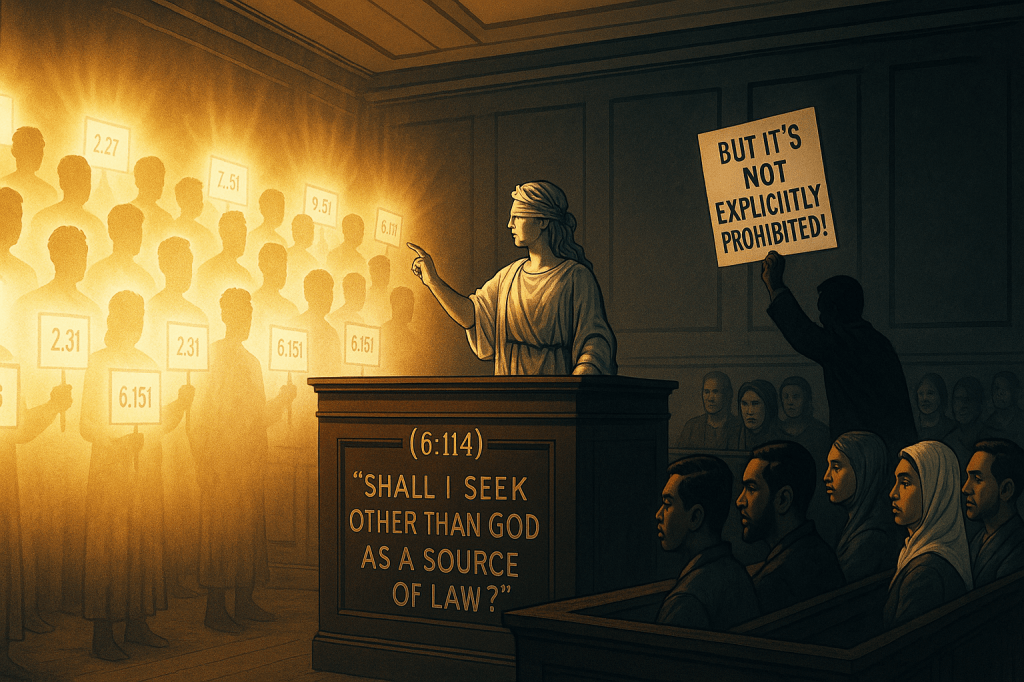
Part 14: The False Mercy Argument – Enabling vs. Helping
When Compassion Becomes Compromise
The document argues that preventing hypocrites from leading prayer lacks mercy, suggesting that “Maybe God will redeem them and make them believers if they keep doing the prayers.” This argument confuses enabling harmful behavior with genuine compassion, and individual practice with public leadership.
[33:24] “God will surely recompense the truthful for their truthfulness, and will punish the hypocrites, if He so wills, or redeem them. God is Forgiver, Most Merciful.”
[15:99] “And worship your Lord, in order to attain certainty.”
Yes, God may redeem hypocrites – but not through validating their ego worship by placing them in positions of spiritual authority. True mercy would be encouraging them to pray sincerely as followers, to work on their spiritual development without the corruption of leadership’s ego-feeding platform. Allowing a hypocrite to lead prayer doesn’t help them; it reinforces their showing off and ego worship.
Consider a parallel: Would you show mercy to an alcoholic by making them a bartender? Would you help a gambling addict by putting them in charge of a casino? Of course not – true compassion requires removing temptations and opportunities for harmful behavior, not enabling them.
The hypocrite’s disease is ego worship and showing off. Making them a prayer leader feeds both pathologies. Every time they stand before the congregation, their ego is stroked. Every time people follow their movements, their self-worship is validated. This isn’t mercy; it’s spiritual malpractice.
Part 15: The Silence That Speaks Volumes – What God Did and Didn’t Prohibit
Understanding Divine Legislative Wisdom
The document makes an interesting observation that actually undermines their entire argument: “God even specifically forbade funeral prayers for known hypocrites (see verse 9:84) but never forbade praying behind them while alive. That silence speaks volumes.”
[9:84] “You shall not observe the funeral prayer for any of them when he dies, nor shall you stand at his grave. They have disbelieved in God and His messenger, and died in a state of wickedness.”
Indeed, this speaks volumes – but not in the way they think. God explicitly prohibits funeral prayers for dead hypocrites because death finalizes their state. There’s no possibility of change, no hope of redemption, no test continuing. The prohibition can be absolute because the situation is final.
Living hypocrites, however, exist in a state of ongoing test. Some may repent, others may sink deeper into hypocrisy. God’s approach to living hypocrites is therefore different – not explicit prohibition but asymptotic limitation. He surrounds them with so many restrictions and warnings that sincere believers understand the impossibility of accepting their leadership without God having to close the door to their potential redemption.
This divine wisdom protects both parties: believers are kept from spiritual contamination while hypocrites aren’t completely cut off from the possibility of redemption. But redemption comes through following, not leading; through learning, not teaching; through humility, not the ego-feeding platform of religious leadership.
Part 16: The Mathematical Signature – Why Nineteen Matters
Divine Design in Numerical Precision
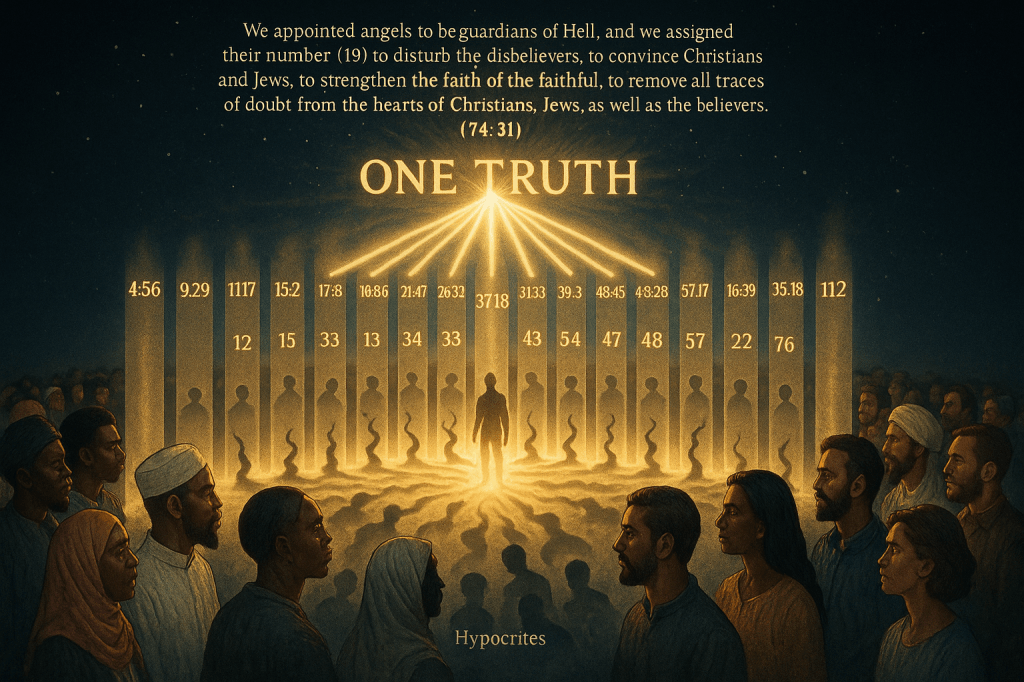
The number nineteen holds special significance throughout the Quran, serving as a mathematical signature of divine authorship. It’s no coincidence that exactly nineteen verses combine to create an insurmountable barrier against praying behind hypocrites.
[74:30] “Over it is nineteen.”
This verse, referring to the guardians of Hell, introduces nineteen as a number of divine significance. Throughout the Quran, this number appears in various mathematical patterns, confirming divine authorship. The fact that precisely nineteen verses align to make praying behind hypocrites impossible isn’t random – it’s divine design.
The document’s author, in their desperation to reach the number nineteen for their “debunking,” actually validates this divine signature. They stretch and repeat arguments, desperately trying to match the number they’re attempting to refute. Their admission that they’re being “repetitive” to “fabricate 19 reasons” reveals their recognition of this number’s significance.
But mathematical signatures cannot be fabricated or debunked through human argumentation. The nineteen verses stand as divine testimony: multiple commands not to obey, requirements to be stern, descriptions of pollution and ego worship, warnings of Hell’s lowest pit, and clear statements that hypocrites’ prayers are worthless showing off. Each verse alone provides reason for caution; together, they create mathematical certainty.

Part 17: The Compromise Pattern – Revealing Deeper Spiritual Disease
When Arguments Expose Heart Conditions
Throughout their document, the author reveals a consistent pattern of compromise. They acknowledge hypocrites are “disgusting,” admit they wouldn’t pray behind them, but insist it can’t be called prohibited. This fence-sitting approach reveals a deeper spiritual disease: the fear of taking a clear stand based on divine guidance.
[2:8] “Then there are those who say, ‘We believe in God and the Last Day,’ while they are not believers.”
[2:9] “In trying to deceive God and those who believe, they only deceive themselves without perceiving.”
[2:14] “When they meet the believers, they say, ‘We believe,’ but when alone with their devils, they say, ‘We are with you; we were only mocking.’”
This compromise pattern – publicly acknowledging truth while privately undermining it – mirrors the hypocrite behavior described in these verses. They know praying behind hypocrites is wrong (calling it “disgusting”), but they lack the spiritual courage to acknowledge what God has made clear through convergent prohibition.
Their repeated use of “Ok, and?” when confronted with divine commands reveals dismissiveness toward God’s guidance. Would a sincere believer respond to warnings about Hell, pollution, and ego worship with such casual indifference? This rhetorical pattern exposes an heart that isn’t truly engaged with divine guidance but is instead seeking justification for predetermined positions.
Part 18: The Messenger’s Clear Position – No Ambiguity
Following the Example of God’s Messenger
The document attempts to use Rashad Khalifa’s teachings to support their position, but a careful examination of his actual words and practice reveals the opposite. The messenger was uncompromising about hypocrites and their role in the community of believers.
The messenger consistently taught that the Quran is complete and fully detailed, that we must follow all of God’s commands, not just those that are convenient. He emphasized understanding the spirit of the law, not just its letter. When nineteen verses align to create a clear divine message, he would have recognized this as God’s will, not sought loopholes to circumvent it.
The messenger’s practice was clear: he never validated hypocrite leadership. He understood that the community of believers must maintain spiritual purity, that contamination by ego worship and insincerity corrupts the entire congregation. His teachings about the mathematical miracle of the Quran specifically highlight how divine patterns – like nineteen converging verses – confirm God’s will.
To invoke the messenger’s name while advocating for practices he would have condemned is a form of bearing false witness. Those who truly follow the messenger’s example will recognize the clear divine pattern and submit to it, not seek clever arguments to avoid it.
Part 19: The Ultimate Test – Whom Do You Really Serve?
When Choices Reveal True Allegiance
The question of praying behind hypocrites ultimately serves as a test that reveals true spiritual allegiance. Do you serve God’s clear will expressed through nineteen converging commands, or do you serve social convenience and human harmony?
[63:1] “When the hypocrites come to you they say, ‘We bear witness that you are the messenger of God.’ God knows that you are His messenger, and God bears witness that the hypocrites are liars.”
[63:2] “Under the guise of their apparent faith, they repel the people from the path of God. Miserable indeed is what they do.”
[63:3] “This is because they believed, then disbelieved. Hence, their minds are blocked; they do not understand.”
These verses describe the hypocrites’ fundamental problem: they appear to believe but actually repel people from God’s path. When we accept their leadership, we participate in this repulsion. We validate their false authority and confuse sincere seekers who see believers following ego worshippers.
The document’s author claims to be defending lawful practice, but they’re actually defending spiritual compromise. They’re more concerned about not adding to God’s prohibitions than about following His clear guidance. This priority reveals whom they truly serve: not God, but their own understanding, their own comfort, their own interpretation.
The test is simple: When God provides nineteen clear commands that make something impossible, do you submit to His will or seek escape routes? Your answer reveals whether you truly believe or merely claim to believe.

Conclusion: The Mathematics of Divine Will
When Nineteen Becomes One Truth
The document titled “19 Reasons DEBUNKED” has inadvertently proven exactly what it sought to disprove. In their desperate attempt to justify praying behind hypocrites, they’ve revealed the weakness of their position through logical contradictions, contextual manipulations, and absurd analogies about potatoes offered to Satan. Their response pattern of “Ok, and?” to divine commands exposes hearts that aren’t truly submitted to God’s will.
The nineteen verses stand unshaken, each one a divine testimony against accepting hypocrite leadership. Together, they form an impenetrable barrier that protects sincere believers from spiritual contamination. This isn’t human interpretation or fabricated prohibition – it’s recognition of divine architecture, understanding how God communicates His will through convergent commands that leave no room for compromise.
The asymptotic nature of this prohibition serves divine wisdom perfectly. It tests sincerity, reveals compromisers, and maintains the possibility of redemption for hypocrites while protecting believers from their contamination. Those who seek loopholes reveal their true priority: social convenience over divine pleasure, human harmony over God’s command, technical permissibility over spiritual wisdom.
The mathematical signature of nineteen confirms divine design. This isn’t coincidence or human construction – it’s God’s own testimony that praying behind hypocrites violates His will. When nineteen verses align to make something impossible, only those blinded by their own agenda could fail to see the clear message.
For sincere believers, the path is clear. We don’t need explicit prohibition when God provides overwhelming convergent guidance. We recognize that following ego worshippers in prayer contradicts everything God commands about our relationship with hypocrites. We understand that true mercy means helping hypocrites find redemption through following, not enabling their ego worship through leadership.
The choice before every believer is simple: Will you follow nineteen divine commands that create an unmistakable message, or will you seek clever arguments to avoid God’s clear will? Will you stand firm on divine principle, or compromise for social comfort? Will you protect the spiritual purity of believers’ worship, or contaminate it with hypocrite leadership?
The nineteen verses have spoken. The mathematical signature is clear. The divine will is unmistakable. Those who truly submit to God will recognize His message and follow it, regardless of social pressure or clever arguments. Those who seek to justify the unjustifiable reveal their own spiritual condition – they may claim to believe, but their arguments expose hearts that haven’t truly submitted to the One who knows all innermost thoughts and intentions.
Let this be a clear message to all who claim to follow God’s guidance: When nineteen divine commands converge to make something impossible, don’t seek the twentieth that might provide escape. When God’s legislative architecture points consistently in one direction, don’t insist on walking the opposite way. When divine mathematics confirms His will, don’t try to debunk it with human cleverness. Submit, truly and completely, to the One who designed these perfect patterns for your protection and guidance.

 Quran Only Studies
Leave a comment