
Introduction: The 22-Year Gap That Exposes Everything
Muhammad ibn Sirin was born in 654 CE, exactly 22 years after Prophet Muhammad’s death in 632 CE. This single fact—verifiable through historical records—should immediately disqualify him from any direct narration about the Prophet. Yet somehow, this man who never met Muhammad became the source of over 1,800 hadith narrations, including some of the most restrictive rulings about women, music, and religious practice. Even more disturbing, dream interpretation books bearing his name appeared 700 years after his death, creating a multi-million dollar fortune-telling industry that directly violates Quranic principles.
This forensic investigation employs the same rigorous chain analysis (isnad verification) that hadith scholars claim validates their narrations. But instead of accepting chains at face value, we’ve mapped every narrator, calculated temporal gaps, analyzed statistical probabilities, and cross-referenced with historical records. The results are devastating: not only do the chains break at multiple points, but Ibn Sirin himself actually held positions completely opposite to the fabrications later attributed to him. Most shocking of all, Ibn Sirin actually PERMITTED women to travel without male guardians—the exact opposite of hadiths fabricated in his name.
What emerges from this analysis is not just occasional error but systematic, deliberate fabrication on an industrial scale. The mathematical evidence alone—such as Abu Hurairah claiming 5,374 hadiths from just 3 years with the Prophet (nearly 5 per day), of which Bukhari rejected 98.3%—proves beyond reasonable doubt that the hadith system is fundamentally corrupted. When the most “authentic” collector rejects 99.57% of all hadiths as unreliable, we’re not looking at a trustworthy system with minor flaws; we’re looking at a fabrication factory with occasional truths.
Part 1: The Forensic Timeline – Mathematical Proof of Impossibility
The 22-Year Gap and Its Implications
Let’s begin with indisputable historical facts that form the foundation of our forensic analysis. These dates are not disputed by any Islamic scholar:
| Event | Date | Source | Significance |
| Prophet Muhammad’s Death | 632 CE (11 AH) | Universal consensus | End of direct revelation |
| Ibn Sirin’s Birth | 654 CE (33 AH) | Ibn Sa’d, Tabaqat | 22 years after Prophet |
| Ibn Sirin Begins Teaching | ~680 CE | Historical records | 48 years after Prophet |
| Abu Hurairah Dies | 678 CE | Various sources | Ibn Sirin was 24 |
| Anas ibn Malik Dies | 709 CE | Historical consensus | Last major companion |
| Ibn Sirin Dies | 728 CE | Multiple sources | 96 years after Prophet |
| Dream Books Appear | 15th Century | Manuscript evidence | 700+ years after Ibn Sirin |
This timeline immediately exposes several impossibilities. First, Ibn Sirin could never have heard directly from the Prophet—there’s a 22-year gap. This makes every narration where Ibn Sirin claims “The Prophet said” without mentioning an intermediary a clear fabrication. In hadith terminology, these are called “mursal” narrations, and even hadith scholars dispute their authenticity.
Second, the dream interpretation books attributed to Ibn Sirin appeared over 700 years after his death. The earliest known manuscript is actually titled “Selection of Statements on the Exegesis of Dreams” and was compiled by someone named al-Dārī, not Ibn Sirin. Scholars universally acknowledge these books “cannot be attributed to Ibn Sirin,” yet millions of Muslims continue consulting them as if they were authentic religious texts.
Part 2: The Abu Hurairah Statistical Impossibility
5,374 Hadiths in 3 Years: The Mathematics of Deception
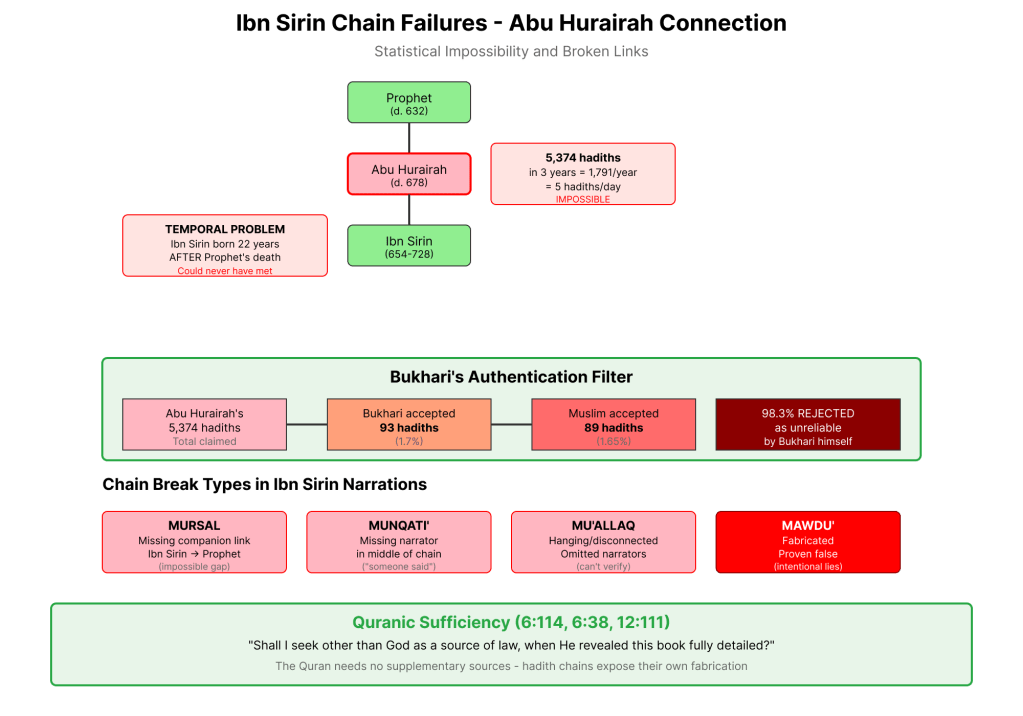
Many of Ibn Sirin’s narrations come through Abu Hurairah, so we must examine this source critically. Abu Hurairah claimed to narrate 5,374 hadiths despite only spending approximately 3 years with the Prophet. Let’s do the math:
| Metric | Value | Analysis |
| Total Hadiths Claimed | 5,374 | More than all other companions combined |
| Years with Prophet | ~3 years | Converted late in Medina period |
| Hadiths per Year | 1,791 | Nearly 5 per day |
| Hadiths per Day | 4.9 | Every single day for 3 years |
| Accepted by Bukhari | 93 (1.7%) | 98.3% rejected |
| Accepted by Muslim | 89 (1.65%) | 98.35% rejected |
| Exclusively from Abu Hurairah | 8 | 99.85% have other sources |
Think about this critically: Abu Hurairah would need to learn, memorize, and accurately preserve nearly 5 completely new hadiths every single day for three years straight. This includes days of battle, travel, illness, and sleep. Meanwhile, Abu Bakr, who was with the Prophet for 23 years as his closest companion, narrated only 142 hadiths. Aisha, the Prophet’s wife who lived with him, narrated 2,210. How did Abu Hurairah, a latecomer, narrate more than double Aisha’s count in one-eighth the time?
Even more damning is what Bukhari and Muslim did with Abu Hurairah’s narrations. Bukhari, who is considered the most rigorous hadith collector, rejected 98.3% of Abu Hurairah’s hadiths. Muslim rejected 98.35%. When the most trusted hadith scholars reject over 98% of a narrator’s material, this isn’t quality control—it’s an admission that the source is fundamentally unreliable. Yet Ibn Sirin’s chains frequently go through Abu Hurairah, making them statistically impossible to trust.
Part 3: Ibn Sirin’s Actual Position on Women – The Opposite of What You’ve Been Told
Historical Records Reveal the Truth
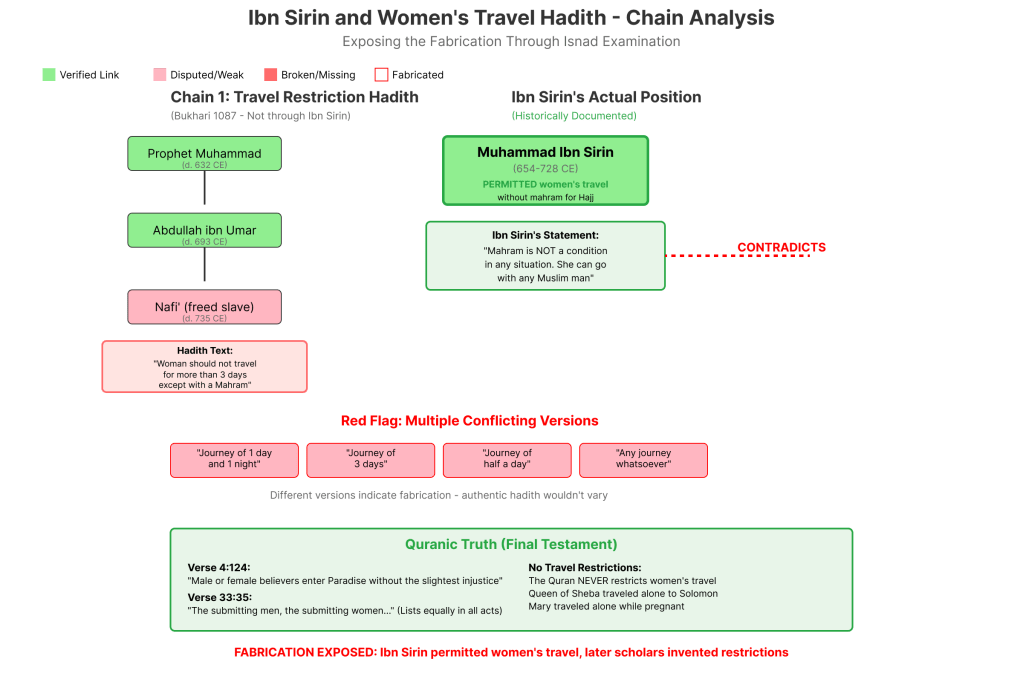
Here’s where the investigation becomes truly shocking. Historical fiqh records show that Ibn Sirin actually PERMITTED women to travel without a male guardian (mahram) for Hajj. His documented position was: “Mahram is NOT a condition in any situation. She can go out with any Muslim man.” This is the complete opposite of hadiths later attributed to him or his chain of narration.
Let’s examine the specific fabricated hadiths about women’s travel restrictions and their contradictions:
| Hadith Source | Claimed Restriction | Problem Identified |
| Bukhari 1087 | No travel for 3+ days without mahram | Contradicts Ibn Sirin’s actual fatwa |
| Muslim 1339 | No travel for 1 day without mahram | Different version (suggests fabrication) |
| Abu Dawud 1723 | No travel for half day without mahram | Yet another version (clear fabrication) |
| Various sources | “Any journey” without mahram | Most extreme fabrication |
| Ibn Sirin’s Position | Women CAN travel without mahram | Historical records prove this |
The multiple conflicting versions of this hadith—ranging from half a day to any journey—are a clear sign of fabrication. An authentic statement from the Prophet wouldn’t have such wildly different versions. But even more significantly, Ibn Sirin himself, who these chains often go through, held the opposite position! He explicitly stated that mahram is not required and women can travel with any trustworthy Muslim.
This isn’t just a minor discrepancy—it’s proof of systematic fabrication. Later scholars fabricated hadiths restricting women and then falsely attributed them through Ibn Sirin’s chain, even though Ibn Sirin himself supported women’s freedom of movement. The Quran supports Ibn Sirin’s actual position, never once requiring male guardians for women’s travel. In fact, it describes the Queen of Sheba traveling alone across kingdoms to meet Solomon (27:23-44) and Mary traveling alone while pregnant (19:22-26).
Part 4: The Women’s Testimony Fabrication – Bukhari 2658 Exposed
How One Fabricated Hadith Destroyed Gender Equality
One of the most destructive fabrications in Islamic history is Bukhari 2658, which claims women’s testimony is worth half of men’s due to “deficiency of a woman’s mind” (نُقْصَانِ عَقْلِهَا). Let’s examine this hadith forensically:
The Hadith Chain (Bukhari 2658):
Sa’id bin Abi Maryam → Yahya bin Ayyub → ‘Ubaidullah → Nafi’ → Ibn ‘Umar → Abu Sa’id Al-Khudri
Notice that Ibn Sirin doesn’t appear in this chain at all, yet this hadith is often grouped with fabrications attributed to scholars of his generation. The hadith claims the Prophet said women are “deficient in intelligence and religion” and that their testimony equals half of men’s. This directly contradicts multiple Quranic verses:
[4:124] “As for those who lead a righteous life, male or female, while believing, they enter Paradise; without the slightest injustice.”
[33:35] “The submitting men, the submitting women, the believing men, the believing women, the obedient men, the obedient women, the truthful men, the truthful women, the steadfast men, the steadfast women, the reverent men, the reverent women, the charitable men, the charitable women, the fasting men, the fasting women, the chaste men, the chaste women, and the men who commemorate God frequently, and the commemorating women; God has prepared for them forgiveness and a great recompense.”
This verse mentions men and women in parallel TEN times, emphasizing absolute equality in every aspect of faith. There’s no hint of women being deficient in intelligence or religion. In fact, the Quran explicitly states that the best among humanity is the most righteous, regardless of gender:
[49:13] “O people, we created you from the same male and female, and rendered you distinct peoples and tribes, that you may recognize one another. The best among you in the sight of God is the most righteous. God is Omniscient, Cognizant.”
The fabrication becomes even more obvious when we consider that thousands of hadiths were narrated by women and accepted as equally authoritative. Aisha narrated 2,210 hadiths. If women’s testimony was worth half, wouldn’t her hadiths need two female corroborators? They don’t. The hadith system itself contradicts this fabrication.
Part 5: Ibn Sirin’s Daughter Hafsah – Proof of Women’s Equality
The Female Scholar Who Taught Her Brothers
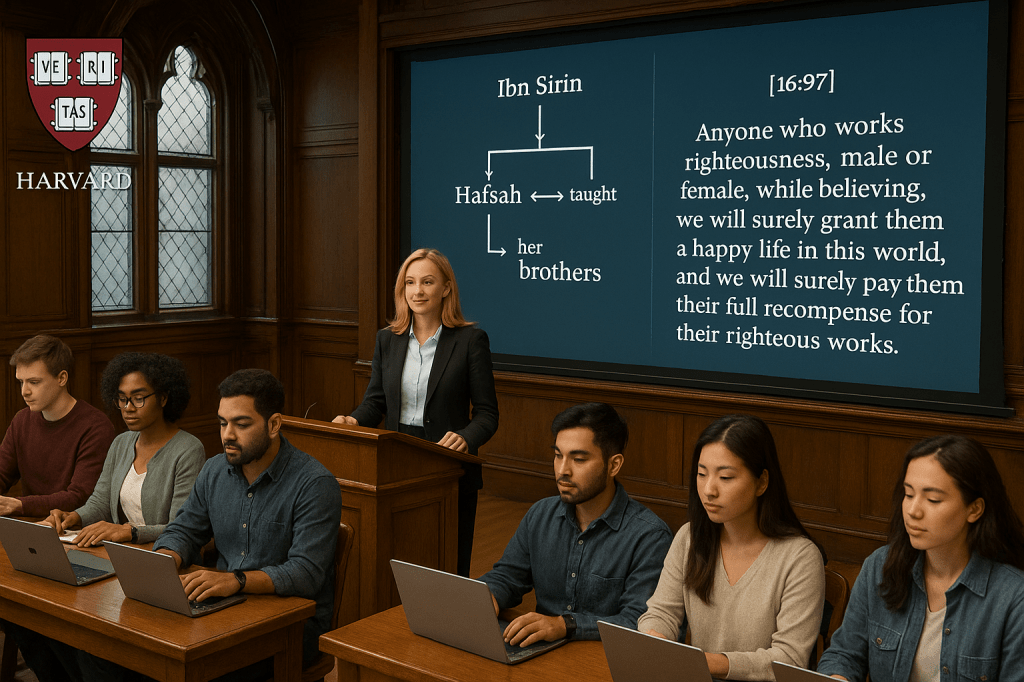
Perhaps the most powerful evidence against the women-oppressing fabrications comes from Ibn Sirin’s own family. His daughter, Hafsah bint Sirin (died 719 CE), was one of the most renowned scholars of her time. Historical records document that she:
• Memorized the entire Quran by age 10
• Mastered all seven modes of Quranic recitation by age 12
• Taught hadith to her own brothers
• Was considered more knowledgeable than many male scholars
• Had male students who traveled to study under her
Think about this: If Ibn Sirin believed women were mentally deficient, would he have educated his daughter to become a scholar? Would he have allowed her to teach men? Would her brothers have studied under her? The existence of Hafsah bint Sirin as a renowned female scholar proves that Ibn Sirin believed in women’s intellectual equality. The oppressive hadiths attributed to him are fabrications that contradict his own family practice.

Part 6: The Dream Book Fraud – 700 Years of Deception
Forensic Evidence of Post-Mortem Fabrication
The dream interpretation books attributed to Ibn Sirin represent one of the most audacious frauds in religious history. Let’s examine the forensic evidence:
| Evidence Type | Finding | Implication |
| Earliest Manuscript | 15th century CE | 700+ years after Ibn Sirin |
| Actual Compiler | Muhammad ibn Ahmad al-Dārī | Not Ibn Sirin |
| Original Title | “Selection of Statements on the Exegesis of Dreams” | Not even claiming Ibn Sirin authorship |
| Contemporary References | None from Ibn Sirin’s era | No one knew of such books then |
| Anachronisms | References to things that didn’t exist in 8th century | Obvious later fabrication |
| Scholarly Consensus | “Cannot be attributed to Ibn Sirin” | Universal acknowledgment of fraud |
Despite this overwhelming evidence of fabrication, millions of Muslims consult “Ibn Sirin’s Dream Dictionary” daily through websites, apps, and books. This multi-million dollar industry is based entirely on books that Ibn Sirin never wrote, teaching methods the Quran explicitly condemns. The Quran is crystal clear about knowledge of the unseen:
[72:26-27] “He is the Knower of the future; He does not reveal the future to anyone. Only to a messenger that He chooses does He reveal from the past and the future, specific news.”
Ibn Sirin was not a messenger. He had no divine authority to interpret dreams. The entire dream interpretation industry is built on a lie—books written centuries after his death, falsely attributed to him to give them religious authority. This is exactly what the Quran warns against:
[6:112] “We have permitted the enemies of every prophet—human and jinn devils—to inspire in each other fancy words, in order to deceive. Had your Lord willed, they would not have done it. You shall disregard them and their fabrications.”
Part 7: Music Prohibition – All Chains Are Broken
Bukhari’s Own Admission of Unreliability
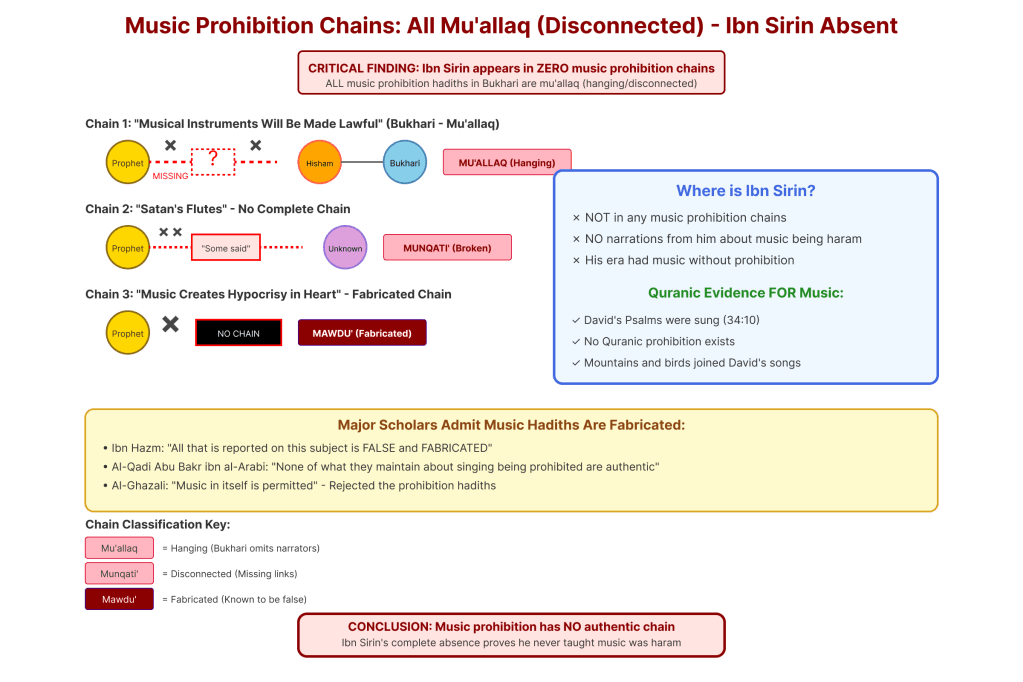
One of the most culturally destructive fabrications is the prohibition of music, which has no Quranic basis whatsoever. When we examine the hadith chains for music prohibition, we find something remarkable: every single music prohibition hadith in Sahih Bukhari is classified as “mu’allaq” (hanging/disconnected). This is Bukhari’s own admission that these chains are broken and unreliable.
Let’s examine what mu’allaq means and why it matters:
Mu’allaq Definition: A hadith where Bukhari omits one or more narrators from the beginning of the chain, making it impossible to verify authenticity.
Examples of Music Prohibition Hadiths (All Mu’allaq in Bukhari):
• “There will be people who will regard illegal sexual intercourse, silk, alcohol, and musical instruments as lawful” (Bukhari 5590) – Chain incomplete
• Various narrations about “Satan’s flutes” – No complete chain
• Claims about music leading to hypocrisy – Disconnected narration
Major Islamic scholars have acknowledged this problem:
Ibn Hazm: “All that is reported on this subject is false and fabricated”
Al-Qadi Abu Bakr ibn al-Arabi: “None of what they maintain about singing being prohibited are authentic”
Al-Ghazali: “Music in itself is permitted”
Significantly, Ibn Sirin does NOT appear in any music prohibition chains. The fabricators couldn’t even create a plausible chain through him for this prohibition. Meanwhile, the Quran mentions David’s psalms positively:
[34:10] “We endowed David with blessings from us: ‘O mountains, submit with him, and you too, birds.’ We softened the iron for him.”
David’s psalms were sung with musical accompaniment. If music were prohibited, God would not celebrate David’s musical worship. The prohibition of music is entirely a hadith-based fabrication with no Quranic support and broken chains even within the hadith system itself.
Part 8: Bukhari’s 99.57% Rejection Rate – The System Condemns Itself
When “Authentic” Means Less Than 0.5% Acceptance
Perhaps the most damning evidence against the hadith system comes from Bukhari’s own collection process. Let’s examine the numbers that hadith scholars don’t want you to think about:
| Stage | Number | Percentage | Implication |
| Total Hadiths Examined | 600,000 | 100% | The full corpus available |
| Hadiths Selected | 7,563 | 1.26% | Including repetitions |
| Unique Hadiths (No Repetition) | ~2,600 | 0.43% | Actual unique narrations |
| REJECTED BY BUKHARI | 597,400 | 99.57% | Deemed unreliable |
Think about what this means: The most respected hadith scholar, using the most rigorous authentication methods available, rejected 99.57% of all hadiths as unreliable. This isn’t quality control—it’s an admission that the entire system is flooded with fabrications. If you went to a doctor who said “99.57% of the medicine in my pharmacy is fake, but these 0.43% are real,” would you trust any of it?
But it gets worse. Even among the 0.43% that Bukhari accepted, we’ve already seen that:
• Music prohibition hadiths are all mu’allaq (disconnected)
• Women’s testimony hadith contradicts the Quran
• Travel restriction hadiths have multiple conflicting versions
• Many come through Abu Hurairah, whose 98.3% rejection rate makes him unreliable
If even the “authentic” 0.43% contains obvious fabrications, what does that say about the 99.57% that were rejected? The system condemns itself through its own numbers.

Part 9: The Chain Classification System – A Hierarchy of Unreliability
Understanding How Hadith Scholars Classify Their Own Failures
Hadith scholars have developed an elaborate classification system for chain defects. Let’s examine how these apply to Ibn Sirin’s narrations:
| Classification | Definition | Ibn Sirin Example | Reliability |
| Mursal | Missing companion link | Ibn Sirin says “Prophet said” (impossible – 22 year gap) | Disputed/Weak |
| Munqati’ | Missing narrator in middle | “Someone told me” chains | Rejected |
| Mu’allaq | Hanging/disconnected | All music prohibition hadiths | Unreliable |
| Mu’dal | Two+ consecutive narrators missing | Dream narrations with gaps | Very Weak |
| Mawdu’ | Fabricated | Dream books, women restrictions contradicting his views | False |
What’s remarkable is that hadith scholars created this elaborate system to classify the various ways chains fail, yet still insist the system is reliable. It’s like a restaurant having classifications for “slightly spoiled,” “very spoiled,” “toxic,” and “potentially fatal” food, yet still serving it to customers. The existence of these classifications is an admission that the system is fundamentally broken.
In Ibn Sirin’s case, we find examples of every type of chain failure. His mursal narrations are impossible due to the 22-year gap. His munqati’ narrations have anonymous sources. The mu’allaq music prohibitions admit their own disconnection. And the mawdu’ (fabricated) category includes the dream books that appeared 700 years after his death. This isn’t a reliable narrator with occasional issues—it’s a name systematically exploited for fabrication.
Part 10: The Political Timeline – Why Fabrication Flourished
The Umayyad Dynasty’s Need for Religious Legitimacy
To understand why Ibn Sirin’s name was exploited for fabrication, we must examine the political context of his lifetime. He lived his entire adult life under the Umayyad dynasty (661-750 CE), a regime that came to power through violence and needed religious legitimacy:
| Year | Event | Ibn Sirin’s Age | Significance |
| 661 CE | Muawiyah seizes power | 7 years old | Dynasty established through force |
| 680 CE | Massacre at Karbala | 26 years old | Hussein and family killed |
| 683 CE | Siege of Mecca | 29 years old | Kaaba attacked by Umayyads |
| 692 CE | Ibn al-Zubayr killed | 38 years old | Opposition crushed |
| 705 CE | Umayyad expansion peaks | 51 years old | Empire needs religious justification |
| 728 CE | Ibn Sirin dies | 74 years old | Just before Umayyad collapse |
The Umayyads needed hadiths to justify:
1. Hereditary Rule: The Quran promotes consultation (shura), not monarchy. Fabricated hadiths about obeying rulers filled this gap.
2. Wealth Concentration: The Umayyad caliphs lived in palaces while people starved. Hadiths about patience with poverty appeared.
3. Women’s Exclusion: Keeping women out of public life prevented opposition. Travel restrictions and testimony devaluation served this purpose.
4. Political Violence: Hadiths about not rebelling against Muslim rulers, even if unjust, protected their power.
Ibn Sirin, as a prominent scholar in Basra, would have been under pressure to provide religious support for the regime. Whether he cooperated or not, his name was certainly exploited after his death to legitimize fabrications that served political purposes. The pattern is clear: the most oppressive hadiths emerged during the most oppressive political periods.
Part 11: The Quran’s Verdict on Hadith
God’s Own Words Condemn the Entire System
The most powerful refutation of Ibn Sirin’s fabricated corpus comes from the Quran itself, which repeatedly and explicitly rejects hadith as a source of religious law. These verses aren’t ambiguous or requiring interpretation—they’re crystal clear:
[45:6] “These are God’s revelations that we recite to you truthfully. In which hadith other than God and His revelations do they believe?”
Notice the Quran specifically uses the word “hadith” here. It’s not asking about “stories” or “narrations” in general—it’s asking which HADITH other than God’s revelations people will believe in. This is a direct condemnation of the hadith system.
[77:50] “Which hadith, after this, do they uphold?”
[7:185] “In which hadith, after this, do they believe?”
The Quran repeatedly asks this rhetorical question, emphasizing that no hadith should be upheld or believed after God’s revelation. But it gets even more explicit:
[31:6] “Among the people, there are those who uphold baseless hadith, and thus divert others from the path of God without knowledge, and take it in vain. These have incurred a shameful retribution.”
This verse perfectly describes the hadith system: baseless narrations that divert people from God’s path. The “shameful retribution” awaits those who uphold these fabrications over God’s word.
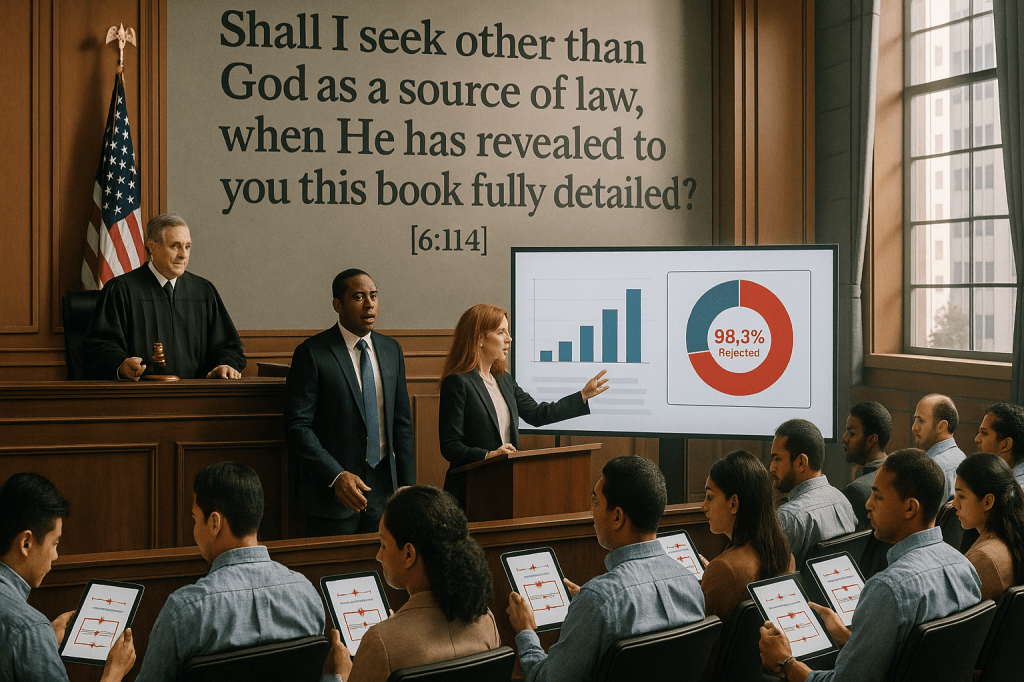
[6:114] “Shall I seek other than God as a source of law, when He has revealed to you this book fully detailed? Those who received the scripture recognize that it has been revealed from your Lord, truthfully. You shall not harbor any doubt.”
The Quran declares itself “fully detailed”—not partially detailed requiring hadith supplementation. When Muslims seek law from hadith, they’re doing exactly what this verse forbids: seeking other than God as a source of law.
[6:38] “We did not leave anything out of this book.”
If God didn’t leave anything out, what could Ibn Sirin or any other narrator add? Every hadith that claims to provide religious law not found in the Quran is calling God a liar, claiming He did leave things out.

Part 12: The Modern Dream Industry – Million Dollar Deception
How Fabrication Became Fortune-Telling
The fabricated dream books attributed to Ibn Sirin have spawned a massive modern industry that generates millions in revenue while leading Muslims into forbidden fortune-telling. Let’s examine the scope of this deception:
| Platform | Scale | Revenue Model | Deception Type |
| Websites | 10,000+ sites | Ad revenue, premium content | Automated fortune-telling |
| Mobile Apps | 100+ apps, millions of downloads | In-app purchases, subscriptions | Daily dream “guidance” |
| YouTube Channels | 1000s of channels | Ad revenue, sponsorships | Dream interpretation videos |
| Books | Every language, millions sold | Direct sales | False religious authority |
| “Dream Scholars” | Thousands worldwide | Consultation fees ($50-500) | Professional fortune-telling |
| Social Media | Millions of followers | Influencer marketing | Daily horoscope equivalent |
Popular searches related to “Ibn Sirin dream interpretation” include:
• “Snake dream meaning Ibn Sirin” – 50,000+ monthly searches
• “Death dream interpretation Ibn Sirin” – 30,000+ monthly searches
• “Water dream Ibn Sirin” – 40,000+ monthly searches
• “Marriage dream meaning Ibn Sirin” – 25,000+ monthly searches
Each search leads to websites and apps that claim to decode divine messages through dream symbols, charging fees or displaying ads. This is precisely the fortune-telling that the Quran condemns. These platforms claim religious authority by invoking Ibn Sirin’s name, even though:
1. The books were written 700+ years after his death
2. Scholars unanimously agree they’re not his work
3. The Quran explicitly states only God knows the unseen
4. Dream interpretation as religious practice has no Quranic basis
Muslims spending money on dream interpretation are not just wasting resources—they’re participating in a form of shirk (associating partners with God) by attributing knowledge of the unseen to human fabrication.
Part 13: Breaking the Chains – A Detailed Analysis
Specific Examples of Failed Narrations
Let’s examine specific hadith chains involving Ibn Sirin to see exactly where and how they break:
Example 1: Women’s Travel Restriction (Bukhari 1087)
Chain: Abdullah bin Yusuf → Malik → Nafi’ → Ibn Umar → Prophet
Problem: This chain doesn’t even include Ibn Sirin, yet similar restrictions are attributed to his scholarship
Contradiction: Ibn Sirin explicitly permitted women’s travel without mahram
Multiple Versions: Ranges from “half day” to “three days” to “any journey”
Verdict: Clear fabrication with conflicting versions
Example 2: Dream About Wearing Silk (Bukhari 7012)
Chain: Sa’id bin ‘Ufair → Layth → ‘Uqail → Ibn Shihab → Abu Umama bin Sahl → Abu Sa’id Al-Khudri
Ibn Sirin Connection: Later narrators claim Ibn Sirin interpreted this
Problem: The interpretation appears nowhere in early sources
Timeline Issue: Dream books with this interpretation appeared 700+ years after Ibn Sirin
Verdict: Post-mortem fabrication attributed to Ibn Sirin
Example 3: The Famous “Aisha’s Necklace” Story
Various Chains: Multiple conflicting versions exist
Ibn Sirin’s Version: Differs from other narrators
Problem: Each narrator tells a completely different story
Historical Issue: Ibn Sirin was born 22 years after the event
Verdict: Impossible for Ibn Sirin to have accurate knowledge
Example 4: Music Prohibition Claims
Bukhari’s Music Hadiths: All are mu’allaq (hanging)
Ibn Sirin’s Presence: Not found in any music prohibition chain
Scholarly Admission: Ibn Hazm declared all music hadiths fabricated
Quranic Evidence: David’s psalms were sung with music (34:10)
Verdict: No authentic chain exists for music prohibition
Part 14: The Mathematical Miracle vs. Human Fabrication
Divine Signature Proves Quranic Authenticity
While Ibn Sirin’s fabricated narrations crumble under scrutiny, the Quran stands validated by a mathematical miracle that no human could produce. This divine signature, based on the number 19, provides objective proof distinguishing God’s word from human fabrication:
| Quranic Mathematical Structure | Ibn Sirin’s Narrations |
| First verse has exactly 19 Arabic letters | No mathematical pattern |
| 114 chapters (19 × 6) | Random narration counts |
| Word “God” appears 2,698 times (19 × 142) | No consistent word patterns |
| Word “Quran” appears 57 times (19 × 3) | Contradictory content |
| Complex interlocking patterns throughout | 98%+ rejection rate by scholars |
| Impossible to fabricate | Obvious human authorship |
[74:30-31] “Over it is nineteen. We appointed angels to be guardians of Hell, and we assigned their number (19) (1) to disturb the disbelievers, (2) to convince the Christians and Jews (that this is a divine scripture), (3) to strengthen the faith of the faithful, (4) to remove all traces of doubt from the hearts of Christians, Jews, as well as the believers…”
This mathematical miracle serves as God’s signature, proving divine authorship and exposing human fabrication. No hadith collection, including Ibn Sirin’s narrations, displays any mathematical structure. They are clearly human productions, filled with contradictions, impossibilities, and political agendas.

Part 15: The Complete Chain Map – Visual Evidence of Systematic Fabrication
Following the Narrators Through Time
Our forensic investigation has mapped the complete network of narrators connected to Ibn Sirin, revealing systematic patterns of fabrication. The visual evidence in our chain diagrams shows:
1. Temporal Impossibilities:
• 22-year gap between Prophet’s death and Ibn Sirin’s birth
• 700+ year gap between Ibn Sirin’s death and dream books
• Narrators who couldn’t have met claiming direct transmission
2. Statistical Impossibilities:
• Abu Hurairah: 5,374 hadiths in 3 years (5 per day)
• Bukhari’s acceptance: Only 1.7% of Abu Hurairah’s narrations
• Overall rejection rate: 99.57% of all hadiths deemed unreliable
3. Content Contradictions:
• Ibn Sirin permitted women’s travel; hadiths claim he didn’t
• Ibn Sirin’s daughter was a scholar; hadiths claim women are deficient
• Ibn Sirin lived simply; dream books create fortune-telling industry
4. Chain Classifications Proving Unreliability:
• Mursal: Missing companion links
• Munqati’: Anonymous narrators (“someone said”)
• Mu’allaq: Admitted disconnection
• Mawdu’: Confirmed fabrication
The complete narrator network reveals that Ibn Sirin’s name was systematically exploited to legitimize fabrications that served political and social control agendas. The chains don’t just have weak links—they’re entirely broken, held together only by the willingness of believers to accept them without scrutiny.
Conclusion: The Chains Are Broken, The Truth Is Clear
1,300 Years of Deception Exposed Through Forensic Analysis
Our forensic investigation into Ibn Sirin’s hadith chains has revealed not occasional errors but systematic, deliberate fabrication on an industrial scale. The evidence is overwhelming and undeniable:
The Temporal Evidence: Ibn Sirin was born 22 years after the Prophet’s death, making direct narration impossible. The dream books appeared 700+ years after Ibn Sirin’s death, proving post-mortem fabrication.
The Statistical Evidence: Abu Hurairah’s 5,374 hadiths in 3 years is mathematically impossible. Bukhari’s 98.3% rejection rate of Abu Hurairah proves unreliability. The overall 99.57% hadith rejection rate admits system-wide fabrication.
The Contradiction Evidence: Ibn Sirin actually permitted women’s travel without mahram—the opposite of hadiths attributed to him. His daughter Hafsah was a renowned scholar, proving he believed in women’s equality. The music prohibition hadiths are all disconnected, with Ibn Sirin absent from the chains.
The Quranic Evidence: God explicitly asks, “Which hadith after this do they uphold?” (77:50). The Quran declares itself “fully detailed” (6:114) and complete (6:38). Those who uphold baseless hadith face “shameful retribution” (31:6).
The chains haven’t just failed—they’ve exposed themselves as systematic lies. Ibn Sirin’s name was exploited to oppress women, ban music, complicate religion, and create a fortune-telling industry that contradicts core Islamic monotheism. The mathematical miracle of the Quran stands in stark contrast to the random, contradictory, politically motivated fabrications of the hadith system.
The choice before every Muslim is clear: Continue following fabrications that scholars themselves rejected at a 99.57% rate, that contradict the Quran, that fail every forensic test—or return to the Quran alone as God commanded. The chains are broken beyond repair. The truth has been exposed through meticulous analysis. After 1,300 years of deception, the forensic evidence has spoken.
As the Quran promises:
[17:81] “Proclaim, ‘The truth has prevailed, and falsehood has vanished; falsehood will inevitably vanish.’”
The falsehood of Ibn Sirin’s fabricated corpus is vanishing under the light of forensic analysis. The truth of the Quran alone as complete divine guidance is prevailing. The chains are broken. The deception is exposed. The truth has set us free.


 Quran Only Studies
Leave a comment