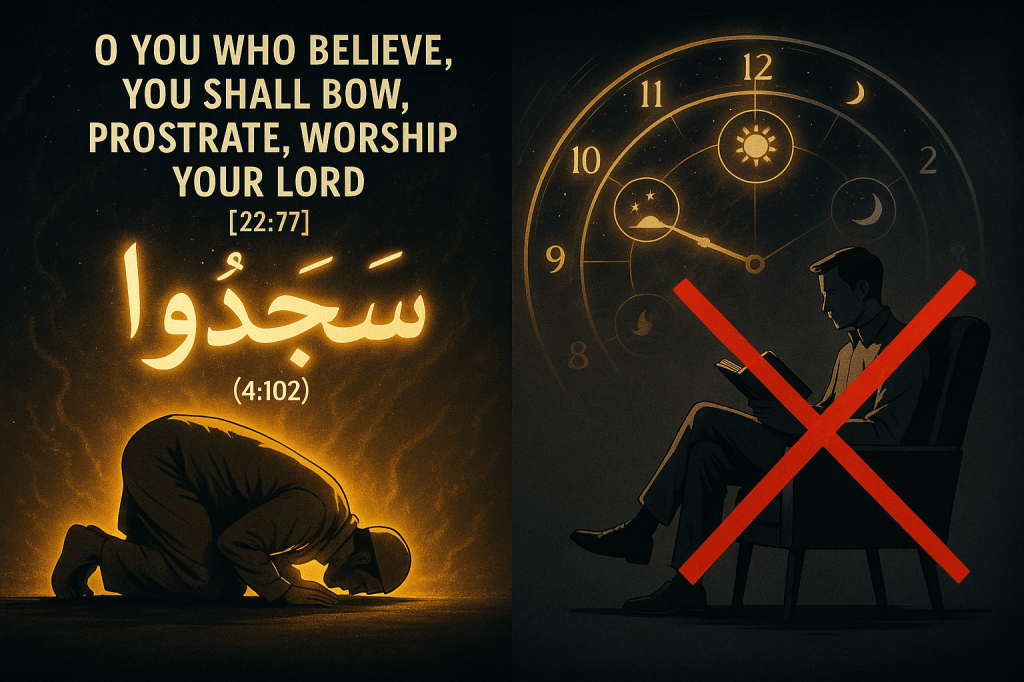
Introduction: The Deception Exposed
Among the most dangerous innovations threatening true submission today is the claim that salat—the Contact Prayer commanded by God—is merely “Quran study” or “reading.” This fabrication, promoted by those who seek to abolish God’s prescribed worship, directly contradicts explicit Quranic commands that describe physical movements, specific times, and ritual requirements that make absolutely no sense for reading a book. The Quran itself demolishes this deception through clear Arabic terminology, undeniable contextual evidence, and logical impossibilities that expose the “salat is study” theory as pure fabrication.
The evidence we present here is so overwhelming, so linguistically precise, and so contextually undeniable that no sincere seeker of truth can maintain the “study” interpretation after examining it. From the Arabic roots that distinguish prayer from recitation, to verses describing physical marks on faces from prostration, to the requirement for armed guards during prayer in battle—the Quran leaves no room for reinterpretation. Those who claim salat means study must answer: Why would you need ablution to read? Why face a specific direction? Why would reading make you vulnerable to enemy attack? The answers expose their agenda—to abolish the worship that connects us directly to our Creator.
Part 1: The Arabic Language Destroys the Study Theory
Distinct Roots for Distinct Acts
The Quran uses precise Arabic terminology that completely separates prayer (صلاة – salat) from reading (قراءة – qira’ah), recitation (تلاوة – tilawah), and study (درس – dars). The root S-L-W (ص-ل-و) fundamentally means “to connect” or “establish connection”—which perfectly describes the ritual prayer that connects us to God. This root appears 99 times in the Quran, consistently referring to the ritual prayer, never to reading or study. When God wants to command reading, He uses entirely different words. This linguistic precision is not accidental—it’s divine design to prevent exactly the kind of manipulation being attempted today.
As established by Abraham himself in his prayer:
[2:128] “Our Lord, make us submitters to You, and from our descendants let there be a community of submitters to You. Show us the rites of our religion, and redeem us. You are the Redeemer, Most Merciful.”
The Arabic word مَنَاسِكَنَا (manasikana) means “our rites” or “our rituals”—Abraham specifically asked God to show him the ritual practices, not to teach him how to read. These rites, including the Contact Prayer, were then preserved and passed down through generations.
Consider verse 29:45 (below), where God explicitly uses two different commands: “recite” (اتْلُ – utlu) for reading the scripture, and “observe the prayers” (أَقِمِ الصَّلَاةَ – aqimi as-salata) for the ritual prayer. If salat meant reading, this verse would absurdly command: “Read what is revealed and read the reading”—pure nonsense that exposes the fabrication.
[29:45] “Recite what is revealed to you of the scripture, and observe the Contact Prayers (Salat). The Contact Prayers prohibit evil and vice, but the remembrance of God (through Salat) is the most important objective. God knows whatever you do.”
The Arabic word for prostration (سجود – sujud) from the root S-J-D appears 92 times, always referring to the physical act of placing one’s forehead on the ground. The word for bowing (ركوع – ruku) from R-K-A appears 13 times, consistently describing the bowing posture. These are not metaphorical terms—they describe specific physical positions that have nothing to do with reading or studying text. When the Quran commands believers to perform ruku and sujud together, it’s commanding physical movements, not different ways of reading a book.
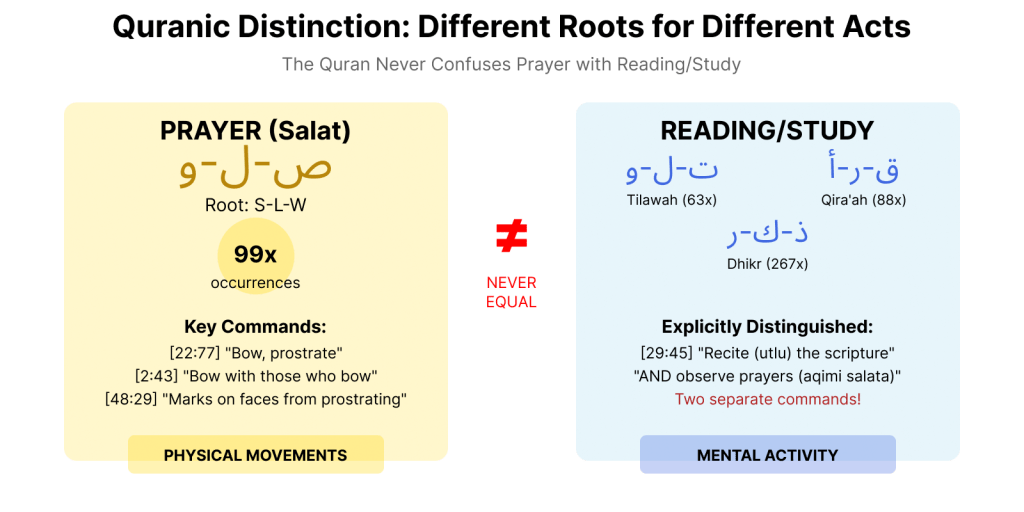
Part 2: Physical Movements Explicitly Commanded
Bow, Prostrate, Stand—Not Read, Study, Contemplate
The Quran contains numerous verses that explicitly command physical movements during prayer, using terminology that cannot possibly refer to reading or study. The most devastating to the “study theory” is this verse:
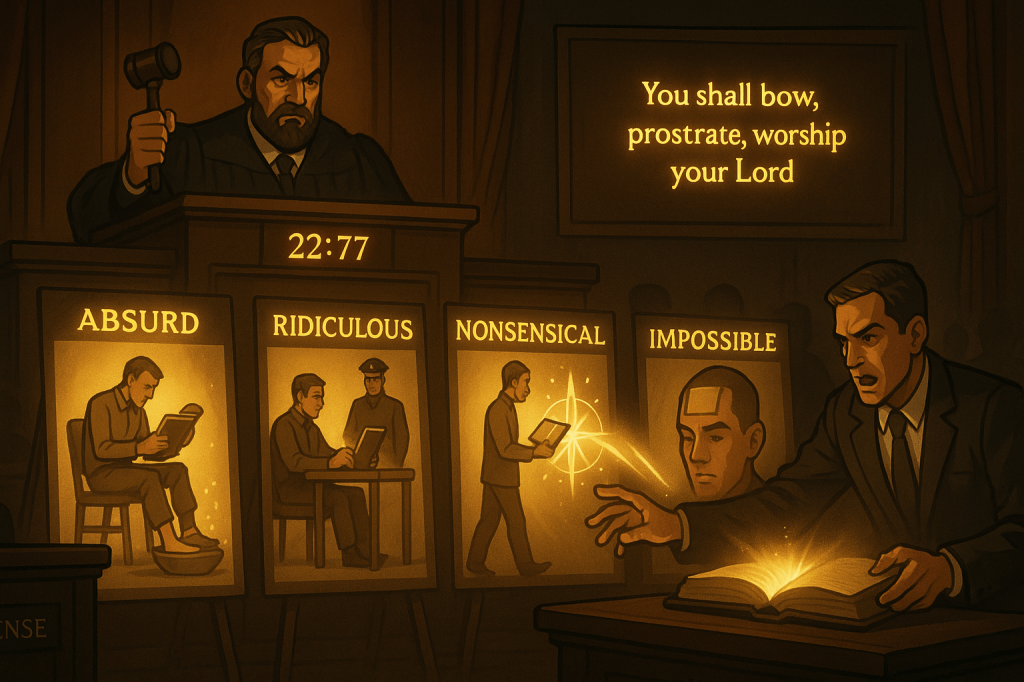
[22:77] “O you who believe, you shall bow, prostrate, worship your Lord, and work righteousness, that you may succeed.”
Even more explicitly, the Quran commands:
[2:43] “You shall observe the Contact Prayers (Salat) and give the obligatory charity (Zakat), and bow down with those who bow down.”
The phrase وَارْكَعُوا مَعَ الرَّاكِعِينَ (warka’u ma’a ar-raki’een) literally means “bow with those who bow.” This describes synchronized group movement—multiple people bowing together at the same time. How would this make any sense for reading? Do people synchronize their reading speed? Do they turn pages in unison? The verse only makes sense as describing congregational prayer with coordinated physical movements.
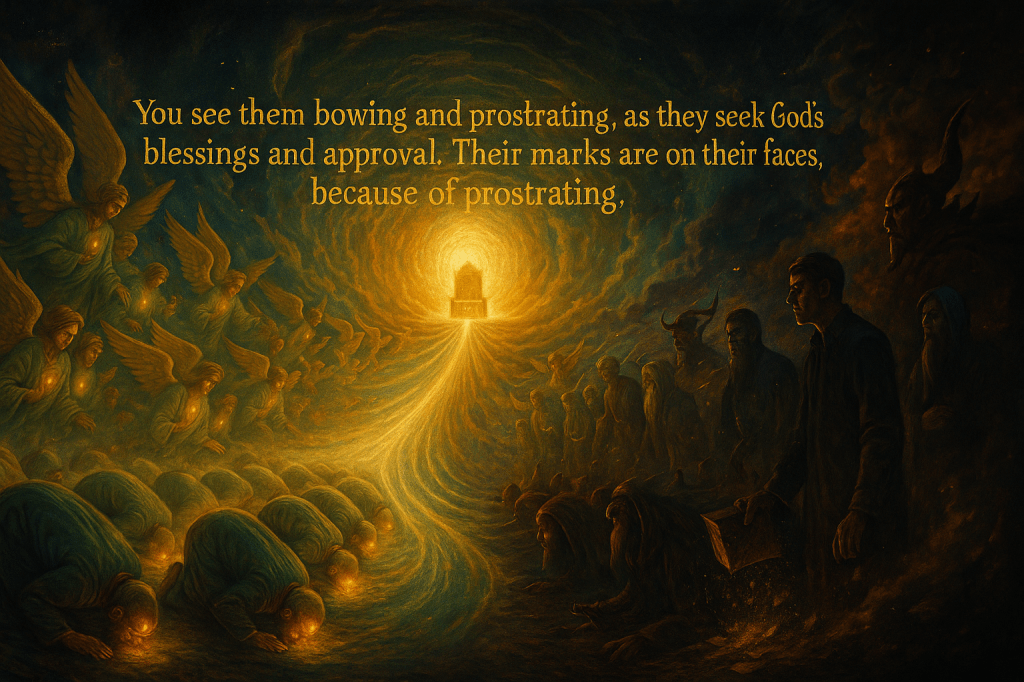
[48:29] “Muhammad—the messenger of God—and those with him are harsh and stern against the disbelievers, but kind and compassionate amongst themselves. You see them bowing and prostrating, as they seek God’s blessings and approval. Their marks are on their faces, because of prostrating. This is their description in the Torah and the Gospel…”
This verse provides crucial evidence about the nature of prayer: “Their marks are on their faces, because of prostrating” (سِيمَاهُمْ فِي وُجُوهِهِم مِّنْ أَثَرِ السُّجُودِ). The Arabic word سِيمَا (sima) means “appearance,” “looks,” or “signs”—not physical scars. This same word appears in verse 2:273 where God says about the poor:
[2:273] “Charity shall go to the poor who are suffering in the cause of God, and cannot emigrate. The unaware may think that they are rich, due to their dignity. But you can recognize them by certain signs; they never beg from the people persistently. Whatever charity you give, God is fully aware thereof.”
The phrase “you can recognize them by their signs (بِسِيمَاهُمْ)” clearly refers to their dignified appearance despite poverty, not physical marks. Similarly, in verse 7:46, people in Purgatory recognize others “by their looks (بِسِيمَاهُمْ).” The “marks” in 48:29 refer to the radiant appearance, the glow of happiness and peace that comes from regular prostration to God—a spiritual transformation visible in their countenance. This spiritual radiance from devotion cannot be faked through mere reading, but manifests from the humble act of placing one’s forehead on the ground in submission to the Creator.
Part 3: Prayer During Battle—The Ultimate Proof
Why Guards Are Needed for Prayer, Not Reading
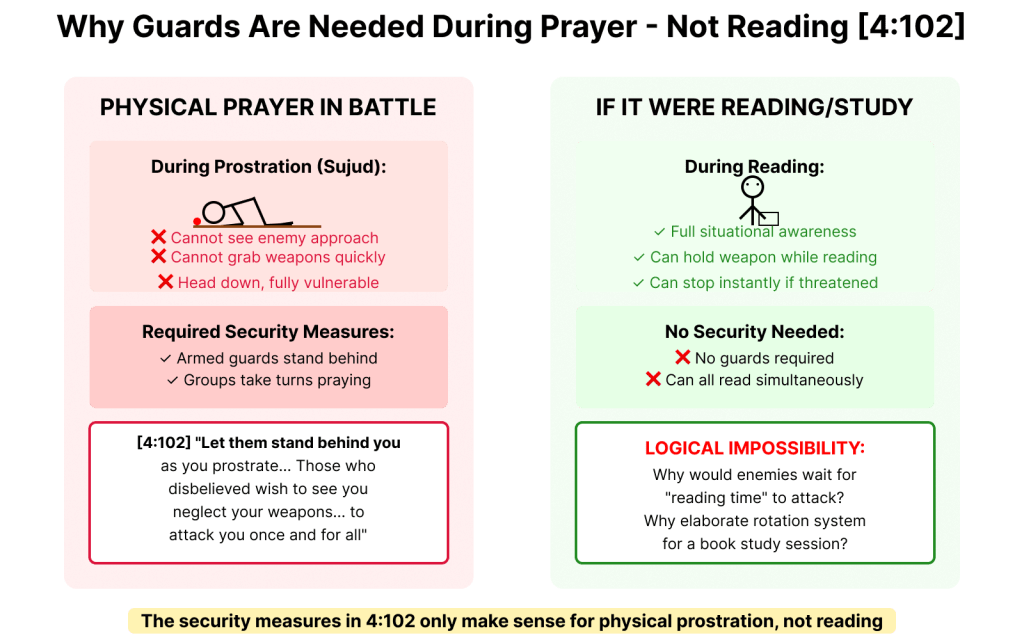
Perhaps the most devastating evidence against the “study theory” comes from verse [4:102], which describes prayer during battle conditions. This single verse contains so many logical impossibilities for the “reading” interpretation that it alone destroys the entire fabrication. The verse describes believers praying while under threat of enemy attack, requiring elaborate security measures that make zero sense for reading or studying.
[4:102] “When you are with them, and lead the Contact Prayer (Salat) for them, let some of you stand guard; let them hold their weapons, and let them stand behind you as you prostrate. Then, let the other group that has not prayed take their turn praying with you, while the others stand guard and hold their weapons. Those who disbelieved wish to see you neglect your weapons and your equipment, in order to attack you once and for all.”
Let’s examine the logical impossibilities if salat meant “study”: Why would soldiers need to take turns studying the Quran during battle? Why couldn’t they all read simultaneously? Why would some need to stand guard with weapons while others read? Most crucially, the verse explicitly states “as you prostrate” (فَإِذَا سَجَدُوا), describing the moment of maximum vulnerability. When prostrating, one’s head is down, vision is blocked, and reaction time is severely impaired. This vulnerability requires armed guards. But reading? One can read while maintaining full situational awareness, can stop instantly if threatened, and can even read while holding a weapon. The security measures described only make sense for physical prayer movements.
The verse continues: “Those who disbelieved wish to see you neglect your weapons and your equipment, in order to attack you once and for all.” The enemies specifically wait for the moment of prostration to attack because that’s when believers are most vulnerable—face down, unable to see approaching danger, unable to quickly grab weapons. If they were merely reading, they could keep weapons in hand, maintain watch, and respond instantly to threats. The elaborate rotation system—one group praying while another guards, then switching—is necessary precisely because the physical movements of prayer create vulnerability that reading never would.
Furthermore, verse [2:239] provides special dispensation for extreme danger: “Under unusual circumstances, you may pray while walking or riding.” Why would God need to give special permission to read while walking or riding? People read while traveling all the time without divine dispensation. But performing the physical movements of prayer—standing, bowing, prostrating—while walking or on horseback? That requires special accommodation. The verse only makes sense if prayer normally requires physical positions that cannot be maintained while in motion.
Part 4: Ablution—Washing for Prayer, Not Reading
The Ritual Purification That Exposes the Truth
The requirement for ritual ablution before prayer provides undeniable proof that salat is a physical ritual, not intellectual study. God explicitly states in
[4:43]: “O you who believe, do not observe the Contact Prayers (Salat) while intoxicated, so that you know what you are saying. Nor after sexual orgasm without bathing, unless you are on the road, traveling; if you are ill or traveling, or you had urinary or fecal-related excretion, or contacted the women (sexually), and you cannot find water, you shall observe Tayammum (dry ablution) by touching clean dry soil, then wiping your faces and hands therewith. God is Pardoner, Forgiver.”
This verse establishes multiple levels of ritual purity required for prayer: avoiding intoxication, performing full ablution after sexual contact, and maintaining cleanliness from bodily excretions. Why would any of these matter for reading? Can one not read the Quran after using the bathroom without washing? The elaborate purity requirements only make sense for a formal ritual where one presents themselves before God in worship.
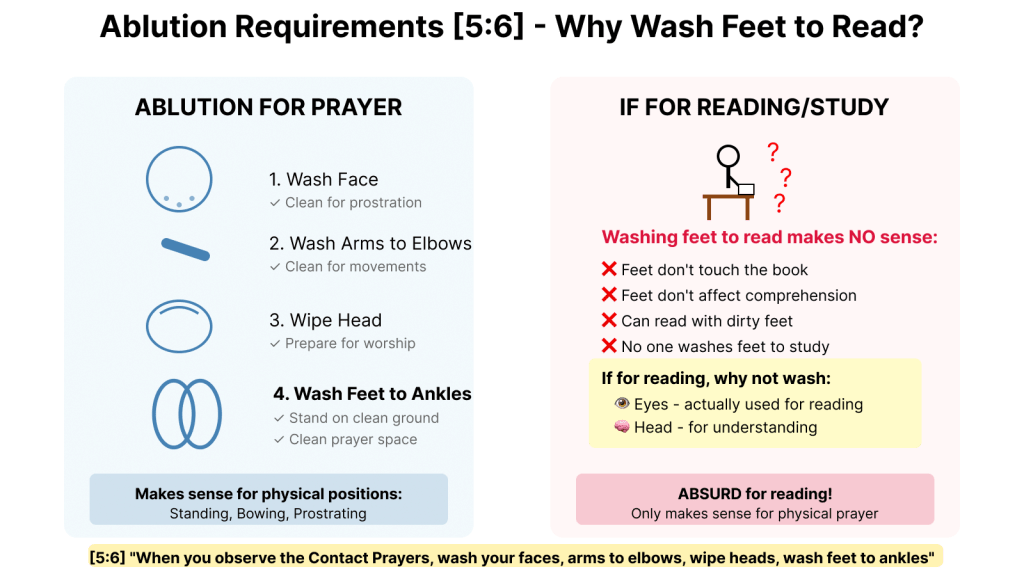
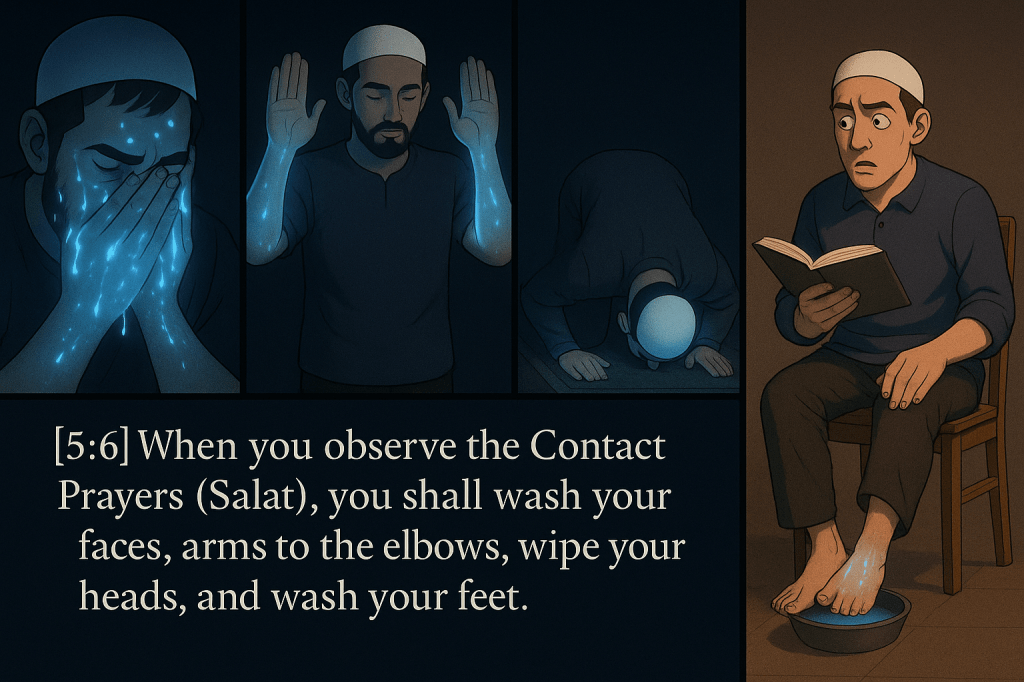
One of the most glaring logical impossibilities of the “study theory” appears in the ablution (wudu) requirements. Verse [5:6] provides detailed instructions for ritual washing before prayer, requirements that make absolutely no sense for reading or studying. The verse commands specific washing of body parts in preparation for prayer—a universal practice across all schools of Islamic thought that cannot be explained if prayer were merely reading.
[5:6] “O you who believe, when you observe the Contact Prayers (Salat), you shall: (1) wash your faces, (2) wash your arms to the elbows, (3) wipe your heads, and (4) wash your feet to the ankles. If you were unclean due to sexual orgasm, you shall bathe. If you are ill, or traveling, or had any digestive excretion (urinary, fecal, or gas), or had (sexual) contact with the women, and you cannot find water, you shall observe the dry ablution (Tayammum) by touching clean dry soil, then rubbing your faces and hands. God does not wish to make the religion difficult for you; He wishes to cleanse you and to perfect His blessing upon you, that you may be appreciative.”
Consider the absurdity if salat meant reading: Why wash your feet to the ankles before reading the Quran? What does foot cleanliness have to do with comprehending text? Why wash your arms to the elbows for studying? The verse even provides alternatives when water is unavailable—tayammum (dry ablution) using clean soil. Would God command believers to rub dirt on their faces and hands before reading His book? The very suggestion is blasphemous and ridiculous.
The purification requirements make perfect sense for physical prayer where one stands, bows, and places their forehead on the ground. Washing ensures cleanliness for these physical postures, especially prostration where the face touches the earth. The emphasis on washing feet—seemingly unrelated to reading—makes complete sense when one understands that believers stand barefoot on prayer mats, and that clean feet are essential for the prayer environment. No one has ever needed to wash their feet to read a book, but everyone who prostrates in prayer understands why clean feet matter in the prayer space.
Part 5: The Five Daily Prayers—Mathematical Perfection
Divine Encoding of Prayer Names
The Quran provides clear evidence for multiple daily prayers through specific prayer times and names mentioned in the text. The Quran explicitly names these prayers:
1. Salat Al-Fajr (Dawn Prayer) – mentioned in 24:58
2. Al-Salat Al-Wusta (The Middle Prayer) – mentioned in 2:238
3. Salat Al-Isha (Night Prayer) – mentioned in 24:58
4. Salat Al-Jumu’ah (Friday Congregational Prayer) – mentioned in 62:9
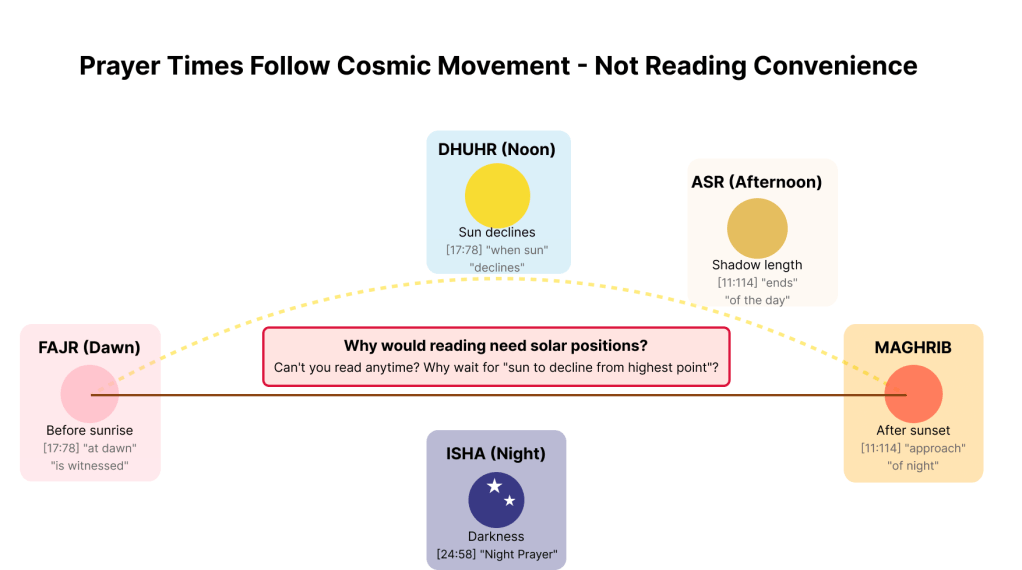
Additionally, the Quran specifies prayer times in verses like 11:114 (“at both ends of the day, and during the night”), 17:78 (“when the sun declines from its highest point” = zuhr), and 30:17-18 which mentions glorifying God “in the evening,” “in the morning,” “in the afternoon,” and “at noon.” These multiple specific times for formal prayer completely contradict the idea that salat is merely reading that could happen anytime. The structured timing confirms distinct, formal prayer sessions—not variable reading times.
Part 6: Prayer Times—When the Universe Calls
Cosmic Appointments That Transcend Reading Schedules
The Quran establishes specific times for prayer that align with cosmic events and solar positions, creating a rhythm of worship that makes no sense for reading or study. These divinely appointed times connect believers to the movement of celestial bodies, not to convenient reading schedules. The precision and universality of these times expose another fatal flaw in the “study theory.”
[17:78] “You shall observe the Contact Prayer (Salat) when the sun declines from its highest point at noon, as it moves towards sunset. You shall also observe (the recitation of) the Quran at dawn. (Reciting) the Quran at dawn is witnessed.”
This verse establishes prayer times based on the sun’s position—”when the sun declines from its highest point at noon” marks the beginning of the noon prayer time. Note that the verse distinguishes between observing salat and reciting the Quran, using different Arabic words for each act. If salat meant reading the Quran, the verse would redundantly say “read the Quran when the sun declines and also read the Quran at dawn”—obvious nonsense. The dawn prayer is specifically called “witnessed,” indicating angels and all creation observe this special prayer time when the world awakens.
[11:114] “You shall observe the Contact Prayers (Salat) at both ends of the day, and during the night. The righteous works wipe out the evil works. This is a reminder for those who would take heed.”
Why would God command reading “at both ends of the day”? Can’t one read whenever convenient? Students study at times that suit their schedules, not based on solar positions. But prayer—ritual prayer that connects us to our Creator—follows the rhythm of creation itself. Dawn prayer as the world awakens, noon prayer as the sun reaches its zenith, afternoon prayer as shadows lengthen, sunset prayer as day transforms to night, and night prayer as darkness deepens. These are appointments with the Divine, not study sessions.
The importance of these specific times becomes even clearer in the Friday congregation verse
[62:9]: “O you who believe, when the Congregational Prayer (Salat Al-Jumu’ah) is announced on Friday, you shall hasten to the commemoration of God, and drop all business. This is better for you, if you only knew.”
Would God command believers to drop all business and rush to a reading session? The urgency, the specific timing, the congregational requirement—all point to a formal ritual that occurs at a precise moment, not a casual study group that could meet anytime.
Part 6: The Direction of Prayer—Facing Truth
Why Qibla Matters for Prayer, Not for Pages
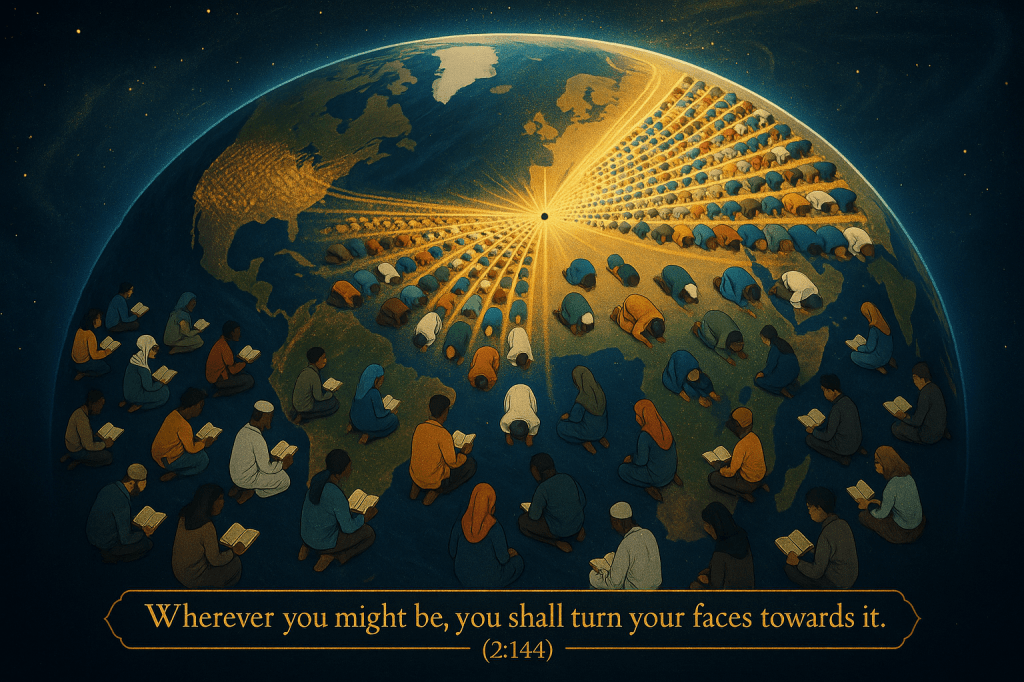
Among the most powerful evidence against the “study theory” is the requirement to face a specific direction during prayer. The Quran dedicates multiple verses to establishing and emphasizing the qibla (prayer direction), something completely unnecessary and illogical for reading or studying. Books can be read facing any direction, but ritual prayer requires unified orientation toward the Sacred Masjid.
[2:144] “We have seen you turning your face about the sky (searching for the right direction). We now assign a Qiblah that is pleasing to you. Henceforth, you shall turn your face towards the Sacred Masjid. Wherever you might be, you shall turn your faces towards it. Those who received previous scripture know that this is the truth from their Lord. God is never unaware of anything they do.”
The emphasis on turning one’s face (وَلِّ وَجْهَكَ) toward the Sacred Masjid is repeated multiple times in this passage and again in verses [2:149-150]. Why would reading require facing Mecca? Do the words change meaning if read facing north instead of southeast? The only reason to maintain a specific directional orientation is for a physical ritual where bodily position matters—where standing, bowing, and prostrating toward a focal point creates unity among believers worldwide.
Consider the practical implications: Muslims worldwide calculate the qibla direction from their location, install qibla compasses in their homes, and mark prayer directions in mosques. Hotels in Muslim countries mark qibla direction in rooms. Prayer apps include qibla compasses. This massive infrastructure exists solely to ensure believers face the correct direction during prayer. If salat were merely reading, this entire system would be the most elaborate waste of resources in human history. No one needs a compass to read a book.
The qibla requirement also explains why the Quran mentions prayer “wherever you might be”—whether traveling, at war, or in foreign lands, the direction remains constant. This creates a physical connection between all believers, all facing the same point during their prayers, creating waves of worship that circle the globe with the movement of prayer times. Reading requires no such unity of direction. Only physical prayer, where believers stand, bow, and prostrate toward a common center, explains this requirement.
Part 7: Congregational Prayer—Unity in Motion
Synchronized Worship Versus Solitary Study
The Quran’s emphasis on congregational prayer provides irrefutable evidence that salat involves coordinated physical movements, not individual reading or study. Multiple verses describe praying “with” others using language that only makes sense for synchronized physical actions, not for reading which is inherently an individual mental activity.
[3:43] “O Mary, you shall submit to your Lord, and prostrate and bow down with those who bow down.”
The phrase “bow down with those who bow down” (وَارْكَعِي مَعَ الرَّاكِعِينَ) describes simultaneous group action. Mary is commanded to bow at the same time as others bow, to prostrate when they prostrate. This synchronization is fundamental to congregational prayer where all participants perform the same movements in unison, following the imam (prayer leader). How would this work for reading? Do groups read the same words at the same speed? Do they turn pages simultaneously? The very concept is absurd.
The Friday congregational prayer provides even stronger evidence. [62:9] states: “O you who believe, when the Congregational Prayer (Salat Al-Jumu’ah) is announced on Friday, you shall hasten to the commemoration of God, and drop all business.” The Arabic term جُمُعَة (Jumu’ah) comes from the root meaning “to gather,” emphasizing physical assembly. Believers must physically gather in one place, cease all commerce, and participate in unified worship. If salat were study, why couldn’t believers study at home? Why interrupt business for a reading session that could happen anytime?
The congregational nature of prayer appears again in the battle prayer verse [4:102], where the Prophet leads prayer for the group: “When you are with them, and lead the Contact Prayer (Salat) for them…” Leading prayer (إِمَامَة) requires coordinated movements where the congregation follows the leader’s positions. The imam says “Allahu Akbar” and moves to the next position; the congregation follows. This leader-follower dynamic only exists in physical ritual prayer. In reading or study, each person proceeds at their own pace, comprehension level, and interest. No one “leads” others in reading a book.
Part 8: Prayer Modifications—Accommodating Physical Reality
Dispensations That Only Make Sense for Physical Acts
The Quran provides specific modifications for prayer under various circumstances—modifications that would be completely unnecessary if prayer were merely reading or study. These accommodations reveal prayer’s physical nature by addressing situations where normal physical movements cannot be performed.
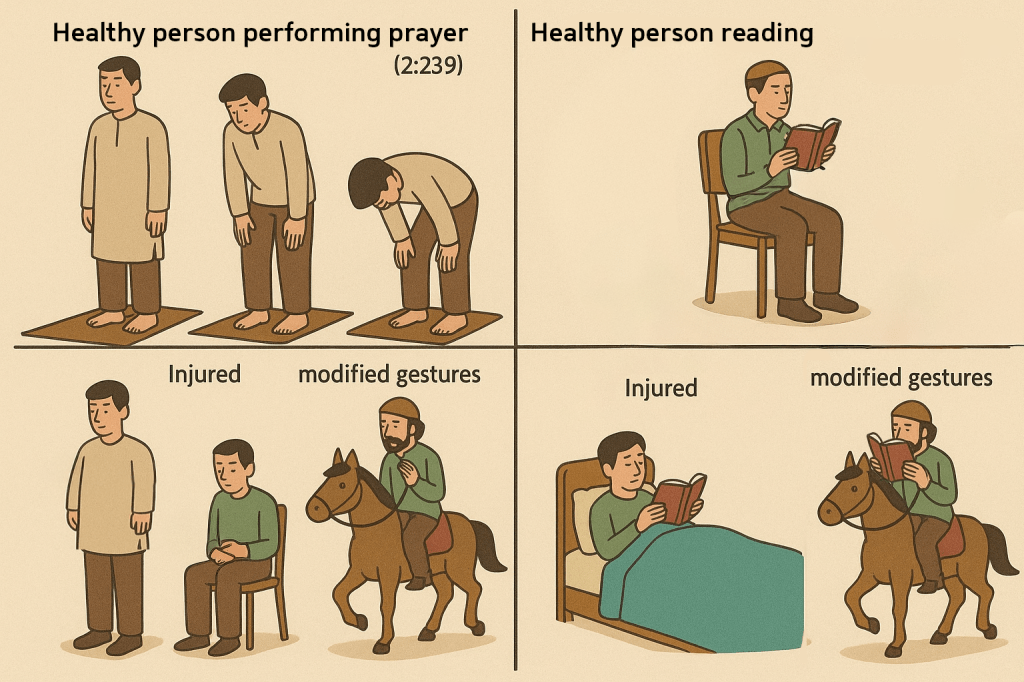
[2:239] “Under unusual circumstances, you may pray while walking or riding. Once you are safe, you shall commemorate God as He taught you what you never knew.”
This verse grants special permission to pray while walking or riding during dangerous situations. Why would anyone need divine permission to read while walking? People read on trains, planes, and while walking every day without special dispensation. But performing the standing, bowing, and prostrating of normal prayer while walking or on horseback? That’s physically impossible, hence the special accommodation. The verse explicitly states “once you are safe,” implying return to normal prayer form—standing properly, bowing fully, prostrating completely.
[4:101] When you travel, during war, you commit no error by shortening your Contact Prayers (Salat), if you fear that the disbelievers may attack you. Surely, the disbelievers are your ardent enemies.
The concept of “shortening” (قَصْر) prayer during travel exposes another logical impossibility for the study theory. How does one “shorten” reading? Do travelers read fewer pages? Skip chapters? The shortening refers to reducing the number of units (rak’ahs) in certain prayers—from four to two. This mathematical reduction only makes sense for countable physical units of prayer, not for reading which has no standardized units. The prayer remains the same ritual with the same movements, just fewer repetitions—exactly what we see in Islamic practice worldwide.
Even more revealing are the accommodations for illness and disability found in hadith literature (which, while fabricated, still reveals early Muslim understanding of prayer as physical). The sick may pray sitting if they cannot stand, lying on their side if they cannot sit, or even with eye movements if paralyzed. These graduated accommodations only exist because prayer normally requires specific physical positions. No one needs permission to read lying down, yet the Quran and early Muslims clearly understood that modified prayer positions required divine authorization.
Part 9: The Mathematical Miracle of Prayer Structure
Divinely Encoded Patterns in Physical Worship
The mathematical structure of Islamic prayer provides stunning evidence of divine design that cannot exist in mere reading or study. The number of daily prayers, their unit compositions, and their relationship to Quranic verses reveal a mathematical system that only works with structured physical worship, not with casual reading sessions.
There are five daily Contact Prayers, totaling 17 units (rak’ahs): Dawn (2), Noon (4), Afternoon (4), Sunset (3), and Night (4). The number 17 is significant—it appears in key verses about prayer and represents those who are righteous. But more remarkably, when we examine how often prayer-related terms appear in the Quran, we find mathematical patterns impossible to attribute to coincidence. The word “salat” appears 67 times, and when we look at verses that mention specific prayer times, they cluster in mathematically significant patterns.
The physical movements themselves follow mathematical precision. Each unit contains: 1 standing, 1 bowing, 2 prostrations, and 1 sitting. This 1-1-2-1 pattern, repeated 17 times daily, creates a mathematical rhythm. If prayer were reading, why would God encode such specific numerical patterns? Why not 3 prostrations, or 2 bowings? The precision indicates divine design in the physical structure of prayer.
Furthermore, the middle prayer mentioned in [2:238]—”You shall consistently observe the Contact Prayers, especially the middle prayer”—only makes sense with a fixed number of prayers. How can there be a “middle” reading session when people read at different times and frequencies? But with five daily prayers, the afternoon prayer sits perfectly in the middle—two prayers before (Dawn and Noon) and two after (Sunset and Night). This mathematical balance cannot exist in unstructured reading.
Part 10: The Witness of History and Human Nature
Fourteen Centuries of Physical Prayer
While Muslims have fabricated many innovations, the physical nature of prayer has remained consistent across all sects, all schools of thought, and all cultures for fourteen centuries. Sunnis, Shias, Sufis, and even the most deviant sects all perform physical prayer with standing, bowing, and prostration. They disagree on almost everything else—laws, leadership, interpretation—but not on prayer’s physical nature. This universal agreement across otherwise hostile groups provides powerful historical evidence.
If prayer were originally just reading, when did the entire Muslim world simultaneously decide to change it to physical movements? How did this massive change occur without any historical record of debate or transition? Where are the early Muslims who protested this supposed change from reading to ritualized movement? They don’t exist because the change never happened. Prayer has always been physical ritual, passed down from Abraham through all the prophets.
Consider also the practical impossibility of the “study theory” in pre-literate societies. When Islam spread to non-Arabic speaking peoples who couldn’t read Arabic (or anything else), how did they perform salat if it meant studying the Quran? The majority of Muslims throughout history have been unable to read Arabic, yet they all performed prayer. Physical movements can be taught and copied regardless of literacy or language. Reading requires literacy. The universal practice of prayer across literate and illiterate populations proves its physical nature.
The transformation described in [48:29]—where believers’ faces show the “effect of prostration”—provides historical continuity. This spiritual radiance, this peaceful countenance that comes from regular prayer, has been observed throughout history. When someone regularly humbles themselves before God through physical prostration, it changes them internally, and this change becomes visible externally. The Arabic uses the word أَثَر (athar) meaning “effect” or “trace”—the prostration leaves its effect not as a physical scar but as a spiritual transformation that manifests in one’s appearance. This is why true devotees across all Abrahamic faiths have been recognized by their peaceful, humble demeanor—the result of regular physical submission to God through prayer.
Part 11: The Spiritual Technology of Physical Prayer
Why God Designed Prayer as Embodied Worship
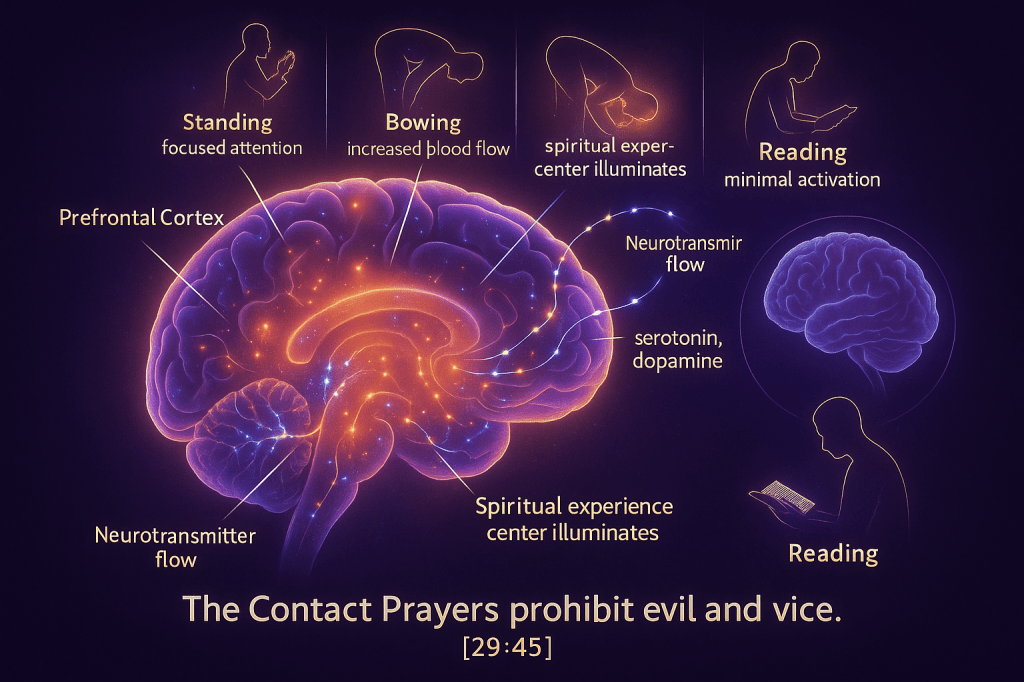
Understanding why God prescribed physical prayer rather than mere study reveals divine wisdom in human psychology and spirituality. Modern neuroscience confirms what God always knew: physical movement profoundly affects consciousness, emotion, and spiritual receptivity in ways that reading alone cannot achieve. The specific positions of Islamic prayer activate neurological and physiological responses that create optimal conditions for divine connection.
Standing (qiyam) promotes alertness and dignity, preparing the consciousness for divine communication. The upright posture activates the sympathetic nervous system, increasing focus and attention. Bowing (ruku) induces humility while maintaining consciousness, with blood flow to the brain increasing clarity. Prostration (sujud)—the climax of prayer—places the highest part of the body (the head) on the lowest level (the ground), creating ultimate submission. This position triggers the parasympathetic nervous system, inducing calm, reducing ego activity in the brain’s default mode network, and creating optimal conditions for spiritual experience.
Research published in neuroscience journals shows that prostration specifically affects the prefrontal cortex, the brain region associated with self-awareness and ego. The physical act of prostration literally reduces activity in the neural networks that maintain our sense of separate self, facilitating the experience of unity with the Divine. This cannot be achieved through reading. You can read about submission, but prostration creates the neurological experience of submission.
The rhythmic nature of prayer movements—standing, bowing, prostrating, sitting—creates what scientists call “embodied meditation.” Unlike static meditation or reading, the dynamic movement sequence prevents mind-wandering while maintaining spiritual focus. The alternation between positions prevents both physical discomfort and mental stagnation. God designed prayer as moving meditation because He created our bodies and knows how they work.
Part 12: God Taught Abraham the Prayer Rituals
The Origin of Islamic Prayer Practices
The Quran explicitly states that God taught the prayer rituals to Abraham, and these practices were passed down through the generations. God says about Abraham, Isaac, and Jacob:
[21:73] “We made them imams who guided in accordance with our commandments, and we taught them how to work righteousness, and how to observe the Contact Prayers (Salat) and the obligatory charity (Zakat). To us, they were devoted worshipers.”
The Arabic here uses the word أَوْحَيْنَا (awhayna) meaning “We inspired” or “We taught”—God directly taught them HOW to observe the prayers. This wasn’t about teaching them to read; they needed divine instruction on the specific ritual practices. This is further confirmed when Abraham himself prays:
[14:40] “My Lord, make me one who consistently observes the Contact Prayers (Salat), and also my descendants. Our Lord, please answer my prayers.”
Abraham uses the term مُقِيمَ (muqeema) which means “one who establishes” or “maintains” the prayer—language that implies regular practice of a structured ritual, not casual reading. The continuity of these Abrahamic practices through Muhammad is emphasized throughout the Quran:
[22:78] “You shall strive for the cause of God as you should strive for His cause. He has chosen you and has placed no hardship on you in practicing your religion—the religion of your father Abraham. He is the one who named you ‘Submitters’ originally. Thus, the messenger shall serve as a witness among you, and you shall serve as witnesses among the people. Therefore, you shall observe the Contact Prayers (Salat) and give the obligatory charity (Zakat), and hold fast to God; He is your Lord, the best Lord and the best Supporter.”
Part 13: The Conspiracy to Abolish Prayer
Why Satan Wants You to Stop Prostrating
The attempt to redefine salat as mere study is not innocent theological disagreement—it’s part of Satan’s ancient conspiracy to prevent human beings from prostrating to God. Remember that Satan’s original sin was refusing to prostrate. Satan’s refusal to prostrate caused his expulsion from Paradise. Now he wants humanity to join him in this rebellion.
[7:11] “We created you, then we shaped you, then we said to the angels, ‘Fall prostrate before Adam.’ They fell prostrate, except Iblees (Satan); he was not with the prostrators.”
Those who promote the “salat is study” deception are literally fulfilling Satan’s agenda—to stop human beings from prostrating. They know that physical prostration is the ultimate act of submission that Satan himself refused. By convincing believers that prayer is just reading, they eliminate the very act that Satan rebelled against. Every person they convince to stop prostrating is a victory for Satan’s rebellion against God’s command.
The sophistication of this deception reveals its satanic origin. It doesn’t openly tell people to stop worshipping God—that would be too obvious. Instead, it redefines worship as something comfortable, convenient, and ego-preserving. Reading a book doesn’t challenge pride. Studying doesn’t humiliate the ego. But placing your forehead on the ground five times a day? That destroys arrogance. That’s why Satan hates it and why his agents work to eliminate it.
Notice how the “study theory” preserves everything that feeds the ego while eliminating everything that challenges it. You can study while sitting comfortably in an expensive chair, but prayer requires you to kneel. You can read while maintaining your sense of superiority, but prostration makes everyone equal. You can study at your convenience, but prayer demands you interrupt your schedule for God. Every aspect that makes prayer challenging to the ego is exactly what the “study theory” eliminates.
Part 14: The Logical Impossibilities Mount
Questions That Destroy the Deception
Let us present a series of questions that those promoting “salat as study” must answer, each one exposing the absurdity of their position:
Why does the Quran prohibit approaching prayer while intoxicated?
[4:43] “O you who believe, do not observe the Contact Prayers (Salat) while intoxicated, so that you know what you are saying. Nor after sexual orgasm without bathing, unless you are on the road, traveling; if you are ill or traveling, or you had urinary or fecal-related excretion, or contacted the women (sexually), and you cannot find water, you shall observe Tayammum (dry ablution) by touching clean dry soil, then wiping your faces and hands therewith. God is Pardoner, Forgiver.”
People read while mildly intoxicated all the time. But performing precise physical movements, maintaining balance during prostration, and coordinating with a congregation requires sobriety. The prohibition only makes sense for physical prayer.
Consider this verse about what comes after prayer:
[4:103] “Once you complete your Contact Prayer, you shall remember God while standing, sitting, or lying down. Once you are secure, you shall observe the Contact Prayers; the Contact Prayers (Salat) are decreed for the believers at specific times.”
If salat were remembrance through study, this verse would say “Once you complete your remembrance, you shall remember”—obvious redundancy. The verse distinguishes between the formal prayer with its specific positions and informal remembrance in any position.
Why does verse 5:6 specify washing “feet to the ankles” for prayer? In what possible universe does ankle cleanliness affect reading comprehension? Why not wash your eyes—the organs actually used for reading? The foot-washing requirement only makes sense for prayer where one stands barefoot on clean ground.
Why does God command purification of His house specifically for those who bow and prostrate?
[2:125] “We have rendered the shrine (the Kaaba) a focal point for the people, and a safe sanctuary. You may use Abraham’s shrine as a prayer house. We commissioned Abraham and Ismail: ‘You shall purify My house for those who visit, those who live there, and those who bow and prostrate.’”
How does one purify a house for reading? But purifying it for physical prostration—ensuring clean floors where foreheads will touch—makes perfect sense.
Similarly, God specifies about the Sacred Masjid:
[22:26] “We appointed Abraham to establish the Shrine: ‘You shall not idolize besides Me anything. Purify My house for those who visit, those who live near it, and those who bow and prostrate.’”
The emphasis on purifying the space for bowing and prostration indicates physical acts requiring clean surfaces, not mental acts of reading.
Part 15: The Moderate Tone Requirement
Neither Silent Nor Loud
Another devastating proof against the “study theory” comes from this verse:
[17:110] “Say, ‘Call Him God, or call Him the Most Gracious; whichever name you use, to Him belongs the best names.’ You shall not utter your Contact Prayers (Salat) too loudly, nor secretly; use a moderate tone.”
This verse establishes that prayer must be recited at a moderate volume—neither too loud nor silent.
Why would God regulate the volume of reading? People read silently to themselves or aloud as they prefer. But in congregational prayer, the imam must recite at a volume that’s audible to those behind him without being disruptively loud. The “moderate tone” requirement makes perfect sense for group ritual prayer where others need to hear the recitation to follow along, but makes no sense for individual study where volume is purely personal preference.
This moderate tone requirement appears again implicitly in the dawn prayer being “witnessed” in verse 17:78—indicating that the recitation during dawn prayer is heard and witnessed by others, requiring audible recitation. Silent reading cannot be “witnessed” in this manner.
Part 16: The Messenger’s Testimony
Rashad Khalifa’s Uncompromising Clarification
The messenger of the covenant, Rashad Khalifa, was absolutely clear about the physical nature of prayer. His teachings leave no room for the “study theory” deception. He not only performed the five daily Contact Prayers physically but emphasized their importance as our primary source of nourishment. His words destroy any attempt to redefine prayer as mere reading or study.
Dr. Khalifa explained: “The Contact Prayers are our means of nourishment; without them we starve spiritually. They constitute our direct hotline to our Creator, and they are the prime daily source of our spiritual energy and peace.” He consistently referred to prayer using physical terminology—standing, bowing, prostrating—never as reading or studying.
In his translation of the Quran, he specifically used “Contact Prayer” to distinguish salat from other forms of worship, and in his appendices, he detailed the physical performance of prayer. He wrote: “The Contact Prayers (Salat) have been practiced by all the prophets and their followers, including Abraham, Moses, Jesus, and Muhammad. The prayers have been preserved through the generations since Abraham.”
The messenger also revealed the mathematical miracle confirming five daily prayers, showing how the Quran mentions specific prayer names exactly five times—corresponding to the five prayers. This mathematical coding only works with a fixed number of formal prayers, not with variable reading sessions. His discovery of the mathematical structure of prayer positions—17 units daily—further confirms the physical nature of prayer as divinely designed worship.
Conclusion: Stand, Bow, Prostrate—Or Perish
The evidence is overwhelming, undeniable, and absolutely conclusive: Salat is physical ritual prayer involving standing, bowing, and prostrating—not reading, studying, or contemplating. Every verse we’ve examined, every logical analysis we’ve conducted, and every piece of evidence we’ve presented points to the same truth. Those who claim otherwise are either deceived or deceivers, working to abolish the very worship that connects us to our Creator.
The Quran commands us in the clearest possible terms:
[22:77] “O you who believe, you shall bow, prostrate, worship your Lord, and work righteousness, that you may succeed.”
These are not metaphors, not suggestions, and certainly not instructions to read. They are direct divine commands to perform specific physical acts of worship. To deny this is to deny the Quran itself.
The Contact Prayers stand as humanity’s direct link to the Divine, a physical technology of spiritual transformation that no amount of reading can replace. When you stand in prayer, you stand before your Lord. When you bow, you acknowledge His greatness. When you prostrate, you achieve the closest position to Him possible in this life. Those who would rob you of this connection, who would reduce this profound physical worship to mere study, are enemies of your soul whether they know it or not. Choose this day whom you will serve: Will you bow and prostrate as commanded, or will you join Satan in his refusal? The choice—and the consequences—are yours alone.

 Quran Only Studies
Leave a comment