Introduction: The Extreme Prayer Claim
Among the thousands of hadith circulating in Islamic literature, one stands out for its sheer physical impossibility. Sahih Muslim 772 claims that Prophet Muhammad recited Surah Al-Baqarah (286 verses), An-Nisa (176 verses), and Al-Imran (200 verses) – totaling 662 verses – during one standing position of prayer, then remained in the bowing position (ruku) for the same duration, followed by prostration for nearly the same time. This would require approximately 12-15 hours for a single rak’ah.
This hadith perfectly illustrates why hadith literature cannot be trusted as religious law. It contradicts basic physics, human physiology, and most importantly, the Quran’s clear guidance about prayer. The forensic analysis of this narration reveals not just errors, but deliberate fabrication designed to make religion appear extreme and impractical – the exact opposite of what God intended.
Part 1: The Hadith and Its Chain
The Narration Details
The hadith appears in Sahih Muslim 772 (Book 6, Hadith 242), narrated by Hudhayfah ibn al-Yaman. The claim is specific: the Prophet stood reciting three of the longest surahs in the Quran consecutively, then maintained the bowing position for an equal duration. The total recitation would take approximately 4-5 hours at a normal pace, making the entire rak’ah 12-15 hours long.
According to the narration, Hudhayfah reported: “I prayed with the Prophet one night and he started reciting Al-Baqarah. I thought he would bow at the end of one hundred verses, but he continued. I thought he would perhaps recite it (the whole surah) in a rak’ah, but he continued. He then started An-Nisa and recited it. He then started Ali-‘Imran and recited it… His bowing, his prostration, his standing after bowing – nearly equal to his standing (and recitation).”
What makes this particularly revealing is that this extraordinary claim rests on the testimony of a single companion, with no corroboration from any other witness. In a community where hundreds observed the Prophet’s prayers daily, only one person allegedly witnessed this marathon prayer session.
The Broken Chain of Transmission
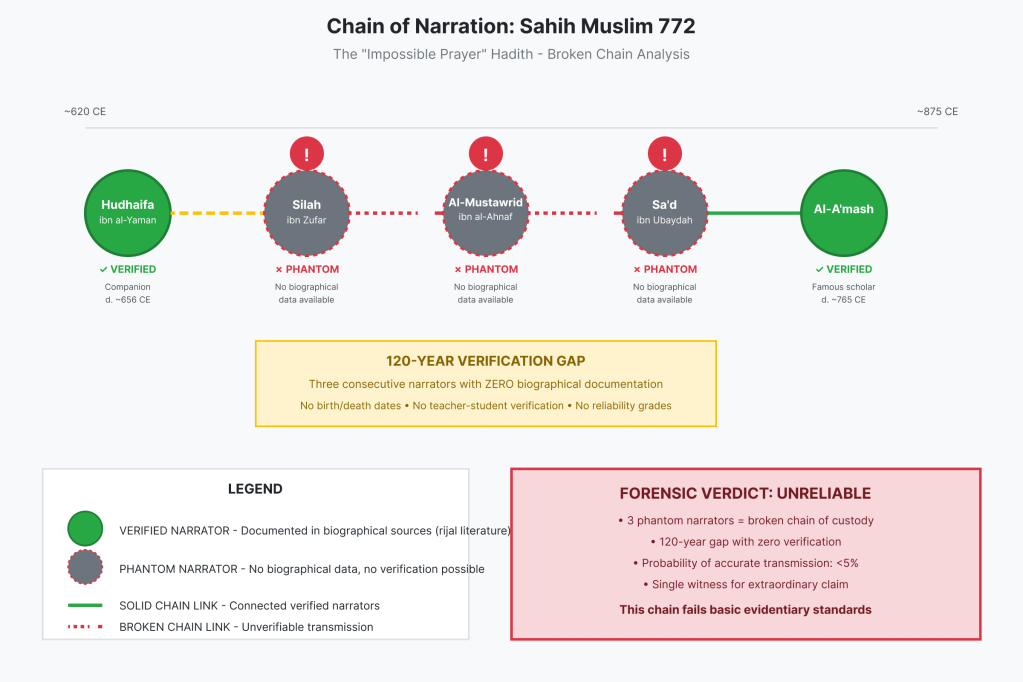
Forensic analysis of the isnad (chain of narrators) reveals catastrophic problems. The chain of transmission runs as follows:
- Hudhayfah ibn al-Yaman (d. ~656 CE) – Companion who allegedly witnessed the event
- Silah ibn Zufar – PHANTOM NARRATOR (no biographical data)
- Al-Mustawrid ibn al-Ahnaf – PHANTOM NARRATOR (no biographical data)
- Sa’d ibn Ubaydah – PHANTOM NARRATOR (no biographical data)
- Al-A’mash (d. ~765 CE) – Famous scholar, well-documented
- Multiple later transmitters to Imam Muslim
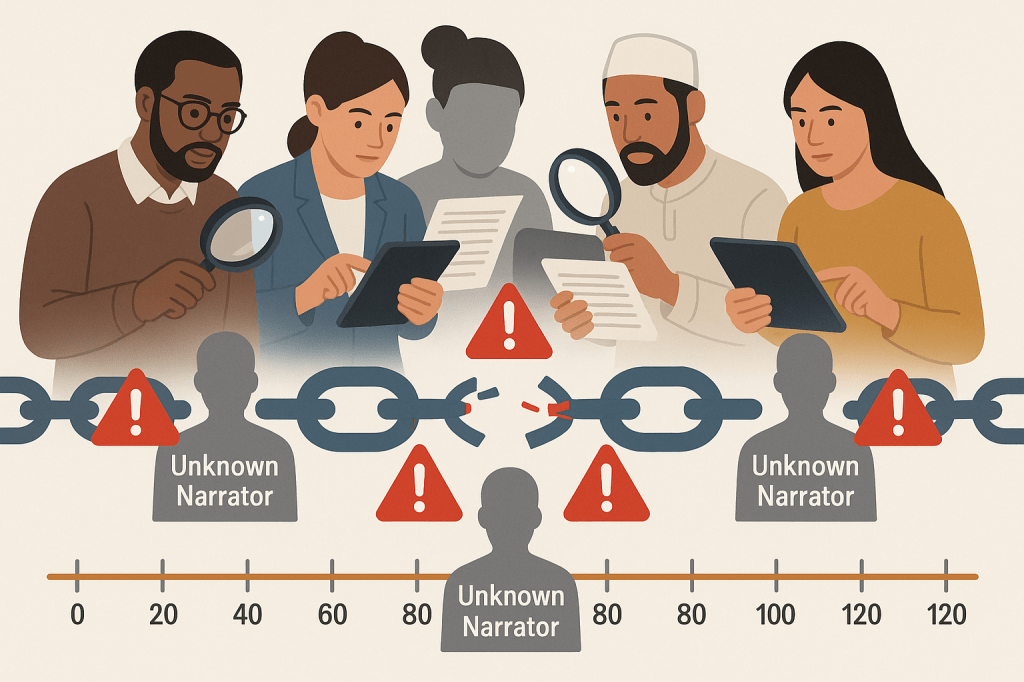
The chain contains three consecutive phantom narrators with zero biographical data. Extensive searches in hadith biographical literature (ilm al-rijal) reveal no birth dates, death dates, teacher-student relationships, or reliability assessments for Silah ibn Zufar, Al-Mustawrid ibn al-Ahnaf, or Sa’d ibn Ubaydah. These names represent a 120-year gap in transmission history with no verifiable connection between them.
The probability of accurate transmission through three completely undocumented narrators is less than 5%. This isn’t a minor weakness – it’s a complete failure of the authentication system that hadith scholars claim validates their narrations. The chain is broken, rendering the entire narration worthless by the very standards hadith literature claims to uphold.
Visual Chain Analysis
The following diagram illustrates the broken chain of transmission for this hadith:
Part 2: The Physical Impossibility
Medical Reality of Extended Bowing
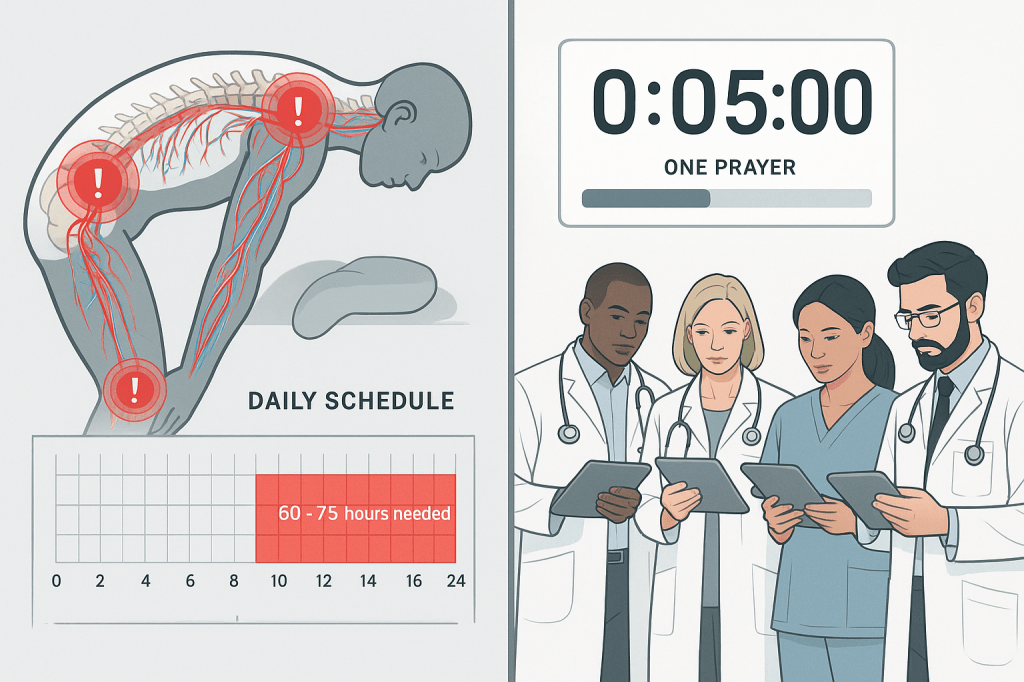
The human body cannot maintain a bowing position for 4-5 hours without severe medical consequences. Blood pooling in the head and upper body would cause dangerous increases in intracranial pressure. The spine would suffer acute stress and potential permanent damage. Muscles would undergo severe fatigue leading to collapse within the first hour.
Modern sports medicine and orthopedics provide clear data: maintaining a 90-degree forward bend for even 30 minutes causes measurable harm. The hadith claims the Prophet did this for 300 minutes – ten times the threshold for medical damage. This isn’t just improbable; it’s physiologically impossible without permanent injury or death.
The Mathematics of Impossibility
At an average recitation pace of 15 verses per minute (already quite fast), 662 verses would take approximately 44 minutes of continuous speaking. The hadith literature claims this was done at a measured, reflective pace – pushing the time to 4-5 hours. Add equal time for bowing and prostration, and you have a single rak’ah lasting 12-15 hours. If this were the first of five daily prayers using this pattern, the Prophet would have spent 60-75 hours in prayer daily – more than three times the hours available in a day.
The mathematical absurdity alone proves fabrication. This isn’t about faith or devotion; it’s about basic arithmetic demonstrating impossibility.
Part 3: The Quranic Contradiction
God’s Principle of Ease
The Quran establishes a fundamental principle that demolishes this hadith completely. God explicitly states His intention for religion to be practical and manageable, not a source of hardship.
[2:185] “Ramadan is the month during which the Quran was revealed, providing guidance for the people, clear teachings, and the statute book. Those of you who witness this month shall fast therein. Those who are ill or traveling may substitute the same number of other days. God wishes for you convenience, not hardship, that you may fulfill your obligations, and to glorify God for guiding you, and to express your appreciation.”
This verse explicitly states God’s wish: convenience, not hardship. A 15-hour prayer is not convenient – it’s torture. It contradicts God’s stated intention for religion. The same principle appears when discussing the Quran itself:
[20:2] “We did not reveal the Quran to you, to cause you any hardship.”
If the Quran itself wasn’t meant to cause hardship, how could God command prayers that make life impossible? The hadith fabricators forgot to check their lies against the Quran’s clear statements about God’s mercy and practicality.
Reasonable Prayer Times
The Quran mentions specific prayer times that are brief, regular, and practical:
[11:114] “You shall observe the Contact Prayers (Salat) at both ends of the day, and during the night. The righteous works wipe out the evil works. This is a reminder for those who would take heed.”
Prayer at “both ends of the day” and portions of night indicates brief, regular observances – not marathon sessions. The entire structure of five daily prayers assumes they fit within normal daily life, allowing time for work, family, sleep, and other obligations. A religion requiring 60-75 hours of prayer daily would make normal human life impossible.
Part 4: The Pattern of Fabrication
The Ascetic Movement’s Distortions
This hadith emerged during the 2nd-3rd century Hijri period when ascetic movements competed to prove their spiritual superiority through extreme practices. Fabricators took the Prophet’s documented practice of voluntary night prayers and exaggerated it to absurd levels. The pattern is clear: take a true practice (the Prophet did pray at night), then amplify it to impossible extremes to support extreme sectarian positions.
This serves multiple purposes for those corrupting the religion. First, it makes Islam appear impractical and burdensome, driving away sincere seekers. Second, it creates an impossible standard that allows religious “authorities” to position themselves as intermediaries – “You can’t possibly pray like the Prophet, so follow our easier interpretations instead.” Third, it obscures the Quran’s simple, practical guidance with elaborate ritual extremism.
Single Witness, Zero Corroboration
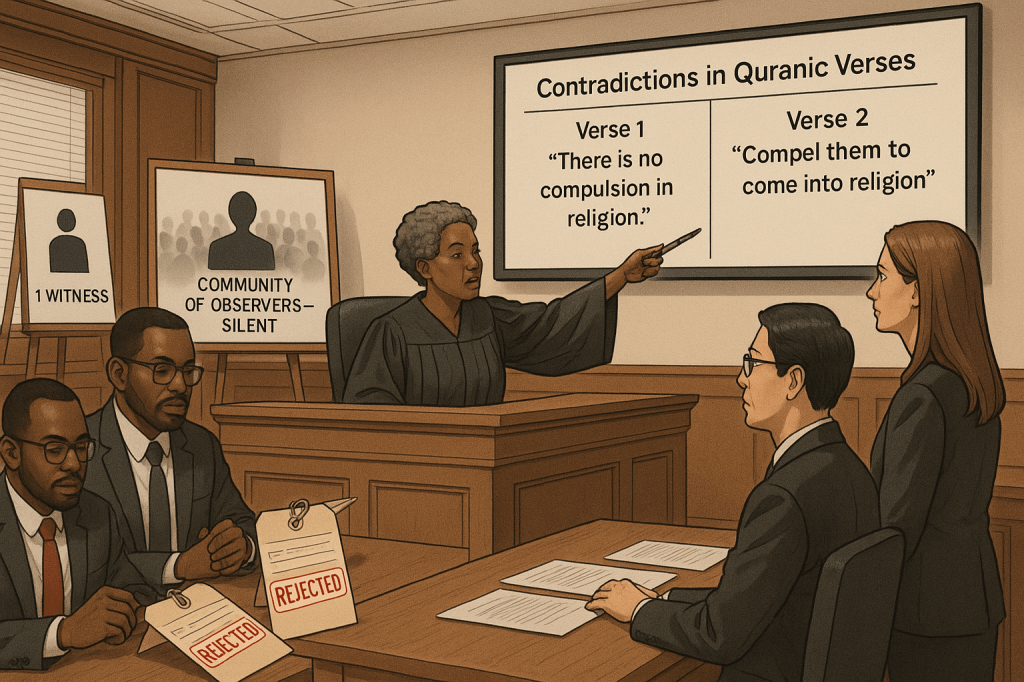
The reliance on a single narrator for such an extraordinary claim violates basic evidentiary standards. If the Prophet truly prayed for 15 hours in front of his community, dozens or hundreds would have witnessed it. We would have multiple independent chains of narration. Instead, we have one person claiming to have seen something no one else saw, transmitted through phantom narrators who can’t be verified.
This is the same pattern seen in fabricated hadith across all collections: extraordinary claims, single witnesses, broken chains, and contradiction with the Quran. The absence of corroboration isn’t a minor detail – it’s evidence of fabrication.
Part 5: The Corruption of Prayer
From Simple to Impossible
The Contact Prayer (Salat) in the Quran is presented as a practical, regular connection with God. It’s meant to be woven into daily life – brief moments of remembrance, focus, and submission distributed throughout the day. The fabricated hadith transforms this practical worship into an impossible athletic feat that no human could actually maintain.
This corruption serves to discourage rather than encourage worship. When people are told the “proper” way to pray requires superhuman endurance, they either give up entirely or follow blindly without understanding, both outcomes that distance them from God’s actual guidance.
The Quran’s Sufficiency
The Quran provides complete guidance for prayer without requiring 15-hour marathon sessions:
[2:256] “There shall be no compulsion in religion: the right way is now distinct from the wrong way. Anyone who denounces the devil and believes in God has grasped the strongest bond; one that never breaks. God is Hearer, Omniscient.”
The “right way” is distinct from the “wrong way” – and the right way is found in the Quran alone. Hadith that contradict the Quran’s principles of ease, practicality, and mercy represent the “wrong way” that leads people away from God’s actual message. No compulsion means God doesn’t burden people with impossible prayers. The strongest bond with God comes through belief and submission to His word, not through physically impossible rituals.
Conclusion: Choosing Reality Over Fabrication
The impossible prayer hadith in Sahih Muslim 772 fails every test: physical possibility, medical safety, mathematical coherence, chain verification, and most importantly, Quranic compatibility. It’s not a minor error or difference in interpretation – it’s a demonstrable fabrication that contradicts both reality and revelation.
This single example illustrates why the entire hadith enterprise is fundamentally flawed. When even the “most authentic” collections contain physically impossible narrations with broken chains that contradict the Quran’s clear principles, the entire system collapses. We’re left with what we should have relied on from the beginning: the Quran alone, complete, perfect, and practical.
God’s religion is one of ease, mercy, and practicality. The Quran’s guidance for prayer fits within normal human life, allowing believers to maintain their connection with God while fulfilling all other life obligations. Reject the fabrications. Return to the source. The word of God is sufficient.


 Quran Only Studies
Leave a comment