
Introduction: The Question of Scope
Among the four dietary prohibitions clearly enumerated in God’s final revelation, the fourth stands out as the most misunderstood and misapplied. While carrion, blood, and pork present little ambiguity in modern contexts, the fourth prohibition – “animals dedicated to other than God” – has been stretched, expanded, and distorted to create restrictions God never intended. Some claim it prohibits eating at any non-Muslim establishment, others extend it to all foods blessed by non-Muslims, and still others use it to create divisions and hardship where God intended ease and clarity.
The truth, however, lies in the linguistic precision of the Quran itself. The Arabic term used for this prohibition – أُهِلَّ (uhilla) from the root ه ل ل – appears in exactly five verses in the entire Quran: four times in the dietary prohibition context, and once referring to the appearance of the new moon. This limited, precise usage reveals something profound: God chose a very specific term with a very specific meaning to describe a very specific prohibition. Understanding this term’s linguistic boundaries reveals the narrow, merciful scope of the fourth dietary prohibition.
As we explored in our previous article on The Architecture of Divine Prohibition, God employs circumscriptive enumeration for material prohibitions – He lists specific items, and everything outside that list is automatically permitted. This principle of “expressio unius est exclusio alterius” (the expression of one thing excludes others) applies perfectly to dietary law. When God lists exactly four prohibited food categories, He simultaneously permits everything else. When He uses a specific, narrow term for the fourth prohibition, He limits its scope to that precise meaning – no more, no less.
Part 1: The Four and Only Four – Circumscriptive Prohibition in Action
God’s Most Comprehensive Statement
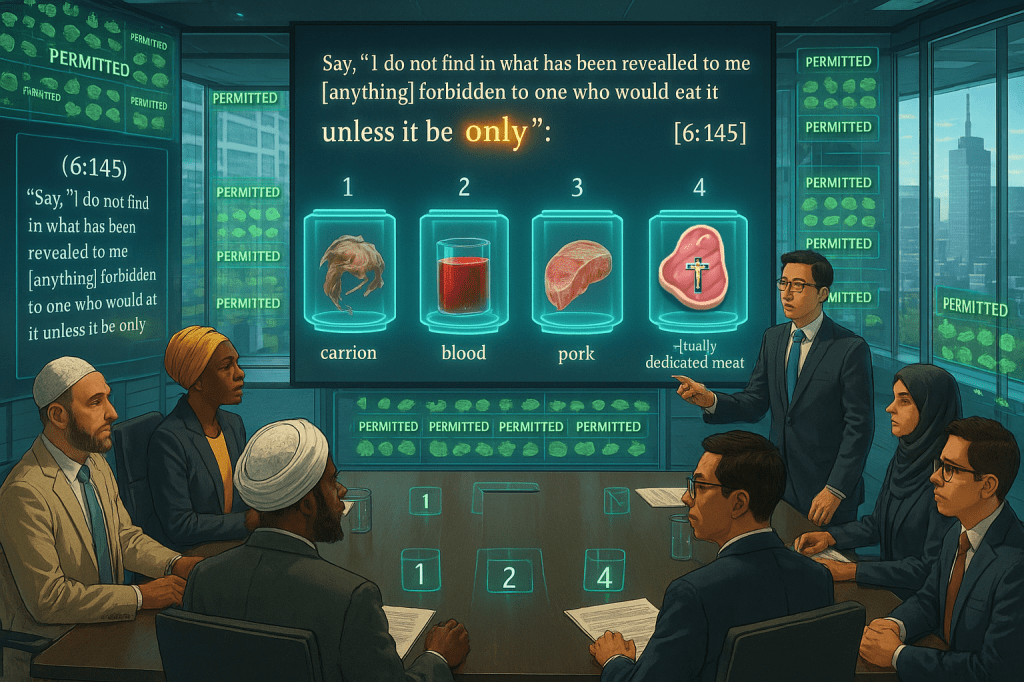
The clearest articulation of dietary law appears in verse [6:145], where God provides an exhaustive, numbered list of prohibited foods. This verse stands as the most comprehensive statement on the subject, using language that leaves no room for expansion or interpretation:
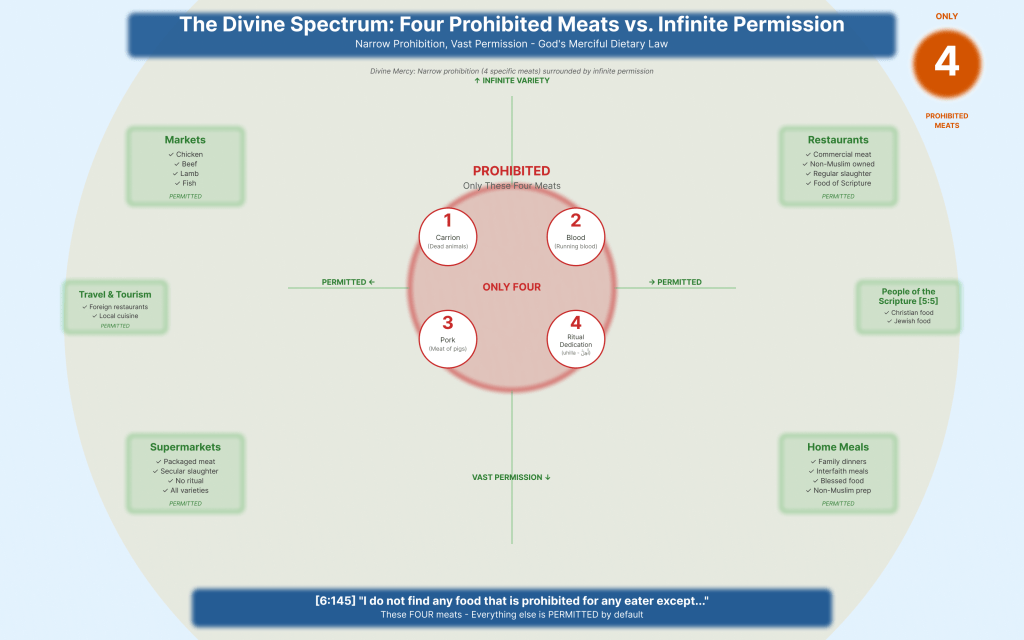
[6:145] “Say, ‘I do not find in the revelations given to me any food that is prohibited for any eater except: (1) carrion, (2) running blood, (3) the meat* of pigs, for it is contaminated, and (4) the meat of animals blasphemously dedicated to other than God.’ If one is forced (to eat these), without being deliberate or malicious, then your Lord is Forgiver, Most Merciful.”
The structure of this verse is juridically perfect. God commands the messenger to declare that he does not find “any food that is prohibited” except these four categories. The phrase “I do not find” establishes an exhaustive search – the messenger has examined all revelations and found only these four prohibitions. The word “any food” (طَعَامٍ – ta’aam) encompasses all edibles, not just meat. Yet the four prohibitions that follow all relate specifically to animal products: dead animals, their blood, pork, and animals dedicated to other than God.
This pattern repeats consistently across all four verses that address dietary prohibition. In [2:173], God states: “He only prohibits for you the eating of animals that die of themselves (without human interference), blood, the meat of pigs, and animals dedicated to other than God.” The word “only” (إِنَّمَا – innama) functions as a legal limit – these alone, nothing more. In [16:115], virtually identical language appears: “He only prohibits for you dead animals, blood, the meat of pigs, and food which is dedicated to other than God.” The consistency is not accidental – it’s emphatic divine emphasis on the completeness of the list.
Part 2: Understanding أُهِلَّ (Uhilla) – The Linguistic Key
A Term Used Only for Ritual Dedication
The entire question of the fourth prohibition’s scope hinges on understanding one Arabic term: أُهِلَّ (uhilla), the passive voice form of the verb أَهَلَّ (ahalla). This root – ه ل ل (h-l-l) – appears in exactly five verses in the entire Quran, making its meaning remarkably clear through limited, consistent usage. Four appearances relate to dietary prohibition ([2:173], [5:3], [6:145], [16:115]), and one relates to the new moon ([2:189]).
The root ه ل ل fundamentally means “to appear” or “to proclaim,” as seen in its usage for the new moon’s appearance (اَهِلَّ – ahilla). When applied to animals before slaughter, it specifically means “to proclaim” or “to invoke” a name over the animal as part of a religious ritual or sacrifice. This is not casual blessing, general prayer, or routine invocation – it is formal, ritual dedication of the animal to a deity at the moment of slaughter.
The morphological analysis reveals even more precision. The term أُهِلَّ (uhilla) is passive voice, meaning “was dedicated” or “was proclaimed over.” The structure is: أُهِلَّ لِغَيْرِ اللَّهِ بِهِ (uhilla lighayri Allahi bihi) – “was dedicated to other than God with it/by it.” The preposition “li” (لِ) indicates dedication “to” or “for” someone, and “ghayri” (غَيْرِ) means “other than.” Combined, this phrase specifically describes animals that were ritually dedicated to entities other than God during the slaughter process.


Part 3: The Root Pattern – Five Verses Tell One Story
Consistent Usage Across the Quran
When a root word appears only five times in a text as vast as the Quran (over 6,300 verses), we can be certain its usage is deliberate and its meaning precise. The pattern of ه ل ل (h-l-l) usage reveals God’s legislative intention:
Verse 1 – [2:189]: “They ask you about the new moons (اَلْأَهِلَّةِ – al-ahillah). Say, ‘They provide a timing device for the people, and determine the time of Hajj.’…” Here, “ahillah” is the plural of “hilaal” (crescent), literally “the things that appear/are proclaimed.” The new moon appears, becomes visible, is announced – this is the core meaning of the root.
Verses 2-5 – Dietary Prohibitions: In all four dietary verses ([2:173], [5:3], [6:145], [16:115]), the term appears in identical passive form: أُهِلَّ (uhilla) – “was dedicated/proclaimed.” The consistency is absolute. Not once does God use a different term, a different form, or add qualifying language that would expand the meaning. The limitation is built into the word choice itself.
This pattern reveals divine precision in legislation. If God intended to prohibit all foods blessed by non-Muslims, He could have used terms like بَارَكَ (baarakا – blessed), دَعَا (da’aa – invoked), or سَمَّى (sammaa – named). If He intended to prohibit foods from non-Muslims generally, He could have used phrases involving ownership or preparation. But He chose أُهِلَّ (uhilla) – a term that specifically and exclusively refers to ritual proclamation and dedication.
Classical Arabic Dictionary Confirmation
The dual meaning of the root ه ل ل is confirmed by classical Arabic dictionaries, which define it with remarkable consistency:
ه ل ل: to appear (new moon), beginning (of lunar month), crescent moon. ahalla – to invoke the name of God upon an animal before slaughtering it.
Notice the specificity: the dictionary explicitly states that in the context of animals, this root means “to invoke the name of God upon an animal before slaughtering it.” This is not about general blessing, not about food preparation, but specifically about the moment of ritual slaughter. When the passive form أُهِلَّ (uhilla) is used with “لِغَيْرِ اللَّهِ” (to other than God), it means the animal was dedicated to an entity other than God during this crucial moment.
The connection between the two meanings – new moon appearance and slaughter dedication – becomes clearer when we understand that both involve a moment of transition: the moon transitions from invisibility to visibility, from death to life; the animal transitions from life to death through slaughter. In both cases, the root ه ل ل captures this transitional moment of proclamation or appearance. When applied to slaughter, it specifically refers to the proclamation made at this transition point.


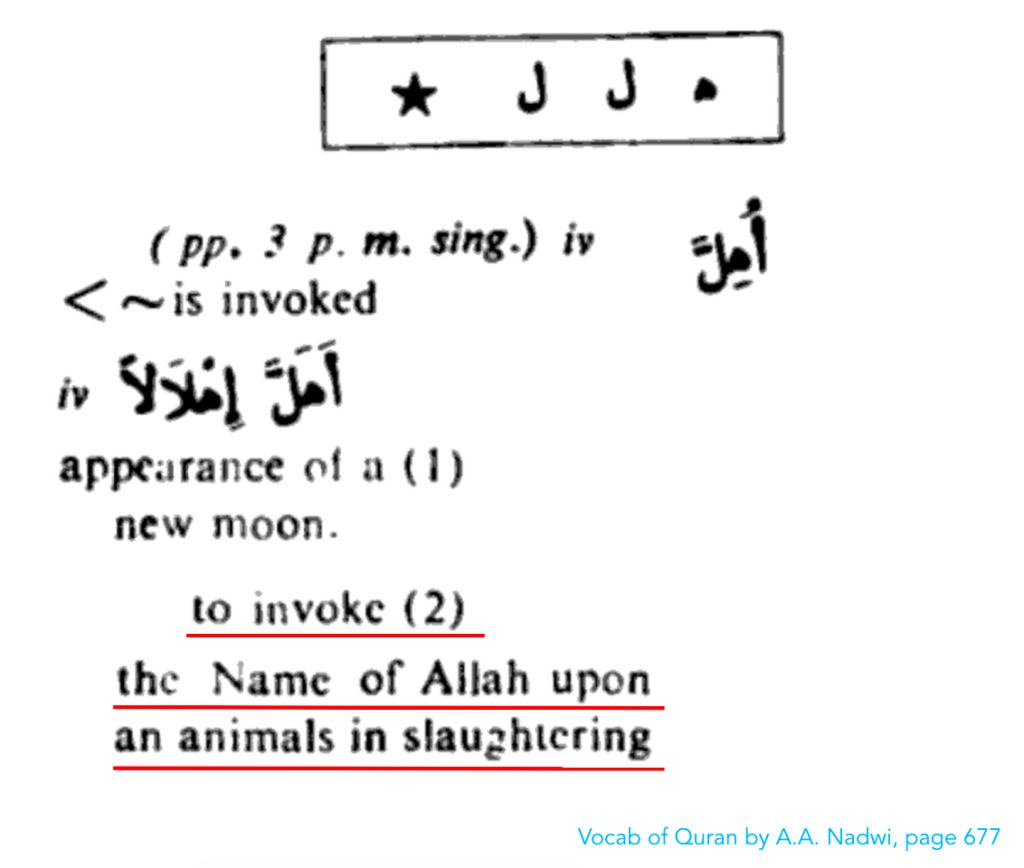
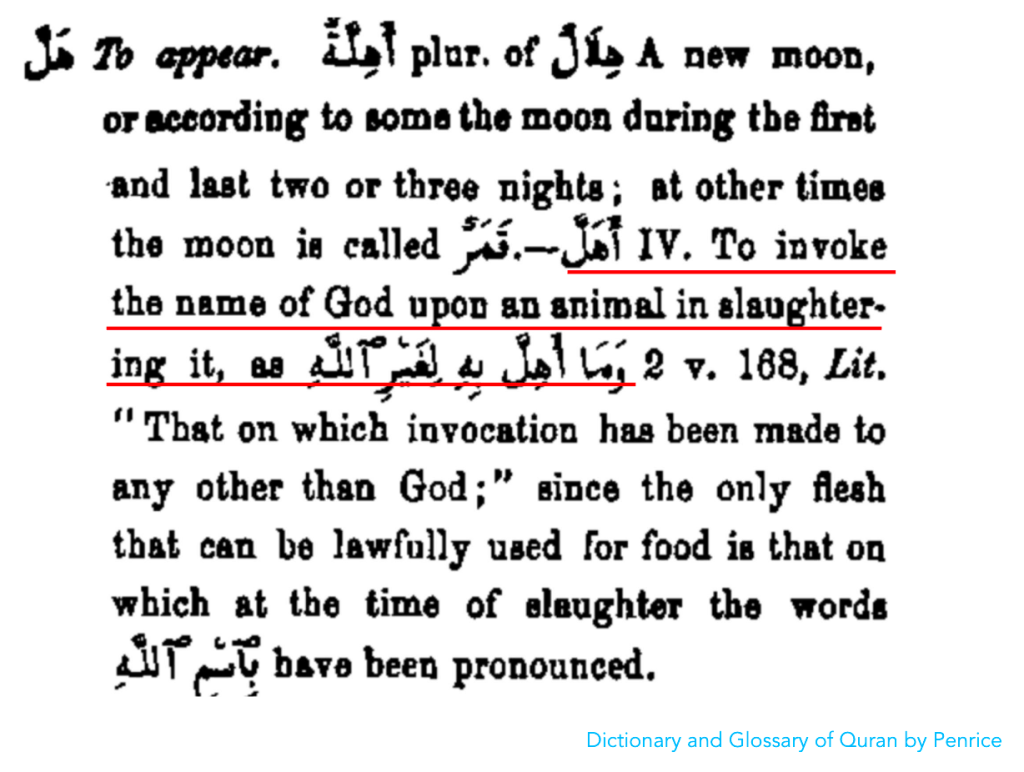
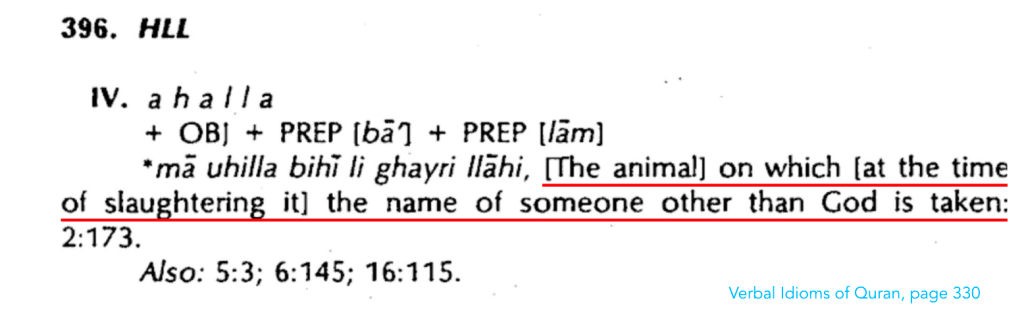
Multiple classical Arabic dictionaries unanimously confirm the precise meaning: ه ل ل in the context of animals specifically refers to invoking a name at the time of slaughtering, not general blessing or food preparation. The consistency across all lexical sources demonstrates the narrow, specific scope of this prohibition.

Part 4: Verse-by-Verse Analysis – Four Statements, One Message
Progressive Revelation with Perfect Consistency
Examining each of the four dietary prohibition verses reveals perfect consistency in message while adding complementary details:
[2:173] – The Foundation: “He only prohibits for you the eating of animals that die of themselves (without human interference), blood, the meat of pigs, and animals dedicated to other than God. If one is forced (to eat these), without being malicious or deliberate, he incurs no sin. God is Forgiver, Most Merciful.”
This early Medinan verse establishes the basic framework. The word “only” (إِنَّمَا – innama) is legally definitive – these alone are prohibited, nothing more. The mercy clause that follows – permitting consumption under duress – appears in all four verses, emphasizing that even these four prohibitions are not absolute but compassionately suspended in life-threatening situations. This mercy principle runs throughout Quranic dietary law, standing in stark contrast to the harsh, expansive restrictions found in religious traditions that add to God’s clear limits.
[5:3] – The Detailed Expansion: “Prohibited for you are animals that die of themselves, blood, the meat of pigs,* and animals dedicated to other than God. (Animals that die of themselves include those) strangled, struck with an object, fallen from a height, gored, attacked by a wild animal—unless you save your animal before it dies—and animals sacrificed on altars. Also prohibited is dividing the meat through a game of chance; this is an abomination. Today, the disbelievers have given up concerning (the eradication of) your religion; do not fear them and fear Me instead. Today, I have completed your religion, perfected My blessing upon you, and I have decreed Submission as the religion for you. If one is forced by famine (to eat prohibited food), without being deliberately sinful, then God is Forgiver, Merciful.”
This verse, revealed on the Day of Arafat during the Farewell Pilgrimage, provides comprehensive details. Notice that God expands on the first category (carrion) by listing various ways an animal can die without proper slaughter: strangling, impact, falling, goring, predation. He then adds that animals sacrificed on altars (النُّصُبِ – al-nusub) fall under the fourth prohibition. This confirms that أُهِلَّ (uhilla) specifically relates to ritual slaughter dedicated to idols or deities other than God. The altar reference makes the idolatrous context explicit.
Critically, this verse declares “Today, I have completed your religion.” If dietary prohibitions were meant to extend beyond these four categories, this would be the verse to expand them. Instead, God confirms completeness – the religion is finished, perfected, and these four prohibitions remain the only ones.
[6:145] – The Comprehensive Declaration: As examined earlier, this verse provides the numbered, exhaustive list and explicitly states that the messenger finds “no food that is prohibited” beyond these four categories. The legal language is unmistakable: this is the complete list, searchable in all revelations, covering all foods.
[16:115] – The Concise Restatement: “He only prohibits for you dead animals, blood, the meat of pigs,* and food which is dedicated to other than God. If one is forced (to eat these), without being deliberate or malicious, then God is Forgiver, Most Merciful.”
The final chronological statement uses slightly different phrasing for the fourth prohibition: “food which is dedicated to other than God” (وَمَا أُهِلَّ لِغَيْرِ اللَّهِ بِهِ – wa maa uhilla lighayri Allahi bihi). The addition of “maa” (what/which) broadens the phrasing but not the meaning – it still refers to items ritually dedicated, using the same specific term أُهِلَّ (uhilla). If God intended this to mean all food from non-Muslims or all food blessed by others, He would not use this rare, specific term that appears only in ritual dedication contexts.
[16:115] “He only prohibits for you dead animals, blood, the meat of pigs,* and food which is dedicated to other than God. If one is forced (to eat these), without being deliberate or malicious, then God is Forgiver, Most Merciful.”

Part 5: What the Fourth Prohibition Does Apply To
The Narrow Scope of Ritual Dedication
Understanding what أُهِلَّ (uhilla) actually prohibits requires examining the historical and practical contexts in which animals are ritually dedicated to entities other than God. The prohibition is narrow and specific:
1. Animals Sacrificed on Altars: As [5:3] explicitly states, animals “sacrificed on altars” (النُّصُبِ – al-nusub) fall under this prohibition. In the time of revelation, pagan Arabs would slaughter animals on stone altars dedicated to specific idols, invoking the idol’s name during the sacrifice. This practice made the meat forbidden – not because of who performed the slaughter, but because of the ritual dedication to a false deity.
2. Animals Dedicated to Saints, Prophets, or Angels: Any animal slaughtered with invocation to entities other than God – whether saints, prophets, angels, or any other being – falls under this prohibition. If someone says “In the name of Jesus” or “In the name of Ali” or “In the name of Prophet Muhammad” while slaughtering an animal, intending this as religious dedication, the meat becomes prohibited. The issue is not the person’s religion but the act of dedication to other than God.
3. Religious Sacrificial Offerings to Non-God Entities: Various religious traditions include sacrificial offerings to spirits, ancestors, or intermediaries. When animals are slaughtered specifically as offerings to these entities – with ritual invocation and dedication – they fall under the fourth prohibition. The key elements are: (a) formal ritual context, (b) explicit invocation or dedication, and (c) intention to honor/worship/appease an entity other than God.
4. Votive Offerings to Idols or Shrines: Some cultures practice votive animal sacrifice, where animals are offered to idol shrines, spirit houses, or sacred sites believed to house supernatural entities. When the slaughter involves dedication to these entities, the prohibition applies. Again, the issue is the ritual dedication, not the slaughterer’s general beliefs.
The common thread is unmistakable: formal ritual dedication of the animal to an entity other than God at the time of slaughter. This is a specific, identifiable practice, not a broad category that encompasses all food from non-Muslims or all blessed food.
Part 6: What the Fourth Prohibition Does NOT Apply To
The Vast Permissibility Beyond the Narrow Ban
Understanding what أُهِلَّ (uhilla) does not prohibit is equally important, as many Muslims have been taught restrictions that God never imposed:
1. Regular Commercial Food from Non-Muslims: The prohibition does not extend to ordinary food purchased from non-Muslim establishments, markets, or restaurants. When a restaurant cook prepares chicken, beef, or lamb for commercial sale without ritual dedication to a deity, the food remains fully permissible. The Quran explicitly permits food from “People of the Scripture” ([5:5]), confirming that the slaughterer’s religion is not the issue – ritual dedication is.
2. Food Blessed by Non-Muslims: If Christians say grace over their meal, thanking God for the food, this does not make the food prohibited. If a Hindu priest blesses food in a general ceremony, this does not constitute أُهِلَّ (uhilla) – ritual dedication at slaughter. The prohibition is specific to the slaughter moment and dedication of the animal, not subsequent blessings or prayers over already-prepared food.
3. Food from Those Who Believe Differently: Simply because someone holds beliefs different from pure monotheism does not make their food prohibited. The Quran permits marrying People of the Scripture and eating their food ([5:5]), even though many Christians believe in trinity and many Jews have various theological differences. The prohibition is about action (ritual dedication), not belief.
4. Food Where God’s Name Was Not Mentioned: Some Muslims claim that meat slaughtered without mentioning God’s name is prohibited. This confuses أُهِلَّ (dedicated to other than God) with simple omission. Verse [6:121] addresses this: “Do not eat from that upon which the name of God has not been mentioned, for it is an abomination.” However, the context and companion verses make clear this refers to animals intentionally dedicated to idols (where God’s name was deliberately replaced with another’s), not simple omission. The Quran repeatedly permits food of People of the Scripture, who typically do not mention God’s name in Arabic during slaughter.
5. Meat from Modern Secular Slaughterhouses: Contemporary industrial meat production involves no religious dedication whatsoever. Animals are slaughtered for commercial purposes without invoking any deity or performing any religious ritual. This meat is entirely permissible, as it falls outside all four prohibited categories. It is not carrion (humans intervened), not blood (it’s drained), not pork (if it’s other meat), and not أُهِلَّ (no ritual dedication occurred).
The Critical Distinction: “Other Than God” vs. Simple Omission
A crucial insight emerges from examining the Quranic text carefully: the prohibition is specifically for animals dedicated “لِغَيْرِ اللَّهِ” (to other than God), not animals where God’s name was simply not mentioned. This distinction is fundamental and demolishes the common misunderstanding that all meat requires explicit Islamic slaughter rites.
The Quran provides clear evidence of this distinction in two powerful verses that address pre-Islamic idol-worshipping practices:
[5:103] “GOD did not prohibit livestock that begets certain combinations of males and females, nor livestock liberated by an oath, nor the one that begets two males in a row, nor the bull that fathers ten. It is the disbelievers who invented such lies about GOD. Most of them do not understand.”
The Arabic terms in this verse – Bahīrah (بَحِيرَةٍ), Sā’ibah (سَائِبَةٍ), Waṣīlah (وَصِيلَةٍ), and Hām (حَامٍ) – refer to specific categories of animals that pagan Arabs would dedicate to their idols based on superstitious criteria. A Bahīrah was a she-camel that had given birth to five calves; a Sā’ibah was an animal liberated by vow to idols; a Waṣīlah was a sheep that bore twins; and Hām was a stallion that had sired ten foals. The pagans would declare these animals sacred to their idols and prohibit their consumption.
Here’s the key: these animals were already dedicated to idols by the pagans. Yet God explicitly declares them lawful for believers to consume! If simply being dedicated to other than God (regardless of slaughter) made meat prohibited, these animals would be unlawful. But God makes clear they are permissible, with one critical condition: they must not be dedicated to other than God at the moment of slaughter.
This is further confirmed in [6:138], which describes the pagan practices:
[6:138] “They said, ‘These are livestock and crops that are prohibited; no one shall eat them except whomever we permit,’ so they claimed. They also prohibited the riding of certain livestock. Even the livestock they ate, they never pronounced GOD’s name as they sacrificed them. Such are innovations attributed to Him. He will surely requite them for their innovations.”
Notice what God criticizes: the pagans “never pronounced GOD’s name as they sacrificed them” – meaning they either invoked idol names or remained silent. But the prohibition doesn’t arise merely from failure to mention God’s name; it arises when they actively dedicate the animal to something other than God. If an animal is slaughtered without dedicating it to anything – neither God nor idols – it remains permissible.
This resolves the apparent tension with [6:121]: “Do not eat from that upon which the name of God has not been mentioned, for it is an abomination.” Read in context with [6:138], this refers to animals sacrificed to idols (where God’s name was deliberately replaced with idol invocation), not commercial slaughter where no deity is invoked at all. The “name not mentioned” phrase describes the pagan practice of invoking idol names instead of God’s name, not neutral commercial slaughter.
The practical implication is profound: when you buy meat from a supermarket or eat at a restaurant where the slaughterer didn’t invoke any deity – neither God nor idols – the meat is permissible. The prohibition only applies when the animal was actively dedicated “لِغَيْرِ اللَّهِ” (to other than God) during slaughter. Absence of dedication is not the same as dedication to other than God.

Part 7: The Architecture of Divine Prohibition – Material Versus Behavioral
Why Food Restrictions Must Be Circumscriptive
As we explored in depth in our article The Architecture of Divine Prohibition, God employs fundamentally different legislative approaches for material prohibitions versus behavioral prohibitions. This distinction is not arbitrary but reflects divine wisdom in addressing different types of human needs and sins.
Material prohibitions – things we eat, drink, or physically consume – must be circumscriptive and exhaustively listed. Why? Because humans need clarity about what they can and cannot consume. Expanding such lists creates hardship, as evidenced by the burdensome dietary restrictions that accumulated in Jewish law through human addition. God criticizes this very tendency in the Quran, explaining that He only prohibited certain foods to the Jews because of their transgressions ([6:146]). The Quran’s approach is the opposite: start with universal permission, then list specific, limited exceptions.
The principle of “expressio unius est exclusio alterius” (the expression of one thing excludes others) governs material prohibition. When God lists four specific food categories as prohibited, He simultaneously declares everything else permissible. This is not human interpretation – it is foundational legal logic that operates in statutory systems worldwide. Specific enumeration creates boundaries.
Behavioral prohibitions, by contrast, must be open-ended and principle-based because human creativity in evil is infinite. If God only prohibited murder, theft, and adultery by name, humans would invent torture, kidnapping, and countless other evils. Open-ended prohibitions like “evil deeds, be they obvious or hidden” ([7:33]) capture infinite manifestations of sin without requiring exhaustive listing.
The fourth dietary prohibition sits firmly in the material category. It addresses what we eat, not how we behave generally. Therefore, it must be circumscriptive and narrow. The specific term أُهِلَّ (uhilla) creates clear boundaries: ritual dedication to other than God at slaughter. Everything outside these boundaries is automatically permitted, not because of loopholes but because of divine legislative design intended to create ease for believers.
Part 8: Practical Modern Applications – Living the Truth
Freedom From False Restrictions
Understanding the true scope of the fourth prohibition liberates believers from unnecessary hardship while maintaining clear monotheistic principles:
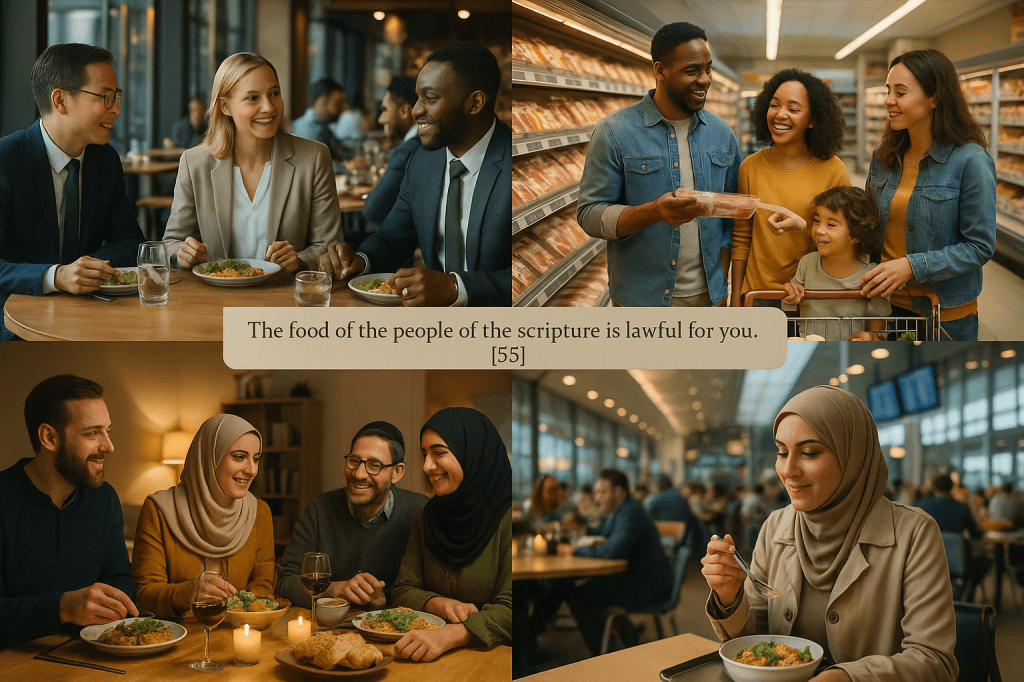
Restaurants and Commercial Food: You can confidently eat at any restaurant – Muslim or non-Muslim – without concern that the food falls under the fourth prohibition, provided the other three prohibitions (carrion, blood, pork) are avoided. The chef’s religion is irrelevant. The restaurant’s ownership is irrelevant. What matters is whether ritual dedication to a deity other than God occurred at slaughter – and this virtually never happens in commercial contexts.
Supermarket Meat: Packaged meat from secular slaughterhouses is fully permissible. Modern industrial meat production involves no religious dedication. Animals are killed for commercial purposes following regulatory standards, with no invocation of any deity. This is neither sacrificial nor ritual – it is commerce. All Quranic conditions for prohibition are absent.
Interfaith Dining: When invited to eat with Christian, Jewish, or other friends, you can accept confidently. The Quran explicitly permits food of People of the Scripture ([5:5]). Unless you have specific knowledge that the meat was ritually dedicated to Jesus, a saint, or another entity during slaughter, it remains permissible. General table prayers or blessings do not constitute أُهِلَّ (uhilla).
Halal Certification Industry: While halal certification can be useful for avoiding pork and ensuring humane slaughter, it is not Quranically required to avoid the fourth prohibition. The Quran does not mandate that God’s name be mentioned in Arabic, that a Muslim perform the slaughter, or that any certification exist. The single requirement is avoiding ritual dedication to other than God – a requirement that commercial slaughter automatically meets by its non-ritual nature.
Travel and Necessity: When traveling in non-Muslim regions, believers can eat available food without anxiety. The Quran’s mercy principle applies: “If one is forced (to eat these), without being deliberate or malicious, then your Lord is Forgiver, Most Merciful” ([6:145]). But even without invoking necessity, regular commercial food is already permissible by default.
The practical impact of understanding أُهِلَّ (uhilla) correctly is freedom – freedom from false restrictions that God never imposed, freedom to participate fully in multi-cultural societies, and freedom to focus on actual obedience to divine command rather than human-invented hardships.
Part 9: The Idolatry Connection – Why This Prohibition Exists
Protecting Monotheism, Not Creating Hardship
The fourth dietary prohibition exists to protect the core principle of Islam (Submission): pure monotheism. Every prohibition has a purpose, and understanding the purpose clarifies the scope. The prohibition of أُهِلَّ (uhilla) targets a specific practice that directly violates God’s exclusive right to worship and dedication.
In pre-Islamic Arabia, pagan tribes would slaughter animals on stone altars (النُّصُبِ – al-nusub) dedicated to specific idols – Lat, Uzza, Manat, and hundreds of local deities. During slaughter, they would invoke the idol’s name, believing this dedication pleased the deity and brought blessings. This practice turned food into an act of worship toward other than God. The Quran prohibits this practice absolutely:
[5:3] “Prohibited for you are animals that die of themselves, blood, the meat of pigs,* and animals dedicated to other than God. (Animals that die of themselves include those) strangled, struck with an object, fallen from a height, gored, attacked by a wild animal—unless you save your animal before it dies—and animals sacrificed on altars…”
The mention of “altars” (النُّصُبِ – al-nusub) immediately after “dedicated to other than God” clarifies the connection: this is about sacrificial worship, not general food preparation. The prohibition protects believers from participating – even inadvertently – in practices that honor false deities. When you eat meat that was ritually dedicated to an idol, you consume the product of an act of shirk (idolatry), the one unforgivable sin if maintained until death.
This also explains why the prohibition is narrow rather than broad. God is not trying to separate Muslims from non-Muslims socially. He is not trying to make life difficult or create food anxiety. He is protecting the singular principle that defines submission: worshiping God alone. Ritual dedication to other deities violates this principle. Commercial slaughter does not. Simple food preparation by non-Muslims does not. General blessings do not. The prohibition targets the specific act of making food an offering to false gods.
Understanding this purpose prevents the expansion of the prohibition beyond its intent. When Muslims claim that all food from non-Muslims is suspect or that any Christian meal is potentially prohibited, they have lost sight of the prohibition’s purpose. The Quran permits eating with and marrying People of the Scripture precisely because their normal food preparation does not constitute ritual dedication to other gods, even if their theology is imperfect.
Part 10: Divine Mercy Embedded in Every Verse
The Consistent Mercy Clause
A remarkable feature appears in all four dietary prohibition verses: each one concludes with affirmation of God’s mercy and forgiveness. This is not coincidental but reveals divine character and legislative intent:
[2:173]: “…If one is forced (to eat these), without being malicious or deliberate, he incurs no sin. God is Forgiver, Most Merciful.”
[5:3]: “…If one is forced by famine (to eat prohibited food), without being deliberately sinful, then God is Forgiver, Merciful.”
[6:145]: “…If one is forced (to eat these), without being deliberate or malicious, then your Lord is Forgiver, Most Merciful.”
[16:115]: “…If one is forced (to eat these), without being deliberate or malicious, then God is Forgiver, Most Merciful.”
This mercy principle operates on multiple levels. First, it suspends even these four prohibitions in life-threatening situations. If you will die without eating, you may consume even pork or carrion without sin, provided you take only what is necessary and do not exceed need. This demonstrates that dietary law serves human welfare, not arbitrary divine command.
Second, the mercy clause emphasizes that these prohibitions are not burdensome. God does not demand hardship. The list is short (only four items), clear (explicitly enumerated), and flexible (suspended under duress). This stands in stark contrast to religious traditions that have expanded dietary restrictions into complex, burdensome systems that make ordinary eating an exercise in anxiety and religious law.
Third, the repeated mention of God being “Forgiver, Most Merciful” addresses human imperfection. If you accidentally consume something prohibited through ignorance or mistake, God’s mercy covers you. If you consumed prohibited food before learning the truth, God forgives. The emphasis is on intentional, deliberate violation versus innocent error.
This mercy context exposes the cruelty of expanding prohibitions beyond God’s clear limits. When religious authorities claim that eating at non-Muslim restaurants is prohibited, that supermarket meat is suspect, or that complex certification is required, they burden believers with restrictions God never imposed. They transform God’s merciful, simple dietary law into a source of hardship and anxiety. This is the very practice the Quran criticizes repeatedly – adding to God’s prohibitions and making religion difficult.

Part 11: Refuting Extended Interpretations – Exposing Human Addition
When Scholars Exceed Divine Limits
Throughout Islamic history, various scholars and schools have attempted to expand the fourth prohibition beyond its Quranic scope. Understanding and refuting these expansions is essential for liberating believers from human-imposed restrictions:
Claim 1: “All meat from non-Muslims is prohibited because they don’t mention God’s name.”
Refutation: This directly contradicts [5:5], which explicitly permits food of People of the Scripture. The Quran never requires that God’s name be mentioned in Arabic or any specific language. The prohibition of أُهِلَّ (uhilla) addresses active dedication to other than God, not the absence of mentioning God’s name. If absence of mention made food prohibited, the Quran would not permit food from Christians and Jews, who typically do not say “Bismillah” during slaughter.
Claim 2: “The fourth prohibition includes any food blessed by non-Muslims.”
Refutation: The term أُهِلَّ (uhilla) specifically refers to dedication at the moment of slaughter, not subsequent blessings. Christians saying grace over a meal do not make the food prohibited. Hindu priests blessing food at a temple do not trigger the prohibition. The Quranic term is precise and narrow – it addresses ritual dedication of the sacrificial animal to a deity, not general blessings of prepared food.
Claim 3: “Modern secular slaughter is prohibited because it’s like carrion – not done Islamically.”
Refutation: Carrion (الْمَيْتَةُ – al-maytah) means an animal that died without human intervention. Secular slaughter involves human intervention, making it definitionally not carrion. The Quran does not require “Islamic” slaughter – it prohibits four specific categories, and secular slaughter falls outside all four. It is not carrion (human intervention occurred), not blood (it’s drained), not pork (if it’s other meat), and not أُهِلَّ (no ritual dedication happened).
Claim 4: “We must avoid all doubt, so better to restrict eating to certified halal only.”
Refutation: The Quran’s principle is the opposite – default permission unless explicitly prohibited. God states in [6:119]: “Why should you not eat from that upon which God’s name has been mentioned, when He has detailed for you what is prohibited for you…?” The detailed prohibitions are the four categories. Everything else is permitted by default. The “avoid doubt” principle, when applied to dietary law, creates the very hardship God condemns. There is no doubt: regular commercial food is permitted unless ritual dedication occurred, which is easily knowable.
Claim 5: “The fourth prohibition is broader than the other three, encompassing all questionable food.”
Refutation: If God intended the fourth prohibition to be broader or more encompassing than the others, He would have used broader language or placed it in a different category. Instead, all four prohibitions appear in a single enumerated list, with parallel structure and equal weight. The fourth is not a catch-all category but a specific prohibition with a specific Arabic term (أُهِلَّ – uhilla) that has a specific meaning: ritual dedication.
These expansions share a common error: substituting human interpretation for divine text. The Quran’s language is clear, consistent, and narrow. When scholars expand beyond this clarity, they reveal their own religious culture, not God’s command. Believers must return to the text itself, understanding the precise Arabic terms and their consistent usage, rather than accepting traditional interpretations that exceed Quranic limits.
Part 12: Lessons From the Messenger’s Clarifications
Rashad Khalifa’s Consistent Teaching on Dietary Law
God’s Messenger of the Covenant, Dr. Rashad Khalifa, consistently taught the narrow, clear scope of dietary prohibition, emphasizing the four and only four categories. In his lecture “Essentials of Submission | Abraham, Pillars, Practices, Prohibitions” (at 26:59), his explanation perfectly captures the Quran’s intent:
“There are four meats that you cannot eat, for example, and these are number one, animals that die of themselves without human interference. Number two, pork, the meat of pigs. Number three, running blood, running blood that you can put in a glass and cook or drink. Number four, animals dedicated to other than God, that are specifically dedicated to Muhammad or Jesus or Ali or somebody. These are forbidden.”
He continued with a practical example, asking (27:29):
“So if you go to the market, you go to Safeway market for example, and you look at the meat, if you want to know if it is halal permitted or haram prohibited, you ask yourself these four questions. Is this meat pork? The answer is no. Then did these animals die of themselves without human interference? The answer is no. Is this running blood? The answer is no. Was this meat dedicated to Jesus or to anyone else, or Saint Francis? The answer is no, therefore this meat is halal, it’s okay, you can eat it.”
And he issued a stern warning about adding to God’s prohibitions (28:01):
“If you make it haram, if you prohibit it, then you are following some other religion, you are not a Muslim when you do that. So it is very important to follow specifically what the Quran prohibits.”
Notice the precision: “animals dedicated to other than God, that are specifically dedicated to Muhammad or Jesus or Ali or somebody.” The messenger understood أُهِلَّ (uhilla) to mean specific, ritual dedication – not general food from non-Muslims, not food blessed by others, but animals deliberately dedicated to entities other than God as acts of religious devotion.
The messenger also emphasized the exhaustive nature of the list, teaching that these four categories constitute the complete set of prohibited foods. He warned against adding to these prohibitions, recognizing that expansion of dietary law represents one of the ways religious communities deviate from pure divine guidance. He understood that God’s legislative architecture requires material prohibitions to be circumscriptive and complete – when God says “only” and provides a numbered list, that list is final.
His translation and footnotes consistently clarified this point. When rendering [6:145], he emphasized “any food that is prohibited for any eater except” – the language of exhaustive search and complete disclosure. When translating the fourth prohibition, he used phrases like “blasphemously dedicated” to capture the intentional, devotional nature of the prohibited act, distinguishing it from incidental or commercial contexts.
The messenger’s approach liberated believers from false restrictions while maintaining clear monotheistic principles. He taught that you can eat at any restaurant without anxiety, that supermarket meat is permissible, and that the food of People of the Scripture is lawful – all while strongly opposing any ritual dedication to other than God. This balance reflects perfect understanding of the Quranic text and its legislative intent.
Appendix 16: Dietary Prohibitions – The Messenger’s Detailed Clarification
In Appendix 16 of his translation, the messenger provided comprehensive clarification on this topic. He wrote: “The absolute specificity of dietary prohibitions in the Quran is best illustrated in 6:145-146. We learn from these two verses that whenever God prohibits ‘meat’ and nothing else, that is what He specifically prohibits. These two verses inform us that ‘the meat’ of pigs is prohibited, not ‘the fat.’ Obviously, God knew that in many countries, lard would be used in baked goods and other food products, and that such usage does not render the foods Haraam (prohibited). The Quran specifically prohibits four meats (2:173, 5:3, 6:142-145, and 16:112).”
This clarification is crucial: the messenger emphasizes “four meats” – not four foods, not four categories that extend to all food types, but specifically four meats. The precision is intentional and reflects the Quranic text’s own precision in using أُهِلَّ (uhilla) exclusively for animal slaughter contexts. This aligns perfectly with the linguistic evidence: the root ه ل ل, when applied to dietary law, specifically relates to animals and their ritual dedication at slaughter.
Rashad Khalifa on Dietary Prohibitions: Audio Explanation
In the following audio (Messenger Audio 20.2), Rashad Khalifa goes into detail that when it comes to dietary prohibitions, people will accidentally prohibit beyond what is mentioned in the Quran. At around the 6-minute mark and continuing through the discussion, he addresses the critical question: Are we required to mention the name of God when we sacrifice an animal? His answer provides crucial clarity on the distinction between dedication to other than God versus simple omission of God’s name.
The Meaning of “Uhilla”: Taking Permission from the Creator
At the critical timestamp of 6:37-6:49, Rashad Khalifa provides the definitive explanation of what it means to mention God’s name when slaughtering:
“Because we have to mention the name of God if you do the slaughtering yourself. Because you are taking permission from the creator of this animal. To end the life of this animal.“
This explanation reveals the profound theological meaning behind أُهِلَّ (uhilla). When you slaughter an animal yourself and mention God’s name, you are acknowledging that God is the creator and owner of that animal’s life. You are asking permission from the rightful owner to take that life. This is an act of submission and recognition of God’s sovereignty.
When someone dedicates the animal “لِغَيْرِ اللَّهِ” (to other than God) – to Muhammad, Jesus, Ali, St. Francis, or any other entity – they are implicitly claiming that this other entity is the creator or owner of that life. They are asking permission from the wrong source. This is why such dedication is forbidden: it constitutes a form of shirk (idolatry) by attributing to other than God the authority that belongs to God alone.
Rashad further clarifies this distinction at 7:56:
“Dedication means I killed this animal in the name of St. Francis. If you mention any name other than God, then it is dedicated to other than God. Therefore it is haram.”
This is the precise boundary: it’s not about whether God’s name was mentioned (or not mentioned) – it’s about whether a different name was invoked as the authority. Commercial slaughter, where no one is invoked, does not cross this line. As Rashad asks rhetorically at 7:11: “Is the meat in Safeway or Lucky dedicated to other than God? Yes or no?” The answer is clearly no – and therefore it is halal.
The messenger explains that while mentioning God’s name when sacrificing an animal is important for the person doing the sacrifice (as they are asking God’s permission and thanking Him), the prohibition specifically targets animals dedicated to other than God – meaning animals where another entity’s name (Muhammad, Jesus, Ali, an idol, etc.) is invoked instead of or in place of God’s name. This is fundamentally different from simply not mentioning God’s name at all, which is the case in modern commercial slaughter.
This audio reinforces the linguistic precision of “لِغَيْرِ اللَّهِ” (to other than God) – it’s about active dedication to false deities, not about the absence of Islamic rites. This distinction is critical for understanding why food from People of the Scripture and modern secular slaughter remains permissible.

Conclusion: Living the Truth of Divine Dietary Law
Freedom Through Understanding
The fourth dietary prohibition – animals dedicated to other than God – reveals divine precision in every aspect: the choice of the specific term أُهِلَّ (uhilla), its rare usage in exactly five Quranic verses, its consistent meaning of ritual proclamation/dedication, and its appearance in the context of four carefully enumerated, exhaustively listed prohibited food categories. This precision is not accidental but intentional, designed to create clear boundaries that protect monotheism while ensuring ease for believers.
Understanding the linguistic reality of أُهِلَّ (uhilla) liberates us from false restrictions that human religious culture has imposed. We can eat confidently at restaurants operated by people of any faith or no faith. We can shop at regular supermarkets without anxiety about whether meat is “halal certified.” We can dine with Christian, Jewish, and other friends without concern that their table prayers make food prohibited. We can travel the world and partake of local cuisine without fear of accidentally consuming أُهِلَّ (uhilla) – because ritual dedication to deities other than God is rare, identifiable, and easily avoided in modern commercial contexts.
At the same time, understanding this prohibition’s purpose ensures we never participate in actual idol worship. If we encounter contexts where animals are sacrificed to saints, spirits, or deities – whether in certain religious festivals, shrine practices, or traditional ceremonies – we recognize these as genuine violations of monotheism and avoid consuming such meat. The prohibition has teeth, but they bite only where intended: at practices that honor entities other than God through ritual dedication.
This precise understanding also exposes how religious communities deviate from divine guidance. When scholars expand the four prohibitions to include dozens of rules about who can slaughter, what words must be said, what certifications are required, and which establishments are acceptable, they burden believers with restrictions God never imposed. They transform simple, merciful dietary law into complex religious bureaucracy. They create anxiety where God intended ease, division where God intended community, and hardship where God intended mercy.
The consistent mercy clause in all four dietary verses reminds us of God’s character and intent. These prohibitions serve human welfare – protecting us from disease (carrion, blood), preserving health (pork), and maintaining pure monotheism (ritual dedication to other than God). They are not arbitrary tests or means of creating religious elitism. They are not tools for separation or markers of sectarian identity. They are simple, clear, limited boundaries that allow maximum freedom within God’s wise parameters.
As explored in The Architecture of Divine Prohibition, God’s use of circumscriptive enumeration for material prohibitions represents perfect legislative wisdom. When applied to dietary law, this principle means: these four and only four categories are prohibited; everything else is permitted by default; and the fourth category (أُهِلَّ – uhilla) has a precise, narrow meaning that does not extend to ordinary commercial food or meals from people of different faiths.
Living the truth of divine dietary law means rejecting both extremes. We reject laxity that ignores clear prohibition – if you knowingly consume meat ritually dedicated to Jesus, Ali, or any deity other than God, you violate clear divine command. But we equally reject excessive restriction that adds to God’s clear limits – when we avoid permissible food out of false piety or manufactured anxiety, we reject divine mercy and wisdom, choosing human tradition over divine guidance.
The path of submission requires precise understanding of precise divine language. The root ه ل ل (h-l-l) appears exactly five times in the Quran. Four of those times, it describes the fourth dietary prohibition. That consistency, that precision, that linguistic specificity reveals God’s intent as surely as His explicit statements. When we honor that precision, we honor divine wisdom. When we expand beyond it, we exceed our authority as servants of God.
Let those who seek truth recognize: the fourth dietary prohibition is narrow, clear, and merciful. It prohibits ritual dedication of animals to entities other than God – a specific, identifiable practice that violates monotheism. It does not prohibit regular commercial food, meals from non-Muslims, or eating at ordinary restaurants. God’s wisdom created this balance: strong protection of monotheism through precise prohibition, coupled with maximum ease and freedom for everyday life. Understanding and living this balance represents true submission – neither adding to God’s commands nor subtracting from them, but accepting them exactly as revealed, in all their linguistic precision and merciful wisdom.

 Quran Only Studies
Leave a comment