
Introduction: The Inversion of Truth
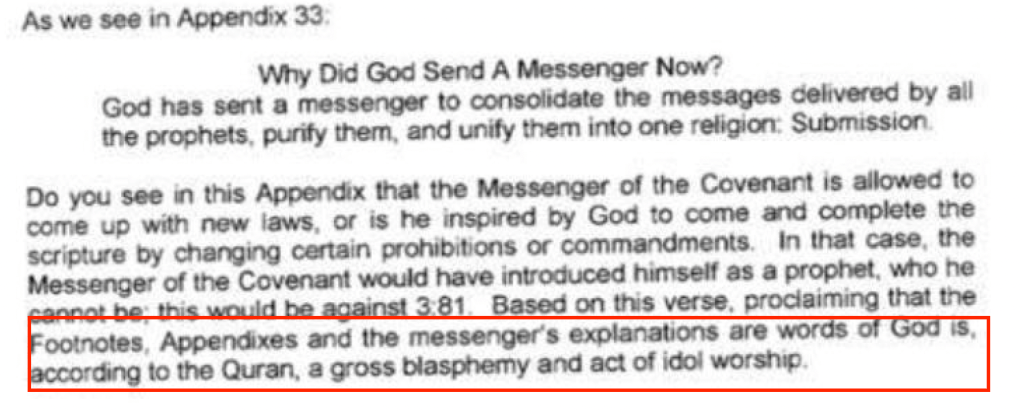
A serious document has circulated making grave accusations against believers who uphold Quranic principles regarding prayer leadership. The document, titled “Weaponizing Salat for Tyranny,” accuses specific individuals of coordinating a scheme to weaponize prayer for control, labeling people as hypocrites to ostracize them, using fear and intimidation, and practicing tyranny rather than religious principle. Most significantly, it claims that the theological position about not praying behind hypocrites has “no Quranic basis.”
This article will demonstrate, through detailed examination of actual theological discussions and Quranic evidence, that these accusations represent a complete inversion of the truth. The real pattern is not tyranny by those advocating Quranic obedience, but rather sophisticated compromise by those who seek to create loopholes around clear divine commands. What is being called “tyranny” is actually total submission to God’s explicit commands, while what is being defended as “compassion” is actually enabling people to violate verses that determine their eternal destiny.
The evidence comes from a Discord theological debate on May 7, 2025, where participants discussed whether to give an admin named Peter an ultimatum regarding his continued attendance at a masjid whose leadership explicitly rejected Rashad Khalifa as God’s messenger. This debate reveals who truly advocates for Quranic principle versus who advocates for theological compromise.
Part 1: The False Accusation of Coordination
Examining the “Scheme” Claim
The accusation suggests that Navid, Syed, and Abdullah coordinated a scheme to weaponize salat for control. However, examination of the actual theological discussion reveals something entirely different: individuals arriving at positions independently based on Quranic evidence, not coordination for control.
In the May 7th discussion, Abdullah’s position emerged from his own theological analysis. He stated: “I’m with whoever is aware how serious of an issue this actually is.”

This is not the language of someone executing a coordinated scheme for power. Rather, it’s the statement of someone who has studied the relevant verses and understood their severity. Abdullah explicitly acknowledged his own past failure: “Anyone else in Peter’s position would have had multiple interventions on this and given the ultimatum long ago. But we turn a blind eye to it and I myself am guilty of this because of how much he strives in RnD.” This admission of personal past oversight contradicts the narrative of a pre-planned scheme.
The theological position emerges from clear Quranic commands, not from coordination. The foundation rests on multiple explicit verses:
[9:107-108] “There are those who abuse the masjid by practicing idol worship, dividing the believers, and providing comfort to those who oppose GOD and His messenger. They solemnly swear: ‘Our intentions are honorable.’ GOD bears witness that they are liars. You shall never pray in such a masjid. A masjid that is established on the basis of righteousness from the first day is more worthy of your praying therein. In it, there are people who love to be purified. GOD loves those who purify themselves.”
[17:71] “The day will come when we summon every people, together with their record. As for those who receive a record of righteous works, they will read it and will not suffer the slightest injustice.”
These verses require no coordination to understand. The word “NEVER” in verse [9:107-108] is unambiguous. The principle in [17:71] that people will be summoned with their record – which includes their imam – is explicit. When a masjid’s leadership sends a letter stating “Rashad got it wrong,” they have explicitly rejected the messenger. According to [4:65], this rejection constitutes failure of the total submission test, making them hypocrites or disbelievers. The theological conclusion follows directly from Quranic evidence, not from coordination.

Part 2: The Weakness of “No Quranic Basis” Claim
Extensive Quranic Foundation
Perhaps the most easily refuted accusation in the document is the claim that the theological position about not praying behind hypocrites has “no Quranic basis.” This claim collapses under the weight of extensive Quranic evidence that explicitly addresses this exact situation.
First, the foundational prohibition:
[9:107-108] “There are those who abuse the masjid by practicing idol worship, dividing the believers, and providing comfort to those who oppose GOD and His messenger… You shall NEVER pray in such a masjid.”
The word “NEVER” is absolute. It does not say “avoid when possible” or “discourage” or “try not to.” It says NEVER. When a masjid’s leadership explicitly rejects God’s messenger – as documented in a letter stating “Rashad got it wrong” – they qualify as those who “oppose GOD and His messenger.” The verse applies directly and unambiguously.
Second, the eternal consequence:
[17:71] “The day will come when we summon every people, together with their record.”
The imam becomes part of your record on the Day of Judgment. This is not symbolic or metaphorical – the Quran states that people will be summoned with their record. If your imam is a hypocrite who rejected the messenger, that becomes part of your eternal record. This is a literal, eternal consequence that cannot be offset by other good deeds or mitigated by “reluctance” in following that imam.
Third, the total submission test:
[4:65] “Never indeed, by your Lord; they are not believers unless they come to you to judge in their disputes, then find no hesitation in their hearts whatsoever in accepting your judgment. They must submit with total submission.”
When the masjid leadership sent a letter saying “Rashad got it wrong,” they failed this test. They did not submit with total submission to the messenger’s judgment. They hesitated, then rejected. According to this verse, they are not believers. The verse provides the test, they failed it, and the theological conclusion follows necessarily.
Fourth, the separation requirement:
[58:22] “You will not find people who believe in GOD and the Last Day befriending those who oppose GOD and His messenger, even if they were their parents, or their children, or their siblings, or their tribe. For these, He decrees faith into their hearts, and supports them with inspiration from Him, and admits them into gardens with flowing streams, wherein they abide forever. GOD is pleased with them, and they are pleased with Him. These are the party of GOD. Most assuredly, GOD’s party are the winners.”
This verse explicitly states that believers will NOT befriend those who oppose God and His messenger – even if they are parents or children. Continued attendance at a masjid where leadership rejected the messenger constitutes befriending those who oppose the messenger, which directly violates this verse.
Fifth, the command for sternness:
[9:73] “O you prophet, strive against the disbelievers and the hypocrites, and be stern with them. Their destiny is Hell; what a miserable abode!”
God does not command us to be “gentle” or merely “encouraging” with hypocrites. He commands STERNNESS. An ultimatum is precisely the kind of sternness this verse requires. Those who frame ultimatums as “too harsh” or “forceful” are actually uncomfortable with God’s explicit command.
Sixth, the reinforcement of harshness:
[66:9] “O you prophet, struggle against the disbelievers and the hypocrites, and be harsh with them. Their ultimate destiny is Hell; what a miserable abode!”
The command is repeated: be HARSH with hypocrites. Not soft, not merely encouraging, but harsh. The document accuses believers of using “fear and intimidation,” but what they call fear and intimidation is actually obedience to God’s explicit command to be harsh with those who reject the messenger.
The accusation of “no Quranic basis” is demonstrably false. The position rests on at least six explicit verses ([9:107-108], [17:71], [4:65], [58:22], [9:73], [66:9]), each of which independently supports the theological conclusion. The accuser cannot cite ANY verse that prohibits this theological approach or that softens these clear commands. The verses speak for themselves.

Part 3: The 18 Tyranny Markers – An Inversion
Who Is Actually Distorting Scripture?
The accusations document reportedly lists 18 tyranny markers, supposedly identifying tyrannical behavior. However, examination of the actual theological debate reveals that these markers more accurately describe the compromise position than the position of Quranic obedience. The accusations are backwards – they describe the opposite party than accused.
Consider marker #16, “Distorting the Quran.” Who is actually distorting scripture in the May 7th debate? The answer becomes clear when examining what Triple A (identified as the primary compromiser) proposed in his hypothetical scenario at 8:21 PM:
“I don’t believe I am condemned for participating in my masjid. I don’t believe they’re all hypocrites. I am striving for God in more meaningful ways. I am not going to increase my level of involvement in my masjid because I don’t feel it is necessary, and nothing says I cannot reluctantly pray behind someone I perceive to be a hypocrite.”

This hypothetical contains multiple distortions of Quranic verses:
The claim “nothing says I cannot reluctantly pray behind someone I perceive to be a hypocrite” directly contradicts [9:107-108], which explicitly says “You shall NEVER pray in such a masjid.” The word is NEVER – not “reluctantly acceptable” or “with proper mindset” or “if you don’t increase involvement.” This is textbook distortion: taking a clear prohibition and creating a loophole by adding qualifiers that don’t exist in the verse.
The statement “I don’t believe they’re all hypocrites” creates a threshold requirement not found in [9:107-108]. The verse addresses masjids “established” by hypocrites or those who “oppose GOD and His messenger.” It doesn’t require 100% hypocrite attendance. The leadership sent the letter rejecting the messenger – that’s sufficient for the verse to apply. Creating a percentage threshold is distorting the verse’s actual criterion.
The claim “I am striving for God in more meaningful ways” attempts to offset one Quranic violation with other good deeds. But [9:107-108] doesn’t have an exception clause for “unless you’re striving in other areas.” This is like saying “I give charity so I don’t need to pray.” The distortion here is treating Quranic commands as negotiable based on one’s overall spiritual portfolio.
Meanwhile, Abdullah’s position represents the verses exactly as written: “You shall NEVER pray in such a masjid” means never. No distortion, no loopholes, no creative reinterpretation. He applies the verse as it stands. The accusation of Quranic distortion applies to the compromise position, not to those advocating straightforward obedience.
Who Makes Oaths Optional?
Marker #17 allegedly addresses “Oaths Made Optional.” Again, the Discord debate reveals this describes the compromise position, not the position of Quranic obedience.
[9:107-108] includes this statement about hypocrites: “They solemnly swear: ‘Our intentions are honorable.’ GOD bears witness that they are liars.” This verse warns about those who make solemn oaths while violating God’s commands. Those who continue to pray behind hypocrites while claiming “good intentions” or “reluctance” are doing exactly what this verse condemns – making oaths about honorable intentions while violating the command to NEVER pray there.
Triple A’s hypothetical explicitly does this: “I don’t believe I am condemned” while doing exactly what [9:107-108] prohibits. This is making the oath (belief in non-condemnation) optional or irrelevant – the person continues the violation while claiming good intentions, exactly as the verse describes hypocrites doing.
Abdullah, by contrast, doesn’t try to maintain good intentions while violating clear commands. He advocates stopping the violation entirely. His position aligns with taking oaths seriously: if the Quran says NEVER, then never means never, regardless of our intentions or reluctance. The marker describes the compromisers, not those advocating obedience.
Who Weaponizes Takfir?
Marker #13 supposedly addresses “Weaponizing Takfir” (declaring people non-believers). The irony is profound: the accusation itself weaponizes the hypocrisy label more than those it accuses.
In the theological debate, Abdullah doesn’t arbitrarily label people as hypocrites. He applies the [4:65] test: “They are not believers unless they come to you to judge in their disputes, then find no hesitation in their hearts whatsoever in accepting your judgment. They must submit with total submission.” When the masjid leadership sent a letter saying “Rashad got it wrong,” they explicitly rejected the messenger’s judgment. According to [4:65], they failed the total submission test. The determination of hypocrisy is based on Quranic criteria, not arbitrary labeling.
By contrast, the accusations document itself uses hypocrisy labels as a weapon – calling those who advocate Quranic obedience “tyrants” who “weaponize” faith. This is actual weaponization: using inflammatory language (tyranny, weaponizing, fear, intimidation) to discredit a Quranic position without engaging the scriptural evidence.
The document makes it impossible to ever apply [4:65] or identify hypocrites, because any attempt to do so gets labeled as “weaponizing takfir.” This effectively nullifies multiple Quranic verses that distinguish between believers and hypocrites based on their submission to the messenger. The true weaponization is making it impossible to apply Quranic tests by accusing anyone who does so of tyranny.

Part 4: The Total Submission Test [4:65]
Who Passes and Who Fails?
The verse [4:65] provides a clear test for identifying true believers versus those who merely claim faith:
[4:65] “Never indeed, by your Lord; they are not believers unless they come to you to judge in their disputes, then find no hesitation in their hearts whatsoever in accepting your judgment. They must submit with total submission.”
This verse establishes three criteria: (1) coming to the messenger to judge, (2) finding NO hesitation in accepting the judgment, and (3) submitting with TOTAL submission. The May 7th theological debate reveals who meets these criteria and who fails them.
Abdullah demonstrates total submission. When confronted with the clear command of [9:107-108] – “You shall NEVER pray in such a masjid” – he advocates immediate obedience without hesitation. He doesn’t seek loopholes, doesn’t create qualifiers, doesn’t soften the command’s urgency. His statement “I’m with whoever is aware how serious of an issue this actually is” shows he finds no discomfort in the stern judgment. He recognizes his past failure (“I myself am guilty of this”) and corrects course – this is total submission in action.
By contrast, Triple A demonstrates multiple forms of hesitation and partial submission. His framing of the ultimatum as a “forceful move” and use of the word “guillotine” reveals discomfort with the stern judgment required by [9:73]. His preference for “just encouragement” rather than an ultimatum shows hesitation to fully apply God’s command to “be stern” and “be harsh” with hypocrites. His hypothetical scenario creates multiple theological loopholes, each representing an attempt to not submit totally to clear commands.
Most revealing is Triple A’s statement: “There’s no blame on either side.” This directly contradicts [4:65]’s binary framework. The verse says they either submit with total submission or they’re not believers – there’s no “both sides have valid points” middle ground. One side advocates compliance with [9:107-108]’s prohibition, the other advocates allowing continued violation under various justifications. According to [4:65], these are not equivalent positions.

The Equalizer also fails the total submission test by advocating that Peter “strive in his community” while continuing to attend the hypocrite masjid “until they either kick him out, or they come around, or hypocrites drop out, or until he’s had enough.” This creates multiple exit conditions, none of which are in [9:107-108]. The verse says NEVER pray there – not “pray there until various conditions are met.” This is not total submission; it’s partial submission conditioned on circumstances the Quran doesn’t condition it on.

Sajad’s position that “it’s way too early to consider this” also reveals hesitation. The [9:107-108] prohibition is immediate – NEVER means from the first moment the leadership rejects the messenger, not after “exhausting other options.” Delaying obedience to an absolute command is a form of hesitation, which [4:65] explicitly disqualifies.

The document accuses Abdullah and others of tyranny, but [4:65] calls what they demonstrate “total submission.” The verse describes those who hesitate or partially submit as “not believers.” The accusations invert the Quranic framework: calling total submission “tyranny” and calling hesitation “compassion.”
[33:1] “O you prophet, you shall reverence GOD and do not obey the disbelievers and the hypocrites. GOD is Omniscient, Most Wise.”
This verse explicitly commands: do not obey the hypocrites. An admin who continues to pray behind hypocrites signals that obeying them is acceptable. Abdullah’s advocacy for an ultimatum is actually obedience to [33:1] – ensuring the community doesn’t obey hypocrites by having leadership that attends their masjid. The compromise position violates [33:1] by allowing continued obedience (through prayer attendance) to those who rejected the messenger.

Part 5: The Real Pattern – Loophole Creation vs Principle
Documenting Sophisticated Compromise
The accusations document claims to identify a pattern of tyranny, but examination of the May 7th theological debate reveals the actual pattern: systematic creation of theological loopholes by those opposing firm Quranic positions. This pattern is far more dangerous than direct rejection of scripture because it appears reasonable and balanced while actually nullifying clear divine commands.
Triple A’s hypothetical at 8:21 PM reveals the loophole creation pattern in detail. Each component of his scenario contradicts specific Quranic verses while appearing to maintain spiritual credibility:
Loophole #1: “I don’t believe I am condemned for participating in my masjid.”
Quranic Response: [9:107-108] says “You shall NEVER pray in such a masjid.” Belief doesn’t override command. This loophole places personal conviction above revealed scripture – the foundational error of all theological compromise.
Loophole #2: “I don’t believe they’re all hypocrites.”
Quranic Response: [9:107-108] addresses masjids “established” by hypocrites or those who “oppose GOD and His messenger.” The leadership sent the letter – that’s sufficient. This loophole creates a threshold requirement (percentage of hypocrites) not found in the verse, allowing continued attendance by claiming insufficient hypocrite density.
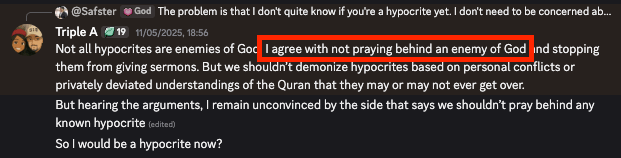
Loophole #3: “I am striving for God in more meaningful ways.”
Quranic Response: This attempts to offset one violation with other good deeds. But submission requires obedience to ALL commands, not selective obedience based on personal assessment of “meaningfulness.” This loophole would allow any violation to be justified by sufficient striving in other areas.
Loophole #4: “I am not going to increase my level of involvement.”
Quranic Response: [9:107-108] doesn’t say “don’t increase involvement” – it says “NEVER pray there.” This loophole creates a non-existent middle ground between full involvement and zero attendance, allowing continued violation at “current levels.”
Loophole #5: “Nothing says I cannot reluctantly pray behind someone I perceive to be a hypocrite.”
Quranic Response: [9:107-108] explicitly says you cannot. The word is NEVER. This is the most brazen loophole – directly claiming the Quran is silent when it’s absolutely clear. Adding “reluctantly” as a qualifier doesn’t change NEVER to SOMETIMES.
Each loophole is sophisticated. They don’t directly deny [9:107-108]; instead, they create qualifiers, thresholds, offsets, and gradations that the verse doesn’t contain. This is more dangerous than simple rejection because it appears to engage with scripture while actually nullifying it.
The Equalizer’s position follows the same pattern: “I believe he should strive in his community… until they either kick him out, or they come around, or hypocrites drop out, or until he’s had enough.” This creates four separate loopholes, each providing a justification for continued violation of [9:107-108]. The verse’s absolute prohibition becomes conditional on leadership response, hypocrite attrition, or personal threshold – none of which appear in the verse.
Triple A’s framing that an ultimatum would be a “forceful move” and his concern about “holding the guillotine” represents another form of loophole: making obedience to [9:73]’s command to “be stern” seem excessive. This allows the command itself to be softened by framing full obedience as extremism.

His statement “There’s no blame on either side” creates perhaps the most comprehensive loophole: moral equivalency. If both positions are equally valid, then the person can choose the easier path without accountability. This loophole nullifies the concept of right and wrong in Quranic interpretation – everything becomes perspective.
By contrast, Abdullah’s position creates no loopholes. [9:107-108] says NEVER – he advocates never. [17:71] says the imam becomes your record – he treats this as the literal eternal consequence it is. [9:73] commands sternness – he advocates an ultimatum. [58:22] requires separation from those who oppose the messenger – he prepares for worst-case scenario where Peter refuses and relationship is affected. No qualifiers, no conditions, no offsets, no gradations. Just straightforward obedience.
The accusations document calls Abdullah’s position “tyranny,” but it’s actually the opposite of tyranny – it’s submission to God’s authority rather than human wisdom. The loophole creation is the real threat because it appears balanced and reasonable while actually establishing human judgment above divine command. Each loophole answered “yes” to the question: “Do I know better than God how to handle this situation?”
[6:116] “If you obey the majority of people on earth, they will divert you from the path of GOD. They follow only conjecture; they only guess.”
Triple A’s use of polling to determine the approach (“can you two vote on this”) falls into exactly this trap. The majority voted for the softer approach (7 out of 8), but [6:116] warns that majorities often lead astray. Truth isn’t determined by popularity – it’s determined by Quranic evidence. The loophole here is democratic: subordinating divine command to group consensus.

Part 6: Abdullah’s Character vs The Accusations
Humility and Course Correction
The accusations document paints those advocating Quranic firmness as power-hungry tyrants orchestrating schemes. Yet Abdullah’s actual statements in the May 7th debate reveal something entirely different: humility, self-awareness, and willingness to acknowledge past failure.
“Anyone else in Peter’s position would have had multiple interventions on this and given the ultimatum long ago. But we turn a blind eye to it and I myself am guilty of this because of how much he strives in RnD.”
This is not the language of tyranny. Tyrants don’t acknowledge their own guilt. They don’t admit to turning a blind eye. They don’t confess to applying double standards. Abdullah explicitly recognizes that Peter received special treatment due to his contributions – and identifies this as wrong. According to [5:8], “You shall be absolutely equitable, and do not be swayed by your personal feelings” – Abdullah’s admission shows him correcting toward equitableness, not away from it.
His willingness to acknowledge past oversight demonstrates the opposite of the coordination accusation. If he had been executing a pre-planned scheme, he wouldn’t frame it as something he should have addressed “long ago” but failed to. The admission of failure shows independent theological growth, not coordinated tyranny.
Integrity Through Course Correction
Abdullah’s position evolved from overlooking the issue to addressing it directly. This trajectory reveals integrity, not tyranny. He could have maintained the status quo – Peter is an admin, contributes significantly, and taking a firm position would create social difficulty. The easier path was continued blind eye. Instead, Abdullah corrected course toward Quranic compliance despite the social cost.
[5:8] “O you who believe, you shall be absolutely equitable, and observe GOD, when you serve as witnesses. Do not be provoked by your conflicts with some people into committing injustice. You shall be absolutely equitable, for it is more righteous. You shall observe GOD. GOD is fully Cognizant of everything you do.”
This verse commands equitable treatment regardless of personal feelings or relationships. Abdullah’s acknowledgment that they gave Peter special treatment, and his advocacy for addressing it now, aligns with this verse. Tyranny would be maintaining the double standard to preserve power relationships. Integrity is correcting toward equitable standards even when difficult.
Firmness on Principle is Submission, Not Tyranny
Abdullah’s statement “I’m with whoever is aware how serious of an issue this actually is” gets accused of being harsh or tyrannical. But examine what he’s actually saying: he prioritizes theological clarity about severity over popularity or group harmony. This is precisely what [4:65] requires – total submission without hesitation based on social considerations.
His preparation for worst-case scenario reveals the same principle-over-relationship priority: “We need to prepare for the worst case scenario. He may turn heavily despondent. Not want to take heed or reflect. What then?” This shows he’s willing to maintain the Quranic position even if Peter refuses and the relationship suffers. This aligns perfectly with [58:22]:
[58:22] “You will not find people who believe in GOD and the Last Day befriending those who oppose GOD and His messenger, even if they were their parents, or their children, or their siblings, or their tribe.”
The verse explicitly says believers won’t befriend those who oppose the messenger “even if they were their parents, or their children.” Abdullah’s willingness to face the possibility that Peter might refuse and relationships might be affected is not tyranny – it’s literal obedience to [58:22]. The verse requires prioritizing separation from those who oppose the messenger over even family relationships. Abdullah demonstrates exactly what the verse describes.
What the accusations call “tyranny” is actually what God calls faith: “For these, He decrees faith into their hearts, and supports them with inspiration from Him” ([58:22] continues). Those who maintain this separation despite relationship costs receive faith decreed into their hearts. The accusation inverts the Quranic framework.
Balanced Approach: Encouragement Plus Ultimatum
Abdullah’s final position further demonstrates that this isn’t about punishment or control: “I’ve commented my third option. (Encouragement + ultimatum).” He doesn’t advocate ultimatum alone – he combines it with encouragement. This shows the intervention is about Peter’s salvation, not about power.
The combination makes theological sense:
The encouragement component aligns with [16:125]: “You shall invite to the path of your Lord with wisdom and kind enlightenment.” The goal is to help Peter understand the eternal stakes.
The ultimatum component aligns with [9:73]: “O you prophet, strive against the disbelievers and the hypocrites, and be stern with them.” Sternness is commanded, not optional.
Together, they represent balanced Quranic obedience: wisdom in delivery, firmness in requirement. This is not tyranny. Tyranny would be punishment without concern for salvation, or maintaining power through fear. Abdullah’s position aims at Peter’s eternal destiny – helping him understand [17:71]’s principle that the imam becomes his record, and ensuring he doesn’t continue accumulating a hypocrite record.
The accusations document frames sternness as tyranny, but [9:73] and [66:9] explicitly command it. Calling obedience to these verses “tyranny” is actually calling God’s commands tyrannical. The real question becomes: whose standard determines what’s tyrannical – human comfort or divine command?

Part 7: Why This Matters – Eternal Destiny vs Temporary Discomfort
The Stakes Could Not Be Higher
The accusations document frames the issue as one of power and control – who gets to label whom, who gets to exclude whom, who gets to make people uncomfortable. This framing completely misses the actual stakes revealed by [17:71]:
[17:71] “The day will come when we summon every people, together with their record. As for those who receive a record of righteous works, they will read it and will not suffer the slightest injustice.”
Your imam becomes part of your record on the Day of Judgment. This is not symbolic, not metaphorical, not a spiritual principle that can be offset by other good deeds. The Quran states that people will be summoned with their record, and every prayer you perform behind an imam adds to that record. If your imam is a hypocrite who explicitly rejected God’s messenger, that hypocrite’s record becomes intertwined with yours for eternity.
Every single day that Peter continues to pray behind the masjid leadership who rejected Rashad Khalifa is another day that their record becomes his record. Every Friday sermon he attends from those who failed the [4:65] total submission test is another entry in his eternal record. This isn’t about social ostracism or community politics – it’s about ETERNAL DESTINY.
The accusations document treats the ultimatum as harsh, but consider the alternative: allowing Peter to continue accumulating a hypocrite record out of concern for his temporary comfort or to avoid social awkwardness. Which is actually more compassionate – the temporary discomfort of a stern intervention, or allowing someone to proceed toward eternal consequence while we remain silent?
[4:138] “Inform the hypocrites that they have incurred painful retribution.”
God doesn’t command us to withhold information about consequences out of concern for people’s feelings. He commands us to INFORM them. The verse doesn’t say “gently suggest if they seem receptive” or “encourage without pressure.” It says inform them of painful retribution. Triple A’s preference for “just encouragement” without ultimatum directly contradicts this command. Real mercy, when eternal destiny is at stake, requires informing people of consequences even if it’s uncomfortable.
False Compassion vs Real Mercy
The compromise position presents itself as more compassionate than the firm position. Triple A frames the ultimatum as a “forceful move” and expresses concern about “hurting Peter.” The Equalizer says “I’m not trying to hurt Peter with an ultimatum.” Sajad worries it will “make him more resistant.” All of this sounds compassionate on the surface.
But examine what this “compassion” actually accomplishes: it allows Peter to continue in violation of [9:107-108] while his imam becomes his record per [17:71]. It prioritizes his temporary comfort over his eternal destiny. It values his current receptivity over his Day of Judgment outcome. This is not mercy – it’s enabling.
Consider a medical analogy: if a doctor discovers a patient has a life-threatening condition, would compassion be withholding the diagnosis to avoid upsetting the patient? Would it be suggesting lifestyle changes without informing them of the fatal consequence if they don’t change? Real medical compassion requires delivering difficult news directly and urgently, because the patient’s life depends on their response.
[17:71] makes the stakes higher than physical life – it’s eternal record. Yet the “compassionate” position advocates less urgency than doctors show for physical health. The proportionality is inverted: infinite stakes receive soft encouragement, while finite stakes receive stern ultimatums.
Abdullah’s position, which the accusations call tyrannical, actually demonstrates real mercy: urgent intervention appropriate to eternal stakes, willingness to risk temporary relationship damage to protect eternal destiny, sternness commanded by [9:73] because Peter’s record on Day of Judgment matters infinitely more than his current comfort.
The Tyranny of Enablement
True tyranny, in this context, would be using power to prevent someone from knowing the truth or making an informed choice. Examine which position does this:
Abdullah’s position: Inform Peter of exactly what [9:107-108] says (NEVER pray there), what [17:71] says (imam becomes your record), what [4:65] says (total submission test), and what [58:22] says (cannot befriend those who oppose messenger). Then give him a clear choice: either stop attending that masjid and keep admin position, or continue attending and step down from admin. Full information, clear choice, real consequences.
Compromise position: Soft encouragement without urgency, allowing continued violation while “trying to fix it,” no clear consequence, treating the choice as open-ended process rather than urgent decision. This obscures the stakes, delays clarity, and allows drift toward eternal consequence.
Which is more tyrannical: giving someone full information and clear choice, or obscuring urgency and allowing them to drift toward eternal harm? The accusations have it backwards.
[2:256] “There shall be no compulsion in religion: the right way is now distinct from the wrong way. Anyone who denounces the devil and believes in GOD has grasped the strongest bond; one that never breaks. GOD is Hearer, Omniscient.”
Abdullah’s position perfectly aligns with this verse. There is no compulsion – Peter has a choice. But the right way must be made distinct from the wrong way. [9:107-108] says NEVER pray behind hypocrites – that’s the right way. Continuing to pray there is the wrong way. Making this distinction clear, with real consequences, allows Peter to grasp the strongest bond. The compromise position blurs the distinction, making it harder to grasp.
The verse continues: “one that never breaks.” [17:71] is about eternal record – the imam relationship creates a bond that extends into eternity. Abdullah’s urgency about severing the bond with hypocrite leadership aligns with protecting the bond with God that never breaks. The compromise allows a breakable human bond (Peter’s attendance at that masjid) to threaten the unbreakable bond with God.

Part 8: The Quran Requires Sternness
When God Commands Harshness
Perhaps the most significant inversion in the accusations document is framing sternness as tyranny when God explicitly commands it. The discomfort people feel with Abdullah’s firm position isn’t evidence of his error – it’s evidence of their discomfort with God’s explicit commands.
[9:73] “O you prophet, strive against the disbelievers and the hypocrites, and be stern with them. Their destiny is Hell; what a miserable abode!”
The command is unambiguous: BE STERN. Not “be gentle if they seem receptive.” Not “encourage softly.” Not “avoid making them uncomfortable.” The verse commands STERNNESS specifically regarding hypocrites. An ultimatum is precisely the kind of sternness this verse requires.
The verse is repeated in even stronger language:
[66:9] “O you prophet, struggle against the disbelievers and the hypocrites, and be harsh with them. Their ultimate destiny is Hell; what a miserable abode!”
The escalation from “stern” to “HARSH” is significant. God doesn’t soften the command in the second instance – He intensifies it. Both verses connect the command to the same eternal consequence: Hell. The harshness is proportional to the stakes.
Triple A’s language reveals discomfort with these commands. He calls the ultimatum a “forceful move” and uses the metaphor of “holding the guillotine.” He asks how many people are “not simply being swept up by the crowd.” This framing makes obedience to [9:73] and [66:9] seem like mob violence rather than divine command.
But examine the Quranic perspective: God commands harshness with hypocrites because their destiny is Hell. The sternness is mercy – it’s the approach most likely to produce the shock necessary for course correction. Soft encouragement allows drift toward Hell. Harsh intervention might provoke the recognition necessary for change. Which is more merciful when someone is heading toward Hell – soft encouragement or harsh warning?
Distinguishing Between Divine Sternness and Human Tyranny
The accusations document conflates two entirely different things: tyranny (using power for selfish control) and sternness (following God’s command for someone’s salvation). The distinction is crucial:
Tyranny asks: How can I maintain my power?
Divine sternness asks: How can I obey God’s command and protect someone’s eternal destiny?
Tyranny operates from self-interest.
Divine sternness operates from [4:138]’s command to inform hypocrites of painful retribution.
Tyranny fears losing control.
Divine sternness, as Abdullah demonstrates, prepares for worst-case scenario where the person refuses and relationship is affected.
Tyranny needs the person to comply to maintain power.
Divine sternness, per [58:22], is willing to separate from the person if they persist in opposing the messenger.
Tyranny is about the tyrant.
Divine sternness is about the person being warned and their eternal destiny.
Abdullah’s position demonstrates divine sternness, not tyranny. He gains nothing personally from Peter stepping down as admin – in fact, it creates more difficulty and potential conflict. His motivation is [17:71]: preventing Peter from accumulating a hypocrite record. The accusations document cannot distinguish between selfishly motivated harshness and God-commanded sternness, so it labels all firmness as tyranny.
The Discomfort is the Point
[4:65] “Never indeed, by your Lord; they are not believers unless they come to you to judge in their disputes, then find no hesitation in their hearts whatsoever in accepting your judgment. They must submit with total submission.”
This verse specifies: “find NO hesitation in their hearts whatsoever.” The test of belief includes absence of hesitation when accepting the messenger’s judgment. Discomfort with stern commands is itself a warning sign – it indicates hesitation, which [4:65] says disqualifies belief.
Triple A’s discomfort with the “forceful” ultimatum, The Equalizer’s preference for gentler encouragement, Sajad’s concern about making Peter “resistant” – all of this is hesitation. They feel discomfort with the harsh approach commanded by [9:73] and [66:9]. According to [4:65], this discomfort is evidence of incomplete submission.
By contrast, Abdullah shows no discomfort with the stern position. He advocates it clearly, prepares for its consequences, and aligns with those who understand severity. This is what [4:65] describes: no hesitation, total submission. The absence of discomfort with God’s harsh commands is itself evidence of faith.
The accusations document identifies this absence of hesitation as tyranny, but [4:65] identifies it as belief. The inversion is complete: what God calls the mark of believers, the accusations call the mark of tyrants.

Part 9: Equitable Standards vs Double Standards
Abdullah Identifies the Problem
One of Abdullah’s most important contributions to the debate exposes a double standard that the accusations document ignores entirely:
“Anyone else in Peter’s position would have had multiple interventions on this and given the ultimatum long ago. But we turn a blind eye to it and I myself am guilty of this because of how much he strives in RnD.”
This acknowledgment reveals that Peter received special treatment. If a different community member – someone who didn’t contribute as much to research and development – prayed at a masjid where leadership explicitly rejected the messenger, they would have faced interventions and ultimatum immediately. But because Peter contributes significantly, the community (including Abdullah himself, as he admits) turned a blind eye.
[5:8] “O you who believe, you shall be absolutely equitable, and observe GOD, when you serve as witnesses. Do not be provoked by your conflicts with some people into committing injustice. You shall be absolutely equitable, for it is more righteous. You shall observe GOD. GOD is fully Cognizant of everything you do.”
The verse commands absolute equitableness regardless of personal feelings or relationships. The double standard Abdullah identifies – stricter standards for regular members, looser standards for high contributors – violates this verse. His advocacy for addressing Peter’s situation now, despite the social difficulty, is actually correction toward equitableness.
The accusations document frames this correction as tyranny, but [5:8] frames it as righteousness. The verse specifies: “Do not be provoked by your conflicts with some people into committing injustice.” Maintaining different standards for different people based on their contributions or relationships is injustice. Abdullah’s position corrects this injustice.
The Admin Position Question
Safster made an important point that reveals the double standard more clearly: would the community accept a NEW admin candidate who openly prays at a masjid where leadership rejected the messenger? The answer is obviously no. If someone applied for admin position and mentioned their current masjid’s leadership sent a letter saying “Rashad got it wrong,” they would be immediately disqualified.
Yet Peter currently holds an admin position while doing exactly this. The only difference is timing – he had the position before this was addressed. But [5:8] doesn’t allow different standards based on when someone acquired their position. Equitableness requires the same standard for all: if a new candidate would be disqualified for this, an existing admin should face the same consequence.
[33:1] “O you prophet, you shall reverence GOD and do not obey the disbelievers and the hypocrites. GOD is Omniscient, Most Wise.”
The verse explicitly commands: do not obey hypocrites. Prayer behind an imam is a form of obedience – you follow their leadership in the fundamental act of worship. An admin who does this sends the message that obeying hypocrites is acceptable, which directly violates [33:1]. The admin position isn’t “merely symbolic” – it’s leadership that sets community standards.
Tyranny of Special Standards
If tyranny means using power to create unjust systems, the real tyranny here would be maintaining special standards for high-status members. Triple A’s concern about the “forceful” ultimatum and his “no blame on either side” framing could enable this actual tyranny: protecting a powerful contributor from consequences that regular members would face.
Abdullah’s position – that Peter should face the same ultimatum anyone else would face – is anti-tyranny. It’s the application of equitable standards regardless of position or contribution. [5:8] calls this righteousness, not tyranny.
The accusations document has it backwards: maintaining special standards for the powerful is tyranny, applying equitable standards is righteousness. Allowing high contributors to violate [9:107-108] without consequence while regular members would face immediate intervention is the definition of unjust double standards.

Part 10: The Majority Can Lead Astray
When Seven Out of Eight Choose Wrong
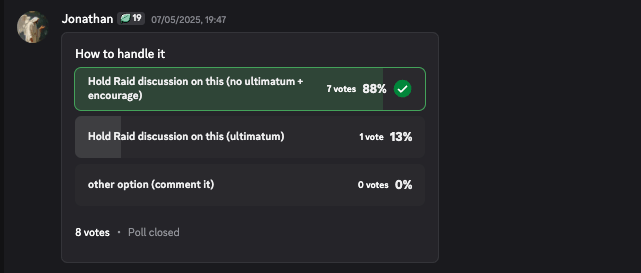
The May 7th debate included a poll where participants voted on the approach. The results: 7 out of 8 voted for “Hold Raid discussion on this (no ultimatum + encourage).” Only one vote (presumably Abdullah’s) supported the firm position with ultimatum. The compromise position won by overwhelming majority.
Triple A cited this poll as if it validated the softer approach. But the Quran explicitly warns against this reasoning:
[6:116] “If you obey the majority of people on earth, they will divert you from the path of GOD. They follow only conjecture; they only guess.”
The verse couldn’t be clearer: obeying the majority leads away from God’s path. Majority opinion is based on conjecture and guessing, not on revealed truth. The poll showed 87.5% favoring the compromise position, but [6:116] warns that this is precisely when you should be most cautious – the majority is most dangerous when their consensus is strongest.
Abdullah stood alone (or nearly alone) advocating for the position grounded in [9:107-108], [17:71], [4:65], and [58:22]. The overwhelming majority preferred soft encouragement without ultimatum. Which position aligns with [6:116]’s warning?
The accusations document treats the firm position as tyranny of a minority imposing on the majority. But [6:116] inverts this: the majority imposes their conjecture on the path of God. The real tyranny would be subordinating clear Quranic commands to majority preference.
Democratic Process for Divine Commands?
Triple A’s use of polling reveals a deeper problem: treating Quranic absolutes as subject to democratic process. He asks people to vote on whether to give ultimatum or just encourage, as if [9:73]’s command to “be stern” is optional pending group consensus.
But examine what’s actually being voted on: Should we obey [9:73]’s command for sternness with hypocrites? Should we treat [9:107-108]’s “NEVER” as absolute or negotiable? Should we prioritize [17:71]’s eternal consequence or current comfort? These aren’t matters for voting – they’re matters for reading what God said and obeying.
The Quran doesn’t say “be stern with hypocrites if the majority agrees” or “NEVER pray in hypocrite masjid unless polling suggests gentler approach.” The commands are absolute. Voting on whether to obey them is itself a form of rebellion – it places human consensus above divine command.
Abdullah’s willingness to hold the minority position shows he understands [6:116]. He doesn’t need majority approval to obey clear verses. The accusations frame this as tyranny – minority forcing their view on majority. But [6:116] frames it as righteousness – refusing to follow majority into error.
Popularity of Compromise
Why did the compromise position win 7-1? The answer reveals why compromise is more dangerous than outright rejection:
Compromise sounds balanced. Triple A’s “no blame on either side” appeals to fairness instinct. The Equalizer’s “strive in the community” sounds proactive and hopeful. Sajad’s “too early” seems cautious and measured. These positions feel reasonable, moderate, balanced.
By contrast, absolute positions sound extreme. “NEVER pray there” seems harsh. Ultimatum seems forceful. Sternness seems unloving. The firm position triggers discomfort.
But [4:65] explicitly requires finding “NO hesitation” and submitting with “TOTAL submission.” The verse doesn’t say “find the balanced middle ground” or “submit moderately.” The discomfort people feel with absolute positions is itself the test – can you submit totally even when it feels extreme?
The compromise position won the poll because it requires less submission. It allows continued violation with good intentions. It avoids the discomfort of harsh measures. It maintains relationships. It feels more compassionate. All of these are human preferences, which is exactly why [6:116] warns against majority opinion.
The firm position requires total submission to uncomfortable commands. It risks relationships per [58:22]. It demands sternness that feels harsh. It prioritizes eternal destiny over current comfort. These align with Quranic commands, which is exactly why it lost the poll.
The accusations document treats the unpopularity of the firm position as evidence against it. But [6:116] treats unpopularity as expected – truth often is the minority position because human preference tends toward compromise that feels balanced rather than obedience that feels absolute.




Part 11: Who Actually Creates Division?
The Accusation of Ostracism
The accusations document claims that those advocating firm positions are using hypocrisy labels to ostracize people and divide the community. This frames the firm position as divisive and the compromise position as unifying. But examination of the actual theological basis reveals the opposite: compromise creates division from God’s commands, while firm positions maintain unity with Quranic principles.
[9:107] “There are those who abuse the masjid by practicing idol worship, dividing the believers, and providing comfort to those who oppose GOD and His messenger.”
The verse itself identifies who causes division: those who oppose God and His messenger. The masjid leadership who sent a letter saying “Rashad got it wrong” are the dividers – they divided from the messenger’s teachings. Abdullah’s position maintains unity with the messenger by refusing to pray behind those who rejected him. The compromise position creates division by trying to maintain unity with both God’s messenger and those who rejected him – an impossible position.
Jesus made this principle clear in a statement preserved in the Gospel: “No one can serve two masters. Either you will hate the one and love the other, or you will be devoted to the one and despise the other.” You cannot simultaneously maintain loyalty to the messenger and loyalty to those who explicitly rejected him. Attempting to do so creates the actual division – divided loyalty, divided obedience, divided submission.
Unifying Around What?
The compromise position values unity, but unity around what? Triple A’s “no blame on either side” creates unity around moral relativism – both positions are valid, choose what feels right. This is unity without truth, which [9:107] itself condemns as the work of hypocrites who divide believers.
By contrast, Abdullah’s position seeks unity around Quranic commands: [9:107-108]’s prohibition, [17:71]’s principle, [4:65]’s test, [58:22]’s requirement. This is unity around revelation, which is the only unity that matters eternally.
[9:107] warns against those who “divide the believers” – but division from what? From God’s commands. The compromise position divides believers from absolute obedience to [9:107-108] by creating loopholes. The firm position maintains unity with the command by refusing to create exceptions.
The Real Ostracism
[58:22] “You will not find people who believe in GOD and the Last Day befriending those who oppose GOD and His messenger, even if they were their parents, or their children, or their siblings, or their tribe.”
The accusations document treats separation from those who oppose the messenger as unjust ostracism. But [58:22] explicitly requires it – believers will NOT befriend those who oppose the messenger, even if they’re family. This verse establishes that the separation isn’t arbitrary exclusion; it’s obedience to divine command.
The verse continues: “For these, He decrees faith into their hearts.” God decrees faith into the hearts of those who maintain this separation despite relationship costs. What the accusations call “ostracism,” God calls evidence of faith.
The real ostracism would be excluding people based on arbitrary human preferences – race, status, wealth, personality. But excluding those who explicitly rejected God’s messenger from community leadership isn’t ostracism – it’s applying [58:22]’s requirement and [33:1]’s prohibition against obeying hypocrites.
Consider the distinction: If Peter prayed behind traditional Sunnis who never knew the truth, that’s one category. If he prayed behind people who knew Rashad was messenger and remained neutral, that’s another category. But he prays behind leadership who KNEW the messenger’s claim and sent a letter explicitly rejecting it – “Rashad got it wrong.” This is the category [4:65] addresses: those who knew the judgment and refused to submit totally. They failed the test. [58:22] requires separation from them.
The accusations invert cause and effect: they blame those who maintain [58:22] separation for the division, when the actual division was caused by the masjid leadership’s explicit rejection of the messenger. Abdullah’s position didn’t create the division – it recognizes the division that already occurred when they sent that letter.

Part 12: The Pattern of Nebulous Compromise
Sophistication as Camouflage
The May 7th debate reveals that the most dangerous form of compromise isn’t crude or obvious. Triple A doesn’t directly say “disobey [9:107-108].” The Equalizer doesn’t explicitly reject [17:71]. Sajad doesn’t openly contradict [9:73]. Instead, they use sophisticated language that sounds reasonable while creating space for continued violation.
Triple A’s hypothetical is a masterclass in this approach: “I don’t believe I am condemned… I don’t believe they’re all hypocrites… I am striving for God in more meaningful ways… I am not going to increase my level of involvement… nothing says I cannot reluctantly pray behind someone I perceive to be a hypocrite.”
Every component sounds like reasonable religious thinking – personal conviction, discernment about others, prioritizing meaningful service, maintaining boundaries, scriptural interpretation. But examine each component against actual verses:
“I don’t believe I am condemned” – places personal belief above [9:107-108]’s explicit prohibition
“I don’t believe they’re all hypocrites” – creates percentage threshold not in verse
“Striving in more meaningful ways” – attempts to offset one violation with other deeds
“Not going to increase involvement” – creates middle ground between [9:107-108]’s NEVER and full involvement
“Nothing says I cannot reluctantly pray behind hypocrite” – directly contradicts [9:107-108]
The sophistication lies in making each loophole sound like sincere religious reasoning. This is more dangerous than crude rejection because it appears to engage with scripture while actually nullifying it. The accusations document exhibits the same pattern – sophisticated religious language (concern for weaponizing takfir, fear of tyranny, protecting people from ostracism) that camouflages opposition to clear Quranic commands.
Nebulous vs Clear
Compare the linguistic characteristics of the two positions:
Abdullah’s position uses clear, absolute language: “serious issue,” “symbolic red flag,” “anyone else would have had ultimatum long ago,” “worst case scenario,” “worse than praying behind a Sunni.” His language matches the Quran’s language – [9:107-108] says “NEVER,” Abdullah says immediate ultimatum. [17:71] is absolute, Abdullah treats it as absolute.
Triple A’s position uses nebulous, qualified language: “slightly forceful move,” “no blame on either side,” “not simply being swept up,” “just encouragement,” “can’t easily retract.” His language softens everything – commands become suggestions, prohibitions become discouragements, absolutes become preferences.
The nebulousness serves a function: it makes the compromise position seem balanced and thoughtful rather than disobedient. But [4:65] requires finding “NO hesitation” and submitting with “TOTAL submission” – not balanced submission, not thoughtful partial obedience, but total.
[3:7] “He sent down to you this scripture, containing straightforward verses – which constitute the essence of the scripture – as well as multiple-meaning or allegorical verses. Those who harbor doubts in their hearts will pursue the multiple-meaning verses to create confusion, and to extricate a certain meaning. None knows the true meaning thereof except GOD and those well founded in knowledge. They say, ‘We believe in this – all of it comes from our Lord.’ Only those who possess intelligence will take heed.”
This verse warns about those who pursue multiple-meaning verses to create confusion. [9:107-108] is not a multiple-meaning verse – it’s straightforward: “You shall NEVER pray in such a masjid.” But the compromise position treats it as if it has multiple possible interpretations, creating confusion where God gave clarity.
The verse identifies two groups: those who create confusion through pursuing ambiguity, and those well-founded in knowledge who say “We believe in this – all of it comes from our Lord.” Abdullah’s position aligns with the second group – taking the clear verse as it stands. Triple A’s position aligns with the first group – creating confusion through qualifiers, conditions, and loopholes.
The Danger of Appearing Reasonable
Abdullah’s position sounds harsh: immediate ultimatum, worst-case planning, admin removal if non-compliance. This harshness makes it easy to label as tyrannical.
Triple A’s position sounds reasonable: balanced consideration, concern about being too forceful, no blame on either side, just encouragement. This reasonableness makes it hard to identify as compromise.
But reasonableness to human ears is not the standard. [9:73] and [66:9] command harshness with hypocrites. What sounds reasonable (soft encouragement) disobeys the command. What sounds harsh (stern ultimatum) obeys it.
The accusations document exploits this dynamic: it frames the harsh-sounding position as tyranny and the reasonable-sounding position as compassion. But this is human framing, not Quranic framing. God’s framing is: obedience vs disobedience, total submission vs partial, clarity vs confusion.
The sophistication of nebulous compromise makes it more dangerous than crude rebellion. Crude rebellion can be easily identified and corrected. Sophisticated compromise camouflages itself as balanced wisdom while creating the same loopholes that nullify commands. The accusations document itself is exhibit A: sophisticated religious language that sounds concerned about justice while actually opposing obedience to [9:107-108], [17:71], [4:65], [58:22], [9:73], and [66:9].

Conclusion: Truth Inverted
The Complete Reversal
The accusations document presents a narrative: power-hungry individuals coordinate to weaponize faith for control, labeling people as hypocrites to ostracize them, using fear and intimidation, practicing tyranny under the guise of principle, all based on theological positions with “no Quranic basis.”
The evidence from the actual May 7th theological debate tells the opposite story: individuals independently arriving at positions grounded in extensive Quranic evidence ([9:107-108], [17:71], [4:65], [58:22], [9:73], [66:9]), applying the total submission test revealed in scripture, advocating sternness that God explicitly commands, prioritizing eternal destiny over temporary comfort, correcting toward equitable standards, and demonstrating willingness to maintain Quranic positions even at cost of relationships.
Every major accusation is inverted:
Accusation: No Quranic basis
Reality: At least six explicit verses independently support the position
Actual problem: Compromise position cannot cite ANY verse permitting what they advocate
Accusation: Weaponizing hypocrisy labels
Reality: Applying [4:65] test to documented rejection of messenger
Actual problem: Accusations document weaponizes “tyranny” label to prevent applying any Quranic test
Accusation: Creating division
Reality: Maintaining [58:22] separation from those who oppose messenger
Actual problem: Compromise position creates division from God’s commands through loopholes
Accusation: Using fear and intimidation
Reality: Obeying [9:73] and [66:9] commands for sternness with hypocrites
Actual problem: Making believers afraid to obey God’s stern commands by labeling obedience as tyranny
Accusation: Practicing tyranny
Reality: Demonstrating [4:65] total submission without hesitation
Actual problem: Enabling double standards that protect high-status members from consequences
Accusation: Coordination scheme
Reality: Independent theological analysis reaching same conclusions from same verses
Actual problem: Coordinated compromise cascade where multiple people adopt softened positions
What’s Really at Stake
[17:71] “The day will come when we summon every people, together with their record.”
Peter’s imam will be his record on the Day of Judgment. This isn’t about power, control, or social dynamics. It’s about where Peter will stand on the Day he is summoned with his record. Every day he continues to pray behind those who rejected the messenger is another day that hypocrite record becomes his record.
Abdullah’s urgency matches the stakes. The compromise position’s casualness contradicts them. Who is actually practicing mercy – those who risk relationship discomfort to protect someone’s eternal record, or those who prioritize current comfort while Peter accumulates a record that will testify against him?
[4:65] “Never indeed, by your Lord; they are not believers unless they come to you to judge in their disputes, then find no hesitation in their hearts whatsoever in accepting your judgment. They must submit with total submission.”
The total submission test reveals who believes and who merely claims to believe. The masjid leadership sent a letter saying “Rashad got it wrong” – they failed the test. Peter continues to pray behind them – he befriends those who failed it, violating [58:22]. The community must decide: will we enable this continued violation out of concern for comfort, or will we demonstrate [9:73]’s commanded sternness because eternal destiny demands it?
The accusations document cannot refute the Quranic evidence because the evidence is explicit and extensive. So it attacks the character of those who cite the evidence, labels obedience as tyranny, frames sternness as fear-mongering, treats separation as ostracism, and claims Quranic positions have no Quranic basis.
But [9:107-108] still says NEVER.
[17:71] still says the imam becomes your record.
[4:65] still requires total submission without hesitation.
[58:22] still prohibits befriending those who oppose the messenger.
[9:73] still commands sternness with hypocrites.
[66:9] still commands harshness.
[33:1] still prohibits obeying them.
[6:116] still warns that majorities lead astray.
[5:8] still requires equitable standards.
The verses remain. The commands stand. The test applies. The consequences are eternal.
Those who obey these verses are not tyrants – they are submitters. Those who create loopholes around them are not compassionate – they are enablers. Those who label obedience as tyranny are not protecting justice – they are protecting compromise.
The accusations are inverted. The tyranny is in the compromise. The freedom is in the submission. And the truth is in the Quran, clear for anyone willing to submit totally, without hesitation, despite the social cost.


 Quran Only Studies
Leave a comment