
Introduction: The Question We Haven’t Asked
For those who accept Rashad Khalifa’s translation that “imam” means “record” in verse 17:71, this article isn’t about defending that translation. You already know it’s linguistically valid. You’ve seen the evidence. The question this article asks is deeper: why did God choose THIS specific word? Why use “imam” – a word that can mean both “leader” and “record” – instead of simply using “kitab” (book) or another unambiguous term for record?
The answer lies in understanding something profound about Quranic eloquence: 17:71 contains a divine double entendre. The word “imam” in this verse doesn’t mean “leader” OR “record” – it means BOTH simultaneously. This isn’t ambiguity; it’s precision. God chose a word whose dual meaning creates an inescapable connection between your choice of earthly imam (leader) and your eternal imam (the record that guides your judgment). The same word bridges both realities because they ARE connected: your choice of who to follow in life gets written into your record, and that record becomes the guide that leads you in death.
This understanding nullifies the dangerous argument made by some believers: “It doesn’t matter if I pray behind a hypocrite imam – the imam is just my record on Judgment Day, not the person.” But that’s precisely the point they’re missing. Your choice of earthly imam IS part of your record, and that record BECOMES your guiding imam. The two meanings aren’t separate alternatives – they’re connected phases of the same reality, elegantly unified by God’s choice of one powerful word.
Part 1: The Root أ-م-م – Understanding the Semantic Foundation
The Trilateral Root and Its Derivatives
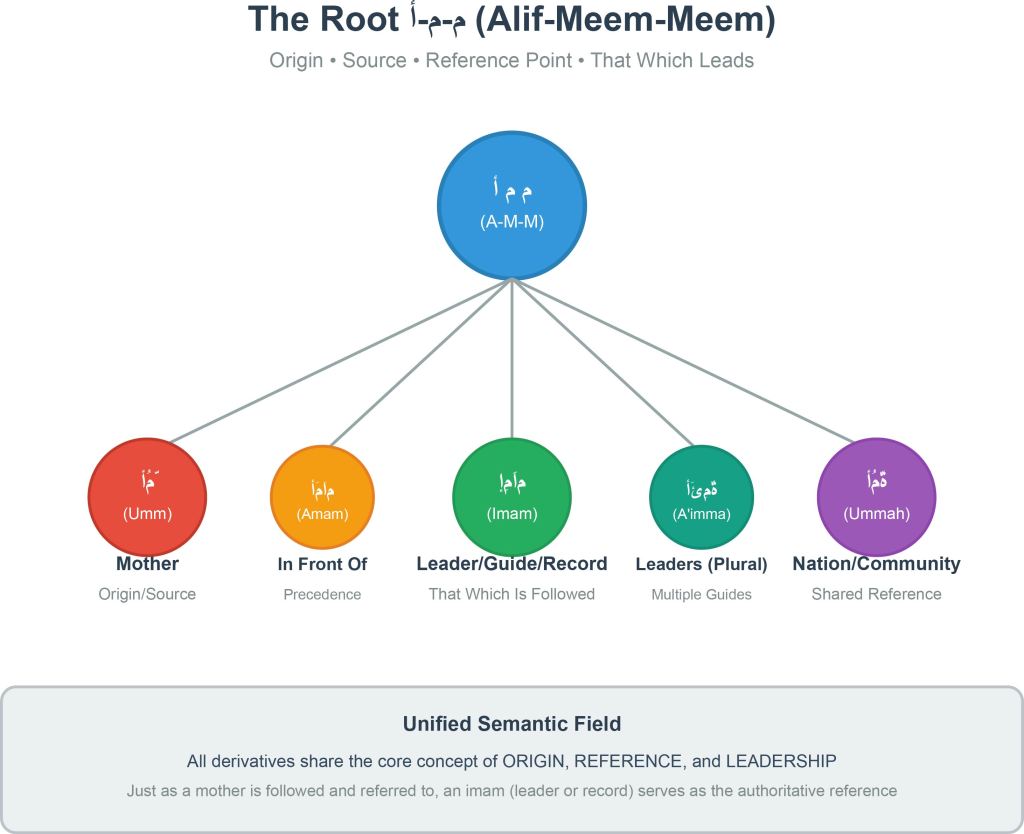
Before we can understand why “imam” carries dual meaning, we must understand the root from which it derives. The Arabic word “imam” (إِمَام) comes from the trilateral root أ-م-م (alif-meem-meem). This root carries a core semantic field centered around the concept of ORIGIN, SOURCE, REFERENCE POINT, and that which is FOLLOWED or LOOKED TO FOR GUIDANCE.
The most famous derivative of this root is “umm” (أُمّ), meaning “mother.” This isn’t coincidental – it’s foundational to understanding everything else the root produces. A mother is the origin (she gives birth), the source (she nourishes), the primary reference point (children look to her), and the one who is naturally followed (her guidance shapes her children). Every other word from this root shares these core concepts of being an origin, source, or reference that others follow.
From the same root, Arabic derives: “ummah” (أُمَّة) meaning nation or community – a group sharing a common origin and reference point; “amam” (أَمَام) meaning “in front of” or “before” – indicating precedence and the position from which one leads; and “imam” (إِمَام) meaning that which leads, guides, or serves as an authoritative reference – whether a person or a document.
Why One Root Produces Multiple Forms
The genius of Arabic root system is that a single root produces multiple words sharing a core semantic concept but varying in specific application. The root أ-م-م consistently points to “that which serves as origin, reference, or leadership.” Whether that leadership comes from a person, a book, a record, or even a physical position (being in front) doesn’t change the core concept. They all share the function of being something that others refer to, follow, or look toward for guidance.
This is why the Quran can use “imam” for both human leaders (like Abraham in 2:124) and written records (like the Book of Moses in 11:17 and 46:12, or the master record in 36:12). The word doesn’t describe a FORM (human vs. written); it describes a FUNCTION (that which leads, guides, or serves as reference). Anything that performs this function can be called an imam. This semantic flexibility isn’t weakness or ambiguity – it’s the precision of a language that describes reality according to function rather than mere appearance.
Part 2: The Seven Occurrences – A Complete Survey
Mapping Every Use of “Imam” in Singular Form
The word “imam” in its singular form appears exactly seven times in the Quran. Before we focus on 17:71’s unique double meaning, let’s examine all seven occurrences neutrally to understand the word’s full semantic range. This isn’t an argument for one meaning over another – it’s a comprehensive survey showing that “imam” genuinely carries multiple meanings depending on context.
[2:124] “Recall that Abraham was put to the test by his Lord, through certain commands, and he fulfilled them. (God) said, ‘I am appointing you an imam for the people.’ He said, ‘And also my descendants?’ He said, ‘My covenant does not include the transgressors.’”
In this first occurrence, “imam” clearly refers to Abraham as a human leader and exemplar. God appoints him as someone people will follow and emulate. The context makes the human reference unmistakable. This establishes that “imam” CAN mean a human guide or leader when context indicates this meaning.
[11:17] “…and before it, the book of Moses has set a precedent and a mercy…”
Here we encounter something remarkable: the Book of Moses – a written scripture – is called an “imam” (the Arabic literally says “kitabu Musa imaman” – “the book of Moses as an imam”). Not Moses the person, but his BOOK serves as imam. This establishes that “imam” CAN mean a written guide or scripture when context indicates this meaning. The word’s semantic range clearly includes both human and written references.
[15:79] “Consequently, we avenged from them, and both communities are fully documented.”
The Arabic phrase is “wa innahuma labi-imamin mubin” – “and indeed they are in a clear imam.” The context discusses the destroyed cities of Lot and the people of Shu’aib. Their fate and history are preserved “in a clear imam” – meaning their story exists as a documented record that serves as a warning and guide. Again, “imam” refers to written documentation, not a human leader.
[17:71] “The day will come when we summon every people, together with their record. As for those who are given a record of righteousness, they will read their record and will not suffer the least injustice.”
This is the verse we’ll explore in depth later. For now, simply note its position: the fourth of seven occurrences, exactly in the center. The Arabic says “bi-imamihim” (with their imam), and the immediate context speaks of being given “kitabahu” (his book) and reading “kitabahu” (his book). We’ll return to why this verse is unique among all seven.
[25:74] “And they say, ‘Our Lord, let our spouses and children be a source of joy for us, and keep us in the forefront of the righteous.’”
The Arabic phrase is “waj’alna lil-muttaqina imaman” – “make us an imam for the righteous.” This is a prayer from believers asking God to make them exemplary leaders. Here, “imam” refers to human leadership and exemplary status. The context indicates people aspiring to be guides for others through their righteousness.
[36:12] “We will certainly revive the dead, and we have recorded everything they have done in this life, as well as the consequences that continue after their death. Everything we have counted in a profound record.”
The Arabic ends with “wa kulla shay’in ahsaynahu fi imamin mubin” – “and everything we have enumerated/counted in a clear imam.” The verbs “naktubu” (we write) and “ahsaynahu” (we have counted) make clear we’re discussing documentation and recording. “Everything” is counted “IN” an imam – you can count things IN a record or register, but not IN a person. This is unambiguous: “imam” here means a comprehensive written record.
[46:12] “Before this, the book of Moses provided guidance and mercy. This too is a scripture that confirms, in Arabic, to warn those who transgressed, and to give good news to the righteous.”
This seventh occurrence repeats the phrasing from 11:17: “kitabu Musa imaman wa rahmatan” – “the book of Moses as an imam and mercy.” The repetition is deliberate, emphasizing that written scriptures can be and are called imams. By repeating this specific formulation, the Quran establishes beyond doubt that “imam” includes books and written records in its semantic range.
The Pattern Emerges
From this neutral survey, the pattern is clear: “imam” describes anything that functions as a guide, leader, or authoritative reference – whether human (2:124, 25:74) or written (11:17, 15:79, 36:12, 46:12). The word’s meaning is determined by context, not by a rigid restriction to only one type of reference. This semantic flexibility is built into the root itself, which describes FUNCTION (that which is followed as reference) rather than FORM (human vs. written).

Part 3: The Morphological Pattern – Why Function Unites Form
The Pattern فِعَال (Fi’al) – Instrument and Means
The word “imam” follows a specific morphological pattern in Arabic: فِعَال (fi’al). Understanding this pattern is crucial to understanding why the same word can refer to both human leaders and written records without confusion or ambiguity. This pattern typically indicates an instrument, means, or tool by which something is accomplished.
Consider other Arabic words following the same pattern:
“kitab” (كِتَاب) – book, the instrument of recording and reading;
“mizan” (مِيزَان) – scale or balance, the instrument of weighing;
“lisan” (لِسَان) – tongue, the instrument of speech;
“hibab” (حِبَال) – rope, the instrument of binding;
“libas” (لِبَاس) – garment, the instrument of covering.
Each of these words refers to something that serves a functional purpose – a tool for accomplishing something.
Applied to “imam,” this pattern indicates: the instrument or means by which people are guided, the tool for establishing direction, the means by which leadership is exercised. Notice that the pattern describes WHAT IT DOES (guides/leads) rather than WHAT IT IS (person/book). This is why a person can be an imam (Abraham guiding people through his example) and a book can be an imam (the Book of Moses guiding people through its teachings) – both perform the imam function even though they have different forms.
Function Over Form – The Wisdom of Arabic
This is one of the profound features of Classical Arabic: words often describe things according to their function rather than their physical form. Two things with completely different forms (a human and a document) can share the same functional name if they perform the same function. A “katib” is anyone who writes – whether with a pen, a computer, or even mentally composing. A “mubin” is anything that clarifies – whether a person explaining, a book presenting clearly, or even an obvious situation. Similarly, an “imam” is anything that guides or serves as an authoritative reference – regardless of whether it’s human or written.
This isn’t vagueness – it’s precision at a higher level. The language isn’t confused about the difference between a person and a book. Rather, it recognizes that different things can perform the same function, and it names them according to that function. This is why the Quran can call both Abraham and the Book of Moses “imam” without any contradiction or confusion. They perform the same function (guiding people) despite having different forms (human vs. written). The word “imam” captures the functional unity beneath the apparent formal difference.
Part 4: Verse 17:71 – The Unique Double Entendre
Why This Verse Is Different From All The Others
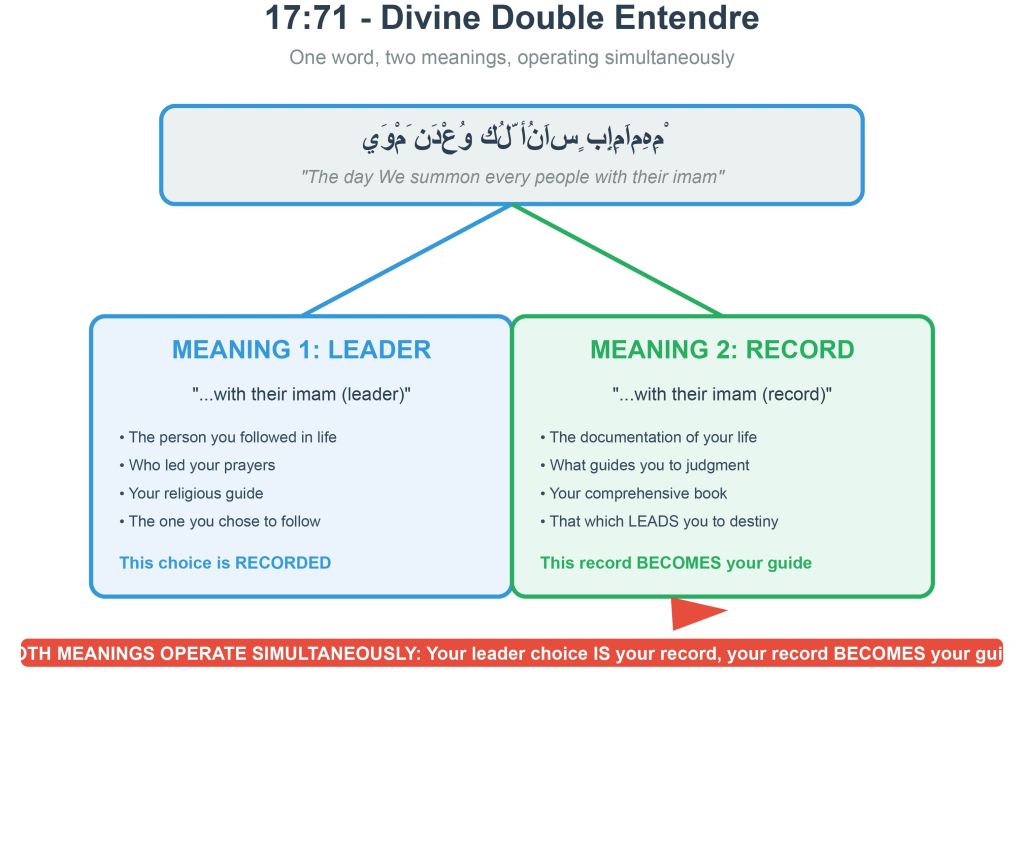
Now we arrive at the central insight: verse 17:71 is unique among all seven occurrences of “imam” because it’s the only verse where BOTH meanings operate simultaneously. This isn’t ambiguity requiring us to choose one meaning and reject the other. This is intentional dual meaning – a divine double entendre where both interpretations are correct and both are meant to be understood together.
Let’s look at the full verse structure:
[17:71] “The day will come when we summon every people, together with their record. As for those who are given a record of righteousness, they will read their record and will not suffer the least injustice.”
The Arabic reads: “Yawma nad’u kulla unasin bi-imamihim faman utiya kitabahu biyaminihi…” The key phrase is “bi-imamihim” – “with their imam.” Then immediately: “whoever is given his kitab (book/record).” The verse seamlessly moves from “imam” to “kitab” to “kitab” again. Notice what happens if we allow both meanings of “imam”:
Reading 1 (Leader interpretation): “The day we summon every people with their imam (the leader they followed)… whoever is given his record in his right hand.” Reading 2 (Record interpretation): “The day we summon every people with their imam (their record)… whoever is given his record in his right hand.” Both readings work grammatically. Both flow naturally into the subsequent mention of “kitab.” But here’s the profound insight: BOTH are meant.
What Is a Double Entendre?
A double entendre is a word or phrase that simultaneously conveys two different meanings, both of which are intended by the speaker. It’s not ambiguity (where the meaning is unclear and must be determined from context). It’s intentional dual meaning where both interpretations are correct and the richness comes from understanding both simultaneously. The Quran uses this literary device in several places, and 17:71 is one of the most profound examples.
When God says “bi-imamihim,” He means BOTH “with their leader” (the one they chose to follow in life) AND “with their record” (the documentation of their choices that now guides them in judgment). The genius is that these aren’t two separate unrelated meanings – they’re intimately connected. Your earthly imam (leader) becomes part of your record, and your record becomes your eternal imam (guide). The SAME WORD captures both phases because they’re two aspects of the same reality.
Why God Chose “Imam” Instead of “Kitab”
Now we can answer the question: why didn’t God simply say “bi-kitabihim” (with their book/record) if He meant record? Why use “imam” – a word with potential dual meaning? The answer is precisely BECAUSE of the dual meaning. God chose “imam” because He wanted to communicate something profound: your choice of earthly imam (leader) and your eternal imam (record-guide) aren’t separate realities. They’re connected through the word itself.
If the verse said “with their kitab,” it would only communicate that people are summoned with their documentation. True, but incomplete. By saying “with their imam,” the verse simultaneously says: with the leader they chose to follow (who they made their imam in life), AND with the record of having made that choice (which becomes their imam in judgment). The connection between choosing a leader and facing the consequences of that choice is built into the word itself. This is linguistic precision at its highest level.
Part 5: The Seamless Connection – From Life to Judgment
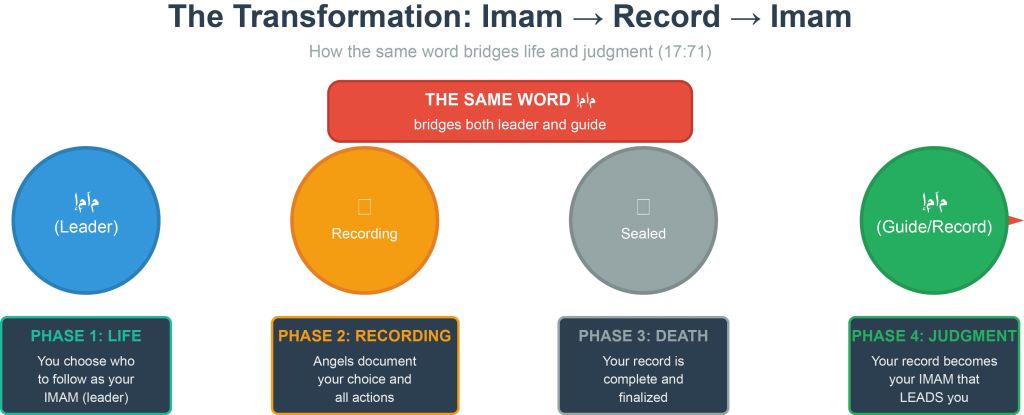
Phase 1: Your Imam in Life (Leader)
In life, you choose who or what to follow. Every person has an imam – something or someone they look to for guidance, leadership, or direction. For some, it’s a religious leader they pray behind. For others, it’s a teacher or mentor whose guidance they follow. For still others, it’s a set of principles or a way of life they’ve adopted as their guide. Whether conscious or unconscious, everyone follows something. In Quranic terminology, that which you follow is your imam.
The critical question is: who or what have you chosen as your imam? Are you following righteous guidance that aligns with God’s revelation? Or are you following corrupt leaders, false teachers, cultural traditions that contradict scripture, or your own desires? Every time you stand behind someone in prayer, you’re acknowledging them as your imam in that moment. Every time you accept someone’s religious guidance, you’re making them your imam. Every time you follow a tradition without investigation, you’re making that tradition your imam.
Phase 2: Everything Is Recorded
As you make your choices about who and what to follow, everything is being recorded with perfect accuracy. Your choice of imam isn’t a private, inconsequential matter. It’s being documented. The recording includes not just the external action (prayed behind X) but the full context: did you know X was corrupt? Did you investigate? What motivated your choice – sincere belief, social pressure, convenience, family expectation?
[50:18] “Not an utterance does he utter without an alert witness.”
If every word is recorded, how much more are your choices about who to follow? Every prayer behind a particular imam, every acceptance of someone’s guidance, every instance of following tradition over scripture – all documented with complete context in your record.
Phase 3: Your Record Becomes Your Imam (Guide)
When you die, your record is finalized. On the Day of Judgment, you’re summoned “with your imam.” Now the word’s meaning transforms: the record that documented your life choices becomes the guide that leads you through judgment. Your imam is no longer the human leader you followed – it’s the record OF having followed that leader. The earthly imam served their function in life. Now your record-imam serves its function in judgment.
This is where the double entendre becomes devastating. You’re summoned “with your imam” – and “imam” means BOTH the leader you chose AND the record of that choice. The leader you followed is present in the form of your documented choice to follow them. Your record doesn’t just passively contain information about your imam; it BECOMES your imam. It leads you. It guides you to your destination. It functions as the authoritative reference that determines your fate.
[17:13-14] “We have recorded the fate of every human being; it is tied to his neck. On the Day of Resurrection we will hand him a record that is accessible. Read your own record. Today, you suffice as your own reckoner.”
Your record is tied to you. It’s given to you to read. You judge yourself through it. And it leads you to the destination your documented choices have earned. Your record has become your imam in the fullest sense – it guides, it leads, it serves as the authoritative reference determining where you go.
Part 6: The Grammar Supports Both Readings Simultaneously
The Phrase “بِإِمَامِهِمْ” (Bi-Imamihim) – With Their Imam
Let’s examine the grammatical structure of the key phrase. “Bi-imamihim” consists of three elements: “bi” (بِ) – the preposition “with”; “imam” (إِمَام) – leader/guide/record; and “him” (هِمْ) – the possessive pronoun “their.” The question is: does the grammar allow both meanings, or does it force us to choose one?
The possessive pronoun “him” (their) works perfectly for both readings. “Their imam” in the sense of “their leader” – the one belonging to them, the one they followed. “Their imam” in the sense of “their record” – the one belonging to them, the one documenting THEIR choices. The possessive works bidirectionally: the leader belongs to them (they chose him), and the record belongs to them (it documents their deeds).
The preposition “bi” (with) also accommodates both meanings. “With their leader” – accompanied by, in the company of. “With their record” – accompanied by, carrying with them. The preposition doesn’t force a choice between meanings. Both are grammatically valid uses of “bi” with the noun that follows.
Why Singular Form With Plural Pronoun Matters
Notice that “imam” is singular (not the plural “a’immah”), but it’s attached to a plural possessive pronoun “him” (their). This creates a distributive meaning: each person has their own imam. Not a shared imam for a group, but an individual imam for each person. This grammatical structure supports the “record” interpretation strongly: each person has their own individual record. But it also works for “leader” if we understand that each group of people followed their particular leader.
However, the subsequent phrase “faman utiya kitabahu” (whoever is given HIS book) shifts to singular possessive “hu” (his). This shift from plural (their imam) to singular (his book) indicates individual accountability. Each person receives their own book. This flows naturally if “their imam” means “their individual records” – each person’s record is their own imam. The grammar elegantly bridges collective summoning with individual accountability.
Part 7: Why This Double Meaning Matters – The Hypocrite Problem
The Dangerous Incomplete Understanding
Now we arrive at the practical urgency of understanding 17:71’s double entendre. Some believers who accept that “imam” means “record” have drawn a dangerous conclusion: “Since my imam on Judgment Day is just my record, not the person I followed, it doesn’t matter if I pray behind a hypocrite. The imam leading my prayer isn’t relevant to my judgment – only my record matters.” This reasoning is dangerously incomplete because it misses the connection between the two meanings.
Your record ISN’T “just your record” disconnected from your life choices. Your record CONTAINS all your choices, including your choice of who to follow as imam. If you chose to pray behind a hypocrite, that choice is in your record. If you knew or suspected someone was corrupt but followed them anyway, that knowledge and that choice are documented. Your earthly imam (leader) isn’t irrelevant to your judgment – he’s VERY relevant because your choice to follow him is a major part of your record, which becomes your guiding imam.
The Connection The Double Entendre Reveals
This is why God chose the word “imam” with its dual meaning. If the verse meant ONLY “record” with no connection to earthly leaders, God would have said “with their kitab.” If the verse meant ONLY “leader” with no emphasis on documentation, God might have said “with their representative” or “with their guide.” But by saying “with their imam” – a word that simultaneously means leader AND record-guide – God reveals the inescapable connection:
Your imam (leader) in life → documented in your record → record becomes your imam (guide) in death. The SAME WORD bridges both realities because choosing an earthly imam and facing your record-imam aren’t separate events. They’re connected cause and effect. Your earthly imam choice IS a major part of your record. Your record (including your imam choice) BECOMES your guide to judgment.
Praying Behind a Hypocrite – What’s Really Being Recorded
When you knowingly pray behind a hypocrite imam – someone whose corruption, disbelief, or opposition to God’s commands you know or strongly suspect – what’s being recorded? Not just “prayed today.” Your record documents:
1. The identity of the person you chose as imam.
2. What you knew or should have known about their character.
3. Why you chose to follow them despite red flags.
4. Whether you investigated or deliberately avoided investigation.
5. Whether you prioritized truth or convenience.
6. Whether social pressure, family expectation, or personal comfort motivated your choice.
7. Whether you truly believed they were righteous or just went along.
All of this context is in your record. And this record becomes your imam – the guide that leads you through judgment. You can’t separate “the imam doesn’t matter” from “my record is my imam” because your choice of imam IS your record. They’re not two separate things – they’re phases of the same reality, unified by the same word.
[4:145] “The hypocrites will be committed to the lowest pit of Hell, and you will find no one to help them.”
The hypocrites go to the lowest pit. Your record will show whether you followed them knowingly or unknowingly, sincerely or conveniently, after investigation or in willful blindness. The record contains context. And that record, containing all of this, becomes your imam that guides you to consequence.
The Excuse That Doesn’t Work
Some attempt to excuse themselves: “I know my imam is questionable, but I’m praying to God, not to the imam. My focus on God should override the imam’s corruption.” But this excuse misunderstands what imam-led prayer represents. By standing behind someone in prayer, you’re acknowledging their religious leadership in that moment. You’re following their recitation, their movements, their guidance. You’re putting them in the position of imam – the one who leads.
Your record documents this. It documents that you knew the imam was questionable but chose to follow him anyway. It documents that you understood what imam-led prayer signifies but participated regardless. It documents your reasoning – however you justified it to yourself. When this record becomes your imam (guide) on Judgment Day, it will lead you based on what’s actually documented, not what you told yourself at the time.
[9:78] “Do they not realize that God knows their secrets, and their conspiracies, and that God is the Knower of all secrets?”
Part 8: The Nullification of Hypocrite Arguments
Why Hypocrites Say “The Imam Doesn’t Matter”
Hypocrites and those who enable them have a vested interest in claiming that who leads prayer doesn’t matter. If believers scrutinize their leaders’ character and refuse to pray behind corrupt imams, the hypocrites lose their position, authority, and social status. So they promote the idea: “It doesn’t matter who the imam is – just pray. Your prayer goes to God regardless of the imam’s character.” This reasoning seems pious on the surface but contradicts Quranic principles.
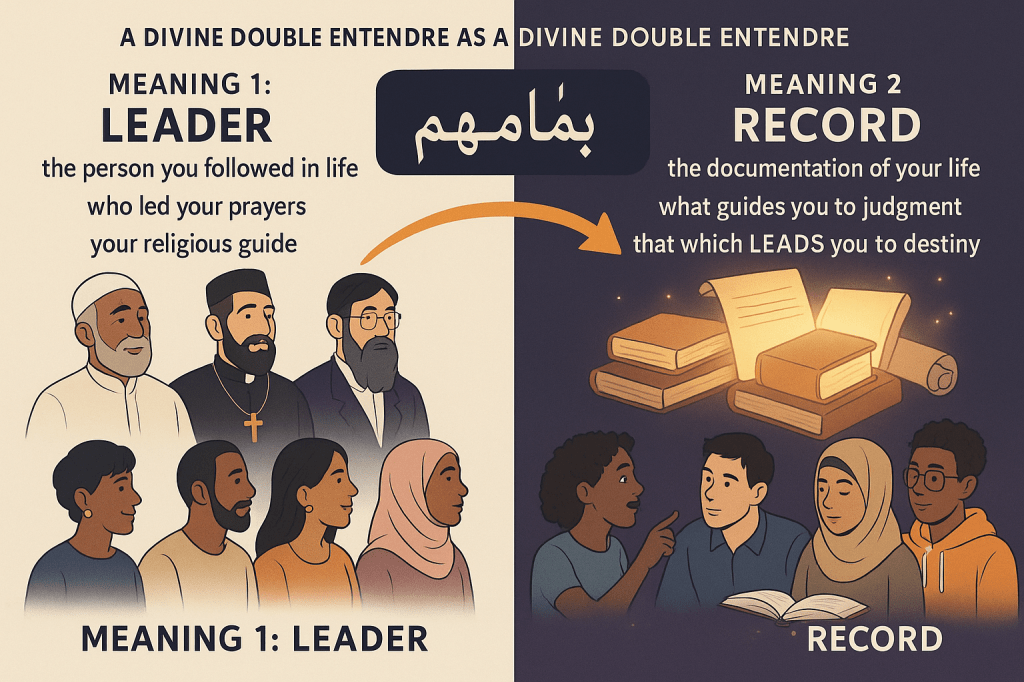
The double entendre in 17:71 destroys this argument. The imam DOES matter precisely because the word “imam” connects your earthly choice with your eternal consequence. You’re summoned “with your imam” – meaning both the leader you chose and the record of having chosen them. You can’t separate these. The connection is built into the language itself, revealing divine wisdom about accountability.
The Same Word, The Same Consequence
Why would God use the exact same word for both your earthly leader and your eternal guide if the connection between them was irrelevant? The linguistic choice reveals a theological reality: who you follow in life determines where you’re led in death. Not because the earthly imam accompanies you to judgment (he doesn’t – everyone faces their record individually), but because your choice to follow that imam is documented in your record, and that record becomes your guide.
If you followed righteousness despite difficulty, your record shows it and guides you toward reward. If you followed hypocrisy despite warnings, your record shows it and guides you toward consequence. The earthly imam doesn’t lead you on Judgment Day – but your record of choosing him does. Same word, same connection, same consequence.
Individual Accountability Demands Individual Decisions
The Quran’s emphasis on individual records (“read YOUR record,” “tied to HIS neck,” “every soul”) means you cannot hide in the crowd. You cannot excuse yourself by saying “everyone prayed behind him” or “my community accepted him” or “it’s traditional.” Your record is individual. Your judgment is individual. And your choices about who to follow must be individual.
[33:67] “They will also say, ‘Our Lord, we have obeyed our masters and leaders, but they led us astray.’”
This excuse won’t work. Blaming your leaders for your choice to follow them doesn’t eliminate your accountability for that choice. Your record will show you chose to follow them. The question is: did you choose based on investigation or blind following? Based on their demonstrated righteousness or social convenience? Your record documents the full context, and that record becomes your imam.
Part 9: Classical Understanding of Double Entendre in the Quran
Multiple Meanings Are a Known Feature of Quranic Eloquence
Understanding 17:71 as a double entendre isn’t innovation or modern interpretation divorced from classical scholarship. Classical Arabic scholars recognized and celebrated the Quran’s use of words with intentional multiple meanings as part of its inimitable eloquence. The technical term is “wujuh wa nadha’ir” – the faces and counterparts of Quranic words, referring to how a single word can have multiple meanings across different contexts.
Early scholars wrote entire works cataloging Quranic words with multiple meanings: “Wujuh al-Quran” by Muqatil ibn Sulayman (8th century), “Al-Wujuh wa al-Nadha’ir” by Al-Damghani (11th century), and others. These works demonstrate that classical scholars didn’t view semantic range as ambiguity to be eliminated. They viewed it as eloquence to be appreciated – God’s choice to use words whose multiple meanings enrich understanding rather than confuse it.
Other Examples of Quranic Double Entendre
The Quran contains numerous examples where a single word or phrase carries multiple valid meanings simultaneously. For instance, in verse 2:222, the phrase can mean both “they ask you about menstruation” and “they ask you about the new moon” – the word “mahid” carries both meanings, and classical commentators acknowledged both. In verse 20:11, the word “ans” means both “human” and “intimacy” – both meanings enrich the verse.
In verse 111:1, “tabbat yada abi lahab” means both “perish the hands of Abu Lahab” and “may Abu Lahab’s works be in vain” – the word “tabbat” and “yada” (hands) both carry literal and metaphorical meanings that work together. Classical scholars didn’t force a choice between meanings – they appreciated that both meanings operate together to create richer significance.
Similarly with 17:71, we don’t need to force a choice between “imam” meaning “leader” OR “record.” Both meanings are linguistically valid, both fit the grammar, both work contextually, and both together create the profound connection between earthly choice and eternal consequence.
Part 10: The Mathematical Precision – Why Seven Occurrences
The Significance of Seven
The word “imam” in singular form appears exactly seven times in the Quran. In Quranic numerology, seven often indicates completeness or perfection. Having examined all seven occurrences, we can see the complete picture of what “imam” means across its full range. The number itself suggests we’re meant to study all seven together to understand the word’s complete meaning.
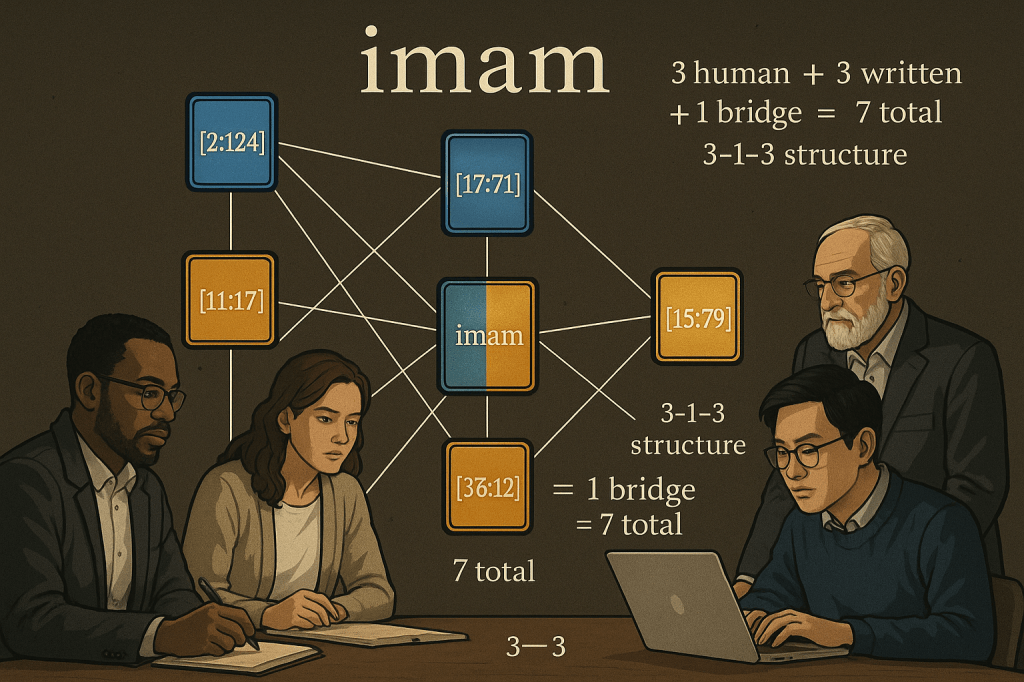
The distribution is also significant: three occurrences clearly indicate human leaders (2:124, 25:74, and contextually elements of 17:71), three clearly indicate written records or books (36:12, 11:17, 46:12), and one (15:79) indicates historical documentation. This creates a balance showing that the word’s semantic range intentionally includes both human and written references – neither is a secondary or metaphorical usage. Both are primary meanings of the word.
The Central Position of 17:71
Verse 17:71 contains the fourth occurrence – exactly in the center of seven. This central positioning is significant in Quranic structure, often indicating pivotal importance or a connecting concept. And indeed, 17:71 is precisely that: the verse that CONNECTS the human meaning (leader you followed) with the written meaning (record that guides). It’s positioned in the center because it bridges the other six occurrences.
The three human occurrences and three written occurrences aren’t separate categories with 17:71 arbitrarily assigned to one category. Rather, 17:71 is the BRIDGE showing how both meanings connect. Your human imam (leader) becomes part of your written imam (record). The center position reflects this connecting function. The mathematical positioning reveals the semantic relationship.
The 3-1-3 Structure
If we map the seven occurrences by primary meaning, we get: human (2:124), written (11:17), written (15:79), BOTH (17:71), human (25:74), written (36:12), written (46:12). This creates a pattern where the human and written meanings alternate and converge, with 17:71 as the pivotal verse where both meanings unite. This isn’t random distribution – it’s structured design showing that the two meanings aren’t competing interpretations but complementary aspects of the same concept.
Part 11: Practical Guidance for Believers
Understanding Changes Everything
Understanding that 17:71 contains a double entendre – where “imam” means both the leader you follow and the record that guides you – should fundamentally change how you approach decisions about religious leadership. This isn’t abstract theology with no practical application. This is daily, immediate, urgent guidance about who you follow in prayer and religious practice.
Every time you stand behind someone in prayer, ask yourself: am I comfortable with this choice being documented in the record that will become my guide to judgment? If you know or strongly suspect the person is a hypocrite – publicly claiming righteousness while privately living in corruption – your choice to follow them anyway is being recorded with full context. That record will become your imam. Are you comfortable with that?
The Two Questions Before Every Prayer
Before standing behind any imam in prayer, two questions matter: First, is this person someone whose character and teachings align with Quranic guidance? Have I investigated, or am I just assuming based on appearance or reputation? Second, if this person is questionable, am I prioritizing truth over convenience? Am I following them because I genuinely believe they’re righteous, or because it’s socially easier, more convenient, or expected?
These questions matter because the answers are being recorded. Your record doesn’t just document that you prayed – it documents your approach to choosing who to follow. Did you investigate or blindly follow? Did you prioritize principle or convenience? Did you choose based on truth or social pressure? All of this context is in your record, and that record becomes your imam.
[17:36] “You shall not accept any information, unless you verify it for yourself. I have given you the hearing, the eyesight, and the brain, and you are responsible for using them.”
This verse immediately precedes the section containing 17:71. The connection is clear: you’re responsible for verifying before following. You have faculties (hearing, sight, intellect) that enable investigation. On Judgment Day, these faculties will be questioned. Did you use them? Or did you follow without verification? Your record documents which you chose.
What To Do When All Available Imams Are Questionable
Some believers face a genuine dilemma: all the imams in their area are questionable, corrupt, or hypocritical. What should they do? The Quran doesn’t obligate you to pray behind questionable leaders. You have options: pray alone, pray with a small group of verified righteous individuals even if less convenient, or travel further to find legitimate guidance. The difficulty of these options is real, but choosing the difficult righteous path is what gets recorded.
Your record will show: “Faced with questionable imams, chose to pray alone rather than validate corruption” or “Traveled an extra distance to find righteous leadership rather than accepting convenient hypocrisy.” This context matters. This context is in your record. And when this record becomes your imam (guide), it will lead you based on these documented priorities. The temporary difficulty of choosing correctly is vastly outweighed by the eternal consequence of choosing incorrectly.
The Way Forward – Personal Responsibility
Understanding the double entendre in 17:71 empowers individual believers and undermines corrupt religious authority. You don’t need human religious mediators who are hypocrites. You need direct connection to God’s revelation and personal responsibility for your choices. Your record – documenting your direct investigation, your principled decisions, your refusal to validate corruption – will be your imam. No corrupt leader can intercede. No questionable authority can save you. You stand with YOUR record, and it leads you based on what YOU chose.
This understanding should make you extremely careful and deliberate about who you follow. Every prayer behind someone is a choice being documented. Every acceptance of someone’s guidance is being recorded. Every time you prioritize convenience over principle or social acceptance over truth, it’s written. Make sure what you’re writing is something you want guiding you eternally.

Part 12: The Wisdom of One Word
Divine Precision, Not Translation Debate
As we conclude, let’s reflect on what we’ve discovered. The question was never “does imam mean leader OR record in 17:71?” That framing misses the profound wisdom of God’s word choice. The question is: “why did God choose a word that means BOTH leader AND record?” The answer reveals layers of meaning that a single-meaning word couldn’t capture.
By using “imam” – a word whose semantic range includes both human leaders and written records, both that which is followed in life and that which guides in judgment – God reveals the inescapable connection between earthly choices and eternal consequences. You’re summoned “with your imam” – and that word simultaneously points backward to the leader you chose and forward to the record-guide that leads you to consequence.
The Same Word, The Same Choice, The Same Consequence
The genius of using one word instead of two separate words is this: your imam in life and your imam in judgment aren’t separate unrelated realities. They’re phases of the same reality, connected by the bridge of documentation. You choose an earthly imam → that choice is documented → the documentation becomes your guiding imam. Same word, same connection, same accountability.
If the verse said “summoned with their leaders, then given their records,” it would present two separate elements without the explicit connection. But by saying “summoned with their imam” – knowing imam means both leader and record – the connection is built into the word itself. Your leader IS (becomes part of) your record, your record IS (becomes) your guide. The unity of terminology reveals the unity of reality.
Both Meanings, Not Either Meaning
This is the critical insight we must carry forward: 17:71 doesn’t require us to choose between “imam means leader” or “imam means record.” Both are correct. Both are meant. Both together create the full meaning that neither alone could convey. This isn’t weakness or ambiguity in the text – it’s the strength of language used with divine precision to communicate layered truth.
[45:29] “This is our record; it utters the truth about you. We have been recording everything you did.”
Your record speaks truth. It documents everything. And it becomes your imam – the authoritative guide that leads you through judgment based on what you yourself chose. The earthly imam you followed is preserved in that record. The record preserving your choice becomes your guiding imam. Same word, both meanings, unified reality.
Conclusion: Your Imam IS Your Record Because Your Record IS Your Imam
The Circle Completes
We began by asking why God chose the word “imam” in 17:71 instead of a more specific unambiguous term. We now have the answer: because “imam” uniquely carries both the meaning of earthly leader and eternal record-guide, and both meanings together reveal a profound truth about accountability that neither meaning alone could convey.
Your imam (the leader you follow) becomes your imam (the record that guides you) through the process of documentation and judgment. The SAME WORD bridges both realities because they ARE bridged in reality. Who you follow in life determines what guides you in death – not because the earthly leader accompanies you to judgment, but because your choice to follow that leader is the primary content of the record that does.
The Answer to Hypocrite Arguments
For those who argue “it doesn’t matter who I pray behind – my record is my imam, not the person,” we now understand why this argument fails. It’s not that your earthly imam is irrelevant. It’s that your earthly imam becomes relevant THROUGH your record. Your choice of leader IS a major part of your record. Your record (containing your leadership choices) BECOMES your guide. You can’t separate them. The double meaning of “imam” reveals their connection.
If you knowingly followed hypocrites, your record documents it. When that record becomes your imam (guide), it will lead you based on what it documents. You chose a hypocrite imam (leader), so your record-imam (guide) leads you to the consequence of that choice. The same word, used twice in different phases, reveals the same accountability.
The Urgency of Choice
Every day, you’re writing your record through your choices. Every prayer behind someone is documenting your imam choice. Every acceptance of someone’s guidance is recorded. The record being written now will become the imam that guides you then. You cannot go back and edit. You cannot delete entries. What’s being documented now with perfect accuracy will guide you eternally.
Choose your earthly imam with the understanding that this choice is writing your eternal imam. If you choose righteousness despite difficulty, that’s being written. If you choose hypocrisy despite warnings, that’s being written. If you investigate before following, that’s written. If you follow blindly, that’s written. All of it becomes the record that becomes your guide. Same word, both meanings, one profound reality.
[69:19] “As for the one who receives his record with his right hand, he will say, ‘Come read my record.’”
[69:25] “As for him who is given his record in his left hand, he will say, ‘Oh, I wish I never received my record.’”
Two reactions based on what the record contains. One person is eager to share their record – it vindicates their choices. The other wishes they’d never received it – it exposes their choices. Both records function as imams, guiding each person to their earned destination. The difference is what was written during life through the choices made about who to follow.
The Final Word
Your record IS your imam. Not merely because the word “imam” can be translated as “record.” But because the record of your choices (including your choice of earthly imam) becomes the guide that leads you to judgment. The double entendre in 17:71 reveals this profound truth: the leader you choose to follow in life and the guide that leads you in judgment are connected by the same word because they’re connected in reality. Your choice creates your record. Your record becomes your guide. Same word, same connection, same accountability.
Choose wisely who you follow as imam, because you’re choosing what will guide you as imam. The choice is urgent because the record is being written now. The consequence is eternal because the record will guide you forever. God’s word choice reveals the connection. Your choices determine the outcome. The same word “imam” appears twice in your life – once as the choice you make, once as the guide you face. Make sure the first is something you want the second to be.


 Quran Only Studies
Leave a comment