Introduction: The Foundation of Faith
In the journey of submission to God, every believer faces a profound test that determines the authenticity of their faith. This is not merely a philosophical exercise or spiritual metaphor – it is a tangible, exacting examination that pushes us to our absolute limits. The submission test represents the moment when we must choose between the comfort of our current circumstances and the uncertain path of total trust in God. It is the defining moment that separates those who merely claim faith from those who live it.
This test does not come in isolation. God has provided us with an unprecedented authenticating proof – the mathematical miracle of Code 19 embedded in the Quran. This superhuman phenomenon serves as the foundation upon which genuine faith is built, offering objective, verifiable evidence of divine authorship that transcends human capability. Together, the submission test and Code 19 form two pillars of the believer’s journey: one tests our hearts, the other proves God’s authority. This article explores both dimensions of submission, examining how they work together to guide us toward total surrender to the Creator.
Part 1: The Four Types of Disasters in Submission
Understanding Divine Tests and Consequences
The messenger Rashad Khalifa identified four distinct categories of disasters that believers may encounter in their journey of submission. Each type serves a different purpose in God’s comprehensive system of guidance, consequence, and spiritual development. Understanding these categories helps us navigate life’s challenges with wisdom and recognize the nature of the trials we face.
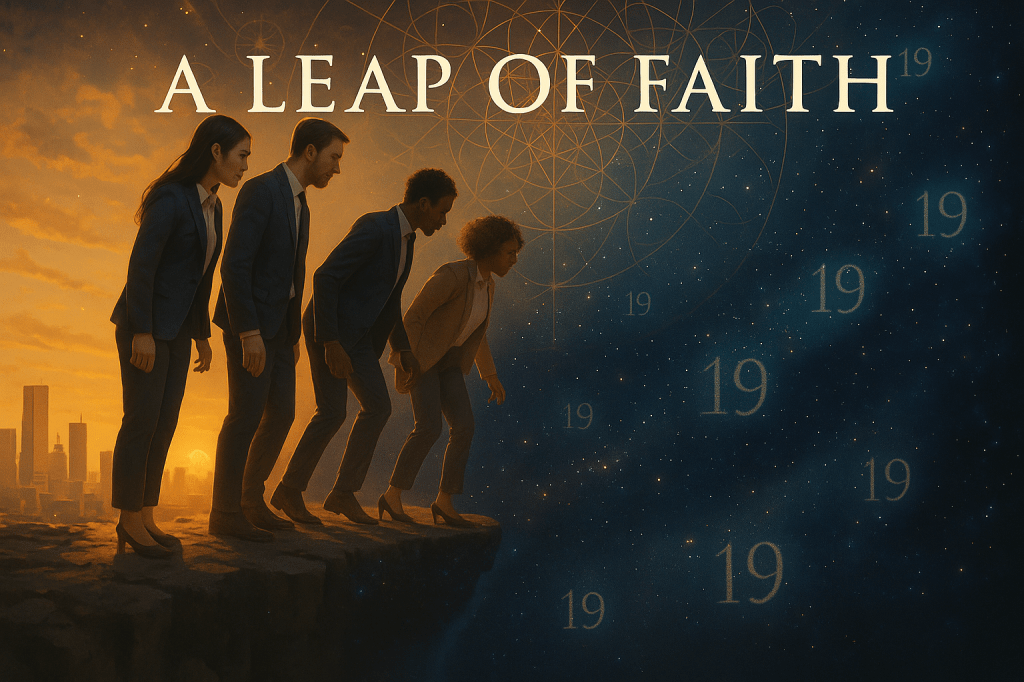
The first type is the admission test, also called the submission test – a deliberate, exacting examination that typically occurs within the first five years of a believer’s journey. This is not random hardship but a specifically designed challenge that will push you to the very edge of your faith. You will know when you face this test because it demands everything from you. It requires you to make a leap of faith into complete uncertainty, trusting that God will catch you on the other side. The admission test is the focus of our exploration because it represents the crucial threshold every believer must cross.
The second category is the retributive disaster – the end-game consequence for communities that persist in disbelief and corruption. History provides clear examples: the people of Noah were destroyed by the flood, the people of Ad by devastating winds, and the people of Thamud by earthquakes. These were not random natural disasters but divine judgments upon societies that rejected God’s messengers and persisted in evil. The coming retributive disaster, as prophesied, will be the smoke mentioned in Surah Ad-Dukhan, a final reckoning for those who refuse to submit.
The third and fourth types are more personal in nature. One is the blessing in disguise – a hardship that appears devastating in the moment but ultimately leads to greater good that we cannot yet perceive. The other is payment for sin, where God exacts immediate consequences for our wrongdoing. The messenger clarified an important principle: the payment for sin always exceeds the enjoyment derived from it. You might win $100,000 through gambling, but the cost will surpass that amount through emotional damage, relationship loss, physical hardship, and spiritual disconnection. Studies confirm that approximately 90% of lottery winners return to their original financial state within three to four years, having lost not just money but peace, relationships, and purpose in the process.
Part 2: The Nature of the Submission Test
Can You Claim Belief Without Being Tested?
God poses a fundamental question to every person who claims faith: Do you believe you can claim to be believers without being put to the test? This question cuts to the heart of what faith actually means. Anyone can say “I believe in God” while sitting comfortably in their chair, surrounded by life’s luxuries, experiencing no challenges to their faith. But what happens when that belief is tested? What happens when you are required to make a leap of faith, to sacrifice something precious, to stand alone against opposition?
[9:16] “Did you think that you will be left alone without God distinguishing those among you who strive, and never ally themselves with God’s enemies, or the enemies of His messenger, or the enemies of the believers? God is fully Cognizant of everything you do.”
This verse reveals God’s methodology. He will not leave believers alone without distinguishing those who genuinely strive in His cause from those who merely pay lip service. The test is designed to reveal what is truly in our hearts. If your trust in God is conditional upon seeing evidence, upon maintaining comfort, upon avoiding sacrifice – then your trust is brittle. It will shatter the moment real pressure is applied. This is the reverse of what God requires from us.
God requires us to make the first leap. He requires us to trust Him before we see the outcome. It is like peering into an abyss – you cannot know with absolute certainty what lies below. If you quit your job because you recognize you are participating in a prohibited system, you do not know if you will find another job. If you distance yourself from family members who oppose your faith, you do not know if you will find new companions. This is the essence of the test: trusting God despite the uncertainty, despite the fear, despite the apparent risk of losing everything you hold dear.

The Divine Promise of Support
For those who struggle with the fear of making this leap, God provides a profound promise. He addresses our anxiety directly, acknowledging that we worry about losing support, about being left alone, about facing hardship without help. His response is both challenging and comforting.
[22:15] “If anyone thinks that God cannot support him in this life and in the Hereafter, let him turn completely to (his Creator in) heaven, and sever (his dependence on anyone else). He will then see that this plan eliminates anything that bothers him.”
The instruction is clear: turn completely to God, sever your dependence on anyone and anything else, extend your rope only to your Creator in heaven. When you do this, you will discover something remarkable – everything that concerned you, everything that kept you awake at night, everything that made you hesitate to submit fully, will disappear. This is not metaphorical. This is a practical promise that you can test. Cut all ties to your false sources of security, rely entirely on God, and watch as He provides in ways you could never have imagined.
The admission test will push you to make this choice. It will confront you with scenarios where every worldly indicator points toward compromise, toward partial submission, toward holding back a portion of your faith for the sake of security. The forces will gather around you, circumstances will pressure you toward actions you know are wrong, and you will face the decision: Do I fight back while objecting internally, or do I submit while trusting God externally?
Part 3: Submission Versus Objection
The Simple Metric of True Faith
How do we know if we are truly believers? How do we know if we have received the test and passed it? The metric is remarkably simple, yet profoundly challenging: examine whether you are objecting. The antonym of submission is objection. If you submit to something, you are not objecting. If you object to something, you are not submitting. These two states cannot coexist.
The messenger Rashad taught a powerful practice: If you ever find yourself objecting to a situation, tell yourself in your head, “You’re not a submitter.” This self-reminder serves as an immediate diagnostic tool. When circumstances gather against you, when events unfold in ways you did not want, when you face outcomes you believe are wrong – your response reveals the state of your heart. Fighting back against injustice is permissible and even necessary. But objecting to the scenario itself, rejecting the test, resenting God’s decree – this is the opposite of submission.
The concept becomes clear when we understand submission properly. Submission means trusting that God will guide you through your life irrespective of the outcomes. Today, you might face immense hardship and pressure. You might feel overwhelmed, afraid, uncertain about the future. But from God’s perspective, five years from now you could be relaxing in a park, playing with your children, at complete peace. You do not know. You are confined by the boundaries of your current knowledge and limited by your present circumstances. You cannot see what God sees. You cannot comprehend what He has planned for you.
This is where the leap of faith becomes necessary. You must make a complete leap, trusting that God’s wisdom exceeds your understanding, that His plan surpasses your limited vision, that His timing is perfect even when it seems delayed. When you can maintain this trust without objecting to the path He has placed you on, you have achieved submission.

Part 4: The Mathematical Miracle of Code 19
The Foundation of Authenticating Proof
Before we can discuss the submission test in its fullest dimension, we must understand the foundation upon which it rests: the mathematical miracle of Code 19. This phenomenon is not a matter of faith or interpretation – it is objective, verifiable, and scientifically demonstrable. It represents an insurmountable proof of divine authorship that no human could have produced.
[74:30] “Over it is nineteen.”
In Surah 74, verse 30, God speaks explicitly about the number nineteen. He clarifies that nineteen angels guard Hell, and then He explains the purpose of this specific number. It is a test for the disbelievers, a source of certainty for those who received previous scripture, an increase in faith for the believers, and a means to prevent doubt from entering the hearts of believers and those who received previous scripture. The number nineteen is not random – it is a deliberate design element woven throughout the entire Quran with mathematical precision that exceeds human capability.
The mathematical structure begins with the opening statement of the Quran: “In the name of God, Most Gracious, Most Merciful.” This statement, known as the Basmalah, consists of exactly 19 Arabic letters. Furthermore, each word in this statement occurs throughout the entire Quran in multiples of 19. The name “Allah” (God) appears 2,698 times (19 × 142). The word “Rahman” (Most Gracious) appears 57 times (19 × 3). The word “Raheem” (Most Merciful) appears 114 times (19 × 6). The word “Ism” (name) appears 19 times exactly.
But this is just the beginning. The Quran consists of 114 chapters (19 × 6). If you add the chapter numbers from 1 to 114, the total is 6,555 (19 × 345). The Quran contains 6,346 numbered verses (19 × 334). When you add all chapter numbers plus all verse numbers, the total is 346,199 (19 × 18,221). The mathematical patterns continue at every level – in the letters, words, verses, chapters, and overall structure.
The Physical Impossibility of Human Authorship
To understand the magnitude of this miracle, consider what would be required to produce it. You would need to write a book of 6,346 verses across 114 chapters, ensuring that every mathematical pattern involving the number 19 remains perfectly intact – not just in the total counts, but in the distribution throughout the text. Every verse placement matters. Every word choice affects multiple calculations simultaneously. One misplaced verse would collapse dozens of mathematical relationships.
Now consider that this book was revealed in the 7th century, compiled over 23 years, in an environment with no computers, calculators, or even basic mathematical tools. The man who received it, Muhammad, was a merchant (he was literate despite what tradionalists say) – this is advanced mathematics meant for the 21st century. The Arabic language at that time did not have standardized numerical notation. Yet the text contains mathematical patterns so complex that they were only fully discovered in the late 20th century using computers.
This is what makes Code 19 an insurmountable barrier. Other religious groups might claim minor miracles – a prophecy that came true, a seemingly impossible event, a subjective spiritual experience. These are small humps that you can easily step over. They can be explained away, coincidental, or even replicated by determined humans. But Code 19 is a wall so high you cannot see the end of it. The physical improbability, the computational impossibility, the perfect precision across thousands of interlocking patterns – this could only come from the Creator of mathematics itself.

Part 5: The Implications of Mathematical Certainty
Recognizing God’s Absolute Authority
When you truly comprehend the magnitude of Code 19, when you understand that this mathematical structure could only come from the Creator of the universe, you must grapple with its implications. This is not merely an interesting phenomenon or a convincing argument for belief. This is God showcasing His authority, demonstrating His power, and establishing His credentials in a way that removes all doubt.
If you accept that Code 19 is real – and the mathematics prove it beyond any reasonable doubt – then you must accept that the Quran is from God. If the Quran is from God, then everything in it carries divine authority. You cannot pick and choose which parts to accept. You cannot say, “I believe 99% of what the messenger teaches, but this one particular instruction doesn’t sit well with me.” God is absolute. He is not 99% God. He is not mostly omnipotent with a few limitations. He is completely, totally, absolutely supreme.
[59:24] “He is the One God; the Creator, the Initiator, the Designer. To Him belong the most beautiful names. Glorifying Him is everything in the heavens and the earth. He is the Almighty, Most Wise.”
This verse describes God’s nature. He is the Creator – He brought everything into existence. He is the Initiator – He began all processes and set all things in motion. He is the Designer – He fashioned creation with purpose and perfection. To Him belong the most beautiful names because every quality of perfection is His. When we say “the Almighty,” God IS that quality in absolute form. When we say “the Truth,” God IS truth itself. When we say “the Just,” God IS justice in its purest expression.
God is not bound by His creation. When you think of something amazing – time, space, matter, energy, consciousness, existence itself – you must understand that God created all of it. He is not subject to time; He created time. He is not limited by space; He created space. He is not made of matter; He created matter. Every concept you can comprehend, every law of physics, every principle of logic – these are His designs, His creations, His tools. He transcends all of them.
The Necessity of Total Submission
This brings us to the crucial intersection of Code 19 and the submission test. Once you recognize God’s absolute authority through the mathematical proof, once you acknowledge that He is the Creator of everything including the very fabric of existence, you face a choice: Will you submit totally, or will you hold something back?
[4:65] “Never indeed, by your Lord; they are not believers unless they come to you to judge in their disputes, then find no hesitation in their hearts whatsoever in accepting your judgment. They must submit a total submission.”
This verse establishes the standard. Total submission is not optional for believers – it is the definition of belief itself. You cannot claim to believe in God while rejecting His messenger. You cannot claim to follow the Quran while disregarding its clear instructions. The verse emphasizes that true believers not only outwardly comply but also have “no hesitation in their hearts whatsoever.” The submission must be internal and complete.
God clarifies throughout the Quran that He communicates with humanity in only three ways: through divine inspiration, through a barrier like Moses experienced at the mountain, or through a messenger He chooses. We live in the era of the third method. God chose Rashad Khalifa as His messenger, authenticating him through Code 19 and the fulfillment of prophecies in the Quran itself.
[3:81] “God took a covenant from the prophets, saying, ‘I will give you the scripture and wisdom. Afterwards, a messenger will come to confirm all existing scriptures. You shall believe in him and support him.’ He said, ‘Do you agree with this, and pledge to fulfill this covenant?’ They said, ‘We agree.’ He said, ‘You have thus borne witness, and I bear witness along with you.’”
This covenant establishes that all previous prophets were required to acknowledge and support the final messenger who would come to confirm all existing scriptures. This messenger would unify God’s message and present the authenticated, purified scripture to all of humanity. The Quran explicitly states that you must obey God and His messenger – and this phrase appears exactly 19 times in the Quran, further confirming the connection between the messenger and the mathematical code.
When the messenger delivers instructions from God – such as the prohibition of insurance, or specific religious practices, or moral guidelines – you cannot accept 99% and reject 1%. That 1% rejection invalidates your submission because submission must be total. It must be absolute. Just as God is absolute in His authority, our submission must be absolute in its completeness.

Part 6: The Test of Your Convictions
99.999% Submission is Still Objection
The submission test will inevitably push you to your absolute limit. It will demand that you sacrifice something precious, risk something valuable, or stand firm when every external pressure urges you to compromise. You might face a scenario where submission appears to cost you everything – your money, your relationships, your social standing, your security, your comfort.
At that moment, you might think, “I’ve submitted to everything else. I’ve made so many sacrifices already. I’ve changed my life completely. Surely God won’t expect me to give up this last thing.” This is the moment of the test. This is when your faith is measured in its purest form. Because 99.999% submission is still objection. It is still holding something back from God. It is still maintaining a condition on your faith.
Consider what this really means. If you are 99% submitted to God, you are saying, “God, I will follow You in everything except this one area where I know better than You.” But if God is truly God – if He is the Creator of the universe, the Designer of existence, the One who knows everything past, present, and future – how can you possibly know better than Him in any area? Your limited human perspective, confined to this brief moment in time, restricted by your incomplete knowledge – how can this compete with God’s infinite wisdom and perfect knowledge?
The test might come in the form of a financial decision. The messenger declares that insurance is prohibited because it is a form of gambling and usury, violating God’s explicit commands. But you think, “I need insurance for my health, my car, my home. How can I live without it?” This is the test. Will you trust God to provide for you, or will you trust in the insurance company? Will you extend your rope to heaven, or will you maintain your dependence on the institutions of man?
The test might come in relationships. Perhaps your family opposes your submission to God and His messenger. They pressure you to compromise, to hide your beliefs, to participate in practices that violate God’s commands. You love your family deeply. The thought of losing their approval, or even their presence in your life, causes immense pain. This is the test. Will you obey God, or will you obey those you love? Will you stand firm in truth, or will you compromise for comfort?
The Reality of Loss and the Promise of Gain
Here is the profound truth that makes the submission test bearable: When you die, you will lose everything anyway. Every possession, every relationship, every achievement, every comfort – all of it will be stripped away. You will wake up in the Hereafter with nothing but your deeds and your faith. The only question is whether you will wake up with regret or with reward.
If you compromised your submission to preserve your worldly possessions and relationships, you will wake up having lost both. You will lose the worldly things through death, and you will lose the eternal rewards through your compromise. But if you sacrificed everything for God, holding nothing back, submitting totally even when it cost you everything – you will wake up to discover that you lost nothing and gained everything.
God promises this explicitly. He does not ask you to submit and then abandon you. He asks you to submit and then provides for you in ways you could never have imagined. The test is not about God’s willingness to help you – it is about your willingness to trust Him. When you let go of everything, when you release your grip on worldly security and extend your rope only to God, you enter His domain. You come under His protection. You experience His provision in its fullest form.
Consider the example of Mary, the mother of Jesus, as described in the Quran. She was a young woman, alone, facing impossible circumstances. Yet God provided for her in miraculous ways.
[3:37] “Her Lord accepted her a gracious acceptance, and brought her up a gracious upbringing, under the guardianship of Zachariah. Whenever Zachariah entered her sanctuary he found provisions with her. He would ask, ‘Mary, where did you get this from?’ She would say, ‘It is from God. God provides for whomever He chooses, without limits.’”
Mary did not know where her provisions would come from, yet God provided. She did not have a guaranteed source of income or a support system in place. She simply trusted God completely, and He took care of her in ways that amazed even the prophet Zachariah. This is the promise available to every believer who makes the leap of faith and submits totally. God provides for whomever He chooses, without limits.

Part 7: The Illusion of Self-Sufficiency
Recognizing Our Complete Dependence
One of the greatest obstacles to total submission is the illusion of self-sufficiency. We live in a world where we feel capable, independent, and in control. We go to our jobs, earn our income, buy our necessities, and manage our lives. From this perspective, it is easy to think we are self-sufficient, that we provide for ourselves, that we deserve credit for our achievements.
But this is a complete delusion. Consider the simple act of drinking coffee from a coffee machine. Do you understand how that machine works? Perhaps you know some basic principles – water heats up, passes through coffee grounds, and produces the beverage. But do you understand the engineering behind the heating element? The materials science that created the machine’s components? The electrical systems that power it? The supply chains that delivered it to your home?
That coffee machine represents the combined knowledge and effort of thousands of people across centuries. Engineers designed its components. Miners extracted the metals. Manufacturers assembled the parts. Logistics companies transported it. Retailers sold it. And behind all of that lies centuries of accumulated knowledge – thermodynamics, electrical engineering, materials science, manufacturing processes, quality control systems. You simply press a button and enjoy the result, oblivious to the vast infrastructure that makes it possible.
Now expand this understanding to every aspect of your life. Your home, your vehicle, your phone, your clothing, your food – all of it relies on systems you do not understand, created by people you will never meet, building on knowledge accumulated over millennia. You did not create any of this. You cannot replicate any of this on your own. You are entirely dependent on a complex web of systems and relationships that you had no part in building.
If you are this dependent on other humans and their collective achievements, how much more dependent are you on God, who created the very laws that make all human achievement possible? God created the physical principles that allow machines to work. God created the human minds that discover and apply those principles. God created the materials, the energy, the time, the space – everything required for anything to exist or function. Your dependence on God is absolute and total, whether you acknowledge it or not.
Shifting Your Paradigm from Illusion to Reality
When you recognize your complete dependence on God, when you come out of the delusion of self-sufficiency and enter the reality of divine providence, everything changes. You realize that submission is not a burden – it is an acknowledgment of truth. You are not giving up independence; you never had it in the first place. You are simply aligning your perception with reality.
This is where Code 19 becomes crucial again. When you try to climb a mountain and you encounter small humps – other religious claims, alternative explanations, competing philosophies – you can easily step over them. Someone in the Christian camp might point to some supposed miracle. Someone in the Jewish tradition might reference their texts. Someone in the Sunni camp might cite hadith and traditions. These are small obstacles, easily overcome, because they lack the objective, verifiable proof that Code 19 provides.
But Code 19 is not a small hump. It is a wall so high you cannot see its top. It is a barrier so insurmountable that no human explanation can account for it. The mathematical precision, the interlocking patterns, the impossibility of coincidence – all of it points to one inescapable conclusion: This is from the Creator. This is God demonstrating His authority in a way that transcends subjective experience and enters the realm of objective, verifiable fact.
Once you recognize this wall, once you acknowledge that only God could have produced such a phenomenon, every subsequent objection becomes a fight against reality itself. If you accept that the Quran is from God, authenticated by Code 19 and delivered through His chosen messenger, but then you reject what the messenger teaches – you are fighting against the very proof you accepted. You are acknowledging God’s authority while refusing to submit to it. This is the height of contradiction.

Part 8: The Messenger’s Role in Submission
Understanding the Covenant of the Prophets
God does not communicate with humanity randomly or arbitrarily. He established a clear system, revealed in the Quran itself, for how divine guidance reaches us. Throughout history, God sent prophets and messengers to guide their communities. Each prophet brought specific guidance for their time and place. But God also established a covenant among all the prophets regarding a final messenger who would come to confirm and unify all existing scriptures.
[3:81] “God took a covenant from the prophets, saying, ‘I will give you the scripture and wisdom. Afterwards, a messenger will come to confirm all existing scriptures. You shall believe in him and support him.’ He said, ‘Do you agree with this, and pledge to fulfill this covenant?’ They said, ‘We agree.’ He said, ‘You have thus borne witness, and I bear witness along with you.’”
This verse establishes several crucial points. First, every prophet who received scripture and wisdom was told about a future messenger. Second, they were explicitly commanded to believe in this messenger and support him. Third, they all agreed to this covenant and bore witness to it. This was not optional or conditional – it was a binding agreement made by all of God’s prophets.
The messenger referenced in this covenant is not the Prophet Muhammad, who came six centuries after Jesus. Muhammad brought the Quran as a new scripture, not a confirmation of existing scriptures in their current corrupted forms. The covenant speaks of a messenger who would come “afterwards” – after all the prophets had come and gone – to confirm and authenticate the original message that had been corrupted over time. This messenger would not bring a new scripture but would purify and authenticate the existing one.
Rashad Khalifa fulfilled this role. He did not claim to bring new scripture. He discovered the mathematical code in the existing Quran, authenticated it through objective analysis, and removed the false verses that had been interpolated into the text. He confirmed the original message of all previous prophets: worship God alone, without partners, without intermediaries, with total submission. This is why God authenticated him through Code 19 – the mathematical miracle that proves divine authorship beyond any doubt.
The Command to Obey God and His Messenger
Throughout the Quran, God repeatedly emphasizes that believers must obey both God and His messenger. This is not a suggestion or recommendation – it is a fundamental requirement of faith. In fact, the phrase “obey God and His messenger” appears exactly 19 times in the Quran, linking the command directly to the mathematical code that authenticates the messenger.
This creates a clear test for believers. If you accept Code 19 as proof of divine authorship, if you acknowledge that the Quran is from God, then you must also acknowledge His messenger. You cannot separate the message from the messenger because God Himself linked them. The same mathematical code that proves the Quran’s divine origin also confirms the messenger’s authenticity.
When the messenger teaches something that challenges you – whether it is the prohibition of insurance, specific religious practices, dietary restrictions, or any other command – you face a choice. You can either trust that the messenger speaks with divine authority, authenticated by Code 19 and appointed by God according to the covenant of the prophets, or you can reject him. But if you reject him on one point while claiming to accept him on others, you are engaging in the same partial submission that the Quran condemns.
This is where the submission test becomes intensely personal. It is one thing to accept abstract theological principles. It is another thing entirely to let those principles dictate your life choices, especially when those choices are difficult, costly, or socially unacceptable. The test reveals whether you truly believe that God sent a messenger, or whether you are merely playing at faith while maintaining control over your own life.

Part 9: The Attributes of God and Why Submission is Necessary
Understanding God’s Absolute Nature
To truly understand why total submission is not merely requested but required, we must comprehend the nature of God Himself. God is not similar to His creation in any way. He is not a more powerful version of humans. He is not bound by any of the limitations that confine created beings. He transcends every category, every limit, every boundary that we can comprehend.
[59:24] “He is the One God; the Creator, the Initiator, the Designer. To Him belong the most beautiful names. Glorifying Him is everything in the heavens and the earth. He is the Almighty, Most Wise.”
Let us examine each attribute mentioned in this verse. God is the Creator – He brought into existence everything that exists. Before His act of creation, there was nothing. No matter, no energy, no space, no time. Everything you see, touch, experience, or imagine is His creation. You did not create yourself. Your parents did not create you in the ultimate sense; they were merely instruments through which God’s creative power operated. The atoms that make up your body, the forces that hold those atoms together, the laws that govern their interactions – all of this is God’s creation.
God is the Initiator – He began all processes. Time itself is His creation and His initiation. He is not bound by time; He created it. When we think of causation, of one event leading to another, we are thinking within the framework of time that God initiated. He stands outside this framework, seeing all moments simultaneously, understanding all causes and effects as a unified whole that we can only experience sequentially.
God is the Designer – He fashioned creation with purpose and perfection. Nothing is random. Nothing is accidental. The intricate balance of forces that allows atoms to form, molecules to bond, cells to function, organisms to live, ecosystems to thrive, planets to orbit, galaxies to form – all of this reflects perfect design. When scientists discover a new principle of nature, they are not discovering something that emerged randomly; they are discovering another aspect of God’s perfect design.
God’s Names Reflect His Absolute Qualities
When the verse states that “to Him belong the most beautiful names,” it is not merely saying that we call God by various titles. It is saying that God embodies these qualities in their absolute, perfect form. When we say “the Almighty,” we do not mean God is very mighty; we mean God IS might itself. All power belongs to Him. When we say “the Truth,” we do not mean God tells the truth; we mean God IS truth. Reality itself is defined by Him. When we say “the Just,” we do not mean God acts justly; we mean God IS justice. The very definition of what is just comes from His nature.
This is crucial for understanding submission. When God commands something, He is not expressing a personal preference or exercising arbitrary authority. He is expressing truth itself. He is defining what is right, what is good, what is just, what is beneficial. When we object to His commands, we are not disagreeing with an opinion; we are rejecting reality itself. We are saying that our limited, flawed, temporary perception is more accurate than the absolute, perfect, eternal truth.
Consider time. In popular fiction, characters who can manipulate time are considered overwhelmingly powerful. The “God of time” in various stories can stop time, reverse it, fast-forward it, trap people in time loops. This is portrayed as supreme power. But God is not merely the God of time – He created time itself. He is not bound by it, not subject to it, not limited by it. He exists outside the framework of time, seeing past, present, and future as a unified whole.
Consider matter. Imagine someone who could transform matter at will – turning a bag into a flower, creating a Lamborghini from thin air, manipulating the physical world with thought alone. We would consider such power godlike. But God did not merely manipulate matter; He created matter. Before His creative act, matter did not exist. The very concept of physical existence is His creation.
Consider ideas, thoughts, consciousness. We might imagine a being that can read minds, implant thoughts, or control consciousness. But God created consciousness itself. He created the capacity for thought. He created the framework of logic that makes coherent thinking possible. Every idea you have ever had, every thought that has ever crossed your mind, occurs within the system He created and sustains.
Submission is Recognition of Reality, Not Ego
When God commands us to worship Him alone, when He requires total submission, this is not ego. This is not a powerful being demanding praise for His own gratification. This is reality asserting itself. This is the fundamental truth of existence: God is the Creator, and we are the creation. God is the source of all, and we are dependent on Him for everything, including our very existence.
When you worship God, you are not inflating His ego. You are acknowledging reality. You are aligning your perception with truth. You are recognizing your absolute dependence on the One who brought you into existence and sustains you every moment. This is not a burden imposed from outside; this is the natural state of created beings recognizing their Creator.
In movies, we often see arrogant rulers demanding, “Bow before me!” This is ego – a created being attempting to elevate himself above others through force or intimidation. But when God commands submission, it is entirely different. It is the Creator reminding the creation of reality. It is truth asserting itself over delusion. It is the One who designed the system explaining how the system works.
We are not God’s slaves in the sense of being forced to serve against our will. We are His servants, and the distinction is crucial. A slave has no choice. A servant chooses to serve. God gave us free will, the capacity to choose, the ability to reject Him if we wish. This proves we are servants, not slaves. But that free will comes with consequences. If we choose to serve God, we enter His protection, experience His provision, and ultimately gain eternal paradise. If we choose to reject Him, we remove ourselves from His protection and face the natural consequences of that rejection.
Part 10: Facing Your Submission Test
Recognizing When the Test Has Arrived
The submission test is not always obvious when it arrives. It does not come with a label saying, “This is your definitive test of faith.” Sometimes it appears as a difficult life circumstance. Sometimes it manifests as a challenging decision. Sometimes it emerges through relationships, finances, health, or career. The form varies, but the essence remains the same: you will be pushed to your absolute limit, required to make a choice between holding back and surrendering completely.
You will know the test by its intensity. It will demand more from you than you think you can give. It will ask you to sacrifice something precious, to risk something valuable, to stand firm when every external pressure urges compromise. The forces will gather around you – circumstances, people, fears, doubts, practical considerations – all pushing you toward a particular choice that your faith says is wrong or that requires you to trust God in a way you have never trusted before.
The test might have already come and gone. You might have made your choice without realizing it was the definitive moment. Or it might still be approaching. Or it might be happening right now, in this moment, as you read these words and recognize that you have been avoiding a decision, postponing a surrender, holding back a portion of your commitment to God.
The messenger Rashad taught that the admission test typically occurs within the first five years of a believer’s journey, though the timing may vary. This test is specifically designed for you, tailored to your particular weaknesses, fears, and attachments. God knows exactly what you are holding back, what you are unwilling to release, what you are reluctant to risk. The test will target precisely that area.
The Crucial Moment of Decision
When you reach the crucial moment – when the test demands your response – you will face a stark choice. On one side lies the path of compromise: holding back 1%, maintaining a safety net, keeping one foot in the world while attempting to keep the other foot in submission. This path appears safer, more reasonable, more practical. You can rationalize it easily: “Surely God doesn’t expect me to risk everything. Surely faith requires some balance with practical wisdom.”
On the other side lies the path of total submission: releasing everything, trusting God completely, making the leap of faith into absolute uncertainty. This path appears dangerous, extreme, impractical. You cannot see the outcome. You cannot guarantee the result. You do not know if God will catch you. You are being asked to sacrifice what you know for what you hope, to exchange what you have for what is promised, to trust what you cannot see over what you can measure and control.
Here is the critical truth that must guide your decision: 99.999% submission is still objection. It is still holding something back. It is still maintaining conditions on your faith. If God is truly God – if He is the Creator of the universe, the Designer of existence, the Almighty, the All-Knowing, the Most Wise – then partial submission is a logical impossibility. You cannot mostly trust the One who controls everything. You either trust Him completely, or you trust Him not at all.
Consider the mathematics of the situation. Code 19 proves divine authorship with a probability so low it is effectively zero. The mathematical patterns could not have occurred by chance. This is not a matter of faith; this is objective fact. If you accept this fact, you accept that the Quran is from God. If the Quran is from God, then everything in it is from God. If God sent a messenger authenticated by this code, then rejecting any part of what that messenger teaches is rejecting God Himself.
The logic is inescapable. If you accept the first premise (Code 19 is real), you must accept the conclusion (total submission to God and His messenger is required). Any objection at any point invalidates your acceptance of the first premise. You are essentially saying, “I believe God created this miracle to prove His authority, but I know better than Him on this particular issue.” The contradiction is absolute.
The Reality of Loss
Your greatest fear in the moment of the test is loss. You fear losing money, relationships, security, comfort, status, or health. These fears are real and valid in a sense – you might indeed lose these things. The test might cost you everything you have built, everything you hold dear, everything you have worked for. This is not an exaggeration. True submission might require you to sacrifice all of it.
But consider this with absolute clarity: when you die, you will lose everything anyway. Every dollar in your bank account will belong to someone else. Every relationship will be severed. Every achievement will be left behind. Every comfort will be stripped away. Death is the ultimate loss of all worldly possessions and attachments. There is no avoiding this. You will lose everything.
The only question is whether you will lose everything while preserving your faith, or lose everything while compromising your faith. If you compromise to preserve your worldly possessions, you will still lose them through death – and you will wake up in the Hereafter with the additional loss of having failed your test. You will have lost both worlds.
But if you sacrifice everything for God, if you let it all go rather than compromise your submission, you will discover something remarkable. First, you might not lose as much as you feared. God often provides in unexpected ways, opening doors you did not know existed, sending help from sources you did not anticipate. Second, even if you do lose everything worldly, you will gain everything eternal. You will wake up in the Hereafter having passed your test, having proven your faith, having chosen God over everything else. You will be invited to your previous life – not the compromised life you would have lived, but the life where you did not reject God, where you accepted Him and submitted with total submission.

Part 11: The Promise of God’s Protection
What Happens When You Truly Let Go
The paradox of submission is that when you release everything, you lose nothing of real value. When you let go of worldly attachments and trust God completely, you discover that He provides in ways you could never have imagined. This is not metaphorical or theoretical – it is a practical reality that every true believer experiences.
God does not ask you to submit and then abandon you. He does not test your faith and then leave you to struggle alone. The very act of submission, the very moment you let go of everything else and extend your rope only to Him, brings you under His protection in a way you have never experienced before. You enter His domain. You become His responsibility. And He does not fail those who depend on Him.
The promise is explicit in the verse we examined earlier: “If anyone thinks that God cannot support him in this life and in the Hereafter, let him turn completely to his Creator in heaven, and sever his dependence on anyone else. He will then see that this plan eliminates anything that bothers him.” This is not a vague hope or a distant dream. This is a practical promise that you can test today.
Cut your ties to false sources of security. Release your grip on the things you think you need. Stop depending on your job, your savings, your relationships, your insurance, your plans, or your abilities to secure your future. Instead, depend only on God. Trust only in Him. Look only to Him for provision, protection, and guidance. Then watch what happens.
You will discover that the things that kept you awake at night no longer trouble you. The fears that paralyzed you lose their power. The concerns that dominated your thoughts fade away. Not because the external circumstances necessarily change immediately, but because you are no longer depending on them. You are depending on God, and He is sufficient. He is more than sufficient. He is absolute in His power and perfect in His wisdom.
Historical Examples and Contemporary Application
Throughout history, believers who made the leap of total submission discovered God’s provision in remarkable ways. The Quran recounts numerous examples of prophets and righteous individuals who trusted God completely, even when circumstances appeared hopeless, and God provided for them in ways that exceeded all expectations.
Mary, the mother of Jesus, found provisions appearing in her sanctuary through divine grace. Abraham was willing to sacrifice his own son, and God provided a substitute. Moses led his people to the sea with Pharaoh’s army behind them, and God parted the waters. Joseph endured slavery and false imprisonment, and God elevated him to a position of authority. In each case, total submission and complete trust in God led to deliverance and provision that no human effort could have achieved.
These are not merely ancient stories. They are patterns that repeat for every believer who submits totally. In our contemporary context, submission might mean leaving a lucrative job that requires you to participate in interest-based transactions. It might mean refusing insurance even when everyone around you insists it is necessary. It might mean distancing yourself from family members who oppose your faith. It might mean accepting financial hardship rather than compromising your principles.
Whatever form it takes, the pattern remains the same: you let go, you trust God, and He provides. The provision might not look like what you expected. It might not come when you expected. It might not be what you would have chosen for yourself. But it will be exactly what you need, perfectly timed, and ultimately far better than what you sacrificed.
This is not blind optimism or naive wishful thinking. This is based on understanding God’s nature. He is the Creator of the universe. He designed the system. He knows exactly what you need before you need it. He has already prepared the provision before you make the sacrifice. Your submission is not surprising to Him; He knew you would submit before you were born. He has already arranged the circumstances that will follow your submission.

Part 12: The Hypocrite’s Dilemma
The Danger of Partial Commitment
One of the most serious warnings in the Quran concerns hypocrites – those who claim faith but hold back in their submission. Hypocrisy is not always conscious or deliberate. Many people believe they are sincere believers while maintaining areas of objection that they do not recognize as hypocrisy. This is why the submission test is so crucial; it reveals what is truly in our hearts.
The messenger Rashad was uncompromising about hypocrites, explaining: “It is in my best interest that people go through the test and the hypocrites are sifted away.” This might sound harsh, but it reflects a profound truth. A community of believers cannot function properly when it includes people who claim faith but object to God’s commands. Hypocrites create confusion, spread doubt, and eventually work to undermine the faith of others. They must be distinguished from true believers, and the submission test serves this purpose.
How does hypocrisy manifest? It appears when someone says, “I believe in God and His messenger, but…” Everything after the “but” is hypocrisy. “I believe, but insurance is different.” “I believe, but my family situation is unique.” “I believe, but I cannot afford to follow that particular command.” “I believe, but surely God does not expect me to…” All of these statements reveal internal objection masquerading as belief.
The verse we examined earlier establishes the standard clearly: “Never indeed, by your Lord; they are not believers unless they come to you to judge in their disputes, then find no hesitation in their hearts whatsoever in accepting your judgment. They must submit a total submission.” The phrase “no hesitation in their hearts whatsoever” is crucial. It is not enough to outwardly comply while internally objecting. The submission must be total, internal, and without reservation.
Self-Examination and Honest Assessment
Every believer must engage in regular, honest self-examination. We must ask ourselves the difficult questions: Am I truly submitted, or am I a hypocrite? Are there areas where I am objecting while claiming to believe? Are there commands I am avoiding, teachings I am dismissing, or practices I am postponing because they are difficult or costly?
The metric is simple but challenging: examine your objections. When you hear a teaching from the messenger that contradicts your preferences, what is your immediate internal response? Do you think, “I will need to change my behavior to align with this,” or do you think, “But surely this does not apply to me”? The first response indicates submission; the second indicates objection.
When circumstances unfold in ways you did not want, do you accept them as part of God’s plan, or do you resent them as unfair obstacles? When you face a decision between following God’s command and preserving worldly benefit, which do you choose? When following the messenger’s teaching would cost you relationships, money, or comfort, are you willing to pay that cost?
These questions are not meant to induce guilt or despair. They are diagnostic tools. They help us identify areas where we are holding back, where our submission is incomplete, where hypocrisy might be lurking beneath our claimed faith. Once we identify these areas, we can address them. We can consciously choose to submit in those specific areas, to let go of our objections, to trust God completely even where we have been holding back.
The goal is not to achieve perfection instantly. The goal is to move toward total submission honestly and consistently. Each area where you release objection and embrace submission represents growth. Each moment where you choose God’s command over your preference represents progress. The submission test will eventually demand total surrender, but the path to that moment involves many smaller choices, many daily decisions to submit rather than object.

Part 13: The Two Kingdoms
Understanding the Fundamental Choice
The messenger Rashad taught comprehensively about the two kingdoms that govern reality: God’s kingdom and Satan’s kingdom. This is not metaphorical or symbolic. These are two actual domains, two systems of operation, two sources of authority between which every human must choose. There is no neutral ground. There is no middle position. You are either in God’s kingdom, operating under His authority and protection, or you are in Satan’s kingdom, operating under his deception and heading toward destruction.
God’s kingdom is characterized by submission, truth, obedience to divine command, and total dependence on God. Those who enter God’s kingdom recognize His absolute authority, accept His messenger, follow His guidance without reservation, and trust Him completely regardless of circumstances. They extend their rope only to God, severing dependence on all other sources of security, guidance, or provision.
Satan’s kingdom is characterized by rebellion, self-sufficiency, partial obedience mixed with personal preference, and dependence on worldly systems. Those in Satan’s kingdom might claim to believe in God, but they maintain conditions on their faith. They pick and choose which commands to follow based on convenience. They trust in insurance, savings, jobs, relationships, and human systems more than they trust in God. They object to circumstances rather than submit to God’s plan.
The messenger explained: “God’s point of view is that God alone is Lord of the universes, He has no partners, no other gods besides Him.” This is not just a theological statement. This is a practical reality that determines every aspect of how we live. If God alone is Lord, then He alone deserves our complete obedience. If He has no partners, then we cannot partially obey Him while partially obeying others. If there are no other gods besides Him, then nothing else can claim our ultimate allegiance, dependence, or trust.
Satan’s strategy is not to get you to deny God completely. That approach rarely works, especially with people who have encountered the truth. Instead, Satan works to get you to compromise. He whispers that you can believe in God while also depending on insurance. He suggests that you can follow the messenger on most things while maintaining your own judgment on a few issues. He convinces you that 99% submission is close enough, that God will overlook the 1% you are holding back.
The Stakes of This Choice
The choice between these two kingdoms is not reversible after death. Once you die, your destination is fixed. If you lived in Satan’s kingdom – even if you claimed faith but maintained objections – you will wake up in hell. The Quran is explicit about this. Hypocrites will be in the lowest depths of hell, even below the outright disbelievers, because they claimed faith while refusing to submit.
But if you lived in God’s kingdom – if you submitted totally, even when it cost you everything – you will wake up in paradise. More than that, you will be returned to your previous life, but as it would have been had you not rejected God. You will experience the life you would have lived if you had always submitted totally, without objection, without holding back. This is the promise to those who pass the submission test.
The messenger taught that the test might cost you everything: money, relationships, familiar bonds, comfort, security – all of it might be required. But remember, when you die, you will lose all of it anyway. The question is whether you will die having preserved your faith or having compromised it. Will you wake up with regret, knowing you failed your test, or will you wake up with reward, knowing you chose God over everything else?
This is why the submission test is so exacting. It must be exacting because the stakes are infinite. We are not discussing temporary consequences or minor adjustments to your lifestyle. We are discussing eternal paradise versus eternal hell. We are discussing waking up to infinite reward or infinite regret. In light of these stakes, no worldly sacrifice is too great. No cost is too high. No loss is too painful. Everything you might sacrifice for total submission is nothing compared to what you gain by passing the test.

Part 14: Practical Steps Toward Total Submission
Moving From Understanding to Action
Understanding the theology and philosophy of submission is necessary but insufficient. Knowledge must translate into action. Belief must manifest in behavior. If you have read this far and recognized areas where your submission is incomplete, the question becomes: What will you do about it? Will you continue as you are, hoping the test will not come or that you will somehow pass it without preparation? Or will you begin today to practice total submission, training yourself for the moment when everything is on the line?
The first step is to identify your attachments. What are you holding onto that you fear losing? What aspects of your life would you find most difficult to sacrifice? These attachments are not necessarily wrong in themselves – you can have money, relationships, a career, possessions – but you must hold them loosely, recognizing that they are temporary loans from God, not permanent possessions. If God requires you to release them, you must be prepared to do so without objection.
Make a mental inventory: What would you do if God required you to give up your job? Could you walk away from your career if it required you to participate in prohibited practices? What if submission meant losing the approval of your family? Could you maintain your faith if everyone you love rejected you for it? What if following the messenger’s teachings cost you your savings, your home, or your security? Could you trust God to provide?
The second step is to begin practicing submission in smaller matters. You do not wait until the final exam to start studying; you practice throughout the course. Similarly, you do not wait until the ultimate submission test to begin submitting. You start now, today, with the smaller choices that reveal whether you are objecting or submitting.
When circumstances unfold differently than you wanted, do you complain or accept? When someone treats you unfairly, do you harbor resentment or trust that God will handle it? When you hear a teaching that challenges your preferences, do you look for ways to avoid it or embrace it? These daily choices train your heart for submission. They build the spiritual muscles you will need when the ultimate test arrives.
The third step is to sever dependence on false securities progressively. You might not be able to eliminate all worldly dependencies immediately – you likely need your job, your home, and basic provisions. But you can change your heart’s dependence. Instead of trusting in your job for security, trust in God while you have a job. Instead of depending on your savings for peace of mind, depend on God while you have savings. The difference is internal before it becomes external.
Examining Specific Areas of Compromise
Let us examine some specific areas where believers commonly face the submission test in contemporary society. These are not hypothetical scenarios; these are real challenges that modern submitters face regularly.
Insurance is explicitly prohibited by the messenger because it combines gambling and usury, two practices that God forbids clearly in the Quran. Yet many believers rationalize maintaining insurance because “everyone does it,” or “it is required by law,” or “it would be irresponsible not to have it.” This is objection, not submission. If God prohibits it through His messenger, authenticated by Code 19, then maintaining insurance means you trust the insurance company more than you trust God.
Interest-based transactions permeate modern financial systems. Banking, mortgages, credit cards, investments – almost every financial tool involves interest in some form. The Quran declares war from God against those who engage in usury. Yet many believers rationalize participation because “there is no alternative,” or “the system forces us,” or “surely this type is different.” This is objection. Total submission means finding ways to operate outside interest-based systems, even when it is difficult or costly.
Dietary restrictions include explicit prohibitions in the Quran. Yet some believers dismiss these as cultural or outdated, insisting that “what matters is the heart” or “God cares about bigger issues.” This is objection. God does not waste words in His scripture. If He prohibits something, He has wisdom in the prohibition that exceeds our understanding. Submission means following the command, not debating whether we agree with it.
Relationship boundaries sometimes require believers to distance themselves from family members or friends who actively oppose submission or pressure believers to compromise. This is among the most painful tests because we deeply love these people and value these relationships. Yet God is explicit: if someone is an enemy of God, His messenger, or the believers, we cannot ally with them. This does not mean hatred; it means maintaining boundaries that protect our faith even when it costs us relationships we treasure.

Conclusion: The Ultimate Choice and the Eternal Consequence
We have journeyed through the comprehensive examination of the submission test and Code 19, exploring their interconnection and their implications for every believer. We have seen how God established an objective, verifiable proof of His authority through mathematical precision that transcends human capability. We have understood that this proof authenticates His messenger and demands total submission without reservation or compromise.
The submission test is not optional. It will come. It may have already come. It might be approaching. Or it might be happening in this very moment as you read these words and realize that you have been holding back, postponing, objecting, or compromising. The test is designed specifically for you, targeting precisely the area where you are most reluctant to submit, most fearful of letting go, most attached to worldly security.
When that test arrives – when you stand at the precipice of total submission, looking into the abyss of uncertainty, required to let go of everything you have held dear – remember these truths: God is the Creator of the universe, the Designer of existence, the Almighty who controls all. He has proven His authority through Code 19 in a way that removes all doubt. He has sent His messenger to guide you, authenticated by prophecy and mathematical proof. He has promised to provide for those who depend on Him completely, to eliminate all concerns from those who sever dependence on everything but Him.
Remember also that when you die, you will lose everything anyway. Every possession, every relationship, every achievement, every source of worldly security – all of it will be stripped away. The only question is whether you will lose it while preserving your faith or lose it while compromising your faith. Will you wake up in the Hereafter with regret, knowing you failed your test and chose worldly comfort over eternal reward? Or will you wake up with the joy of knowing you chose God over everything else, that you submitted totally despite the cost, that you trusted Him completely even when you could not see the outcome?
[4:65] “Never indeed, by your Lord; they are not believers unless they come to you to judge in their disputes, then find no hesitation in their hearts whatsoever in accepting your judgment. They must submit a total submission.”
Total submission is the only acceptable standard. God does not grade on a curve. He does not accept 99% as close enough. He requires everything because He deserves everything. He created you, sustains you, and provides everything you have. Your very existence depends on Him every moment. In light of this absolute dependence, total submission is not an unfair demand – it is simple recognition of reality.
The choice is yours. No one can make this choice for you. No one can submit on your behalf. No one can pass your test for you. You will stand alone before God, accountable for your own decisions, judged by your own actions. The submission test will reveal what is truly in your heart. It will distinguish between those who merely claim faith and those who live it. It will separate the hypocrites from the believers, the objectors from the submitters, those in Satan’s kingdom from those in God’s kingdom.
When that moment comes – and it will come – let go. Release everything. Trust God completely. Make the leap of faith into absolute uncertainty. Extend your rope only to Him, severing dependence on everything and everyone else. Submit totally, without hesitation, without reservation, without holding back even 0.001%. Give God everything because He deserves everything and because He is the only One who can provide everything.
And when you wake up in the Hereafter, having passed your test, having proven your faith, having chosen God over everything else, you will understand with perfect clarity that every sacrifice was worth it, every cost was nothing, every fear was misplaced. You will be invited to your previous life – the life where you did not reject God, where you accepted Him and submitted with total submission. You will experience eternal paradise, infinite reward, and the incomprehensible joy of God’s pleasure with you.
They Go Straight to Paradise
[16:32] The angels terminate their lives in a state of righteousness, saying, “Peace be upon you. Enter Paradise (now) as a reward for your works.”
This is the promise. This is the path. This is the submission test and Code 19 working together to guide you toward total surrender to the Creator. The proof is before you. The choice is yours. What will you decide?

 Quran Only Studies
Leave a comment