
Introduction: A Dangerous Reversal
A troubling argument has emerged in contemporary religious discourse: the suggestion that an atheist—someone who explicitly denies the existence of God—should perform Islamic worship rituals as a pathway toward belief. Proponents of this view argue that “actions lead to belief,” that people should “crawl before they walk,” and that encouraging an atheist to pray constitutes “advocating righteousness.” This position, while perhaps well-intentioned, represents a fundamental reversal of the divine methodology established throughout the Quran and exemplified by every messenger of God.
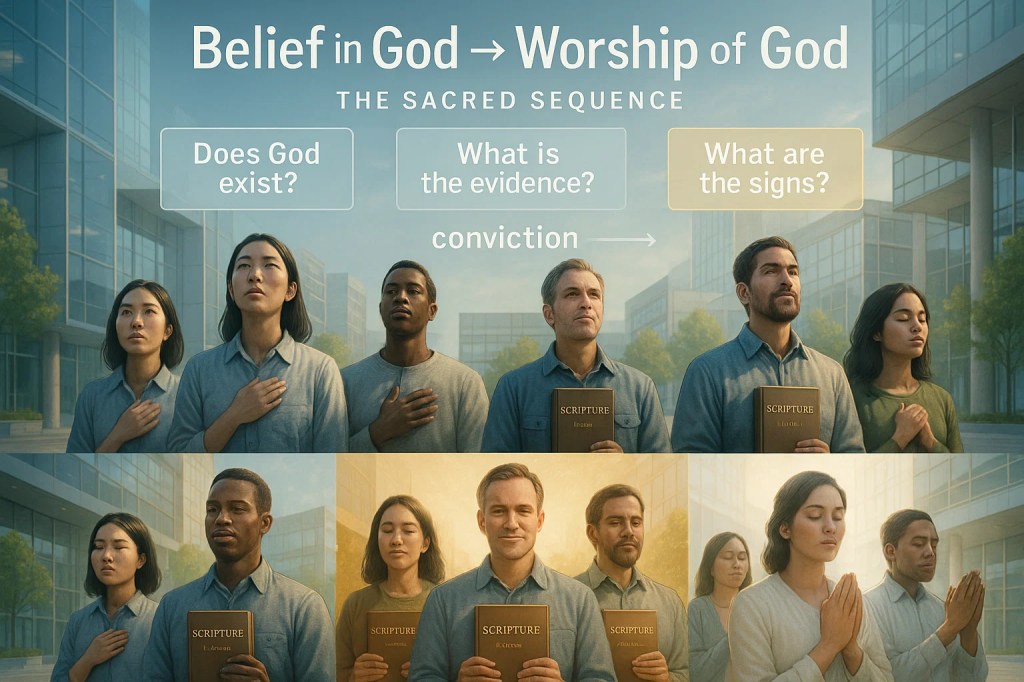
This is not merely an academic theological debate. The sequence of belief and action matters profoundly because it determines whether we are following God’s revealed methodology or inventing our own. When we encourage actions divorced from conviction, we are not helping people move toward faith—we are teaching them hypocrisy, conditioning them to perform religious motions without spiritual substance. The Quran is unambiguous on this matter: belief in God must precede worship of God. To reverse this order is to undermine the very foundation of faith itself.
This article will systematically demonstrate why the “actions before belief” approach contradicts Quranic teaching, prophetic methodology, the nature of prayer itself, and basic logic. We will examine what the scripture actually says about the proper sequence of faith development, how every prophet approached their mission, what worship truly means, and why reversing this order leads not to guidance but to the characteristics of hypocrisy that the Quran explicitly condemns.
Part 1: The Quranic Order is Sacred and Unchangeable
The Consistent Pattern Throughout Scripture
Throughout the entire Quran, without a single exception, the pattern is absolutely consistent: belief in God precedes acts of worship. This is not coincidental or arbitrary—this sequence represents the divine methodology for spiritual development. When we examine how God describes the righteous, the guided, and the successful, we find that conviction always forms the foundation upon which actions are built.
The opening chapter of the Quran after Al-Fatihah establishes this pattern immediately and unambiguously. Notice the precise sequence in the description of the righteous:
[2:2] “This scripture is infallible; a beacon for the righteous;”
[2:3] “who believe in the unseen, observe the Contact Prayers (Salat), and from our provisions to them, they give to charity.”
[2:4] “And they believe in what was revealed to you, and in what was revealed before you, and with regard to the Hereafter, they are absolutely certain.”
[2:5] “These are guided by their Lord; these are the winners.”
The structure is deliberate and instructive. First comes belief—”believe in the unseen.” Only then does the observance of Contact Prayers follow. The Quran doesn’t say “observe the prayers so that you might eventually believe in the unseen.” It doesn’t suggest “start praying and belief will follow.” The sequence is explicit: they believe, and then, as believers, they observe the prayers. This is the description of those who are “guided by their Lord” and who are “the winners.” The guidance comes through the proper sequence.
The Comprehensive Definition of Righteousness
Later in the same chapter, God provides perhaps the most comprehensive definition of righteousness in the entire Quran. This verse is remarkable not only for its thoroughness but for its unwavering adherence to the belief-then-action sequence:
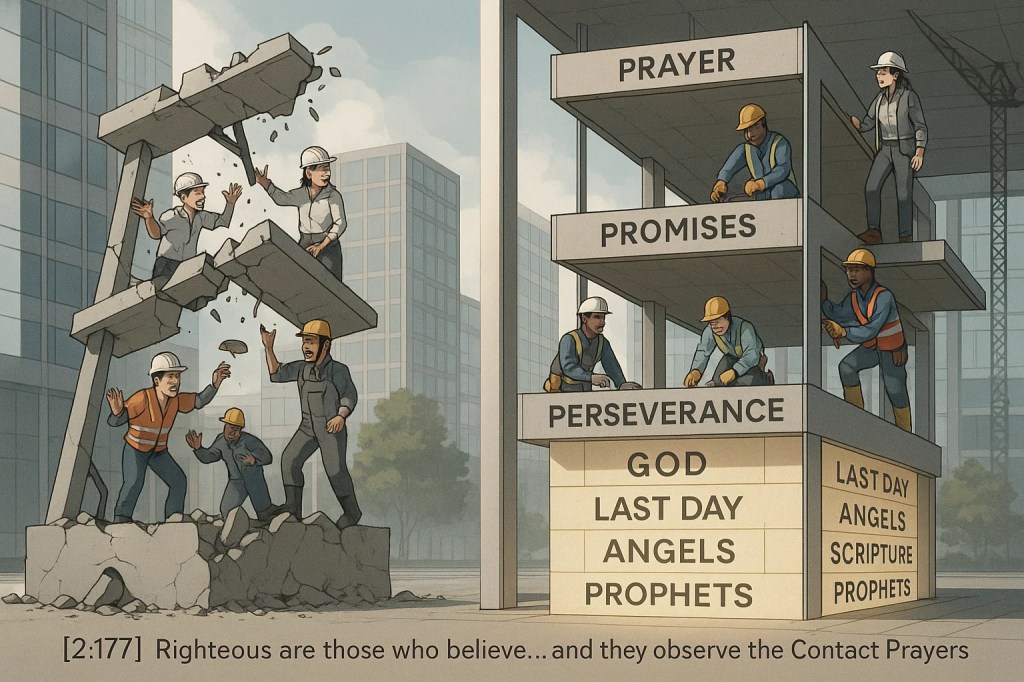
[2:177] “Righteousness is not turning your faces towards the east or the west. Righteous are those who believe in God, the Last Day, the angels, the scripture, and the prophets; and they give the money, cheerfully, to the relatives, the orphans, the needy, the traveling alien, the beggars, and to free the slaves; and they observe the Contact Prayers (Salat) and give the obligatory charity (Zakat); and they keep their word whenever they make a promise; and they steadfastly persevere in the face of persecution, hardship, and war. These are the truthful; these are the righteous.”
This verse is a masterclass in divine prioritization. God begins by dismissing superficial directional rituals and instead defines true righteousness. Notice what comes first: “those who believe in God, the Last Day, the angels, the scripture, and the prophets.” Only after establishing this foundation of comprehensive belief does God mention the actions: giving money to charity, observing the Contact Prayers, giving the obligatory charity, keeping promises, and persevering through hardship. The belief component is not just mentioned first—it is the qualifying characteristic that makes all subsequent actions meaningful. Without belief in God, the Last Day, the angels, the scripture, and the prophets, the performance of these actions would not constitute righteousness at all.
This is not merely a chronological description of what righteous people happen to do. It is a definitional statement about what righteousness actually is. The actions—prayer, charity, promise-keeping, perseverance—are manifestations of an existing belief structure, not techniques for creating belief. To encourage an atheist to perform the actions while lacking the belief is to encourage them to perform a hollow imitation of righteousness, not righteousness itself.
Part 2: Every Prophet’s Methodology—Belief First, Always
The Universal Message of All Messengers
If the “actions before belief” approach were valid, we would expect to find at least one prophet in the Quran who employed this methodology. We would expect to find a messenger who said to his disbelieving people: “Start performing these worship rituals, and perhaps belief will follow.” But we find no such example. Instead, every single prophet mentioned in the Quran began their mission with the same fundamental call: believe in and worship the One God. The rituals, the laws, the detailed practices—these came only after the foundation of belief was established.
The Quran explicitly tells us that every messenger delivered the same primary message:
[16:36] “We have sent a messenger to every community, saying, ‘You shall worship God, and avoid idolatry.’ Subsequently, some were guided by God, while others were committed to straying. Roam the earth and note the consequences for the rejectors.”
[21:25] “We did not send any messenger before you except with the inspiration: ‘There is no god except Me; you shall worship Me alone.’”
The message is identical across all messengers and all communities: worship God alone. But notice what this presupposes: you cannot worship what you don’t believe exists. The call to worship is inherently a call to believe in the One being worshiped. Every messenger’s first task was to establish conviction in God’s existence and oneness. Only then could worship have any meaning.
Examining Individual Prophets
When we look at specific prophets, the pattern is unmistakable. Noah’s message to his people was direct and foundational:
[7:59] “We sent Noah to his people, saying, ‘O my people, worship God; you have no other god beside Him. I fear for you the retribution of an awesome day.’”
[71:1] “We sent Noah to his people: ‘You shall warn your people before a painful retribution afflicts them.’”
[71:2] “He said, ‘O my people, I am a manifest warner to you.’”
[71:3] “‘To alert you that you shall worship God, reverence Him, and obey me.’”
Noah didn’t say “Start performing these worship movements and maybe you’ll come to believe.” His message was “worship God”—which presupposes belief in God. He called them to recognize God’s existence and authority, to reverence Him, and only then to obey the messenger’s instructions. The sequence is: belief in God → reverence for God → obedience to divine commands.
The same pattern appears with Hud, sent to the people of ‘Ad:
[7:65] “To ‘Ãd we sent their brother Hûd. He said, ‘O my people, worship God; you have no other god beside Him. Would you then observe righteousness?’”
And with Saleh, sent to Thamud:
[7:73] “To Thamûd we sent their brother Sãleh. He said, ‘O my people, worship God; you have no other god beside Him. Proof has been provided for you from your Lord: here is God’s camel, to serve as a sign for you. Let her eat from God’s land, and do not touch her with any harm, lest you incur a painful retribution.’”
Every prophet’s methodology was identical: establish belief in the One God first. The proof, the signs, the warnings—all of these were designed to create conviction. The worship practices, the specific laws, the detailed rituals—these came after belief was established. Never once did a prophet say to confirmed atheists, “Perform these worship rituals as a step toward believing.”

Part 3: What Is Prayer? Remembrance Requires Belief
The Essential Nature of Salat
To understand why an atheist cannot meaningfully perform Islamic prayer, we must understand what prayer actually is. Prayer is not mere physical exercise. It is not stretching, or calisthenics, or a meditation technique divorced from its theological content. Islamic prayer—Salat—is fundamentally and irreducibly an act of remembering, acknowledging, and communicating with God. This is not our interpretation; this is what God Himself says about prayer:
[20:14] “‘I am God; there is no other god beside Me. You shall worship Me alone, and observe the Contact Prayers (Salat) to remember Me.’”
[29:45] “You shall recite what is revealed to you of the scripture, and observe the Contact Prayers (Salat), for the Contact Prayers prohibit evil and vice. But the remembrance of God (through Salat) is the most important objective. God knows everything you do.”
The purpose of prayer is explicitly stated: to remember God. Not to remember the concept of God, not to remember the possibility that God might exist, but to remember God Himself. The “most important objective” of prayer is “the remembrance of God.” How can an atheist—someone who denies God’s existence—remember God through prayer? You cannot remember what you believe does not exist. You cannot direct your attention toward a being whose reality you reject. The entire premise is logically incoherent.
The Logical Impossibility
Consider what happens during Islamic prayer. The worshiper begins with “Allahu Akbar”—God is great. An atheist saying these words is either lying or has ceased to be an atheist. The worshiper recites Al-Fatihah, which addresses God directly: “You alone we worship, You alone we ask for help, guide us in the right path.” An atheist speaking these words is engaging in performance, not prayer. Every word of prayer presupposes and declares belief in God’s existence, presence, awareness, and power.
This is why God says that hearts rejoice through remembrance:
[13:28] “They are the ones whose hearts rejoice in remembering God. Absolutely, by remembering God, the hearts rejoice.”
The joy comes from the remembrance of God—the conscious awareness of His presence, His attributes, His mercy. An atheist has no access to this joy because they have no belief in the One being remembered. They might experience the physical movements, the meditative rhythm, even a certain psychological calm from the routine, but they are not experiencing prayer as prayer is defined in the Quran. They are experiencing something fundamentally different—perhaps a form of ritual exercise or cultural practice, but not the remembrance of God that constitutes true Salat.
The Quran also tells us who actually frequents the places of prayer:
[9:18] “The only people to frequent God’s masjids are those who believe in God and the Last Day, and observe the Contact Prayers (Salat), and give the obligatory charity (Zakat), and do not fear except God. These will surely be among the guided ones.”
Notice the qualification: “those who believe in God and the Last Day.” Belief comes first. The masjids are frequented by believers who then observe the prayers. An atheist in a masjid performing prayer motions is not fulfilling this description. They lack the essential prerequisite: belief in God and the Last Day.
Part 4: The Hypocrites’ Prayer—Worship Without Conviction
The Quranic Description of Prayer Without Belief
The Quran does actually describe people who perform prayers without genuine belief in their hearts. But these people are not held up as positive examples on a journey toward faith. They are identified as hypocrites—munafiqun—and their prayers are described with condemnation, not encouragement. This is precisely what happens when actions are divorced from conviction:
[4:142] “The hypocrites think that they are deceiving God, but He is the One who leads them on. When they get up for the Contact Prayer (Salat), they get up lazily. That is because they only show off in front of the people, and rarely do they think of God.”
The hypocrites perform the prayers. They get up when it’s time to pray. They go through the motions. But their prayers are characterized by laziness, insincerity, and showing off—because they “rarely think of God.” Their actions are divorced from conviction. This is exactly what would happen if an atheist were to perform Islamic prayer: they would be going through motions without conviction, performing for an audience (perhaps themselves, perhaps others) rather than genuinely engaging in remembrance of God.
The Quran is even more severe in its condemnation of those who pray without proper consciousness and sincerity:
[107:4] “And woe to those who observe the contact prayers (Salat)—”
[107:5] “who are totally heedless of their prayers.”
[107:6] “They only show off.”
Read that carefully. “Woe to those who observe the contact prayers.” The performance of prayer itself, when done with heedlessness and for show, earns not divine pleasure but divine woe. An atheist performing Islamic prayer is by definition heedless—they cannot be mindful of a God they don’t believe exists. They can only be showing off, whether to others or to themselves, performing a cultural ritual divorced from its theological essence.
When Prayer Becomes Mockery
The Quran also describes a historical situation where prayers were performed by those who lacked proper belief, and it calls these prayers “mockery”:
[8:35] “Their Contact Prayers (Salat) at the shrine (Ka’bah) were no more than a mockery and a means of repelling the people (by crowding them out). Therefore, suffer the retribution for your disbelief.”
When prayer is performed without the proper foundation of belief, it doesn’t constitute worship—it constitutes mockery. It becomes a means of repelling people, not attracting them to faith. This is what happens when we reverse the divine order: instead of guiding people toward genuine faith, we teach them to mock the very practices we claim to honor.
The Quran also warns against taking religion as play and amusement:
[6:70] “You shall disregard those who take their religion in vain, as if it is a social function, and are totally absorbed in this worldly life. Remind with this (Quran), lest a soul may suffer the consequences of its evil earnings. It has none beside God as a Lord and Master, nor an intercessor. If it could offer any kind of ransom, it would not be accepted. They suffer the consequences of the evil works they earn; they have incurred hellish drinks, and a painful retribution because of their disbelief.”
[7:51] “Those who do not take their religion seriously, and are totally preoccupied with this worldly life, we forget them on that day, because they forgot that day, and because they spurned our revelations.”
An atheist performing Islamic prayer is taking religion as a social function, as play, as an experiment. They cannot take it seriously as worship because they don’t believe in the One being worshiped. To encourage this is not to guide them toward faith—it is to condition them in treating divine revelation as a game.

Part 5: The “Crawl Before Walk” Fallacy—A Backwards Analogy
Understanding the Analogy Correctly
Proponents of the “actions before belief” approach often invoke the analogy of “crawling before walking,” suggesting that performing Islamic rituals is the “crawling” stage that naturally precedes the “walking” stage of genuine belief. This analogy is not only flawed—it is precisely backwards. To understand why, we need to examine what crawling and walking actually represent in the spiritual journey.
In the physical development of a child, crawling and walking are both forms of locomotion built on the same fundamental foundation: a body with bones, muscles, a nervous system, and the basic physical capacity for movement. A child doesn’t develop legs by crawling; they crawl because they already have the foundational physical equipment that will eventually enable walking. The progression from crawling to walking is a progression in sophistication of movement within an already-established physical framework.
In the spiritual realm, the foundational framework is belief. Belief in God is not the advanced stage that comes after ritual practice—it is the foundation that makes ritual practice meaningful. Using the crawling-walking analogy correctly, we would say: belief is the body itself, basic actions are crawling, and sophisticated practice is walking. You cannot crawl without a body, and you cannot perform meaningful worship without belief.
The Correct Analogies: Foundation and Building
A more accurate analogy comes from construction: you cannot build a house starting with the roof. You must begin with the foundation. Belief in God is the foundation; prayer, charity, fasting, and other practices are the building constructed on that foundation. No matter how skilled a builder you are, attempting to construct the upper floors before laying the foundation results in collapse, not success. This is exactly what happens when we encourage ritual practice before establishing belief: we build on nothing, and the structure cannot stand.
Another accurate analogy: you cannot teach someone to dive before teaching them to swim. Diving is a more advanced aquatic skill that presupposes swimming ability. Someone who cannot swim, if pushed off a diving board, will not gradually learn to dive through repeated attempts—they will drown or, at best, develop a fear of water. Similarly, pushing an atheist into Islamic prayer rituals doesn’t gradually cultivate genuine worship; it cultivates either resentment or hollow performance.
The Quran itself uses the foundation metaphor when describing the proper approach to religion:
[7:29] “Say, ‘My Lord advocates justice, and to stand devoted to Him alone at every place of worship. You shall devote your worship absolutely to Him alone. Just as He initiated you, you will ultimately go back to Him.’”
Worship must be devoted to God alone—which presupposes belief that God exists. The devotion is absolute, not experimental. You cannot “absolutely devote” yourself to a being whose existence you deny. The foundation must be in place: conviction in God’s reality. Only then can worship be built upon it.
What “Meeting People Where They Are” Actually Means
Another common argument is that encouraging atheists to pray represents “meeting people where they are.” But this misunderstands what that principle actually means. Meeting people where they are means addressing their current level of understanding and their current questions—not skipping over their foundational issues to rush them into advanced practices they cannot genuinely perform.
If someone is at the stage of atheism—denial of God’s existence—then meeting them where they are means addressing that denial. It means engaging with their questions about God’s existence, presenting evidence for God’s reality, discussing the logical implications of design, purpose, and consciousness. It means pointing them to the Quran’s own arguments for God’s existence and the signs in creation. What it does not mean is pretending they are already past the belief stage and moving them into worship practices that presuppose what they explicitly reject.
The Quran acknowledges that some people’s hearts are sealed to belief:
[2:6] “As for those who disbelieve, it is the same for them; whether you warn them, or not warn them, they cannot believe.”
[2:7] “God seals their minds and their hearing, and their eyes are veiled. They have incurred severe retribution.”
Some people will not believe no matter what approach is taken. The solution to this is not to have them pretend to be believers through ritual performance. The solution is to recognize that guidance comes from God, not from us, and our job is to present the message clearly, not to manipulate people into religious motions divorced from religious conviction.
Part 6: No Compulsion in Religion—The Difference Between Teaching and Compelling
The Quranic Prohibition on Compulsion
One of the most fundamental principles in the Quran is the prohibition against compulsion in religion. God makes this absolutely clear:
[2:256] “There shall be no compulsion in religion: the right way is now distinct from the wrong way. Anyone who denounces the devil and believes in God has grasped the strongest bond; one that never breaks. God is Hearer, Omniscient.”
Notice the structure of this verse. First, the prohibition: “There shall be no compulsion in religion.” Then the reason: “the right way is now distinct from the wrong way.” The truth is clear, so compulsion is unnecessary and inappropriate. Then, the proper sequence: “denounces the devil and believes in God.” Only after belief is established does one grasp “the strongest bond.” The bond is not grasped through actions divorced from belief; it is grasped through belief itself.
God reinforces this principle by telling the Prophet Muhammad himself that he cannot force people to believe:
[10:99] “Had your Lord willed, all the people on earth would have believed. Do you want to force the people to become believers?”
[88:21] “You shall remind, for your mission is to deliver this reminder.”
[88:22] “You have no power over them.”
The messenger’s job is to remind, to deliver the message clearly. He has no power to compel belief. If the Prophet himself—the recipient of revelation—had no power to force people to believe, what makes us think we can guide atheists to belief by having them perform worship rituals they cannot authentically engage in?
The Distinction: Teaching Believers vs. Compelling Atheists
There is a crucial distinction between teaching worship practices to those who already believe and encouraging worship practices as a supposed path to belief. The Quran does describe teaching rituals—but notice to whom this teaching is directed:
[2:128] “‘Our Lord, make us submitters to You, and from our descendants let there be a community of submitters to You. Teach us the rites of our religion, and redeem us. You are the Redeemer, Most Merciful.’”
[2:129] “‘Our Lord, and raise among them a messenger to recite to them Your revelations, teach them the scripture and wisdom, and purify them. You are the Almighty, Most Wise.’”
Abraham and Ishmael pray for a community of submitters—people who have already submitted to God—and they ask that these submitters be taught the rites of religion. The messenger is raised to teach “them”—the believers—the scripture and wisdom. The rites are taught to those who are already submitters. First comes submission (belief), then comes the teaching of rites.
This is not compulsion; it’s education. It’s the natural and necessary instruction that believers need to worship correctly. But this presupposes the belief is already established. Teaching a believer how to pray is completely different from telling an atheist to perform prayers as a means of cultivating belief. The first is education in worship; the second is encouragement of hypocrisy.

Part 7: Worship Must Be Exclusively for God—The Requirement of Sincerity
The Quranic Emphasis on Exclusive Devotion
Throughout the Quran, God emphasizes that worship must be devoted exclusively to Him alone. This exclusivity is not just about avoiding polytheism—it’s also about the sincerity and purity of intention in worship. The Arabic concept of “mukhlis” (making pure, sincere) appears repeatedly when God describes acceptable worship:
[98:5] “All that was asked of them was to worship God, devoting the religion absolutely to Him alone, observe the contact prayers (Salat), and give the obligatory charity (Zakat). Such is the perfect religion.”
[39:11] “Say, ‘I have been commanded to worship God, devoting the religion absolutely to Him alone.’”
[39:14] “Say, ‘God is the only One I worship, devoting my religion absolutely to Him alone.’”
The worship must be devoted “absolutely” to God alone. The religion must be “pure” and “sincere.” But how can an atheist devote their worship absolutely to God when they don’t believe God exists? How can they make their religion pure for God when they deny God’s reality? The entire concept is contradictory. Worship divorced from belief cannot be sincere, cannot be pure, cannot be exclusively devoted to God—because it is not devoted to God at all. It is devoted to the performance itself, to the social experience, to personal experimentation, or to some other purpose entirely.
What Happens Without Sincerity
The Quran is clear about what God thinks of those who set up rivals beside Him or who fail to devote their worship sincerely to Him alone:
[39:3] “Absolutely, the religion shall be devoted to God alone. Those who set up idols beside Him say, ‘We idolize them only to bring us closer to God; for they are in a better position!’ God will judge them regarding their disputes. God does not guide such liars, disbelievers.”
Notice the harsh language: “God does not guide such liars, disbelievers.” When worship is not exclusively and sincerely for God, God does not guide those performing it. The idea that performing insincere worship will somehow lead to guidance contradicts this verse directly. God does not guide people who perform religious acts without true devotion to Him. An atheist performing Islamic prayer is, by definition, not devoting their worship to God—they’re experimenting with a practice while denying the very existence of the One the practice is designed to worship.
The Quran also addresses those who merely submit externally without internal belief:
[49:14] “The Arabs said, ‘We are Mu’mens (believers).’ Say, ‘You have not believed; what you should say is, ‘We are Muslims (submitters),’ until belief is established in your hearts.’ If you obey God and His messenger, He will not put any of your works to waste. God is Forgiver, Most Merciful.”
Even those who outwardly submit—performing the external practices—are told they have not believed until “belief is established in your hearts.” External submission without internal belief is not enough. The heart must believe. Only then do the works have value. An atheist performing prayers has not even reached the level of outward submission with potential for inner belief—they are performing motions while explicitly maintaining disbelief. Their works have no spiritual value because they are divorced from the essential foundation: conviction in God’s reality.
Part 8: What Is Righteousness? Both Belief and Action Required
The Inseparable Nature of Belief and Action
One of the arguments made by those who encourage atheists to pray is that they are “advocating righteousness.” But this fundamentally misunderstands what righteousness actually is. Righteousness is not action alone. Righteousness is not belief alone. Righteousness is the inseparable combination of both, with belief forming the necessary foundation that makes the actions meaningful.
We’ve already examined verse 2:177, which provides the comprehensive definition of righteousness. Let’s revisit it with this specific focus:
[2:177] “Righteousness is not turning your faces towards the east or the west. Righteous are those who believe in God, the Last Day, the angels, the scripture, and the prophets; and they give the money, cheerfully, to the relatives, the orphans, the needy, the traveling alien, the beggars, and to free the slaves; and they observe the Contact Prayers (Salat) and give the obligatory charity (Zakat); and they keep their word whenever they make a promise; and they steadfastly persevere in the face of persecution, hardship, and war. These are the truthful; these are the righteous.”
Righteousness requires both components: belief (in God, the Last Day, the angels, the scripture, and the prophets) and action (giving money, observing prayers, giving charity, keeping promises, persevering). Remove either component and you no longer have righteousness. An atheist performing the actions lacks the belief component, so their performance does not constitute righteousness—it constitutes hollow imitation.
Action Divorced from Belief Is Not Righteousness
Consider an analogy: If someone gives money to charity not out of genuine compassion or obedience to God, but purely as a tax write-off or for social status, is that act righteous? Most would say no—the action is tainted by the impure motivation. Similarly, if someone performs Islamic prayer not out of belief in God and devotion to Him, but as an experiment in ritual practice or as a cultural experience, that act is not righteous. It lacks the essential component that makes it righteousness: sincere devotion to God based on conviction in His reality.
The Quran makes it clear that intentions matter:
[7:29] “Say, ‘My Lord advocates justice, and to stand devoted to Him alone at every place of worship. You shall devote your worship absolutely to Him alone. Just as He initiated you, you will ultimately go back to Him.’”
Worship must be “devoted to Him alone” and this devotion must be “absolute.” An atheist cannot absolutely devote their worship to a being they don’t believe exists. Therefore, their performance of worship motions, whatever other value it might have (exercise, cultural education, meditation), does not constitute the righteousness that God describes in His scripture.
To tell an atheist that performing prayers is “righteousness” is to lie to them about what righteousness actually is. It conditions them to believe that external conformity to religious practices constitutes righteousness regardless of internal conviction. This is precisely the hypocrisy that the Quran condemns.
Part 9: The Logical Incoherence—Can an Atheist Truly Want to Worship?
Examining the Premise
The argument for encouraging atheists to pray often includes the phrase “we shouldn’t assume bad intentions when an atheist wants to pray.” But this phrase itself contains a logical incoherence that deserves examination: Can an atheist genuinely want to pray—to worship God—while maintaining their atheism? And if they do express such a want, what does that actually mean?
Islamic prayer is not meditation. It is not stretching. It is not a cultural ritual divorced from theological content. Islamic prayer is the worship of God—direct communication with, submission to, and remembrance of the Creator. Every word of the prayer declares and presupposes God’s existence, presence, awareness, and power. To say “I want to pray to God” is to say “I want to worship, submit to, and communicate with God.” But an atheist, by definition, denies God’s existence.
So when an atheist says they want to “pray,” what are they actually expressing? They might be expressing curiosity about the cultural practice, interest in the meditative aspects, desire to fit in with a Muslim community, or openness to reconsidering their atheism. These are all legitimate states of mind. But they are not “wanting to worship God.” You cannot want to worship what you believe doesn’t exist. At best, you can want to experiment with a practice, or you can be reconsidering your disbelief.
The Two Possible Scenarios
If an atheist expresses interest in Islamic prayer, there are two possible scenarios:
Scenario One: They are no longer actually atheists. They have begun to question their disbelief, to consider the possibility of God’s existence, to feel drawn toward faith. In this case, they are not atheists; they are seekers. And seekers should be met where they are: at the stage of questioning, considering, and examining the evidence for God’s existence. The conversation should be about belief, evidence, logic, revelation, signs—not about jumping ahead to worship practices that they are not yet ready to perform with sincerity. Once their questions are addressed and belief is established, then—and only then—should worship practices be taught and encouraged.
Scenario Two: They remain committed atheists but are interested in the practice from an external, observational, or experimental perspective. They want to experience what Muslims do, understand the culture, or try the ritual out of curiosity. This is not “wanting to worship God”—this is wanting to observe, experiment, or participate in a cultural practice. In this case, honesty requires acknowledging what they’re actually doing: they’re engaging in cultural anthropology, personal experimentation, or meditation, not worship. They can be educated about what prayer is, what it means, what it requires—but they should not be told that their performance constitutes worship or righteousness, and they should not be encouraged to believe that performing these motions while maintaining disbelief is a path to genuine faith.
The Problem with “Not Assuming Bad Intentions”
The phrase “we shouldn’t assume bad intentions” is often used to suggest that questioning an atheist’s desire to pray is being judgmental or harsh. But this misses the point entirely. It’s not about assuming bad intentions—it’s about acknowledging reality. An atheist performing Islamic prayer without belief in God cannot be performing sincere worship because sincere worship requires belief. This is not a judgment of their character or intentions; it’s a recognition of logical and theological reality.
Moreover, the Quran itself instructs us to recognize reality about people’s beliefs:
[49:14] “The Arabs said, ‘We are Mu’mens (believers).’ Say, ‘You have not believed; what you should say is, ‘We are Muslims (submitters),’ until belief is established in your hearts.’ If you obey God and His messenger, He will not put any of your works to waste. God is Forgiver, Most Merciful.”
God instructs the Prophet to correct people’s self-identification when it doesn’t match reality. These Arabs claimed to be believers, but they were told “You have not believed” because belief had not been established in their hearts. This is not “assuming bad intentions”—it’s acknowledging the truth about the state of their hearts. Similarly, when an atheist wants to perform prayers, we can acknowledge the truth: without belief in God, they cannot be performing worship, they cannot be engaging in righteousness, and they are not on the path the Quran prescribes. This acknowledgment is not harsh or judgmental—it’s honest, and honesty is what genuine guidance requires.

Part 10: The Danger of Reversing the Order—What We Actually Teach
Conditioning People in Hypocrisy
When we encourage atheists to perform Islamic prayers as a supposed step toward belief, we are not guiding them toward genuine faith—we are conditioning them in the very characteristics that the Quran condemns in hypocrites. We are teaching them that external conformity to religious practice is acceptable regardless of internal conviction. We are normalizing the divorce of action from belief. We are training them to perform worship motions while their hearts remain disconnected from the One being worshiped.
The result is not eventual sincere faith—it’s habitual insincerity. It’s the development of religious muscle memory divorced from spiritual substance. It’s the creation of people who know how to look like they’re praying but who have never learned what prayer actually is: sincere devotion to God based on conviction in His reality.
The Quran describes this exact phenomenon in the hypocrites:
[4:142] “The hypocrites think that they are deceiving God, but He is the One who leads them on. When they get up for the Contact Prayer (Salat), they get up lazily. That is because they only show off in front of the people, and rarely do they think of God.”
The hypocrites perform prayers. They get up when it’s time to pray. They go through the motions. But their prayers are characterized by laziness and showing off because they “rarely think of God.” This is what happens when you condition people to perform worship divorced from conviction: they become experts at the performance while remaining strangers to genuine devotion.
Undermining the Foundation of Faith
Perhaps even more damaging than teaching individual atheists to perform hollow rituals is what this approach does to the broader understanding of faith itself. When we suggest that actions can precede belief, that worship can be divorced from conviction, that righteousness can exist without faith, we undermine the entire foundation of religion as the Quran presents it.
The Quran is absolutely consistent: belief is the foundation, actions are the building. Belief in God is not the advanced stage you eventually reach after practicing rituals—it is the essential starting point without which the rituals have no meaning. When we reverse this order, we’re not just making a methodological mistake; we’re contradicting the divine methodology established by every prophet and confirmed throughout scripture.
This reversed approach also fundamentally misunderstands the nature of guidance. Guidance is not a mechanical process where performing certain actions automatically produces certain internal states. Guidance comes from God:
[39:3] “Absolutely, the religion shall be devoted to God alone. Those who set up idols beside Him say, ‘We idolize them only to bring us closer to God; for they are in a better position!’ God will judge them regarding their disputes. God does not guide such liars, disbelievers.”
God does not guide those who perform religious acts without sincere devotion to Him alone. The idea that we can guide atheists to belief by having them perform worship practices contradicts this verse. God guides whom He wills, and He guides through the proper sequence: evidence, contemplation, conviction, then worship.
What We Should Do Instead
Instead of encouraging atheists to perform prayers they cannot authentically engage in, we should do what every prophet did: call them to belief in God first. Present the evidence for God’s existence. Point them to the signs in creation, in their own selves, in the mathematical miracle of the Quran. Engage with their questions and objections. Help them think through the logical implications of design, purpose, consciousness, and moral law. Share the Quran’s own arguments for God’s reality.
This is what God commands us to do:
[88:21] “You shall remind, for your mission is to deliver this reminder.”
[88:22] “You have no power over them.”
Our job is to remind—to present the message clearly. We have no power to force belief, and we have no business encouraging practices that presuppose belief before belief is established. Once an atheist becomes convinced of God’s reality—once they transition from atheist to believer—then we teach them how to worship. Then we show them the beauty and structure of the Contact Prayers. Then we guide them in the practices of their newly embraced faith.
This is not harsh. This is not judgmental. This is honest, logical, and faithful to the divine methodology that every messenger of God followed without exception.
Conclusion: The Only Path Forward
The argument that atheists should perform Islamic prayers as a step toward belief represents a fundamental reversal of the Quranic methodology. It contradicts the explicit sequence presented in verse after verse, where belief in God always precedes worship of God. It contradicts the universal approach of every prophet mentioned in the Quran, all of whom began their missions by calling people to believe in and worship the One God—never by encouraging ritual practice before establishing conviction. It contradicts the very nature of prayer itself, which the Quran defines as remembrance of God—an impossibility for one who denies God’s existence.
This reversed approach does not lead to genuine faith. Instead, it conditions people in the characteristics of hypocrisy: performing worship motions without conviction, showing off rather than sincerely remembering God, taking religion as play rather than serious devotion. The Quran condemns these characteristics in the harshest terms, describing such prayers as earning “woe,” as “mockery,” as worthy of retribution rather than reward.
The proper sequence is not negotiable because it is not our invention—it is God’s revealed methodology. First comes belief: conviction in God’s existence, oneness, and attributes. This belief is cultivated through evidence, contemplation, and divine guidance—not through performing rituals one doesn’t understand or believe in. Once belief is established in the heart, then come the actions: prayer, charity, fasting, and all the other practices that express and strengthen that belief.
Righteousness is not action alone. It is not belief alone. It is the inseparable combination of both, with belief as the essential foundation. An atheist performing prayers may be engaging in cultural exploration, meditative exercise, or curious experimentation, but they are not engaging in worship and they are not practicing righteousness. To suggest otherwise is to redefine righteousness in a way that contradicts the Quran’s explicit definition.
When an atheist expresses interest in Islamic prayer, the honest and compassionate response is not to encourage them to perform motions divorced from conviction. The honest response is to address where they actually are: at the stage of disbelief or questioning. Engage with their questions about God’s existence. Present the evidence and the arguments. Point them to the signs that God Himself points to in the Quran. Help them think through the implications of what they observe in creation, consciousness, and revelation. This is what meeting people where they are actually means.
If and when their questions are answered, their objections addressed, and their hearts become convinced of God’s reality, then—at that precise moment—they are no longer atheists. They are believers. And believers should absolutely be taught how to worship, how to pray, how to express their newfound faith through the beautiful practices that God has prescribed. But not before. Never before.
The foundation must be laid before the building is constructed. The body must exist before crawling and walking can occur. Swimming must be learned before diving can be taught. And belief in God must be established before worship of God can be meaningful. This is not our opinion—this is the consistent, unambiguous, universal methodology of every prophet, confirmed in verse after verse, forming the very structure of how the Quran describes the righteous.
To reverse this order is not to innovate a better path to faith. It is to abandon the divine methodology in favor of our own ideas. It is to contradict what God has revealed about the nature of righteousness, the purpose of prayer, the characteristics of hypocrisy, and the proper sequence of spiritual development. It is to risk conditioning people in hollow performance rather than guiding them to genuine conviction.
The Quran is clear. The prophets were consistent. The logic is inescapable. The sequence is sacred: belief first, always.

 Quran Only Studies
Leave a comment