
Introduction: The Gravity of Scriptural Integrity
Among the most grievous distortions imposed upon the Quran is the claim that it permits child marriage – a fabrication that contradicts the scripture’s explicit requirements for maturity, consent, and contractual capability. This comprehensive analysis will demonstrate through irrefutable Quranic evidence that marriage in Islam requires adult women who have reached physical and mental maturity, not children who lack the capacity for such profound commitments. The distinction between “woman” (امرأة – imra’ah) and “child” (طفل – tifl) in the Quran is deliberate, consistent, and legally binding.
The Final Testament, God’s authorized English translation through Rashad Khalifa, preserves these critical distinctions that have been obscured by cultural practices and hadith fabrications. Through linguistic analysis of Arabic roots, examination of legal requirements, and cross-referencing of interconnected verses, we will establish that the Quran’s position is unambiguous: marriage is a contract between mature adults, specifically requiring women who can consent, manage their affairs, and fulfill marital responsibilities. Any interpretation suggesting children can marry stands in direct violation of multiple Quranic principles.
Part 1: The Maturity Mandate – Verse 4:6’s Legal Framework
Establishing the Foundation of Contractual Capacity
The Quran establishes an unbreakable link between maturity and the ability to enter contracts, with verse 4:6 serving as the cornerstone of this legal principle. This verse doesn’t merely suggest maturity; it mandates it as a prerequisite for managing one’s affairs:
[4:6] “You shall test the orphans when they reach puberty. As soon as you find them mature enough, give them their property. Do not consume it extravagantly in a hurry, before they grow up. The rich guardian shall not charge any wage, but the poor guardian may charge equitably. When you give them their properties, you shall have witnesses. God suffices as Reckoner.”
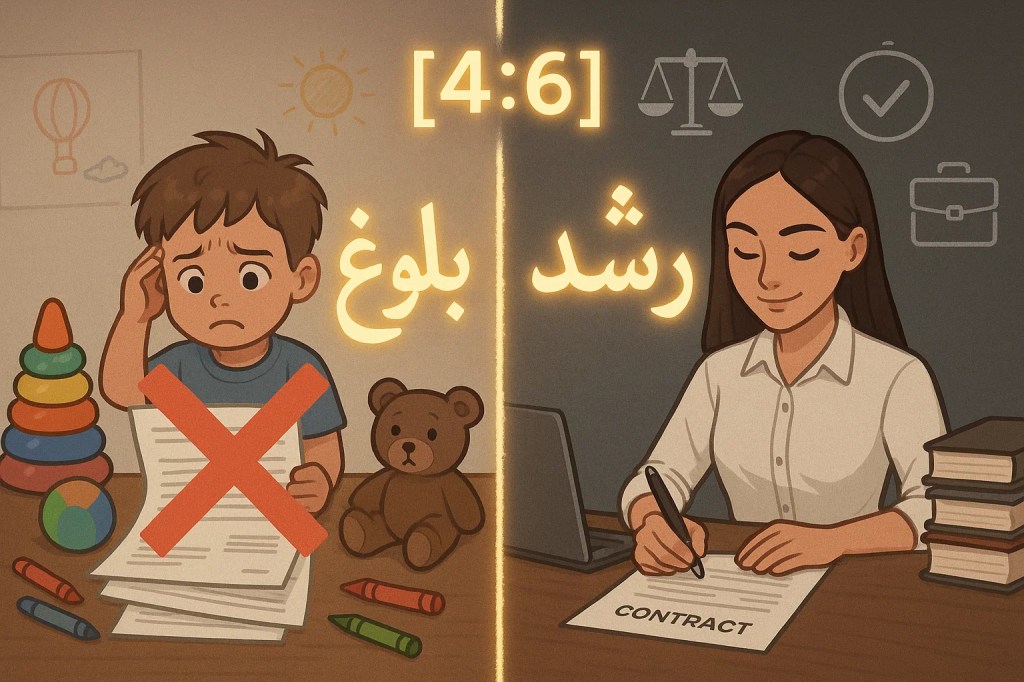
The Arabic phrase “بَلَغُوا النِّكَاحَ” (balaghoo an-nikah) literally means “they reach marriageability,” directly linking the age of marriage to the attainment of maturity. The root ب-ل-غ (ba-lam-ghayn) signifies reaching, attaining, or arriving at a destination – in this context, the destination is full maturity. The verse then adds another crucial requirement: “رُشْدًا” (rushdan), meaning sound judgment or intellectual maturity, from the root ر-ش-د (ra-sheen-dal) which encompasses guidance, right direction, and wisdom.
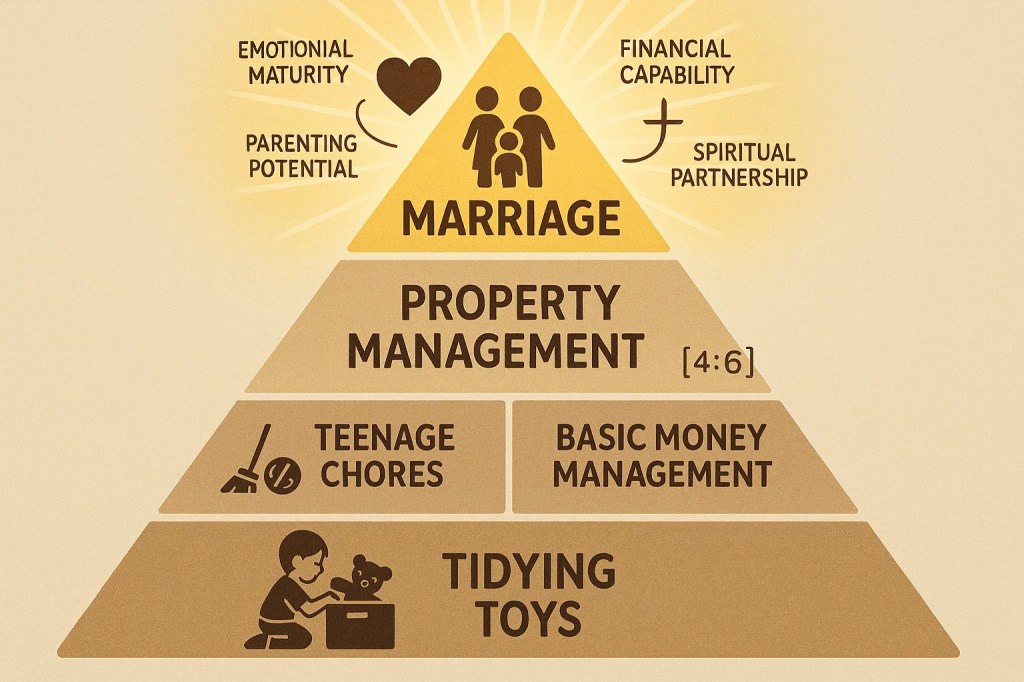
This dual requirement – reaching physical maturity (buloogh) and demonstrating sound judgment (rushd) – establishes that even reaching puberty alone is insufficient. The Quran demands evidence of mental and emotional maturity before entrusting orphans with their property. If God requires such stringent criteria for property management, how could marriage – a more complex and consequential contract involving another person’s rights, intimate relations, and lifelong commitments – require anything less? The logical hierarchy is clear: if one cannot manage property without proven maturity, one certainly cannot enter the marriage contract.
Part 2: The Linguistic Distinction – Woman vs Child in Quranic Arabic
Analyzing the Root Meanings and Contextual Usage
The Quran’s linguistic precision in distinguishing between women and children demolishes any claim that children can be marriage partners. The Arabic word “امرأة” (imra’ah), consistently used for marriageable females, derives from the root م-ر-أ (meem-ra-hamza), which fundamentally relates to authority, command, and personhood. A woman (imra’ah) is literally “one who has authority over herself,” capable of making decisions and bearing responsibility for her actions. This etymological foundation alone precludes children, who by definition lack such autonomy.
Throughout the Quran, whenever marriage is discussed, the term used is invariably “women” (نساء – nisaa’ in plural, امرأة – imra’ah in singular), never “children” (أطفال – atfaal) or “girls” (بنات – banaat when referring to young daughters). This consistency spans hundreds of verses across all chapters. Consider verse 4:3’s marriage instruction:
[4:3] “If you deem it best for the orphans, you may marry their mothers—you may marry two, three, or four. If you fear lest you become unfair, then you shall be content with only one, or with what you already have. Additionally, you are thus more likely to avoid financial hardship.”
The verse explicitly states “مِّنَ النِّسَاءِ” (min an-nisaa’i) – “from the women,” not from children or girls. This pattern repeats consistently: verse 4:25 discusses marrying “believing women,” verse 4:127 addresses the rights of “women,” and verse 24:32 encourages the marriage of single “people” using terms that denote adults. The Quran never once uses the word “child” (طفل – tifl) in any context related to marriage eligibility.
Even more telling is how the Quran explicitly describes children as those who have NOT reached the age of marriage awareness. Verse 24:31 mentions “الطِّفْلِ الَّذِينَ لَمْ يَظْهَرُوا عَلَىٰ عَوْرَاتِ النِّسَاءِ” (children who are not yet aware of women’s private aspects), clearly distinguishing children as a separate category from women, and explicitly stating they lack the awareness necessary for intimate relationships. Similarly, verse 24:59 mandates that when children reach puberty (الْحُلُمَ – al-hulum), they must begin asking permission before entering private spaces, marking their transition toward adulthood but not immediately conferring marriage eligibility.
Part 3: The Misunderstood Verse – Deconstructing 65:4
Grammatical Analysis and Contextual Clarity
Perhaps no verse has been more deliberately misinterpreted to justify child marriage than 65:4, which addresses waiting periods for divorce. Those who distort this verse claim it refers to children, but careful analysis of the Arabic grammar and context reveals this interpretation as impossible:
[65:4] “As for the women who have reached menopause, if you have any doubts, their interim shall be three months. As for those who do not menstruate, and discover that they are pregnant, their interim ends upon giving birth. Anyone who reverences God, He makes everything easy for him.”
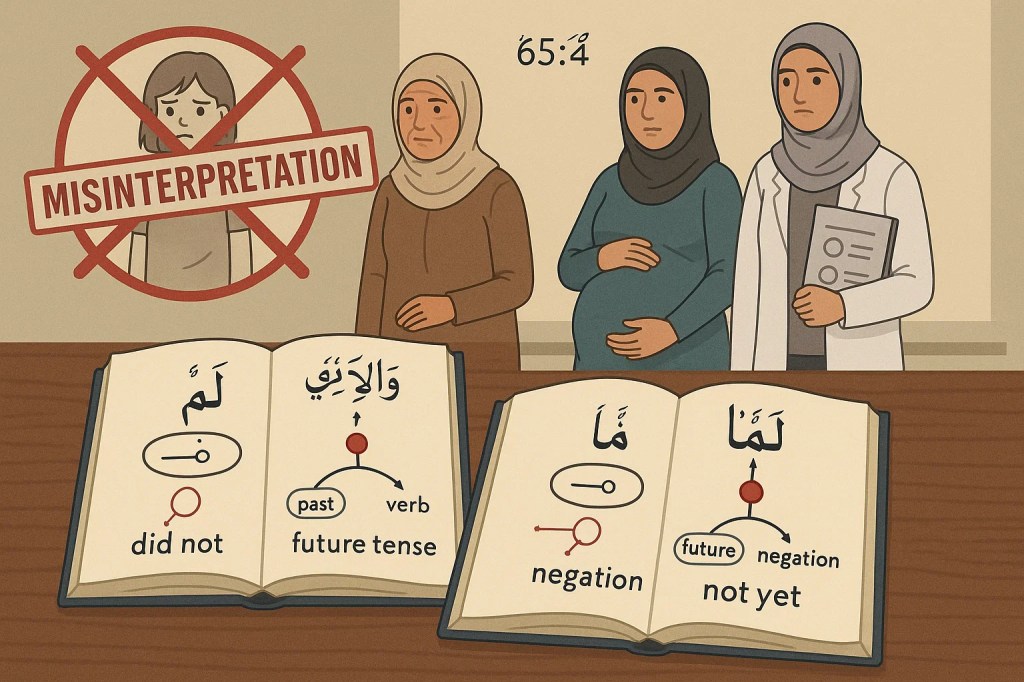
The phrase “وَاللَّائِي لَمْ يَحِضْنَ” (wa-allaa’ee lam yahidna) means “those who do not menstruate.” The critical grammatical element here is “لَمْ” (lam), which is a negation particle that describes a current state or recent past, not a permanent condition. If the verse meant “those who have never menstruated” (implying children), it would use “لَمَّا” (lamma) or “مَا” (maa) with the past tense. The use of “لَمْ” indicates a temporary or situational absence of menstruation.
Furthermore, the entire context of Chapter 65 (At-Talaaq – The Divorce) deals exclusively with adult women who are already married and now divorcing. The verse addresses three categories of divorcing women: (1) those past menopause, (2) those currently not menstruating (due to pregnancy, nursing, medical conditions, or other reasons), and (3) those who are pregnant. All three categories presuppose adult women who were married – children cannot be “divorcing women” because they cannot be married women in the first place.
The connecting phrase “and discover that they are pregnant” further confirms these are adult women. The verse is addressing the practical issue of determining waiting periods for women whose menstrual cycles are unclear – either because they’ve stopped due to age (menopause) or are temporarily suspended (pregnancy, nursing, medical conditions). The grammar, context, and logic all point to adult women in specific physiological situations, not children who have never menstruated.
Part 4: The Consistency of Quranic Marriage Requirements
Cross-Referencing Verses on Consent and Capacity
The Quran’s requirement for adult capacity in marriage becomes even clearer when we examine the constellation of verses addressing marital rights, responsibilities, and procedures. Each of these verses assumes and requires adult reasoning capacity that children inherently lack. Consider verse 2:232’s instruction about remarriage:
[2:232] “If you divorce the women, once they fulfill their interim, do not prevent them from remarrying their husbands, if they reconcile amicably. This shall be heeded by those among you who believe in God and the Last Day. This is purer for you, and more righteous. God knows, while you do not know.”
This verse explicitly requires the woman’s consent and decision-making ability in choosing to remarry. The phrase “if they reconcile amicably” necessitates mutual adult agreement and understanding. A child lacks the cognitive development to make such consequential decisions about reconciliation, evaluation of a spouse’s character, or the complex emotional and practical considerations involved in remarriage. The verse addresses women who can evaluate their experiences, learn from them, and make informed choices about their future.
Similarly, verse 4:19 establishes that women in marriage have rights that must be respected and cannot be coerced:
[4:19] “O you who believe, it is not lawful for you to inherit what the women leave behind, against their will. You shall not force them to give up anything you had given them, unless they commit a proven adultery. You shall treat them nicely. If you dislike them, you may dislike something wherein God has placed a lot of good.”
The prohibition against forcing women and the requirement to treat them with kindness assumes they are individuals with will, agency, and the capacity to own property. Children cannot legally own property according to verse 4:6, so how could they be the “women” referenced here who have property rights in marriage? The verse also speaks of mutual likes and dislikes, requiring emotional maturity and the ability to navigate complex interpersonal relationships.
Verse 30:21 presents marriage’s purpose in terms that require adult emotional and intellectual capacity:
[30:21] “Among His proofs is that He created for you spouses from among yourselves, in order to have tranquility and contentment with each other, and He placed in your hearts love and care towards your spouses. In this, there are sufficient proofs for people who think.”
The concepts of tranquility (سَكَن – sakan), love (مَوَدَّة – mawaddah), and mercy (رَحْمَة – rahmah) described here require emotional maturity and the capacity for deep, reciprocal emotional bonds. These are not feelings a child can genuinely provide or receive in a marital context. The verse ends by saying these are “proofs for people who think” – emphasizing the intellectual component necessary to understand and fulfill marriage’s purpose.
Part 5: The Property Management Principle
The Hierarchical Logic of Contractual Capacity
The Quran establishes a clear hierarchy of responsibilities, with property management serving as a prerequisite for more complex contracts. This principle, established in verse 4:6, creates an insurmountable logical barrier to child marriage. If the Quran requires proof of maturity before allowing someone to manage their own property, it is logically impossible that it would allow them to enter marriage – a contract involving another person’s rights, sexuality, children, and shared property.
Consider the components of the marriage contract as described in verse 4:21:
[4:21] “How could you take it back, after you have been intimate with each other, and they had taken from you a solemn pledge?”
The verse describes marriage as a “مِيثَاقًا غَلِيظًا” (meethaqan ghaleedha) – a solemn pledge or heavy covenant. The root و-ث-ق (waw-tha-qaf) implies binding, securing, and establishing trust, while غَلِيظ (ghaleeth) means thick, heavy, or substantial. This is not lightweight commitment but a profound covenant requiring full understanding of its implications. The verse also mentions intimacy, which requires both physical maturity and emotional readiness that children do not possess.
The marriage contract involves numerous complex elements that require adult comprehension: financial obligations (dowry and maintenance), sexual rights and responsibilities, potential parenthood, household management, conflict resolution, and long-term planning. Verse 4:25 even discusses the financial considerations of marriage:
[4:25] “Those among you who cannot afford to marry free believing women, may marry believing slave women. God knows best about your belief, and you are equal to one another, as far as belief is concerned. You shall obtain permission from their guardians before you marry them, and pay them their due dowry equitably.”
The verse discusses affordability, dowry negotiations, and obtaining proper permissions – all requiring adult financial understanding and negotiation skills. The phrase “those among you who cannot afford” assumes the ability to assess one’s financial situation and make economic decisions, capabilities that children do not possess. Even in this historical context of different social classes, the Quran consistently refers to “women,” not children.
Part 6: Refuting Historical and Hadith-Based Arguments
The Quran’s Supremacy Over Cultural Practices
When confronted with the Quran’s clear requirements for maturity in marriage, some attempt to invoke historical practices or hadith narratives to justify child marriage. This approach fundamentally violates the Quranic principle stated in verse 6:114:
[6:114] “Shall I seek other than God as a source of law, when He has revealed to you this book fully detailed? Those who received the scripture recognize that it has been revealed from your Lord, truthfully. You shall not harbor any doubt.”
The Quran declares itself “fully detailed” (مُفَصَّلًا – mufassalan), meaning it contains all necessary religious law. If the Quran wanted to permit child marriage, it would have stated so explicitly, just as it explicitly details other marriage-related laws. Instead, every marriage verse consistently refers to women, requires consent and understanding, and assumes adult capacity. No historical practice or hadith can override these explicit Quranic requirements.
Furthermore, the Quran explicitly warns against following traditions that contradict God’s law. Verse 7:28 states:
[7:28] “They commit a gross sin, then say, ‘We found our parents doing this, and God has commanded us to do it.’ Say, ‘God never advocates sin. Are you saying about God what you do not know?’”
This verse directly addresses those who justify harmful practices by claiming religious authority or tradition. Child marriage, causing documented physical and psychological harm, falls squarely into the category of practices that humans attribute to God without scriptural basis. The Quran’s consistent use of “women” in marriage contexts, coupled with its maturity requirements, makes it impossible to claim divine sanction for child marriage.
Even if certain historical figures practiced child marriage (a claim that itself requires scrutiny), the Quran establishes universal principles that transcend time and culture. Verse 33:21 speaks of the messenger as an excellent example, but this must be understood through Quranic principles, not alleged historical practices that contradict the scripture. The Quran’s requirements for maturity, consent, and capacity in marriage are not culturally relative but absolute divine commands.
Part 7: The Developmental Reality – Why Children Cannot Consent
Neurological and Psychological Evidence Confirming Quranic Wisdom
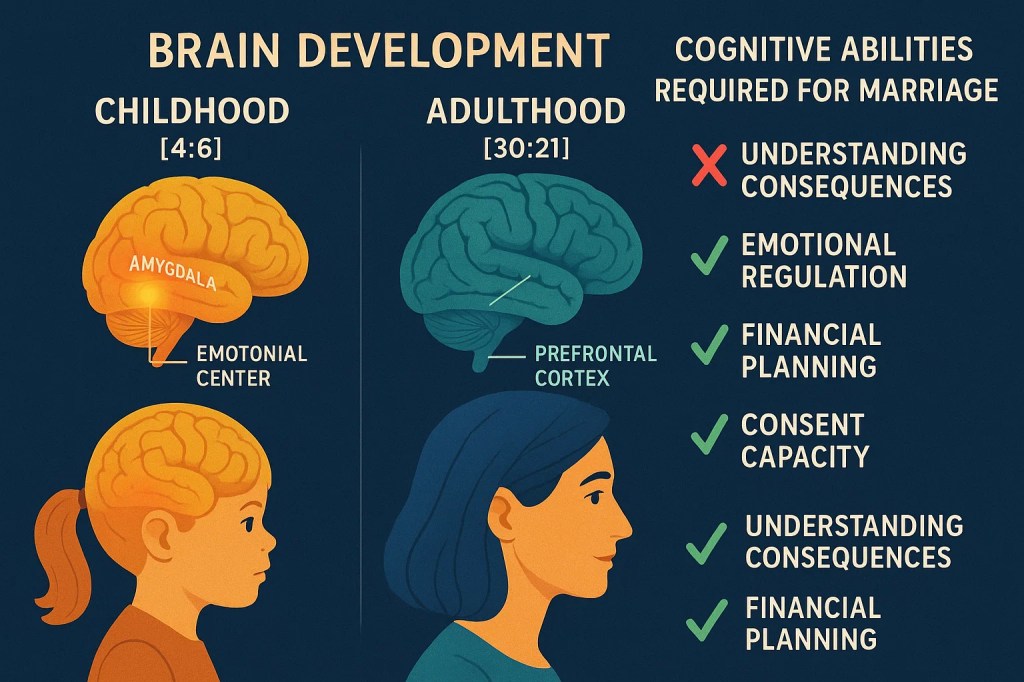
Modern neuroscience and developmental psychology confirm what the Quran established fourteen centuries ago: children lack the neurological development necessary for marriage decisions. The prefrontal cortex, responsible for complex decision-making, consequence evaluation, and emotional regulation, doesn’t fully develop until the mid-twenties. This scientific reality aligns perfectly with the Quran’s requirement for “رُشْدًا” (rushdan) – sound judgment that comes with maturity.
Research published in neuroscience journals demonstrates that children’s brains process information fundamentally differently from adults. They rely more heavily on the amygdala (emotional center) rather than the prefrontal cortex (reasoning center) for decision-making. This biological reality makes them incapable of truly understanding the long-term implications of marriage, including its sexual, emotional, financial, and social dimensions. The Quran’s wisdom in requiring maturity before major contracts reflects this biological truth.
Psychological studies consistently show that child marriage causes severe trauma, including depression, anxiety, post-traumatic stress disorder, and developmental disruption. These outcomes directly contradict verse 30:21’s description of marriage as a source of tranquility and mercy. If marriage to a child causes harm rather than tranquility, it cannot be the marriage that God sanctioned in the Quran. The scripture’s requirements protect children from exploitation during their vulnerable developmental years.
The concept of consent itself requires cognitive abilities that children have not yet developed. True consent requires: understanding of what is being agreed to, awareness of alternatives, freedom from coercion, and ability to project future consequences. Children fail all these criteria. They cannot understand adult sexuality, don’t know relationship alternatives, are inherently under adult authority, and cannot project long-term consequences. The Quran’s requirement for adult women in marriage protects this fundamental right to meaningful consent.
Part 8: The Rights and Responsibilities Framework
Adult Obligations That Children Cannot Fulfill
The Quran outlines extensive rights and responsibilities within marriage that require adult capacity to understand and fulfill. These obligations create an impossible burden for children, further proving that Quranic marriage requires adult women. Consider the financial responsibilities outlined in verse 4:34:
[4:34] “The men are made responsible for the women, and GOD has endowed them with certain qualities, and made them the bread earners. The righteous women will cheerfully accept this arrangement, since it is GOD’s commandment, and honor their husbands during their absence. If you experience rebellion from the women, you shall first talk to them, then desertion in bed, then you may (as a last alternative) beat them. If they obey you, you are not permitted to transgress against them. GOD is Most High, Supreme.”
While this verse addresses men’s responsibilities, it also implies women’s capacity to “cheerfully accept” arrangements, “honor” agreements, and make conscious choices about obedience or rebellion. These are adult cognitive and emotional processes. A child cannot meaningfully “accept” an arrangement she doesn’t understand, nor can she be held responsible for “rebellion” when she lacks the maturity to comprehend marital obligations.
The mutual rights framework is elaborated in verse 2:228:
[2:228] “The divorced women shall wait three menstruations (before marrying another man). It is not lawful for them to conceal what God creates in their wombs, if they believe in God and the Last Day. (In case of pregnancy,) the husband’s wishes shall supersede the wife’s wishes, if he wants to remarry her. The women have rights, as well as obligations, equitably. Thus, the man’s wishes prevail (in case of pregnancy). God is Almighty, Most Wise.”
This verse establishes that women have both rights and obligations in marriage – a reciprocal framework requiring adult understanding. The verse discusses biological processes (menstruation, pregnancy), religious conviction (belief in God and the Last Day), and ethical obligations (not concealing pregnancy). Children cannot comprehend these complex interrelationships nor fulfill these responsibilities.
The sexual rights and responsibilities in marriage, delicately addressed in verse 2:187, also require adult maturity:
[2:187] “Permitted for you is sexual intercourse with your wives during the nights of fasting. They are the keepers of your secrets, and you are the keepers of their secrets. God knew that you used to betray yourselves, and He has redeemed you, and has pardoned you. Henceforth, you may have intercourse with them, seeking what God has permitted for you. You may eat and drink until the white thread of light becomes distinguishable from the dark thread of night at dawn. Then, you shall fast until sunset. Sexual intercourse is prohibited if you decide to retreat to the masjid (during the last ten days of Ramadan). These are God’s laws; you shall not transgress them. God thus clarifies His revelations for the people, that they may attain salvation.”
The verse describes spouses as “keepers of secrets” for each other, implying deep trust and emotional intimacy possible only between adults. The complex interplay of religious obligations (fasting), physical needs, and marital intimacy requires mature understanding of boundaries, consent, and spiritual significance that children cannot possess.
Part 9: The Witness and Contract Requirements
Legal Procedures Demanding Adult Participation
The Quran’s marriage and divorce procedures consistently require elements that exclude child participation. Verse 4:6’s requirement for witnesses when transferring property to mature orphans establishes a principle: important contracts require witnesses who can testify to the party’s competence and understanding. This principle applies even more strongly to marriage, as indicated in verse 2:282’s general contract requirements:
[2:282] “O you who believe, when you transact a loan for any period, you shall write it down. An impartial scribe shall do the writing. No scribe shall refuse to perform this service, according to God’s teachings. He shall write, while the debtor dictates the terms. He shall observe God his Lord and never cheat. If the debtor is mentally incapable or helpless, or cannot dictate, his guardian shall dictate equitably. Two men shall serve as witnesses; if not two men, then a man and two women whose testimony is acceptable to all. Thus, if one woman becomes biased, the other will remind her. It is the obligation of the witnesses to testify when called upon to do so. Do not tire of writing the details, no matter how long, including the time of repayment. This is equitable in the sight of God, assures better witnessing, and eliminates any doubts you may have. Business transactions that you execute on the spot need not be recorded, but have them witnessed. No scribe or witness shall be harmed on account of his services. If you harm them, it would be wickedness on your part. You shall observe God, and God will teach you. God is Omniscient.”
This comprehensive verse about contracts establishes several principles that make child marriage impossible. First, it acknowledges that mentally incapable individuals cannot enter contracts themselves – their guardians must act for them. Children, by definition, fall into this category of those who cannot dictate terms or understand complex agreements. Second, the verse requires witnesses who can evaluate whether the parties understand the agreement. How could witnesses testify that a child comprehends a marriage contract when verse 4:6 establishes children cannot even manage property?
The divorce procedures further confirm adult requirements. Verse 65:2 states:
[65:2] “Once the interim is fulfilled, you may reconcile with them equitably, or go through with the separation equitably. You shall have two equitable witnesses witness the divorce before God. This is to enlighten those who believe in God and the Last Day. Anyone who reverences God, He will create an exit for him.”
The requirement for “equitable witnesses” who can testify “before God” assumes all parties understand the spiritual and legal gravity of their actions. Children cannot serve as witnesses in Islamic law precisely because they lack the maturity to understand what they’re witnessing. If children cannot be witnesses to marriage or divorce, how could they be parties to these contracts?

Part 10: The Pregnancy and Parenthood Dimension
Biological and Parental Responsibilities Requiring Maturity
The Quran’s discussion of pregnancy and parenthood within marriage further confirms that marriage requires adult women. The physical dangers of pregnancy for children’s underdeveloped bodies, combined with the parental responsibilities described in the Quran, make child marriage impossible under Quranic law.
Verse 2:233 outlines the extensive responsibilities of parenthood:
[2:233] “Divorced mothers shall nurse their infants two full years, if the father so wishes. The father shall provide the mother’s food and clothing equitably. No one shall be burdened beyond his ability. No mother shall be harmed on account of her infant, nor shall the father be harmed because of his infant. (If the father dies), his inheritor shall assume these responsibilities. If the infant’s parents mutually agree to part, after due consultation, they commit no error by doing so. You commit no error by hiring nursing mothers, so long as you pay them equitably. You shall observe God, and know that God is Seer of everything you do.”
This verse assumes mothers who can make decisions about nursing, negotiate with fathers, engage in “mutual consultation,” and potentially hire help. These are adult capabilities requiring physical maturity (for nursing), emotional stability (for childcare), and intellectual capacity (for decision-making). A child cannot fulfill the role of mother as described here – she would herself need care rather than providing it.
The medical reality of childhood pregnancy presents severe risks including obstructed labor, obstetric fistula, eclampsia, and death. The World Health Organization identifies pregnancy as a leading cause of death for girls aged 15-19 in developing countries, with even higher risks for younger girls. These medical facts align with the Quran’s protection of life and its requirement for maturity before marriage. God, in His wisdom, would not sanction relationships that endanger His servants’ lives.
Furthermore, verse 46:15 describes the physical and emotional toll of pregnancy and parenthood:
[46:15] “We enjoined the human being to honor his parents. His mother bore him arduously, gave birth to him arduously, and took intimate care of him for thirty months. When he reaches maturity, and reaches the age of forty, he should say, ‘My Lord, direct me to appreciate the blessings You have bestowed upon me and upon my parents, and to do the righteous works that please You. Let my children be righteous as well. I have repented to You; I am a submitter.’”
The verse describes pregnancy and childbirth as “arduous” (كُرْهًا – kurhan), acknowledging the significant physical and emotional challenges involved. It links parenthood with reaching maturity, suggesting that proper parenting requires the wisdom and strength that come with age. The verse’s mention of appreciating blessings and guiding one’s children in righteousness requires spiritual and emotional maturity that children do not possess.
Part 11: The Quranic Model of Life Stages
From Childhood Through Maturity to Marriage
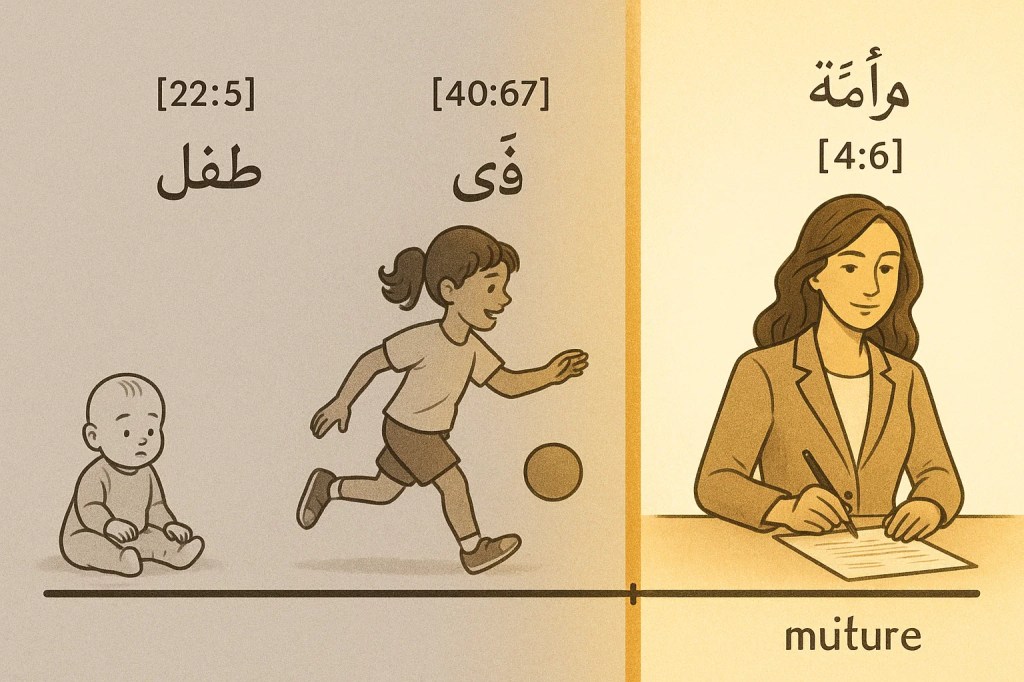
The Quran presents a clear progression of human development stages, with marriage occurring only after achieving full maturity. This developmental model appears throughout the scripture, consistently distinguishing between childhood, youth, and adulthood. Verse 22:5 provides a comprehensive overview:
[22:5] “O people, if you have any doubt about resurrection, (remember that) we created you from dust, and subsequently from a tiny drop, which turns into a hanging embryo, then it becomes a fetus that is given life or deemed lifeless. We thus clarify things for you. We settle in the wombs whatever we will for a predetermined period. We then bring you out as infants, then you reach maturity. Some of you die young, while others live to the worst age, only to find out that no more knowledge can be attained beyond a certain limit. You look at a land that is dead, then as soon as we shower it with water, it vibrates with life and grows all kinds of beautiful plants.”
The verse traces human development from conception through infancy (طِفْلًا – tiflan) to maturity (أَشُدَّكُمْ – ashuddakum). The Arabic term “ashudd” represents full strength and maturity, not merely puberty. This is the stage at which the Quran considers humans ready for major responsibilities. The clear progression – embryo, fetus, infant, then maturity – establishes that significant time and development must occur before reaching the stage appropriate for marriage.
Verse 40:67 reinforces this developmental sequence:
[40:67] “He is the One who created you from dust, and subsequently from a tiny drop, then from a hanging embryo, then He brings you out as a child, then He lets you reach maturity, then you become old—some of you die earlier. You attain a predetermined age, that you may understand.”
Again, the progression moves from childhood to maturity (لِتَبْلُغُوا أَشُدَّكُمْ – litablughoo ashuddakum), with understanding (تَعْقِلُونَ – ta’qiloon) as the ultimate goal. The root ع-ق-ل (‘ayn-qaf-lam) means to use intellect, to reason, to comprehend. This verse explicitly links maturity with the development of reasoning capacity, which is essential for marriage decisions.
The Quran also recognizes a stage of youth between childhood and full maturity. Verse 18:13 mentions “فِتْيَةٌ” (fityah) – youths who believed in their Lord. This intermediate stage acknowledges that even after puberty, there’s a period of continued development before reaching full maturity. The marriage verses never use terms for youth or adolescence; they consistently specify “women” and “men,” indicating fully mature adults.
Part 12: The Protection of the Vulnerable
Quranic Principles Safeguarding Children
The Quran consistently emphasizes protecting the vulnerable, with children being among the most vulnerable members of society. This protective principle runs throughout the scripture and fundamentally contradicts any interpretation allowing child marriage. Verse 4:127 specifically addresses the protection of orphaned girls:
[4:127] “They consult you concerning women: say, ‘God enlightens you regarding them, as recited for you in the scripture. You shall restore the rights of orphaned girls whom you cheat out of their due dowries when you wish to marry them: you shall not take advantage of them. The rights of orphaned boys must also be protected as well. You shall treat the orphans equitably. Whatever good you do, God is fully aware thereof.’”
This verse explicitly prohibits taking advantage of orphaned girls in marriage situations. If God prohibits exploiting orphaned girls who have reached marriageable age (note the verse still calls them “women” in Arabic – “يَتَامَى النِّسَاءِ” – orphans of the women), how much more would He prohibit marrying actual children who are even more vulnerable? The verse commands equitable treatment and protection of rights, impossible when one party is a child incapable of understanding or asserting her rights.
The Quran’s emphasis on justice (عَدْل – ‘adl) and equity (قِسْط – qist) appears in numerous verses and cannot coexist with child marriage. Verse 4:58 commands:
[4:58] “God commands you to give back anything the people have entrusted to you. If you judge among the people, you shall judge equitably. The best enlightenment indeed is what God recommends for you. God is Hearer, Seer.”
How can there be equity between an adult man and a child in marriage? The power imbalance is absolute – physically, mentally, emotionally, financially, and socially. The child has no real agency, no escape options, no ability to negotiate terms, and no capacity to understand what’s happening to her. This fundamental inequity violates the Quranic principle of justice in human relationships.
The protection extends to preventing any form of oppression (ظُلْم – dhulm). Verse 42:42 states:
[42:42] “The only ones who incur God’s condemnation are those who treat the people unjustly, and resort to aggression without provocation. These have incurred a painful retribution.”
Child marriage constitutes severe oppression – forcing a child into adult situations she cannot comprehend, subjecting her to physical and psychological trauma, depriving her of childhood, education, and normal development. This is precisely the type of injustice and aggression the Quran condemns. Those who use religion to justify such oppression “incur God’s condemnation.”
Part 13: The Educational and Developmental Rights
Knowledge Seeking as a Barrier to Child Marriage
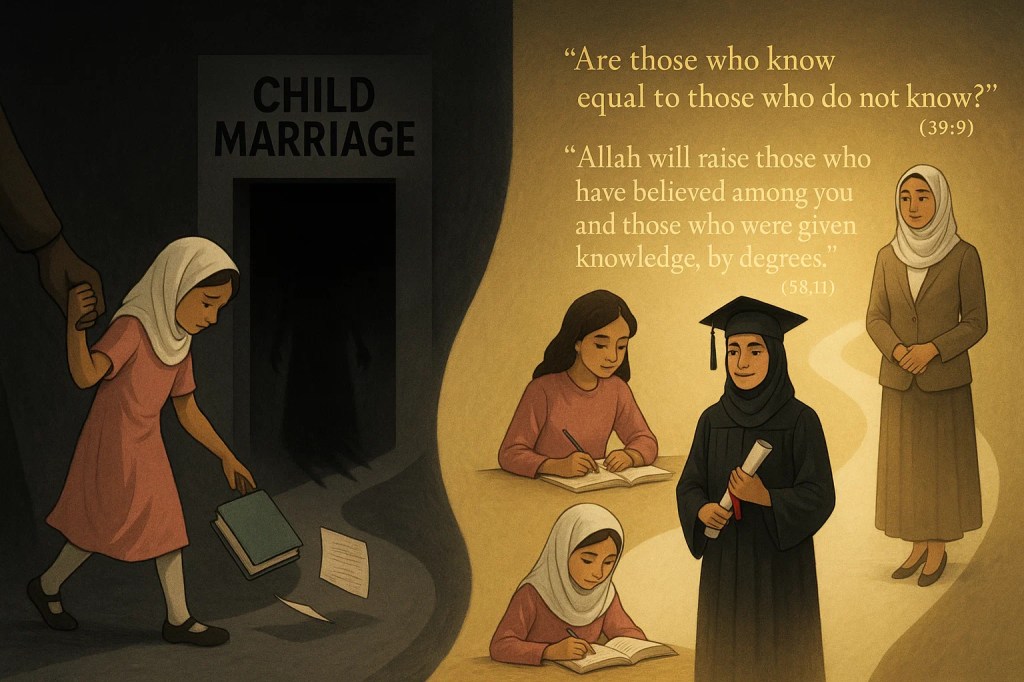
The Quran’s emphasis on seeking knowledge and developing understanding creates another insurmountable barrier to child marriage. The scripture repeatedly commands believers to seek knowledge, reflect, and understand – processes that require time and development through childhood and youth. Verse 39:9 asks:
[39:9] “Is it not better to be one of those who meditate in the night, prostrating and staying up, being aware of the Hereafter, and seeking the mercy of their Lord? Say, ‘Are those who know equal to those who do not know?’ Only those who possess intelligence will take heed.”
This verse distinguishes between those who know and those who don’t, linking knowledge with intelligence and understanding. Children, in their developmental stage, are still acquiring basic knowledge and cognitive skills. Forcing them into marriage disrupts this crucial educational period, violating the Quranic imperative to seek knowledge. The verse’s emphasis on “those who possess intelligence” (أُولُو الْأَلْبَابِ – ulu al-albaab) again points to mental maturity as a prerequisite for major life decisions.
The Quran’s first revealed word was “Read!” (اقْرَأْ – iqra’), emphasizing the paramount importance of education. Child marriage typically ends a girl’s education, contradicting this fundamental Quranic value. Verse 58:11 promises elevated ranks for those who acquire knowledge:
[58:11] “O you who believe, when you are told, ‘Please make room,’ in the sessions, you shall make room. God will then make room for you. If you are asked to get up and move, get up and move. God raises those among you who believe, and those who acquire knowledge to higher ranks. God is fully Cognizant of everything you do.”
How can a child forced into marriage “acquire knowledge” and achieve these “higher ranks” when marriage typically ends her educational opportunities? The contradiction is clear: God commands seeking knowledge and promises rewards for it, while child marriage prevents this divine directive from being fulfilled.
Furthermore, the Quran requires understanding and reflection on its verses. Verse 47:24 asks:
[47:24] “Why do they not study the Quran carefully? Do they have locks on their hearts?”
Studying the Quran carefully (يَتَدَبَّرُونَ – yatadabbaroon) requires cognitive development, literacy, and analytical thinking – skills developed through education during childhood and youth. A child bride, deprived of education and burdened with adult responsibilities, cannot fulfill this Quranic obligation to study and understand God’s message.
Part 14: The Mutual Consent and Love Foundation
Emotional Reciprocity Impossible with Children
The Quran establishes marriage on foundations of mutual love, mercy, and consent – emotional states requiring adult emotional development. Verse 30:21’s description of marriage reveals why children cannot be parties to Islamic marriage:
[30:21] “Among His proofs is that He created for you spouses from among yourselves, in order to have tranquility and contentment with each other, and He placed in your hearts love and care towards your spouses. In this, there are sufficient proofs for people who think.”
The verse describes three essential elements: tranquility (سُكُون – sukoon), love (مَوَدَّة – mawaddah), and mercy (رَحْمَة – rahmah). Each requires emotional maturity children haven’t developed. Mawaddah isn’t mere affection but deep, intimate love between equals. Rahmah encompasses compassion, understanding, and emotional support. These complex emotions develop through life experience and emotional maturation, not present in children whose emotional understanding remains basic and self-centered due to normal developmental stages.
The reciprocal nature of marriage appears in verse 2:187’s description:
[2:187] “Permitted for you is sexual intercourse with your wives during the nights of fasting. They are the keepers of your secrets, and you are the keepers of their secrets.”
The phrase “هُنَّ لِبَاسٌ لَكُمْ وَأَنْتُمْ لِبَاسٌ لَهُنَّ” (they are garments for you and you are garments for them) establishes complete mutuality. A garment protects, covers vulnerabilities, provides comfort, and enhances dignity. This reciprocal relationship requires emotional and intellectual equality impossible between an adult and child. A child cannot be a “garment” providing protection and support to an adult; she needs protection herself.
Consent, fundamental to Islamic marriage, requires understanding what one consents to. Verse 4:19’s prohibition against forcing women confirms consent’s centrality:
[4:19] “O you who believe, it is not lawful for you to inherit what the women leave behind, against their will. You shall not force them to give up anything you had given them, unless they commit a proven adultery.”
If adult women cannot be forced or inherited against their will, how could children – who cannot form valid will due to developmental limitations – enter marriage? The verse’s phrase “against their will” (كَرْهًا – karhan) presupposes the capacity to have will, to consent or refuse. Children in their developmental stage cannot form the kind of informed, mature will the Quran requires for marriage.
Part 15: The Comprehensive Prohibition Through Interconnected Principles
How Multiple Quranic Laws Converge to Prohibit Child Marriage
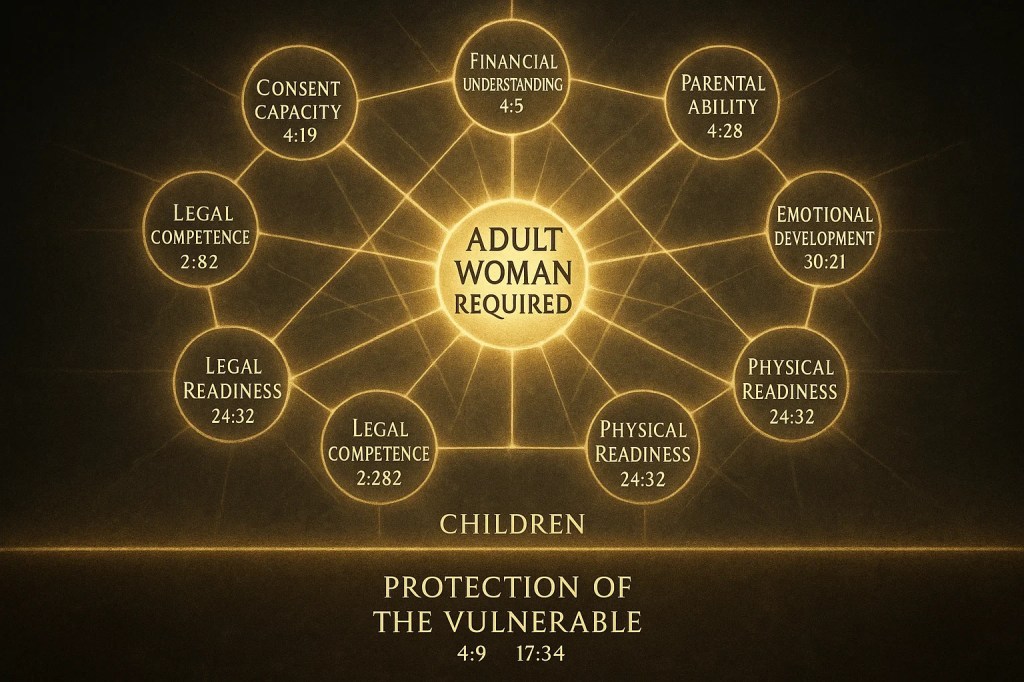
When we synthesize all the Quranic evidence, we find not just one or two verses but an entire framework of interconnected principles that make child marriage impossible under Quranic law. This convergence of multiple independent requirements creates an insurmountable barrier to any claim that Islam permits child marriage.
First, the maturity requirement of verse 4:6 establishes that children cannot manage property until proving mental and emotional maturity. Second, the consistent use of “women” (not children) in all marriage verses creates a linguistic boundary. Third, the consent requirements throughout the Quran demand cognitive capacity children lack. Fourth, the mutual rights and responsibilities framework assumes adult capabilities. Fifth, the educational imperatives conflict with child marriage’s typical outcomes. Sixth, the protection of vulnerable populations specifically includes children. Seventh, the requirement for witnesses who can testify to understanding assumes adult parties.
These principles don’t exist in isolation but reinforce each other. For instance, verse 24:32’s encouragement of marriage states:
[24:32] “You shall encourage those of you who are single to get married. They may marry the righteous among your male and female servants, if they are poor. God will enrich them from His grace. God is Bounteous, Knower.”
The verse addresses “those who are single” (الْأَيَامَىٰ – al-ayaama), a term for unmarried adults, not children. It mentions poverty and God’s enrichment, assuming financial understanding. It speaks of choosing “righteous” partners, requiring moral discernment. Every element assumes adult capacity.
Similarly, the divorce procedures outlined in Chapter 65 assume parties who understand complex waiting periods, custody arrangements, and financial obligations. Verse 65:6 states:
[65:6] “You shall allow them to live in the same home in which they lived with you, and do not make life so miserable for them that they leave on their own. If they are pregnant, you shall spend on them until they give birth. If they nurse the infant for you, you shall pay them for this service. You shall maintain the amicable relations among you. If you disagree, you may hire another woman to nurse the child.”
These negotiations about living arrangements, financial support, nursing services, and hiring help require adult judgment and negotiation skills. The verse assumes parties who can “maintain amicable relations” despite divorce – emotional maturity children don’t possess.
Conclusion: The Quran’s Unequivocal Protection of Childhood
The evidence is overwhelming and irrefutable: the Quran requires adult women, not children, for marriage. This isn’t a matter of interpretation or cultural preference but explicit divine law established through multiple independent requirements that converge on a single truth. From the maturity requirements of verse 4:6 to the consistent linguistic usage of “women” in marriage contexts, from the consent and understanding prerequisites to the complex responsibilities marriage entails, every aspect of Quranic marriage law excludes children.
Those who claim Islamic sanction for child marriage commit a grave injustice against both the scripture and innocent children. They ignore the Quran’s clear requirements, contradict its protective principles, and cause immense harm to society’s most vulnerable members. The Final Testament’s preservation of these protective laws through accurate translation exposes centuries of cultural distortion that prioritized harmful traditions over divine guidance.
As believers committed to the Quran alone, we must forcefully refute any attempt to use our religion to justify child marriage. The scripture’s wisdom, confirmed by modern science and ethical understanding, protects children’s rights to develop, learn, and grow before taking on adult responsibilities. This is not modernist interpretation but faithful adherence to what God actually revealed, freed from the corruptions of hadith and cultural tradition. The Quran stands as humanity’s strongest scriptural protection against child marriage, establishing through divine law what human rights advocates struggle to achieve through human legislation. Let those who truly believe in God’s word stand firmly against this injustice, armed with the irrefutable evidence of the Quran itself.


 Quran Only Studies
Leave a comment