
Introduction: A Mathematical Foundation for Faith
The Discovery That Changed Everything
In 1974, Dr. Rashad Khalifa, a biochemist working in the United States, made a discovery that would reshape understanding of the Quran’s structure. Using early computer technology to analyze the Arabic text, he uncovered an intricate mathematical pattern based on the number 19. This wasn’t merely an interesting curiosity – it was precisely what the Quran itself had prophesied fourteen centuries earlier.
The Quran explicitly identifies this number as significant, not as an arbitrary choice but as a deliberate sign of divine authorship:
[74:30] “Over it is nineteen.”
But the Quran goes further, explaining the purpose of this mathematical structure – it serves multiple functions for different audiences:
[74:31] “We appointed angels to be guardians of Hell, and we assigned their number (19) (1) to disturb the disbelievers, (2) to convince the Christians and Jews (that this is a divine scripture), (3) to strengthen the faith of the faithful, (4) to remove all traces of doubt from the hearts of Christians, Jews, as well as the believers, and (5) to expose those who harbor doubt in their hearts, and the disbelievers; they will say, ‘What did God mean by this allegory?’ God thus sends astray whomever He wills, and guides whomever He wills. None knows the soldiers of your Lord except He. This is a reminder for the people.”
This verse prophetically anticipated the exact debate that would unfold – that some would be convinced, others strengthened, and still others would say “What did God mean by this?” The mathematical code functions as a divine sorting mechanism, distinguishing sincere seekers from those who approach with predetermined conclusions.
Part 1: The Foundation – What the Mathematical Structure Actually Shows
The Basic Building Blocks
Before examining criticisms, we must understand what Code 19 actually claims. The mathematical structure encompasses multiple layers of organization within the Quran, all connected to the number 19. These are not vague assertions but specific, countable, verifiable patterns.
The most fundamental patterns include: The Quran contains exactly 114 surahs (chapters), which equals 19 multiplied by 6. The opening statement of the Quran – “Bismillah Al-Rahman Al-Raheem” (In the name of God, Most Gracious, Most Merciful) – contains exactly 19 Arabic letters. This opening phrase appears 114 times throughout the Quran (19 times 6). The word “Allah” (God) appears exactly 2,698 times throughout the Quran, which equals 19 multiplied by 142.
These are not obscure patterns requiring specialized interpretation – they are direct counts that anyone with the Arabic text can verify. The preservation promise in the Quran takes on new meaning in light of this mathematical protection:
[15:9] “Absolutely, we have revealed the reminder, and, absolutely, we will preserve it.”
The mathematical code serves as the mechanism of this preservation – any alteration to the text would disrupt the intricate numerical relationships, immediately exposing the change.
The Initialed Surahs: A Systematic Pattern
Perhaps the most compelling evidence comes from the 29 surahs that begin with mysterious letter combinations (Quranic initials like Alif-Lam-Meem, Ha-Meem, Ya-Seen). For fourteen centuries, scholars wondered about the meaning of these letters. The mathematical code reveals their function: in each case, the counts of these specific letters within their respective surahs form multiples of 19.
Consider Surah 50, which begins with the letter Qaf. The letter Qaf appears exactly 57 times in this surah – which is 19 multiplied by 3. Even more remarkably, Surah 42 also features Qaf in its initials, and it too contains exactly 57 occurrences of Qaf. Two different surahs, same initial letter, identical count – both perfectly divisible by 19.
This is not cherry-picking. The pattern is systematic: the initiated surahs have their initiating letters counted as multiples of 19. This is a structured prediction, not a post-hoc discovery of random coincidences.

Part 2: Sura 96 – The First Revelation’s Mathematical Signature
The Very First Words Revealed
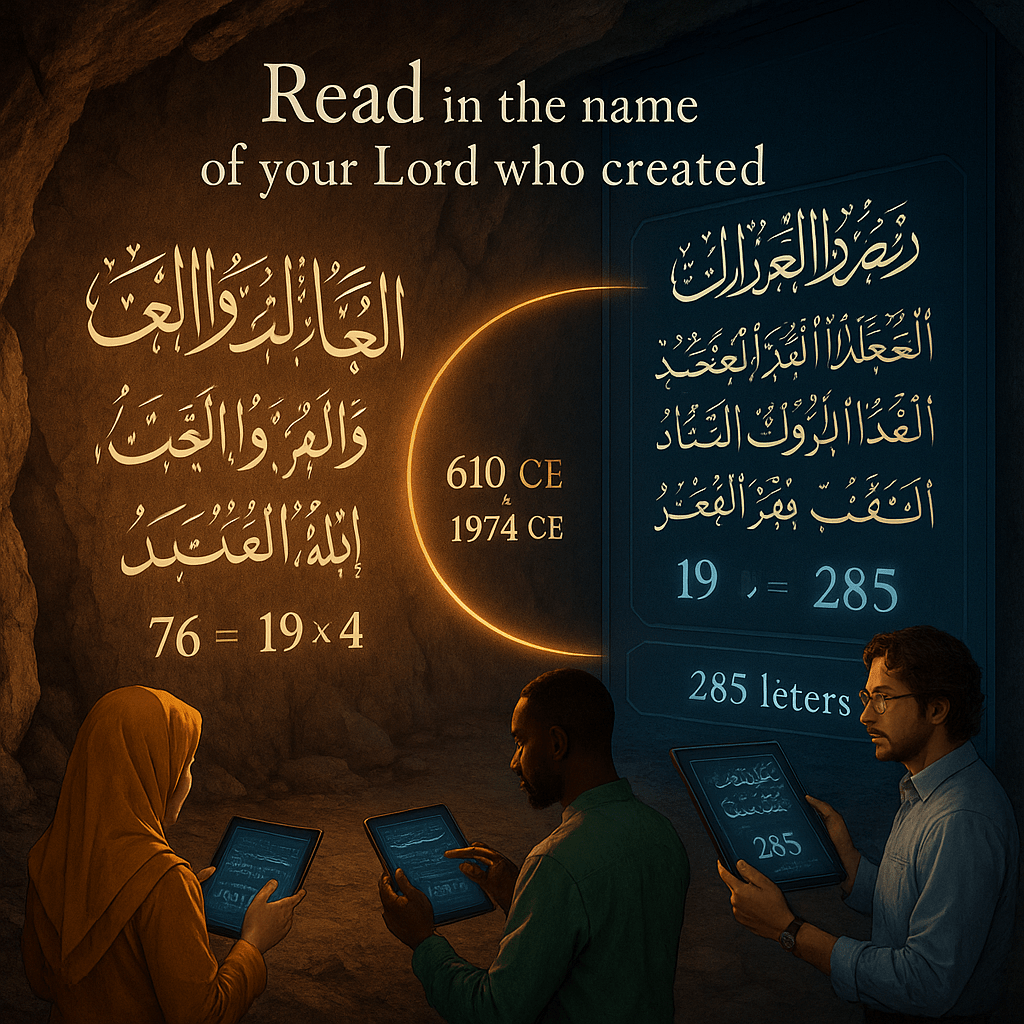
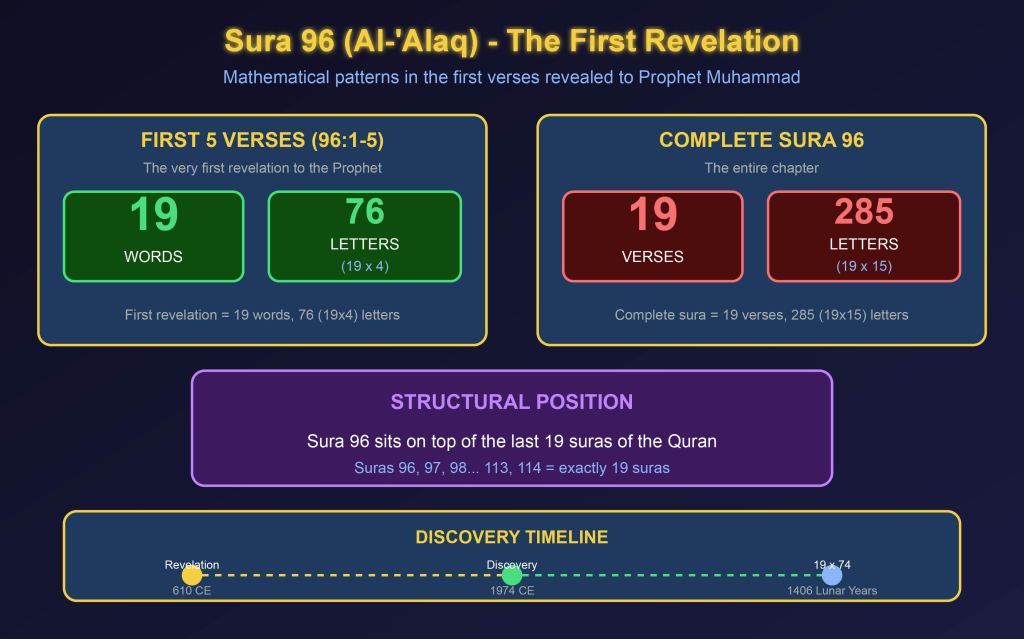
Sura 96, Al-‘Alaq (The Clot), holds a unique position in Islamic tradition as the first revelation given to Prophet Muhammad. The opening five verses – “Read in the name of your Lord who created…” – mark the beginning of Quranic revelation in the year 610 CE. Remarkably, these very first verses contain precise mathematical patterns that would not be discovered for 1,364 years.
The First Five Verses: 19 Words, 76 Letters
The first revelation (verses 96:1-5) contains exactly 19 Arabic words. When we count the letters in these five verses, we find exactly 76 letters – which is 19 multiplied by 4. This is not a single coincidence but a double lock: the word count and the letter count both conform to the 19-based system.
Consider the significance: the very first words revealed to humanity through the final prophet already contained the mathematical signature that would authenticate the message fourteen centuries later. This was not inserted after the fact – these verses have been recited identically since 610 CE.
Complete Sura 96: 19 Verses, 285 Letters
The complete Sura 96 contains exactly 19 verses. The total letter count of the entire sura is 285 letters – which is 19 multiplied by 15. Again, a double confirmation: verse count and letter count both divisible by 19.
Furthermore, Sura 96’s position in the Quran is itself mathematically significant: it sits atop the last 19 suras of the Quran (suras 96 through 114). The sura that introduced the revelation marks the beginning of the final 19 chapters.
The Timing of Discovery: 1406 Lunar Years
The mathematical code was discovered in 1974 CE. From the year of revelation (610 CE) to 1974, exactly 1406 lunar years elapsed. The number 1406 equals 19 multiplied by 74. And Sura 74 is precisely the chapter that announces “Over it is nineteen” – the very verse that identifies the mathematical foundation.
This creates an extraordinary convergence: the number of lunar years until discovery (1406 = 19 × 74) points directly to the sura (74) that reveals the key number (19). The timing of the discovery was itself encoded in the system.
Part 3: Combined Probability – Beyond “Just 1/19”
The Mathematics of Multiple Independent Patterns
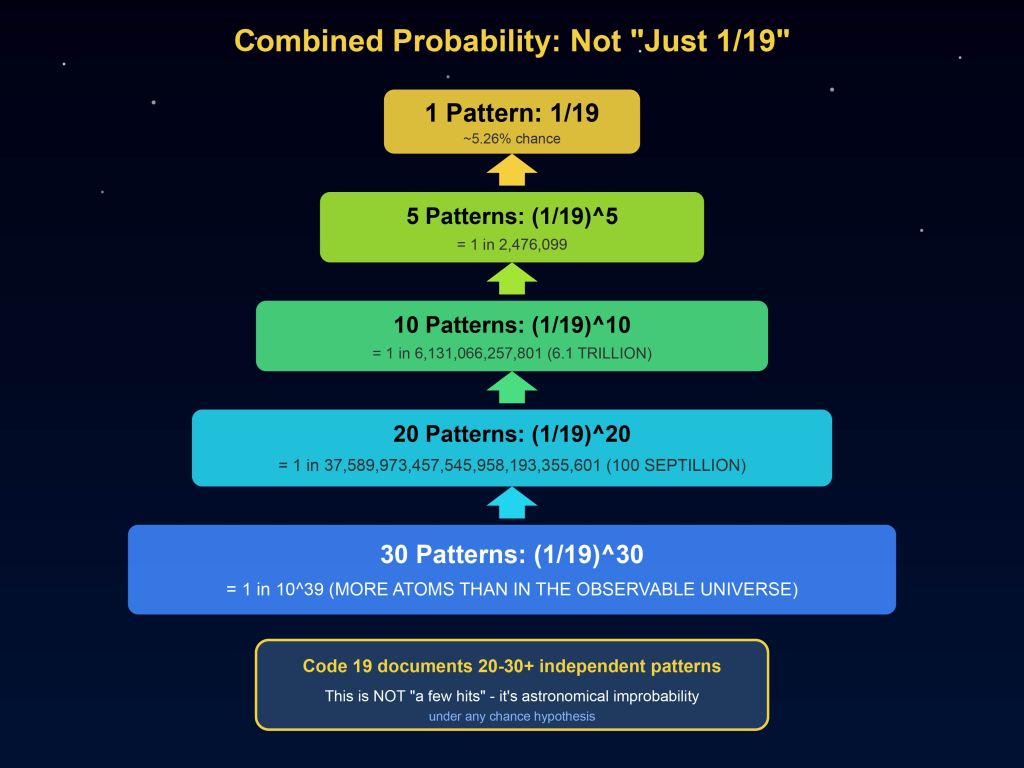
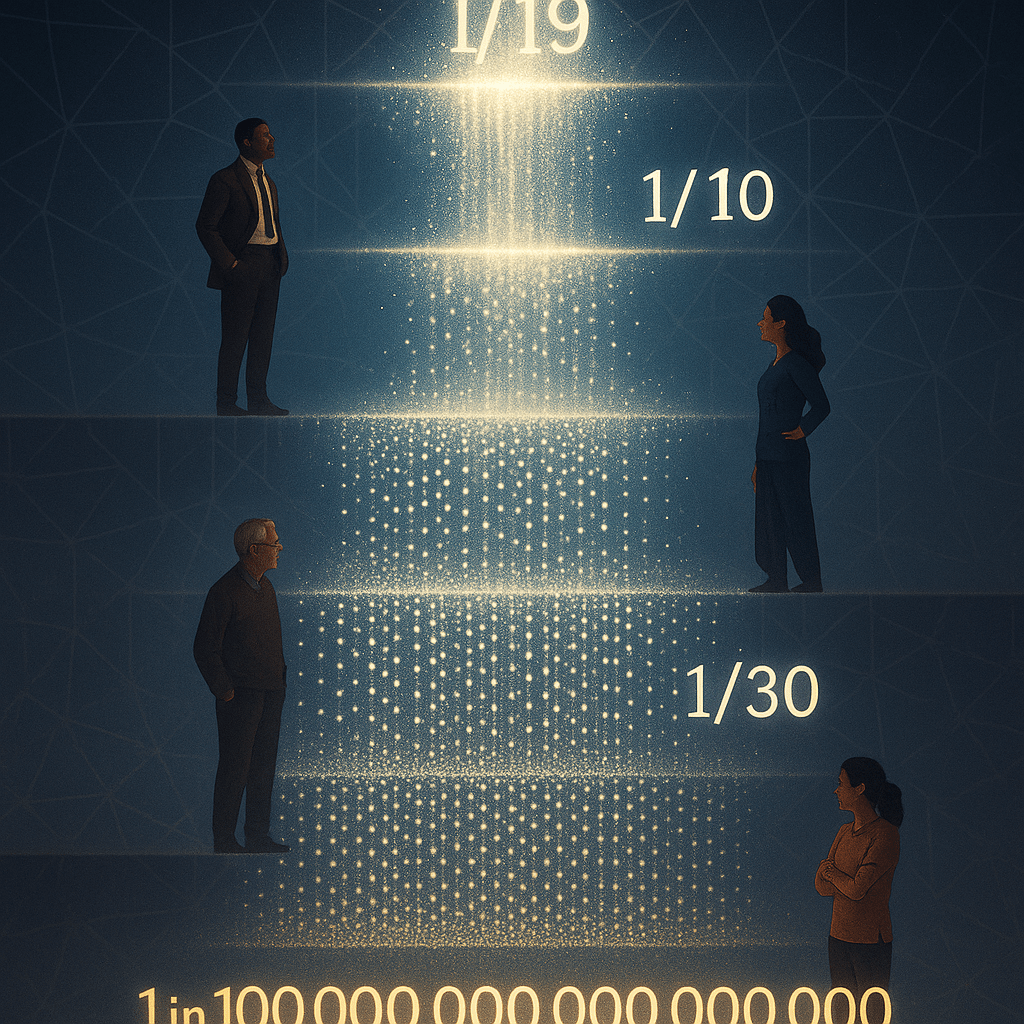
Critics sometimes dismiss individual patterns by noting that any count has a 1 in 19 chance of being divisible by 19. This is mathematically correct but profoundly misses the point. The question is not about individual patterns but about the combined probability of multiple independent patterns occurring together.
Consider basic probability theory: if one event has probability 1/19, and another independent event also has probability 1/19, the probability of both occurring together is (1/19) times (1/19), which equals 1/361. For three independent patterns, it becomes 1/6,859. For ten patterns, approximately 1 in 6.1 trillion.
The documented patterns in Code 19 number between 20 and 30 independent observations. The combined probability for 20 independent patterns is (1/19) raised to the 20th power – approximately 1 in 100 septillion (10 to the 26th power). For 30 patterns, we reach 1 in 10 to the 39th power – more atoms than exist in the observable universe. These are not “a few hits” – this is astronomical improbability under any chance hypothesis.
[41:53] “We will show them our proofs in the horizons, and within themselves, until they realize that this is the truth. Is your Lord not sufficient, as a witness of all things?”
The mathematical patterns represent exactly this – proofs that transcend cultural boundaries, requiring only the ability to count and calculate. A Chinese mathematician, a Nigerian statistician, and a Brazilian engineer can all verify these patterns without any special theological training.
Why 19 Specifically?
If the patterns were merely the result of searching for any mathematical relationship, we would expect different prime numbers to emerge in different contexts. Instead, 19 dominates across all the patterns – initialed surahs, structural features, word counts, historical timing. This specificity itself is evidence against the “data mining” hypothesis. The number was not chosen to fit the data; it was prophesied in verse 74:30 and then discovered throughout the text.
Part 3: Addressing the Critics – The “Arbitrary Rules” Claim
Historical Context vs. Modern Assumptions
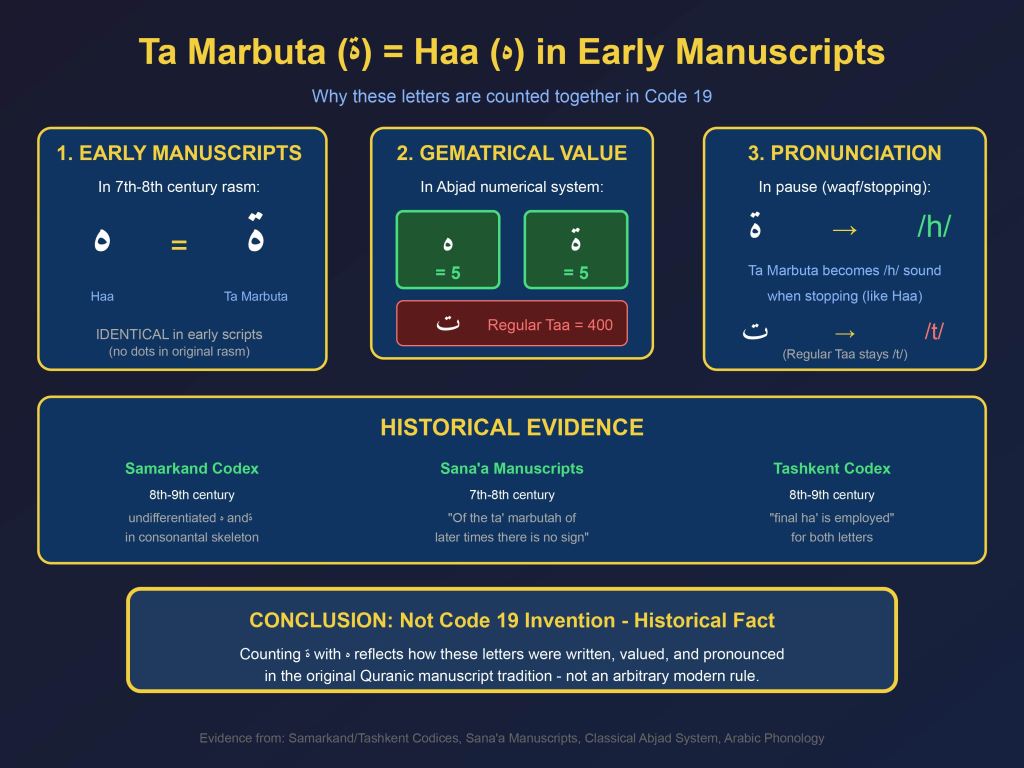
The most common criticism alleges that Code 19’s counting rules are “arbitrary” or “reverse-engineered” to produce desired results. This criticism typically focuses on specific orthographic conventions, particularly the treatment of taa marbuta (the letter ة) as equivalent to haa (ه) in counting.
Critics argue from modern Arabic grammar, which classifies taa marbuta as a variant of taa (ت). However, this criticism confuses different levels of linguistic analysis. Modern pedagogical grammar teaches one thing; historical manuscript tradition shows another entirely.
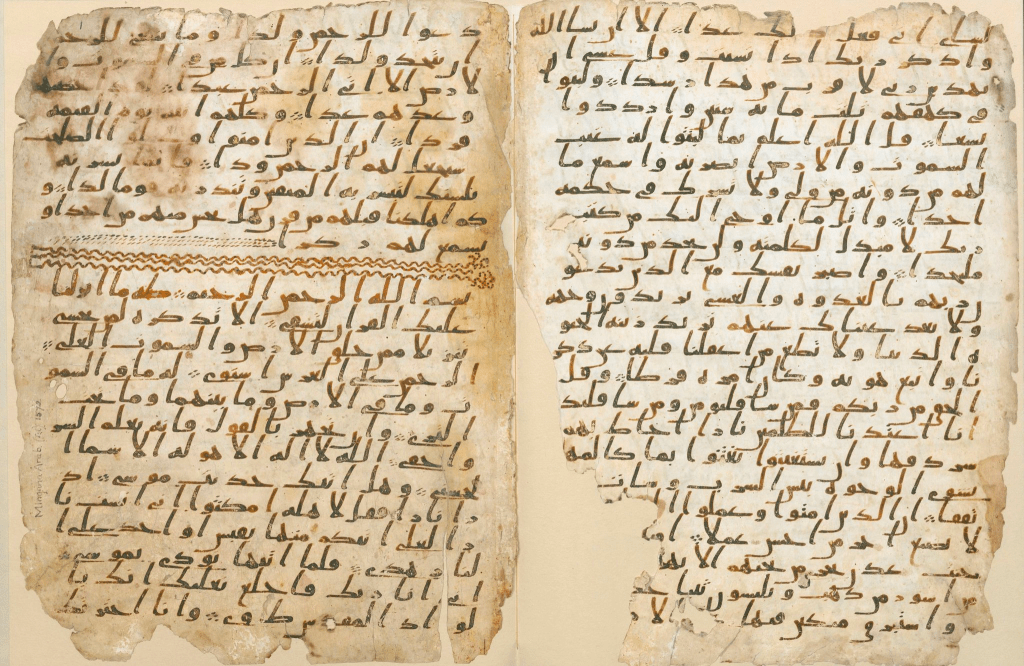
In early Quranic manuscripts written in rasm script – the original consonantal skeleton before diacritical marks were added – taa marbuta and final haa were written identically. There was no visual distinction between them. Only regular taa (ت) received the two dots that distinguished it. This is not a Code 19 invention; it is paleographic fact visible in the Samarkand, Tashkent, and Sana’a codices.
The Evidence: Four Independent Lines of Confirmation
1. Manuscript Evidence: Academic studies of early Quranic manuscripts confirm: “In early manuscripts: ‘Of the ta’ marbutah of later times there is of course no sign; final ha’ is employed.’” (Islamic Awareness – Quranic Manuscripts). The Samarkand Codex (8th-9th century, radiocarbon dated 775-995 CE) and the Sana’a manuscripts (7th-8th century) show this identical form. For more detail on rasm script, see the Wikipedia article on Rasm, which notes that early Arabic had only 18 letter forms with many modern letters being indistinguishable.
2. Gematrical Evidence: In the ancient Abjad numerical system (gematria), taa marbuta is assigned the value 5 – matching haa (ه), not taa which has the value 400. As documented by the Abjad Calculator: “The Abjad Calculator program treats the Arabic letter tā’ marbūṭah as if it were hā’ and assigns it a value of 5. This is due to a general principle in abjad calculation, that letters are judged by their form (rasm), rather than by their pronunciation.” This reflects how the letter was understood by classical Arabic scholars for over a millennium.
3. Phonological Evidence: In pause (waqf/stopping during Quranic recitation), taa marbuta shifts from /t/ to /h/ sound, behaving like haa rather than taa. This is standard Arabic phonology, documented in classical tajweed texts and modern linguistics alike.
4. Morphological Evidence: Neither taa marbuta nor haa appear in Arabic root letters – they are both grammatical suffixes that do not carry lexical meaning. Regular taa (ت), by contrast, frequently appears in roots and carries the value 400 in gematria.
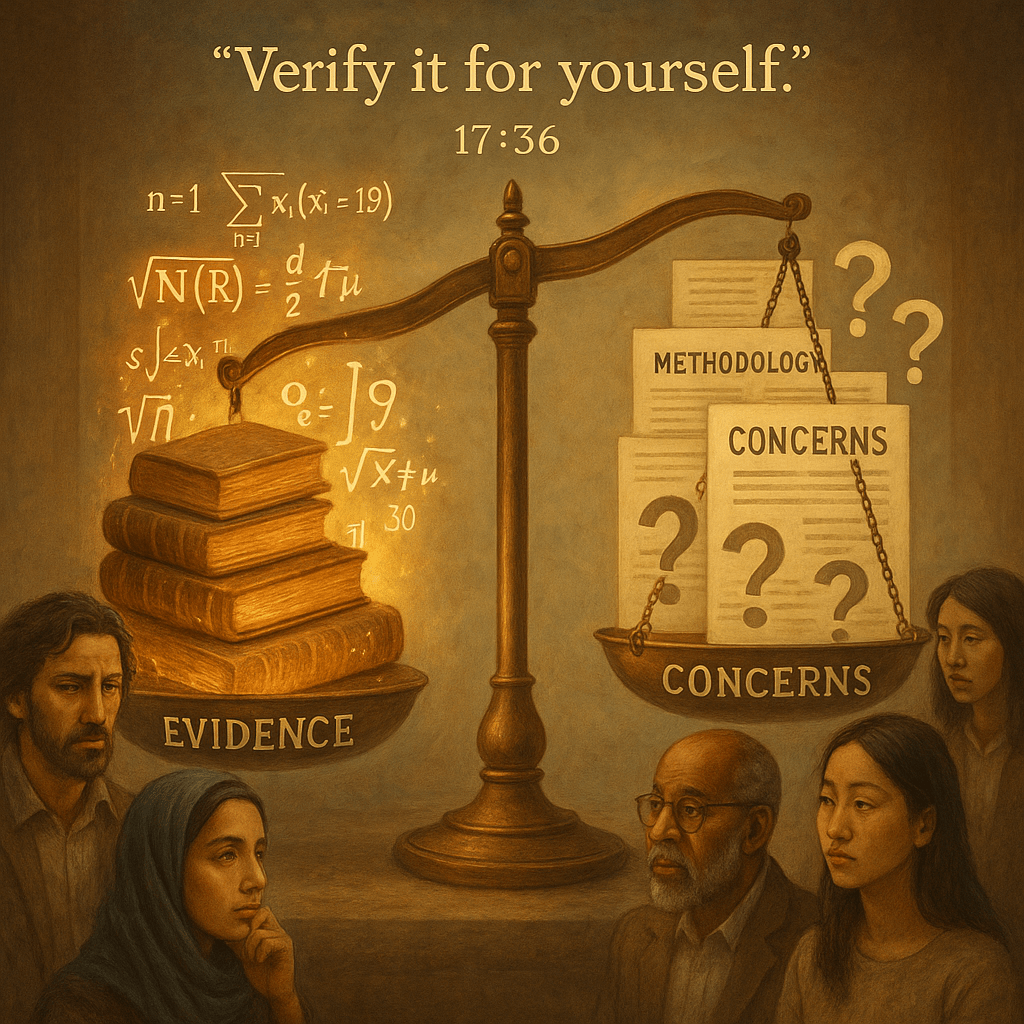
[17:36] “You shall not accept any information, unless you verify it for yourself. I have given you the hearing, the eyesight, and the brain, and you are responsible for using them.”
This verse commands verification – and the manuscript evidence, gematrical tradition, and phonological behavior all verify the historical identity of these letters. The “arbitrary” criticism stems from applying modern grammatical categories to a text that predates those categories by centuries.
Part 4: The 9:128-129 Question – Predictive Power
A Test Case of Code 19’s Function
One of the most significant aspects of Code 19 is its identification of verses 9:128-129 as later additions to the original text. Critics present this as “deleting verses to make the math work.” The reality is precisely opposite: the mathematical code identified a textual problem that independent historical evidence confirms.
According to Sahih al-Bukhari and other hadith collections, verses 9:128-129 have a unique attestation problem. While all other Quranic verses were confirmed by multiple independent witnesses during the compilation, these two verses were found with only a single witness – Khuzaimah ibn Thabit. To accommodate this anomaly, a special hadith was invoked claiming “the testimony of Khuzaima equals the testimony of two men.”
This is a remarkable exception. The standard tawatur requirement – multiple independent witnesses – was violated for these specific verses. The mathematical code identified them as disrupting the patterns, and historical research confirms they have attestation problems predating any awareness of Code 19. This represents predictive power: the code identified a problem that independent evidence validates.
If early manuscripts emerged showing these verses with multiple independent witnesses, this would falsify Code 19’s claim. That no such evidence exists, while single-witness attestation is documented, represents convergent validation from independent sources.
Falsifiability – The Mark of Genuine Claims
Code 19 makes specific, falsifiable predictions. If the word “Allah” were consistently counted as something other than 2,698 by independent researchers using the same text and rules, the claim would be falsified. If early manuscripts showed taa marbuta and haa were always written differently, the orthographic foundation would collapse. If the initialed surahs’ letter counts were not multiples of 19 using historically justified rules, the pattern would fail.
These are testable, verifiable, falsifiable claims. The criticism that Code 19 “can always be repaired” mistakes documentation gaps for unfalsifiability. The patterns either exist or they don’t. The rules either have historical justification or they don’t. These are factual questions with factual answers.
Part 5: The “Post-Hoc” Accusation and Pattern Recognition
Distinguishing Discovery from Fabrication
Critics often invoke “post-hoc rationalization” – the idea that patterns were reverse-engineered after seeing the data. This is a legitimate concern in statistical analysis. The Texas Sharpshooter Fallacy warns against drawing targets around existing bullet holes. But Code 19 differs from post-hoc pattern-finding in crucial ways.
First, the number 19 was not discovered in the data and then claimed as significant. It was prophesied in verse 74:30 – “Over it is nineteen” – fourteen centuries before the mathematical analysis began. The hypothesis was pre-specified, not derived from the data.
Second, the patterns are structured predictions, not random associations. The claim is not “somewhere in the Quran, you’ll find 19s if you look hard enough.” The claim is: “Surahs initiated with specific letters will have those letters counted as multiples of 19.” This is a systematic, testable framework that could easily fail – but doesn’t.
Third, the counting rules are not invented for Code 19; they reflect historical Arabic orthography. The identity of taa marbuta and haa in early manuscripts, the gematrical values assigned by classical scholars, the phonological behavior documented in Arabic linguistics – these existed before anyone counted letters for 19-divisibility.
Critics sometimes produce counter-examples like deliberately timing a message to 19:19:19 on the 19th day and finding multiple 19-patterns in the timestamp. This is legitimate mockery of post-hoc pattern-finding – but it misses the distinction. Timestamp patterns involve arbitrary operations (multiplication, concatenation, various additions) applied to arbitrary data with no pre-specified hypothesis. Code 19 involves a single operation (counting letters, checking divisibility by pre-specified number 19) applied to a pre-existing sacred text.

Part 6: Documentation Gaps vs. Proof of Fraud
A Critical Distinction
Perhaps the most sophisticated criticism acknowledges that patterns exist but argues that poor documentation renders the system suspect. This critique correctly identifies a real issue: Code 19’s counting rules are scattered across multiple sources (Khalifa’s appendices, verification websites, classical Arabic grammar texts, manuscript studies). A unified methodology document would strengthen the case.
However, critics often conflate two different claims:
Claim A: “Documentation is incomplete and scattered.” This is TRUE. The rules exist in multiple places and need compilation.
Claim B: “Therefore, the rules are arbitrary post-hoc fabrications.” This does NOT follow from Claim A.
Consider an analogy: imagine discovering mathematical patterns in Shakespeare’s sonnets based on stressed syllables. A critic might say, “You haven’t documented every rule of English prosody in one central place! The rules must be reverse-engineered!” But English phonology exists independently in linguistic literature. The pattern-discoverer didn’t invent stressed syllables – they’re a feature of English.
Similarly, Code 19’s rules exist in classical Arabic orthography, historical manuscript tradition, gematrical systems, and phonological analysis. The documentation is scattered, but the independent justification exists. Need for better compilation does not equal proof of fabrication.
What Would Actually Resolve This
Fair critics and honest proponents can agree on what would advance understanding:
First, a frozen reference text with cryptographic hash – specifying exactly which Quranic edition serves as the basis for counts. Second, a comprehensive methodology document compiling all counting rules from their various sources with explicit justification. Third, open-source verification software that anyone can run to reproduce the counts. Fourth, third-party replication by independent researchers.
These improvements would clarify Code 19, not refute it. Resistance to better documentation is counterproductive for truth-seekers on any side.

Part 7: The Debate in Perspective – What’s Actually Been Established
Points of Agreement
Through extensive debate, certain points emerge as agreed by both proponents and thoughtful critics:
Patterns exist using the stated rules. Even critics acknowledge “some patterns work” and that the 19-multiples are “plentiful.” The existence of the patterns is not in dispute.
Better documentation would be valuable. A unified methodology with frozen text, explicit rules, and reproducible software would strengthen everyone’s ability to verify claims.
Statistical rigor matters. Proper analysis with multiple-testing corrections would address selection bias concerns definitively.
Points of Dispute
The genuine disagreement concerns whether the counting rules are historically and linguistically justified or arbitrarily constructed to produce results.
Proponents point to: manuscript evidence showing letter identity in early texts, gematrical traditions assigning values consistent with the counting, phonological behavior aligning with the groupings, independent historical evidence for textual issues like 9:128-129.
Critics point to: modern grammatical classifications differing from the counting rules, documentation scattered across sources rather than unified, lack of rigorous statistical analysis with corrections.
This is the genuine debate – not whether patterns exist (agreed) but whether the framework for finding them is justified (disputed).
The Honest Assessment
“Code 19 is obviously human fraud” ignores the documented patterns and their astronomical combined probability.
The honest position: Extensive patterns exist using rules that have historical precedent in Arabic orthography and manuscript tradition. Better documentation and statistical analysis would clarify the picture. The patterns are real; their ultimate explanation remains a matter where sincere people can disagree while investigation continues.
Part 8: Why This Matters – The Function of Mathematical Proof
Authentication for the Modern Mind
In an age of scientific skepticism, the mathematical structure serves a unique purpose. It provides evidence that transcends cultural and linguistic barriers. A Japanese programmer, a Brazilian statistician, an Egyptian linguist, and a German mathematician can all verify the same patterns. No appeal to faith, tradition, or authority is required – only counting and calculation.
This matches the Quran’s own emphasis on verification:
[17:36] “You shall not accept any information, unless you verify it for yourself. I have given you the hearing, the eyesight, and the brain, and you are responsible for using them.”
The mathematical code makes the Quran verifiable in a way no previous scripture has been. It transforms faith from blind acceptance to informed conviction based on countable, checkable evidence.
Preservation Made Manifest
The promise of preservation takes concrete form through the mathematical structure:
[15:9] “Absolutely, we have revealed the reminder, and, absolutely, we will preserve it.”
Any alteration to the text – adding, removing, or changing words – would disrupt the intricate numerical relationships. The code functions as a checksum, immediately exposing any corruption. This explains why the Quran has been preserved with such remarkable consistency across fourteen centuries: the mathematical structure itself prevents undetected change.
A Sorting Mechanism
Verse 74:31 explicitly states that the number 19 will have different effects on different people – convincing some, strengthening others, exposing doubt in still others. The mathematical code functions exactly as prophesied: sincere seekers find their faith strengthened, while those approaching with predetermined rejection find reasons to dismiss.
This is not a flaw in the evidence; it is its intended function. The code sorts by sincerity, not by intelligence. Brilliant people reject it; simple people accept it. The variable is not cognitive capacity but willingness to verify with an open heart.
Conclusion: An Invitation to Verify
The Challenge Remains Open
The mathematical structure of the Quran based on 19 is not a matter of faith but of fact. The patterns either exist or they don’t. The rules either have historical justification or they don’t. These are questions that can be investigated, verified, and resolved through honest inquiry.
For skeptics: the invitation is to actually verify rather than simply dismiss. Count the letters. Check the manuscripts. Examine the gematrical tradition. Test the predictions. If the patterns don’t hold up under scrutiny, say so with evidence. But if they do – be willing to consider what that might mean.
For believers: welcome scrutiny rather than fearing it. Better documentation, rigorous analysis, and third-party verification will only strengthen a legitimate case. Truth has nothing to fear from investigation.
For everyone: the command to verify stands regardless of prior beliefs. God has given us hearing, eyesight, and brain – and we are responsible for using them. The mathematical code provides something that can be heard (the count), seen (the patterns), and processed by the brain (the probability calculations). The rest is between each person and their Creator.
[41:53] “We will show them our proofs in the horizons, and within themselves, until they realize that this is the truth. Is your Lord not sufficient, as a witness of all things?”
The proofs are there for those with eyes to see and minds willing to verify. The mathematical structure of the Quran stands as one such proof – in the horizons of textual analysis and within the self who does the counting. Fourteen centuries after revelation, in an age that demands evidence, the code speaks to those ready to listen.
Document prepared for truth-seekers of all backgrounds. The mathematical evidence is available for verification by anyone willing to investigate. May those who seek find, and may those who verify discover.

 Quran Only Studies

Leave a comment