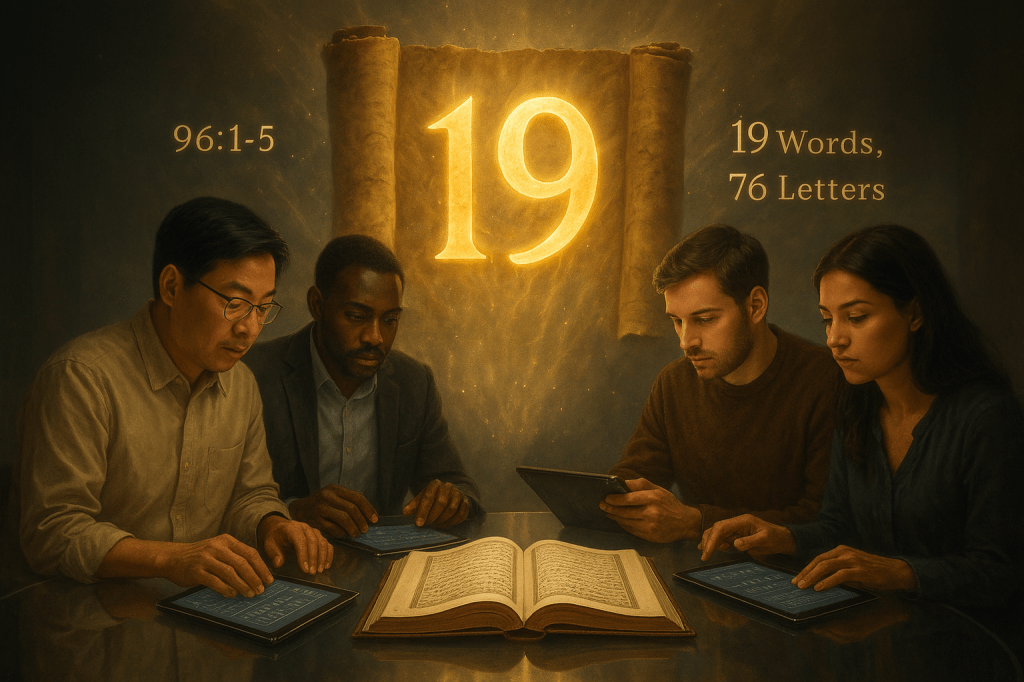
Introduction: Where Divine Revelation Meets Mathematical Certainty
Over fourteen centuries ago, the first words of divine revelation descended upon Muhammad. These were not random words chosen by chance, nor were they simply eloquent phrases meant to inspire. They were precisely calculated, mathematically structured, and embedded with a numerical signature that would remain hidden for over 1,400 years until the computer age would unlock their secrets. Chapter 96, known as “The Embryo,” contains the first five verses revealed to Muhammad, and these verses bear the unmistakable fingerprint of their divine Author: the number 19.
The mathematical miracle of Code 19 in Chapter 96 stands as one of the most compelling pieces of evidence for the divine origin of the Quran. Unlike the miracles given to previous messengers – miracles witnessed by only a few people in specific times and places – this mathematical authentication is perpetual, verifiable, and available to anyone with the ability to count. Every word, every letter, every verse in this chapter has been precisely positioned to conform to a mathematical system that transcends human capability. As we examine the evidence, we will see that the very first words of the Quran to reach humanity were already encoded with proof of their divine source.
[74:30] “Over it is nineteen.”
This foundational verse establishes 19 as the Quran’s common denominator, the signature that God placed upon His final testament to humanity. The subsequent verses explain the profound purposes of this number: to disturb the disbelievers, to strengthen the faith of the believers, and to remove all traces of doubt from the hearts of sincere seekers. Chapter 96, the first revelation, embodies this mathematical miracle in ways that continue to astonish researchers and mathematicians alike.
Part 1: The First Revelation – Five Verses That Changed the World
The Command to Read
The first words revealed to Muhammad were not a theological treatise or a set of religious laws. They were a command – a directive that would establish the foundation of this final message to humanity. “Read” – this single word opened the door to a revelation that would transform the world. The five verses of this first revelation (96:1-5) contain a profound message about knowledge, creation, and the relationship between God and humanity, while simultaneously encoding mathematical proof of their divine origin.
These opening verses introduce fundamental concepts that distinguish this message: God created humanity from an embryo (a scientific fact confirmed only in modern times), He teaches through the pen (emphasizing written knowledge and literacy), and He imparts knowledge that humanity never possessed before. The emphasis on reading, writing, and learning placed knowledge-seeking at the very foundation of this faith. But beyond their profound meaning, these verses carry a mathematical signature that no human author could have engineered.
[96:1] “Read, in the name of your Lord, who created.”
[96:2] “He created man from an embryo.”
[96:3] “Read, and your Lord, Most Exalted.”
[96:4] “Teaches by means of the pen.”
[96:5] “He teaches man what he never knew.”
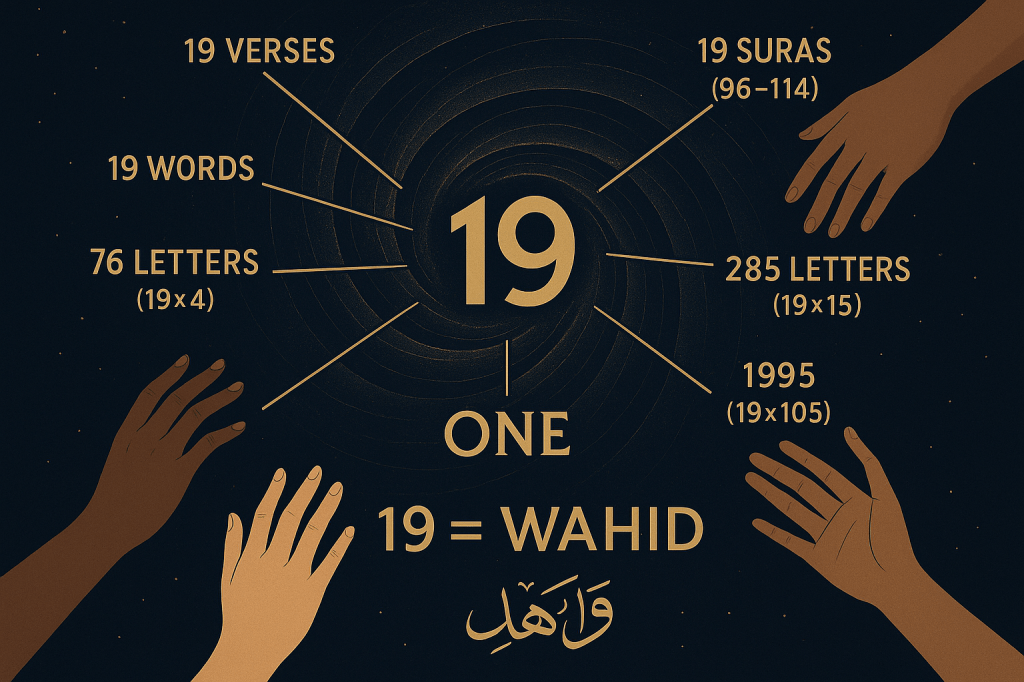
When we examine these five verses mathematically, we discover something extraordinary: they consist of exactly 19 Arabic words. Not 18, not 20, but precisely 19. Furthermore, these 19 words contain exactly 76 letters – which is 19 multiplied by 4. The mathematical precision extends even further when we count the total letters in the entire chapter: 285 letters, which equals 19 multiplied by 15. Such intricate mathematical composition, achieved while maintaining perfect literary eloquence and profound meaning, could not be the product of human design.
Word-by-Word Analysis: 19 Words, 76 Letters in Chapter 96:1-5

Part 2: Chapter 96 – 19 Verses of Divine Precision
The Complete Mathematical Structure
The mathematical miracle extends far beyond the first five verses. The complete Chapter 96 contains exactly 19 verses – not approximately, not roughly, but precisely 19. This is the same number mentioned in verse 74:30 as the Quran’s common denominator. When we count every letter in the entire chapter, including all 19 verses, we find 285 letters – which is 19 multiplied by 15. Every aspect of this chapter has been crafted with mathematical precision while maintaining perfect Arabic eloquence.
Consider what this means: the chapter that was revealed first, the chapter that marks the beginning of the Quranic revelation, contains exactly 19 verses. The message that initiated Muhammad’s messengership bears the mathematical signature of its Author. This cannot be attributed to coincidence. The probability of having exactly 19 verses, with the first 5 verses containing exactly 19 words and 76 letters, while the complete chapter contains exactly 285 letters (all multiples of 19), is astronomically small unless it was intentionally designed this way by an intelligence capable of such precise composition.
Complete Letter Count: 285 Letters in Chapter 96 (19 × 15)

[96:6] “Indeed, the human transgresses.”
[96:7] “When he becomes rich.”
[96:8] “To your Lord is the ultimate destiny.”
The remaining verses of Chapter 96 address human nature, the tendency toward arrogance and transgression, and the ultimate accountability before God. Yet even as the chapter delivers these powerful spiritual lessons, it maintains its mathematical structure. Every verse, every word, every letter contributes to a system that mathematically proves this could not be the work of any human being.
Part 3: The Word-by-Word Analysis of the First Revelation
Examining the 19 Words
Let us examine the first revelation (96:1-5) word by word in Arabic to verify the count. This analysis has been conducted by scholars, linguists, and researchers worldwide, and the count consistently produces the same result. The Arabic text reads: “Iqra’ bismi rabbika alladhi khalaq. Khalaqa al-insana min ‘alaq. Iqra’ wa rabbuka al-akram. Alladhi ‘allama bil-qalam. ‘Allama al-insana ma lam ya’lam.” When we count each distinct word in the Arabic, we arrive at exactly 19 words.
The precision of this count becomes even more remarkable when we consider what was required. The very first words revealed formed a mathematically perfect structure – 19 words containing 76 letters. No human author, no matter how skilled in mathematics, could compose text in real-time that maintains such intricate numerical patterns while simultaneously delivering profound meaning in perfect literary Arabic. This is a feat that would later be discovered to permeate the entire Quran, containing numerical patterns beyond the capability of the most sophisticated human mathematicians of any era.
The 76 letters (19 x 4) in these first five verses have been counted and verified repeatedly. Critics have attempted to challenge this count, but careful analysis using standard Arabic linguistic rules consistently produces the same result. The letters are counted according to established Arabic orthographic conventions, and the total always equals 76 – a perfect multiple of 19. This mathematical precision, achieved in the very first words of revelation, sets the pattern for the entire Quran.
Part 4: The Ma-Lam Linguistic Evidence
Addressing the Critics
Some critics have attempted to dispute the 19-word count in verses 96:1-5 by challenging the treatment of the word “ma-lam” (what he never) in verse 96:5. They argue that this should be counted as two separate words rather than one compound word, which would alter the count to 20. However, this objection crumbles under the weight of linguistic evidence from classical Arabic dictionaries and established grammatical conventions that span over a millennium of Arabic scholarship.
The Arabic expression “ma-lam” functions as a compound unit in classical Arabic grammar, similar to how English treats expressions like “whatever” or “whenever.” When the particle “ma” (what) combines with “lam” (never/not), they form a single semantic unit that functions as one word in the sentence structure. This is not a novel interpretation invented to preserve the mathematical miracle – it is standard Arabic linguistics that has been documented by scholars centuries before Code 19 was discovered.
Classical Dictionary Support
The treatment of compound words like “ma-lam” is well-established in classical Arabic lexicography. Abu ‘Ubayd al-Qasim bin Salam (d. 838 CE), one of the earliest and most respected Arabic linguists, documented the compound nature of such constructions in his work “Gharib al-Hadith.” This was written over a thousand years before the mathematical miracle was discovered, eliminating any possibility that the linguistic ruling was invented to support a predetermined conclusion.
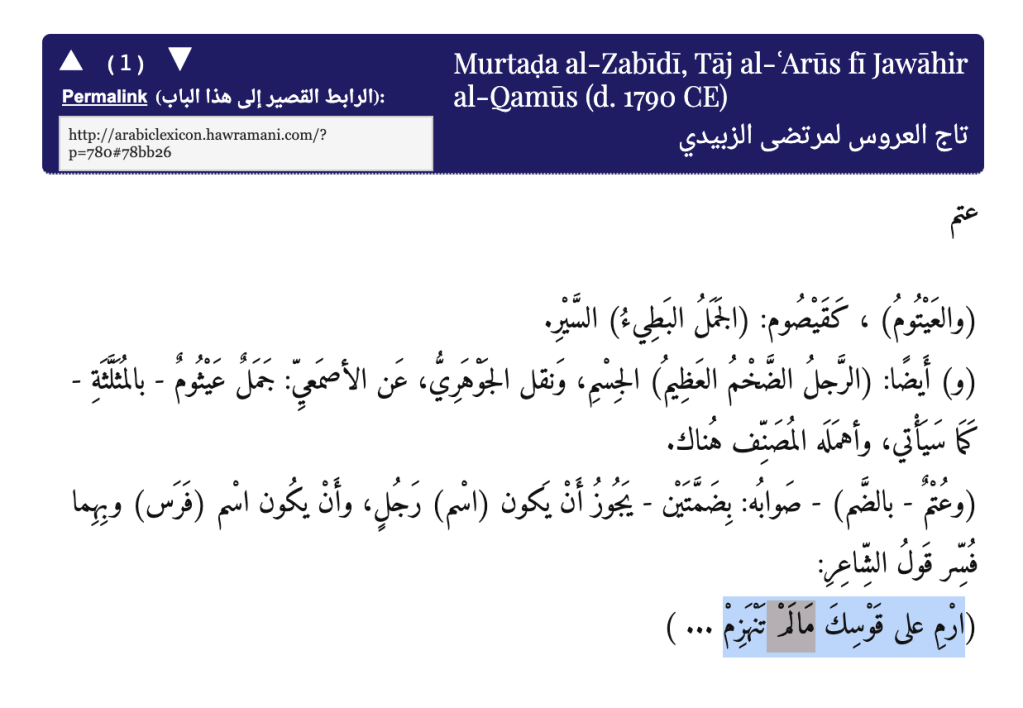
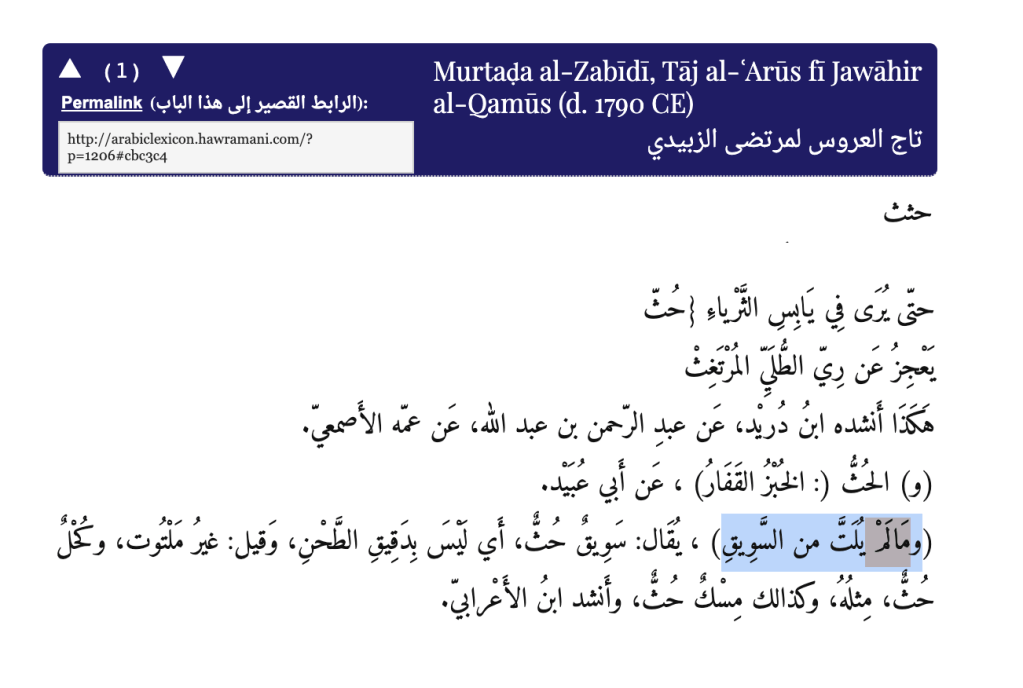
Murtada al-Zabidi (d. 1790 CE), in his monumental work “Taj al-‘Arus” (The Crown of the Bride), one of the most comprehensive Arabic dictionaries ever compiled, also treats such compound constructions as single lexical units. Ahmad Mukhtar Umar (d. 2003 CE), in his “Mu’jam al-Lugha al-‘Arabiya al-Mu’asira” (Dictionary of Contemporary Arabic), confirms this treatment in modern linguistic terminology. Even the Western scholar Edward William Lane (d. 1876 CE), in his celebrated “Arabic-English Lexicon,” recognizes the compound nature of such Arabic constructions.
Classical Dictionary Evidence for “Ma-Lam” as Compound Word:



Similar Compound Words
The Quran contains numerous examples of similar compound words that are universally accepted as single words by Arabic linguists. Consider “awalam” (have they not), “mimma” (from what), and “fima” (in what) – these are all compound constructions that combine particles with other elements to form single words. No scholar disputes their status as single words. The same grammatical principle applies to “ma-lam,” and treating it consistently produces the 19-word count in the first revelation.
The objection to counting “ma-lam” as one word appears to be motivated by a desire to disprove the mathematical miracle rather than by genuine linguistic analysis. When we apply consistent Arabic grammatical rules – rules established by classical scholars who had no knowledge of Code 19 – we arrive at exactly 19 words. The mathematical miracle remains intact because it was designed by the One who created the Arabic language itself.
Part 5: Ancient Manuscript Evidence
What Historical Documents Reveal
Critics sometimes point to variations in word spacing in ancient Quran manuscripts as evidence against the 19-word count. However, this argument fundamentally misunderstands how ancient Arabic manuscripts were written. Early Arabic writing did not consistently use spaces between words – this is a convention that developed over time. Ancient manuscripts from approximately 800 CE, 1198 CE, and 1203 CE show varied spacing patterns that reflect the scribal practices of their time rather than linguistic word boundaries.
Ancient Manuscripts Showing Word Spacing Variations:

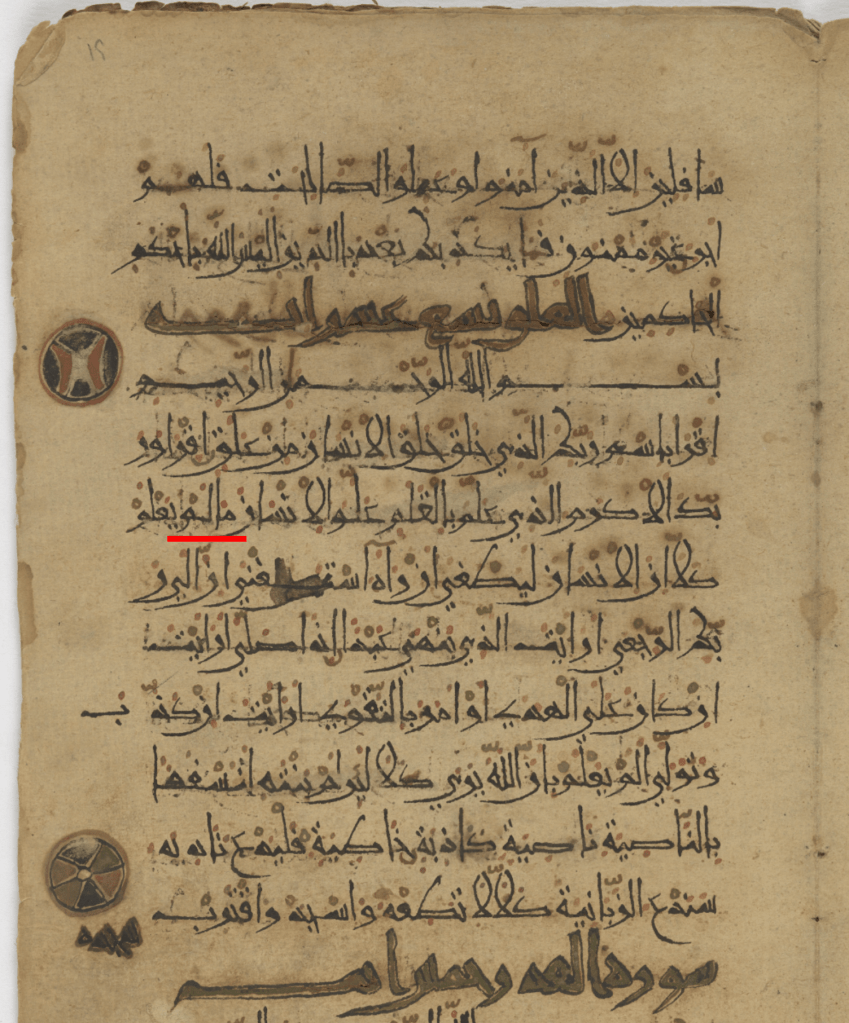
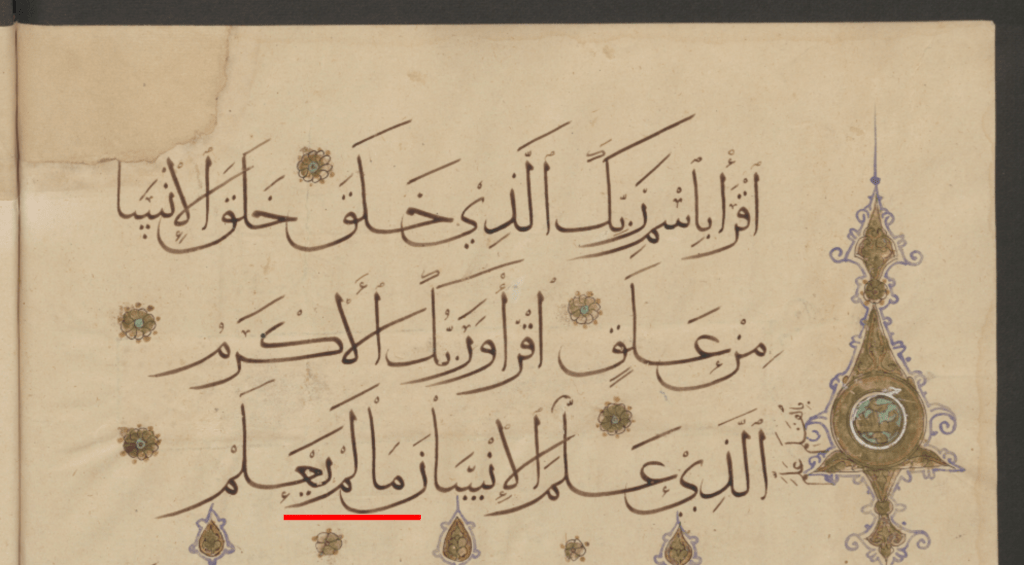
Manuscripts Showing “Ma-Lam” Written as Compound Word (highlighted in red):


The absence of consistent spacing in ancient manuscripts actually supports the reliability of oral transmission and established linguistic rules rather than visual spacing conventions. Arabic scholars determined word boundaries based on grammar and meaning, not on physical gaps between letters on a page. The manuscripts preserve the letters and their sequence, while the linguistic analysis determines how those letters are grouped into words. This is why Arabic dictionaries and grammar texts, not manuscript spacing, are the authoritative sources for word counts.
[96:9] “Have you seen the one who enjoins.”
[96:10] “Others from praying?”
[96:11] “Is it not better for him to follow the guidance?”
Furthermore, the fact that the mathematical miracle has been verified using printed Qurans from around the world – all of which preserve the same text – demonstrates the remarkable preservation of the Quranic text. The mathematical structure requires precise preservation of every letter, and the fact that the numbers work proves that not a single letter has been added or removed in 1,400 years. The manuscript evidence, when properly understood, actually strengthens rather than weakens the case for the mathematical miracle.
Part 6: The Final 19 Chapters Pattern
Chapter 96 and Its Position in the Quran
Chapter 96 occupies a remarkable position in the Quran’s structure. When we count backward from the end of the Quran (Chapter 114), Chapter 96 is the 19th chapter from the end. In other words, Chapters 96 through 114 constitute exactly 19 chapters. This is not a minor detail – it places the first revelation at the head of the final 19 chapters, creating a structural connection between the number 19 and the beginning of revelation.
The mathematical relationships extend further. When we add up all the chapter numbers from 96 to 114, we can use the arithmetic series formula: Sum = n × (first + last) / 2 = 19 × (96 + 114) / 2 = 19 × 210 / 2 = 19 × 105 = 1,995. The fact that this sum is inherently a multiple of 19 is a mathematical property: any 19 consecutive numbers will sum to 19 times the middle number. The positioning of Chapter 96 as the first of the final 19 chapters means these 19 chapters contain a built-in mathematical signature, where Chapter 105 (the middle chapter) multiplied by 19 equals the total.
The Final 19 Chapters of the Quran (96-114):

[96:12] “Or advocate righteousness?”
[96:13] “If he disbelieves and turns away.”
[96:14] “Does he not realize that God sees?”
This structural positioning could not have been arranged by Muhammad or any human author. The ordering of the chapters in the Quran was divinely inspired, and the fact that this ordering creates mathematical patterns based on 19 proves that the entire Quran – its content, its structure, its verse counts, and its letter counts – was designed by an intelligence far beyond human capability. The first revelation sits precisely where it must sit to maintain the mathematical integrity of the entire book.
Part 7: Scientific Verification and Modern Discovery
The Computer Age Unveils the Miracle
The mathematical miracle of Code 19 remained hidden for over 1,400 years until the advent of computers made comprehensive statistical analysis possible. Dr. Rashad Khalifa, an Egyptian-American biochemist, began researching the Quranic initials in 1968 using computer analysis. After years of painstaking research, a mathematical pattern emerged with 19 as the common denominator – the same number mentioned in verse 74:30 as being “one of the great miracles.”
In his presentation on the mathematical miracle, Dr. Khalifa demonstrated how the first revelation consists of exactly 19 words: “So the first chapter revealed is positioned in the Quran atop the last 19 chapters in the Quran. You also notice that this chapter consists of 19 verses. The first revelation was 19 words exactly… If you count the letters in these 19 words, you find that the total is 76, 19 times 4. And if you count the letters in the whole chapter, the first chapter revealed, you find that the total is 285 letters, or 19 times 15” (at 5:32).
The discovery of Code 19 represents a new kind of miracle – one that is perpetual, verifiable, and accessible to anyone. Unlike the miracles of previous prophets, which were witnessed by only a few people in specific times and places, the mathematical miracle of the Quran can be verified by anyone who takes the time to count. It does not require faith to accept – it requires only honesty and the willingness to examine the evidence. The numbers speak for themselves, providing physical, tangible proof that the Quran is God’s message to humanity.
Part 8: The Significance of 19
Why This Particular Number?
The choice of 19 as the Quran’s mathematical signature is itself significant. In Arabic numerology (gematria), where letters also serve as numbers, the word “wahid” (meaning “one”) has a numerical value of 19: waw (6) + alif (1) + ha (8) + dal (4) = 19. Thus, the number 19 represents the core message of the Quran: God is One. The mathematical structure of the Quran proclaims monotheism not only through its words but through its very numerical composition.
The number 19 also has unique mathematical properties. It is a prime number, divisible only by 1 and itself. This makes it ideal for a mathematical code – any deviation from the original text would disrupt the multiples of 19. If a single letter were added or removed anywhere in the Quran, the entire mathematical system would collapse. This property ensures the preservation of the Quran’s text across time, providing a built-in authentication system that detects any tampering or corruption.
[96:15] “Indeed, unless he refrains, we will take him by the forelock.”
[96:16] “A forelock that is disbelieving and sinful.”
[96:17] “Let him then call on his helpers.”
Furthermore, 19 is the sum of the first powers of 9 and 10 (9 + 10 = 19), numbers that represent the transition between single digits and double digits. It represents completeness and transition, fitting for a message that serves as the final testament to humanity. The wisdom in choosing 19 as the common denominator reflects an intelligence that understood mathematics, linguistics, and human psychology at levels that far exceed any human capability.
Part 9: The Testimony of Scholars
Ahmed Deedat and the Recognition of Code 19
The mathematical miracle of Code 19 gained international attention through the work of various scholars and lecturers who recognized its significance. Ahmed Deedat, the famous South African Islamic scholar known for his comparative religion debates, presented the 19-word count analysis of the first revelation in his lectures. His presentation showed the word-by-word count of verses 96:1-5, visually demonstrating how the first revelation consists of exactly 19 Arabic words.
Deedat’s engagement with Code 19 demonstrated that the mathematical miracle transcends the boundaries of any particular school of thought or interpretation. The numbers are objective facts that can be verified by anyone. Whether one counts the words in Arabic script, analyzes the letters using computer software, or traces the patterns using traditional methods, the results remain consistent. The mathematical structure exists independently of the counter’s beliefs, making it a universally accessible proof.
[96:18] “We will call the guardians of Hell.”
[96:19] “You shall not obey him; you shall fall prostrate and draw nearer.”
The final verse of Chapter 96 – verse 19 – delivers the ultimate instruction: prostrate and draw nearer to God. The chapter that began with the command to “Read” concludes with the command to “prostrate and draw nearer.” The 19th verse of this 19-verse chapter calls humanity to worship God alone. The mathematical structure and the spiritual message converge in perfect harmony, demonstrating that both were designed by the same Author.
Part 10: The Implications of the Mathematical Miracle
What This Evidence Means for Humanity
The mathematical miracle of Code 19 in Chapter 96 carries profound implications. First, it provides tangible, verifiable evidence that the Quran is of divine origin. This is not a matter of faith alone – it is a matter of mathematical fact. Anyone who examines the evidence honestly must confront the reality that no human being could have composed a text with such intricate mathematical properties while simultaneously maintaining perfect literary eloquence and profound spiritual content.
Second, the mathematical miracle proves that the Quran has been perfectly preserved since its revelation. The fact that the numbers work – that the mathematical patterns remain intact after 1,400 years – demonstrates that not a single letter has been added, removed, or altered. The Quran in our hands today is the same Quran that was revealed to Muhammad, letter for letter. This addresses the common claim that religious scriptures have been corrupted over time; the mathematical structure serves as a built-in verification system that detects any tampering.
Third, the timing of this discovery is significant. The mathematical miracle was revealed in the computer age, when humanity has the tools to verify and analyze such complex patterns. Previous generations did not have access to computers and could not have conducted the comprehensive statistical analyses required to uncover Code 19. The miracle was embedded in the text 1,400 years ago but revealed at a time when humanity could fully appreciate and verify it. This suggests a divine plan that unfolds according to a precise timeline.
Conclusion: The First Words Bear the Final Proof
Chapter 96 stands as a monument to divine precision. The first words revealed to Muhammad carry within them the mathematical signature of their Author. Nineteen words, 76 letters, 19 verses, 285 total letters – every number perfectly divisible by 19. The chapter sits at the head of the final 19 chapters, with their numbers summing to a multiple of 19. This is not coincidence; this is design. This is not human work; this is divine composition.
The critics who attempt to challenge these findings reveal more about their own biases than about any genuine problems with the evidence. When classical Arabic dictionaries spanning over a millennium consistently treat compound words according to established grammatical rules, when manuscripts from different centuries preserve the same text, when independent researchers using different methods arrive at the same counts – the evidence speaks for itself. The mathematical miracle is real, it is verifiable, and it is conclusive.
For those who sincerely seek the truth, Chapter 96 offers both guidance and proof. It commands us to read, to learn, to seek knowledge. And when we do – when we read this chapter carefully, count its words and letters, examine its position in the Quran – we find that the first revelation bears the stamp of its Creator. The very words that began this final message to humanity carry within them the proof that they came from God. Over it is nineteen, and that nineteen proves everything.
[74:31] “We appointed angels to be guardians of Hell, and we assigned their number (19) (1) to disturb the disbelievers, (2) to convince the Christians and Jews (that this is a divine scripture), (3) to strengthen the faith of the faithful, (4) to remove all traces of doubt from the hearts of Christians, Jews, as well as the believers, and (5) to expose those who harbor doubt in their hearts, and the disbelievers…”

 Quran Only Studies
Leave a comment