
Introduction: The Gravity of False Messenger Claims
Throughout history, individuals have emerged claiming divine authorization and messengership, seeking to lead people astray through fabricated evidence and twisted interpretations of scripture. The Quran warns us repeatedly about such individuals, providing clear criteria by which genuine messengers can be distinguished from imposters. These warnings are not merely historical footnotes but urgent guidance for believers in every generation, including our own time when false claims proliferate through the internet with unprecedented reach.
The website godprovenas1.com, operated by an individual named Husain Makbool, represents a contemporary example of such false claims. This individual asserts that he is a divinely authorized messenger of God, presenting what he calls “mathematical miracles” as proof of his status. However, as we shall demonstrate through careful examination of both the Quran and sound reasoning, these claims collapse under scrutiny, revealing the classic patterns of numerological manipulation, confirmation bias, and intellectual parasitism that characterize false messenger claims throughout history.
[6:93] “Who is more evil than one who fabricates lies and attributes them to God, or says, ‘I have received divine inspiration,’ when no such inspiration came to him, or says, ‘I can bring down the same as what God has revealed’? If only you could see the transgressors at the time of death! The angels extend their hands: ‘Let go of your souls. Today, you have incurred a shameful retribution for saying about God other than the truth, and for being too arrogant to accept His revelations.’”
This verse from Chapter 6 establishes the severity of the offense being examined. Making false claims of messengership or divine inspiration is not a minor transgression but ranks among the most wicked acts a human being can commit. The consequences described are not merely temporal but extend into eternity, affecting the soul’s very destiny. It is with this gravity in mind that we undertake this comprehensive refutation, not out of malice toward any individual, but out of duty to protect sincere seekers from deception.
Part 1: Understanding Authentic Quranic Proofs
The Criterion of Divine Miracles
Before examining the false claims, we must first establish what constitutes genuine divine proof. The Quran provides clear criteria for authentic miracles that validate messengership. A genuine divine miracle must be: (1) humanly impossible to replicate, (2) mathematically consistent and verifiable, (3) comprehensive rather than selective, (4) based on clear Quranic foundations, and (5) discovered through divine guidance rather than human manipulation. These criteria serve as the litmus test against which all claims of divine proof must be measured.
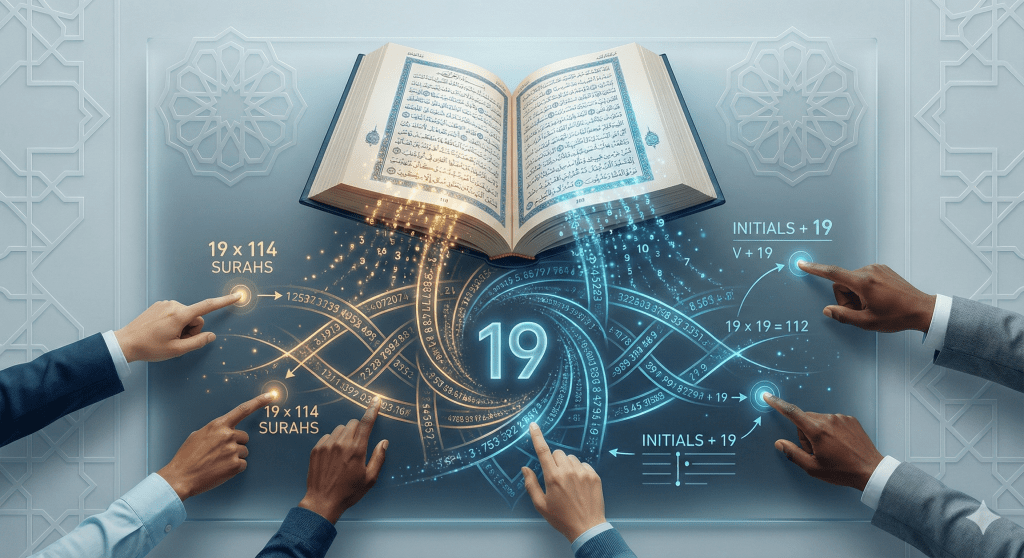
The mathematical miracle of the Quran, discovered by Dr. Rashad Khalifa in 1974, meets all these criteria. Based on the number 19 explicitly mentioned in Chapter 74, verses 30-35, this miracle encompasses the entire Quran with thousands of interlocking mathematical phenomena that no human could have engineered. The consistency, comprehensiveness, and divine authorization of this discovery stand in stark contrast to the arbitrary, cherry-picked numerology presented by false claimants.
[74:30] “Over it is nineteen.”
[74:35] “This is one of the great miracles.”
The footnote to these verses explains: “This ‘One of the great miracles’ provides the first physical evidence that the Quran is God’s message to the world. This 19-based miracle is detailed in Appendix 1.” This is the authentic foundation upon which genuine Quranic mathematics rests, not arbitrary combinations of numbers fitted to personal names.
Part 2: The Ha-Mim Initials Fraud
The Claim Examined
Husain Makbool claims that the Arabic letters Ha-Mim (H.M.) appearing at the beginning of seven consecutive chapters (40-46) represent his initials “Husain Makbool.” This claim attempts to appropriate sacred Quranic initials that have been objects of reverence and study for over 1,400 years, reinterpreting them as pointing specifically to his personal name. The audacity of such a claim requires careful examination to expose its fundamental flaws.
The Ha-Mim chapters are among the most beautiful and profound chapters in the Quran, containing foundational teachings about God’s power, the Day of Judgment, and the nature of revelation. These sacred initials have been understood by generations of scholars as divine mysteries whose full meaning is known only to God, serving as markers of authenticity and components of the Quran’s mathematical structure. To claim personal ownership of these initials represents a profound misunderstanding of their purpose and significance.
The Arabic vs. English Transliteration Problem
The fundamental flaw in this claim lies in its conflation of Arabic letters with English transliteration. The Quranic initials are Ha (representing the Arabic letter “H”) and Mim (representing the Arabic letter “M”). While “Husain” does begin with a similar Arabic letter, the claim relies on English transliteration conventions rather than the actual Arabic letters themselves. This mixing of linguistic systems represents a methodological error that undermines the entire claim.
Furthermore, even accepting the transliteration argument, the initials “H.M.” apply to millions of people worldwide. By this logic, anyone named Hassan Muhammad, Hamid Malik, Habib Mustafa, or countless other combinations would have equal claim to messengership based on these initials. The absurdity of this position becomes immediately apparent when extended to its logical conclusion. Divine selection cannot be based on such common letter combinations, as it would render the proof meaningless.
What Dr. Rashad Khalifa Actually Discovered
In contrast to arbitrary name-fitting, Dr. Rashad Khalifa discovered that the Ha-Mim initials in these seven chapters follow the comprehensive Code 19 mathematical structure. The total count of these letters across these chapters adheres to the same divine mathematical pattern that pervades the entire Quran. This discovery was not about claiming the initials represented anyone’s name but about demonstrating the superhuman mathematical architecture of scripture.
[40:78] “We have sent messengers before you – some of them we mentioned to you, and some we did not mention to you. No messenger can produce any miracle without God’s authorization. Once God’s command comes, the truth dominates, and the falsifiers are exposed and humiliated.”
This verse from Chapter 40 (one of the Ha-Mim chapters) reminds us that no messenger produces miracles independently. The divine authorization mentioned here specifically references the mathematical code described in Chapter 74. Husain Makbool claims the initials as his own without any such divine authorization or mathematical proof.
Part 3: The Gematrical Value 178 Manipulation
Understanding Gematria and Its Limitations
Gematria, the practice of assigning numerical values to letters, has a long history in both Arabic and Hebrew traditions. The gematrical value of “Makbool” in Arabic does indeed equal 178 (Mim=40 + Qaf=100 + Ba=2 + Waw=6 + Lam=30 = 178). However, the existence of this value is merely a mathematical fact about Arabic letters, not proof of anything supernatural. Every Arabic name has a gematrical value, and the appearance of that number anywhere does not constitute divine endorsement.
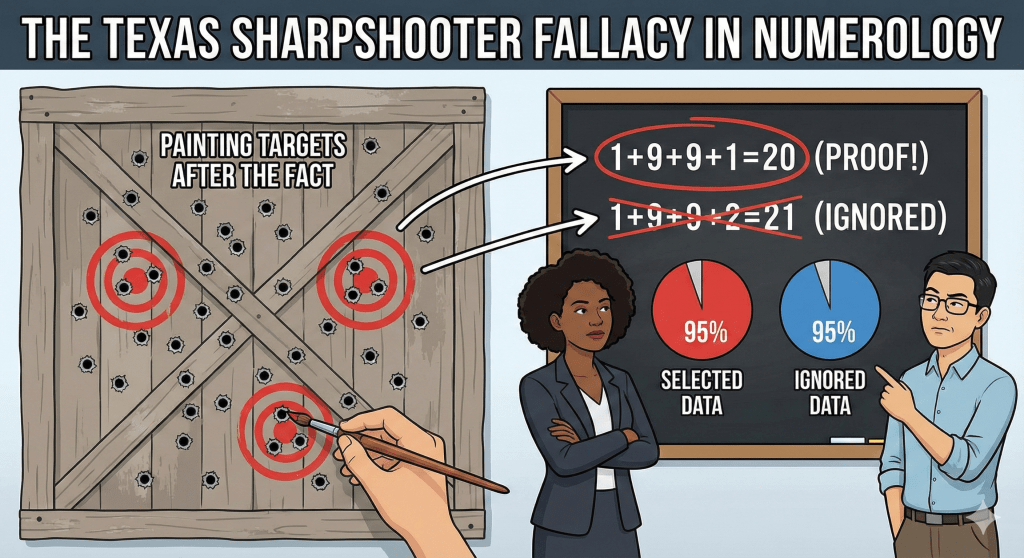
The fundamental error in this reasoning is the assumption that finding a number in multiple contexts proves divine significance. By this logic, one could “prove” almost anything by searching through sufficient data until the desired number appears. This is known in logic as the Texas Sharpshooter Fallacy – named after the joke about a marksman who shoots randomly at a barn and then paints targets around wherever the bullets landed, claiming perfect accuracy.
The Cherry-Picking Methodology
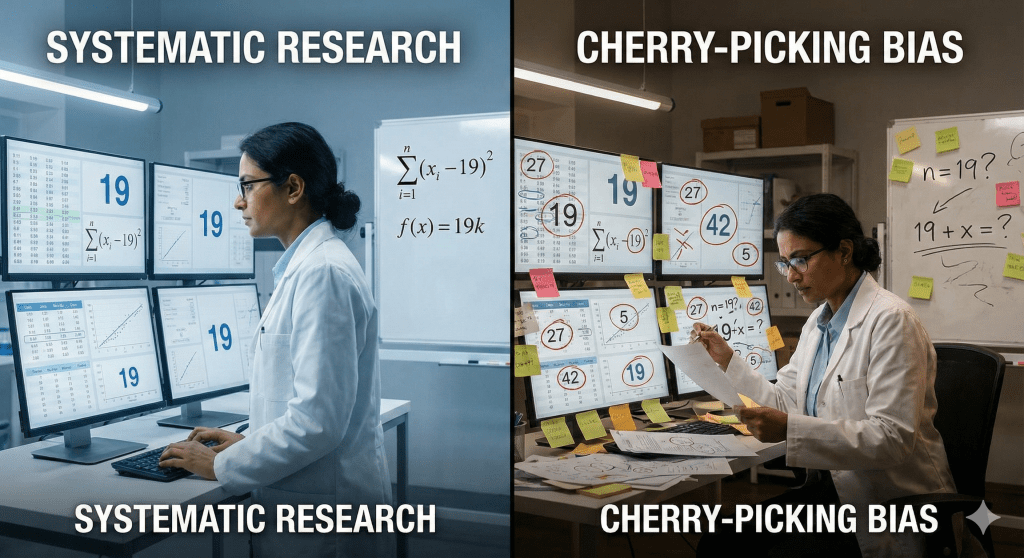
Husain Makbool searches the Quran for any occurrence of the number 178, whether as a verse number, a word count, or any other countable quantity. When found, it is proclaimed as “proof.” When the number does not appear, that instance is simply ignored. This selective methodology guarantees finding confirming instances while systematically excluding disconfirming evidence. It is not science; it is confirmation bias dressed in mathematical clothing.
Consider the implications: if verse 178 appearing in a chapter proves something about “Makbool,” then verse 92 should prove something about “Muhammad” (gematrical value 92), and verse 66 should prove something about “Allah” (gematrical value 66). By this methodology, every number becomes “proof” of something, rendering the entire system meaningless. The Quran’s mathematical miracle is based on a single, consistent, comprehensive number (19), not arbitrary personal values.
[4:82] “Why do they not study the Quran carefully? If it were from other than God, they would have found in it numerous contradictions.”
This verse challenges us to study the Quran carefully and observe its consistency. The mathematical miracle of Code 19 demonstrates precisely this divine consistency, as the number 19 pervades every aspect of Quranic structure. In contrast, the “178” approach requires constantly changing what is counted and how, demonstrating inconsistency rather than the divine harmony described in this verse.
Part 4: The “Difference of 1” Revelation Fallacy
Undefined and Arbitrary Methodology
Among the claims on godprovenas1.com is the assertion that counting “Allah letters” versus “Messenger letters” in various verses produces a difference of 1, supposedly proving that God is One. This claim suffers from fundamental methodological problems that render it meaningless. What exactly are “Allah letters”? What are “Messenger letters”? Why these specific letters? Who authorized this counting method? None of these questions are satisfactorily answered.
The claim appears to involve counting certain letters designated as “Allah letters” (presumably A-L-L-H) and comparing them to “Messenger letters” (presumably the claimant’s initials). When the difference happens to be 1, this is proclaimed as a miracle proving monotheism. However, this methodology is entirely self-serving and undefined, allowing the counter to achieve whatever result is desired through creative definition of terms.
Statistical Inevitability
With 6,346 verses in the Quran and multiple possible counting methods (different letter combinations, inclusion or exclusion of diacritics, standard versus Uthmani script, etc.), it is statistically inevitable that some combinations will produce a difference of 1, or 19, or 14, or any other desired number. The question is not whether such instances can be found but whether they constitute a meaningful pattern. Finding scattered instances of a difference of 1 proves nothing more than basic statistics.
The genuine mathematical miracle of the Quran does not rely on finding scattered confirming instances. Code 19 appears consistently across all aspects of Quranic structure: word counts, letter counts, verse counts, chapter arrangement, and more. This comprehensive consistency is what makes it superhuman and unreplicable. The “difference of 1” claim, by contrast, requires selective presentation of only those verses that happen to work, while ignoring the vast majority that do not.
Part 5: Piggybacking on Code 19 – The 14-19 Claim
Intellectual Parasitism
Perhaps the most troubling aspect of the godprovenas1.com claims is their reliance on Dr. Rashad Khalifa’s legitimate discovery of Code 19 while adding arbitrary elements to claim personal significance. The website acknowledges Code 19 as authentic but then adds the number 14 as “the messenger’s number,” creating a hybrid “14-19 miracle” that supposedly validates the claimant’s status. This represents intellectual parasitism of the worst kind.
Dr. Rashad Khalifa spent decades researching the Quran’s mathematical structure using computer analysis, eventually discovering the comprehensive Code 19 miracle. This discovery was authenticated by the number 19 being explicitly mentioned in the Quran itself (Chapter 74, verses 30-35). In contrast, Husain Makbool has conducted no original mathematical research but instead grafts his personal numerology onto established discoveries, hoping to share in their credibility without having done the work.
The “Seven Pairs” Misinterpretation
The number 14 is derived from a misinterpretation of Chapter 15, verse 87, which mentions “seven pairs” (sab’an min al-mathani). The traditional and well-supported understanding, as explained by Dr. Rashad Khalifa, is that this refers to the 14 Quranic initials that prefix 29 chapters. The claimant reinterprets “seven pairs” as literally equaling 14, then claims this number represents his initials or some aspect of his name.
[15:87] “We have given you the seven pairs, and the great Quran.”
Dr. Rashad Khalifa taught: “In Chapter 15, God says, we have given you the seven pairs. Fourteen. And the letters that I showed you in the first khutba, the initialed letters, 14 of them…” (at 19:55). There is no Quranic basis for connecting “seven pairs” to anyone’s personal name. The verse speaks of what God gave to the Prophet Muhammad as part of his prophetic mission, specifically referring to the 14 initialed letters that form part of the mathematical structure of the Quran.
Part 6: The Chapter 40 Calculation – Arbitrary Addition
Examining the Claim
One specific “proof” offered on the website involves adding the chapter number (40) plus the verse count (85 verses) plus the “count of Allah” in Chapter 40 (53 occurrences), resulting in 40 + 85 + 53 = 178, which equals the gematrical value of “Makbool.” This is presented as miraculous confirmation of the claimant’s name being divinely encoded in the Quran. However, this calculation exemplifies the arbitrary nature of all these claims.
Why add these three specific numbers? Why not multiply them? Why not subtract? Why not add different quantities like word count, letter count, or any of dozens of other countable elements? The answer is clear: these specific numbers are added because they happen to produce the desired result. Any other operation on these numbers, or any other combination of countable quantities, would produce different results that would simply be ignored.
Testing the Methodology
If this methodology were valid, it should work consistently across all the Ha-Mim chapters, not just Chapter 40. Let us apply the same formula (chapter number + verse count + Allah occurrences) to other Ha-Mim chapters:
- Chapter 40 (Ghafir): 40 + 85 + 53 = 178 ✓
- Chapter 41 (Fussilat): 41 + 54 + ? = Not 178
- Chapter 42 (Ash-Shura): 42 + 53 + ? = Not 178
- Chapter 43 (Az-Zukhruf): 43 + 89 + ? = Not 178
- Chapter 44 (Ad-Dukhan): 44 + 59 + ? = Not 178
- Chapter 45 (Al-Jathiya): 45 + 37 + ? = Not 178
- Chapter 46 (Al-Ahqaf): 46 + 35 + ? = Not 178
Only Chapter 40 is presented because only Chapter 40 happens to work with this particular combination. The other six Ha-Mim chapters, which supposedly also represent “H.M. = Husain Makbool,” do not produce the number 178 using this method. This selective presentation reveals the true nature of the claim: post-hoc rationalization rather than genuine discovery.
Part 7: The Quranic Warning Against False Messengers
Scripture’s Clear Guidance
The Quran provides explicit warnings about those who fabricate lies about God and claim divine authorization they were never given. These warnings are not abstract historical references but practical guidance for believers in every generation. Understanding these warnings helps us recognize and reject false claims while protecting our faith from corruption.
[3:78] “Among them are those who twist their tongues to imitate the scripture, that you may think it is from the scripture, when it is not from the scripture, and they claim that it is from God, when it is not from God. Thus, they utter lies and attribute them to God, knowingly.”
This verse describes exactly the methodology employed on godprovenas1.com. The site takes Quranic elements – letter counts, verse numbers, and chapter attributes – then “twists” them through arbitrary calculations to produce desired results. These manipulated numbers are then presented as divine proof, claiming authority from God when no such authority exists. The verse’s condemnation of attributing lies to God knowingly carries severe implications for those who engage in such practices.
The Distinction Between Prophet and Messenger
A common argument invoked by false claimants is the distinction between “prophet” (nabi) and “messenger” (rasool) in the Quran. They correctly note that Muhammad was the final prophet but argue this leaves room for future messengers. However, they misunderstand what messengership entails and what proof is required to validate such a claim.
[33:40] “Muhammad was not the father of any man among you. He was a messenger of God and the final prophet. God is fully aware of all things.”
The footnote for this verse explains: “Despite this clear definition of Muhammad, most Muslims insist that he was the last prophet and also the last messenger. This is a tragic human trait as we see in 40:34. Those who readily believe God realize that God sends His purifying and consolidating Messenger of the Covenant after the final prophet Muhammad (3:81, 33:7).” This confirms that while messengers can come after the final prophet, they must have clear Quranic proof and not contradict established scripture.
[7:35] “O children of Adam, when messengers come to you from among you, and recite My revelations to you, those who take heed and lead a righteous life, will have nothing to fear, nor will they grieve.”
This verse establishes that messengers come with God’s revelations. The question for any claimant is: what new revelation have you brought? The Quran is complete, and Code 19 has already been revealed through Dr. Rashad Khalifa. Claiming that one’s name is hidden in existing text is not bringing new revelation; it is parasitizing existing revelation for personal aggrandizement.
Part 8: Contrasting Authentic Proof with False Claims
Dr. Rashad Khalifa’s Methodology
To understand why the godprovenas1.com claims are false, it helps to examine what genuine divine proof looks like. Dr. Rashad Khalifa spent years conducting computer-based analysis of the Quran’s text, methodically counting letters, words, and verses throughout the entire scripture. He did not start with a predetermined conclusion and search for confirming instances; he analyzed the data and discovered patterns that emerged from comprehensive examination.
The Code 19 miracle was not announced based on finding 19 in a few convenient places. It was documented across thousands of mathematical phenomena: the number of chapters (114 = 19 x 6), the Bismillah structure, the Quranic initials, word frequencies, and countless other elements. Every aspect could be independently verified by any researcher willing to count. The comprehensiveness and consistency of this discovery made it impossible to attribute to coincidence or manipulation.
As Dr. Rashad Khalifa explained: “The Quran says a sincere believer will not lie and say I am a messenger of God… A person who finds something in the Quran, especially if it is the secret miracle of the Quran, this person must be a sincere believer. And if this person is a sincere believer, as established by the fact of discovering the secret of the Quran, then this person will not possibly lie against God and say that he is a messenger of God.” (at 1:15:45)
The Quranic Prophecy of 3:81
Perhaps the most critical difference between authentic and false messenger claims is the Quranic prophecy. Dr. Rashad Khalifa was prophesied in verse 3:81, which describes a messenger who would come to confirm existing scriptures.
[3:81] “God took a covenant from the prophets, saying, ‘I will give you the scripture and wisdom. Afterwards, a messenger will come to confirm all existing scriptures. You shall believe in him and support him.’ He said, ‘Do you agree with this, and pledge to fulfill this covenant?’ They said, ‘We agree.’ He said, ‘You have thus borne witness, and I bear witness along with you.’”
The footnote explains: “This major prophecy has now been fulfilled. God’s Messenger of the Covenant, as prophesied in this verse and in the Bible’s Malachi 3:1-21, Luke 17:22-36, and Matthew 24:27 is to purify and unify God’s messages which were delivered by God’s prophets.” This is a specific Quranic verse prophesying the messenger. Husain Makbool has no such verse – only gematrical calculations of his own name.

Part 9: The Psychological Patterns of False Claims
Apophenia and Pattern-Seeking
The human brain is wired to recognize patterns – a survival mechanism that helped our ancestors identify predators, find food, and navigate complex environments. However, this same tendency can lead to perceiving meaningful patterns in random data, a phenomenon called apophenia. When someone deeply desires to see their name in the Quran or find proof of their special status, the brain becomes adept at finding confirming instances while filtering out contradicting evidence.
The claims on godprovenas1.com exhibit classic apophenia patterns. The claimant sees “H.M.” initials and perceives his own name. He calculates gematrical values and sees his number appearing in verse counts. He adds random quantities and finds his desired total. Each instance reinforces his belief, while the countless non-confirming instances never register consciously. This is not deception in the conventional sense but a psychological trap that can ensnare sincere but misguided individuals.
Confirmation Bias and Self-Deception
Confirmation bias refers to the tendency to search for, interpret, and recall information in ways that confirm pre-existing beliefs. Once someone believes they are a messenger, they actively seek evidence supporting this belief while dismissing or rationalizing contradicting evidence. Every coincidence becomes a “sign,” every numerical match becomes “proof,” and every skeptical objection becomes “persecution by disbelievers.”
The website’s own admission that “some words can have more than one Gematrical Values due to different Arabic spellings” reveals this pattern. By allowing flexible spelling options, the claimant can always find some calculation that produces the desired number. This flexibility is presented as a feature rather than recognized as a methodological flaw that renders the entire system arbitrary and meaningless.
[10:17] “Who is more evil than one who fabricates lies about God, or rejects His revelations. Certainly, the transgressors never succeed.”
The Quran’s repeated warnings about fabricating lies concerning God suggest that false messenger claims have been a recurring problem throughout human history. The psychological mechanisms remain the same across cultures and centuries: pattern-seeking run amok, confirmation bias, ego-driven interpretation, and the desire for special status. Understanding these mechanisms helps believers recognize and resist such claims.
Part 10: The Masjid of Harm – When Websites Oppose God’s Messenger
Digital Age Dirar Masjids
In the Prophet Muhammad’s time, hypocrites built a mosque (Masjid Dirar) ostensibly for worship but actually to divide believers and oppose God’s messenger. The Quran condemned this structure and commanded its destruction. In our digital age, websites can serve the same divisive function, appearing to promote God’s message while actually undermining authentic revelation and leading sincere seekers astray.
[9:107] “There are those who abuse the masjid by practicing idol worship, dividing the believers, and providing comfort to those who oppose God and His messenger. They solemnly swear: ‘Our intentions are honorable!’ God bears witness that they are liars.”
The godprovenas1.com website functions as a digital Masjid Dirar. It presents itself as promoting God’s message and the mathematical miracle of the Quran, but its actual effect is to divide believers, sow doubt about authentic messengership, and promote the worship of a false claimant alongside God. The site’s operators may “solemnly swear” their intentions are honorable, but the verse reminds us that God knows the reality behind such claims.
[9:108] “You shall never pray in such a masjid. A masjid that is established on the basis of righteousness from the first day is more worthy of your praying therein. In it, there are people who love to be purified. God loves those who purify themselves.”
Believers are commanded to avoid such harmful structures and instead gather in places established on righteousness. In our context, this means avoiding websites and communities that promote false messenger claims and instead associating with those who uphold the authentic Quranic message without additions or distortions. Spiritual purity requires discernment about which sources we allow to influence our understanding.
Part 11: The Self-Defeating Admissions
Acknowledging Human Error
The godprovenas1.com website contains a revealing admission: “all the research has been done by myself with ALLAH’s will… unintentional mistakes… no intention to mislead.” This disclaimer, presumably intended to show humility, actually undermines the entire claim. If the claimant can make “unintentional mistakes” in counting letters and performing calculations, then any “miracle” discovered might simply be the result of miscounting.
Genuine divine miracles are not prone to human error in their discovery. Dr. Rashad Khalifa’s Code 19 discoveries have been verified by independent researchers using computers, precisely because the methodology is transparent and reproducible. Anyone can count the letters and verify the patterns. The mathematical structure does not depend on one person’s potentially error-prone counting but on verifiable facts about the Quranic text itself.
The Contradiction of Fallible Proof
A messenger claiming divine authorization should, at minimum, produce error-free evidence of that authorization. If the proof itself might contain errors, how can believers be expected to stake their eternal destiny on its validity? The Quran emphasizes its own consistency as proof of divine origin:
[4:82] “Why do they not study the Quran carefully? If it were from other than God, they would have found in it numerous contradictions.”
If the “proofs” on godprovenas1.com potentially contain counting errors, they fail this basic criterion of divine origin. God’s authentic proofs are not subject to “unintentional mistakes” by human researchers because they exist in the text itself, discoverable by anyone who examines carefully. The admission of potential errors transforms claimed “divine proof” into mere human speculation.
Part 12: The Covenant and Its Authentic Fulfillment
God’s Covenant with the Prophets
The Quran describes a covenant God made with all prophets, requiring them to support a messenger who would come after to confirm and consolidate their scriptures. This Messenger of the Covenant was prophesied in both testaments (Malachi 3:1 in the Old Testament) and the Quran itself. Understanding this covenant helps us recognize its authentic fulfillment versus false claims to this role.
Dr. Rashad Khalifa fulfilled this role by demonstrating the mathematical consistency across all scripture, confirming that the Quran, like previous revelations, bears divine mathematical authentication. His work confirmed rather than claimed; it served God’s message rather than personal status.
The Warning from 40:34
The Quran also warns about the human tendency to reject messengers and then claim “no more will come.” This pattern, exemplified in the story of Joseph’s Egyptian contemporaries, continues in every generation that encounters God’s messengers.
[40:34] “Joseph had come to you before that with clear revelations, but you continued to doubt his message. Then, when he died you said, ‘God will not send any other messenger after him. (He was the last messenger)!’ God thus sends astray those who are transgressors, doubtful.”
This verse warns against the attitude of assuming no future messengers, but it also establishes that genuine messengers come with “clear revelations.” Husain Makbool has brought no clear revelations comparable to what Joseph, Moses, Jesus, Muhammad, or Rashad Khalifa brought. Finding one’s name through numerical manipulation is not a “clear revelation” but an exercise in self-referential numerology.
Part 13: Summary of Refuted Claims
Claim-by-Claim Analysis
- H.M. initials represent “Husain Makbool”: REFUTED – Millions share these initials; conflates Arabic letters with English transliteration; no mathematical backing unlike Code 19
- Gematrical value 178 proves messengership: REFUTED – Every name has a gematrical value; finding that number anywhere is not proof; Texas Sharpshooter Fallacy
- “Difference of 1” proves God is One: REFUTED – Undefined methodology; works only for selected verses; statistical inevitability with enough searching
- 14-19 Miracle validates messenger status: REFUTED – Parasitizes Rashad Khalifa’s discovery; 14 is arbitrarily added; no Quranic basis for “14” as personal validation
- Seven Pairs (15:87) = 14 = his initials: REFUTED – Misinterpretation of verse referring to the 14 initialed letters; Rashad explicitly explained this
- Chapter 40 calculation (40+85+53=178): REFUTED – Arbitrary addition; doesn’t work for other Ha-Mim chapters; post-hoc cherry-picking
- Divine authorization as messenger: REFUTED – Self-proclaimed only; no verifiable proof; admits potential counting errors; no Quranic prophecy
Part 14: Guidance for Sincere Seekers
How to Evaluate Messenger Claims
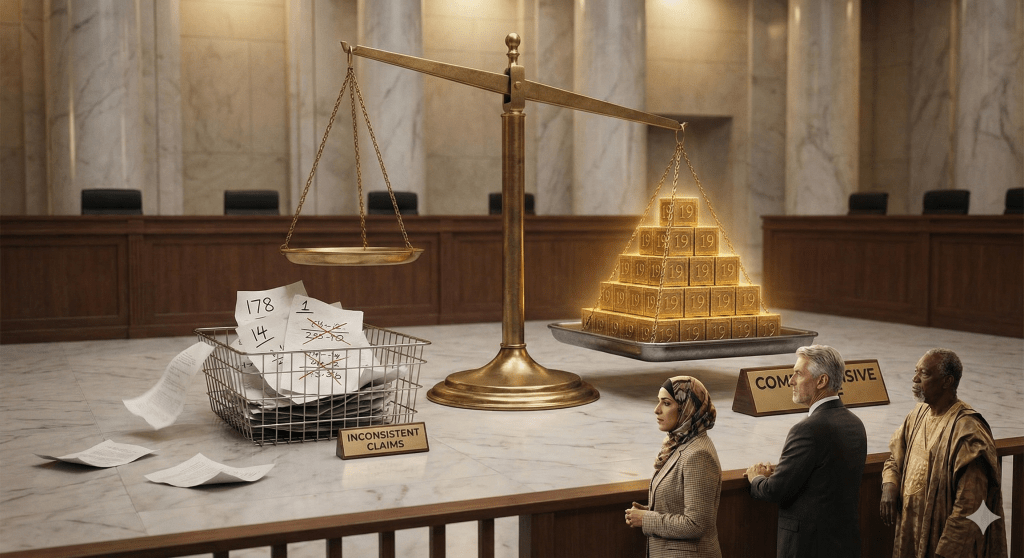
The Quran provides believers with clear criteria for evaluating anyone who claims messengership. First, examine whether the claimed proof is comprehensive or selective. God’s authentic miracles apply to entire scriptures, not cherry-picked portions. Second, verify whether the proof is reproducible by independent researchers or depends on one person’s potentially biased counting. Third, consider whether the claimant brings something genuinely new or merely parasitizes existing discoveries.
[2:42] “Do not confound the truth with falsehood, nor shall you conceal the truth, knowingly.”
This verse commands believers not to mix truth with falsehood. The godprovenas1.com site exemplifies this forbidden mixing: it acknowledges Code 19 (truth) while adding arbitrary personal numerology (falsehood), creating a confusing blend that can mislead sincere seekers. Recognizing this pattern of mixing helps believers separate wheat from chaff in evaluating religious claims.
The Protection of Genuine Faith
Ultimately, protection from false claims comes from strong connection to God and thorough knowledge of the Quran. Those who worship God alone, follow the Quran alone, and maintain regular Contact Prayer develop discernment that shields them from deception.
[17:36] “You shall not accept any information, unless you verify it for yourself. I have given you the hearing, the eyesight, and the brain, and you are responsible for using them.”
Genuine submission means testing all claims against the Quran, not accepting anything based on personality, eloquence, or sophisticated-sounding mathematics. The Quran itself is the criterion, and claims that cannot be verified through its clear text and authentic mathematical structure should be rejected, regardless of how convincing they may initially appear.
Key Takeaways for Believers
- Genuine divine proof is comprehensive, consistent, and independently verifiable
- Finding one’s name through numerical manipulation is not divine proof
- Cherry-picked evidence that ignores contradicting data is not scientific or spiritual
- The Quran’s Code 19 remains the authentic mathematical miracle, based on Chapter 74, verses 30-35
- False messenger claims harm both the claimant and those misled by them
- Protection comes from knowledge of Quran and sincere devotion to God alone
- Ask the simple question: “Which verse prophesies this person as a messenger?” Rashad had 3:81. Husain has nothing.
Conclusion: Standing Firm on Truth
The examination of godprovenas1.com’s claims reveals a pattern familiar from Quranic warnings about false messengers: self-serving interpretation, selective evidence, and the mixing of truth with falsehood. Husain Makbool has not brought any genuine divine proof comparable to what authentic messengers delivered. His claims rest on numerological manipulation, confirmation bias, and intellectual parasitism on Dr. Rashad Khalifa’s legitimate discoveries.
As believers, we bear responsibility to protect ourselves and others from such deception. This requires knowledge of the Quran, understanding of what constitutes genuine proof, and the courage to reject false claims regardless of how they are packaged. The Quran provides all necessary guidance for making these distinctions, and Code 19 remains the authentic mathematical miracle that validates God’s final scripture.
[17:88] “Say, ‘If all the humans and all the jinns banded together in order to produce a Quran like this, they can never produce anything like it, no matter how much assistance they lent one another.’”
The Quran’s inimitable nature includes its mathematical structure, which no human could replicate or manipulate into personal validation. Those who attempt to claim divine proof through name-fitting and arbitrary calculations only demonstrate their inability to produce anything approaching the Quran’s genuine mathematical miracle. The authentic Code 19 stands as testimony to divine authorship, while false claims collapse under examination.
May God guide all sincere seekers to truth and protect them from those who, knowingly or unknowingly, lead others astray. May we recognize the difference between comprehensive divine proof and self-serving manipulation. And may we stand firm on the criterion of the Quran, rejecting all additions, distortions, and false claims that threaten to corrupt our pure monotheistic faith.
[11:13] “If they say, ‘He fabricated (the Quran),’ tell them, ‘Then produce ten chapters like these, fabricated, and invite whomever you can, other than God, if you are truthful.’”
The challenge stands for anyone claiming divine authorization: produce comprehensive, consistent, independently verifiable proof of the same magnitude as the Quran’s mathematical miracle. Finding one’s name through selective numerology does not meet this standard. Until such proof is produced, the claims of godprovenas1.com must be rejected as fabrications dressed in mathematical clothing, dangerous to the souls of both the claimant and those he might mislead.


 Quran Only Studies
Leave a comment