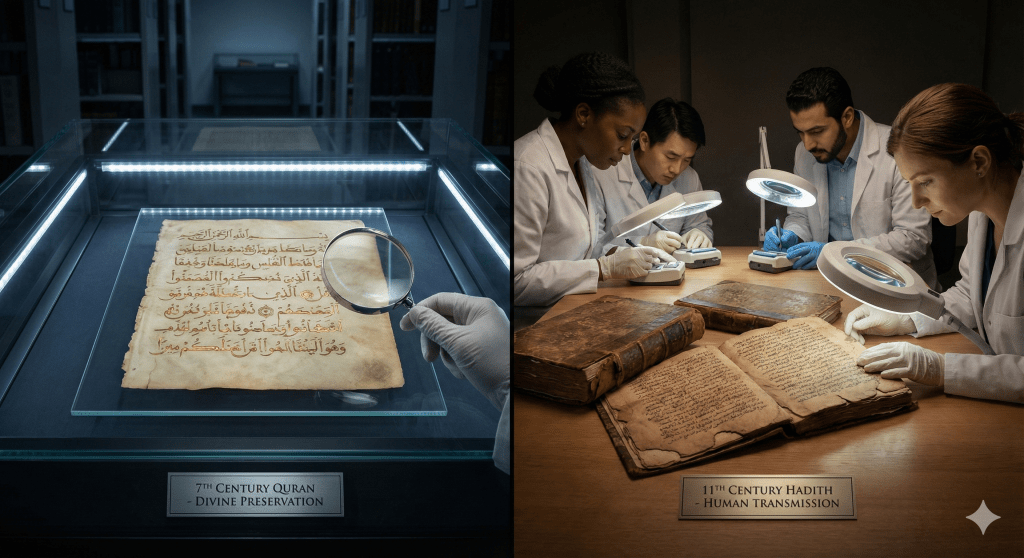
Introduction: The Question of Authenticity
In an age where historical claims demand empirical evidence, the question of scriptural authenticity has never been more relevant. When we examine the foundations of religious practice, we must ask: what physical evidence exists for the texts we follow? This is not merely an academic exercise but a matter of eternal consequence. For those who claim to follow God’s message, the integrity of that message is paramount. The distinction between divine revelation and human fabrication determines the very trajectory of one’s spiritual journey.
This comprehensive analysis examines the manuscript evidence for both the Quran and the hadith collections that many Muslims treat as authoritative sources alongside Scripture. We will compare carbon dating results, the time gaps between claimed authorship and physical manuscripts, and the profound theological implications of these findings. As we shall see, the evidence overwhelmingly demonstrates that God has fulfilled His promise to preserve the Quran while no such divine protection was granted to hadith literature. This distinction is not merely historical curiosity – it determines whether one’s religion comes from God or from human invention.
The stakes could not be higher. If hadith collections lack manuscript evidence from the time of their alleged compilation, and if the Quran’s preservation is demonstrably superior, then the choice of which source to follow becomes clear for anyone seeking God’s truth. The Almighty Himself asks the critical question that frames our entire investigation:
[45:6] “These are God’s revelations that we recite to you truthfully. In which Hadith other than God and His revelations do they believe?”
Part 1: The Quran’s Manuscript Evidence
Understanding Divine Preservation
Before examining the physical evidence, we must understand the theological foundation for the Quran’s preservation. Unlike any other scripture in human history, God explicitly promised to preserve the Quran from corruption. This is not a human claim but a divine guarantee recorded within the scripture itself. When the Creator of the universe makes a promise, that promise is fulfilled with absolute certainty.
[15:9] “Absolutely, we have revealed the reminder, and, absolutely, we will preserve it.”
This verse establishes an unbreakable covenant between God and humanity. The double emphasis (“absolutely… absolutely”) in the Arabic uses the emphatic particle “inna” twice, stressing with maximum force that preservation is not merely intended but guaranteed. Unlike the Torah and Gospel, which were given to human custodianship and subsequently corrupted, the Quran would remain under divine protection. The manuscript evidence we are about to examine proves that this promise has been kept.
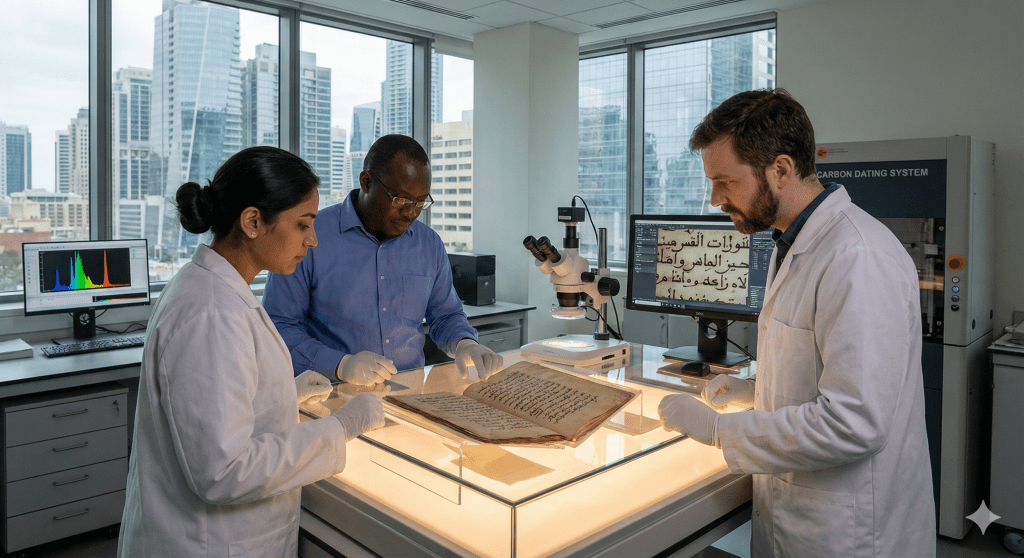
The Birmingham/Mingana Manuscript (568-645 CE)
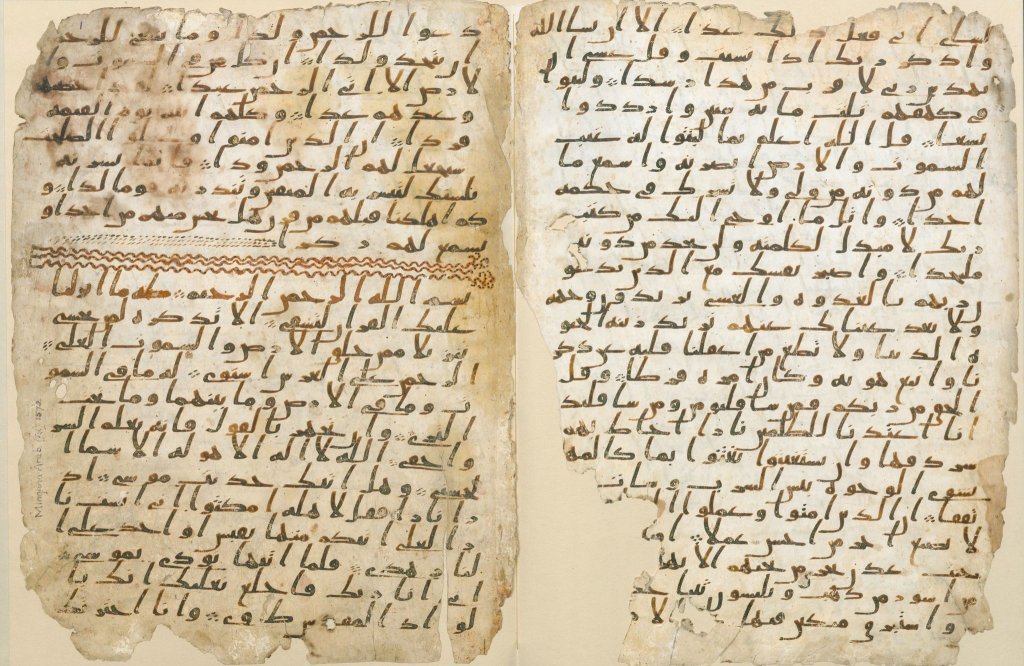
The Birmingham Quran manuscript (568-645 CE) – Carbon dated to within the Prophet’s lifetime. Source: University of Birmingham/Internet Archive
Perhaps the most significant Quranic manuscript discovery of the modern era is the Birmingham Quran, also known as the Mingana Manuscript. Housed at the University of Birmingham’s Cadbury Research Library, this manuscript underwent rigorous radiocarbon dating at Oxford University in 2015. The results sent shockwaves through the academic world: the parchment was dated with 95.4% accuracy to between 568 and 645 CE. This places the physical manuscript within the lifetime of Prophet Muhammad (570-632 CE) or mere years after his death.
The implications are profound. This is not a copy of a copy of a copy made centuries later – this is a manuscript that could have been written by someone who heard the Quran directly from the Prophet’s mouth. The Birmingham manuscript contains portions of Surahs 18, 19, and 20, and when compared to modern Qurans, the text is identical. Not one word differs. Not one letter has been changed. The carbon dating was conducted by the Oxford Radiocarbon Accelerator Unit, one of the world’s most respected dating facilities, and the results were published in peer-reviewed academic journals.
According to Professor David Thomas of the University of Birmingham, who analyzed the manuscript, “The person who actually had their hand on these pieces of parchment could well have known the Prophet Muhammad. He would have seen him probably, and maybe have heard him preach.” (BBC News, 2015) This level of proximity to the original source is unmatched by any hadith manuscript.
The Topkapi Manuscript (Istanbul)
The Topkapi Mushaf, preserved at the Topkapi Palace Museum in Istanbul, Turkey, is one of the oldest complete Qurans in existence. Traditional accounts attribute this manuscript to the third caliph, Uthman ibn Affan, who commissioned the first official compilation of the Quran circa 650 CE. While some scholars debate this attribution, paleographic analysis and radiocarbon dating consistently place the manuscript within the first century of Islam.
The Topkapi manuscript is written in Kufic script on parchment made from deer skin, comprising 408 folios. What makes this manuscript particularly significant is its textual consistency with all other ancient Quran manuscripts worldwide. Despite being separated by thousands of miles and centuries of transmission, Quran manuscripts from Yemen, Egypt, Morocco, and Istanbul contain identical text. This uniformity across geographical and temporal distances provides compelling evidence of successful preservation.
The manuscript shows certain scribal marks and corrections that indicate a careful review process, reflecting the meticulous attention given to Quranic preservation from the earliest times. Some folios contain variant readings (qira’at) noted in the margins, demonstrating that even acknowledged recitation differences were carefully documented rather than allowed to alter the primary text.
The Sana’a Manuscripts (Yemen)
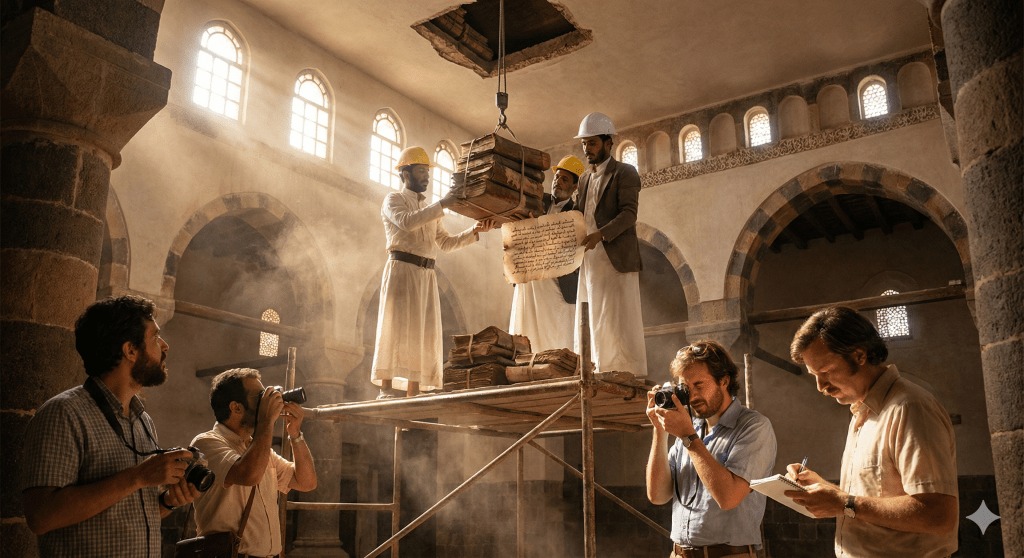
Discovered in 1972 during restoration work on the Great Mosque of Sana’a in Yemen, these manuscripts represent one of the largest collections of early Quranic fragments ever found. Dating to the late 7th and early 8th centuries CE, the Sana’a manuscripts comprise thousands of parchment fragments that have been painstakingly analyzed by scholars including Gerd-R. Puin and Hans-Caspar Graf von Bothmer of Saarland University, Germany.
Critics of Islam initially hoped these manuscripts would reveal textual corruption, but comprehensive analysis has proven the opposite. While some palimpsest fragments (manuscripts where earlier text was washed and overwritten) show minor spelling variations or different word order, these represent regional orthographic conventions rather than textual corruption. The core consonantal text – the actual words of the Quran – remains consistent across all fragments. Dr. Puin himself acknowledged that the variations were comparable to British versus American English spelling differences, not doctrinal changes.
The Sana’a manuscripts also provide crucial evidence regarding the Quran’s compilation timeline. Radiocarbon dating of the parchment, combined with paleographic analysis of the script style, confirms that written Quran manuscripts existed within decades of the Prophet’s death – not centuries later as some critics have claimed. This early dating destroys the argument that the Quran was gradually composed or significantly edited over time.
The Berlin Manuscript
The Staatsbibliothek zu Berlin houses several early Quran fragments, including portions acquired during the 19th and 20th centuries from various Middle Eastern sources. These manuscripts have been subjected to extensive scholarly analysis, including radiocarbon dating that places several fragments firmly within the first century of Islam (7th century CE).
One particularly significant folio from the Berlin collection (Ms. or. fol. 4313) contains portions of Surah Al-Baqarah (Chapter 2) and has been dated to approximately 670-690 CE. When compared letter-by-letter with modern printed Qurans, the text shows complete consonantal agreement. This consistency across manuscripts produced in different locations by different scribes – with no central authority to enforce uniformity in an age before printing – is nothing short of remarkable.
The Berlin manuscripts also preserve examples of the Hijazi script, an early Arabic calligraphic style predating the more angular Kufic script. This script evidence helps scholars trace the evolution of Arabic writing while simultaneously confirming the stability of the Quranic text itself. The words remained constant even as the aesthetic presentation evolved.
The Samarkand Codex
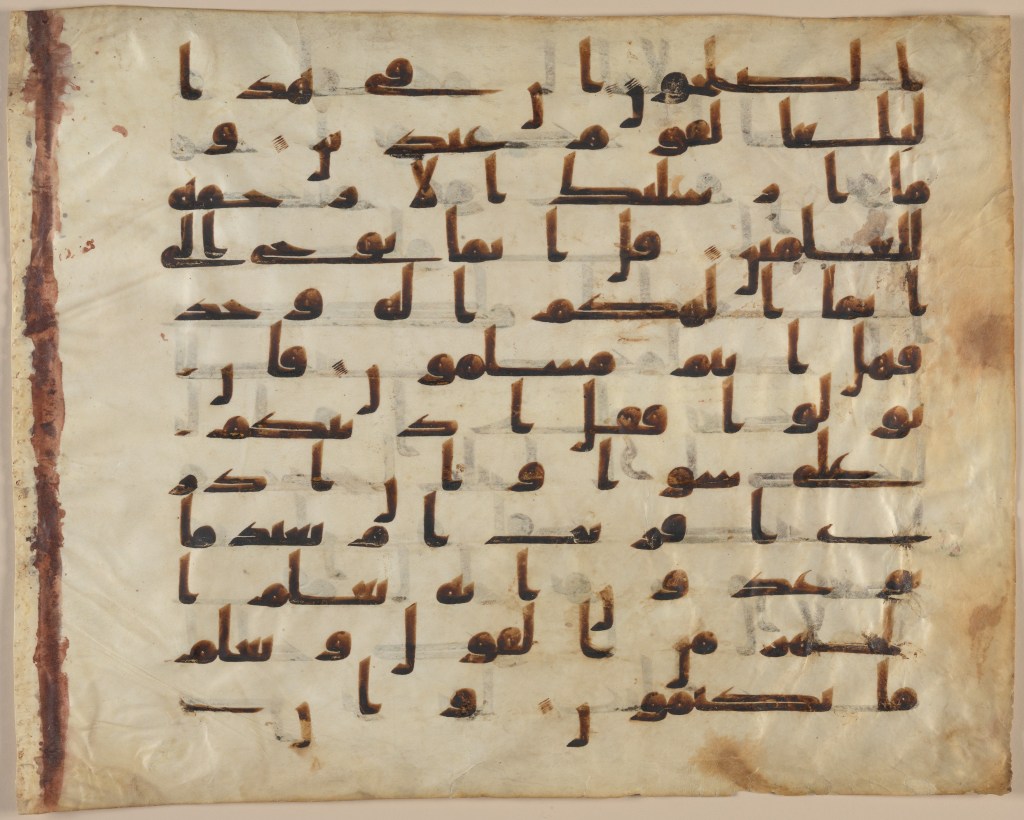
Folio from the Samarkand/Tashkent Quran – One of the oldest near-complete Qurans. Source: Metropolitan Museum of Art (Public Domain)
Also known as the Uthman Quran or Samarkand Kufic Quran, this manuscript is currently housed in Tashkent, Uzbekistan. Like the Topkapi manuscript, it is traditionally attributed to the era of Caliph Uthman (644-656 CE). The manuscript’s history traces a path through Damascus, Baghdad, and Samarkand before reaching its current location.
The Samarkand Codex consists of approximately 250 parchment folios containing much of the Quranic text. Scholars have noted that the codex bears what appear to be blood stains on some pages, which tradition attributes to Uthman’s assassination while he was reading from this very copy. While this attribution is historically disputed, the manuscript’s early dating is not in serious question.
Comparative textual analysis between the Samarkand Codex and other early manuscripts confirms the same remarkable consistency. Despite being preserved on opposite ends of the Muslim world – from Yemen to Uzbekistan, from Morocco to Indonesia – all early Quran manuscripts contain essentially identical text. This geographical universality of textual integrity cannot be explained by human effort alone; it testifies to divine preservation.
Other Early Quran Manuscripts
Beyond these major manuscripts, dozens of other early Quran fragments have been identified worldwide. The Bibliotheque nationale de France holds several important early fragments. The British Library contains folios from the “Ma’il Quran,” written in an elegant sloping script dated to the late 7th century. Cambridge University, St. Petersburg, Cairo’s Dar al-Kutub, and numerous other institutions preserve fragments that, when analyzed collectively, present an overwhelming pattern: textual consistency across time and space.
The Chester Beatty Library in Dublin contains important Quran folios dated to the 8th century. The David Collection in Copenhagen houses fragments in various early scripts. Each discovery adds to our understanding of early Quran transmission while confirming the same essential fact: the text we read today matches what Muslims read thirteen centuries ago. This is the promise of [15:9] fulfilled before our eyes, documented by secular academic institutions with no religious motivation to prove Submission correct.
Part 2: The Critical Timeline – Quran vs. Hadith
The Quran’s Documentation Timeline
The Quran’s preservation followed a clear, documented timeline. During the Prophet’s lifetime (610-632 CE), verses were memorized by numerous companions and written on various materials – palm leaves, animal bones, leather, and parchment. Multiple companions served as official scribes, including Zayd ibn Thabit, who would later lead the compilation effort. The tradition of memorization (hifz) ensured that dozens, if not hundreds, of individuals had the complete Quran committed to memory.
Within two years of the Prophet’s death, during the caliphate of Abu Bakr (632-634 CE), a formal compilation was undertaken at the urging of Umar ibn al-Khattab after many memorizers died in the Battle of Yamama. Zayd ibn Thabit led this effort, requiring each verse to be verified by multiple witnesses with written documentation. This compiled manuscript was given to Hafsa bint Umar for safekeeping. Then, during Uthman’s caliphate (644-656 CE), official copies were made from Hafsa’s manuscript and distributed to major Islamic centers, while variant personal copies were ordered destroyed to ensure uniformity.
From this timeline, we can document the Quran’s journey from oral revelation to written compilation within 24 years of the Prophet’s death. And our physical manuscripts – particularly the Birmingham manuscript – date to this exact period or even earlier. The chain is unbroken, the evidence is tangible, and the consistency is undeniable.
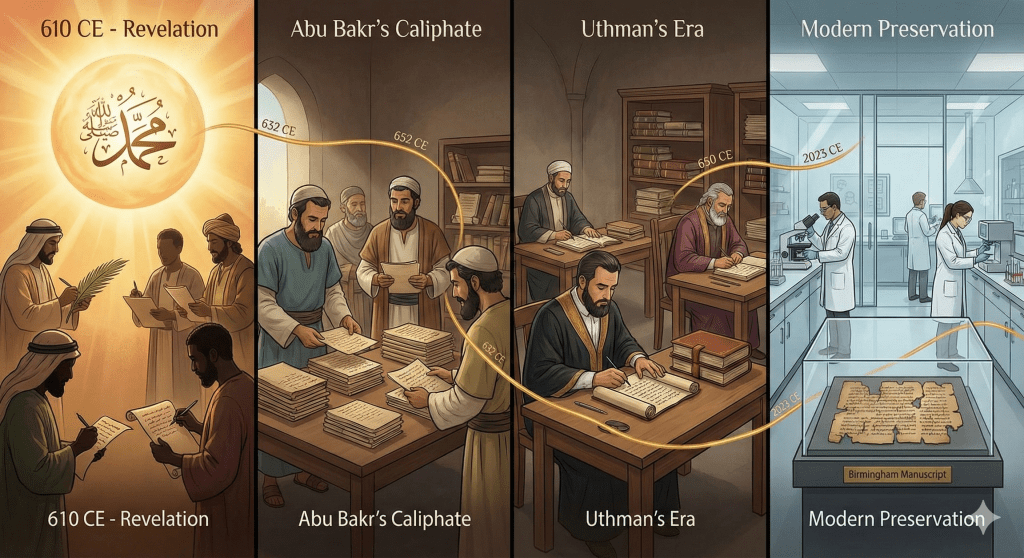
The Hadith Documentation Timeline – A Troubling Gap
In stark contrast to the Quran’s documentation, the hadith literature presents a fundamentally different and far more problematic timeline. Understanding this gap is essential for anyone seeking to follow authentic religious guidance. The hadith collections now considered authoritative by Sunni Muslims were compiled 200-300 years after the Prophet’s death, and their earliest surviving manuscripts date even later.
Consider the timeline: Prophet Muhammad died in 632 CE. The most famous hadith collection, Sahih Bukhari, was compiled by Muhammad al-Bukhari, who lived from 810-870 CE. He compiled his collection between approximately 830-846 CE – a full 200+ years after the Prophet’s death. But here is the critical point: the earliest surviving manuscript of Sahih Bukhari dates to approximately 1017 CE, over 150 years after Bukhari himself died. The famous Damascus manuscript of Bukhari (known as Youniniyya) was copied in 1203 CE – nearly 600 years after the Prophet.
This represents a 385-year gap between the Prophet’s death and our earliest Bukhari manuscript, and an additional 150-year gap between Bukhari’s death and that manuscript. During this immense timespan, we have no physical evidence for how the hadith were transmitted, preserved, or potentially altered. We are asked to accept on faith that the oral transmission through multiple generations maintained perfect accuracy – despite the human propensity for error, exaggeration, and fabrication.
Comparing the Evidence: A Clear Contrast
Let us present this evidence in its starkest form:
| Source | Claimed Authorship/Compilation | Earliest Physical Manuscript | Gap |
|---|---|---|---|
| Quran (Birmingham) | 610-632 CE | 568-645 CE (carbon dated) | Within lifetime or 13 years |
| Quran (Sana’a) | 610-632 CE | 670-710 CE | 38-78 years |
| Sahih Bukhari | 830-846 CE | ~1017 CE | 171-187 years after Bukhari |
| Sahih Muslim | ~855 CE | ~11th century CE | ~150+ years |
| Sahifah Hammam | Claimed ~700 CE | 9th century CE | ~150+ years |
| Al-Kafi (Shia) | ~941 CE | Medieval period | Unknown centuries |
The contrast is undeniable. For the Quran, we have physical manuscripts that may predate the Prophet’s death and certainly exist from within years of it. For hadith, we have gaps of 150-385 years or more between claimed origin and physical evidence. Any objective assessment must acknowledge this profound difference in evidentiary foundation.
Part 3: Sunni Hadith Sources – Manuscript Analysis
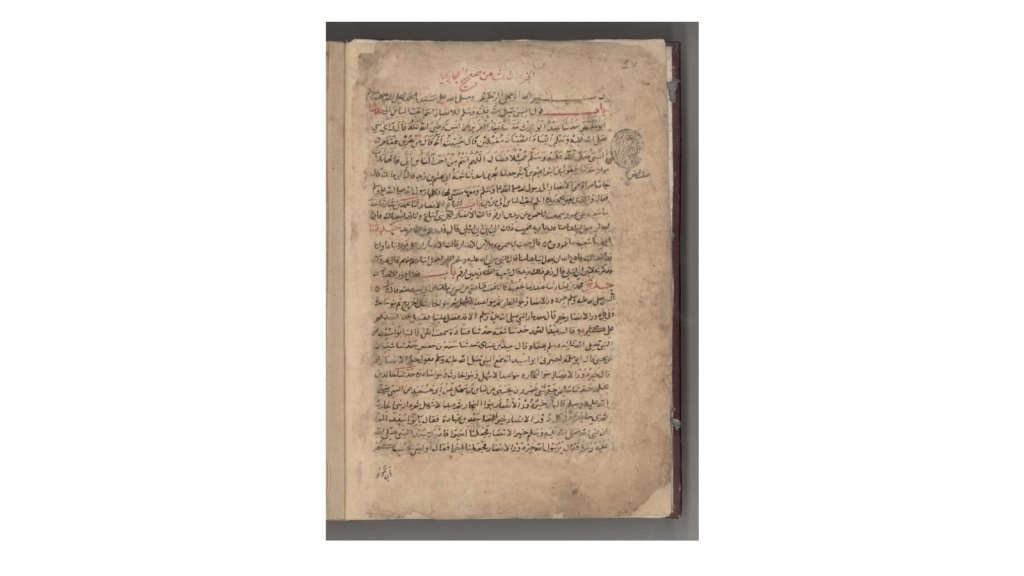
The oldest surviving Sahih Bukhari manuscript (1017 CE) – Created 385 years after the Prophet’s death. Source: Library of Congress/World Digital Library
Sahih Bukhari: The Gold Standard?
Muhammad ibn Ismail al-Bukhari (810-870 CE) is considered the most authoritative hadith compiler in Sunni Islam. His collection, titled “Al-Jami’ al-Sahih,” contains approximately 7,563 hadiths (including repetitions) or about 2,602 distinct traditions. Bukhari reportedly examined 600,000 reports and selected only those meeting his rigorous criteria for authenticity. This filtering process is presented as evidence of the collection’s reliability.
However, several problems emerge upon closer examination. First, as noted above, our earliest manuscripts of Bukhari date to approximately 1017 CE – 147 years after his death in 870 CE. During this gap, we have no physical evidence of what Bukhari’s collection actually contained. We rely entirely on claims of oral and written transmission that cannot be verified. Second, the very concept of “sahih” (authentic) grading was developed after the major collections were compiled, creating a system that retroactively validated texts rather than testing them scientifically.
Third, the chain of transmission (isnad) system relies on human attestation across 8-10 generations. Even if each link in the chain had 95% accuracy, the cumulative probability of accurate transmission across 10 generations would be only 60%. With 200 years of transmission before Bukhari even began collecting, and another 150+ years before our earliest manuscripts, the chain has potentially 15+ human links, each introducing potential for error, embellishment, or fabrication.

The Sahifah of Hammam ibn Munabbih
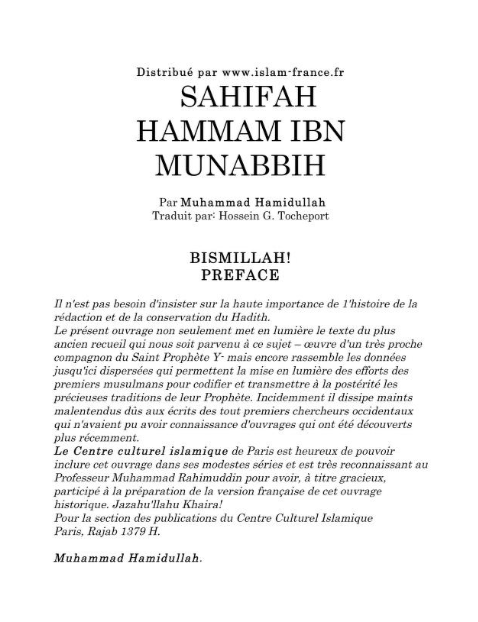
Note: The original 9th-century Berlin manuscript of the Sahifah is not publicly available. This is Hamidullah’s 1978 edition based on those later manuscripts.
Defenders of hadith literature often cite the Sahifah of Hammam ibn Munabbih as evidence for early hadith documentation. This collection of 138 hadiths is attributed to Hammam (d. 719 CE), a student of Abu Hurayrah, making it potentially one of the earliest hadith compilations. The argument is that its existence proves hadiths were written down during the companions’ era.
However, the manuscript evidence tells a different story. The earliest known manuscript of the Sahifah dates to the 9th century CE – approximately 150 years after Hammam’s death. Just as with Bukhari, we have no physical evidence from the time of claimed authorship. We are asked to believe that the text was faithfully preserved through oral transmission for over a century before being written in the form we possess today.
Furthermore, when the Sahifah’s hadiths are compared with the same hadiths appearing in Bukhari and Muslim’s collections, textual variations appear. These variations are not major doctrinal differences, but they demonstrate that hadith transmission was not as precise as Quran transmission. If minor variations occurred, major alterations could also have occurred – and we have no manuscripts to verify either way.
Muwatta Malik and Other Early Collections
Imam Malik ibn Anas (711-795 CE) compiled the Muwatta, considered by many the earliest major hadith collection still extant. Malik lived in Medina and had access to second and third-generation knowledge of the Prophet’s teachings. His collection contains approximately 1,700 narrations, combining hadiths, companion statements, and his own legal opinions.
Yet once again, our earliest manuscripts of the Muwatta date to significantly after Malik’s death. The various recensions (versions) of the Muwatta show notable differences, with some containing hundreds more narrations than others. This variation itself demonstrates that “Malik’s Muwatta” was not a fixed text but rather a collection that evolved through transmission. Which version represents what Malik actually compiled? Without early manuscripts, we cannot definitively answer.
Other early collections face similar challenges. The Musannaf of Abd al-Razzaq (d. 827 CE), the Musannaf of Ibn Abi Shaybah (d. 849 CE), and the collections of Ahmad ibn Hanbal (d. 855 CE) all lack manuscript evidence from the authors’ lifetimes. The pattern is consistent: we are asked to accept hadith authenticity based on chains of oral transmission, not physical documentation.
The Grading System: A Post-Hoc Rationalization
The hadith authentication system of sahih (authentic), hasan (good), and da’if (weak) was developed primarily in the 9th-10th centuries CE, after the major collections were already compiled. This is like developing a grading rubric after exams are submitted – it may organize existing material but cannot verify its original accuracy. The criteria for “sahih” grading include: a continuous chain of narrators, each narrator must be known for integrity and strong memory, and the hadith should not contradict more reliable sources or contain hidden defects.
But who evaluated the narrators’ memories and integrity? Other narrators, evaluated by yet others, in an endless chain of human judgment. No physical evidence, no audio recordings, no written documents from the original era verify these assessments. The entire system relies on accepting later scholars’ judgments about earlier generations’ reliability – judgments made 150-250 years after the fact based on biographical works that themselves have transmission questions.
Furthermore, the “contradiction” criterion creates circular logic: a hadith contradicting the Quran should be rejected, but hadith supporters frequently interpret Quran verses in light of hadith, making hadith the interpretive lens rather than the Quran. This inverts the natural order where God’s Word should judge all else.
Part 4: Shia Hadith Sources – Different Narrators, Same Problems
Al-Kafi and the Four Books
Shia Islam developed its own hadith canon, called the “Kutub al-Arba’a” or Four Books. The most prominent is Al-Kafi, compiled by Muhammad ibn Ya’qub al-Kulayni (d. 941 CE). Al-Kafi contains approximately 16,000 traditions attributed to the Prophet and the Twelve Imams. The other three books – Man La Yahduruhu al-Faqih by Ibn Babawayh (d. 991 CE), Tahdhib al-Ahkam and Al-Istibsar both by Shaykh Tusi (d. 1067 CE) – complete the canonical collection.
Notice the dates: Kulayni died in 941 CE, more than 300 years after the Prophet’s death. Ibn Babawayh compiled his work around 990 CE. Tusi’s collections date to the mid-11th century. If Sunni hadith collections have problematic gaps between claimed origin and physical manuscripts, Shia collections have even greater gaps between the Prophet’s era and their compilation.
The manuscript evidence for Shia hadith is even more sparse than for Sunni collections. While extensive research has been devoted to early Quran manuscripts and to major Sunni hadith manuscripts, the critical scholarly analysis of early Shia hadith manuscripts is less developed. What manuscripts exist generally date to medieval periods, centuries after the compilers’ deaths.

Contradictions Between Sunni and Shia Sources
The existence of two fundamentally different hadith corpuses – Sunni and Shia – itself undermines hadith reliability. Consider: both traditions claim to transmit authentic reports from the Prophet Muhammad. Yet they rely on different narrators, different chains of transmission, and often reach contradictory conclusions. The most glaring difference involves Abu Hurayrah, the single most prolific narrator in Sunni hadith literature.
Abu Hurayrah narrates over 5,300 hadiths in Sunni collections – more than any other companion despite joining Islam only four years before the Prophet’s death. Shia sources, however, consider Abu Hurayrah unreliable or even a fabricator. They point to reports that Umar ibn al-Khattab once beat Abu Hurayrah for narrating too many traditions and accused him of stealing from the public treasury. If the primary source for Sunni hadith is rejected by Shia scholarship, how can both traditions claim authenticity?
The contradictions extend to doctrinal matters. Sunni hadiths affirm the legitimacy of the first three caliphs; Shia hadiths suggest Ali should have been immediate successor. Sunni hadiths are used to justify certain practices; Shia hadiths are used to justify different practices. The Prophet Muhammad could not have taught contradictory things. If he was consistent, then at least one tradition – and possibly both – contains significant human additions.
The Implication of Mutual Exclusivity
When two groups claim authentic transmission from the same source yet produce mutually exclusive material, logic dictates at least one is wrong. The question becomes: how do we determine which, if any, is reliable? We cannot verify through manuscript evidence, since both corpora lack early physical documentation. We cannot verify through chain analysis, since each tradition validates its own chains while rejecting the other’s. We cannot verify through majority consensus, since majorities can be mistaken.
The only objective standard is the Quran itself – the one source with demonstrable manuscript evidence from the earliest period. And the Quran, as we shall see, consistently points away from following any hadith besides itself. This is not a rejection of the Prophet’s teaching; it is recognition that the Quran IS the Prophet’s teaching, while hadith collections represent later human compilation with all the vulnerabilities that entails.
Part 5: The Quran’s Warning Against Following Other Sources
God’s Clear Statements
The Quran contains numerous verses warning against following any source of religious law besides God’s revelation. These warnings are explicit, repeated, and impossible to misunderstand for anyone who reads the Quran directly. God knew that later generations would face the temptation to supplement His perfect revelation with human traditions, and He preemptively condemned this practice.
[6:114] “Shall I seek other than God as a source of law, when He has revealed to you this book fully detailed? Those who received the scripture recognize that it has been revealed from your Lord, truthfully. You shall not harbor any doubt.”
The rhetorical question format emphasizes the absurdity of seeking another source. If God has revealed a “fully detailed” book, what legitimate reason could exist to seek additional sources? The phrase “fully detailed” (mufassalan) leaves no room for claiming the Quran is incomplete and needs hadith supplementation. And lest anyone think this was addressed only to past generations, the verse commands: “You shall not harbor any doubt.” This is a direct address to every reader.
[6:115] “The word of your Lord is complete, in truth and justice. Nothing shall abrogate His words. He is the Hearer, the Omniscient.”
Here we find another emphatic declaration: God’s word is COMPLETE. The Arabic “tammat” indicates perfection and fullness – nothing is missing, nothing needs addition. Furthermore, “nothing shall abrogate His words” – this eliminates the claim that hadith can modify, explain, or supersede Quranic commands. Any teaching that claims to add requirements not found in the Quran, or that interprets the Quran in ways contradicting its plain meaning, is a rejection of this verse.

The Word “Hadith” in the Quran
Remarkably, God uses the very word “hadith” in the Quran to warn against following any hadith other than His revelation. This is not a coincidence but a deliberate divine choice. The Arabic word “hadith” means “narration,” “saying,” or “story” – precisely what later hadith collections claim to contain. By using this word, God anticipated and condemned the phenomenon that would arise centuries later.
[7:185] “Have they not looked at the dominion of the heavens and the earth, and all the things God has created? Does it ever occur to them that the end of their life may be near? Which Hadith, beside this, do they believe in?”
[77:50] “Which Hadith, other than this, do they uphold?”
[31:6] “Among the people, there are those who uphold baseless Hadith, and thus divert others from the path of God without knowledge, and take it in vain. These have incurred a shameful retribution.”
These verses leave no ambiguity. Following “hadith” other than God’s hadith (the Quran) is explicitly condemned and carries “shameful retribution.” The question “Which hadith after this do they believe in?” implies that believing in the Quran should preclude believing in any other hadith. Those who uphold “baseless hadith” – narrations without proper foundation – “divert others from the path of God.” This describes precisely what hadith literature has done: diverting Muslims from the Quran’s clear guidance into a maze of contradictory, unverifiable human traditions.
The Quran Is Not “Fabricated Hadith”
In an especially pointed verse, God distinguishes the Quran from fabricated hadith, implying that other hadiths attributed to the Prophet fall into the “fabricated” category:
[12:111] “In their history, there is a lesson for those who possess intelligence. This is not fabricated Hadith; this (Quran) confirms all previous scriptures, provides the details of everything, and is a beacon and mercy for those who believe.”
Note the structure: “This is NOT fabricated hadith” – implying the existence of fabricated hadith that must be distinguished from the Quran. The Quran “provides the details of everything” – again, the claim of completeness that eliminates any need for hadith supplementation. And importantly, the Quran is for “those who possess intelligence” – suggesting that following unverified hadith instead of the clear Quran reflects a lack of intellectual rigor.
[39:23] “God has revealed herein the best Hadith; a book that is consistent, and points out both ways (to Heaven and Hell). The skins of those who reverence their Lord cringe therefrom, then their skins and their hearts soften up for God’s message.”
God explicitly calls the Quran “the best hadith” (ahsana al-hadith). If the Quran is the BEST hadith, then all other hadiths are inferior by definition. Why would a believer prioritize inferior sources over the best source? The verse also emphasizes the Quran’s consistency – it does not contradict itself. Hadith literature, in contrast, is filled with contradictions that scholars have struggled for centuries to harmonize or explain away.
Part 6: What Rashad Khalifa Taught About Hadith and Sources
The Quran Is Complete, Perfect, and Fully Detailed
Dr. Rashad Khalifa, God’s Messenger of the Covenant, devoted significant teaching to explaining why the Quran alone must be our source of religious law. In his documented lectures, he consistently emphasized the Quranic principle that the scripture is “complete, perfect, and fully detailed” – a phrase that appears repeatedly in his teachings because it appears repeatedly in the Quran itself.
As Rashad explained: “I believe that the Quran is complete, perfect, and fully detailed, because God says so in the Quran. And we do not have to use hadith or sunnah at all.” (at 7:41) This is not a fringe opinion but the clear teaching of the Quran itself. When God declares His book complete and detailed, accepting that declaration is an act of faith; rejecting it by seeking additional sources is an act of disbelief.
Rashad further explained the logic: “If you believe God, you believe that the Quran is complete, perfect, and fully detailed. Listen to this, this is verse 114 in surah 6, it says… Shall I seek help from God, the source of law, when he sent down to you this book fully detailed? Therefore, if you go to anything else, you will be a rejecter of the Quran. You have rejected, you have disbelieved God.” (at 14:44)

The Origin of Hadith: Fabrication, Not Revelation
Rashad’s teaching clarified a crucial point often missed: the hadith collections are not authentic transmissions from the Prophet but fabrications attributed to him. As he stated: “We know now from many, many years of research that the hadith are fabrications attributed to the prophet. Now Satan knows that we love the prophet very much, and he used that as a bait. When you catch fish, you put bait on a deadly hook, and you catch the fish.” (at 16:19)
This analogy captures the spiritual danger of hadith literature. Satan exploited Muslims’ love for Prophet Muhammad by attaching fabricated sayings to his name. The bait is the Prophet’s beloved name; the hook is deviation from God’s Book. Believers who swallow this bait find themselves caught in a web of contradictory, unverifiable traditions that lead away from the Quran’s clear guidance.
Regarding the timing of hadith compilation, Rashad noted: “The first hadith that was recorded was 250 years after Muhammad, across 8 generations of the day. So from the day Muhammad died to 250 years, there was no hadith at all… So Bukhari came 250 years later and claimed that the prophet said these things, and as you know Bukhari eliminated 90% of the things that he wrote himself, and still whatever is left, the thousands of hadith are attacking and spewing against the prophet.” (at 24:20)
If You Want to Follow Muhammad, Follow the Quran
A common objection to following the Quran alone is that it supposedly “ignores” Prophet Muhammad. Rashad addressed this directly with irrefutable logic: “If you want to follow Muhammad, you follow the Quran, because it came out of Muhammad’s mouth.” (at 18:27)
This point deserves careful consideration. The Quran was revealed to Muhammad, recited by Muhammad, and delivered to humanity through Muhammad. It IS Muhammad’s teaching, authorized and preserved by God. The hadith, in contrast, are reports compiled by strangers who never met the Prophet, based on chains of oral transmission across centuries. Which truly represents Muhammad’s message: the revelation God chose to preserve, or the human compilations God allowed to become corrupted and contradictory?
Rashad further explained: “The hadith was never authored by the prophet, it has nothing to do with the prophet… Did the Quran come out of the prophet’s mouth? Yes, Gabriel brought it, revealed it to Muhammad, it came out of his mouth. Therefore, if you want to follow Muhammad, you follow the Quran, because it came out of Muhammad’s mouth.” (at 18:20)
Part 7: The Submission (Quran Alone) Perspective
Why Manuscript Evidence Matters
For Submitters (Muslims who follow the Quran alone), the manuscript evidence is not merely an academic curiosity but a confirmation of our faith. We believe God’s promise to preserve the Quran because we believe God. But God, in His mercy, has also provided physical proof that this promise was kept. The carbon-dated manuscripts, the textual consistency across millennia, and the stark contrast with hadith manuscript gaps all serve as tangible evidence for those who reflect.
This evidence matters because it demonstrates that our choice to follow the Quran alone is not blind faith but reasoned conviction. God invites humans to use their intellect, to examine evidence, and to reach conclusions based on rational analysis. The Quran repeatedly appeals to “those who reflect,” “those who understand,” and “those who possess intelligence.” The manuscript evidence provides exactly the kind of verifiable proof that an intellectually honest person should demand before committing their eternal soul to a source of guidance.
When someone asks why we follow the Quran but not hadith, we can point to this evidence. The Quran has manuscripts from within years of the Prophet; hadith collections have gaps of centuries. The Quran is textually consistent across all manuscripts; hadith collections contain contradictions even within themselves. The Quran has God’s explicit promise of preservation; hadith has no such guarantee. On what rational basis would we treat these sources as equivalent?

God Preserved What He Promised to Preserve
A crucial theological point emerges from the manuscript evidence: God preserved exactly what He promised to preserve – and nothing more. The promise in [15:9] specifically covers “the reminder” (al-dhikr), referring to the Quran. God did not promise to preserve hadith, sunnah, or any other source. And indeed, He did not preserve them – as the manuscript gaps and internal contradictions demonstrate.
This selectivity is itself a message. If God had intended hadith to serve as an authoritative source alongside the Quran, He could easily have preserved them with the same miraculous consistency. The fact that He did not tells us something important about their status. God preserved His words; He allowed human words to suffer the fate of all human compositions – corruption, variation, and uncertainty.
This understanding liberates believers from the impossible task of navigating contradictory hadith literature. We do not need to spend years studying which hadiths are “authentic” and which are “weak,” which chains are reliable and which contain liars – a science (ilm al-hadith) that has occupied scholars for centuries without reaching consensus. Instead, we turn directly to God’s preserved, consistent, verified word and follow what we can actually confirm came from our Creator.
[18:27] “You shall recite what is revealed to you of your Lord’s scripture. Nothing shall abrogate His words, and you shall not find any other source beside it.”
The Practical Implications
Following the Quran alone produces a religion that is simple, consistent, and unified. All believers have access to the same source – God’s preserved word – without needing intermediary scholars to tell them which hadiths to follow. The Quran provides all essential guidance for worship, ethics, law, and spiritual development. Where it is silent, it has granted us freedom.
The traditional reliance on hadith has produced a religion of endless complexity and division. Sunnis and Shias fight over hadith authenticity. Within Sunni Islam, different schools reach different conclusions based on different hadith preferences. Muslims argue endlessly about beard length, clothing styles, and ritual details that the Quran never mandates – debates fueled entirely by hadith literature. None of this division honors God or serves humanity.
By returning to the Quran alone, Submitters find unity based on what God actually revealed. We are not Sunni or Shia, Hanafi or Shafi’i, Sufi or Salafi – we are simply Submitters to God, following His book. This is the religion of Abraham, Moses, Jesus, and Muhammad – pure monotheism based on divine revelation, not sectarian divisions based on human traditions.
Part 8: The Sunni Position and Its Challenges
The Claim of Complementary Sources
Sunni scholarship maintains that the Quran and authentic hadith together form the basis of Islamic law. The argument goes that the Quran provides general principles while hadith provides practical details. For example, the Quran commands prayer but hadith specifies the number of rak’ahs; the Quran commands charity but hadith specifies the percentages for different types of wealth.
This position faces several challenges from the manuscript evidence. First, if hadith is essential for understanding and practicing Islam, why did God not preserve it as He preserved the Quran? The 150-300 year gaps between hadith compilation and earliest manuscripts represent generations when Muslims presumably needed this essential guidance but had no verified text. Were early Muslims practicing an incomplete religion until Bukhari’s collection was copied in 1017 CE?
Second, the existence of contradictory hadiths – even within collections deemed “authentic” – creates practical impossibilities. When two “sahih” hadiths give different instructions, which does the believer follow? Traditional scholarship developed complex abrogation theories and preferencing rules, but these are human judgments about human compilations. The Quran, by contrast, is “consistent” (mutashabihan) and free from contradiction, as [39:23] states.
The Circularity Problem
Sunni authentication of hadith ultimately rests on circular reasoning. Hadiths are verified through chains of narrators (isnad). But how do we know the narrators were reliable? Through biographical works (ilm al-rijal) written by later scholars. How do we know these scholars accurately assessed narrators they never met? Because other scholars verified them. How did those scholars know? The chain extends backward indefinitely without reaching firm ground.
At some point, Sunni scholarship asks us to accept human judgment about human memory about human transmission. There is no physical evidence, no audio recordings, no signed documents. The entire edifice rests on trusting that scholars across centuries accurately evaluated the honesty and memory of people they never knew. This is a fundamentally different evidentiary standard than the Quran’s manuscript verification.
Furthermore, the criteria for “authenticity” were developed by scholars who already believed in hadith authority. They were not neutral investigators but advocates for a particular view. The grading system naturally validated what they already accepted and rejected what challenged their views. This is not scientific methodology but confirmation bias institutionalized.
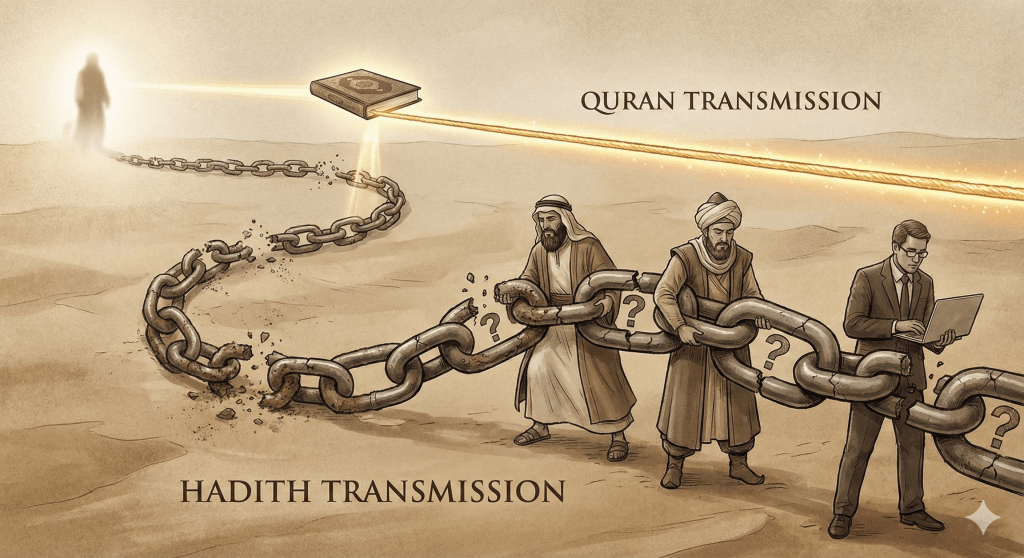
The Fabrication Problem
Even Sunni scholarship acknowledges that hadith fabrication was rampant in early Islam. Various motivations drove this fabrication: political factions created hadiths supporting their candidates for leadership; preachers invented hadiths to encourage piety or discourage sin; scholars in rival cities created hadiths favoring their localities; merchants created hadiths praising their trade goods. The categories of motivations for fabrication are well-documented in classical hadith sciences.
The authentication methodology was developed precisely because fabrication was recognized as a massive problem. But how successful was this methodology? We cannot know with certainty because we lack the physical evidence to verify. We are told that Bukhari examined 600,000 reports and accepted only 7,000 – a 99% rejection rate. But on what basis did he reject or accept? His criteria, applied by human judgment to oral reports, cannot be verified today. And even his accepted hadiths might include fabrications that fooled him.
Defenders argue that the rigorous methodology makes fabrication unlikely in “sahih” collections. But this argument assumes the methodology works – an assumption we cannot verify without early manuscripts showing what texts actually existed in the Prophet’s era. The Quran, by contrast, has exactly such manuscripts, confirming that our current text matches what existed then.
Part 9: The Shia Position and Its Challenges
Different Sources, Same Epistemological Problems
Shia Islam developed its own hadith tradition centered on the Twelve Imams, beginning with Ali ibn Abi Talib. The Four Books – Al-Kafi, Man La Yahduruhu al-Faqih, Tahdhib al-Ahkam, and Al-Istibsar – serve as the primary hadith sources. Shia scholars reject many Sunni narrators while accepting their own chains of transmission back to the Imams and through them to the Prophet.
However, the manuscript challenges facing Shia hadith are identical or worse than those facing Sunni collections. Al-Kafi was compiled by Kulayni, who died in 941 CE – over 300 years after the Prophet and nearly 250 years after the last Imam. The gaps between claimed origin and physical manuscripts are similar to Sunni collections. The methodology relies on the same chain-of-transmission system with the same verification challenges.
The mutual rejection between Sunni and Shia hadith scholars highlights an insoluble problem: each tradition considers the other’s primary narrators unreliable. If trained scholars within the hadith tradition cannot agree on which narrators are trustworthy, how is an ordinary believer supposed to navigate these competing claims? The very existence of two incompatible “authentic” traditions proves that at least one – and possibly both – contains massive errors.
The Question of the Imams’ Authority
Shia hadith authority rests partly on the belief that the Twelve Imams were divinely appointed, infallible guides. If this is true, their teachings would carry prophetic authority. But the concept of Imamate itself comes primarily from hadith literature, not the Quran. The Quran does not name Ali as the Prophet’s successor, does not establish a line of twelve Imams, and does not grant these individuals infallibility.
This creates another circularity: hadith literature establishes the Imams’ authority, and the Imams’ authority validates hadith literature. But without independent verification – the kind provided by manuscript evidence for the Quran – both claims remain assertions rather than proven facts. A believer seeking certainty cannot find it in this self-referential system.
Shia scholars acknowledge that Al-Kafi contains unreliable hadiths; many narrations within it are classified as weak or rejected by later Shia scholarship. This acknowledgment proves that “being in Al-Kafi” does not equal “being authentic.” But without manuscript evidence from the original era, we cannot determine which portions are reliable and which are not.
Part 10: Carbon Dating and Scientific Evidence
How Radiocarbon Dating Works
Radiocarbon dating measures the decay of Carbon-14, a radioactive isotope absorbed by living organisms during their lifetime. When an organism dies, it stops absorbing C-14, and the existing C-14 begins to decay at a known rate (half-life of approximately 5,730 years). By measuring the remaining C-14 in organic materials like parchment, scientists can determine when the animal whose skin became the parchment died.
This method is widely accepted in archaeology, paleontology, and historical studies. It has been refined over decades and is now remarkably accurate for materials up to 50,000 years old. When applied to ancient manuscripts, it tells us when the writing material was prepared – providing a terminus post quem (earliest possible date) for the writing itself. The parchment cannot be older than the carbon date; the writing is necessarily the same age or younger.
The Birmingham Quran’s carbon dating was conducted by the Oxford Radiocarbon Accelerator Unit, a world-leading facility that has dated thousands of artifacts for major museums and universities. Their methodology and results undergo peer review and meet the highest scientific standards. When they report a 95.4% confidence interval of 568-645 CE for the Birmingham fragments, this is not speculation but rigorous measurement.

What We Can and Cannot Date
It is important to understand both the power and limitations of radiocarbon dating. For Quran manuscripts, we can date the parchment material and thus establish a range for when the manuscript was created. For the Birmingham manuscript, this gives us 568-645 CE – either during the Prophet’s lifetime or within 13 years of his death. For the Sana’a manuscripts, dating produces late 7th to early 8th century ranges.
For hadith manuscripts, scientific dating produces results that undermine claims of early origin. When scholars have dated early hadith manuscripts, they consistently find dates from the 9th-11th centuries CE, not the 7th-8th centuries that would support claims of early documentation. The famous Youniniyya manuscript of Bukhari, often touted as an early copy, dates to 1203 CE – nearly 600 years after the Prophet.
The absence of early hadith manuscripts is itself significant. If hadiths were written down during the companions’ era, as some defenders claim, where are these early manuscripts? They should exist alongside early Quran manuscripts. The fact that early Quran manuscripts survive while early hadith manuscripts do not suggests that early Quran documentation was common while early hadith documentation was rare or nonexistent.
Implications for Religious Authority
Scientific dating provides objective, verifiable evidence that any rational person can evaluate. When a laboratory reports a date, that date is not influenced by religious preferences or sectarian commitments. Carbon atoms decay according to physics, not theology. This objectivity is precisely what makes the evidence so powerful for evaluating manuscript claims.
For the Quran, carbon dating confirms what believers already believe: God preserved His book. The physical evidence aligns with the theological claim. For hadith, carbon dating reveals what critics have long suspected: the gap between claimed origin and physical evidence is enormous and problematic. The physical evidence does not support the theological claim of reliable transmission.
This does not mean hadith scholars were necessarily dishonest. They may have genuinely believed they were preserving authentic teachings. But good intentions cannot substitute for physical evidence. In any other field – law, science, history – we would not accept claims unsupported by documentation for centuries. Religious claims should not receive special exemption from evidentiary standards.
Part 11: The Question of Following the Messenger
What Does It Mean to Obey the Messenger?
Those who advocate for hadith authority frequently cite Quranic verses commanding obedience to the Messenger. These verses are real and must be taken seriously. The question is: what does obeying the Messenger actually mean, and how do we accomplish it 14 centuries after his death?
As Rashad Khalifa explained, the Messenger’s message IS the Quran. The Quran came through Muhammad; it is his teaching authorized by God. Obeying the Messenger means obeying what God revealed through him – the Quran. It does not mean obeying unverified reports compiled centuries later by people who never met him. “If you want to follow Muhammad, you follow the Quran, because it came out of Muhammad’s mouth.”
Furthermore, the Quran explicitly limits the Messenger’s role to delivering the message: “The sole duty of the messenger is to deliver the message” ([5:99]). The Prophet was forbidden from explaining or adding to the Quran – that authority belongs to God alone ([75:16-19]). Any hadith claiming the Prophet added teachings beyond the Quran contradicts these Quranic statements about the Prophet’s own role.
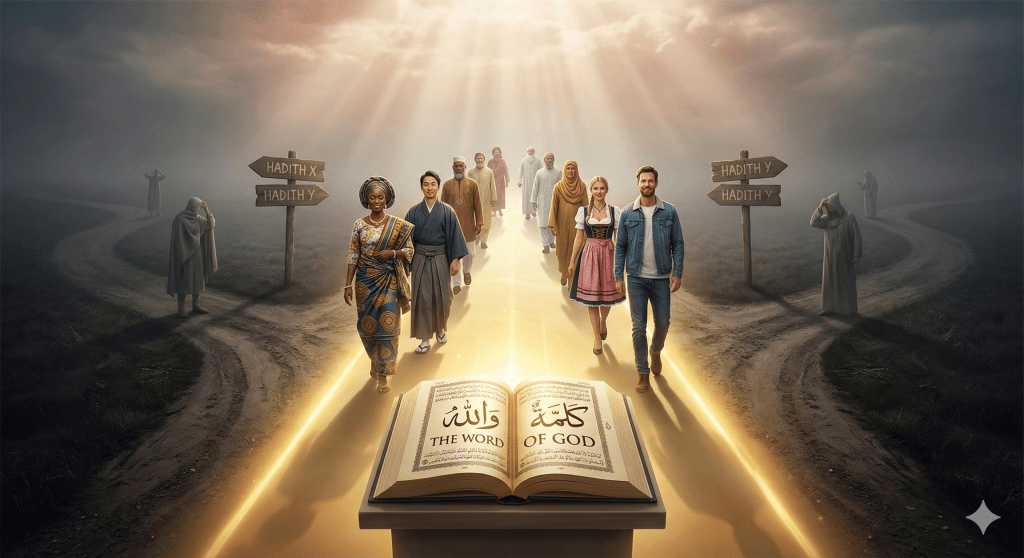
The Prophet’s Actual Teaching About Sources
Interestingly, hadith literature itself contains narrations warning against recording the Prophet’s words beyond the Quran. Sahih Muslim records the Prophet saying: “Do not write anything from me except the Quran. Whoever has written anything from me other than the Quran, let him erase it.” (Sahih Muslim, Book 42, Number 7147). If this hadith is authentic, it condemns the entire hadith enterprise. If it is fabricated, it demonstrates that even “sahih” collections contain fabrications.
This creates an impossible situation for hadith defenders. They cannot accept this hadith without undermining their own sources. They cannot reject it without admitting that their authentication methodology fails to identify fabrications even in the most “reliable” collections. Either way, the reliability of hadith literature is called into question by hadith literature itself.
The Quran resolves this paradox by providing a clear, verified source that needs no supplementation. God’s complete, detailed, preserved book is sufficient. Those who accept this sufficiency honor both God and His Messenger. Those who insist on additional sources implicitly reject the Quran’s claims about itself.
Part 12: The Mathematical Miracle and Preservation
Code 19: Additional Proof of Preservation
Beyond manuscript evidence, the Quran contains a mathematical structure based on the number 19 that provides further proof of its precise preservation. This mathematical code, discovered by Dr. Rashad Khalifa, interlocks the Quran’s letters, words, and verses in patterns that would be destroyed by any addition or deletion. It serves as a built-in authentication system that the Quran itself announces:
[74:30] “Over it is nineteen.”
The mathematical miracle encompasses numerous verifiable facts: the number of surahs (114 = 19 x 6), the first revelation’s letter count (57 = 19 x 3), the position of specific key words, the gematrical values of phrases, and countless other patterns. These patterns were discovered through computer analysis in the modern era – they could not have been artificially constructed by 7th-century Arabs writing on palm leaves.
This mathematical structure confirms the Quran’s divine authorship and perfect preservation. Any alteration to the text – adding, removing, or changing a single letter – would disrupt the mathematical patterns. The fact that these patterns exist proves the text has been preserved exactly as revealed. No such mathematical structure exists in hadith literature, providing yet another distinction between divinely protected scripture and humanly transmitted reports.
The Human Element Cannot Produce This Precision
Critics sometimes suggest that perhaps the Quran’s uniformity results from careful human editing. But the mathematical code eliminates this possibility. No human editor could have designed a text where the first verse has 19 letters, “God” appears a multiple of 19 times, each chapter’s verses relate mathematically to its position in the Quran, and hundreds of other intricate patterns interlock – all while producing coherent, meaningful text that has inspired billions.
The odds of such patterns occurring by chance have been calculated as astronomically impossible. The odds of artificial construction in the 7th century, without computers, while also producing spiritual masterpiece, are equally impossible. The only rational explanation is divine design and protection. God authored the Quran, God preserved the Quran, and God encoded it with authentication that modern technology would reveal.
Hadith literature lacks any such mathematical structure. Even if specific compilations showed some numerical patterns, the contradictions between different hadith collections, the acknowledged presence of fabrications even in “authentic” collections, and the lack of any claimed divine mathematical signature distinguish hadith from scripture. One is from God; the other is from human compilation.
Part 13: Practical Applications for the Believer
How to Study Religious Questions
For a believer who accepts the Quran’s manuscript evidence and rejects hadith authority, practical questions arise: how do we study religion? How do we answer questions the Quran does not explicitly address? How do we practice our faith? These questions have clear answers grounded in Quranic principles.
First, the Quran is our primary and sufficient source. Any religious question should be answered first by consulting the Quran directly. The Quran covers all fundamental matters of belief, worship, ethics, and law. Where it provides explicit guidance, that guidance is final. The manuscript evidence confirms this is God’s preserved word; following it is following God.
Second, where the Quran is silent, we have freedom. If God intended a matter to be religiously regulated, He would have regulated it in His complete, detailed book. Silence equals permission. The elaborate rules about dress, food preparation, social customs, and minutiae of ritual that dominate traditional Islamic jurisprudence – and come entirely from hadith – are human inventions. God’s silence on these matters is deliberate, granting us flexibility.
Third, we use God-given reason and consult scientific knowledge for worldly matters. The Quran commands reflection and reasoning. Medicine, science, economics, and social organization can be approached rationally without requiring scriptural micromanagement. The Quran provides ethical principles; we apply them intelligently to changing circumstances.

Answering Common Questions
Common objections arise: “How do we know how to pray without hadith?” The Quran provides the prayer’s structure, timing, direction, and spiritual significance. The specific physical movements were taught by Abraham and transmitted through continuous practice – not through hadith written 200+ years later. The contact prayer (salat) existed before Muhammad, before hadith, and its practice has been continuous. The mathematical code of the Quran even confirms the number of prayers and their rak’ahs.
“How do we know how to perform hajj without hadith?” The Quran describes hajj in considerable detail: when to go, what to do there, the prohibited and permitted actions. The rituals existed long before hadith compilation and were practiced continuously. The hadith additions to hajj – visiting Medina, specific du’as, elaboration details – are later human additions, not original divine commands.
“How do we handle legal matters not addressed in the Quran?” Through the principles the Quran provides: justice, equity, preservation of life, prevention of harm, consultation, and wisdom. These principles can be applied to new situations without needing alleged prophetic rulings on every specific case. This is how intelligent beings – which God created us to be – handle novel situations: through principled reasoning, not rote application of ancient rulings to changed circumstances.
Part 14: Summary of the Evidence
What the Manuscripts Prove
Our examination of manuscript evidence leads to clear conclusions. First, the Quran has physical manuscripts dating to the Prophet’s lifetime or within years of his death. Carbon dating, paleographic analysis, and textual comparison all confirm this remarkable early documentation. God’s promise in [15:9] has been demonstrably fulfilled.
Second, the Quran’s text is uniform across all early manuscripts. From Yemen to Birmingham, from Berlin to Istanbul, manuscripts separated by centuries and continents contain identical consonantal text. Minor orthographic variations exist (like spelling differences between British and American English), but the actual words – God’s actual message – remain constant. This uniformity cannot be explained by human effort alone; it evidences divine preservation.
Third, hadith literature lacks comparable manuscript evidence. The gap between claimed compilation and physical manuscripts spans 150-300+ years. We have no way to verify what the original compilations contained, what was added, removed, or altered during transmission. The methodology for authentication is circular and ultimately relies on trusting human judgment about human memory across many generations.
Fourth, hadith collections contradict each other and internally. Sunni and Shia traditions produce mutually exclusive canons based on the same Prophet. Even within Sunni collections, contradictions require complex harmonization theories. This inconsistency contrasts sharply with the Quran’s internal consistency, explicitly praised in [39:23].
What the Quran Commands
Beyond the manuscript evidence, the Quran itself commands us to follow it alone. Verses like [6:114-115], [45:6], [77:50], [31:6], [12:111], and [39:23] explicitly condemn following hadith besides God’s hadith. These verses name “hadith” directly, anticipating and prohibiting the phenomenon that would emerge. The Quran calls itself complete, detailed, and sufficient – terms that leave no room for supplementary sources.
These Quranic commands align perfectly with the manuscript evidence. God promised to preserve His reminder; the manuscripts prove He did. God warned against following other hadith; the manuscript gaps show why – they cannot be verified and therefore cannot be trusted. God declared His book complete; the contradictions in hadith literature demonstrate what happens when humans try to add to God’s word. Every piece of evidence points in the same direction: the Quran alone is our reliable source.

Conclusion: The Choice Before Every Believer
The evidence is before us, comprehensive and clear. God preserved the Quran with physical manuscripts from the earliest period. God did not preserve hadith literature, which lacks comparable documentation. God explicitly commanded us to follow His revelation and warned against following other hadith. The choice now rests with each individual believer.
This is not a matter of scholarly opinion or sectarian preference. It is a matter of following verifiable divine guidance versus following unverifiable human compilation. It is a matter of accepting God’s declared sufficiency versus implicitly rejecting it by demanding additional sources. It is a matter of believing God’s promise of preservation or trusting human claims of transmission. The stakes are eternal.
For those with eyes to see and hearts to understand, the path is clear. The Quran – God’s final testament, mathematically structured, historically preserved, internally consistent – stands as the beacon for humanity. Those who cling to it will find guidance. Those who mix it with human traditions will find confusion, contradiction, and distance from God’s pure message. The manuscript evidence simply confirms what the Quran already told us:
[45:6] “These are God’s revelations that we recite to you truthfully. In which Hadith other than God and His revelations do they believe?”
May God guide all seekers to His preserved truth. May we have the courage to follow evidence where it leads, even when it challenges inherited traditions. May we honor the Prophet by following what actually came from him – the Quran – rather than unverified reports attributed to him. And may we find unity in God’s book, leaving behind the divisions that human traditions have created.


 Quran Only Studies
Leave a comment