
Introduction: The Sacred Boundaries of Divine Legislation
One of the most critical principles in the Quran is that God alone has the authority to legislate religious law. When humans add to or subtract from what God has decreed, they commit a grave transgression that the Quran explicitly condemns. Yet throughout history, religious authorities have expanded the boundaries of divine law far beyond what the scripture actually mandates, adding prohibitions that God never commanded and declaring practices obligatory that God never required.
This analysis examines two common claims that represent this phenomenon: first, that circumcision is part of the manasik (religious rites) of Abraham’s religion; and second, that dietary prohibitions extend beyond the specific four items mentioned in the Quran. Through careful examination of the Quranic text, linguistic analysis, and logical reasoning, we will demonstrate that both claims are demonstrably false and represent human innovations that contradict the clear message of scripture. The evidence is not merely suggestive but overwhelming: God’s religion is precisely what He decreed, nothing more and nothing less.
Part 1: Understanding Manasik – The Quranic Definition
The Arabic Root and Its Usage
The Arabic root ن-س-ك (n-s-k) appears exactly five times in the Quran, and each occurrence provides critical insight into what manasik actually means. This is not a word used casually or broadly; it carries specific theological weight that must be understood through the Quran’s own usage rather than later cultural interpretations. When God uses a term repeatedly in specific contexts, He is defining that term for us, and we are obligated to accept His definition.
The first occurrence comes in Abraham’s prayer, where he asks God to teach him and his descendants the proper ways of worship. This foundational usage establishes manasik as divinely-taught religious observances that require instruction from God Himself. Abraham, despite being a prophet and the founder of monotheistic religion as we know it, recognized that only God could define the rites of worship. If Abraham needed divine instruction to know the manasik, how can later generations claim to add to them through human reasoning?
[2:128] “Our Lord, make us submitters to You, and from our descendants let there be a community of submitters to You. Teach us the rites of our religion, and redeem us. You are the Redeemer, Most Merciful.”
This verse is foundational. Abraham specifically asks God to “teach us the rites” (manasikana). The rites were not self-evident, nor were they to be determined by human reasoning or cultural practice. They required divine instruction, and the Quran tells us exactly what those rites are.

Part 2: The Five Quranic Occurrences of Manasik
Complete Textual Analysis
When we examine every occurrence of this root in the Quran, a clear pattern emerges. The word is used exclusively in the context of formal worship rites, never for physical procedures or cultural practices. This consistency across multiple suras and contexts provides an unambiguous definition that leaves no room for expansion beyond what God explicitly included.
The second occurrence appears in the context of completing the Hajj pilgrimage, directly connecting manasik to this pillar of the faith:
[2:200] “Once you complete your rites, you shall continue to commemorate God as you commemorate your own parents, or even better. Some people would say, ‘Our Lord, give us of this world,’ while having no share in the Hereafter.”
The third occurrence links nusuk directly with Salat, the Contact Prayer, placing it within the context of formal worship:
[6:162] “Say, ‘My Contact Prayers (Salat), my worship practices, my life and my death, are all devoted absolutely to God alone, the Lord of the universe.’”
The fourth and fifth occurrences both appear in Sura 22, in the context of animal offerings during Hajj and the divinely decreed observances for each community:
[22:34] “For each congregation we have decreed rites whereby they commemorate the name of God for providing them with the livestock. Your god is one and the same God; you shall all submit to Him. Give good news to the obedient.”
[22:67] “For each congregation, we have decreed a set of rites that they must uphold. Therefore, they should not dispute with you. You shall continue to invite everyone to your Lord. Most assuredly, you are on the right path.”
This comprehensive survey reveals that manasik in the Quran refers exclusively to: the Hajj pilgrimage rituals, the Contact Prayers (Salat), animal offerings during worship, and other divinely decreed formal observances. At no point does the Quran use this term for physical alterations to the human body or any practice resembling circumcision.
Part 3: What Abraham’s Religion Actually Includes
The Explicit Quranic Enumeration
The Quran is not silent about what constitutes Abraham’s religious practices. In fact, it is remarkably explicit. The footnote at verse 2:135 in The Final Testament translation states: “Abraham received a practical ‘book’ that included all the duties and practices of Islam: Contact Prayers (Salat), obligatory charity (Zakat), fasting during Ramadan, and Hajj Pilgrimage.” This enumeration is comprehensive and deliberate. Notice what is included, and notice what is conspicuously absent.
The Quran further confirms this in multiple verses that describe what God actually taught Abraham and his descendants:
[21:73] “We made them imams who guided in accordance with our commandments, and we taught them how to work righteousness, and how to observe the Contact Prayers (Salat) and the obligatory charity (Zakat). To us, they were devoted worshipers.”
The accompanying footnote states: “When the Quran was revealed, all religious duties were already established through Abraham (2:128, 16:123, 22:78).” This is crucial: all religious duties were already established through Abraham, and those duties are explicitly enumerated as Salat, Zakat, fasting, and Hajj. Circumcision is never mentioned as one of these duties, despite ample opportunity to include it if it were indeed a religious requirement.
[22:78] “You shall strive for the cause of God as you should strive for His cause. He has chosen you and has placed no hardship on you in practicing your religion–the religion of your father Abraham. He has named you ‘Submitters’ originally. Thus, the messenger shall serve as a witness among you, and you shall serve as witnesses among the people. Therefore, you shall observe the Contact Prayers (Salat) and give the obligatory charity (Zakat), and hold fast to God; He is your Lord, the best Lord and the best Supporter.”
The footnote elaborates: “Although all messengers preached one and the same message, ‘Worship God alone,’ Abraham was the first messenger to coin the terms ‘Submission’ (Islam) and ‘Submitter’ (Muslim) (2:128). What did Abraham contribute to Submission (Islam)? We learn from 16:123 that all religious duties in Submission were revealed through Abraham.” Once again, the duties are specified, and circumcision is absent from every list.

Part 4: The Complete Absence of Circumcision in the Quran
A Search That Returns Nothing
When we search the entire Quran for any mention of circumcision, the result is unequivocal: zero occurrences. The Arabic word for circumcision (khitan – ختان) does not appear in the Quran. The root kh-t-n (خ-ت-ن) does not appear in the Quran. Not once. This is not an oversight or a matter of interpretation; it is a complete and total absence.
Consider the implications: God revealed a Book that He describes as “complete” and “fully detailed” for all religious matters. This Book explicitly enumerates the pillars of worship, provides extensive guidance on everything from marriage to commerce to warfare, discusses bodily matters when relevant (such as ablution and menstruation), yet says absolutely nothing about circumcision. The silence is not accidental; it is definitive. When God wants to command something, He commands it clearly. When He wants to prohibit something, He prohibits it clearly. The absence of any command regarding circumcision means exactly what it appears to mean: it is not a religious requirement.
[16:123] “Then we inspired you (Muhammad) to follow the religion of Abraham, the monotheist; he never was an idol worshiper.”
The accompanying footnote confirms: “This informs us that all religious practices, which came to us through Abraham, were intact at the time of Muhammad (see 22:78 and Appendix 9).” Muhammad was commanded to follow Abraham’s religion – the same religion whose practices are explicitly enumerated as Salat, Zakat, fasting, and Hajj. If circumcision were part of this religion, God would have mentioned it at least once in His final, complete scripture. He did not.
Part 5: The Jurisprudential Disagreement Argument
When Scholars Cannot Agree, the Source Is Not Divine
One of the most compelling proofs that circumcision is not part of Quranic manasik comes from examining how traditional Islamic jurisprudence has handled the issue. The major schools of thought are remarkably divided on this question, which would be impossible if circumcision were actually decreed by God in His scripture.
The Hanafi school, representing approximately 38% of Muslims worldwide, considers circumcision to be Sunnah (recommended but not obligatory). The Maliki school, representing about 16% of Muslims, also considers it Sunnah. However, the Shafi’i school, representing about 29% of Muslims, considers it Wajib (obligatory). The Hanbali school, representing about 6% of Muslims, also considers it obligatory.
This fundamental disagreement among scholars who dedicated their lives to studying Islamic law is itself proof that circumcision is not in the Quran. Compare this to the undisputed obligations: no school of thought debates whether Salat is obligatory. No school questions whether Zakat is required. No school disputes that fasting during Ramadan is mandatory. No school argues about whether Hajj is a pillar of the faith for those who are able. These matters are clear because God made them clear in His Book. The fact that circumcision generates such fundamental disagreement – with nearly half of Muslims following scholars who say it is merely recommended while the other half follow scholars who say it is required – demonstrates beyond doubt that its source is not divine revelation but human interpretation and cultural tradition.

Part 6: Rashad Khalifa’s Teaching on Abraham’s Practices
The Messenger of the Covenant’s Explicit Enumeration
Rashad Khalifa, God’s Messenger of the Covenant, was meticulous in his teaching about what constitutes the religious practices of Abraham. In his extensive lectures spanning decades, he consistently enumerated the same practices: Salat, Zakat, fasting, and Hajj. After searching through 2,227 transcript chunks from his lectures, there are zero mentions of circumcision as a religious requirement or as part of Abraham’s religion.
In his lecture “Essentials of Submission,” Rashad stated clearly:
“See they forget that the contact prayers, the fasting of Ramadan, the zakat, charity, and the Hajj pilgrimage, all these duties came to us from Abraham. And the Quran says so. If you look at surah 21, verse 73, it tells you that Abraham started the salat and the zakat. And in surah 22, entitled Hajj, you see that Abraham is the source of Hajj.”
— Rashad Khalifa, Essentials of Submission (25:01)
This explicit enumeration, given in the context of explaining what Abraham’s religion actually consists of, notably excludes circumcision. The absence is significant precisely because Rashad was unafraid to challenge cultural and traditional practices that had no Quranic basis. He openly corrected misunderstandings about many aspects of the religion. If circumcision were indeed a religious requirement, he would have said so. His silence on this matter, combined with his explicit enumeration of the four practices that do come from Abraham, speaks volumes.
Research Note: After searching through 200+ hours of transcript from Rashad Khalifa’s lectures, sermons, and audio recordings, ZERO mentions of circumcision were found. This absence is meaningful: Rashad discussed dietary laws, prayer, ablution, Hajj, Zakat, fasting, and all major religious topics. He specifically addressed innovations and additions to religion. If circumcision were a religious requirement, it would have been mentioned. The complete silence confirms it is NOT part of the divine religious requirements.
Part 7: The Prohibition Against Religious Innovation
Adding to God’s Religion Is a Grave Sin
The Quran is emphatic that humans have no authority to add to what God has decreed as religious law. This principle appears throughout the scripture, making it clear that expanding the boundaries of divine legislation is itself a form of idol worship – placing human authority alongside or above God’s authority.
Rashad Khalifa addressed this issue directly in his lecture “Principles of Contact Prayer,” where he discussed the pervasive problem of innovations that accumulated over 1400 years:
“The innovations, superstitions, prejudices, customs, and traditions did not hit the adhan and the wudu only, brothers and sisters, it also hit the salat itself, the contact prayers. There is so much garbage that we had to remove from the contact prayers to make it pure, and make it exactly the contact prayers that the Prophet Muhammad preached and practiced. So what I’m going to present to you is the pure contact prayers without any innovations or additions that happened in the last 1400 years.”
— Rashad Khalifa, Principles of Contact Prayer (33:28)
This principle of removing innovations applies not only to the contact prayers but to all aspects of religion – including claims that circumcision is religiously required and that dietary prohibitions extend beyond the four explicitly stated in the Quran.
[5:87] “O you who believe, do not prohibit good things that are made lawful by God, and do not aggress; God dislikes the aggressors.”
This verse establishes a crucial principle that applies equally to adding prohibitions and adding requirements. If God has not prohibited something, humans have no authority to prohibit it. If God has not required something, humans have no authority to require it. Circumcision falls squarely into this category: God never required it, therefore no human has the authority to make it obligatory.
[16:116] “You shall not utter lies with your own tongues stating: ‘This is lawful, and this is unlawful,’ to fabricate lies and attribute them to God. Surely, those who fabricate lies and attribute them to God will never succeed.”
The severity of this warning cannot be overstated. Declaring something lawful or unlawful – or by extension, obligatory or forbidden – without divine authority is described as fabricating lies against God. Those who claim circumcision is a religious requirement, when God never required it in His Book, fall under this condemnation. The claim attributes to God what He never said, making it a form of slander against the Creator.

Part 8: The Four Dietary Prohibitions – Quranic Clarity
God’s Explicit and Complete Enumeration
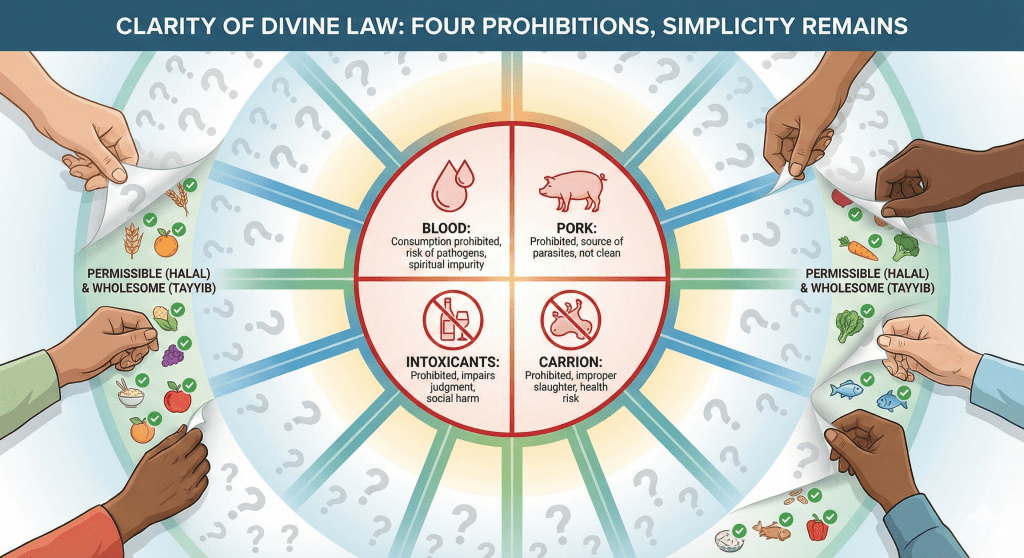
Just as the Quran is clear about what constitutes the manasik of Abraham’s religion, it is equally clear – perhaps even more so – about dietary prohibitions. The Quran states in no fewer than four separate verses exactly what foods are prohibited, and the list is remarkably consistent and remarkably brief.
[2:173] “He only prohibits for you the eating of animals that die of themselves (without human interference), blood, the meat of pigs, and animals dedicated to other than God. If one is forced (to eat these), without being malicious or deliberate, he incurs no sin. God is Forgiver, Most Merciful.”
The word “only” (innama in Arabic) at the beginning of this verse is crucial. It is a restrictive particle that limits the prohibition to the items that follow. God is not saying “here are some examples” or “among the prohibited items are.” He is saying “He ONLY prohibits” – establishing a complete and exhaustive list.
This same list appears in 5:3, 6:145, and 16:115, with the same four categories each time:
- Al-Maytah (الْمَيْتَة) – Carrion, animals that die of themselves without proper slaughter
- Ad-Dam (الدَّم) – Blood, specifically running blood not trapped in the meat
- Lahm al-Khinzir (لَحْم الْخِنزِير) – The meat of pigs (notably, the fat is not mentioned)
- Ma Uhilla li-Ghayri Allah (مَا أُهِلَّ لِغَيْرِ اللَّه) – What is dedicated to other than God at the time of slaughter
Part 9: The Linguistic Precision of “Uhilla”
Why the Fourth Prohibition Applies Only to Meat
Some have attempted to expand the fourth prohibition – “what is dedicated to other than God” – to include non-meat items like fruits offered at shrines or food blessed in the name of saints. However, the Arabic verb used (uhilla – أُهِلَّ) has a very specific meaning that makes this expansion linguistically impossible.
The root ه-ل-ل (h-l-l) in this form specifically means “to cry out or invoke at the moment of slaughter.” It refers to the pre-Islamic practice of calling out the name of an idol while slitting an animal’s throat. You cannot “uhilla” a fruit because the verb inherently involves the act of slaughtering. The verb is slaughter-specific by its very nature.
This linguistic precision is not accidental. God chose His words carefully, and He chose a word that specifically refers to meat dedication at the moment of slaughter. If He had intended to prohibit all foods associated with idol worship – including fruits, grains, or prepared dishes – He would have used a different, broader term. The choice of “uhilla” definitively limits this prohibition to animals slaughtered in the name of entities other than God.
[6:145] “Say, ‘I do not find in the revelations given to me any food that is prohibited for any eater except: (1) carrion, (2) running blood, (3) the meat of pigs, for it is contaminated, and (4) the meat of animals blasphemously dedicated to other than God.’ If one is forced (to eat these), without being deliberate or malicious, then your Lord is Forgiver, Most Merciful.”
The footnote to this verse states: “Only four kinds of animal products are prohibited: animals that die of themselves, running blood (not trapped within the meat), the meat of pigs, and animals dedicated to other than their Creator. Verse 146 informs us that such prohibitions are very specific; God prohibits either ‘the meat’ or ‘the fat,’ or both, if He so wills.” The specificity emphasized here underscores that God’s prohibitions are precise, not general or expandable by human interpretation.

Part 10: Rashad Khalifa’s Definitive Statements on Dietary Law
The Messenger Clarifies What Is Prohibited
Rashad Khalifa was explicit and unequivocal about what the Quran prohibits regarding food. In his lecture “Essentials of Submission,” he enumerated the four prohibitions clearly:
“There are four meats that you cannot eat, for example, and these are: (1) Animals that die of themselves without human interference, (2) Pork, the meat of pigs, (3) Running blood, running blood that you can put in a glass and cook or drink, (4) Animals dedicated to other than God, that are specifically dedicated to Muhammad or Jesus or Ali or somebody. These are forbidden.”
— Rashad Khalifa, Essentials of Submission (26:59)
In another lecture (Messenger Audio 20.2), he reinforced the limited scope of these prohibitions:
“Anyway, the Quran lists exactly four things that are prohibited. Anything beyond that is OK.“
— Rashad Khalifa, Messenger Audio 20.2 (7:33)
He further clarified in his Quran Study from November 4, 1989: “It says do not eat meat that is DEDICATED to other than God. There is a difference.” The emphasis on “dedicated” and “difference” shows his understanding that the prohibition is specific to the dedication ritual at slaughter, not a blanket ban on anything associated with other religions.
Regarding the specificity of dedication, Rashad explained: “Dedication means I killed this animal in the name of St. Francis. If you mention any name other than God, then it is dedicated to other than God.” This definition focuses on the verbal invocation at the moment of slaughter – exactly what the Arabic verb “uhilla” signifies.
When asked about fruits offered at shrines, Rashad’s response was notably different from his definitive statements about meat. He used phrases like “It’s even possible,” “I think personally,” and “It’s a waste of good food” – hedging language that indicates personal opinion rather than divine decree. His practical suggestion was to “just convince them not to put those fruits” – a social solution rather than a legal prohibition. Compare this uncertainty to his absolute clarity about meat: “Fourth, meat. Specifically meat.”
Part 11: The Footnotes Confirm the Limitation
The Final Testament’s Commentary
The Final Testament translation, produced under Rashad Khalifa’s supervision, includes footnotes that reinforce the limited scope of dietary prohibitions. At 5:3, the footnote states: “The ‘meat’ of the pig is prohibited, not the ‘fat.’ Anything that is not specifically prohibited in the Quran must be considered lawful.” This principle – that what is not specifically prohibited is lawful – is the cornerstone of Quranic dietary law.
The footnote at 2:172-173 is even more comprehensive: “Throughout the Quran, only four meats are prohibited (6:145, 16:115, Appendix 16). Dietary prohibitions beyond these four are tantamount to idol worship (6:121,148, 150; 7:32).” This statement is extraordinary in its implications: adding dietary prohibitions beyond what God decreed is not merely an error or an excess of caution – it is described as tantamount to idol worship.
[16:115] “He only prohibits for you dead animals, blood, the meat of pigs, and food which is dedicated to other than God. If one is forced (to eat these), without being deliberate or malicious, then God is Forgiver, Most Merciful.”
The accompanying footnote provides interesting scientific context: “The most devastating trichinosis parasite, Trichinella spiralis, (also the pork tapeworm Taenia solium) survives in the meat of pigs, not the fat.” This detail about the distinction between meat and fat further emphasizes God’s precision in His prohibitions – He prohibits exactly what needs to be prohibited, nothing more and nothing less.
Part 12: The Sin of Prohibiting What God Made Lawful
A Quranic Condemnation of Human Additions
The Quran does not merely state what is prohibited; it actively condemns those who add to the list of prohibitions. This is not a neutral matter of preference or caution – it is a serious transgression that the Quran addresses directly and severely.
[7:32] “Say, ‘Who prohibited the nice things God has created for His creatures, and the good provisions?’ Say, ‘Such provisions are to be enjoyed in this life by those who believe. Moreover, the good provisions will be exclusively theirs on the Day of Resurrection.’ We thus explain the revelations for people who know.”
The rhetorical question “Who prohibited the nice things God has created?” implies that those who do so have exceeded their authority. God created good provisions for His creatures to enjoy, and He told us exactly which few items to avoid. Those who expand these prohibitions are effectively telling God that His list was incomplete or insufficiently cautious – a position of breathtaking arrogance.
The footnote at 2:172-173 drives this point home by describing dietary prohibitions beyond the four as “tantamount to idol worship.” Why such a severe characterization? Because when humans claim the authority to legislate religious law, they are setting themselves up as rivals to God. They are saying, in effect, “God’s prohibitions are not enough; we know better.” This is precisely the attitude that constitutes shirk – associating partners with God in His exclusive domains of authority.
Part 13: The Practical Implications
Living by Quran Alone Means Accepting Its Sufficiency
For those who claim to follow the Quran alone, the implications of this analysis are clear. We cannot simultaneously claim to reject human sources while maintaining practices or prohibitions that have no Quranic basis. This requires honest self-examination: are there practices we observe or prohibitions we maintain simply because they are culturally expected rather than divinely commanded?
Regarding circumcision: it is a personal medical decision, not a religious obligation. Parents may choose to circumcise their sons for health or cultural reasons, but they should not deceive themselves or others by claiming it is a Quranic requirement. It is not. The Quran does not mention it, and therefore we have no authority to require it.
Regarding dietary restrictions: what God made lawful remains lawful regardless of cultural taboos or excessive caution. Shellfish, for example, is lawful. Meat slaughtered by Jews and Christians is lawful. Food from restaurants that do not specifically invoke other deities is lawful. The burden of proof is on those who claim something is prohibited, and that proof must come from the Quran itself – not from cultural assumptions, not from hadith, not from scholarly opinions, but from the clear text of God’s scripture.
[5:87] “O you who believe, do not prohibit good things that are made lawful by God, and do not aggress; God dislikes the aggressors.”
Those who add prohibitions are described as “aggressors” whom God dislikes. This should give pause to anyone who casually expands the list of forbidden things beyond what God explicitly prohibited.

Part 14: The Pattern of Human Additions Throughout History
How Religion Becomes Burdened
The pattern of adding human requirements to divine religion is as old as religion itself. The Quran notes that this was done to previous scriptures, and we see it happening in real-time within the Muslim community. What begins as a cultural practice becomes “recommended,” then “highly recommended,” and eventually “obligatory” in the minds of many, even though God never commanded it.
The mechanism is usually appeal to tradition: “This is what Muslims have always done.” But tradition is not revelation. Cultural consensus is not divine decree. Scholarly consensus, when it contradicts or adds to the Quran, is human overreach dressed in religious authority. The Quran itself warns us about this pattern:
[16:116] “You shall not utter lies with your own tongues stating: ‘This is lawful, and this is unlawful,’ to fabricate lies and attribute them to God. Surely, those who fabricate lies and attribute them to God will never succeed.”
The verse specifically mentions “this is lawful, and this is unlawful” as the content of the fabricated lies. This is precisely what has happened with dietary restrictions that go beyond the four Quranic prohibitions and with practices like circumcision that have been elevated to religious requirements. People have uttered with their tongues: “This food is haram” when God did not prohibit it. “This practice is wajib” when God did not require it. These are lies attributed to God, regardless of how sincerely held or how traditionally accepted.
Part 15: The Sufficiency of Divine Revelation
God’s Book Is Complete
Underlying both issues – circumcision and dietary restrictions – is a fundamental question about whether we truly believe God’s Book is sufficient. Do we trust that if something were important for our salvation or our religious practice, God would have included it in His detailed, complete revelation?
The Quran repeatedly emphasizes its completeness and detail. It is not a sketch requiring human elaboration but a finished work requiring only obedience. When we add to it, we implicitly suggest that God forgot something or was not thorough enough. When we subtract from it or dismiss its plain meaning, we suggest that God was unclear or exaggerated.
True submission to God means accepting His legislation as He gave it – neither adding nor subtracting, neither inflating nor diminishing. The manasik of Abraham’s religion are Salat, Zakat, fasting, and Hajj. The dietary prohibitions are carrion, blood, pig meat, and meat dedicated to other than God. These boundaries were set by God, and they are sufficient.

Conclusion: The Clarity of Divine Boundaries
The evidence presented in this analysis is not ambiguous or subject to multiple interpretations. The Quran uses the term manasik exclusively for formal worship rites – Salat, Zakat, fasting, and Hajj. It never mentions circumcision, not even once, in any context. It explicitly limits dietary prohibitions to four categories and condemns those who add to this list. These are not findings that require interpretation; they are direct observations from the Quranic text itself.
For those who claim to follow the Quran alone, the path forward is clear: we must align our practices with what God actually decreed, not with cultural expectations or traditional assumptions. This may require uncomfortable conversations with family members who expect circumcision of every male child. It may require declining invitations to participate in food practices that treat lawful things as prohibited. But this is the price of genuine submission – placing God’s word above human additions.
The boundaries of divine law are exactly where God placed them. He did not need our help in completing His religion, and He does not need our additions to make it more thorough or more pious. True piety lies in accepting what God decreed as sufficient – neither too much nor too little, but precisely right.
[22:78] “You shall strive for the cause of God as you should strive for His cause. He has chosen you and has placed no hardship on you in practicing your religion–the religion of your father Abraham.”
God placed no hardship on us. When religion becomes burdensome with endless restrictions and requirements that God never imposed, the burden comes from human additions, not from God. To return to the ease that God intended, we must return to what God actually said, accept its sufficiency, and let go of what humans have added over the centuries. This is not liberalism or laxity – it is obedience to the principle that God alone legislates, and His legislation is complete.



 Quran Only Studies
Leave a comment