Introduction: The Misunderstood Role of God’s Messengers
For centuries, traditionalist religious authorities have built entire theological systems on a fundamental misreading of a single Arabic word. The claim that verse 16:44 gives Prophet Muhammad the authority to “explain” the Quran has become the cornerstone justifying fabricated narrations, invented traditions, and human-made religious laws that contradict God’s scripture. This linguistic error has had catastrophic consequences – transforming what God explicitly reserved for Himself into a human enterprise that dilutes, distorts, and ultimately replaces divine guidance with human opinion.
This article presents irrefutable linguistic and scriptural evidence that the Arabic word “litubayyina” in verse 16:44 means “to proclaim” or “to deliver clearly” – NOT “to explain.” More importantly, we will demonstrate from the Quran itself that God explicitly FORBADE Muhammad from explaining the Quran, reserving this role exclusively for Himself. The evidence is overwhelming: multiple verses declare the messenger’s SOLE duty as delivery, God explicitly states HE will explain the Quran, and the scripture itself is declared to contain “explanations for everything.” When we understand these facts, the entire edifice of extra-Quranic religious authority crumbles.
Part 1: The Critical Verse – Understanding 16:44
What the Verse Actually Says
Let us examine the verse that has been so profoundly misunderstood by those seeking to justify human religious authority beyond God’s scripture. The verse in question is central to understanding the messenger’s actual role and mission. When properly translated according to the Arabic linguistic evidence and cross-referenced with other Quranic verses, its meaning becomes crystal clear.
[16:44] “We provided them with the proofs and the scriptures. And we sent down to you this message, to proclaim for the people everything that is sent down to them, perhaps they will reflect.”
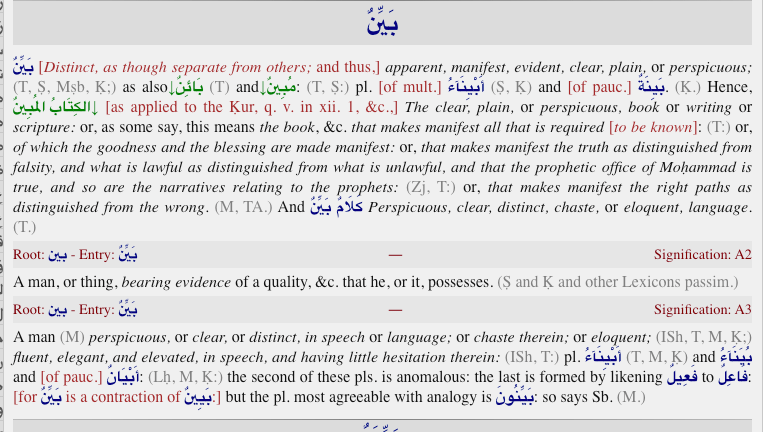
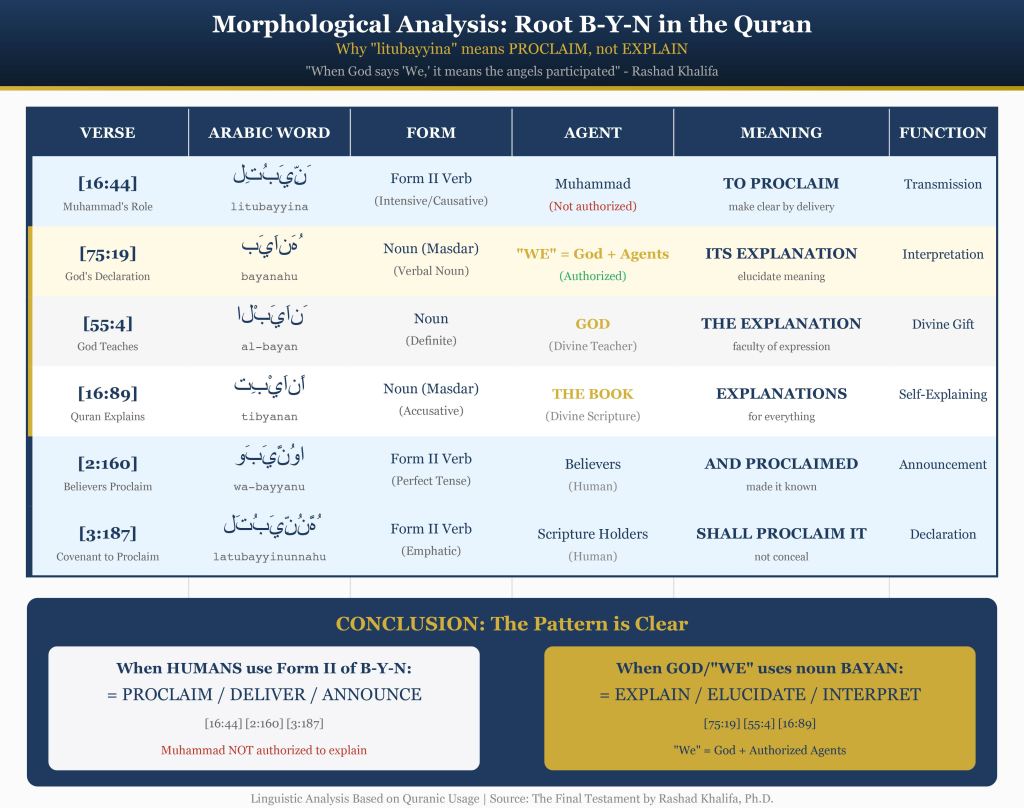
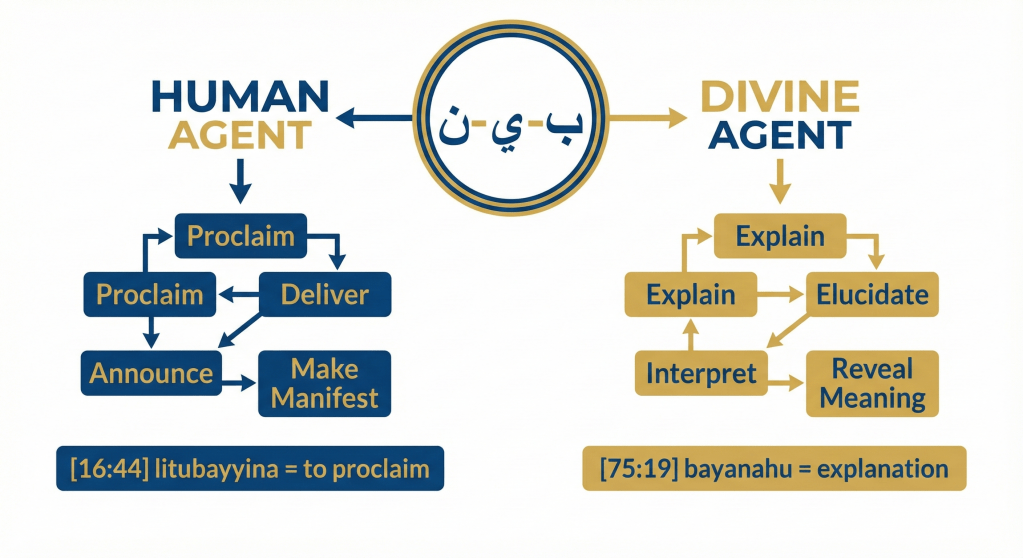
Notice the key phrase: “to proclaim for the people everything that is sent down to them.” The Arabic word used here is “litubayyina” (لِتُبَيِّنَ), from the root ب-ي-ن (b-y-n). This word has been deliberately mistranslated by traditionalists as “to explain” to justify their extensive libraries of fabricated narrations. However, as we shall demonstrate, this translation creates an irreconcilable contradiction with verse 75:19, where God explicitly declares that HE – not any human – will explain the Quran. The correct translation “to proclaim” or “to make clear by delivering” resolves this apparent contradiction and aligns perfectly with the messenger’s repeatedly stated duty throughout the Quran.
Part 2: The Divine Declaration – God Alone Explains
Verse 75:16-19: The Undeniable Proof
If there remained any doubt about the messenger’s role regarding Quranic explanation, verses 75:16-19 eliminate that doubt entirely. These verses represent one of the clearest statements in the entire Quran about the division of responsibility between God and His messenger. Here, God addresses Muhammad directly during the revelation process, giving him specific instructions that restrict his role to reception and recitation – never interpretation or explanation.
[75:16] “Do not move your tongue to hasten it.”
[75:17] “It is we who will collect it into Quran.”
[75:18] “Once we recite it, you shall follow such a Quran.”
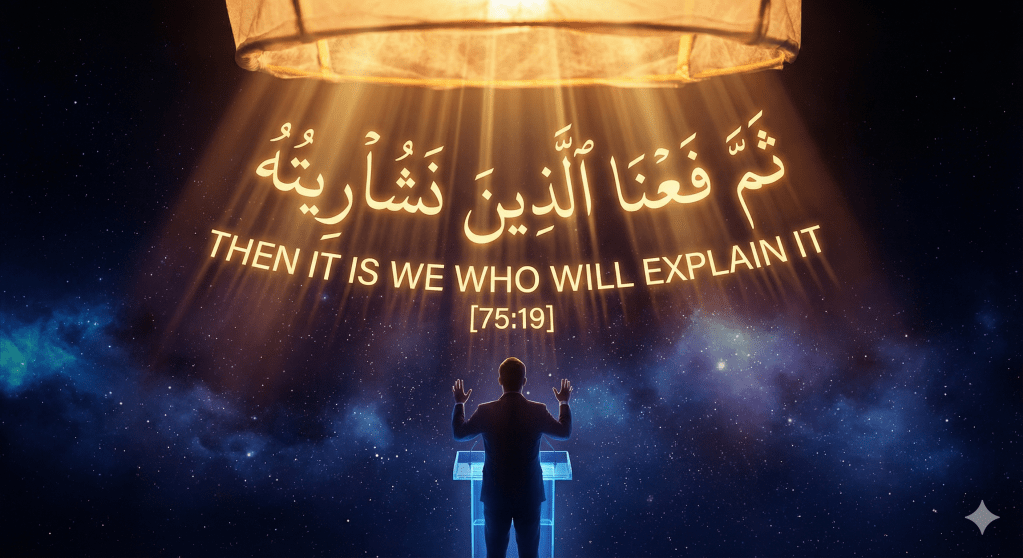
[75:19] “Then it is we who will explain it.”
The significance of these verses cannot be overstated. God explicitly declares THREE functions: (1) collecting the Quran, (2) reciting/teaching the Quran, and (3) explaining the Quran. The Arabic phrase “inna ‘alayna bayanahu” (إِنَّ عَلَيْنَا بَيَانَهُ) in verse 75:19 is emphatic – “it is upon US.” Muhammad’s role? Simply to “follow such a Quran” (75:18). Not to add to it, not to explain it on his own authority, not to interpret it independently – just to follow it and deliver it.
Understanding “We” in the Quran: God and His Authorized Agents
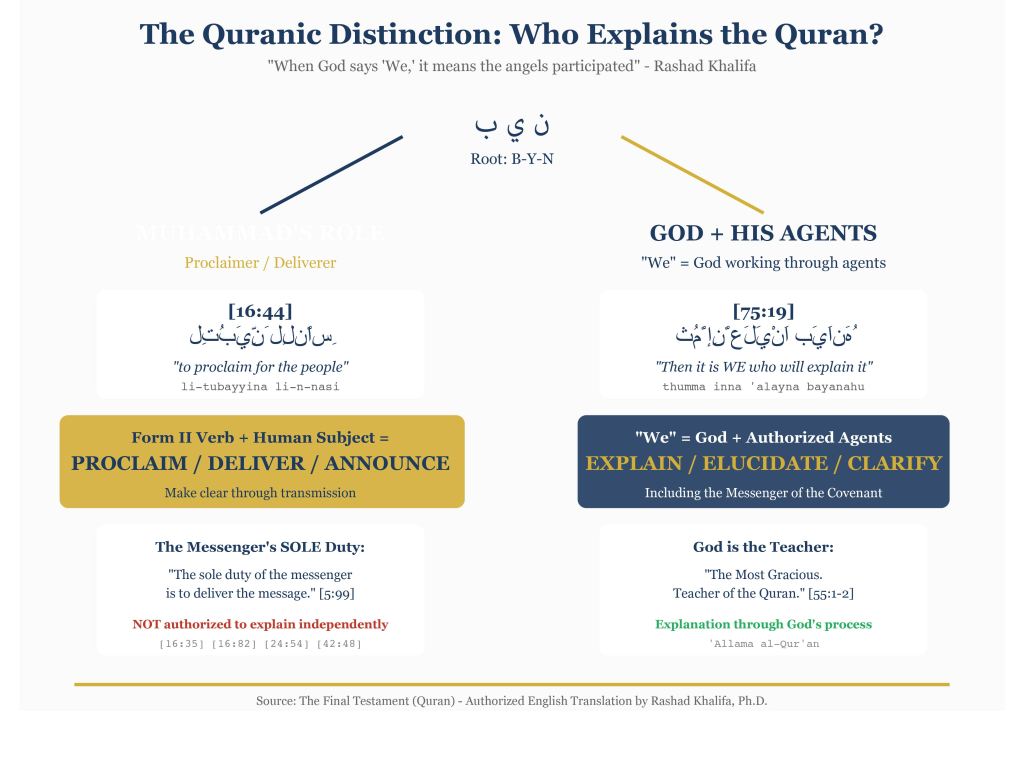
A critical point of understanding must be addressed here. When the Quran uses “We” (نَحْنُ), this is NOT a “royal we” or “majestic plural” as some traditionalists claim. The messenger of the covenant, Rashad Khalifa, clarified this definitively: “When God says ‘we,’ plural, it means the angels participated. When God says ‘I created,’ it means nobody else participated.” He further explained: “Like what God says, ‘we revealed to the Christians, and we will preserve it,’ because Gabriel participated in the process of revelation. And ‘we will preserve it,’ because the angels making sure that nobody will tamper with it. This is generally the rule.”
This understanding transforms our comprehension of 75:19. When God says “We will explain it,” He is indicating that the explanation of the Quran comes through God working with His authorized agents – His angels and His messengers. Muhammad’s specific role was proclamation and delivery of the text. But God’s explanation of the Quran comes through the process He establishes – including through the Messenger of the Covenant whom God appointed to unveil the Quran’s mathematical miracle and clarify its message for this generation.
This creates a clear distinction that refutes traditionalist claims. If traditionalists insist on using their flawed understanding of “We” as a royal plural meaning God alone, they face an insurmountable problem: If 16:44 means Muhammad was to “explain” the Quran, and 75:19 means God alone explains the Quran, this creates a direct contradiction. The Quran contains no contradictions (4:82), therefore the traditionalist interpretation of 16:44 must be wrong. The word “litubayyina” must mean something other than “explain” – it means “to proclaim” or “to deliver clearly.” Either way – whether understanding “We” correctly as God + agents, or using the traditionalist framework – the conclusion is the same: Muhammad’s role was NOT independent explanation of the Quran.
Part 3: Linguistic Analysis of the Root B-Y-N (ب ي ن)
How Context and Agent Determine Meaning
The Arabic root ب-ي-ن (b-y-n) is one of the richest roots in the Quranic vocabulary, carrying a range of meanings that depend critically on context, grammatical form, and especially the AGENT performing the action. This linguistic principle is fundamental to understanding the distinction between divine and human roles in relation to the Quran. Just as the same English word “run” means different things when a person runs versus when a river runs versus when colors run, Arabic verbs carry different semantic weight depending on their subject.
When the agent is HUMAN (a messenger), derivatives of b-y-n typically mean: to make clear by delivering, to proclaim, to announce, to convey openly, to make manifest. The human makes something “bayyina” (clear) by TRANSMITTING it faithfully, not by adding interpretation. Think of a news anchor reading headlines – they make the news “clear” by delivering it accurately, not by explaining what it means or telling you how to interpret it. When the agent is DIVINE (God), however, derivatives of b-y-n carry the fuller meaning of: to explain, to elucidate, to interpret, to reveal the deeper meaning. God makes something “bayan” (clear) by providing understanding, wisdom, and insight into its meaning.
This distinction is not arbitrary – it reflects the Quran’s consistent teaching that true understanding and guidance come from God alone. Humans can deliver the message; only God can illuminate the heart to understand it. Consider verse 55:4, which we will examine shortly, where God declares He taught humanity “al-bayan” – the ability to distinguish and understand. This capacity for understanding is a divine gift, not a human authority.
Part 4: The Contradiction Argument – An Irrefutable Proof
Why 16:44 Cannot Mean “Explain”
Let us apply simple logic to demonstrate why the traditionalist translation of 16:44 is impossible. The Quran declares itself free of contradiction: “Do they not reflect upon the Quran? Had it been from other than God, they would have found in it many a discrepancy” (4:82). This means any interpretation that creates contradiction must be rejected. Now consider the implications of translating “litubayyina” in 16:44 as “explain.”
If 16:44 means Muhammad was sent “to explain for the people everything that is sent down to them,” this creates a problem with 75:19 where God states “it is WE who will explain it.” With the correct understanding that “We” means God working through His authorized agents, we see that Muhammad’s role was specifically proclamation and delivery – he was not among those authorized to explain. The explanation comes through God’s designated process, which includes the Messenger of the Covenant who would come later to unveil the mathematical miracle and clarify the message.
Even using the traditionalists’ own flawed framework (treating “We” as meaning God alone), they still cannot escape the conclusion. If “We” means only God, then 75:19 states God ALONE explains the Quran – creating a direct contradiction with their interpretation that Muhammad explained it. The Quran is contradiction-free (4:82), so their interpretation of 16:44 must be wrong.
The resolution is straightforward: 75:19 is completely unambiguous (“it is WE who will explain it” – no room for alternate meaning), while 16:44 uses a verb that has multiple valid translations (“litubayyina” can mean proclaim/deliver/make clear). Therefore, 16:44 should be translated as “to proclaim” or “to deliver clearly.” Muhammad’s role was to proclaim and deliver the message; God’s explanation comes through His established process and authorized agents. The messenger delivers; God – working through His system – illuminates. This harmonizes perfectly with the Quran’s consistent teaching throughout.
Part 5: The Messenger’s Sole Duty – Al-Balagh (The Delivery)
Over Ten Verses Confirming Delivery, Not Explanation
The Quran does not leave this matter to inference. In verse after verse, God explicitly declares that the messenger’s SOLE duty, ONLY function, and SINGLE mission is delivery (al-balagh). The repetition of this theme across multiple chapters using nearly identical language demonstrates its fundamental importance. If the messenger’s role included explanation, why would God repeatedly emphasize that delivery is the ONLY duty?
[5:99] “The sole duty of the messenger is to deliver the message, and God knows everything you declare and everything you conceal.”
[5:92] “You shall obey God, and you shall obey the messenger, and beware. If you turn away, then know that the sole duty of our messenger is to deliver the message efficiently.”
[24:54] “Say, ‘Obey God, and obey the messenger.’ If they refuse, then he is responsible for his obligations, and you are responsible for your obligations. If you obey him, you will be guided. The sole duty of the messenger is to deliver (the message).”
The pattern continues throughout the Quran with remarkable consistency. Consider these additional verses that hammer home the same point:
[42:48] “If they turn away, we did not send you as their guardian. Your sole mission is delivering the message…”
[3:20] “…your sole mission is to deliver this message. God is Seer of all people.”
[13:40] “Whether we show you what we promise them, or terminate your life before that, your sole mission is to deliver (the message). It is us who will call them to account.”
[16:35] “…Can the messengers do anything but deliver the complete message?”
[16:82] “If they still turn away, then your sole mission is the clear delivery (of the message).”
[29:18] “If you disbelieve, generations before you have also disbelieved. The sole function of the messenger is to deliver (the message).”
[36:17] “Our sole mission is to deliver the message.”
[64:12] “You shall obey God and you shall obey the messenger. If you turn away, then the sole mission of our messenger is to deliver the message.”
The Arabic term used throughout these verses is “al-balagh” (البلاغ), meaning delivery, conveyance, or transmission. Not once does the Quran say the messenger’s duty includes “al-tafsir” (explanation/interpretation) or even “al-bayan” (clarification/elucidation) in the sense of adding meaning. Delivery. That is the complete job description. Anything beyond delivery is an innovation that contradicts the Quran’s explicit statements.
Part 6: The Self-Explaining Scripture
The Quran Contains Explanations for Everything
If the Quran needed external human explanation, God would not have described it as containing “explanations for everything.” Yet this is precisely what God declares about His scripture. The Quran is not a partial message requiring human supplements – it is complete, detailed, and self-sufficient. Every claim that the Quran needs fabricated narrations or traditions to be understood is a direct denial of God’s repeated declarations about His own book.
[16:89] “The day will come when we will raise from every community a witness from among them, and bring you as the witness of these people. We have revealed to you this book to provide explanations for everything, and guidance, and mercy, and good news for the submitters.”
Notice the same chapter (16) that contains verse 44 also contains verse 89. In verse 89, God uses “tibyanan” (تِبْيَانًا) – a word from the same root b-y-n – to describe what the QURAN provides. The Quran provides “tibyanan li-kulli shay” – “explanations for everything.” If the Quran itself contains explanations for everything, why would we need any human being – even a prophet – to add more explanations? The logic is inescapable: the Quran explains itself through internal cross-referencing, through repetition, through detailed elaboration across multiple chapters.
[6:114] “Shall I seek other than God as a source of law, when He has revealed to you this book fully detailed? Those who received the scripture recognize that it has been revealed from your Lord, truthfully. You shall not harbor any doubt.”
[11:1] “A.L.R. This is a scripture whose verses have been perfected, then elucidated. It comes from a Most Wise, Most Cognizant.”
[10:37] “This Quran could not possibly be authored by other than God. It confirms all previous messages, and provides a fully detailed scripture. It is infallible; for it comes from the Lord of the universe.”
[12:111] “In their history, there is a lesson for those who possess intelligence. This is not fabricated Hadith; this (Quran) confirms all previous scriptures, provides the details of everything, and is a beacon and mercy for those who believe.”
Verse 12:111 is particularly striking. God explicitly contrasts the Quran with “fabricated Hadith” (حَدِيثًا يُفْتَرَىٰ – hadithun yuftara), declaring that the Quran is NOT fabricated narrations but rather provides “the details of everything” (tafsila kulli shay). This verse alone demolishes the argument that we need collections of narrations to understand or implement the Quran. The Quran provides the details of EVERYTHING – and explicitly warns against fabricated narrations as the false alternative.
Part 7: God, The Teacher of the Quran
55:1-4 – The Divine Instructor
The opening verses of chapter 55 (The Most Gracious) establish with absolute clarity WHO teaches the Quran and WHO gives humanity the capacity to understand it. These verses appear at the beginning of a chapter that emphasizes God’s blessings and marvels, placing the teaching of the Quran among His greatest gifts. Notice that no human intermediary is mentioned – God Himself is the direct teacher.
[55:1] “The Most Gracious.”
[55:2] “Teacher of the Quran.”
[55:3] “Creator of the human beings.”
[55:4] “He taught them how to distinguish.”
God identifies Himself as “Teacher of the Quran” (عَلَّمَ ٱلْقُرْءَانَ – ‘allama al-Quran). The verb ‘allama means to teach, to instruct, to impart knowledge. And in verse 55:4, God states He taught humanity “al-bayan” (ٱلْبَيَانَ) – the ability to distinguish, to understand, to discern meaning. This is the same root b-y-n we have been discussing. God gave humans the CAPACITY for understanding (al-bayan), and God Himself TEACHES the Quran. No human teacher of the Quran is mentioned because none is authorized.
Consider the implications: If God is the Teacher of the Quran, what role does this leave for human “explanation”? The messenger DELIVERS the textbook; God TEACHES the curriculum. The messenger hands you the Quran; God illuminates your heart to understand it. This is why sincere readers who approach the Quran with pure hearts receive guidance, while those who approach it with ulterior motives remain blind even if they memorize every word. Understanding is a divine gift, not a human transmission.

Part 8: The Severe Warning – 69:44-47
What Happens If a Messenger Adds Teachings
Some may argue that even if the messenger’s primary role was delivery, surely he had authority to add some explanations or clarifications. The Quran addresses this hypothetical directly and with terrifying severity. In verses 69:44-47, God describes what would happen if the messenger dared to add any teachings beyond what was revealed. This is not a gentle correction – it is a death threat from the Creator Himself.
[69:44] “Had he uttered any other teachings.”
[69:45] “We would have punished him.”
[69:46] “We would have stopped the revelations to him.”
[69:47] “None of you could have helped him.”
The severity of this warning demonstrates how seriously God takes the purity of His message. If Muhammad had uttered “any other teachings” (بَعْضَ ٱلْأَقَاوِيلِ – some other statements/sayings), he would have been punished, cut off from revelation, and abandoned by God with no one able to help him. This completely contradicts the traditionalist claim that Muhammad provided authoritative teachings alongside the Quran. Such teachings would have triggered divine punishment, not divine approval.
This warning also exposes the inherent danger of the fabricated narrations attributed to the Prophet. If Muhammad himself was under strict prohibition against adding teachings to the Quran, how much more dangerous is it to attribute invented teachings to him centuries after his death? Those who follow fabricated narrations are not honoring the Prophet – they are participating in the very crime God warned the Prophet against committing. They are completing a violation that the Prophet himself was forbidden from initiating.
Part 9: The Contrast Between Delivering and Explaining
Understanding the Functional Difference
To fully appreciate the significance of this linguistic distinction, consider the functional difference between a deliverer and an explainer. A mail carrier delivers a letter – their job is to get the sealed envelope from sender to recipient without opening it, altering it, or adding commentary. If the mail carrier opened your letter, read it, then told you what they think it means, they would have violated their role. Their job is delivery, not interpretation. Similarly, a news anchor reads the news – they deliver the headlines. An analyst explains the news – they provide context, interpretation, and commentary. These are fundamentally different roles.
Muhammad’s role as messenger was that of the mail carrier or news anchor – faithful delivery without alteration or addition. God’s role is that of the original author who knows what He meant and provides the understanding through His own teaching. When traditionalists claim that 16:44 gives Muhammad explanatory authority, they are essentially claiming that God commissioned the mail carrier to open the mail and add their own notes. This contradicts the explicit Quranic statements about the messenger’s sole duty being delivery and God’s exclusive role as teacher and explainer.
This understanding also explains why the Quran repeatedly tells Muhammad to say “I follow only what is revealed to me” (6:50, 7:203, 10:15, 46:9). The Prophet was not inventing teachings or providing independent explanations – he was following and transmitting exactly what God revealed. Verse 10:15 is particularly clear:
[10:15] “…I cannot possibly change it on my own. I simply follow what is revealed to me. I fear, if I disobey my Lord, the retribution of an awesome day.”
Muhammad feared the retribution of God if he strayed beyond what was revealed. This is not the posture of someone with authority to explain or expand upon the message – it is the humble recognition of a deliverer who knows his boundaries.

Part 10: The Quran as the Only Source
No Other Source Beside It
The Quran leaves no room for additional sources of religious guidance. In explicit terms, God commands that no other source be followed and that nothing shall abrogate or supplement His words. These declarations make the acceptance of fabricated narrations as religious authority not merely misguided but a direct violation of divine command.
[18:27] “You shall recite what is revealed to you of your Lord’s scripture. Nothing shall abrogate His words, and you shall not find any other source beside it.”
The phrase “you shall not find any other source beside it” (وَلَن تَجِدَ مِن دُونِهِۦ مُلْتَحَدًا) is a complete prohibition against seeking guidance from anything other than God’s scripture. The word “multahadan” means a refuge, a source to turn to, a place of guidance. God commands that no such source exists or should be sought beside His scripture. This verse alone should end any debate about whether fabricated narrations can serve as religious authority.
[6:114] “Shall I seek other than God as a source of law, when He has revealed to you this book fully detailed?”
The question is rhetorical, expecting the answer “No!” Why would anyone seek other than God as a source of law when the book is “fully detailed” (mufassalan)? The very question exposes the absurdity of seeking human narrations when divine scripture provides complete detail. Those who turn to fabricated narrations are essentially answering this rhetorical question with “Yes, I will seek other than God as a source of law” – directly contradicting the expected Quranic response.
Part 11: The Implications for Religious Authority
Why This Matters Today
Understanding that Muhammad’s role was proclamation, not explanation, has profound implications for how we approach religion today. It means that vast libraries of so-called “explanatory” traditions have no divine authority. It means that religious scholars who claim to interpret the Quran through these narrations are building on a false foundation. It means that millions of religious practices, laws, and beliefs that cannot be found in the Quran have no legitimate basis, no matter how many narrations are cited in their support.
The Quran provides us with a complete, detailed, self-explaining scripture that God Himself teaches to sincere seekers. We need nothing else. The messenger delivered this message faithfully, and his mission is complete. What remains is for each of us to read, reflect, and allow God to guide us directly through His words. This is the liberating truth that the linguistic evidence reveals: you have direct access to God’s guidance, without need for human intermediaries claiming explanatory authority.
This does not mean scholarship has no value – understanding Arabic, studying historical context, and comparing verses are all legitimate tools for engaging with the Quran. But these are aids to understanding God’s words, not replacements for them. A dictionary helps you read a book; it does not become a new book with equal authority. Similarly, linguistic and historical tools help us access the Quran’s meaning; they do not create new religious content beyond what God revealed.

Part 12: How the Quran Explains Itself
Internal Cross-References and Divine Pedagogy
One of the most remarkable features of the Quran is its internal coherence and self-referential nature. Concepts introduced briefly in one place are elaborated elsewhere. Themes recur across chapters with progressive depth. Stories are told from different angles in different locations, with each retelling adding new dimensions. This is how God teaches through His Quran – not through external human commentary, but through the scripture’s own internal structure.
[41:3] “A scripture whose verses provide the complete details, in an Arabic Quran, for people who know.”
The Quran’s verses “fussilat” – they have been detailed, elaborated, made distinct. This detailed nature is intrinsic to the scripture itself. When you encounter something unclear in one verse, the Quran’s methodology is to search for clarification in other verses. This is why God says the Quran was revealed in Arabic – not because Arabic speakers are superior, but because the linguistic precision and internal cross-referencing require the original language’s structural integrity. Understanding Quranic Arabic (which is accessible to any dedicated student) unlocks this self-referential nature.
Consider how the Quran teaches: a concept is introduced, then repeated, then elaborated, then applied in different contexts. Prayer is mentioned, then its times specified, then its manner described, then its spiritual significance explored across multiple passages. This is divine pedagogy – God’s teaching method. No human explanation is needed because God designed His book to teach progressively and completely within itself.
Part 13: The Historical Development of False Authority
How Human Explanation Replaced Divine Guidance
Understanding how we arrived at the current situation helps us appreciate the importance of returning to the Quranic truth. After Muhammad’s death, political and religious authorities recognized that controlling “interpretation” of the Quran meant controlling the community. Within two centuries, vast collections of narrations were compiled, attributed to the Prophet, and elevated to near-scriptural authority. But consider: these narrations were collected 200+ years after Muhammad died, passed through chains of oral transmission, and were selected by human compilers with their own biases and agendas.
The very concept that Muhammad “explained” the Quran (rather than simply delivered it) was essential to legitimizing these collections. If Muhammad’s role was only delivery, then only the delivered text (the Quran) has authority. But if Muhammad also “explained,” then there must be explanations somewhere – and conveniently, those with political power claimed to possess them. This is how the mistranslation of “litubayyina” became institutionalized: it served the interests of those seeking religious authority beyond the Quran.
The Quran itself predicted this corruption. Verse 25:30 records a complaint the Prophet will make on the Day of Judgment: “My Lord, my people have deserted this Quran.” Not “they misunderstood my explanations” or “they lost my traditions” – they deserted the QURAN. The Quran was abandoned in favor of human narrations, just as previous communities abandoned their scriptures. The solution is not reform of the tradition-based system but return to the Quranic truth: the messenger delivered, God explains, and the Quran contains everything we need.
Part 14: Summary of the Linguistic Evidence
The Case for “Proclaim” Over “Explain”
Let us now summarize the cumulative evidence that “litubayyina” in 16:44 means “proclaim” not “explain”:
1. The “We” Understanding: When God says “We” in the Quran, it indicates God working with His authorized agents (angels, messengers). “We will explain it” (75:19) means God’s explanation comes through His authorized process – not through Muhammad’s independent commentary. Muhammad was the proclaimer; explanation comes through God’s designated agents like the Messenger of the Covenant.
2. The Contradiction Argument: Even using the traditionalists’ flawed “royal we” framework, if 16:44 means Muhammad “explains” and 75:19 means God explains, this creates contradiction. The Quran is contradiction-free (4:82), so their interpretation of 16:44 must be wrong.
3. The Root Analysis: The root b-y-n carries different meanings depending on the agent. When humans are the agent, it typically means “to make clear by delivering/proclaiming.” When God and His agents are involved, it means “to explain/elucidate.”
4. The Sole Duty Verses: Over ten verses explicitly state the messenger’s SOLE duty is delivery (al-balagh). If explanation were part of his duty, “sole duty is delivery” would be false.
5. The Self-Sufficiency Verses: The Quran is described as “fully detailed” (6:114, 10:37), providing “explanations for everything” (16:89), and needing no other source (18:27). These descriptions preclude the need for human explanation.
6. The Divine Teacher Verses: God identifies Himself as “Teacher of the Quran” (55:2) and states He gave humanity the capacity for understanding (55:4). Teaching and explaining are God’s role, not the messenger’s.
7. The Warning Verses: Muhammad was warned of severe punishment if he uttered “any other teachings” (69:44-47). This prohibits explanatory additions, not just fabrications.
8. The “Follow Only” Verses: Muhammad repeatedly states “I follow only what is revealed to me” (10:15, etc.), indicating he transmitted rather than originated teachings.
This convergence of evidence from multiple angles and multiple verses creates an overwhelming case. The traditionalist interpretation of 16:44 cannot stand against this weight of Quranic testimony.

Part 15: Conclusion – Returning to the Pure Message
What This Means for Believers
The evidence is conclusive: Muhammad was the proclaimer, not the explainer of God’s message. His mission was delivery (al-balagh), and he completed it faithfully. God is the Teacher of the Quran, God explains the Quran, and the Quran contains explanations for everything believers need. This understanding liberates us from dependence on human intermediaries and returns us to direct engagement with God’s word. It strips away the accumulated layers of human tradition and reveals the pure, sufficient scripture that God actually revealed.
This does not diminish Muhammad’s honor – on the contrary, it confirms that he faithfully fulfilled his mission exactly as God commanded. He delivered without distortion, proclaimed without addition, and obeyed without innovation. His example is complete submission to God’s command, not invention of new religious content. Honoring Muhammad means following the Quran he delivered, not fabrications attributed to him by those who came later.
For believers today, this understanding opens the door to authentic spirituality. You can approach the Quran directly, confident that God Himself will teach you through His words. You need not filter God’s message through layers of human interpretation that may contradict, complicate, or obscure the original meaning. The path is clear: read the Quran, reflect deeply, maintain sincere devotion to God alone, and trust that the One who revealed the Book will guide you to understand it. The Proclaimer completed his mission; now it is between you and the Divine Teacher.
[17:9] “This Quran guides to the best path, and brings good news to the believers who lead a righteous life, that they have deserved a great recompense.”


 Quran Only Studies
Leave a comment