
Introduction: The Question Everyone Thinks They Can Answer
Ask anyone what the Quran is, and you will likely receive a quick, confident answer: “It’s the holy book of Islam,” “It’s scripture revealed to Muhammad,” or “It’s the word of God.” While these responses contain elements of truth, they barely scratch the surface of a far more profound reality. The Quran is not merely a book you pick up and read—it is a living, dynamic interaction between the Creator and the seeker, a spiritual technology that responds differently to different hearts. Understanding what the Quran truly is requires us to move beyond superficial definitions and explore both its physical composition and its spiritual dimensions.
This exploration matters because billions of people claim to follow the Quran, yet they arrive at contradictory conclusions. Entire nations, movements, and individuals all cite the same scripture while holding diametrically opposed beliefs about fundamental matters. How can the same book produce such divergent outcomes? The answer lies not in the text itself, but in understanding that the Quran consists of two inseparable components: the physical scripture and the spiritual access required to truly comprehend it. Without understanding both dimensions, we possess only half of what the Quran actually is.
[2:2] “This scripture is infallible; a beacon for the righteous.”
Notice the precision of this opening declaration. The Quran does not claim to be a beacon for everyone indiscriminately—it specifies that it guides “the righteous.” From its very second verse, the scripture establishes that its transformative power is conditional upon the spiritual state of the reader. This is the first clue that the Quran is far more than ink on paper or recitation of words.
Part 1: The Physical Quran — Letters, Words, and Mathematical Architecture
The Tangible Text We Can Hold
The physical Quran is what most people envision when they think of this scripture. It consists of 114 chapters containing approximately 6,346 verses, composed of specific Arabic words arranged in a precise order. This is the Quran that can be printed, bound, translated, and distributed around the world. It has been memorized letter-by-letter by millions throughout history, passed down through an unbroken chain of oral transmission alongside written manuscripts. The physical text is observable, measurable, and can be studied by anyone regardless of their beliefs.
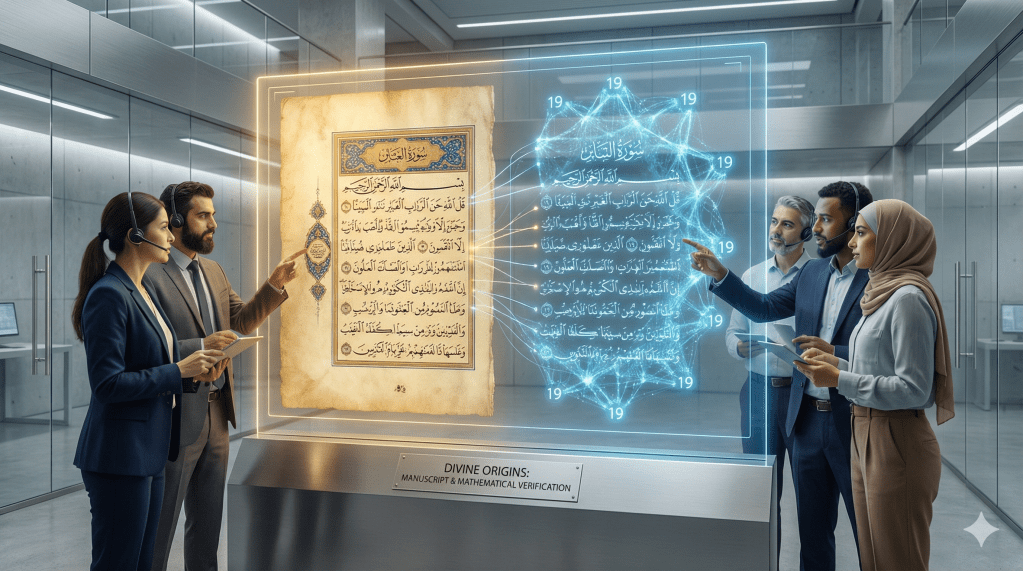
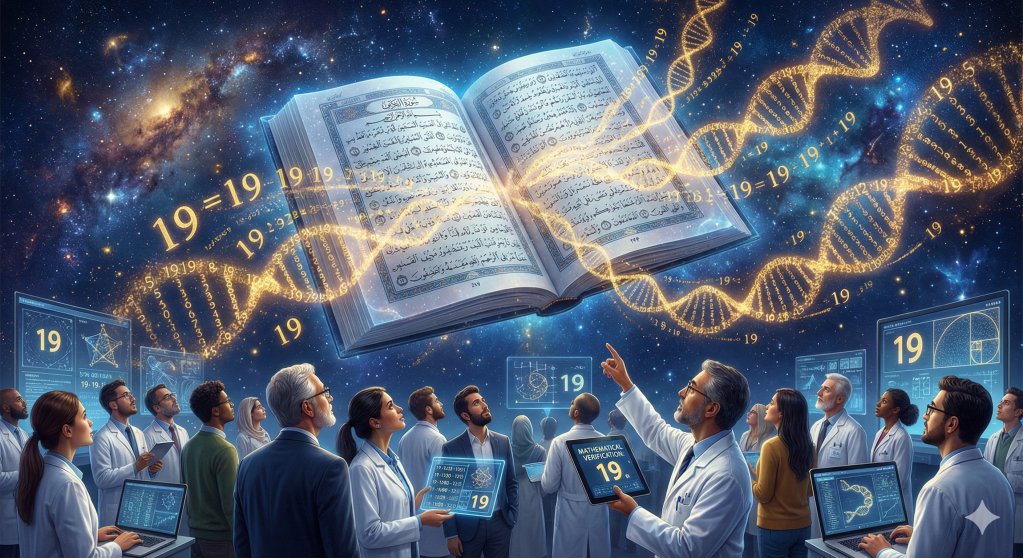
But the physical Quran extends far beyond mere words on a page. Hidden within its structure lies something unprecedented in human literature: a mathematical architecture so sophisticated that it could not have been produced by any human author in the seventh century—or any century. This mathematical composition involves the interplay of letters, words, verses, and chapters in patterns based on the number 19, as referenced in the scripture itself.
[74:30] “Over it is nineteen.”
[74:35] “This is one of the great miracles.”
The mathematical miracle of the Quran, discovered through computer analysis in the late 20th century, demonstrates that every element of the scripture—from the frequency of specific letters to the number of verses in each chapter—forms interlocking patterns divisible by 19. This mathematical code serves as God’s signature, an authentication system proving the divine origin of the text and its perfect preservation over fourteen centuries. The physical Quran, therefore, is not merely a collection of teachings but a mathematically structured document whose composition transcends human capability.
Part 2: The Spiritual Quran — Access Beyond Literacy
Why Reading Does Not Equal Understanding
Here is where most people’s understanding of the Quran falls tragically short. While the physical text can be read by anyone with literacy, the spiritual Quran—the actual meaning and wisdom embedded within it—is accessible only to those who meet specific conditions. This is not an arbitrary exclusion but a fundamental characteristic of the scripture itself. The Quran repeatedly and explicitly states that God places barriers between insincere readers and the text’s true meaning.
Consider the implications of this reality. A professor of Arabic literature who has spent decades studying the language may read the Quran and completely miss its message, while a new believer in Indonesia who reads only a translation may grasp profound truths immediately. Language proficiency, academic credentials, and scholarly reputation mean nothing when it comes to accessing the Quran’s wisdom. What matters is something the scripture calls sincerity, purity, or being among “the sincere.”
[56:79] “None can grasp it except the sincere.”
This verse demolishes the assumption that the Quran is equally accessible to all readers. The Arabic word “mutahharoon” (the sincere, the purified) indicates that a spiritual prerequisite exists for understanding. Just as certain frequencies of light are invisible to the human eye without special equipment, the Quran’s deeper meanings remain invisible to those whose hearts are not calibrated to receive them. This explains how the same text can be healing for some and a source of increased transgression for others.
[17:82] “We send down in the Quran healing and mercy for the believers. At the same time, it only increases the wickedness of the transgressors.”
Part 3: The Divine Barrier — Why Some Cannot Understand
Shields on the Heart
The Quran describes a phenomenon that seems almost paradoxical to modern sensibilities: God actively prevents certain people from understanding His message. This is not cruelty but justice—a response to the choices people make with their free will. When someone consistently rejects truth, ignores their conscience, or approaches the scripture with arrogance and predetermined conclusions, God responds by sealing their ability to perceive.
The mechanism is described vividly throughout the scripture. God places “shields” around their minds, “deafness” in their ears, and “veils” over their hearts. These are not physical barriers but spiritual ones—the natural consequence of choosing falsehood over truth until the capacity for discernment atrophies. It is analogous to how muscles weaken through disuse or how repeated lies eventually make a person unable to recognize truth even within themselves.
[17:45-46] “When you read the Quran, we place between you and those who do not believe in the Hereafter an invisible barrier. We place shields around their minds, to prevent them from understanding it, and deafness in their ears. And when you preach your Lord, using the Quran alone, they run away in aversion.”
Notice the phrase “using the Quran alone.” This verse connects the barrier to those who reject the Quran’s sole authority. When people insist on adding human sources—whether traditions, scholarly opinions, or cultural practices—to God’s scripture, they trigger this divine response. The running away “in aversion” describes the visceral rejection many exhibit when confronted with the Quran’s pure message, stripped of human additions.
[18:57] “Who are more evil than those who are reminded of their Lord’s proofs, then disregard them, without realizing what they are doing. Consequently, we place shields on their hearts to prevent them from understanding it (the Quran), and deafness in their ears. Thus, no matter what you do to guide them, they can never ever be guided.”

Part 4: Same Text, Different Results — The Quran as Spiritual Mirror
A Scripture That Responds to the Reader
One of the most remarkable aspects of the Quran is that it functions almost like a spiritual mirror, reflecting back different things to different readers based on their inner state. This explains why two people can read the same verse and arrive at opposite conclusions, why entire movements claiming to follow “Quran alone” contradict each other, and why the Muslim world—despite having the same scripture for 1400 years—exhibits such profound disagreement on fundamental issues.
The Quran itself predicts and explains this phenomenon. When those “who harbor doubt in their hearts” encounter the scripture’s allegorical verses, they pursue them “to create confusion.” Meanwhile, those “well-founded in knowledge” accept both the clear and allegorical verses, recognizing that “all of it comes from our Lord.” The difference lies not in the text but in the reader. The Quran is a constant; the variable is the human heart.
[3:7] “He sent down to you this scripture, containing straightforward verses—which constitute the essence of the scripture—as well as multiple-meaning or allegorical verses. Those who harbor doubts in their hearts will pursue the multiple-meaning verses to create confusion, and to extricate a certain meaning. None knows the true meaning thereof except God and those well founded in knowledge. They say, ‘We believe in this—all of it comes from our Lord.’ Only those who possess intelligence will take heed.”
This verse reveals why sincere scholarship and insincere scholarship produce radically different results. The insincere approach the Quran with an agenda—to find support for pre-existing beliefs, to justify cultural practices, or to win arguments. They cherry-pick allegorical verses while ignoring clear ones. The sincere approach the Quran as students, willing to have their assumptions challenged, accepting that their understanding may be incomplete, and recognizing that true knowledge comes from God alone.
[41:44] “If we made it a non-Arabic Quran they would have said, ‘Why did it come down in that language?’ Whether it is Arabic or non-Arabic, say, ‘For those who believe, it is a guide and healing. As for those who disbelieve, they will be deaf and blind to it, as if they are being addressed from faraway.’”
Part 5: The Language Myth — Why Arabic Is Not Enough
Debunking the Notion That Arabic Speakers Have Special Access
A persistent myth suggests that Arabic speakers have inherent advantages in understanding the Quran, that the scripture’s true meaning is locked within the Arabic language and can only be fully accessed by those fluent in it. While the Quran was indeed revealed in Arabic, and while understanding Arabic can provide linguistic insights, the scripture itself demolishes the idea that language proficiency equals spiritual comprehension.
Consider this: the people who most vigorously rejected Prophet Muhammad’s message were native Arabic speakers. The Quraysh tribe, fluent in the most eloquent Arabic, heard the Quran directly from the Prophet himself—and most of them rejected it. Meanwhile, history has shown that non-Arabic speakers, reading translations, have often grasped the Quran’s message more readily than those immersed in Arabic culture. The barrier to understanding is not linguistic but spiritual.
[6:25] “Some of them listen to you, but we place veils on their hearts to prevent them from understanding, and deafness in their ears. Thus, no matter what kind of proof they see, they cannot believe. Thus, when they come to argue with you, the disbelievers say, ‘These are tales from the past.’”
This verse describes people who “listen”—they hear the Arabic words perfectly—yet cannot understand because of spiritual barriers. Listening is not the same as hearing. Reading Arabic is not the same as comprehending God’s message. The Quran can be “tales from the past” to a native Arabic speaker while being transformative revelation to someone reading an English translation thousands of miles away. What matters is the condition of the heart, not the language of the tongue.
[47:24] “Why do they not study the Quran carefully? Do they have locks on their minds?”

Part 6: The Sincerity Requirement — What God Actually Asks
Qualities That Unlock the Quran’s Wisdom
If language is not the key to understanding the Quran, what is? The scripture provides clear guidance on the qualities required to access its wisdom. These qualities can be summarized as sincerity—an authentic desire to know truth regardless of where it leads, a willingness to submit to God alone without partners, and an openness to having one’s preconceptions challenged. Sincerity is not claimed through words but demonstrated through actions and intentions.
The sincere seeker approaches the Quran without an agenda to prove pre-existing beliefs. They read to learn, not to confirm. They accept the possibility that everything they thought they knew might be wrong. They prioritize what God says over what scholars, parents, or cultures have taught. This is terrifying for the ego but liberating for the soul. The Quran opens its treasures to those willing to receive whatever it contains, even when it contradicts cherished assumptions.
[39:18] “They are the ones who examine all words, then follow the best. These are the ones whom God has guided; these are the ones who possess intelligence.”
This verse describes the methodology of the sincere: examine all words, then follow the best. Not follow tradition. Not follow the majority. Not follow what feels comfortable. Follow the best—which, when examined against God’s revelation, means following what God actually says. This willingness to evaluate and choose based on truth rather than convenience marks the sincere seeker whom God guides to understanding.
[5:16] “With it, God guides those who seek His approval. He guides them to the paths of peace, leads them out of darkness into the light by His leave, and guides them in a straight path.”
The phrase “seek His approval” is crucial. Many claim to follow God while actually seeking the approval of religious authorities, family members, or social groups. The Quran distinguishes between those genuinely seeking God’s approval—even when it costs them human approval—and those who use religious language while their hearts remain attached to other priorities. God knows the difference, even when humans cannot discern it.
Part 7: The Mathematical Miracle — God’s Unforgeable Signature
Physical Proof for a Skeptical Age
In an age when humanity has developed tools to verify claims scientifically, God has provided physical, verifiable proof of the Quran’s divine origin. The mathematical miracle of the Quran, based on the number 19, represents an interlocking code of such complexity that its existence cannot be attributed to human authorship. This miracle serves multiple purposes: it authenticates the Quran as God’s word, it proves the scripture’s perfect preservation, and it exposes additions or alterations to the original text.
The Quran explicitly announces this miracle and its purposes. The number 19 is not arbitrarily significant—it is woven into the fabric of existence, from the periodic table of elements to biological cycles. When applied to the Quran, it reveals patterns in letter frequencies, word counts, verse numbers, and chapter structures that form an interconnected mathematical tapestry. No human in the 7th century—or any century—could have composed a text with this level of mathematical precision while simultaneously producing the most eloquent Arabic literature ever written.
[74:31] “We appointed angels to be guardians of Hell, and we assigned their number (19) (1) to disturb the disbelievers, (2) to convince the Christians and Jews (that this is a divine scripture), (3) to strengthen the faith of the faithful, (4) to remove all traces of doubt from the hearts of Christians, Jews, as well as the believers, and (5) to expose those who harbor doubt in their hearts, and the disbelievers; they will say, ‘What did God mean by this allegory?’ God thus sends astray whomever He wills, and guides whomever He wills. None knows the soldiers of your Lord except He. This is a reminder for the people.”
Notice how this verse predicts the exact responses that would occur when the miracle is revealed. Some would be disturbed, others convinced, and some would dismiss it saying, “What did God mean by this?” The miracle functions as a test—the same evidence that strengthens believers exposes those who harbor doubt. The mathematical code is therefore both proof and filter, confirming the righteous while leaving the arrogant without excuse.
[15:9] “Absolutely, we have revealed the reminder, and, absolutely, we will preserve it.”
Part 8: The Messenger’s Role — Restoration of the Original Message
Why a Messenger Was Necessary
The Quran was revealed in the 7th century, but its mathematical miracle was not unveiled until the late 20th century. This timing was divinely predetermined. God sent a messenger—Rashad Khalifa—to decode this miracle and restore the Quran’s message to its original purity. Just as accumulated barnacles can obscure a ship’s true form, centuries of human additions—fabricated traditions, scholarly innovations, and cultural accretions—had obscured the Quran’s clear message. The messenger’s role was to remove these additions and present the scripture as God intended it to be understood.
This messenger’s work included translating the Quran into English with the mathematical code’s insights, identifying false verses that had been added to the scripture, and clarifying practices that had been distorted over centuries. The mathematical code itself served as the authentication—not human scholarship or traditional authority, but God’s own verification system. This represents a paradigm shift: rather than relying on chains of human transmission to validate religious knowledge, we now have physical, verifiable proof that the sincere can confirm for themselves.
[25:30] “The messenger said, ‘My Lord, my people have deserted this Quran.’”
This verse, though spoken by the Prophet Muhammad, prophesies the condition that would prevail until the Quran’s restoration. The Muslims had effectively deserted the Quran by adding to it, by prioritizing human sources over God’s word, and by following scholars and traditions instead of the scripture itself. The mathematical miracle and the messenger who unveiled it represent God’s intervention to correct this deviation and offer humanity another chance to submit to Him alone.
Dr. Rashad Khalifa discovered that the Quran’s mathematical structure reveals not just its divine origin but also specific information about its preservation and the identity of God’s messenger. His work demonstrated that the Quran we possess today, when purified of historical additions, perfectly conforms to the mathematical code—proving both divine authorship and divine protection throughout the centuries.
Part 9: The “Quran Alone” Paradox — Why Groups Still Disagree
Same Slogan, Different Outcomes
A fascinating phenomenon in the modern religious landscape is the existence of multiple groups all claiming to follow “Quran alone” while arriving at contradictory conclusions. Some perform prayers differently. Some accept certain hadiths while claiming to reject hadith. Some deny the existence of any messenger after Muhammad despite clear Quranic evidence. How can people reading the same scripture reach such different destinations?
The answer returns to the Quran’s dual nature. The physical text is identical, but spiritual access varies based on sincerity. Many who claim “Quran alone” actually mean “Quran interpreted through my preferred lens.” They bring pre-existing beliefs to the scripture and find what they’re looking for—not because the Quran supports their position, but because they lack the sincerity to let the Quran challenge their assumptions. The slogan becomes a shield against external traditions while internal biases remain unchecked.
[6:114] “Shall I seek other than God as a source of law, when He has revealed to you this book fully detailed? Those who received the scripture recognize that it has been revealed from your Lord, truthfully. You shall not harbor any doubt.”
True submission to “Quran alone” requires more than rejecting external hadith—it demands internal submission as well. One must be willing to accept what the Quran says even when it contradicts personal preferences, cultural expectations, or the opinions of respected scholars. This internal submission is rare. Many are willing to reject hadith that contradict their beliefs while clinging to Quranic interpretations that support their preconceptions. The ego finds endless ways to maintain control while appearing spiritual.
[45:6] “These are God’s revelations that we recite to you truthfully. In which Hadith other than God and His revelations do they believe?”

Part 10: The Heart’s Condition — The True Determinant
Why Everything Returns to the Inner State
After examining the Quran’s physical and spiritual dimensions, we arrive at the central truth: the heart’s condition determines everything. Not the theological heart of emotions, but the spiritual heart—the core of human consciousness where intentions are formed, where sincerity or hypocrisy resides, where submission to God either occurs or is refused. This heart can have locks, veils, shields, or seals placed upon it by God in response to choices the person makes.
The Quran describes various conditions of the heart. Some hearts are hardened like stone, impervious to truth. Some are diseased with hypocrisy, appearing faithful while harboring doubt. Some have locks that prevent entry. Others are soft, receptive, and trembling at God’s mention. The same verse that terrifies a hardened heart brings peace to a receptive one. The same truth that enrages the arrogant brings tears of recognition to the sincere. This is why the Quran produces such different results—not because it changes, but because hearts differ.
[22:46] “Did they not roam the earth, then use their minds to understand, and use their ears to hear? Indeed, the real blindness is not the blindness of the eyes, but the blindness of the hearts inside the chests.”
This verse shifts our attention from external faculties to internal capacity. Physical eyes may see perfectly while the heart remains blind. Ears may hear every word while the heart remains deaf. The real perception, the one that matters for understanding divine truth, happens in the heart. When the heart is aligned with God—sincere, humble, seeking—it perceives what no physical faculty can access. When the heart is misaligned—arrogant, attached to other authorities, seeking to confirm rather than learn—it remains in darkness regardless of intellectual capabilities.
[39:23] “God has revealed herein the best Hadith; a book that is consistent, and points out both ways (to Heaven and Hell). The skins of those who reverence their Lord cringe therefrom, then their skins and their hearts soften up for God’s message. Such is God’s guidance; He bestows it upon whomever He wills. As for those sent astray by God, nothing can guide them.”
Part 11: How to Truly Connect with the Quran
Practical Steps for Sincere Seekers
Understanding what the Quran truly is naturally leads to the question: how can I access its wisdom? The Quran itself provides guidance. First, approach the scripture with sincerity—not to prove what you already believe, but to learn what God teaches. This requires intellectual humility, the acknowledgment that your current understanding may be incomplete or wrong. It means being willing to change when confronted with truth, even when change is uncomfortable.
Second, rely on God alone. Before reading, seek His help to understand. Ask Him to open your heart, to remove barriers, to guide you to truth. This prayer itself is an act of submission, an acknowledgment that understanding comes from Him, not from your own cleverness. The Quran is not conquered through intellectual effort but received through divine grace—grace that comes to those who sincerely seek it.
[54:17] “We made the Quran easy to learn. Does any of you wish to learn?”
This verse reassures the sincere seeker: the Quran is not inaccessible. God made it easy—but for whom? For those who truly wish to learn. The conditional nature of access appears again. The door is open to those who genuinely knock. The question at the verse’s end is not rhetorical but searching: do you actually wish to learn? Or do you wish to confirm, to argue, to appear knowledgeable? The Quran responds to the answer you carry in your heart.
[38:29] “This is a scripture that we sent down to you, that is sacred—perhaps they reflect on its verses. Those who possess intelligence will take heed.”
Third, study consistently and reflectively. The Quran is not meant to be rushed through or treated as a talisman to be recited without understanding. God calls us to “reflect” and “take heed”—active mental engagement with the text. Read slowly. Contemplate each verse. Ask what God is teaching. Look for connections between verses. Let the Quran interpret itself through its internal consistency. This is the approach of those who possess intelligence—not academic intelligence, but the spiritual intelligence that submits to God.

Part 12: The Quran as Complete Guidance
Everything We Need, Nothing We Don’t
A crucial aspect of understanding what the Quran is involves recognizing what it claims to be: complete. The Quran repeatedly describes itself as fully detailed, providing explanations for everything believers need. This is not a claim that it contains every piece of information in the universe, but that it contains every piece of religious guidance required for human beings to return to their Creator. Nothing essential is missing; nothing inauthentic should be added.
This completeness has profound implications. It means we do not need external sources to supplement God’s guidance. It means that when the Quran is silent on a matter, that silence itself may be divine permission. It means that adding requirements beyond what God requires is as dangerous as removing what He commanded. The Quran is sufficient—not because human beings decided it should be, but because the Author declared it so.
[16:89] “The day will come when we will raise from every community a witness from among them, and bring you as the witness of these people. We have revealed to you this book to provide explanations for everything, and guidance, and mercy, and good news for the submitters.”
[12:111] “In their history, there is a lesson for those who possess intelligence. This is not fabricated Hadith; this (Quran) confirms all previous scriptures, provides the details of everything, and is a beacon and mercy for those who believe.”
The phrase “not fabricated Hadith” in verse 12:111 is particularly significant. God contrasts His scripture with fabricated human traditions, affirming that the Quran provides “the details of everything” needed. When someone claims that the Quran is insufficient and must be supplemented with human narrations, they contradict God’s own description of His book. The Quran’s completeness is not a human claim—it is a divine declaration that the sincere take seriously.
Conclusion: The Two-Fold Nature of Divine Revelation
So what is the Quran? It is simultaneously a physical text and a spiritual experience. It is letters, words, and mathematical structures that can be verified and studied. It is also a living interaction between the Creator and His creation, a dynamic engagement that produces different results based on the seeker’s sincerity. The Quran cannot be reduced to either dimension alone—it requires both to be what God intended it to be.
This understanding explains the paradoxes we observe in the world. It explains why scholars can spend lifetimes with the Arabic text and remain misguided while new believers with translations are transformed. It explains why the same scripture that heals believers increases transgression in others. It explains why groups claiming “Quran alone” contradict each other. The physical text is identical; the spiritual access differs based on what each heart brings to the encounter.
[17:9] “This Quran guides to the best path, and brings good news to the believers who lead a righteous life, that they have deserved a great recompense.”
The Quran guides—but to whom? To those it recognizes as believers leading righteous lives. The guidance is real, the good news is genuine, and the recompense is great. But access is conditional. The Quran is not a passive book waiting to be decoded by clever minds. It is an active divine instrument that opens to the sincere and closes to the arrogant. Understanding this transforms how we approach the scripture—not as masters seeking to extract meaning, but as students hoping to receive what God offers to those He finds worthy.
May we all approach this Final Testament with the sincerity it requires, the humility it demands, and the consistency it deserves. May God open our hearts to His message, remove any barriers we have erected through our own choices, and guide us to truth regardless of where it leads. The Quran awaits—the question is whether we are ready to truly receive what it contains.

 Quran Only Studies
Leave a comment