Introduction: The Only Chapter Beginning with N
A Unique Initial Among Twenty-Nine
Among the 114 chapters of the Quran, twenty-nine begin with mysterious letter combinations known as the Quranic initials (Arabic: al-ḥurūf al-muqaṭṭaʿāt). These enigmatic prefixes – combinations like A.L.M., H.M., and Y.S. – puzzled scholars for fourteen centuries until their mathematical function was discovered in 1974. Among all these initialed chapters, Chapter 68 stands uniquely alone: it is the only chapter in the entire Quran that begins with the single letter N (ن), spelled phonetically as “NuN” (نون – Noon Waw Noon).
This distinction is not merely a curiosity of classification. The NuN initial carries within it a mathematical precision that validates the Quran’s divine authorship. When we count every occurrence of the letter N (ن) throughout Chapter 68, we find exactly 133 instances – a number that equals 19 multiplied by 7. This is not coincidence; this is the mathematical signature of the Creator, embedded in the very fabric of scripture fourteen centuries before anyone possessed the computational tools to discover it.
[68:1] “NuN, the pen, and what they (the people) write.”
The verse itself speaks of writing – the pen and what people write. Remarkably, the mathematical structure concealed within this chapter about writing would only be discovered when humanity developed the ability to process and count letters systematically. The message about writing contains a mathematical code that validates its own authenticity.
The Significance of 19
Before examining the NuN counts in detail, we must understand why the number 19 is significant. The Quran explicitly identifies this number as the foundation of a mathematical proof system:
[74:30] “Over it is nineteen.”
[74:31] “We appointed angels to be guardians of Hell, and we assigned their number (19) (1) to disturb the disbelievers, (2) to convince the Christians and Jews (that this is a divine scripture), (3) to strengthen the faith of the faithful, (4) to remove all traces of doubt from the hearts of Christians, Jews, as well as the believers, and (5) to expose those who harbor doubt in their hearts, and the disbelievers; they will say, ‘What did God mean by this allegory?’ God thus sends astray whomever He wills, and guides whomever He wills. None knows the soldiers of your Lord except He. This is a reminder for the people.”
The verse prophetically anticipated that some would question the significance of 19, asking “What did God mean by this allegory?” – the very response we witness today from those who dismiss the mathematical miracle. Meanwhile, the faithful find their conviction strengthened by this tangible, verifiable evidence of divine authorship.
Part 1: The NuN Spelling – Three Letters, Not One
Why the Spelling Matters
A critical element of understanding the NuN mathematical miracle lies in how the initial is spelled. In modern Arabic, when you see the single letter ن, you might assume it represents just one letter. However, the Quranic initial at the beginning of Chapter 68 is spelled out phonetically as نون (Noon-Waw-Noon) – three letters that spell the name of the letter N. This distinction is crucial because counting the letter N in Chapter 68 requires understanding that the initial itself contributes three N’s to the total count, not just one.
This is not a modern invention to make the mathematics work. The spelling of NuN as three letters has been documented by Islamic scholarship for over a thousand years. The great classical scholars recognized this variant reading and preserved it in their works on Quranic orthography and variant readings (qira’at).
Historical Authentication: The erquran.org Database
Professor Shady Hekmat Nasser of Harvard University released the Encyclopedia of the Variant Readings of the Qur’an (EvQ/ErQ) at erquran.org. This comprehensive database catalogs the variant readings of the Quran as documented by classical scholars, providing an open-access resource for studying canonical and non-canonical variants.
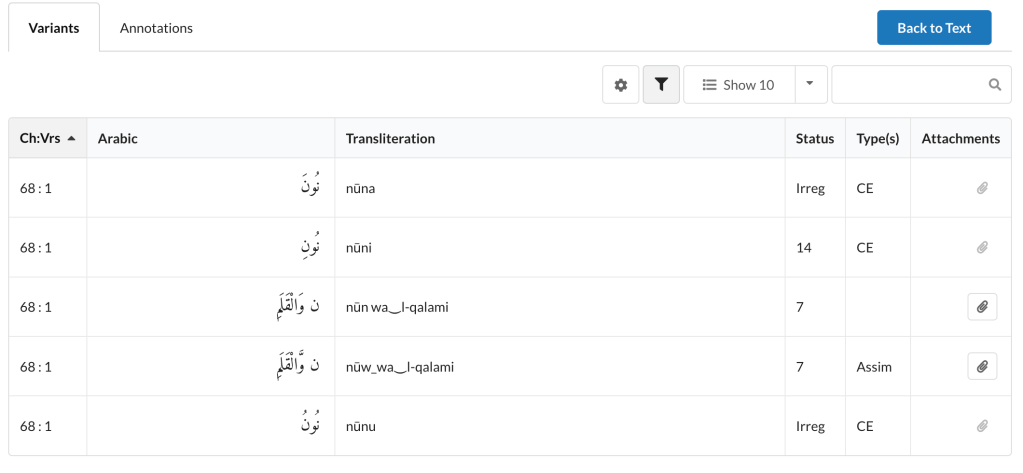
The database clearly documents multiple variant readings for verse 68:1, including the three-letter spelling of NuN (نُونِ). The following screenshot from erquran.org shows the documented variants:
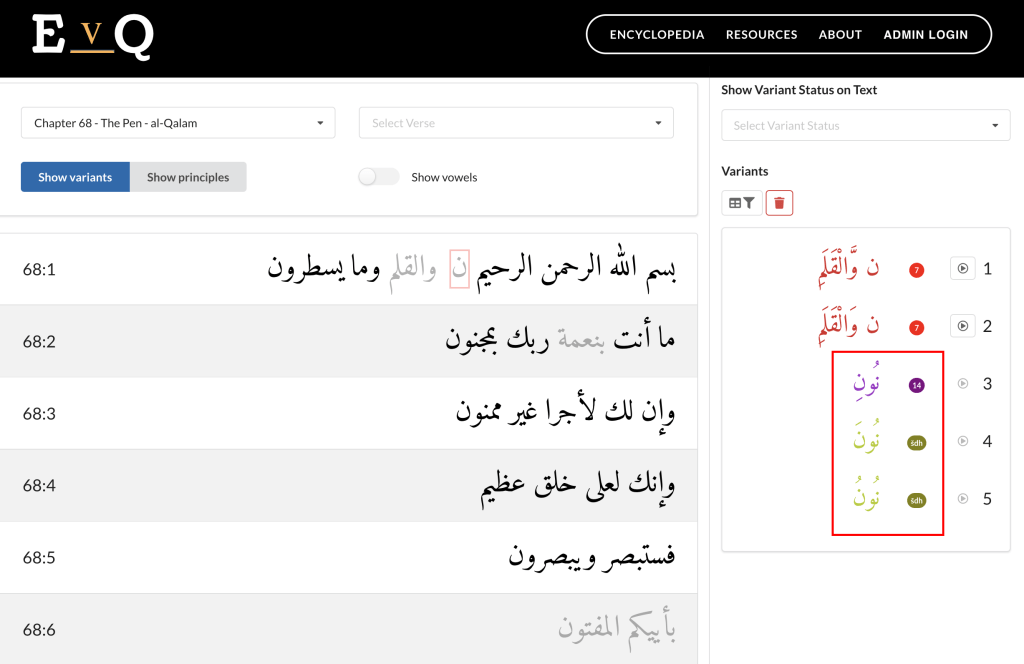
The detailed variant table below shows the specific readings documented in the database:
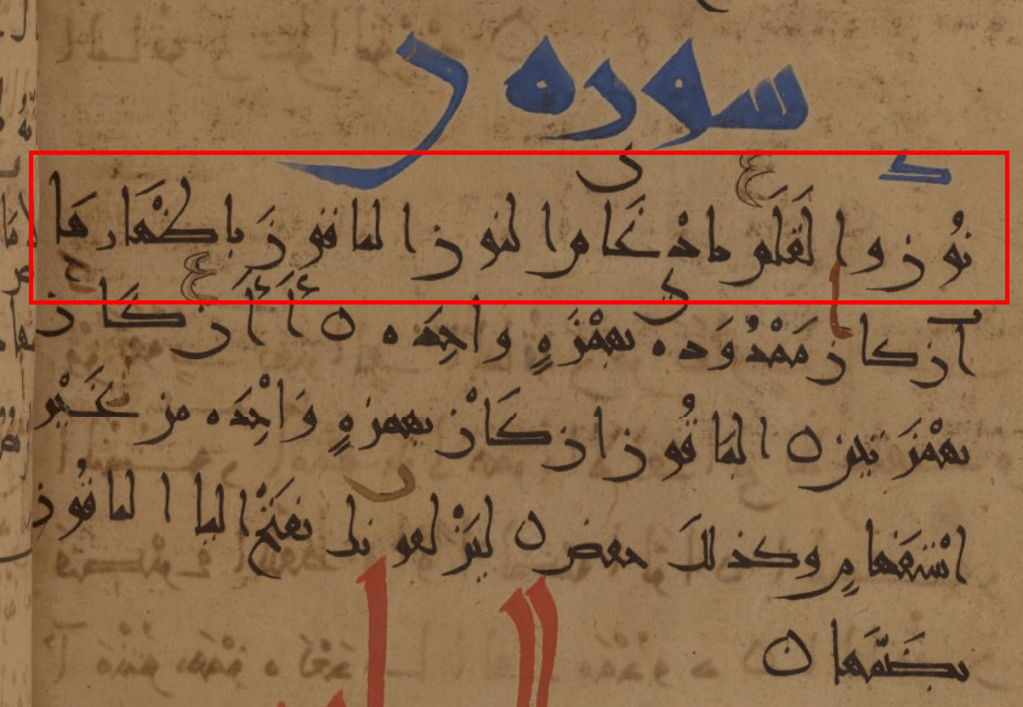
The Chester Beatty Manuscript: Ibn Khalawayh’s Kitab al-Badi’
Perhaps the most compelling historical evidence comes from Ibn Khalawayh (d. 980 CE), the 10th-century linguist and Quranic scholar. His masterwork “Kitab al-Badi’” (The Book of Wonders/Treatise on Variant Readings of the Qur’an) is preserved at the Chester Beatty Library in Dublin (manuscript Ar. 3051).
Written in elegant Eastern Kufic script, this 106-folio manuscript was possibly written during Ibn Khalawayh’s own lifetime – an additional note records that the manuscript was written in 370 AH (September-October 980 CE). The manuscript explicitly documents the three-letter spelling of NuN:
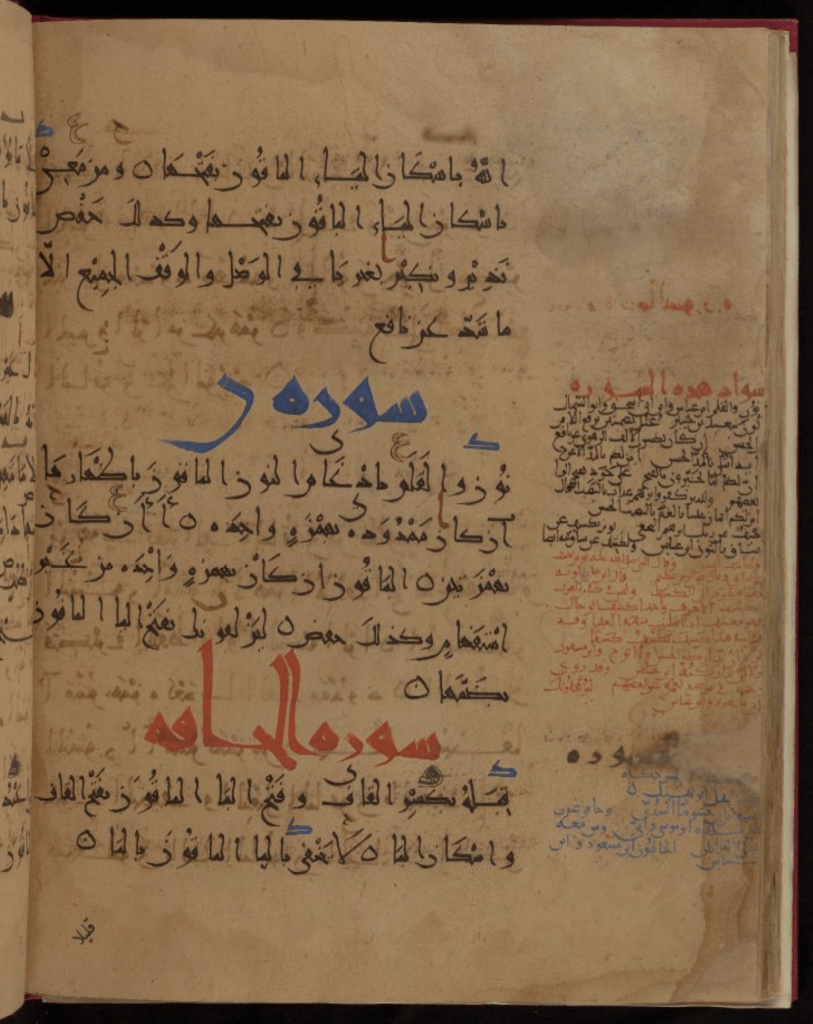
The key line from the manuscript states: “Nun (نون) and the pen, assimilation of the Nun with its clear pronunciation.” This historical documentation predates any awareness of the mathematical miracle by nearly a millennium, demonstrating that the three-letter spelling was recognized as authentic long before anyone thought to count letters for mathematical patterns.
The Transmitter Chain: Seven Historical Witnesses
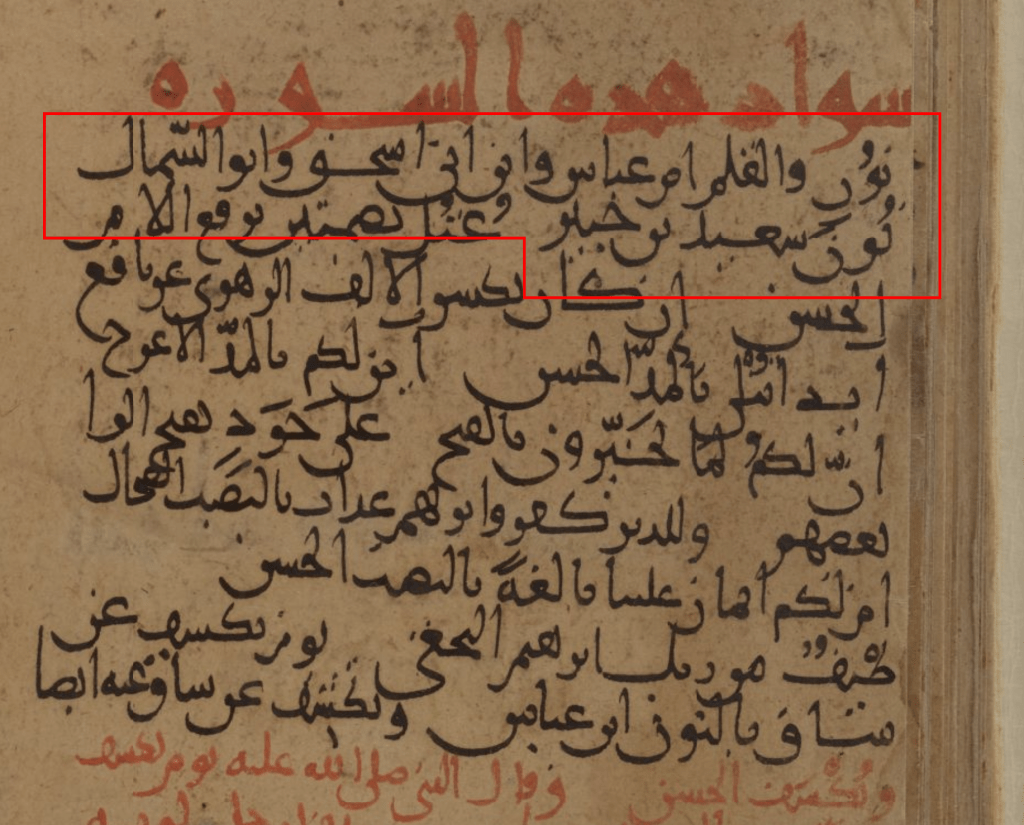
The margin commentary of Ibn Khalawayh’s manuscript identifies the transmitters who documented this spelling variant. These were not minor figures but respected scholars whose opinions shaped the understanding of Quranic recitation for generations:
| Transmitter | Status | Era | Significance |
|---|---|---|---|
| Ibn Abbas | Companion of the Prophet | d. 687 CE | Known as “The Interpreter of the Quran” |
| al-Hasan al-Basri | Successor (Tabi’i) | d. 728 CE | Leading scholar of Basra; one of four additional reciters whose readings were later recognized |
| Mujahid ibn Jabr | Successor (Tabi’i) | d. 722 CE | Student of Ibn Abbas |
| Qatada | Successor (Tabi’i) | d. 735 CE | Prolific commentator |
| Al-Dahhak | Successor (Tabi’i) | d. 723 CE | Known for Quranic exegesis |
| Ibn Zaid | Scholar | 8th century CE | Transmitted readings from predecessors |
| Ibn Khalawayh | Linguist/Scholar | d. 980 CE | Documented in Kitab al-Badi’ (Chester Beatty Ar. 3051) |
The presence of Ibn Abbas in this list is particularly significant. As a companion of the Prophet Muhammad and one of the most respected authorities on Quranic interpretation, his transmission of the three-letter spelling carries immense weight. His tafsir (commentary) on 68:1 is preserved in classical sources.
Part 2: The Mathematical Count – 133 = 19 x 7
Counting Every N in Chapter 68
When we systematically count every occurrence of the letter N (ن) throughout Chapter 68, including the three N’s in the initial “NuN” (نون), we arrive at exactly 133 instances. This number is precisely divisible by 19, yielding the quotient 7. The equation 133 = 19 x 7 represents a mathematical signature that could not have been engineered by human design in the 7th century.
Consider the implications: every verse in Chapter 68 would need to contain exactly the right number of N’s for this total to emerge. Adding or removing a single N would disrupt the pattern. The chapter contains 52 verses, ranging from brief statements to longer narratives, yet across all this varied content, the letter N appears exactly 133 times. This is the kind of precision that transcends human authorship.
The Probability Analysis
Some might argue that any count has a 1-in-19 chance of being divisible by 19, making this pattern unremarkable. This reasoning, while mathematically correct in isolation, profoundly misses the point. The NuN count does not exist in isolation – it is part of a systematic pattern that extends across all 29 initialed chapters of the Quran.
If we consider just the initialed chapters where letter counts have been verified, we find multiple independent instances of 19-divisibility. The probability of multiple independent events all conforming to the same pattern multiplies: (1/19) x (1/19) x (1/19) for each additional pattern. With even ten such patterns, the probability drops to approximately 1 in 6.1 trillion. The NuN count is one of dozens of such patterns, pushing the probability of coincidence beyond any reasonable threshold.
[41:53] “We will show them our proofs in the horizons, and within themselves, until they realize that this is the truth. Is your Lord not sufficient, as a witness of all things?”
The mathematical patterns are precisely these “proofs in the horizons” – evidence that transcends cultural boundaries and requires only the ability to count and calculate. A Japanese mathematician, a Nigerian statistician, and a Brazilian engineer can all verify these patterns without any special theological training. The proof speaks a universal language.
Part 3: The Boundaries of Revelation – A Structural Miracle
From First Initial to Last Initial
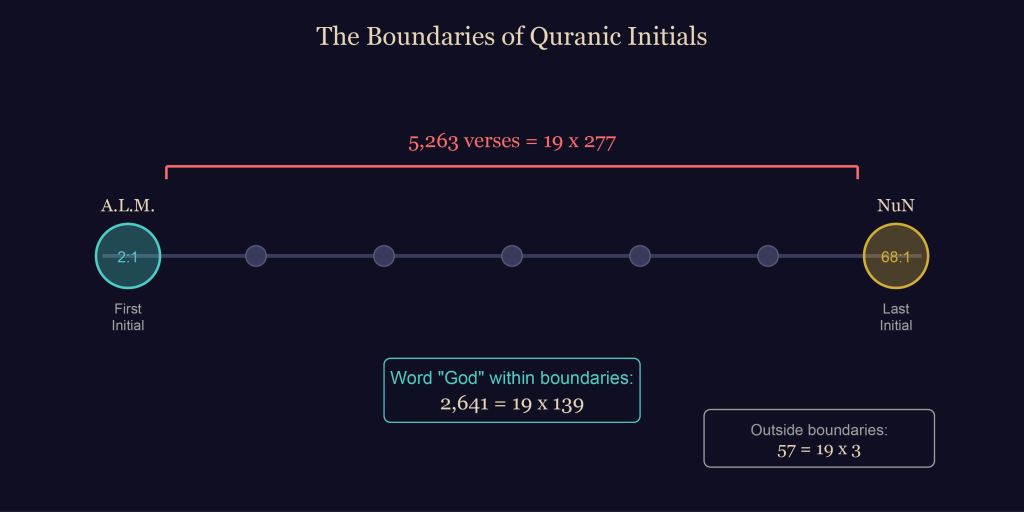
The NuN initial of Chapter 68 holds a special position in the Quran’s structure: it is the last Quranic initial in terms of the chapters’ sequential arrangement. The first initialed chapter is Chapter 2, which begins with A.L.M. (الم). Between the first verse containing an initial (2:1) and the last verse containing an initial (68:1), an extraordinary mathematical pattern emerges.
The total number of verses between these two boundary markers – from the first initial of A.L.M. in 2:1 to the last initial of N in 68:1 – is exactly 5,263 verses. This number equals 19 multiplied by 277. The boundaries of the initialed section of the Quran are mathematically defined by the very number that the Quran identifies as its authenticating signature.
The Word “God” Within These Boundaries
Perhaps even more remarkable is the count of the word “God” (Allah) within these boundaries. Between 2:1 and 68:1, the word “God” appears exactly 2,641 times – which equals 19 multiplied by 139. Meanwhile, the occurrences of “God” outside these initialed boundaries (in the non-initialed chapters) total exactly 57 – which equals 19 multiplied by 3.
This creates a complete mathematical framework: the total occurrences of “God” in the entire Quran divide into 19-based multiples both inside and outside the initialed sections. The boundaries marked by the initials – from A.L.M. to NuN – delineate a mathematically precise structure that encompasses the most important word in the entire scripture.
Part 4: The Complete Table of Initialed Chapters
A Systematic Pattern Across Twenty-Nine Chapters
The NuN count in Chapter 68 is not an isolated phenomenon. It belongs to a comprehensive system that spans all 29 initialed chapters of the Quran. According to the scholarly study of the Muqatta’at (disjointed letters), these initials are “78 in total, at the beginning of 29 surahs, occurring in 14 distinct combinations” using “fourteen out of 28 letters of the Arabic alphabet.” In each initialed chapter, the letters that appear in the chapter’s initial are counted throughout that chapter, and the totals consistently yield multiples of 19:
| Chapter | Initials | Arabic | Letter Count | Multiple of 19 |
|---|---|---|---|---|
| 2 | A.L.M. | الم | 9,899 | 19 x 521 |
| 3 | A.L.M. | الم | 5,662 | 19 x 298 |
| 7 | A.L.M.S. | المص | 5,320 | 19 x 280 |
| 19 | K.H.Y.’A.S. | كهيعص | 798 | 19 x 42 |
| 36 | Y.S. | يس | 285 | 19 x 15 |
| 40-46 | H.M. | حم | 2,147 | 19 x 113 |
| 50 | Q. | ق | 57 | 19 x 3 |
| 68 | N (NuN) | نون | 133 | 19 x 7 |
The highlighted row shows Chapter 68 with its NuN initial. Notice how this chapter, despite having a completely different initial from the others, still conforms to the same 19-based mathematical system. The consistency across diverse initials – from single letters like Q and N to five-letter combinations like K.H.Y.’A.S. – demonstrates systematic design rather than coincidental patterns.
Part 5: The Jonah Connection – Zan-Noon
The Prophet with an N in His Name
Chapter 68 contains a profound connection to the prophet Jonah that further illuminates the significance of the NuN initial. In the final section of Chapter 68, God instructs the messenger to be patient and not be like the companion of the fish – a direct reference to Jonah who fled from his mission and was swallowed by a great fish.
[68:48] “You shall steadfastly persevere in carrying out the commands of your Lord. Do not be like (Jonah) who called from inside the fish.”
[68:49] “If it were not for his Lord’s grace, he would have been ejected into the desert as a sinner.”
[68:50] “But his Lord blessed him, and made him righteous.”
This reference to Jonah in the chapter that begins with NuN is not accidental. Elsewhere in the Quran, Jonah is given a remarkable epithet that directly connects him to this chapter’s initial:
[21:87] “And Zan-Noon (Jonah, ‘the one with an N in his name’), abandoned his mission in protest, thinking that we could not control him. He ended up imploring from the darkness (of the big fish’s belly): ‘There is no God other than You. Be You glorified. I have committed a gross sin.’”
Zan-Noon: The Spelling Connection
In verse 21:87, Jonah is called “Zan-Noon” (ذَا ٱلنُّونِ) – literally “the one with an N” or “the one associated with the N.” The word for N in this verse is spelled نُّونِ (NuN) – the same three-letter spelling that appears at the beginning of Chapter 68. This creates a profound symbolic and linguistic connection: the prophet associated with the letter N is referenced in the chapter that uniquely begins with that letter.
The spelling of NuN as three letters (نون) in both the chapter initial and in Jonah’s epithet is not coincidental. It establishes a deliberate textual link between the two passages. The messenger is warned in Chapter 68 not to be like Jonah, and Jonah himself is identified by the very letter that initiates this chapter. The mathematical code and the thematic content interweave in ways that reveal intentional design.
Part 6: The Discovery and Its Verification
Rashad Khalifa and Code 19
The mathematical code was discovered by Dr. Rashad Khalifa (1935-1990), an Egyptian-American biochemist. According to historical records, in 1969, Khalifa began analyzing the separated letters of the Quran (Quranic initials). In 1973 he published the book Miracle of the Quran: Significance of the Mysterious Alphabets, describing the Quranic initials through enumerations and distributions. In 1974, he claimed to have discovered a mathematical code hidden in the Quran based around the number 19.
The discovery became widely discussed in Muslim countries in 1976, and his work was translated into many languages. The Quran code (also known as Code 19) refers to the claim that the Quranic text contains a mathematically complex pattern based on alleged multiple appearances of the number 19 in counts of words, letters, and chapters.
Scholarly Resources for Verification
The evidence presented in this article can be independently verified using the following scholarly resources:
| Resource | Type | Access |
|---|---|---|
| Encyclopedia of Variant Readings (erquran.org) | Digital Database | Open access; Harvard-backed |
| Chester Beatty Library Ar. 3051 | Digital Manuscript | Open access; Creative Commons |
| Nasser, S.H. “The Transmission of the Variant Readings of the Qurʾān” | Academic Book | Brill, 2012 |
| Tafsir Ibn Abbas on 68:1 | Classical Commentary | Open access |
| Multiple Tafsirs on 68:1 | Classical Commentaries | Open access |
Part 7: Addressing Objections
The “Arbitrary Spelling” Objection
Critics sometimes argue that spelling NuN as three letters rather than one is an arbitrary choice made to produce the desired mathematical result. This objection fails on multiple grounds. First, as documented above with images from the Chester Beatty manuscript and the erquran.org database, seven prominent transmitters from the earliest Islamic period recorded this spelling – long before anyone had any reason to count letters for mathematical patterns. The spelling is historical, not invented.
Second, the three-letter spelling is linguistically accurate. “NuN” is the name of the letter N in Arabic, just as “bee” is the name of the letter B in English. When you write “NuN,” you are spelling out the letter’s name, which requires three letters: Noon-Waw-Noon (ن-و-ن). This is not manipulation; it is linguistic precision.
Third, the connection to Jonah (Zan-Noon) in verse 21:87 provides independent confirmation. In that verse, the word for N is also spelled as نُّونِ (NuN) – three letters. The Quran itself demonstrates that NuN is spelled as three letters, not just in the initial of Chapter 68, but in the reference to Jonah as well.
The “Cherry-Picking” Objection
Another objection claims that proponents of the mathematical code “cherry-pick” which counting rules to apply. This objection conflates two separate issues: the existence of historical evidence and the completeness of documentation.
The counting rules used in Code 19 are not invented post-hoc; they reflect historical Arabic orthography, manuscript traditions, and phonological conventions. The identity of certain letters in early Arabic script, the gematrical values assigned by classical scholars, and the spelling of letter names are all documented independently of any mathematical counting. The rules existed before anyone applied them to Code 19.
[15:9] “Absolutely, we have revealed the reminder, and, absolutely, we will preserve it.”
The mathematical code serves as the mechanism of this preservation promise. Any alteration to the text – adding or removing a single letter – would disrupt the mathematical patterns and expose the change. The NuN count of 133 in Chapter 68 is one of many such protective patterns that guarantee the Quran’s textual integrity.
Part 8: The Timeline of Scholarly Documentation
The following visualization demonstrates the crucial point: the three-letter spelling of NuN was documented and transmitted for over 1,300 years before anyone had any reason to count letters for mathematical patterns:
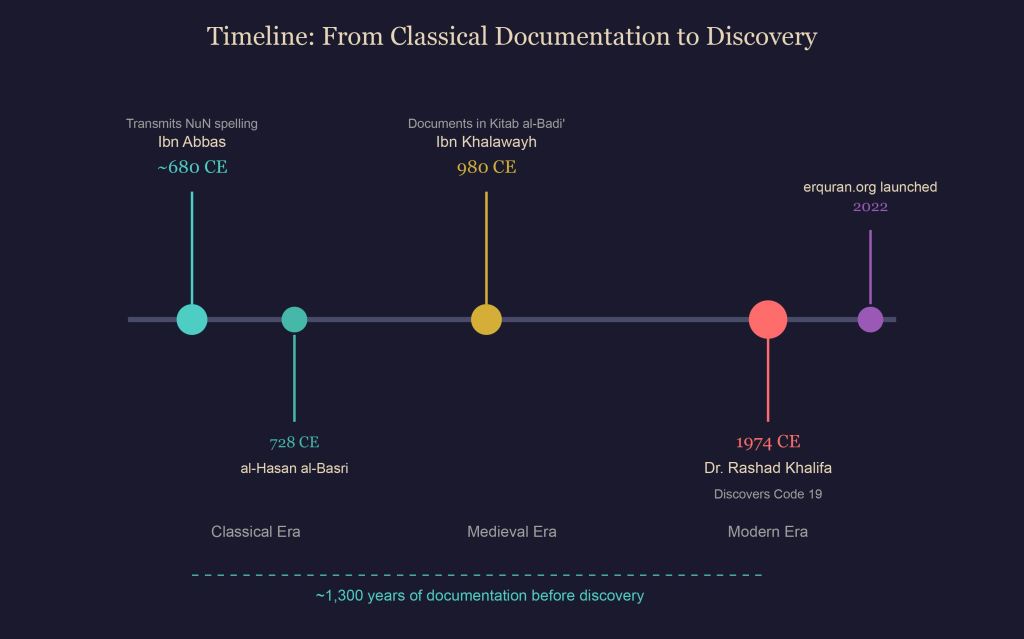
The scholarly chain stretching from Ibn Abbas through al-Hasan al-Basri to Ibn Khalawayh represents continuous, independent documentation of a reading that only acquired mathematical significance with the discovery of Code 19 in 1974. Modern digital scholarship through projects like erquran.org now makes this evidence accessible to anyone.
Conclusion: The Letter That Unlocks the Mystery
Evidence Beyond Coincidence
The NuN initial of Chapter 68 represents far more than an interesting numerical pattern. It stands as evidence of design – a mathematical signature embedded in ancient scripture that could only be discovered in an age of computation. The count of 133 N’s (19 x 7), the historical documentation of the three-letter spelling in the Chester Beatty manuscript, the connection to Jonah (Zan-Noon), and the structural position marking the final boundary of Quranic initials all converge to demonstrate intentional, intelligent authorship.
The probability of these patterns emerging by chance is astronomically small. When combined with the dozens of other 19-based patterns throughout the Quran – in initialed chapters, structural features, word counts, and thematic arrangements – the cumulative evidence becomes overwhelming. This is not coincidence. This is not human engineering (which was impossible in the 7th century). This is the fingerprint of the Creator on His final testament to humanity.
A Call to Verification
Unlike arguments that require faith alone, the mathematical miracle invites verification. Anyone with access to the Arabic text of Chapter 68 can count the letter N. Anyone with basic arithmetic can confirm that 133 divided by 19 equals 7 with no remainder. Anyone with access to historical scholarship can verify the documented spelling of NuN as three letters by transmitters including Ibn Abbas through the resources linked in this article.
The evidence stands open to examination. Those who approach with sincere hearts seeking truth will find it. Those who approach determined to reject will find ways to dismiss any evidence, as verse 74:31 prophetically warned. The mathematical code serves its five-fold function: disturbing the disbelievers, convincing the people of previous scriptures, strengthening the faithful, removing doubt from believers’ hearts, and exposing those who harbor doubt.
[68:52] “It is in fact a message to the world.”
The NuN mystery is solved. The letter count is verified. The historical documentation is established. What remains is the reader’s response.
References and Sources
- Chester Beatty Library. “Treatise on Variant Readings of the Qur’an (Kitab al-Badi’) by Ibn Khalawayh (d. 980).” Manuscript Ar. 3051. https://viewer.cbl.ie/viewer/image/Ar_3051/13/LOG_0000/
- Nasser, Shady Hekmat. “Encyclopedia of the (Variant) Readings of the Qur’an (EvQ/ErQ).” Harvard University, 2022. https://erquran.org/
- Nasser, Shady Hekmat. The Transmission of the Variant Readings of the Qurʾān: The Problem of Tawātur and the Emergence of Shawādhdh. Brill, 2012. https://brill.com/display/title/22618
- Harvard University. “Encyclopedia of the (Variant) Readings of the Qur’an (EvQ/ErQ).” Alwaleed Islamic Studies Program. https://islamicstudies.harvard.edu/
- QuranX. “Tanwîr al-Miqbâs min Tafsîr Ibn ‘Abbâs commentary for verse 68.1.” https://quranx.com/Tafsir/Abbas/68.1
- Wikipedia. “Muqattaʿat.” https://en.wikipedia.org/wiki/Muqatta%CA%BFat
- Wikipedia. “Qira’at.” https://en.wikipedia.org/wiki/Qira’at
- Wikipedia. “Quran code.” https://en.wikipedia.org/wiki/Quran_code
All Quranic verses quoted from The Final Testament (Authorized English Version) translated by Rashad Khalifa, Ph.D.

 Quran Only Studies
Leave a comment