
Introduction: The Apologetics Trap
Trinitarian apologists like GodLogicApologetics have built impressive-sounding arguments designed to trap those who submit to God alone. They present what they call “dilemmas” and claim logical contradictions in monotheistic positions. However, when we examine their arguments carefully, a remarkable pattern emerges: their strongest attacks target human traditions and secondary literature, not scripture itself. More devastating still, their own Bible – when examined honestly – undermines the very doctrines they claim it teaches.
This article takes a different approach than most responses to Trinitarian apologetics. Rather than simply asserting Quranic positions, we will demonstrate that the Bible’s own internal inconsistencies, manuscript chaos, and the words attributed to Jesus himself refute the Trinity doctrine more powerfully than any external critique could. The Quran serves as the final criterion, confirming what was true in previous revelations and exposing what humans added to corrupt them.
As Submitters who follow the Quran alone, we have a significant advantage in this discussion. We are not burdened by defending centuries of fabricated narrations, questionable chains of transmission, or the contradictions found in secondary literature. Our position is simple: God is One, His final scripture is preserved, and it supersedes all previous revelations as the ultimate reference point for truth.
Part 1: The “Islamic Dilemma” – A False Choice Exposed
The Argument Deconstructed
GodLogicApologetics presents what he considers his most powerful argument: the “Islamic Dilemma.” The argument goes like this: The Quran confirms the Torah and Gospel that existed in Muhammad’s time. Therefore, either these scriptures were preserved (making submission false for contradicting them) or corrupted (making the Quran false for confirming corrupted books). This appears to be an airtight logical trap.
However, this argument commits a fundamental error: it presents only two options when a third, more nuanced position exists and is actually what the Quran teaches. The Quran confirms the original divine revelations given to Moses and Jesus while simultaneously acknowledging that humans have corrupted the manuscripts over time. This is not a contradiction – it is precisely what we would expect if God sent true revelations that fallible humans then altered.
The Quran’s Actual Position
The Quran is remarkably consistent on this matter. It confirms that original revelations were sent while explicitly warning that humans corrupted them:
[3:3] “He sent down to you this scripture, truthfully, confirming all previous scriptures, and He sent down the Torah and the Gospel.”
Notice the careful language: God “sent down” the Torah and Gospel – past tense, referring to the original revelations. The Quran confirms these original messages, not every manuscript copy that exists today.
[2:79] “Therefore, woe to those who distort the scripture with their own hands, then say, ‘This is what God has revealed,’ seeking a cheap material gain. Woe to them for such distortion, and woe to them for their illicit gains.”
Here the Quran explicitly states that people have distorted scripture with their own hands and then falsely attributed these distortions to God. This verse alone destroys the “dilemma” – the Quran never claimed that all existing manuscripts were perfectly preserved.
[3:78] “Among them are those who twist their tongues to imitate the scripture, that you may think it is from the scripture, when it is not from the scripture, and they claim that it is from God, when it is not from God. Thus, they utter lies and attribute them to God, knowingly.”
The Quran Supersedes Previous Scripture
[5:48] “Then we revealed to you this scripture, truthfully, confirming previous scriptures, and superseding them. You shall rule among them in accordance with God’s revelations, and do not follow their wishes if they differ from the truth that came to you.”
The Arabic word “muhayminan” translated as “superseding” also carries meanings of “guardian,” “protector,” and “authority over.” The Quran is the final arbiter – where previous scriptures contradict the Quran, we follow the Quran because it supersedes them.

Part 2: The Trinity – Never Taught by Jesus
What Jesus Actually Said
Perhaps the most damaging evidence against Trinitarianism comes from the Gospels themselves. If Jesus was God incarnate, the second person of a Trinity, we would expect him to clearly teach this fundamental doctrine. Instead, we find Jesus consistently pointing to the Father as the one true God, distinct from and greater than himself.
Consider these statements attributed to Jesus in the Gospels:
- “My Father is greater than I” (John 14:28) – If Jesus and the Father are co-equal persons of one God, how can the Father be “greater”?
- “The Father is greater than all” (John 10:29) – Not “the Trinity is greater than all” but specifically the Father.
- “This is eternal life, that they know you, the only true God” (John 17:3) – Jesus addresses the Father as “the only true God” – language that excludes himself from that category.
- “My God, my God, why have you forsaken me?” (Mark 15:34) – God calling to God? God forsaking God? This makes sense only if Jesus was a human servant of God.
- “I can do nothing on my own” (John 5:30) – A strange statement for an omnipotent deity.
The Quran captures what Jesus actually taught:
[5:72] “Pagans indeed are those who say that God is the Messiah, son of Mary. The Messiah himself said, ‘O Children of Israel, you shall worship God; my Lord and your Lord.’ Anyone who sets up any idol beside God, God has forbidden Paradise for him, and his destiny is Hell. The wicked have no helpers.”
Notice that the Quran quotes Jesus calling God “my Lord and your Lord” – the same Lord for Jesus and for his followers. Jesus did not claim equality with God; he pointed his followers to worship the same God he worshipped.
The Word “Trinity” Never Appears
It is a remarkable fact that the word “Trinity” appears nowhere in the Bible. This central doctrine of Christianity – supposedly the most important truth about God’s nature – is never explicitly stated in their own scripture. The doctrine was developed over centuries through church councils, philosophical debates, and political compromises.
The Council of Nicaea (325 CE) formulated the first creed attempting to define the relationship between Father and Son. The Council of Constantinople (381 CE) further developed the doctrine to include the Holy Spirit. These were human conventions held centuries after Jesus, influenced by Greek philosophy and political pressures.
[5:73] “Pagans indeed are those who say that God is a third in a trinity. There is no God except the one God. Unless they refrain from saying this, those who disbelieve among them will incur a painful retribution.”

Part 3: The Divinity Claim – Examining the Evidence
Jesus Ate Food
The Quran makes a devastatingly simple argument against Jesus’s divinity:
[5:75] “The Messiah, son of Mary, is no more than a messenger like the messengers before him, and his mother was a saint. Both of them used to eat the food. Note how we explain the revelations for them, and note how they still deviate!”
“Both of them used to eat the food.” This seemingly simple statement carries profound theological weight. God does not eat. God does not depend on food for sustenance. God is not subject to hunger, digestion, or the biological processes that eating entails. A being who eats is by definition dependent on external sustenance – a quality fundamentally incompatible with divinity.
The Gospels record Jesus eating on multiple occasions. He ate with tax collectors and sinners (Matthew 9:10). He ate the Passover meal with his disciples (Matthew 26:26). Can the Almighty Creator of the universe be hungry? Can He require bread to sustain His existence?
Jesus Prayed to God
Throughout the Gospels, Jesus is depicted praying to God. In the Garden of Gethsemane, he fell on his face and prayed (Matthew 26:39). He taught his disciples to pray to “Our Father in heaven” (Matthew 6:9). If Jesus was God, to whom was he praying? Himself?
Prayer is an act of worship, submission, and petition from a lesser being to a greater being. Jesus praying demonstrates his position as a servant of God, not as God himself.
[5:116] “God will say, ‘O Jesus, son of Mary, did you say to the people, “Make me and my mother idols beside God”?’ He will say, ‘Be You glorified. I could not utter what was not right. Had I said it, You already would have known it. You know my thoughts, and I do not know Your thoughts. You know all the secrets.’”
Jesus will deny ever teaching people to worship him. He will acknowledge God’s omniscience (“You know my thoughts”) while admitting his own limited knowledge (“I do not know Your thoughts”). This asymmetry of knowledge proves they are not co-equal members of a Trinity.

Part 4: Biblical Manuscript Chaos
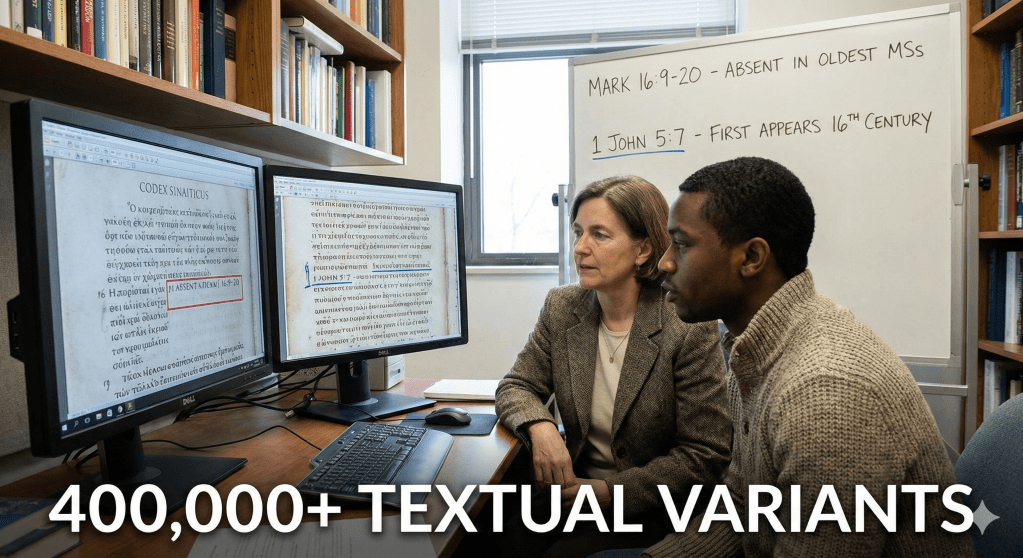
Over 400,000 Textual Variants
Trinitarian apologists often attack the Quran’s preservation while ignoring the catastrophic manuscript problems in their own scripture. The New Testament has over 400,000 textual variants among existing manuscripts. To put this in perspective, there are more variants than there are words in the entire New Testament.
Not all variants are equally significant, but many are. Entire passages that Christians have cherished for centuries do not appear in the earliest and best manuscripts.
Mark 16:9-20: The Resurrection Ending Added Later
The Gospel of Mark originally ended at verse 8 with the women fleeing the empty tomb in fear. The verses describing Jesus’s resurrection appearances (Mark 16:9-20) are not found in the oldest and most reliable manuscripts, including Codex Sinaiticus and Codex Vaticanus. Even Christian scholars acknowledge this section was added later.
This is not a minor scribal error. The resurrection is supposedly the central event of Christianity, and the ending describing its appearances was added to the oldest Gospel.
1 John 5:7: The Only Explicit Trinity Verse – A Forgery
The Johannine Comma is the only verse in the Bible that explicitly states Trinitarian theology: “For there are three that bear record in heaven, the Father, the Word, and the Holy Ghost: and these three are one.” It appears in the King James Version and influenced centuries of Trinitarian thinking.
There is one significant problem: this verse is a proven forgery. It does not appear in any Greek manuscript before the 16th century. It was inserted into the Latin Vulgate and then back-translated into Greek. Modern Bible translations either remove it entirely or include footnotes acknowledging it is not authentic.
The one verse that clearly teaches the Trinity is a forgery. This fact alone should give every honest truth-seeker pause.
[15:9] “Absolutely, we have revealed the reminder, and, absolutely, we will preserve it.”
God promises to preserve His final scripture – the Quran. No such promise was made for previous scriptures, and the manuscript evidence confirms they have not been preserved with the same integrity.
Part 5: Paul vs. Jesus – The Theological Hijacking
The Contradiction
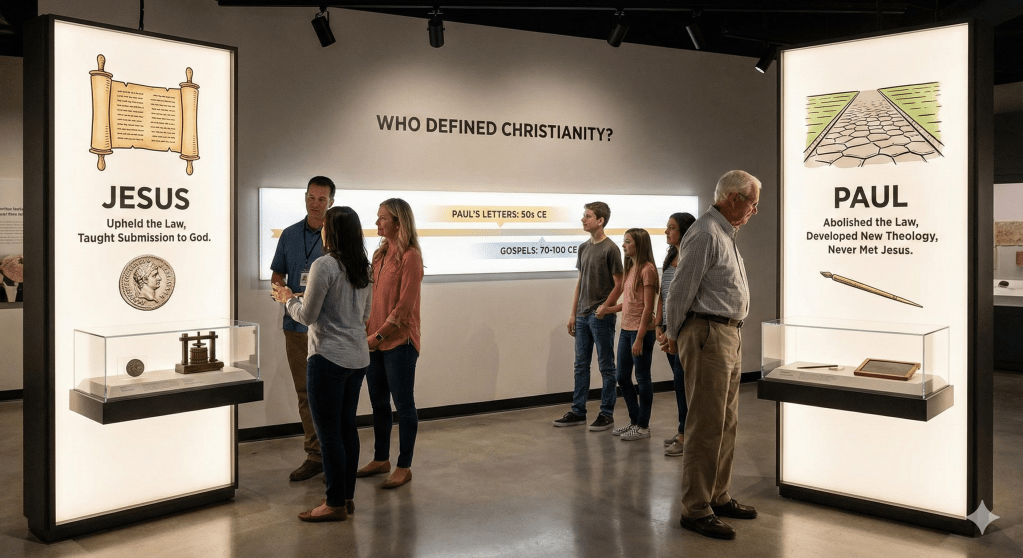
A careful examination of the New Testament reveals a fundamental tension between what Jesus taught and what Paul promoted. Jesus was a Jewish prophet who upheld the Law. Paul was a self-proclaimed apostle who never met Jesus (except in visions) and systematically dismantled the Law’s requirements.
Consider the contrast:
Jesus on the Law (Matthew 5:17-19): “Do not think that I have come to abolish the Law or the Prophets; I have not come to abolish them but to fulfill them… Anyone who sets aside one of the least of these commands and teaches others accordingly will be called least in the kingdom of heaven.”
Paul on the Law (Galatians 2:16): “Know that a person is not justified by the works of the law, but by faith in Jesus Christ… because by the works of the law no one will be justified.”
Jesus says do not set aside the commands. Paul systematically sets aside the commands. These positions are irreconcilable.
Paul’s Letters Predate the Gospels
A fact that many Christians do not realize: Paul’s letters were written before the Gospels. Paul wrote in the 50s CE, while the Gospels were composed between 70-100 CE. This means the earliest Christian writings we possess come from someone who never walked with Jesus, never heard his direct teachings, and based his entire theology on visions.
[5:14] “Also from those who said, ‘We are Christian,’ we took their covenant. But they disregarded some of the commandments given to them. Consequently, we condemned them to animosity and hatred among themselves, until the Day of Resurrection. God will then inform them of everything they had done.”
Notice the description: they “disregarded some of the commandments given to them” and this resulted in “animosity and hatred among themselves.” Does this not precisely describe Christian history – the endless schisms, the violent theological disputes?
Part 6: The Submitter Advantage in Debate
We Only Defend the Quran
A significant portion of GodLogicApologetics’ content attacks narrations attributed to the Prophet Muhammad that were compiled 200+ years after his death. He attacks stories about violent revelations, questions about the Prophet’s character, and contradictions within these collections.
For Submitters, these attacks are completely irrelevant. We reject these fabricated narrations entirely. We do not believe they are authoritative or necessarily accurate. We follow the Quran alone, as God commands:
[6:114] “Shall I seek other than God as a source of law, when He has revealed to you this book fully detailed? Those who received the scripture recognize that it has been revealed from your Lord, truthfully. You shall not harbor any doubt.”
When a Trinitarian apologist says, “But the narrations say…” our response is simple: “We reject fabricated narrations. Address the Quran directly.”
This forces the debate onto Quranic territory, where the arguments for pure monotheism are explicit, clear, and repeated dozens of times. There is no ambiguity about God’s oneness in the Quran.
[4:171] “O people of the scripture, do not transgress the limits of your religion, and do not say about God except the truth. The Messiah, Jesus, the son of Mary, was a messenger of God, and His word that He had sent to Mary, and a revelation from Him. Therefore, you shall believe in God and His messengers. You shall not say, ‘Trinity.’ You shall refrain from this for your own good. God is only one God. Be He glorified; He is much too glorious to have a son.”
Part 7: The Cosmic Blasphemy
What the Trinity Claim Really Means
The Quran does not merely disagree with the Trinity – it describes claiming that God has a son as a cosmic blasphemy of unimaginable proportions:
[19:88-92] “They said, ‘The Most Gracious has begotten a son!’ You have uttered a gross blasphemy. The heavens are about to shatter, the earth is about to tear asunder, and the mountains are about to crumble. Because they claim that the Most Gracious has begotten a son. It is not befitting the Most Gracious that He should beget a son.”
The imagery is apocalyptic – heavens shattering, earth tearing, mountains crumbling. Why such extreme language? Because the claim strikes at the very foundation of reality: God’s absolute uniqueness and transcendence.
To say God “begot” a son implies that God underwent a process, that He was incomplete without offspring, that He shares His divine nature with another being. These implications contradict everything we know about the infinite, self-sufficient Creator.
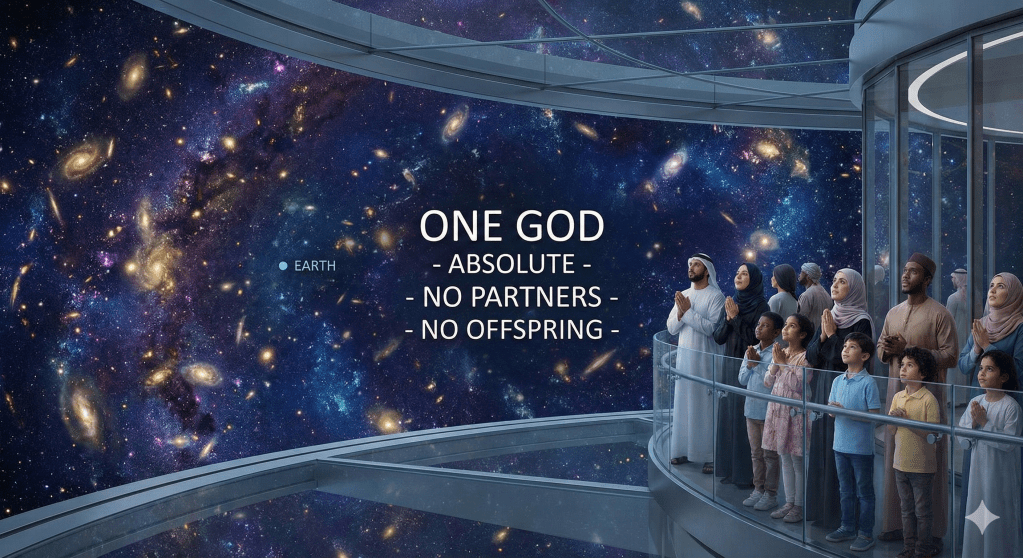
[112:1-4] “Proclaim, ‘He is the One and only God. The Absolute God. Never did He beget. Nor was He begotten. None equals Him.’”
Chapter 112 is called “Absoluteness.” In four short verses, it demolishes the Trinity completely. God is ONE (not three). He is ABSOLUTE (not dependent). He never BEGOT (no Son). He was never BEGOTTEN (no Father to Him). NONE EQUALS Him (no co-equal persons).
Part 8: The Crucifixion Question
What Really Happened
The crucifixion and resurrection form the theological core of Christianity. According to Trinitarian theology, God the Son had to die to pay for humanity’s sins, then rise again to prove his divinity. Without this, their entire system collapses.
The Quran directly contradicts this narrative:
[4:157] “And for claiming that they killed the Messiah, Jesus, son of Mary, the messenger of God. In fact, they never killed him, they never crucified him – they were made to think that they did. All factions who are disputing in this matter are full of doubt concerning this issue. They possess no knowledge; they only conjecture. For certain, they never killed him.”
This verse is clear and emphatic: Jesus was not killed, was not crucified, and those who claim otherwise are conjecturing without knowledge.
[3:55] “Thus, God said, ‘O Jesus, I am terminating your life, raising you to Me, and ridding you of the disbelievers. I will exalt those who follow you above those who disbelieve, till the Day of Resurrection.’”
Problems with the Crucifixion Narrative
Even examining the Gospels alone, the crucifixion narrative has serious problems. The accounts contradict each other on Jesus’s last words, who discovered the empty tomb, and what happened after. Divine revelation does not contradict itself.
The theology also makes no sense – if Jesus is God, God cannot die. If Jesus died, he was not God. Trinitarians try to escape by saying only the human nature died, but this means it was not really God who paid for sins.
[5:17] “Pagans indeed are those who say that God is the Messiah, the son of Mary. Say, ‘Who could oppose God if He willed to annihilate the Messiah, son of Mary, and his mother, and everyone on earth?’ To God belongs the sovereignty of the heavens and the earth, and everything between them. He creates whatever He wills. God is Omnipotent.”
God is omnipotent. He does not need to sacrifice anyone to accomplish anything.
Part 9: The Clear Quranic Position
Pure Monotheism Without Ambiguity
Unlike the Bible, which Trinitarians must interpret and council-debate to extract their doctrine, the Quran’s monotheism is explicit, repeated, and unambiguous:
[4:171] “You shall not say, ‘Trinity.’ You shall refrain from this for your own good. God is only one God. Be He glorified; He is much too glorious to have a son.”
[5:73] “Pagans indeed are those who say that God is a third in a trinity. There is no God except the one God.”
These verses require no interpretation, no councils, no philosophical frameworks. They say what they mean and mean what they say. God is ONE. Do not say Trinity. God has no son. None equals Him.
Jesus in His Proper Place
The Quran honors Jesus appropriately – as a great messenger, born of a virgin, who performed miracles by God’s permission. What it does not do is elevate him to divinity, which would be an insult to the one true God.
[5:75] “The Messiah, son of Mary, is no more than a messenger like the messengers before him, and his mother was a saint.”
“No more than a messenger” – honored, respected, but not worshipped. This is the proper understanding that Jesus himself taught.
Conclusion: The Choice Before You
The evidence presented in this article comes primarily from the Bible itself and historical scholarship. The Quran serves as the criterion that confirms original truth and exposes later corruption.
On one side stands a doctrine (the Trinity) that: appears nowhere in the Bible by name, developed through centuries of councils, is contradicted by Jesus’s own words, requires philosophical gymnastics to explain, was supported by forged verses (1 John 5:7), and is called “gross blasphemy” by God’s final revelation.
On the other side stands pure monotheism: explicitly taught throughout scripture, consistent from Abraham to Muhammad, matching Jesus’s own recorded teachings, logically coherent, mathematically preserved in the Quran, and offering a direct relationship with the One True God without intermediaries.
[4:82] “Why do they not study the Quran carefully? If it were from other than God, they would have found in it numerous contradictions.”
We extend the same invitation to examine the Bible. Study it carefully. Note its contradictions. Trace its manuscript history. Examine when and how the Trinity developed. Let the evidence guide you to truth.
The path of submission to God alone remains open. It is the same path walked by Abraham, Moses, Jesus, and Muhammad. It requires no philosophical gymnastics, no councils to define what God meant, no defending of forgeries. It is simple, clear, and liberating: There is no god except the One God, and we submit to Him alone.

Quick Reference: Key Points for Debate
| Trinitarian Claim | Response | Evidence |
|---|---|---|
| “The Islamic Dilemma proves contradiction” | False dilemma – Quran confirms originals while acknowledging corruption | [3:3], [2:79], [5:48] |
| “Jesus is God” | Jesus said “my Lord and your Lord” – same God for both | [5:72], John 14:28, John 17:3 |
| “The Trinity is Biblical” | Word never appears; doctrine developed in 4th century councils | Historical evidence |
| “1 John 5:7 teaches Trinity” | Proven forgery not in early manuscripts | Textual scholarship |
| “The Bible is preserved” | 400,000+ variants; forged endings and passages | Mark 16:9-20, 1 John 5:7 |
| “What is the Gospel?” | Revelation GIVEN TO Jesus, not written ABOUT him | [5:46] |
| “Jesus was crucified” | They conjecture without knowledge; he was not killed | [4:157], [3:55] |
| “Muhammad’s revelation was demonic” | Based on fabricated narrations; Submitters reject these | Quran alone |
This article was written from the Submitter (Quran-alone) perspective. All Quranic translations are from The Final Testament by Dr. Rashad Khalifa.

 Quran Only Studies
Leave a comment