Introduction: The Problem Nobody Wants to Talk About
Every person who has ever engaged in a religious debate has encountered it — the invisible wall of circular reasoning. “How do you know your scripture is true?” you ask. “Because God said so,” they reply. “How do you know God said so?” you press. “Because the scripture says so.” Around and around the argument goes, a logical merry-go-round that never arrives at a destination. This form of fallacy, known formally as petitio principii or “begging the question,” lies at the heart of nearly every religious dispute in human history. The premise assumes the conclusion, and the conclusion rests on the premise. No external evidence is ever introduced. No independent verification is ever sought. The argument feeds on itself like a snake eating its own tail.
But what if there were a way to break this circularity? What if one scripture — and one scripture alone — offered something beyond self-referential claims? What if there existed a form of evidence so mathematically precise, so statistically impossible to fabricate, that it could serve as the external validator every honest seeker has been looking for? This article examines the circular reasoning that plagues interfaith dialogue, exposes the textual corruptions that undermine scriptural claims, invokes a proven mathematical theorem to explain why self-referencing systems always fail, and ultimately presents the Quran’s Code 19 as the singular phenomenon that shatters the circular deadlock.
Part 1: What Is Circular Reasoning?
The Logical Fallacy Defined
Circular reasoning, also called circular logic or circulus in probando, is a logical fallacy in which the conclusion of an argument is assumed in one of its premises. In simpler terms, you use what you are trying to prove as the basis of your proof. Imagine someone claims, “I am the most trustworthy person you will ever meet.” When you ask for evidence, they respond, “You can trust me on that because I am completely trustworthy.” The claim has not been substantiated; it has merely been restated. This is the logical equivalent of a hamster running on a wheel — vigorous activity, zero progress.
The reason circular reasoning is so dangerous in religious discourse is that it masquerades as evidence. When a person says, “The Bible is the word of God because the Bible says it is the word of God,” the statement sounds authoritative. It carries the weight of conviction. But conviction is not proof. Sincerity is not evidence. A person can be sincerely wrong, and an entire tradition can be built on a foundation that has never been independently verified. The philosophical community has recognized this fallacy for over two millennia — Aristotle identified it in his Prior Analytics — yet it remains the primary mechanism by which billions of people defend their religious beliefs today.
Why External Evidence Is Non-Negotiable
To break out of circular reasoning, you need something external to the system. If someone claims to be a billionaire, you do not take their word for it — you check their bank account. The bank statement is the external verification. It exists outside the person’s claims and independently confirms or denies them. In the realm of scripture, this means that a book claiming divine origin must offer proof that exists beyond the book’s own testimony about itself. Self-attestation, no matter how eloquent, cannot constitute proof. The question that matters is not “What does this book say about itself?” but rather “What evidence, independent of the book’s own claims, proves this book is from God?”
This principle is not anti-religious — it is pro-truth. God, if He is the author of a genuine scripture, would know that His creatures are rational beings capable of demanding evidence. A God who demands blind faith without providing verifiable proof would be setting up His creation for failure. As we will see, the Quran not only acknowledges this need for external proof but provides it in a form that no human being could have fabricated in the 7th century — or any century.
[4:82] “Why do they not study the Quran carefully? If it were from other than God, they would have found in it numerous contradictions.”
This verse is remarkable because it does not simply assert divine authorship — it issues a challenge. It invites scrutiny. It tells the reader to examine the text and look for flaws. This is the opposite of circular reasoning. Rather than saying “Believe because I say so,” it says “Examine, test, investigate — and you will find consistency.” The confidence embedded in this challenge is extraordinary, and as we shall see, it is backed by mathematical evidence that has withstood decades of scrutiny.
Part 2: The Christian Circular Argument
The Chain of Claims
One of the most common interfaith arguments directed at Muslims goes something like this: “The Quran says it confirms the Bible. Therefore, you should read the Bible. The Bible says Jesus is God. Therefore, you must believe Jesus is God.” On the surface, this argument appears logically sequential — one statement follows another. But upon examination, the chain collapses under its own weight. The argument uses the Quran’s authority selectively: it accepts the Quran’s claim of confirmation as valid while simultaneously rejecting the Quran’s explicit corrections and clarifications of the Bible. In other words, it cherry-picks the Quran when convenient and discards it when inconvenient. This is not logic — it is intellectual dishonesty.
Furthermore, the argument smuggles in an enormous assumption: that “confirming” means “agreeing with every word of the current text.” But confirmation and blind endorsement are not the same thing. A teacher who confirms a student’s understanding of mathematics is not thereby endorsing every answer the student has ever written on every test. Confirmation can coexist with correction. The Quran makes this explicit — it confirms the original revelations given to Moses and Jesus while simultaneously pointing out where human hands have altered those texts. The verse that Christians cite most often actually contains the very language that undermines their argument:
[5:48] “Then we revealed to you this scripture, truthfully, confirming previous scriptures, and superseding them. You shall rule among them in accordance with God’s revelations, and do not follow their wishes if they differ from the truth that came to you. For each of you, we have decreed laws and different rites. Had God willed, He could have made you one congregation. But He thus puts you to the test through the revelations He has given each of you. You shall compete in righteousness. To God is your final destiny — all of you — then He will inform you of everything you had disputed.”
Note the critical phrase: “and superseding them.” The Quran does not merely confirm — it supersedes. It serves as the final arbiter, the authoritative edition. When there is a discrepancy between what the current Bible says and what the Quran says, the Quran takes precedence precisely because it is the uncorrupted, mathematically authenticated final testament. To accept the Quran’s confirmation while rejecting its supersession is to use only half a verse — and half-truths are whole lies.
Which Christianity?
Even if we were to accept the Christian argument on its own terms, an immediate problem arises: which Christianity should we believe? The Bible has been interpreted in radically different ways by different Christian denominations, and these interpretations are not minor variations — they concern the most fundamental questions of theology. Trinitarians believe God exists as three co-equal persons: Father, Son, and Holy Spirit. Unitarians deny the Trinity entirely and view Jesus as a human prophet. Jehovah’s Witnesses believe Jesus is the archangel Michael. The Church of Jesus Christ of Latter-day Saints believes God has a physical body and that humans can become gods. Catholics affirm the real presence of Christ in the Eucharist; most Protestants do not. Each of these groups reads the same Bible and arrives at irreconcilable conclusions.
If the Bible’s message were truly clear, there would not be over 45,000 Christian denominations worldwide (Center for the Study of Global Christianity, Gordon-Conwell Theological Seminary, Status of Global Christianity Report). The sheer number of conflicting interpretations is itself evidence that the text has been altered, that clarity has been lost, and that human hands have introduced confusion where divine guidance once existed. The Quran addresses this reality directly:
[5:68] “Say, ‘O people of the scripture, you have no basis until you uphold the Torah, and the Gospel, and what is sent down to you herein from your Lord.’ For sure, these revelations from your Lord will cause many of them to plunge deeper into transgression and disbelief. Therefore, do not feel sorry for the disbelieving people.”
The command is clear: the original Torah, the original Gospel, and the Quran must be upheld together. The problem is that the “original” Torah and Gospel no longer exist in their pristine form — a fact that even mainstream Christian and Jewish scholarship acknowledges. What remains are manuscripts with hundreds of thousands of textual variations, interpolations, and editorial additions that accumulated over centuries of hand-copying and theological editing.
Part 3: What the Quran Actually Says About Jesus
A Prophet Honored, Not Deified
The Quran’s position on Jesus is unambiguous, consistent, and repeated across multiple chapters. Jesus, the son of Mary, was one of the greatest messengers of God — a man chosen, supported by the Holy Spirit, and granted extraordinary miracles. He spoke from the cradle, healed the blind and leprous, and raised the dead — all by God’s leave. But he was not God. He was not the son of God in any literal sense. He never claimed divinity, and on the Day of Judgment, he will explicitly deny having ever asked anyone to worship him.
[5:116] “God will say, ‘O Jesus, son of Mary, did you say to the people, Make me and my mother idols beside God?’ He will say, ‘Be You glorified. I could not utter what was not right. Had I said it, You already would have known it. You know my thoughts, and I do not know Your thoughts. You know all the secrets.’”
This is one of the most powerful scenes in the entire Quran. The Creator of the heavens and the earth will directly question Jesus about the doctrine of the Trinity. And Jesus — the very person whom billions worship as God — will deny it categorically. “I could not utter what was not right.” This is not ambiguous. This is not open to interpretation. It is a direct, first-person denial of divinity from the lips of Jesus himself, as recorded by God in His final, authenticated scripture.
[4:171] “O people of the scripture, do not transgress the limits of your religion, and do not say about God except the truth. The Messiah, Jesus, the son of Mary, was a messenger of God, and His word that He had sent to Mary, and a revelation from Him. Therefore, you shall believe in God and His messengers. You shall not say, ‘Trinity.’ You shall refrain from this for your own good. God is only one God. Be He glorified; He is much too glorious to have a son. To Him belongs everything in the heavens and everything on earth. God suffices as Lord and Master.”
The command “You shall not say Trinity” is as direct as scripture can be. God does not suggest, hint, or imply — He commands. The verse further clarifies exactly what Jesus was: “a messenger of God, and His word that He had sent to Mary, and a revelation from Him.” Jesus was the word of God — meaning God said “Be” and Jesus was. This is the same mechanism by which all of creation came into existence. It does not make Jesus God any more than it makes the universe God.
The Quran’s Comprehensive Portrait
The Quran dedicates an entire chapter to Mary (Chapter 19, Maryam) and provides one of the most detailed accounts of Jesus’s birth, mission, and message found in any scripture. Far from dismissing Jesus, the Quran elevates him to one of the highest ranks among God’s messengers. The infant Jesus speaks from the cradle to defend his mother’s honor:
[19:30] “(The infant spoke and) said, ‘I am a servant of God. He has given me the scripture, and has appointed me a prophet.’”
Notice the very first words Jesus speaks in the Quran: “I am a servant of God.” Not “I am God.” Not “I am the son of God.” A servant. This is consistent with Jesus’s own words in the Bible — in John 5:30, Jesus says, “I can of mine own self do nothing: as I hear, I judge: and my judgment is just; because I seek not mine own will, but the will of the Father which hath sent me.” A being who can “of his own self do nothing” cannot logically be the omnipotent Creator. The Quran confirms this humility:
[10:49] “Say, ‘I possess no power to harm myself, or benefit myself; only what God wills takes place.’ Each community has a predetermined life span. Once their interim comes to an end, they cannot delay it by one hour, nor advance it.”
This verse, addressed to Muhammad, mirrors John 5:30 almost word for word. Both messengers — Jesus and Muhammad — make identical declarations of total dependence on God. Neither claims independent power. Neither claims divinity. Both point away from themselves and toward the One God who sent them. The parallel is too precise to be accidental.
[5:75] “The Messiah, son of Mary, is no more than a messenger like the messengers before him, and his mother was a saint. Both of them used to eat the food. Note how we explain the revelations for them, and note how they still deviate!”
The phrase “Both of them used to eat the food” is devastatingly simple in its logic. God does not eat. God does not need sustenance. A being that requires food to survive is, by definition, a dependent creature — not the self-sufficient, eternal Creator. This one observation demolishes the doctrine of incarnation more effectively than volumes of theology.
Part 4: Bible Interpolations — The Textual Evidence
The Comma Johanneum (1 John 5:7-8)
Perhaps no single passage better illustrates the corruption of the biblical text than the Comma Johanneum — the famous Trinitarian addition to 1 John 5:7-8. In most modern Bibles, this passage reads: “For there are three that bear record in heaven, the Father, the Word, and the Holy Ghost: and these three are one.” This is the most explicit Trinitarian statement in the entire Bible. There is just one problem: it was not in the original text.
The Comma Johanneum is absent from the two oldest and most authoritative Greek manuscripts of the New Testament — Codex Sinaiticus and Codex Vaticanus, both dating to approximately 300 CE. It is absent from virtually every Greek manuscript produced before the 16th century. Scholars have determined that the passage was originally a Latin marginal gloss (a reader’s note written in the margin) in the Vulgate tradition, which was later incorporated into the main text by copyists who mistook it for original scripture. When Erasmus produced his Greek New Testament in 1516, he initially omitted the passage because he could not find it in any Greek manuscript. Under intense pressure from the Catholic Church, he included it in his third edition (1522), citing a single dubious Greek manuscript (Codex Montfortianus) that scholars now believe was created specifically to justify the interpolation (Encyclopaedia Britannica, “Comma Johanneum”). Bruce Metzger, one of the foremost New Testament textual critics of the 20th century, wrote extensively about this interpolation in A Textual Commentary on the Greek New Testament, confirming its spurious nature.
The implications are staggering. The single most explicit Trinitarian proof-text in the Bible is a forgery. It was not written by John. It was not part of the original epistle. It was inserted by human hands, centuries after the apostolic era, to support a theological doctrine that the text itself did not originally teach. If the strongest proof requires fabrication, what does that say about the doctrine it was fabricated to support?
The Long Ending of Mark (Mark 16:9-20)
The Gospel of Mark — widely considered by scholars to be the earliest of the four canonical Gospels — originally ended at verse 8 of chapter 16. The women discover the empty tomb, “and they said nothing to anyone, for they were afraid.” That is where Mark’s Gospel ends in the earliest manuscripts. The dramatic resurrection appearances, the Great Commission (“Go into all the world and preach the gospel to every creature”), and the ascension of Jesus — all found in Mark 16:9-20 — are later additions. Codex Sinaiticus and Codex Vaticanus both end Mark at 16:8. Some manuscripts include a “shorter ending,” others include the “longer ending,” and some include both — clear evidence that scribes were uncomfortable with the abrupt ending and felt compelled to add material (Bart Ehrman, “The Ending of Mark’s Gospel”).
This is not a minor textual variant. This concerns the very foundation of Christian faith — the resurrection of Jesus Christ. If the earliest Gospel writer either did not know about post-resurrection appearances or chose not to record them, the implications for Christian theology are profound. The later additions were not corrections of an oversight; they were theological expansions designed to harmonize Mark with the other Gospels and to provide a more satisfying narrative conclusion.
The Titus Interpolation and Other Additions
The Epistle to Titus contains Trinitarian language (Titus 2:13 — “the great God and our Savior Jesus Christ”) that did not appear in early manuscripts with the same phrasing. While the textual history of Titus is more complex than the Comma Johanneum, scholars have noted that the phrase’s grammatical construction in Greek is ambiguous and was leveraged by later Trinitarian editors to support their theology. Similarly, John 10:30 (“I and the Father are one”) is often cited as proof of Jesus’s divinity, but the context — which Christians rarely examine — reveals that Jesus himself explains his meaning by referencing Psalm 82:6: “Is it not written in your Law, ‘I have said you are gods’?” Jesus is quoting a passage where human judges are called “gods” as representatives of God’s authority. He is placing himself in that same category — a representative, not the Almighty Himself. And lest there be any doubt, John 5:30 provides Jesus’s own unambiguous testimony: “I can of mine own self do nothing.”
The cumulative weight of this textual evidence is devastating. The Bible’s most explicit Trinitarian proof-texts are either interpolations, mistranslations, or passages ripped from their explanatory context. The Quran’s warning about this is pointed:
[5:72] “Pagans indeed are those who say that God is the Messiah, son of Mary. The Messiah himself said, ‘O Children of Israel, you shall worship God; my Lord and your Lord.’ Anyone who sets up any idol beside God, God has forbidden Paradise for him, and his destiny is Hell. The wicked have no helpers.”
[5:73] “Pagans indeed are those who say that God is a third in a trinity. There is no God except the one God. Unless they refrain from saying this, those who disbelieve among them will incur a painful retribution.”
Part 5: Confirmation Means Superiority, Not Subordination
The Logic of the Confirmer
Christians who argue that the Quran’s confirmation of the Bible means Muslims should follow the Bible miss a fundamental logical point: the act of confirmation inherently places the confirmer in a position of authority over the confirmed. Consider a simple analogy. When John the Baptist baptized Jesus in the Jordan River, who held the superior position in that moment? The baptizer — John — because the one who validates must possess authority equal to or greater than the one being validated. You do not ask someone of lesser authority to certify your credentials. A student does not grade the professor’s exam. A junior employee does not sign off on the CEO’s performance review.
The same logic applies to scripture. If the Quran confirms the Bible, then the Quran is the authority and the Bible is the subject of that authority. The confirmer is inherently superior to the thing being confirmed. This is not just philosophical reasoning — it is embedded in the very language of the Quran. Verse 5:48 does not say the Quran “agrees with” or “defers to” previous scriptures. It says the Quran “confirms” and “supersedes” them. The Arabic word muhayminan (translated as “superseding”) carries the meaning of guardian, protector, and authority over something. The Quran is the guardian of scriptural truth — the final editor, the quality control, the ultimate reference point.
The Blockchain Analogy
For the technologically minded, consider a blockchain analogy. In blockchain technology, each new block confirms the previous blocks in the chain. But which block has the highest token of validity? The newest one. The newest block contains the cumulative hash of all previous blocks and adds its own authentication layer. It confirms everything that came before while simultaneously serving as the authoritative record. If there is a discrepancy between the data in an earlier block and the data validated by the latest block, the latest block takes precedence. The Quran functions in exactly this way — it is the final block in the chain of revelation, confirming the authentic content of previous scriptures while serving as the authoritative, tamper-proof record.
This is why the Christian argument actually undermines itself. By pointing to the Quran’s confirmation of the Bible, Christians are unwittingly acknowledging the Quran’s authority. If the Quran is authoritative enough to serve as a confirming witness, then it is authoritative enough to be believed when it says “You shall not say Trinity” (4:171), when it reports Jesus denying his own deification (5:116), and when it declares “God is only one God” (4:171). You cannot accept the Quran as a witness for your case and then dismiss its testimony when it rules against you.
[3:3] “He sent down to you this scripture, truthfully, confirming all previous scriptures, and He sent down the Torah and the Gospel”
[3:4] “before that, to guide the people, and He sent down the statute book. Those who disbelieve in God’s revelations incur severe retribution. God is Almighty, Avenger.”
Part 6: Godel’s Incompleteness Theorem — Why Systems Cannot Validate Themselves
The Mathematical Proof That Self-Reference Fails
In 1931, a 25-year-old Austrian mathematician named Kurt Godel published a paper that shattered the foundations of modern mathematics. His two Incompleteness Theorems demonstrated, with rigorous mathematical proof, that any consistent formal system capable of expressing basic arithmetic is inherently incomplete — there will always be true statements within the system that cannot be proved using only the rules and axioms of that system. In other words, no sufficiently complex system can prove its own consistency. Math cannot prove math. Logic cannot validate logic. A system cannot validate itself from within.
Godel’s method was brilliantly creative. He assigned unique prime numbers to every symbol and operation in mathematical logic — a technique now known as Godel numbering. This allowed him to encode mathematical statements as numbers and, crucially, to create self-referential statements within the system. He constructed a statement equivalent to “This statement cannot be proven within this system.” If the statement is true, then there exists a truth that the system cannot prove — and the system is incomplete. If the statement is false, then it can be proven — but a false statement being provable means the system is inconsistent. Either way, the system fails on its own terms. This is not a theory, not a hypothesis, not an opinion — it is a theorem, a proven mathematical fact that has withstood nearly a century of scrutiny (Stanford Encyclopedia of Philosophy, “Godel’s Incompleteness Theorems”).
The implications for religious epistemology are profound. If the most rigorous formal system ever devised by human minds — mathematics — cannot prove its own validity using its own rules, how much less can a scripture prove its own divine origin using only its own claims? The Bible says it is the word of God. The Quran says it is the word of God. The Vedas claim divine authority. The Book of Mormon claims divine authorship. Every scripture self-attests. But Godel proved that self-attestation is inherently insufficient. Something external to the system is required.
The Bridge Between Mathematics and Scripture
Godel’s theorem reveals that every formal system ultimately rests on axioms that must be accepted — taken on faith, if you will — because they cannot be proven within the system. The entire edifice of mathematics, upon which modern science, engineering, and technology are built, stands on a foundation of unproven (and unprovable) assumptions. This is not a weakness of mathematics; it is a fundamental property of all formal systems. And it mirrors the human condition perfectly: at some point, every chain of reasoning terminates in something that must be believed rather than proven.
But here is where the analogy becomes an argument. If we accept that self-referencing systems cannot prove themselves, then we must look for external evidence to validate any scripture’s claim of divine origin. Most scriptures offer only internal testimony — “Believe me because I say so.” The Quran is unique because it offers both internal testimony and external, mathematically verifiable evidence that operates independently of the text’s claims about itself. This evidence is Code 19 — a mathematical structure embedded in the Quran that no human being in the 7th century (or any century) could have designed, and that serves precisely the function Godel’s theorem demands: an external validator that breaks the circularity.
As Dr. Rashad Khalifa explained: “The physical evidence was in the form of a mathematical code that pervades the whole scripture” (at 0:23). This is not a metaphorical or spiritual claim — it is a statement about verifiable, countable, mathematical facts embedded within the text of the Quran.
Part 7: Code 19 — The External Proof
The Declaration
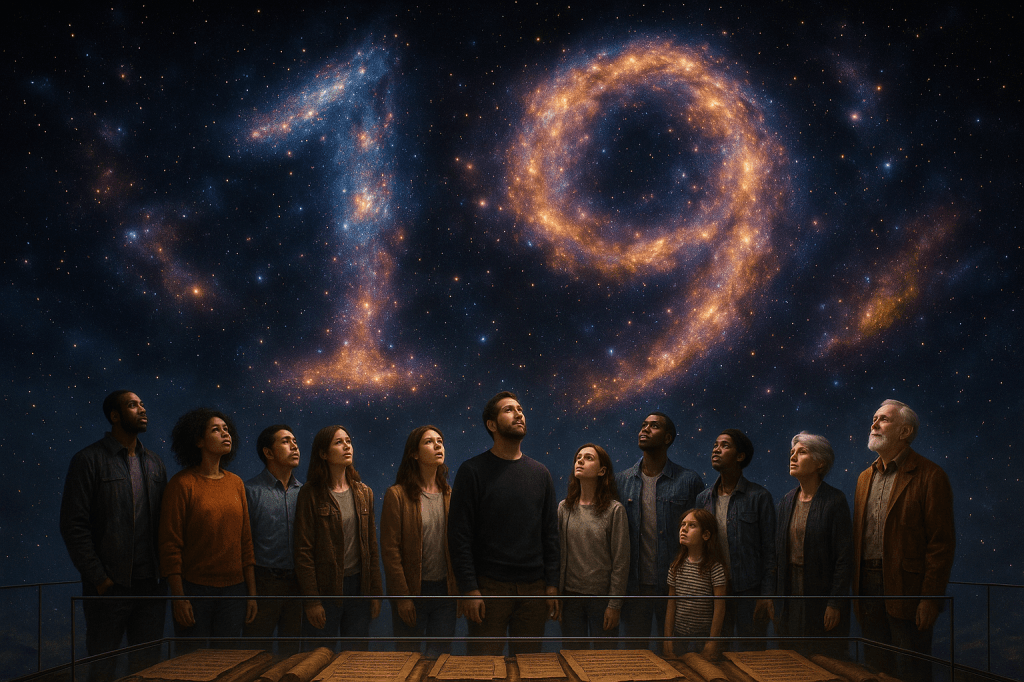
In Chapter 74 of the Quran, titled Al-Muddathir (The Hidden Secret), God makes an extraordinary declaration. After swearing by the moon, the night, and the morning — cosmic witnesses of unimpeachable authority — He introduces what He calls “one of the great miracles”:
[74:30] “Over it is nineteen.”
[74:31] “We appointed angels to be guardians of Hell, and we assigned their number (19) (1) to disturb the disbelievers, (2) to convince the Christians and Jews (that this is a divine scripture), (3) to strengthen the faith of the faithful, (4) to remove all traces of doubt from the hearts of Christians, Jews, as well as the believers, and (5) to expose those who harbor doubt in their hearts, and the disbelievers; they will say, ‘What did God mean by this allegory?’ God thus sends astray whomever He wills, and guides whomever He wills. None knows the soldiers of your Lord except He. This is a reminder for the people.”
[74:32] “Absolutely, (I swear) by the moon.”
[74:33] “And the night as it passes.”
[74:34] “And the morning as it shines.”
[74:35] “This is one of the great miracles.”
Verse 74:31 explicitly lists five purposes for this number, and the second purpose is critically relevant to our discussion: “to convince the Christians and Jews that this is a divine scripture.” God is telling us that Code 19 exists specifically to provide the external evidence that followers of the Bible need in order to recognize the Quran’s divine origin. It is the answer to the circularity problem. It is the bank statement that proves the claim. It is the external system that validates the internal one, exactly as Godel’s theorem demands.
The Mathematical Facts
The mathematical miracle of the Quran is not a vague pattern or a subjective interpretation — it is a system of interlocking mathematical facts that can be verified by anyone with basic counting ability. Here are some of the foundational elements:
The Opening Statement (Bismillah): “In the name of God, Most Gracious, Most Merciful” — the opening verse of the Quran — consists of exactly 19 Arabic letters. This is the foundation upon which the entire mathematical structure is built.
[1:1] “In the name of God, Most Gracious, Most Merciful.”
Structural Multiples: The Quran contains 114 chapters, which equals 19 x 6. The total number of verses in the Quran is 6,346, which equals 19 x 334. These are not arbitrary numbers — they are structural properties of the entire book that align with a single mathematical key.
Word Frequencies of the Bismillah: Each of the four key words in the opening verse occurs throughout the entire Quran in multiples of 19:
- “Ism” (name): 19 occurrences = 19 x 1
- “Allah” (God): 2,698 occurrences = 19 x 142
- “Al-Rahman” (Most Gracious): 57 occurrences = 19 x 3
- “Al-Raheem” (Most Merciful): 114 occurrences = 19 x 6
The First Revelation: The first passage revealed to Muhammad (96:1-5) consists of exactly 19 words. The second revelation (68:1-9) consists of 38 words (19 x 2). The third revelation (73:1-10) consists of 57 words (19 x 3). The pattern is unmistakable.
Root Word Distribution: The three root words of the Bismillah — the roots for “God,” “Gracious,” and “Merciful” — appear together across exactly 1,919 verses of the Quran. The number 1,919 is itself composed of 19s.
The probability of all these patterns occurring simultaneously by chance is astronomically small — far beyond the threshold of statistical significance used in any scientific discipline. As Dr. Rashad Khalifa described it upon discovering the pattern through computer analysis: “This is only the most amazing discovery in the history of the world” (at 1:58).
Part 8: Manuscript Preservation — The Quran vs. The Bible
400,000 Variants vs. Zero
The textual history of the Bible and the Quran could not be more different. According to Dr. Bart Ehrman, a leading New Testament scholar and former evangelical Christian, there are more textual variations among surviving New Testament manuscripts than there are words in the New Testament itself — over 400,000 variants across the approximately 5,800 extant Greek manuscripts (Ehrman, Misquoting Jesus, HarperOne, 2005). These are not all trivial spelling differences. Many involve significant theological content — the Comma Johanneum, the long ending of Mark, the Pericope Adulterae (John 7:53-8:11), and numerous other passages where the “original” text is uncertain or unknowable.
The situation is so severe that the discipline of New Testament textual criticism exists specifically to try to reconstruct what the original authors might have written — a task that scholars acknowledge may never be fully achievable. As Ehrman writes: “We don’t have the originals of any of the books of the New Testament. What we have are copies of copies of copies… made hundreds of years later, and all of these copies are different from one another.” This is not the claim of a hostile critic — it is the consensus of mainstream biblical scholarship.
The Quran’s Unbroken Chain
Contrast this with the Quran. The earliest physical manuscripts of the Quran — including the Samarkand Codex (Tashkent), the Topkapi Manuscript (Istanbul), the Sana’a Manuscripts (Yemen), and the Birmingham Quran Fragments (University of Birmingham, radiocarbon-dated to 568-645 CE) — show remarkable consistency with the modern printed Quran. There is no 115th chapter. There is no 6,347th verse. The text matches letter for letter, word for word, verse for verse. The Birmingham fragments, some of the oldest Quranic manuscripts in existence, were radiocarbon-dated with 95.4% confidence to between 568 and 645 CE — potentially within the lifetime of the Prophet Muhammad himself (University of Birmingham, “Quran Manuscript”).
This preservation is not accidental. It is the direct result of the mathematical structure embedded within the text. Code 19 functions as a built-in error-detection system. Just as a checksum verifies the integrity of a digital file, the interlocking mathematical patterns of the Quran ensure that any addition, deletion, or alteration would break the mathematical code. You cannot add a 115th chapter without breaking the 19 x 6 structure. You cannot insert a 6,347th verse without breaking the 19 x 334 structure. You cannot change the frequency of “Allah” from 2,698 without breaking the 19 x 142 pattern. The mathematics protect the text. This is divine engineering at its most elegant.
Part 9: The Messenger Parallel — Jesus and Muhammad
Identical Declarations of Dependence
One of the most striking aspects of the Quran’s message is how it places all of God’s messengers on the same footing — not as divine beings, but as humble servants who possessed no independent power. The parallel between Jesus and Muhammad on this point is impossible to miss. In John 5:30, Jesus declares: “I can of mine own self do nothing.” In the Quran, Muhammad is instructed to make an almost identical declaration:
[10:49] “Say, ‘I possess no power to harm myself, or benefit myself; only what God wills takes place.’”
[46:9] “Say, ‘I am not different from other messengers. I have no idea what will happen to me or to you. I only follow what is revealed to me. I am no more than a profound warner.’”
[18:110] “Say, ‘I am no more than a human like you, being inspired that your god is one God. Those who hope to meet their Lord shall work righteousness, and never worship any other god beside his Lord.’”
The consistency is remarkable. Jesus says he can do nothing of himself. Muhammad says he possesses no power to harm or benefit himself. Jesus says he follows the will of the Father. Muhammad says he follows only what is revealed. Jesus identifies himself as sent by God. Muhammad identifies himself as a human being like everyone else, whose only distinction is the inspiration he receives. Both messengers point away from themselves and toward the One God. Neither claims divinity. Neither claims independent authority. Both serve as conduits for the divine message — nothing more, nothing less.
[72:21] “Say, ‘I possess no power to harm you, nor to guide you.’”
[72:22] “Say, ‘No one can protect me from God, nor can I find any other refuge besides Him.’”
This is why the Quran commands believers to make no distinction among the messengers — because they all delivered the same core message:
[2:285] “The messenger has believed in what was sent down to him from his Lord, and so did the believers. They believe in God, His angels, His scripture, and His messengers: ‘We make no distinction among any of His messengers.’ They say, ‘We hear, and we obey. Forgive us, our Lord. To You is the ultimate destiny.’”
Part 10: The God of Abraham — One Message, One God
The Unchanging Core
At its heart, every authentic divine revelation has carried the same message: there is one God, and He alone is to be worshipped. This message was delivered by Abraham, Moses, Jesus, Muhammad, and every messenger between and beyond them. The Quran does not introduce a new religion — it restores the original one. It does not replace previous scriptures — it confirms their authentic core while correcting the corruptions that accumulated through centuries of human tampering.
[3:64] “Say, ‘O followers of the scripture, let us come to a logical agreement between us and you: that we shall not worship except God; that we never set up any idols besides Him, nor set up any human beings as lords beside God.’ If they turn away, say, ‘Bear witness that we are submitters.’”
This verse issues a universal invitation — not to a new sect or a new ideology, but to the most ancient and fundamental truth: worship God alone. No human intermediaries. No divine incarnations. No saints, no clergy, no intercessors. Just the direct, unmediated relationship between the creature and the Creator. This is the message that Abraham preached. This is the message that Moses delivered. This is the message that Jesus taught. And this is the message that the Quran preserves in its final, mathematically protected form.
[112:1] “Proclaim, ‘He is the One and only God.”
[112:2] “‘The Absolute God.”
[112:3] “‘Never did He beget. Nor was He begotten.”
[112:4] “‘None equals Him.’”
Chapter 112, Al-Ikhlas (Absoluteness), is the Quran’s most concise statement of monotheism. In just four verses, it demolishes every form of polytheism, every doctrine of incarnation, every theology of divine offspring, and every claim of partnership with God. “Never did He beget. Nor was He begotten.” This single verse invalidates the doctrine of the Trinity, the concept of Jesus as “the only begotten Son,” and any theology that ascribes biological or familial relationships to the eternal, self-sufficient Creator.
Part 11: The Cosmic Reaction to Blasphemy
When Creation Itself Revolts
The Quran does not merely argue against the deification of Jesus — it describes the entire universe’s visceral reaction to this claim. In Chapter 19, after narrating the story of Jesus’s miraculous birth and his mission to the Children of Israel, the Quran addresses those who attribute a son to God with some of the most dramatic language in all of scripture:
[19:88] “They said, ‘The Most Gracious has begotten a son!’”
[19:89] “You have uttered a gross blasphemy.”
[19:90] “The heavens are about to shatter, the earth is about to tear asunder, and the mountains are about to crumble.”
[19:91] “Because they claim that the Most Gracious has begotten a son.”
[19:92] “It is not befitting the Most Gracious that He should beget a son.”
[19:93] “Every single one in the heavens and the earth is a servant of the Most Gracious.”
The imagery is apocalyptic. The heavens almost shatter. The earth almost tears itself apart. The mountains almost crumble. This is not a theological disagreement being described — it is a cosmic trauma. The universe itself cannot bear the weight of this falsehood. And the reason is stated with perfect clarity in verse 93: “Every single one in the heavens and the earth is a servant of the Most Gracious.” Everyone and everything — every angel, every prophet, every human, every atom — is a servant. There are no exceptions. There are no divine offspring. There is no “second person of the Trinity.” There is God, and there is everything else, and everything else is His creation and His servant.
This passage should give pause to anyone who claims that the Quran’s disagreement with Christian theology is merely a difference of interpretation. The language is too extreme, the imagery too violent, the condemnation too absolute for this to be a minor doctrinal quibble. The Quran treats the attribution of a son to God as one of the gravest sins in existence — a sin so monstrous that the physical universe recoils from it.
Part 12: The Primordial Covenant
Why We Already Know the Truth
If God’s oneness is the central truth of existence, why do so many people get it wrong? Why do billions embrace polytheism, the Trinity, or other forms of partner-worship? The Quran answers this question by revealing a moment that occurred before physical creation — a primordial covenant in which every soul that would ever exist was brought before God and asked a single question:
[7:172] “Recall that your Lord summoned all the descendants of Adam, and had them bear witness for themselves: ‘Am I not your Lord?’ They all said, ‘Yes. We bear witness.’ Thus, you cannot say on the Day of Resurrection, ‘We were not aware of this.’”
Every soul — yours, mine, everyone who has ever lived or ever will live — answered “Yes. We bear witness.” This is not a metaphor. This is a historical event that occurred in a realm beyond our current perception, before any of us were placed in physical bodies on this earth. The memory of this covenant is embedded in our souls, which is why monotheism feels “right” even to people who have never read a scripture. It is why children instinctively turn to God in moments of distress. It is why the concept of a single Creator resonates across every culture, every civilization, every era of human history.
This is also why we bear witness in our daily Contact Prayers (Salat): “I bear witness that there is no god except God.” We are not learning something new — we are remembering something ancient. We are reaffirming a testimony we already gave, in a realm we can no longer see, to a Lord whose existence we already acknowledged. The Quran’s role is to remind us of what we already know, and Code 19 is the mathematical confirmation that this reminder is genuinely from the One we made our covenant with.
[20:14] “‘I am God; there is no other god beside Me. You shall worship Me alone, and observe the Contact Prayers (Salat) to remember Me.’”

Part 13: The Five Purposes Fulfilled
A Miracle Designed for Every Audience
Revisiting verse 74:31, we find that God designed Code 19 to serve five distinct purposes, each targeting a different audience. This is not a one-size-fits-all miracle — it is a precision-engineered proof system designed to address the specific doubts and objections of every category of human being who encounters it.
Purpose 1: To disturb the disbelievers. Those who deny God’s existence or reject the possibility of divine revelation are confronted with a mathematical structure that defies naturalistic explanation. How did a man in 7th-century Arabia produce a text whose word frequencies, verse counts, and structural properties align with a single prime number across hundreds of interlocking variables? The disbeliever has no satisfactory answer, and this absence of explanation is itself a form of evidence.
Purpose 2: To convince the Christians and Jews. This is the purpose most directly relevant to our discussion of circular reasoning. Christians and Jews who have honest questions about the Quran’s authenticity are given mathematical proof that transcends theological argument. You do not need to accept Islamic theology to count letters. You do not need to be Muslim to verify that “Bismillah” contains 19 letters, or that the word “Allah” appears 2,698 times. The mathematics stands independent of belief — it is the external evidence that breaks the circularity.
Purpose 3: To strengthen the faith of the faithful. Believers who already accept the Quran as God’s word receive additional confirmation that strengthens their conviction. In moments of doubt or difficulty, the mathematical miracle serves as an anchor — a tangible, verifiable reminder that their faith is not based on wishful thinking but on demonstrable evidence.
Purpose 4: To remove all traces of doubt. This purpose targets believers who have lingering questions or uncertainties. The mathematical proof is designed to eliminate doubt completely — not by demanding blind faith, but by providing evidence so overwhelming that doubt becomes unreasonable.
Purpose 5: To expose the hypocrites. Those who claim to believe but harbor disbelief in their hearts will be exposed by their reaction to Code 19. The verse predicts their response: “What did God mean by this allegory?” They dismiss the mathematical evidence as metaphorical or irrelevant, revealing that their objection is not intellectual but spiritual — they do not want the Quran to be proven true because its truth would demand changes in their lives that they are unwilling to make.
[74:36] “A warning to the human race.”
[74:37] “For those among you who wish to advance, or regress.”
Part 14: The Invitation
Beyond Arguments, Toward Truth
The purpose of this analysis is not to win a debate. Debates produce winners and losers; truth produces transformation. The goal is far simpler and far more important: to present evidence clearly, honestly, and completely, and to let the reader decide. The Quran itself establishes this principle with absolute clarity:
[2:256] “There shall be no compulsion in religion: the right way is now distinct from the wrong way. Anyone who denounces the devil and believes in God has grasped the strongest bond; one that never breaks. God is Hearer, Omniscient.”
No compulsion. No coercion. No forced conversions. The truth has been made distinct from falsehood, and every person is free to choose. But freedom of choice does not mean freedom from evidence. The evidence has been presented: circular reasoning has been exposed, biblical interpolations have been documented, Godel’s theorem has demonstrated why self-referencing systems fail, Code 19 has provided the external mathematical proof that breaks the deadlock, and manuscript evidence has confirmed that the Quran alone has been preserved with perfect integrity.
[5:69] “Surely, those who believe, those who are Jewish, the converts, and the Christians; any of them who (1) believe in God and (2) believe in the Last Day, and (3) lead a righteous life, have nothing to fear, nor will they grieve.”
The Quran’s message to Christians and Jews is not one of condemnation — it is one of invitation. Believe in the one God. Believe in the Last Day. Lead a righteous life. These are the criteria. The labels do not matter. The denominations do not matter. The theological systems do not matter. What matters is monotheism, accountability, and righteousness. And the proof that this invitation is genuine — that it truly comes from the Creator of the heavens and the earth — is Code 19: the mathematical signature of God, woven into every layer of His final scripture, standing as an eternal, unbreakable, externally verifiable proof for all who seek the truth.
[6:19] “Say, ‘Whose testimony is the greatest?’ Say, ‘God’s. He is the witness between me and you that this Quran has been inspired to me, to preach it to you and whomever it reaches. Indeed, you bear witness that there are other gods beside God.’ Say, ‘I do not testify as you do; there is only one God, and I disown your idolatry.’”
Conclusion: The Circle Is Broken
We began with a question: How do you break out of circular reasoning? The answer, as Godel proved and the Quran demonstrates, is that you need something external — a proof that operates outside the system it validates. For centuries, every religion relied on self-attestation. Every scripture said, “I am from God because I say I am from God.” The circle went unbroken, and interfaith dialogue devolved into a contest of competing self-referential claims. Code 19 changes everything. It is not a theological argument — it is a mathematical fact. It does not ask you to believe — it invites you to count. It does not appeal to emotion — it appeals to reason. It is the external validator that Godel’s theorem tells us is necessary and that honest seekers have always been searching for.
The Bible’s most explicit Trinitarian passages are demonstrable forgeries. The Quran’s text has been preserved letter-perfect across fourteen centuries. Jesus himself, both in the Bible and the Quran, denied being God and declared total dependence on the Creator. And the mathematical structure of the Quran — 19 letters in the Bismillah, 114 chapters, 6,346 verses, word frequencies in perfect multiples — stands as testimony that no human mind designed this book. The circle of reasoning is broken. The evidence is external, mathematical, and verifiable. The only question that remains is what you will do with it.
[20:14] “‘I am God; there is no other god beside Me. You shall worship Me alone, and observe the Contact Prayers (Salat) to remember Me.’”

 Quran Only Studies
Leave a comment