How the Legal Doctrine of Binding Precedent Reveals the Mechanism by Which Small Innovations Become Permanent Distortions of God’s Religion

I. Introduction: The Most Dangerous Word in Religion Is “Why Not?”
There is a question that has destroyed more religious communities than any outright blasphemy ever could. It is not a question of denial. It is not a question of defiance. It is the seemingly innocent, seemingly reasonable question: “Why not?” Why not add this small practice? Why not adjust this minor detail? Why not accommodate this particular situation? The question sounds so harmless, so logical, so compassionate. And that is precisely what makes it lethal. Every major corruption of every divine message in human history began not with a thunderous rejection of God, but with a whispered “Why not?” followed by a seemingly reasonable innovation that no one challenged.
In the legal world, there exists a doctrine that perfectly illustrates how this mechanism works. It is called stare decisis et non quieta movere — “to stand by decisions and not disturb settled matters.” In law, once a court makes a ruling, that ruling becomes precedent. Lower courts are bound by it. Future cases must conform to it. What begins as one judge’s reasoning in one case becomes the immovable foundation upon which entire legal systems are built. The doctrine exists for good reason in law — it provides stability, predictability, and consistency. But when we examine how precedent functions, we discover a terrifying parallel to how religious innovations operate. And unlike legal precedent, which humans have the authority to create and overturn, religious “precedent” created by human beings is nothing less than an assault on the authority of God Himself.
This article examines the doctrine of stare decisis not as an endorsement of legal reasoning, but as a warning. It is a case study in how human systems calcify, how temporary accommodations become permanent fixtures, and how the mechanisms that make this happen in courtrooms are identical to those that have corrupted every religious community since the beginning of time. Specifically, we will examine one emerging scenario that perfectly illustrates this danger: the practice of women delivering the Friday congregational sermon and leading the prayer when no males are present — a practice that begins as an apparent necessity and, through the exact mechanisms of stare decisis, becomes an entrenched norm that no one dares question.

II. How Stare Decisis Works: The Anatomy of Binding Precedent
To understand why the parallel to religious innovation is so precise, we must first understand exactly how legal precedent operates. When a court issues a ruling, two components are produced. The first is the ratio decidendi — the core legal reasoning that directly addresses the question at hand. This is the part that binds future courts. The second is the obiter dicta — remarks made “by the way” that may be interesting or instructive but do not carry binding force. Only the ratio decidendi — the essential reasoning — creates precedent. Higher courts bind lower courts absolutely, while courts of equal standing create persuasive but not strictly binding precedent.
Consider one of the most consequential cases in legal history: Donoghue v. Stevenson (1932). A woman found a decomposed snail in her bottle of ginger beer. There was no contract between her and the manufacturer, so under existing law, she had no claim. But the House of Lords created something entirely new: the concept of a “duty of care” owed by a manufacturer to the ultimate consumer, regardless of contract. This single case — involving one woman and one snail — created the entire modern law of negligence. Every personal injury lawsuit, every product liability claim, every medical malpractice case in the common law world traces its lineage back to that one bottle of ginger beer. One ruling. One precedent. An entire legal framework that would govern millions of lives for generations.
Or consider Brown v. Board of Education (1954), which overturned Plessy v. Ferguson (1896). The Plessy case had established “separate but equal” as constitutionally valid, and this precedent stood for fifty-eight years. For more than half a century, racial segregation was not merely tolerated but legally mandated — all because of one Supreme Court ruling that subsequent courts were bound to follow. When Brown finally overturned it, the legal system demonstrated that precedent, no matter how entrenched, can be challenged. But the damage of those fifty-eight years was irreversible. Generations lived under legalized racial oppression because a legal precedent, once set, is extraordinarily difficult to dislodge.
And then there is R v. R (1991), in which the House of Lords ruled that a husband could be convicted of raping his wife — overturning centuries of assumed legal immunity based on the idea that marriage constituted perpetual consent. This was not a precedent set by any explicit statute. It was an assumption, a practice, a custom that had hardened into what everyone treated as law. No one had formally decreed it. It simply became the way things were done, and that was enough to make it binding for hundreds of years.
The Mechanism: How Temporary Becomes Permanent
What these cases reveal is a consistent mechanism. First, a situation arises that existing rules do not explicitly address. Second, someone makes a ruling or decision to handle that specific situation. Third, that ruling is documented and referenced. Fourth, subsequent cases follow the ruling not because it is inherently correct, but because it exists as precedent. Fifth, the precedent becomes so entrenched that challenging it becomes almost unthinkable. Sixth, the original context and reasoning are forgotten, and the precedent is simply “the way things are.” This is exactly — precisely, identically — the mechanism by which religious innovations become permanent distortions. And it is the mechanism we must guard against with absolute vigilance.
III. The Fundamental Error: Treating God’s Silence as Permission
The most dangerous assumption in religion is this: if God did not explicitly prohibit something, it must be permitted. This reasoning sounds logical. It appeals to our sense of freedom and our desire for a religion that is not unnecessarily restrictive. But it contains a fatal flaw. It reverses the burden of authorization. In God’s system, the question is never “Did God prohibit this?” The question is always “Did God authorize this?” These are not the same question, and confusing them has been the entry point for every innovation that has ever corrupted a divinely ordained religion.
[42:21] “They follow idols who decree for them religious laws never authorized by God. If it were not for the predetermined decision, they would have been judged immediately. Indeed, the transgressors have incurred a painful retribution.”
Notice the precision of this verse. God does not say they “violated” His laws. He says they decreed religious laws “never authorized” by God. The distinction is critical. You do not need to contradict an explicit commandment to transgress. You merely need to create a religious practice that God never authorized. The act of legislating where God did not legislate is itself the transgression. The footnote to this verse in the Final Testament makes the point even more forcefully: the religion of the traditional Muslim world has been so distorted by the additions of religious scholars — their extraneous laws, prohibitions, dress codes, dietary regulations, and religious practices never authorized by God — that it has become something entirely different from what God revealed.
[6:114] “Shall I seek other than God as a source of law, when He has revealed to you this book fully detailed? Those who received the scripture recognize that it has been revealed from your Lord, truthfully. You shall not harbor any doubt.”
[6:115] “The word of your Lord is complete, in truth and justice. Nothing shall abrogate His words. He is the Hearer, the Omniscient.”
The Quran is fully detailed. The word of God is complete. These are not casual assertions. They are categorical declarations that leave no room for human supplementation. If the Quran is fully detailed and complete, then anything not found in it is, by definition, not part of the religion. Not “probably not part of the religion.” Not “arguably not part of the religion.” Simply and absolutely not part of the religion. When we add practices, modify structures, or create accommodations that the Quran does not authorize, we are not filling in gaps. We are declaring that God’s completed, fully detailed system has gaps — which is a direct contradiction of what God Himself has told us.
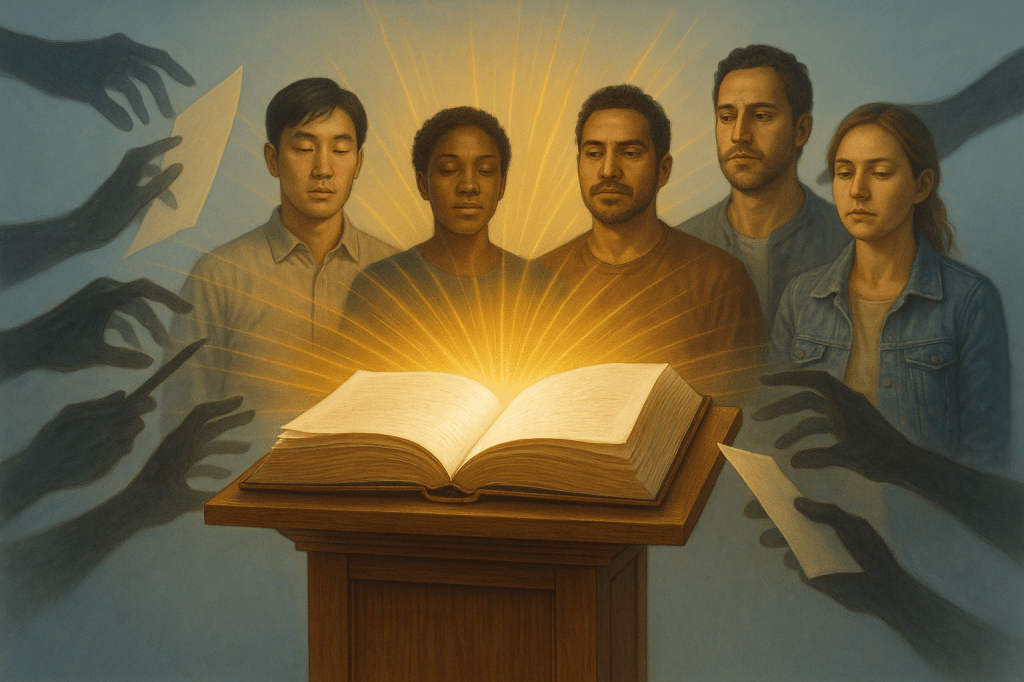
IV. The Friday Prayer: A Structure Defined, Delivered, and Not Open for Modification
The Friday congregational prayer is one of the few acts of worship that the Quran addresses with specific, direct commandments. This is not an area where God was silent. This is an area where God spoke clearly, and where the practices were established through Abraham and delivered to us through the Prophet Muhammad, and then confirmed and purified by God’s Messenger of the Covenant, Rashad Khalifa.
[62:9] “O you who believe, when the Congregational Prayer (Salat Al-Jumu’ah) is announced on Friday, you shall hasten to the commemoration of God, and drop all business. This is better for you, if you only knew.”
[62:10] “Once the prayer is completed, you may spread through the land to seek God’s bounties, and continue to remember God frequently, that you may succeed.”
The commandment is clear and specific: when the Friday prayer is announced, believers must drop all business and hasten to the commemoration of God. This is not optional. It is not a suggestion. It is a direct commandment from the Creator of the heavens and the earth. And the structure of this prayer — the sermon (khutba) delivered in two parts, followed by two units of prayer led by an imam — came to us through Abraham and has been practiced this way by every community of believers since. As Rashad Khalifa explained in his teaching on the Friday prayer: “The Friday congregational prayer is an obligatory duty upon every Muslim man and woman. This is a social function decreed by God almighty for the Muslims to get together and to know each other and to be familiar with their problems and their joys” (at 1:17:41).
Rashad further emphasized that the sermon structure and its requirements “came to us all the way from Abraham and it is universal, this is the way it is happening all over the world.” He described the specific requirements: the sermon opens with “alhamdulillah, la ilaha illallah,” deals with subjects from the Quran or local community matters, and must be delivered in the language of the congregation so the people understand. The imam then concludes the sermon by calling for the prayer (aqim salat), and leads the congregation in two units of prayer (at 1:20:20). This is not a structure that we inherited by accident. It is not a cultural artifact. It is a divinely established framework that was delivered through the chain of prophets and confirmed by the Messenger of the Covenant.
The practice of men serving as imam — leading the prayer and delivering the sermon — is part of this Abrahamic structure. It is not a product of “Arab culture.” It is not a vestige of patriarchy. It is the way this specific act of worship has been practiced by every community of submitters since Abraham. And critically, as we will see, God’s Messenger of the Covenant directly addressed this matter and affirmed it.
V. The Messenger’s Direct Teaching: “That Never Happened”
One of the most valuable aspects of having a confirmed messenger of God in our era is that we have his direct teachings on precisely these kinds of questions. When the question of women leading the prayer was raised in Rashad Khalifa’s presence, he addressed it directly and unequivocally.
Rashad stated: “This is the way it came to us, order from Abraham. And usually, if God wants to set a precedent for the subsequent generations, God would create a situation or circumstances that will force this issue and then we’ll have a precedent. That a woman is leading the prayer. But that never happened. And the innovations are a very serious matter. So, just so not start any innovation, we’re keeping this rule. This has been always the rule. And any change in it will be an innovation. So, it’s not worth it. It’s not worth it.”
— Rashad Khalifa (at 24:52)
Let us dissect this teaching carefully, because every sentence carries weight. First, Rashad identifies the source: “This is the way it came to us, order from Abraham.” The prayer structure, including who leads it, is Abrahamic in origin. It is part of the divinely delivered system of worship. Second, Rashad articulates a profound principle: if God wanted to establish a precedent for women leading prayer, God would have created the circumstances to force the issue. God is not passive. God is not an absent legislator who forgot to address important matters. God is the Most Wise, the All-Knowing, and He deliberately and intentionally designed the system the way it is. The fact that no such precedent was ever established — across thousands of years, across every community of believers, across every messenger’s ministry — is itself God’s statement on the matter.
Third, and most critically for our discussion, Rashad directly invokes the concept of innovation: “The innovations are a very serious matter. So, just so not start any innovation, we’re keeping this rule.” He does not say “it would be nice to avoid innovation.” He says innovations are a “very serious matter” — language that should make every sincere submitter pause. And he explicitly categorizes any change to this practice as an innovation: “Any change in it will be an innovation.” The messenger’s verdict is clear, direct, and leaves no room for reinterpretation.
Furthermore, in another teaching, Rashad made the broader point about innovations in worship: “Innovations creep up on us, and after one generation or two generations, there will be thoughts. Thoughts will be added to the frame” (at 0:00). This is exactly the stare decisis mechanism at work: something new is introduced, it goes unchallenged, and within a generation or two, it has become part of the framework that everyone accepts as normal.
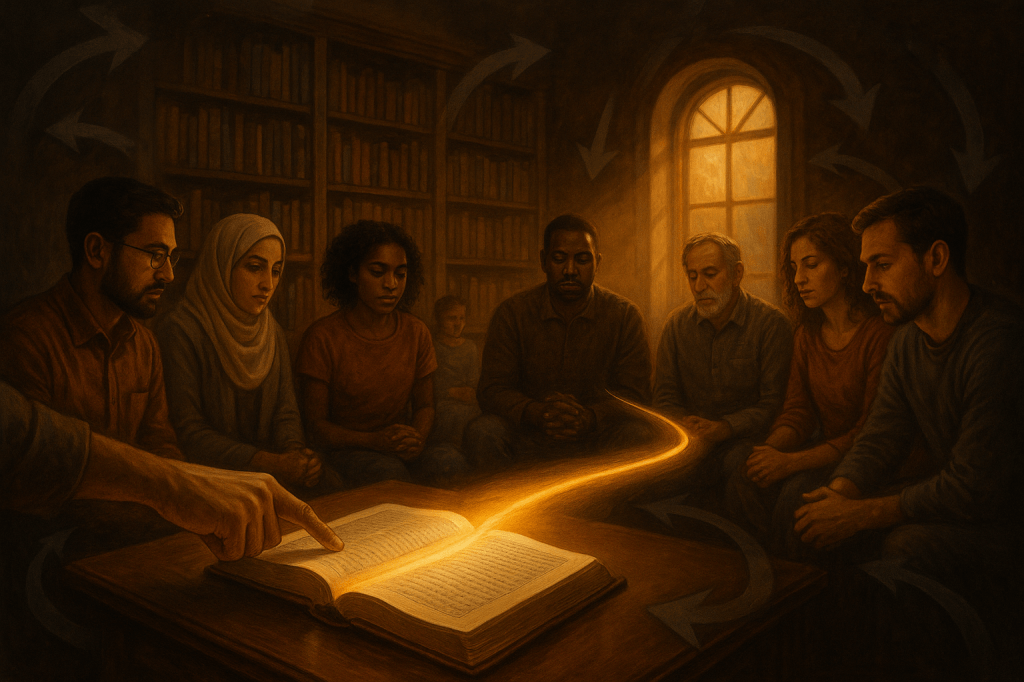
VI. The Scenario: How a “Necessity” Becomes a Norm
Now let us examine the specific scenario through the lens of stare decisis. A small community of Submitters gathers for Friday prayer. No male members are present on a particular Friday. The community faces a practical question: should they simply not hold the congregational prayer? Or should a woman step in to deliver the sermon and lead the prayer? The argument for accommodation seems compelling: the Quran commands believers to hasten to the Friday prayer. Is it not better to hold the prayer with a female leader than to not hold it at all? Is not some form of Friday congregation better than none?
This is where the legal analogy becomes frighteningly precise. In the first instance, the woman leads out of perceived necessity. There is no formal decision that this is permissible. There is no ruling. There is simply an action taken to address a specific situation. This is exactly how case law begins — not with a grand pronouncement, but with a practical response to an immediate problem.
The following week, the same situation arises. The community has already done it once. There is now a precedent. The discomfort that might have existed the first time has been reduced. The second time is easier than the first. By the third and fourth time, it is no longer an exception — it is becoming the community’s practice. Within months, it is simply “what we do.” Within a year, new members who join the community know no other way. Within a generation, anyone who questions the practice is told, “This is how we have always done it.”
This is stare decisis in its purest form. The first occurrence was the ratio decidendi — the precedent-setting ruling. Every subsequent occurrence was a court of equal standing following persuasive precedent. The practice was documented in meeting records. No formal challenge was raised. The precedent calcified. And now, a practice that God never authorized, that the messenger explicitly warned against, and that contradicts the Abrahamic structure of worship has become an entrenched norm — all because the first time it happened, no one said no.
[7:28] “They commit a gross sin, then say, ‘We found our parents doing this, and God has commanded us to do it.’ Say, ‘God never advocates sin. Are you saying about God what you do not know?’”
Within a generation, the “parents” in this verse are the founding members of that small community. And the “gross sin” is not some dramatic act of idolatry — it is the quiet, gradual establishment of a practice that God never authorized, dressed up in the language of necessity, compassion, and common sense.

VII. The Equality Argument: A Misapplied Principle
The most common justification offered for women leading Friday prayer invokes the principle of gender equality in the Quran. And indeed, the Quran is absolutely clear about the spiritual equality of men and women before God:
[3:195] “Their Lord responded to them: ‘I never fail to reward any worker among you for any work you do, be you male or female — you are equal to one another. Thus, those who immigrate, and get evicted from their homes, and are persecuted because of Me, and fight and get killed, I will surely remit their sins and admit them into gardens with flowing streams.’ Such is the reward from God. God possesses the ultimate reward.”
This verse establishes, beyond any doubt, that men and women are spiritually equal before God. Their work is equally rewarded. Their faith is equally valued. Their sacrifices are equally recognized. No honest student of the Quran can deny this fundamental principle. But — and this is where the reasoning goes critically wrong — equality in spiritual standing and reward does not mean identical roles in every aspect of worship structure. These are two completely different propositions, and conflating them is a logical error that leads to dangerous conclusions.
Consider an analogy from within the Quran itself. The prophets and messengers of God are equal in their submission to God, yet they were given different roles, different books, different communities, different laws. Does this inequality of role diminish their equality of standing? Of course not. Similarly, the Quran prescribes different roles for men and women in certain contexts — not because one is superior to the other, but because God, in His infinite wisdom, designed specific structures for specific purposes. The Friday congregational prayer has a specific structure. That structure includes a male imam. This is not a commentary on the worth, intelligence, piety, or spiritual standing of women. It is simply the structure that God established through Abraham and confirmed through every subsequent messenger.
As Rashad stated directly, “From the logical point of view, a woman leading the prayer is not…” — and then he added, “The woman is dignified” (at 25:44). The messenger connected the practice of not leading with dignity, not with diminishment. The innovation of changing this structure is not an elevation of women — it is a distortion of the worship structure that God designed.
[33:36] “No believing man or believing woman, if God and His messenger issue any command, has any choice regarding that command. Anyone who disobeys God and His messenger has gone far astray.”
When the messenger has issued a clear command, neither believing men nor believing women have a choice in the matter. This applies to men who might want to modify the prayer structure just as much as it applies to women. The command is not gendered. The obedience required is universal.
VIII. The Historical Warning: How the Hadith System Was Born
If you want to understand where religious innovation leads, you need look no further than the hadith system — the single greatest corruption of the religion of Submission in history. And the mechanism by which it was established is identical to the stare decisis mechanism we have been examining. The hadith did not appear overnight. The Prophet Muhammad did not die and have millions of fabricated sayings attributed to him the next morning. The process was gradual, organic, and — at every step — seemingly reasonable.
It began with small things. Someone remembered something the Prophet said in a specific context. They shared it with others. It seemed helpful, illuminating, practical. No one questioned it because it appeared to support the Quran. This was the first precedent — the equivalent of that first Friday when a woman led the prayer. Then more sayings were collected, shared, and passed along. Each new hadith was a new case following the precedent established by the previous ones. Within a few generations, the collection and transmission of hadith had become an industry. Within a few centuries, the hadith corpus had become so massive and so entrenched that challenging any part of it was tantamount to apostasy. The precedent had calcified into immovable law.
[45:6] “These are God’s revelations that we recite to you truthfully. In which Hadith other than God and His revelations do they believe?”
[12:111] “In their history, there is a lesson for those who possess intelligence. This is not fabricated Hadith; this (Quran) confirms all previous scriptures, provides the details of everything, and is a beacon and mercy for those who believe.”
God condemns hadith by name. God declares the Quran provides the details of everything. And yet, despite these categorical statements, the hadith system became the dominant source of religious law for over a billion people. How? Through exactly the same mechanism we see in stare decisis: precedent, repetition, entrenchment, and the eventual inability to imagine things being any different. The first person who said “the Prophet also said…” was not trying to corrupt the religion. They were being “helpful.” They were providing “context.” They were making the religion “easier to understand.” These are precisely the same arguments used today to justify innovations like modifying the Friday prayer structure.
The lesson is devastatingly clear: it does not matter what your intention is. It does not matter how helpful your innovation seems. It does not matter how small the change appears. Once a precedent is set, the mechanism of entrenchment takes over, and within a generation, your “helpful” addition has become law that no one can challenge. This is why Rashad said, “Innovations are a very serious matter.” He understood the mechanism. He had seen its results across 1,400 years of history. And he warned us not to repeat it.

IX. The Quran’s Explicit Warnings Against Unauthorized Legislation
The Quran does not merely hint at the danger of religious innovation. It addresses it directly, repeatedly, and with unmistakable severity. Every verse on this topic reads like a warning label written by someone who knows exactly how the corruption will occur — because God, of course, knows exactly how it occurs.
[16:116] “You shall not utter lies with your own tongues stating: ‘This is lawful, and this is unlawful,’ to fabricate lies and attribute them to God. Surely, those who fabricate lies and attribute them to God will never succeed.”
When a community declares that women leading Friday prayer is permissible — without any authorization from God, without any precedent from Abraham, without the endorsement of the messenger — they are doing exactly what this verse warns against. They are using their own tongues to declare something lawful that God never authorized. They may not think of it as “fabricating lies and attributing them to God,” but that is precisely what it is. When you perform a religious practice and declare it acceptable, you are implicitly attributing its authorization to God. And if God never authorized it, that attribution is a lie.
[10:59] “Say, ‘Did you note how God sends down to you all kinds of provisions, then you render some of them unlawful, and some lawful?’ Say, ‘Did God give you permission to do this? Or, do you fabricate lies and attribute them to God?’”
[18:27] “You shall recite what is revealed to you of your Lord’s scripture. Nothing shall abrogate His words, and you shall not find any other source beside it.”
Nothing shall abrogate God’s words. You shall not find any other source beside it. These are not ambiguous statements. They are absolute prohibitions against modifying, supplementing, or replacing what God has revealed. When the Quran says “nothing shall abrogate His words,” this includes the well-intentioned innovations of sincere believers. Sincerity does not exempt you from the prohibition. A sincere person who adds to God’s religion is still adding to God’s religion — and the Quran makes clear that this is among the gravest of transgressions.
[7:29] “Say, ‘My Lord advocates justice, and to stand devoted to Him alone at every place of worship. You shall devote your worship absolutely to Him alone. Just as He initiated you, you will ultimately go back to Him.’”
Worship is to be devoted absolutely to God alone, according to what God has initiated. Not according to what we think is fair. Not according to what contemporary sensibilities demand. Not according to what makes us comfortable. According to what God initiated. If God initiated a worship structure through Abraham that includes specific roles, then our job is to follow it — not to “improve” it.
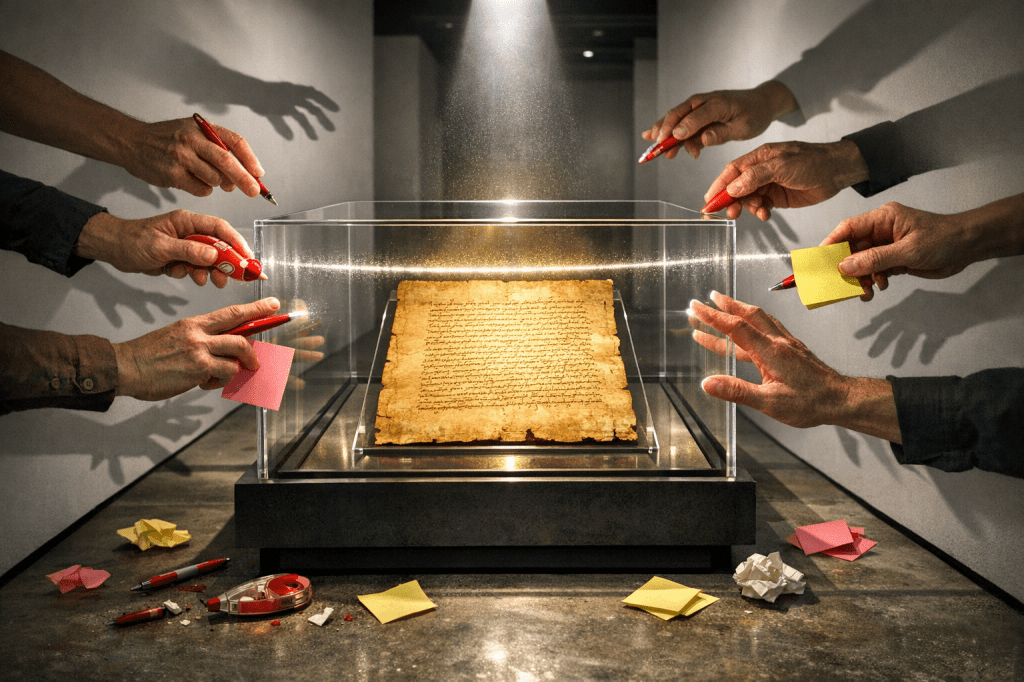
X. The Social Pressure Trap: When the Majority Becomes the Authority
One of the most insidious aspects of the stare decisis mechanism in religion is the social pressure it generates. Once an innovation becomes established practice in a community, questioning it becomes socially costly. You are accused of being backward. You are accused of not supporting women. You are accused of being rigid, uncompassionate, or legalistic. The social cost of standing with God’s system becomes higher than the social cost of going along with the innovation. And the Quran warns us about exactly this dynamic:
[6:116] “If you obey the majority of people on earth, they will divert you from the path of God. They follow only conjecture; they only guess.”
The majority will divert you from God’s path. Not because the majority is malicious. Not because the majority is stupid. But because the majority follows conjecture — they guess. They reason by analogy. They extrapolate from principles. They innovate based on what seems right. And the aggregate effect of all this well-intentioned guessing is diversion from God’s path. The verse is not warning about following atheists or pagans. It is warning about following the majority of people who claim to be believers but whose religion is based on conjecture rather than revelation.
[2:170] “When they are told, ‘Follow what God has revealed herein,’ they say, ‘We follow only what we found our parents doing.’ What if their parents did not understand, and were not guided?”
[31:21] “When they are told, ‘Follow these revelations of God,’ they say, ‘No, we follow only what we found our parents doing.’ What if the devil is leading them to the agony of Hell?”
These verses are usually applied to traditional Muslims who follow the practices of their ancestors. But the principle is universal. Within the context of stare decisis, the “parents” are not just biological ancestors — they are the previous generation of practitioners in any community. If a community establishes an innovation and the next generation inherits it, that next generation is “following what they found their parents doing” in exactly the way these verses describe. The innovation becomes tradition. The tradition becomes identity. And anyone who points to God’s actual revelation is told, “That is not how we do things.”
Rashad emphasized this principle with characteristic directness: “Anybody here, and we all know this, we do not follow any person, and we emphasize here that we are worshippers of God alone, we follow the word of God alone. And if I ever say anything that is not in the Quran or contradicts the Quran, I am the first one to appreciate alerting me to this, because then I am wrong” (at various points). The standard is the Quran and what came through the authorized chain of messengers — not what any community decides is acceptable based on their own reasoning.
XI. The Compounding Effect: How Small Deviations Create Major Departures
One of the most underappreciated dangers of religious innovation is the compounding effect. A single deviation, in isolation, may appear trivial. But innovations do not exist in isolation. Each one creates a new baseline from which the next deviation occurs. And over time, the cumulative effect is a religion that bears no resemblance to what God revealed. This is not hypothetical. This is exactly what happened to the religion of Abraham, which was corrupted into Judaism, Christianity, and traditional Islam — three vastly different religions, all claiming descent from the same patriarch, all unrecognizable from the original.
The Legal Parallel: Compounding Precedent
In law, this compounding effect is well documented. Case A establishes Precedent 1. Case B, building on Precedent 1, extends it slightly to establish Precedent 2. Case C, building on Precedent 2, extends it further to establish Precedent 3. By the time you reach Case Z, the law bears almost no resemblance to the original ruling in Case A. Each step was small. Each step was “logical.” Each step cited the previous precedent as authority. But the aggregate journey was enormous and unforeseen. This is how “separate but equal” lasted for 58 years. This is how a husband’s immunity from rape charges lasted for centuries. Each generation simply accepted what the previous generation had established and built upon it.
Now apply this to our scenario. Step one: women deliver the Friday sermon when no males are present. Step two: since women can deliver the sermon, they can also lead the prayer in those circumstances. Step three: since they have been leading prayer in all-female gatherings, surely they can lead when some males are present but none volunteer. Step four: since they have been leading in mixed gatherings occasionally, why restrict it at all? Step five: since women can lead prayer, the traditional practice of male imams must have been a cultural artifact, not a religious requirement. Step six: the entire Abrahamic structure of worship is now questioned and reinterpreted through the lens of contemporary values rather than divine authority.
Each step is “small.” Each step is “logical.” Each step cites the previous practice as its justification. And the end result is a religion that has been fundamentally altered — not by a dramatic act of rebellion, but by the quiet, relentless compounding of innovations that no one challenged when they were small enough to stop.
[6:153] “This is My path — a straight one. You shall follow it, and do not follow any other paths, lest they divert you from His path. These are His commandments to you, that you may be saved.”
God describes His path as a single, straight line. The imagery is deliberate. A straight line admits no deviation, however slight. You are either on the line or you are not. And God warns that other paths — plural — will divert you from His path. Every innovation is an “other path.” It may start parallel to God’s path. It may start very close to God’s path. But given enough time and enough compounding, it will diverge until the two paths are heading in completely different directions.

XII. The Danger of Human Authority: Taking Religious Leaders as Lords
When a community establishes a religious practice based on human reasoning rather than divine authorization, they have, whether they realize it or not, elevated human authority to the level of divine authority. They have taken a human judgment and given it the force of religious law. The Quran has a specific term for this:
[9:31] “They have set up their religious leaders and scholars as lords, instead of God. Others deified the Messiah, son of Mary. They were all commanded to worship only one God. There is no God except He. Be He glorified, high above having any partners.”
The footnote to this verse in the Final Testament is illuminating: “If you consult the ‘Muslim scholars’ about worshiping God alone, and upholding the word of God alone, as taught in this proven scripture, they will advise you against it.” The parallel is exact. When a community establishes its own religious practices based on community consensus rather than Quranic authority, every member who follows that practice is, in effect, treating the community’s decision-makers as legislative authorities in religion — a role that belongs to God alone.
This does not mean that community leaders are malicious or that their intentions are impure. The scholars who established the hadith system were not, for the most part, conscious corrupters of the religion. They were people who believed they were helping. They were people who believed they were preserving. They were people who believed they were making the religion more accessible, more practical, more complete. And yet, the result of their well-intentioned efforts was the greatest corruption of divine religion in human history. Good intentions do not prevent bad outcomes when the action itself violates God’s authority.
[42:10] “If you dispute any part of this message, the judgment for doing this rests with God. Such is God my Lord. In Him I trust, and to Him I submit.”
When disputes arise — and the question of who leads Friday prayer is a dispute — the judgment rests with God. Not with community votes. Not with scholarly consensus. Not with contemporary social values. With God. And God’s judgment is found in His scripture and in the practices established through His authorized messengers. If God’s scripture does not authorize a practice, and God’s messenger explicitly warned against it, then the judgment has already been rendered. To override that judgment with community reasoning is to take the community as a lord beside God.
XIII. Sectarianism Through Innovation: How Divisions Form
One of the most overlooked consequences of religious innovation is its inevitable tendency to create division. When a community adopts a practice that others recognize as unauthorized, a split becomes inevitable. Those who accept the innovation form one group. Those who reject it form another. Both cite their reasoning. Both believe they are right. And the religion that God designed to be unified fractures into competing factions — exactly as the Quran warns:
[42:13] “He decreed for you the same religion decreed for Noah, and what we inspired to you, and what we decreed for Abraham, Moses, and Jesus: ‘You shall uphold this one religion, and do not divide it.’ The idol worshipers will greatly resent what you invite them to do. God redeems to Himself whomever He wills; He guides to Himself only those who totally submit.”
[42:14] “Ironically, they broke up into sects only after the knowledge had come to them, due to jealousy and resentment among themselves. If it were not for a predetermined decision from your Lord to respite them for a definite interim, they would have been judged immediately. Indeed, the later generations who inherited the scripture are full of doubts.”
[6:159] “Those who divide themselves into sects do not belong with you. Their judgment rests with God, then He will inform them of everything they had done.”
The religion is one. It is the same religion decreed for Noah, Abraham, Moses, Jesus, Muhammad, and Rashad. And the commandment is explicit: “do not divide it.” But innovation, by its very nature, creates division. When one community adopts a practice that others reject, division is the inevitable result. The community that introduced the innovation may believe they are “progressing” or “evolving,” but in reality, they are doing exactly what verse 42:14 describes: breaking up into sects after the knowledge has come to them. The knowledge of what the Quran teaches and what the messenger established is clear. Departing from it is not progress — it is sectarianism.
This is another parallel to the legal world. When different courts interpret precedent differently, the result is a “circuit split” — different jurisdictions applying different rules to the same situation. In law, a higher court eventually resolves the split. In religion, the “higher court” is God, and His ruling has already been issued in the Quran. The question is whether we accept that ruling or create our own competing jurisprudence.

XIV. The Practical Question: What Should a Community Do?
If a community genuinely has no male members available for Friday prayer, the answer is not to innovate a new practice. The answer is to address the underlying situation. Friday prayer is a community obligation. If a community cannot fulfill the requirements of Friday prayer as established through Abraham and confirmed by the messenger, then they should join another community for Friday prayer, even if this requires travel. The Quran commands believers to “drop all business” and hasten to the Friday prayer — this language implies effort, sacrifice, and prioritization.
[5:101] “O you who believe, do not ask about matters which, if revealed to you prematurely, would hurt you. If you ask about them in light of the Quran, they will become obvious to you. God has deliberately overlooked them. God is Forgiver, Clement.”
This verse contains a profound principle: God has “deliberately overlooked” certain matters. When God does not address something in the Quran, it is not an oversight. It is deliberate. God did not forget to authorize women leading Friday prayer. God did not accidentally omit this provision. God deliberately did not include it. And when God deliberately overlooks something, we should take the hint rather than rushing to fill what we perceive as a gap. The Quran is complete and fully detailed. If something is not in it, it is not an incomplete detail — it is a completed omission.
Furthermore, Rashad emphasized the importance of the community function of Friday prayer. He stated that “all the believers who follow the Quran alone must get together, they must know each other, they must be united.” If a community is too small to fulfill the requirements, the solution is to unite with other communities — not to modify the requirements. The social function of the Friday prayer is served by bringing people together, not by creating isolated pockets of modified practice.
[4:103] “Once you complete your Contact Prayer (Salat), you shall remember God while standing, sitting, or lying down. Once the war is over, you shall observe the Contact Prayers (Salat); the Contact Prayers (Salat) are decreed for the believers at specific times.”
Even in the extreme circumstance of war, God does not authorize modifying the prayer structure. He authorizes shortening or adjusting the timing — but the fundamental structure remains intact. If God does not authorize structural modification even during warfare, how much less does He authorize it for the mere inconvenience of community size?
XV. The Completed Religion: “Today I Have Perfected Your Religion”
Perhaps the most powerful verse in this entire discussion is one that should end all arguments about religious innovation:
[5:3] “…Today, the disbelievers have given up concerning (the eradication of) your religion; do not fear them and fear Me instead. Today, I have completed your religion, perfected My blessing upon you, and I have decreed Submission as the religion for you…”
The religion is completed. The blessings are perfected. The system is decreed. This is God’s own declaration that nothing needs to be added, modified, or supplemented. When we innovate, we are implicitly declaring that the completed religion is incomplete. We are declaring that the perfected blessings need improvement. We are declaring that the decreed system needs revision. Is there any statement more arrogant than telling the Creator of the universe that His completed, perfected, decreed system needs our help?
[6:38] “All the creatures on earth, and all the birds that fly with wings, are communities like you. We did not leave anything out of this book. To their Lord, all these creatures will be summoned.”
God left nothing out. If the authorization for women to lead Friday prayer is not in the Quran, God did not leave it out by accident. He left it out on purpose. And our job — our only job — is to submit to what God has decreed, not to supplement what we believe He should have decreed.
[10:15] “When our revelations are recited to them, those who do not expect to meet us say, ‘Bring a Quran other than this, or change it!’ Say, ‘I cannot possibly change it on my own. I simply follow what is revealed to me. I fear, if I disobey my Lord, the retribution of an awesome day.’”
Even the messenger cannot change the Quran or what God has revealed. How much less can any community of believers claim the authority to modify the worship practices that came through the chain of authorized messengers from Abraham to Rashad? The answer is clear: they cannot. And the attempt to do so, however well-intentioned, places them squarely in the category of those who seek to “change” God’s message — a category from which every sincere submitter should flee.
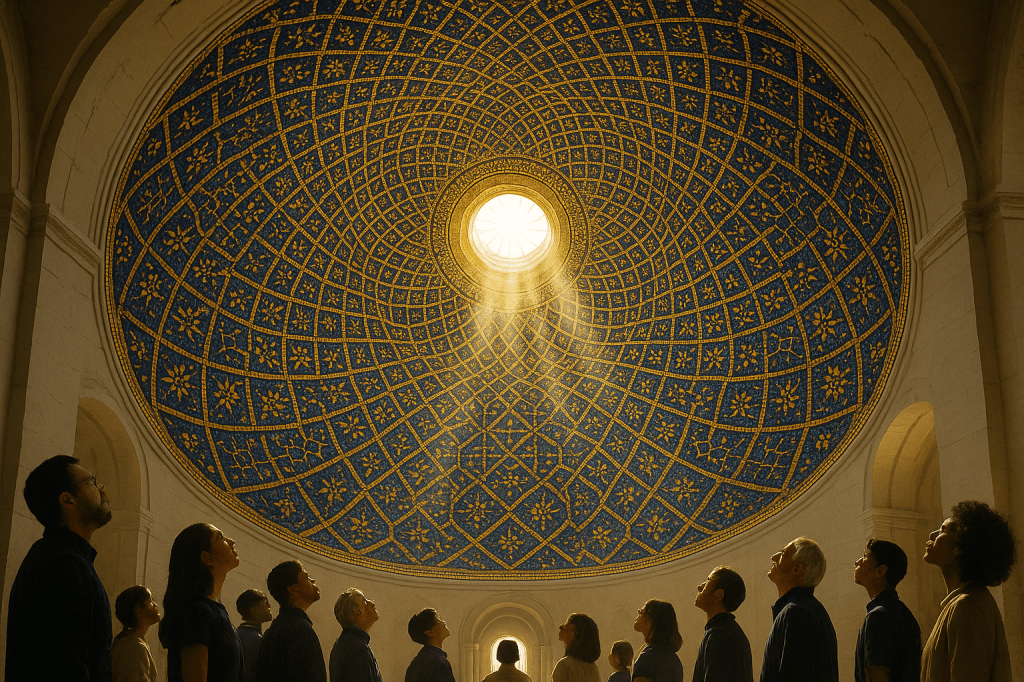
XVI. The Precedent God Never Set: Silence as Statement
Rashad Khalifa made a profound observation that deserves special emphasis: “If God wants to set a precedent for the subsequent generations, God would create a situation or circumstances that will force this issue and then we’ll have a precedent.” This is not merely an observation about prayer. It is a principle about how God operates. God is not passive. God is not absent. God is the active designer and administrator of the entire system of worship, and if He wanted a particular practice to be part of that system, He would have ensured it was established.
Consider the evidence. Across thousands of years — from Abraham to Muhammad to Rashad — God guided communities of believers through every conceivable circumstance. There were small communities. There were communities with few men. There were communities where women were the primary believers. There were communities in persecution, in war, in exile, in poverty, in isolation. And in not one of these communities, across all of these millennia, did God ever create the circumstances that would establish the precedent of a woman leading the Friday congregational prayer. The absence of this precedent is not an accident. It is God’s deliberate design.
[17:36] “You shall not accept any information, unless you verify it for yourself. I have given you the hearing, the eyesight, and the brain, and you are responsible for using them.”
When someone says “it should be permissible for women to lead Friday prayer,” verify it. Where is the Quranic authorization? Where is the Abrahamic precedent? Where is the messenger’s endorsement? If you cannot find verification for this claim in any of these sources — and you cannot — then you are responsible for rejecting it, no matter how reasonable it sounds, no matter how many people accept it, and no matter how socially costly the rejection may be.
XVII. The False Compassion Trap: When “Mercy” Becomes the Gateway to Innovation
Perhaps the most effective tool Satan uses to introduce innovations is the language of compassion. “Are you really going to tell these women they cannot worship God on Friday because no man showed up?” “Is it not more merciful to allow them to pray than to send them home?” “Does God really want people to miss their Friday prayer over a technicality?” These questions are designed to make adherence to God’s system sound cruel and innovation sound merciful. But this is a deception, because true mercy is God’s mercy — and God’s mercy is expressed through His system, not through our modifications of it.
[2:79] “Therefore, woe to those who distort the scripture with their own hands, then say, ‘This is what God has revealed,’ seeking a cheap material gain. Woe to them for such distortion, and woe to them for their illicit gains.”
The “cheap gain” in this verse is not always monetary. Sometimes it is social approval. Sometimes it is the comfort of avoiding a difficult conversation. Sometimes it is the emotional satisfaction of feeling progressive and compassionate. But whatever the gain, if it comes at the cost of distorting God’s system, it is illicit. The temporary emotional comfort of allowing an unauthorized practice is not worth the permanent damage of establishing a precedent that corrupts the religion for future generations.
Consider the legal parallel once more. In R v. R, the precedent of marital immunity from rape charges persisted for centuries partly because challenging it seemed socially disruptive. People rationalized it. They found ways to make it seem acceptable. They told themselves it served a purpose. And for hundreds of years, real human beings suffered because of a precedent that no one was willing to challenge. The same dynamic works in reverse with religious innovation: people rationalize it, find ways to make it seem acceptable, tell themselves it serves a purpose — and for generations afterward, the worship of God is corrupted because no one was willing to say “no” when the innovation was first introduced.

XVIII. Conclusion: Standing Firm When Standing Is Hardest
The doctrine of stare decisis teaches us something invaluable about human nature: we are creatures of precedent. We do what was done before. We follow what was established. We accept what is familiar. This tendency serves us well in many areas of life. But in religion, it is a double-edged sword. When the precedent is God’s precedent — established through His messengers, confirmed through His scripture, delivered through the chain of Abraham — following it is an act of submission. But when the precedent is a human innovation that was never authorized by God, following it is an act of idolatry disguised as tradition.
[46:9] “Say, ‘I am not different from other messengers. I have no idea what will happen to me or to you. I only follow what is revealed to me. I am no more than a profound warner.’”
Even God’s messengers follow only what is revealed. They do not innovate. They do not improvise. They do not adapt God’s religion to suit contemporary sensibilities. They follow revelation. And if the messengers of God did not claim the authority to modify the religion, what authority do we have?
[18:110] “Say, ‘I am no more than a human like you, being inspired that your god is one God. Those who hope to meet their Lord shall work righteousness, and never worship any other god beside his Lord.’”
We are human beings. We are not legislators of religion. We are not architects of worship. We are servants of the Most High, and our role is to submit — fully, completely, and without reservation — to the system He has designed. When we are tempted to modify that system, whether out of necessity, compassion, social pressure, or any other reason, we must remember that every corruption of divine religion in human history began with the same temptation. And we must choose, as the Quran commands, to follow what God has revealed rather than what seems reasonable to us.
[33:36] “No believing man or believing woman, if God and His messenger issue any command, has any choice regarding that command. Anyone who disobeys God and His messenger has gone far astray.”
The command has been issued. The messenger has spoken. The Quran is clear. The religion is complete. Let us not be the generation that introduces the innovation that becomes the next generation’s tradition that becomes the following generation’s unquestionable law. Let us not be the case that sets the precedent. Let us instead be the community that stood firm when standing was hardest, that followed God’s system when following was inconvenient, and that chose submission over innovation when the entire world was telling us to choose otherwise.
The legal world understands that precedent, once set, is almost impossible to overturn. Plessy v. Ferguson stood for fifty-eight years. Marital immunity from rape stood for centuries. The hadith system has stood for over a millennium. If we set the precedent of modifying God’s worship structure, who will overturn it? And at what cost? The answer is simple: do not set the precedent. Do not take the first step. Do not whisper the first “Why not?” Because once you do, stare decisis takes over, and the innovation becomes the law — and the law of human precedent will have replaced the law of God.

Written in service to God alone. All praise belongs to God, Lord of the universe.
Verse references from The Final Testament (authorized English translation by Rashad Khalifa, Ph.D.).
Rashad Khalifa’s teachings referenced from verified audio/video recordings.

 Quran Only Studies
Leave a comment