Introduction: The Most Important Exam You Will Ever Take
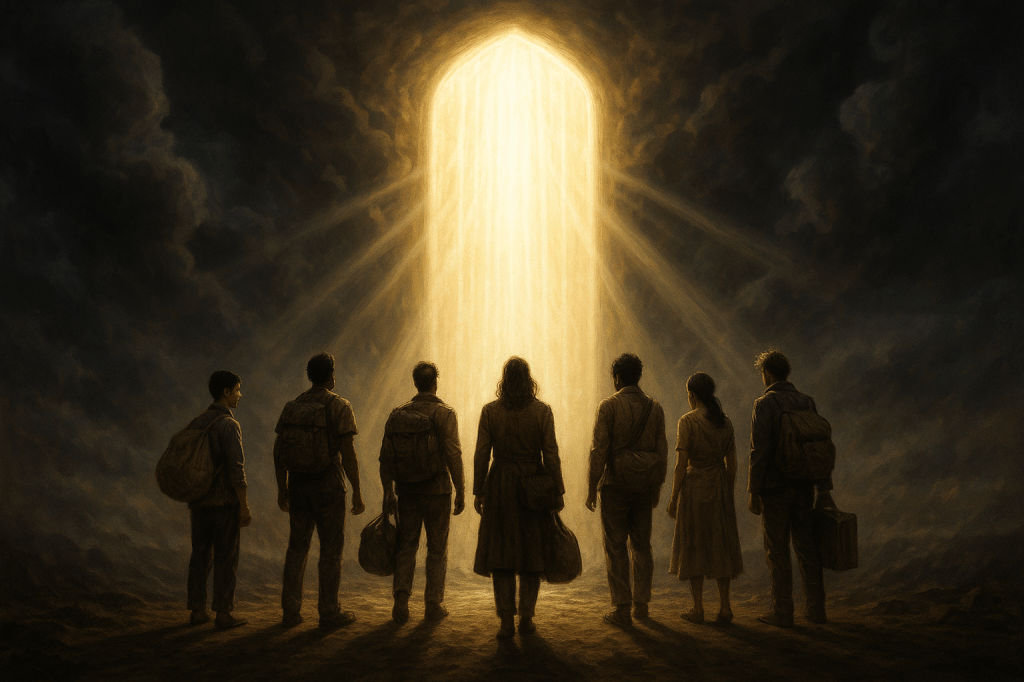
There is an exam you are taking right now. Not a written test, not a standardized assessment, not something with a proctor and a time limit — but an examination so comprehensive, so thorough, and so exacting that it tests the very core of what you claim to believe. This is the admission test into God’s kingdom, and every single human being must take it. There are no exemptions, no shortcuts, and no one who can take it on your behalf. The question is not whether you will be tested, but whether you will pass.
The Quran is unambiguous about this reality. Every person who claims to believe will be put to the test, and the test is designed to expose the difference between genuine conviction and mere lip service. God’s messenger Rashad Khalifa described this test as “very exacting” — a word chosen with precision. Exacting means demanding, rigorous, requiring great care and attention. It is not a casual quiz; it is the most important examination of your existence. Understanding what the test entails, how it operates, and what it demands from you is the difference between passing into God’s kingdom and failing catastrophically.
[29:2] “Do the people think that they will be left to say, ‘We believe,’ without being put to the test?”
This article will take you through the full architecture of God’s admission test. We will explore why we are here in the first place, the four types of calamities that befall human beings, the liberating truth that God is doing everything, the ontological nature of sin and evil, the staggering scale of creation across seven universes, and — most critically — the paradox of human agency versus divine sovereignty. The main purpose is to help you recognize that your agency, compared to God’s, is effectively non-existent, and that this realization is not a cause for despair but for profound liberation. When you truly understand that God is in control, you stop worrying and start living.
Part 1: The Cosmic Context — Why We Are Here
The Feud in the High Society
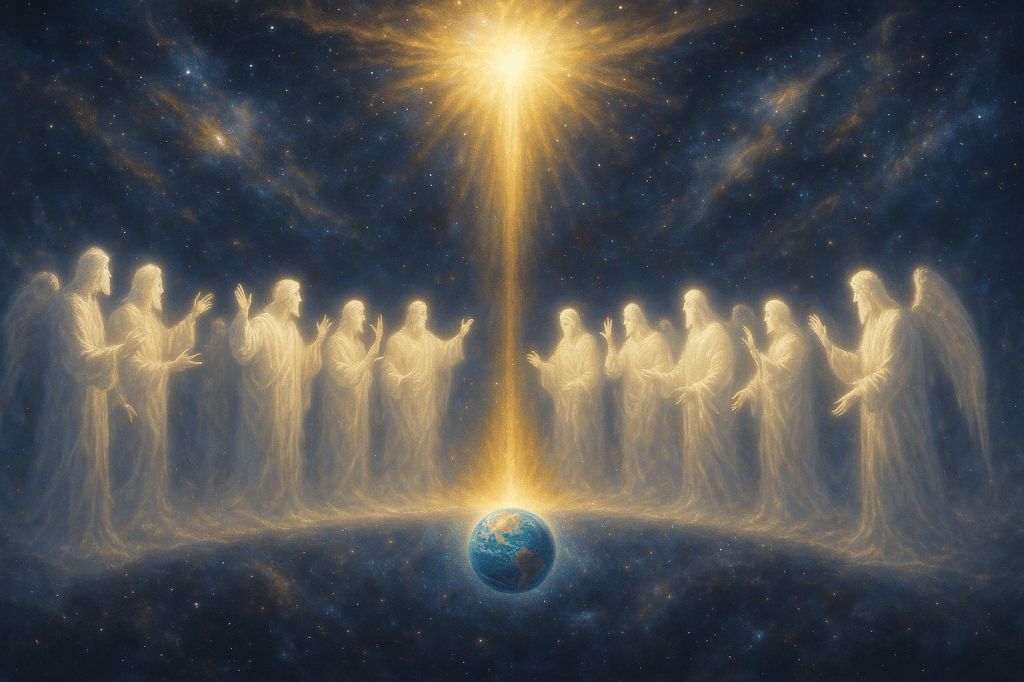
Before the heavens and the earth, before the mountains and the seas, before you and I drew breath — there was a dispute. The Quran calls it “the feud in the High Society,” and it is, without exaggeration, the single most important event in the history of every creature that has ever existed. Billions of years ago, God’s creatures — not yet classified as angels, humans, or jinns — were presented with a fundamental question: Do you accept God’s absolute authority? Some creatures, without hesitation, affirmed that God alone possesses all power and all authority. They became angels. One creature, however, challenged God’s absolute authority. That creature became Satan. And then there were the rest of us — the ones who failed to take a firm, unequivocal stand.
[38:69] “I had no knowledge previously, about the feud in the High Society.”
The footnote to this verse is devastating in its clarity: “The feud in the High Society was triggered by Satan’s challenge to God’s absolute authority. This is definitely the most important event in the history of the human race. We failed to make a firm stand regarding God’s absolute authority. This life represents the third and final chance to redeem ourselves.” We are not here by accident. We are not here for amusement. We are here because we committed a transgression so severe that it warranted exile from God’s kingdom. The messenger explained this with characteristic directness: “We committed a horrendous crime back billions of years ago, and this is why we are here, to redeem ourselves. The original sin is very much a fact, a Quranic fact. And it is not Adam eating from the tree either, it goes billions of years before that” (at 18:15).
[33:72] “We have offered the responsibility (freedom of choice) to the heavens and the earth, and the mountains, but they refused to bear it, and were afraid of it. But the human being accepted it; he was transgressing, ignorant.”
The responsibility here is freedom of choice — the ability to choose between God and everything else. The heavens, the earth, and the mountains refused it. They chose the safety of automatic submission to God’s will, and they are now perfectly content in their roles. But the human being, transgressing and ignorant, accepted it. We wanted independence. We wanted autonomy. And so God, in His infinite mercy, gave us exactly what we asked for — along with the opportunity to use that freedom to find our way back to Him.
God’s Mercy: A Second Chance
What happened after we failed to uphold God’s absolute authority is one of the most moving passages in Rashad Khalifa’s teachings. The angels, who had affirmed God’s authority without hesitation, looked at the rest of us and said, “Send them all to hell.” That was the angelic verdict. No test, no second chance, no planet earth, no seven universes — just immediate and permanent exile. But God, who describes Himself as the Most Gracious, Most Merciful, overruled the angels.
[2:30] “Recall that your Lord said to the angels, ‘I am placing a representative (a temporary god) on Earth.’ They said, ‘Will You place therein one who will spread evil therein and shed blood, while we sing Your praises, glorify You, and uphold Your absolute authority?’ He said, ‘I know what you do not know.’”
Rashad Khalifa elaborated: “If it were up to the angels, who believed in God’s absolute authority, we would be now in hell. There would be no test, no seven universes, no planet earth, it would be just hell. We would be dismissed from God’s kingdom. But God, who described himself as the most gracious, most merciful, said, I am giving them another chance to come to me. Do you think we should love God? Should we not love God for that? This is why we should love God” (at 7:00). This is the cosmic context in which your admission test takes place. You are not being tested arbitrarily. You are being given a chance — a merciful, gracious, extraordinary chance — to prove that you belong in God’s kingdom.
Part 2: The Four Types of Calamities
Only One Comes from God
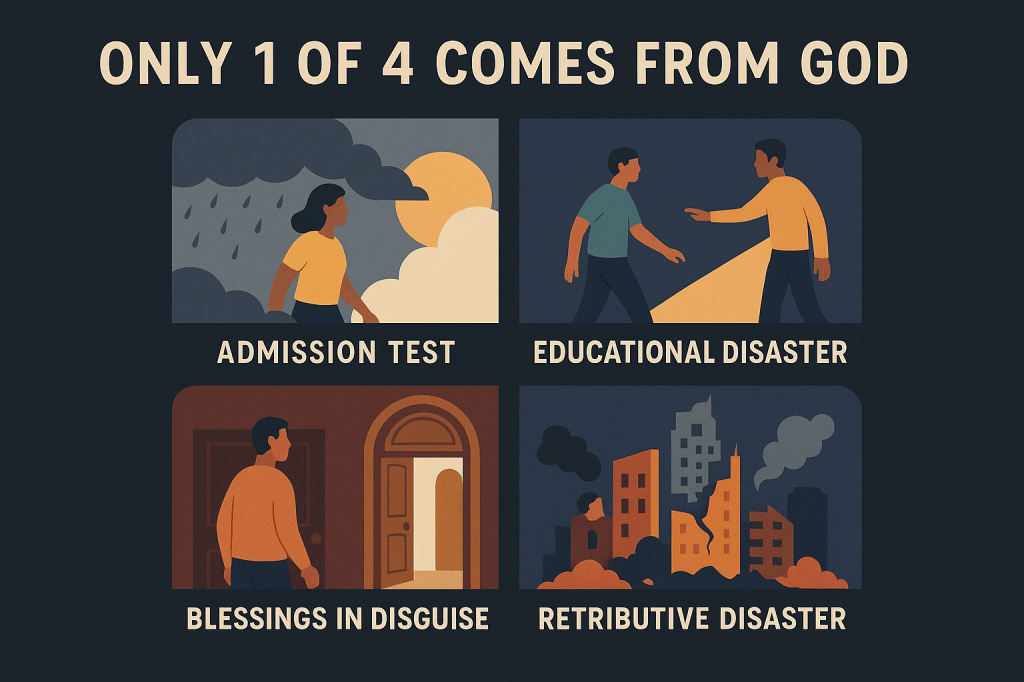
One of the most profound teachings from God’s messenger Rashad Khalifa is the classification of all disasters into four distinct types. This framework is essential for understanding the admission test because it answers the question that every human being asks when suffering strikes: “Why is this happening to me?” The answer depends entirely on which of the four types of disaster you are experiencing. Rashad explained in his landmark sermon: “God does not inflict any harm on his creation. There are four kinds of disasters” (at 42:00).
Here is the critical insight that most people miss: of these four types of disasters, only one is directly attributable to God. The other three are consequences of our own actions, Satan’s interference, or hidden blessings. Understanding this distinction transforms your relationship with suffering and fundamentally changes how you experience the admission test.
Type 1: Admission Tests
The first kind of disaster is the admission test itself. When you claim to believe that God alone is the Lord of the universe, that claim must be verified. You cannot simply say, “I believe,” and expect to be admitted into God’s kingdom without proof. The admission test is the mechanism by which your claim is put to trial. Rashad described it precisely: “When you or I claim that we believe that God alone is Lord of the universe without any idols, we must be put to the test. These admission tests are designed to show that we uphold this conviction solidly, unshakably, under all circumstances, rich or poor, health or sickness” (at 42:10).
A crucial characteristic of the admission test is that it does not leave permanent damage. It tests you thoroughly, sometimes painfully, but once you pass, you are admitted into God’s kingdom and the test is over. The test is also inflicted by Satan, not by God. God permits the test, sets its boundaries, and ensures it does not exceed what you can bear, but the actual adversity comes from Satan, who is eager to prove that your faith is hollow.
[2:155] “We will surely test you through some fear, hunger, and loss of money, lives, and crops. Give good news to the steadfast.”
[2:156] “When an affliction befalls them, they say, ‘We belong to God, and to Him we are returning.’”
[2:157] “These have deserved blessings from their Lord and mercy. These are the guided ones.”
Notice the progression: the test comes through fear, hunger, and loss. The response of the steadfast is not complaint but affirmation of God’s sovereignty. And the result is blessings, mercy, and guidance. The admission test is not punishment — it is the gateway to eternal happiness.
Type 2: Educational Disasters
The second type of disaster serves a corrective function. If you have already entered God’s kingdom but then begin to stray — perhaps through neglecting your prayers, forgetting God, or flirting with idolatry in subtle ways — you step outside of God’s protection. The moment you step out, Satan captures you, smites you, and gives you a problem. This disaster is your attention-getter. It alerts you that you have strayed from the path and need to return immediately.
Rashad explained the mechanism: “This is designed to bring us back into God’s kingdom if we sway out of God’s kingdom. If we make a mistake and step out of God’s kingdom, Satan captures you, smites you, gives you a problem, a disaster, and this will be your attention-getter. You will be alerted that you have stepped out of God’s kingdom, and you will come back fast. That is called educational disaster” (at 43:05). Like the admission test, educational disasters are inflicted by Satan, not God. They are a consequence of stepping outside the divine umbrella of protection.
Type 3: Blessings in Disguise
The third type of disaster appears catastrophic in the moment but reveals itself as a blessing in retrospect. You apply for a job and do not get it. You are devastated. But months later, you discover that the company went bankrupt, or that the position would have required you to compromise your principles, or that a far better opportunity was waiting for you. Rashad gave this very example: “You go apply for a job and you don’t get it, you flunk in the interview, and you’re very upset because you wanted that job, but later on you discover that with time you obtained a better job and that had you succeeded in getting that job it would have been much worse for you” (at 44:14).
[2:216] “Fighting may be imposed on you, even though you dislike it. But you may dislike something which is good for you, and you may like something which is bad for you. God knows while you do not know.”
This verse perfectly captures the nature of blessings in disguise. Our limited perspective makes it impossible to see the full picture. What looks like a disaster from our vantage point may be precisely the protection we needed from something far worse. God knows while we do not know.
Type 4: Retributive Disasters
The fourth and final type of disaster is the only kind directly attributable to God. Retributive disasters occur when an individual or a society reaches the point of corruption beyond reform — the point of no return. The example Rashad gave is Sodom and Gomorrah, where the people became so hopelessly trapped in their corruption that there was no possibility of redemption. At that point, God enacts the retributive disaster.
But even here, Rashad added a crucial nuance: “This is the only kind that you may attribute to God, but actually this ended their life, it was the final blow, and death is a fact of life as you know, everyone dies, so it is not really a disaster since it is the final act. Death is a fact of life; we all die, and that is not a disaster” (at 45:32). Even the one type of disaster attributable to God is, in essence, simply the acceleration of death — which is an inevitability for everyone. This means that in the truest sense, God does not inflict harm on His creation. The disasters we experience are overwhelmingly the result of our own choices and Satan’s interference within the boundaries God has set.
[4:147] “What will God gain from punishing you, if you became appreciative and believed? God is Appreciative, Omniscient.”
Part 3: “God is Doing Everything” — The Liberating Truth
The Most Misunderstood Attribute of God
If you want to truly understand the admission test — and more importantly, if you want to pass it — you must grapple with one of the most profound and frequently misunderstood attributes of God: He is doing everything. Not some things. Not most things. Everything. This is not a metaphor, not an exaggeration, and not a theological nicety. It is a fundamental quality of God without which belief in Him is incomplete.
[8:17] “It was not you who killed them; God is the One who killed them. It was not you who threw when you threw; God is the One who threw. But He thus gives the believers a chance to earn a lot of credit. God is Hearer, Omniscient.”
The footnote to this verse is explicit: “Believing in God necessitates believing in His qualities, one of which is that He is doing everything. Without knowing God, there is no belief.” This is a staggering statement. If you do not believe that God is doing everything, you do not truly believe in God. The messenger Rashad Khalifa reiterated this point repeatedly: “You do not really believe in God unless you know that He is doing everything. You make the initial decision, this is our role, we make a decision to be with God or not” (at 0:15).
This teaching connects directly to the admission test because the test is designed to verify precisely this: Do you truly believe that God is in control of everything? When you lose your job, do you panic or do you trust? When illness strikes, do you despair or do you submit? When relationships fall apart, do you blame or do you recognize God’s hand? The admission test probes the depth of your conviction that God is doing everything — not just the pleasant things, but everything.
The Paradox of Consequences
If God is doing everything, then how can bad things be consequences of our own deeds? The Quran addresses this apparent paradox head-on:
[4:78] “Wherever you are, death will catch up with you, even if you live in formidable castles. When something good happens to them, they say, ‘This is from God,’ and when something bad afflicts them, they blame you. Say, ‘Everything comes from God.’ Why do these people misunderstand almost everything?”
[4:79] “Anything good that happens to you is from God, and anything bad that happens to you is from you. We have sent you as a messenger to the people, and God suffices as witness.”
The footnote to 4:78 resolves the paradox with a brilliant analogy: “Bad things are consequences of our own deeds (42:30, 64:11), though God is the doer of everything (8:17). God created the fire to serve us, but you can decide to put your finger in it. We thus hurt ourselves. It is God’s law that if you put your finger in the fire, it will hurt.” God created the laws. God sustains the laws. God is the ultimate cause of everything within the system. But within that system, you have the freedom to put your finger in the fire or to keep it away. The pain is a consequence of your choice, operating within God’s laws. Both statements are simultaneously true: God is doing everything (because He set up and sustains the system), and bad things are from you (because you chose the action within that system).
[42:30] “Anything bad that happens to you is a consequence of your own deeds, and He overlooks many (of your sins).”
[10:44] “God never wrongs the people; it is the people who wrong their own souls.”
Part 4: The Ontological Nature of Sin
Sin as Absence, Not Substance
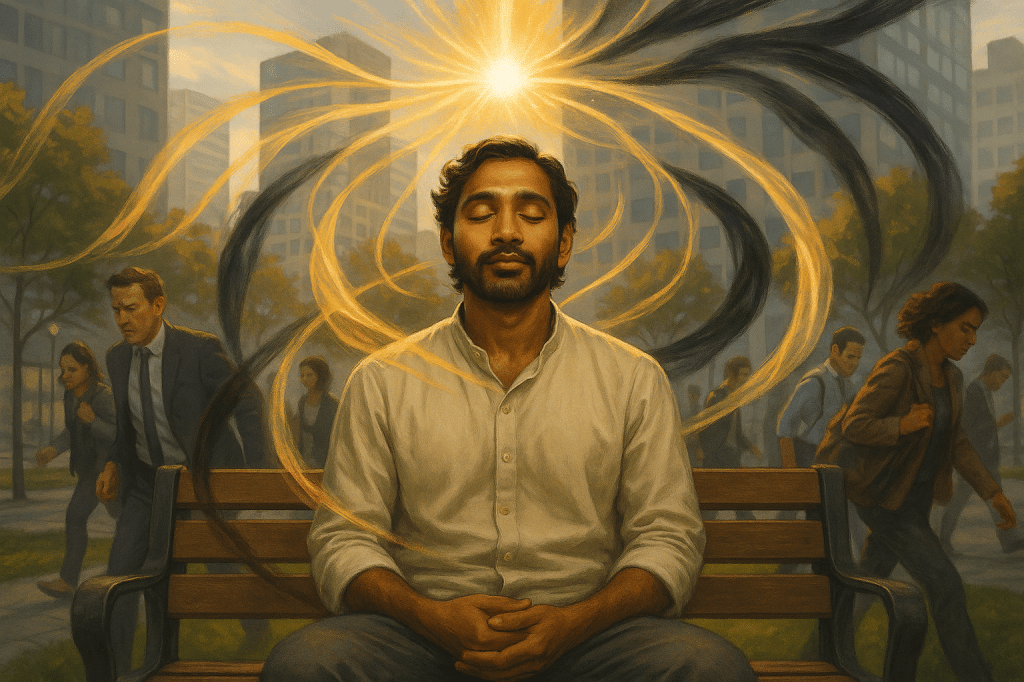
To fully understand the admission test and its stakes, we must understand the nature of what we are being tested against. What is sin? What is evil? The common misconception is that evil is a “thing” — a force, a substance, a creation that exists independently and opposes God. But the Quran reveals a far more profound truth: evil is not a thing at all. It is the absence of something. Specifically, it is the absence of God’s light.
[6:1] “Praise be to God, who created the heavens and the earth, and made the darkness and the light. Yet, those who disbelieve in their Lord continue to deviate.”
Notice the asymmetry in this verse. God created the heavens and the earth — these are positive creations, things that exist. He also “made the darkness and the light.” But darkness is not a thing. Darkness is the absence of light. You cannot create a beam of darkness and project it into a room. You cannot bottle darkness and pour it out. Darkness exists only insofar as light is absent. This is not a philosophical abstraction; it is a physical fact that directly mirrors the spiritual reality. Sin, evil, and suffering exist only insofar as God’s light — His guidance, His mercy, His presence — is absent from a soul or a situation.
[24:35] “God is the light of the heavens and the earth. The allegory of His light is that of a concave mirror behind a lamp that is placed inside a glass container. The glass container is like a bright, pearl-like star. The fuel thereof is supplied from a blessed oil-producing tree, that is neither eastern, nor western. Its oil is almost self-radiating; needs no fire to ignite it. Light upon light. God guides to His light whomever He wills. God thus cites the parables for the people. God is fully aware of all things.”
God is not “a” light. God is “the” light. The definitive, singular, ultimate source of all illumination, both physical and spiritual. When a soul turns away from this light, it does not encounter some opposing force called “evil.” It simply enters the absence of light — darkness. The deeper it moves away from God, the darker its existence becomes. This is why hell is described in terms of darkness, and paradise in terms of light.
The Moral Implications
[2:257] “God is Lord of those who believe; He leads them out of darkness into the light. As for those who disbelieve, their lords are their idols; they lead them out of the light into darkness — these will be the dwellers of Hell; they abide in it forever.”
The directional language here is striking. God leads believers FROM darkness TO light. Idols lead disbelievers FROM light TO darkness. The movement is in opposite directions, and the destination is determined by your choice of lord. Choose God, and you move toward light. Choose anything else — money, status, tradition, ego, another human being — and you move toward darkness. Not because God punishes you, but because you have turned your back on the only source of light that exists.
[91:8] “Then showed it what is evil and what is good.”
[91:9] “Successful is one who redeems it.”
[91:10] “Failing is one who neglects it.”
God showed every soul the two paths. The choice is yours. The admission test does not determine your path for you — it reveals which path you have already chosen. Success means redeeming your soul by turning toward the light. Failure means neglecting your soul by allowing the darkness to persist.
[90:10] “Did we not show him the two paths?”
Part 5: Hell’s Darkness — The Absence of the Divine
What Hell Really Is
Understanding sin as the absence of God’s light leads directly to understanding what hell really is. Hell is not primarily a place of fire (though fire is used as an allegory). Hell is not a torture chamber designed by a vindictive deity. Hell is, in its most fundamental essence, the complete absence of God. And since God is the source of everything good — light, sustenance, peace, health, joy — the absence of God is the absence of everything good.
[19:71] “Every single one of you must see it; this is an irrevocable decision of your Lord.”
[19:72] “Then we rescue the righteous, and leave the transgressors in it, humiliated.”
The footnote to 19:71 reveals the deeper meaning: “We will be resurrected prior to God’s physical arrival to our universe. That will be a temporary taste of Hell, since the absence of God is Hell. When God comes, the righteous will be rescued.” This is the definition of hell — not an externally imposed torture, but the natural, inevitable consequence of existing without God. Rashad Khalifa taught this with remarkable clarity: “The definition of hell is simply the absence of God. If God is not here, this is hell” (at 9:00).
This World: A Halfway House
If hell is the absence of God, then what is this world? Rashad Khalifa described it as a “halfway house” between heaven and hell: “This is a mild hell, because God did not completely throw us into hell. It is a halfway house. For example, God provides. In the real hell, God will not provide” (at 10:17). This perspective transforms how you view every difficulty you face. Yes, there is suffering in this world — but it is a mild version of what complete separation from God would entail. God still provides. The sun still rises. Food still grows. There is still beauty, still love, still laughter. All of these are provisions from God, offered even to those who reject Him, as part of the test.
[16:61] “If God punished the people for their transgressions, He would have annihilated every creature on earth. But He respites them for a specific, predetermined time. Once their interim ends, they cannot delay it by one hour, nor advance it.”
This verse reveals the incredible restraint and mercy of God. If He punished every transgression immediately, nothing would survive. Instead, He gives us time — a respite, a chance, a window of opportunity to repent, to grow, to pass the admission test. The provisions we enjoy in this halfway house are evidence of God’s mercy, not proof that everything is fine. The test is ongoing, and the provisions are there to sustain you while you take it.

Part 6: Seven Universes, Seven Sets of Laws
The Scale of Creation
To appreciate the magnitude of God’s plan and the insignificance of our limited perspective, we must consider the staggering scale of creation. Our universe — the one containing billions of galaxies, each with billions of stars, spanning distances so vast that light itself takes billions of years to traverse them — is the smallest and innermost of seven universes. Let that sink in. Everything we have ever observed, every galaxy, every star, every planet, every atom, exists within what amounts to the innermost shell of a seven-layered cosmic structure.
[65:12] “God created seven universes and the same number of earths. The commands flow among them. This is to let you know that God is Omnipotent, and that God is fully aware of all things.”
[67:3] “He created seven universes in layers. You do not see any imperfection in the creation by the Most Gracious. Keep looking; do you see any flaw?”
[2:29] “He is the One who created for you everything on earth, then turned to the sky and perfected seven universes therein, and He is fully aware of all things.”
The footnote to 2:29 states: “Our universe with its billion galaxies, spanning distances of billions of light years, is the smallest and innermost of seven universes.” We exist in the smallest room of a mansion we cannot even begin to fathom. And each of these seven universes operates according to its own distinct set of laws.
Different Laws for Different Universes
[41:12] “Thus, He completed the seven universes in two days, and set up the laws for every universe. And we adorned the lowest universe with lamps, and placed guards around it. Such is the design of the Almighty, the Omniscient.”
This verse contains a revelation that should stop every human being in their tracks: God “set up the laws for every universe.” Not one set of laws for all seven — distinct laws for each. The physics we know, the mathematics we rely on, the very fabric of spacetime as we understand it — these are the laws of our universe alone. The other six universes operate under different laws, laws we cannot even conceive of, let alone understand.
The footnote to 41:12 adds another dimension: “Our universe cannot stand the physical presence of God.” This means the laws governing our universe are specifically calibrated to exist without God’s physical presence. The other universes, with their different laws, may have entirely different relationships to the Divine. We cannot know, we cannot imagine, and we cannot test these possibilities. This is why the admission test fundamentally requires trust — because we are operating within a system whose full architecture is beyond our comprehension.
[67:4] “Look again and again; your eyes will come back stumped and conquered.”
Part 7: Beyond Comprehension — The Limits of Human Understanding
The Ten Dimensions and Our Cognitive Limitations
To illustrate just how limited our understanding truly is, consider the concept of dimensions. We live in three spatial dimensions (length, width, height) and experience one temporal dimension (time), for a total of four dimensions. Theoretical physicists and mathematicians have described models of reality that extend to ten dimensions. The progression reveals how utterly incapable we are of grasping even the fourth dimension fully, let alone the higher ones.
Start with a point — zero dimensions. Many points make a line — one dimension. From a one-dimensional line, other lines create a plane — two dimensions. From the second dimension, the third dimension is what you would jump through to instantaneously move from one position to another. Many planes make a space — three dimensions. Many frames of space make a world line — four dimensions. Already, at the fourth dimension, our intuitive understanding begins to fail. We experience time, but we cannot see it, navigate it freely, or perceive it the way we perceive length and width.
But the progression continues relentlessly. The fifth dimension represents probability planes — all possible outcomes from a single point in your four-dimensional world line. The sixth dimension allows jumping between probability planes. The seventh dimension creates lines of different unique universes. The eighth dimension creates phase planes of physical universes. The ninth dimension is an information space beyond the physical entirely, dealing only with patterns and tendencies. And the tenth dimension is the single, timeless, ultimate ensemble — everything, all possibilities, all information, in one point.
The Quran tells us God created seven universes, each with its own laws. If we can barely conceive of the fourth dimension — time, which we experience every second of every day — how can we possibly understand the laws governing entirely different universes? How can we presume to know what is best for us, what is fair, what is just, when we cannot even perceive the full structure of the reality we inhabit? This is not a call to ignorance but a call to humility. The admission test requires you to trust a God whose knowledge infinitely exceeds your own.
[6:59] “With Him are the keys to all secrets; none knows them except He. He knows everything on land and in the sea. Not a leaf falls without His knowledge. Nor is there a grain in the depths of the soil. Nor is there anything wet or dry, that is not recorded in a profound record.”
[50:16] “We created the human, and we know what he whispers to himself. We are closer to him than his jugular vein.”
A God who knows what you whisper to yourself, who is closer to you than your own jugular vein, who tracks every leaf that falls and every grain in the soil — this is the God who designed your admission test. Do you trust His design, or do you trust your own judgment, which cannot even perceive the fourth dimension properly?

Part 8: Human Agency — Effectively Non-Existent
The Verse That Changed Everything
We now arrive at the central thesis of this article. If God is doing everything, if He created seven universes each with its own laws, if He knows what we whisper to ourselves and is closer to us than our jugular vein — then what is human agency? The answer, when you confront it honestly, is simultaneously terrifying and liberating: our agency, compared to God’s, is effectively non-existent.
[8:17] “It was not you who killed them; God is the One who killed them. It was not you who threw when you threw; God is the One who threw. But He thus gives the believers a chance to earn a lot of credit. God is Hearer, Omniscient.”
Read that again. “It was not you who threw when you threw; God is the One who threw.” You performed the physical action of throwing. Your muscles contracted, your arm moved, the projectile left your hand. And yet, God says it was not you who threw. God was the One who threw. This is not a denial of your experience — you did throw. It is a revelation about the nature of agency itself. Your action occurred within God’s system, sustained by God’s power, governed by God’s laws, and directed by God’s will. Your contribution to the action, compared to God’s, is so infinitesimally small as to be effectively non-existent.
This is not a comfortable teaching. It demands that you relinquish the illusion of control that your ego clings to. But it is the truth, and the admission test is specifically designed to verify whether you believe it.
The Misunderstood Verse: 22:15
One of the most dramatic examples of how badly human translators can distort God’s message is found in the translation of verse 22:15. Rashad Khalifa revealed that this verse was “translated unanimously in all the other translations as: If you don’t believe that God can help you in this world and forever, hang yourself” (at 1:21:29). Every other translator rendered it as an instruction to commit suicide — a command that directly contradicts God’s law against taking any life, including your own.
[22:15] “If anyone thinks that God cannot support him in this life and in the Hereafter, let him turn completely to (his Creator in) heaven, and sever (his dependence on anyone else). He will then see that this plan eliminates anything that bothers him.”
The correct translation is not “hang yourself” but “turn completely to your Creator in heaven and sever your dependence on anyone else.” This is the opposite of despair — it is the prescription for liberation. When you sever your dependence on everything and everyone except God, you discover that this plan — God’s plan — eliminates anything that bothers you. The problems do not necessarily disappear, but your relationship to them transforms completely. You stop being a victim of circumstance and become a witness to God’s perfect management of your life.
This is directly relevant to the admission test because the test is designed to push you to exactly this point: the point where you either turn completely to God or break. The test is exacting precisely because it must reach deep enough to verify whether your dependence on God is genuine or whether you still maintain backup plans, safety nets, and contingencies that involve other than God.

Part 9: The Paradox Resolved — Freedom Within Sovereignty
How Both Can Be True
The apparent contradiction between God doing everything and humans having free will is not a contradiction at all — it is a paradox that resolves beautifully once you understand the framework. God created the system. God sustains the system. God set up the laws within the system. Within that system, you have a genuine but infinitesimally small degree of freedom: the freedom to choose God or to choose other than God. This one choice — and the countless micro-choices that flow from it — is the entirety of your agency.
[3:154] “…Say, ‘Everything is up to God.’ They concealed inside themselves what they did not reveal to you. They said, ‘If it was up to us, none of us would have been killed in this battle.’ Say, ‘Had you stayed in your homes, those destined to be killed would have crawled into their death beds.’ God thus puts you to the test to bring out your true convictions, and to test what is in your hearts. God is fully aware of the innermost thoughts.”
This verse contains one of the most powerful statements in the entire Quran about the nature of destiny: “Had you stayed in your homes, those destined to be killed would have crawled into their death beds.” Your choices feel significant — and in the context of your admission test, they are. But in the context of God’s plan, the outcomes were already determined. Those who were destined to die would have found their way to death regardless of the choices they made. This is not fatalism; it is an acknowledgment of God’s total sovereignty operating simultaneously with human freedom of choice.
[57:22] “Anything that happens on earth, or to you, has already been recorded, even before the creation. This is easy for God to do.”
[57:23] “Thus, you should not grieve over anything you miss, nor be proud of anything He has bestowed upon you. God does not love those who are boastful, proud.”
The footnote to 57:22 adds: “We are absolutely free to side with God, or with Satan. God happens to know precisely what kind of decision each of us will make. The video tape of your life, from birth to death, is already recorded.” You are free — genuinely free — to make your choice. But God already knows what that choice will be. The recording already exists. This does not eliminate your freedom; it reveals the omniscience of God. You choose freely, and God knows freely what you will choose. Both are simultaneously true.
Why This Is Liberating
Here is where the teaching becomes not merely intellectually satisfying but emotionally transformative. If God is doing everything, if everything that happens has already been recorded, if God knows precisely what will occur — then what exactly are you worried about? The admission test pushes you to a breaking point specifically so that you can reach this realization: there is nothing to worry about.
[9:51] “Say, ‘Nothing happens to us, except what God has decreed for us. He is our Lord and Master. In God the believers shall trust.’”
[64:11] “Nothing happens to you except in accordance with God’s will. Anyone who believes in God, He will guide his heart. God is fully aware of all things.”
When you internalize these verses — not as intellectual propositions but as lived reality — something extraordinary happens. The anxiety dissolves. The fear recedes. The frantic need to control outcomes evaporates. You realize that you have been trying to steer a ship that was already being steered by the Creator of the ocean, the wind, and the ship itself. Your job is not to steer. Your job is to trust the One who steers.
[10:107] “If God touches you with a hardship, none can relieve it except He. And when He blesses you, no force can prevent His grace. He bestows it upon whomever He chooses from among His servants. He is the Forgiver, Most Merciful.”

Part 10: How the Admission Test Works
The Mechanics of Testing
Now that we understand the cosmic context, the nature of disasters, God’s sovereignty, and the paradox of agency, we can examine how the admission test actually operates in practice. Rashad Khalifa provided the clearest possible description: “You have to realize that there is an admission test. And the admission test is very exacting. Very exacting. It’s usually in the first five years after you claim that you’ve come to worship God alone. Doesn’t mean it will last five years. Don’t be scared. It comes within that period. If you’re proven to be a total submitter completely, in the first month, then it is over. But you must realize it happens and all the while you’re in God’s hands” (at 10:05).
Several key points emerge from this teaching. First, the test is exacting — it is not easy, not gentle, and not superficial. It is designed to probe the deepest levels of your conviction. Second, it typically occurs within the first five years of claiming to worship God alone, though it can be resolved much sooner if your submission is genuine and complete. Third, and most importantly, the entire time you are being tested, you are in God’s hands. The test is supervised. It is bounded. It will not destroy you unless you choose to abandon God during it.
[47:31] “We will certainly put you to the test, in order to distinguish those among you who strive, and steadfastly persevere. We must expose your true qualities.”
[3:186] “You will certainly be tested, through your money and your lives, and you will hear from those who received the scripture, and from the idol worshipers, a lot of insult. If you steadfastly persevere and lead a righteous life, this will prove the strength of your faith.”
The footnote to 3:186 contains the promise: “After passing the admission tests, the proven worshipers of God ALONE enjoy a perfect life, now and forever.” This is the reward. After the test is passed, you enjoy a perfect life — not in some distant afterlife only, but now and forever. The admission test is the gateway, and what lies beyond it is worth every moment of difficulty you endure.
What the Test Looks Like
The Quran specifies the categories through which you will be tested: fear, hunger, loss of money, loss of lives, and loss of crops (provisions). These are not abstract — they are concrete, visceral, and deeply personal. You may lose your job. Your health may suffer. Relationships may break. Financial security may vanish. Family members may turn against you. Each of these is designed to answer one question: Do you still trust God?
[21:35] “Every soul will taste death, after we put you to the test through adversity and prosperity, then to us you ultimately return.”
Notice that the test comes through both adversity AND prosperity. Being rich is as much a test as being poor. Success can be as dangerous as failure if it leads to arrogance, complacency, or forgetting God. The test is comprehensive — it probes your response to good fortune just as thoroughly as it probes your response to hardship. Rashad gave a vivid example of someone undergoing the test: “He temporarily lost his wife, his kids, his cars, his computers. And he’s very tearful as you see. It’s all temporary.” The key word is “temporarily.” The admission test does not leave permanent damage. It shakes you, tests you, pushes you to your limits — and then, if you pass, everything is restored and elevated.
[76:2] “We created the human from a liquid mixture, from two parents, in order to test him. Thus, we made him a hearer and a seer.”
[23:115] “Did you think that we created you in vain; that you were not to be returned to us?”
Part 11: Practical Guide — How to Pass the Admission Test
Step 1: Recognize God’s Sovereignty Over Everything
The first and most fundamental step is to internalize the truth that God controls everything. Not some things. Not most things. Everything. Every leaf that falls, every grain in the soil, every breath you take, every heartbeat — all of it is under God’s direct control. This is not a belief you hold in your head; it must be a reality you carry in your heart.
[10:61] “You do not get into any situation, nor do you recite any Quran, nor do you do anything, without us being witnesses thereof as you do it. Not even an atom’s weight is out of your Lord’s control, be it in the heavens or the earth. Nor is there anything smaller than an atom, or larger, that is not recorded in a profound record.”
[36:82] “All He needs to do to carry out any command is say to it, ‘Be,’ and it is.”
To pass the admission test, you must reach a point where this knowledge is not merely intellectual but experiential. When difficulty strikes, your first response should not be panic or complaint but recognition: “God is in control. This is happening for a reason. I trust God’s plan.” This is not passive resignation — it is active trust. It is the hardest thing a human being can do, and that is precisely why the test is exacting.
Step 2: Maintain Conviction Under All Circumstances
The test is designed to verify that your conviction holds up under pressure. It is easy to believe in God when everything is going well. The admission test strips away the comfort and asks: Do you still believe? Do you still trust? Do you still worship God alone when your money is gone, your health is failing, and the people you love are turning against you?
[2:214] “Do you expect to enter Paradise without being tested like those before you? They were tested with hardship and adversity, and were shaken up, until the messenger and those who believed with him said, ‘Where is God’s victory?’ God’s victory is near.”
The people in this verse were “shaken up” — not mildly inconvenienced, not slightly troubled, but shaken to their core. They reached the point of crying out, “Where is God’s victory?” And the answer came immediately: “God’s victory is near.” The test pushes you to the edge specifically because it is at the edge that your true conviction is revealed. If you hold firm at the edge, you pass. If you break, you were not ready.
Step 3: Do Not Believe “Just in Case”
Rashad Khalifa addressed this critical point with one of his most memorable teachings. He described the common argument: “If you don’t believe in God and there is a day of judgment, you will be in deep trouble. But if you believe in God and there is no God, you’ve got nothing to lose.” Then he demolished it: “I am here to tell you that it doesn’t work that way. You cannot believe in God just in case there is a God. The only way is to reach deep, solid, unshakable conviction about God. Not only that God exists, but also that God is the only Lord of the universe, that there is no idol, no other God besides Him” (at 47:16).
This is why the admission test exists. A “just in case” faith collapses at the first sign of real adversity. The test is designed to distinguish between those who have reached deep, solid conviction and those who are hedging their bets. God does not need your belief. God gains nothing from it. The belief is for you, and it must be genuine.
Step 4: Do Not Grieve Over What You Miss or Boast About What You Get
[57:22] “Anything that happens on earth, or to you, has already been recorded, even before the creation. This is easy for God to do.”
[57:23] “Thus, you should not grieve over anything you miss, nor be proud of anything He has bestowed upon you. God does not love those who are boastful, proud.”
These two verses contain the practical formula for passing the admission test. Since everything has already been recorded before the creation, your grieving will not change the outcome, and your pride did not cause it. When you lose something, recognize that the loss was recorded before you were born. When you gain something, recognize that the gain was also recorded before you were born. Your response to both should be the same: gratitude to God, trust in God’s plan, and steadfast perseverance on God’s path. The admission test measures your response to events, not the events themselves. How you react when things go wrong is infinitely more important than what goes wrong.
Step 5: Seek God’s Kingship and Let Everything Else Follow
[40:68] “He is the only One who controls life and death. To have anything done, He simply says to it, ‘Be,’ and it is.”
[51:56] “I did not create the jinns and the humans except to worship Me alone.”
The purpose of your creation is singular: to worship God alone. Not to accumulate wealth, not to build empires, not to achieve fame, not to maximize pleasure — but to worship God alone. When you align your life with this purpose, everything else falls into place. The messenger taught that you should “seek God’s kingship over you and everything else follows. Everything else is fixed for you.” The admission test verifies whether you have genuinely placed God’s kingship above all else, or whether you are still clinging to worldly priorities while paying lip service to God.

Part 12: The Evidence All Around You
Why the Universe Points to Trust
The admission test does not require blind faith. God has embedded evidence of His sovereignty, His mercy, and His meticulous control throughout creation. Modern science — far from undermining faith — continues to reveal the astonishing precision with which the universe has been designed.
Consider the fine-tuning of physical constants. The cosmological constant, which governs the expansion rate of the universe, is fine-tuned to approximately 1 part in 10^120. If it were even slightly different, the universe would either have expanded so rapidly that no structures could form, or collapsed back on itself before any stars could ignite (Source: Reviews of Modern Physics, Vol. 61, 1989). The strong nuclear force, which holds atomic nuclei together, is calibrated with similarly astonishing precision. Change it by as little as 2%, and protons could not form, chemistry would not exist, and life would be impossible (Source: Martin Rees, “Just Six Numbers,” 1999).
[67:3] “He created seven universes in layers. You do not see any imperfection in the creation by the Most Gracious. Keep looking; do you see any flaw?”
[67:4] “Look again and again; your eyes will come back stumped and conquered.”
The more you look, the more precision you find. The more you investigate, the more evidence of design you encounter. The universe is not a random accident — it is a meticulously calibrated creation by a God who is “fully aware of all things.” When you are in the midst of the admission test and everything seems to be falling apart, look at the universe. Look at the constants. Look at the laws. The same God who calibrated the cosmological constant to 1 part in 10^120 is the God who designed your test. If He can be trusted with the expansion rate of the universe, He can be trusted with your life.
The Neuroscience of Surrender
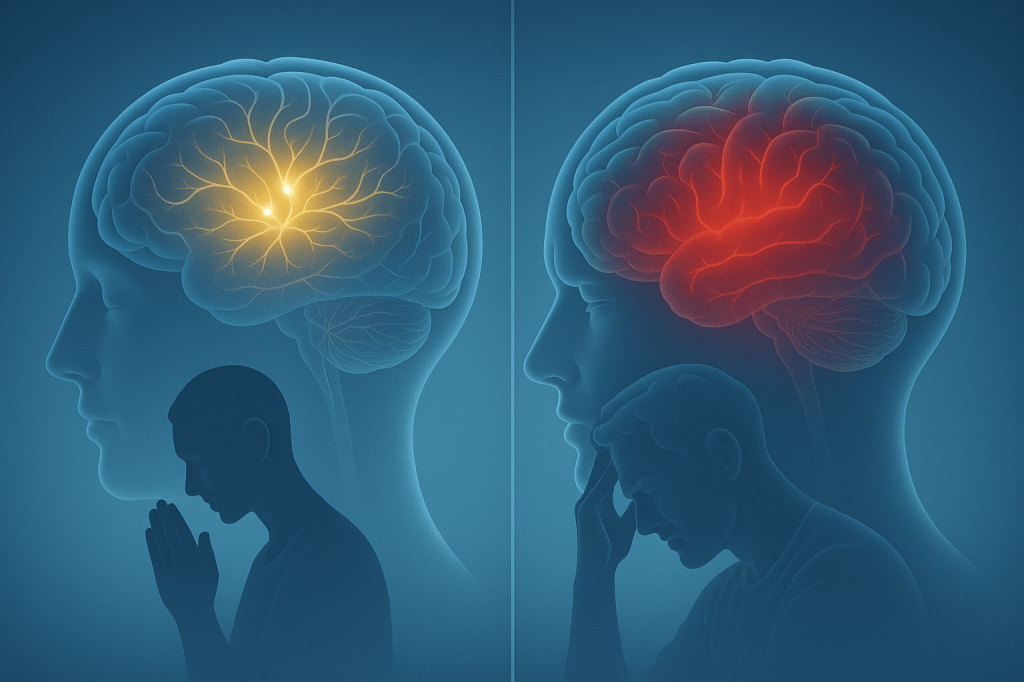
Modern neuroscience has confirmed what the Quran has taught for over 1,400 years: surrendering to a higher power reduces anxiety, activates the prefrontal cortex, and triggers the release of calming neurochemicals. A comprehensive meta-analysis published in JAMA Psychiatry found that individuals with strong religious commitment had significantly lower rates of depression, anxiety, and substance abuse (Source: JAMA Psychiatry, 2021). Researchers at the University of Pennsylvania’s Center for Neurotheology found that prayer and meditation practices activate the prefrontal cortex and produce measurable increases in serotonin and dopamine (Source: Andrew Newberg, “Neurotheology,” Frontiers in Psychology, 2018).
This is not coincidental. The Quran explicitly teaches that the remembrance of God is the mechanism by which hearts find peace. When you trust God during the admission test, your brain literally functions better. When you panic and try to control outcomes yourself, your brain floods with cortisol and adrenaline, impairing your judgment and increasing your suffering. The test is designed so that the correct response — trust in God — is also the response that minimizes your suffering. God’s system is perfectly integrated: the right spiritual response produces the right neurological outcome.
[38:27] “We did not create the heaven and the earth, and everything between them, in vain. Such is the thinking of those who disbelieve. Therefore, woe to those who disbelieve; they will suffer in Hell.”
Part 13: The Exacting Standard
Why “Exacting” Is the Perfect Word
Rashad Khalifa used the word “exacting” deliberately. An exacting test is one that demands precision, thoroughness, and unwavering commitment. It does not grade on a curve. It does not accept half-measures. It does not let you pass with 60% — it requires 100% conviction that God alone is Lord, 100% of the time, under 100% of circumstances.
[67:2] “The One who created death and life for the purpose of distinguishing those among you who would do better. He is the Almighty, the Forgiving.”
The purpose of death and life — all of it, every breath, every heartbeat, every joy and every sorrow — is to distinguish those who would “do better.” Not those who merely believe in their heads but those who demonstrate that belief through their actions and reactions under pressure. The admission test is the mechanism of distinction. It separates those who truly worship God alone from those who worship God plus their ego, their wealth, their status, their family, or their comfort.
Rashad emphasized the seriousness: “The test is very tough.” He was not trying to frighten people; he was preparing them. If you expect the test to be easy, you will be blindsided when it arrives. If you know in advance that it will be exacting — that it will push you to your limits and beyond — you can prepare your heart, your mind, and your soul. And the preparation itself is part of the test: Do you take God’s warnings seriously, or do you dismiss them as exaggeration?
[30:41] “Disasters have spread throughout the land and sea, because of what the people have committed. He thus lets them taste the consequences of some of their works, that they may return (to the right works).”
The Timeline of Testing
Rashad mentioned that the admission test typically occurs within the first five years after a person claims to worship God alone. This is not an arbitrary timeframe; it reflects the nature of genuine transformation. When someone first commits to worshipping God alone, the initial enthusiasm is high. Everything feels new, powerful, and clear. But enthusiasm is not conviction. The test comes to verify whether the commitment survives after the initial excitement fades — after the novelty wears off, after the difficulties accumulate, after the people around you challenge or mock your beliefs.
The good news, as Rashad explicitly stated, is that the test can be resolved quickly: “If you’re proven to be a total submitter completely, in the first month, then it is over.” The duration of the test is not fixed. It is proportional to how quickly you demonstrate genuine, unshakable conviction. Some people pass in weeks. Others struggle for years. The variable is not God’s cruelty but the depth and sincerity of the individual’s submission.
[7:179] “We have committed to Hell multitudes of jinns and humans. They have minds with which they do not understand, eyes with which they do not see, and ears with which they do not hear. They are like animals; no, they are far worse — they are totally unaware.”
The contrast could not be starker. Those who pass the test gain a perfect life, now and forever. Those who fail are described as worse than animals — not because God demeans them, but because they possessed the faculties to understand, to see, and to hear, and chose not to use them. They had every opportunity, every provision, every chance — and they squandered it all by refusing to trust the One who created them.
Conclusion: Surrender as Liberation
The admission test into God’s kingdom is the most important challenge you will ever face. It is exacting because it must be. A kingdom governed by the Creator of seven universes, the Knower of all secrets, the Controller of every atom — such a kingdom cannot admit residents who are uncertain about their landlord. The test verifies that you understand, at the deepest level of your being, that God is doing everything, that your agency compared to His is effectively non-existent, and that this realization is not a cause for despair but for the most profound liberation imaginable.
When you truly understand that God controls everything, you stop trying to control everything yourself. When you truly believe that everything has already been recorded before the creation, you stop grieving over what you miss and boasting about what you get. When you truly internalize that bad things are consequences of your own deeds within God’s perfect system, you stop blaming God and start examining yourself. And when you turn completely to your Creator in heaven, severing your dependence on anyone and anything else, you discover what 22:15 promises: this plan eliminates anything that bothers you.
The test is not punishment. The test is mercy. It is God giving you the opportunity to prove — to yourself, to the angels, to all of creation — that you belong in His kingdom. The four types of calamities, the ontological nature of sin, the staggering scale of seven universes, the neuroscience of surrender, the paradox of freedom within sovereignty — all of these converge on a single, luminous truth: trust God, and everything else follows. That is how you pass the admission test. Not by being perfect, but by being perfectly willing to trust the One who is.
[2:155] “We will surely test you through some fear, hunger, and loss of money, lives, and crops. Give good news to the steadfast.”
Give good news to the steadfast. The test will come. The test will be exacting. And the test will end. On the other side of it lies a perfect life, now and forever, in the kingdom of the Most Gracious, Most Merciful God. Hold firm. Trust God. Pass the test.


 Quran Only Studies
Leave a comment