Introduction: The Most Dangerous Sin Is the One You Convince Yourself Is Not a Sin
There is a category of sin more dangerous than the sin committed in weakness, in a moment of temptation that is immediately followed by regret. That category is the sin that has been intellectualized, rationalized, dressed in the language of economics and utility, and presented back to the sinner as something righteous. The Quran warns us with chilling precision about this exact phenomenon: people whose evil works are adorned in their eyes until they believe they are doing good. Anyone who has convinced themselves that speculation is “providing liquidity” and “serving a market function” is not merely engaging in a prohibited activity — they have entered the territory described in Chapter 18, verses 103-104, among the worst losers whose works are totally astray while they think they are doing good.
In recent years, day trading has exploded in popularity, and with it has come a growing chorus of rationalizations from believers who want to participate. They parse the words of God’s Messenger of the Covenant, Rashad Khalifa. They deploy economic jargon and construct elaborate frameworks to justify what God has categorically prohibited. The arguments are always the same — liquidity provision, price discovery, algorithmic market structure, economic growth — and every one of them was anticipated and demolished by the Quran over 1,400 years ago in a single, devastating verse: “In them there is a gross sin, and some benefits for the people. But their sinfulness far outweighs their benefit” [2:219]. The benefits argument is not a defense. It is the very thing God warned us about.
What follows is a comprehensive, verse-by-verse, root-by-root analysis of why day trading constitutes gambling under the Quran’s own definition. This is not an academic exercise. Souls are at stake.
Part 1: The Quranic Definition of Gambling — Morphological Foundation
The Root Y-S-R: What “Maysir” Actually Means
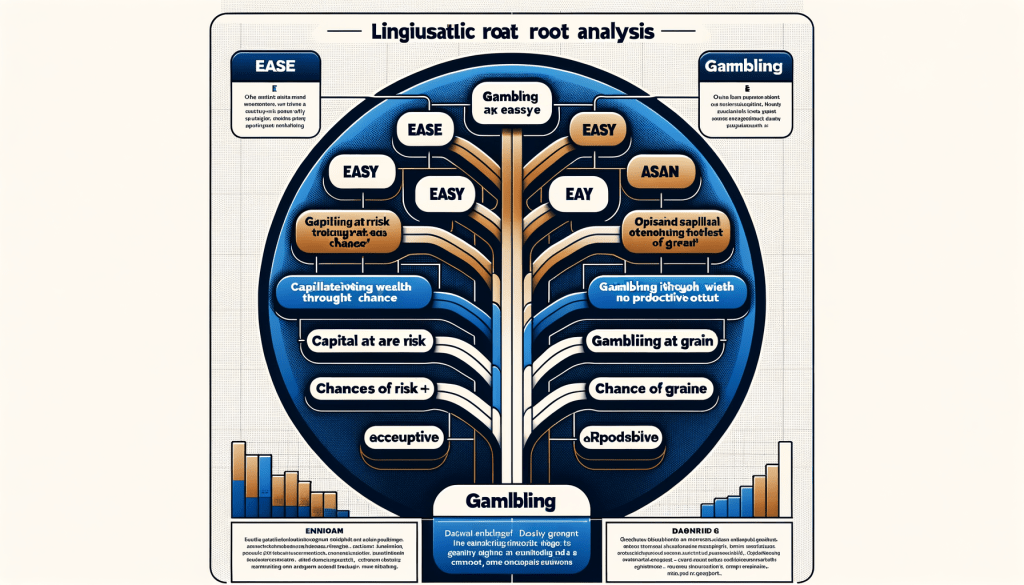
The Arabic word for gambling in the Quran is “al-maysir,” derived from the root Y-S-R (ya-sin-ra). This root carries the fundamental meaning of “ease” or “obtaining something with ease” — that is, acquiring wealth without proportional labor or productive effort. The word “maysir” literally connotes obtaining something effortlessly, through chance rather than through legitimate toil. This is the essential linguistic insight that demolishes the day trading defense: the Quran does not define gambling by whether it occurs in a casino, or whether it involves dice, or whether it has an economic side-effect. The Quran defines gambling by its nature — the attempt to obtain wealth through chance, through risk of loss for the possibility of gain, without productive labor underlying the transaction.
The morphological pattern of “maysir” follows the “maf’il” pattern, which in Arabic denotes the instrument or means by which an action is performed. It is the instrument of “yusr” (ease) — the mechanism by which wealth is obtained without commensurate productive effort. Day trading fits this definition with surgical precision. The day trader does not produce a good, nor provide a service in the traditional sense. Day traders do not manufacture, build, grow, teach, heal, or create. They place capital at risk on the directional movement of a price within hours or minutes, hoping to extract money from the market. One person’s gain is another participant’s loss. This is maysir — obtaining wealth through a mechanism of ease and chance.
The Root T-J-R: What Legitimate Trade Looks Like
In stark contrast to maysir, the Quran uses the word “tijarah” from the root T-J-R (ta-jim-ra) to describe legitimate commerce. This root carries the meaning of conducting trade through exchange — the mutual, consensual transfer of goods, services, or value between parties. The Quran consistently uses “tijarah” in contexts involving real productive exchange or, metaphorically, the spiritual “trade” with God through righteous works. There are nine occurrences of this root across the Quran, and every single one either describes legitimate productive commerce or serves as a metaphor for spiritual investment. Not one occurrence of “tijarah” describes speculative risk-taking for its own sake.
Consider the key verses where God uses this root. In [2:16], those who traded guidance for straying are told “such trade never prospers.” The word “rabihat” (from the root R-B-H, meaning profit) is used here — their trade yielded no profit. In [4:29], God commands: “Do not consume each others’ properties illicitly– only mutually acceptable transactions are permitted.” Notice the critical qualifier: mutual consent and satisfaction. In [24:37], God praises “people who are not distracted by business or trade from commemorating God.” In [35:29], God describes the ultimate profitable investment: “those who recite the book of God, observe the Contact Prayers, and from our provisions to them they spend — secretly and publicly — are engaged in an investment that never loses.” And in [61:10], God offers believers “a trade that will save you from painful retribution” — that trade is belief in God and striving in His cause.
The contrast is unmistakable. Tijarah in the Quran involves: (1) exchange of real value, (2) mutual consent and satisfaction, (3) productive contribution to society, and (4) when used metaphorically, it always describes spiritual devotion as the ultimate “profitable trade.” Day trading involves none of these elements. There is no exchange of goods or services. There is no mutual satisfaction — one party’s gain is structurally another’s loss. There is no productive contribution — the day trader adds nothing to the economy that would not exist without them. Day trading is not tijarah. It is maysir dressed in a business suit.
The Root K-S-B: The Quranic Standard for Earning
The root K-S-B (kaf-sin-ba) means “to earn” or “to acquire through effort.” This root appears over 60 times in the Quran and is the primary word God uses to describe legitimate human earning. It is used both for earning good (righteous deeds) and earning evil (sins), but the consistent implication is that what one earns is what one has genuinely worked for and is accountable for. In [2:267], God commands: “You shall give to charity from the good things you earn.” In [2:286], God states: “To its credit is what it earns, and against it is what it commits.” The intensified form implies deliberate, intentional acquisition, often with negative connotation when applied to sin.
In [4:111], God declares: “Anyone who earns a sin, earns it to the detriment of his own soul.” Any day trader who knowingly engages in gambling while professing faith is earning sin. And notice that the Quran uses the same root (K-S-B) for earning sin as for earning wealth. This is not coincidental. When the method of earning wealth is itself sinful, the wealth “earned” is actually sin being accumulated against the soul. One is not earning money. One is earning retribution.
Part 2: The Three Decisive Verses — 2:219, 5:90, and 5:91
Verse 2:219 — God Anticipated Every “Benefit” Argument
[2:219] “They ask you about intoxicants and gambling: say, ‘In them there is a gross sin, and some benefits for the people. But their sinfulness far outweighs their benefit.’ They also ask you what to give to charity: say, ‘The excess.’ God thus clarifies the revelations for you, that you may reflect,”
This verse is the most devastating refutation of the day trading defense, because it anticipates and demolishes the exact arguments commonly made. Proponents of day trading argue that it provides liquidity, aids price discovery, and serves a market function. They argue it has economic utility. God’s response, revealed over 1,400 years ago, is breathtaking in its precision: “In them there is a gross sin, AND SOME BENEFITS FOR THE PEOPLE.” God does not deny that gambling has benefits. God acknowledges the benefits. Liquidity provision? Sure, that is a benefit. Price discovery? Fine, that is a benefit. Market efficiency? Granted, that is a benefit. God is not ignorant of economics. God created economics.
But then comes the divine verdict that no amount of economic theory can overturn: “But their sinfulness FAR OUTWEIGHS their benefit.” The Arabic is emphatic — their sin is GREATER than their benefit. God uses the comparative form to make it absolutely, mathematically clear: even when you stack up every conceivable benefit of gambling — every job created, every dollar of liquidity provided, every basis point of price efficiency gained — the sin side of the equation still outweighs it all. This is not a close call. God says the sin “far outweighs” the benefit.
The footnote to this verse in The Final Testament is equally decisive. Rashad Khalifa writes: “The world now recognizes that the economic benefits from manufacturing alcoholic beverages and illicit drugs are not worth the traffic fatalities, brain damage to children of alcoholic mothers, family crises, and other disastrous consequences. Check with ‘Alcoholics Anonymous’ and ‘Gamblers Anonymous’ for more information. See also 5:90-91.” Rashad explicitly references Gamblers Anonymous — an organization that exists precisely because gambling destroys lives regardless of its economic side-effects. He directs us to consider the CONSEQUENCES, not the theoretical utility.
The day trading proponent says: “Day trading provides liquidity.” The alcohol manufacturer says: “Alcohol provides jobs and tax revenue.” The casino operator says: “Casinos stimulate local economies.” God says: the sin outweighs all of it. The argument is not about whether benefits exist. The argument is about whether benefits can sanctify sin. God’s answer is no.
Verse 5:90 — The Strongest Prohibition in the Quran
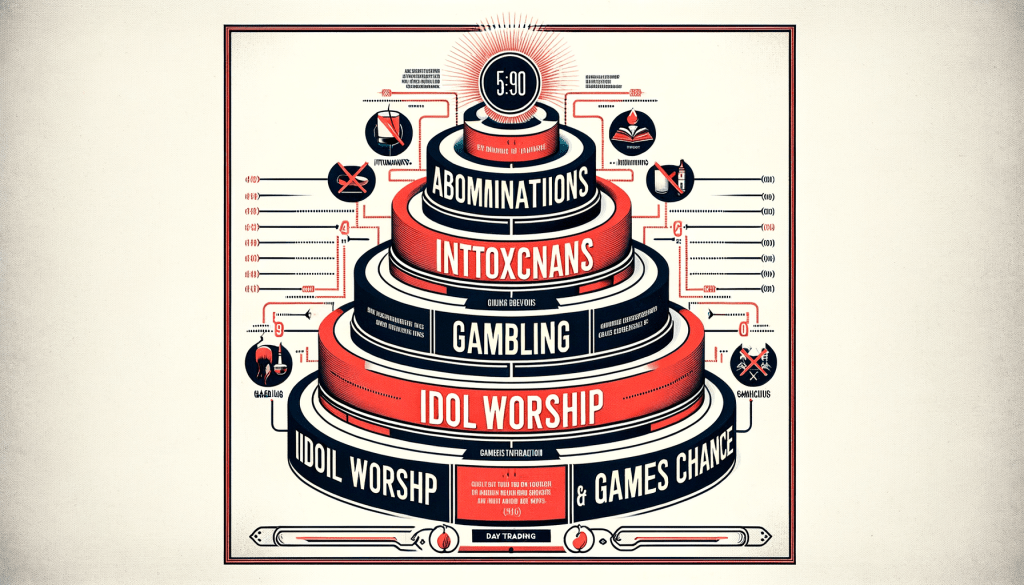
[5:90] “O you who believe, intoxicants, and gambling, and the altars of idols, and the games of chance are abominations of the devil; you shall avoid them, that you may succeed.”
This verse contains multiple elements that are directly relevant to the day trading question. First, notice the address: “O you who believe.” This is directed specifically at believers — at Submitters. It is not a suggestion for consideration. It is a command to those who claim faith. Second, notice the categorization. Gambling is listed alongside idolatry and is classified as an abomination FROM THE WORK OF THE DEVIL. This is not a minor dietary preference. This is classified at the same level as idol worship. It is literally called the devil’s handiwork.
Third, and critically, notice that God lists BOTH “al-maysir” (gambling) AND “al-azlam” (games of chance/divining arrows) separately. The word “al-azlam” from the root Z-L-M refers to the pre-Islamic Arabian practice of using arrows for divination and games of chance — essentially, randomized risk-taking for gain. God prohibits BOTH the general concept of gambling (maysir) AND the specific mechanism of games of chance (azlam). This double prohibition eliminates any argument that certain types of chance-based profit-seeking might be exempt. Whether you call it “games of chance,” “probability-based trading,” “algorithmic speculation,” or “IPDA-informed liquidity provision,” if the outcome is uncertain and you risk capital for the chance of gain without productive exchange, it falls under one or both of these prohibitions.
Fourth, the command is “you shall AVOID them.” The root J-N-B means to keep away from, to put distance between yourself and something. Rashad Khalifa explained this in his teachings (at 36:10): “Straight forward command not to come close to gambling and alcohol… It’s a very strong prohibition. This is what God told Adam and Eve. God told Adam and Eve don’t come close to this tree.” The command is not merely “do not gamble.” It is “stay away from gambling.” Do not go near it. Do not flirt with it. Do not redefine it and then approach it under a new name.
As Rashad himself stated emphatically (at 40:01): “God uses the strongest prohibition when it comes to alcohol and gambling. God uses the strongest prohibition in the Quran.”
Verse 5:91 — The Psychological Destruction
[5:91] “The devil wants to provoke animosity and hatred among you through intoxicants and gambling, and to distract you from remembering God, and from observing the Contact Prayers (Salat). Will you then refrain?”
God now reveals the devil’s strategic purpose behind gambling. There are three objectives Satan pursues through gambling: (1) provoking animosity and hatred between people, (2) distracting from the remembrance of God, and (3) distracting from the Contact Prayers. Every single one of these manifests observably in day trading.
Animosity and hatred: The day trading community is rife with adversarial dynamics. Every profitable trade requires a counterparty who loses. Day traders celebrate “squeezing shorts,” celebrate others’ financial destruction, refer to retail traders as “dumb money” and “exit liquidity.” The culture of day trading forums, Discord servers, and social media is saturated with contempt, mockery of losers, and predatory psychology. This is exactly what God predicted: gambling produces animosity and hatred between people.
Distraction from remembering God: Ask any day trader how they spend their mornings between 9:30 AM and 4:00 PM. They are glued to screens, watching candlestick charts, monitoring Level 2 data, reacting to price movements with the intensity of a cardiac surgeon. Their hearts are not occupied with God during those hours. Their hearts are occupied with the next trade. The remembrance of God is replaced by the remembrance of price action. This is not speculation — this is the observable, lived reality of every day trader.
Distraction from Contact Prayers: The US market opens at 9:30 AM Eastern. The pre-market session starts at 4:00 AM. The most volatile and profitable trading occurs in the first and last hours of the session. A day trader who takes 15-20 minutes to perform ablution and pray risks missing a trade setup worth thousands of dollars. The incentive structure of day trading is designed — as if by the devil himself — to make the Contact Prayers an obstacle to profit. God ends this verse with a question that rings across the centuries: “Will you then refrain?” This is not a polite suggestion. This is God asking, with finality, whether you will stop.
Part 3: Rashad Khalifa’s Own Words — No Loopholes Exist
Rashad on the Stock Market: “Not Really an Investment”
A common defense among day trading advocates is to parse Rashad Khalifa’s words, claiming he only condemned buying and selling “every day” but not “intraday” trading. This is a manipulation that falls apart under any honest examination. Let us look at exactly what Rashad Khalifa said.
In a recorded teaching session, when the topic of the stock market arose, Rashad stated clearly (at 32:00): “The stock market, the way it operates, is not really an investment either. Some people do use it for gambling.” When a listener responded about investing for the future, Rashad pressed further (at 32:12): “If people buy and sell every day, this is a business. You can just move the money from here to there. That’s gambling. Because it’s all that kind of gambling that’s been going on these days.” He then delivered the categorical verdict (at 32:30): “Any non-productive games of chance are gambling, prohibited, haram. You have to be productive.” This is unambiguous. Rashad explicitly named the exact behavior — buying and selling every day, moving money from here to there — and called it gambling. He then defined the universal criterion: any non-productive game of chance is gambling, prohibited, haram. Day trading is, by definition, not productive. The day trader produces nothing. Money is moved from one account to another based on price fluctuations. The activity is not productive. Therefore, by Rashad’s own words, day trading is gambling.
When a follower mentioned having put money in the stock market, Rashad acknowledged that they “lost money in that transaction” (at 29:40) and then added (at 32:50): “But I assure you, God is making it up to them in many different ways.” Rashad understood that avoiding the prohibited path does not mean losing out — God compensates those who obey Him through other channels.
Rashad on Games of Chance: “Any Kind”
In another teaching, Rashad declared without qualification (at 29:06): “Also gambling is prohibited, don’t play the lottery, believe me it will cost you more than even if you win the jackpot, you will end up a loser, believe me, because God is in control and he prohibited gambling, games of chance of any kind.” The phrase “of any kind” eliminates every attempt to carve out exceptions. Not lottery gambling. Not casino gambling. Not sports betting. Games of chance OF ANY KIND. Day trading, where you risk capital on the uncertain directional movement of a price, is a game of chance. Rashad prohibited it categorically.
Rashad on Insurance as Gambling: The Precedent
Rashad Khalifa explicitly classified insurance as gambling, providing a framework that applies directly to day trading. He stated (at 44:49): “Insurance is considered haram because of many reasons — first of all it is a game of chance, gambling. Second, it indicates lack of knowledge about God, because if you know then you know that if you are with God nothing bad will happen to you. God will take care of you. Is God not sufficient for his servant? And also insurance indicates lack of confidence in God.”
Now consider: if insurance — where you pay a premium and might receive a payout if a specific event occurs — is classified as a game of chance and therefore gambling, how much more obviously does day trading qualify? Insurance at least has a protective social function. Day trading does not even have that. If the lesser activity (insurance) is gambling, the greater activity (speculative trading) is gambling with even more certainty. Rashad further explained (at 14:27): “It’s a game of chance because I can buy insurance, pay one installment of $200 and cash $100,000 in the next month. It’s a game of chance.” Apply the same logic to day trading: you can put in $5,000, make a trade, and walk away with $50,000 or lose everything. That is a game of chance. Period.
Rashad on the Consequences of Breaking This Law
Rashad provided a powerful illustration of what happens when God’s prohibition on gambling is violated, even at the state level (at 0:43): “Arizona instituted the lottery to make some money and they were never poorer. Never. The year they introduced the lottery the copper went bad and the state had a hundred million dollar deficit. Something that never happened in the history of Arizona. So from the time they started the lottery they have been poor and they have deficits.”
He then applied this principle to individuals (at 1:45): “If we are to break God’s law and gamble in order to make money, we probably make 10,000 and then lose 100,000 somewhere else. It’s the way God works. When you break his law you have a blindfold.” This is the invisible mathematics of divine consequence. You may show a profit on your trading screen, but God is subtracting from your life in ways you cannot see — health, relationships, peace of mind, spiritual growth, blessings in your other earnings. The day trader’s P&L statement does not capture the full accounting that God maintains.
Part 4: Examining the Six Common Arguments
Argument 1: “Day Trading Provides Liquidity and Is Essential to Markets”
This argument proves nothing about permissibility. Alcohol manufacturing provides jobs. The pornography industry generates billions in revenue and provides employment. Casinos employ hundreds of thousands of workers and generate tax revenue that funds schools and roads. Drug trafficking provides income to impoverished communities. None of these economic contributions make these activities permissible. The Quran explicitly acknowledges that prohibited activities have benefits — “some benefits for the people” [2:219] — and then declares the sin greater than those benefits. Saying “day trading provides liquidity” is saying exactly what God told us the people would say, and it is exactly the argument God rejected.
Furthermore, modern markets functioned before the explosion of day trading. Institutional investors, long-term investors, market makers (who have specific regulatory obligations and risk controls unlike day traders), and genuine hedgers provide the liquidity that markets need. Day traders are not essential to this ecosystem. They are parasitic participants who extract wealth from the productive economy without adding to it. The market does not need day traders any more than the economy needs casinos.
Argument 2: “It’s Not a Zero-Sum Game Because the Economy Grows”
This is a clever conflation of two different things. Yes, the broader economy grows over time. Yes, the stock market, measured over decades, tends to appreciate. But day trading does not participate in that growth. Day trading is, by definition, short-term speculation where positions are opened and closed within the same day. Day traders do not benefit from long-term economic growth because they do not hold positions long enough to capture it. They are not investing in the growth of companies. They are betting on minute-to-minute price fluctuations.
Within any single trading day, the market IS approximately zero-sum (minus transaction costs, which make it negative-sum). For every buyer there is a seller. For every winner there is a loser. The money does not come from economic growth — it comes from other market participants’ pockets. When a day trader makes $5,000 in profit on a trade, that $5,000 came from someone else who lost $5,000 on the other side of that trade (plus additional money lost to spreads, commissions, and fees). This is the very definition of what the Quran condemns in [4:29]: consuming each other’s properties. The economy growing in the background does not change the fact that the specific transaction is extractive, not productive.
Argument 3: “Day Traders Serve a Function (Price Discovery, Liquidity Provision)”
[4:29] “O you who believe, do not consume each others’ properties illicitly— only mutually acceptable transactions are permitted. You shall not kill yourselves. God is Merciful towards you.”
The Quran defines legitimate trade as transactions based on mutual consent and satisfaction. In a legitimate trade, both parties receive value. A baker sells bread; the buyer gets food, the baker gets money. Both are satisfied. Both have exchanged real value. In day trading, there is no mutual satisfaction. One party wins and the other loses. The “consent” is merely the mechanical agreement to execute a transaction on an exchange — it is not the meaningful mutual benefit that the Quran describes. The losing party did not consent to lose their money. They entered the trade hoping to win, and they lost. This is not tijarah. This is maysir.
As for “price discovery” — this is a function that markets perform naturally through the interaction of genuine buyers and sellers who have real economic reasons to buy or sell. A farmer hedging his crop prices, a pension fund allocating capital for retirees, a corporation buying back its own shares — these participants contribute to price discovery through genuine economic activity. Day traders contribute noise, volatility, and artificial price movements that often HINDER genuine price discovery. The “flash crash” phenomena, the meme stock bubbles, the artificial squeezes — these are direct results of speculative day trading distorting, not discovering, fair prices.
Argument 4: “Rashad Only Condemned Buying/Selling ‘Every Day,’ Not ‘Intraday’”
This argument attempts to create a loophole through semantic parsing of Rashad’s words. But Rashad addressed this exact scenario directly. He said: “Some people do use it for gambling. If people buy and sell every day… that’s gambling.” He then gave the categorical criterion: “Any non-productive games of chance are gambling, prohibited, haram.” He condemned “games of chance of any kind.” He classified even insurance as gambling because it involves risking money for an uncertain payout.
The claim that Rashad did not condemn intraday trading is refuted by his own explicit words — “if people buy and sell every day, that’s gambling.” If buying a stock on Monday and selling it on Tuesday is gambling (which it is, by Rashad’s standard), then buying a stock at 10:00 AM and selling it at 10:15 AM is gambling with even more intensity, more risk, and more detachment from any productive purpose. Intraday trading is MORE speculative, MORE chance-based, and MORE divorced from productive investment than swing trading. If the longer timeframe is gambling, the shorter timeframe is gambling on steroids.
This kind of parsing reveals a deeper spiritual problem. When a believer’s first instinct upon encountering a divine prohibition is to look for loopholes and technicalities, the battle is already lost. The Quran describes this mentality precisely:
[2:9] “In trying to deceive God and those who believe, they only deceive themselves without perceiving.”
[2:204] “Among the people, one may impress you with his utterances concerning this life, and may even call upon God to witness his innermost thoughts, while he is a most ardent opponent.”
Argument 5: “The Markets Run on an Algorithm (IPDA) and Day Traders Are Just Liquidity Providers”
This argument is particularly revealing because it actually proves the opposite of what is intended. The IPDA (Interbank Price Delivery Algorithm) concept, popular in certain trading communities, posits that markets are algorithmically designed to hunt for and consume liquidity — to move price to levels where stop losses are clustered and take money from retail participants. If this is true (and many day traders believe it is), then the day trader is not a neutral “liquidity provider” — they are a knowing participant in a system designed to transfer wealth from the many to the few through engineered price movements. Every participant is either the hunter or the hunted in a predatory system. This is not tijarah. This is the very definition of “consuming each other’s properties illicitly” that God prohibits in [4:29] and [2:188].
[2:188] “You shall not take each others’ money illicitly, nor shall you bribe the officials to deprive others of some of their rights illicitly, while you know.”
The Arabic phrase “bi al-batil” — “illicitly” or “through falsehood/corruption” — means through vanity, falsehood, or corrupt means. Speculation on price movements, where wealth is transferred without productive exchange, is precisely what this describes. And the verse ends with the devastating qualifier: “while you know.” This is directed at people who know they are doing wrong but do it anyway. Any believer who has read the Quran, who has heard Rashad’s teachings, and who still day trades is consuming others’ money illicitly WHILE KNOWING.
Argument 6: “Day Trading Is Like ‘Oil in the Engine’ of the Economy”
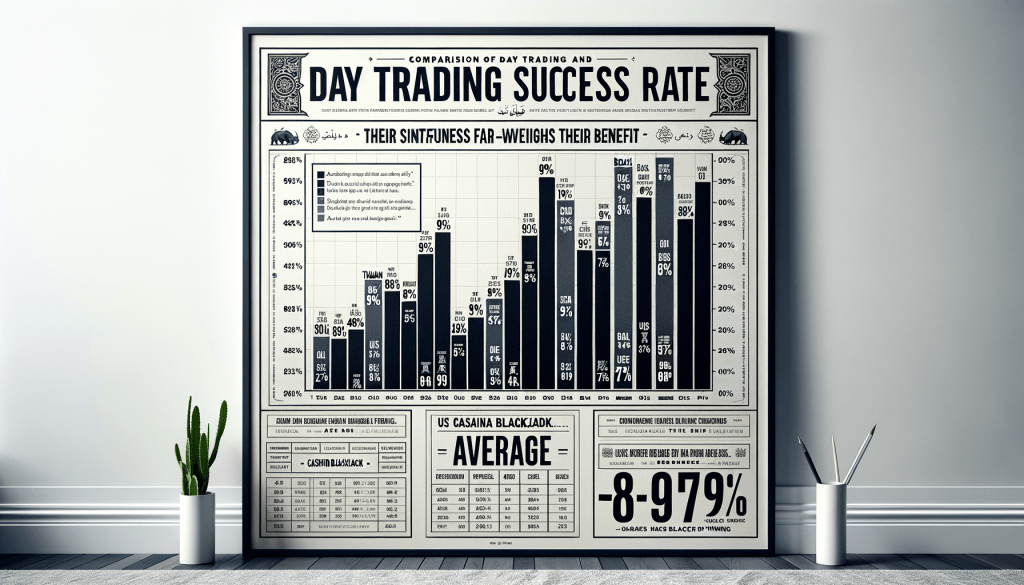
This is a metaphor, not an argument. Here is a more accurate metaphor: day trading is like sugar in the engine of the economy. It may feel sweet going in, but it destroys the machinery. The 80% failure rate among day traders — a well-documented statistical reality — proves this. A comprehensive study by Brad Barber, Yi-Tsung Lee, Yu-Jane Liu, and Terrance Odean published in the Review of Financial Studies found that the vast majority of day traders lose money consistently. Only approximately 1% of day traders are able to predictably profit net of fees. (Source: Barber et al., “Do Day Traders Rationally Learn About Their Ability?” Review of Financial Studies, 2010). A more recent 2019 study from the Brazilian Securities Exchange Commission (CVM) found that 97% of day traders who persisted for more than 300 days lost money. Only 1.1% earned more than the minimum wage. (Source: Chague, De-Losso, and Giovannetti, “Day Trading for a Living?” SSRN, 2019).
If an activity has an 80-97% loss rate, it is not “oil in the engine.” It is a mechanism for destroying wealth. It is a game of chance where the odds are stacked against the participant. It is, by every statistical and Quranic measure, gambling.
[6:32] “The life of this world is no more than illusion and vanity, while the abode of the Hereafter is far better for the righteous. Do you not understand?!”
Part 5: The Quran on Self-Deception and Rationalization
When Evil Works Are Adorned in Your Eyes
The Quran contains a repeated, devastating warning about a specific spiritual condition: the state in which a person’s sinful actions are made to appear righteous to them. This is not ignorance — it is active self-deception, and it is one of the most dangerous spiritual states a person can occupy. Anyone who has built an intellectual framework to justify day trading has entered this territory, and the Quran describes this condition with clinical precision across multiple verses.
[18:103-104] Say, “Shall I tell you who the worst losers are?” “They are the ones whose works in this life are totally astray, but they think that they are doing good.”
This is not about disbelievers who have never heard of God. This is about people who are CONVINCED they are doing good while their works are “totally astray.” Any day trader who has constructed an elaborate intellectual framework proving that their gambling is actually “providing liquidity” and “serving the economy” fits this description precisely. They think they are doing good. Their works are astray. They are among the worst losers — not because they lose money (though statistically they likely will), but because they are losing their souls while celebrating their cleverness.
[35:8] “Note the one whose evil work is adorned in his eyes, until he thinks that it is righteous. God thus sends astray whoever wills (to go astray), and He guides whoever wills (to be guided). Therefore, do not grieve over them. God is fully aware of everything they do.”
[6:43] “If only they implored when our test afflicted them! Instead, their hearts were hardened, and the devil adorned their works in their eyes.”
[47:14] “Are those enlightened by their Lord the same as those whose evil works are adorned in their eyes, and they follow their own opinions?”
Notice in [47:14] — “and they follow their own opinions” (literally, “their desires/whims”). The day trading defense is not based on Quranic evidence. It is based on personal opinion, economic theory, and the desire to justify a profitable activity. God distinguishes between those who follow divine guidance and those who follow their own opinions. Those who defend day trading are following their own opinions against God’s explicit prohibition.
[16:63] “By God, we have sent (messengers) to communities before you, but the devil adorned their works in their eyes. Consequently, he is now their lord, and they have incurred a painful retribution.”
The consequence is stated plainly: when the devil adorns your works in your eyes, he becomes your lord. Any day trader who cannot give up trading because “the market provides too much opportunity” has made the market their lord. Their devotion, their attention, their emotional energy, their hours are given to the market. This is a form of idolatry — setting up the market as a rival to God for attention and devotion.

Part 6: The Usury Parallel — “They Claim That Usury Is the Same as Commerce”
The Exact Same Logical Fallacy, Exposed by the Quran
[2:275] “Those who charge usury are in the same position as those controlled by the devil’s influence. This is because they claim that usury is the same as commerce. However, God permits commerce, and prohibits usury. Thus, whoever heeds this commandment from his Lord, and refrains from usury, he may keep his past earnings, and his judgment rests with God. As for those who persist in usury, they incur Hell, wherein they abide forever.”
This verse contains one of the most important principles in the entire Quran for our discussion. The people who practiced usury made EXACTLY the same argument that day trading advocates make today: they claimed that their prohibited activity was “the same as” legitimate commerce. “Usury is just trade with money,” they said. “It serves an economic function. It provides capital. It lubricates the economy.” God’s response: “God permits commerce, and prohibits usury.” The two are NOT the same, regardless of superficial similarities. The same principle applies perfectly to gambling: “God permits commerce, and prohibits gambling.” Day trading is NOT commerce merely because it occurs on a stock exchange. A casino is not a place of worship merely because it has a building.
Notice also the description of the usurers: they are “in the same position as those controlled by the devil’s influence.” This is the same devil referenced in [5:90] whose “work” includes gambling. The logical chain is airtight: the devil’s work includes gambling; those who claim prohibited financial activities are the same as commerce are under the devil’s influence; anyone who claims gambling is commerce is under the devil’s influence. This is not a human opinion. This is the Quran’s conclusion.
Rashad Khalifa, in his teaching on usury, made the direct connection (at 1:35): “Some of the other things that are forbidden, alcohol, gambling — it’s even pointed out there may be some good in them. There’s absolutely no good that can come at all from usury. Only evil.” Notice how Rashad groups gambling with usury as prohibited financial activities. Both involve unproductive wealth extraction. Both are forbidden. Both have defenders who claim they are merely “commerce.” Both are denounced by God.
Part 7: The Wealth Obsession Warning
When Money Becomes Your God
The Quran contains a devastating series of warnings about the obsessive accumulation of wealth — a psychological state that day trading both requires and amplifies. Day trading is not a casual activity. It demands obsessive attention to price movements, constant monitoring of positions, emotional investment in outcomes, and a psychological orientation toward wealth accumulation that crowds out everything else. The Quran describes this state repeatedly and condemns it absolutely.
[102:1-2] “You remain preoccupied with hoarding. Until you go to the graves.”
[104:2-3] “He hoards money and counts it. As if his money will make him immortal.”
[57:20] “Know that this worldly life is no more than play and games, and boasting among you, and hoarding of money and children. It is like abundant rain that produces plants and pleases the disbelievers. But then the plants turn into useless hay, and are blown away by the wind. In the Hereafter there is either severe retribution, or forgiveness from God and approval. This worldly life is no more than a temporary illusion.”
[63:9] “O you who believe, do not be distracted by your money and your children from remembering God. Those who do this are the losers.”
The phrase “do not be distracted by your money” uses the root L-H-W, the same root used for “lahw” (distraction/entertainment/play). This is the exact same root used in [57:20] where worldly life is described as “play and games.” The Quran linguistically connects the distraction of money-pursuit with the vanity of games. Day trading is, linguistically and conceptually, BOTH — it is a game (maysir/lahw) that distracts from God. It is the intersection of two prohibitions.
[9:34-35] “O you who believe, many religious leaders and preachers take the people’s money illicitly, and repel from the path of God. Those who hoard the gold and silver, and do not spend them in the cause of God, promise them a painful retribution. The day will come when their gold and silver will be heated in the fire of Hell, then used to burn their foreheads, their sides, and their backs: ‘This is what you hoarded for yourselves, so taste what you have hoarded.’”
The day trader’s entire orientation is the accumulation of money through speculation. There is no investing in productive enterprise. There is no spending in the cause of God. There is only hoarding — accumulating through the mechanism of maysir, keeping what is extracted from other market participants. These verses are not metaphorical. They describe a literal consequence for a literal behavior.
Part 8: The Real Trade God Offers
An Investment That Never Loses
The Quran does not merely prohibit gambling — it offers a superior alternative. God uses the language of trade and investment to describe righteous works, creating an explicit contrast with the world’s financial transactions.
[35:29] “Surely, those who recite the book of God, observe the Contact Prayers (Salat), and from our provisions to them they spend—secretly and publicly—are engaged in an investment that never loses.”
The phrase “an investment that never loses” is extraordinary. God uses the word “tijarah” (trade/investment) to describe righteous works, and then guarantees something no day trader can ever guarantee: a return that never fails. The day trader faces an 80-97% chance of losing money. God offers a 100% return rate. The day trader’s investment might go to zero. God’s investment will NEVER perish. Any rational investor who truly understood risk-adjusted returns would immediately close the trading platform and open the Quran.
[61:10-11] “O you who believe, let Me inform you of a trade that will save you from painful retribution. Believe in God and His messenger and strive in the cause of God with your money and your lives. This is the best deal for you, if you only knew.”
God calls it “the best deal.” The day trader thinks his best deal is a 3:1 risk-to-reward ratio on a momentum trade. God says the best deal is belief and striving in His cause. One of these trades pays in currency that depreciates, in an account that will be closed at death, in a market that will be shut down permanently. The other pays in eternal paradise. Every day trader reading this knows, in their heart, which is the better deal. The question is whether they will act on that knowledge or continue to let the devil adorn their works in their eyes.
[24:37] “People who are not distracted by business or trade from commemorating God; they observe the Contact Prayers (Salat), and give the obligatory charity (Zakat), and they are conscious of the day when the minds and the eyes will be horrified.”
This verse describes the ideal believer: someone for whom neither business nor trade distracts from the remembrance of God. Notice that God is not prohibiting business here — He is praising people who keep business in its proper place, subordinate to worship. The day trader, by the nature of the activity, has inverted this hierarchy. Worship (if it happens at all during trading hours) is subordinate to trading. The remembrance of God is interrupted by the remembrance of price. The day trader is the inverse of what this verse describes.
Part 9: The 80% Loss Rate — Statistical Proof of Divine Truth
The Numbers Do Not Lie
God tells us that gambling’s “sinfulness far outweighs its benefit” [2:219]. Modern data on day trading confirms this divine assessment with mathematical precision. Multiple peer-reviewed studies have consistently demonstrated that the vast majority of day traders lose money:
- A study by the U.S. Securities and Exchange Commission found that approximately 70% of day traders lose money every quarter, with most eventually losing all their trading capital.
- A comprehensive study of Taiwanese day traders (Barber et al., 2010, Review of Financial Studies) found that less than 1% of day traders were consistently profitable after transaction costs.
- A Brazilian Securities Commission study (Chague et al., 2019) found that 97% of day traders who traded for more than 300 days lost money, and only 1.1% earned more than the Brazilian minimum wage.
- A study in the Journal of Finance (Barber et al., 2009) found that individual day traders provide liquidity that yields net negative returns — meaning they systematically lose money in exchange for the “service” of providing liquidity.
When 80-97% of participants in an activity lose money, and the primary mechanism of the activity is uncertain outcomes, and the gains of the winners come directly from the losses of the losers — that is not investment. That is not commerce. That is not “providing liquidity.” That is a game of chance. That is maysir. That is what God prohibited. The empirical data is God’s sign, confirming His word.
Rashad Khalifa stated (at 2:56): “Each one of us, by the way, has a number of dollars assigned to him or to her. There’s no way you’re going to get any more, there’s no way you’re going to get any less. You cannot escape from it, no matter what you do.” If your provision is predetermined by God, then day trading is not creating wealth for you — it is merely shifting the mechanism through which your provision arrives from a lawful channel to an unlawful one. You receive the same amount, but you receive it through sin rather than through obedience. Why would any rational believer choose to receive their provision through a channel that earns them hellfire?
Part 10: Addressing the “But the Economy Grows” Fallacy
The Difference Between Investing and Day Trading
There is a fundamental distinction that day trading advocates routinely obscure: the difference between legitimate investment and speculative day trading. Legitimate investment involves purchasing ownership in a productive enterprise (a business, real estate, equipment) and sharing in its profits over time. This is consistent with productive “tijarah.” A person who buys shares in a company because they believe in its products, its management, and its long-term growth potential, and who holds those shares for years while the company generates real economic value — that person is participating in productive commerce.
A day trader does none of this. They do not care about the company. They do not even know what the company does, in many cases. They buy a stock at 10:03 AM because the 5-minute candlestick broke above the VWAP, and sell it at 10:11 AM because it hit a profit target. There is no relationship with the underlying business. No capital is added to the company (purchases on the secondary market do not give the company any money). The day trader is a pure speculator — betting on price direction over minutes or hours, with no productive engagement with the real economy.
God permits commerce [2:275]. God prohibits gambling [5:90]. Long-term, productive investment in real businesses is commerce. Day trading is gambling. The “economy grows” argument applies to the former, not the latter. A day trader who claims to be participating in economic growth is like a spectator at a construction site who claims to be building the building because they walked past it.
Part 11: The Final Warning
“Will You Then Refrain?”
The Quran’s question at the end of [5:91] — “Will you then refrain?” — is one of the most powerful rhetorical questions in all of scripture. It comes after God has: (1) classified gambling as the devil’s abomination [5:90], (2) revealed the devil’s strategic purpose behind gambling [5:91], (3) identified the spiritual damage gambling causes (animosity, hatred, distraction from God, distraction from prayer) [5:91], and (4) acknowledged that gambling has “some benefits” but declared the sin greater [2:219]. After all of this, God asks: Will you stop?
This question is now being asked of every reader of this analysis. The Quranic evidence has been presented. Rashad Khalifa’s own words have been heard. The statistical reality has been examined. Every rationalization has been dismantled. The question is no longer whether day trading is gambling — the Quran has answered that definitively. The question is whether the reader will obey.
[2:206] “When he is told, ‘Observe God,’ he becomes arrogantly indignant. Consequently, his only destiny is Hell; what a miserable abode.”
The test is whether, upon being presented with clear evidence from God’s book and His messenger’s teachings, a person will submit — or become “arrogantly indignant” and continue to defend what God has prohibited. Rashad Khalifa warned: “If you know that gambling is prohibited, and you gamble, knowing that it is prohibited” — then repentance becomes difficult, because the sin is committed with full knowledge and without ignorance as an excuse.
[2:86] “It is they who bought this lowly life at the expense of the Hereafter. Consequently, the retribution is never commuted for them, nor can they be helped.”
[2:16] “It is they who bought the straying, at the expense of guidance. Such trade never prospers, nor do they receive any guidance.”
The Quran uses the language of trade to describe the most catastrophic spiritual transaction imaginable: trading the Hereafter for this world, trading guidance for straying. Any day trader who trades obedience to God for a few thousand dollars in speculative profit has made this exact trade. And God says clearly: “such trade never prospers.” Their trade yielded no profit. Zero return. Total loss. Not in this life necessarily, but in the only accounting that matters.
Conclusion: The Soul Is Not Worth Any Trade
The defense of day trading as permissible in Submission fails on every level: linguistically, scripturally, logically, statistically, and according to the explicit teachings of God’s Messenger of the Covenant. The Arabic root for gambling (Y-S-R) defines it as obtaining wealth through ease and chance — exactly what day trading is. The Quran prohibits gambling in the strongest possible terms, classifying it as the devil’s abomination alongside idolatry. God explicitly acknowledges that gambling has “some benefits” but declares the sin greater — directly addressing and rejecting the “liquidity/price discovery/economic utility” argument. Rashad Khalifa condemned the stock market as “not really an investment” and classified any non-productive game of chance as “gambling, prohibited, haram.” And the statistical evidence — 80-97% of day traders losing money — confirms the Quranic assessment that this activity’s harm far outweighs its benefit.
Those who defend day trading are engaged in what the Quran identifies as one of the most dangerous spiritual conditions: having their evil works adorned in their eyes until they think they are doing good [18:103-104]. Every economic argument commonly deployed has been anticipated and answered by God. Every attempt to parse Rashad’s words is refuted by the totality of his teachings. Every claim that day trading is “different” from gambling is demolished by the Quran’s own definition of maysir, which is rooted in the nature of the activity (chance-based wealth acquisition without productive labor), not in its cosmetic appearance.
The question for every believer is simple and final: Do we worship God, or do we worship the market? Do we follow the Quran, or do we follow our own opinions? Do we submit to God’s prohibition, or do we submit to our desire for easy money? God is asking: “Will you then refrain?” [5:91]. The answer determines whether the next trade is a buy order on a stock platform, or a buy order on one’s own soul’s salvation.
[10:58] Say, “With God’s grace and with His mercy they shall rejoice.” This is far better than any wealth they can accumulate.
Close the trading platform. Open the Quran. That is the only trade that never loses.


 Quran Only Studies
Leave a comment