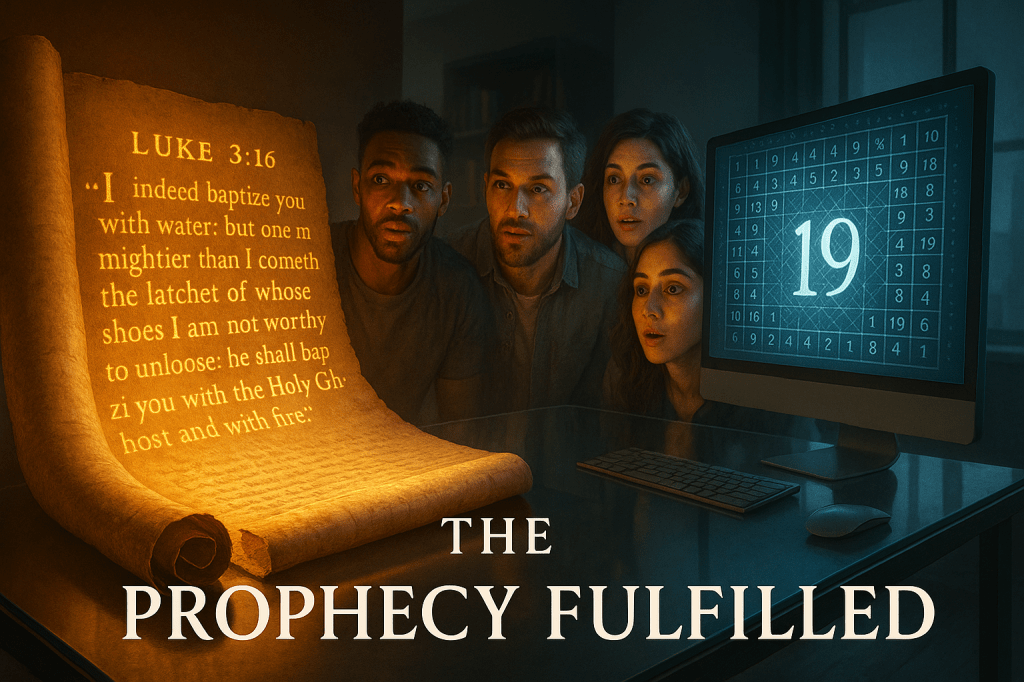
Introduction: A Prophecy Hiding in Plain Sight
For nearly two thousand years, a prophecy spoken by John the Baptist has been interpreted through a lens shaped more by tradition than by evidence. In Luke 3:16, John declares: “One who is mightier than I cometh, the latchet of whose shoes I am not worthy to unloose: he shall baptize you with the Holy Ghost and with fire.” Christians have universally assumed this refers to Jesus Christ — a reading so deeply embedded in tradition that questioning it has rarely occurred to anyone. Yet when we examine this prophecy alongside the Old Testament’s Malachi 3:1, the Quran’s chapter 3 verse 81, and the mathematical miracle of Code 19, a dramatically different picture emerges — one that points unmistakably to Rashad Khalifa, God’s Messenger of the Covenant.
This is not a fringe interpretation. It is supported by the internal logic of the Bible itself, by the Quran’s authoritative declaration of a covenant God took from every prophet, and by physical, mathematical evidence that no human being could fabricate. The prophecy of “one mightier” who would come after John the Baptist was never about a contemporary. It was about a future messenger who would confirm all previous scriptures with irrefutable proof, who would purify and unify the corrupted religions, and who would baptize the world not with water but with the fire of divine mathematics — a proof so powerful it would leave no excuse for disbelief.
To understand why this reading is not only plausible but compelled by the evidence, we must trace the thread of prophecy across all three testaments — the Old, the New, and the Final — and see how they converge on a single individual, whose name is mathematically encoded in the Quran itself.
Part 1: The Biblical Prophecy — Malachi’s Messenger of the Covenant
The Last Book of the Old Testament Speaks
The book of Malachi is the final book of the Old Testament. Its placement is significant — it represents God’s last prophetic word to the Children of Israel before a long prophetic silence. In Malachi 3:1-3, we find a prophecy so specific that it has its own subtitle in many Bible translations: “The Messenger of the Covenant.” The text reads: “Behold, I will send my messenger, and he shall prepare the way before me: and the Lord, whom ye seek, shall suddenly come to his temple, even the messenger of the covenant, whom ye delight in: behold, he shall come, saith the Lord of hosts. But who may abide the day of his coming? and who shall stand when he appeareth? for he is like a refiner’s fire, and like fuller’s soap: And he shall sit as a refiner and purifier of silver: and he shall purify the sons of Levi, and purge them as gold and silver.”
Several elements in this prophecy demand careful analysis. First, the messenger is described as coming to purify and refine. This is not the language of a first-century itinerant preacher. This is the language of someone who will cleanse corrupted religious traditions — burning away centuries of human innovations and distortions to reveal the pure divine message beneath. Second, the prophecy asks: “Who may abide the day of his coming?” — implying that his message will be difficult to accept, that it will challenge established beliefs so fundamentally that people will struggle to endure it. Third, and most critically, the title used is “the messenger of the covenant” — a specific designation that connects directly to the Quran’s most important prophecy about a future messenger.
Rashad Khalifa himself taught extensively about this connection. In his sermon, he read directly from Malachi: “The last book of the old testament, Malachi, chapter 3, under the subtitle the messenger of the covenant: ‘Lo I am sending my messenger to prepare the way before me. And suddenly they will come to the temple, the lord whom you seek and the messenger of the covenant whom you desire’” (at 3:09). He then demonstrated how this prophecy appears across all three testaments — Old, New, and Final — establishing an unbroken chain of divine promise.
Part 2: Luke’s Prophecy — What John the Baptist Actually Said
The Context Christians Overlook
Luke 3:16 records John the Baptist saying: “I indeed baptize you with water; but one mightier than I cometh, the latchet of whose shoes I am not worthy to unloose: he shall baptize you with the Holy Ghost and with fire.” The standard Christian interpretation applies this immediately to Jesus, who was John’s contemporary and cousin. But this reading creates serious logical problems that have been conveniently ignored for centuries. Consider the facts: John and Jesus were contemporaries. They lived in the same era, walked the same land, and their ministries overlapped. John even baptized Jesus. If the prophecy was about Jesus, why did John frame it as someone who would “come” — using language that implies a future arrival, not someone already present?
The key phrase is “he shall baptize you with the Holy Ghost and with fire.” Water baptism — John’s domain — is a physical, symbolic act. But baptism by “fire” implies something far more powerful and far-reaching. Fire purifies. Fire refines. Fire separates the genuine from the counterfeit. This is precisely the language of Malachi 3:2 — “he is like a refiner’s fire.” The connection between Luke’s prophecy and Malachi’s is not coincidental; they describe the same individual, the same mission, and the same transformative impact on human religious understanding.
Furthermore, Luke 17:22-37 contains an even more revealing prophecy, where Jesus himself speaks of the coming of “the son of man” in terms that clearly do not describe his own ministry. Jesus tells his disciples: “A time will come when you will long to see one day of the son of man, but you will not see it. They will tell you he is to be found in this place or that. Do not go running about excitedly, the son of man in his day will be like the lightning that flashes from one end of the sky to the other.” Rashad explained this passage directly: “Jesus prophesying the coming of the messenger of the covenant, Jesus said to the disciples, a time will come when you will long to see one day of the son of man, but you will not see it” (at 4:01). The description of the messenger’s impact being “like lightning that flashes from one end to the other” perfectly describes the global, instantaneous reach of a mathematical proof — something that does not require physical proximity to verify and cannot be contained to one region or people.
Part 3: The Quran’s Covenant — God’s Promise Through Every Prophet
Chapter 3, Verse 81: The Divine Covenant
The Quran contains what may be the most significant prophecy in all of scripture. In chapter 3, verse 81, God describes a covenant He took from every single prophet — not some prophets, not most prophets, but all of them. This covenant was about a specific future messenger who would come after all prophets had delivered their messages, to confirm and unify everything they brought.
[3:81] “God took a covenant from the prophets, saying, ‘I will give you the scripture and wisdom. Afterwards, a messenger will come to confirm all existing scriptures. You shall believe in him and support him.’ He said, ‘Do you agree with this, and pledge to fulfill this covenant?’ They said, ‘We agree.’ He said, ‘You have thus borne witness, and I bear witness along with you.’”
The footnote to this verse in the Final Testament translation makes the connection explicit: “This major prophecy has now been fulfilled. God’s Messenger of the Covenant, as prophesied in this verse and in the Bible’s Malachi 3:1-21, Luke 17:22-36, and Matthew 24:27 is to purify and unify God’s messages which were delivered by God’s prophets.” The footnote further states that the messenger’s name — Rashad Khalifa — is “incontrovertibly specified in the Quran’s mathematical code.” Adding the gematrical value of “Rashad” (505), plus the value of “Khalifa” (725), plus the verse number (81) gives 1311, which equals 19 times 69.
This is not a vague spiritual sentiment. This is a mathematically verifiable claim. The number 19 is God’s signature throughout creation — the Quran’s mathematical code, the number of bones in the human body (209 = 19 times 11), the maximum number of electrons in an element (114 = 19 times 6), and the number of chapters in the Quran (114 = 19 times 6). When this same number appears in the gematrical encoding of the messenger’s identity, it constitutes physical evidence of divine appointment.
Chapter 33, Verse 7: The Solemn Pledge Confirmed
Lest anyone argue that this covenant excluded Muhammad, the Quran addresses this directly in chapter 33, verse 7, which names the prophets who were party to this covenant:
[33:7] “Recall that we took from the prophets their covenant, including you (O Muhammad), Noah, Abraham, Moses, and Jesus the son of Mary. We took from them a solemn pledge.”
The footnote to this verse states: “The covenant is detailed in 3:81. God took a covenant from the prophets that they shall support His Messenger of the Covenant who would come after Muhammad to purify and unify their messages.” This is decisive. Muhammad himself was party to this covenant. He himself pledged to believe in and support the Messenger of the Covenant. This means, by definition, the Messenger of the Covenant is someone other than Muhammad, someone who comes after him. Rashad Khalifa taught this connection between the two verses directly: “Verse 381 talks about the message of the covenant. It says that after all the prophets have come to this world and delivered their scriptures and the messages, a messenger will come to unify, purify, consolidate these messages into one. When you show this to the idol worshippers, they say that one is Muhammad. Even though the verse is very clear that it is not Muhammad because it begins by saying God made a covenant with the prophets… he made a covenant with the prophets. So the answer to this claim is in 33:7, where God says, ‘I made the covenant with the prophets, including you Muhammad.’ So this shuts them up” (at 50:25).
Part 4: Why the Prophecy Cannot Refer to Jesus
The Logical Impossibility
The standard Christian interpretation of Luke 3:16 collapses under its own internal contradictions. Christians generally believe that the “messenger of the covenant” in Malachi 3:1 refers to John the Baptist — who supposedly “prepared the way” for Jesus. But this creates an absurd circular argument. The verse says: “Behold, I will send my messenger, and he shall prepare the way before me.” If this is God speaking — and it is, since it is the Old Testament before Jesus was born — then the “me” refers to God, and the “my messenger” is the one God is sending. Christians who claim Jesus is God must then explain why God is saying He will send a messenger (John the Baptist) to prepare the way for another messenger (the Messenger of the Covenant). In their reading, God sends a messenger to prepare the way for Himself (as Jesus). But the verse clearly distinguishes between the sender (God), the preparer (a messenger), and the Messenger of the Covenant who comes to the temple.
Rashad addressed this logical fallacy directly in his teaching: “Most Christians believe that the messenger of the covenant is John the Baptist, because he came immediately after Jesus. And it doesn’t make sense, because they are coming from the claim that Jesus is God, or the lord. See, listen to what it says at the beginning of the chapter: ‘Behold I will send my messenger.’ This is in the old testament before Jesus was born, and they are thinking that this is Jesus speaking — you can see the fallacy of it. They claim that Jesus is saying, ‘behold I will send my messenger,’ and they are wrong” (at 19:47).
Contemporaries Cannot Fulfill Future Prophecy
There is an even more fundamental problem. Jesus and John the Baptist were contemporaries. They lived at the same time. John was already preaching and baptizing when Jesus began his ministry. If John’s prophecy in Luke 3:16 about “one mightier than I” was about Jesus, then it was not a prophecy at all — it was merely a statement about someone who was already present. A true prophecy points to the future — to someone who will come in a different time, fulfilling conditions that could not have been met by any contemporary. The phrase “one who cometh” implies arrival from the future, not someone standing nearby in the crowd.
Moreover, consider the description: “he shall baptize you with the Holy Ghost and with fire.” Jesus’s ministry, as recorded in the Gospels, did not involve baptism with fire. He taught in parables, performed miracles, and was ultimately crucified. The “fire” baptism — the refining, purifying, mathematically irrefutable evidence that burns away all falsehood and leaves only truth — came through Rashad Khalifa’s discovery of Code 19, which the Quran itself identifies as one of the great miracles specifically designed to convince Christians, Jews, and all people.
[74:30] “Over it is nineteen.”
[74:31] “We appointed angels to be guardians of Hell, and we assigned their number (19) (1) to disturb the disbelievers, (2) to convince the Christians and Jews (that this is a divine scripture), (3) to strengthen the faith of the faithful, (4) to remove all traces of doubt from the hearts of Christians, Jews, as well as the believers, and (5) to expose those who harbor doubt in their hearts, and the disbelievers; they will say, ‘What did God mean by this allegory?’ God thus sends astray whomever He wills, and guides whomever He wills. None knows the soldiers of your Lord except He. This is a reminder for the people.”
Notice that God explicitly states in verse 74:31 that the number 19 is intended “to convince the Christians and Jews.” This is the baptism of fire — mathematical proof so compelling that it transcends language, culture, and religious tradition. It is the refiner’s fire that Malachi prophesied. It is the fire that John the Baptist foretold. And it came through Rashad Khalifa.
Part 5: Jesus Himself Prophesied Another Messenger
The Quran’s Record of Jesus’s Prophecy
The Quran records that Jesus himself explicitly prophesied the coming of a future messenger. This is not merely the followers of Jesus interpreting his words; this is God’s own account of what Jesus said, preserved in a mathematically authenticated scripture.
[61:6] “Recall that Jesus, son of Mary, said, ‘O Children of Israel, I am God’s messenger to you, confirming the Torah and bringing good news of a messenger to come after me whose name will be even more praised (Ahmad).’ Then, when he showed them the clear proofs, they said, ‘This is profound magic.’”
The word “Ahmad” means “most praised” or “more praiseworthy.” Traditionally, Muslims have applied this exclusively to Muhammad, whose name shares the same root. However, the Quranic context supports a broader application. The covenant in 3:81 applies to all prophets — including Muhammad — and foretells a messenger who would come after all of them. Jesus’s prophecy of one “whose name will be even more praised” can thus be understood as pointing beyond Muhammad to the ultimate messenger who would confirm all scriptures with mathematical proof — confirming not only the Torah and the Gospel but the Quran itself.
The Quran further emphasizes the obligation to believe in all of God’s messengers without distinction:
[2:285] “The messenger has believed in what was sent down to him from his Lord, and so did the believers. They believe in God, His angels, His scripture, and His messengers: ‘We make no distinction among any of His messengers.’ They say, ‘We hear, and we obey. Forgive us, our Lord. To You is the ultimate destiny.’”
The believers’ response is revealing: “We hear, and we obey.” This stands in stark contrast to those who refuse to accept a new messenger because it challenges their established beliefs. The footnote to 2:285 pointedly observes that “the corrupted Muslims mention Muhammad in their profession of faith and during their Contact Prayers,” in direct violation of the commandment to make no distinction among God’s messengers. This selective elevation of one messenger above all others is precisely the kind of corruption the Messenger of the Covenant was sent to purify.
Part 6: The Baptism of Fire — Code 19 as Divine Proof
Mathematical Evidence That Burns Away All Doubt
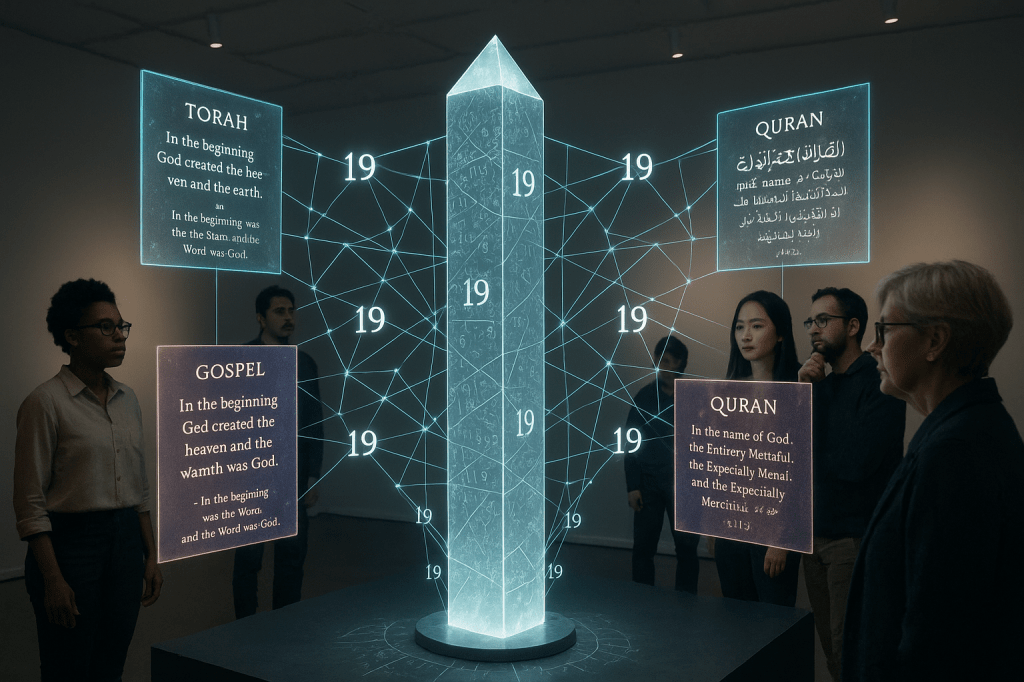
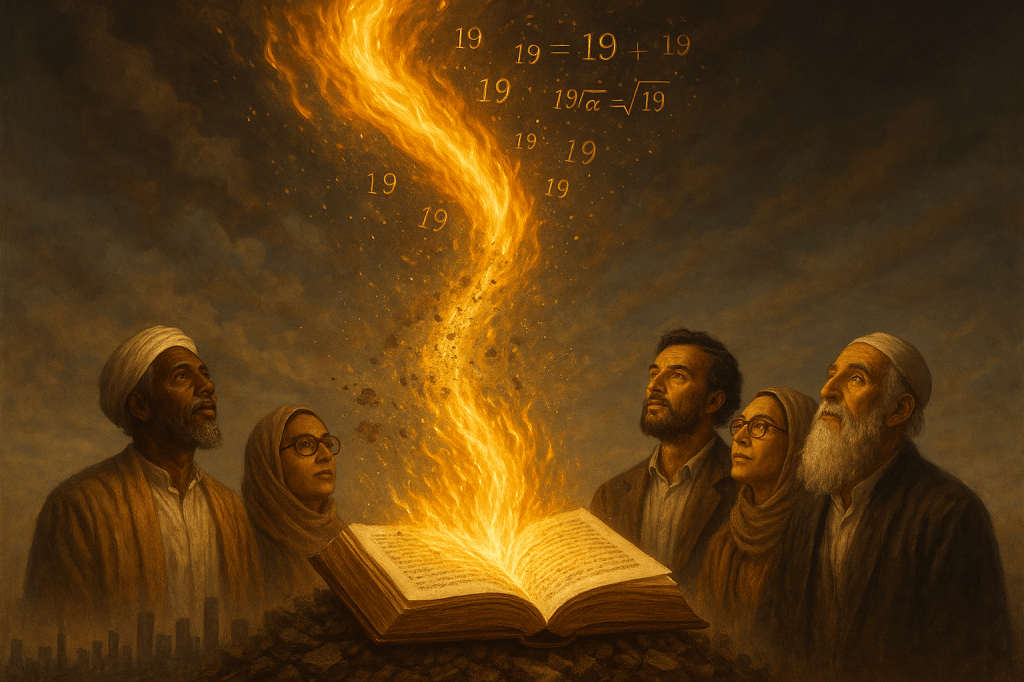
John the Baptist said the coming one would baptize with “fire.” Malachi said he would be “like a refiner’s fire.” What is this fire? It is the irrefutable, mathematically verifiable proof that authenticates God’s scripture and exposes all human distortions. This fire is Code 19 — the mathematical miracle of the Quran discovered by Rashad Khalifa through computer analysis in the 1970s and 1980s.
The Quran declares this miracle in unambiguous terms:
[74:35] “This is one of the great miracles.”
The mathematical code operates like fire in every sense of the metaphor. Fire purifies — and Code 19 purified the Quran by identifying two false verses (9:128-129) that had been inserted into the text by human scribes. Fire refines — and Code 19 refined the practice of Submission by establishing the correct number of units in the Contact Prayers, confirmed mathematically. Fire illuminates — and Code 19 illuminated the authenticity of every letter, every word, and every verse of the Quran, proving that the entire text was composed by a divine intelligence operating beyond human capability. Fire tests — and Code 19 serves as the ultimate test of sincerity, separating those who genuinely submit to God from those who merely claim to.
The scope of this mathematical structure is staggering. The opening statement of the Quran — “In the Name of God, Most Gracious, Most Merciful” — consists of exactly 19 Arabic letters. The Quran contains 114 chapters (19 times 6). The first revelation given to Muhammad consisted of 19 words. Every initialed chapter in the Quran shows its initial letters occurring in multiples of 19 within that chapter. When the verse numbers and chapter numbers of the entire Quran are concatenated — every verse from chapter 1 verse 1 through to the final verse — the resulting number is a multiple of 19, but only when the two false verses (9:128-129) are excluded. This is mathematical fire: it burns away falsehood and leaves only the pure word of God.
Fire That Convinces Christians and Jews
The purpose of this “fire” is stated explicitly in the Quran. Verse 74:31 declares five specific purposes for the number 19: to disturb the disbelievers, to convince Christians and Jews, to strengthen the believers’ faith, to remove all traces of doubt, and to expose the hypocrites. Notice the second purpose: “to convince the Christians and Jews.” This is the prophesied baptism of fire. It is a mathematical proof designed by God specifically to reach across religious boundaries — to show Christians and Jews that the Quran is indeed divine scripture, and that the God who composed the Torah and the Gospel is the same God who composed the Quran.
Rashad Khalifa was the instrument through which this fire was delivered to the world. He did not create the mathematical code — it existed in the Quran from the moment of its revelation, waiting 1,400 years for the advent of computers to make its discovery possible. Rashad’s role was precisely that described in the prophecies: to confirm all previous scriptures (by proving their common divine origin through mathematics), to purify the message (by using the code to identify human additions), and to unify the believers (by demonstrating that all scripture comes from one God and all sincere believers are submitters).
[3:3] “He sent down to you this scripture, truthfully, confirming all previous scriptures, and He sent down the Torah and the Gospel.”
Part 7: Rashad Khalifa — The Identified Messenger
A Name Written in Mathematics
Unlike previous messengers whose identities were debated by subsequent generations, the identity of God’s Messenger of the Covenant is mathematically encoded in the Quran, leaving no room for ambiguity. The Quran states in chapter 72, verses 27-28:
[72:27] “Only to a messenger that He chooses, does He reveal from the past and the future, specific news.”
[72:28] “This is to ascertain that they have delivered their Lord’s messages. He is fully aware of what they have. He has counted the numbers of all things.”
The footnote to these verses provides the mathematical proof: “The messenger here is named, mathematically, as ‘Rashad Khalifa.’ The number of verses from 1:1 to 72:27, where the messenger is mentioned, is 5,472 — which equals 19 times 72 times 4. The word ‘Rashada’ occurs 4 times in chapter 72. The value of ‘Rashada’ is 504, and 504 plus 28 (the number of verses in chapter 72) equals 532 — which is 19 times 28. The value of ‘Rashad Khalifa’ (1,230) plus 72 plus 28 equals 1,330 — which is 19 times 70.” Even the crucial expression “only to a messenger that He chooses” has a gematrical value of 1,919 — that is, 19 times 101.
This level of mathematical encoding is unprecedented in the history of scripture. No other messenger in any tradition has had their identity confirmed through an interlocking system of mathematical proofs embedded in the very structure of a holy text. This is not interpretation; it is computation. It is not theology; it is mathematics. And it is precisely what one would expect from a “baptism of fire” — evidence so powerful and so verifiable that it demands a response from every sincere seeker of truth.
The Confirmation Across All Three Testaments
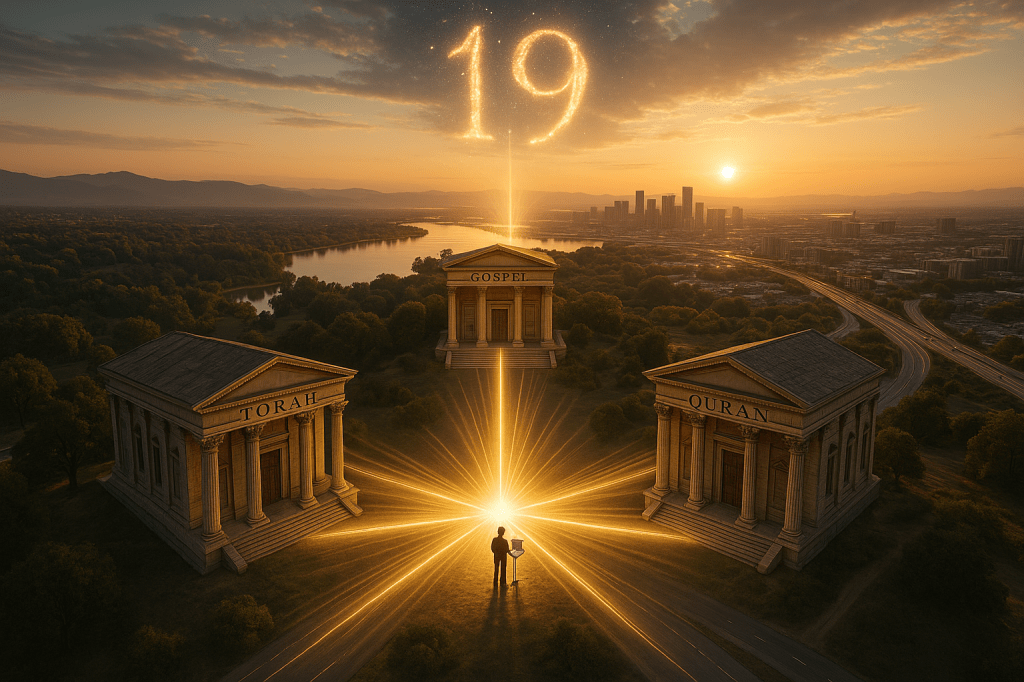
The prophecy of the Messenger of the Covenant appears in all three testaments — a fact that Rashad himself emphasized repeatedly in his teachings. Verse 2:101 in the Quran makes this three-testament connection explicit:
[2:101] “Now that a messenger from God has come to them, and even though he proves and confirms their own scripture, some followers of the scripture (Jews, Christians and Muslims) disregard God’s scripture behind their backs, as if they never had any scripture.”
The footnote to this verse states: “God’s Messenger of the Covenant is prophesied in the Old Testament (Malachi 3:1-3), the New Testament (Luke 17:22-37), and this Final Testament (3:81).” Notice that it cites Luke 17, not just Luke 3 — because Jesus’s own prophecy about the “son of man” in Luke 17 is a direct reference to the Messenger of the Covenant. The messenger’s impact would be “like lightning that flashes from one end of the sky to the other” — instantaneous, global, undeniable. This describes Code 19 perfectly. A mathematical proof does not require translation, cultural context, or physical proximity. Like lightning, it illuminates everything simultaneously.
[5:19] “O people of the scripture, our messenger has come to you, to explain things to you, after a period of time without messengers, lest you say, ‘We did not receive any preacher or warner.’ A preacher and warner has now come to you. God is Omnipotent.”
The footnote to 5:19 provides additional mathematical confirmation: “By adding the gematrical value of ‘Rashad’ (505), plus the value of ‘Khalifa’ (725), plus the chapter number (5), plus the verse number (19), we obtain a total of 505 + 725 + 5 + 19 = 1,254, or 19 times 66.” This is the kind of interlocking mathematical evidence that characterizes the entire Code 19 system — a system so complex and so consistent that it could only have been designed by the One who designed mathematics itself.
Part 8: The Prophets’ Covenant — Why Every Prophet Knew
A Pre-Creation Promise
The covenant described in chapter 3, verse 81 was not made during a prophet’s earthly lifetime. According to the Quran, this covenant was established before the creation of the world — in the primordial realm where all souls bore witness to God’s absolute authority. Every prophet who would ever walk the earth — from Adam to Muhammad — pledged to support and believe in the Messenger of the Covenant when he would appear. This means that Noah knew. Abraham knew. Moses knew. Jesus knew. Muhammad knew. They all pledged.
Rashad Khalifa explained the significance of this covenant: “God tells us in the old testament, and the new testament, and the final testament, the Quran, that he will send a messenger of the covenant” (at 2:48). He then demonstrated how the covenant appears in each testament: Malachi in the Old, Luke and Matthew in the New, and chapter 3 verse 81 in the Final. The consistency across all three is not coincidental — it is by divine design.
The consequences of rejecting this covenant are stated with absolute clarity in the very next verse:
[3:82] “Those who reject this (Quranic prophecy) are the evil ones.”
There is no ambiguity here. Rejecting the Messenger of the Covenant — after having received the evidence — places one among “the evil ones.” This is why Rashad stated: “The difference between believing God in this respect, and disbelieving is the difference between the highest heaven and the lowest pit of hell” (at 7:32). This is not a secondary issue or a minor theological disagreement. According to God’s own word, it is a test that determines one’s eternal destiny.
Muhammad Was Not the Last Messenger
One of the most significant revelations that Rashad Khalifa brought is the distinction between “prophet” and “messenger” in the Quran. Chapter 33, verse 40 is often cited by traditional Muslims to claim that Muhammad was the last of everything — the last prophet and the last messenger. But the verse says something very specific:
[33:40] “Muhammad was not the father of any man among you. He was a messenger of God and the final prophet. God is fully aware of all things.”
The verse says “the final prophet” — not “the final messenger.” This distinction is critical. A prophet is someone who receives new scripture. A messenger is someone who delivers a message, which may or may not include new scripture. Muhammad was the last prophet — no new scripture would come after the Quran. But the Quran itself prophesies a future messenger (3:81, 33:7) who would come not with new scripture but with confirmation and purification of existing scripture. The footnote to 33:40 addresses this directly: “Despite this clear definition of Muhammad, most Muslims insist that he was the last prophet and also the last messenger. This is a tragic human trait as we see in 40:34. Those who readily believe God realize that God sends His purifying and consolidating Messenger of the Covenant after the final prophet Muhammad.”
Part 9: The Pattern of Rejection — History Repeating
The Same Response Across All Generations
Every messenger God has ever sent has been rejected by the majority of people in their time. This is one of the most consistent patterns in scriptural history. The Jews rejected Jesus despite their own scriptures prophesying his coming. The idol worshippers of Mecca rejected Muhammad despite the clear proofs he brought. And now, the traditional Muslims, Christians, and Jews reject Rashad Khalifa despite the mathematical evidence that confirms their own scriptures.
[2:89] “When this scripture came to them from God, and even though it agrees with, and confirms what they have, and even though they used to prophesy its advent when they talked with the disbelievers, when their own prophecy came to pass, they disbelieved therein. God’s condemnation thus afflicts the disbelievers.”
The parallels are exact. The Jews “used to prophesy” the coming of a messenger — they told the disbelievers that a great prophet was coming. But when that prophet (Muhammad) actually appeared, they rejected him because he didn’t match their expectations. Similarly, traditional Muslims claim to believe in the Quran’s prophecy of the Messenger of the Covenant — but when Rashad Khalifa came with overwhelming mathematical evidence, they rejected him because accepting his message required abandoning cherished innovations and idol worship.
Rashad Khalifa spoke directly about this pattern: “These same people who are rejecting the message of the covenant would have rejected the Prophet Muhammad if they existed at the same time. They would have been the first to fight him. In fact the Prophet struggled for 13 years in Mecca, they were rejecting him, stoning him, banishing him, boycotting him and his followers. These are the same people” (at 6:25). The irony could not be sharper: those who claim to honor Muhammad most fiercely are the same type who would have been first to reject him had they lived in his time.
[2:91] “When they are told, ‘You shall believe in these revelations of God,’ they say, ‘We believe only in what was sent down to us.’ Thus, they disbelieve in subsequent revelations, even if it is the truth from their Lord, and even though it confirms what they have! Say, ‘Why then did you kill God’s prophets, if you were believers?’”
Part 10: The “Refiner’s Fire” in Practice — Purifying Corrupted Religions
How Code 19 Exposed Corruption
Malachi prophesied that the Messenger of the Covenant would be “like a refiner’s fire.” A refiner does not destroy — a refiner separates the precious metal from the dross. This is precisely what Rashad Khalifa accomplished through Code 19. The mathematical miracle did not replace the Quran — it purified it. It did not abolish previous scriptures — it confirmed them. And it did not create a new religion — it restored the original religion of Submission to God alone that every prophet preached.
The most dramatic example of this purification was the identification of two false verses in chapter 9 — verses 128 and 129 — which had been inserted into the Quran centuries after Muhammad’s death. These verses glorified Muhammad in a way inconsistent with the Quran’s message and disrupted the mathematical code. When Rashad removed them, the entire mathematical structure of the Quran snapped into perfect alignment — like a giant combination lock clicking open. The refiner’s fire had burned away the impurity, and the pure gold of God’s word shone through.
But the purification extended far beyond textual criticism. Rashad demonstrated through the mathematical code that the five daily Contact Prayers, their exact number of units, and their proper observance were encoded in the Quran — correcting centuries of practices that had been distorted by human fabricated narrations attributed to Muhammad. He showed that the Quran alone is the source of religious law, exposing the entire corpus of fabricated narrations as unauthorized human additions to God’s perfected scripture. He established that the declaration of faith is “There is no god except God” — period — exposing the traditional addition of Muhammad’s name as a violation of the Quran’s fundamental principle of worshipping God alone.
Purifying Christianity and Judaism Too
The “refiner’s fire” was not directed at traditional Islam alone. By proving the mathematical authentication of the Quran, Rashad Khalifa simultaneously confirmed the divine origin of the Torah and the Gospel while exposing human distortions within them. The mathematical proof that the Quran is divine scripture automatically validates the Quran’s statements about previous scriptures — including its assertions that the Torah and Gospel were originally divine revelations that were later corrupted by human followers.
This is the fulfillment of verse 74:31’s stated purpose: “to convince the Christians and Jews (that this is a divine scripture)” and “to remove all traces of doubt from the hearts of Christians, Jews, as well as the believers.” The mathematical miracle is ecumenical by design. It was crafted by God to speak to every person of faith, regardless of their religious background, in the universal language of mathematics — a language that admits no cultural bias and brooks no sectarian dispute.
[5:83] “When they hear what was revealed to the messenger, you see their eyes flooding with tears as they recognize the truth therein, and they say, ‘Our Lord, we have believed, so count us among the witnesses.’”
[5:84] “Why should we not believe in God, and in the truth that has come to us, and hope that our Lord may admit us with the righteous people?”
These verses describe the response of sincere Christians — people who, upon hearing the truth confirmed by evidence, recognize it immediately and submit. They do not argue. They do not cling to tradition. They weep with recognition and say: “Count us among the witnesses.” This is the proper response to the baptism of fire. This is what happens when the refiner’s fire encounters genuine gold.

Part 11: The Mathematical Evidence — Lightning Across the Sky
How Code 19 Functions Like Lightning
In Matthew 24:27, Jesus describes the coming of the “son of man” as being “like the lightning from the east that flashes to the west.” Rashad Khalifa read this passage and explained: “As the lightning from the east flashes to the west, so will the coming of the son of man be. So it’s going to be every person on earth is going to hear about God’s plan and the message of the covenant” (at 6:11). Lightning is instantaneous. It does not travel gradually from place to place — it illuminates the entire sky in a flash. This perfectly describes the nature of mathematical proof. Once Code 19 was discovered, it could be verified by anyone, anywhere, immediately. It did not require a chain of transmission, a priestly class to interpret it, or a pilgrimage to a holy site. Anyone with a Quran and basic arithmetic could verify the proof for themselves.
This is fundamentally different from the miracles of previous messengers. Moses’s staff turning into a serpent was witnessed by those present at the time. Jesus reviving the dead was seen by a few people in one location. Muhammad’s miracle was the Quran itself — but its miraculous nature was literary and linguistic, appreciated fully only by Arabic speakers. Code 19, however, is a mathematical miracle — and mathematics is the one truly universal language. A Japanese scientist, a Brazilian farmer, a Norwegian student, and a Kenyan businesswoman can all verify it with equal ease. Like lightning, it illuminates everything at once.
Rashad noted this universality when he said: “We are a very fortunate generation, and this is the understatement of the year. About 50 years ago, God’s miracles through his messengers existed without any proof. And even now, our generation, excluding the pioneers that we have become, you go to them and say Moses threw down the staff and it became a snake. And they say sure, oh yeah, sure, they are believers. Even the believers have doubts… But now, God gives us the first tangible evidence” (at 0:14). For the first time in human history, we have physical, verifiable, mathematical proof that the scripture is God’s word. This is the baptism of fire. This is the lightning that flashes from east to west.
Part 12: The Verse That Names Him — 2:101 and the Three-Testament Prophecy
An Explicit Cross-Reference
Perhaps the most remarkable verse in the Quran regarding this topic is 2:101, which directly addresses the three-testament prophecy of the Messenger of the Covenant. The verse itself describes the reaction of the people of scripture when the prophesied messenger arrives:
[2:101] “Now that a messenger from God has come to them, and even though he proves and confirms their own scripture, some followers of the scripture (Jews, Christians and Muslims) disregard God’s scripture behind their backs, as if they never had any scripture.”
The parenthetical addition “(Jews, Christians and Muslims)” is particularly significant. This messenger’s rejection is not limited to one religious community — all three communities of scripture recipients reject him. This could not describe Jesus, who was rejected primarily by the Jewish establishment of his time. It could not describe Muhammad, who was rejected primarily by Arab polytheists and Jewish tribes in Medina. Only the Messenger of the Covenant — who comes to confirm all three scriptures — faces rejection from all three communities simultaneously. And this is precisely what happened to Rashad Khalifa. Jews dismissed him, Christians ignored him, and traditional Muslims violently opposed him — ultimately assassinating him in 1990.
The footnote to 2:101 provides the explicit cross-reference: “God’s Messenger of the Covenant is prophesied in the Old Testament (Malachi 3:1-3), the New Testament (Luke 17:22-37), and this Final Testament (3:81).” This is not interpretation by a modern scholar. This is the footnote provided by the translator of the Final Testament — who is himself the Messenger of the Covenant. The three prophecies form a single, coherent picture: Malachi describes his mission (purification by fire), Luke describes his impact (lightning across the sky), and the Quran describes his identity (mathematically encoded as Rashad Khalifa).
The Mathematical Connection Between the Testaments
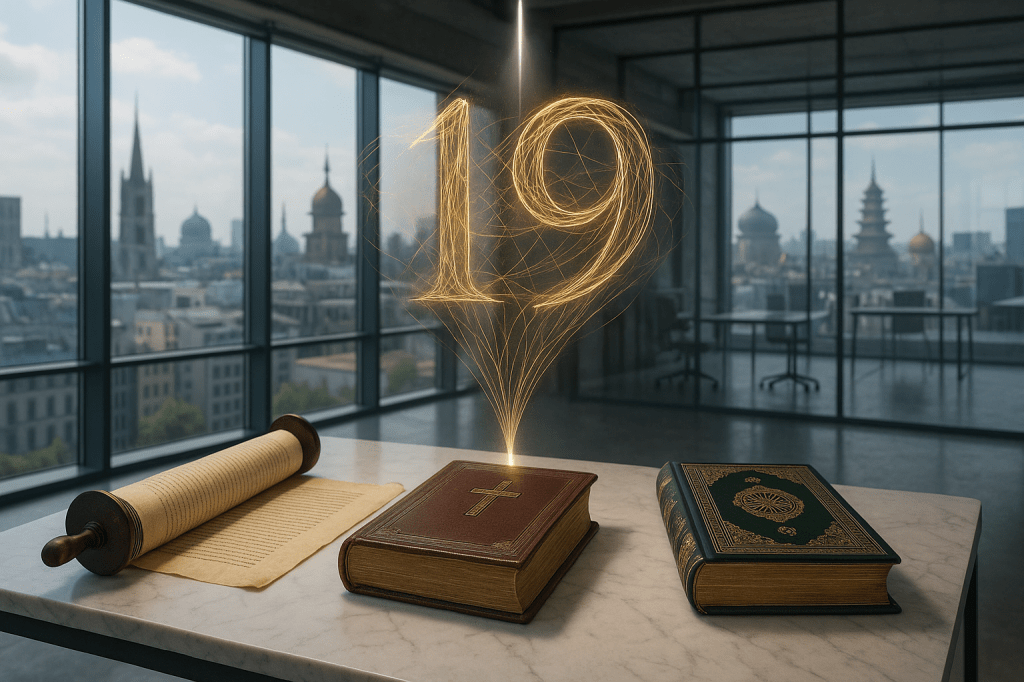
The mathematical miracle even bridges the gap between the Old and New Testaments and the Quran. Rashad shared a discovery made by researchers in Turkey: “The deep-strength in Turkey counted the verses from 3:81 to the answer to their claim 33:7 and found that the number of verses is a multiple of 19” (at 52:22). The number of verses between the prophecy (3:81) and its confirmation that Muhammad was included in the covenant (33:7) is mathematically locked by the code of 19. God left nothing to chance. Every aspect of this system — the prophecy, the identity of the messenger, the mathematical proof, and even the connection between the relevant verses — is sealed by the divine signature of 19.
Part 13: Suffering and Rejection — “Who Can Stand When He Appears?”
The Price of Truth
Malachi’s prophecy contains a haunting question: “Who may abide the day of his coming? And who shall stand when he appeareth?” This is not merely rhetorical — it is predictive. The Messenger of the Covenant’s message would be so challenging to established religious authorities that few would be able to accept it. Rashad Khalifa experienced this rejection in the most extreme form imaginable. He was vilified, declared a heretic, and ultimately assassinated on January 31, 1990, by members of the extremist group Jamaat ul-Fuqra. He paid the ultimate price for delivering God’s message — joining the long line of messengers and prophets who were killed by the very people they were sent to help.
Jesus prophesied this suffering explicitly in Luke 17:25: “First, however, he must suffer much and be rejected by the present age.” Rashad read this prophecy and recognized it: “First, however, he must suffer much and be rejected by the present age” (at 4:31). The suffering was not incidental — it was prophesied. The rejection was not a failure — it was fulfillment. And the assassination was not the end of the message — it was, in a terrible and profound way, its confirmation. Every genuine messenger of God has faced violent opposition. Rashad’s assassination by religious extremists places him precisely in the prophesied pattern.
Rashad Khalifa addressed this when teaching from Malachi in another sermon: “But who will endure the day of his coming? And who can stand when he appears? For he is like the refiner’s fire, or like the fuller’s lime. He will set refining and purifying, and he will purify the sons of Levi, meaning the people. Refining them like gold, or like silver, that they may offer due sacrifice to the lord. And it goes on, this purification process, and it seems like our generation is doing this, the purification process” (at 19:15).
[2:90] “Miserable indeed is what they sold their souls for—rejecting these revelations of God out of sheer resentment that God should bestow His grace upon whomever He chooses from among His servants. Consequently, they incurred wrath upon wrath. The disbelievers have incurred a humiliating retribution.”
The root of the rejection is exposed here: “sheer resentment that God should bestow His grace upon whomever He chooses.” The ego cannot tolerate that God would choose someone unexpected — not a famous scholar, not a political leader, not a descendant of Muhammad, but a quiet Egyptian-American biochemist in Tucson, Arizona. The pattern is eternal: God chooses whom He wills, and the arrogant cannot stand it.
Part 14: No Distinction Among Messengers — The Final Test
The Commandment That Separates Believers From Idol Worshippers
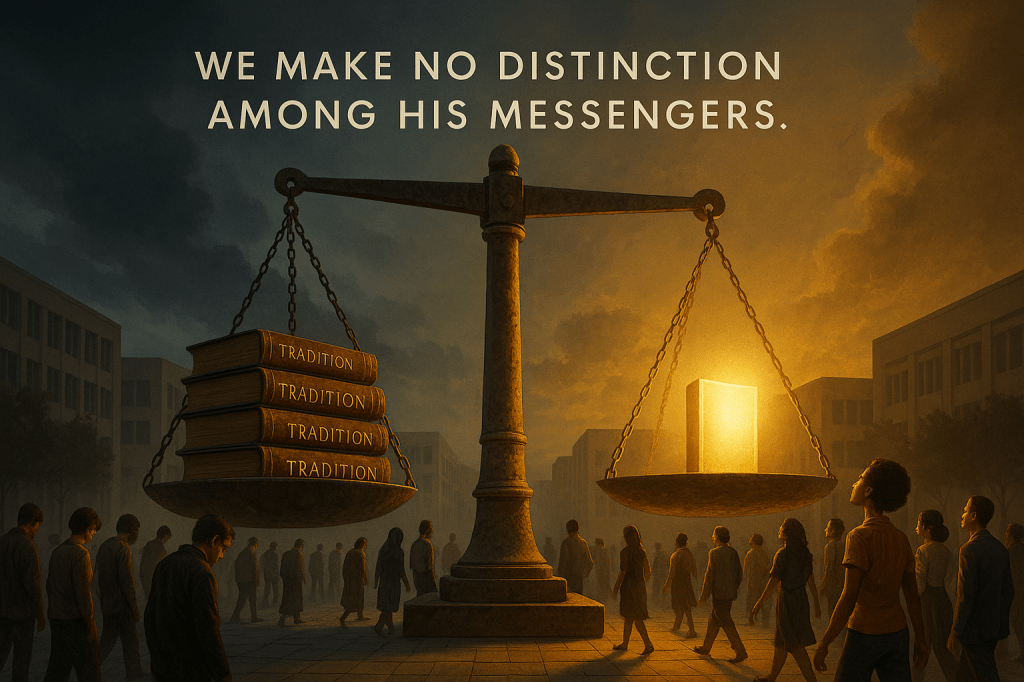
The Quran repeatedly commands believers to make no distinction among God’s messengers. This commandment is itself the ultimate test of sincerity — because the human ego desperately wants to elevate one messenger above all others. Christians elevate Jesus. Traditional Muslims elevate Muhammad. And in doing so, both groups violate the fundamental principle of Submission to God alone.
[4:150] “Those who disbelieve in God and His messengers, and seek to make distinction among God and His messengers, and say, ‘We believe in some and reject some,’ and wish to follow a path in between;”
[4:151] “these are the real disbelievers. We have prepared for the disbelievers a shameful retribution.”
[4:152] “As for those who believe in God and His messengers, and make no distinction among them, He will grant them their recompense. God is Forgiver, Most Merciful.”
The language could not be more direct. Those who say “we believe in some and reject some” are “the real disbelievers.” Not partial believers. Not misguided believers. The real disbelievers. This applies directly to anyone who accepts Moses and Jesus but rejects Muhammad, anyone who accepts Muhammad but rejects Rashad Khalifa, and anyone who claims to believe in God’s messages while refusing to accept the messenger God has mathematically identified in His own scripture.
This is why the Luke prophecy matters so profoundly. It is not merely an academic exercise in comparative religion. It is a test of whether one truly submits to God or to religious tradition. The “one mightier than I” whom John the Baptist foretold is the messenger who would come with something more powerful than water baptism — mathematical proof. Those who accept this proof submit to God. Those who reject it, despite understanding it, have chosen their tradition over their Creator.
Part 15: The Witness from the Children of Israel
Additional Biblical Confirmation
The Quran provides yet another fascinating piece of evidence connecting the mathematical miracle to previous scriptural traditions. In chapter 46, verse 10, we find a reference to a witness from the Children of Israel who recognized the same mathematical phenomenon:
[46:10] “Say, ‘What if it is from God and you disbelieved in it? A witness from the Children of Israel has borne witness to a similar phenomenon, and he has believed, while you have turned arrogant. Surely, God does not guide the wicked people.’”
The footnote identifies this witness as “Rabbi Judah the Pious (11th Century A.D.), who discovered the same 19-based mathematical code in intact fragments of the scripture.” This is remarkable on multiple levels. First, it demonstrates that Code 19 is not limited to the Quran — it exists in the Torah as well, confirming the common divine authorship of all scripture. Second, it shows that a Jewish scholar, working independently over eight centuries before Rashad Khalifa, found the same mathematical signature in his own scripture. Third, it means the “fire” of mathematical proof was always present in all of God’s scriptures — it simply required the right person, at the right time, with the right tools, to reveal it to the world.
This discovery by Rabbi Judah the Pious also strengthens the case that John the Baptist’s prophecy was not about Jesus. The “fire” baptism — the mathematical proof embedded in scripture — was something that transcended any single prophet’s era. It was designed to be discovered when humanity had developed the computational tools to verify it. The age of computers, which enabled Rashad Khalifa to analyze the entire Quran mathematically, represents the precise technological moment when this “fire” could be unleashed upon the world. Jesus lived 1,400 years before computers. The prophecy of fire had to wait for its appointed time.
Conclusion: Answering the Call of Evidence
The evidence, when examined honestly and completely, paints an unmistakable picture. John the Baptist’s prophecy in Luke 3:16 — “one mightier than I who shall baptize you with the Holy Ghost and with fire” — cannot logically refer to Jesus, who was John’s contemporary, who baptized with neither Holy Ghost nor fire in the way described, and who himself prophesied the coming of another messenger after him. Malachi’s “messenger of the covenant” in the Old Testament, Jesus’s prophecy of the “son of man” in Luke 17, and the Quran’s covenant with the prophets in chapter 3 verse 81 all converge on a single figure: God’s Messenger of the Covenant, whose identity is mathematically encoded in the Quran as Rashad Khalifa.
The “fire” is real. It is the mathematical miracle of Code 19 — a system so vast, so intricate, and so perfectly interlocking that it could only have been designed by the Creator of the universe. This fire purifies scripture by identifying human additions. It refines the believers by strengthening their faith with physical evidence. It illuminates the truth by providing verifiable proof that transcends language, culture, and religious tradition. And it tests every soul by demanding a response: Will you submit to God’s evidence, or will you cling to human tradition?
We live in the generation that Rashad Khalifa described as “the most fortunate generation” — the generation that has received, for the first time in human history, physical, mathematical proof of God’s scripture. The prophecy has been fulfilled. The messenger has come and gone — martyred, as prophecy foretold. But the fire he brought continues to burn. The mathematical code remains in the Quran, waiting for every sincere seeker to verify it. The question is no longer whether the prophecy has been fulfilled. The question is: what will you do with the evidence?
[3:81] “God took a covenant from the prophets, saying, ‘I will give you the scripture and wisdom. Afterwards, a messenger will come to confirm all existing scriptures. You shall believe in him and support him.’”
[74:30] “Over it is nineteen.”
[74:35] “This is one of the great miracles.”

 Quran Only Studies
Leave a comment