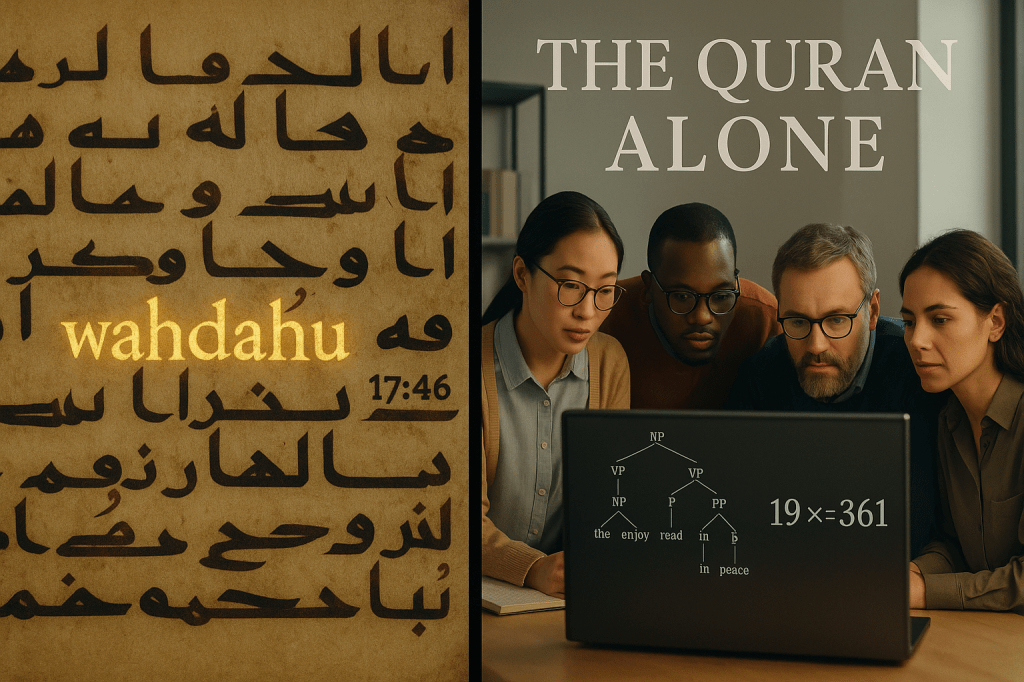
Introduction: The Most Consequential Mistranslation in History
There are mistranslations, and then there are deliberate doctrinal distortions that alter the entire trajectory of a billion people’s faith. The traditional rendering of verse 17:46 falls squarely into the second category. For centuries, translators like Abdullah Yusuf Ali and Muhammad Marmaduke Pickthall have moved a single Arabic word — wahdahu (alone) — from its divinely ordained position, making it refer to “your Lord” instead of “the Quran.” This seemingly minor rearrangement does not merely change the meaning of one verse. It annihilates an entire Quranic doctrine: that the Quran is the sole source of religious law and guidance, requiring no supplementary texts, no fabricated narrations, and no human traditions to complete it.
This article presents irrefutable evidence from four independent domains — Arabic grammar, Quranic cross-reference, mathematical structure, and morphological analysis — that the word “alone” in 17:46 modifies “the Quran,” not “your Lord.” The proof is not a matter of opinion or interpretive preference. It is embedded in the grammatical rules of the Arabic language itself, confirmed by an identical construction in verse 6:4, locked into place by the mathematical code of the Quran based on the prime number 19, and further validated by the root morphology of every word in the sentence. When all four lines of evidence converge on the same conclusion, what remains is not ambiguity but certainty — and the traditional translators’ distortion stands exposed as what God’s messenger Rashad Khalifa called “Satan-inspired translations.”
Part 1: The Verse in Full — Setting Up the Crime Scene
The Arabic Text and Its Context
Before we can analyze the grammar of 17:46, we must first read it in its original Arabic alongside the preceding verse, which establishes the context. Verse 17:45 introduces the scene: the Quran creates an invisible barrier between the reader and those who disbelieve in the Hereafter. Verse 17:46 then elaborates on this barrier, explaining that God places shields over the hearts and deafness in the ears of the disbelievers, and that when the Prophet preaches using the Quran alone, they flee in aversion. The two verses form a seamless unit, and the subject throughout is the Quran itself — not God in isolation.
[17:45] “When you read the Quran, we place between you and those who do not believe in the Hereafter an invisible barrier.”
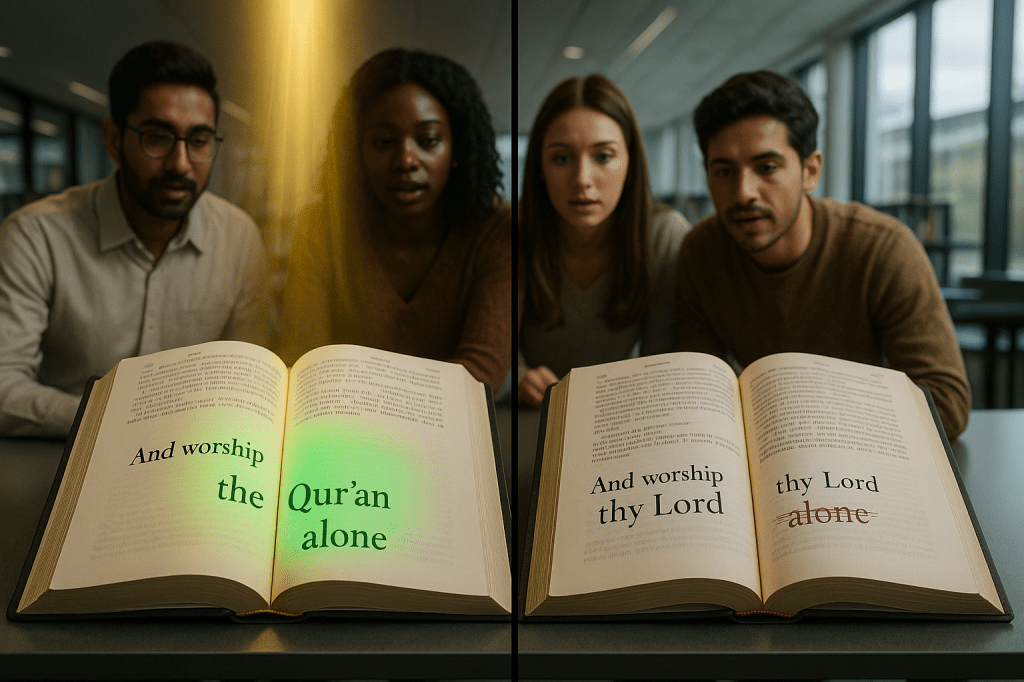
[17:46] “We place shields around their minds, to prevent them from understanding it, and deafness in their ears. And when you preach your Lord, using the Quran alone,* they run away in aversion.”
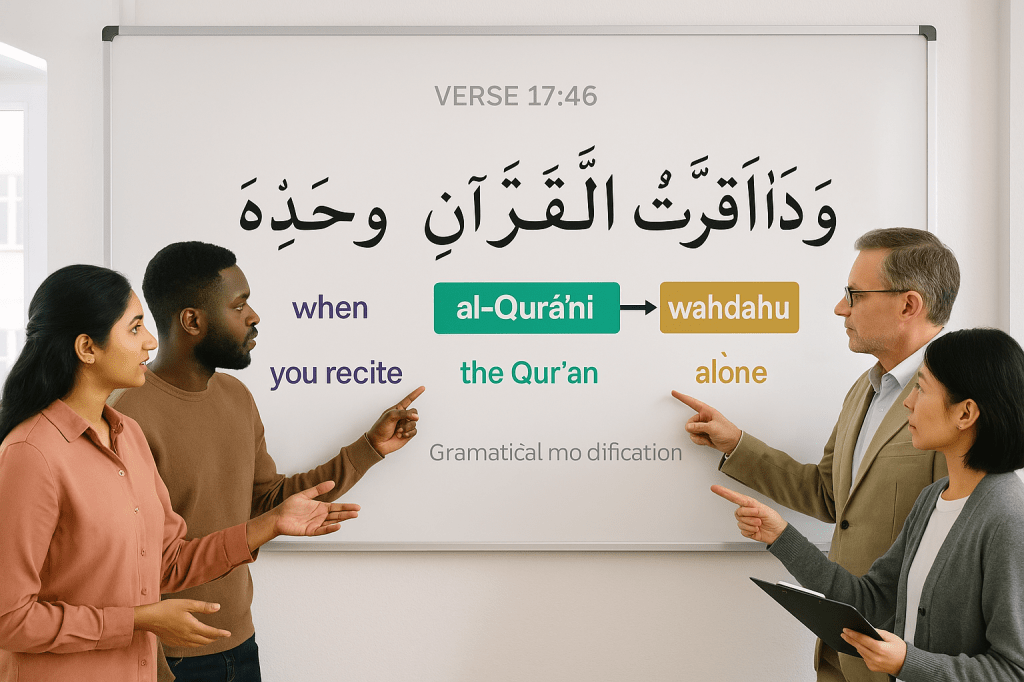
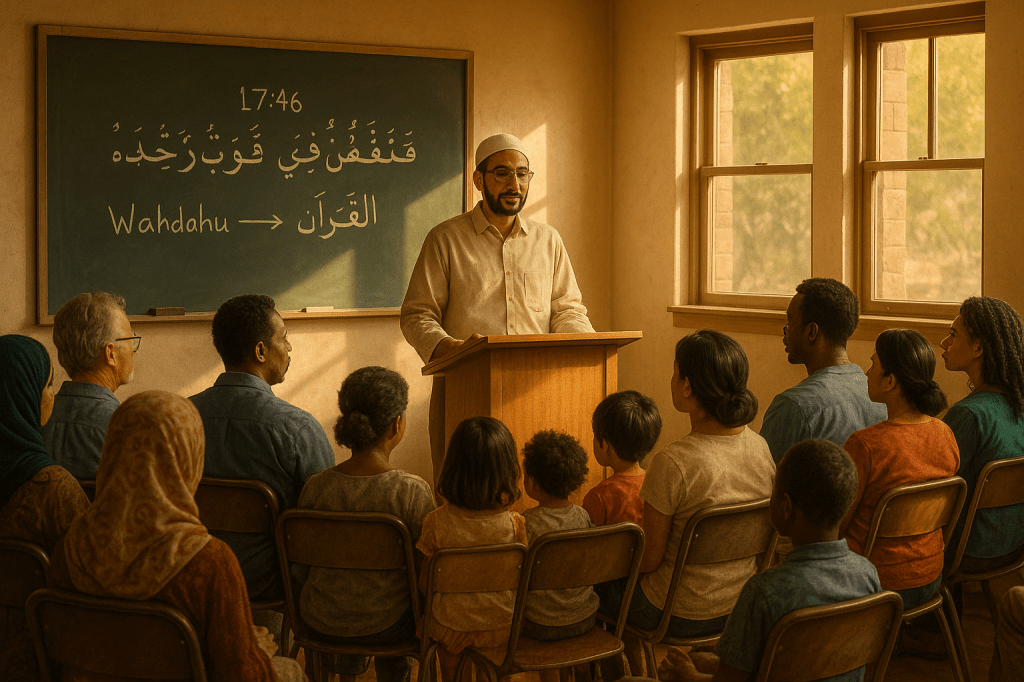
The Arabic of the critical clause in 17:46 reads: وَإِذَا ذَكَرْتَ رَبَّكَ فِى ٱلْقُرْءَانِ وَحْدَهُۥ — transliterated as wa idha dhakarta rabbaka fil-Qur’ani wahdahu. Every word matters. The verb dhakarta (you mention/preach) takes rabbaka (your Lord) as its direct object. Then comes the prepositional phrase fil-Qur’ani (in the Quran), and finally the word wahdahu (alone). The question that determines the entire doctrine is devastatingly simple: does “alone” modify “your Lord” or “the Quran”? The answer, as we shall prove beyond any doubt, is the Quran.
Word-by-Word Breakdown
Let us dissect every word in the clause wa idha dhakarta rabbaka fil-Qur’ani wahdahu to understand exactly what the Arabic says:
| Arabic | Transliteration | Translation | Grammatical Function |
|---|---|---|---|
| وَ | wa | and | Conjunction (عَطْف) |
| إِذَا | idha | when | Conditional particle (ظَرْف شَرْط) |
| ذَكَرْتَ | dhakarta | you mention / you preach | Verb, past tense, 2nd person masculine singular (فِعْل مَاضٍ) |
| رَبَّكَ | rabbaka | your Lord | Direct object (مَفْعُول بِهِ), accusative case |
| فِى | fi | in / using | Preposition (حَرْف جَر) |
| ٱلْقُرْءَانِ | al-Qur’ani | the Quran | Object of preposition (مَجْرُور), genitive case |
| وَحْدَهُۥ | wahdahu | alone / by itself | Circumstantial accusative (حَال), modifying the nearest noun |
The critical observation is this: the word wahdahu occupies the position immediately following al-Qur’ani (the Quran). It does not follow rabbaka (your Lord). In Arabic grammar, wahdahu functions as a hal (حال) — a circumstantial accusative that describes the state or condition of the noun it modifies. And the noun it modifies, by every rule of Arabic syntax, is the one immediately preceding it: al-Qur’an.
Part 2: The Arabic Grammar — The Hal (Circumstantial Accusative) Rule
What is a Hal (حال) and Why Does It Matter?
In Arabic grammar, the hal (حال) is one of the most well-defined grammatical constructs. It is a word or phrase in the accusative case that describes the state or condition of a noun (called the sahib al-hal, صَاحِب الحَال — the “possessor of the state”) at the time the action of the verb occurs. The hal answers the question “in what state?” or “in what condition?” For example, in the sentence ja’a Zaydun raakiban (Zayd came riding), the word raakiban (riding) is the hal that describes Zayd’s state when he came. Nobody would argue that “riding” describes the destination or some other noun — it describes the subject, because it is positioned after it and agrees with it in reference.
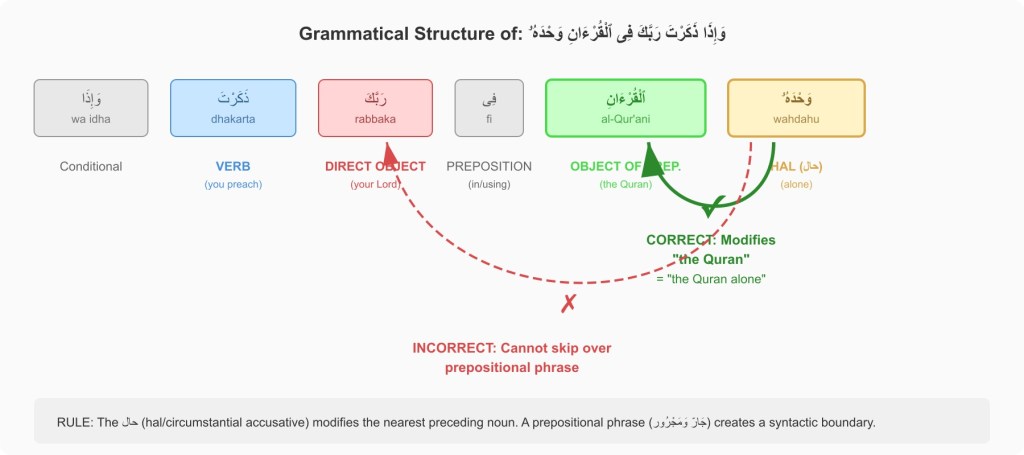
The word wahdahu is a well-known hal construction in Arabic. It consists of the root word wahd (alone/solitary) with the pronoun suffix -hu (his/its), forming a frozen accusative construction meaning “alone” or “by itself.” When wahdahu appears after a noun, it serves as a hal describing that noun’s state. The grammatical principle is unambiguous: the hal modifies its sahib al-hal, which is typically the nearest eligible noun. In 17:46, the nearest noun before wahdahu is al-Qur’an, not rabbaka.
The Prepositional Phrase Creates a Grammatical Boundary
There is an additional grammatical factor that makes the traditional interpretation impossible. The phrase fil-Qur’ani (in the Quran) is a prepositional phrase (جَارّ وَمَجْرُور) that creates a syntactic boundary between rabbaka and wahdahu. In Arabic syntax, when a prepositional phrase intervenes between a noun and a potential modifier, the modifier attaches to the nearest noun within or adjacent to the prepositional phrase — not to a noun that precedes the entire prepositional phrase. The preposition fi (in) governs al-Qur’an, making “the Quran” the immediate syntactic neighbor of wahdahu. Any competent Arabic grammarian would identify al-Qur’an as the sahib al-hal (the noun described by “alone”).
To understand why this matters so profoundly, consider what the verse actually says with the correct grammatical reading: “And when you preach your Lord, using the Quran alone, they run away in aversion.” The meaning is crystal clear: the Prophet preaches about his Lord (rabbaka) using the instrument of the Quran (fil-Qur’ani), and this Quran is used alone (wahdahu) — without supplementary texts, traditions, or fabricated narrations. The Quran is the sole tool of the preaching. This reading preserves both the grammar and the doctrine.
Part 3: The Definitive Word-Order Test
If God Meant “Your Lord Alone,” Where Would Wahdahu Be?
Arabic is a remarkably precise language, and God — who revealed the Quran in “a clear Arabic tongue” — chose every word position with divine precision. If the intended meaning were “when you mention your Lord alone in the Quran,” the Arabic word order would be fundamentally different. The word wahdahu would appear immediately after rabbaka, before the prepositional phrase, like this: ذَكَرْتَ رَبَّكَ وَحْدَهُ فِى ٱلْقُرْءَانِ (dhakarta rabbaka wahdahu fil-Qur’ani). This would unambiguously mean “you mention your Lord alone in the Quran.” But this is NOT what the Quran says.
Instead, God placed wahdahu AFTER fil-Qur’ani, producing the word order: dhakarta rabbaka fil-Qur’ani wahdahu. This placement means: “you mention your Lord in the Quran alone” — that is, using the Quran as the sole instrument of preaching. The difference between these two word orders is not subtle. It is the difference between a doctrine of God’s uniqueness (which is already established in dozens of other verses) and the revolutionary doctrine that the Quran is the only source of religious guidance — a doctrine that directly threatens the entire edifice of fabricated narrations and human traditions that traditional scholars depend upon for their authority.
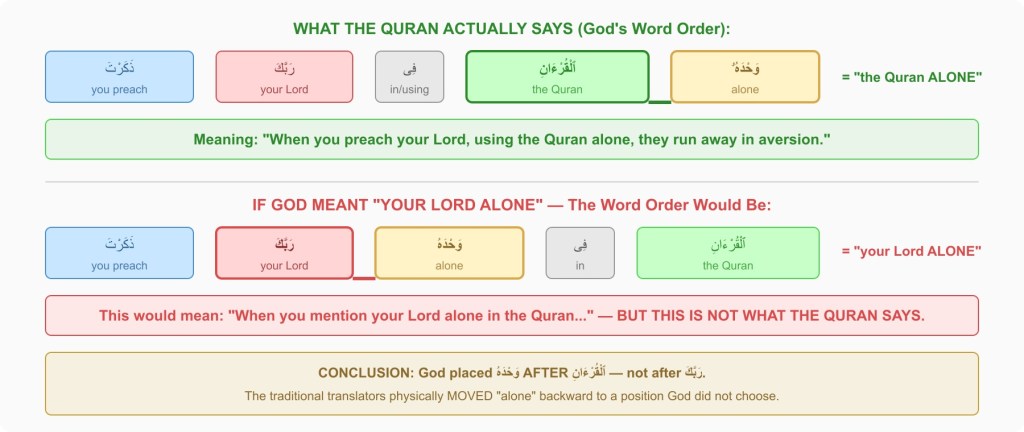
This is not a matter of scholarly disagreement or competing interpretive traditions. The Arabic text is fixed, immutable, and divinely authored. God placed wahdahu after al-Qur’an, not after rabbaka. The translators moved it. There is no third possibility. Either God made a grammatical error (impossible, by definition of God), or the translators altered the meaning. The conclusion is inescapable.
Part 4: The 6:4 Parallel — God’s Own Grammatical Precedent
An Identical Arabic Construction Settles the Debate
God’s messenger Rashad Khalifa recounted an illuminating incident in the Submitters Perspective newsletter #26 (March 1987). A man in Vancouver, British Columbia, told him that he was “ignorant of the Arabic grammar” because the word “alone” in 17:46 supposedly refers to God, not the Quran, due to “a unique twist of the Arabic grammar.” Rashad’s response was devastating in its simplicity: “The Almighty God knows Arabic grammar, and He has put in the Quran an identical expression in 6:04, where the word ‘alone’ refers to the word immediately preceding it.”
[6:4] “No matter what kind of proof comes to them from their Lord, they turn away from it, in aversion.”
The Arabic of 6:4 reads: وَمَا تَأْتِيهِم مِّنْ ءَايَةٍ مِّنْ ءَايَٰتِ رَبِّهِمْ إِلَّا كَانُوا عَنْهَا مُعْرِضِينَ. The structure here is directly parallel to 17:46. In 6:4, the pronoun -ha (عَنْهَا, “from it”) refers back to the nearest preceding noun ayah (ءَايَةٍ, “proof/sign”), not to the more distant noun rabbihim (رَبِّهِمْ, “their Lord”). No Arabic grammarian in the world would argue that “from it” in 6:4 refers to “their Lord.” The pronoun clearly refers to the nearest antecedent — the proof/sign. This is standard Arabic grammar, applied consistently throughout the Quran.
Now apply the same rule to 17:46. In both verses, a qualifier or pronoun appears after a chain of nouns, and in both cases, the qualifier attaches to the nearest noun — not to a more distant one. In 6:4, “from it” attaches to “proof,” not “their Lord.” In 17:46, “alone” attaches to “the Quran,” not “your Lord.” The grammatical principle is identical. The only difference is that 6:4’s meaning does not threaten the traditional scholars’ authority, so they translate it correctly. But 17:46 strikes at the very foundation of their power — the claim that the Quran needs supplementary sources — so they distort it. The selectivity of their “grammar” reveals that their objection was never about grammar at all. It was about protecting their own authority.

Part 5: The Comparative Translation Exposé
How the Translators Moved “Alone” to Protect Their Traditions
The distortion becomes visually obvious when we place the major translations side by side and compare them with the actual Arabic word positions. Below is a comparative analysis showing exactly how the traditional translators rearranged the meaning of 17:46:
| Translator | Translation of 17:46 (key clause) | Where is “alone”? | Faithful to Arabic? |
|---|---|---|---|
| Rashad Khalifa (The Final Testament) | “And when you preach your Lord, using the Quran alone, they run away in aversion.” | Modifies “the Quran” — as written in Arabic | YES |
| Abdullah Yusuf Ali | “When thou dost commemorate thy Lord — and Him alone — in the Qur-an, they turn on their backs, fleeing (from the Truth).” | MOVED to modify “thy Lord” — with em-dashes to force the reading | NO |
| Muhammad Marmaduke Pickthall | “And when thou makest mention of thy Lord alone in the Qur’an, they turn their backs in aversion.” | MOVED to modify “thy Lord” — rearranged word order | NO |
| Sahih International | “And when you mention your Lord alone in the Qur’an, they turn back in aversion.” | MOVED to modify “your Lord” | NO |
Notice the pattern: every traditional translator physically moves the word “alone” from its position after “the Quran” and places it after “your Lord.” Yusuf Ali even inserts em-dashes around “and Him alone” to create a parenthetical clause that does not exist in the Arabic text. This is not translation — it is editorial insertion. The Arabic text has no pause, no parenthetical, and no em-dashes between rabbaka and fil-Qur’ani wahdahu. The clause flows as a single, continuous statement: “you preach your Lord in-the-Quran alone.” The traditional translators break this flow, rearrange the components, and produce a meaning that the Arabic does not support.
As Rashad Khalifa wrote in SP #26: “The word ‘ALONE’ (WAHDAHU) is strategically placed immediately following the word ‘Quran.’ Yet, Abdullah Yusuf Ali (and also Muhammad Marmaduke Pickthall’s translation, as well as all other English translations, with the single exception of my translation) moved the word ‘ALONE’ back to make it refer to God, instead of Quran. This doctrinal distortion effectively destroys one of the major doctrines” of the religion of Submission. He continued: “What I presented in this article is proof that the traditional Muslims’ translations are Satan-inspired, since they consistently destroy the basic doctrines of God’s religion.”
Part 6: The Mathematical Proof — Code 19 Confirms “The Quran”
When Numbers Speak Louder Than Scholars
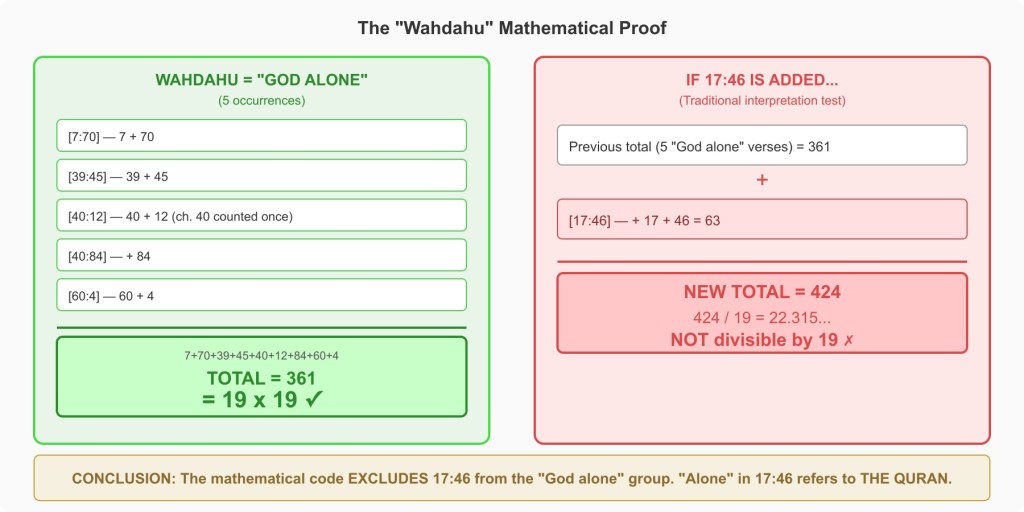
The Arabic grammar alone is sufficient to settle this question. But God, in His infinite wisdom, has provided an additional layer of proof that transcends human opinion entirely: the mathematical code based on the prime number 19. The word wahdahu (وَحْدَهُ — alone) appears exactly six times in the entire Quran. Five of those occurrences refer to God alone, and one — in 17:46 — refers to the Quran alone. The mathematical structure of the Quran confirms this distinction with stunning precision.
The five verses where wahdahu refers to God alone are: [7:70], [39:45], [40:12], [40:84], and [60:4]. When we add the chapter numbers and verse numbers of these five occurrences, we get:
| Verse | Numbers Used | Explanation |
|---|---|---|
| [7:70] | 7 + 70 | Chapter 7, Verse 70 |
| [39:45] | 39 + 45 | Chapter 39, Verse 45 |
| [40:12] | 40 + 12 + 84 | Chapter 40 (counted once), Verses 12 and 84 |
| [40:84] | ||
| [60:4] | 60 + 4 | Chapter 60, Verse 4 |
| TOTAL: 7 + 70 + 39 + 45 + 40 + 12 + 84 + 60 + 4 = 361 = 19 x 19 | ||
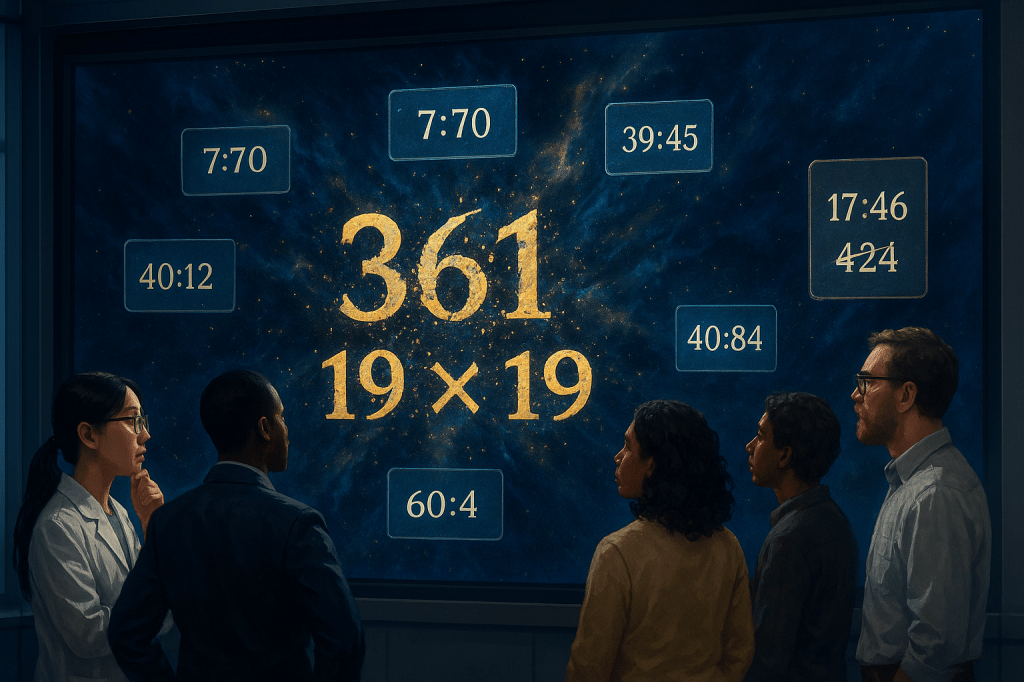
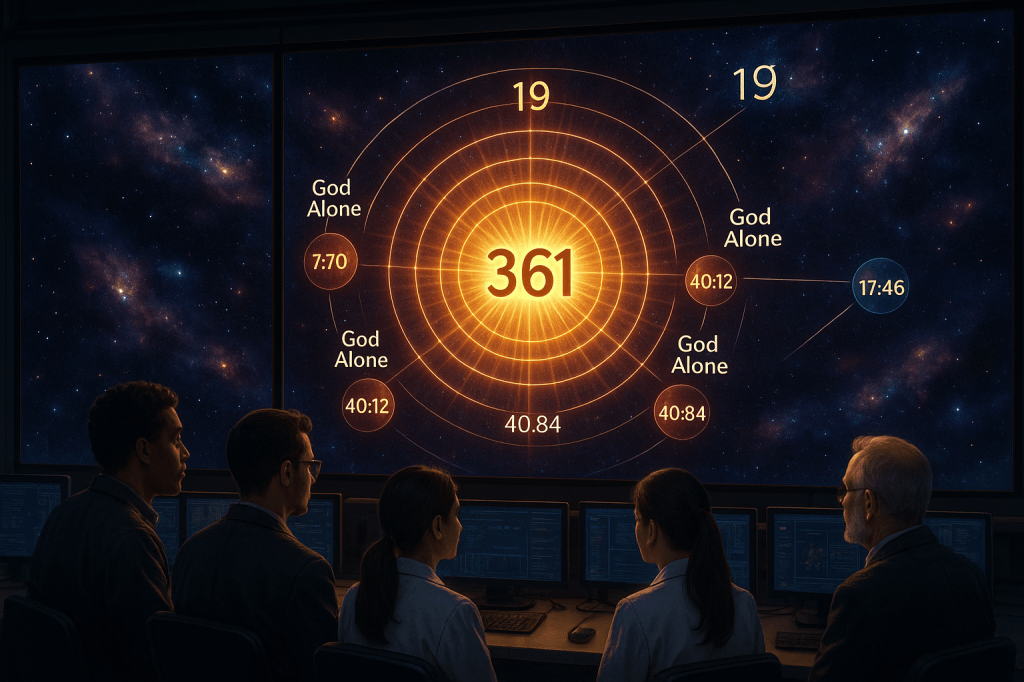
The sum is computed as the footnote in the Final Testament specifies: add the chapter and verse numbers, counting each chapter number once. Chapter 40 contains two wahdahu references (verses 12 and 84), so the chapter number 40 is counted once, and both verse numbers are added. The total is 7+70+39+45+40+12+84+60+4 = 361. And 361 = 19 x 19. This is not merely a multiple of 19 — it is 19 squared, an extraordinary mathematical signature that screams divine authorship. The five “God alone” verses form a perfect, self-contained mathematical group stamped with the Quran’s authenticating prime.
[7:70] “They said, ‘Did you come to make us worship God alone, and abandon what our parents used to worship? We challenge you to bring the doom you threaten us with, if you are truthful.’”
[39:45] “When God ALONE is mentioned, the hearts of those who do not believe in the Hereafter shrink with aversion. But when others are mentioned beside Him, they become satisfied.”
[40:12] “This is because when God ALONE was advocated, you disbelieved, but when others were mentioned beside Him, you believed. Therefore, God’s judgment has been issued; He is the Most High, the Great.”
[40:84] “Subsequently, when they saw our retribution they said, ‘Now we believe in God ALONE, and we now disbelieve in the idol worship that we used to practice.’”
[60:4] “A good example has been set for you by Abraham and those with him. They said to their people, ‘We disown you and the idols that you worship besides God. We denounce you, and you will see nothing from us except animosity and hatred until you believe in God ALONE.’”
What Happens When You Add 17:46?
Now, if the traditional interpretation were correct — if wahdahu in 17:46 also referred to God — then adding 17:46 to this group should maintain the mathematical pattern. Let us test: adding chapter 17 and verse 46 to the previous total gives us 361 + 17 + 46 = 424. Is 424 divisible by 19? We divide: 424 / 19 = 22.315… It is NOT a multiple of 19. The mathematical code rejects the inclusion of 17:46 in the “God alone” group. The code is telling us, with mathematical certainty, that wahdahu in 17:46 does NOT refer to God. It refers to something else — and the only other noun it can grammatically refer to is al-Qur’an.
This is the beauty of God’s system. The Arabic grammar points to the Quran. The parallel construction in 6:4 confirms it. And the mathematical code — which no human being can manipulate — seals it permanently. Three independent lines of evidence, converging on one inescapable conclusion: “alone” in 17:46 refers to the Quran.
Part 7: Rashad Khalifa’s Audio Teaching — The Great Debate
The Messenger Explains Wahdahu Live
God’s messenger Rashad Khalifa addressed the wahdahu proof multiple times in his recorded teachings, most notably during “The Great Debate” — a 90-minute recorded debate between Rashad and a leading traditionalist scholar. In this remarkable exchange, Rashad laid out the mathematical evidence with characteristic precision, explaining the wahdahu code to his opponent in real time. He stated: “Look at page 745 [of the Quran index], and look at the chapters and verses where Allah wahdahu is mentioned. Chapter 7, verse 70, chapter 39, verse 45, chapter 40, verses 12 and 84, chapter 60, verse 4 — you add these numbers, you come to 19 times 19” (at 1:08:48).
In another recorded lecture on the mathematical miracle of the Quran, Rashad explained the same proof with even greater detail: “The word Wahdahu is mentioned five times, but when you add the verses and chapters numbers, where this word Wahdahu is found, the total is 361, 19 times 19” (at 24:38). And in a separate Friday sermon, Rashad provided even more granular detail: “This word [wahdahu] is mentioned in the Quran six times. Five times, it has to do with God, and one time with the Quran. If you preach the Quran alone, they don’t like it. But the five times you take the verses and the chapters, again, and you add them up, and the total is 361… This is 19 times 19” (at 36:23).
The Vancouver Incident — Grammar vs. God
The most revealing account comes from Rashad’s own newsletter. In Submitters Perspective #26 (March 1987), he recounted: “I remember an incident in Vancouver, British Columbia, where a gentleman told me that I am ignorant of the Arabic grammar, because the word ‘ALONE’ (WAHDAHU) in 17:46 refers to God, not the Quran, due to ‘a unique twist of the Arabic grammar.’ For the sake of peace, I agreed with him that I am ignorant, but the Almighty God knows Arabic grammar, and He has put in the Quran an identical expression in 6:04, where the word ‘ALONE’ refers to the word immediately preceding it.” This response is quintessential Rashad — humble in tone, devastating in substance. He did not need to win an argument about grammar. He simply pointed to God’s own usage of the same grammatical construction, which settles the matter permanently.
Rashad then drove the point home: “If the word ‘ALONE’ in 17:46 were placed immediately after the word ‘RABBAKA’ (Your Lord), it would have been perfectly correct. But then, it would convey a totally different meaning, and a totally different criterion. As it is, the crucial word ‘ALONE’ appears immediately after the word ‘Quran,’ because this is what our Creator wishes to tell us.” The word-order argument is irrefutable. Arabic, like every language, carries meaning through word position, and God chose a specific position for wahdahu — after the Quran, not after the Lord.
Part 8: Root Analysis — The Morphological Evidence
Dissecting the Roots of Every Word
Arabic is a root-based language where every word derives from a three-letter (or occasionally four-letter) root that carries a core semantic field. By examining the roots of the key words in 17:46, we gain additional insight into the verse’s meaning and the relationships between its components. Each root tells a story, and together they paint a picture that is entirely consistent with the “Quran alone” reading.
The four critical roots in the clause are:
- ذ-ك-ر (dh-k-r) — Root of dhakarta (ذَكَرْتَ): This root carries the meanings of “mention,” “remember,” “remind,” “preach,” and “commemorate.” Its semantic range encompasses both passive remembrance and active preaching. In 17:46, the form dhakarta (second person masculine singular past tense) means “you mentioned” or “you preached.” The verb takes a direct object (rabbaka, your Lord) and an instrumental complement (fil-Qur’ani, using the Quran). The preacher mentions the Lord by means of the Quran — the Quran is the instrument of the preaching.
- ر-ب-ب (r-b-b) — Root of rabbaka (رَبَّكَ): This root means “lord,” “master,” “sustainer,” “nurturer.” The word rabb refers to the one who nourishes, sustains, and develops creation. With the possessive suffix -ka (your), it becomes rabbaka — “your Lord.” In this verse, the Lord is the subject being preached about, not the instrument of preaching. The Lord is the content of the message; the Quran is the vehicle.
- ق-ر-أ (q-r-‘) — Root of al-Qur’an (ٱلْقُرْءَانِ): This root means “to read,” “to recite,” “to gather.” The word Qur’an literally means “the reading” or “the recitation” — the collected divine text that serves as the sole source of guidance. In this verse, the Quran occupies the instrumental position (fi = in/using), making it the means by which the preaching occurs. This is exactly the noun that wahdahu modifies: the Quran is used alone, without other sources.
- و-ح-د (w-h-d) — Root of wahdahu (وَحْدَهُ): This root carries the meaning of “one,” “alone,” “unique,” “sole.” The word wahd is the verbal noun meaning “aloneness” or “solitude,” and when combined with the pronoun suffix -hu (his/its), it creates the frozen accusative wahdahu — “alone” or “by itself.” This word is a hal (circumstantial accusative) that describes the state of its sahib al-hal (the noun it modifies). Its pronoun suffix -hu (masculine singular) is grammatically compatible with al-Qur’an (a masculine noun), confirming the modification.
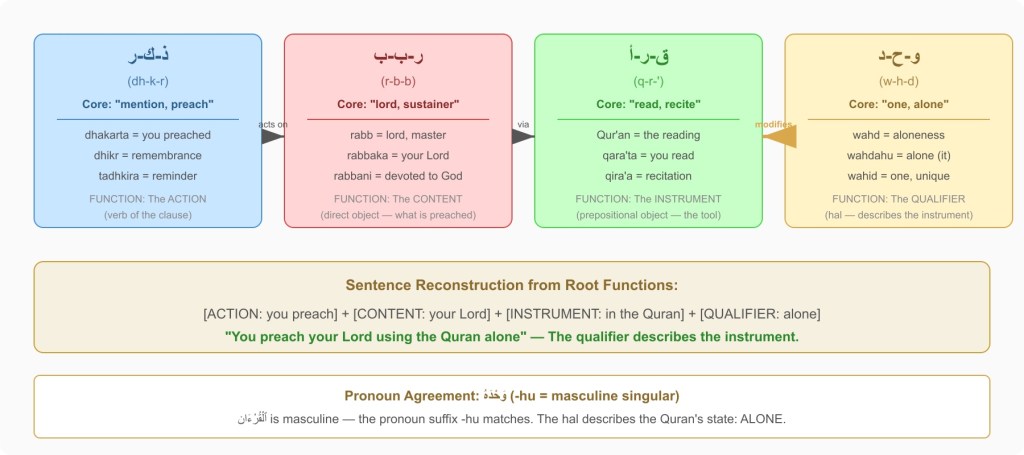
The morphological analysis provides yet another layer of confirmation. The pronoun suffix -hu in wahdahu is masculine singular, and al-Qur’an is a masculine singular noun. The pronoun agrees grammatically with the Quran. While rabb is also masculine, the positional rule still applies: the hal modifies the nearest noun, which is al-Qur’an. The root analysis confirms the semantic roles: the Lord is the content of preaching, the Quran is the instrument of preaching, and “alone” describes the condition of the instrument — the Quran is used as the sole instrument, without any supplementary sources.
Part 9: The Companion Verse — 39:45 and the Dual Criterion
God Alone and Quran Alone: Two Sides of One Coin
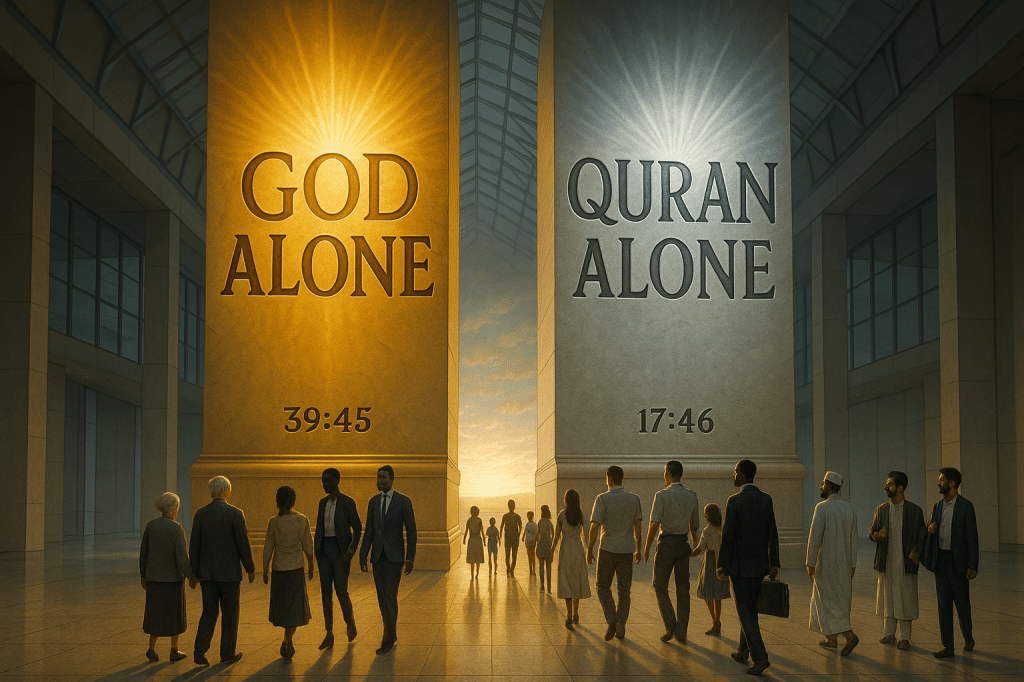
A superficial reading might suggest that 17:46 and 39:45 say the same thing. They do not. They are complementary criteria that test two distinct but related aspects of genuine belief in the Hereafter. Verse 39:45 tests whether a person accepts God alone — without partners, without intermediaries, without names mentioned alongside His. Verse 17:46 tests whether a person accepts the Quran alone — without supplementary texts, without fabricated narrations, without human traditions.
[39:45] “When God ALONE is mentioned, the hearts of those who do not believe in the Hereafter shrink with aversion. But when others are mentioned beside Him, they become satisfied.”
If wahdahu in 17:46 also referred to God, then 17:46 would simply repeat the criterion of 39:45 — making it redundant. But God does not include redundant verses. Every verse serves a unique purpose. The fact that 39:45 already establishes the “God alone” criterion means that 17:46 must establish a different, complementary criterion: the “Quran alone” criterion. Together, these two verses form the complete test of belief in the Hereafter:
- 39:45 — The Monotheism Test: Do you worship God alone, without mentioning any name alongside His? When you hear “there is no god except God” — without the addition of Muhammad’s name or any other name — does your heart shrink in aversion, or does it rejoice?
- 17:46 — The Scripture Test: Do you accept the Quran alone as your source of religious guidance, without supplementing it with fabricated narrations or human traditions? When someone preaches using the Quran alone — without quoting the so-called “authentic” narration collections — do you run away in aversion?
These are two distinct tests. The traditional interpretation — which makes 17:46 say the same thing as 39:45 — is not only grammatically wrong, it is theologically incoherent. It turns two complementary criteria into a single redundant statement, wasting a verse in a book that God describes as containing “no redundancy” and being “fully detailed.”
[6:114] “Shall I seek other than God as a source of law, when He has revealed to you this book fully detailed? Those who received the scripture recognize that it has been revealed from your Lord, truthfully. You shall not harbor any doubt.”
[6:19] “Say, ‘Whose testimony is the greatest?’ Say, ‘God’s. He is the witness between me and you that this Quran has been inspired to me, to preach it to you and whomever it reaches. Indeed, you bear witness that there are other gods beside God.’ Say, ‘I do not testify as you do; there is only one God, and I disown your idolatry.’”
Part 10: Why the Translators Did It — Motive and Consequence
The Doctrine That Threatens Scholarly Authority
Understanding why the translators moved “alone” requires understanding what the correct translation threatens. If the Quran alone is the source of religious law and guidance, then the entire infrastructure of traditional religion collapses overnight. The six major collections of fabricated narrations — Bukhari, Muslim, Abu Dawud, Tirmidhi, al-Nasa’i, and Ibn Majah — become not merely unnecessary but positively harmful. The elaborate system of jurisprudence (fiqh) built upon these collections becomes invalid. The scholarly class that derives its authority from interpreting these narrations loses its raison d’etre. The political structures that depend on this scholarly class for legitimacy are undermined.
In other words, a correct translation of 17:46 threatens the livelihoods, the status, and the power of millions of religious professionals worldwide. It is no wonder they moved one word. The marvel is that they could not move it in the Arabic — only in their translations. The original Arabic remains exactly as God revealed it, waiting for those with eyes to see and hearts to understand.
Rashad Khalifa identified this pattern with devastating clarity in SP #26: “In accordance with God’s statement of fact in 12:106, the vast majority of Muslims have flunked the idolatry test. This is reflected in the translations of the Quran by traditional Muslims.” He documented how Yusuf Ali distorted not only 17:46 but also 39:45 — replacing “alone” with “the one and only” to neutralize the doctrinal impact — and 20:15, where the Arabic word akaad (almost) was reversed to hide the Quran’s prophecy about the end of the world. The pattern is consistent: wherever a verse threatens traditional theology, the translation is distorted.
[6:112] “We have permitted the enemies of every prophet — human and jinn devils — to inspire in each other fancy words, in order to deceive. Had your Lord willed, they would not have done it. You shall disregard them and their fabrications.”
[6:113] “This is to let the minds of those who do not believe in the Hereafter listen to such fabrications, and accept them, and thus expose their real convictions.”
The Yusuf Ali Distortion of 39:45
Rashad documented that Yusuf Ali’s distortion of 17:46 was not an isolated incident but part of a systematic pattern. In his translation of 39:45, Yusuf Ali replaced the word “ALONE” with “the one and only” — a phrase that completely neutralizes the doctrinal force of the verse. To say “when God, the one and only, is mentioned” is functionally equivalent to saying “when God, the Most Gracious, is mentioned” or “when God, the Almighty, is mentioned.” It becomes a mere attribute, not a criterion. The word “alone” is a test: it asks whether you can tolerate God being mentioned without any other name alongside Him. The phrase “the one and only” asks no such question. Yusuf Ali also added the word “gods” in parentheses when discussing “those other than Him,” limiting the category to deities and thereby excluding the mention of prophets, saints, and scholars — the very names that traditional practice insists on adding alongside God.
Part 11: The Broader Quranic Context — A Web of Confirmation
Every Thread Leads to the Same Truth
The “Quran alone” doctrine is not a fringe interpretation supported by a single verse. It is one of the most extensively documented themes in the entire Quran. Verse 17:46 is part of a vast web of verses that collectively establish, reinforce, and protect this doctrine from every possible angle. Consider the following chain of evidence:
[6:19] “Say, ‘Whose testimony is the greatest?’ Say, ‘God’s. He is the witness between me and you that this Quran has been inspired to me, to preach it to you and whomever it reaches…’”
This verse establishes that the Quran was inspired to the Prophet specifically for preaching. It is the instrument of the message, the vehicle of divine communication. When 17:46 then says that the Prophet preaches “using the Quran alone,” it is describing exactly what 6:19 commands: preach with the Quran, and preach with nothing else. The two verses are perfectly harmonious.
[6:114] “Shall I seek other than God as a source of law, when He has revealed to you this book fully detailed?”
[6:115] “The word of your Lord is complete, in truth and justice. Nothing shall abrogate His words. He is the Hearer, the Omniscient.”
These companion verses establish that the Quran is “fully detailed” and “complete.” If the scripture is already complete and fully detailed, what role could any supplementary text possibly play? The Quran alone is sufficient — and 17:46 confirms this by using the word wahdahu (alone) to modify al-Qur’an. The verse does not merely state a preference for the Quran; it defines the Quran’s solitary, exclusive status as the source of religious guidance.
[17:45] “When you read the Quran, we place between you and those who do not believe in the Hereafter an invisible barrier.”
Note the immediate context: 17:45 speaks of reading the Quran — not of mentioning God. The subject is the Quran. The barrier is placed when the Quran is read. Then 17:46 continues the same theme: shields are placed on their hearts to prevent them from understanding it (the Quran), and when the Prophet preaches using the Quran alone, they flee. The pronoun “it” (-hu in yafqahuhu) refers to the Quran, and the “alone” refers to the Quran. The entire passage, from 17:45 through 17:47, is about the Quran’s impact on disbelievers — not about the abstract concept of God’s oneness, which is addressed elsewhere.
[17:47] “We are fully aware of what they hear, when they listen to you, and when they conspire secretly — the disbelievers say, ‘You are following a crazy man.’”
The three verses form a tight thematic unit. The disbelievers cannot understand the Quran (17:45). They are shielded from understanding it and they flee when the Quran alone is used for preaching (17:46). And they privately call the Prophet “a crazy man” (17:47). The subject throughout is the Quran-based preaching, not a theological lecture about monotheism.
Part 12: The Pronoun -hu in Wahdahu — Grammatical Gender Agreement
Technical Confirmation Through Pronoun Morphology
A final grammatical point deserves attention. The word wahdahu (وَحْدَهُ) contains the third-person masculine singular pronoun suffix -hu (هُ). This pronoun must agree in gender and number with its referent — the noun it points back to. In Arabic, al-Qur’an (ٱلْقُرْءَان) is a masculine singular noun. The pronoun -hu (masculine singular) agrees perfectly with al-Qur’an. This agreement is not proof by itself — since rabb is also masculine — but it confirms that there is no grammatical obstacle to wahdahu referring to the Quran. The grammar permits it, the word order demands it, the parallel in 6:4 confirms it, and the mathematical code seals it.
Some traditionalists have argued that the pronoun in wahdahu must refer to “your Lord” because God is more “important” than the Quran. This is a theological argument, not a grammatical one, and it fails on its own terms. Arabic grammar does not assign modifiers based on perceived importance; it assigns them based on syntactic position. Furthermore, the argument creates a false hierarchy: the Quran is God’s word, and to advocate the Quran alone is to advocate God alone. The two doctrines are not in competition — they are expressions of the same truth, articulated from different angles by different verses.
Part 13: Appendix 18 and the Broader Mathematical Framework
The Code That No Human Can Forge
The mathematical proof regarding wahdahu and 19 x 19 is not an isolated curiosity. It is part of the vast mathematical structure described in Appendix 18 of the Final Testament, which documents the Quran’s comprehensive mathematical code. This code, based on the prime number 19 (as stated in verse 74:30), permeates every aspect of the Quran — from the number of chapters and verses to the frequency of specific words, the values of letters, and the positions of key terms.
[18:110] “Say, ‘I am no more than a human like you, being inspired that your god is one God. Those who hope to meet their Lord shall work righteousness, and never worship any other god beside his Lord.’”
Rashad Khalifa explained the wahdahu proof within this broader mathematical context. In his lecture on the mathematical miracle, he noted that “the word Wahd, referring to God as one, is mentioned in the Quran 19 times.” This is itself a multiple of 19 — the Quran’s authenticating number. Then, within this set, the word wahdahu specifically (the emphatic form meaning “alone”) appears six times: five referring to God and one referring to the Quran. The five “God alone” occurrences sum to 361 (19 x 19), and the sixth occurrence (17:46) is excluded from this group by the mathematical code itself. The system is self-authenticating and self-verifying: it identifies its own members and rejects imposters.
This mathematical precision is what Rashad described as the “physical, tangible, examinable, verifiable” proof that the Quran is divinely authored. No human being could construct a text where the positions of a single word across the entire document produce a sum that is exactly the square of a specific prime number, while simultaneously excluding one occurrence that carries a different meaning. This is beyond human capability. It is the work of the One who knows every word’s position before the book was written.
The footnote in the Final Testament at verse 60:4 states it plainly: “The Arabic word for ‘ALONE’ (WAHDAHU) occurs only six times in the Quran, one of them refers to upholding the Quran ALONE (17:46). The reference to God ALONE occurs in 7:70, 39:45, 40:12 & 84, and 60:4. The sum of these numbers (7+70+39+45+40+12+84+60+4) equals 361, or 19×19.”
Part 14: The Broader Consequence — What “Quran Alone” Means for Believers
Liberation from Human Authority
The correct understanding of 17:46 is not merely an academic exercise in Arabic grammar. It is a liberating truth that frees believers from centuries of accumulated human interference with God’s message. When we understand that the Quran alone is the source of religious guidance, we are freed from the burden of navigating thousands of conflicting, often contradictory, fabricated narrations that were compiled two centuries after the Prophet’s death. We are freed from the authority of scholars who claim the right to interpret these narrations and issue binding rulings on everything from how to brush one’s teeth to how to enter a bathroom.
The Quran-alone doctrine does not diminish the importance of the Prophet. On the contrary, it honors him by preserving only what God authorized him to deliver — the Quran itself. The Prophet’s mission was to deliver the Quran, as verse 6:19 makes explicit. Attributing thousands of additional statements to him — many of which contradict the Quran — is not honoring the Prophet; it is slandering him. The correct reading of 17:46 restores the Prophet to his proper role as the deliverer of God’s message, rather than the co-author of a parallel religious system.
[6:112] “We have permitted the enemies of every prophet — human and jinn devils — to inspire in each other fancy words, in order to deceive. Had your Lord willed, they would not have done it. You shall disregard them and their fabrications.”
[3:18] “God bears witness that there is no god except He, and so do the angels and those who possess knowledge. Truthfully and equitably, He is the absolute God; there is no god but He, the Almighty, Most Wise.”
The declaration of faith, as decreed by God in 3:18, is simply: “There is no god except God.” No human name is added. Similarly, the source of religious guidance, as established by 17:46, is simply: the Quran alone. No supplementary text is added. These two principles — God alone in worship, and the Quran alone in guidance — form the twin pillars of the religion of Submission as originally revealed to Abraham and confirmed through every messenger since.
Conclusion: The Verdict of Grammar, Mathematics, and God
The evidence presented in this article is not a matter of interpretation, opinion, or scholarly preference. It is a convergence of four independent, objectively verifiable lines of proof that all point to the same conclusion: the word wahdahu (alone) in verse 17:46 refers to al-Qur’an (the Quran), not to rabbaka (your Lord). The Arabic grammar places wahdahu immediately after al-Qur’an, making it the hal (circumstantial accusative) that modifies the nearest preceding noun. The identical construction in 6:4 confirms this grammatical rule. The mathematical code based on 19 excludes 17:46 from the “God alone” group (which sums to 361 = 19 x 19), proving that wahdahu here does not refer to God. And the root morphology of every word in the clause confirms the semantic roles: the Lord is the content, the Quran is the instrument, and “alone” describes the instrument — the Quran alone.
The traditional translators — Yusuf Ali, Pickthall, and their many imitators — moved the word “alone” from its divine position to protect their traditions, their authority, and their supplementary texts from the devastating simplicity of God’s decree. They could distort the translations, but they could not change the Arabic. They could mislead the masses who read only in English, but they could not alter the mathematical code embedded in the original text. The truth has always been there, waiting in the precise word order of a single verse, confirmed by the unerring mathematics of the prime number 19.
The choice before every reader is now the same choice described in the verse itself: when you are presented with the Quran alone — without the crutch of human traditions, without the comfort of fabricated narrations, without the familiar names added alongside God’s — do you embrace it, or do you “run away in aversion”? The verse is its own test. And the correct translation is the key that unlocks the test’s meaning. God has now given us the grammar, the parallel, the mathematics, and the messenger’s explanation. What remains is our response.
[36:60] “Did I not covenant with you, O Children of Adam, that you shall not worship the devil? That he is your most ardent enemy?”

 Quran Only Studies
Leave a comment