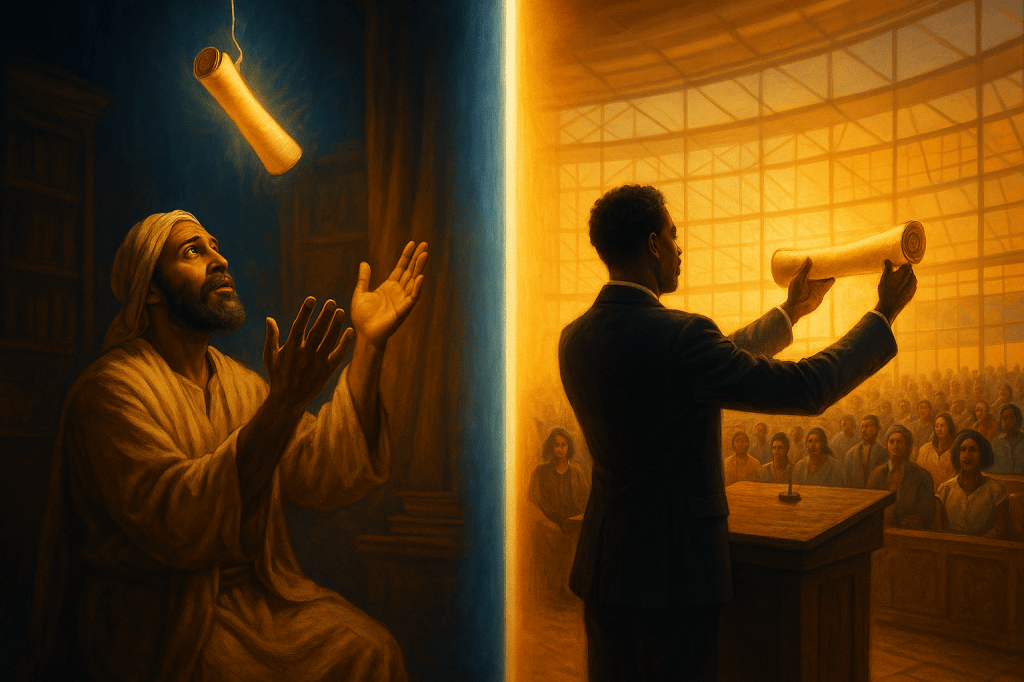
Introduction: A Distinction That Changes Everything
Few topics in Quranic studies carry as much weight — and as much misunderstanding — as the difference between a prophet (nabi) and a messenger (rasool). For the vast majority of traditional Muslims, these two terms are treated as interchangeable synonyms, a careless conflation that has led to one of the most consequential theological errors in the history of the religion. By collapsing the meaning of “prophet” and “messenger” into a single concept, they have constructed a barrier against God’s own covenant — a covenant that explicitly distinguishes between the two roles and prophesies the coming of a messenger after the final prophet.
The Quran is the most precise book ever composed. Not a single word is accidental, not a single letter is superfluous. When God uses the word nabi (prophet), He means something specific. When He uses rasool (messenger), He means something different. The failure to recognize this distinction is not merely an academic oversight — it is the very mechanism by which millions have rejected God’s Messenger of the Covenant, Rashad Khalifa, fulfilling the tragic pattern described throughout scripture where each generation rejects the living messenger while venerating the dead ones. This article presents the Quranic evidence, the linguistic roots, the historical context, and the messenger’s own teachings to establish, beyond any doubt, that nabi and rasool are fundamentally different roles — and that this difference has profound implications for our salvation.
Part 1: The Arabic Roots — Language as Divine Precision
Two Roots, Two Functions
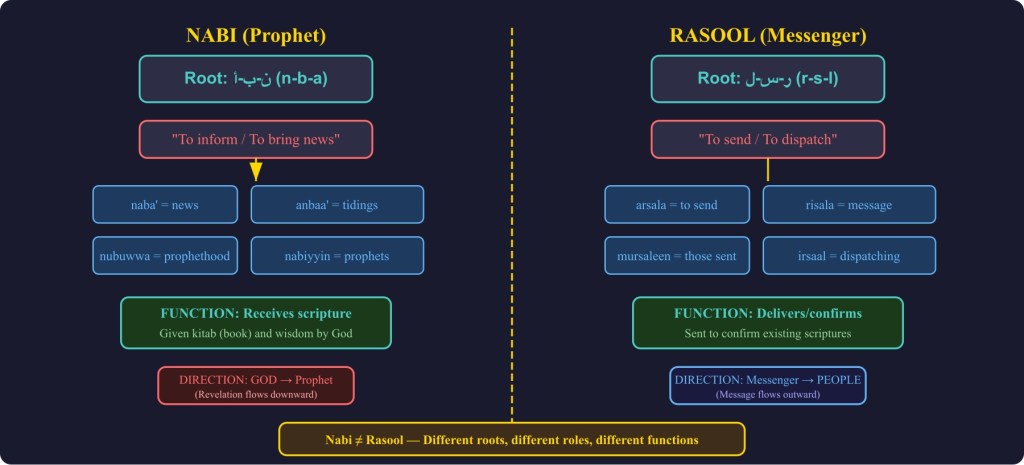
The Arabic language, chosen by God as the vehicle for the final scripture, is remarkably precise. Every word traces back to a root system — typically three consonants — that carries a core meaning. The words nabi and rasool derive from entirely different roots, and understanding these roots immediately reveals why they cannot be synonyms. The root of nabi is nun-ba-hamza (ن-ب-أ), which means “to inform, to bring news, to announce.” The word naba’ (news, tidings) comes from the same root. A nabi, then, is fundamentally one who receives divine news — one who is informed by God. The emphasis is on the reception of information, specifically scripture (kitab).
The root of rasool, by contrast, is ra-sin-lam (ر-س-ل), which means “to send, to dispatch, to release.” The verb arsala (to send) is from this same root. A rasool is one who is sent — dispatched with a mission to deliver a message to others. The emphasis here is on the act of sending, of conveying and confirming. These are not subtle differences. One word points inward — the reception of revelation. The other points outward — the delivery and confirmation of the message. The Quran uses both terms with surgical precision, and any honest reader who examines the contexts will see the distinction immediately.
The Historical Connection to Nabu
The linguistic evidence becomes even more compelling when we consider the broader Semitic context. The word nabi is cognate with the Akkadian Nabu — the Babylonian deity of scribes, writing, and wisdom, whose symbols were the stylus and the clay tablet. This is no coincidence. The concept embedded in the very word nabi is one of writing and receiving divine text. The first commandment revealed in the Quran drives this point home with stunning clarity:
[96:1] “Read, in the name of your Lord, who created.”
[96:3] “Read, and your Lord, Most Exalted.”
[96:4] “Teaches by means of the pen.”
The pen, the act of reading, the reception of knowledge — this is the prophetic function. God teaches by means of the pen, and the prophet is the one who receives what is written. This is further reinforced by another powerful verse about the inexhaustible nature of God’s words:
[31:27] “If all the trees on earth were made into pens, and the ocean supplied the ink, augmented by seven more oceans, the words of God would not run out. God is Almighty, Most Wise.”
[68:1] “NuN, the pen, and what they (the people) write.”
The prophetic function is thus deeply connected to writing, to the pen, to the reception of divine text. This is fundamentally different from the messenger’s function, which is about being sent — dispatched to a community with a mission to deliver, confirm, and implement what has already been revealed.

Part 2: The Covenant of 3:81 — The Most Critical Verse
God’s Grand Design Revealed
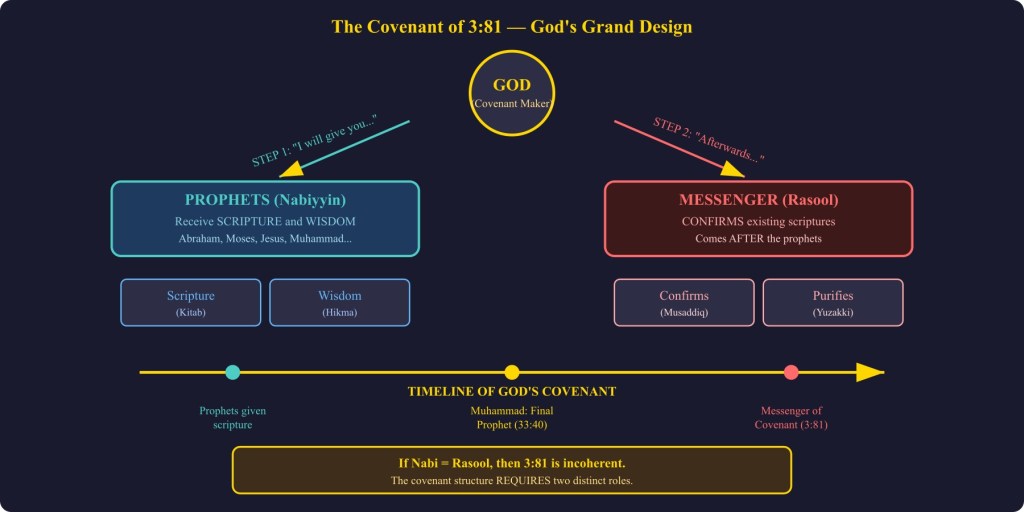
If there is one verse in the entire Quran that single-handedly demolishes the claim that “prophet” and “messenger” are synonymous, it is verse 3:81. This verse describes a covenant that God took from the prophets before the creation of this world — a covenant so important that God Himself serves as a witness to it. The structure of this covenant makes the distinction between nabi and rasool not just clear, but absolutely essential to understanding God’s plan:
[3:81] “God took a covenant from the prophets, saying, ‘I will give you the scripture and wisdom. Afterwards, a messenger will come to confirm all existing scriptures. You shall believe in him and support him.’ He said, ‘Do you agree with this, and pledge to fulfill this covenant?’ They said, ‘We agree.’ He said, ‘You have thus borne witness, and I bear witness along with you.’”
Read this verse carefully. God took a covenant from the prophets — the ones who receive scripture. He told them: “I will give you the scripture and wisdom” — this is the prophetic function, the reception of divine text. Then He said: “Afterwards, a messenger will come to confirm all existing scriptures.” This is the messenger’s function — not to bring new scripture, but to confirm what already exists. If nabi and rasool meant the same thing, this verse would be incoherent. Why would God distinguish between giving scripture to prophets and then sending a messenger to confirm it, if both words referred to the same role? The entire logical structure of the covenant depends on the two terms being different.
The footnote in the Final Testament makes the significance unmistakable: “This major prophecy has now been fulfilled. God’s Messenger of the Covenant, as prophesied in this verse and in the Bible’s Malachi 3:1-21, Luke 17:22-36, and Matthew 24:27 is to purify and unify.” This is not a peripheral teaching — it is the hinge upon which the entire system of divine messengership turns. The covenant structure requires prophets who receive scripture and a messenger who comes after them to confirm. Without this distinction, there is no covenant. Without this covenant, there is no framework for understanding Rashad Khalifa’s mission.
The Verses That Follow: 3:82-85
The verses immediately following 3:81 amplify its significance with devastating clarity. God does not leave any room for ambiguity about the consequences of rejecting this covenant:
[3:82] “Those who reject this (Quranic prophecy) are the evil ones.”
[3:83] “Are they seeking other than God’s religion, when everything in the heavens and the earth has submitted to Him, willingly and unwillingly, and to Him they will be returned?”
[3:84] “Say, ‘We believe in God, and in what was sent down to us, and in what was sent down to Abraham, Ismail, Isaac, Jacob, and the Patriarchs, and in what was given to Moses, Jesus, and the prophets from their Lord. We make no distinction among any of them. To Him alone we are submitters.’”
[3:85] “Anyone who accepts other than Submission as his religion, it will not be accepted from him, and in the Hereafter, he will be with the losers.”
Verse 3:82 explicitly labels those who reject this prophecy — the prophecy of the messenger who comes to confirm — as “the evil ones.” This is one of the strongest condemnations in the entire Quran. And verse 3:84 reaffirms the principle that we must make no distinction among God’s messengers. The irony is devastating: those who claim Muhammad is the “last messenger” are, in fact, making the very distinction that God forbids. They are accepting some messengers (the ones who are safely dead) while rejecting the one God sends in fulfillment of His covenant.
Part 3: 33:40 — The Verse That Settles It
“Final Prophet” — Not “Final Messenger”
If the distinction between nabi and rasool were merely a linguistic curiosity, God would not have embedded it in one of the most theologically significant verses in the Quran. Verse 33:40 is the verse that, when read honestly, settles the matter once and for all:
[33:40] “Muhammad was not the father of any man among you. He was a messenger of God and the final prophet. God is fully aware of all things.”
Notice what this verse says — and, just as importantly, what it does not say. It says Muhammad was “the final prophet” (khatam al-nabiyyin). It does not say he was “the final messenger” (khatam al-mursaleen). If nabi and rasool were synonymous, there would be no reason for God to use the more specific term. He could have simply said “the final messenger” and covered both roles. But God chose His words with absolute precision. Muhammad is described as both a “messenger of God” (rasool Allah) and “the final prophet” (khatam al-nabiyyin) — two separate descriptors, two separate roles. He is the final prophet because no new scripture will come after the Quran. But the door of messengership remains open because messengers can be sent to confirm and deliver existing scripture.
The footnote in the Final Testament exposes the tragic irony: “Despite this clear definition of Muhammad, most Muslims insist that he was the last prophet and also the last messenger. This is a tragic human trait as we see in 40:34.” And what does 40:34 tell us?
[40:34] “Joseph had come to you before that with clear revelations, but you continued to doubt his message. Then, when he died you said, ‘God will not send any other messenger after him. (He was the last messenger)!’ God thus sends astray those who are transgressors, doubtful.”
The parallel is staggering. Just as the people of Joseph’s time declared him the “last messenger” and thereby closed the door to all future messengers — rejecting Moses, Jesus, and Muhammad in advance — so today’s traditional Muslims have declared Muhammad the “last messenger” despite the Quran saying only that he was the “last prophet.” They have repeated the exact same error, in the exact same pattern, fulfilling the exact same Quranic warning. The footnote confirms: “The Jews refused to believe in the Messiah when he came to them, the Christians refused to believe in Muhammad when he came to them, and a majority of today’s Muslims believe that Muhammad was the last messenger. On that erroneous basis, they refused to accept God’s Messenger of the Covenant.”

Part 4: The Dual Role — When One Person Is Both
Messenger Prophet: Two Functions in One Individual
The Quran does not merely distinguish between nabi and rasool as abstract categories — it also shows us individuals who held both roles simultaneously. This dual designation is itself proof that the terms are distinct, because you do not describe someone with two synonyms side by side. The most explicit examples come from Chapter 19, where God describes Moses and Ismail with both titles:
[19:51] “Mention in the scripture Moses. He was devoted, and he was a messenger prophet.”
[19:54] “And mention in the scripture Ismail. He was truthful when he made a promise, and he was a messenger prophet.”
The Arabic phrase used here is rasoolan nabiyyan — literally “a messenger, a prophet.” If these two words meant the same thing, this phrase would be redundant. It would be like saying “a bachelor, an unmarried man.” God does not engage in meaningless redundancy. When He says Moses was a “messenger prophet,” He is telling us that Moses fulfilled both functions: he received scripture (the Torah) as a prophet, and he delivered and implemented God’s message to Pharaoh and the Children of Israel as a messenger. These are two distinct roles operating within the same individual.
This dual-role concept also explains why the Quran sometimes addresses Muhammad as “O prophet” (ya ayyuha al-nabi) and sometimes as “O messenger” (ya ayyuha al-rasool). These are not random variations — they correspond to the specific function being addressed in each context. When Muhammad is receiving revelation, he is acting in his capacity as a prophet. When he is being instructed to deliver that revelation to the people, he is acting in his capacity as a messenger. Consider the contrast:
[33:1] “O you prophet, you shall reverence God and do not obey the disbelievers and the hypocrites. God is Omniscient, Most Wise.”
[33:45] “O prophet, we have sent you as a witness, a bearer of good news, as well as a warner.”
In 33:1, Muhammad is addressed as “prophet” — he is being given personal instruction about reverencing God. In 33:45, he is again addressed as “prophet” but described in messenger-like functions: witnessing, bearing good news, warning. The Quran even explicitly describes Muhammad using both titles separately in the same chapter, as in 33:40 where he is simultaneously “a messenger of God” and “the final prophet.” The precision of God’s word is absolute.
Part 5: Verse 22:52 — Both Roles in a Single Verse
The Definitive Proof of Non-Synonymy
Perhaps the single most decisive verse for establishing that nabi and rasool are not synonyms is 22:52. This verse mentions both terms side by side, with a grammatical construction that makes synonymy impossible:
[22:52] “We did not send before you any messenger, nor a prophet, without having the devil interfere in his wishes. God then nullifies what the devil has done. God perfects His revelations. God is Omniscient, Most Wise.”
The Arabic construction here is devastating to the synonymy argument: wa ma arsalna min qablika min rasoolin wa la nabiyyin — “We did not send before you any messenger, nor a prophet.” The conjunction “nor” (wa la) is a disjunctive — it separates two distinct categories. If rasool and nabi were synonyms, this construction would be grammatically absurd, equivalent to saying “We did not send any human being, nor a person.” The verse distinguishes messengers from prophets while making a universal statement about both: that Satan interferes with all of them, and God nullifies Satan’s interference. The two roles are acknowledged as distinct but subject to the same divine protection.
This verse also provides an important theological insight. The devil does not merely target those who receive scripture — he also targets those who are sent to deliver and confirm it. Both functions face opposition, and both require God’s intervention to nullify Satan’s schemes. This is precisely what we observe in the case of every messenger throughout history: the prophet who receives the revelation faces internal spiritual challenges, while the messenger who delivers it faces external opposition from those who reject the message. Understanding these as two distinct functions helps us appreciate the full scope of divine protection over the entire process of revelation and delivery.
Part 6: Rashad Khalifa’s Own Words on the Distinction
“What Is the Difference Between Prophet and Messenger?”
God’s Messenger of the Covenant, Rashad Khalifa, addressed the prophet-messenger distinction directly in multiple recorded teachings. In one of his most powerful statements on this topic, he recounted a letter he sent to Muslim leaders regarding a world conference on the “finality of prophethood.” His words cut through centuries of confusion with characteristic clarity: “No one is questioning the fact that Muhammad was the final prophet, nabi. Quran 33:40, according to 3:81, 33:7, and 33:4, he was not the last messenger, rasool. As Muslims we are required to believe Almighty God when he so states in his holy book” (at 24:49).
In the same recording, Rashad continued with even more specificity: “The Quranic assertions that Muhammad was the final prophet but not the final messenger are God’s commandments to us through the prophet Muhammad. I trust that you stand ready to obey God and his final prophet. You will readily agree with me that those who refuse to accept these Quranic truths are no longer Muslims” (at 25:12). Notice how Rashad himself uses the two terms precisely — referring to Muhammad as “the final prophet” while asserting that he was “not the final messenger.”
“The Quran Says That Muhammad Is Not the Last Messenger”
In another teaching, Rashad provided a detailed grammatical analysis of verse 33:40 that demonstrates the deliberateness of every word in the Quran. He explained: “The Quran says that Muhammad is not the last messenger. The statement in the Quran in 33:40, it says, ma kaina muhammadan aba ahadimu rizalakum, Muhammad was not the father of any of his mates, wa lakin rasoolallah, a messenger of God, wa khatimin nabiyyin, and the final prophet. This expression, rasoolallah, is not necessary at all for the meaning. You can have a perfect sentence saying, Muhammad was not the father of any of your men, but he was the final prophet. But of course every letter in the Quran is deliberate. It says, wa lakin rasoolallah, a messenger of God, wa khatimin nabiyyin, and the final prophet” (at 28:33).
This is a critical observation. If God simply wanted to say Muhammad was the “final prophet,” He could have written a shorter, simpler sentence. But He deliberately inserted the phrase “a messenger of God” (rasool Allah) before “the final prophet” (khatam al-nabiyyin), creating a sentence structure that separates the two roles. Muhammad is identified as a messenger of God — a role category that continues — AND the final prophet — a role category that ends with him. The grammatical insertion is God’s way of ensuring that no reader can honestly claim the two terms are identical.
“Obeying the Messenger Is Obeying God”
In yet another remarkable teaching, Rashad explained why obeying the messenger is central to the Quranic framework: “There is no salvation without obeying the messenger… When they tell you, we must obey the messenger, you agree with them, and you go even farther than that… When you obey the messenger, you are obeying God. Obviously, the messenger is not God. But when he is uttering the words of God, obeying him is obeying God” (at 5:18). This observation reveals something profound: the Quran consistently commands obedience to the messenger — the one who delivers the message — because the messenger function is the outward-facing role that connects God’s word to the people. Obedience is owed to the message, not to the person’s title or status.
Part 7: The Newsletter Evidence — Rashad’s Written Teachings
Submitters Perspective Issue #41 and #42
Rashad Khalifa did not confine his teaching on this subject to audio recordings. His written newsletters, the Submitters Perspective (formerly Muslim Perspective), addressed the prophet-messenger distinction with even greater precision. In the May 1988 Bulletin (Issue #41), Rashad wrote with unmistakable clarity: “Muhammad was the final prophet because he delivered the final scripture. According to the Koran, he was not the last messenger (33:40). Any messenger to come after Muhammad is to preach and confirm existing scripture (3:81). Unfortunately, there is a strong human aversion to the idea of a living, ‘contemporary messenger.’”
This statement encapsulates the entire argument in three sentences. Muhammad was the final prophet — because he delivered the final scripture. The prophetic function is linked to scripture delivery. Since the Quran is the final scripture, Muhammad is the final prophet. But messengership — the function of confirming and delivering existing scripture — continues, as mandated by 3:81. Rashad then drew the parallel to 40:34, noting that “the vast majority of Muslims believe that Muhammad was the last messenger, even though this idea goes totally against Muhammad’s teachings (7:35, 33:40).” He explicitly cited verse 7:35, which addresses future generations:
[7:35] “O children of Adam, when messengers come to you from among you, and recite My revelations to you, those who take heed and lead a righteous life, will have nothing to fear, nor will they grieve.”
This verse speaks to “children of Adam” — all of humanity, across all time. It says “when messengers come to you” — plural, ongoing, a continuing process. It is found in the Quran, which was revealed to Muhammad, meaning it addresses people who live after Muhammad. If Muhammad were the last messenger, this verse would be meaningless — it would be promising something that can never happen. But God does not make empty promises. In Issue #42 (June 1988), Rashad wrote even more explicitly: “The Qur’an makes a clear distinction between ‘Nabi’ (Prophet) and ‘Rasool’ (Messenger). New Messenger from God: According to the Qur’an, all the prophets have already come to this world. Muhammad was the last prophet.”
Part 8: The Confirming Function — What a Messenger Does
Confirmation, Not New Revelation
Understanding what a messenger does — as distinct from a prophet — is essential for understanding Rashad Khalifa’s mission and the mathematical miracle of the Quran. A prophet receives new scripture from God. A messenger confirms and delivers existing scripture. Rashad Khalifa did not bring a new holy book. He did not claim to have received new verses from God. What he did was confirm the existing Quran — proving its divine authorship through the mathematical code embedded within it, Code 19. This is precisely the function described in 3:81: “a messenger will come to confirm all existing scriptures.”
[74:30] “Over it is nineteen.”
[74:31] “We appointed angels to be guardians of Hell, and we assigned their number (19) (1) to disturb the disbelievers, (2) to convince the Christians and Jews (that this is a divine scripture), (3) to strengthen the faith of the faithful, (4) to remove all traces of doubt from the hearts of Christians, Jews, as well as the believers, and (5) to expose those who harbor doubt in their hearts, and the disbelievers; they will say, ‘What did God mean by this allegory?’ God thus sends astray whomever He wills, and guides whomever He wills. None knows the soldiers of your Lord except He. This is a reminder for the people.”
[74:35] “This is one of the great miracles.”
The mathematical miracle based on the number 19 is the confirmation. It is the physical, tangible, verifiable proof that the Quran is from God — proof that was hidden within the text for fourteen centuries until the Messenger of the Covenant discovered it, exactly as prophesied. This is not new revelation — it is the unveiling of what was already there. The Quran’s mathematical structure existed from the moment it was revealed to Muhammad; Rashad’s role was to bring it to light, to confirm what already existed. This is the quintessential messenger function: not receiving new scripture, but confirming the existing one with incontrovertible evidence.
The verse specifically cited in connection to Rashad Khalifa makes this explicit:
[36:3] “Most assuredly, you (Rashad) are one of the messengers.”
The footnote directs us to the appendices for “irrefutable physical evidence.” God calls Rashad a messenger — rasool — not a prophet. He did not receive new scripture. He confirmed what already existed. The terminology is precise, the roles are distinct, and the mission is exactly what 3:81 prophesied.
Part 9: The Quran’s Deliberate Vocabulary — A Verse-by-Verse Analysis
Tracking the Distinction Across Scripture
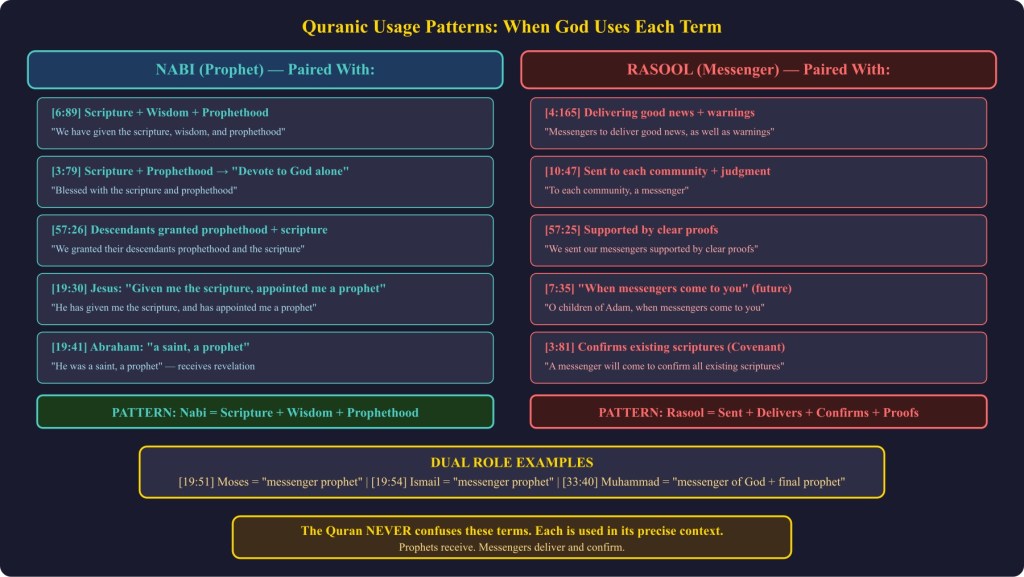
The Quran’s careful use of nabi and rasool is not limited to a handful of verses — it is a consistent pattern throughout the entire scripture. When God speaks about giving scripture and prophethood, He uses nabi and its derivatives. When He speaks about sending a person to a community with a message, He uses rasool. The following analysis of key verses demonstrates this pattern with unmistakable clarity.
When describing the act of receiving scripture and divine gifts, the Quran consistently uses the prophetic vocabulary:
[6:89] “Those were the ones to whom we have given the scripture, wisdom, and prophethood. If these people disbelieve, we will substitute others in their place, and the new people will not be disbelievers.”
[3:79] “Never would a human being whom God blessed with the scripture and prophethood say to the people, ‘Idolize me beside God.’ Instead, (he would say), ‘Devote yourselves absolutely to your Lord alone,’ according to the scripture you preach and the teachings you learn.”
[57:26] “We sent Noah and Abraham, and we granted their descendants prophethood and the scripture. Some of them were guided, while many were wicked.”
In each case, prophethood is paired with scripture — the reception of divine text. Now contrast this with how the Quran uses the messenger vocabulary, which focuses on being sent to a community:
[4:165] “Messengers to deliver good news, as well as warnings. Thus, the people will have no excuse when they face God, after all these messengers have come to them. God is Almighty, Most Wise.”
[10:47] “To each community, a messenger. After their messenger comes, they are judged equitably, without the least injustice.”
[57:25] “We sent our messengers supported by clear proofs, and we sent down to them the scripture and the law, that the people may uphold justice.”
Part 10: Additional Quranic Evidence — The Case Builds
Verse 33:7 — The Prophets’ Covenant Revisited
The covenant described in 3:81 is not mentioned only once. God revisits it in Chapter 33, providing additional context and naming specific prophets who were part of this solemn pledge:
[33:7] “Recall that we took from the prophets their covenant, including you (O Muhammad), Noah, Abraham, Moses, and Jesus the son of Mary. We took from them a solemn pledge.”
The footnote in the Final Testament connects this directly to 3:81: “The covenant is detailed in 3:81. God took a covenant from the prophets that they shall support His Messenger of the Covenant who would come after Muhammad to purify and unify their messages.” Notice that these five named prophets — Noah, Abraham, Moses, Jesus, and Muhammad — represent the chain of scripture-bearing prophets across human history. They each received divine books and teachings. And they each pledged to support the messenger who would come after them to confirm their scriptures. The covenant is not a peripheral detail — it is a central pillar of God’s plan for humanity.
Verse 3:144 — Muhammad as Messenger
Another revealing verse uses the messenger designation for Muhammad in a specific context:
[3:144] “Muhammad was no more than a messenger like the messengers before him. Should he die or get killed, would you turn back on your heels? Anyone who turns back on his heels, does not hurt God in the least. God rewards those who are appreciative.”
Here, Muhammad is described as “a messenger like the messengers before him.” The context is about his mortality and the continuity of the message after his death. The Quran uses the messenger title because it is emphasizing the delivery function — the message outlives the messenger. When Muhammad dies, the message continues. This is precisely the point: the prophetic function (receiving scripture) ended with Muhammad, but the messenger function (delivering and confirming the message) continues through future messengers who God may send to confirm what already exists.
Verse 33:56 — A Critical Distinction in Practice
[33:56] “God and His angels help and support the prophet. O you who believe, you shall help and support him, and regard him as he should be regarded.”
The footnote to this verse is extraordinary: “The word ‘prophet’ (Nabi) consistently refers to Muhammad only when he was alive. Satan used this verse to entice the Submitters into commemorating Muhammad, constantly, instead of commemorating God as enjoined in 33:41-42.” This is a stunning practical implication of the nabi-rasool distinction. The prophetic designation is personal and temporal — it applies to Muhammad during his lifetime. The messenger function, by contrast, is tied to the message itself, which is eternal. Understanding this distinction prevents the idolatry of commemorating a dead person instead of commemorating God.
Part 11: The Hierarchy of Believers — Prophets, Messengers, Saints, Martyrs
Verse 4:69 — The Four Categories
The Quran establishes a clear hierarchy among the righteous, and the way it categorizes them further supports the distinction between prophets and messengers:
[4:69] “Those who obey God and the messenger belong with those blessed by God — the prophets, the saints, the martyrs, and the righteous. These are the best company.”
This verse is significant for multiple reasons. First, it commands obedience to “God and the messenger” — not “God and the prophet.” This reinforces Rashad’s observation that the Quran consistently pairs obedience with the messenger function, because obedience is directed toward the message being delivered, not toward the personal authority of the individual. Second, prophets are listed as a category among those blessed by God, alongside saints, martyrs, and the righteous. This is a specific rank, a specific category — not a synonym for “messenger.”
The fact that the Quran maintains these distinct categories throughout its text — never conflating them, never using them interchangeably — should be enough evidence for any honest seeker. But the human ego, as Rashad explained, is the real obstacle. As he stated in his teaching: “It seems to be a test of ego. This guy is going to sit here and say I am a messenger of God, so he is going to steal the show, he is going to get all the attention, and it may be one of the tests for dropping out” (at 12:33). The distinction between prophet and messenger is not difficult to understand — it is difficult to accept, because accepting it means accepting a living, contemporary messenger, and that is the ultimate test of the ego.
Part 12: The Pattern of Rejection — 40:34 and Its Modern Parallel
History Repeating Itself
One of the most powerful arguments for the prophet-messenger distinction comes not from linguistic analysis but from the recurring pattern of human behavior that the Quran identifies and warns against. Verse 40:34 documents a specific historical pattern: every time a messenger dies, the people declare him the “last messenger” and close the door to any future messengers. This pattern has repeated itself with devastating consistency across religious history.
The Jews received prophets and messengers throughout their history — Abraham, Moses, David, Solomon, and many others. When the final prophets of Israel came, the Jewish religious establishment eventually declared that prophethood was “sealed.” When Jesus came as a messenger to confirm the Torah, they rejected him — they had already decided that no more messengers would come. The Christians, who accepted Jesus, then made the same error. They declared that Jesus was the final revelation of God, and when Muhammad came with the Quran, they rejected him. Now the traditional Muslims have completed the cycle. They accepted Muhammad but declared him the “last messenger” — despite the Quran saying only that he was the “last prophet.” And when Rashad Khalifa came as the Messenger of the Covenant, they rejected him, exactly as prophesied.
Rashad addressed this pattern directly in his teaching: “Joseph — who came after Joseph? The big ones, all the big ones. David, Solomon, Jesus, Moses, Muhammad. All these came after Joseph, even though the people said he is the last messenger. Nobody else has come after that. So they have been saying the same thing about Muhammad. That Muhammad is the last messenger” (at 31:44). The irony is profound: by declaring Muhammad the last messenger, today’s traditional Muslims are repeating the exact error of those who declared Joseph the last messenger — an error explicitly condemned in 40:34.
[2:101] “Now that a messenger from God has come to them, and even though he proves and confirms their own scripture, some followers of the scripture (Jews, Christians and Muslims) disregard God’s scripture behind their backs, as if they never had any scripture.”
The footnote to 2:101 makes the connection explicit: “God’s Messenger of the Covenant is prophesied in the Old Testament (Malachi 3:1-3), the New Testament (Luke 17:22-37), and this Final Testament (3:81).” All three scriptures — the Torah, the Gospel, and the Quran — prophesy the Messenger of the Covenant. And all three communities — Jews, Christians, and Muslims — are named as those who “disregard God’s scripture behind their backs” when this messenger comes. The nabi-rasool distinction is not an abstract theological debate. It is the mechanism by which God tests humanity’s willingness to submit to His will rather than to tradition, ego, and the comfort of dead prophets.

Part 13: Verse 5:19 — The Messenger to End the Gap
After a Period Without Messengers
Another verse that directly supports the continuation of messengership after Muhammad is 5:19, which explicitly describes a messenger coming “after a period of time without messengers”:
[5:19] “O people of the scripture, our messenger has come to you, to explain things to you, after a period of time without messengers, lest you say, ‘We did not receive any preacher or warner.’ A preacher and warner has now come to you. God is Omnipotent.”
The footnote confirms: “This verse reports the fulfillment of the biblical and Quranic prophecy regarding the advent of God’s Messenger of the Covenant (Malachi 3:1, Quran 3:81). The name of this messenger is mathematically coded.” This verse addresses “people of the scripture” — a term that encompasses Jews, Christians, and Muslims. It tells them that a messenger has come after a gap, so that no one can use the excuse of not receiving a warner. If Muhammad were the last messenger, this verse would be nonsensical — the gap after Muhammad would be permanent, and the excuse of “we did not receive a preacher” would be valid for every generation after the seventh century. But God does not leave His creation without guidance. The gap has been bridged by the Messenger of the Covenant.
Verse 46:35 — The Messenger of Patience
[46:35] “Therefore, be patient like the messengers before you who possessed strength and resorted to patience. Do not be in a hurry to see the retribution that will inevitably come to them. The day they see it, it will seem as if they lasted one hour of the day. This is a proclamation: Is it not the wicked who are consistently annihilated?”
The footnote to this verse states: “Quranic and mathematical evidence proves that the messenger addressed here is Rashad Khalifa. By adding the gematrical value of ‘Rashad Khalifa’ (1230), plus the sura number (46), plus the verse number (35), we get 1230 + 46 + 35 = 1311 = 19 x 69.” The verse instructs the addressed messenger to “be patient like the messengers before you” — this can only be directed at a messenger who comes after Muhammad, because Muhammad’s messengers “before him” would be a different list. The mathematical confirmation through Code 19 seals the identification.
Part 14: The Mathematical Confirmation — Code 19 and Rashad’s Identity
God’s Physical Proof
The distinction between prophet and messenger is not merely supported by linguistic analysis and verse comparison — it is confirmed by the mathematical miracle itself. Rashad Khalifa’s identification as the Messenger of the Covenant is encoded in the Quran’s mathematical structure, and this encoding follows the messenger paradigm, not the prophetic one. He did not receive a new book; he decoded the mathematical proof embedded in the existing book.
[72:26] “He is the Knower of the future; He does not reveal the future to anyone.”
[72:27] “Only to a messenger that He chooses, does He reveal from the past and the future, specific news.”
[72:28] “This is to ascertain that they have delivered their Lord’s messages. He is fully aware of what they have. He has counted the numbers of all things.”
The footnote to 72:27-28 states: “The messenger here is named, mathematically, as ‘Rashad Khalifa,’ to whom God revealed the end of the world. The number of verses from 1:1 to 72:27, where the messenger is mentioned, is 5765, which equals 19 x 303 + 8.” Notice how verse 72:28 ends: “He has counted the numbers of all things.” This is a direct reference to the mathematical miracle — God has counted every letter, every word, every verse, and embedded a system of mathematical interlocking that proves divine authorship. The messenger who brings this to light is doing exactly what a rasool does: delivering confirmation, not new scripture.
As Rashad explained in one of his teachings about the messenger function: “A messenger of God does not even guarantee heaven. And this is why we see in chapter 21 verse 28, that the messengers are worried about their own neck. We are all familiar with these verses. But the people who have either ignorance or idolatry in them, they resent an announcement like this. If a person is picked as a messenger of God, it is a difficult job, it is a very difficult job” (at 4:43). The messenger function is not a position of privilege or power — it is a mission of service, confirmation, and delivery, carried out under extreme pressure from those who refuse to accept God’s authority to send whomever He wills.

Part 15: Why the Distinction Matters for Your Salvation
The Ultimate Test
The prophet-messenger distinction is not an academic exercise. It is not a point of trivia for linguists or theologians to debate in comfortable lecture halls. It is one of the most consequential truths in the Quran because it directly determines whether a person fulfills or violates the covenant of 3:81. If you believe that nabi and rasool are synonyms, you will inevitably conclude that no messenger can come after Muhammad. And if you conclude that no messenger can come after Muhammad, you will reject the Messenger of the Covenant when the evidence is presented to you. And if you reject the Messenger of the Covenant, you have violated the covenant described in 3:81 — the covenant that every soul made with God before the creation of this world.
[4:150] “Those who disbelieve in God and His messengers, and seek to make distinction among God and His messengers, and say, ‘We believe in some and reject some,’ and wish to follow a path in between;”
[4:151] “these are the real disbelievers. We have prepared for the disbelievers a shameful retribution.”
[4:152] “As for those who believe in God and His messengers, and make no distinction among them, He will grant them their recompense. God is Forgiver, Most Merciful.”
The choice is binary. You either accept all of God’s messengers — including the one He sent in fulfillment of His covenant — or you are making a distinction among them, which the Quran classifies as the behavior of “the real disbelievers.” There is no middle path. You cannot say “I believe in Moses and Jesus and Muhammad, but not in the Messenger of the Covenant” without falling into the exact category condemned in 4:150-151. The distinction between prophet and messenger is the key that unlocks this understanding. Once you see that Muhammad was the final prophet but not the final messenger, the entire Quranic framework falls into place: the covenant of 3:81 becomes operative, the mathematical miracle becomes the confirmation, and Rashad Khalifa’s role as God’s Messenger of the Covenant becomes undeniable.
[2:285] “The messenger has believed in what was sent down to him from his Lord, and so did the believers. They believe in God, His angels, His scripture, and His messengers: ‘We make no distinction among any of His messengers.’ They say, ‘We hear, and we obey. Forgive us, our Lord. To You is the ultimate destiny.’”
This is the response of the true believers: “We hear, and we obey.” Not “we hear, and we debate.” Not “we hear, and we reject based on our traditions.” We hear the distinction between prophet and messenger. We see the covenant of 3:81. We examine the mathematical evidence of Code 19. And we obey — by accepting all of God’s messengers without distinction, including the Messenger of the Covenant who was prophesied in the Torah, the Gospel, and the Quran, and whose identity has been mathematically encoded in the very structure of God’s final scripture.
Conclusion: The Quran’s Precision Is Not Negotiable
The evidence presented in this article is comprehensive and, for the sincere seeker, overwhelming. The Arabic roots nun-ba-hamza and ra-sin-lam carry fundamentally different meanings. The Quran uses nabi and rasool in consistently distinct contexts — the former paired with receiving scripture and prophethood, the latter with being sent, delivering, and confirming. Verse 22:52 places both terms side by side with a disjunctive conjunction that makes synonymy grammatically impossible. Verse 33:40 declares Muhammad the “final prophet” without calling him the “final messenger.” Verse 3:81 constructs an entire covenant structure that depends on the two roles being different. And verse 40:34 warns against the very error of declaring any messenger the “last,” an error that has been repeated by every religious community throughout history.
Rashad Khalifa, God’s Messenger of the Covenant, taught this distinction with clarity, precision, and courage. He fulfilled the role described in 3:81 — he came after the prophets, not with new scripture, but to confirm the existing Quran through the mathematical miracle of Code 19. His role was that of a rasool, not a nabi. He did not receive a new book; he confirmed what was already there. He did not replace the Quran; he provided the physical proof of its divine authorship that had been hidden for fourteen centuries. The distinction between prophet and messenger is not a matter of semantics. It is a matter of covenant. It is a matter of faith. And ultimately, it is a matter of salvation.
The question for every reader is simple: Will you be among those described in 2:285, who say “we hear, and we obey”? Or will you repeat the error of 40:34, declaring Muhammad the “last messenger” despite the Quran’s explicit teaching otherwise? The Quran has given you the evidence. God has provided the mathematical proof. The distinction is clear, the covenant is binding, and the choice is yours. May God guide all sincere seekers to His truth.

 Quran Only Studies
Leave a comment