Introduction: When Words Lose Their Meaning, Laws Lose Their Force
What is a masjid? For any reader of the Quran, the answer should be self-evident. A masjid is a defined, physical place of worship — a building established for the purpose of prostrating to God. The Quran speaks of masjids being built, founded, entered, demolished, frequented, resided in, and prayed inside. It speaks of the men who are physically present within them. It speaks of their foundations, their walls, their custodians, and their doors. There is no ambiguity in the Quranic text about what a masjid is — it is a place, a structure, a location you travel to, stand in, and worship inside.
Yet a troubling argument has emerged among some who claim allegiance to the Quran alone. The argument goes like this: “masjid” is not merely a physical building — it is simultaneously a spiritual concept. By this logic, when the Quran commands you to “never pray in such a masjid” in [9:108], this does not necessarily refer to a physical building at all, or at least not exclusively. It could refer to a spiritual sphere, a formless zone of influence, a metaphysical concept floating somewhere between the literal and the abstract. This argument hinges primarily on verse [72:18] and a misrepresentation of what Rashad Khalifa taught about it.
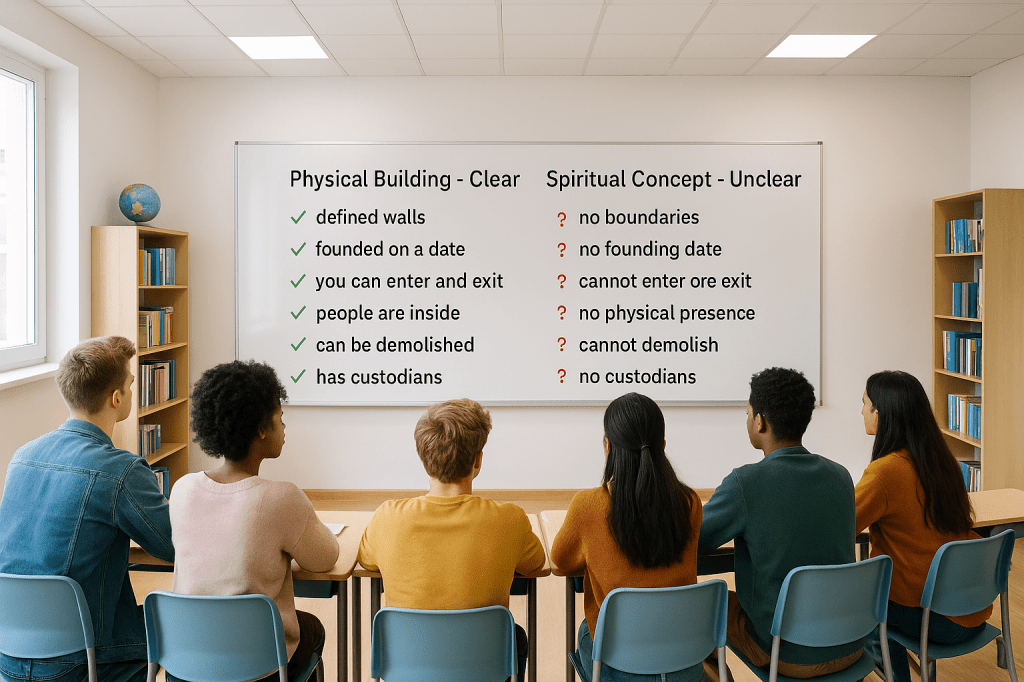
The stakes of this argument are not academic. If a masjid can be redefined as a spiritual concept, then the Quran’s clear prohibition in [9:108] — “You shall never pray in such a masjid” — becomes unenforceable. After all, where does a spiritual masjid begin and end? What are its boundaries? Can you be five meters from someone establishing Satan’s spiritual masjid? Half a meter behind them? If a masjid is not a building with walls and a door, then no one can ever know whether they are inside or outside of it — and no law regarding it can ever be applied. This is precisely the kind of vagueness that God, who describes His book as clear and detailed, would never allow in a legal commandment.
The Opponent’s Position: “Masjid Is Both Spiritual and Physical”
Let us state the position fairly before examining it. Those who hold this view generally concede that [9:17] — “The idol worshipers are not to frequent the masjids of God” — applies to physical masjids. They concede that [7:31] — “you shall be clean and dress nicely when you go to the masjid” — refers to physical buildings. They accept that masjids can be physical places. Their contention is specifically that “masjid” in the Quran is both physical and spiritual simultaneously, and — critically — that [9:108] does not apply specifically to the physical masjid (building).
The linchpin of this argument is [72:18]: “The places of worship belong to God; do not call on anyone else beside God.” Proponents point to Rashad Khalifa’s comment about this verse — “the places of worship is in the act of worship” — and conclude that masjid is a spiritual concept. If Rashad himself said the masjid is “in the act of worship,” then surely masjid transcends physical space, right? By this reasoning, wherever worship happens, a masjid exists. And if a masjid is wherever worship happens, then [9:108] must refer to more than just a building — it must encompass some kind of spiritual atmosphere, a zone of worship-influence, a formless prohibition.
This position, however sincerely held, collapses under scrutiny — from the Arabic grammar, from the Quranic context, from Rashad’s own full statements (which are taken out of context in this argument), and from basic logic. Let us examine each angle.
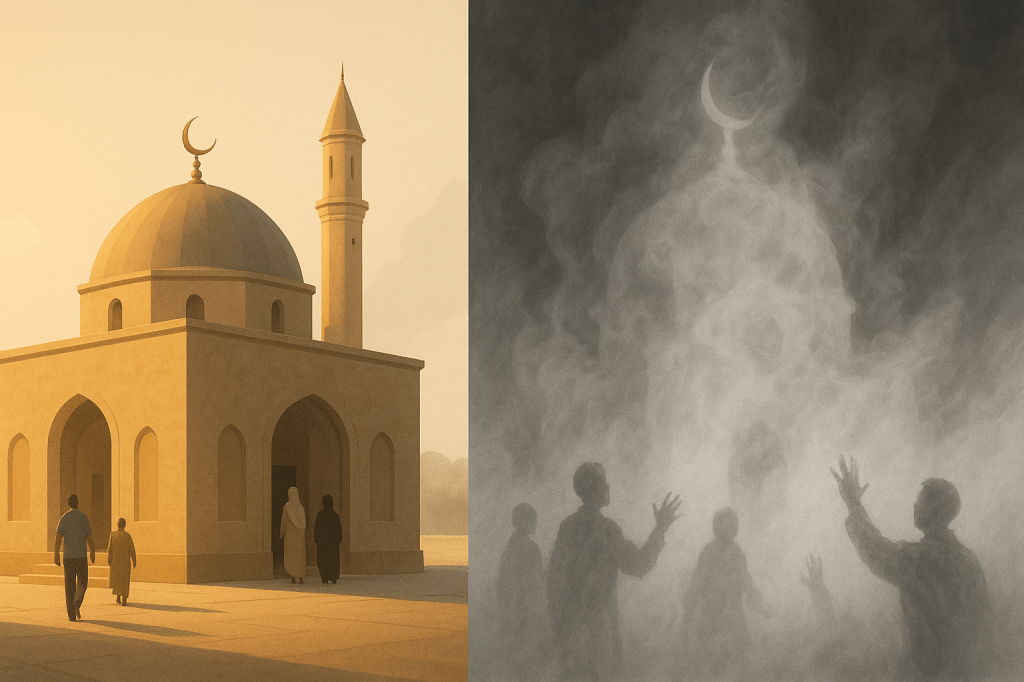
The “Sphere of Influence” Problem: Where Does a Spiritual Masjid End?
Before we even open the Arabic grammar or the Quranic text, let us confront the most basic problem with the spiritual-masjid theory: it is completely unpragmatic. If a masjid is a spiritual concept rather than a physical building, then [9:108]‘s command — “You shall never pray in such a masjid” — requires you to identify the boundaries of something that has no boundaries. Consider the practical implications. A group of hypocrites establishes a place of worship. They practice idol worship in it, they mention names besides God in their prayers, they divide the believers. God commands: “You shall never pray in such a masjid.” If this masjid is spiritual rather than physical, what exactly are you avoiding? Where does Satan’s spiritual masjid begin? Where does it end?
Can you be five meters from someone establishing Satan’s “spiritual masjid” and still pray? Three meters? Half a meter behind them? What if they are in a corridor, or a shared office space, or a public park? If a hypocrite performs their corrupted prayer in a multi-faith room at an airport, does that room become a masjid you can never pray in? What about the corridor outside? What about the terminal? The spiritual-masjid theory provides no answers — because it cannot. You cannot draw boundaries around a concept. You cannot be inside or outside of an abstraction.
But God’s command is precise. He says in [9:108]:
[9:108] “You shall never pray in such a masjid. A masjid that is established on the basis of righteousness from the first day is more worthy of your praying therein. In it, there are people who love to be purified. God loves those who purify themselves.”
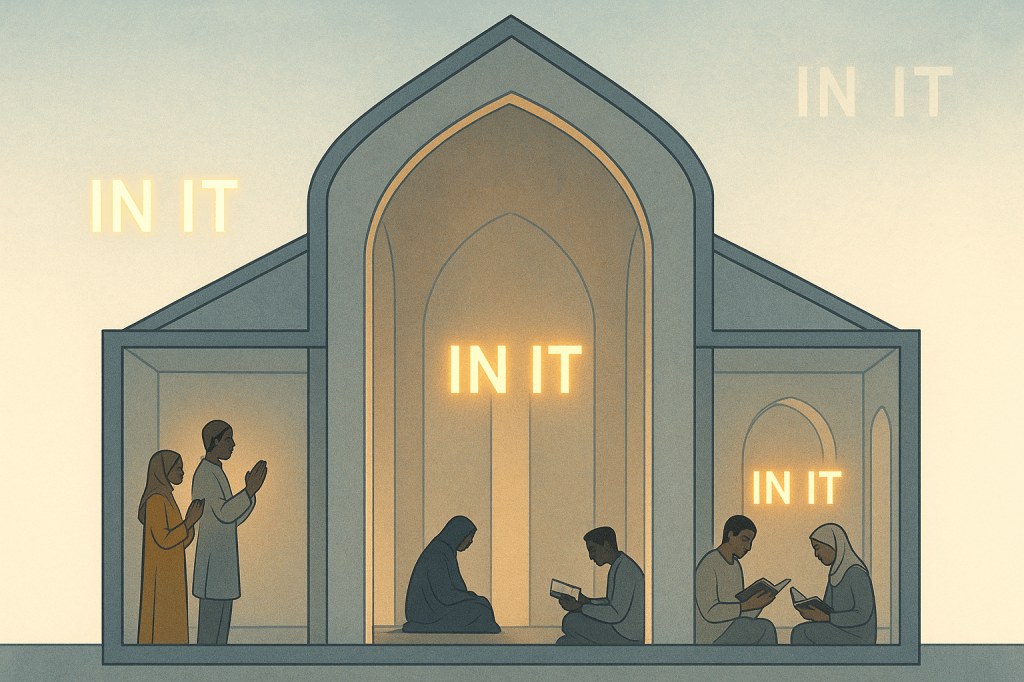
Notice the phrase fihi — “in it” — appears three times in this single verse. “Do not stand in it.” “More worthy of your praying in it.” “In it there are men who love to be purified.” God is describing physical interiority — being inside a defined space. You cannot be physically “in” a spiritual concept. You cannot stand “in” an abstraction. The very grammar of the verse demolishes the spiritual-masjid interpretation before the argument even begins.
Words Must Have Defined Meanings: The 5:32 Analogy
There is a dangerous hermeneutical principle lurking beneath the spiritual-masjid argument: the idea that Quranic words can be spiritualized beyond their linguistic definitions whenever it suits a particular interpretation. If “masjid” can mean both a physical building and a spiritual state simultaneously, then what stops us from applying the same logic to every other word in the Quran?
Consider [5:32]:
[5:32] “…anyone who murders any person who had not committed murder or horrendous crimes, it shall be as if he murdered all the people. And anyone who spares a life it shall be as if he spared the lives of all the people.”
The word “kill” (qatala, root ق ت ل) in this verse means to kill — to physically take a life. Now, could someone argue that “kill” here is both physical and spiritual? That killing someone’s spirit, or killing their hope, or killing their faith is equally covered? They could try. But the moment you accept that interpretation, the very next verse — [5:33], which prescribes capital punishment for those who “fight God and His messenger” — becomes an unenforceable mess. What is the punishment for spiritually killing someone? Can you execute someone for killing another person’s hopes?
[5:33] “The just retribution for those who fight God and His messenger, and commit horrendous crimes, is to be killed, or crucified, or to have their hands and feet cut off on alternate sides, or to be banished from the land.”
The Quran’s legal system works precisely because its words have defined meanings. “Kill” means kill. “Fast” means fast. “Pray” means pray. And “masjid” means a defined place of prostration — a physical location established for worship. When we spiritualize these words beyond their definitions, no law in the Quran can be followed. The entire framework of Quranic jurisprudence depends on words meaning what they mean. The spiritual-masjid argument, if accepted, does not merely affect one verse — it undermines the entire legal authority of the Quran.
What the Arabic Root Tells Us: Ma + Sajada = A Place
The Arabic language itself settles this debate before we even consult the Quran’s usage. The word مَسْجِد (masjid) is constructed from two elements: the prefix مَ (ma-) and the root سجد (s-j-d), meaning “to prostrate.” In Arabic morphology, the مَ prefix (specifically, the مَفْعِل pattern — maf’il) creates what grammarians call an ism al-makan — a noun of place. This is not a matter of interpretation. It is a fixed grammatical rule of the Arabic language.
Root: س ج د (s-j-d) = to prostrate, to bow down in worship
Pattern: مَفْعِل (maf’il) = noun of place/time
Result: مَسْجِد (masjid) = a place of prostration
Compare with identical formations:
– مَكْتَب (maktab) = from كتب (to write) = a place of writing (office/desk)
– مَطْبَخ (matbakh) = from طبخ (to cook) = a place of cooking (kitchen)
– مَدْرَسَة (madrasa) = from درس (to study) = a place of study (school)
– مَسْكَن (maskan) = from سكن (to dwell) = a place of dwelling (residence)
– مَسْجِد (masjid) = from سجد (to prostrate) = a place of prostration
No Arabic grammarian in history has ever classified the مَفْعِل (maf’il) pattern as producing spiritual abstractions. A مَكْتَب is not “the spiritual experience of writing.” A مَطْبَخ is not “the inner journey of cooking.” A مَسْكَن is not “the abstract state of dwelling.” These are places — physical locations where an activity occurs. The مَ prefix does one thing and one thing only: it designates the place where the root action happens. Therefore مَسْجِد means one thing: the place where prostration happens. A physical location. A defined space.
This is not a theological claim. This is Arabic grammar. Anyone who claims “masjid” is simultaneously a spiritual concept must first explain why the مَفْعِل morphological pattern — which produces nouns of place in every other instance in Arabic — suddenly produces a spiritual abstraction in this one case. They cannot, because it does not.
The Quran’s Physical Language for Masjid: Every Verb Is Concrete
If the Arabic root were not sufficient proof, the Quran provides an overwhelming body of additional evidence. Every single verb that the Quran pairs with the word “masjid” is a physical, concrete, spatial action. There is not a single instance in the entire Quran where “masjid” is paired with a spiritual or abstract verb. Let us survey the evidence systematically.
| Verse | Arabic Verb | Root | Meaning | Physical Action? |
|---|---|---|---|---|
| [9:108] | لَا تَقُمْ فِيهِ (la taqum fihi) | ق و م | “Do not stand in it” | Yes — standing in a space |
| [9:108] | أُسِّسَ (ussisa) | ا س س | “Was founded/established” | Yes — laying foundations |
| [9:17] | يَعْمُرُوا (ya’muru) | ع م ر | “To frequent/maintain” | Yes — habitual physical presence |
| [7:31] | عِندَ كُلِّ مَسْجِدٍ (‘inda kulli masjidin) | ع ن د | “At every masjid” | Yes — going to a location |
| [22:40] | لَّهُدِّمَتْ (la-huddimat) | ه د م | “Would have been demolished” | Yes — physical destruction |
| [2:114] | يَدْخُلُوهَآ (yadkhuluha) | د خ ل | “They enter it” | Yes — physical entry |
| [2:114] | خَرَابِهَآ (kharabiha) | خ ر ب | “Its ruin/desertion” | Yes — physical deterioration |
| [2:187] | عَٰكِفُونَ فِى (aakifuna fi) | ع ك ف | “Residing/secluded in” | Yes — bodily presence |
| [17:1] | مِّنَ … إِلَى (min … ila) | — | “From … to” | Yes — spatial movement |
| [48:27] | لَتَدْخُلُنَّ (la-tadkhulunna) | د خ ل | “You WILL enter” | Yes — emphatic physical entry |
| [8:34] | أَوْلِيَآءَهُۥٓ (awliyaa’ahu) | و ل ي | “Its custodians” | Yes — guardianship of a place |
| [18:21] | لَنَتَّخِذَنَّ … مَّسْجِدًا (la-nattakhidhanna masjidan) | ا خ ذ | “We will build a masjid” | Yes — construction |
| [9:28] | فَلَا يَقْرَبُوا (fa-la yaqrabu) | ق ر ب | “They shall not approach” | Yes — physical proximity |
| [17:7] | وَلِيَدْخُلُوا (wa-li-yadkhulu) | د خ ل | “And they will enter” | Yes — physical invasion |
| [9:19] | عِمَارَةَ (imaarat) | ع م ر | “Maintenance/upkeep” | Yes — physical care of building |
The evidence is unanimous. Across fifteen distinct verbs and prepositions in over a dozen verses, the Quran consistently treats “masjid” as a physical, spatial, architectural entity. You stand in it. You enter it. You approach it. You demolish it. You build it. You reside in it. You travel from one to another. You maintain it. You guard it. Not a single verse in the entire Quran pairs “masjid” with a spiritual, abstract, or metaphysical verb. The Quran’s own usage — its internal dictionary — defines “masjid” as a physical building.
The question to the opponent is simple: can you demolish a spiritual concept? Can you enter an abstraction? Can you reside inside a metaphor? Can you travel from one spiritual state to another on a night journey? The Quran says yes to all these actions regarding a masjid — which means a masjid is what the language says it is: a physical place.
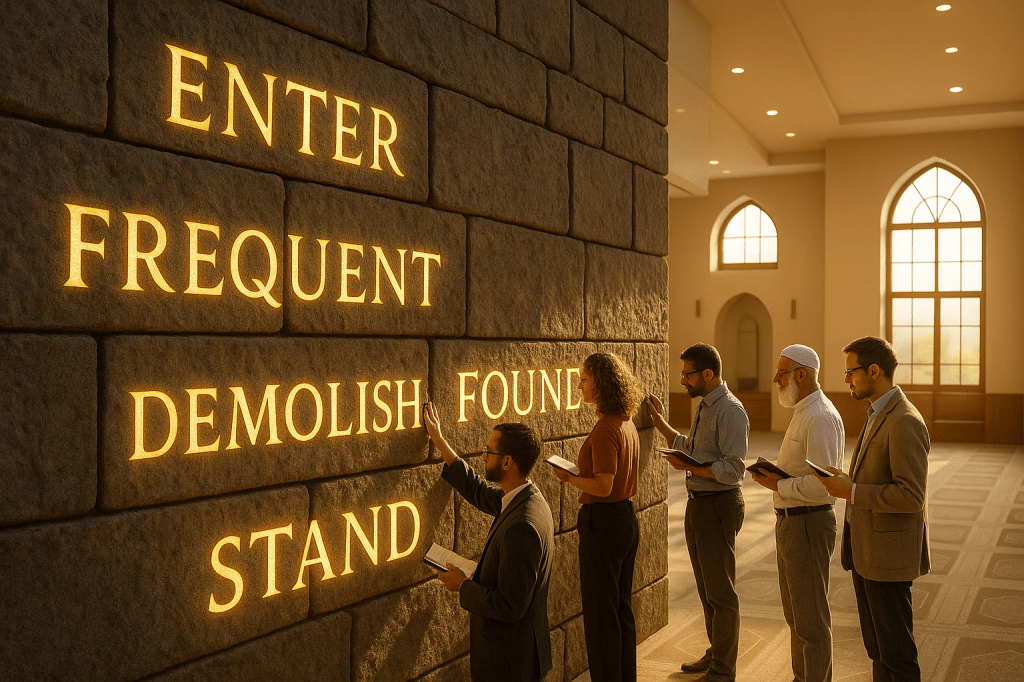
9:107-110: A Continuous Physical Passage You Cannot Spiritualize
Perhaps the most devastating evidence against the spiritual-masjid interpretation comes from reading [9:107-110] as the continuous passage it is. These four verses form a single, unbroken argument — and the Quran moves seamlessly from “masjid” to “building” to “foundations” to “crumbling cliff” without any break in subject matter. The progression makes it impossible to spiritualize “masjid” in verse 107 without also spiritualizing “building on a crumbling cliff” in verse 109.
[9:107] “There are those who abuse the masjid by practicing idol worship, dividing the believers, and providing comfort to those who oppose God and His messenger. They solemnly swear: ‘Our intentions are honorable!’ God bears witness that they are liars.”
Verse 107 introduces the masjid that the hypocrites have established (ittakhadhu masjidan — literally “they took/established a masjid”). Rashad Khalifa’s footnote on this verse is unambiguous: “*9:107 Any masjid where the practices are not devoted absolutely to God ALONE belongs to Satan, not God.” Note: “any masjid” — a place, a building, a defined worship location.
[9:108] “You shall never pray in such a masjid. A masjid that is established on the basis of righteousness from the first day is more worthy of your praying therein. In it, there are people who love to be purified. God loves those who purify themselves.”
Verse 108 delivers the prohibition — “never pray in such a masjid” — and contrasts it with a righteous masjid that was “established” (ussisa, root ا س س — the same root used for laying physical foundations). This masjid was established “from the first day” (min awwali yawmin), a temporal marker that points to an event of founding — the founding of a building. Inside this righteous masjid, “there are men who love to be purified” (fihi rijalun). Physical men, physically inside a physical structure.
[9:109] “Is one who establishes his building on the basis of reverencing God and to gain His approval better, or one who establishes his building on the brink of a crumbling cliff, that falls down with him into the fire of Hell? God does not guide the transgressing people.”
Now God transitions from “masjid” to “building” (bunyan, root ب ن ي). This is not a change of subject — it is the same subject described with a different word. The masjid of verse 107-108 is now called a “building” in verse 109, and God asks: is one who establishes his building on God-consciousness better than one who establishes his building on the brink of a crumbling cliff? The word “building” (bunyan) appears twice in this verse. The word “established” (assasa, root ا س س — the very same root as ussisa in verse 108) also appears twice. A crumbling cliff (jurufin haarin) is invoked — physical geology, physical collapse.
[9:110] “Such a building that they have established remains a source of doubt in their hearts, until their hearts are stilled. God is Omniscient, Most Wise.”
Verse 110 doubles down: “their building which they built” (bunyaanuhum alladhi banaw). The root ب ن ي (b-n-y, “to build”) appears twice in a single clause — once as a noun (bunyanuhum — their building) and once as a verb (banaw — they built). This is God emphasizing, through deliberate repetition, the physical, constructed nature of what the hypocrites established.
9:107: Hypocrites established a masjid (مَسْجِدًا)
9:108: Never pray in it; a masjid founded (أُسِّسَ) on righteousness is better
9:109: One who establishes (أَسَّسَ) his building (بُنْيَٰنَهُۥ) on a crumbling cliff
9:110: Their building (بُنْيَٰنُهُمُ) which they built (بَنَوْا)
The subject never changes. Masjid = Building = Founded structure = Built construction.
You cannot spiritualize a building on a crumbling cliff.
The progression is inescapable. God moves from “masjid” to “building” to “established” to “crumbling cliff” to “their building which they built” — all in four consecutive verses, all about the same subject. If “masjid” in verse 107 is a spiritual concept, then “building” in verse 109 must also be a spiritual concept, and “crumbling cliff” must also be spiritual, and “their building which they built” must also be spiritual. But no one — not even the opponent — would claim that a crumbling cliff is a spiritual metaphor for a formless worship-zone. The passage is about a physical structure, from first verse to last.
The Fihi (فِيهِ) Proof: “In It” Demands Physical Interiority
The Arabic preposition فِي (fi) followed by the pronoun هِ (hi) — forming فِيهِ (fihi, “in it”) — is one of the most important pieces of evidence in this debate. This prepositional phrase denotes physical interiority — being inside something. When the Quran says fihi rijalun (“in it there are men”), it means men are physically present within a defined, enclosed space. You cannot be physically “in” a spiritual concept. You cannot be “inside” an abstraction.
In [9:108] alone, the word fihi appears three times:
First fihi: لَا تَقُمْ فِيهِ أَبَدًا — “Do not stand in it ever” — Physical standing inside a space
Second fihi: أَحَقُّ أَن تَقُومَ فِيهِ — “More worthy of your standing in it” — Physical standing inside a space
Third fihi: فِيهِ رِجَالٌ يُحِبُّونَ أَن يَتَطَهَّرُوا — “In it there are men who love to be purified” — Physical men inside a physical space
Three times in a single verse, God uses the language of physical interiority. This is not accidental. This is not metaphorical. When God says “in it there are men” (fihi rijalun), He is describing a physical building in which physical human beings are present. The word rijalun (men, root ر ج ل) refers to human beings — people with bodies, who occupy space, who stand and sit and pray inside a structure. How can there be men physically “inside” a spiritual concept?
This pattern of fihi + masjid continues throughout the Quran:
[2:114] “Who are more evil than those who boycott God’s masjids, where His name is commemorated, and contribute to their desertion? These ought not to enter therein except fearfully.”
Here the Quran uses يَدْخُلُوهَآ (yadkhuluha — “they enter it”) — you enter a physical building, not a spiritual state.
[2:187] “Sexual intercourse is prohibited if you decide to retreat to the masjid (during the last ten days of Ramadan).”
The Arabic reads: وَأَنتُمْ عَٰكِفُونَ فِى ٱلْمَسَٰجِدِ — “while you are secluded in the masjids.” This is i’tikaf — the practice of physically residing inside a masjid during Ramadan. You eat there. You sleep there. You do not leave. This is bodily presence in a physical building with four walls and a roof. It is impossible to be “secluded in” a spiritual concept.
[2:191] “Do not fight them at the Sacred Mosque (Masjid), unless they attack you therein. If they attack you, you may kill them.”
The Arabic: فِيهِ (fihi) — “therein.” You fight at a physical location. You are attacked inside a physical structure. The rules of engagement differ based on whether you are inside or outside of a defined, physical space.
The fihi evidence is conclusive. Across multiple verses and multiple contexts — prayer, seclusion, combat, commemoration — the Quran consistently places people inside masjids using the language of physical interiority. This language is incompatible with a spiritual interpretation.
18:21 — The Definitive Verse: Bunyan AND Masjid in One Sentence
If any remaining doubt exists about the physical nature of a masjid, verse [18:21] eliminates it entirely. This verse is the single most important piece of evidence in the entire debate, because it uses both the word “building” (bunyan) and the word “masjid” in the same verse, about the same physical location — demonstrating that a masjid is a building, a specific type of building with a specific purpose.
[18:21] “…The people then disputed among themselves regarding them. Some said, ‘Let us build a building around them.’ Their Lord is the best knower about them. Those who prevailed said, ‘We will build a place of worship around them.’”
The Arabic is decisive:
The first group says: ٱبْنُوا عَلَيْهِم بُنْيَٰنًا — “Let us build (ibnu) upon them a building (bunyanan).” The second group, those who prevailed, says: لَنَتَّخِذَنَّ عَلَيْهِم مَّسْجِدًا — “We will surely take/establish upon them a masjid.” Both groups are proposing the same physical action: constructing a structure over the Companions of the Cave. The difference is not physical vs. spiritual — the difference is purpose. One group proposes a generic building; the other proposes a building dedicated to worship.
A bunyan (building) is a physical structure.
A masjid is also a physical structure — with the added designation of being for worship.
Both words describe the same physical reality in the same verse.
A masjid is a type of building — a building consecrated for prostration to God.
It is not a spiritual concept that happens to sometimes coincide with a building.
This verse alone should end the debate. A masjid is a building. The Quran itself uses the two terms — bunyan and masjid — interchangeably in the same physical context, with the only distinction being that a masjid is a building with a specific sacred purpose. You cannot spiritualize a masjid without also spiritualizing the bunyan it is compared to, and no one argues that a building is a spiritual concept.
72:18 — What Rashad Khalifa Actually Said (And What He Did Not)
Now we arrive at the crux of the opponent’s argument: verse [72:18] and what Rashad Khalifa supposedly said about it. Let us first read the verse:
[72:18] “The places of worship belong to God; do not call on anyone else beside God.”
The opponent quotes Rashad saying “the places of worship is in the act of worship” and concludes: Rashad taught that masjid is a spiritual concept! But this claim disintegrates the moment we listen to the full recording — with context. The relevant discussion comes from Quran Study 5/19/89, Sura 71 & 72 (at 1:19:20). A questioner asks whether 72:18 means you can never mention any name other than God inside the mosque — even during Quranic study, where the Quran itself mentions Abraham, Moses, Pharaoh, and others.
Rashad’s Actual Answer: It Is About Conduct, Not Definition
Rashad’s response distinguishes between acts of worship and other activities that happen inside a masjid. Here is what he actually said:
At 1:19:20: “This is the places of worship and the act of worship. When you do the prayer, or the fasting, or the Hajj — you must be devoted to God alone. In the Khutbah and in the Quranic study, in the Quran and so on — the Quran itself says, mentions, in connection with the scripture: Abraham, Mary, Pharaoh.” (at 1:19:20)
At 1:20:30: “So when you study the Quran, or you’re learning from history, you have to mention these names. Only because God said so. But when it comes to the act of worship, you must devote it to God completely.” (at 1:20:30)
At 1:21:45: “Devoted to God alone — in the act of worship. But we were studying. Now, for example, we’re studying the Quran. The Quran tells you to mention these names to learn from the history. In this context.” (at 1:21:45)
At 1:23:00: “But the key words here are place of worship. Or position of worship. So, in the specific practices of worship — like Salat, and fasting, and zakat, and Hajj, and sacrificing animals, whatever — this must be devoted to God alone.” (at 1:23:00)
Read this carefully. Rashad is answering a specific question: can you mention names other than God during Quranic study inside a mosque? His answer is yes — because Quranic study is not an “act of worship” in the strict ritual sense. The “places of worship” reference is about the scope of the prohibition (what you do while worshipping), not about the definition of what a masjid is. He is saying: “72:18 governs what happens during acts of worship — Salat, fasting, Hajj — not during Quranic study.” He is distinguishing between activities, not redefining architecture.
The Picnic-Area Statement: The Clincher
If there were any remaining doubt about what Rashad meant, he provides a crystal-clear illustration moments later:
At 1:23:30: “When you do the prayer in the picnic area, when you stand up for the prayer, you mention only the name of God. In the prayer. As soon as you say Salam Alaikum, say congratulations, Douglas. You mention Douglas. But it is not part of the worship. So I want to make this very strict.” (at 1:23:30)
This is Rashad explaining exactly what he means. When you pray — even in a picnic area — you mention only God’s name during the prayer itself. The moment you finish the prayer (say Salam Alaikum), you can mention anyone. The prohibition is about conduct during worship, not about the nature of a masjid. The picnic area does not become a masjid because you prayed there. The prohibition follows the act of worship, not the physical space. And yet the masjid — as Rashad was about to describe — is still a physical building where these acts of worship happen.
Rashad’s Vision: A Physical Building with a Physical Prayer Hall
Just two minutes after the statement the opponent quotes, Rashad describes his vision for a physical mosque with specific architectural features:
At 1:25:14: “But listen, if God guides them to mention no other name than [God] in the mosque, under any circumstances, we may be able to build a mosque right here in this area where there is a prayer hall where no other name is mentioned here. And our Quranic study will be in a place where we have chairs, and a movie screen, or a big TV, or something. That will be for the Quranic study. And when we go to the prayer hall, no other name will be mentioned in that hall.” (at 1:25:14)
This is devastating to the spiritual-masjid argument. In the very same discussion, in the very same recording, within minutes of the quote the opponent relies upon, Rashad describes: (1) building a physical mosque, (2) with a specific prayer hall, (3) with separate rooms for Quranic study containing chairs and a TV screen, (4) where no name other than God’s would be mentioned in the prayer hall. This is not a man describing a spiritual concept. This is a man describing a floor plan. He is talking about walls, rooms, halls, chairs, and screens — the most concrete, physical, architectural language possible.
And consider this: the Quran Study on Sura 71 and 72 took place in May 1989. Seven months later, in December 1989, Rashad would say about [9:108]: “I used to be not sure.” This means that in May 1989, when he was discussing 72:18, he was still in the process of working through the full implications of these verses. His statements about “the act of worship” in May were not a settled, final position on the definition of masjid — they were part of an ongoing exploration. By December, the Quran had settled it for him: a masjid is a physical building, and you can never pray in one that belongs to Satan. Whatever ambiguity 72:18 might have introduced was resolved by the clarity of [9:108] — and Rashad said so himself.

Rashad’s Practice: He Bought, Built, and Expanded a Physical Building
Beyond his words, Rashad Khalifa’s actions speak with absolute clarity on this matter. He did not merely theorize about spiritual masjids — he purchased a physical building, expanded its walls, planned further construction, and enforced Quranic laws regarding who could and could not pray inside it. His entire life’s work regarding congregational worship was centered on a physical, architectural masjid in Tucson, Arizona.
He Bought a Building and Called It “My Mosque”
In a December 1989 Quran study, Rashad explicitly describes his relationship to a physical building:
At 1:25:30: “I was vice-president of the Sunni mosque… And I bought it.” (at 1:25:30)
At 1:26:03: “We’re expanding it. The mosque is only up to here. And then we added this part. So we keep expanding.” (at 1:26:03)
At 1:26:21: “I’m pretty sure inshallah we’ll take the whole block. This whole block and we’ll build a mosque.” (at 1:26:21)
Rashad bought a physical building. He expanded it by adding walls. He planned to acquire more land (“the whole block”) and build a larger mosque. These are the actions of a man who understood, practiced, and lived the Quranic definition of masjid as a physical building. You do not “buy” a spiritual concept. You do not “expand” an abstraction. You do not plan to acquire land for a metaphysical state.
He Applied 9:108 to the Physical Building — and Admitted His Own Earlier Uncertainty
In the same December 1989 recording, Rashad addresses [9:108] directly. This is analyzed in full detail in the section below (“The December 1989 Ruling”), but the key point belongs here alongside his physical actions: Rashad called idolatrous mosques “the house of Satan” and said “you shall NEVER pray in such a mosque” — repeating the prohibition twice. He admitted he “used to be not sure” about this commandment, but after reading the verse over and over, he reached certainty: it is a direct, strong, absolute prohibition about a physical building you must never enter to pray in. This is the same man who bought, expanded, and planned to build physical mosques. His final, settled understanding of [9:108] was entirely physical.
He Enforced 9:17 on His Physical Building
Rashad also applied [9:17] — the prohibition against idol worshipers frequenting God’s masjids — to his own physical mosque:
At 18:23 of Messenger Audio 14.2: “If God says His law is the idol worshippers will not pray in my mosque. Some of you people remember telling me, why do you let these idol worshippers pray here?” (at 18:23)
He says “my mosque” — a physical building he owns and operates. He applies God’s law about idol worshippers to a specific, physical location. Congregants asked him why idol worshippers were allowed to pray “here” — a physical “here,” a defined location, a building with walls.
The December 1989 Ruling: Rashad Resolves His Own Uncertainty
The most powerful evidence comes from the same December 1989 recording. Just before his statement about “the house of Satan,” someone asks Rashad directly: can I pray in a mosque that doesn’t worship God alone when I’m out on the street?
At 1:28:45: Someone asks about praying in a mosque that doesn’t worship God alone when traveling.
Rashad: “Because there is a DIRECT COMMANDMENT saying don’t.”
Attendee: “In a very strong way.”
Attendee: “Actually, in the house of Satan.”
Rashad: “Do you go in the house of Satan to pray? No. Because in surah 9, really the commandment is VERY STRONG. I used to be not sure. And then, when I read this verse over and over, I said, you shall NEVER PRAY IN SUCH A MOSQUE. You shall NEVER PRAY IN SUCH A MOSQUE.”
This exchange is the definitive answer to the entire debate. Rashad openly admits he “used to be not sure” — meaning there was a period when the practical application of [9:108] was unclear to him. Perhaps he once thought praying in an idolatrous mosque was acceptable under certain circumstances. Perhaps he was uncertain how 72:18 related to the physical prohibition. Whatever the specifics of his earlier uncertainty, he resolved it. And he resolved it by reading [9:108] over and over until its meaning became unmistakable: this is a direct commandment — the strongest prohibition — about a physical building that you must never enter to pray in.
This single admission overrides every earlier statement that could be construed as ambiguous. It is Rashad’s final, settled, mature understanding of [9:108] — reached through careful, repeated study of the verse itself. He calls the idolatrous mosque “the house of Satan” — a house, a physical structure with walls and a roof, that belongs to Satan because of the idol worship practiced inside it. Not a spiritual zone. Not a formless concept. A house. And the commandment is absolute: never pray there.
The Logical Chain: If 9:17 Is Physical, Then 9:108 Must Be Physical
The opponent concedes that [9:17] applies to physical masjids. Let us hold them to this concession and follow the logic to its inescapable conclusion.
[9:17] “The idol worshipers are not to frequent the masjids of God, while confessing their disbelief. These have nullified their works, and they will abide forever in Hell.”
[9:108] “You shall never pray in such a masjid. A masjid that is established on the basis of righteousness from the first day is more worthy of your praying therein.”
Both verses are in Sura 9 — the same chapter. Both use the word masjid (root س ج د). Both issue prohibitions about what can and cannot happen in masjids. Both deal with the relationship between worship practices and physical worship spaces. The only difference is the strength of the prohibition: 9:17 says idol worshippers “are not to frequent” (ya’muru) God’s masjids; 9:108 says “you shall never (abadan) pray in such a masjid” — adding the emphatic أَبَدًا (abadan, meaning “ever, forever”), making 9:108 a stronger prohibition than 9:17.
If the same word (masjid), in the same chapter (Sura 9), in the same context (worship prohibitions), means “physical building” in verse 17 but “spiritual concept” in verse 108 — then the Quran is using the same word with two different meanings in the same context with no indication of a shift. This violates every principle of coherent communication and would make the Quran internally inconsistent — something God explicitly denies.
Furthermore, consider the escalation pattern. In [9:17-18], God establishes who may and may not frequent His masjids. In [9:19], He asks whether maintaining the Sacred Masjid (عِمَارَةَ ٱلْمَسْجِدِ — imaarat al-masjid, physical maintenance) substitutes for genuine faith. In [9:28], He commands that idol worshippers “shall not approach” (la yaqrabu) the Sacred Masjid. Then in [9:107-110], He describes a specific masjid established by hypocrites and prohibits praying in it. The entire progression is about physical buildings and physical access to them. To suddenly inject a spiritual meaning at verse 108 — while maintaining a physical meaning at verses 17, 19, and 28 — is arbitrary and unjustifiable.
[9:28] “O you who believe, the idol worshipers are polluted; they shall not be permitted to approach the Sacred Masjid after this year.”
You approach a building. You do not “approach” a spiritual concept “after this year.” The temporal marker (“after this year”) and the physical verb (“approach”) cement the physical nature of every masjid reference in Sura 9.
72:18 In Its Full Quranic Context: Conduct, Not Definition
Let us now read [72:18] in its Quranic context, not as an isolated proof-text. What does the Sura actually discuss in the surrounding verses?
[72:14] “‘Among us are the submitters, and among us are the compromisers.’ As for those who submitted, they are on the right path.”
[72:15] “As for the compromisers, they will be fuel for Gehenna.”
[72:16] “If they remain on the right path, we will bless them with abundant water.”
[72:17] “We will surely test them all. As for him who disregards the message of his Lord, He will direct him to ever increasing retribution.”
[72:18] “The places of worship belong to God; do not call on anyone else beside God.”
[72:19] “When God’s servant advocated Him alone, almost all of them banded together to oppose him.”
[72:20] “Say, ‘I worship only my Lord; I never set up any idols besides Him.’”
The context is clear: the passage moves from a description of submitters vs. compromisers, to the consequences of staying on the right path, to a command about worship. Verse 18 commands that worship belongs to God alone — do not invoke other names. Verse 19 describes the opposition that comes when God’s servant advocates this. Verse 20 reaffirms: “I worship only my Lord.”
The verse is about conduct — what you do in worship. It commands: in your worship, invoke God alone. This is a behavioral directive, not a definitional statement. It does not say “a masjid is whatever space you worship in.” It says “the places of worship belong to God” — they are His, and therefore His rules apply in them. The primary rule being: do not invoke anyone else. Rashad confirmed this reading in multiple contexts, as we have seen.
This interpretation is further confirmed by Rashad’s statement in The Great Debate:
At 57:38: “wa annal masajida bil ma’fila tadawama allahi ahadah, this is very clear Arabic, it is telling you that this worship belongs to God, do not mention any other names.” (at 57:38)
And in Heavenly Community, No Mosques For God Alone, where Rashad identifies the physical building as the site of the 72:18 violation:
At 11:09: “There is not a single mosque in the world, other than this mosque, and a few associated with it, where God is commemorated alone. Every single mosque in the world is violating the commandment in 72:18 that says the mosque belongs to God, do not call it any other name but His name.” (at 11:09)
Rashad says “this mosque” — a physical building in Tucson — is one of the only places where 72:18 is upheld. “Every single mosque in the world” — physical buildings across the globe — violates it. He is not saying “every spiritual worship-state in the world” is in violation. He is pointing to buildings. Structures. Institutions. Places with addresses and doors and congregations. The 72:18 prohibition governs what happens inside these physical places of worship. It does not redefine what those places are.
The Corridor Test: Why Location Without Establishment Is Not a Masjid
The spiritual-masjid theory leads to absurd practical consequences that can be tested with a simple thought experiment. Call it “The Corridor Test.”
Imagine a hypocrite — someone who practices idol worship, mentions names besides God in their prayers, and divides the believers — walks into the corridor of your office building during lunch break and performs their corrupted prayer. Under the spiritual-masjid theory, they have just established a spiritual masjid in that corridor. After all, if “masjid” is wherever worship happens, then their act of worship has just created a masjid — and under [9:107-108], since this masjid involves idol worship, you should now never pray in that corridor again.
This is absurd for multiple reasons. First, the corridor was never established (ussisa) as a masjid. The Quran says in [9:108] that a righteous masjid is one that was “established on the basis of righteousness from the first day.” The word أُسِّسَ (ussisa) means “was founded” — it implies a deliberate act of establishment, a designation of purpose. An office corridor is not founded as a place of worship. It is a hallway. Someone praying in it does not transform it into a masjid any more than someone eating lunch in it transforms it into a restaurant.
Second, the Quran says the hypocrites “took/established a masjid” (ittakhadhu masjidan, [9:107]) — they deliberately created a worship space for the purpose of harm. This is an intentional, institutional act. A drive-by prayer in a random location does not constitute “establishing a masjid.” The word ittakhadhu (root ا خ ذ, “to take/adopt/establish”) implies permanence and purpose — you take something and make it into something specific.
Third, Rashad himself made this distinction explicitly. When he said “I walk in any of these mosques and I go make my wudu and pray — just like at work” (at 1:39), he equated praying in a random mosque to praying at work. Neither location is his established, righteous masjid. But he does not treat his workplace as a masjid — he treats it as a place where he happens to pray when no better option exists. The masjid is a defined, established building. The workplace is not.
Question: If a hypocrite prays in your office hallway, can you still pray there?
Answer: Yes — because a hallway is not a masjid. It was never established as one.
Question: Under the spiritual-masjid theory, can you still pray there?
Answer: Unknown — because you cannot determine the boundaries of a spiritual masjid, when it begins, when it ends, or whether someone’s corrupted worship has transformed the space.
The physical-masjid interpretation gives a clear, followable answer.
The spiritual-masjid interpretation gives confusion.
22:40 — You Cannot Demolish a Spiritual Concept
One of the most powerful verses for establishing the physical nature of masjids is [22:40], which places masjids alongside other physical houses of worship that can be physically destroyed:
[22:40] “They were evicted from their homes unjustly, for no reason other than saying, ‘Our Lord is God.’ If it were not for God’s supporting of some people against others, monasteries, churches, synagogues, and masjids — where the name of God is commemorated frequently — would have been destroyed. Absolutely, God supports those who support Him. God is Powerful, Almighty.”
The Arabic word is لَّهُدِّمَتْ (la-huddimat), from the root ه د م, meaning “to demolish, to tear down, to destroy.” This verb is used exclusively for physical structures. You demolish a building. You demolish a wall. You demolish a bridge. You do not “demolish” a spiritual concept, a state of mind, or an act of worship.
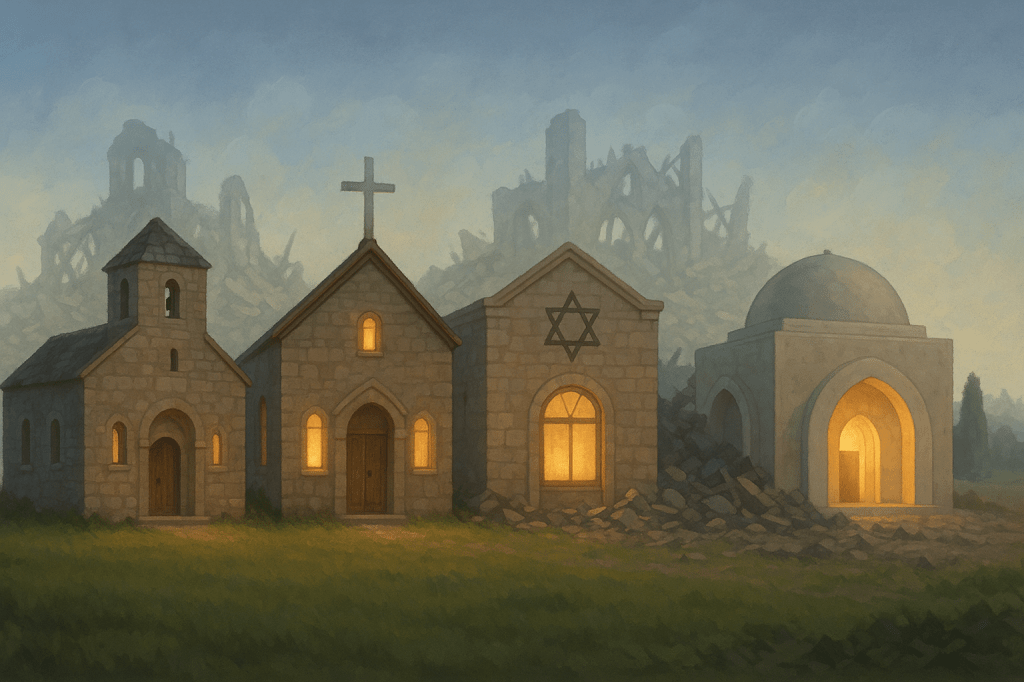
Furthermore, the verse lists four types of worship buildings in sequence: monasteries (sawami’), churches (biya’), synagogues (salawat), and masjids (masajid). All four are physical buildings. All four can be demolished. God groups masjids with monasteries, churches, and synagogues — all of which are indisputably physical structures. If “masjid” in this verse means a spiritual concept, then so do “monastery,” “church,” and “synagogue.” But no one argues that a church is a spiritual concept. The grouping proves that masjids, like churches, are physical buildings that can be physically destroyed.
Additional Quranic Evidence: A Cascade of Physical References
The physical nature of masjids is not supported by a handful of verses — it is supported by a massive, unbroken chain of evidence spanning the entire Quran. Let us briefly survey the additional testimony.
Travel Between Masjids: 17:1
[17:1] “Most glorified is the One who summoned His servant (Muhammad) during the night, from the Sacred Masjid (of Mecca) to the farthest place of prostration, whose surroundings we have blessed, in order to show him some of our signs.”
Muhammad’s soul was transported مِّنَ ٱلْمَسْجِدِ ٱلْحَرَامِ إِلَى ٱلْمَسْجِدِ ٱلْأَقْصَا — “from the Sacred Masjid to the farthest place of prostration.” The prepositions مِن (min, “from”) and إِلَى (ila, “to”) describe spatial movement between two locations. You travel “from” one physical place “to” another. You do not travel “from” one spiritual state “to” another using spatial prepositions.
Enter the Masjid: 48:27
[48:27] “God has fulfilled His messenger’s truthful vision: ‘You will enter the Sacred Masjid, God willing, perfectly secure, and you will cut your hair or shorten it (as you fulfill the pilgrimage rituals) there.’”
The Arabic لَتَدْخُلُنَّ ٱلْمَسْجِدَ ٱلْحَرَامَ (la-tadkhulunna al-masjid al-haram) is an emphatic future: “you WILL enter the Sacred Masjid.” The verb دخل (dakhala, “to enter”) is a physical action — you enter a building, a city, a room. You do not “enter” a spiritual concept.
Custodians of the Masjid: 8:34
[8:34] “Have they not deserved God’s retribution, by repelling others from the Sacred Masjid, even though they are not the custodians thereof? The true custodians thereof are the righteous, but most of them do not know.”
The word أَوْلِيَآءَهُۥٓ (awliyaa’ahu, “its custodians/guardians”) implies ownership or authority over a physical property. You are a custodian of a building, a shrine, a site. You cannot be a “custodian” of a spiritual concept — who guards an abstraction?
Dress Nicely to Go There: 7:31
[7:31] “O children of Adam, you shall be clean and dress nicely when you go to the masjid.”
The phrase عِندَ كُلِّ مَسْجِدٍ (‘inda kulli masjidin, “at every masjid”) uses the preposition عِندَ (‘inda, “at/near”), indicating a physical destination. You dress nicely when you go — implying travel to a location. You do not dress up to enter a spiritual state. Even the opponent concedes this verse is physical — but the concession destroys their own argument, because the same word (masjid) cannot mean “physical building” in one verse and “spiritual concept” in another without explicit Quranic indication of the shift.
Maintenance of the Masjid: 9:19
[9:19] “Have you considered the watering of the pilgrims and caring for the Sacred Masjid a substitute for believing in God and the Last Day, and striving in the cause of God?”
The Arabic عِمَارَةَ ٱلْمَسْجِدِ ٱلْحَرَامِ (imaarat al-masjid al-haram) means “the maintenance/upkeep of the Sacred Masjid.” The root ع م ر (a-m-r) in this form refers to physical care — maintaining a building, keeping it habitable, tending to its structure. You maintain a building, not a spiritual concept.
Approach Forbidden: 9:28
[9:28] “O you who believe, the idol worshipers are polluted; they shall not be permitted to approach the Sacred Masjid after this year.”
The Arabic فَلَا يَقْرَبُوا ٱلْمَسْجِدَ ٱلْحَرَامَ (fa-la yaqrabu al-masjid al-haram) means “they shall not approach the Sacred Masjid.” The verb قرب (qaraba, “to approach/come near”) is physical proximity to a physical location. The temporal marker “after this year” (ba’da aamihim hadha) pins the prohibition to a specific point in time and a specific physical place. You approach a building. You do not “approach” a spiritual concept “after this year.”
Eviction from the Masjid: 2:217
[2:217] “…repelling from the path of God and disbelieving in Him and in the sanctity of the Sacred Mosque (Masjid), and evicting its people, are greater sacrileges…”
The Arabic وَإِخْرَاجُ أَهْلِهِۦ مِنْهُ (wa-ikhraj ahlihi minhu, “and evicting its people from it”) describes the physical removal of people from a physical place. You evict someone from a building. You do not evict someone from a spiritual state.
The Sacred Masjid: A Physical Place with an Address, a Direction, and a Door
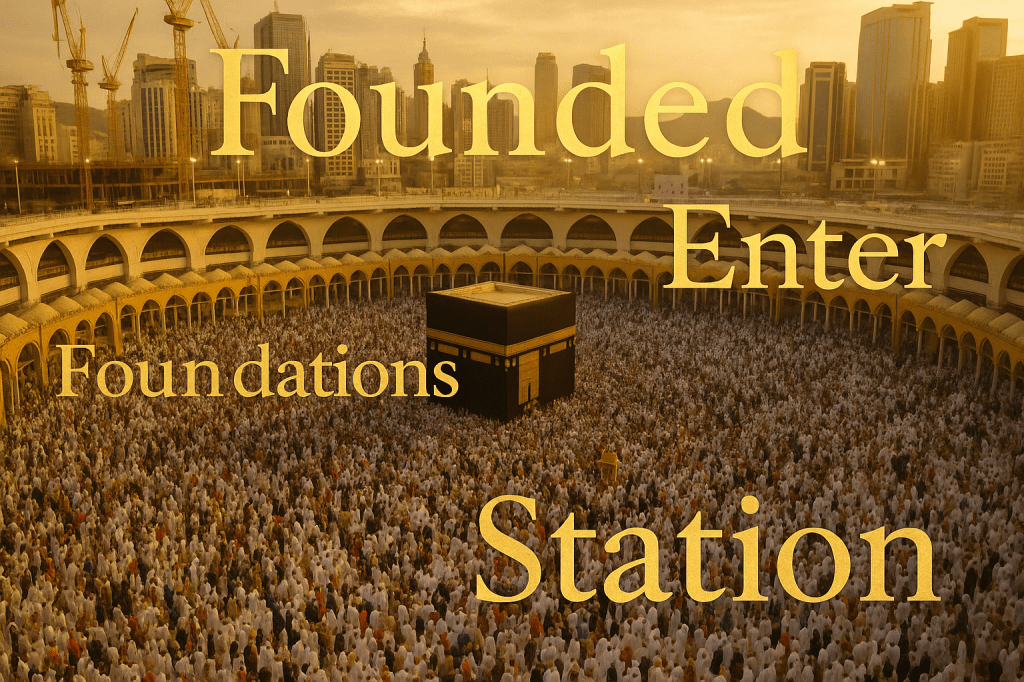
The single strongest proof that the Quran uses “masjid” to mean a physical building is the Sacred Masjid (al-Masjid al-Haram) — the Ka’aba in Mecca. This masjid is mentioned by name in over a dozen verses. The Quran tells us its physical location (Becca/Mecca), its builder (Abraham), its direction (Qiblah), its rituals (Hajj, ‘Umrah), its custodians, its sanctity, and its physical characteristics. No one — not even the most ardent spiritual-masjid theorist — would claim that the Sacred Masjid is a spiritual concept rather than a physical building.
[3:96] “The most important shrine established for the people is the one in Becca; a blessed beacon for all the people.”
[3:97] “In it are clear signs: the station of Abraham. Anyone who enters it shall be granted safe passage.”
[2:144] “…Henceforth, you shall turn your face towards the Sacred Masjid. Wherever you may be, all of you shall turn your faces towards it.”
[2:127] “As Abraham raised the foundations of the shrine, together with Ismail (they prayed): ‘Our Lord, accept this from us.’”
Consider the verbs and nouns used with the Sacred Masjid: it is “in Becca” (a physical location), it was “established” (wudi’a), Abraham “raised its foundations” (yarfa’u al-qawa’id — physically lifting stones), it has “clear signs” (ayat bayyinat) and “the station of Abraham” (maqam Ibrahim — a physical location within it), you “enter” it (dakhala), you “turn your face towards” it (walli wajhak shatr — a directional command requiring a physical reference point), and people “approach” it or are “prevented from approaching” it.
If the Sacred Masjid — the most important masjid in the Quran — is indisputably a physical building, then on what basis can the same word “masjid” in [9:108] be claimed to mean something other than a physical building? The burden of proof is on the opponent to show where the Quran indicates a shift in meaning. They cannot produce such evidence because it does not exist.
72:18 and the Contact Prayer: The Worship-Conduct Reading Confirmed
Rashad Khalifa’s teachings on the Contact Prayer (Salat) further confirm that [72:18] is about what you do during worship — not about where you do it or what a masjid is. In his audio teachings, Rashad consistently explained that the Contact Prayer is a precise, structured act of devotion — a nourishment for the soul — during which only God’s name should be mentioned.
At 14:45 of Principles of Contact Prayer: “Think of them as the meal for the soul, for the real person. The morning prayer is the breakfast for the soul.” (at 14:45)
At 34:13 of Principles of Contact Prayer: “The most important point is never to mention any name other than the name of Allah, the name of God, in the contact prayer. We see this in the Quran in surah 72, ayah or verse number 18.” (at 34:13)
Notice Rashad’s application of 72:18: he says “never to mention any name other than the name of God in the contact prayer.” He applies 72:18 to the act of prayer, not to the definition of a building. This is the worship-conduct reading: 72:18 tells you what to do during Salat (mention only God’s name), not what a masjid is. The masjid remains a physical building — the place where this act of worship occurs. The verse governs the behavior, not the architecture.
This is further confirmed by Rashad’s Newsletter #33 (October 1987), where he writes: “It is now established that the contact prayer (Salat) triggers contact between us and our creator through a divine numerical combination. The combination that opens the door for us is THE OPENER ‘Al-Faatiha.’ It is combination of ‘sounds’ given to us by the Almighty Creator in order to establish contact with Him five times a day.” The contact prayer is a specific ritual act — a “combination of sounds” — not a building and not a state of being. It is something you do, in a place, at specific times. The place is the masjid. The act is the worship. 72:18 governs the act.
Answering Remaining Objections
Objection: “But 72:18 says ‘places of worship,’ plural — doesn’t that include all worship spaces?”
The Arabic ٱلْمَسَٰجِدَ (al-masajid) is simply the plural of masjid. The plural does not change the word’s meaning — it multiplies it. “Masjids” means “multiple masjids,” each one a physical place of prostration. When [22:40] lists “monasteries, churches, synagogues, and masjids” — all physical buildings — the plural form does not suddenly transform any of them into spiritual concepts. Multiple physical buildings are still physical buildings.
Furthermore, the Quran uses the plural to encompass all the masjids in the world — Mecca, Medina, Tucson, every physical masjid anywhere. The plural is about quantity, not about abstracting the word beyond its meaning.
Objection: “Rashad said ‘position of worship’ — doesn’t that prove masjid can mean a posture?”
Rashad used the word “position” as a near-synonym for “place” — not as “posture” or “stance.” When he said “place of worship or position of worship” (at 1:23:00), he was clarifying the scope of the prohibition, not redefining the word masjid. The very same sentence continues: “So, in the specific practices of worship — like Salat, and fasting, and zakat, and Hajj…” He is saying: this verse applies when you are in the position/situation of worshipping. He is not saying a masjid is a posture. Minutes later, he describes building a physical mosque with a prayer hall, study room, chairs, and a TV. A man describing a posture does not then draw a floor plan.
Objection: “But doesn’t the fact that you can pray anywhere prove that every place is a potential masjid?”
No. The fact that you can pray anywhere does not make everywhere a masjid. You can eat anywhere — that does not make everywhere a kitchen. You can write anywhere — that does not make everywhere an office. The Arabic grammar is clear: مَسْجِد is a مَفْعِل (maf’il) form — a noun of established place. It is not “wherever prostration happens to occur” but rather “the place designated for prostration.” The مَ prefix creates permanent, defined locations, not temporary, ad hoc ones.
Rashad demonstrated this distinction himself. He prayed at work — but he did not call his workplace a masjid. He prayed while traveling in various mosques — but he distinguished between them and “his mosque.” A masjid is a designated, established place of worship, not any spot where someone happens to pray.
Objection: “Why can’t 9:108 apply to both physical and spiritual simultaneously?”
Because “never stand in it” (la taqum fihi) requires you to know what “it” is and where “it” ends. If a masjid is simultaneously physical and spiritual, and you obey the physical prohibition (don’t enter the building), but the spiritual prohibition has no defined boundaries, then you can never be certain you are obeying God’s command. God does not issue commands that cannot be followed. The Quran is “fully detailed” ([6:114]) and leaves no room for guesswork about how to comply with its laws.
More fundamentally: the verse already applies to a physical building, and the physical reading accounts for every word in it — “stand,” “in it,” “founded,” “from the first day,” “in it there are men.” Adding a spiritual layer does not clarify anything — it only confuses. When a verse’s plain meaning is complete, coherent, and actionable, adding metaphorical layers is not insight — it is obfuscation.
The Complete Picture: A Masjid According to the Quran
Let us now synthesize everything the Quran tells us about what a masjid is. Not what we wish it to be, not what we theorize it could be, but what God’s own words — using physical verbs, concrete nouns, spatial prepositions, and architectural language — define it as.
1. A physical building — It is a “building” (bunyan, [9:109-110], [18:21]) that can be “built” (banaw, [9:110]).
2. An established, founded structure — It is “established” (ussisa, [9:108]) and “founded” (assasa, [9:109]) on a specific basis, “from the first day” ([9:108]).
3. A place you enter and exit — People “enter” it (yadkhulu, [2:114], [17:7], [48:27]) and can be “evicted” from it (ikhraj, [2:217]).
4. A place you frequent and maintain — Believers “frequent” it (ya’muru, [9:17-18]) and “maintain” it (imarat, [9:19]).
5. A place you can approach or be barred from — Idol worshippers are told not to “approach” it (la yaqrabu, [9:28]), and people are “repelled from” it (saddu ‘an, [8:34], [22:25]).
6. A place you reside in — Believers “seclude” themselves in it (aakifun fi, [2:187]).
7. A place that can be demolished — Masjids can be “destroyed” (huddimat, [22:40]) and “ruined” (kharab, [2:114]).
8. A place you travel to and from — Muhammad was taken “from” the Sacred Masjid “to” the farthest place of prostration ([17:1]).
9. A place with a direction — Believers are commanded to “turn your face towards” it ([2:144, 2:149, 2:150]).
10. A place with custodians — It has “custodians” (awliya’, [8:34]) — guardians of a physical property.
11. A place you dress up for — You “dress nicely when you go to” it ([7:31]).
12. A place with people inside it — “In it there are men who love to be purified” ([9:108]).
Every single attribute the Quran assigns to masjids is physical, spatial, and architectural. Not a single verse in the entire Quran describes a masjid as a spiritual state, a zone of influence, a formless concept, or an abstraction. The evidence is not ambiguous. It is not even close. It is unanimous.
Conclusion: A Masjid Is a Masjid
A masjid is a masjid. The Quran defines it with foundations, walls, doors, custodians, and men standing inside it. Arabic grammar defines it as a noun of place — the place where prostration happens. Rashad Khalifa bought one, expanded its walls, planned to acquire an entire city block for it, checked the Qibla direction of a potential purchase (and rejected the building because the orientation was wrong), enforced Quranic law within it, and called it “my mosque.” He called the idol-worshipping mosque “the house of Satan” — a physical house, with a physical door, that he told believers to never pray in.
Most critically: in December 1989 — the final month of his life — Rashad addressed [9:108] directly and admitted “I used to be not sure.” His uncertainty was never about whether a masjid is a physical building. That was never in question. His uncertainty was about how strong the prohibition was — and after reading the verse over and over, he concluded it was the strongest commandment: “You shall never pray in such a mosque.” He resolved his uncertainty with a physical answer about a physical building. If even the messenger of the covenant needed time to absorb the full force of this physical prohibition, how much more absurd is it to dissolve the verse into a spiritual abstraction?
72:18 does not redefine “masjid.” It tells you what to do inside a masjid — and during all worship, wherever it occurs. Mention only God’s name. Devote the act entirely to Him. This is a command about conduct, not about architecture. Rashad confirmed this when he said you can mention other names during Quranic study (because study is not worship), but not during Salat (because prayer is worship). He confirmed it when he described building a prayer hall separate from a study room. He confirmed it when he said praying in a random mosque is “just like at work” — not a masjid in the [9:108] sense, but a place where you happen to pray.
The spiritual-masjid theory fails every test. It fails the grammatical test (مَفْعِل produces nouns of place, not spiritual concepts). It fails the verb test (you cannot demolish, enter, exit, reside in, approach, or be custodian of an abstraction). It fails the fihi test (“in it” demands physical interiority). It fails the 9:107-110 continuity test (masjid = building = founded structure = construction on a cliff). It fails the 18:21 test (bunyan and masjid in the same verse about the same physical thing). It fails the corridor test (a hallway does not become a masjid because someone prayed there). It fails the practical test (you cannot follow a law about avoiding something that has no boundaries). And it fails the Rashad test (he bought, expanded, and planned buildings — not spiritual concepts).
[9:108] “You shall never pray in such a masjid. A masjid that is established on the basis of righteousness from the first day is more worthy of your praying therein. In it, there are people who love to be purified. God loves those who purify themselves.”
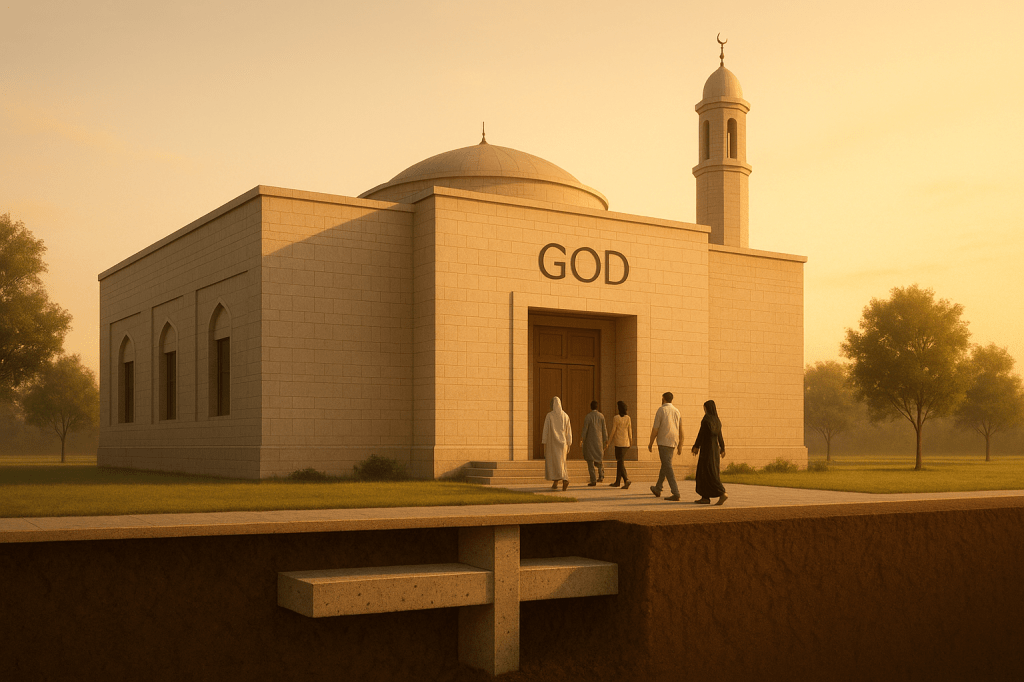
This verse is about a building. A physical building, founded on a specific day, for a specific purpose, with specific people inside it. God said it clearly. He said it with physical verbs, architectural nouns, and spatial prepositions. He repeated “in it” three times in a single verse to make the point impossible to miss. He then followed it with two verses about “buildings” and “foundations” and “crumbling cliffs” to drive the physical reality home beyond any doubt.
When God is this clear, our job is not to find creative ways to make His words mean something else. Our job is to hear, to understand, and to obey.

 Quran Only Studies
Leave a comment