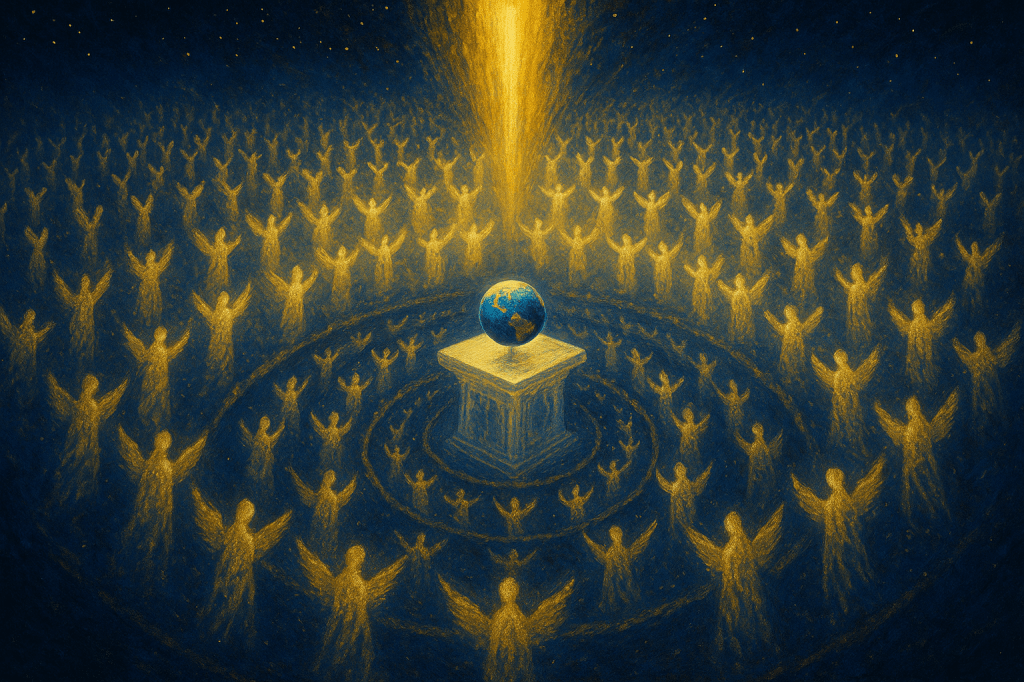
Introduction: The Most Misunderstood Verse in the Quran
There is a verse in the Quran that contains the answer to the most fundamental question any human being can ask: why are we here? It is a verse that most people read quickly and move past, assuming they already know what it means. They reduce it to a simple narrative — God told the angels He was making a “vicegerent” on Earth, the angels objected, and that was that. But this superficial reading misses something extraordinary. The Arabic grammar of this verse, the audience it addresses, the objection it records, and the root meaning of its key word all converge on a single, stunning conclusion: God placed a temporary replacement — a stand-in god with a lowercase “g” — on Earth to prove a point. That verse is 2:30, and its implications reshape everything we think we know about the purpose of human existence.
This is not a speculative reading. The Final Testament translation by Rashad Khalifa renders the key term explicitly: “a representative (a temporary god).” This article will prove that this translation is not only linguistically justified but is the only translation that makes sense when you examine the Arabic grammar, the context of the conversation, the root morphology of the word “khalifa,” every other occurrence of this root in the Quran, and the parallel accounts in at least five other chapters. What emerges is not a quaint creation story but a courtroom drama of cosmic proportions — a drama in which Satan is the defendant, Earth is the exhibit, and you and I are the witnesses whose own choices will determine whether we return to God or follow the defendant into permanent exile.
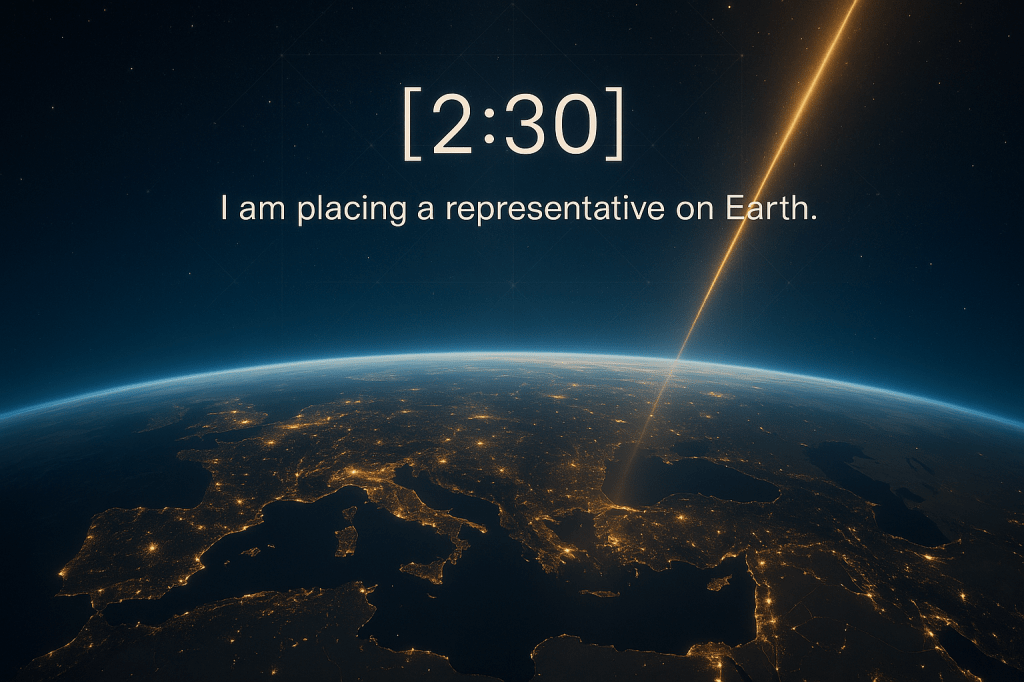
[2:30] Recall that your Lord said to the angels, “I am placing a representative (a temporary god) on Earth.” They said, “Will You place therein one who will spread evil therein and shed blood, while we sing Your praises, glorify You, and uphold Your absolute authority?” He said, “I know what you do not know.”
Part 1: The Grammar Proves It — “Khalifatan Fil Ard”
The Prepositional Phrase That Changes Everything
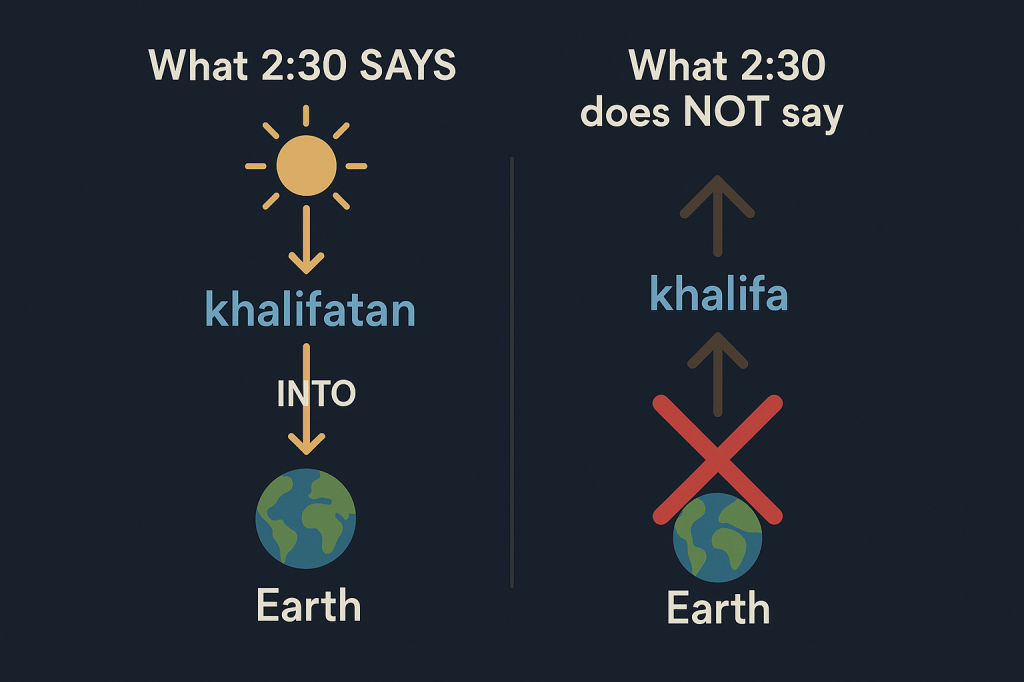
The Arabic of 2:30 reads: “inni ja’ilun fil-ardi khalifatan” — literally, “Indeed I am placing IN the earth a khalifa.” This is not a minor grammatical detail. The preposition “fi” (in/on) combined with the definite article on “al-ard” (the earth) creates a directional construction. God is placing something ON Earth. The earth is the destination, the location where this khalifa is being deposited. It is not “ardil khalifa” — “the earth’s khalifa” — which would make the earth the possessor and the khalifa its property. The difference is as stark as saying “I am placing an ambassador in France” versus “France’s ambassador.” In the first construction, the one doing the placing has authority, and France is merely the location. In the second, France owns the ambassador. God is not giving Earth a ruler who belongs to it. He is placing His own representative on Earth — like depositing a proxy in a foreign territory.
The verb “ja’ala” (root: ج-ع-ل) reinforces this. The word-by-word breakdown from the Quranic Arabic corpus confirms the meaning: “ja’ilun” = “appointing / placing.” This is an active participle — God is the one actively doing the placing. He is not responding to Earth’s need for a ruler. He is not filling a vacancy that Earth advertised. He is executing a sovereign decision to place His own agent in a specific location for His own purposes. The angels even echo this grammar in their response: “ataj’alu fiha” — “Will You place therein?” They understood perfectly. The question was not “Are You giving Earth a king?” but “Are You placing in it someone who will cause corruption?” The “fi” (in/therein) appears three times in this single verse, hammering the point: the earth is a container, a venue, a test site — not an owner.
The Verb “Ja’ala” Across the Quran
The root ج-ع-ل (ja’ala) appears extensively throughout the Quran, and its consistent usage confirms this reading. When God uses “ja’ala” with the preposition “fi,” it always means placing something in a location — never creating something that inherently belongs to that location. Consider the pattern: God “ja’ala” (placed) mountains on the earth, God “ja’ala” (placed) the night and day as alternating signs, God “ja’ala” (placed/made) the stars as guides. In every case, the thing being placed serves God’s purpose, not the location’s purpose. The mountains do not belong to the earth in the sense that the earth requested them — God placed them there for stability. Similarly, the khalifa does not belong to the earth — God placed the khalifa there for a test.
This grammatical analysis demolishes the traditional reading that treats “khalifa” as merely “vicegerent” in the sense of a local ruler. A vicegerent governs on behalf of someone else, yes — but the traditional interpretation stops there, as if God simply needed a property manager for Earth. The grammar tells us something far more radical: God is taking a being from one place and depositing it in another. The khalifa existed before the placement. The earth existed (or was about to exist) as a destination. The act is a transfer, not a creation. And this transfer, as we will see, is the answer to why every human soul finds itself trapped in a physical body on a small planet in the outermost reaches of the universe.
Part 2: The Audience Is Angels — A Pre-Creation Conversation
The Celestial Boardroom
Who is God talking to in 2:30? Angels. Not humans, not jinns, not earthly creatures. Angels. This matters enormously because of what it implies about the timing of this conversation. Angels are beings who existed before the physical universe was created. They are not made from the earth’s materials. They do not inhabit the earth. They exist in a realm that predates matter itself. When God tells the angels “I am placing a khalifa on Earth,” He is announcing a plan to beings who exist outside of Earth, before Earth as we know it was populated. This is a boardroom meeting before the project begins — a divine announcement of intent.
The Quran consistently presents this pattern: God informs the angels of His decisions, not to seek their approval, but to establish a record. The angels’ role is to witness, obey, and execute. Their response in 2:30 — “Will You place therein one who will spread evil therein and shed blood?” — is not an objection in the sense of defiance. It is an observation, a question born from knowledge or experience. But the critical point is this: God is addressing creatures who exist in His direct presence, creatures who “sing His praises, glorify Him, and uphold His absolute authority.” This conversation is happening in the celestial realm, in what the Quran calls “the High Society” (al-mala’ al-a’la). The earth, at this point, is a future destination — not the present setting.
[38:69] “I had no knowledge previously, about the feud in the High Society.”
This verse, addressed to Muhammad, confirms that a “feud” (dispute) occurred in this celestial assembly. The footnote in the Final Testament states: “The feud in the High Society was triggered by Satan’s challenge to God’s absolute authority. This is definitely the most important event in the history of the human race. We failed to make a firm stand regarding God’s absolute authority. This life represents the third and final chance to redeem ourselves.” The announcement in 2:30 is therefore not the beginning of the story — it is God’s response to a crisis that had already occurred. The placement of a khalifa on Earth is not the opening act of creation. It is the sentencing phase of a cosmic trial.

The Angels Knew What Would Happen
The angels’ question is perhaps the most underappreciated detail in this verse. They asked: “Will You place therein one who will spread evil therein and shed blood?” How did they know? The khalifa had not yet been placed. No blood had yet been shed on Earth. There are only two possible explanations, and both are devastating to the idea that 2:30 is a simple creation narrative. Either the angels had witnessed a previous experiment — a prior placement of beings on Earth or on another world that ended in corruption and bloodshed — or they understood the nature of the beings being placed. They knew that creatures who had wavered in their loyalty to God, creatures who had entertained Satan’s challenge to divine authority, would inevitably produce corruption and violence when given freedom of choice on a physical plane.
Rashad Khalifa explained this dynamic in his teachings. Addressing the question of why the angels objected, he stated: “The angels said, since these creatures here rebelled, put them all in hell. Throw them all in hell. Banish them from your kingdom. As in chapter 2, verse 30, God says, no. One of the names of God is the Most Merciful. God wanted to give us another chance to reconsider our decision to side with Satan” (at 29:28). The angels were not guessing. They were arguing for immediate punishment. God overruled them with mercy — and with a plan the angels could not foresee.
Part 3: The Root Analysis — What “Khalifa” Actually Means
The Root خ-ل-ف (Kha-La-Fa)
The word “khalifa” (خَلِيفَة) derives from the trilateral root خ-ل-ف (kha-la-fa), which carries meanings of succession, replacement, coming after, and substitution. This root appears in 116 verses across the Quran, making it one of the most frequently used roots in the entire scripture. The core semantic field of this root is clear and consistent: something that comes after something else, something that replaces what was there before, something temporary by definition. You cannot be a “successor” if the role is permanent. Succession implies that someone held the position before you, and someone will hold it after you. The very word contains its own expiration date.
The word-by-word analysis of 2:30 from the Quranic Arabic corpus translates “khalifatan” as “an alternative / vicegerent / ruler.” Notice the first option: “alternative.” This is not a permanent installation. It is a substitute, a stand-in, a replacement for something or someone. When Rashad Khalifa translates this as “a representative (a temporary god),” he is not being provocative — he is being precise. The khalifa is a being granted temporary authority to manage a domain, just as a substitute teacher manages a classroom. The substitute does not own the school, did not build the school, and will not stay at the school. They are there for a limited period, with borrowed authority, and they are accountable to the one who placed them there.
[6:165] He is the One who made you inheritors of the earth, and He raised some of you above others in rank, in order to test you in accordance with what He has given you. Surely, your Lord is efficient in enforcing retribution, and He is Forgiver, Most Merciful.
Every Khalifa in the Quran Is Temporary
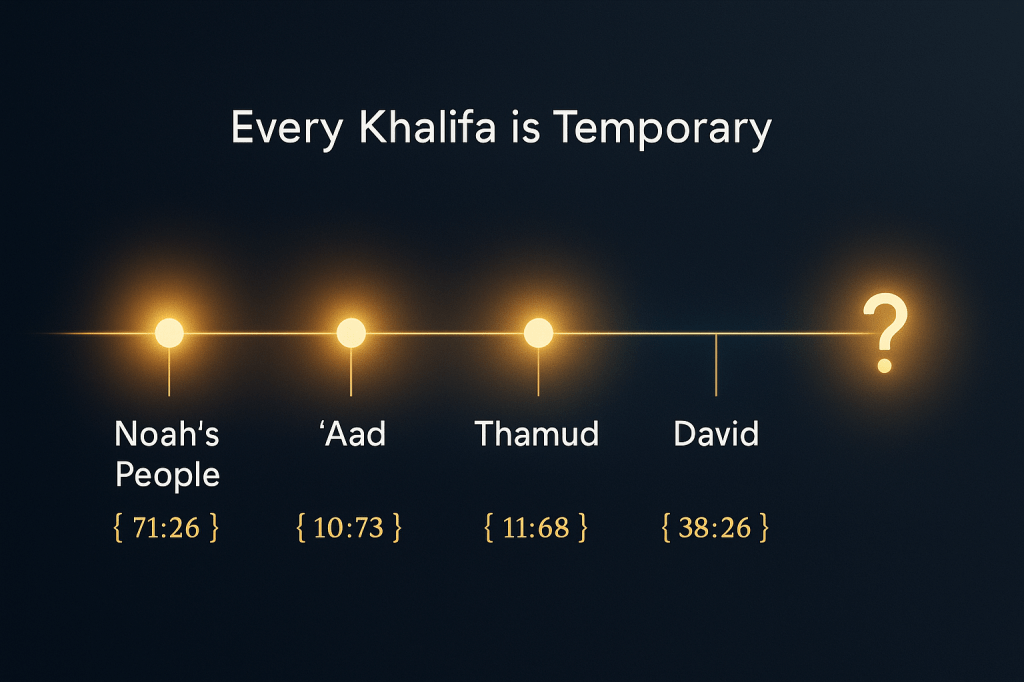
The proof that “khalifa” means a temporary role is not limited to linguistic analysis. Every single instance of this root in the Quran, when applied to human beings, describes a temporary arrangement. Consider the evidence across all ten verses where the root خ-ل-ف is used in the context of “inheritors” or “successors” on earth:
In [7:69], the people of ‘Ad are told: “Recall that He made you inheritors after the people of Noah.” The people of ‘Ad were not permanent rulers — they were eventually destroyed and replaced. In [7:74], the people of Thamud are told: “Recall that He made you inheritors after ‘Ad.” Again, Thamud was temporary — they were destroyed by a single blast. In [10:14], God says: “Then we made you inheritors of the earth after them, to see how you will do.” The phrase “to see how you will do” explicitly frames the khalifa role as a test with evaluation. In [10:73], Noah’s people in the ark are “made the inheritors” after the drowning of the disbelievers. In [27:62], God asks: “Who is the One who… makes you inheritors of the earth?” The question demands that humans recognize the source of their temporary authority. In [35:39], God states: “He is the One who made you inheritors of the earth. Subsequently, whoever chooses to disbelieve does so to his own detriment.” Even the word “subsequently” signals temporal sequence — this is a role with consequences, not a permanent station.
[24:55] God promises those among you who believe and lead a righteous life, that He will make them sovereigns on earth, as He did for those before them, and will establish for them the religion He has chosen for them, and will substitute peace and security for them in place of fear. All this because they worship Me alone; they never set up any idols beside Me. Those who disbelieve after this are the truly wicked.
Even in [24:55], where God promises to make believers “sovereigns on earth,” the language is conditional and temporary — “as He did for those before them.” Previous sovereigns came and went. Future sovereigns will come and go. The khalifa role is a revolving door, not a throne. And the most explicit khalifa verse after 2:30 is [38:26], where God tells David directly:
[38:26] O David, we have made you a ruler on earth. Therefore, you shall judge among the people equitably, and do not follow your personal opinion, lest it diverts you from the way of God. Surely, those who stray off the way of God incur severe retribution for forgetting the Day of Reckoning.
David — a prophet and a king — is told he is a khalifa on earth, and in the same breath told not to follow his own opinion and warned about the Day of Reckoning. This is not the language of permanent authority. This is the language of a temporary assignment with strict accountability. David was khalifa. David died. Someone succeeded him. The role is inherently temporary.
Part 4: Satan — The Incompetent Temporary God
The Connection Between 2:30 and Satan’s Challenge
Now we arrive at the explosive implication that traditional scholarship avoids: if the khalifa in 2:30 is a “temporary god” — a being given authority to manage Earth — then who is that being, and what is the purpose of the arrangement? The answer lies in connecting 2:30 to the event that preceded it: Satan’s challenge to God’s absolute authority. Rashad Khalifa explained this connection with remarkable clarity: “It all began a few billion years ago when one of God’s high-ranking creatures, Satan, developed supercilious thoughts that he could be a god besides God. This challenge to God’s absolute authority was not only blasphemous, it was totally erroneous. Satan was ignorant of the fact that God alone possesses the power and qualification to be a God, and that there is much more to Godhood than he could have ever imagined” (at 26:07).
Satan declared he could be a god. God’s response was not to simply punish him but to give him the chance to prove it — or rather, to prove that he could not. Earth became the testing ground, and Satan became the “temporary god” of this world in the sense that he was given limited dominion over it to demonstrate his incompetence. Rashad Khalifa stated this explicitly: “An important part of this universe is exposing Satan as an incompetent god with a small g, an incompetent temporary God. So these constituents of Satan had to be there in order to prove his incompetence” (at 16:49). The world’s suffering — the famine, disease, war, earthquakes, injustice — is not evidence against God. It is evidence against Satan. It is the proof, accumulating daily, that Satan cannot run so much as a single planet without producing chaos.
[7:16] He said, “Since You have willed that I go astray, I will skulk for them on Your straight path.
[7:17] “I will come to them from before them, and from behind them, and from their right, and from their left, and You will find that most of them are unappreciative.”
The Classification of Creatures
When Satan challenged God’s authority, every creature in the celestial realm had to take a position. This moment of cosmic decision-making produced three categories of beings. Rashad Khalifa described it: “The creatures who, without hesitation, without any question, accepted God’s absolute authority, they became angels. Satan, who challenged God’s absolute authority, became a jinn, a fallen angel. And the creatures who mentally agreed with Satan — are you and me — became humans” (at 4:30). This classification is the key to understanding 2:30. The “khalifa” being placed on Earth is Satan — the being who openly challenged God’s authority. The humans placed alongside him are the ones who wavered, who did not make a firm stand when it mattered most. Earth is the testing ground where Satan’s incompetence as a god is exposed and where the indecisive souls get a second chance to choose correctly.
The Quran confirms this classification through the event that immediately follows the khalifa announcement in 2:30. God commands the angels to prostrate before Adam, and Satan refuses. This is not a separate story — it is the same story. The prostration command was itself a test, and Satan’s refusal was the public manifestation of a rebellion that had already occurred in the High Society. The placement of the khalifa, the command to prostrate, and Satan’s refusal are three acts of a single drama — the drama of who deserves authority and who does not.
[38:74] except Satan; he refused, and was too arrogant, unappreciative.
[38:75] He said, “O Satan, what prevented you from prostrating before what I created with My hands? Are you too arrogant? Have you rebelled?”
[38:76] He said, “I am better than he; You created me from fire, and created him from clay.”
Part 5: Adam — The First Test Subject
“He Taught Adam All the Names”
The verse immediately following the khalifa announcement introduces Adam — and the traditional reading assumes Adam is the khalifa. But a careful reading reveals something more nuanced. In 2:31, God teaches Adam “all the names” and then presents them to the angels as proof that God knows what they do not know. The footnote in the Final Testament provides a stunning clarification of what these “names” are: “These are the names of the animals, the automobile, the submarine, the space satellite, the VCR, and all other objects to be encountered by the human beings on Earth.” This is not spiritual knowledge. This is practical knowledge — the names of physical things that exist in the material world. God is equipping Adam with the tools needed to navigate the physical environment, the way you would brief an operative before deploying them into the field.
[2:31] He taught Adam all the names then presented them to the angels, saying, “Give Me the names of these, if you are right.”
[2:32] They said, “Be You glorified, we have no knowledge, except that which You have taught us. You are the Omniscient, Most Wise.”
[2:33] He said, “O Adam, tell them their names.” When he told them their names, He said, “Did I not tell you that I know the secrets of the heavens and the earth? I know what you declare, and what you conceal.”
The angels could not name these things because they do not belong to the physical world. They have no need for automobiles, submarines, or space satellites. Adam could name them because he was being prepared for Earth — equipped with the knowledge necessary for the specific domain where he was being placed. This proves that Adam’s knowledge was domain-specific, not spiritually superior. The angels are not inferior to Adam in terms of devotion or worship. They are simply not designed for the physical world. Adam was, and this was God’s point: “I know what you do not know.” God knew that the test required beings who could navigate the physical world, and Adam was equipped for exactly that purpose.
Adam’s Fall — Predetermined or Free?
One of the most provocative questions about the Adam narrative is whether Adam was set up to fail. Consider the sequence: God places Adam in Paradise, tells him not to approach one tree, and then Satan whispers to him until he disobeys. Was this not the predictable outcome? The Quran itself provides the answer in a verse that most readers overlook:
[20:115] We tested Adam in the past, but he forgot, and we found him indecisive.
The footnote to this verse is explosive: “When Satan challenged God’s absolute authority (38:69), you and I did not make a firm stand against Satan. God is giving us a chance, on this earth, to redeem ourselves by denouncing Satan and upholding God’s absolute authority.” Adam’s failure in Paradise was not his first failure. He had already wavered during the High Society feud. His eating from the tree was a reenactment of his original indecisiveness — a physical manifestation of the spiritual weakness he had already demonstrated. God did not set Adam up to fail. Adam failed because failing is what indecisive souls do when confronted with temptation. The test merely revealed what was already there.
The parallel accounts in other chapters confirm this reading. In chapter 7, the story is told with additional details:
[7:20] The devil whispered to them, in order to reveal their bodies, which were invisible to them. He said, “Your Lord did not forbid you from this tree, except to prevent you from becoming angels, and from attaining eternal existence.”
[7:22] He thus duped them with lies. As soon as they tasted the tree, their bodies became visible to them, and they tried to cover themselves with the leaves of Paradise. Their Lord called upon them: “Did I not enjoin you from that tree, and warn you that the devil is your most ardent enemy?”
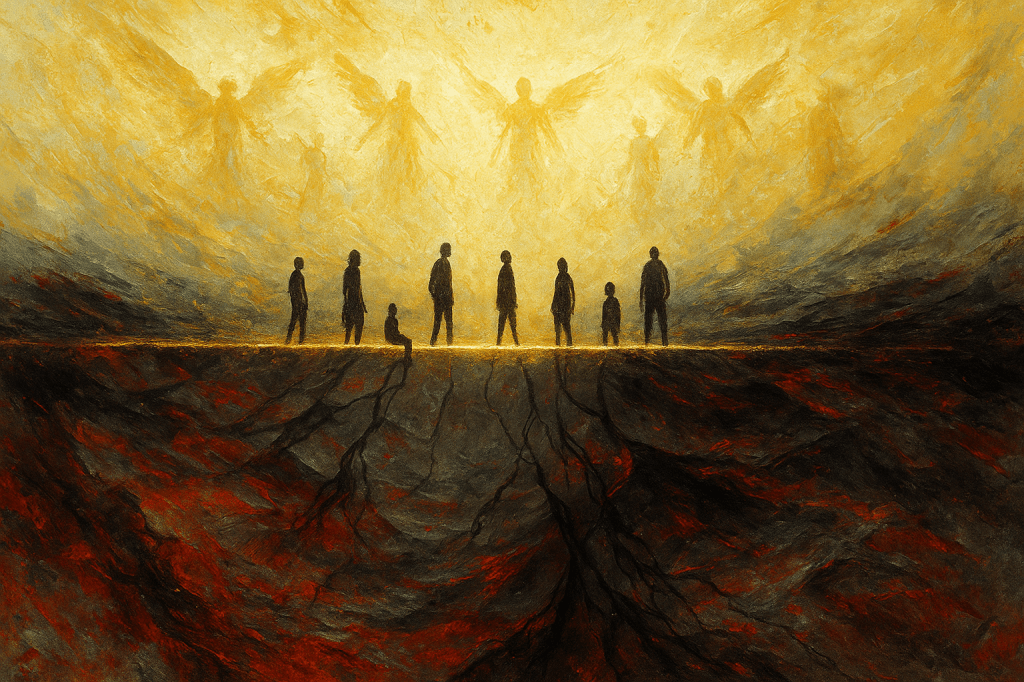
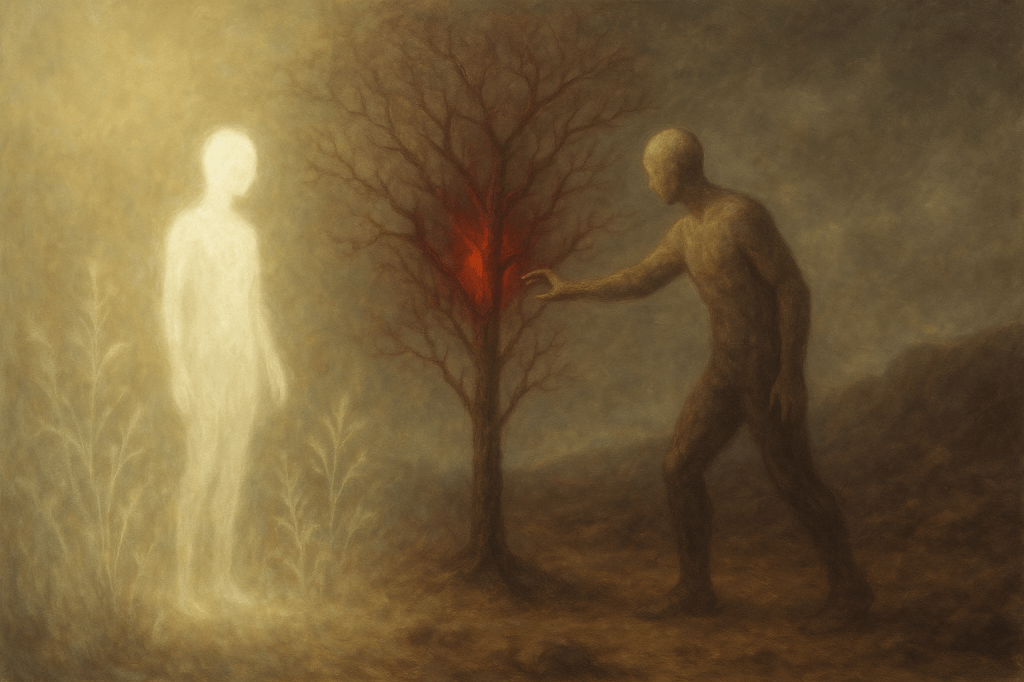
Notice the detail: their bodies “became visible to them.” Before eating from the tree, Adam and his wife existed in Paradise without awareness of their physical form. The disobedience triggered a shift from spiritual existence to physical awareness. This is the transition from the celestial realm to the earthly one — the moment the soul became trapped in the body and deposited into the domain where Satan — the khalifa of 2:30 — already held temporary authority. The eating of the tree was not merely a moral failure. It was the trigger that moved the test subjects into the testing ground where the incompetent temporary god was waiting.
Part 6: The Dissident — Satan’s Refusal and Its Meaning
The Command to Prostrate
In every account of the Adam story across the Quran, one event is repeated with absolute consistency: God commands the angels to prostrate before Adam, and Satan refuses. This event is narrated in at least six different chapters (2, 7, 15, 17, 18, 20, 38), each adding unique details but all agreeing on the core event. The repetition alone signals its supreme importance. In the Quran, repetition is emphasis — the more times something is repeated, the more critical it is to understand. The command to prostrate before Adam is the second-most-repeated narrative event in the entire Quran, after the story of Moses and Pharaoh. That should tell us something about its centrality to the divine message.
[2:34] When we said to the angels, “Fall prostrate before Adam,” they fell prostrate, except Satan; he refused, was too arrogant, and a disbeliever.
[15:28] Your Lord said to the angels, “I am creating a human being from aged mud, like the potter’s clay.
[15:29] “Once I perfect him, and blow into him from My spirit, you shall fall prostrate before him.”
The command to prostrate is significant on multiple levels. First, prostration in the Quran is an act of submission to God’s authority, not worship of the object of prostration. The angels were not being asked to worship Adam — they were being asked to acknowledge God’s decision to place Adam on Earth and to submit to that decision. Satan’s refusal was therefore not merely a refusal to bow before Adam. It was a refusal to accept God’s plan. It was a continuation of his original challenge to God’s authority. His stated reason — “I am better than he; You created me from fire, and created him from clay” — reveals the real issue: arrogance. Satan believed his composition (fire/energy) was superior to Adam’s (clay/matter), and this belief led him to reject God’s sovereign decision.
Second, the prostration command was itself a test within the larger test. God was not surprised by Satan’s refusal — He designed the scenario to expose it. By commanding prostration before a creature made from clay, God was directly challenging the pride that had led Satan to rebel in the first place. It was a provocation in the truest sense: a deliberate act designed to reveal what was hidden. And it worked perfectly. Satan’s refusal became the public evidence of his private rebellion, and his banishment from Paradise became the legal consequence.
[7:12] He said, “What prevented you from prostrating when I ordered you?” He said, “I am better than he; You created me from fire, and created him from mud.”
[7:13] He said, “Therefore, you must go down, for you are not to be arrogant here. Get out; you are debased.”
Satan’s Bargain — Respite Until the Day of Resurrection
After his banishment, Satan makes a request that God grants. He asks for respite — time — until the Day of Resurrection. This is critical because it establishes the duration of his temporary authority. Satan is not given permanent dominion over Earth. He is given a fixed term, after which his authority expires and judgment occurs. This makes Satan the prototype of the “temporary god” — a being with limited, borrowed authority over a limited domain for a limited time, whose performance will be evaluated and whose fate will be decided by the true God who placed him there.
[15:36] He said, “My Lord, respite me until the day they are resurrected.”
[15:37] He said, “You are respited.
[15:38] “Until the specified day and time.”
[17:62] He said, “Since You have honored him over me, if You respite me till the Day of Resurrection, I will possess all his descendants, except a few.”
God’s response to Satan is instructive. He does not say “I grant you authority over Earth.” He says “You are respited” — granted a delay of your punishment. And then God sets the terms: “You have no power over My servants. You only have power over the strayers who follow you” ([15:42]). Satan’s authority is not just temporary — it is conditional. He can only affect those who choose to follow him. Those who choose God are beyond his reach. This reveals the true nature of the test: Earth is not a domain where Satan rules and we are his subjects. Earth is a domain where two competing messages are broadcast simultaneously, and each human being must choose which one to follow.
[15:42] “You have no power over My servants. You only have power over the strayers who follow you.

Part 7: The Parallel Accounts — Five Witnesses to One Event
Chapter 15: The Potter’s Clay
The account in chapter 15 provides unique details about the material composition of the human body. God tells the angels: “I am creating a human being from aged mud, like the potter’s clay” (15:28). The emphasis on material composition — clay, mud, earth — is deliberate. It connects the khalifa to the earth literally. The human body is made from earth’s materials, which means the “placement” in 2:30 is not just geographical but compositional. The khalifa is placed ON earth and made FROM earth. This double connection to the earth underscores the temporary nature of the arrangement — the body will return to the earth from which it came, while the soul (which was “blown into” the body from God’s spirit in 15:29) will return to its original realm for judgment.
[15:33] He said, “I am not to prostrate before a human being, whom You created from aged mud, like the potter’s clay.”
[7:25] He said, “On it you will live, on it you will die, and from it you will be brought out.”
Verse 7:25 is a comprehensive summary of the temporary khalifa arrangement: live on Earth, die on Earth, be resurrected from Earth. Three verbs, three phases, all tied to Earth. The khalifa role has a beginning (placement), a middle (the test), and an end (extraction for judgment). Nothing about this arrangement is permanent.
Chapter 38: The Feud and Satan’s Declared Plan
Chapter 38 is the only place in the Quran where “the feud in the High Society” is explicitly named (38:69) and where Satan declares his plan to mislead humanity (38:82). These two details connect directly to 2:30. The angels’ objection — “Will You place therein one who will spread evil and shed blood?” — is answered by Satan himself in this chapter. After refusing to prostrate and being banished, Satan states his agenda openly: “I will mislead them all” (38:82). The corruption and bloodshed the angels predicted are not a description of human nature. They are a description of what Satan would cause once placed on earth as the temporary god. Chapter 38 also reveals Satan’s reasoning: “I am better than he; You created me from fire, and created him from clay” (38:76). This arrogance — the belief that his composition made him superior — is what disqualified him from permanent authority and is exactly the kind of hubris that produces corruption when given unchecked power.
[38:69] “I had no knowledge previously, about the feud in the High Society.”
[38:82] He said, “I swear by Your majesty, I will mislead them all.
[38:83] “Except Your worshipers who are devoted absolutely to You alone.”
Chapter 20: The Warning
Chapter 20 provides the clearest statement of the adversarial relationship between Adam and Satan:
[20:117] We then said, “O Adam, this is an enemy of you and your wife. Do not let him evict you from Paradise, lest you become miserable.
[20:120] But the devil whispered to him, saying, “O Adam, let me show you the tree of eternity and unending kingship.”
Satan’s offer to Adam is revealing: “the tree of eternity and unending kingship.” This is the khalifa projecting his own obsession. Satan wanted permanent authority — that was his original crime, his challenge to God’s absolute authority. Now, as the temporary god on earth, he tempts Adam with the same lie that ruined him: the promise of permanence. Adam fell for it, just as he had wavered during the original feud. The body that became visible to him after eating from the tree was the prison sentence — the mechanism by which the indecisive soul was locked into the physical world, now fully within the domain of the incompetent khalifa whose first act of governance was to corrupt the very beings he was supposed to coexist with.
Part 8: The Responsibility We Accepted
The Covenant of 33:72
Perhaps the most significant verse for understanding the khalifa concept is one that does not use the word “khalifa” at all. In chapter 33, verse 72, God reveals a truth that explains why human beings — and not angels or mountains or heavens — were placed on Earth:
[33:72] We have offered the responsibility (freedom of choice) to the heavens and the earth, and the mountains, but they refused to bear it, and were afraid of it. But the human being accepted it; he was transgressing, ignorant.
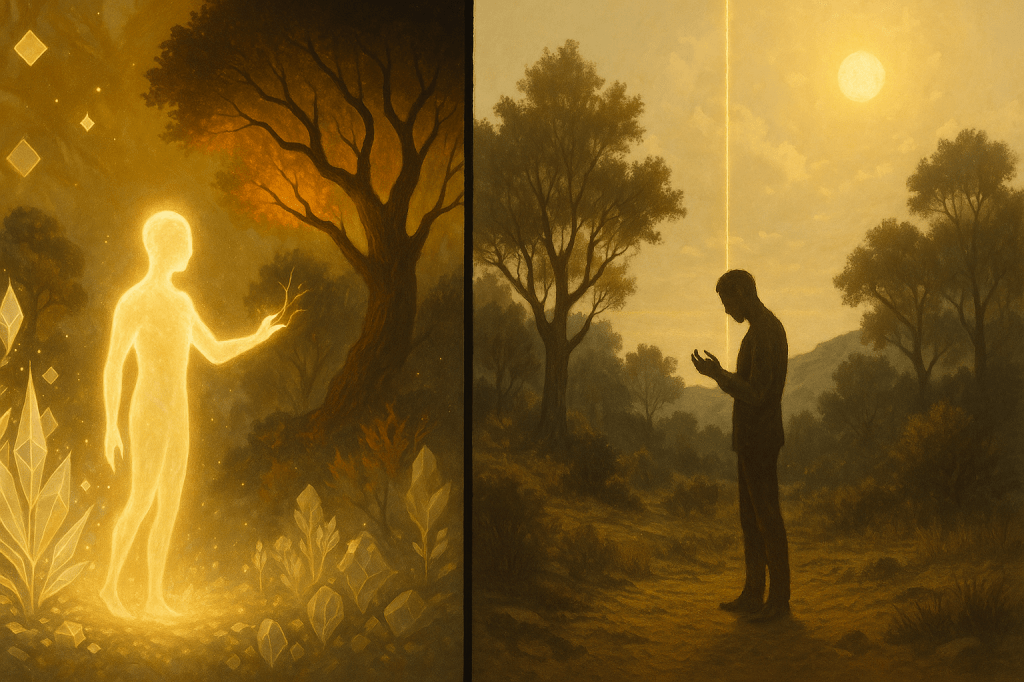
The “responsibility” is freedom of choice — the ability to choose between God and Satan, between submission and rebellion, between truth and falsehood. The heavens, the earth, and the mountains refused it. They chose guaranteed submission over risky freedom. They chose to prostrate perpetually rather than risk damnation by accepting the ability to choose. But the human being accepted it. And God’s assessment of this acceptance is damning: “he was transgressing, ignorant.” We did not accept this responsibility because we were brave. We accepted it because we were foolish — too ignorant to understand what we were taking on, too transgressive to realize the weight of the burden.
This verse connects directly to 2:30, but not in the way most people assume. The humans who accepted freedom of choice are not the khalifa — they are the test subjects. The khalifa of 2:30 is Satan, the being whose challenge to God’s authority created the need for a test in the first place. The human acceptance of freedom of choice in 33:72 explains why we were placed on earth alongside the khalifa. You wanted freedom of choice? Here it is — on a planet where Satan has been given temporary authority as the incompetent god, where your body is made from clay, where death is certain, and where every day is an examination. The angels’ objection in 2:30 now makes perfect sense: they knew that placing Satan as a temporary god on earth would inevitably produce corruption and bloodshed, because that is what happens when you give authority to a being who challenged the real God.
The Covenant of 7:172
Before being placed on Earth, every human soul was summoned before God and asked to bear witness to a fundamental truth:
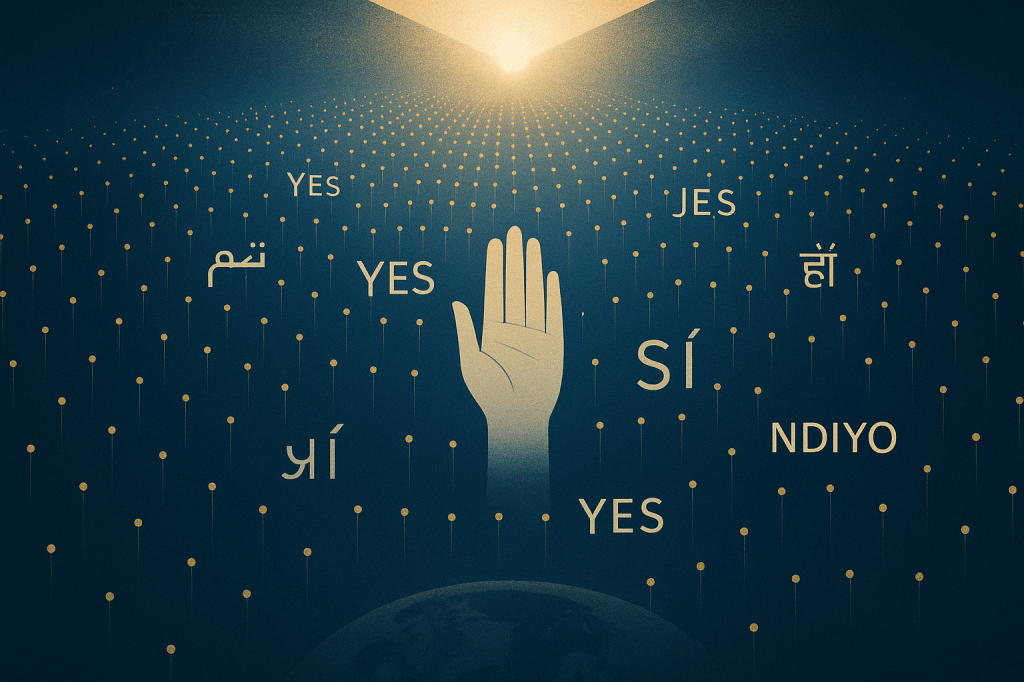
[7:172] Recall that your Lord summoned all the descendants of Adam, and had them bear witness for themselves: “Am I not your Lord?” They all said, “Yes. We bear witness.” Thus, you cannot say on the Day of Resurrection, “We were not aware of this.”
This verse establishes that every human being entered the test with informed consent. You were told God is your Lord. You agreed. You bore witness. And then you were placed on Earth with that knowledge buried deep in your instinct — the footnote states: “Every human being is born with an instinctive knowledge about God.” The khalifa role is therefore not an arbitrary imposition. It is the fulfillment of a contract you signed, a test you agreed to take, a responsibility you accepted. And the terms were clear: worship God alone, reject Satan, and prove through your choices that you deserve to return to the celestial realm from which you came.
[51:56] I did not create the jinns and the humans except to worship Me alone.
Rashad Khalifa summarized the entire cosmic narrative: “The original sin was billions of years before eating from the tree. It was when we did not make a firm stand with God’s absolute authority. When Satan proclaimed that he can be a god and he’s right, we said, that’s an interesting idea, isn’t it? That was dumb. The jinns were even more stupid — they said, yeah, you can do it. The angels said, no way” (at 39:27). This is the context of 2:30 — the announcement was not the beginning of the story but the middle of it.
Part 9: The Two Deaths and Two Lives
The Cycle of Existence
The temporary nature of the khalifa role is further confirmed by the Quran’s description of the cycle of death and life that every human soul undergoes. In 2:28, God poses a rhetorical question that contains the entire timeline of human existence:
[2:28] How can you disbelieve in God when you were dead and He gave you life, then He puts you to death, then He brings you back to life, then to Him you ultimately return?
Count the stages: you were dead (in the celestial realm, after the feud, when God put all rebellious souls to death), He gave you life (placed you on Earth in a physical body), He puts you to death (your physical death at the end of your earthly term), He brings you back to life (resurrection on the Day of Judgment), and then to Him you return (final accountability). The khalifa role occupies only one segment of this timeline — the segment between “He gave you life” and “He puts you to death.” It is a brief interval in a much longer cosmic narrative, a single chapter in a book that began before the universe and ends after it.
[40:11] They will say, “Our Lord, you have put us to death twice, and You gave us two lives; now we have confessed our sins. Is there any way out?”
The disbelievers on the Day of Judgment will acknowledge two deaths and two lives. The first death was in the celestial realm, when God terminated the lives of all rebellious souls after the feud. The first life is this earthly existence — the khalifa period. The second death is physical death on Earth. The second life is resurrection for judgment. Rashad Khalifa explained: “When we rebelled against God, God put us all to death. The first death. Two deaths for the unrighteous, one death for the righteous. We were all put to death with the stipulation that we will be brought into this life at the specified time and given the chance to redeem ourselves” (at 47:40). The khalifa role is the redemption period — the window between the first death and the final judgment.
The Purpose of Death and Life
God explicitly states the purpose of this arrangement in chapter 67:
[67:2] The One who created death and life for the purpose of distinguishing those among you who would do better. He is the Almighty, the Forgiving.
Death and life were created — designed, engineered — for one purpose: to distinguish those who do better from those who do not. The khalifa role is the test instrument. The human body is the testing apparatus. Earth is the laboratory. And the results — your choices, your worship, your resistance to Satan’s whispers, your steadfastness in upholding God’s absolute authority — are the data that will determine your eternal fate. Nothing about this is permanent. A laboratory closes when the experiment ends. The khalifa role terminates when the test concludes. And the test concludes, for each individual, at the moment of death.
[76:2] We created the human from a liquid mixture, from two parents, in order to test him. Thus, we made him a hearer and a seer.
Part 10: The Eviction — From Paradise to Earth
The Descent
The transition from Paradise to Earth is described with consistent language across multiple chapters, and the word choice is devastating in its implications. God does not say “I am sending you to Earth” or “Go to Earth.” He says “Go down” — a descent, a demotion, a fall from a higher state to a lower one. This language is used in 2:36, 2:38, 7:24, and 20:123:
[2:36] But the devil duped them, and caused their eviction therefrom. We said, “Go down as enemies of one another. On Earth shall be your habitation and provision for awhile.”
[7:24] He said, “Go down as enemies of one another. On earth shall be your habitation and provision for awhile.”
Two phrases demand attention. First: “enemies of one another.” The beings sent to earth are not placed there as a unified team. They are placed as adversaries — humans against Satan (the khalifa), and (because of the freedom of choice) humans against each other. The test requires conflict, and the conflict is built into the design. Second: “for awhile.” The Arabic word is “hin” (حِين), meaning a period of time, an interval, a temporary duration. Earth is not a permanent home. It is a temporary habitation with an expiration date. Every human being who has ever lived has confirmed this by dying.
[20:123] He said, “Go down therefrom, all of you. You are enemies of one another. When guidance comes to you from Me, anyone who follows My guidance will not go astray, nor suffer any misery.
Notice the conditional promise in 20:123: “When guidance comes to you from Me.” God does not abandon the khalifas after placing them on Earth. He sends guidance — scriptures, messengers, signs — to help them pass the test. The placement is not exile without hope. It is exile with a lifeline, a rope thrown to drowning souls. The human who grasps that rope and follows the guidance will “not go astray, nor suffer any misery.” The human who lets go will face the consequences. The entire structure — the khalifa’s temporary authority, the human test, the guidance, the choice, the judgment — is designed to end.

Part 11: Modern Implications — What It Means to Be a Temporary God
Authority Without Ownership
If the khalifa in 2:30 is Satan — a temporary god whose incompetence is being exposed — then every human being alive today is living inside that demonstration. You exist in a world governed by an incompetent authority, a world where corruption and bloodshed are the daily evidence of Satan’s failure as a god. The suffering you see around you — the famine, the injustice, the senseless violence — is not evidence against God. It is evidence against Satan. It is the proof, accumulating day after day, that the being who challenged God’s authority cannot manage a single planet without producing chaos. And your test, as a human, is to recognize this — to see through the khalifa’s incompetence and choose the real God over the fake one.
This has practical implications for every dimension of human life. If Satan is the khalifa and his world is the evidence of his failure, then every act of injustice you witness is a data point in God’s case against him. Every war, every famine, every system of oppression — these are not random events. They are the natural output of a world run by a being who thought he could do God’s job. Your role as a human is not to fix Satan’s broken world but to demonstrate, through your individual choices, that you reject his authority and uphold God’s. The test is personal, not political. The question on the Day of Judgment will not be “Did you fix the world?” but “Did you worship God alone in a world designed to distract you from Him?”
[6:165] He is the One who made you inheritors of the earth, and He raised some of you above others in rank, in order to test you in accordance with what He has given you. Surely, your Lord is efficient in enforcing retribution, and He is Forgiver, Most Merciful.
Accountability Is Inevitable
Accountability applies on two levels. For Satan, the khalifa, his record of governance is the evidence against him — a planet of corruption and bloodshed, exactly as the angels predicted. His trial ends when his respite expires. For humans, the test is different: did you see through the khalifa’s deception? Did you uphold God’s absolute authority in a world designed by Satan to make you forget it? Both the khalifa and the humans placed in his domain will face “severe retribution for forgetting the Day of Reckoning” (38:26). The Day of Reckoning is the final audit — where Satan’s performance as temporary god is reviewed and where every human’s choice between God and Satan is weighed.
God frames the test with perfect clarity in the Quran’s purpose statements:
[67:2] The One who created death and life for the purpose of distinguishing those among you who would do better. He is the Almighty, the Forgiving.
[76:2] We created the human from a liquid mixture, from two parents, in order to test him. Thus, we made him a hearer and a seer.
The test is not rigged. You have been given hearing and sight — the tools to receive and process guidance. You have been given instinctive knowledge of God from the covenant of 7:172. You have been given scriptures and messengers. You have been given a lifetime — however long it may be — to demonstrate your choice. The human who uses these tools to uphold God’s absolute authority, rejecting the khalifa’s influence, passes the test. The human who follows the khalifa’s whispers and serves Satan’s agenda fails. And the results are final.
Part 12: The Return — When the Khalifa’s Term Expires
The Promise to the Righteous
For the human who passes the test — who rejects the khalifa’s authority and upholds God’s — the Quran describes a homecoming of indescribable beauty. The earthly exile ends, the body returns to the earth from which it was made, and the soul — the real person, the entity that existed before the body and will exist after it — returns to its Lord. Chapter 89 captures this moment in four of the most moving verses in the entire Quran:
[89:27] As for you, O content soul.
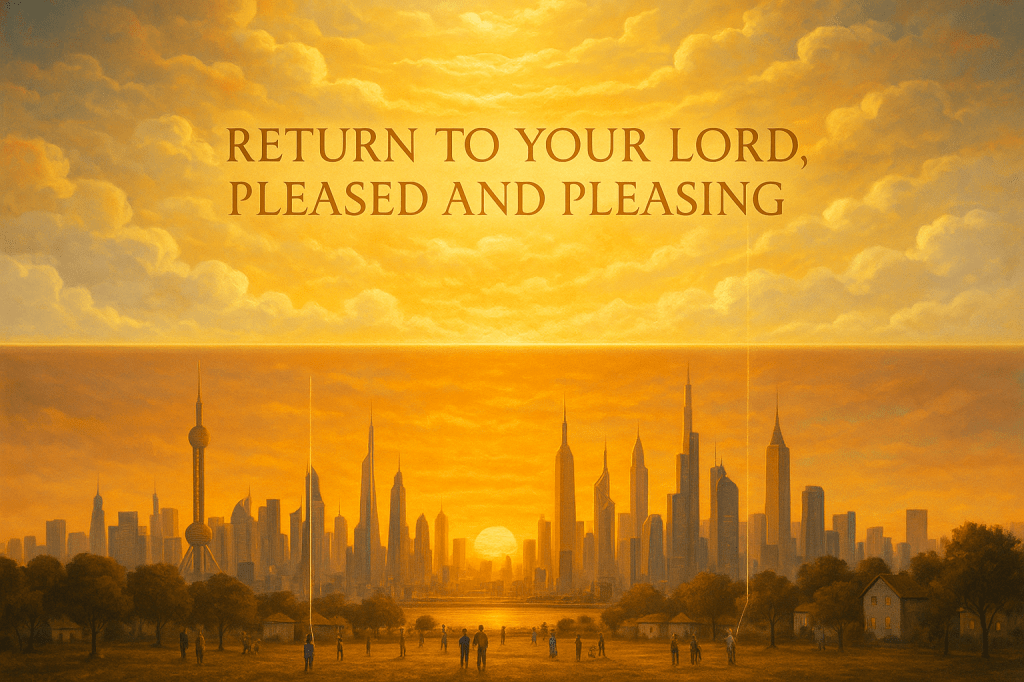
[89:28] Return to your Lord, pleased and pleasing.
[89:29] Welcome into My servants.
[89:30] Welcome into My Paradise.
The phrase “return to your Lord” confirms the temporary nature of the earthly test. You can only return to a place you came from. The soul originated in God’s presence, was placed on Earth in the khalifa’s domain, and now returns to God’s presence — “pleased and pleasing.” The test is complete. The word “content” (mutma’innah) describes a soul that has found peace through its submission to God, a soul that saw through Satan’s deception, rejected his authority, and chose the real God despite living in a world run by the fake one. It now receives its reward: permanent residence in Paradise, the very place from which Adam was evicted. The exile ends. The circle closes.
For the human who fails the test — who follows the khalifa instead of God — the Quran is equally clear:
[2:39] As for those who disbelieve and reject our revelations, they will be dwellers of Hell, wherein they abide forever.
The contrast is absolute. The righteous human returns to Paradise permanently. The one who followed the khalifa is confined to Hell permanently — alongside the khalifa himself. The temporary arrangement on Earth was the determining factor — the interval that decided the permanent outcome. This is why the angels’ objection in 2:30 was overruled: God’s purpose was not to create a utopia on Earth but to use Earth as a demonstration — proof that Satan cannot be a god — and simultaneously as a screening mechanism, a filter that separates human souls based on whether they chose the real God or the fake one. The corruption and bloodshed the angels predicted were not design flaws — they were the expected output of Satan’s governance, the very evidence needed to prove his incompetence.
Part 13: The Covenant Before Time — 36:60-62
The Reminder We All Forgot
In chapter 36, God addresses the Children of Adam — not a specific nation, not a specific era, but all of humanity across all time — with a reminder of a covenant that was made before any of us set foot on Earth:
[36:60] Did I not covenant with you, O Children of Adam, that you shall not worship the devil? That he is your most ardent enemy?
[36:61] And that you shall worship Me alone? This is the right path.
[36:62] He has misled multitudes of you. Did you not possess any understanding?
This covenant was made before the khalifa was placed on Earth. It establishes the terms of the test: worship God alone and do not worship Satan. The covenant existed before the body, before the earth, before the physical universe. It was a pre-creation agreement between God and every soul that would ever inhabit a human body. And God’s question in 36:62 — “Did you not possess any understanding?” — is not rhetorical. It is an indictment. You were told. You agreed. You were placed on Earth with the covenant written on your instincts. And yet, as God observes, Satan has “misled multitudes.” The test is rigorous. The majority fail it. And the khalifa role continues to turn over, generation after generation, as each new cohort of souls is given its chance to prove where its allegiance lies.
The connection to 2:30 is now complete. When God told the angels “I am placing a khalifa on Earth,” He was implementing a multi-layered plan: place Satan on earth with limited authority to prove he cannot be a god, give the indecisive souls physical bodies and deposit them in Satan’s domain, send guidance through prophets and scriptures, and see which souls honor the covenant and which ones follow the khalifa. Satan is not a king being crowned. He is a defendant being given enough rope to hang himself — and every human placed on his earth is a witness to his failure, each one tested on whether they can see through it.
Part 14: The Mathematical Confirmation
The Precision of 2:30
The Quran is not only a book of meaning — it is a book of mathematics. The placement of 2:30 in chapter 2 (The Heifer) is significant because chapter 2 is the longest chapter in the Quran and serves as a comprehensive introduction to the major themes that the rest of the scripture develops. The khalifa announcement appears very early in the Quran’s narrative, at verse 30 of chapter 2, establishing it as foundational material — something you need to understand before everything else makes sense. The footnote to 2:30-37 in the Final Testament directs the reader to Appendix 7, which is titled “Why Were We Created?” — confirming that the khalifa concept is the Quran’s answer to the most fundamental question of human existence.
Furthermore, the word “khalifa” appears in only two verses in the singular form: 2:30 and 38:26. This pairing is instructive and reveals the dual usage of the term. In 2:30, the khalifa is Satan — the temporary god placed on earth to prove his incompetence. In 38:26, the khalifa is David — a human given temporary rulership and warned to judge equitably. The same word, two different applications: one for the original rebel whose authority is evidence of his failure, and one for a righteous human whose authority is a test of his obedience. In both cases the emphasis is on accountability: in 2:30, God says “I know what you do not know” (defending His decision to place Satan on earth), and in 38:26, God warns David not to follow his own opinion “lest it diverts you from the way of God.” Authority, whether granted to Satan or to David, is always temporary and always accountable to God.
Conclusion: The Verdict Is Still Out
The evidence is overwhelming and convergent. The Arabic grammar of 2:30 proves that God is placing a temporary representative ON Earth, not giving Earth a permanent ruler. The audience — angels — confirms that this conversation occurred before the physical world was populated, in the celestial realm where the High Society feud had already taken place. The root خ-ل-ف proves that “khalifa” means successor, replacement, stand-in — a role that is temporary by definition. Every other instance of this root in the Quran, when applied to human beings, describes temporary inheritors who are eventually replaced — but 2:30 uniquely refers to the original khalifa: Satan, the being who challenged God’s authority and was given a planet to prove he could do better. The parallel accounts in chapters 7, 15, 17, 20, and 38 all confirm that the khalifa’s placement was preceded by a cosmic feud, that Satan declared his intention to mislead humanity (38:82), and that his governance produces exactly the corruption and bloodshed the angels predicted. Humans were placed in his domain not as khalifas but as test subjects — souls who had wavered during the original feud (20:115), who accepted freedom of choice (33:72), and who entered the test with informed consent (7:172).
You are not the khalifa. Satan is. You are living in the khalifa’s world — a world run by an incompetent temporary god whose daily output is corruption, injustice, and bloodshed. Every act of suffering you witness is another line on his performance review. Every war, every lie, every system of oppression is further proof that the being who challenged God cannot manage a single planet. Your test is simpler but no less consequential: can you see through it? Can you recognize that the god of this world is a fraud, reject his authority, and choose the real God? Your body is your testing apparatus. Your lifespan is your window. Your choices are the data. And the Day of Reckoning is when the khalifa’s term expires and every soul — his and yours — faces the verdict.
[2:38] We said, “Go down therefrom, all of you. When guidance comes to you from Me, those who follow My guidance will have no fear, nor will they grieve.
The guidance has come. The test is ongoing. And the verdict, for each of us, is still out. May God help us pass it.

 Quran Only Studies
Leave a comment