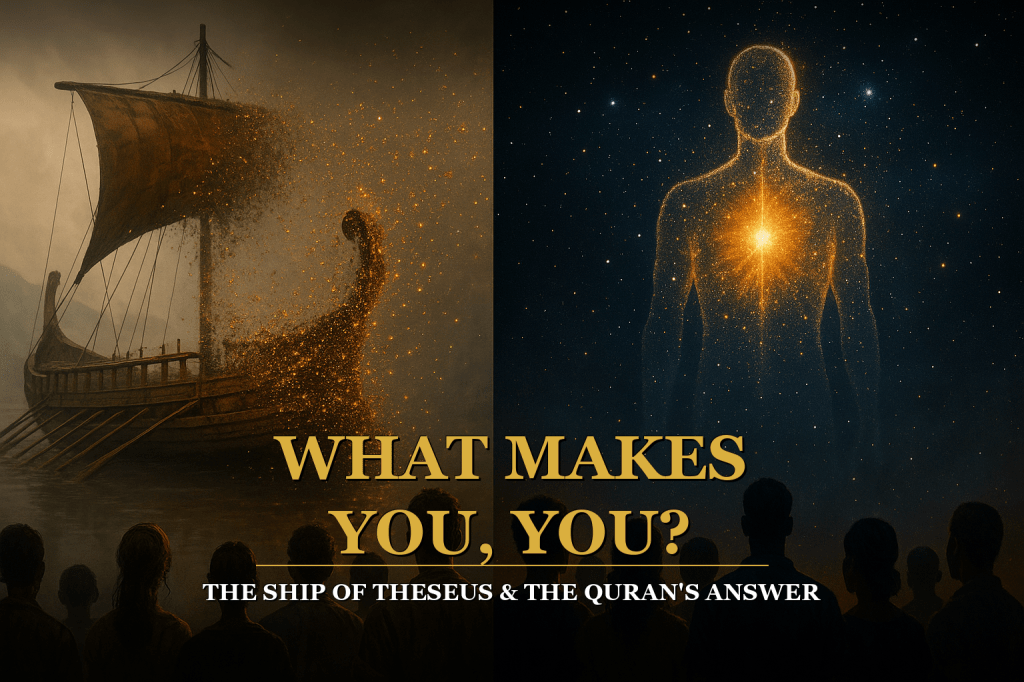
The Ancient Question: What Makes You, You?
It is the question that haunts every human being at some point in their life. A child looks in the mirror and wonders who is looking back. A teenager struggles to define themselves apart from their parents. A middle-aged person watches their body change and wonders if they are still the same person they were at twenty. An elderly person, their body failing, asks the most urgent version of the question: if everything about me has changed, what remains? The question of identity is not academic. It is existential. It is the question beneath every crisis, every search for meaning, every prayer whispered in the dark.
Philosophers have wrestled with this question for over two thousand years. Scientists have offered their own answers, pointing to DNA, neural patterns, and the continuity of memory. Psychologists speak of the self-concept, the narrative identity, the constructed ego. Theologians across traditions have invoked the soul, the spirit, the divine spark. And yet, despite millennia of effort, there is no consensus. The question remains open, the wound unhealed. What makes you, you? The answer, as we will see, was given fourteen centuries ago in a book that most of humanity ignores — and it dissolves the paradox that philosophy could never solve.
The Ship of Theseus — The Paradox That Broke Philosophy
Plutarch’s Original Puzzle
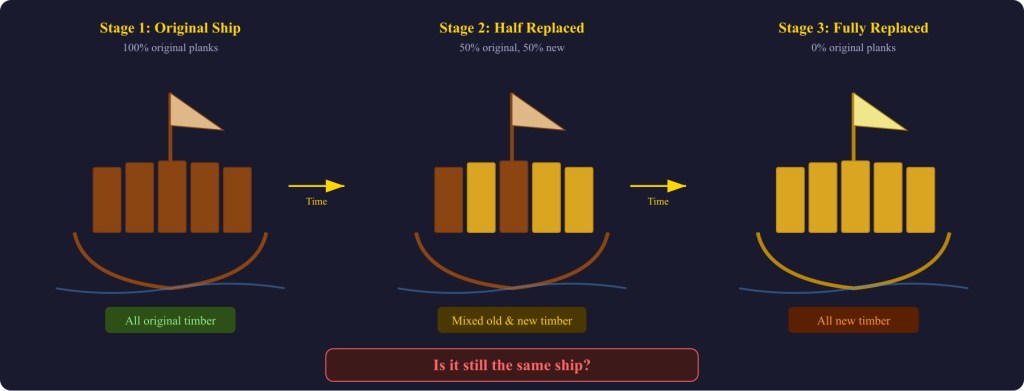
The ancient Greek historian Plutarch, writing in the first century CE, preserved a thought experiment that has tormented philosophers ever since. The ship on which Theseus sailed to Crete and back was preserved by the Athenians as a memorial. Over the years, as the wooden planks decayed, the Athenians replaced them one by one with new timber. Each replacement was minor — a single plank here, a beam there. No single act of replacement seemed to change the ship’s identity. But eventually, after decades of maintenance, every single original plank had been replaced. Not a single piece of the original ship remained. The question Plutarch posed was devastatingly simple: is it still the same ship?
The intuition of most people is to say yes — of course it is still the Ship of Theseus. It was maintained continuously, it sits in the same harbor, it carries the same name. But this intuition creates a problem. If you can replace every single component of something and it remains the same thing, then what does “sameness” even mean? The ship’s identity cannot reside in its material, because the material is entirely new. It cannot reside in its form alone, because a perfect replica built from scratch would have the same form but would not be considered the “real” ship. Something deeper is at work — and philosophy has no satisfying answer for what that something is.
Hobbes’ Devastating Extension
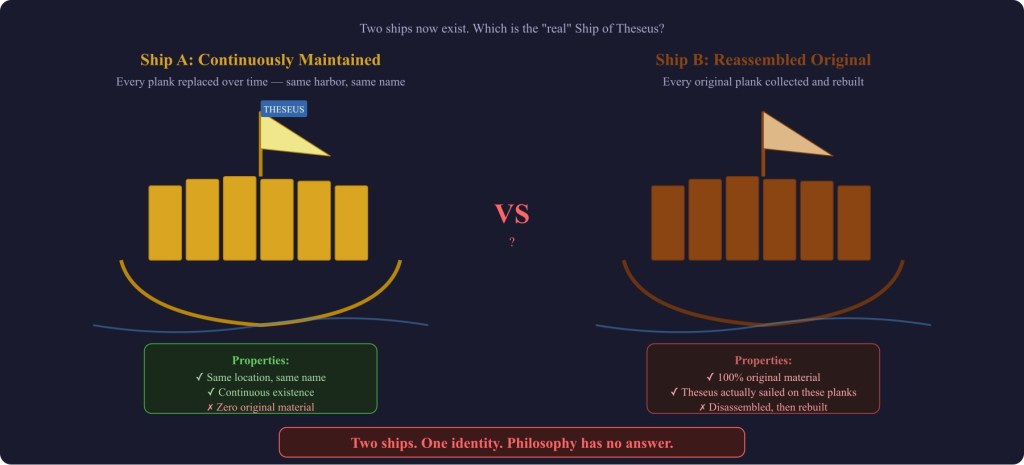
In the seventeenth century, the philosopher Thomas Hobbes made the paradox even worse. Suppose, he argued, that someone had been collecting all the old planks as they were removed from the Ship of Theseus. Over the years, this person reassembles them into a complete ship — using every original plank, in its original position. Now there are two ships. One has been continuously maintained in the harbor, its planks replaced one at a time, carrying the name and the history. The other is built entirely from the original materials, the very wood that Theseus himself once sailed on. Which one is the “real” Ship of Theseus?
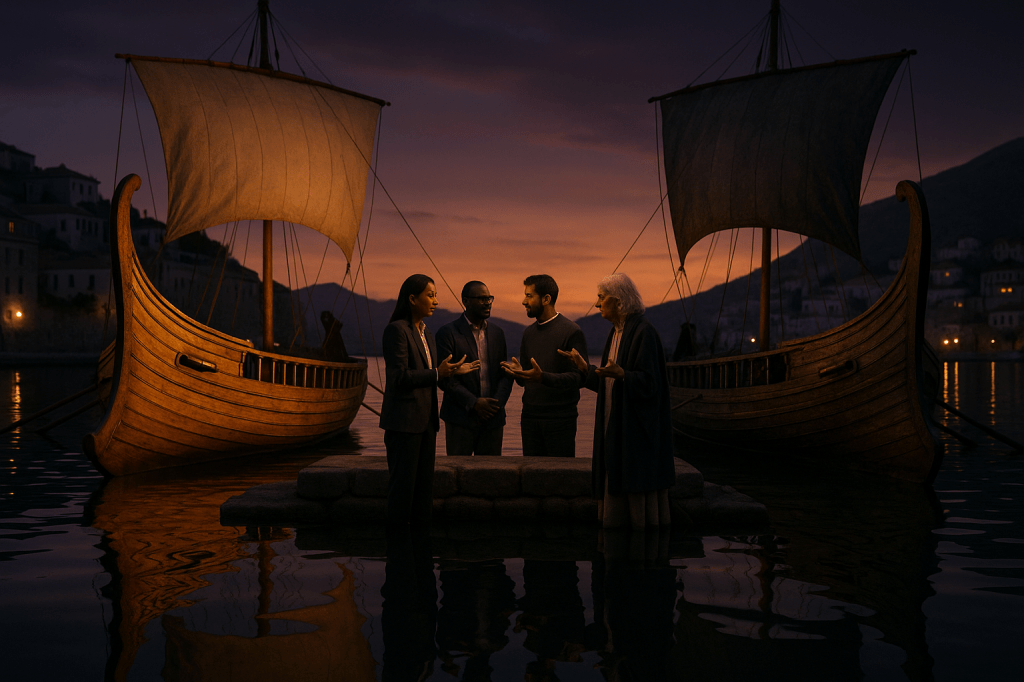
This extension exposes the fatal flaw in every materialist answer. If identity is in the material, then the reassembled ship is the real one — it contains every original atom. But if identity is in the continuity of form and function, then the maintained ship is the real one — it was never disassembled, never ceased to exist. You cannot have it both ways. And if you try to say both are the Ship of Theseus, you have destroyed the very concept of identity, because two distinct objects cannot be the same object. Philosophy has debated this for over two thousand years. Materialists, formalists, four-dimensionalists, and continuity theorists have all offered frameworks, and none has achieved consensus. The paradox remains unresolved in Western philosophy to this day.
The Biggest Problem in the World
Rashad Khalifa Identifies the Crisis
While Western philosophy was still debating planks and forms, God’s messenger to our generation identified this crisis with stunning clarity. Rashad Khalifa did not frame it as an academic puzzle — he called it “the biggest problem in the world.” In his lecture “What is Life About and Who is God,” he stated plainly: “The big question is what are you doing for you, the real person, and you can agree with me now that this is the biggest problem in the world, not knowing who we are” (at 11:41). This is not hyperbole. When you do not know who you are, you cannot know what you need. You feed the body and starve the soul. You accumulate possessions and lose yourself. You chase identity through nationality, career, relationships, ideology — and none of it holds, because you are trying to define the ship by its planks.
In his lecture on the “Principles of Contact Prayer,” Rashad made the point even more directly: “Most people do not even know who they are. You ask a person, who are you? And they look in the mirror, they say this is me, and you know something, they are wrong. This is not me, this is my body, and the body is like a garment that we are wearing temporarily” (at 12:09). Notice what Rashad is doing here. He is not merely making a spiritual claim — he is dissolving the Ship of Theseus paradox before his audience even realizes it. If the body is a garment, then asking “which body is the real you?” is as absurd as asking “which shirt is the real you?” The question is malformed. You are not any shirt. You are the one wearing it.
The Mathematically Coded Message
In his lecture “I Thought I Was Doomed,” Rashad connected this identity crisis to the Quran’s mathematical structure: “The most vital information, that first and foremost is, who are you? God tells us in this mathematically coded message who we are. Ask the average person out there, who are you? And they will look in the mirror. Which is wrong, because they think this is us. We come to realize now that each one of us consists of two entities, distinct entities, a body and a soul. And that the soul is the real person, that the body is not the person. The body is a garment of our wearings” (at 3:13). The phrase “mathematically coded message” is critical. This is not mysticism. This is not vague spirituality. The Quran’s answer to the identity question comes from a book whose divine authorship is mathematically proven — a book that answers the question philosophy cannot.
And the implications are profound. In his Quran Study on January 19, 1990, Rashad summarized the scope of this message: “Here’s a message from God, proven to be from God. It tells us who we are, why we are here, where we’re going and how to attain perfect happiness now and forever” (at 31:58). Four questions, one source, and the first question — “who we are” — is the foundation for all the others. You cannot know why you are here if you do not know what you are. You cannot know where you are going if you do not know what part of you survives the journey.
The Quran’s Framework: You Are Not Your Body
The Soul as the Real Person
The Quran does not treat the soul as a metaphor or a poetic abstraction. It treats it as the fundamental reality of what a person is. The body is secondary — a vehicle, a garment, a temporary container. When God describes the creation of the human being, the sequence is telling: the physical body is formed first, from clay and water, and then the soul is blown into it as a separate, divine act. Chapter 32 lays out this sequence with precision:
[32:7] “He is the One who perfected everything He created, and started the creation of the human from clay.”
[32:8] “Then He continued his reproduction through a certain lowly liquid.”
[32:9] “He shaped him and blew into him from His spirit. And He gave you the hearing, the eyesight, and the brains; rarely are you thankful.”
The body is shaped from clay. The body reproduces through biological processes. But the person — the hearing, the sight, the consciousness, the capacity for gratitude — that comes from God’s spirit, blown into the body as a separate act. The body is the house; the soul is the inhabitant. And just as a house can be renovated, remodeled, or even demolished without affecting the identity of the person who lived in it, the body can change, decay, and die without affecting the identity of the soul. This is the Quran’s answer to the Ship of Theseus, stated with a directness that philosophy never achieved.
Death as Proof of the Body-Soul Distinction
If the body were the person, then death would be annihilation — the end of identity, full stop. But the Quran describes death not as destruction but as a separation. The soul is taken; the body is left behind. This distinction is stated explicitly:
[39:42] “God puts the souls to death when the end of their life comes, and also at the time of sleep. Thus, He takes some back during their sleep, while others are allowed to continue living until the end of their predetermined interim. This should provide lessons for people who reflect.”
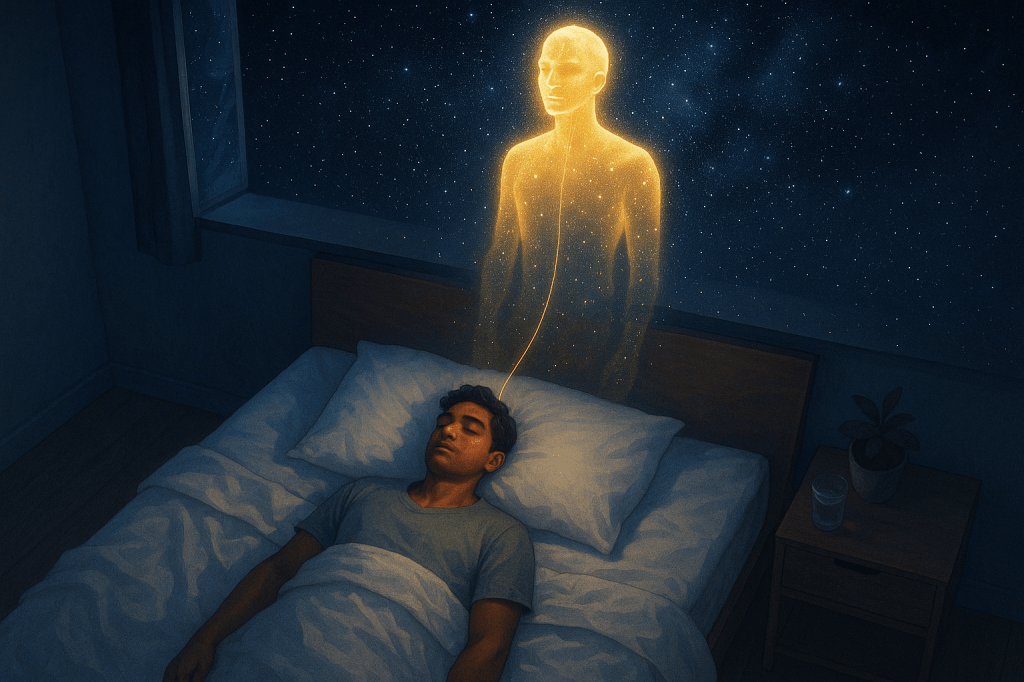
This verse is extraordinary. It tells us that every night, when you fall asleep, your soul leaves your body. Every morning when you wake, it returns. You have experienced the Ship of Theseus every single night of your life. Your body lies unconscious on the bed — the same body, the same material — but “you” are gone. You are taken somewhere else. And when you wake, “you” return to the body. The body did not change during sleep. What changed was the presence or absence of the soul. This is empirical evidence, available to every human being, that the soul is the real person and the body is merely the ship it sails in.
[89:27] “As for you, O content soul.”
[89:28] “Return to your Lord, pleased and pleasing.”
[89:29] “Welcome into My servants.”
[89:30] “Welcome into My Paradise.”
Notice the language of the final invitation. God does not say, “O content body.” He does not say, “O content brain” or “O content DNA sequence.” He addresses the soul — because the soul is the person. The soul is what returns to its Lord. The soul is what enters Paradise. The body is left behind, returned to the earth from which it came. When you understand this, the Ship of Theseus paradox does not just get solved — it evaporates. The ship was never the planks. You were never the body.
Your Body IS the Ship of Theseus
The Science of Cellular Replacement
The Ship of Theseus is not merely a thought experiment. It is happening to you right now. Modern biology has established that the human body replaces its cells continuously throughout life. Red blood cells last about 120 days. The cells lining your stomach are replaced every few days. Skin cells turn over roughly every two to three weeks. Even the cells of the skeleton — which seem permanent — are replaced over a period of about ten years (Source: Spalding et al., “Dynamics of Cell Generation and Turnover in the Human Body,” Cell, 2005). Research using carbon-14 dating from nuclear bomb tests has confirmed that the vast majority of cells in the human body are significantly younger than the person they belong to.
This means that the body you have right now shares virtually no material with the body you had fifteen years ago. The atoms are different. The cells are different. The proteins, the water, the minerals — all replaced. If you met your fifteen-year-old self, you would share no physical substance with them at all. And yet, no one doubts that you are the same person. Why? Because intuitively, every human being knows that identity is not in the material. The Ship of Theseus paradox is resolved every time someone looks at a childhood photograph and says, “That’s me.” The material is different. The form has changed. But the person — the soul, the consciousness, the “I” — persists. Science confirms what the Quran stated over fourteen centuries ago: the body is temporary. What endures is something else entirely.
[56:60] “We have predetermined death for you. Nothing can stop us—”
[56:61] “from substituting new generations in your place, and establishing what you do not know.”
[56:62] “You know about the first creation. Do you not remember?”
God explicitly states that He substitutes, replaces, transforms. The physical forms come and go. New generations replace old ones. Even within a single lifetime, the body is substituted cell by cell. And yet the verse ends with an appeal to memory: “Do you not remember?” — because memory, consciousness, and the soul persist through every material change. The body is the ship. The soul is Theseus himself.
Resurrection: The Ultimate Test
The disbelievers of every age have made the same error: they confuse the body with the person. They look at decomposed bones and ask how anyone could be brought back. The Quran records this objection and demolishes it:
[36:78] “He raises a question to us — while forgetting his initial creation — ‘Who can resurrect the bones after they had rotted?’”
[36:79] “Say, ‘The One who initiated them in the first place will resurrect them. He is fully aware of every creation.’”
The disbeliever’s mistake is the same mistake embedded in the Ship of Theseus paradox: he thinks identity is in the material. He looks at scattered bones and concludes the person is gone. But the Quran’s answer is precise: the One who created you the first time — who blew His spirit into a body made from clay — can certainly do it again. The bones are just planks. The person — the soul — never decomposed. It was taken by God at the time of death, as stated in [39:42], and will be returned to a new body at the time of resurrection. The identity survives because the identity was never in the bones.
Identity by Establishment: The Masjid Proof
The Quran’s Physical Test Case
If the Quran’s answer to identity were limited to the soul, it might seem abstract. But God, in His wisdom, gives us a concrete, physical test case that perfectly mirrors the Ship of Theseus — and resolves it in exactly the same way. In our companion article, “What Is a Masjid? The Quran Defines It — With Bricks, Foundations, and Walls,” we demonstrated that the Quran treats the identity of a place of worship not as a function of its building materials, but as a function of what it is established as. The key passage is Chapter 9, verses 107 through 110, which form a continuous argument about the identity of a building:
[9:107] “There are those who abuse the masjid by practicing idol worship, dividing the believers, and providing comfort to those who oppose God and His messenger. They solemnly swear: ‘Our intentions are honorable!’ God bears witness that they are liars.”
[9:108] “You shall never pray in such a masjid. A masjid that is established on the basis of righteousness from the first day is more worthy of your praying therein. In it, there are people who love to be purified. God loves those who purify themselves.”
[9:109] “Is one who establishes his building on the basis of reverencing God and to gain His approval better, or one who establishes his building on the brink of a crumbling cliff, that falls down with him into the fire of Hell? God does not guide the transgressing people.”
[9:110] “Such a building that they have established remains a source of doubt in their hearts, until their hearts are stilled. God is Omniscient, Most Wise.”
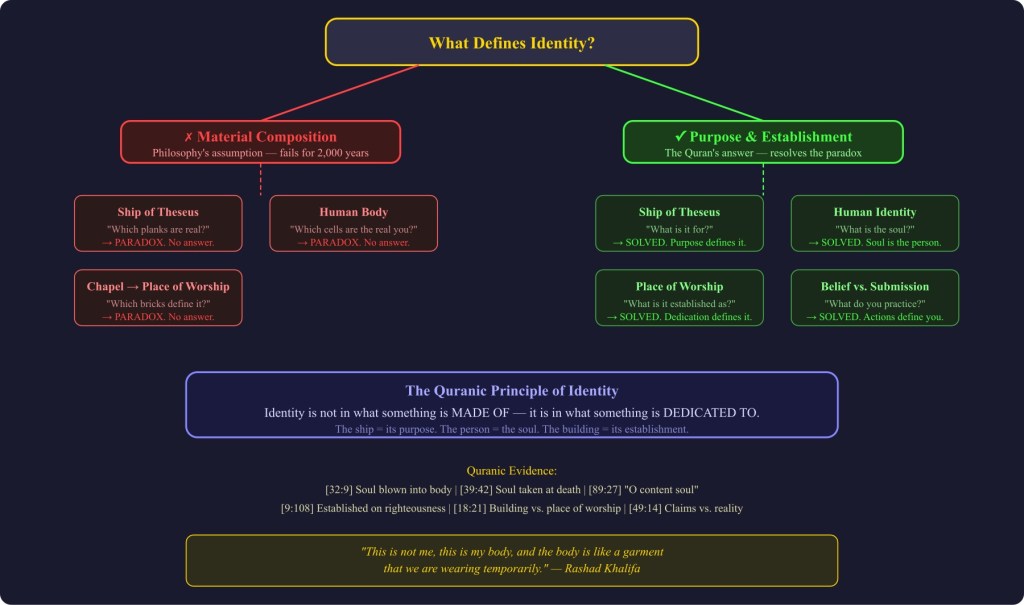
This passage is the Ship of Theseus applied to sacred space. Two buildings may look identical from the outside — same bricks, same dome, same minaret. But God says their identities are completely different based on what they were established as. One is “established on the basis of righteousness” and is a true place of worship. The other is established on hypocrisy, idol worship, and division — and it belongs to Satan. The planks are the same. The identity is not. The Quran defines the identity of a building the same way it defines the identity of a person: not by material composition, but by purpose and establishment.
The Chapel Test
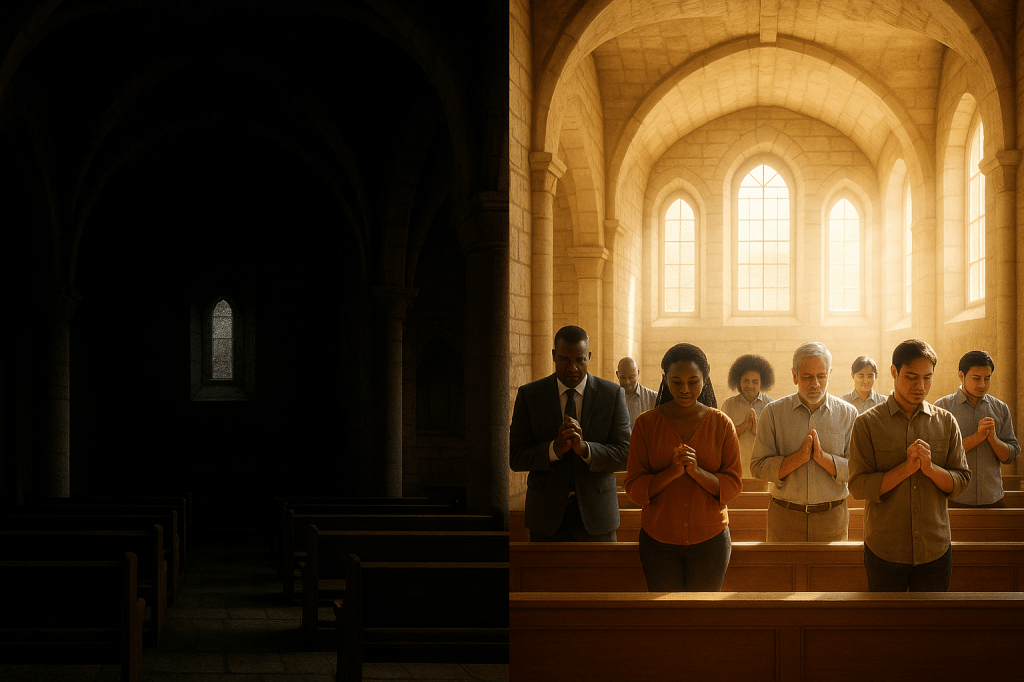
The companion article explored a thought experiment we called “the Chapel Test.” Imagine a stone chapel, built two hundred years ago, with stained-glass windows depicting saints, oak pews, and a cross above the door. The congregation disbands, and the building is purchased by a community of Submitters. They remove the cross. They clean out the pews. They dedicate the building to the worship of God alone. Is it a chapel or a place of worship? The answer, according to the Quran’s framework, is unambiguous: it is whatever it is established as. The moment it is dedicated to the worship of God alone, it becomes a place of worship — regardless of what the bricks “used to be.” The bricks do not remember. The bricks do not have identity. Identity belongs to purpose.
This is exactly the principle demonstrated in verse 18:21, which our companion article identified as the definitive verse on this question:
[18:21] “We caused them to be discovered, to let everyone know that God’s promise is true, and to remove all doubt concerning the end of the world. The people then disputed among themselves regarding them. Some said, ‘Let us build a building around them.’ Their Lord is the best knower about them. Those who prevailed said, ‘We will build a place of worship around them.’”
Look at what happens in this verse. The same physical location, the same structure, the same bricks — but one group calls it a “building” and another group calls it a “place of worship.” The difference is not in the material. The difference is in the purpose: what the structure is dedicated to. A building is a building. A place of worship dedicated to God is a place of worship. The planks do not define the ship. The dedication defines the ship.
The Counterexample: When Identity Changes
Identity Is Not a Claim — It Is a Reality
If the Quran’s framework of identity seems too permissive — as if anything can be anything simply by declaration — the Quran itself provides the corrective. Identity is defined by purpose and establishment, yes. But purpose is not what you claim. Purpose is what you actually practice. A place of worship that is used for idol worship, division, and hypocrisy is not a place of worship, regardless of what sign hangs above the door. This is the devastating lesson of verse 9:107: the people who built that place of worship swore their intentions were honorable. God called them liars. The building’s identity was determined by what it was actually used for, not by what its builders said about it.
This principle extends directly to human identity. Chapter 49, verse 14 delivers one of the sharpest corrections in the entire Quran:
[49:14] “The Arabs said, ‘We are Mu’mens (believers).’ Say, ‘You have not believed; what you should say is, “We are Muslims (submitters),” until belief is established in your hearts.’ If you obey God and His messenger, He will not put any of your works to waste. God is Forgiver, Most Merciful.”
The Arabs claimed to be believers. God corrected them: you have not believed. You have submitted outwardly, but belief has not yet been established in your hearts. This is identity by establishment applied to the human soul. Your identity is not what you profess with your lips. It is what is established in your heart. A person who claims to worship God alone but secretly idolizes a prophet, a saint, or a scholar is not a monotheist — they are an idolater, regardless of what they call themselves. A ship that can no longer sail is not a ship — it is wreckage, no matter what is painted on its hull.
The Body as Evidence, Not Identity
This framework also explains why the Quran tells us that the human being will be their own judge on the Day of Resurrection:
[75:14] “The human being will be his own judge.”
[75:15] “No excuses will be accepted.”
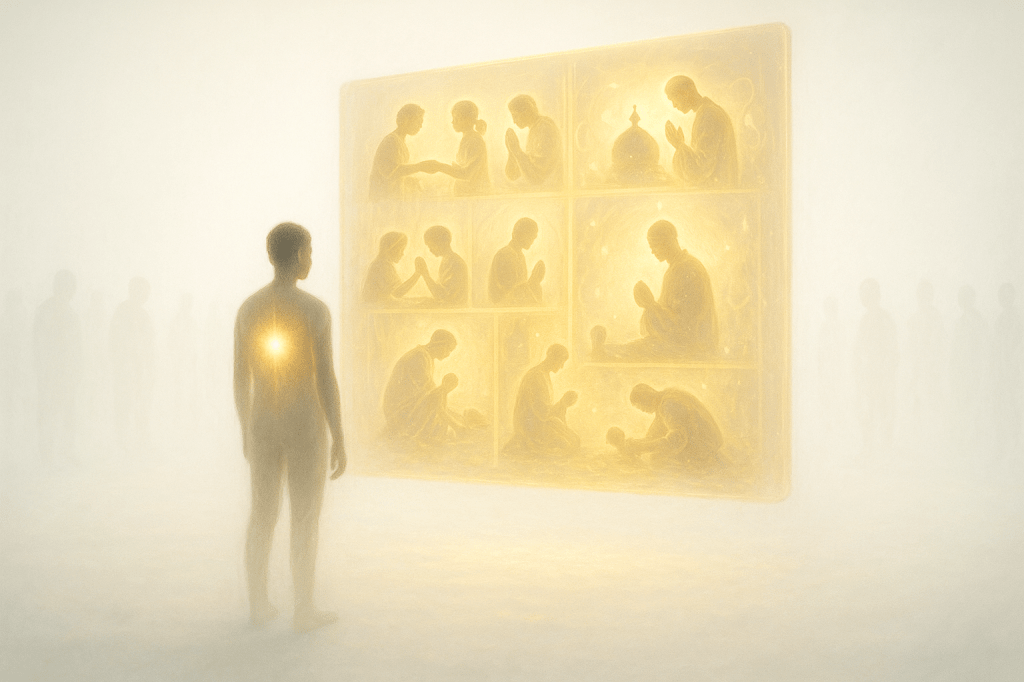
On that Day, you will not be judged by your body. You will not be judged by your race, your nationality, your physical appearance, or the atoms that made up your flesh. You will be judged by the state of your soul — by what was established in your heart, by the purpose to which you dedicated your life. The body was merely the garment you wore during the test. It was the ship you sailed in. But you — the real you, the soul that God addressed in [89:27] — you are the one who stands before your Lord. And you will know, with perfect clarity, exactly who you are and what you did. No excuses will be accepted because the soul knows. The soul was always the person.
The Missing Ingredient: Why Material Success Fails
Nourishing the Wrong Entity
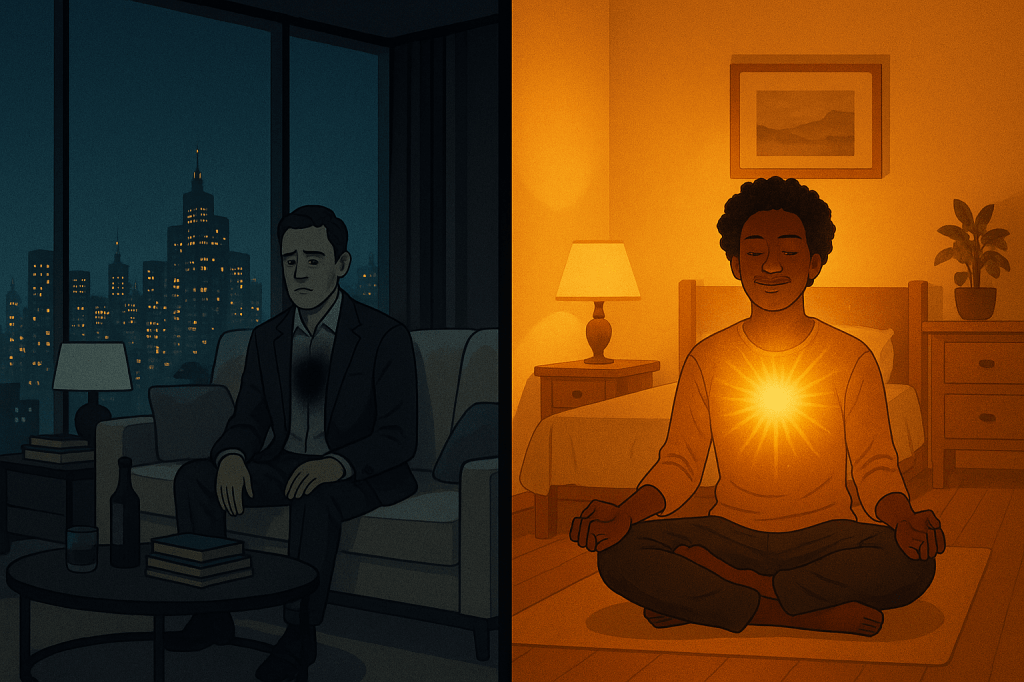
Once you understand the Quran’s identity framework — that you are a soul wearing a body — the epidemic of unhappiness in the modern world becomes entirely explicable. People are feeding the garment and starving the person. They are polishing the ship’s planks while ignoring the sailor. Rashad Khalifa identified this with characteristic directness: “Money, fame, beauty, and so on, do not bring happiness, there is something missing… we have to develop the real self in order to be happy. If you have a body that has everything, money, fame, everything it wants, but the soul is not nourished, happiness will be missing” (at 15:32).
This is not just spiritual wisdom — it is empirically verifiable. The so-called “Easterlin Paradox,” documented by economist Richard Easterlin in 1974 and confirmed by subsequent research, shows that beyond a baseline level of income, increases in wealth do not correlate with increases in happiness (Source: Easterlin et al., “The happiness-income paradox revisited,” PNAS, 2010). The wealthiest nations on earth are riddled with depression, anxiety, addiction, and suicide. People who have satisfied every desire of the body — food, shelter, comfort, entertainment, sex, status — remain profoundly unhappy. Why? Because they are nourishing the garment and neglecting the person. They are replacing the ship’s planks with gold and wondering why the voyage feels meaningless.
The Quran diagnoses this condition with devastating accuracy:
[57:20] “Know that this worldly life is no more than play and games, and boasting among you, and hoarding of money and children. It is like abundant rain that produces plants and pleases the disbelievers. But then the plants turn into useless hay, and are blown away by the wind. In the Hereafter there is either severe retribution, or forgiveness from God and approval. This worldly life is no more than a temporary illusion.”
[6:32] “The life of this world is no more than illusion and vanity, while the abode of the Hereafter is far better for the righteous. Do you not understand?!”
The body’s pleasures are “play and games.” The body’s accumulations are “temporary illusion.” This is not because physical life is inherently evil — it is because physical life is not the point. The point is the soul’s development. The point is what you are established as, what you are dedicated to. A person who dedicates their entire life to the body — to its comfort, its pleasures, its status — has invested everything in planks that will rot. The soul, neglected and starving, cannot produce happiness because it was never fed. The Quran does not merely explain the Ship of Theseus — it explains the entire crisis of modern civilization.
The Covenant: Identity Before the Body
You Existed Before Your Ship
The Quran reveals something that demolishes the Ship of Theseus paradox from an entirely different angle: your identity predates your body. Before you were ever placed in a physical form, before you had a single cell, before any plank was laid, you existed as a soul and you made a choice. This is the Great Covenant, described in Chapter 7:
[7:172] “Recall that your Lord summoned all the descendants of Adam, and had them bear witness for themselves: ‘Am I not your Lord?’ They all said, ‘Yes. We bear witness.’ Thus, you cannot say on the Day of Resurrection, ‘We were not aware of this.’”
Every soul that will ever inhabit a human body was summoned before the creation of the physical world. Every soul bore witness that God is their Lord. This happened before you had a body. Before your ship was built. Before the first plank was cut. Your identity was established in that primordial moment — not by material composition, not by physical form, but by a declaration made by your soul directly to your Creator. You are the soul that said “yes.” That is your identity. Everything that followed — the body, the life, the test — is secondary to that foundational act of witness.
This also explains why Rashad emphasized that the Quran tells us “who we are” as the first and most vital piece of information. We are souls who made a covenant with God. We are not bodies that happened to develop consciousness. We are not biochemical accidents that stumbled into self-awareness. We are souls — created, covenanted, placed into bodies for a test, and destined to return. The body is the examination room. The soul is the student. And the student existed before the room was built.
Dissolving the Paradox
The Wrong Question
The Ship of Theseus has survived as a paradox for over two thousand years because philosophy insists on asking the wrong question. “Which collection of matter is the real ship?” is a question that presupposes matter is the basis of identity. But matter is not the basis of identity. It never was. The Quran’s answer is not a competing theory within the same framework — it is a reframing of the entire question. It says: you are not asking about identity at all. You are asking about material, and material is not where identity lives.
Consider the evidence we have assembled. The human body replaces its cells continuously — you are literally a Ship of Theseus, and yet your identity persists. A place of worship can be made from the bricks of a chapel, and its identity is defined not by its materials but by what it is established as. A soul is blown into a body of clay, and the person is the soul, not the clay. God takes souls at the time of death and at the time of sleep — the body remains, but the person is gone. On the Day of Judgment, God addresses the soul, not the body. The covenant was made by souls before bodies existed. Every single piece of evidence points in the same direction: identity is not in the material. Identity is in the purpose, the dedication, the soul.
Philosophy’s Blindness
Why could philosophy not see this? Because philosophy, by and large, operates within a materialist framework. Even philosophers who believe in souls or minds tend to treat identity as a property of physical objects. They debate whether identity follows the “continuity of form” or the “continuity of matter” or some four-dimensional spacetime worm — all of which presuppose that identity is a physical phenomenon. The Quran cuts through all of this with a single insight: you are not your body. The body is a garment. The soul is the person. The question “which collection of atoms is the real you?” is as confused as asking “which thread in my shirt is the real me?”
And this is not merely a philosophical victory. It is a practical one. When you know that you are a soul, you know what to feed. When you know that your body is a garment, you stop worshipping the garment. When you know that identity is established by purpose and dedication, you dedicate yourself to the One who created you — and in doing so, you know exactly who you are. The crisis of identity that plagues modern civilization, the epidemic of meaninglessness, the frantic chase for external validation — all of it stems from one error: confusing the ship with the sailor.
[22:46] “Did they not roam the earth, then use their minds to understand, and use their ears to hear? Indeed, the real blindness is not the blindness of the eyes, but the blindness of the hearts inside the chests.”
The real blindness is not a failure to see the physical world. It is a failure to see through it — to recognize that the physical world is a temporary stage, and the real drama is happening in the heart, in the soul, in the unseen core of the person. The Ship of Theseus is only a paradox for those who are blind in this way. For those who see with the heart, there is no paradox at all.
Conclusion: Know Who You Are
The Ship of Theseus asked: if you replace every plank, is it still the same ship? For two thousand years, the greatest minds in philosophy could not agree on an answer. Materialists said no. Formalists said yes. Hobbes made it worse by building a second ship from the original planks. And the debate continues, endlessly, in seminar rooms and philosophy journals, because the question is unanswerable within a materialist framework. You cannot locate identity in matter, because matter changes. You cannot locate it in form, because form can be duplicated. You cannot locate it in continuity, because continuity can be broken and resumed.
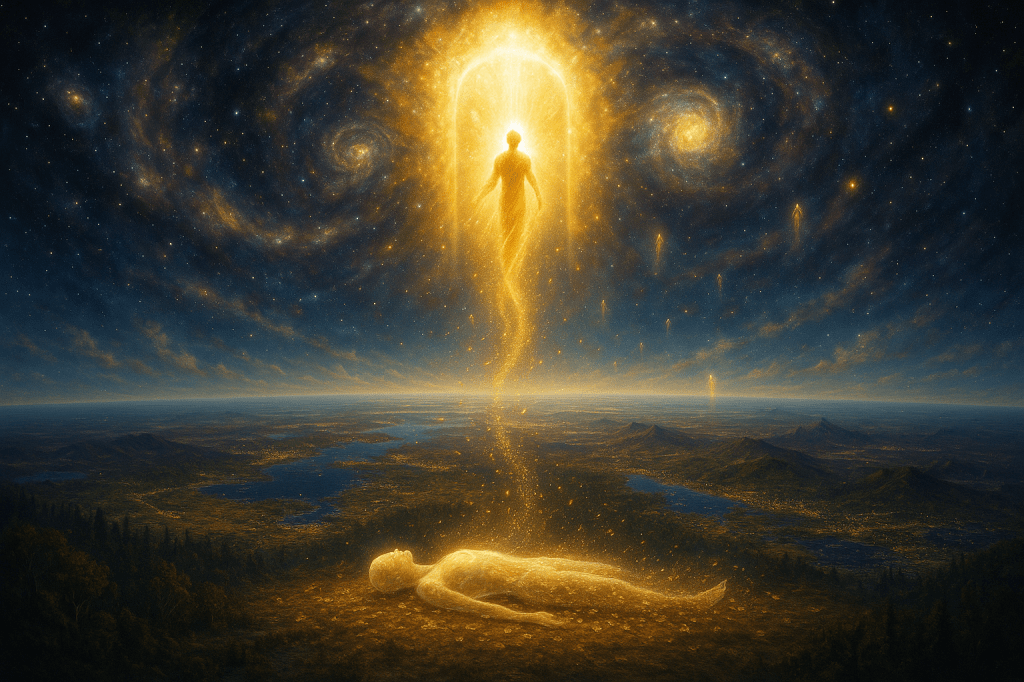
The Quran does not enter this debate. It dissolves it. Identity is not in the planks. Identity is not in the body. Identity is in the soul — the entity that God created, covenanted with, blew into a body of clay, takes at the time of death, and will address on the Day of Judgment. The soul is the person. The body is the garment. The ship is defined not by its wood but by its purpose — to carry Theseus, to serve Athens, to sail. And you are defined not by your cells but by your soul — the soul that bore witness before God, the soul that chose to be here, the soul that will return to its Lord.
Rashad Khalifa was right: the biggest problem in the world is not knowing who we are. And the Quran, proven to be from God by an incontrovertible mathematical code, answers that question with a clarity that no philosopher, no scientist, no psychologist has ever matched. You are a soul. Your body is a ship. The planks will change, the wood will rot, the form will age and crumble. But you — the real you — were here before the ship was built, and you will be here long after it is gone. Know who you are. Nourish the right entity. Dedicate yourself to the right purpose. And when the time comes for your soul to leave this temporary garment, may you hear the words that every soul longs to hear:
[89:27] “As for you, O content soul.”
[89:28] “Return to your Lord, pleased and pleasing.”
[89:29] “Welcome into My servants.”
[89:30] “Welcome into My Paradise.”

 Quran Only Studies
Leave a comment