Introduction: A Signature Hidden in Plain Sight
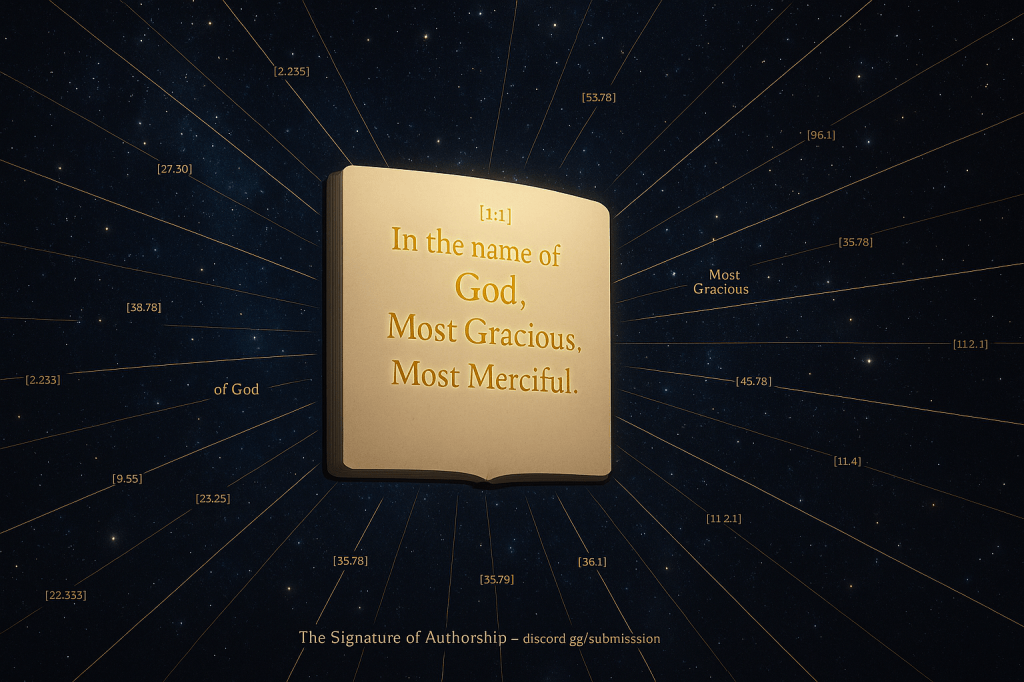
The first verse of the Quran is the most recited sentence in human history. A child in Karachi learns it before her own name. A convert in Oslo whispers it the instant faith takes root. A believer in Lagos inscribes it above her front door. “In the name of God, Most Gracious, Most Merciful” — [1:1] — is the scripture’s opening breath, its threshold, its overture. And yet for fourteen centuries the entire Muslim world read past it without realising that the four words of that single verse carry a mathematical signature of authorship woven into the very fabric of the book.
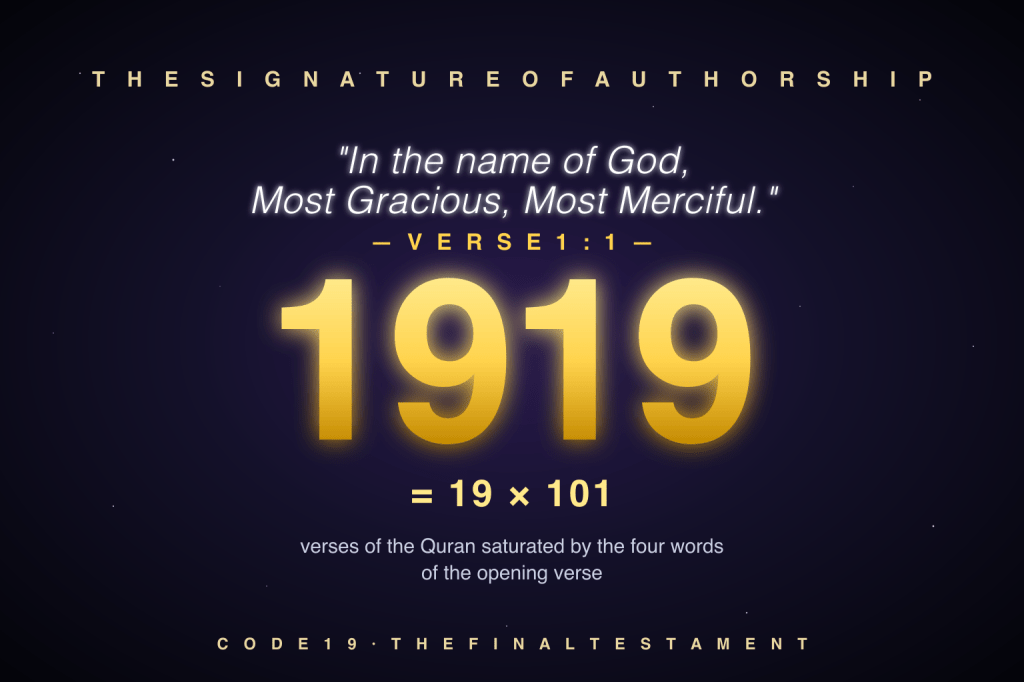
This article presents, for the first time in a single consolidated argument, the complete proof: that the four words of verse 1:1 — bismi (in the name), Allah (of God), al-Rahman (Most Gracious), al-Raheem (Most Merciful) — collectively saturate exactly 1,919 unique verses of the Quran when counted with their proper morphological grammar. 1,919 factors as 19 × 101, a dual 19 signature of the very number Rashad Khalifa uncovered in 1974 as the mathematical seal of divine authorship. Verse 1:1 is the source. The 1,919 are the verses it saturates — the scriptural field over which the four opening words cast their shadow. A reality no human author could engineer across a text revealed in twenty-three years of spontaneous circumstance. What follows is how that signature works, how it was counted, and why it matters.
[1:1] “In the name of God, Most Gracious, Most Merciful.”
Part 1: The Opening Verse as Cosmic Foundation
A Sentence That Opens Everything
Every chapter of the Quran except chapter 9 begins with the same fourteen-century-old sentence. A Muslim says it before eating, before entering a home, before driving a car, before slaughtering an animal, before reading, before reciting. Children memorise it before they can count to ten. The Bismillah is not merely an ornament or a pious preamble — it is the literal and theological gateway through which every sacred act passes. To begin anything in the name of God is to refuse autonomy, to refuse self-deification, to consecrate the moment to its rightful Owner.
But the Bismillah is more than liturgy. Structurally, it is the scripture’s first line, the title-page of the Final Testament, the verse that declares the source of everything that follows. Every word the Quran contains, every commandment, every parable, every vision of Paradise and Hell, every legal ruling and prophetic story, is uttered under the shadow of these four opening words. The authority of the entire book rests on the authority of its opening. If verse 1:1 is true, the book is true. If it is false, the book is false. The Bismillah is therefore the linchpin — and as we will see, God has signed that linchpin in a way no forger could imitate.
Part 2: Four Words, Four Roots — The Morphology of the Bismillah
Anatomy of a Sentence
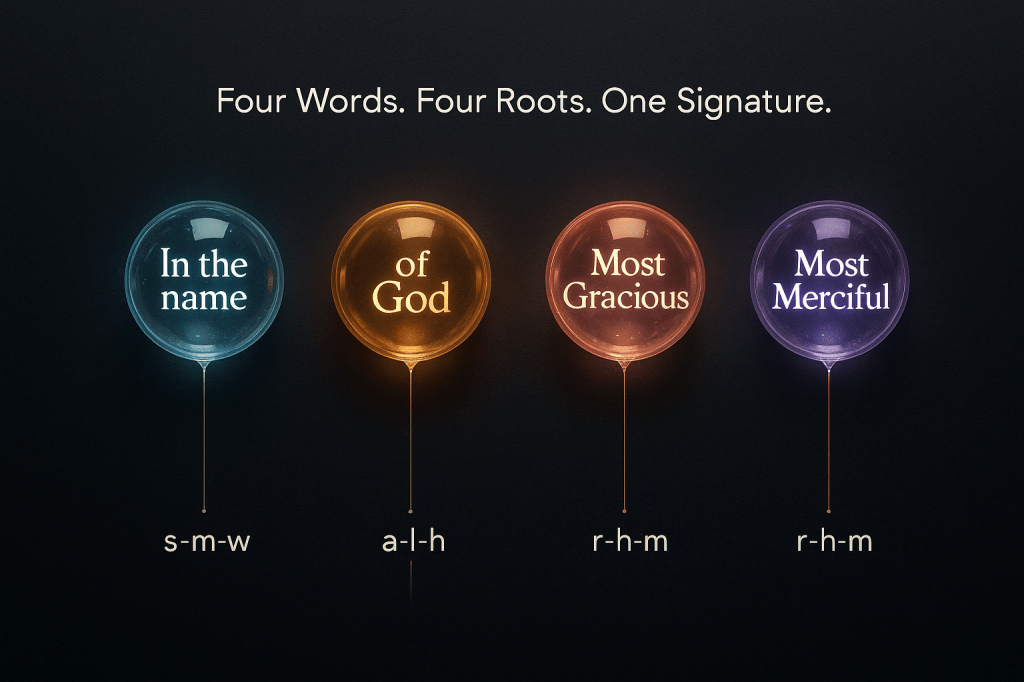
To understand the signature, one must first understand the grammar. The Bismillah contains exactly four orthographic words in Arabic, each drawn from a distinct semantic root. The first word is bismi — a compound of the preposition bi (“in” or “by”) and the noun ism (“name”) — derived from the root letters s–m–w, which in the Arabic lexicon is also the root of the word for “sky” or “heaven.” The second word is the proper noun Allah, from the root a–l–h, which underlies both the proper name and the common noun ilah (“deity” or “god” in the generic sense). The third word, al-Rahman, and the fourth word, al-Raheem, share a single root: r–h–m, the root of mercy, womb, kinship, and compassion.
These four words are therefore drawn from exactly three linguistic roots (because al-Rahman and al-Raheem share one). And yet each of those roots branches in the Quran into many different forms. The root r–h–m, for instance, yields the verb rahima (“he had mercy”), the verbal noun rahma (“mercy”), the plural arham (“wombs”), the active participle rahimin (“the merciful ones”), the superlative arham (“most merciful” — a different word though spelled identically in consonants), and the two intensive adjectives that appear in verse 1:1 itself: al-Rahman and al-Raheem. The signature that saturates 1,919 verses arises from counting, under precise morphological rules, which of these branches actually refers to the divine name and which do not. The filter is not arbitrary — it is the same filter a careful lexicographer would apply.
Part 3: The 19-Letter Architecture of Verse 1:1
The First Miracle, Uncovered
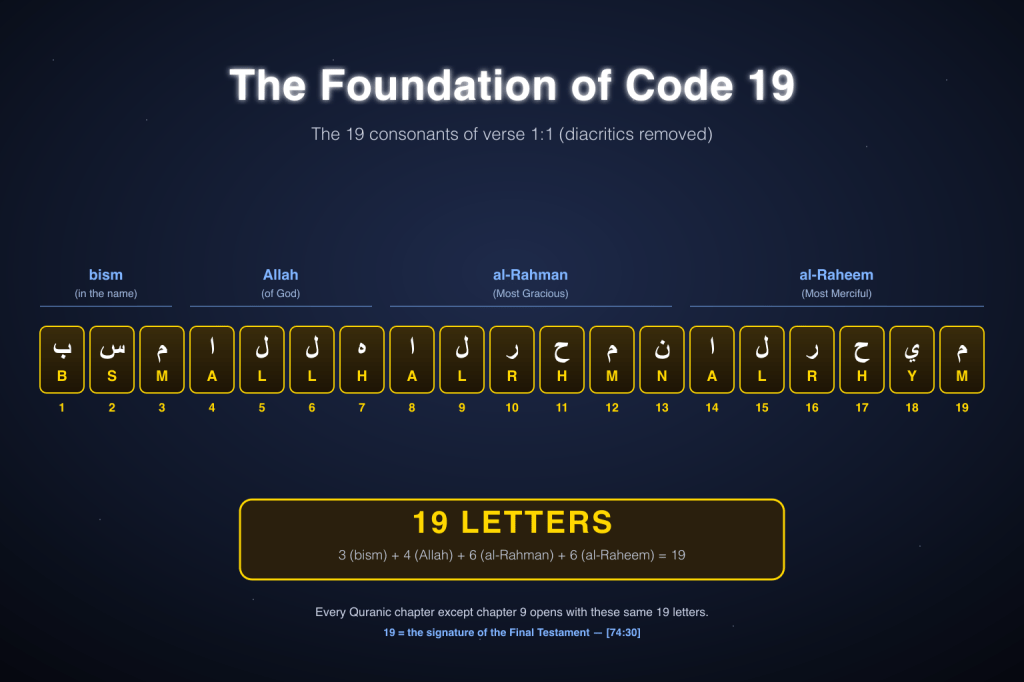
In 1974, Dr. Rashad Khalifa, an Egyptian-American biochemist working at the University of Arizona, fed the Arabic text of the Quran into a mainframe computer to count the letters of every word. His method was brute-force enumeration — he wanted to know whether the so-called mysterious “initial letters” at the start of twenty-nine chapters had any statistical regularity. What he found, and would spend the rest of his life documenting, was an arithmetic signature so vast and so deliberate that it could only be the work of a mind with perfect knowledge of the whole book in advance of its revelation: the number 19, embedded through every dimension of the text, precisely and irreducibly.
The first sentence of the Quran — verse 1:1, the Bismillah itself — contains exactly nineteen Arabic consonants when written without diacritical marks. Three for bism, four for Allah, six for al-Rahman, six for al-Raheem. Three plus four plus six plus six equals nineteen. This is the surface of the code. But Rashad soon realised this was only the first visible crystal of a vastly larger structure. If the opening verse of the scripture is nineteen letters long, and if nineteen is going to be the signature of divine authorship throughout the book, then the four words of that opening verse should themselves behave in mathematically disciplined ways. They do. Each one, when counted through the entire Quran, produces a total that is an exact multiple of nineteen.
The messenger explained this foundational observation openly (at 0:58): “Our Muslim scholars are still stuck in the first letter of the Quran. In ‘Bismillah ar-Rahman ar-Raheem,’ they are still trying to figure out how many letters are in the Basmala, the first verse.” The scholars who refused the miracle could not even agree on the letter count of the opening verse — not because it is ambiguous, but because admitting nineteen would mean admitting the entire case.
Part 4: The 1919-Verse Signature — A Deliberate Morphological Logic
Counting by the Rules of Grammar, Not by Superstition
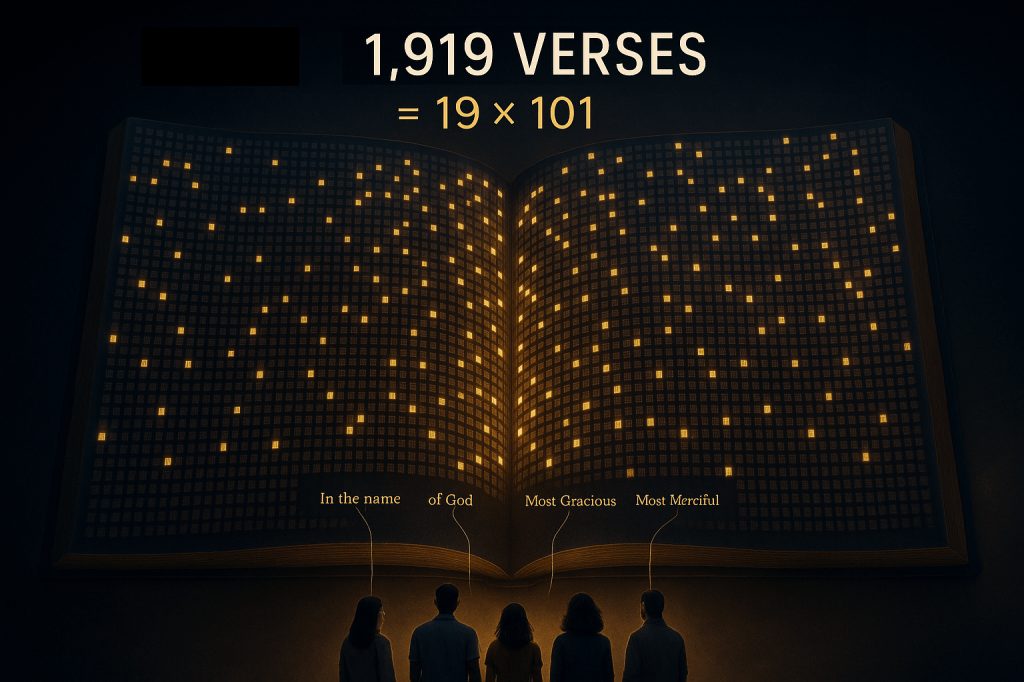
Here we come to the central finding. The four words of verse 1:1 do not merely count to multiples of 19 in their raw frequencies. They also saturate the book — that is, they appear across a precisely disciplined set of unique verses. The question is: across how many verses of the Quran does at least one of these four words appear in its divine-name sense? The answer, when the count is performed with the morphological rigour of a serious lexicographer, is exactly 1,919. That is 19 × 101 — a dual 19 signature. Every student of the Quran has seen that 1:1 contains 19 letters. Very few have seen that the four words of 1:1 also mark out 1,919 verses.
The morphological logic is not arbitrary. A casual grep for the root r–h–m (“mercy”) would return verbs like rahima (“he had mercy”), nouns like rahma (“mercy”), plurals like arham (“wombs”), and active participles like rahimin (“the merciful ones”). None of those are the words of verse 1:1. The verse 1:1 uses two specific adjectival intensives: al-Rahman (the definite Most Gracious, a proper name reserved for God) and al-Raheem (the Most Merciful, applied overwhelmingly to God and occasionally as a descriptive epithet). So when we count the signature, we count exactly those two forms — plus the rare superlative arham when it refers to God (four occurrences) — and we exclude every verb, every plural “wombs,” every ordinary “mercy.” The same care is applied to ism (“name”): we count only the nineteen verse-positions where ism refers to the Name of God or of the Lord, excluding the cognate samaa (“sky”), the verb “to name,” the passive “appointed,” and so on. And we count Allah only in its proper-noun inflections, excluding the generic ilah (“deity”) and the vocative Allahumma (“O God”). Apply this disciplined filter, deduplicate the verse list, remove the two known false verses at 9:128 and 9:129 (which the Final Testament has already stripped from chapter 9, leaving chapter 9 to end at 9:127), and also remove verse 1:1 itself (since we are asking how many other verses the signature saturates), and the answer falls out: 1,919.
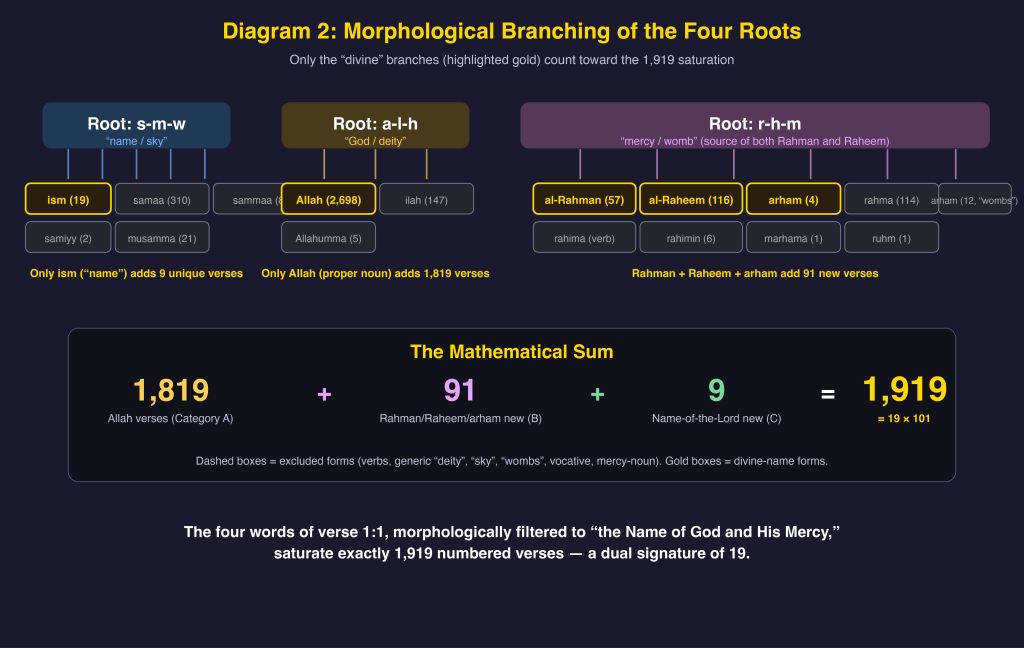
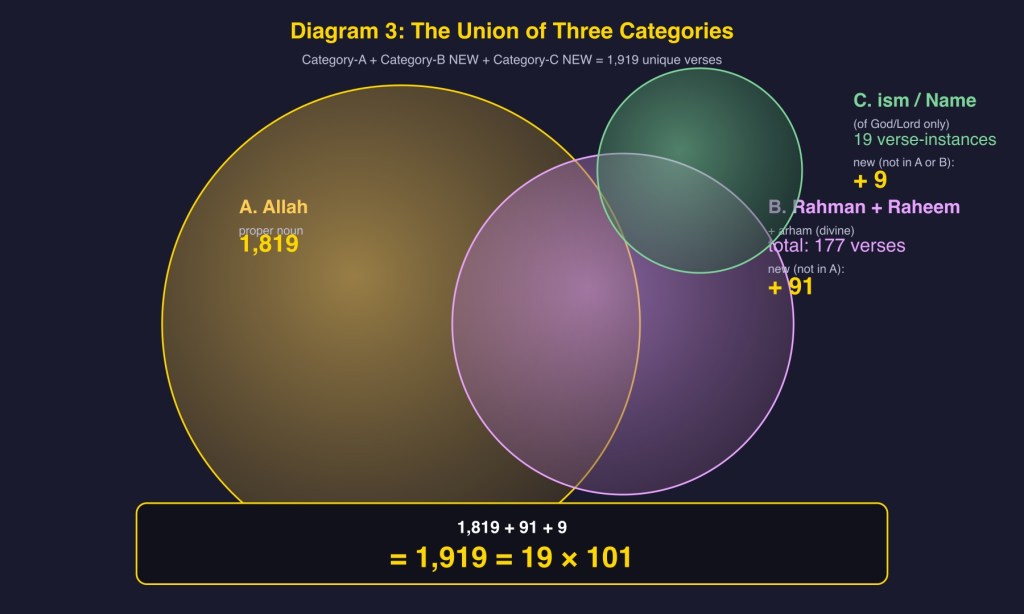
The three categories do not overlap perfectly; they layer. Category A — the verses containing the proper noun Allah — is by far the largest, at 1,819 unique verses. Category B — the verses containing al-Rahman, al-Raheem, or the superlative arham — adds 91 new verses that did not already contain the word Allah. Category C — the nine verses where ism specifically refers to God’s name or the Lord’s name, and which do not already contain Allah or al-Rahman — adds the final nine verses. 1,819 + 91 + 9 = 1,919. The sum is exact. The categories are morphologically disjoint additions. The filter is the same filter a careful Arabic lexicographer would use without ever knowing about Code 19.
Part 5: Category A — Allah as Proper Noun (1,819 Verses)
The Name That Names Itself
The word Allah is unique in the Arabic language. Unlike the generic ilah (“a god”), it is a proper noun: it never takes the indefinite article, it never takes a plural, and it never refers to any being except the one true God. When the Quran says Allah, it is naming a specific reality — the Creator of the heavens and the earth, the Possessor of the universe, the One. By contrast, ilah is a category term. The Quran uses ilah in phrases like “there is no ilah but He” ([2:163]) and in the accusation that the disbelievers take “other ilahs besides God” ([21:24]). The two words are grammatically and semantically distinct, and the Code 19 count respects that distinction absolutely.
In the authentic Quran — the Final Testament, which excludes the two fabricated verses 9:128 and 9:129 and ends chapter 9 at verse 9:127 — the proper noun Allah and its various inflected forms (l-lahi, l-lahu, l-laha, wal-lahu, bil-lahi, lillahi, fal-lahu and a dozen others involving conjunctions and prepositions) appear exactly 2,698 times (= 19 × 142). These 2,698 occurrences distribute across 1,820 unique verses. Remove verse 1:1 itself — the Bismillah, which is the signature rather than a verse that merely contains it — and we arrive at exactly 1,819 verses that contain Allah as a proper noun. That number, 1,819, is the floor of the signature. Every additional word that the Bismillah contributes is a new verse added on top.
[2:163] “your god is one God; there is no God but He, Most Gracious, Most Merciful.”
Notice how even this single verse, [2:163], rehearses the Bismillah in its own way — “one God” (Allah), “Most Gracious” (al-Rahman), “Most Merciful” (al-Raheem). The opening verse is not merely the scripture’s preface; its words are the genetic material out of which the rest of the book is composed. This is what it means to say the Bismillah saturates the Quran. Wherever you open, the Name of God or His mercy is almost certain to be within a few lines. The 1,919 figure is simply that ubiquity made mathematically precise.
Part 6: Category B — The Divine Names of Mercy (+91 Verses)
Al-Rahman, Al-Raheem, and the Superlative arham
Mercy is the first attribute the Quran names, the first attribute it repeats, and the attribute it returns to again and again throughout the scripture. Verse 1:1 names God twice as merciful, in two different grammatical intensities: al-Rahman (the Most Gracious, a form that intensifies through the prefix and suggests a mercy so vast it saturates the whole cosmos) and al-Raheem (the Most Merciful, a form that implies continuous, sustained mercy extended to specific recipients). The distinction is not redundant. Classical commentators and Arabic lexicographers have long observed that al-Rahman denotes God’s universal mercy on all creation (believer and unbeliever, animal and plant) while al-Raheem denotes God’s particular, personal mercy on the submitters.
The Quran makes this explicit in [17:110]: “Call Him God, or call Him Most Gracious; whichever name you use, to Him belongs the best names.” The two intensive adjectives from verse 1:1 are treated as alternative names of the same One. Adding every verse that contains either al-Rahman, al-Raheem, or the superlative arham (“most merciful of the merciful ones” — used only four times and always of God, in [7:151], [12:64], [12:92], and [21:83]) produces a set of 169 unique verses total (after excluding the false verse 9:128, which describes the messenger rather than God as “raheem”). Of those 169, 78 already appear in Category A (they already contain the word Allah). That leaves exactly 91 new verses in which the signature extends the reach of Category A.
[21:83] “And Job implored his Lord: ‘Adversity has befallen me, and, of all the merciful ones, You are the Most Merciful.’”
Observe: Job’s cry for help, in the pit of his suffering, is phrased exactly with the superlative arham. The word appears only four times in the whole Quran — and each time, without exception, it is a creature calling on the Most Merciful. Moses uses it in [7:151] (“of all the merciful ones, You are the Most Merciful”). Jacob uses it in [12:64]. Joseph uses it in [12:92]. And Job uses it in [21:83]. Four messengers, four moments of extremity, four uses of a single rare word. That is a literary pattern. And the mathematical layer adds 91 new verses to the Bismillah signature through these mercy-forms.
Part 7: Category C — The Name of the Lord (+9 Verses)
Nine Verses Where “the Name” Completes the Signature
The third and smallest category is the narrowest and therefore the most revealing. It is the word ism (“name”), counted only where it is used as a singular noun pointing at the Name of the Lord. The Quranic word ism is cognate with samaa (“sky”), sammaa (“to name”), samiyy (“namesake”), and musamma (“appointed”). All of these share the root s–m–w, but only one narrow branch — the singular noun ism, meaning “the name of God” or “the name of your Lord” — belongs to the Bismillah signature. After filtering out every other form, and after removing the verses that are already in Category A (because they also contain the word Allah), what remains is exactly nine verses: 55:78, 56:74, 56:96, 69:52, 73:8, 76:25, 87:1, 87:15, and 96:1. These nine complete the 1,919 count.
Each of these nine verses uses ism to point at the Lord’s Name in a distinct, reverential way. They are verses like [96:1], the first command ever revealed to the prophet: “Read, in the name of your Lord, who created.” They are verses like [73:8]: “You shall commemorate the name of your Lord, to come ever closer and closer to Him.” They are verses like [87:1]: “Glorify the name of your Lord, the Most High.” Each of these uses ism to point directly at the Name of the Lord — and each of these happens, by the deliberate architecture of the book, to be exactly one of the nine additional verses the Bismillah signature needs to complete its 1,919 count.
[96:1] “Read, in the name of your Lord, who created.”
This matters profoundly. The first word ever revealed to the prophet Muhammad was “Read” (iqra), and the first phrase after it was “in the name of your Lord” — bismi rabbika. The very same word bismi that opens the Bismillah itself. The revelation begins where the book begins. And it begins with one of the nine verses that complete the 1,919 count. The opening of the messenger’s prophetic career and the opening of the book are mathematically the same gesture.
Part 8: The 114 Bismillahs = 19 × 6
One Hundred and Fourteen Complete Opening Statements
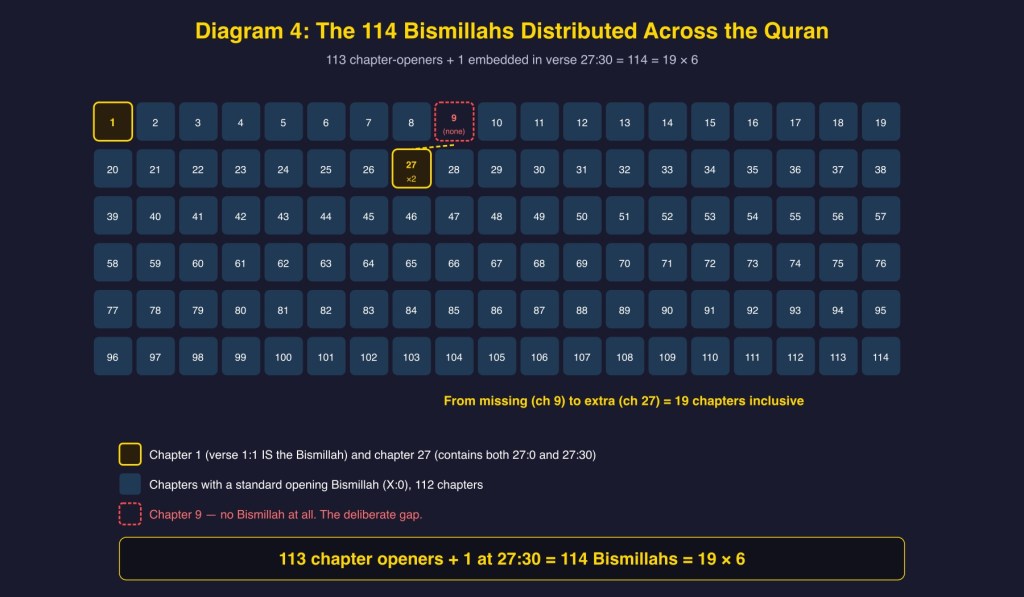
The signature extends beyond the verse level. At the chapter level, the Bismillah appears as a complete sentence in precisely 114 locations throughout the Quran: 113 of them at chapter openings, and 1 additional instance embedded inside the text of chapter 27 as part of Solomon’s letter to the Queen of Sheba. 114 factors as 19 × 6 — another Code 19 signature, at a different level of the text’s structure. The number is not approximate; it is precise. And the location of the 114th Bismillah is not random; it is at exactly the verse that would be needed to make the total a multiple of 19.
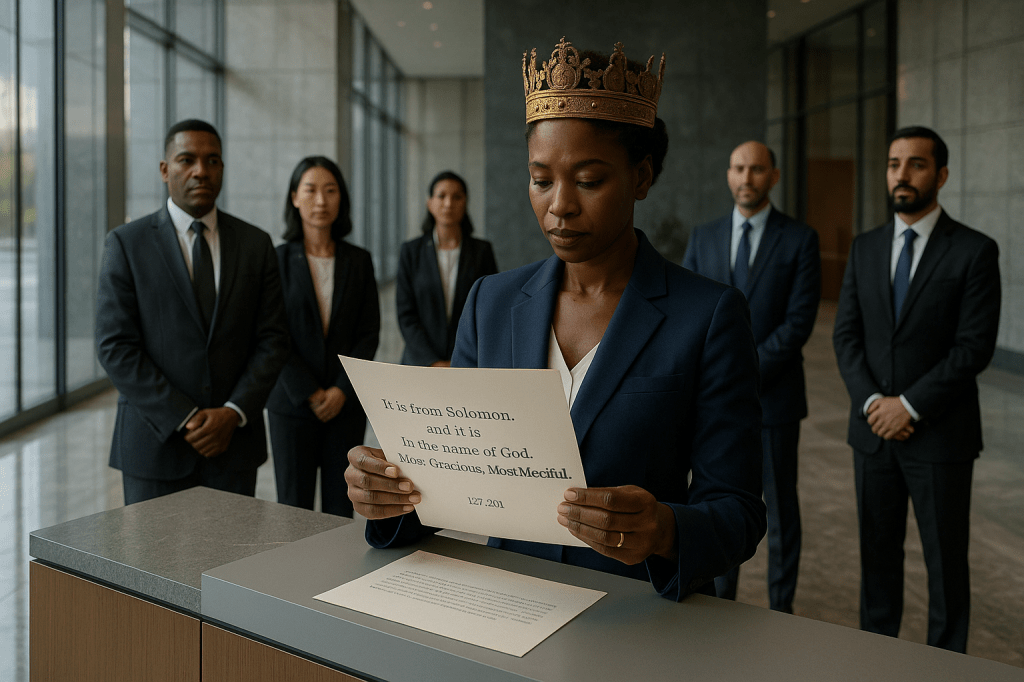
The arithmetic works like this. The Quran has 114 chapters. If every chapter opened with a Bismillah, the count would be 114 — a multiple of 19. But chapter 9 has no Bismillah. So the naive count is 113, which is not a multiple of 19. To preserve the signature, one additional Bismillah must exist somewhere else in the book. And it does: inside verse 27:30, when Solomon (peace be upon him) dictates a letter to the queen of the people of Sheba, and the letter’s opening sentence — quoted in the scripture itself — is “In the name of God, Most Gracious, Most Merciful.” That single embedded Bismillah restores the count to 114, which is 19 × 6.
The messenger explained this openly (at 10:12): “If you go to chapter 9, you will notice that this chapter does not have a Bismillah. Now, since the Quran has 114 chapters, and this one does not have an opening statement, this will mean that we have only 113 Bismillahs in the Quran, and this number is not divisible by 19. But we find that this missing Bismillah is made up in chapter number 27. So if you go to chapter number 27, you will see that we have two Bismillahs… And this restores the number of this important opening statement to 114, or 19 times 6.” This is not apologetics spoken in hindsight; it is the direct observation any reader can make simply by counting.
Part 9: The Two Anchors — 1:1 and 27:30
The Only Two Numbered Verses Containing All Four Words
Across all 6,234 numbered verses of the Quran, only two verses contain all four words of the Bismillah in complete uninterrupted sequence. The first, obviously, is verse [1:1] itself — the first line of the scripture. The second is [27:30], Solomon’s letter to the Queen of Sheba. These are the two anchors of the entire signature, and their placement is not coincidental. The first Bismillah opens the book. The second Bismillah sits exactly where needed to make the count of chapter-openings divisible by 19. And the chapter that contains the second Bismillah — chapter 27 — is exactly the 19th chapter counted inclusively from the missing chapter 9.
Solomon’s letter, preserved in the Quran in the middle of a long narrative about a bird that scouted the kingdom of Sheba, opens with the Bismillah in full. Its theological significance is profound: it is a prophet of the distant past, writing to a pagan queen, commanding her to submit to God — and he does so by using exactly the same four-word formula that the Quran itself opens with, in exactly the form that the Quran would later preserve. That correspondence itself would be sufficient literary beauty. The mathematical layer is extra: by being preserved at verse 27:30, and by being the second of exactly two Bismillahs in chapter 27 (the other being the unnumbered 27:0 chapter opener), Solomon’s letter becomes the mechanical counterweight that keeps the total Bismillah count at 114.
[27:30] “It is from Solomon, and it is, ‘In the name of God, Most Gracious, Most Merciful.’*”
The Queen of Sheba opens the letter, and what she reads is the voice of every prophet through every age: not “I command you,” not “my gods say,” but “in the name of God, Most Gracious, Most Merciful.” The same sentence that every child of every submitter on earth has said before sitting down to eat. The messenger was adamant (at 10:12) that this is not mysticism but arithmetic: “From the missing Bismillah to the extra Bismillah, from chapter 9 to chapter 27, we find exactly 19 chapters, inclusive. This is the chapter that has two Bismillahs. And it is chapter number 19, after the missing Bismillah of chapter 9.” Three independent facts, one signature.
Part 10: Why Chapter 9 Has No Bismillah — The Gap That Completes the Pattern
A Calculated Absence
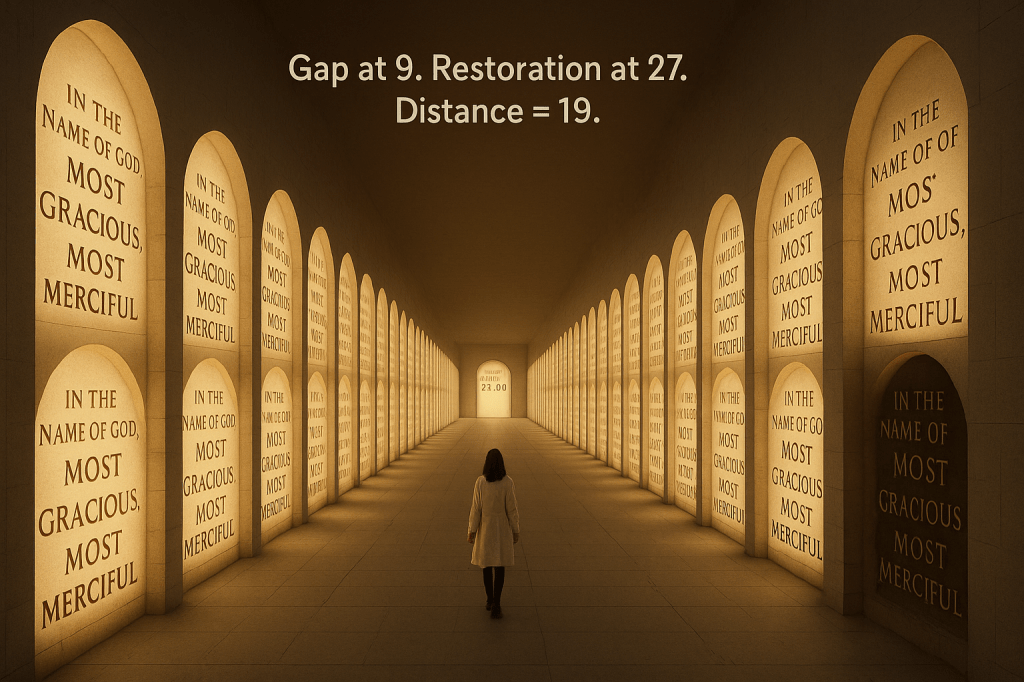
For centuries, scholars have offered theological explanations for why chapter 9 (“the Ultimatum”) lacks a Bismillah at its opening. Some claimed it was a chapter of war and therefore mercy had no place in its preamble. Others claimed it was originally joined with chapter 8 and the opening was dropped by scribal convention. None of these explanations holds up under examination — chapters 3 and 4, equally harsh in tone, retain their Bismillahs, and the ancient manuscripts consistently separate chapters 8 and 9. The true reason for the missing Bismillah is not theological, it is structural. It is the hinge on which the entire 19-based code rotates.
If chapter 9 had a standard Bismillah, the total count would be 115, which is not a multiple of 19. If no chapter had one, the count would be 113, also not a multiple of 19. Only by removing exactly one chapter-opener Bismillah, and by then restoring it exactly once inside the text of another chapter (27:30), does the total land precisely on 114 = 19 × 6. Furthermore, the chapter from which it is removed and the chapter in which the replacement is embedded must be separated by exactly 19 chapters inclusive. Chapter 9 is the missing one. Chapter 27 is the replacement. 27 − 9 + 1 = 19. The entire arithmetic is locked.
[41:3] “A scripture whose verses provide the complete details, in an Arabic Quran, for people who know.”
Verse [41:3] speaks to exactly this kind of reader — “people who know.” The Quran declares itself to be a fully detailed book, and the missing Bismillah of chapter 9 is one of those full details: not an oversight, not a scribal lapse, but a deliberately engineered absence that makes the whole mathematical signature possible. No human author writing in the seventh century could have engineered this. No compiler after the fact could have engineered this. The four words of verse 1:1, the count of their divine-name forms, the distribution of the Bismillah across chapters, the gap at 9, the restoration at 27:30 — all of it knits together into one single, enormously over-determined equation whose only possible author is the one named in the opening verse.
Part 11: Classical Rashad Khalifa Counts — 19, 2698, 57, 114
The Word-Level Arithmetic of the Four Words
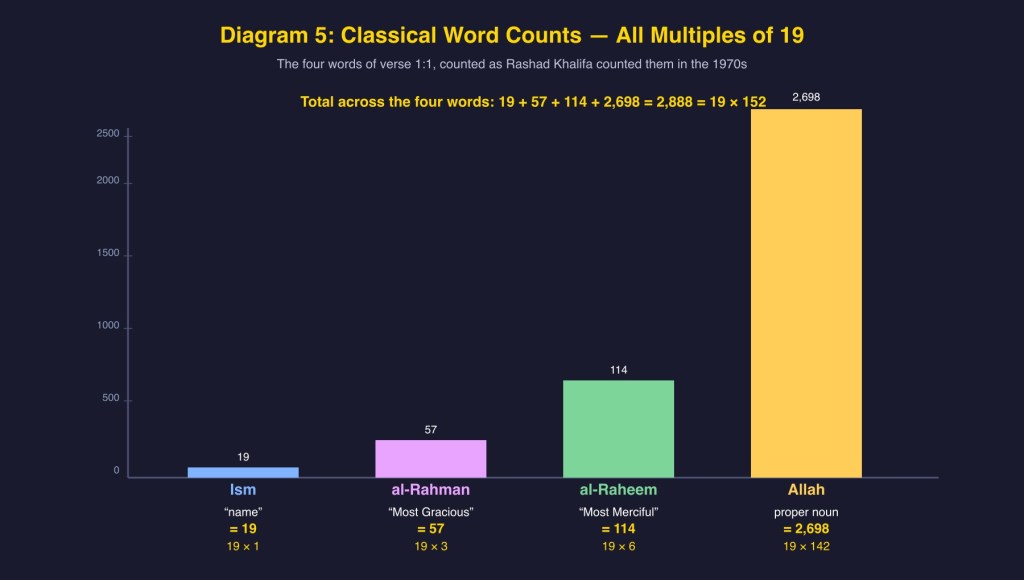
The 1,919 figure is a verse-level count — how many unique verses the signature saturates. The foundational word-level counts that Rashad Khalifa published in the 1970s are even more direct and no less striking. Each of the four words of verse 1:1, counted as raw occurrences throughout the Quran, produces a total that is an exact multiple of 19. The word ism (“name”) in its divine-name sense appears exactly 19 times — that is, 19 × 1 occurrences — across the nineteen verse-positions listed earlier. The proper noun Allah appears in Rashad’s classical count exactly 2,698 times — that is, 19 × 142 occurrences. The word al-Rahman appears exactly 57 times — that is, 19 × 3 occurrences. And the word al-Raheem appears exactly 114 times — that is, 19 × 6 occurrences, the same count as the total number of chapters in the Quran, and the same as the total number of complete Bismillahs.
Add these four counts together: 19 + 2,698 + 57 + 114 = 2,888. And 2,888 = 19 × 152. Every layer is a multiple of 19. Every individual word is a multiple of 19. The sum is a multiple of 19. The Bismillah is not just structurally symmetrical; it is arithmetically irreducible. The messenger captured the significance openly (at 25:54): “When Rabbi Judah discovered the number 19 in the older scriptures, he didn’t know why 19… As you recall when I quoted him he said there is a secret and the great esoteric meaning to the number 19, but he didn’t know why, because this question had to wait until the completion of God’s message to the world by revealing the final edition: the Quran in the Arabic language.”
Consider how over-determined this system is. To forge even a single one of these four counts at random would require placing the word Allah exactly 2,698 times — landing precisely on 19 × 142 — across a text composed over twenty-three years in response to wars, family conflicts, questions from followers, moral dilemmas, and unpredictable human events. The probability of landing exactly on a multiple of 19 by chance is 1 in 19. The probability of landing on a multiple of 19 for all four words independently is 1 in 194 = 1 in 130,321. And that is before we add the constraint that the four words also happen to saturate exactly 1,919 unique verses, the 112 unnumbered chapter-openers plus 1:1 and 27:30 equal exactly 114 = 19 × 6, and verse 1:1 itself contains exactly 19 letters. The joint probability of all these constraints being satisfied by chance is astronomically small.
Part 12: The Theological Meaning — Why the Bismillah Saturates the Quran
The Signature Is the Message
Mathematics without theology is a puzzle. But the 1,919 signature is not a puzzle; it is a message. It says that the four words of the opening verse are not just liturgical decoration but the very thing the book is about. The Quran is, at every level, in the name of God, Most Gracious, Most Merciful. That is what it announces in its first sentence, and that is what it mathematically enacts across its 6,234 verses. Wherever you turn — chapter 2, chapter 50, chapter 112, chapter 55 — the Name of God and His Mercy are there. Not occasionally. In 1,919 out of 6,234 numbered verses, which is roughly 30 percent — meaning that on average, every third verse of the scripture contains at least one of the four words of verse 1:1 in its divine-name form.
The deeper message is that God’s Name and God’s Mercy are inseparable. The proper noun and the two intensive adjectives for mercy form a single package — one cannot invoke Him without invoking His Mercy, and one cannot experience His Mercy without knowing His Name. The Quran’s opening verse is itself an instruction on how to approach God: by name, with reverence, and with the confident expectation that He is Most Gracious and Most Merciful. The 1,919 signature says that this instruction is not a one-time greeting but the permanent frame of the entire book. Reading the Quran is reading under the shadow of 1:1. And living as a submitter is living under the same shadow: in the name of God, Most Gracious, Most Merciful.
[50:16] “We created the human, and we know what he whispers to himself. We are closer to him than his jugular vein.”
This closeness is not metaphorical. It is mathematical. It is built into the very fabric of the book. Every third verse, on average, pronounces His Name. And the signature proves it was engineered by One who knew, in advance of revelation, how every later verse would be composed. Come and see. Test it for yourself. Open the Quran at random and count how often the four words of 1:1 appear. You will find them everywhere — because they were placed there by the Author who signed His opening verse with 19 letters, His first chapter with 7 verses, His total chapter count at 114 (= 19 × 6), and His opening four-word signature saturating 1,919 unique verses. If you wish to discuss this article, share evidence, ask questions, or meet fellow submitters who take the Final Testament at its word, you are welcome to join the conversation at discord.gg/submission.
Conclusion: The Signature of Authorship
The Bismillah is the shortest sentence in the Quran, and it is the most-recited sentence on earth. For fourteen centuries it was treated as mere preface — the pious opening you said before reading, before eating, before beginning a journey. In 1974 a biochemist in Arizona, counting letters with a computer, discovered that this shortest sentence was the key to the entire book: nineteen letters, four words, three roots, and a signature of arithmetic perfection embedded at every level of the Quran’s structure. What this article has added is the next layer of that discovery. The four words of verse 1:1 do not merely count to multiples of 19 individually; they collectively saturate 1,919 unique verses of the Quran — that is, 19 × 101 — a dual 19 signature encoded into the verse distribution itself.
Count the Bismillah formula itself and the total is 114, which is 19 × 6 — 113 chapter-opener Bismillahs (every chapter except chapter 9) plus the single embedded Bismillah inside verse 27:30. The chapter missing its opening Bismillah is chapter 9. The chapter containing the replacement is chapter 27. The distance between them, counted inclusively, is exactly 19 chapters. Every piece of the architecture is a multiple of 19. Every piece of the architecture is exact. Every piece of the architecture is impossible to forge. These are not patterns discovered after the fact by an enthusiastic reader. These are the arithmetic facts of the text, and they match what the text itself predicted in [74:30]: “Over it is nineteen.”
The signature of a work of art is what proves who painted it. The signature of an author is what proves who wrote the book. The signature of God on His final scripture is the mathematical structure of verse 1:1, extending outward in every direction through every measurable dimension of the text. For the scientist, it is a statistical impossibility by chance. For the reader, it is an invitation: the very first line of the book names the Author, and every line after it confirms the naming. The Quran is not a human composition wearing a divine costume; it is a divine composition wearing the costume of human language. And the costume has been signed, at the opening hem, in the name of God, Most Gracious, Most Merciful.
Appendix: Verify the 1,919 Verses Yourself
The complete list of 1,919 verses that contain at least one of the four Bismillah words (in their divine sense, after excluding verse 1:1 and the two fabricated verses 9:128–129). Open any Quran translation and verify each verse contains Allah as proper noun, al-Rahman, al-Raheem, the superlative arham (used of God), or singular ism referring to the Lord’s Name.
| Category | Criterion | Count |
|---|---|---|
| A | Allah (proper noun, all inflections) | 1819 |
| B | al-Rahman / al-Raheem / arham (new verses not in A) | 91 |
| C | singular ism referring to the Lord’s Name (new verses not in A or B) | 9 |
| TOTAL | 1919 = 19 × 101 | |
Category A — Allah (Proper Noun) (1819 verses)
| 1:2 | 2:7 | 2:8 | 2:9 | 2:10 | 2:15 |
| 2:17 | 2:19 | 2:20 | 2:22 | 2:23 | 2:26 |
| 2:27 | 2:28 | 2:55 | 2:60 | 2:61 | 2:62 |
| 2:64 | 2:67 | 2:70 | 2:72 | 2:73 | 2:74 |
| 2:75 | 2:76 | 2:77 | 2:79 | 2:80 | 2:83 |
| 2:85 | 2:88 | 2:89 | 2:90 | 2:91 | 2:94 |
| 2:95 | 2:96 | 2:97 | 2:98 | 2:101 | 2:102 |
| 2:103 | 2:105 | 2:106 | 2:107 | 2:109 | 2:110 |
| 2:112 | 2:113 | 2:114 | 2:115 | 2:116 | 2:118 |
| 2:120 | 2:126 | 2:132 | 2:136 | 2:137 | 2:138 |
| 2:139 | 2:140 | 2:142 | 2:143 | 2:144 | 2:148 |
| 2:149 | 2:153 | 2:154 | 2:156 | 2:158 | 2:159 |
| 2:161 | 2:164 | 2:165 | 2:167 | 2:169 | 2:170 |
| 2:172 | 2:173 | 2:174 | 2:176 | 2:177 | 2:181 |
| 2:182 | 2:185 | 2:187 | 2:189 | 2:190 | 2:192 |
| 2:193 | 2:194 | 2:195 | 2:196 | 2:197 | 2:198 |
| 2:199 | 2:200 | 2:202 | 2:203 | 2:204 | 2:205 |
| 2:206 | 2:207 | 2:209 | 2:210 | 2:211 | 2:212 |
| 2:213 | 2:214 | 2:215 | 2:216 | 2:217 | 2:218 |
| 2:219 | 2:220 | 2:221 | 2:222 | 2:223 | 2:224 |
| 2:225 | 2:226 | 2:227 | 2:228 | 2:229 | 2:230 |
| 2:231 | 2:232 | 2:233 | 2:234 | 2:235 | 2:237 |
| 2:238 | 2:239 | 2:240 | 2:242 | 2:243 | 2:244 |
| 2:245 | 2:246 | 2:247 | 2:249 | 2:251 | 2:252 |
| 2:253 | 2:255 | 2:256 | 2:257 | 2:258 | 2:259 |
| 2:260 | 2:261 | 2:262 | 2:263 | 2:264 | 2:265 |
| 2:266 | 2:267 | 2:268 | 2:270 | 2:271 | 2:272 |
| 2:273 | 2:275 | 2:276 | 2:278 | 2:279 | 2:281 |
| 2:282 | 2:283 | 2:284 | 2:285 | 2:286 | 3:2 |
| 3:4 | 3:5 | 3:7 | 3:9 | 3:10 | 3:11 |
| 3:13 | 3:14 | 3:15 | 3:18 | 3:19 | 3:20 |
| 3:21 | 3:23 | 3:28 | 3:29 | 3:30 | 3:31 |
| 3:32 | 3:33 | 3:34 | 3:36 | 3:37 | 3:39 |
| 3:40 | 3:42 | 3:45 | 3:47 | 3:49 | 3:50 |
| 3:51 | 3:52 | 3:54 | 3:55 | 3:57 | 3:59 |
| 3:61 | 3:62 | 3:63 | 3:64 | 3:66 | 3:68 |
| 3:70 | 3:73 | 3:74 | 3:75 | 3:76 | 3:77 |
| 3:78 | 3:79 | 3:81 | 3:83 | 3:84 | 3:86 |
| 3:87 | 3:89 | 3:92 | 3:94 | 3:95 | 3:97 |
| 3:98 | 3:99 | 3:101 | 3:102 | 3:103 | 3:107 |
| 3:108 | 3:109 | 3:110 | 3:112 | 3:113 | 3:114 |
| 3:115 | 3:116 | 3:117 | 3:119 | 3:120 | 3:121 |
| 3:122 | 3:123 | 3:126 | 3:129 | 3:130 | 3:132 |
| 3:134 | 3:135 | 3:140 | 3:141 | 3:142 | 3:144 |
| 3:145 | 3:146 | 3:148 | 3:150 | 3:151 | 3:152 |
| 3:153 | 3:154 | 3:155 | 3:156 | 3:157 | 3:158 |
| 3:159 | 3:160 | 3:162 | 3:163 | 3:164 | 3:165 |
| 3:166 | 3:167 | 3:169 | 3:170 | 3:171 | 3:172 |
| 3:173 | 3:174 | 3:176 | 3:177 | 3:179 | 3:180 |
| 3:181 | 3:182 | 3:183 | 3:187 | 3:189 | 3:191 |
| 3:195 | 3:198 | 3:199 | 3:200 | 4:1 | 4:5 |
| 4:6 | 4:9 | 4:11 | 4:12 | 4:13 | 4:14 |
| 4:15 | 4:16 | 4:17 | 4:19 | 4:23 | 4:24 |
| 4:25 | 4:26 | 4:27 | 4:28 | 4:29 | 4:30 |
| 4:32 | 4:33 | 4:34 | 4:35 | 4:36 | 4:37 |
| 4:38 | 4:39 | 4:40 | 4:42 | 4:43 | 4:45 |
| 4:46 | 4:47 | 4:48 | 4:49 | 4:50 | 4:52 |
| 4:54 | 4:56 | 4:58 | 4:59 | 4:61 | 4:62 |
| 4:63 | 4:64 | 4:69 | 4:70 | 4:72 | 4:73 |
| 4:74 | 4:75 | 4:76 | 4:77 | 4:78 | 4:79 |
| 4:80 | 4:81 | 4:82 | 4:83 | 4:84 | 4:85 |
| 4:86 | 4:87 | 4:88 | 4:89 | 4:90 | 4:92 |
| 4:93 | 4:94 | 4:95 | 4:96 | 4:97 | 4:99 |
| 4:100 | 4:102 | 4:103 | 4:104 | 4:105 | 4:106 |
| 4:107 | 4:108 | 4:109 | 4:110 | 4:111 | 4:113 |
| 4:114 | 4:116 | 4:118 | 4:119 | 4:122 | 4:123 |
| 4:125 | 4:126 | 4:127 | 4:128 | 4:129 | 4:130 |
| 4:131 | 4:132 | 4:133 | 4:134 | 4:135 | 4:136 |
| 4:137 | 4:139 | 4:140 | 4:141 | 4:142 | 4:143 |
| 4:144 | 4:146 | 4:147 | 4:148 | 4:149 | 4:150 |
| 4:152 | 4:153 | 4:155 | 4:157 | 4:158 | 4:160 |
| 4:162 | 4:164 | 4:165 | 4:166 | 4:167 | 4:168 |
| 4:169 | 4:170 | 4:171 | 4:172 | 4:173 | 4:175 |
| 4:176 | 5:1 | 5:2 | 5:3 | 5:4 | 5:6 |
| 5:7 | 5:8 | 5:9 | 5:11 | 5:12 | 5:13 |
| 5:14 | 5:15 | 5:16 | 5:17 | 5:18 | 5:19 |
| 5:20 | 5:21 | 5:23 | 5:27 | 5:28 | 5:31 |
| 5:33 | 5:34 | 5:35 | 5:38 | 5:39 | 5:40 |
| 5:41 | 5:42 | 5:43 | 5:44 | 5:45 | 5:47 |
| 5:48 | 5:49 | 5:50 | 5:51 | 5:52 | 5:53 |
| 5:54 | 5:55 | 5:56 | 5:57 | 5:59 | 5:60 |
| 5:61 | 5:64 | 5:67 | 5:69 | 5:71 | 5:72 |
| 5:73 | 5:74 | 5:76 | 5:80 | 5:81 | 5:84 |
| 5:85 | 5:87 | 5:88 | 5:89 | 5:91 | 5:92 |
| 5:93 | 5:94 | 5:95 | 5:96 | 5:97 | 5:98 |
| 5:99 | 5:100 | 5:101 | 5:103 | 5:104 | 5:105 |
| 5:106 | 5:107 | 5:108 | 5:109 | 5:110 | 5:112 |
| 5:115 | 5:116 | 5:117 | 5:119 | 5:120 | 6:1 |
| 6:3 | 6:12 | 6:14 | 6:17 | 6:19 | 6:21 |
| 6:23 | 6:31 | 6:33 | 6:34 | 6:35 | 6:36 |
| 6:37 | 6:39 | 6:40 | 6:45 | 6:46 | 6:47 |
| 6:50 | 6:53 | 6:56 | 6:57 | 6:58 | 6:62 |
| 6:64 | 6:70 | 6:71 | 6:80 | 6:81 | 6:88 |
| 6:90 | 6:91 | 6:93 | 6:95 | 6:100 | 6:102 |
| 6:107 | 6:108 | 6:109 | 6:111 | 6:114 | 6:116 |
| 6:118 | 6:119 | 6:121 | 6:124 | 6:125 | 6:128 |
| 6:136 | 6:137 | 6:138 | 6:140 | 6:142 | 6:144 |
| 6:145 | 6:148 | 6:149 | 6:150 | 6:151 | 6:152 |
| 6:157 | 6:159 | 6:162 | 6:164 | 7:26 | 7:28 |
| 7:30 | 7:32 | 7:33 | 7:37 | 7:43 | 7:44 |
| 7:45 | 7:49 | 7:50 | 7:54 | 7:56 | 7:59 |
| 7:62 | 7:65 | 7:69 | 7:70 | 7:71 | 7:73 |
| 7:74 | 7:85 | 7:86 | 7:87 | 7:89 | 7:99 |
| 7:101 | 7:105 | 7:128 | 7:131 | 7:140 | 7:158 |
| 7:164 | 7:169 | 7:178 | 7:180 | 7:185 | 7:186 |
| 7:187 | 7:188 | 7:189 | 7:190 | 7:194 | 7:196 |
| 7:200 | 8:1 | 8:2 | 8:7 | 8:10 | 8:13 |
| 8:16 | 8:17 | 8:18 | 8:19 | 8:20 | 8:22 |
| 8:23 | 8:24 | 8:25 | 8:27 | 8:28 | 8:29 |
| 8:30 | 8:33 | 8:34 | 8:36 | 8:37 | 8:39 |
| 8:40 | 8:41 | 8:42 | 8:43 | 8:44 | 8:45 |
| 8:46 | 8:47 | 8:48 | 8:49 | 8:51 | 8:52 |
| 8:53 | 8:55 | 8:58 | 8:60 | 8:61 | 8:62 |
| 8:63 | 8:64 | 8:66 | 8:67 | 8:68 | 8:69 |
| 8:70 | 8:71 | 8:72 | 8:74 | 8:75 | 9:1 |
| 9:2 | 9:3 | 9:4 | 9:5 | 9:6 | 9:7 |
| 9:9 | 9:13 | 9:14 | 9:15 | 9:16 | 9:17 |
| 9:18 | 9:19 | 9:20 | 9:22 | 9:24 | 9:25 |
| 9:26 | 9:27 | 9:28 | 9:29 | 9:30 | 9:31 |
| 9:32 | 9:34 | 9:36 | 9:37 | 9:38 | 9:39 |
| 9:40 | 9:41 | 9:42 | 9:43 | 9:44 | 9:45 |
| 9:46 | 9:47 | 9:48 | 9:51 | 9:52 | 9:54 |
| 9:55 | 9:56 | 9:59 | 9:60 | 9:61 | 9:62 |
| 9:63 | 9:64 | 9:65 | 9:67 | 9:68 | 9:70 |
| 9:71 | 9:72 | 9:74 | 9:75 | 9:77 | 9:78 |
| 9:79 | 9:80 | 9:81 | 9:83 | 9:84 | 9:85 |
| 9:86 | 9:89 | 9:90 | 9:91 | 9:93 | 9:94 |
| 9:95 | 9:96 | 9:97 | 9:98 | 9:99 | 9:100 |
| 9:102 | 9:103 | 9:104 | 9:105 | 9:106 | 9:107 |
| 9:108 | 9:109 | 9:110 | 9:111 | 9:112 | 9:114 |
| 9:115 | 9:116 | 9:117 | 9:118 | 9:119 | 9:120 |
| 9:121 | 9:123 | 9:127 | 10:3 | 10:4 | 10:5 |
| 10:6 | 10:10 | 10:11 | 10:16 | 10:17 | 10:18 |
| 10:20 | 10:21 | 10:22 | 10:25 | 10:27 | 10:29 |
| 10:30 | 10:31 | 10:32 | 10:34 | 10:35 | 10:36 |
| 10:37 | 10:38 | 10:44 | 10:45 | 10:46 | 10:49 |
| 10:55 | 10:58 | 10:59 | 10:60 | 10:62 | 10:64 |
| 10:65 | 10:66 | 10:68 | 10:69 | 10:71 | 10:72 |
| 10:81 | 10:82 | 10:84 | 10:85 | 10:95 | 10:100 |
| 10:104 | 10:106 | 10:107 | 10:109 | 11:2 | 11:4 |
| 11:6 | 11:12 | 11:13 | 11:14 | 11:18 | 11:19 |
| 11:20 | 11:26 | 11:29 | 11:30 | 11:31 | 11:33 |
| 11:34 | 11:41 | 11:43 | 11:50 | 11:54 | 11:56 |
| 11:61 | 11:63 | 11:64 | 11:73 | 11:78 | 11:84 |
| 11:86 | 11:88 | 11:92 | 11:101 | 11:113 | 11:115 |
| 11:123 | 12:18 | 12:19 | 12:21 | 12:23 | 12:31 |
| 12:37 | 12:38 | 12:39 | 12:40 | 12:51 | 12:52 |
| 12:64 | 12:66 | 12:67 | 12:68 | 12:73 | 12:76 |
| 12:77 | 12:79 | 12:80 | 12:83 | 12:85 | 12:86 |
| 12:87 | 12:88 | 12:90 | 12:91 | 12:92 | 12:95 |
| 12:96 | 12:99 | 12:106 | 12:107 | 12:108 | 13:2 |
| 13:8 | 13:11 | 13:13 | 13:15 | 13:16 | 13:17 |
| 13:20 | 13:21 | 13:25 | 13:26 | 13:27 | 13:28 |
| 13:31 | 13:33 | 13:34 | 13:36 | 13:37 | 13:38 |
| 13:39 | 13:41 | 13:42 | 13:43 | 14:2 | 14:3 |
| 14:4 | 14:5 | 14:6 | 14:8 | 14:9 | 14:10 |
| 14:11 | 14:12 | 14:19 | 14:20 | 14:21 | 14:22 |
| 14:24 | 14:25 | 14:27 | 14:28 | 14:30 | 14:32 |
| 14:34 | 14:38 | 14:39 | 14:42 | 14:46 | 14:47 |
| 14:48 | 14:51 | 15:69 | 15:96 | 16:1 | 16:9 |
| 16:18 | 16:19 | 16:20 | 16:23 | 16:26 | 16:28 |
| 16:31 | 16:33 | 16:35 | 16:36 | 16:37 | 16:38 |
| 16:41 | 16:45 | 16:48 | 16:49 | 16:51 | 16:52 |
| 16:53 | 16:56 | 16:57 | 16:60 | 16:61 | 16:62 |
| 16:63 | 16:65 | 16:70 | 16:71 | 16:72 | 16:73 |
| 16:74 | 16:75 | 16:76 | 16:77 | 16:78 | 16:79 |
| 16:80 | 16:81 | 16:83 | 16:87 | 16:88 | 16:90 |
| 16:91 | 16:92 | 16:93 | 16:94 | 16:95 | 16:96 |
| 16:98 | 16:101 | 16:104 | 16:105 | 16:106 | 16:107 |
| 16:108 | 16:112 | 16:114 | 16:115 | 16:116 | 16:120 |
| 16:127 | 16:128 | 17:22 | 17:33 | 17:39 | 17:92 |
| 17:94 | 17:96 | 17:97 | 17:99 | 17:110 | 17:111 |
| 18:1 | 18:4 | 18:15 | 18:16 | 18:17 | 18:21 |
| 18:24 | 18:26 | 18:38 | 18:39 | 18:43 | 18:44 |
| 18:45 | 18:69 | 19:30 | 19:35 | 19:36 | 19:48 |
| 19:49 | 19:58 | 19:76 | 19:81 | 20:8 | 20:14 |
| 20:61 | 20:73 | 20:98 | 20:114 | 21:22 | 21:57 |
| 21:66 | 21:67 | 21:98 | 22:2 | 22:3 | 22:6 |
| 22:7 | 22:8 | 22:9 | 22:10 | 22:11 | 22:12 |
| 22:14 | 22:15 | 22:16 | 22:17 | 22:18 | 22:23 |
| 22:25 | 22:28 | 22:30 | 22:31 | 22:32 | 22:34 |
| 22:35 | 22:36 | 22:37 | 22:38 | 22:39 | 22:40 |
| 22:41 | 22:47 | 22:52 | 22:54 | 22:56 | 22:58 |
| 22:59 | 22:60 | 22:61 | 22:62 | 22:63 | 22:64 |
| 22:65 | 22:68 | 22:69 | 22:70 | 22:71 | 22:72 |
| 22:73 | 22:74 | 22:75 | 22:76 | 22:78 | 23:14 |
| 23:23 | 23:24 | 23:28 | 23:32 | 23:38 | 23:85 |
| 23:87 | 23:89 | 23:91 | 23:116 | 23:117 | 24:2 |
| 24:5 | 24:6 | 24:7 | 24:8 | 24:9 | 24:10 |
| 24:13 | 24:14 | 24:15 | 24:17 | 24:18 | 24:19 |
| 24:20 | 24:21 | 24:22 | 24:25 | 24:28 | 24:29 |
| 24:30 | 24:31 | 24:32 | 24:33 | 24:35 | 24:36 |
| 24:37 | 24:38 | 24:39 | 24:40 | 24:41 | 24:42 |
| 24:43 | 24:44 | 24:45 | 24:46 | 24:47 | 24:48 |
| 24:50 | 24:51 | 24:52 | 24:53 | 24:54 | 24:55 |
| 24:58 | 24:59 | 24:60 | 24:61 | 24:62 | 24:63 |
| 24:64 | 25:17 | 25:41 | 25:55 | 25:68 | 25:70 |
| 25:71 | 26:89 | 26:93 | 26:97 | 26:108 | 26:110 |
| 26:126 | 26:131 | 26:144 | 26:150 | 26:163 | 26:179 |
| 26:213 | 26:227 | 27:8 | 27:9 | 27:15 | 27:24 |
| 27:25 | 27:26 | 27:30 | 27:36 | 27:43 | 27:44 |
| 27:45 | 27:46 | 27:47 | 27:49 | 27:59 | 27:60 |
| 27:61 | 27:62 | 27:63 | 27:64 | 27:65 | 27:79 |
| 27:87 | 27:88 | 27:93 | 28:13 | 28:27 | 28:28 |
| 28:30 | 28:49 | 28:50 | 28:56 | 28:60 | 28:68 |
| 28:70 | 28:71 | 28:72 | 28:75 | 28:76 | 28:77 |
| 28:78 | 28:80 | 28:81 | 28:82 | 28:87 | 28:88 |
| 29:3 | 29:5 | 29:6 | 29:10 | 29:11 | 29:16 |
| 29:17 | 29:19 | 29:20 | 29:22 | 29:23 | 29:24 |
| 29:25 | 29:29 | 29:36 | 29:40 | 29:41 | 29:42 |
| 29:44 | 29:45 | 29:50 | 29:52 | 29:60 | 29:61 |
| 29:62 | 29:63 | 29:65 | 29:67 | 29:68 | 29:69 |
| 30:4 | 30:5 | 30:6 | 30:8 | 30:9 | 30:10 |
| 30:11 | 30:17 | 30:29 | 30:30 | 30:37 | 30:38 |
| 30:39 | 30:40 | 30:43 | 30:48 | 30:50 | 30:54 |
| 30:56 | 30:59 | 30:60 | 31:6 | 31:9 | 31:11 |
| 31:12 | 31:13 | 31:16 | 31:18 | 31:20 | 31:21 |
| 31:22 | 31:23 | 31:25 | 31:26 | 31:27 | 31:28 |
| 31:29 | 31:30 | 31:31 | 31:32 | 31:33 | 31:34 |
| 32:4 | 33:1 | 33:2 | 33:3 | 33:4 | 33:5 |
| 33:6 | 33:9 | 33:10 | 33:12 | 33:15 | 33:17 |
| 33:18 | 33:19 | 33:21 | 33:22 | 33:23 | 33:24 |
| 33:25 | 33:27 | 33:29 | 33:30 | 33:31 | 33:33 |
| 33:34 | 33:35 | 33:36 | 33:37 | 33:38 | 33:39 |
| 33:40 | 33:41 | 33:46 | 33:47 | 33:48 | 33:50 |
| 33:51 | 33:52 | 33:53 | 33:54 | 33:55 | 33:56 |
| 33:57 | 33:59 | 33:62 | 33:63 | 33:64 | 33:66 |
| 33:69 | 33:70 | 33:71 | 33:73 | 34:1 | 34:8 |
| 34:22 | 34:24 | 34:27 | 34:33 | 34:46 | 34:47 |
| 35:1 | 35:2 | 35:3 | 35:4 | 35:5 | 35:8 |
| 35:9 | 35:10 | 35:11 | 35:13 | 35:15 | 35:17 |
| 35:18 | 35:22 | 35:27 | 35:28 | 35:29 | 35:31 |
| 35:32 | 35:34 | 35:38 | 35:40 | 35:41 | 35:42 |
| 35:43 | 35:44 | 35:45 | 36:47 | 36:74 | 37:23 |
| 37:35 | 37:40 | 37:56 | 37:74 | 37:86 | 37:96 |
| 37:102 | 37:126 | 37:128 | 37:152 | 37:159 | 37:160 |
| 37:169 | 37:182 | 38:26 | 38:65 | 39:1 | 39:2 |
| 39:3 | 39:4 | 39:6 | 39:7 | 39:8 | 39:10 |
| 39:11 | 39:14 | 39:16 | 39:17 | 39:18 | 39:20 |
| 39:21 | 39:22 | 39:23 | 39:26 | 39:29 | 39:32 |
| 39:35 | 39:36 | 39:37 | 39:38 | 39:42 | 39:43 |
| 39:44 | 39:45 | 39:47 | 39:52 | 39:53 | 39:56 |
| 39:57 | 39:60 | 39:61 | 39:62 | 39:63 | 39:64 |
| 39:66 | 39:67 | 39:68 | 39:74 | 39:75 | 40:2 |
| 40:4 | 40:10 | 40:12 | 40:14 | 40:16 | 40:17 |
| 40:20 | 40:21 | 40:22 | 40:28 | 40:29 | 40:31 |
| 40:33 | 40:34 | 40:35 | 40:42 | 40:43 | 40:44 |
| 40:45 | 40:48 | 40:55 | 40:56 | 40:61 | 40:62 |
| 40:63 | 40:64 | 40:65 | 40:66 | 40:69 | 40:74 |
| 40:77 | 40:78 | 40:79 | 40:81 | 40:84 | 40:85 |
| 41:14 | 41:15 | 41:19 | 41:21 | 41:22 | 41:28 |
| 41:30 | 41:33 | 41:36 | 41:37 | 41:52 | 42:3 |
| 42:5 | 42:6 | 42:8 | 42:9 | 42:10 | 42:13 |
| 42:15 | 42:16 | 42:17 | 42:19 | 42:21 | 42:23 |
| 42:24 | 42:27 | 42:31 | 42:36 | 42:40 | 42:44 |
| 42:46 | 42:47 | 42:49 | 42:51 | 42:53 | 43:63 |
| 43:64 | 43:87 | 44:18 | 44:19 | 44:42 | 45:2 |
| 45:5 | 45:6 | 45:8 | 45:10 | 45:12 | 45:14 |
| 45:19 | 45:22 | 45:23 | 45:26 | 45:27 | 45:32 |
| 45:35 | 45:36 | 46:2 | 46:4 | 46:5 | 46:8 |
| 46:10 | 46:13 | 46:17 | 46:21 | 46:23 | 46:26 |
| 46:28 | 46:31 | 46:32 | 46:33 | 47:1 | 47:3 |
| 47:4 | 47:7 | 47:9 | 47:10 | 47:11 | 47:12 |
| 47:16 | 47:19 | 47:21 | 47:23 | 47:26 | 47:28 |
| 47:29 | 47:30 | 47:32 | 47:33 | 47:34 | 47:35 |
| 47:38 | 48:2 | 48:3 | 48:4 | 48:5 | 48:6 |
| 48:7 | 48:9 | 48:10 | 48:11 | 48:13 | 48:14 |
| 48:15 | 48:16 | 48:17 | 48:18 | 48:19 | 48:20 |
| 48:21 | 48:23 | 48:24 | 48:25 | 48:26 | 48:27 |
| 48:28 | 48:29 | 49:1 | 49:3 | 49:5 | 49:7 |
| 49:8 | 49:9 | 49:10 | 49:12 | 49:13 | 49:14 |
| 49:15 | 49:16 | 49:17 | 49:18 | 50:26 | 51:50 |
| 51:51 | 51:58 | 52:27 | 52:43 | 53:23 | 53:25 |
| 53:26 | 53:31 | 53:58 | 53:62 | 57:1 | 57:4 |
| 57:5 | 57:7 | 57:8 | 57:9 | 57:10 | 57:11 |
| 57:14 | 57:16 | 57:17 | 57:18 | 57:19 | 57:20 |
| 57:21 | 57:22 | 57:23 | 57:24 | 57:25 | 57:27 |
| 57:28 | 57:29 | 58:1 | 58:2 | 58:3 | 58:4 |
| 58:5 | 58:6 | 58:7 | 58:8 | 58:9 | 58:10 |
| 58:11 | 58:12 | 58:13 | 58:14 | 58:15 | 58:16 |
| 58:17 | 58:18 | 58:19 | 58:20 | 58:21 | 58:22 |
| 59:1 | 59:2 | 59:3 | 59:4 | 59:5 | 59:6 |
| 59:7 | 59:8 | 59:11 | 59:13 | 59:16 | 59:18 |
| 59:19 | 59:21 | 59:22 | 59:23 | 59:24 | 60:1 |
| 60:3 | 60:4 | 60:6 | 60:7 | 60:8 | 60:9 |
| 60:10 | 60:11 | 60:12 | 60:13 | 61:1 | 61:3 |
| 61:4 | 61:5 | 61:6 | 61:7 | 61:8 | 61:11 |
| 61:13 | 61:14 | 62:1 | 62:4 | 62:5 | 62:6 |
| 62:7 | 62:9 | 62:10 | 62:11 | 63:1 | 63:2 |
| 63:4 | 63:5 | 63:6 | 63:7 | 63:8 | 63:9 |
| 63:11 | 64:1 | 64:2 | 64:4 | 64:6 | 64:7 |
| 64:8 | 64:9 | 64:11 | 64:12 | 64:13 | 64:14 |
| 64:15 | 64:16 | 64:17 | 65:1 | 65:2 | 65:3 |
| 65:4 | 65:5 | 65:7 | 65:10 | 65:11 | 65:12 |
| 66:1 | 66:2 | 66:3 | 66:4 | 66:6 | 66:8 |
| 66:10 | 66:11 | 67:9 | 67:26 | 67:28 | 69:33 |
| 70:3 | 71:3 | 71:4 | 71:13 | 71:15 | 71:17 |
| 71:19 | 71:25 | 72:4 | 72:5 | 72:7 | 72:12 |
| 72:18 | 72:19 | 72:22 | 72:23 | 73:20 | 74:31 |
| 74:56 | 76:6 | 76:9 | 76:11 | 76:30 | 79:25 |
| 81:29 | 82:19 | 84:23 | 85:8 | 85:9 | 85:20 |
| 87:7 | 88:24 | 91:13 | 95:8 | 96:14 | 98:2 |
| 98:5 | 98:8 | 104:6 | 110:1 | 110:2 | 112:1 |
| 112:2 |
Category B — al-Rahman / al-Raheem / arham (91 new verses)
| 1:3 | 2:37 | 2:54 | 2:128 | 2:160 | 2:163 |
| 6:54 | 6:165 | 7:151 | 7:153 | 7:167 | 11:90 |
| 12:53 | 12:98 | 13:30 | 14:36 | 15:49 | 16:7 |
| 16:47 | 16:110 | 16:119 | 17:66 | 19:18 | 19:26 |
| 19:44 | 19:45 | 19:61 | 19:69 | 19:75 | 19:78 |
| 19:85 | 19:87 | 19:88 | 19:91 | 19:92 | 19:93 |
| 19:96 | 20:5 | 20:90 | 20:108 | 20:109 | 21:26 |
| 21:36 | 21:42 | 21:83 | 21:112 | 25:6 | 25:26 |
| 25:59 | 25:60 | 25:63 | 26:5 | 26:9 | 26:68 |
| 26:104 | 26:122 | 26:140 | 26:159 | 26:175 | 26:191 |
| 26:217 | 27:11 | 28:16 | 32:6 | 33:43 | 34:2 |
| 36:5 | 36:11 | 36:15 | 36:23 | 36:52 | 36:58 |
| 41:2 | 41:32 | 43:17 | 43:19 | 43:20 | 43:33 |
| 43:36 | 43:45 | 43:81 | 50:33 | 52:28 | 55:1 |
| 59:10 | 67:3 | 67:19 | 67:20 | 67:29 | 78:37 |
| 78:38 |
Category C — The Lord’s Name (9 verses)
| # | Verse | Key Phrase |
|---|---|---|
| 1 | 55:78 | “Blessed is the name of your Lord” |
| 2 | 56:74 | “glorify the name of your Lord the Supreme” |
| 3 | 56:96 | “glorify the name of your Lord the Supreme” |
| 4 | 69:52 | “glorify the name of your Lord the Supreme” |
| 5 | 73:8 | “commemorate the name of your Lord” |
| 6 | 76:25 | “remember the name of your Lord” |
| 7 | 87:1 | “Glorify the name of your Lord, the Most High” |
| 8 | 87:15 | “remembers the name of his Lord” |
| 9 | 96:1 | “Read, in the name of your Lord, who created” |
Verification: 1819 (Category A) + 91 (Category B new) + 9 (Category C new) = 1,919 = 19 × 101. Every entry is a unique verse of the Final Testament. The categories are disjoint additions (B contains only verses without Allah; C contains only verses without Allah or al-Rahman/al-Raheem). Any reader can open a Quran and confirm that each listed verse contains one of the four Bismillah words in its divine sense.

 Quran Only Studies
Leave a comment