
Introduction: The Fabricated Controversy
For centuries, religious scholars have debated whether music is permissible in God’s religion, with many declaring it forbidden. This supposed “controversy” has led to countless believers feeling guilty about enjoying one of life’s most universal pleasures. But what if this entire debate is built on a foundation of lies? What if the prohibition of music is nothing more than a man-made fabrication that directly contradicts God’s clear commandments?
This comprehensive analysis will demonstrate, using the Quran alone as our source, that:
- God never prohibited music in the Quran
- The prohibition comes from fabricated narrations (hadith) that God explicitly condemns
- Adding such prohibitions constitutes a grave sin that God warns against repeatedly
- Those who follow such innovations have abandoned God’s religion for a man-made cult
Part 1: The Deafening Silence – What God Did NOT Prohibit
God’s Complete List of Dietary Prohibitions
When God prohibits something, He does so clearly and repeatedly. Consider how explicitly God lists dietary prohibitions:
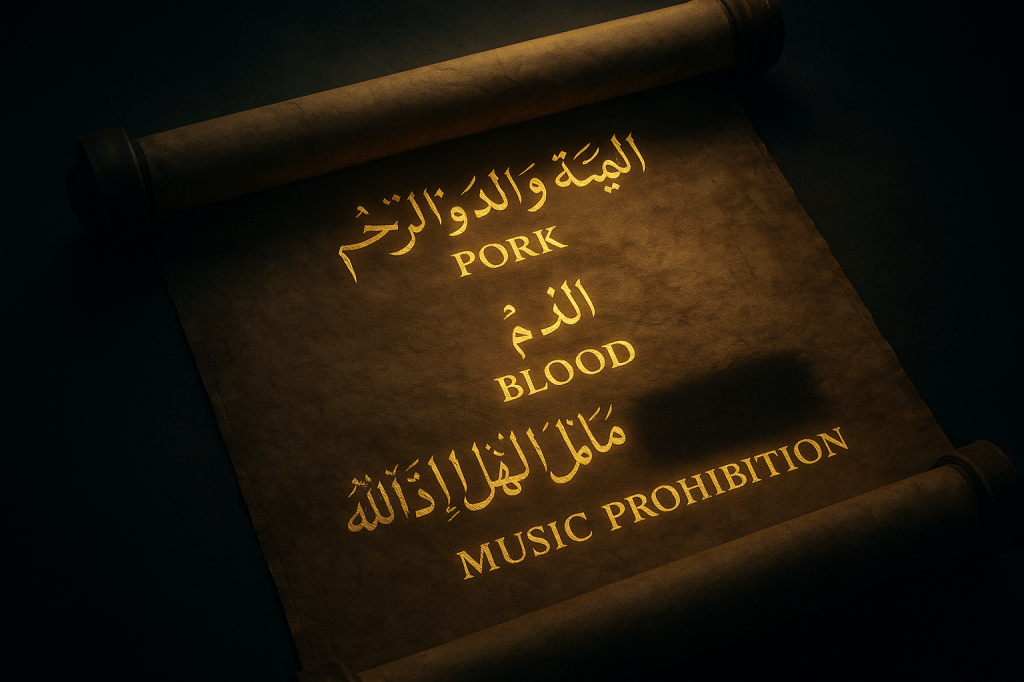
2:173 “He only prohibits for you the eating of animals that die of themselves (without human interference), blood, the meat of pigs, and animals dedicated to other than God. If one is forced (to eat these), without being malicious or deliberate, he incurs no sin. God is Forgiver, Most Merciful.”
This exact list is repeated in:
5:3 “Prohibited for you are animals that die of themselves, blood, the meat of pigs, and animals dedicated to other than God…”
6:145 “Say, ‘I do not find in the revelations given to me any food that is prohibited for any eater except: (1) carrion, (2) running blood, (3) the meat of pigs, for it is contaminated, and (4) the meat of animals blasphemously dedicated to other than God.’”
16:115 “He only prohibits for you dead animals, blood, the meat of pigs, and food which is dedicated to other than God. If one is forced (to eat these), without being deliberate or malicious, then God is Forgiver, Most Merciful.”
Notice the pattern: God repeats these prohibitions four times using clear, unambiguous language. There is no room for interpretation or confusion.
The Absence of Any Prohibition on Music
Now consider: In a scripture that spans 114 chapters and over 6,000 verses, containing detailed guidance on everything from inheritance law to personal hygiene, there is not a single verse that says:
- “Music is prohibited”
- “Do not listen to singing”
- “Musical instruments are forbidden”
- “Avoid melodies”
This silence is not an oversight. It is deliberate and meaningful.
Part 2: The Quranic Condemnation of Hadith
God Explicitly Condemns “Hadith” by Name
Far from being a legitimate source of religious law, the Quran repeatedly condemns following any hadith other than God’s:
77:50 “Which Hadith, other than this, do they uphold?”
45:6 “These are God’s revelations that we recite to you truthfully. In which Hadith other than God and His revelations do they believe?”
The footnote for verse 45:6 could not be clearer: “God condemns ‘Hadith’ by name, and informs us that it is a blasphemous fabrication.”
7:185 “Have they not looked at the dominion of the heavens and the earth, and all the things God has created? Does it ever occur to them that the end of their life may be near? Which Hadith, beside this, do they believe in?”
The Infamous “Music Verse” Actually Condemns Hadith
The verse most often misused to prohibit music actually condemns following fabricated hadith:
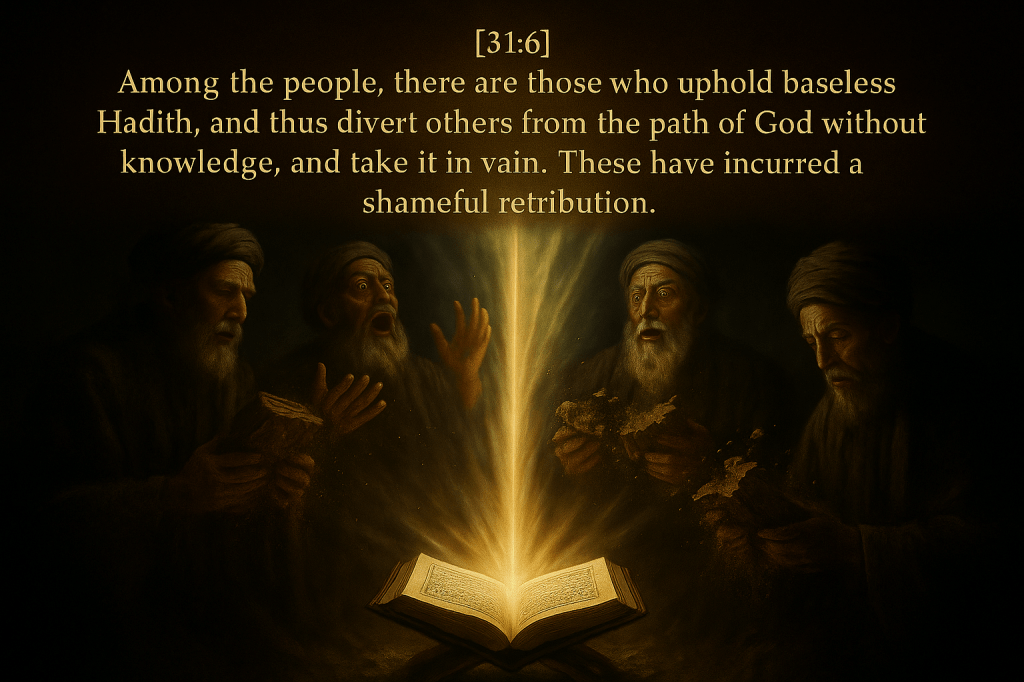
31:6 “Among the people, there are those who uphold baseless Hadith, and thus divert others from the path of God without knowledge, and take it in vain. These have incurred a shameful retribution.”
The phrase “lahw al-hadith” literally means “baseless/idle hadith” – not music! This verse condemns those who follow fabricated narrations that divert people from God’s path. Ironically, those who use this verse to prohibit music are guilty of exactly what the verse condemns: following baseless hadith instead of God’s clear words.
Part 3: The Quran is Complete and Fully Detailed
No Other Source of Law is Needed or Allowed
God states unequivocally that the Quran is complete and fully detailed:
6:114 “Shall I seek other than God as a source of law, when He has revealed to you this book fully detailed? Those who received the scripture recognize that it has been revealed from your Lord, truthfully. You shall not harbor any doubt.”
The footnote emphasizes: “Upholding any source beside the Quran reflects disbelief in the Quran.”
6:115 “The word of your Lord is complete, in truth and justice. Nothing shall abrogate His words. He is the Hearer, the Omniscient.”
10:37 “This Quran could not possibly be authored by other than God. It confirms all previous messages, and provides a fully detailed scripture. It is infallible; for it comes from the Lord of the universe.”
Following Other Sources is Idol Worship
7:3 “You shall all follow what is revealed to you from your Lord; do not follow any idols besides Him. Rarely do you take heed.”
When religious scholars create laws from hadith, they become idols who are followed instead of God:
42:21 “They follow idols who decree for them religious laws never authorized by God. If it were not for the predetermined decision, they would have been judged immediately. Indeed, the transgressors have incurred a painful retribution.”
The footnote for this verse is damning: “The [religion] of today’s [believers] has been so distorted, it has become a Satanic cult. The Ulama, or religious scholars, have added many extraneous laws, prohibitions, dress codes, dietary regulations, and religious practices never authorized by God.”
Part 4: The Grave Sin of Adding Prohibitions
God’s Stern Warning Against Fabricating Religious Laws
16:116 “You shall not utter lies with your own tongues stating: ‘This is lawful, and this is unlawful,’ to fabricate lies and attribute them to God. Surely, those who fabricate lies and attribute them to God will never succeed.”
This verse directly addresses those who declare music unlawful without God’s authorization. They are fabricating lies and attributing them to God – a crime that ensures they “will never succeed.”
5:87 “O you who believe, do not prohibit good things that are made lawful by God, and do not aggress; God dislikes the aggressors.”
Notice the word “aggress” – adding prohibitions that God did not ordain is an act of aggression against God’s law and His servants.
6:150 “Say, ‘Bring your witnesses who would testify that God has prohibited this or that.’ If they testify, do not testify with them. Nor shall you follow the opinions of those who reject our revelations, and those who disbelieve in the Hereafter, and those who stray away from their Lord.”

The Historical Pattern of False Prohibitions
3:93-94 “All food used to be lawful for the Children of Israel, until Israel imposed certain prohibitions on themselves before the Torah was sent down. Say, ‘Bring the Torah and read it, if you are truthful.’ Those who fabricate false prohibitions after this, and attribute them to God, are truly wicked.”
This shows that fabricating prohibitions has been a problem throughout history. Those who do so are labeled “truly wicked.”
10:59 “Say, ‘Did you note how God sends down to you all kinds of provisions, then you render some of them unlawful, and some lawful?’ Say, ‘Did God give you permission to do this? Or, do you fabricate lies and attribute them to God?’”
Part 5: God Has Made All Good Things Lawful
The Divine Principle of Permission
7:32 “Say, ‘Who prohibited the nice things God has created for His creatures, and the good provisions?’ Say, ‘Such provisions are to be enjoyed in this life by those who believe. Moreover, the good provisions will be exclusively theirs on the Day of Resurrection.’ We thus explain the revelations for people who know.”
This verse directly challenges anyone who prohibits “nice things God has created.” Music, as a source of joy, comfort, and artistic expression, certainly falls under “nice things.”
5:5 “Today, all good food is made lawful for you. The food of the people of the scripture is lawful for you…”
7:157 “(4) follow the messenger, the gentile prophet (Muhammad), whom they find written in their Torah and Gospel. He exhorts them to be righteous, enjoins them from evil, allows for them all good food, and prohibits that which is bad…”
The true messenger allows “all good food” (which in Arabic encompasses all good things), and only prohibits “that which is bad.” Since God never declared music bad or prohibited it, it remains among the good things that are lawful.

Part 6: Following Religious Scholars Instead of God
The Root of the Problem
9:31 “They have set up their religious leaders and scholars as lords, instead of God. Others deified the Messiah, son of Mary. They were all commanded to worship only one God. There is no god except He. Be He glorified, high above having any partners.”
The footnote explains: “If you consult a religious scholar about dietary prohibitions, or any religious practice, and he gives you an answer that is contrary to God’s teachings, and you follow his advice, you have set him up as a god.”
This is exactly what happens when people follow scholars who prohibit music based on hadith, despite God never prohibiting it in the Quran.
33:67 “They will also say, ‘Our Lord, we have obeyed our masters and leaders, but they led us astray.’”
On the Day of Judgment, those who followed their religious leaders’ fabricated prohibitions will blame them for leading them astray. But this excuse will not save them.
The Sects and Their Innovations
6:159 “Those who divide themselves into sects do not belong with you. Their judgment rests with God, then He will inform them of everything they had done.”
Different sects have different views on music – some prohibit all music, some allow only certain types, some permit vocals but not instruments. This division itself is condemned by God:
30:32 “(Do not fall in idol worship,) like those who divide their religion into sects; each party rejoicing with what they have.”
Part 7: The Reality of Conjecture-Based Religion
Following Assumptions Instead of Divine Guidance
10:36 “Most of them follow nothing but conjecture, and conjecture is no substitute for the truth. God is fully aware of everything they do.”
The prohibition of music is based entirely on conjecture – interpretations of ambiguous hadith, assumptions about what might distract from worship, and personal opinions of scholars. None of this constitutes divine law.
53:23 “These are but names that you made up, you and your forefathers. God never authorized such a blasphemy. They follow conjecture, and personal desire, when the true guidance has come to them herein from their Lord.”
Calling music “haram” (forbidden) when God never declared it so is making up religious terminology that “God never authorized.”
Part 8: The Hadith That Prohibit Music – A Case Study in Fabrication
Examples of Fabricated Narrations
While we rely solely on the Quran, it’s instructive to see how hadith collections contradict both the Quran and each other on this issue:
- Bukhari claims the Prophet said: “There will be people from my nation who will make lawful fornication, silk, alcohol, and musical instruments.” Notice how this hadith lumps music with actual Quranic prohibitions to give it false legitimacy.
- Muslim reports conflicting narrations – some saying the Prophet enjoyed singing, others claiming he forbade it.
- Different hadith collections prohibit different aspects: some ban all instruments, some only wind instruments, some allow drums, some forbid even that.
This confusion and contradiction is exactly what God warned about:
39:23 “God has revealed herein the best Hadith; a book that is consistent, and points out both ways (to Heaven and Hell)…”
The Quran is the only consistent hadith. All others lead to confusion and contradiction.
Part 9: The Angels Sing God’s Praises
Divine Approval of Vocal Expression
2:30 “Recall that your Lord said to the angels, ‘I am placing a representative (a temporary god) on Earth.’ They said, ‘Will You place therein one who will spread evil therein and shed blood, while we sing Your praises, glorify You, and uphold Your absolute authority?’ He said, ‘I know what you do not know.’”
The angels “sing” (نُسَبِّحُ) God’s praises. If singing were inherently evil, would the purest of God’s creatures engage in it? The Arabic root س ب ح (sabbaha) implies vocal glorification, often with melodic qualities.

Part 10: The Psychological Impact of False Prohibitions
Creating Guilt Where None Should Exist
When religious authorities prohibit what God has made lawful, they:
- Burden believers unnecessarily: Making life difficult when God intended ease
- Create false guilt: Making people feel sinful for enjoying God’s blessings
- Drive people away: Causing many to abandon religion due to unreasonable restrictions
- Distort God’s image: Portraying God as harsh and restrictive rather than Most Merciful
2:185 “God wises for you convenience, not hardship…”
5:101 “O you who believe, do not ask about matters which, if revealed to you prematurely, would hurt you…”
Part 11: What the Quran Actually Says About Distraction
The Real Concern: Balance, Not Prohibition
The Quran’s approach to potentially distracting activities is one of balance and priority, not blanket prohibition:
24:37 “People who are not distracted by business or trade from commemorating God; they observe the Contact Prayers (Salat), and give the obligatory charity (Zakat), and they are conscious of the day when the minds and the eyes will be horrified.”
Notice that business and trade are not prohibited, despite being potentially distracting. The righteous are those who maintain balance.
62:11 “When some of them come across a business deal, or some entertainment, they rush to it and leave you standing! Say, ‘What God possesses is far better than the entertainment or the business. God is the best Provider.’”
Even here, when people left Friday prayer for entertainment, God did not prohibit entertainment. He simply reminded them of priorities.

Part 12: The Complete List of Quranic Prohibitions
What God Actually Forbade
To put the music controversy in perspective, here is what God actually prohibited in the Quran:
Dietary Laws:
- Dead animals (carrion)
- Blood
- Pork
- Animals dedicated to other than God
Financial:
- Usury/Interest (2:275-276)
- Cheating in trade (83:1-3)
- Consuming orphans’ money (4:10)
Social/Sexual:
- Adultery (17:32)
- Homosexuality (7:80-81)
- Marrying certain relatives (4:23)
Behavioral:
- Murder (4:93, 5:32)
- Theft (5:38)
- False testimony (25:72)
- Intoxicants and gambling (5:90-91)
Spiritual:
- Idol worship (4:48)
- Attributing lies to God (16:116)
- Following conjecture in religion (53:23)
Notice: Music appears nowhere on this comprehensive list.
Part 13: The Consequences of Following Fabricated Religion
A Religion That Has Nothing to Do With God
Rashad Khalifa’s translation footnotes are frank about the state of corrupted religion:
42:21 Footnote “The [religion] of today’s [believers] has been so distorted, it has become a Satanic cult. The Ulama, or religious scholars, have added many extraneous laws, prohibitions, dress codes, dietary regulations, and religious practices never authorized by God.”
When we follow prohibitions that God never ordained, we are no longer following God’s religion. We are following a man-made cult that happens to use God’s name.
The Day of Reckoning
6:19 “Say, ‘Whose testimony is the greatest?’ Say, ‘God’s. He is the witness between me and you that this Quran has been inspired to me, to preach it to you and whomever it reaches. Indeed, you bear witness that there are other gods beside God.’ Say, ‘I do not testify as you do; there is only one god, and I disown your idolatry.’”
On the Day of Judgment, those who prohibited what God never prohibited will face this question: By whose authority did you legislate?

Part 14: The Path Forward – Returning to Pure Monotheism
Rejecting All Sources Besides the Quran
17:46 “We place shields around their minds, to prevent them from understanding it, and deafness in their ears. And when you preach your Lord, using the Quran alone, they run away in aversion.”
True believers accept the Quran alone, while those infected with idol worship run away when hadith and human opinions are excluded.
The Liberation of Following God Alone
When we abandon fabricated prohibitions and follow only what God revealed:
- We experience true freedom: Living by God’s reasonable laws, not human restrictions
- We find peace: No more confusion from contradictory sources
- We worship God alone: Not sharing our devotion with religious scholars
- We enjoy God’s blessings: Including the beauty of music and arts
39:45 “When God ALONE is mentioned, the hearts of those who do not believe in the Hereafter shrink with aversion. But when others are mentioned beside Him, they become satisfied.”
Conclusion: The Clear Truth
This comprehensive analysis reveals the undeniable truth:
- God never prohibited music – Not in a single verse among thousands
- The prohibition comes from hadith – Which God condemns by name
- Adding such prohibitions is a grave sin – Condemned repeatedly in the Quran
- The Quran is complete and fully detailed – Needing no supplementary sources
- God made all good things lawful – Only prohibiting what is harmful
- Following fabricated laws is idol worship – Setting up religious scholars as gods
The question of music in God’s religion has a clear answer: It was never prohibited by God. Those who claim otherwise are following a corrupted religion that has abandoned the Quran for human fabrications.
18:109 “Say, ‘If the ocean were ink for the words of my Lord, the ocean would run out, before the words of my Lord run out, even if we double the ink supply.’”
God’s words in the Quran are infinite in wisdom and complete in guidance. When He chose not to prohibit music among His detailed prohibitions, it was not an oversight – it was divine wisdom.
Final Reflection: Choose Your Path
6:114 “Shall I seek other than God as a source of law, when He has revealed to you this book fully detailed?”
The choice is yours: Follow the clear, complete, and fully detailed Quran, or follow the contradictory fabrications of human beings. But know that this choice has eternal consequences.
For those who choose to follow God alone, enjoy the beautiful music He never prohibited, and praise Him for His mercy in making lawful all good things. Let your heart sing with gratitude for a Lord who desires ease, not hardship, for His servants.
7:32 “Say, ‘Who prohibited the nice things God has created for His creatures, and the good provisions?’ Say, ‘Such provisions are to be enjoyed in this life by those who believe. Moreover, the good provisions will be exclusively theirs on the Day of Resurrection.’ We thus explain the revelations for people who know.”
Peace be upon those who follow the guidance – the true guidance found only in God’s preserved and perfect word: the Quran.


 Quran Only Studies
Leave a reply to Abdullah Cancel reply