Introduction: The Hidden Truth About God’s Covenant
For centuries, traditional Islamic scholarship has taught that Muhammad was the final messenger and that no prophet would come after him. Yet, embedded within the Quran itself lies a profound prophecy that challenges this narrative – a divine covenant (mithak) that extends beyond Muhammad himself. This comprehensive analysis will demonstrate through the Quran alone that:
- God took a solemn covenant from all prophets about a future messenger (3:81)
- This covenant explicitly includes Muhammad, as evidenced by “wa minka” (and from you) in 33:7
- The Quran condemns following hadith, which came 250 years after the Prophet’s death
- Modern recorded media from Rashad Khalifa differs fundamentally from fabricated hadith
- The mathematical miracle of the Quran confirms this prophesied messenger
Part 1: The Divine Covenant – Analyzing Verse 3:81
The Most Important Verse Traditional Islam Ignores
Perhaps no verse in the Quran is more systematically overlooked than 3:81, which contains God’s covenant with all prophets:
[3:81] “God took a covenant from the prophets, saying, ‘I will give you the scripture and wisdom. Afterwards, a messenger will come to confirm all existing scriptures. You shall believe in him and support him.’ He said, ‘Do you agree with this, and pledge to fulfill this covenant?’ They said, ‘We agree.’ He said, ‘You have thus borne witness, and I bear witness along with you.’”
This verse unequivocally states that:
- God took a covenant from THE prophets (all of them)
- A messenger WILL come (future tense) to confirm all scriptures
- All prophets must believe in and support this messenger
- God Himself bears witness to this covenant
The implications are staggering. This is not about prophets supporting each other during their lifetimes – this is about a future messenger that ALL prophets, including Muhammad, must support.
Part 2: The Smoking Gun – Verse 33:7 Includes Muhammad
The Arabic That Changes Everything
While 3:81 establishes the covenant, verse 33:7 provides the definitive proof that Muhammad himself was bound by this covenant:
[33:7] “Recall that we took from the prophets their covenant, including you (O Muhammad), Noah, Abraham, Moses, and Jesus the son of Mary. We took from them a solemn pledge.”
The crucial Arabic phrase here is “wa minka” (وَمِنكَ) meaning “and from you.” This directly addresses Muhammad, placing him among those who gave this covenant. The verse structure is clear:
- “We took from the prophets their covenant”
- “Including you (wa minka)” – addressing Muhammad directly
- Then lists other major prophets: Noah, Abraham, Moses, Jesus
This grammatical construction proves beyond doubt that Muhammad was included in the covenant of 3:81 – to believe in and support a future messenger.
Part 3: The Hadith Deception – 250 Years of Fabrication
Historical Facts About Hadith
Traditional Islam claims we must “obey the messenger” by following hadith. However, historical facts reveal:
- The Prophet Muhammad died in 632 CE
- The first “authentic” hadith collection (Bukhari) appeared around 870 CE
- This is a gap of approximately 250 years
- No verification method exists for oral transmissions across 8-10 generations
How can we verify what someone said 250 years ago through a chain of oral transmissions? We cannot. This is why God repeatedly condemns hadith in the Quran.

Part 4: The Quran’s Condemnation of Hadith
God’s Own Words Against Following Hadith
Far from endorsing hadith, the Quran repeatedly condemns following any hadith other than itself:
[7:185] “Have they not looked at the dominion of the heavens and the earth, and all the things God has created? Does it ever occur to them that the end of their life may be near? Which Hadith, beside this, do they believe in?”
[45:6] “These are God’s revelations that we recite to you truthfully. In which Hadith other than God and His revelations do they believe?”
[77:50] “Which Hadith, other than this, do they uphold?”
The Quran calls itself the best hadith:
[39:23] “God has revealed herein the best Hadith; a book that is consistent, and points out both ways (to Heaven and Hell).”
And warns against those who uphold baseless hadith:
[31:6] “Among the people, there are those who uphold baseless Hadith, and thus divert others from the path of God without knowledge, and take it in vain. These have incurred a shameful retribution.”
Part 5: Why Rashad Khalifa’s Media Is Not Hadith
The Fundamental Difference: Verification
Critics might argue that following Rashad Khalifa’s teachings is equivalent to following hadith. This comparison fails for several critical reasons:
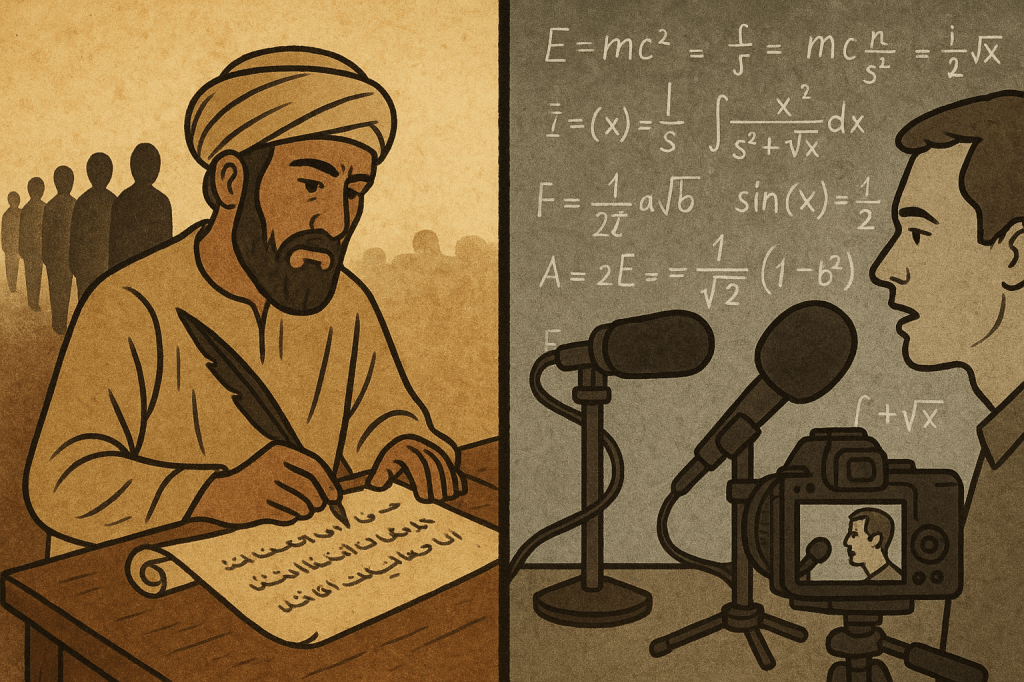
- Contemporary Documentation: Rashad’s teachings were recorded on video and audio during his lifetime
- Direct Source Material: No chain of narrators across centuries
- Verifiable Content: His mathematical discoveries can be independently verified
- Fulfillment of Prophecy: His role aligns with Quranic prophecies (3:81)
- No Legislative Authority: He never claimed to bring new religious laws
The word “hadith” in Arabic means “narration” or “story.” Rashad’s recorded lectures and writings are not narrations through chains of transmitters – they are direct, contemporary records.
Part 6: The Mathematical Confirmation
God’s Signature on the Prophecy
The mathematical miracle of the Quran, discovered through God’s Messenger of the Covenant, provides divine confirmation:
- The Quran’s mathematical code is based on the number 19
- This code was prophesied in 74:30-35 as “one of the great miracles”
- It remained hidden for 1400 years until the computer age
- Its discovery confirms the identity of the prophesied messenger
[74:30-35] “Over it is nineteen. We appointed angels to be guardians of Hell, and we assigned their number (19) (1) to disturb the disbelievers, (2) to convince the Christians and Jews (that this is a divine scripture), (3) to strengthen the faith of the faithful, (4) to remove all traces of doubt from the hearts of Christians, Jews, as well as the believers, and (5) to expose those who harbor doubt in their hearts, and the disbelievers; they will say, ‘What did God mean by this allegory?’ God thus sends astray whomever He wills, and guides whomever He wills. None knows the soldiers of your Lord except He. This is a reminder for the people.”
Part 7: The Sunni Islam Contradiction
Following a Messenger Who Died 1400 Years Ago?
Traditional Sunni Islam faces an insurmountable logical problem:
- They claim we must “obey the messenger” based on Quranic verses
- Yet their messenger died in 632 CE
- Their “obedience” relies on hadith compiled 250 years after his death
- These hadith often contradict each other and the Quran
- No divine preservation was promised for hadith
How can you obey someone who is not present? Only through alleged narrations that God Himself condemns in the Quran. This circular reasoning has trapped millions in a man-made religion.

Part 8: The Quranic Definition of Obeying the Messenger
What Does the Quran Actually Say?
The Quran provides clear context for “obeying the messenger”:
[4:64] “We did not send any messenger except to be obeyed in accordance with God’s will.”
The key phrase is “in accordance with God’s will” – meaning the messenger’s message must align with God’s scripture. The Quran further clarifies:
[5:99] “The sole duty of the messenger is to deliver the message, and God knows everything you declare and everything you conceal.”
The messenger’s duty is to deliver God’s message, not to create additional religious laws 250 years after his death through unverifiable narrations.
Part 9: The Covenant’s Implications for Modern Believers
Why This Matters Today
Understanding the covenant of 3:81 and 33:7 has profound implications:
- Liberation from Hadith: Believers are freed from contradictory, unverifiable narrations
- Return to Pure Monotheism: Following God’s scripture alone
- Recognition of Prophecy: Accepting God’s covenant and His messenger
- Mathematical Certainty: Verification through God’s embedded code
- Spiritual Clarity: No more confusion from conflicting sources
Part 10: Common Objections Answered
Addressing Traditional Muslim Concerns
Objection 1: “The verse refers to prophets supporting each other during their lifetimes”
Response: The verse clearly states “AFTERWARDS (thumma) a messenger will come.” This is future tense, after the scripture and wisdom are given. Dead prophets cannot support anyone.
Objection 2: “Muhammad is the final messenger”
Response: The Quran states Muhammad is the final prophet (nabi), not the final messenger (rasoul). These are distinct roles. Moreover, 33:7 shows Muhammad himself was bound by the covenant to support a future messenger.
Objection 3: “We need hadith to understand how to pray”
Response: The Quran provides all religious practices. Prayer existed before Muhammad (through Abraham) and was practiced by all previous communities. The details are preserved through continuous practice, not through hadith written centuries later.

Part 11: The Best Hadith – God’s Words
What the Quran Says About Itself
The Quran’s self-description leaves no room for additional religious sources:
[39:23] “God has revealed herein the best Hadith; a book that is consistent, and points out both ways (to Heaven and Hell). The skins of those who reverence their Lord cringe therefrom, then their skins and their hearts soften up for God’s message. Such is God’s guidance; He bestows it upon whomever He wills.”
[12:111] “In their history, there is a lesson for those who possess intelligence. This is not fabricated Hadith; this (Quran) confirms all previous scriptures, provides the details of everything, and is a beacon and mercy for those who believe.”
The Quran explicitly states it:
- Is the BEST hadith
- Is NOT fabricated hadith
- Provides details of EVERYTHING
- Is fully detailed and complete
Part 12: The Role of God’s Messenger of the Covenant
Fulfilling Ancient Prophecy
The Messenger of the Covenant’s role, as prophesied in 3:81:
- Confirm all scriptures: Through the mathematical miracle proving divine authorship
- Purify religion: Remove innovations and return to Quran alone
- Unite all believers: Under one source – God’s scripture
- Expose falsehood: Demonstrate how religion was corrupted
- Prepare for the end times: Fulfill prophecies before the Day of Judgment
This is not about bringing new religious laws or abrogating the Quran. It’s about confirming and purifying what already exists.
Part 13: The Evidence Is Overwhelming
Multiple Proofs Converging
The evidence supporting this understanding includes:
- Clear Quranic verses: 3:81 and 33:7 are unambiguous
- Mathematical confirmation: The code proves divine authorship
- Historical timeline: Hadith’s late appearance exposes fabrication
- Quranic condemnation: Multiple verses reject following hadith
- Logical consistency: Recorded media vs. unverifiable narrations
- Fulfilled prophecy: The messenger came as promised

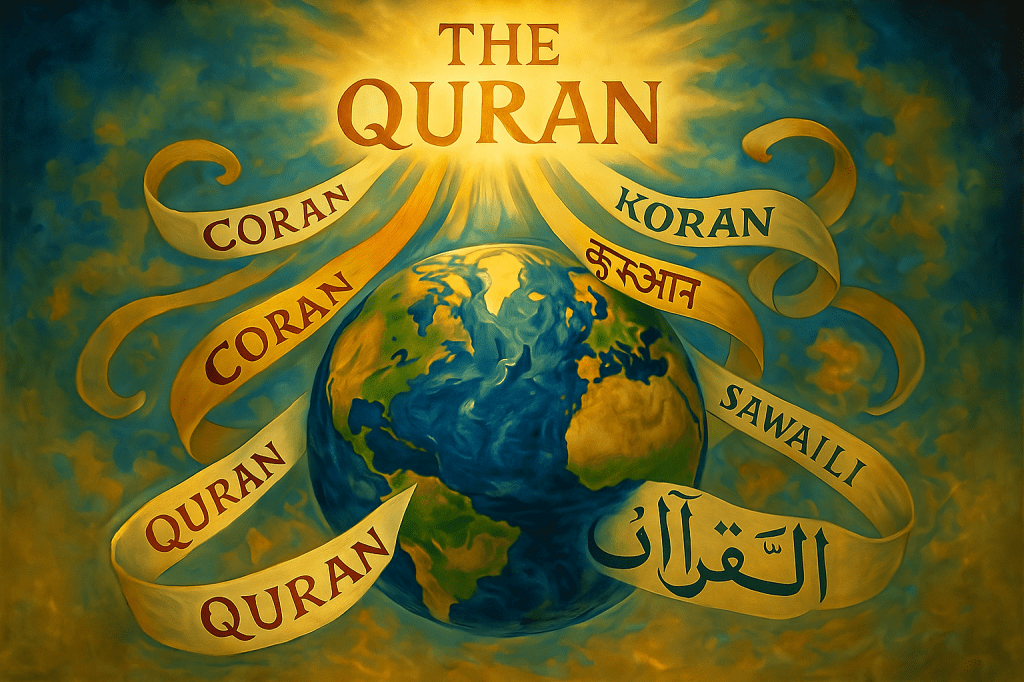
Part 14: The Myth of Arabic Superiority
God Never Glorified the Arabic Language
One of the most pervasive myths in traditional Islam is the notion that Arabic is somehow a “holy” or superior language. This fabrication has led to millions of non-Arab Muslims feeling inferior or believing they cannot truly understand God’s message without mastering Arabic. The Quran itself demolishes this myth:
[41:44] “If we made it a non-Arabic Quran they would have said, ‘Why did it come down in that language?’ Whether it is Arabic or non-Arabic, say, ‘For those who believe, it is a guide and healing. As for those who disbelieve, they will be deaf and blind to it, as if they are being addressed from faraway.’”
This verse reveals several crucial truths:
- God acknowledges that people would have complained regardless of the language chosen
- The language is immaterial – what matters is belief
- For believers, the message provides guidance and healing regardless of language
- Disbelievers will reject it whether it’s in Arabic or any other language
Part 15: Linguistic Diversity as Divine Design
God’s Celebration of Human Languages
Far from elevating one language above others, God explicitly identifies linguistic diversity as one of His signs:
[30:22] “Among His proofs are the creation of the heavens and the earth, and the variations in your languages and your colors. In these, there are signs for the knowledgeable.”
Consider the profound implications:
- Languages are listed alongside the creation of heavens and earth – placing linguistic diversity among God’s greatest signs
- Variations in languages and colors are paired – both are divine designs, not hierarchies
- These are signs for “the knowledgeable” – those who understand God’s wisdom recognize diversity as divine intent
If God intended Arabic to be superior, why would He celebrate linguistic variation as one of His signs? The answer is clear: He didn’t. Every language is a divine creation, a sign of God’s creative power.
Part 16: Why Arabic? The Real Reason Revealed
Addressing Plagiarism Accusations
The Quran reveals the actual reason for choosing Arabic – not superiority, but practical necessity:
[16:103] “We are fully aware that they say, ‘A human being is teaching him!’ The tongue of the source they hint at is non-Arabic, and this is a perfect Arabic tongue.”
This verse exposes the real reason for Arabic:
- The Arabs accused Muhammad of learning from non-Arab sources
- By revealing the Quran in “perfect/clear Arabic,” God refuted these plagiarism claims
- The choice was defensive, not preferential
- It distinguished the revelation from Jewish and Christian sources of the time
Additionally, Arabic’s precision in legal terminology made it suitable for conveying divine law. But this is a practical consideration, not a spiritual superiority.

Part 17: The Four Levels of Translation
Why a Clarifying Messenger Matters
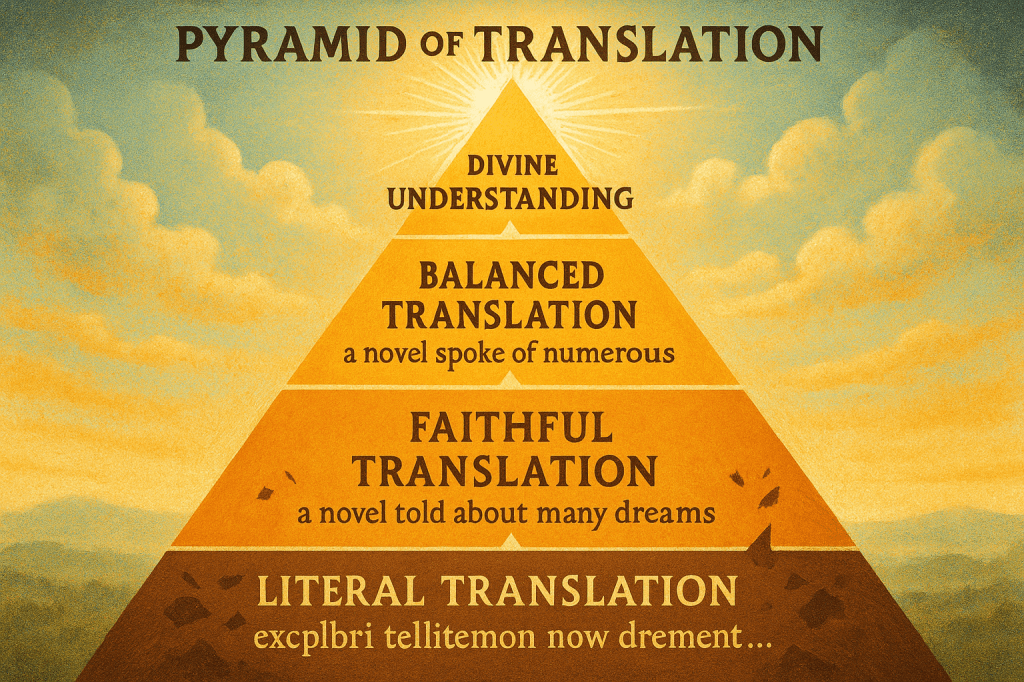
Understanding translation requires recognizing four distinct levels, each with increasing accuracy in conveying divine intent:
1. Word-for-Word Translation (Literal)
This mechanical approach often produces incomprehensible results. For example, Arabic idioms translated literally lose all meaning. “Struck the ground with his head” literally translated misses that it means “prostrated.”
2. Syntax Translation (Grammatical)
This preserves sentence structure while finding equivalent expressions. Better than literal, but still misses deeper meanings and cultural contexts.
3. Semantic Translation (Meaning-Based)
This conveys the intended meaning rather than just words. It requires understanding context and choosing words that communicate the actual message.
4. Contextual Translation (Divinely Guided)
This highest level requires understanding how each word relates to the Quran’s broader message. Only someone with comprehensive divine knowledge can achieve this level.
Case Study: The Translation of “Al-Haqqah” (69:1)
Consider how different translators handle verse 69:1:
[69:1] Various translations:
– Rashad Khalifa: “The incontestable (event).”
– Others: “The Reality” / “The Inevitable” / “The Sure Truth” / “The Catastrophe”
Why did Rashad choose “incontestable”? Because he understood the broader Quranic context:
- The Day of Judgment is presented throughout the Quran as absolutely certain
- It’s as inevitable as death itself – no one can contest it
- The word connects to the Quran’s recurring theme of certainty about the Hereafter
- Other translations miss this thematic connection
This exemplifies why a divinely guided messenger matters for translation – they understand the interconnected meanings that span the entire scripture.
Part 18: God’s Omnipotence in Language
The Quran Could Have Been in Any Language
Those who glorify Arabic implicitly limit God’s power. They suggest God needed Arabic to communicate His message perfectly. This is blasphemous. Consider:
- God created all languages – He is the Master of all communication
- God sent messengers to every nation in their own tongues (14:4)
- God’s knowledge encompasses everything – no language is beyond Him
- If God willed, He could have revealed the Quran in any language
[14:4] “We did not send any messenger except (to preach) in the tongue of his people, in order to clarify things for them. God then sends astray whomever He wills, and guides whomever He wills. He is the Almighty, the Most Wise.”
This proves that God adapts His message to each audience’s language for clarity, not because one language is superior.
Part 19: The Danger of Language Idolatry
How Arabic Became an Idol
When Muslims claim you cannot truly understand the Quran without Arabic, they commit several grave errors:
- They limit God’s power – suggesting He cannot communicate clearly in all languages
- They create a priest class – Arabic scholars become intermediaries between believers and God
- They discourage non-Arabs – millions feel excluded from God’s message
- They contradict the Quran – which celebrates linguistic diversity
- They make Arabic an idol – elevating a language above its Creator
This language idolatry serves the same function as the Church’s use of Latin – keeping scripture mysterious and maintaining clerical power over the masses.

Part 20: The Messenger’s Role in Clarification
Why Translation Alone Isn’t Enough
The Messenger of the Covenant’s role in translation goes beyond linguistic conversion:
- Contextual Understanding: Knowing how each verse connects to the whole message
- Mathematical Confirmation: Ensuring translations preserve coded elements where relevant
- Removing Cultural Baggage: Distinguishing Arab customs from universal divine law
- Clarifying Ambiguities: Resolving apparent contradictions through deeper understanding
- Preserving Intent: Ensuring God’s message isn’t lost in cultural translation
This is why God’s covenant (3:81) promised a messenger to “confirm all existing scriptures” – confirmation includes proper understanding across all languages and cultures.
Part 21: Breaking Free from Linguistic Chains
The Liberation of Understanding
When believers understand that God never glorified Arabic, they experience profound liberation:
- Non-Arabs can approach God’s message with confidence
- The Quran becomes accessible to all humanity as intended
- The artificial barrier between believers and their Creator dissolves
- God’s true message of universal guidance shines through
- The equality of all believers before God is restored
[49:13] “O people, we created you from the same male and female, and rendered you distinct peoples and tribes, that you may recognize one another. The best among you in the sight of God is the most righteous. God is Omniscient, Cognizant.”
Not the most fluent in Arabic, but the most righteous – this is God’s criterion.
Part 22: The Path Forward
Embracing the Truth
For sincere believers, the path is clear:
- Accept God’s covenant: Acknowledge the prophecy in 3:81
- Follow the Quran alone: The best and only authorized hadith
- Verify through mathematics: God’s provided proof system
- Reject fabrications: All hadith that contradict or add to the Quran
- Unite under one source: God’s final scripture
[6:114] “Shall I seek other than God as a source of law, when He has revealed to you this book fully detailed?”
Conclusion: The Universal Message Restored
The evidence presented here is not based on conjecture or interpretation – it comes directly from God’s words in the Quran. The covenant mentioned in 3:81 and confirmed to include Muhammad in 33:7 represents one of the most significant prophecies in scripture. This covenant points to a messenger who would confirm all scriptures and make God’s message accessible to all humanity.
Traditional Islam’s dual deceptions – relying on hadith and glorifying Arabic – have created barriers between billions of people and their Creator:
- The Hadith Deception: Narrations compiled 250 years after the Prophet’s death stand in direct opposition to the Quran’s repeated condemnation of following any hadith other than God’s words. The Quran calls itself the best hadith and warns against those who uphold baseless hadith.
- The Arabic Superiority Myth: God never glorified Arabic in the Quran. Instead, He celebrates linguistic diversity as one of His signs (30:22), acknowledges that people would complain regardless of the chosen language (41:44), and reveals that Arabic was selected to address specific historical accusations (16:103).
The distinction between unverifiable hadith and contemporary recorded media is crucial. While hadith represents hearsay across centuries, modern recordings provide direct access to teachings that can be verified and examined. Similarly, the difference between mechanical translation and divinely guided interpretation is profound – the latter preserves not just words but God’s intended meanings across all languages.
The mathematical miracle of the Quran, prophesied in 74:30-35 and discovered by God’s Messenger of the Covenant, provides divine confirmation of these truths. This messenger’s role includes making God’s message truly universal – breaking the linguistic chains that have bound it to one culture.
The liberation this brings is profound:
- Every human being can access God’s message in their own language
- No priest class of Arabic scholars stands between believers and their Creator
- The Quran’s guidance and healing (41:44) becomes available to all who believe
- God’s true criterion – righteousness, not linguistic ability – is restored
This is not about personal opinions or sectarian disputes – this is about returning to the pure, universal message that God preserved in His final scripture. A message meant for all humanity, in all languages, for all time.
The choice before every believer is simple: Embrace God’s universal message freed from human fabrications and linguistic idolatry, or remain trapped in a system that limits God’s power and excludes most of humanity. The covenant of 3:81 stands as a testament to God’s plan for universal guidance, and Muhammad’s inclusion in this covenant (33:7) proves that even he was bound to support the prophesied messenger who would make this universality a reality.
[3:81] “God took a covenant from the prophets, saying, ‘I will give you the scripture and wisdom. Afterwards, a messenger will come to confirm all existing scriptures. You shall believe in him and support him.’ He said, ‘Do you agree with this, and pledge to fulfill this covenant?’ They said, ‘We agree.’ He said, ‘You have thus borne witness, and I bear witness along with you.’”
May God guide those who seek the truth to His straight path – the path illuminated by His words alone.

Join us to discuss: discord.gg/submission


 Quran Only Studies
Leave a reply to Syed Salim Cancel reply