
Introduction: The Most Critical Decision in Worship
Every time you stand for the Contact Prayer (Salat), you make a choice that echoes through eternity. Behind whom will you pray? With whom will you establish your connection to the Almighty? This isn’t merely a matter of convenience or community – it’s a decision that determines whether your worship reaches God or falls into the abyss of nullification.
In an age where religious compromise has become normalized, where “unity” is often valued over truth, and where social pressure pushes believers to pray anywhere with anyone, this comprehensive analysis will demonstrate through Quranic evidence why praying behind a non-submitter is not just inadvisable – it’s categorically forbidden by God Himself.
Part 1: Defining the Non-Submitter – Four Categories of Spiritual Deviation
The Quranic Classification System
Before we can understand why praying behind certain individuals is forbidden, we must first identify who qualifies as a “non-submitter.” The Quran provides crystal-clear categories:
1. Idolaters (Mushriks) – The Majority Who Think They Believe
[12:106] “The majority of those who believe in God do not do so without committing idol worship.”
This shocking revelation exposes the reality that most people who claim belief in God are actually idolaters. They may say “La ilaha illa Allah” (There is no god but God), but their hearts and practices tell a different story. They:
- Call upon Prophet Muhammad, Jesus, or saints alongside God
- Believe religious leaders can intercede for them
- Follow hadith and sunnah as divine law equal to Quran
- Attribute divine qualities to human beings
- Seek help from dead saints at shrines

2. Disbelievers (Kāfirs) – Those Who Reject Outright
[2:6] “As for those who disbelieve, it is the same for them; whether you warn them, or not warn them, they cannot believe.”
Disbelievers are perhaps the most straightforward category – they openly reject God’s existence or His messages. As clarified in a profound exchange: “Robert: in that case the only people that would be disbelievers are essentially atheist. Rashad: yes, exactly… the vast majority of people are hypocrites” (March 10, 1989, at 1:05:49). This includes:
- Atheists who deny God entirely
- Agnostics who claim God cannot be known
- Those who mock religious faith
- People who actively oppose divine guidance
3. Hypocrites (Munāfiqūn) – The Most Dangerous Category
[2:8] “Then there are those who say, ‘We believe in God and the Last Day,’ while they are not believers.”
[4:145] “The hypocrites will be in the lowest depths of Hell, and you will find no one to help them.”
Hypocrites are the most insidious because they appear as believers while harboring disbelief or idolatry. As Dr. Khalifa explained: “hypocrisy is lack belief, they go along with whatever group they’re in, they’re really worshiping their own ego…These are the three kind of people: believers, disbelievers and hypocrites” (March 10, 1989, at 24:07). They:
- Attend prayers but worship their own egos
- Use religion for social status or financial gain
- Secretly mock true believers
- Spread doubt and division among the faithful
- Maintain religious appearance while violating core principles
4. Compromisers (Qāsiṭūn) – Those Who Mix Truth with Falsehood
[72:14-15] “‘Among us are those who are submitters, and among us are those who are compromisers. As for those who submit, they are on the right path. As for the compromisers, they will be fuel for Gehenna.’”
Compromisers represent those who try to have it both ways – partial submission mixed with personal preferences. They:
- Accept some Quranic teachings while rejecting others
- Modify religious practices to fit social norms
- Create “moderate” versions of God’s clear commands
- Prioritize cultural traditions over divine guidance
- Seek middle ground between truth and falsehood

Part 2: Understanding the Masjid – A Spiritual Reality, Not a Building
The Revolutionary Quranic Definition
One of the most profound revelations in understanding this issue is recognizing what a “masjid” truly is according to the Quran. The word comes from the root س-ج-د (s-j-d), meaning “to prostrate,” and refers not to a physical structure but to a spiritual reality. As Dr. Rashad Khalifa emphatically stated: “Places of worship is in the acts of worship” (May 19, 1989, at 1:19:19).
Consider how the Quran distinguishes between the physical and the spiritual:
[9:107] “There are those who abuse the masjid by practicing idol worship, dividing the believers, and providing comfort to those who oppose God and His messenger. They solemnly swear: ‘Our intentions are honorable!’ God bears witness that they are liars.”
[9:108] “You shall never pray in such a masjid. A masjid that is established on the basis of righteousness from the first day is more worthy of your praying therein. In it, there are people who love to be purified. God loves those who purify themselves.”
Notice how the verse uses both “masjid” and “building” (bun’yān), clearly showing that a masjid is not defined by its physical architecture but by the spiritual intention and practice within it.
The Act Creates the Space
A masjid comes into existence through the act of prostration and worship, not through construction permits and architectural plans. When you perform Salat:
- You create a sacred space through your worship
- The spiritual quality depends on your devotion
- The legitimacy relies on to whom you direct your prayer
- The validity requires absolute dedication to God alone
[72:18] “The places of worship (masājid) belong to God; do not call on anyone else beside Him.”
This verse establishes the fundamental principle: any “masjid” where others are invoked alongside God is not a true masjid at all – it’s a place of shirk (idolatry).

Part 3: The Authority of Leadership – Who Truly Establishes the Prayer?
The Imam as Spiritual Architect
The Quran makes clear that the one who leads the prayer holds special responsibility and authority:
[4:102] “When you are with them, and lead the Contact Prayer (Salat) for them, let some of you stand guard…”
The Arabic verb used here, ‘aqamta’ (أَقَمْتَ), carries profound meaning. While often translated as “lead,” its root meaning throughout the Quran is “to establish,” “to make stand,” or “to maintain.” This is the same root used in:
[2:43] “You shall observe (aqīmū) the Contact Prayers (Salat)…”
The Leader Defines the Spiritual Space
When someone leads the prayer, they don’t just coordinate movements – they establish the entire spiritual framework. As explained in detail: “In the group prayer one person leads and the rest of the group stands behind the imam and do exactly what he does” (at 1:01:48). This leadership role carries immense spiritual responsibility:
- They set the intention – To whom is this prayer directed?
- They establish the focus – Is it purely for God or compromised?
- They create the masjid – Through their leadership and devotion
- They bear responsibility – For all who follow them
This is why the question of who leads is not trivial – it determines whether you’re participating in true worship or spiritual deviation.
Part 4: The Corruption of Compromised Leadership
When Non-Submitters Lead: A Spiritual Catastrophe
What happens when someone who doesn’t worship God alone leads the prayer? The Quran provides a chilling answer:
[9:107] “There are those who abuse the masjid by practicing idol worship, dividing the believers, and providing comfort to those who oppose God and His messenger.”
Even if they perform the physical movements perfectly, even if they recite the same words, the spiritual reality is devastating:
1. The Prayer Causes Harm
Instead of connecting to God, it reinforces false beliefs and practices. Every prostration behind an idolater strengthens the system of shirk.
2. It Promotes Disbelief
By accepting their leadership, you validate their deviation. Your participation becomes an endorsement of their corruption.
3. It Divides Believers
True submitters are forced to choose between social acceptance and divine commandments, creating painful divisions.
4. It Provides Comfort to God’s Enemies
The verse specifically mentions providing “comfort” – not just agreement – to those who oppose God and His messenger. Simply praying behind them offers this comfort.

Part 5: The Deception of Outward Similarity
Why Perfect Form Cannot Mask Corrupted Faith
One of the most dangerous deceptions is believing that if someone performs the prayer movements correctly and recites the right words, it doesn’t matter what they believe. The Quran demolishes this misconception:
[39:45] “When God ALONE is mentioned, the hearts of those who do not believe in the Hereafter shrink with aversion. But when others are mentioned beside Him, they become satisfied.”
This verse provides a litmus test. When a true submitter says “God alone,” their heart expands with joy. When an idolater says the same words, their heart contracts because they’re thinking of their saints, prophets, or scholars alongside God.
The Reality Behind the Recitation
Consider what happens during prayer with different types of non-submitters:
When an Idolater Leads:
- They say “Guide us in the straight path” while believing Muhammad or Jesus is the guide
- They proclaim “You alone we worship” while their heart invokes saints
- They declare “You alone we ask for help” while believing in intercession
- Every verse becomes a lie in their mouth
When a Hypocrite Leads:
- They go through motions for social standing
- Their “worship” is actually self-worship
- They seek praise from people, not God
- The prayer becomes a performance, not worship
[25:43] “Have you seen the one whose god is his own ego? Will you be his advocate?”
When a Disbeliever Leads (Theoretical):
- The words are empty sounds without belief
- There’s no connection to the Divine
- It’s merely cultural participation
- The prayer is spiritually dead

Part 6: The Divine Prohibition – God’s Clear Command
The Unequivocal Quranic Ruling
After understanding the spiritual realities, we arrive at God’s explicit command:
[9:108] “You shall never pray in such a masjid. A masjid that is established on the basis of righteousness from the first day is more worthy of your praying therein. In it, there are people who love to be purified. God loves those who purify themselves.”
The Arabic “la taqum fīhi abadan” (لَا تَقُمْ فِيهِ أَبَدًا) means “do not stand in it ever.” This is not a suggestion or recommendation – it’s a divine prohibition. The word “abadan” (ever/never) makes it absolute and eternal. As Dr. Khalifa emphasized: “la taqum fihi abadan-you shall never pray in there (not God alone masjid) a very strong commandment” (December 28, 1989, at 1:28:27).
The Crime of Cooperation
But the prohibition goes deeper than just avoiding corruption. The Quran commands:
[5:2] “…You shall cooperate in matters of righteousness and piety; do not cooperate in matters that are sinful and evil. You shall observe God. God is strict in enforcing retribution.”
When you pray behind a non-submitter:
- You cooperate in their shirk (idolatry)
- You validate their false authority
- You strengthen their illegitimate institution
- You become complicit in misleading others
- You violate God’s direct command
Part 7: Common Objections and Their Refutation
Addressing the Arguments for Compromise
Objection 1: “But they’re praying to the same God!”
Response: Are they really? When someone invokes Prophet Muhammad or Jesus alongside God, when they believe in intercession, when they follow hadith as divine law – are they truly praying to the same God who declares:
[72:18] “The places of worship belong to God; do not call on anyone else beside Him.”
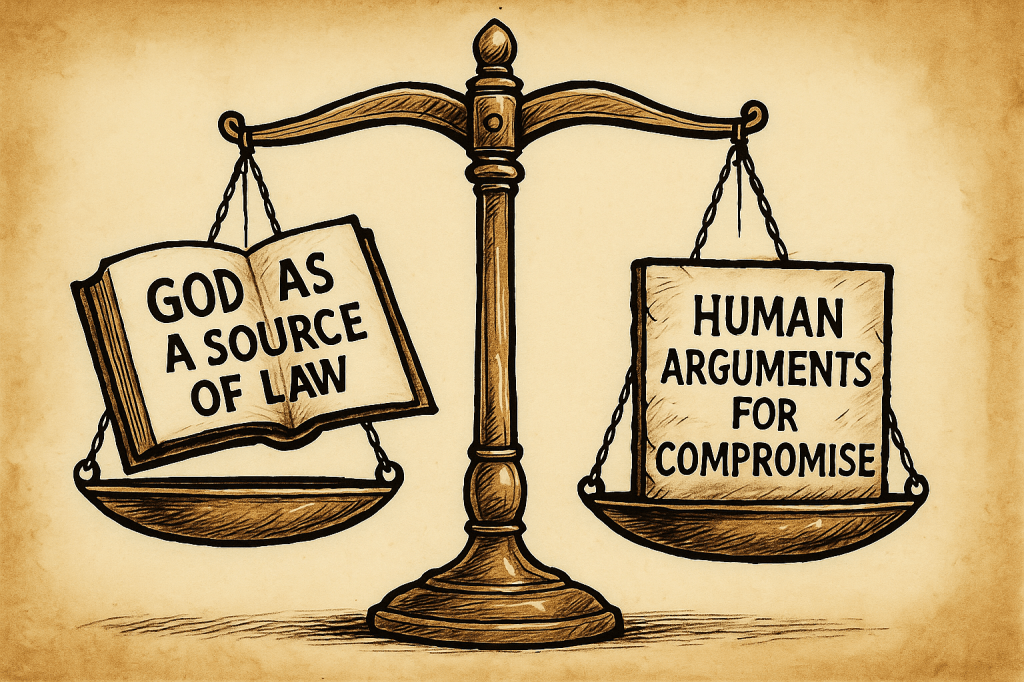
Objection 2: “We should maintain unity in the community!”
Response: Unity in falsehood is not unity – it’s collective deviation. The Quran prioritizes truth over false unity:
[3:103] “You shall hold fast to the rope of God, all of you, and do not be divided…”
The “rope of God” is His pure guidance, not compromised traditions. True unity comes from united submission to God alone.
Objection 3: “It’s better to pray in congregation than alone!”
Response: Not when the congregation is led by those who violate God’s fundamental requirement:
[7:29] “Say, ‘My Lord advocates justice, and to stand devoted to Him alone at every place of worship. You shall devote your worship absolutely to Him alone.’”
A corrupted congregation prayer is worth less than nothing – it incurs sin rather than reward. Dr. Khalifa warned in a July 1987 sermon: “heedless prayer results in a grave sin…must make sure your salat is perfect…have to direct it to God alone” (July 1987, from 24:00-32:24).
Objection 4: “How can we judge what’s in someone’s heart?”
Response: We don’t need to read hearts when actions and beliefs are manifest:
- Do they follow hadith and sunnah? = Not submitting to God alone
- Do they invoke Muhammad in prayers? = Clear idolatry
- Do they believe in intercession? = Rejecting God’s sovereignty
- Do they claim scholars’ opinions override Quran? = Making partners with God
Part 8: The Historical Lesson – Masjid Ad-Dirar
When God Ordered a Mosque Destroyed
The Quran provides a historical precedent that should shake every believer to their core. During Prophet Muhammad’s time, a group built a mosque (Masjid ad-Dirar) with seemingly religious intentions. Yet God revealed:
[9:107] “There are those who abuse the masjid by practicing idol worship, dividing the believers, and providing comfort to those who oppose God and His messenger. They solemnly swear: ‘Our intentions are honorable!’ God bears witness that they are liars.”
God commanded the Prophet to:
- Never pray in it
- Have it destroyed
- Establish that only mosques founded on righteousness deserve standing
If God ordered the destruction of a physical mosque because of the intentions and beliefs of those who built it, what about the spiritual “mosques” created by non-submitters today?
Part 9: The Practical Reality – Where Can True Submitters Pray?
Creating Spaces of Pure Worship
Given these divine requirements, where can those who submit to God alone pray?
1. In Your Home
[2:187] “…These are God’s laws; you shall not transgress them…”
Your home becomes a masjid when you establish prayer there. No corrupted imam, no compromised congregation – just you and your Creator.
2. With Other True Submitters
Seek out those who:
- Worship God alone without partners
- Follow the Quran alone as religious law
- Reject intercession and sainthood
- Accept God’s verses without reservation
3. In Nature
[2:115] “To God belongs the east and the west; wherever you go there will be the presence of God. God is Omnipresent, Omniscient.”
A park, a beach, a mountain – anywhere you can connect with God without the corruption of false religious authorities.
4. Establish New Congregations
Rather than compromising with corruption, establish new spaces dedicated to pure monotheistic worship. This is what believers have done throughout history when faced with deviation.
Part 10: The Consequences – What’s Really at Stake
The Price of Compromise
This isn’t about religious sectarianism or creating division for its own sake. The stakes are eternal:
1. Nullified Worship
[39:65] “It has been revealed to you, and to those before you that if you ever commit idol worship, all your works will be nullified, and you will be with the losers.”
Every prayer behind an idolater risks nullification. Instead of gaining reward, you accumulate sin.
2. Shared Responsibility
[4:85] “Whoever intercedes for a good cause receives a share of the credit thereof, and whoever intercedes for an evil cause, incurs a share thereof…”
By following their lead in prayer, you share in their deviation.
3. Supporting Falsehood
Your presence legitimizes their authority and encourages others to follow their corrupted path.
4. Divine Displeasure
You knowingly violate God’s explicit command in [9:108], inviting His displeasure.
Part 11: The Messenger’s Guidance – Rashad Khalifa’s Clarification
The Modern Context
Dr. Rashad Khalifa, the Messenger of the Covenant, brought crucial clarification for our era. His unwavering stance on Quranic authority was clear when challenged: “(Hamid argues with MOC) Once I show you something in the Quran I expect you to say this is what God says, I accept” (at 36:52). His core message aligns perfectly with Quranic teaching:
- The vast majority claiming Islam are actually hypocrites following cultural religion
- True submission requires abandoning all sources besides Quran
- Places of worship must be devoted to God ALONE
- Establishing proper worship takes precedence over communal harmony
His establishment of Masjid Tucson demonstrated the practical application – when existing institutions are corrupted, establish new ones based on pure monotheism.
Part 12: A Call to Courage – Standing for Truth
The Test of Our Time
In an age where religious compromise is normalized, where “moderate Islam” means accepting some Quran and some hadith, where unity is valued over truth, God tests us:
[29:2-3] “Do the people think that they will be left to say, ‘We believe,’ without being put to the test? We have tested those before them, for God must distinguish those who are truthful, and He must expose the liars.”
Will you stand alone with truth or sit in crowds with falsehood? Will you maintain pure worship or compromise for social acceptance?
The Path Forward
- Recognize Reality: Most claiming submission are actually idolaters or hypocrites
- Verify Leadership: Before praying behind anyone, verify their beliefs and practices
- Choose Courageously: Better to pray alone in truth than in congregation with falsehood
- Establish Truth: Create or join communities devoted to God alone
- Maintain Standards: Never compromise on the fundamental requirement of monotheism

Conclusion: The Sacred Boundary That Protects Pure Worship
The prohibition against praying behind non-submitters isn’t arbitrary religious exclusivism – it’s divine protection for the most sacred act of worship. When you understand that:
- A masjid is created by the act of worship, not by buildings
- The leader establishes the spiritual framework
- Non-submitters cannot establish legitimate worship
- Participation equals cooperation in sin
- God explicitly forbids standing in corrupted “mosques”
The conclusion becomes inescapable: It is absolutely forbidden to pray behind anyone who does not worship God ALONE without compromise or reservation.
This boundary protects:
- The purity of your worship
- The integrity of your faith
- The truth of God’s message
- The distinction between guidance and misguidance
- Your eternal destination
As we face increasing pressure to compromise, to “unite” with those who mix truth with falsehood, to prioritize community over commandments, remember:
[6:162-163] “Say, ‘My Contact Prayers (Salat), my worship practices, my life and my death, are all devoted absolutely to God alone, the Lord of the universe. He has no partner. This is what I am commanded to believe, and I am the first to submit.’”
No partner. No compromise. No exception.
The choice is yours: Will you guard the sacred boundary that protects pure worship, or will you cross it for the sake of social convenience? Your answer determines not just where you pray, but where you stand with God.
[2:256] “There shall be no compulsion in religion: the right way is now distinct from the wrong way. Anyone who denounces the devil and believes in God has grasped the strongest bond; one that never breaks. God is Hearer, Omniscient.”
The right way is distinct. The prohibition is clear. The choice is yours.
Choose wisely. Eternity depends on it.


 Quran Only Studies
Leave a reply to Abdullah Cancel reply