
Introduction: The Game You Never Knew You Were Playing
In 1986, religious scholar James P. Carse published a revolutionary book titled “Finite and Infinite Games” that would forever change how we understand human purpose and fulfillment. His simple yet profound distinction illuminates why so many successful people feel empty at the pinnacle of their achievements, and why others with seemingly little find profound contentment. The answer lies not in what game you’re winning, but in understanding which game you’re actually playing.
As we stand at the intersection of material ambition and spiritual yearning, millions chase finite victories – the next promotion, the bigger house, the million-dollar milestone – only to discover that each achievement feels hollow the moment it’s grasped. The Quran addressed this human condition fourteen centuries ago, revealing that true fulfillment comes not from accumulating temporary victories but from engaging in an infinite game where the purpose isn’t to win, but to continue growing. This article will demonstrate through both modern philosophy and divine revelation why permanent soul growth provides the only lasting fulfillment for both body and spirit.
Part 1: Understanding Finite and Infinite Games
The Revolutionary Framework
James Carse’s framework is elegantly simple yet profoundly transformative: “A finite game is played for the purpose of winning, an infinite game for the purpose of continuing the play.” Finite games have clear boundaries, defined rules, agreed-upon winners and losers, and most importantly, they end. Think of sports competitions, academic degrees, business deals, or even wars – all finite games with definitive conclusions. The players agree to the rules precisely because they seek the conclusive victory that ends the game.
Infinite games, by contrast, have no predetermined endpoint. The purpose is not to win but to perpetuate the game itself. The rules can change, players can come and go, and the boundaries are fluid. The only real objective is to ensure the game continues. Marriage at its best is an infinite game – the point isn’t to “win” against your spouse but to keep the relationship growing. Parenting, true friendship, artistic creation, and most importantly, spiritual development are all infinite games where “winning” would actually mean failure.
The tragedy of modern life is that we’ve been conditioned to approach infinite games with finite game strategies. We try to “win” at life by accumulating achievements, reaching milestones, and defeating competitors. But life itself is an infinite game, and treating it as finite guarantees existential emptiness. The Quran addresses this directly:
[28:60] “And whatever you were given from things is but a temporary enjoyment of the life of the world and its adornments. And what is with God is better and everlasting. So will you not understand?”
Part 2: Vietnam – When David Played an Infinite Game Against Goliath
The Ultimate Case Study in Misunderstanding the Game
The Vietnam War provides perhaps history’s most powerful illustration of what happens when one side plays a finite game while the other plays an infinite game. The United States, with its overwhelming military superiority, approached the conflict as a finite game – apply enough force, win enough battles, kill enough enemies, and victory would be achieved. The metrics were clear: body counts, territory controlled, battles won. By every finite measure, America was winning decisively.
Consider the statistics: American forces won virtually every major battle. The kill ratio was approximately 20:1 in America’s favor – for every American soldier killed, nearly twenty Vietnamese died. The U.S. possessed technological superiority, air dominance, and resources that dwarfed those of North Vietnam. In any finite game, these advantages would guarantee victory. Yet America lost the war, not on the battlefield but in the realm of understanding what game was actually being played.
Ho Chi Minh and the North Vietnamese understood something profound: they weren’t playing to win in the conventional sense – they were playing to continue playing. As analysts have noted, Ho Chi Minh “wasn’t in the business of trying to win a fast victory.” He understood that civilians and guerrilla forces would “plague a US-led regime for years and years, willing to die in vast numbers.” The North Vietnamese strategy was infinite: keep the game going long enough, and eventually, the finite player would exhaust their will to continue.
This mirrors a divine principle expressed in the Quran about the nature of true struggle:
[2:155] “We will surely test you with some fear and hunger and loss of wealth and lives and fruits, but give good tidings to the patient.”
The North Vietnamese embodied this patience, understanding that their game wasn’t about winning battles but about enduring until their opponent’s finite game mindset collapsed under its own limitations. The American public, seeing mounting casualties with no clear “victory” in sight, eventually demanded withdrawal. The infinite player had outlasted the finite player, not through superior force but through superior understanding of what game was being played.

Part 3: The Illusion of Finite Success
Why Achievement Feels Empty
Consider the archetypal story repeated countless times across human experience: An entrepreneur works eighteen-hour days for years, sacrificing relationships and health to build a company worth millions. The day the acquisition closes, depositing life-changing wealth into their account, they feel… nothing. Or worse, they feel empty. The goal that structured their entire existence for years has been achieved, the finite game has been won, and now what? This isn’t ingratitude or depression – it’s the natural consequence of playing finite games in an infinite existence.
Studies in hedonic adaptation reveal that humans quickly return to baseline happiness levels after both positive and negative events (Source: Journal of Happiness Studies, 2011). Lottery winners, after an initial spike in happiness, return to pre-winning levels within months. The promotion you thought would validate your worth becomes the new normal within weeks. The house that was supposed to represent “making it” becomes just where you live. This isn’t a flaw in human psychology – it’s a feature designed to push us toward infinite rather than finite games.
The Quran explicitly warns against this trap of accumulation:
[102:1] You remain preoccupied with hoarding.
[102:2] Until you go to the graves.
This verse captures the futility of finite games perfectly – we accumulate competitively until death ends the game entirely, rendering all our finite victories meaningless. The visiting of graves is the ultimate reminder that all finite games end, and their prizes dissolve into irrelevance. Yet most people spend their entire lives pursuing these temporary victories, moving from one finite game to another, never questioning why each victory feels increasingly hollow.
Part 4: The Infinite Game of Soul Development
Why Spiritual Growth Never Disappoints
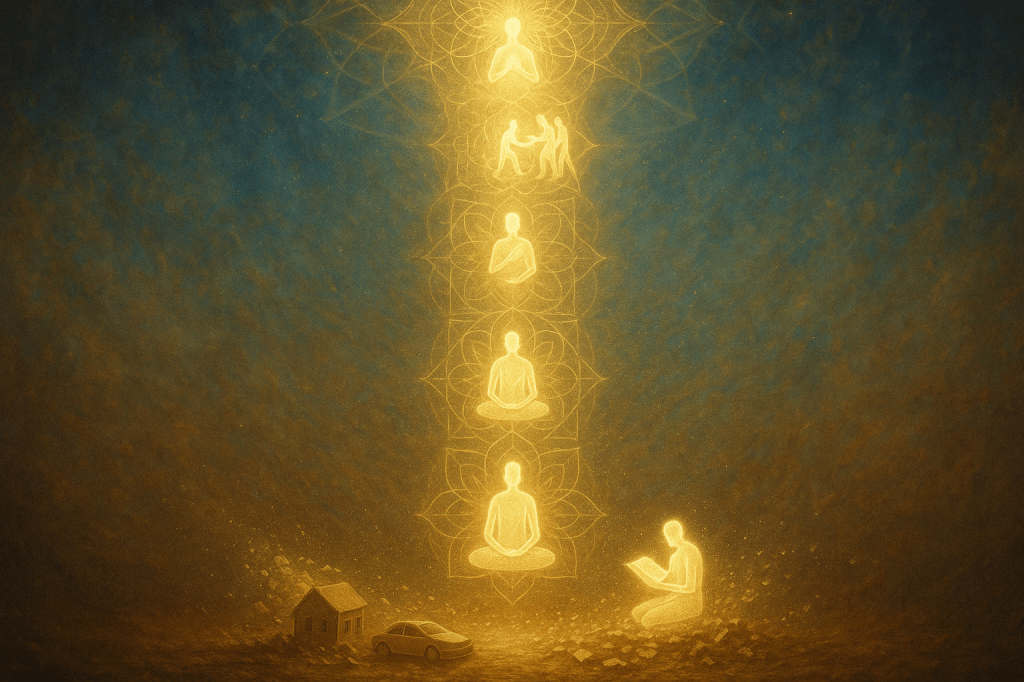
While finite games end in either victory or defeat, the infinite game of soul development offers something far more valuable: continuous growth and expanding fulfillment. Every act of worship, every moment of sincere remembrance, every righteous deed adds to an accumulation that never diminishes. Unlike material wealth that can be lost, stolen, or devalued, spiritual development compounds eternally.
The Quran presents this truth with crystal clarity:
[16:97] “Whoever does righteous deeds, whether male or female, while being a believer, We will surely give them life, a good life, and surely We will pay them their reward with the best of what they used to do.”
Notice the promise here: not just reward in the afterlife, but “a good life” in this world. This is the guarantee of the infinite game – continuous fulfillment rather than momentary victory. The person engaged in soul development experiences what psychologists call “eudaimonic well-being” – a sense of meaning and purpose that transcends temporary pleasures (Source: American Psychological Association, 2008).
Consider the practice of daily prayer (Salat). It’s not a finite game where you “win” by completing it. Each prayer is both complete in itself and part of an infinite progression of connection with the Divine. You cannot “master” prayer in the way you might master a skill because each prayer offers infinite depths of presence, consciousness, and connection. The most devoted worshipper of ninety years still discovers new dimensions in their practice. This is the nature of infinite games – they become richer, not exhausted, through continued play.
Part 5: The Science of Fulfillment
What Research Reveals About Lasting Happiness
Modern neuroscience and psychology have inadvertently validated what divine revelation has long taught about fulfillment. Research from Harvard’s Grant Study, one of the longest-running studies on human happiness spanning over 80 years, concludes that relationships and connection – not achievement or wealth – determine life satisfaction (Source: Harvard Health Publishing, 2017). These relationships are infinite games – they’re about continuation and growth, not winning.
Similarly, studies on purpose and meaning show that people who engage in what researchers call “self-transcendent” activities – those that connect them to something greater than themselves – report higher life satisfaction than those focused on self-enhancement or material gain (Source: Journal of Positive Psychology, 2014). Prayer, charity, service to others, and spiritual practice all fall into this category of self-transcendent, infinite game activities.
The Quran articulated this principle with remarkable precision:
[13:28] They are the ones whose hearts rejoice in remembering God. Absolutely, by remembering God, the hearts rejoice.
This isn’t merely poetic language but a description of neurological reality. Brain imaging studies show that prayer and meditation activate regions associated with peace, contentment, and reduced anxiety while deactivating areas linked to stress and fear (Source: Nature Scientific Reports, 2018). The infinite game of spiritual connection literally rewires our brains for contentment rather than craving.
Part 6: Breaking Free from the Finite Game Trap
Practical Steps Toward Infinite Living
Understanding the distinction between finite and infinite games is transformative, but how do we actually shift from one to the other? The transition requires both recognition and reorientation. First, we must recognize the finite games we’re unconsciously playing and question whether winning them would truly fulfill us. Second, we must consciously choose infinite games and commit to playing them regardless of immediate “results.”
The Quran provides a clear framework for this transition. Consider this profound verse about wealth and purpose:
[10:58] “Say, ‘With God’s grace and with His mercy they shall rejoice.’ This is far better than any wealth they can accumulate.”
This isn’t suggesting poverty but rather a fundamental reorientation of what we’re playing for. Wealth becomes a tool in the infinite game of serving God and humanity rather than a trophy in the finite game of accumulation. The same job that once served only to increase your bank balance can become a means of supporting family, contributing to society, and earning lawful provision while maintaining prayer and remembrance. The game changes not in its external appearance but in its internal orientation.
Consider these practical shifts from finite to infinite games: Instead of trying to “win” arguments with your spouse (finite), focus on deepening understanding and connection (infinite). Rather than racing to accumulate the most possessions (finite), concentrate on developing generosity and detachment (infinite). Replace the goal of being recognized as successful (finite) with the practice of daily gratitude and service (infinite). Each shift moves you from a game that must end to one that enriches eternally.

Part 7: The Ultimate Infinite Game – Submission to God
Why Islam Means Playing the Eternal Game
The word “Islam” itself means submission, and submission is inherently an infinite game. You don’t “win” at submission – you continually deepen it. Every prayer, every act of charity, every moment of patience in hardship, every choice to forgive rather than retaliate – these aren’t points scored toward a final victory but movements in an eternal dance with the Divine. This is why true believers find increasing rather than diminishing satisfaction in their practice over time.
The Quran makes this infinite nature explicit:
[6:162] Say, “My Contact Prayers (Salat), my worship practices, my life and my death, are all devoted absolutely to God alone, the Lord of the universe.
Living and dying for God isn’t a finite project with a completion date – it’s a comprehensive reorientation of existence toward the infinite. Every breath becomes part of this game, every heartbeat a move in the eternal play. This is why mystics speak of being “drunk with God” – they’ve discovered a game so infinitely rich that all finite games pale in comparison. The businessman who discovers prayer may continue in business, but now each transaction becomes an opportunity for honesty, fairness, and trust in divine provision rather than mere profit maximization.
Scientific research on religious practice confirms its infinite game benefits. Studies show that regular spiritual practice correlates with lower rates of depression, anxiety, and suicide, while increasing resilience, life satisfaction, and even longevity (Source: Religion, Senescence, and Mental Health, 2015). These benefits don’t plateau but often increase with continued practice, demonstrating the infinite game principle – the longer you play, the richer it becomes.
Conclusion: Choosing Your Game Wisely
As we stand at the crossroads of existence, each of us must choose: Will we exhaust ourselves playing finite games that must end in either hollow victory or bitter defeat? Or will we embrace the infinite game of soul development, where every moment offers opportunity for growth, every challenge becomes a chance for spiritual advancement, and fulfillment deepens rather than diminishes with time?
The evidence is overwhelming – from Carse’s philosophical framework to the Quran’s divine guidance, from neuroscience research to the testimony of countless souls who’ve made the shift – that infinite games offer what finite games only promise: lasting fulfillment, continuous growth, and genuine happiness. The temporary enjoyments of this world, as the Quran repeatedly reminds us, are fleeting mirages compared to the eternal reality of spiritual development.
Your soul’s growth is the only investment that never depreciates, the only achievement that death cannot steal, the only game where everyone can win without anyone losing. In choosing the infinite game of submission to God, of righteous deeds and spiritual development, you choose not just a better afterlife but a richer present life. You choose not just personal fulfillment but contribution to an eternal purpose. You choose not just to win a game but to play in harmony with the very purpose of existence.
[42:36] Whatever you are given is no more than temporary material of this life. What God possesses is far better and everlasting, for those who believe and trust in their Lord.


 Quran Only Studies
Leave a reply to nazmoe85 Cancel reply