
Introduction: Two Types of Divine Prohibition
In the grand architecture of divine law, God employs two fundamentally different approaches to prohibition – each precisely calibrated to serve its purpose in guiding humanity toward righteousness. The first type, material prohibition, operates through what legal scholars call “expressio unius est exclusio alterius” – the inclusion of specific items excludes all others. The second type, behavioral prohibition, functions through open-ended principles that encompass infinite manifestations of sin. Understanding this distinction reveals why certain divine commands appear absolute while others seem to approach prohibition asymptotically, creating conditions where compliance with evil becomes practically impossible without explicit ban.
This divine wisdom manifests most clearly when we examine how God prohibits dietary items versus sinful behaviors. When God lists four specific meats as prohibited in [6:145], He creates a closed system – everything outside these four is automatically permitted. But when God addresses complex behavioral sins like hypocrisy, ego worship, or intoxication, He employs a sophisticated system of asymptotic limitation, surrounding the behavior with so many restrictions and warnings that engagement becomes virtually impossible for any sincere believer.
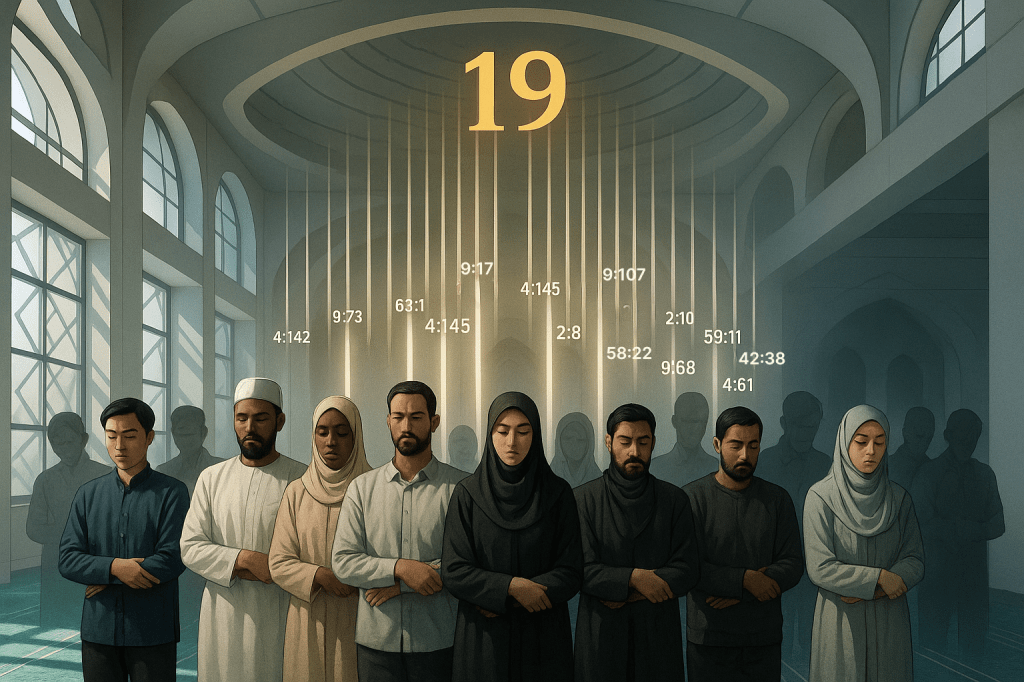
The question of praying behind hypocrites perfectly illustrates this principle. While God never explicitly states “you cannot pray behind hypocrites,” He provides nineteen separate commandments that, when combined, create an insurmountable barrier to such practice. This asymptotic approach – approaching prohibition without explicit statement – serves a profound purpose: it tests the sincerity of believers, reveals the compromisers, and demonstrates who truly understands the spirit versus the letter of divine law.
Part 1: Material Prohibitions – The Exhaustive List
The Four and Only Four
God’s approach to dietary prohibition demonstrates perfect legal precision. In [6:145], He provides an exhaustive enumeration that cannot be expanded:
[6:145] “Say, ‘I do not find in the revelations given to me any food that is prohibited for any eater except: (1) carrion, (2) running blood, (3) the meat of pigs, for it is contaminated, and (4) the meat of animals blasphemously dedicated to other than God.’ If one is forced (to eat these), without being deliberate or malicious, then your Lord is Forgiver, Most Merciful.”
The messenger explained this principle clearly, emphasizing that these four categories represent the complete list of prohibited foods. As recorded in his teachings, he stated: “There are four meats that you cannot eat, for example, and these are number one, animals that die of themselves without human interference. Number two, pork, the meat of pigs. Number three, running blood, running blood that you can put in a glass and cook or drink. Number four, animals dedicated to other than God, that are specifically dedicated to Muhammad or Jesus or Ali or somebody. These are forbidden.”
The critical insight here is that this list is circumscriptive – it defines exact boundaries. Anything outside these four categories is automatically permitted. This means dog meat, though culturally unusual, is not prohibited. Horse meat, camel meat, rabbit meat – all permitted because they fall outside the enumerated list. This is the nature of material prohibition: specific, bounded, and exhaustive.

Part 2: The Legal Principle of Circumscriptive Enumeration
When Listing Means Limiting
The legal principle of “expressio unius est exclusio alterius” – the expression of one thing excludes others – is not merely a human legal construct but a divine legislative tool. When God chooses to enumerate specific items for prohibition, He simultaneously permits everything else in that category. This principle appears throughout statutory interpretation across legal systems worldwide, reflecting a universal understanding of how specific enumeration functions in law.
Consider the implications if God had only prohibited four specific sinful acts – murder, theft, adultery, and lying. Under the principle of exhaustive enumeration, everything else would be permitted: torture, kidnapping, fraud, violence, and countless other evils. The absurdity of this scenario demonstrates why God must use a different approach for behavioral sins. The variety and creativity of human evil cannot be captured in a finite list.
This distinction becomes crucial when examining religious practices. If God wanted to prohibit specific religious leaders or specific prayer configurations, He could have provided an exhaustive list. Instead, He provides principles and characteristics that create boundaries without enumeration. This approach allows the prohibition to encompass all variations of the prohibited behavior, not just specific manifestations.
Part 3: Behavioral Prohibitions – The Open Canvas of Sin
Infinite Manifestations Require Infinite Coverage
When God addresses behavioral sins, He shifts from circumscriptive enumeration to open-ended prohibition. Consider His approach to general sin:
[7:33] “Say, ‘My Lord prohibits only evil deeds, be they obvious or hidden, and sins, and unjustifiable aggression, and to set up beside God powerless idols, and to say about God what you do not know.’”
Notice the expansive language: “evil deeds, be they obvious or hidden.” This formulation captures infinite possibilities. Hidden evils alone could manifest in millions of ways – from subtle manipulation to complex financial fraud, from psychological abuse to spiritual corruption. No finite list could encompass the creativity of human malice.
This open-ended approach appears consistently when God addresses complex sins. He doesn’t list every form of aggression, every type of idol worship, or every way of speaking falsely about Him. Instead, He provides principles that cover all possible manifestations. This legislative technique ensures that human innovation in evil cannot outpace divine prohibition.

Part 4: Asymptotic Limitation – God’s Sophisticated Approach
Approaching Prohibition Without Explicit Statement
Asymptotic limitation represents God’s most sophisticated legislative tool – creating conditions where certain behaviors become practically impossible without explicit prohibition. Like a mathematical asymptote that approaches but never touches a line, these divine commands surround and constrain behavior until engagement becomes virtually impossible for sincere believers.
This approach serves multiple divine purposes. First, it tests the depth of understanding – do believers grasp the spirit of the law or merely its letter? Second, it reveals true intention – those seeking loopholes expose their insincerity. Third, it provides mercy by allowing gradual recognition and repentance rather than immediate, harsh judgment.
The asymptotic approach appears in several critical areas: intoxicants, slavery, domestic violence, and religious leadership. In each case, God provides sufficient guidance that sincere believers understand the prohibition, while those seeking justification for their desires can claim technical permission. This divine methodology separates the wheat from the chaff, the sincere from the hypocrites.
Part 5: The Alcohol Model – Progressive Prohibition
From Discouragement to Recognition
God’s approach to alcohol demonstrates asymptotic prohibition in action. Rather than immediate, explicit ban, He surrounds alcohol with increasingly severe warnings and restrictions:
[2:219] “They ask you about intoxicants and gambling: say, ‘In them there is a gross sin, and some benefits for the people. But their sinfulness far outweighs their benefit.’…”
[5:90] “O you who believe, intoxicants, and gambling, and the altars of idols, and the games of chance are abominations of the devil; you shall avoid them, that you may succeed.”
[5:91] “The devil wants to provoke animosity and hatred among you through intoxicants and gambling, and to distract you from remembering God, and from observing the Contact Prayers (Salat). Will you then refrain?”
The progression is clear: it’s a gross sin, it’s an abomination of the devil, you shall avoid it, it causes strife and prevents prayer. While never stating “alcohol is prohibited,” God makes consumption impossible for anyone sincere about their faith. The messenger confirmed this understanding, clarifying that intoxicants are indeed prohibited – not because of new revelation, but because the existing verses make prohibition unmistakable to sincere believers.

Part 6: The Slavery Paradigm – Elimination Through Righteousness
Making the Wrong Choice Impossible
God’s approach to slavery exemplifies asymptotic prohibition through positive commandment. Rather than stating “you cannot take slaves,” God commands freeing slaves as expiation for sins, as charity, as righteousness. He surrounds the practice with so many requirements for manumission that maintaining slavery becomes impossible for righteous believers.
[90:13] “The freeing of slaves.”
[2:177] “Righteousness is not turning your faces towards the east or the west. Righteous are those who believe in God, the Last Day, the angels, the scripture, and the prophets; and they give the money, cheerfully, to the relatives, the orphans, the needy, the traveling alien, the beggars, and to free the slaves…”
When freeing slaves becomes a marker of righteousness, a form of charity, an expiation for sins, the message becomes clear: taking slaves opposes these divine commands. The righteous path leads only toward freedom, never toward bondage. This positive asymptotic approach – commanding the opposite of what is effectively prohibited – represents divine mercy and wisdom.
Part 7: Domestic Relations – Steps That Prevent the Final Action
The Three-Step Process That Never Reaches Step Three
The verse about domestic disputes [4:34] has been misunderstood by those who read it in isolation. God provides three steps for dealing with marital rebellion, but structures them so that sincere believers never reach the third step:
[4:34] “The men are made responsible for the women, and God has endowed them with certain qualities, and made them the bread earners. The righteous women will cheerfully accept this arrangement, since it is God’s commandment, and honor their husbands during their absence. If you experience rebellion from the women, you shall first talk to them, then (you may use negative incentives like) deserting them in bed, then you may (as a last alternative) beat them. If they obey you, you are not permitted to transgress against them. God is Most High, Supreme.”
The messenger, in his translation and footnotes, clarified that beating women is prohibited. How can this be when the verse mentions it? Because the structure ensures that righteous believers never reach that point. If talking fails and separation fails, the relationship has already ended. The third step exists as a theoretical limit that exposes those who seek justification for violence. Sincere believers understand: if steps one and two fail, the marriage is over, not an invitation to violence.
This represents asymptotic design at its finest – the appearance of permission that becomes impossible to reach for anyone following divine guidance. Those who cite this verse to justify domestic violence reveal their own spiritual disease, not divine permission.
Part 8: The Hypocrite Dilemma – When Nineteen Verses Create Impossibility
The Overwhelming Evidence Against Compromise
The question of praying behind hypocrites represents the ultimate example of asymptotic prohibition. While God never explicitly states “you cannot pray behind hypocrites,” He provides nineteen separate commandments that make such practice impossible. Let us examine how these verses create an impenetrable barrier:
First, the direct commands against obedience:
[33:1] “O you prophet, you shall reverence God and do not obey the disbelievers and the hypocrites. God is Omniscient, Most Wise.”
[33:48] “Do not obey the disbelievers and the hypocrites, disregard their insults, and put your trust in God; God suffices as an advocate.”
How can we follow someone in prayer – the ultimate act of obedience – when God explicitly commands us not to obey them? The contradiction is immediate and insurmountable. Prayer requires following the imam’s movements, recitations, and timing. This is obedience by definition.
Second, the command to be stern and struggle against them:
[9:73] “O you prophet, strive against the disbelievers and the hypocrites, and be stern in dealing with them. Their destiny is Hell; what a miserable abode!”
[66:9] “O prophet, struggle against the disbelievers and the hypocrites and be stern with them. Their abode is Gehenna, and a miserable destiny.”
We cannot simultaneously be stern with someone and accept them as our spiritual leader. We cannot struggle against someone while lining up behind them in worship. The commands are mutually exclusive.
Part 9: Understanding Ego Worship as Ultimate Idolatry
The God of Self
The Quran’s most devastating description of hypocrites reveals their true nature – they are idol worshipers who have made their ego their god:
[25:43] “Have you seen the one whose god is his own ego? Will you be his advocate?”
[45:23] “Have you noted the one whose god is his ego? Consequently, God sends him astray, despite his knowledge, seals his hearing and his mind, and places a veil on his eyes. Who then can guide him, after such a decision by God? Would you not take heed?”
This is not metaphorical. The hypocrite literally worships themselves – their opinions, desires, and ego override divine command. When we pray behind such a person, we participate in their ego worship. We validate their self-deification. We become advocates for those whose god is their own ego, directly violating God’s rhetorical question that demands only one answer: No, we cannot be their advocates.
The connection to the foundational description of hypocrites in [2:8-15] becomes clear. They claim belief but constantly choose their own opinion over divine guidance. They meet privately to reinforce their ego-driven interpretations. They mock sincere believers while thinking themselves clever. This is ego worship in practice – the elevation of self above God.
Part 10: The Messenger’s Clarification on Prohibition Types
Making the Implicit Explicit
The messenger’s role included clarifying what asymptotic prohibition actually means. Regarding dietary laws, he emphasized the exhaustive nature of the four prohibitions, stating clearly that anything outside these four categories is permitted. This clarification prevents the expansion of dietary restrictions that plagued previous communities.
Regarding intoxicants, he stated unequivocally that they are prohibited, though the Quran approaches this through asymptotic limitation rather than explicit ban. This clarification came not through new revelation but through recognizing what the existing verses unmistakably communicate to sincere believers.
On the matter of hypocrites, the messenger’s practice and teaching were crystal clear. He never prayed behind known hypocrites and warned believers to “run for your life” from places where hypocrites lead worship. He understood that the nineteen verses created an absolute barrier, even without explicit prohibition.

Part 11: Why Material and Behavioral Prohibitions Must Differ
The Wisdom in Legislative Diversity
The divine wisdom in using different prohibition types for materials versus behaviors reflects perfect understanding of human nature and practical needs. Material prohibitions must be clear and limited – people need to know exactly what they can and cannot eat. Expanding such lists leads to hardship and confusion, as seen in the dietary restrictions that accumulated in Jewish law through human addition.
Behavioral prohibitions, however, must be flexible enough to encompass human creativity in evil. If God listed specific sins, humans would simply invent new ones. If He prohibited specific forms of oppression, oppressors would devise novel methods. The open-ended nature of behavioral prohibition ensures comprehensive coverage across time and culture.
This distinction also serves mercy. With materials, clear permission prevents unnecessary restriction. With behaviors, asymptotic approach allows for gradual understanding and repentance. Those struggling with alcohol can recognize the increasing warnings. Those trapped in systems of slavery can understand the divine push toward freedom. Those considering violence can see the barriers God places before that final, irreversible step.
The system reveals divine perfection: precise where precision serves humanity, flexible where flexibility prevents evil, merciful in approach while firm in ultimate standard. This is legislative architecture at its most sublime.
Part 12: The Mathematical Precision of Nineteen
When Verses Align to Create Impossibility
The number nineteen holds special significance in the Quran’s mathematical structure, and it’s no coincidence that exactly nineteen verses combine to make praying behind hypocrites impossible. This mathematical precision demonstrates divine design, not human interpretation.
These nineteen verses create overlapping barriers: commands not to obey, requirements to struggle against, descriptions of pollution and disease, warnings about eternal consequences, and revelations of ego worship. Each verse alone might leave room for interpretation, but together they form an impenetrable wall.
Consider the cumulative effect: We cannot obey them [33:1, 48], must be stern with them [9:73], cannot consult them [42:38], must strive against them [9:73], must struggle against them [66:9], must inform them of Hell [4:138], must ignore them [4:63], must disregard them [9:95], know they’re destined for the lowest Hell [4:145], know they belong together away from believers [9:67], know believers belong together [33:35], know they’re disbelievers [4:89, 9:73-74], know they worship their ego [25:43, 45:23], must run away from them [58:22], cannot pray in their masjids [9:107-108], know they’re blocked from masjids [9:17], know they’re polluted [9:28], know they’ll be our record on Judgment Day [17:71], and know their prayer is fake showmanship [4:142, 107:4-7].
This is not prohibition by single verse but by overwhelming convergence. The mathematical signature of nineteen confirms divine intent: praying behind hypocrites is impossible for sincere believers.

Conclusion: The Wisdom of Divine Legislative Architecture
Understanding the System, Recognizing the Truth
The divine system of prohibition reveals layers of wisdom that become apparent only through deep contemplation. God’s use of circumscriptive enumeration for material items protects humanity from unnecessary restriction while ensuring clear guidance. His use of open-ended prohibition for behaviors ensures comprehensive coverage of evil’s infinite manifestations. His employment of asymptotic limitation for complex moral issues provides mercy, tests sincerity, and reveals true character.
The case of praying behind hypocrites demonstrates this system at its most sophisticated. Without explicit prohibition, God makes the practice impossible through convergent commands. This approach serves multiple purposes: it tests whether believers understand spirit versus letter, reveals those who seek truth versus those who seek justification, and provides clear guidance while maintaining the test of faith.
Those who argue that praying behind hypocrites is permissible because it’s not explicitly prohibited reveal their failure to understand divine legislative architecture. They seek loopholes where God has created barriers. They claim technical permission where God has established practical impossibility. In doing so, they expose their own spiritual condition – prioritizing social comfort over divine command, choosing human harmony over God’s pleasure.
The message for sincere believers is clear: understand the system, recognize the patterns, and follow the guidance whether it comes through explicit command or asymptotic limitation. When nineteen verses align to make something impossible, don’t seek the twentieth that might provide escape. When God surrounds a behavior with warnings and restrictions, don’t claim technical permission. When divine architecture points consistently in one direction, don’t insist on walking the opposite way.
This is the ultimate test of submission: will we follow God’s guidance in all its forms, or only when it comes as explicit command? Will we understand the wisdom of different prohibition types, or insist on uniformity that would either restrict unnecessarily or permit boundlessly? Will we recognize that asymptotic approach is divine mercy, or exploit it as weakness?
The hypocrites have made their choice – they worship their ego, placing their opinion above divine guidance. The sincere believers must make theirs – complete submission to God’s will, whether expressed through enumeration, principle, or asymptotic limitation. In this choice lies the difference between guidance and misguidance, between God’s kingdom and Satan’s realm, between eternal success and ultimate failure.
Let those with understanding recognize: the architecture of divine prohibition is perfect in its diversity, merciful in its approach, and comprehensive in its coverage. The impossibility of praying behind hypocrites is not a harsh restriction but a protective barrier, keeping sincere believers from contamination by ego worship and spiritual pollution. When we understand and follow this divine system, we align ourselves with God’s will and ensure our place among the righteous.


 Quran Only Studies
Leave a reply to Shaqeera Marjorie Cancel reply