
Introduction: A Fabricated Chain of Oppression
For centuries, countless Muslim women have been told they cannot travel without a male guardian (mahram). This restriction has been used to control women’s education, employment, religious obligations, and basic freedom of movement. The hadiths demanding this restriction are among the most frequently cited tools of patriarchal control in Muslim communities worldwide. But what if these hadiths are not from God at all? What if they directly contradict the Quran’s clear message of women’s equality and autonomy?
This article presents comprehensive forensic evidence proving that the mahram travel restriction hadiths are fabrications – politically-motivated lies designed to subjugate women contrary to God’s message in the Final Testament. Through detailed analysis of narrator chains, internal contradictions, and Quranic refutation, we expose these hadiths as tools of oppression that have no place in the religion of submission to God alone.
Part 1: The Contradictory Hadith Corpus
A Web of Inconsistencies Reveals Fabrication
The mahram travel restriction appears in multiple hadith collections, but these narrations contradict each other on the most fundamental question: how long can a woman travel? According to Bukhari 1087 narrated by Ibn Umar, a woman should not travel for more than three days without a mahram. Yet Muslim 1339, narrated by Abu Huraira, claims it’s unlawful for a woman to travel for even a day and night without her guardian. Meanwhile, Bukhari 1729 and Muslim 2391 through Ibn Abbas provide no time limit at all – simply stating no woman should travel except with a mahram.
This inconsistency is fatal to the authenticity of these hadiths. Divine guidance does not contradict itself. If the Prophet truly established this rule, there would be one clear, consistent instruction – not this chaotic collection of conflicting time limits ranging from three days, to two days, to one day and night, to no specified duration at all. The very existence of these contradictions proves human fabrication, not divine revelation.
Further examination reveals even more problems. Some versions specify distance measures instead of time. Others mention different combinations of male relatives who can serve as mahrams. The variations expose what happens when multiple narrators invent restrictions to serve their own purposes – each adds their own details, creating an irreconcilable mess of contradictory “divine commands” that couldn’t possibly all be true.

Comprehensive forensic analysis of the contradictions and narrator ironies:

Part 2: Abu Huraira – The Unreliable Narrator
Statistical Impossibility and Contemporary Criticism
Many of these travel restriction hadiths trace back to one man: Abu Huraira. His credibility as a narrator is destroyed by simple mathematics and historical documentation. Abu Huraira is credited with narrating 5,374 hadiths – more than any other companion of the Prophet. Yet he only spent approximately 3-4 years with the Prophet, having converted around 629 CE while the Prophet died in 632 CE. This means Abu Huraira would have had to narrate an average of 4-5 hadiths per day, every single day, for years.
Compare this to the closest companions who spent decades with the Prophet. Abu Bakr, who was the Prophet’s closest friend for over 23 years, narrated only 142 hadiths – a rate of 0.02 hadiths per day. Umar ibn al-Khattab, who led the Muslim community and spent 23 years with the Prophet, narrated 537 hadiths – 0.06 per day. Ali, who grew up in the Prophet’s household and spent over 32 years with him, narrated 586 hadiths – 0.05 per day. Abu Huraira’s narration rate is 98 to 245 times higher than these lifelong companions. This is statistically impossible without massive fabrication.
The historical record confirms this fraud. Umar ibn al-Khattab, the second caliph, physically struck Abu Huraira with his cane for excessive narration, warning him: “You narrate far too many hadiths from the Prophet; I’m afraid you will lie about him.” Aisha, the Prophet’s wife who lived with him for years, repeatedly contradicted Abu Huraira’s narrations. When confronted about false attribution, Abu Huraira himself admitted he heard narrations from others but attributed them to the Prophet, confessing: “I heard it from Fadl ibn Abbas, not from the Messenger of Allah.”
Abu Huraira’s political motivations further destroy his credibility. He received significant payments from the Umayyad dynasty – a regime notorious for corrupting Islamic teachings to serve political interests. He was appointed governor of Bahrain by Umar but was removed for corruption. Many of his hadiths conveniently supported Umayyad political positions, particularly those restricting women’s rights and autonomy. The mahram travel restriction perfectly served rulers who wanted to control women’s economic participation and movement.
[12:111] “In their history, there is a lesson for those who possess intelligence. This is not fabricated Hadith; this (Quran) confirms all previous scriptures, provides the details of everything, and is a beacon and mercy for those who believe.”
God explicitly warns against fabricated hadith in the Quran itself. The word “hadith” appears in this verse as a warning – not an endorsement. God tells us the Quran provides the details of everything we need. Abu Huraira’s fabrications directly violate this divine instruction, adding restrictions God never authorized.
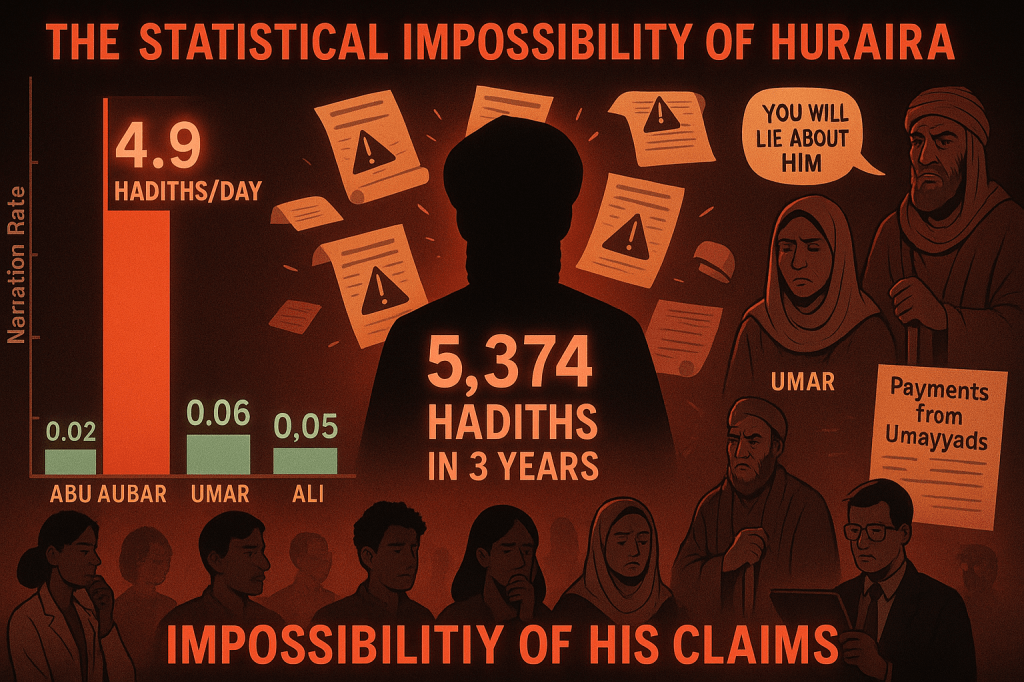
For comprehensive statistical analysis and documented criticism from his contemporaries:

Part 3: The Queen of Sheba – God’s Example of Women’s Leadership
A Powerful Ruler Who Traveled Alone
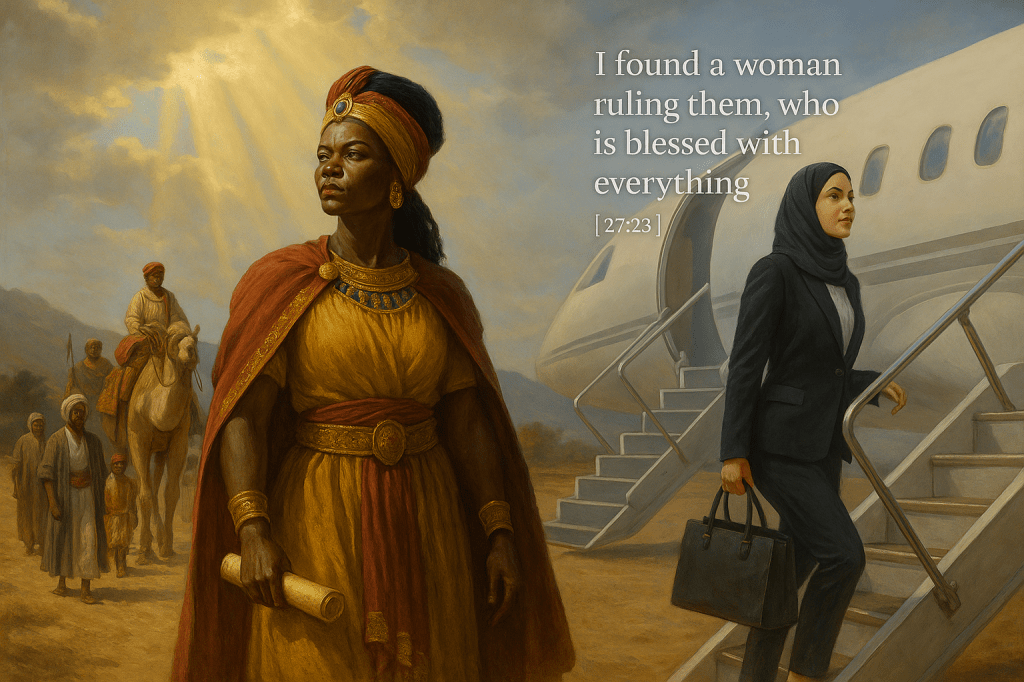
The Quran provides us with clear examples that demolish the mahram restriction. One of the most powerful is the story of the Queen of Sheba, known as Bilqis. This remarkable woman ruled an entire nation, made independent decisions about diplomacy and statecraft, and traveled long distances to meet Prophet Solomon – all without any mention of requiring a male guardian.
[27:23] “I found a woman ruling them, who is blessed with everything, and possesses a tremendous palace.”
God presents the Queen of Sheba as a legitimate ruler, blessed by God with wisdom, wealth, and authority. She was not criticized for being a woman in power. She was not told she needed male permission or guardianship. Instead, the Quran shows her as an intelligent leader who consulted with her advisors and made careful, wise decisions.
[27:32] “She said, ‘O my advisers, counsel me in this matter. I am not deciding anything until you advise me.’”
When faced with Solomon’s message, she didn’t defer to male authority or seek a mahram’s permission. She consulted her council as a leader should, then made her own decision to send a diplomatic gift to test Solomon’s intentions.
[27:35] “I am sending a gift to them; let us see what the messengers come back with.”
Most significantly for our discussion, she then traveled – across substantial distance through potentially dangerous territory – to meet Solomon personally. The Quran never mentions her needing a mahram. No male guardian accompanied her as a requirement. God protected her journey and praised her eventual submission to truth.
[27:44] “She said, ‘My Lord, I have wronged my soul. I now submit with Solomon to God, Lord of the universe.’”
If God required women to have male guardians for travel, this story would be the perfect place to establish that rule. Instead, the Queen of Sheba’s independent travel and leadership are presented without criticism or restriction. Her story proves that righteous women are under God’s direct protection and need no human male intermediary for their freedom of movement.
Part 4: Mary’s Journey – Alone and Protected by God
The Ultimate Example of Divine Protection
Another powerful Quranic example that destroys the mahram restriction is the story of Mary (Maryam), the mother of Jesus. The Quran describes Mary isolating herself from her family and traveling alone during the most vulnerable time of her life – while pregnant and during childbirth. If ever a woman “needed” male protection according to hadith logic, it would be during pregnancy and labor. Yet God not only permitted Mary’s solitary journey but protected and provided for her directly.
[19:16] “Mention in the scripture Mary. She isolated herself from her family, into an eastern location.”
Mary deliberately separated from her family and traveled alone to a distant location. The Quran uses the word “isolated” – she was intentionally alone, without male guardians, without mahrams. This was not criticized as improper or dangerous. It was simply stated as fact, with no hint of disapproval.
[19:22] “When she bore him, she isolated herself to a faraway place.”
Even during her pregnancy, Mary traveled alone to a faraway location. The Quran emphasizes her solitude – she was by herself, far from family and community support. According to the fabricated mahram hadiths, this should have been forbidden, dangerous, and sinful. Instead, the Quran presents it matter-of-factly as part of her blessed story.
[19:23] “The birth process came to her by the trunk of a palm tree. She said, ‘(I am so ashamed;) I wish I were dead before this happened, and completely forgotten.’”
[19:24] “(The infant) called her from beneath her, saying, ‘Do not grieve. Your Lord has provided you with a stream.’”
During the most vulnerable moment of childbirth, Mary was completely alone – no midwife, no family, no male guardian. Yet God provided for her directly, through miracles of speech from the infant Jesus and fresh water from a stream. The message is crystal clear: righteous women who submit to God are under His direct protection. They need no human male intermediary. God Himself guards and provides for them.
If the mahram restriction were truly from God, the story of Mary would include criticism for her solo journey, or at minimum mention that she should have had male guardians. Instead, her solitary travels are presented as part of her honored story, an example for all believers. The fabricators of the mahram hadiths directly contradict these Quranic examples, proving their narrations are false.

Part 5: The Quran’s Declaration of Complete Equality
Men and Women Are Equal Before God
The mahram restriction fundamentally depends on the false premise that women are less capable, less trustworthy, or more vulnerable than men in ways that require male control. The Quran systematically demolishes this premise by declaring absolute equality between men and women in every aspect that matters to God.
[33:35] “The submitting men, the submitting women, the believing men, the believing women, the obedient men, the obedient women, the truthful men, the truthful women, the steadfast men, the steadfast women, the reverent men, the reverent women, the charitable men, the charitable women, the fasting men, the fasting women, the chaste men, the chaste women, and the men who commemorate God frequently, and the commemorating women; God has prepared for them forgiveness and a great recompense.”
This extraordinary verse lists men and women side by side in complete equality across every dimension of faith and righteousness. Submission, belief, obedience, truthfulness, steadfastness, reverence, charity, fasting, chastity, and commemoration of God – in every single category, men and women are equal. God does not say submitting men lead submitting women, or that believing men guide believing women. He presents them as parallel equals, each accountable directly to God for their own choices and actions.
The mahram restriction would require inserting “traveling men, and women who travel with their mahrams” into this list – an absurd addition that God never made. If women required male supervision for travel, God would have mentioned it in this comprehensive verse about male-female equality in religious life. The silence speaks volumes.
[49:13] “O people, we created you from the same male and female, and rendered you distinct peoples and tribes, that you may recognize one another. The best among you in the sight of God is the most righteous.”
All humans – regardless of gender, ethnicity, or tribal affiliation – come from the same origin and are judged by the same standard: righteousness. Not gender. Not male approval. Not compliance with fabricated restrictions. Righteousness alone determines a person’s standing before God. A righteous woman traveling alone for legitimate purposes is superior in God’s sight to an unrighteous man who stays home. The mahram restriction inverts this divine standard by making male presence more important than female righteousness.
[4:124] “As for those who lead a righteous life, male or female, while believing, they enter Paradise; without the slightest injustice.”
[16:97] “Anyone who works righteousness, male or female, while believing, we will surely grant them a happy life in this world, and we will surely pay them their full recompense (on the Day of Judgment) for their righteous works.”
God repeatedly emphasizes “male or female” when discussing righteousness, rewards, and Paradise. Gender is mentioned specifically to emphasize that it makes no difference. Righteous women and righteous men receive identical promises, identical rewards, identical access to Paradise. If God intended women to be subordinate to men, requiring male permission and guardianship for basic activities like travel, these verses would reflect that hierarchy. Instead, they proclaim equality.

Part 6: The Quran Is Complete – Nothing Missing
Divine Declaration Against Adding Restrictions
One of the most devastating arguments against the mahram restriction is God’s explicit declaration that the Quran is complete, fully detailed, and needs no additions. If women truly needed male guardians for travel, this would be a fundamental religious law affecting billions of women throughout history. God would not forget to mention it in His final, complete message to humanity.
[6:38] “All the creatures on earth, and all the birds that fly with wings, are communities like you. We did not leave anything out of this book. To their Lord, all these creatures will be summoned.”
God explicitly states “We did not leave anything out of this book.” The Quran is comprehensive. It covers what we need to know about how to live righteously. If the mahram restriction were truly required by God, it would be in the Quran. Its absence from the Quran, combined with God’s declaration that nothing was left out, proves the mahram restriction is a human fabrication added after the Quran was complete.
[6:114] “Shall I seek other than God as a source of law, when He has revealed to you this book fully detailed? Those who received the scripture recognize that it has been revealed from your Lord, truthfully. You shall not harbor any doubt.”
God asks a rhetorical question: should we seek other than God as a source of law? The answer is obviously no. Yet the mahram restriction comes not from God’s book, but from hadiths narrated by discredited men like Abu Huraira who lived generations before the hadith books were compiled. Those who insist on the mahram restriction are literally seeking other than God as their source of law – they are following the fabricated words of men instead of God’s complete, fully detailed book.
[6:115] “The word of your Lord is complete, in truth and justice. Nothing shall abrogate His words. He is the Hearer, the Omniscient.”
God’s word is complete. Nothing can be added to it or taken from it. The mahram restriction is an attempt to abrogate God’s words – to add a restriction where God placed none, to override the examples of the Queen of Sheba and Mary traveling freely, to contradict God’s declarations of male-female equality. This verse warns us that nothing shall abrogate God’s words, yet the hadith fabricators did exactly that.
The pattern is clear throughout the Quran. When God wants to establish a restriction or requirement, He states it explicitly. Dietary laws, inheritance rules, marriage regulations, prayer requirements, charity obligations, pilgrimage rites – all are detailed in the Quran. The mahram travel restriction is conspicuously absent because it is not from God. It is a human invention designed to control women, contradicting God’s message of freedom and equality.
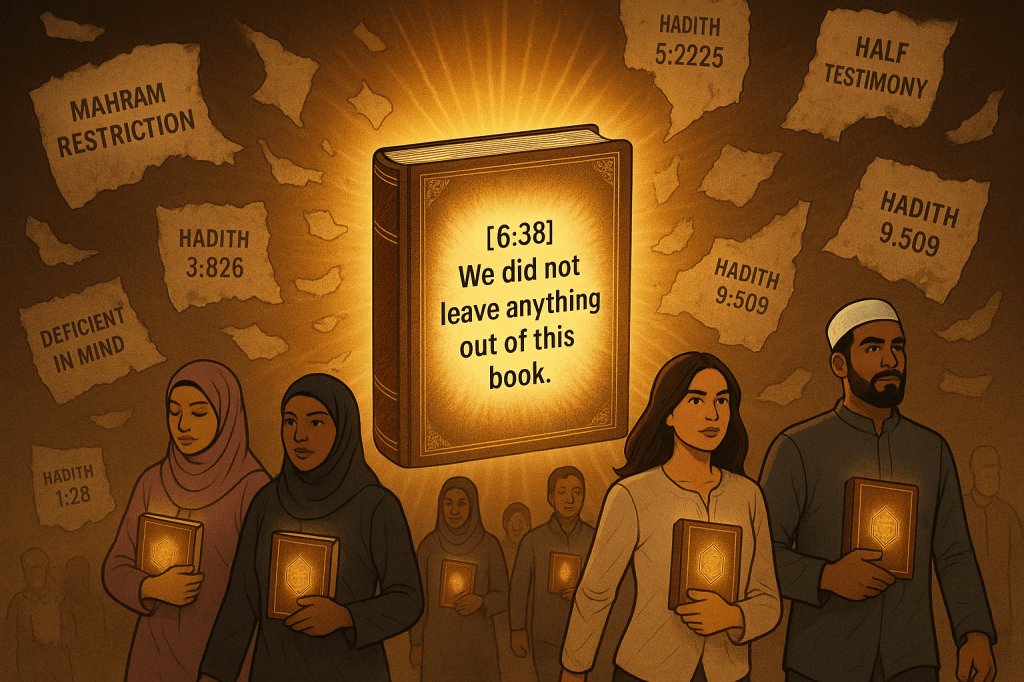
Part 7: Logical Contradictions and Practical Absurdities
When Fabrications Collide With Reality
Beyond Quranic refutation, the mahram restriction creates logical contradictions that expose its human origin. Divine law is coherent and practical. Fabricated restrictions contradict themselves and create impossible situations that God would never impose.
Consider the Hajj paradox. The Quran explicitly commands pilgrimage for all who can afford it:
[3:97] “In it are clear signs: the station of Abraham. Anyone who enters it shall be granted safe passage. The people owe it to God that they shall observe Hajj to this shrine, when they can afford it. As for those who disbelieve, God does not need anyone.”
God makes Hajj obligatory for everyone who can afford it – no gender distinction, no mahram requirement mentioned. Yet the fabricated hadiths claim women cannot travel without male guardians. What about the millions of women who have no available mahram? Widows whose husbands have died, women whose brothers are too young or too old, converts whose families are non-Muslim, women whose male relatives refuse to accompany them or are abusive? Would God command these women to perform Hajj while simultaneously making it impossible for them by requiring unavailable male guardians? The contradiction exposes the human origin of the mahram restriction.
The widow and divorcee dilemma further reveals the absurdity. If a woman’s husband dies and she has no adult sons or available brothers, is she imprisoned in her home for the rest of her life? Can she never visit family in other cities, never seek medical treatment in distant hospitals, never pursue education or employment that requires travel? The mahram restriction would make these women prisoners, dependent on the availability and goodwill of male relatives who may not exist or may be unreliable. God would never create such a cruel system.
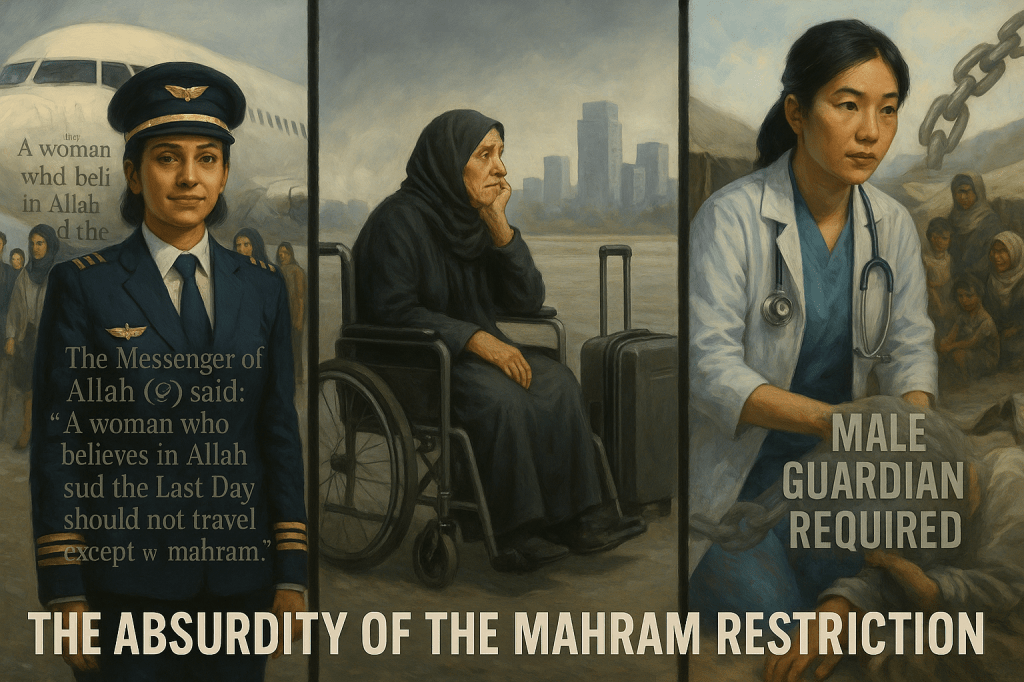
Modern reality completely undermines the supposed justification for the mahram restriction. The claimed reason is protection – that women traveling alone face danger and need male guardians to protect them. Yet today, women are commercial pilots flying hundreds of passengers across oceans, military officers commanding troops in dangerous regions, doctors traveling to conflict zones to provide emergency medicine, CEOs conducting international business across continents. Women travel safely using modern transportation, communication technology, and professional security when needed. Meanwhile, statistics show that women are often more at risk from male relatives than from strangers – the “protection” argument is exposed as false.
The mahram restriction also discriminates based on biological relationship in ways that make no practical sense. A woman can travel with her elderly father who needs a wheelchair, but not with her trusted female friend who is a martial arts expert. She can travel with her teenage son who has never left their hometown, but not with her experienced female colleague who has traveled the world. She can travel with a brother who may be irresponsible or even abusive, but not alone even if she is a trained security professional. The restriction prioritizes male biology over female capability, male presence over female righteousness – exactly the kind of arbitrary, illogical discrimination that God would never mandate.
Part 8: Historical Pattern of Misogynistic Fabrications
The Mahram Restriction in Context
The mahram travel restriction is not an isolated fabrication. It fits within a clear historical pattern of hadiths designed to restrict, control, and diminish women in ways the Quran never authorized. Understanding this pattern helps us recognize the systematic nature of the deception.
Consider the collection of misogynistic hadiths that all serve the same purpose – establishing male dominance contrary to Quranic equality. There are fabricated hadiths claiming women are “deficient in intelligence and religion,” hadiths claiming women’s testimony is worth half of men’s testimony, hadiths requiring women to cover everything except their eyes, hadiths claiming most inhabitants of hell are women, hadiths limiting women’s inheritance beyond Quranic specifications, and hadiths restricting women’s participation in congregational prayer. The mahram travel restriction belongs to this same fabricated corpus.
These restrictions emerged during specific historical periods when controlling women served political and economic interests. The Umayyad dynasty (661-750 CE) and the Abbasid period (750-1258 CE) saw the introduction of many restrictions on women that had never existed during the Prophet’s lifetime. These dynasties absorbed patriarchal customs from conquered Persian and Byzantine territories, then used hadith fabrication to make these foreign customs appear to be part of Islam.
Controlling women’s movement through the mahram restriction served multiple political purposes. It limited women’s economic participation, keeping wealth concentrated in male hands. It prevented women from organizing politically or socially across family lines. It reinforced a hierarchical social structure where men controlled women, while rulers controlled men. It created economic opportunities for men as “professional mahrams” who would be paid to accompany women on necessary travel. Every aspect served patriarchal power, not divine guidance.
The men who fabricated and promoted these restrictions had clear motives. Abu Huraira received payments from the Umayyads. Later hadith compilers like Bukhari and Muslim worked under Abbasid patronage and had incentive to include hadiths that supported the existing power structure. Scholars who challenged these fabrications faced persecution, while those who promoted them received prestige and patronage. The system created economic and social incentives for hadith fabrication, particularly fabrications that controlled women and reinforced patriarchy.
What makes this pattern particularly insidious is how it inverted Quranic values. The Quran presents women as independent moral agents directly accountable to God. The fabricated hadiths made women subordinate to men. The Quran shows women as leaders, travelers, and decision-makers. The fabricated hadiths restricted women to homes and male supervision. The Quran judges people by righteousness regardless of gender. The fabricated hadiths judged women as inherently less capable and trustworthy than men. This systematic inversion reveals the anti-Quranic agenda behind these fabrications.

Part 9: The 191-Year Gap and Chain Analysis
Temporal Impossibilities in Transmission
Even if we ignored all the logical and Quranic problems with the mahram restriction, the hadith chains themselves contain fatal flaws that prove fabrication. The most obvious problem is the enormous temporal gap between the claimed original narrators and the compilers who wrote down these hadiths nearly two centuries later.
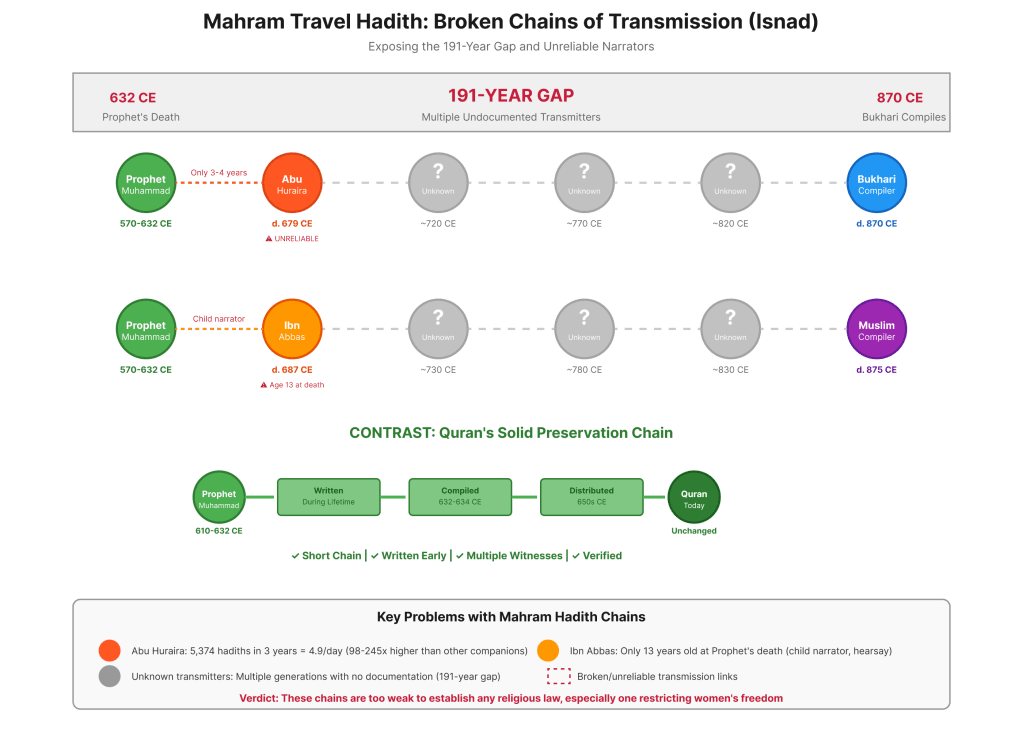
Abu Huraira died in 679 CE. Sahih Bukhari, which contains many of the mahram restriction hadiths, was compiled by Muhammad al-Bukhari who died in 870 CE – a gap of 191 years. Muslim ibn al-Hajjaj, compiler of Sahih Muslim which also contains these hadiths, died in 875 CE – an even larger gap. This means there were multiple generations of unnamed, undocumented transmitters between Abu Huraira and the men who finally wrote down these hadiths. Each link in this chain presents an opportunity for fabrication, error, or politically-motivated invention.
Ibn Abbas, another narrator of mahram restriction hadiths, died in 687 CE – creating a 188-year gap before Muslim compiled his collection. Moreover, Ibn Abbas was only around 13 years old when the Prophet died, making him a child during most of the Prophet’s ministry. Most of his narrations are necessarily hearsay from other companions, not direct witness testimony. This introduces yet another layer of unreliability into the transmission chain.
The hadith chains also contain geographic impossibilities. Narrators who supposedly transmitted hadiths from one person to another lived in different regions – often thousands of miles apart in an era when travel was extremely difficult. Some chains claim direct transmission between people who likely never met based on historical documentation of their locations and lifespans. These geographic and temporal impossibilities expose the fabricated nature of the chains.
Compare this to the Quran’s preservation. The Quran was written down during the Prophet’s lifetime, compiled immediately after his death, and distributed widely in written form within decades. Multiple companions memorized the entire Quran and could verify its accuracy. The transmission chain is short, documented, and reliable. The hadith collections, by contrast, were compiled generations later based on oral transmission through multiple undocumented intermediaries. The difference in reliability is astronomical.
The temporal gap created perfect conditions for fabrication. By the time Bukhari and Muslim compiled their collections, everyone who knew the Prophet personally was long dead. No one could directly contradict fabricated narrations by saying “I was there, and that never happened.” The political circumstances had changed dramatically – the Umayyad and Abbasid dynasties had established patriarchal systems that needed religious justification. Fabricating hadiths to support existing power structures and then attributing them to narrators who had been dead for nearly two centuries was the perfect crime – no witnesses to contradict it, and clear political benefit from the fabrication.

Detailed analysis of the broken chains of narration (isnad) exposing the fabrication:
Part 10: God’s Promise of Sovereignty to Believers
Women as Leaders and Independent Agents
The mahram restriction fundamentally contradicts God’s promise that believers – both men and women – will be granted sovereignty and leadership on earth. The Quran explicitly promises that righteous believers will rule, lead, and exercise authority. This promise makes no gender distinction and is exemplified by Quranic examples of women in positions of supreme authority.
[24:55] “God promises those among you who believe and lead a righteous life, that He will make them sovereigns on earth, as He did for those before them, and will establish for them the religion He has chosen for them, and will substitute peace and security for them in place of fear. All this because they worship Me alone; they never set up any idols beside Me. Those who disbelieve after this are the truly wicked.”
God promises sovereignty to “those among you who believe and lead a righteous life” – no gender qualifier. The promise of becoming sovereigns on earth applies equally to believing men and believing women. A woman who believes and leads a righteous life is promised by God to receive authority, leadership, and sovereignty. How can such a woman need a male guardian’s permission to travel? How can she be sovereign while simultaneously subordinate to male relatives? The mahram restriction directly contradicts God’s promise of sovereignty to righteous believing women.
The Queen of Sheba, discussed earlier, is the perfect example of this promise fulfilled. She was a sovereign – a woman ruling an entire nation with absolute authority. God did not criticize her sovereignty. He did not say she should have a male king instead or that she needed male permission for her decisions. Instead, her story is presented positively, showing that women can and do exercise the sovereignty God promises to believers.
Modern history has proven the Quran right and the hadith fabricators wrong. Women have served as prime ministers, presidents, supreme court justices, military commanders, CEOs of multinational corporations, and leaders in every field of human endeavor. These women exercise sovereignty and authority, making decisions that affect millions of people. They travel freely as their responsibilities require. The idea that these capable, powerful women need male guardians to accompany them on travel is absurd – yet that is exactly what the fabricated mahram restriction would require.
The mahram restriction also contradicts God’s promise to “substitute peace and security for them in place of fear.” God promises that righteous believers will have security – not through male guardianship, but through their submission to God alone. The fabricated hadiths inject fear into women’s lives, telling them they are unsafe without male supervision, that travel without men is dangerous and sinful. This fear-mongering directly opposes God’s promise of security to believers. Righteous women who trust in God have divine security, not male-dependent security.

Part 11: The Economic Motive Behind Gender Restrictions
Follow the Money in Hadith Fabrication
Understanding who benefited economically from the mahram restriction reveals the human motives behind its fabrication. Throughout history, restricting women’s movement and autonomy has served economic interests. The mahram restriction is no exception – it created and maintained economic systems that concentrated wealth and opportunity in male hands while limiting female economic participation.
In pre-modern economies, travel was essential for trade, education, and economic advancement. Merchants traveled to markets. Students traveled to centers of learning. Professionals traveled to find work and opportunities. By restricting women’s ability to travel freely, the mahram restriction effectively barred women from many forms of economic participation. A woman could not independently pursue trade, could not travel to study with distant scholars, could not seek employment in other regions – unless a male relative was willing and able to accompany her. This dependency kept economic power concentrated in male hands.
The restriction also created economic opportunities for men at women’s expense. “Professional mahrams” emerged – men who charged fees to accompany women on necessary travel, particularly for religious pilgrimage. Women had to pay men for the “privilege” of fulfilling religious obligations or conducting necessary business. This turned women’s basic freedom of movement into a male revenue stream, another way to extract economic benefit from female dependency.
Moreover, the mahram restriction reinforced other economic restrictions on women. If a woman couldn’t travel without male permission and accompaniment, she couldn’t independently pursue legal claims in distant courts, couldn’t inspect distant properties she inherited, couldn’t conduct business negotiations in other regions, couldn’t flee abusive marriages to family in other areas. Her economic vulnerability increased dramatically, making her more dependent on male relatives for survival and support. This dependency benefited men who controlled family wealth and resources.
The political dynasties that promoted these restrictions had clear economic interests. The Umayyad and Abbasid rulers absorbed patriarchal economic systems from conquered Persian and Byzantine territories. These systems concentrated wealth and political power in male elite hands. Hadith fabrications that restricted women’s movement and economic participation helped maintain this system by appearing to give divine sanction to patriarchal economics. Rulers patronized scholars who promoted such hadiths and persecuted those who challenged them, creating an economic ecosystem that rewarded fabrication and punished truth.
Today, in regions where the mahram restriction is still enforced, we see the same economic pattern. Women’s economic participation is limited. Female poverty is higher. Women’s entrepreneurship is restricted. Economic opportunities flow primarily to men. This is not coincidental – it is the intended effect of the restriction, the same effect it had when it was fabricated over a millennium ago. The restriction was never about divine law or women’s protection. It was always about economic control and male advantage.
[2:256] “There shall be no compulsion in religion: the right way is now distinct from the wrong way. Anyone who denounces the devil and believes in God has grasped the strongest bond; one that never breaks. God is Hearer, Omniscient.”
God declares there is no compulsion in religion. The mahram restriction is exactly such a compulsion – a fabricated rule that compels women to submit to male authority that God never authorized. It compels women to give up economic opportunities and freedom of movement based on a lie. Those who recognize the fabrication, who denounce these devilish inventions and return to God’s book alone, have grasped the strongest bond – the bond of direct submission to God, not to men who fabricate restrictions in God’s name for their own benefit.
Part 12: Breaking Free – The Path Forward
Returning to the Quran Alone
The comprehensive evidence presented in this article leads to one inescapable conclusion: the mahram travel restriction is a fabrication. It contradicts the Quran’s examples of women traveling alone. It contradicts God’s declarations of male-female equality. It contradicts God’s promise of sovereignty to believing women. It comes from unreliable narrators through broken chains spanning two centuries. It creates logical absurdities and practical impossibilities. It serves economic and political interests rather than divine guidance. It is false, and it must be rejected.
For Muslim women who have been imprisoned by this restriction, liberation begins with recognizing its false origin. You do not need male permission to travel for legitimate purposes. You are not sinning when you travel alone to work, to study, to worship, to visit family, to conduct business, or to fulfill any righteous purpose. God has given you autonomy, agency, and sovereignty. The fabricated hadiths attempted to take these away, but they have no legitimate authority. God’s word in the Quran stands supreme, and God never restricted your freedom of movement.
For Muslim men who have enforced this restriction on their female relatives, justice requires acknowledging the truth. Controlling women’s movement based on fabricated hadiths is oppression, not righteousness. It contradicts God’s message. It violates the Quranic principle of no compulsion in religion. Supporting women’s freedom to travel, work, study, and worship according to their own choices and circumstances is not Western influence or cultural corruption – it is returning to the Quranic standard that existed before hadith fabrications corrupted the religion.
For Muslim communities that have institutionalized the mahram restriction in law and custom, reform is both necessary and possible. The same scholarly methods that expose this fabrication can be applied to other restrictions that have no Quranic basis. The project of returning to Quran alone requires courage, honesty, and willingness to abandon traditions when they contradict God’s book. The reward is liberating the religion from human corruption and experiencing the true freedom that submission to God alone provides.
The Quran provides everything we need for guidance. It presents us with examples of righteous, independent women who traveled, led nations, and made their own decisions under God’s direct protection. It promises sovereignty to believing women and men equally. It declares complete equality in every aspect of faith and righteousness. It warns against fabricated hadith and commands us to seek no source of law other than God’s fully detailed book.
[6:115] “The word of your Lord is complete, in truth and justice. Nothing shall abrogate His words. He is the Hearer, the Omniscient.”
God’s word is complete. We need nothing more. The mahram restriction is an attempt to abrogate God’s words, to add what God never authorized, to restrict what God left free. It has oppressed millions of women across centuries, kept them from education and opportunity, turned their basic freedom into male-controlled permission, and done all this while falsely claiming divine authority.
The truth is now clear. The mahram travel restriction is a fabrication designed to oppress women contrary to God’s message. Recognizing this truth and rejecting this fabrication is not rebellion against religion – it is submission to God alone, freed from human corruption. It is the path back to the pure religion of Abraham, Moses, Jesus, and Muhammad – submission to the One God who created men and women equal and judges us by righteousness alone.


 Quran Only Studies
Leave a comment