Introduction: The Greatest Deception in Islamic History
For centuries, Muslims have celebrated what they believe to be one of the most remarkable prophecies in Islamic history – the supposed prediction by Prophet Muhammad that Constantinople would be conquered by Muslims. This hadith, glorified in countless sermons and used as “proof” of Muhammad’s prophethood, has become so embedded in Islamic consciousness that questioning it is considered heresy. Yet what if this celebrated prophecy is nothing more than a carefully crafted lie, invented centuries after the events it claims to predict? What if the entire narrative is a political fabrication designed to legitimize Ottoman rule and create a false sense of divine endorsement?
Today, we embark on a forensic investigation that will shatter this illusion once and for all. Using the tools of hadith criticism, historical analysis, and most importantly, the clear guidance of the Quran itself, we will expose how this “prophecy” represents everything wrong with hadith literature – the lies, the fabrications, and the blatant contradictions with God’s final scripture. The evidence we will present is not based on emotion or sectarian bias, but on hard facts that even traditional hadith scholars couldn’t ignore. By the end of this investigation, you will see how political opportunists manufactured divine prophecies to serve their earthly ambitions, and why the Quran warned us about exactly this type of fabrication.
The stakes of this investigation extend far beyond a single hadith. If Muslims can be deceived about something as significant as a prophetic prediction, what else in the hadith literature is fabricated? How many other “prophecies” were invented after the fact to create an illusion of divine foreknowledge? This analysis will demonstrate why God commanded us to follow the Quran alone, and why He specifically condemned those who believe in “hadith” other than His revelations.
Part 1: The Claim Examined – A Prophecy Too Convenient to Be True
The Hadith That Fooled a Billion Muslims
The Constantinople hadith appears in multiple collections, but let’s examine the version from
Al-Tabarani (Hadith 14157), which states: “You will fight the yellow people with a group of Muslims who will not blame them for the sake of Allah until you conquer Constantinople with takbir and tasbih.”
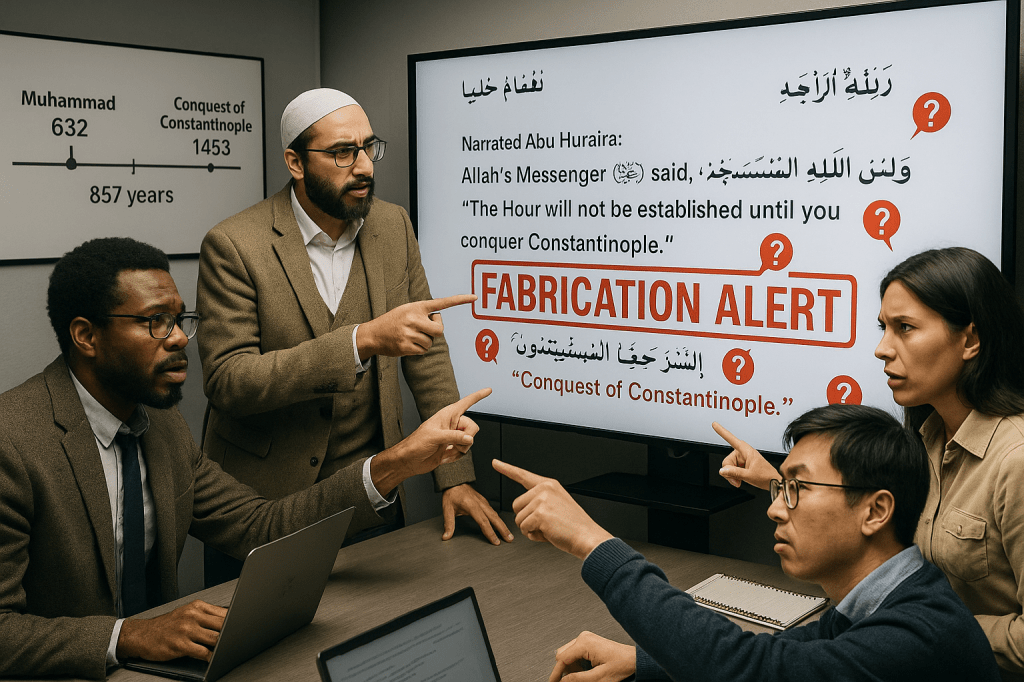
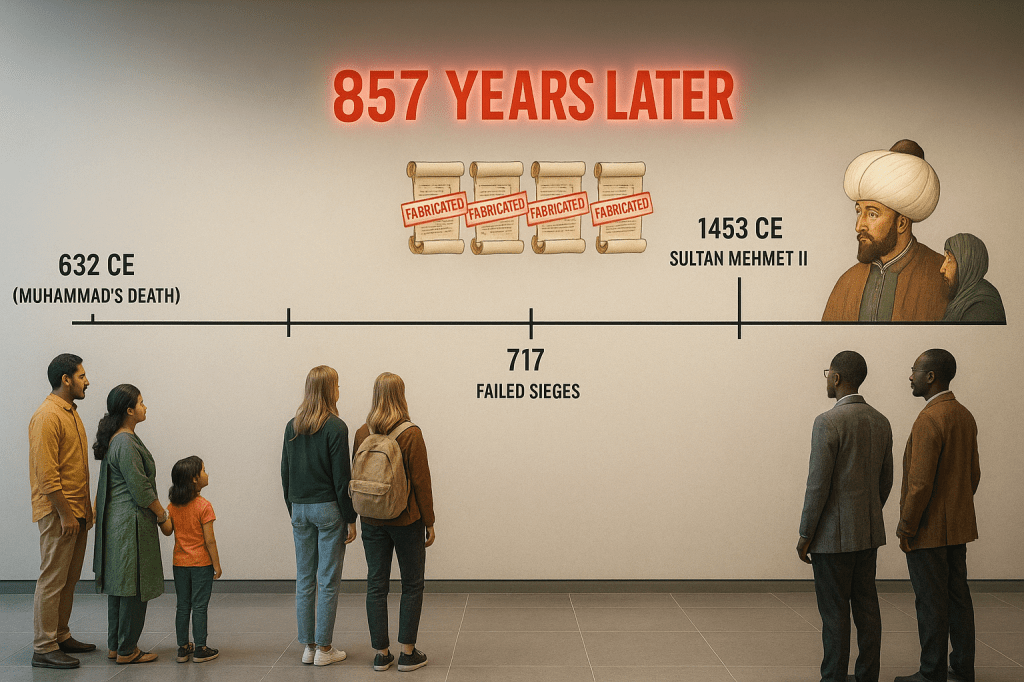
This hadith claims that Prophet Muhammad predicted the Muslim conquest of Constantinople, describing how it would fall to Muslim forces through religious proclamations rather than military might. The hadith has been embellished over time, with some versions adding details about the excellence of the conquering army and its commander, conveniently fitting Sultan Mehmet II’s narrative when he conquered the city in 1453 CE – a full 857 years after Muhammad’s death.
What makes this hadith particularly appealing to believers is its specificity combined with its apparent fulfillment. Constantinople was indeed conquered by Muslims, and Sultan Mehmet II did invoke religious slogans during the conquest. For those desperate to prove Islam through prophecy, this seems like a slam dunk. But this surface-level analysis ignores the most fundamental question: When did this hadith first appear in Islamic literature? Was it known during the Prophet’s lifetime, or did it mysteriously emerge centuries later, perhaps around the time when Muslim armies were attempting to conquer Constantinople? The answer to this question alone destroys the entire prophecy claim.
The hadith’s content also raises immediate red flags for anyone familiar with Quranic principles. The Quran explicitly states that Prophet Muhammad did not know the future and could not predict what would happen to himself or others. Yet here we have a hadith claiming he made specific predictions about military conquests centuries in the future. This fundamental contradiction should be enough to reject the hadith outright, but the emotional attachment to these fabrications runs so deep that Muslims would rather reject clear Quranic verses than question their precious hadith collections.
Part 2: The Chain of Transmission – A Forensic Analysis
Following the Trail of Deception
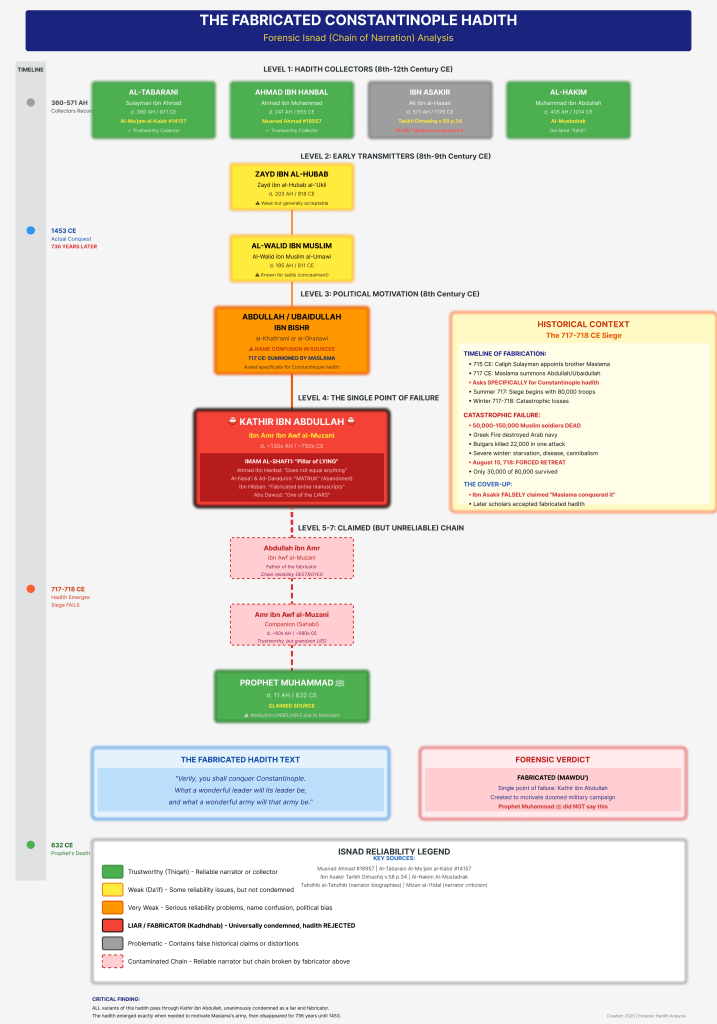
Every hadith stands or falls on its chain of transmission (isnad), and the Constantinople hadith’s chain is a disaster of epic proportions. The primary narrator upon whom all versions depend is identified in hadith literature with confusing variations: sometimes as “Abdullah ibn Bishr” and sometimes as “Ubaidullah ibn Bishr.” This name confusion itself – likely scribal errors by different copyists – already raises red flags about the transmission’s reliability. But the real disaster is the identity behind either name: Kathir ibn Abdullah ibn Amr ibn Awf al-Muzani, one of the most notorious fabricators in hadith history. Historical analysis reveals that “Ubaidullah” or “Abdullah ibn Bishr” is actually the same problematic narrator connected to the Kathir chain, with his name garbled through multiple transmissions.
The critical historical context exposes the fabrication’s political origins: According to Ibn Asakir and other sources, a narrator named Ubaidullah (or Abdullah) was summoned by Maslama ibn Abd al-Malik, the Umayyad general, who specifically asked him about the hadith regarding Constantinople’s conquest. After hearing this convenient prophecy, Maslama then led the 717-718 CE siege of Constantinople. The timing is too suspicious to ignore – a military commander requests prophetic justification for his campaign, a narrator conveniently produces a hadith about conquering Constantinople, and the expedition immediately follows. This wasn’t prophecy transmission; it was on-demand fabrication for military propaganda.
The condemnation of Kathir by classical hadith scholars is devastating and unanimous. Imam al-Shafi’i, one of the most respected figures in Islamic jurisprudence, didn’t mince words: “He is a pillar from among the pillars of lying.” Think about that for a moment – not just a liar, but a PILLAR of lying, a foundational figure in the art of deception. Ahmad ibn Hanbal, founder of the Hanbali school, completely rejected Kathir’s narrations and refused to include them in his Musnad, stating “Kathir ibn Abdullah does not equal anything.” Al-Nasa’i and Ad-Daraqutni classified him as “matruk” (abandoned/discarded), the technical term for a narrator whose hadiths must be rejected. Ibn Hibban went even further, stating that Kathir “related from his father from his grandfather a fabricated manuscript” – meaning he invented an entire collection of fake hadiths and attributed them to his family line.
The mathematical probability of accurate transmission through this chain approaches zero. Even if we generously assume each narrator in the chain had a 90% reliability rate (which is absurdly generous given Kathir’s reputation), the cumulative probability of accurate transmission through eight narrators would be 0.9^8 = 43%. But with Kathir in the chain – a known fabricator with essentially 0% reliability – the entire chain collapses. All versions of this hadith, despite their minor variations, ultimately trace back to this single source: the fabricator connected to Ubaidullah/Abdullah who produced the hadith on demand for Maslama’s military campaign. This is like trying to build a bridge with a critical support beam made of cardboard; it doesn’t matter how strong the other components are, the structure will fail. Yet Muslims continue to defend this hadith because admitting its fabrication would force them to question the entire hadith system they’ve built their religion upon.
Part 3: Historical Timeline – The Smoking Gun
When Fiction Became “Prophecy”
The historical timeline of this hadith exposes the fabrication beyond any reasonable doubt. Constantinople fell to Ottoman Sultan Mehmet II on May 29, 1453 CE – 857 years after Prophet Muhammad’s death in 632 CE. But here’s the smoking gun: This hadith first appears in Islamic literature during the Umayyad period, specifically around the failed siege of Constantinople in 717-718 CE, led by Maslama ibn Abd al-Malik. Historical sources record that Maslama specifically requested to hear “prophecies” about Constantinople before his campaign – and suddenly, conveniently, this hadith emerges. The correlation is too obvious to ignore: Military commanders needed motivation for their troops, so they manufactured divine prophecies to inspire them.
The Catastrophic Failure That Exposed the Lie
The 717-718 CE siege – the very campaign for which this hadith was fabricated – ended in complete disaster for the Umayyads, further exposing the prophecy as fraudulent. According to al-Tabari’s authoritative history, Maslama led what the historian describes as an “ill-fated Arab expedition to Constantinople.” The siege lasted from August 717 to August 718, with the Umayyad forces facing catastrophic losses. More than 20,000 Muslim soldiers died – not in glorious conquest, but from starvation, Greek fire, and attacks by Bulgar horsemen allied with the Byzantines. The remnants of the army limped home in defeat, leaving their dead behind in foreign soil. This disaster weakened the Umayyad state and marked the end of their great conquests, serving as a turning point in Islamic expansion.
The irony is devastating: The hadith was fabricated to motivate and legitimize Maslama’s campaign, promising divine endorsement for the conquest, yet the campaign ended in humiliating defeat. If this were truly a prophecy from Muhammad, why did it fail so spectacularly when first applied? The obvious answer is that it was never a real prophecy, just military propaganda that couldn’t change the reality of Byzantine defenses and Umayyad overextension. The fact that this fabricated “prophecy” remained in circulation despite the crushing failure of the campaign for which it was created demonstrates how disconnected hadith literature is from historical reality. Muslims continue to cite this hadith as evidence of prophetic foreknowledge while ignoring that its first application resulted in over 20,000 dead Muslims and a defeated army.
The pattern becomes even clearer when we examine other Constantinople-related hadiths. Multiple versions with different details suddenly appear during various Muslim attempts to conquer the city – 674-678 CE, 717-718 CE, and later attempts. Each version was tailored to the specific political and military needs of the time. Some versions emphasize the righteousness of the conquering army (to motivate troops), others focus on the commander’s excellence (to legitimize leadership), and still others describe the method of conquest (to provide tactical divine guidance). This isn’t prophecy; it’s propaganda, manufactured in real-time to serve immediate political purposes.
The Ottoman manipulation of this hadith after 1453 CE represents the final stage of the fabrication. Once Constantinople actually fell, Ottoman scholars retroactively claimed the prophecy had been fulfilled, conveniently ignoring that the hadith was unknown during the Prophet’s lifetime and first appeared during failed military campaigns. They embellished the narrative further, adding details about Mehmet II being the promised commander, despite the hadith’s questionable origin. This post-hoc rationalization is a textbook example of confirmation bias – taking a vague, fabricated statement and retroactively claiming it predicted a specific event. It’s the same tactic used by fortune tellers and psychics: make enough vague predictions, wait for something to happen, then claim you predicted it all along.
Part 4: The Quran’s Position on Prophecy – Muhammad Didn’t Know the Future
God’s Clear Declaration vs. Human Fabrications
The Quran could not be clearer about Prophet Muhammad’s lack of knowledge regarding future events. In multiple verses, God explicitly commands Muhammad to declare his human limitations and his inability to predict the future. These verses don’t just suggest or imply – they directly command Muhammad to tell people he doesn’t know what will happen. Yet the hadith literature portrays him as making detailed predictions about events centuries in the future. This isn’t just a minor discrepancy; it’s a fundamental contradiction that exposes the hadith system as a massive fraud designed to elevate Muhammad beyond his Quranic role.
[6:50] “Say, ‘I do not say to you that I possess the treasures of God. Nor do I know the future. Nor do I say to you that I am an angel. I simply follow what is revealed to me.’ Say, ‘Is the blind the same as the seer? Do you not reflect?’”
This verse alone should end all debate about prophetic predictions in hadith. God explicitly commands Muhammad to declare that he does NOT know the future (la a’lamu al-ghayb). The Arabic is unambiguous – there’s no room for interpretation or exception. Muhammad is commanded to tell people he only follows what is revealed to him, not that he receives special knowledge about future military conquests. How then can Muslims accept hadiths claiming Muhammad predicted the conquest of Constantinople, the coming of specific rulers, or detailed end-time scenarios? The cognitive dissonance required to hold these contradictory beliefs simultaneously is staggering.
[7:188] “Say, ‘I have no power to benefit myself, or harm myself. Only what God wills happens to me. If I knew the future, I would have increased my wealth, and no harm would have afflicted me. I am no more than a warner, and a bearer of good news for those who believe.’”
Here God provides a logical proof that Muhammad didn’t know the future – if he had such knowledge, he would have used it to avoid the numerous hardships he faced. Muhammad faced poverty, military defeats, personal tragedies, and assassination attempts. If he could predict Constantinople’s conquest 800 years in the future, why couldn’t he predict and prevent the defeat at Uhud? Why couldn’t he predict and prevent the poisoning attempt that allegedly contributed to his death? The hadith fabricators didn’t think through these logical inconsistencies when they invented their fake prophecies.
[46:9] “Say, ‘I am not different from other messengers. I have no idea what will happen to me or to you. I only follow what is revealed to me. I am no more than a profound warner.’”
This verse delivers the final blow to all hadith-based prophecy claims. Muhammad explicitly states he has “no idea” what will happen to himself or others. The Arabic phrase “ma adri” means “I don’t know” – it’s not ambiguous or metaphorical. Yet hadith collectors want us to believe that the same prophet who was commanded by God to say “I don’t know what will happen” was simultaneously making detailed predictions about future conquests, technologies, and end-time events. The contradiction is so blatant that only willful blindness can explain why Muslims continue to accept these fabrications.
[72:26-27] “He is the Knower of the future; He does not reveal the future to anyone. Only to a messenger that He chooses, does He reveal from the past and the future, specific news.”
Even this verse, which allows for limited prophetic knowledge, specifies that such revelation comes only through the official revelation process – not through casual conversations recorded in hadith. The Quran contains the complete revelation given to Muhammad. If God wanted to reveal the conquest of Constantinople, it would be in the Quran, not in suspicious hadiths narrated by known liars centuries after the Prophet’s death. The fact that the Quran contains no mention of Constantinople’s conquest while containing other prophecies (like the Roman victory in 30:2-4) proves that this prediction was never part of divine revelation.
Part 5: Comparing Real vs Fabricated Prophecies
The Quran’s Actual Prophecy vs. Hadith Fabrications
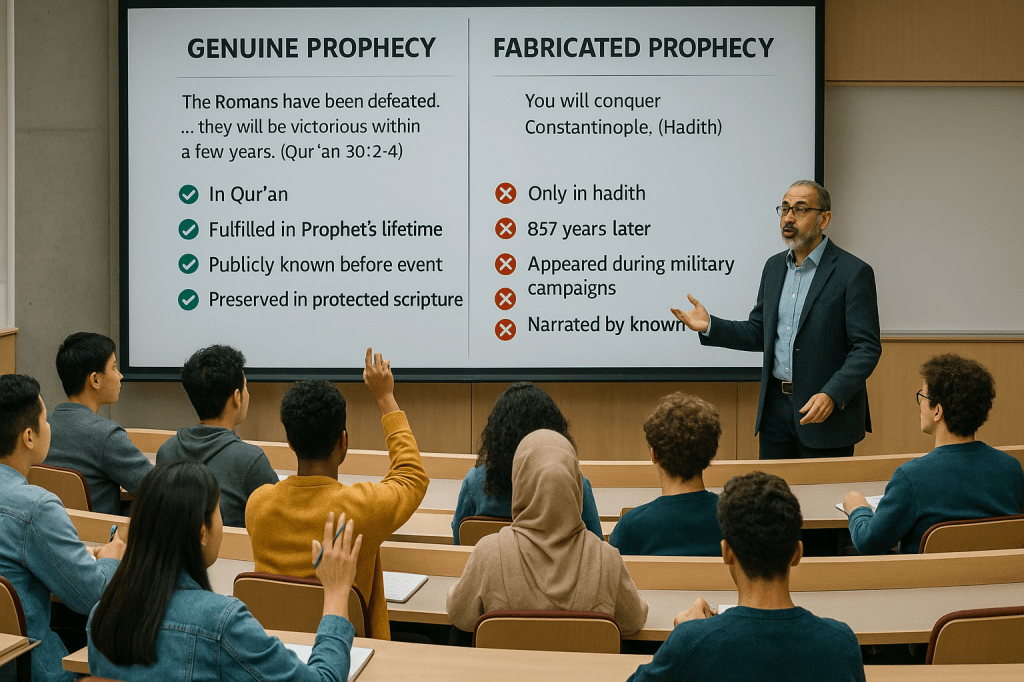
The Quran contains a genuine prophecy that was fulfilled during the Prophet’s lifetime, providing a perfect contrast to expose fabricated hadith predictions. This real prophecy demonstrates the characteristics of authentic divine revelation while highlighting everything wrong with the Constantinople hadith. The difference between Quranic prophecy and hadith fabrication is like the difference between a genuine diamond and cheap glass – once you know what to look for, the fake becomes obvious.
[30:2-4] “Certainly, the Romans will be defeated. In the nearest land. After their defeat, they will rise again and win. Within several years. Such is God’s decision, both in the first prophecy, and the second. On that day, the believers shall rejoice.”
This Quranic prophecy about the Romans exemplifies authentic divine prediction. First, it appears in the Quran itself – the verified, preserved revelation that Muslims universally accept. Second, it was fulfilled within the Prophet’s lifetime (within 3-9 years), allowing contemporaries to witness its fulfillment. Third, it was specific enough to be meaningful (Romans would win after defeat) but not so detailed as to suggest post-hoc fabrication. Fourth, it served a clear spiritual purpose – strengthening believers’ faith during a difficult period. Compare this to the Constantinople hadith: appears only in hadith collections, fulfilled 857 years later, suspiciously detailed, and primarily serves political rather than spiritual purposes.
The placement and preservation of prophecies also reveals their authenticity. Real prophecies appear in the Quran because God preserves His book from corruption. Fabricated prophecies appear in hadith because humans can easily insert them into oral traditions. Consider the logical question: If God wanted to provide a prophecy about Constantinople to strengthen believers’ faith, why would He put it in unreliable hadith narrated by known liars instead of in His protected book? The answer is obvious – He didn’t. Humans fabricated the Constantinople prophecy and couldn’t insert it into the Quran, so they inserted it into hadith collections instead.
The timing of prophecy revelation versus fulfillment provides another critical distinction. Genuine prophecies are revealed publicly before the predicted events, allowing skeptics to document them and believers to anticipate them. The Roman prophecy was recited publicly in Mecca when Muslims were weak and persecuted, making its fulfillment even more remarkable. The Constantinople hadith, however, mysteriously appears in literature only when Muslim armies are actively trying to conquer the city. No contemporary sources from the Prophet’s lifetime mention this supposedly important prophecy. It’s like someone claiming they predicted the lottery numbers – but only mentioning it after the drawing.
Part 6: The Pattern of Post-Event “Prophecies”
The Hadith Factory of Convenient Predictions
The Constantinople fabrication is not an isolated incident but part of a systematic pattern of manufacturing prophecies after events occurred. This pattern is so consistent throughout hadith literature that it reveals an entire industry of fabrication operating for centuries after the Prophet’s death. Once you recognize this pattern, you can’t unsee it – suddenly, countless “miraculous” prophecies are exposed as obvious frauds. The hadith collectors weren’t preserving divine predictions; they were running a prophecy factory, manufacturing religious authority for political and sectarian purposes.
Consider the suspiciously specific “prophecies” about the Abbasid dynasty, which conveniently appeared during Abbasid rule. Or the detailed predictions about specific battles and conquests that mysteriously emerged after those events occurred. The hadith about “black flags from Khurasan” supposedly predicting the Abbasid revolution? It appeared after the Abbasids came to power from that region. The predictions about specific cities Muslims would conquer? They emerged after each conquest. The pattern is consistent: Event happens → Hadith appears claiming Muhammad predicted it → Muslims celebrate the “miracle” → Political authorities gain religious legitimacy.
The technical term for this fraud is “vaticinium ex eventu” – prophecy from the event. It’s a common technique in fabricated religious literature across all traditions. The forger takes a historical event, creates a “prediction” of it, then backdates that prediction to a revered figure. In the case of Islamic hadith, fabricators had a perfect system: They could claim Muhammad said anything, create a chain of transmission through compliant or fictional narrators, and insert it into the ever-growing hadith collections. The only barrier was the Quran itself – they couldn’t alter that, which is why all these fake prophecies exist in hadith, not in the Quran.
The motivation for this fabrication industry was primarily political. Each dynasty needed religious legitimacy, so they sponsored scholars who would “discover” hadiths supporting their rule. The Umayyads had their hadith, the Abbasids had theirs, and the Ottomans had theirs. The Constantinople hadith served Ottoman interests perfectly – it transformed their military conquest into a fulfillment of divine prophecy, making their rule seem ordained by God. This is exactly what God warned us about in the Quran when He condemned those who “fabricate lies about God” for worldly gain.
Part 7: Why Muslims Fall For This
The Psychology of Deception and Desperation
Understanding why educated, intelligent Muslims continue to believe obviously fabricated hadiths requires examining the psychological and social forces at work. The Constantinople hadith’s acceptance despite overwhelming evidence of fabrication reveals how deeply the hadith system has corrupted Islamic thought. Muslims aren’t inherently gullible, but centuries of conditioning have created blind spots that prevent critical analysis of religious sources. The tragedy is that in their desperation to prove Islam through fake prophecies, they actually undermine the religion’s credibility and violate the Quran’s clear commandments.
The primary psychological factor is confirmation bias combined with emotional investment. Muslims desperately want Islam to be true, and prophecies seem like powerful proof. When they hear about Constantinople’s conquest being “predicted,” it triggers an emotional high that overrides critical thinking. They don’t investigate the hadith’s authenticity because they don’t want to find problems. It’s like a person in love ignoring red flags about their partner – the emotional need for the relationship to work prevents honest assessment. The scholars who should be providing critical analysis are often the most invested in maintaining the hadith system, as their entire careers and religious authority depend on it.
The social pressure to accept hadith is enormous. Questioning hadith is equated with questioning Islam itself, leading to accusations of apostasy, social ostracism, and in some countries, legal persecution. Muslims learn from childhood that doubting hadith makes them bad Muslims, creating a powerful psychological barrier to critical thinking. The few scholars who do question hadith authenticity are marginalized, their works banned, and their reputations destroyed. In this environment, it’s easier to accept obvious fabrications than to face the social consequences of honest investigation. The Constantinople hadith becomes a loyalty test – accept it to prove you’re a good Muslim, regardless of the evidence.

Part 8: The Quran’s Sufficiency – Why We Don’t Need Hadith
God’s Complete Guidance vs. Human Corruption
The Quran repeatedly declares itself complete, fully detailed, and sufficient for guidance, making the entire hadith enterprise not just unnecessary but blasphemous. God didn’t forget to include important religious instructions that needed to be supplemented by hadith narrated by liars and fabricators. The idea that the Quran needs hadith for completion is itself an insult to God’s wisdom and competence. Every hadith that claims to add religious law to what God revealed is essentially claiming that God’s book is deficient – a claim that the Quran itself condemns as the ultimate blasphemy.
[6:38] “All the creatures on earth, and all the birds that fly with wings, are communities like you. We did not leave anything out of this book. To their Lord, all these creatures will be summoned.”
God explicitly states that He did not leave anything out of the Quran. The Arabic “ma farratna fi al-kitabi min shay’” is absolutely comprehensive – nothing was omitted from the book. This verse alone destroys the entire justification for hadith. If God didn’t leave anything out, what exactly are hadith adding? The only logical answer is that hadith are adding human fabrications, political propaganda, and sectarian divisions that God deliberately excluded from His perfect book. The Constantinople hadith is a perfect example – God didn’t include it because it’s a lie, but humans added it to serve their political purposes.
[6:114] “Shall I seek other than God as a source of law, when He has revealed to you this book fully detailed? Those who received the scripture recognize that it has been revealed from your Lord, truthfully. You shall not harbor any doubt.”
This verse explicitly prohibits seeking any source of law other than God through His revealed book. The Quran is described as “mufassalan” – fully detailed. Yet the entire hadith system is based on seeking other sources of law, claiming the Quran isn’t detailed enough for practical religion. Muslims who follow hadith are directly violating this commandment, seeking human sources of law instead of God’s complete revelation. The Constantinople hadith attempts to add prophetic authority to human military conquests – exactly the kind of corruption this verse prohibits.
[6:115] “The word of your Lord is complete, in truth and justice. Nothing shall abrogate His words. He is the Hearer, the Omniscient.”
God’s word is “complete” (tammat), requiring no supplementation. This completeness encompasses both truth and justice, meaning the Quran provides all necessary guidance for both belief and practice. The hadith system claims to supplement God’s complete word, effectively arguing that God’s word isn’t actually complete. This is precisely why fabricated prophecies like the Constantinople hadith exist – they attempt to add authority and detail that God deliberately didn’t include in His complete revelation.
[12:111] “In their history, there is a lesson for those who possess intelligence. This is not fabricated Hadith; this (Quran) confirms all previous scriptures, provides the details of everything, and is a beacon and mercy for those who believe.”
God specifically contrasts the Quran with “fabricated Hadith” (hadithan yuftara), making clear that His book is not fabricated hadith and provides “the details of everything” (tafsila kulli shay’). The Constantinople hadith is exactly what this verse warns against – a fabricated hadith that contradicts the Quran’s clear statements about Muhammad’s lack of future knowledge. The fact that God uses the exact word “hadith” in this condemnation is not coincidental – He knew exactly what corruption would plague the Muslim community.
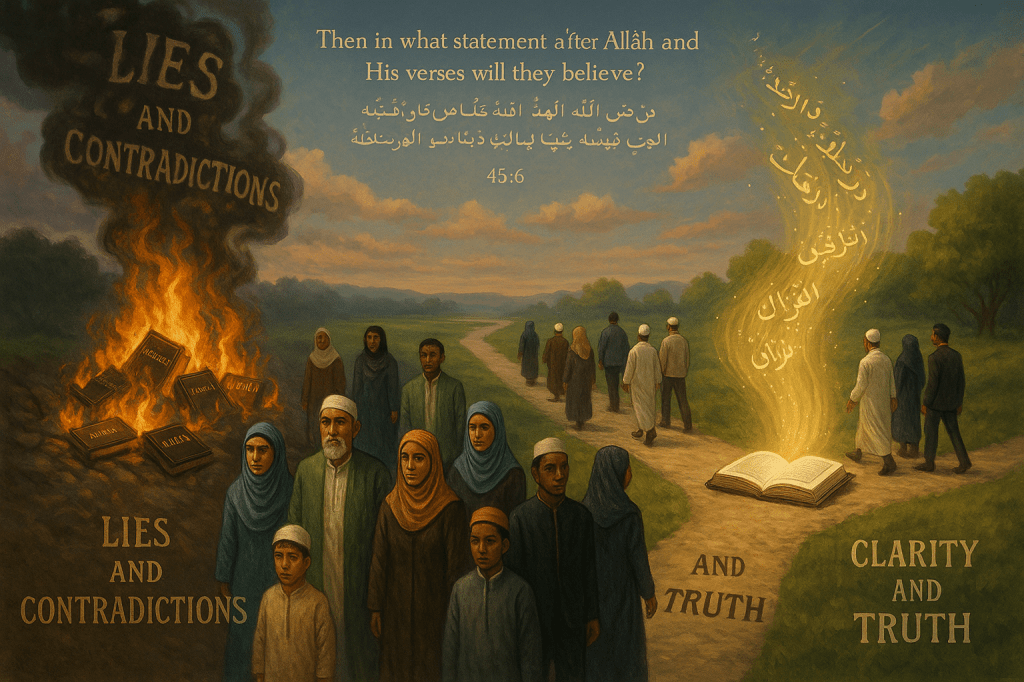
[45:6] “These are God’s revelations that we recite to you truthfully. In which Hadith other than God and His revelations do they believe?”
God directly challenges those who believe in hadith other than His revelations. The question is rhetorical – the answer is that they should not believe in any hadith beyond God’s revelations. Yet Muslims have built an entire religion based on believing in hadith narrated by known liars like Kathir ibn Abdullah. The Constantinople hadith represents exactly what this verse condemns – a hadith other than God’s revelation that Muslims have chosen to believe despite its obvious fabrication.
[77:50] “Which Hadith, other than this, do they uphold?”
The Quran’s final condemnation of external hadith comes near its end, as if God wanted to leave no doubt about His position. After presenting all His revelations, God asks which hadith other than the Quran people will uphold. The answer should be “none,” but Muslims have chosen to uphold thousands of hadith, including obvious fabrications like the Constantinople prophecy. This verse stands as an eternal indictment of the hadith system and all who defend it.
Part 9: The Scholarly Cover-Up
How Islamic Scholars Protect the Lie
The most damning aspect of the Constantinople hadith scandal is not the fabrication itself, but the systematic cover-up by Islamic scholars who know the truth but continue to promote the lie. These scholars have access to the same historical sources, the same biographical dictionaries of narrators, and the same critical methodologies that expose this hadith as fabricated. Yet they continue to cite it in sermons, include it in their books, and use it to inspire Muslims, knowing full well that it’s built on the testimony of a narrator whom their own classical authorities called “a pillar of lying.” This isn’t innocent error; it’s deliberate deception designed to maintain the hadith system’s authority regardless of truth.
Ibn Asakir’s Brazen Historical Falsification
Perhaps the most shocking example of scholarly dishonesty appears in Ibn Asakir’s “History of Damascus,” where he records this hadith with an astounding claim: After narrating the Constantinople prophecy, he states that “Maslama ibn Abd al-Malik called me and he conquered it.” This is an outright historical lie. Maslama did NOT conquer Constantinople – he led a catastrophic siege that ended in utter defeat with over 20,000 casualties. Ibn Asakir, a respected classical scholar whose works are still cited with authority today, either fabricated this claim or uncritically transmitted it despite knowing its historical impossibility. This wasn’t an innocent mistake or minor error – it was deliberate falsification of history to make the fabricated hadith appear fulfilled.
The implications of this scholarly fraud are devastating. If Ibn Asakir could falsely claim that Maslama conquered Constantinople when he actually suffered a humiliating defeat, what else in his historical works is fabricated? More importantly, if a celebrated classical scholar could engage in such brazen lying, how can we trust any hadith scholar’s claims about authenticity or historical accuracy? This single false claim exposes the entire methodology as corrupted. Yet modern Muslims continue to cite Ibn Asakir’s works as authoritative sources while ignoring his demonstrable dishonesty about Constantinople. The cognitive dissonance required to simultaneously acknowledge this lie while trusting his other narrations is staggering.
Contemporary scholars employ various tactics to avoid addressing the hadith’s fatal flaws. Some simply ignore the narrator criticism, presenting the hadith without mentioning Kathir ibn Abdullah’s reputation. Others acknowledge the weakness but claim there are “supporting narrations” – which invariably turn out to also trace back to the same fabricator or other weak narrators. Still others resort to emotional manipulation, arguing that even if the hadith is weak, it “strengthens faith” and shouldn’t be questioned. The most sophisticated deception involves drowning the audience in technical terminology and complex isnad discussions, knowing that most Muslims will defer to their “expertise” rather than investigate themselves.
The financial and institutional interests maintaining this deception are enormous. Islamic universities, publishing houses, and religious institutions have built entire industries around hadith studies. Thousands of scholars have devoted their careers to hadith “sciences,” writing commentaries, teaching courses, and establishing their authority as hadith experts. Admitting that a celebrated hadith like the Constantinople prophecy is fabricated would raise questions about the entire system. If this famous hadith is fake, what about others? If classical scholars couldn’t detect obvious fabrications, how reliable is their methodology? The dominos would start falling, threatening the entire religious establishment.
The scholars’ betrayal becomes even more egregious when we consider their treatment of those who expose hadith fabrication. Scholars who critically examine hadith are labeled as “hadith rejectors,” “Quranists,” or even apostates. Their books are banned, their lectures are canceled, and their reputations are systematically destroyed. This isn’t the behavior of people confident in their truth; it’s the desperate censorship of those protecting a lie. The same scholars who claim Islam encourages critical thinking and investigation become authoritarian censors when that investigation threatens their hadith system.
Part 10: The Ottoman Political Machine
How Empires Manufactured Divine Endorsement
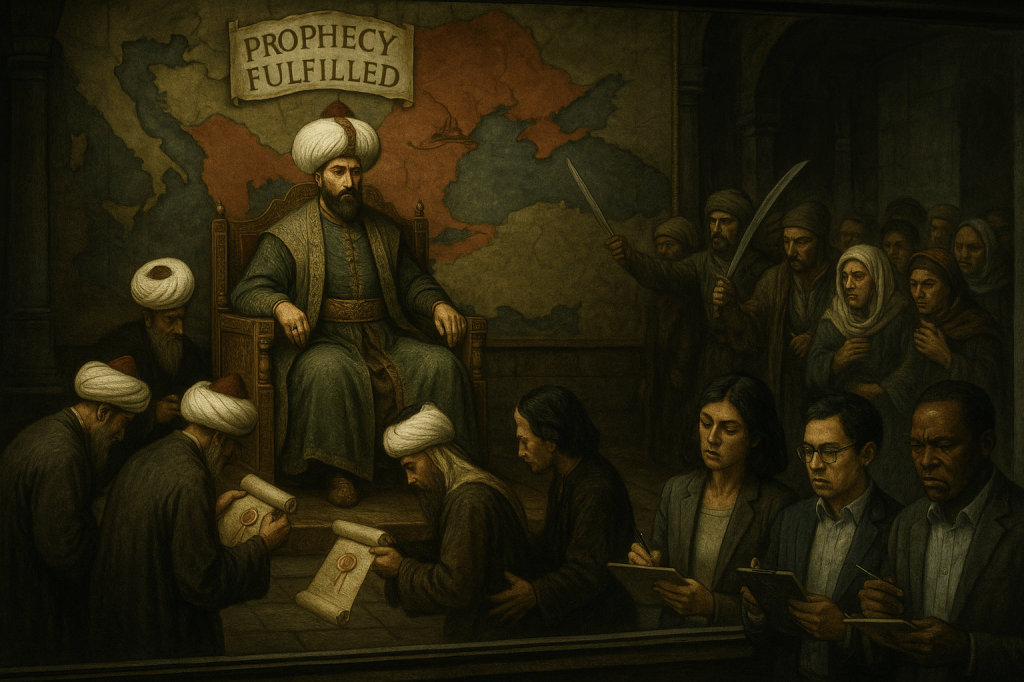
The Ottoman Empire’s manipulation of the Constantinople hadith represents one of history’s most successful propaganda campaigns, transforming a military conquest into a divine fulfillment that legitimized centuries of rule. After Mehmet II conquered Constantinople in 1453, Ottoman court scholars immediately began promoting the narrative that this victory fulfilled Muhammad’s prophecy, despite the hadith’s dubious origins and the 857-year gap since the Prophet’s death. This wasn’t merely religious interpretation; it was calculated political strategy designed to present Ottoman expansion as divinely ordained, making resistance to Ottoman rule equivalent to opposing God’s will.
The “Wonderful Leader” Who Murdered Infants
The hadith describes the conquering leader as “wonderful” – a moral endorsement that should reflect exceptional character and ethical conduct. Yet when we examine Mehmet II’s actual character and policies, we find a ruler whose actions starkly contradict any prophetic praise. Upon assuming power, Mehmet enacted and enforced fratricide laws that gave Ottoman sultans the legal right to murder their own brothers to prevent political rivalry. This wasn’t merely a theoretical policy – Mehmet personally implemented it by ordering the execution of his infant brother, drowning the helpless child to secure his throne. This policy of fratricide continued throughout the Ottoman dynasty, resulting in the systematic murder of countless princes, many of them infants and children, a practice utterly condemned by Quranic ethical standards.
The cognitive dissonance required to call such a ruler “wonderful” while he murders infants reveals how desperately Muslims need this prophecy to be true. If we accept that the hadith’s “wonderful leader” refers to Mehmet II, then we’re claiming the Prophet praised a child-killer who institutionalized infanticide as state policy. This alone should awaken any sincere believer to the fabrication. No prophet of God would describe a man who drowns his infant brother as “wonderful.” The fact that Ottoman scholars promoted this connection anyway demonstrates their complete abandonment of moral reasoning in service of political propaganda. They were willing to portray infanticide as divinely endorsed if it meant legitimizing their sultan’s rule.
The Ottomans didn’t just passively benefit from this fabricated prophecy; they actively embellished and promoted it through state-sponsored religious institutions. Court historians wrote elaborate accounts connecting Mehmet II to the promised commander in the hadith, adding details that weren’t even in the original fabrication. They commissioned poems, songs, and artistic works celebrating the “prophetic fulfillment.” Mosque sermons across the empire repeated the narrative, embedding it in public consciousness. The hadith became a cornerstone of Ottoman legitimacy, used to justify their rule over Arab lands and their claim to the caliphate. Any questioning of the hadith’s authenticity was treated as treason against both religion and state.
The pattern extends beyond the Constantinople hadith to reveal systematic Ottoman manipulation of religious texts for political purposes. They promoted hadiths that supported Turkish supremacy, sultan’s absolute authority, and the religious obligation to expand the empire. They suppressed hadiths that might challenge their rule or support rival claims to leadership. The religious establishment was fully integrated into this propaganda machine, with scholars receiving positions, salaries, and prestige in exchange for providing religious cover for political decisions. This corruption of religious scholarship for political purposes is exactly what the Quran warns against when it condemns those who “sell God’s revelations for a cheap price.”
Part 11: Breaking Down the Prophetic Fraud
A Point-by-Point Demolition
Let’s systematically demolish every aspect of this fabricated prophecy, leaving no room for doubt about its fraudulent nature. First, the timing: The hadith claims Muhammad predicted Constantinople’s conquest, but it first appears in Islamic literature during the Umayyad siege of 717-718 CE, 85 years after Muhammad’s death. No companion of the Prophet ever mentioned this supposedly important prophecy during their lifetimes. No early caliph cited it when planning military campaigns. It mysteriously materialized exactly when Muslim armies needed motivation to attack Constantinople. This isn’t prophecy; it’s military propaganda created in real-time.
Second, the narrator: Every version of this hadith depends on Kathir ibn Abdullah, whom Imam Shafi’i called “a pillar of lying.” This isn’t a minor weakness in the chain; it’s complete demolition. When the primary narrator is known for fabricating entire manuscripts of fake hadiths, nothing he narrates can be accepted. It’s like building a house on quicksand – no matter how solid the other materials might appear, the foundation guarantees collapse. The fact that hadith scholars still cite this narration knowing Kathir’s reputation proves they prioritize maintaining the hadith system over truth.
Third, the Quranic contradiction: The Quran explicitly states Muhammad didn’t know the future (6:50, 7:188, 46:9), yet this hadith claims he made detailed predictions about events 857 years later. This isn’t a subtle inconsistency that requires interpretation; it’s a direct contradiction. Either the Quran is wrong when it says Muhammad didn’t know the future, or the hadith is fabricated. For Muslims who claim to believe the Quran is God’s perfect word, the choice should be obvious. Yet they perform mental gymnastics to maintain both beliefs simultaneously, revealing how deeply the hadith corruption has penetrated Islamic thought.
Fourth, the historical impossibility: The hadith describes conquering Constantinople with “takbir and tasbih” (religious proclamations), implying a miraculous victory through faith rather than military might. In reality, Mehmet II conquered Constantinople using massive cannons, a naval blockade, and a 53-day siege involving tens of thousands of soldiers. The conquest was a military operation using cutting-edge technology (for its time), not a miraculous victory through prayer. The hadith’s description doesn’t match the historical reality, proving it wasn’t an accurate prophecy but a fabricated motivation tool that subsequent generations tried to retroactively connect to actual events.
Fifth, the complete absence from Bukhari and Muslim: The two most trusted hadith collections, Sahih Bukhari and Sahih Muslim, don’t include this hadith despite its supposedly momentous importance. These collectors, who included hadiths about the smallest details of daily life, somehow missed a prophecy about one of Islam’s greatest military victories? The obvious explanation is that even these hadith collectors, despite their general acceptance of weak narrations, recognized this particular fabrication as too problematic to include. Its absence from the “sahih” collections while appearing in less reliable sources confirms its fabricated nature.
Part 12: The Danger of Accepting Lies
How One Fabrication Corrupts Everything
Accepting fabricated hadiths like the Constantinople prophecy doesn’t just involve believing one false narrative; it corrupts the entire framework of religious understanding and opens the door to unlimited manipulation. When Muslims accept that Muhammad made prophecies contradicting the Quran’s clear statements, they’ve essentially declared that hadith can override God’s word. This precedent allows any fabrication to enter the religion as long as it has an isnad chain, regardless of how obviously it contradicts the Quran or historical reality. The Constantinople hadith thus becomes a gateway drug to accepting increasingly absurd fabrications that transform Islam from a monotheistic faith into a personality cult centered on manufactured stories about Muhammad.
The intellectual damage caused by accepting such fabrications is profound and generational. Children raised believing these fake prophecies develop a distorted understanding of both their religion and critical thinking itself. They’re taught that faith means accepting obvious contradictions, that questioning religious sources is sinful, and that emotional attachment to tradition overrides logical analysis. This intellectual corruption extends beyond religion into all areas of life, creating societies where authority is unquestioned, critical thinking is suppressed, and truth becomes subordinate to tradition. The Muslim world’s intellectual stagnation over the past centuries correlates directly with the elevation of hadith over the Quran’s emphasis on reason and evidence.
The spiritual corruption is even more devastating. By accepting fabricated prophecies, Muslims inadvertently commit the very sin the Quran repeatedly condemns – attributing lies to God and His messenger. Every time someone cites the Constantinople hadith as proof of Muhammad’s prophethood, they’re spreading a lie in God’s name. They’re also implying that the Quran’s actual content isn’t sufficient to prove Islam’s truth, so fabricated prophecies are needed to supplement God’s supposedly perfect book. This represents a complete inversion of Islamic monotheism, replacing trust in God’s word with faith in human fabrications.

Part 13: The Real Miracle – The Quran’s Preservation
Why Fabricators Couldn’t Touch God’s Book
The true miracle that Muslims should celebrate isn’t a fabricated prophecy about Constantinople, but the remarkable preservation of the Quran that prevented fabricators from inserting their lies into God’s book. While hadith literature became flooded with fabrications, political propaganda, and sectarian inventions, the Quran remained pristine, its mathematical structure and divine authorship protecting it from human corruption. The very existence of fabricated hadiths like the Constantinople prophecy, contrasted with the Quran’s purity, proves the divine protection God promised for His final revelation. The fabricators could corrupt hadith because they’re human works, but they couldn’t touch the Quran because it’s divinely protected.
The mathematical miracle of the Quran, particularly the intricate patterns based on the number 19, creates an impenetrable barrier against fabrication. Any attempt to insert false prophecies or additional verses would destroy these mathematical patterns, immediately exposing the tampering. This is why all the fabricated prophecies exist in hadith, not in the Quran. The forgers knew they couldn’t alter the Quran without detection, so they created a parallel system of hadith where they could insert whatever served their purposes. The Constantinople hadith couldn’t be inserted into the Quran because it would have disrupted the mathematical structure, so it was inserted into hadith collections instead.
Consider the profound wisdom in God’s system: He revealed a mathematically structured book that humans cannot successfully alter, then explicitly warned against following any other source of religious law. He knew that humans would try to corrupt His religion with fabrications, so He built in a failsafe – the Quran’s preservation. Every fabricated hadith actually serves as proof of the Quran’s miraculous preservation. If humans could have altered the Quran like they altered hadith, they would have. The fact that they had to resort to external hadith proves they couldn’t corrupt God’s protected book. Muslims celebrating fake hadith prophecies are missing the real miracle right in front of them.
Part 14: Return to Reason
The Quran’s Call to Critical Thinking
The Quran repeatedly commands believers to use reason, demand evidence, and think critically – the exact opposite of the blind faith required to accept fabricated hadiths. God presents His signs with logical arguments, invites scrutiny of His revelations, and challenges disbelievers to find contradictions. This emphasis on reason and evidence stands in stark contrast to the hadith system’s demand for unquestioning acceptance of narrations from known liars. The Constantinople hadith represents everything the Quran opposes: blind faith in human authority, acceptance of logical contradictions, and elevation of tradition over truth.
The Quranic methodology for determining truth is clear and consistent: Examine the evidence, use your reason, and don’t accept claims without proof. God repeatedly asks, “Do you not think?” “Do you not reflect?” “Do you not use reason?” These aren’t rhetorical questions but divine commands to engage our critical faculties. When Muslims accept the Constantinople hadith despite its obvious problems, they’re violating these Quranic commands. They’re choosing blind faith in human traditions over the rational investigation God demands. The tragedy is that they think they’re being pious when they’re actually disobeying God’s clear instructions.
Returning to Quranic reasoning would immediately expose all hadith fabrications. If Muslims simply asked, “Does this contradict the Quran?” and “What’s the evidence for this claim?” the entire hadith system would collapse. The Constantinople hadith fails both tests – it contradicts Quranic verses about Muhammad’s knowledge and lacks any credible evidence. But asking these questions requires courage to challenge authority and risk social censure. The Quran promises that truth will always defeat falsehood if people use their reason, but that promise requires people to actually engage their critical thinking rather than surrendering it to religious authorities.
Conclusion: The Moment of Truth
Choosing Between God’s Word and Human Lies
We have now completed our forensic investigation of the Constantinople hadith, and the evidence is overwhelming and undeniable. This celebrated “prophecy” is a complete fabrication, invented during failed military campaigns, narrated by a known liar, contradicting explicit Quranic verses, and historically impossible. The 857-year gap between Muhammad’s death and Constantinople’s conquest, combined with the hadith’s convenient emergence during Umayyad military campaigns, exposes it as transparent political propaganda. No amount of emotional attachment or scholarly apologetics can overcome these facts. The Constantinople hadith is a lie, and everyone who continues to propagate it after learning these facts becomes complicit in spreading falsehood in God’s name.
The implications of this investigation extend far beyond a single hadith. If one of Islam’s most celebrated prophecies is fabricated, what does this say about the entire hadith system? How many other “miraculous” predictions were invented after the fact? How many religious laws and practices are based on similar fabrications? The answer is terrifying for those whose faith depends on hadith: The entire system is corrupted beyond redemption. The presence of even one fabrication narrated by known liars proves the system’s failure. The fact that classical scholars couldn’t or wouldn’t identify obvious fabrications proves their methodology is fatally flawed. The only solution is complete rejection of the hadith system and return to the Quran alone.
To our Muslim brothers and sisters reading this investigation, we present you with a clear choice: You can continue believing in fabricated hadiths that contradict the Quran, making you complicit in the greatest corruption of God’s religion in history. Or you can return to the Quran alone, as God commanded, accepting His complete and perfect guidance without human additions. The evidence is before you – the Constantinople hadith is fabricated, its narrator was a liar, and it contradicts God’s clear statements about His messenger. Your response to this evidence will determine whether you stand with truth or falsehood, with God’s word or human fabrication, with the Quran or the corruption that has plagued Islam for centuries.
The Quran warns repeatedly about those who fabricate lies about God and His messenger, promising them humiliation in this life and severe punishment in the Hereafter. Every time you repeat the Constantinople hadith knowing it’s fabricated, you join their ranks. Every time you use this lie to “prove” Islam, you actually undermine the religion and confirm skeptics’ suspicions that Islam needs lies to support itself. The truth is that Islam needs no fabricated prophecies – the Quran itself is sufficient proof for those who use reason. But that requires the courage to abandon cherished traditions and face the social consequences of standing for truth against popular falsehood.
We conclude with God’s own words, which should guide every sincere believer’s response to fabricated hadiths:
[45:6] “These are God’s revelations that we recite to you truthfully. In which Hadith other than God and His revelations do they believe?”
The choice is yours. Will you continue believing in hadith narrated by “pillars of lying,” or will you return to God’s revelations alone? Will you stand with those who fabricate lies about God, or with those who uphold His pure word? The evidence has been presented, the truth has been revealed, and the judgment now rests with you. Choose wisely, for your choice will determine not just your understanding of Islam, but your standing before God on the Day of Judgment when all fabrications are exposed and only truth remains.


 Quran Only Studies
Leave a reply to The Tall Tale of Tall Buildings: Exposing the “Barefoot Bedouins” Hadith – Quran Only Studies Cancel reply