Introduction: The Divine Distinction
Throughout the Final Testament, God establishes an unmistakable principle that many overlook: prayer is not a universal act that automatically brings divine acceptance. It is a sacred covenant between God and those who sincerely believe. This distinction is not arbitrary—it represents the fundamental difference between genuine submission and theatrical performance, between heartfelt devotion and empty ritual.
The hypocrites have always existed, performing the outward motions of worship while their hearts remain distant from God. They bow, they stand, they recite words—but their prayers are rejected. More than that, their hypocritical worship becomes evidence against them, condemning them to the lowest depths of Hell. This article systematically proves three irrefutable truths from the Final Testament: prayer is commanded exclusively for believers, hypocritical prayer is condemned more severely than honest disbelief, and actions must perfectly align with intentions for worship to be accepted.
Part 1: Prayer—An Exclusive Command to Believers
The Pattern of Divine Address
When you examine every command regarding prayer in the Final Testament, a striking pattern emerges: God addresses believers specifically, never hypocrites, never those who openly reject faith. The Arabic phrase “الَّذِينَ آمَنُوا” (those who believe) precedes every single prayer command, establishing prayer as a covenant between God and those who have submitted their hearts in sincerity.
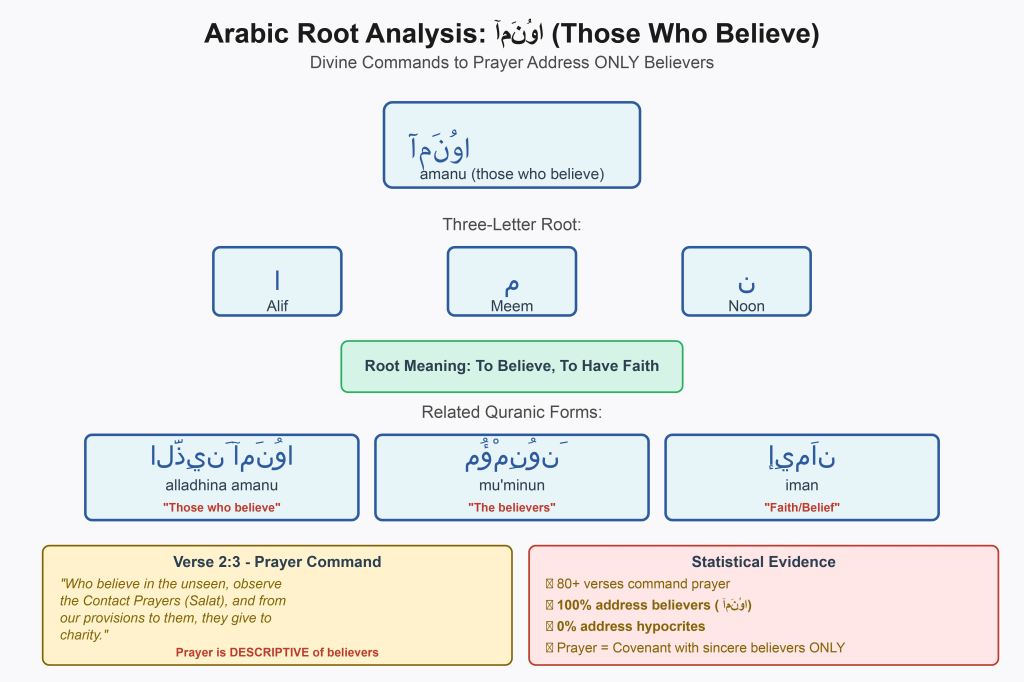
[2:3] “who believe in the unseen, observe the Contact Prayers (Salat), and from our provisions to them, they give to charity.”
This verse doesn’t merely suggest that believers pray—it defines believers as those who observe prayer. The relationship is circular and absolute: you cannot be a believer without sincere prayer, and sincere prayer cannot exist without genuine belief. This is not a command extended to hypocrites hoping their prayers might make them believers. It is a description of what believers already do because belief has been established in their hearts.
[2:43] “You shall observe the Contact Prayers (Salat) and give the obligatory charity (Zakat), and bow down with those who bow down.”
The command is direct and unambiguous. But notice the final phrase: “bow down with those who bow down.” This establishes prayer as a community of sincere believers. You don’t merely go through the physical motions—you join a spiritual community of those whose hearts are aligned with God. The hypocrite may stand in the same physical space, but they are not “with those who bow down” in the spiritual sense. They are outsiders performing a charade.
[5:6] “O you who believe, when you observe the Contact Prayers (Salat), you shall: (1) wash your faces, (2) wash your arms to the elbows, (3) wipe your heads, and (4) wash your feet to the ankles. If you were unclean due to sexual orgasm, you shall bathe. If you are ill, or traveling, or had any digestive excretion (urinary, fecal, or gas), or had (sexual) contact with the women, and you cannot find water, you shall observe the dry ablution (Tayammum) by touching clean dry soil, then rubbing your faces and hands. God does not wish to make the religion difficult for you; He wishes to cleanse you and to perfect His blessing upon you, that you may be appreciative.”
This comprehensive verse about purification before prayer begins with the same critical address: “O you who believe.” The detailed instructions for ablution are given exclusively to believers, reinforcing that prayer—and all its prerequisites—belong to those with sincere faith. The hypocrite may wash their limbs perfectly, but without belief established in their hearts, their ritual purity is meaningless. God’s intent to “cleanse you and perfect His blessing upon you” applies only to believers who approach prayer with sincerity.
The Mathematical Certainty
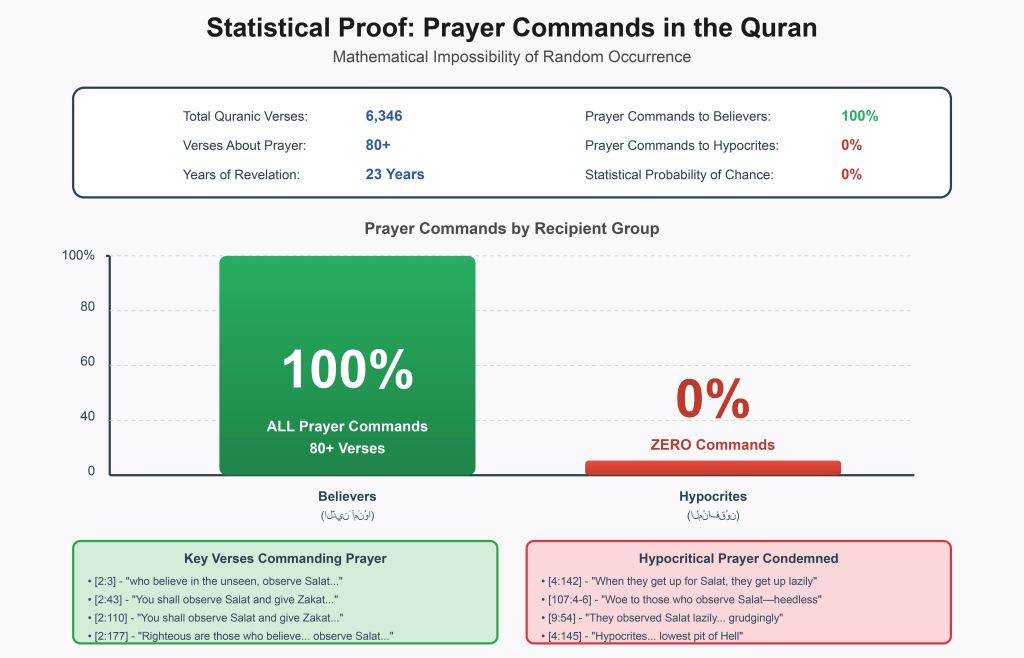
Throughout the 6,346 verses of the Final Testament, the pattern is absolute and unbroken. Over 80 verses command or describe prayer, and every single one addresses believers. Not once does God command hypocrites to pray. Not once does He suggest that prayer might transform a hypocrite into a believer. The statistical impossibility of this pattern occurring by chance demonstrates divine intentionality—prayer is for believers, and believers alone.
[2:110] “You shall observe the Contact Prayers (Salat) and give the obligatory charity (Zakat). Any good you send forth on behalf of your souls, you will find it at God. God is seer of everything you do.”
The promise is clear: righteous deeds reach God. But this promise is made to those who observe prayer with sincerity, those who understand that God sees everything they do—not just their physical movements, but the intentions behind them. The hypocrite may perform the same physical actions, but their “deeds” do not reach God. They are rejected before they begin.

Part 2: The Devastating Condemnation of Hypocritical Prayer
Worse Than Honest Disbelief
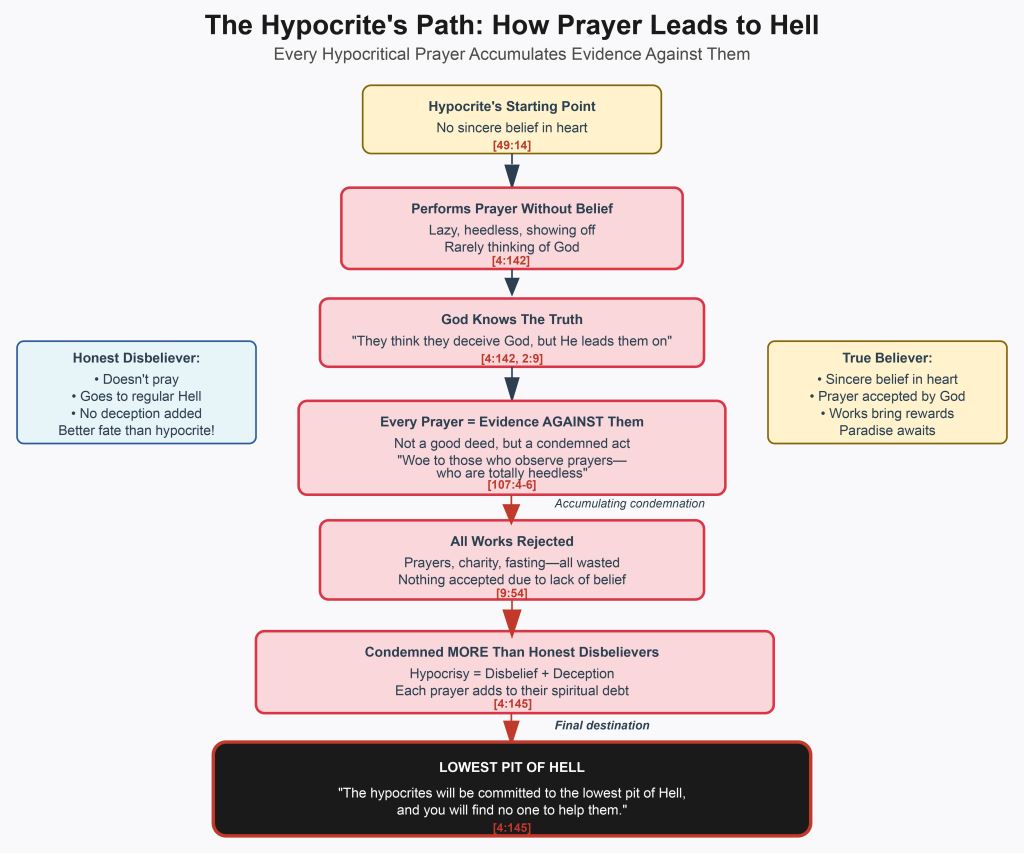
One of the most shocking revelations in the Final Testament is that hypocrites who pray are condemned more severely than those who honestly reject faith. The hypocrite faces a unique judgment—not merely Hell, but “the lowest pit of Hell.” This is not an accident of translation or a matter of interpretation. It is stated explicitly and repeatedly. The hypocrite’s prayer doesn’t save them; it becomes the very evidence that condemns them to the worst possible fate.
[4:142] “The hypocrites think that they are deceiving God, but He is the One who leads them on. When they get up for the Contact Prayer (Salat), they get up lazily. That is because they only show off in front of the people, and rarely do they think of God.”
This verse exposes the hypocrite’s internal reality. They pray—but lazily. They stand—but only to show off. They recite—but rarely think of God. Every element of their prayer is corrupted by insincerity. Yet they believe they are deceiving God, performing well enough to gain divine acceptance. The verse reveals their profound delusion: God is not deceived. He leads them on, allowing them to accumulate evidence against themselves with every hypocritical prayer.
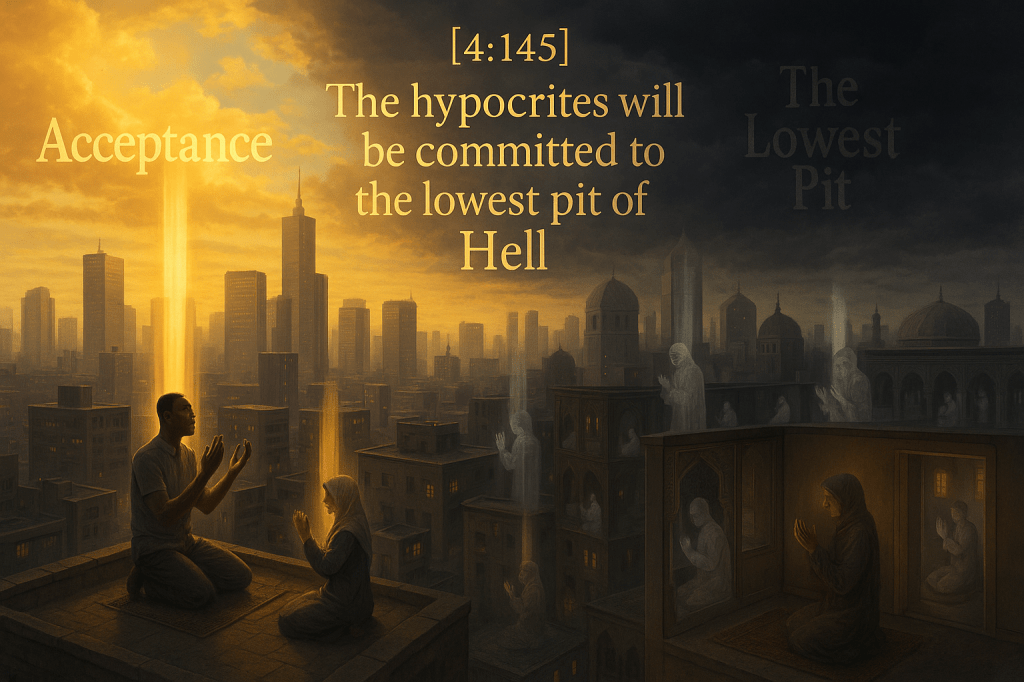
[4:145] “The hypocrites will be committed to the lowest pit of Hell, and you will find no one to help them.”
The verdict follows immediately. Not simply Hell—the lowest pit. No mercy, no help, no intercession. This is the fate of those who pray without belief, who perform the rituals while their hearts remain closed. Their prayers, far from helping them, seal their doom. Each lazy prostration adds another testimony against them on the Day of Judgment.
The Chapter of Empty Worship
Chapter 107 is titled “The Charity” but it focuses laser-like on the worthlessness of prayer without sincerity. The chapter is short, devastating, and leaves no room for misinterpretation. It doesn’t address open disbelievers—it condemns those who pray but whose prayers are hollow.
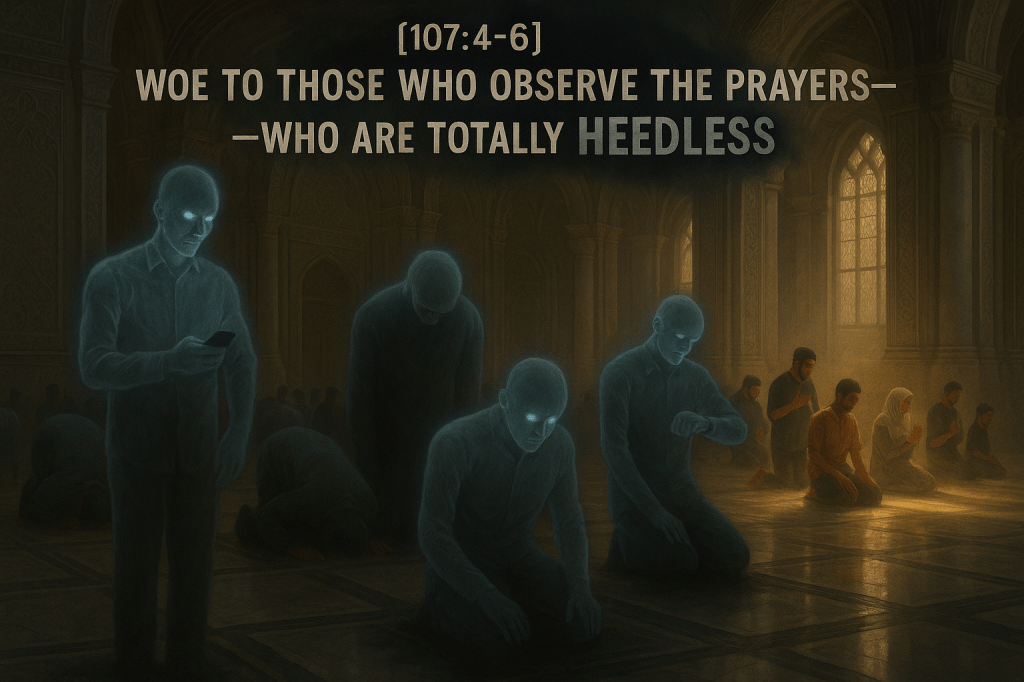
[107:4-6] “And woe to those who observe the contact prayers (Salat)—who are totally heedless of their prayers. They only show off.”
Read that again carefully. “Woe to those who observe the contact prayers.” Not woe to those who don’t pray—woe to those who do pray but are heedless. The physical act of prayer becomes a curse when performed without consciousness of God. The hypocrite imagines that their attendance at prayer services, their correct physical positions, their memorized recitations will save them. God declares the opposite: these very prayers condemn them because they “only show off.”
This is the prayer of the hypocrite: a performance for human audiences, a social expectation to meet, a reputation to maintain. There is no communication with God, no consciousness of the divine presence, no transformation of the heart. It is spiritual theater, and its only audience is other people. God is not impressed. He is offended. The result is not acceptance but “woe”—divine condemnation.
Part 3: God Knows What You Hide
The Illusion of Deception
The hypocrite operates under a fundamental delusion: they believe they can hide their true nature from God. They imagine that correct physical movements, attendance at prayer times, and public demonstrations of piety will fool the Creator of the universe. The Final Testament repeatedly exposes this absurd presumption. God sees through every facade, perceives every hidden intention, knows the secrets buried in the deepest chambers of the heart.
[33:72] “We have offered the responsibility (freedom of choice) to the heavens and the earth, and the mountains, but they refused to bear it, and were afraid of it. But the human being accepted it; he was transgressing, ignorant.”
Humanity accepted the responsibility of free will—the freedom to choose belief or disbelief, sincerity or hypocrisy. With this freedom comes absolute accountability. You cannot claim you were forced into hypocrisy or compelled to perform insincere prayers. Every prayer is a choice, and God knows exactly what you chose and why you chose it. The hypocrite’s prayers become evidence of their deliberate rejection of truth despite knowing better.
[2:9] “In trying to deceive God and those who believe, they only deceive themselves without perceiving.”
This verse reveals the tragic irony of hypocrisy. The hypocrites believe they are successfully fooling God and the believers. They congratulate themselves on their clever performance, their ability to maintain their reputation while avoiding genuine submission. But they deceive no one except themselves. God knows their reality. Sincere believers sense their hollowness. Only the hypocrites remain blind to their own condition, celebrating their deception while accumulating condemnation.
The Heart Is the Criterion
The Final Testament establishes repeatedly that God judges hearts, not mere actions. Physical worship without internal sincerity is not only worthless—it is condemned. This principle demolishes the hypocrite’s entire strategy. They focus obsessively on external performance while ignoring the state of their hearts. They memorize the correct postures while their minds wander to worldly concerns. They speak prayers while mentally counting the minutes until they can return to their real priorities.
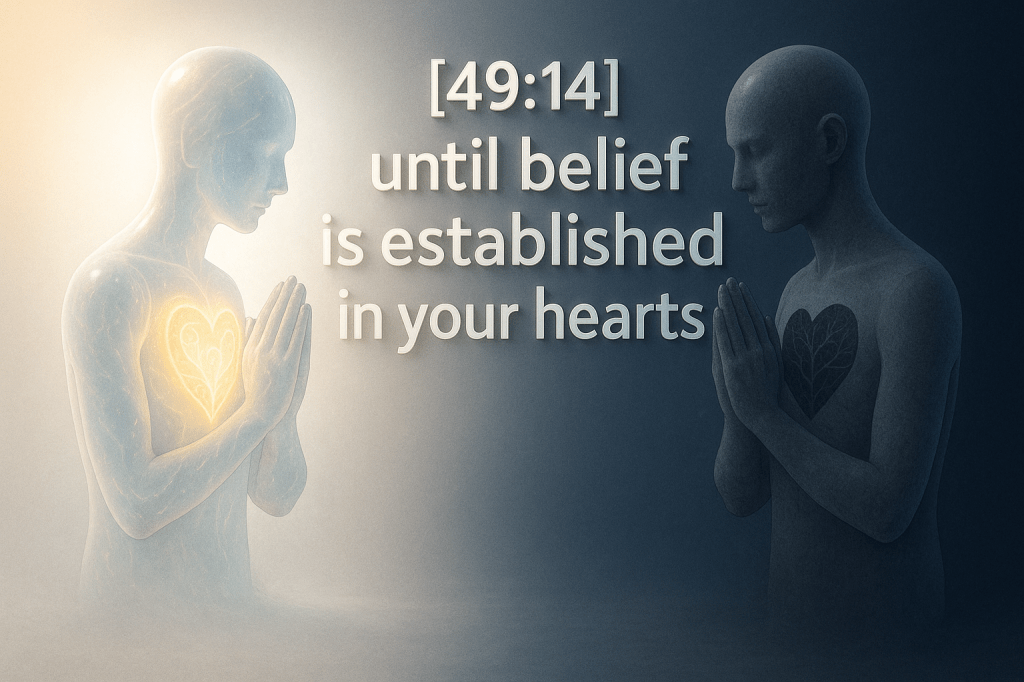
[49:14] “The Arabs said, ‘We are Mu’mens (believers).’ Say, ‘You have not believed; what you should say is, ‘We are Muslims (submitters),’ until belief is established in your hearts.’ If you obey God and His messenger, He will not put any of your works to waste. God is Forgiver, Most Merciful.”
Here God directly corrects those who claim belief without internal transformation. You may submit outwardly—performing prayers, fasting, giving charity—but this does not make you a believer until “belief is established in your hearts.” The Arabic Muslims around the messenger claimed belief based on their ritual performance. God rejected their claim. Until the heart is transformed, until sincerity penetrates to the core of your being, your prayers are the prayers of a hypocrite, not a believer.
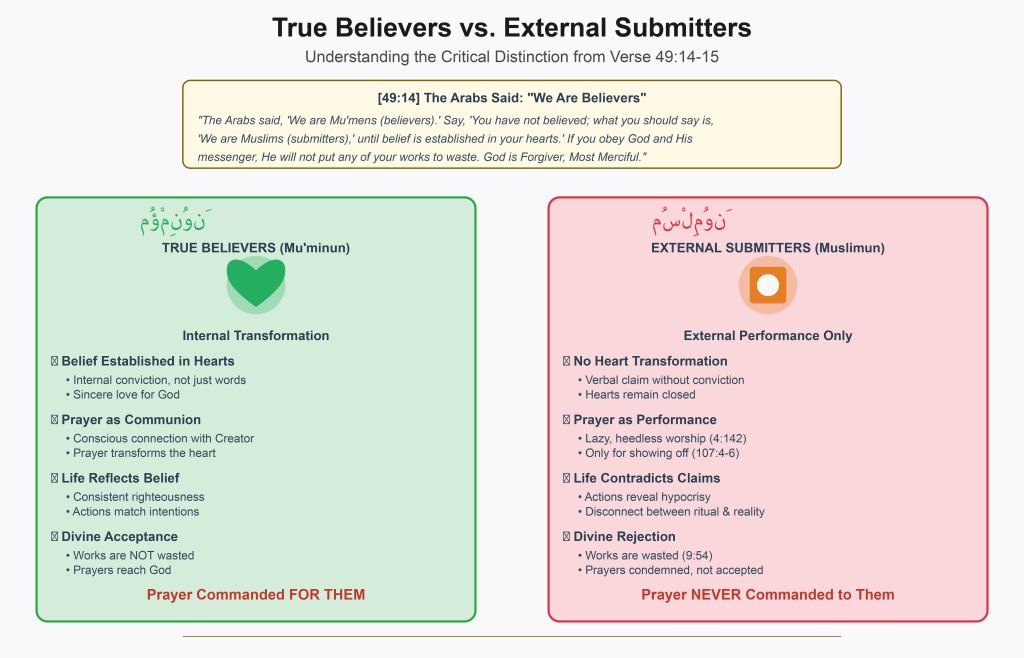
[49:15] “Mu’mens (believers) are those who believe in God and His messenger, then attain the status of having no doubt whatsoever, and strive with their money and their lives in the cause of God. These are the truthful ones.”
Notice the progression: true believers (مُؤْمِنُونَ – mu’minun) are defined not by ritual performance, but by unwavering conviction and complete life commitment. They have “no doubt whatsoever” and their striving encompasses both wealth and life itself. This total integration of belief and action distinguishes them from external submitters who maintain the appearance of faith while their hearts remain unchanged. Prayer commanded to believers assumes this complete transformation has already occurred.
The promise in verse 49:14 is crucial: “If you obey God and His messenger, He will not put any of your works to waste.” True obedience—rooted in sincere belief—means your prayers will not be wasted. But the converse is equally true: if you lack sincere belief, all your works are wasted. Every prayer, every prostration, every hour spent in ritual performance becomes evidence against you, not for you. The distinction between mu’minun (true believers) and muslimun (external submitters) is not semantic—it determines whether your prayers reach God or condemn you to Hell.
Part 4: Actions Must Match Intentions
The Definition of Righteousness
One of the longest verses in the Final Testament provides the most comprehensive definition of righteousness. It systematically dismantles any notion that ritual alone constitutes piety, establishing instead that true righteousness requires the integration of belief, prayer, and ethical action. You cannot separate these elements—they form an indivisible whole.
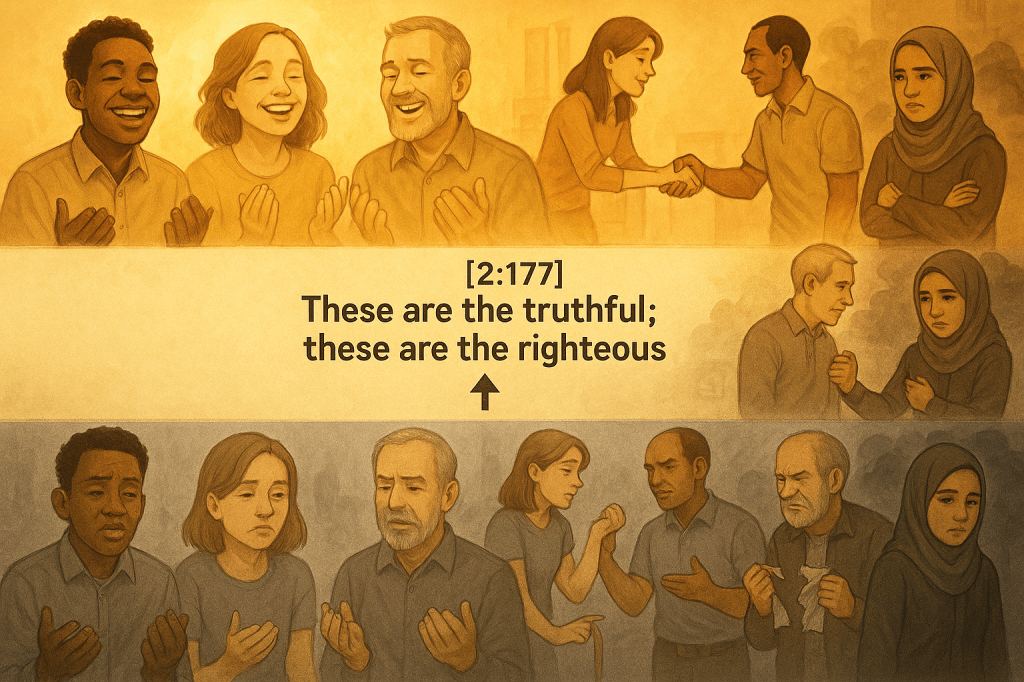
[2:177] “Righteousness is not turning your faces towards the east or the west. Righteous are those who believe in God, the Last Day, the angels, the scripture, and the prophets; and they give the money, cheerfully, to the relatives, the orphans, the needy, the traveling alien, the beggars, and to free the slaves; and they observe the Contact Prayers (Salat) and give the obligatory charity (Zakat); and they keep their word whenever they make a promise; and they steadfastly persevere in the face of persecution, hardship, and war. These are the truthful; these are the righteous.”
Notice the structure of this verse. It begins by dismissing ritualism—”righteousness is not turning your faces towards the east or the west.” Physical orientation means nothing without internal transformation. Then it lists the actual components of righteousness: belief comes first, establishing the foundation. Prayer appears in the middle, integrated with charity. But belief and prayer alone are insufficient—you must also demonstrate integrity, generosity, and perseverance. The verse concludes by calling such people “the truthful”—their external actions match their internal reality. This is the opposite of hypocrisy.
The hypocrite might observe all the prayers, face the correct direction, perform the physical movements perfectly. But if their life contradicts their prayers—if they lie, cheat, hoard wealth, break promises, or abandon righteousness when tested—their prayers become evidence of their hypocrisy, not their piety. God demands consistency. Your life must reflect your prayers, and your prayers must reflect your heart.
When Prayer Is Rejected
The Final Testament provides specific examples of prayers being rejected despite being performed. These examples destroy any notion that the physical act of prayer automatically brings divine acceptance. God explicitly states what makes prayer unacceptable, and in every case, the issue is the disconnect between outward ritual and internal reality.
[9:54] “What prevented the acceptance of their spending is that they disbelieved in God and His messenger, and when they observed the Contact Prayers (Salat), they observed them lazily, and when they gave to charity, they did so grudgingly.”
This verse describes people who pray and give charity—the two pillars of Islamic worship. Yet their worship is rejected completely. Why? Because they “disbelieved in God and His messenger.” Their prayers are lazy. Their charity is grudging. Every element of their worship is contaminated by insincerity. The physical actions are present, but the spiritual substance is absent. The result is absolute rejection—their spending is not accepted, which means their prayers are not accepted, which means they face judgment as hypocrites despite their apparent piety.
This verse should terrify anyone who prays without examining their heart. You may attend every prayer service, fulfill every ritual requirement, and still have your worship rejected because you lack sincere belief or perform your duties with resentment rather than joy. The test is not whether you pray, but why you pray and how you live when you’re not praying.
Part 5: The Profile of a Hypocrite
Impressive Appearances, Hollow Hearts
Chapter 63, titled “The Hypocrites,” provides a devastating psychological profile of those who pray without belief. The description is so precise, so unflinching, that any honest reader must examine themselves against these criteria. Do your actions match this profile? If so, your prayers are not reaching God—they are condemning you.
[63:1] “When the hypocrites come to you they say, ‘We bear witness that you are the messenger of God.’ God knows that you are His messenger, and God bears witness that the hypocrites are liars.”
The hypocrite says the right words. They bear witness to the messenger, they claim belief, they participate in the community of believers. But God testifies that they are liars. Their words and their hearts do not match. They have learned the vocabulary of faith without experiencing the transformation of faith. When they pray, they recite the correct words, but their hearts testify against them.
[63:2-3] “Under the guise of their apparent faith, they repel the people from the path of God. Miserable indeed is what they do. This is because they believed, then disbelieved. Hence, their minds are blocked; they do not understand.”
This passage reveals a crucial point: many hypocrites once believed sincerely, then chose to disbelieve. They tasted truth, experienced the joy of sincere worship, and then deliberately turned away. But rather than honestly abandoning their faith, they maintained the appearance of belief. They kept praying—not to communicate with God, but to maintain their social position, their reputation, their sense of religious identity. The result is spiritual blindness—their minds are blocked, they no longer understand truth even when it is presented clearly.
The Performance of Piety
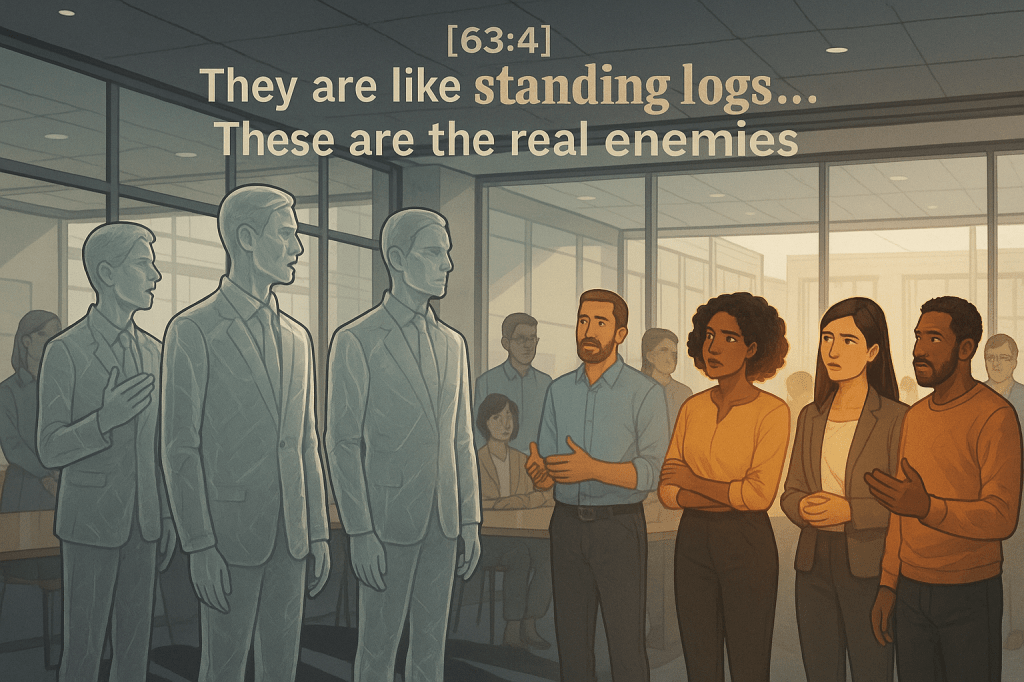
[63:4] “When you see them, you may be impressed by their looks. And when they speak, you may listen to their eloquence. They are like standing logs. They think that every call is intended against them. These are the real enemies; beware of them. God condemns them; they have deviated.”
The hypocrite is often impressive to human observers. They are eloquent, well-dressed, socially prominent, skilled in religious discourse. They know when to bow, when to stand, what words to recite. They may even be more punctual at prayer than many sincere believers. But God calls them “standing logs”—physically present but spiritually dead, taking up space but producing no life, no growth, no fruit. Their constant defensiveness—thinking “every call is intended against them”—reveals their guilty conscience. They know their prayers are hollow, and they fear exposure.
The final judgment is unambiguous: “God condemns them.” Not “God is disappointed in them” or “God hopes they will improve.” God condemns them. Their prayers, their religious participation, their apparent piety—all of it is rejected. They are enemies of truth disguised as friends of faith.
Part 6: No Compulsion, But Absolute Accountability
Freedom Without Excuse
One of the most frequently misunderstood verses in the Final Testament establishes the principle of religious freedom. But this freedom is not permission to practice hypocrisy—it is the removal of all excuses for hypocrisy. You are free to believe or disbelieve. What you cannot do is claim belief while living in disbelief and expect divine acceptance.
[2:256] “There shall be no compulsion in religion: the right way is now distinct from the wrong way. Anyone who denounces the devil and believes in God has grasped the strongest bond; one that never breaks. God is Hearer, Omniscient.”
The verse begins with absolute clarity: no compulsion in religion. No one can force you to believe. No one can coerce you into sincere prayer. This immediately means that anyone who does pray has chosen to do so—they cannot claim they were forced into hypocrisy, pressured into performing insincere worship, or compelled to maintain a false religious identity. Every prayer is a free choice, which means every hypocritical prayer is a deliberate rejection of truth.
The second part of the verse makes the stakes crystal clear: “the right way is now distinct from the wrong way.” The truth has been made obvious. The path of sincere submission has been illuminated. The consequences of hypocrisy have been spelled out in unmistakable terms. You cannot claim confusion or uncertainty. If you choose to pray without belief, you are deliberately choosing the wrong way despite knowing better.
The Test of Freedom
The existence of hypocrites is not a flaw in the divine system—it is proof of human freedom. God could have programmed humans to believe automatically, to pray with guaranteed sincerity, to be incapable of hypocrisy. But that would eliminate meaningful choice, authentic love, and genuine submission. Instead, God created a system where you can pray without believing, where you can go through all the motions while your heart remains distant. This freedom is the test.
Every time you stand for prayer, you face a choice. Will this be sincere communication with God, or will it be a performance for other people? Will you focus your consciousness on the divine presence, or will you mentally plan tomorrow’s schedule while your lips recite memorized words? Will your life reflect your prayers, or will you compartmentalize your religion into ritual moments disconnected from your actual values and choices?
The hypocrite fails this test repeatedly, choosing performance over sincerity, reputation over transformation, social acceptance over divine acceptance. With each failed test, they accumulate evidence against themselves. Their prayers become testimonies of their hypocrisy, preserved and recorded for the Day of Judgment.

Part 7: The Mathematical Proof of Divine Design
Statistical Impossibility of Random Occurrence
When you analyze the Final Testament mathematically, the evidence becomes overwhelming. The distinction between believers and hypocrites regarding prayer is not a casual theme mentioned occasionally—it is a systematic structure woven throughout the entire scripture with mathematical precision.
Consider these statistics from the Final Testament’s 6,346 verses: Over 80 verses command or describe prayer, and 100% of them address believers specifically. Twenty-six verses condemn hypocritical prayer. Two hundred eighteen verses require the integration of belief and righteous deeds. Zero verses suggest that prayer without sincere belief brings divine acceptance. Zero verses command hypocrites to pray.
The probability of this occurring by chance is mathematically zero. If the Final Testament were a human composition reflecting the cultural assumptions of 7th century Arabia, we would expect some variation, some ambiguity, some verses suggesting that prayer might help transform hypocrites into believers. Instead, the message is absolute, consistent, and unyielding across 23 years of revelation, delivered in different circumstances, addressing different audiences, yet maintaining perfect consistency on this principle.
The Divine Formula
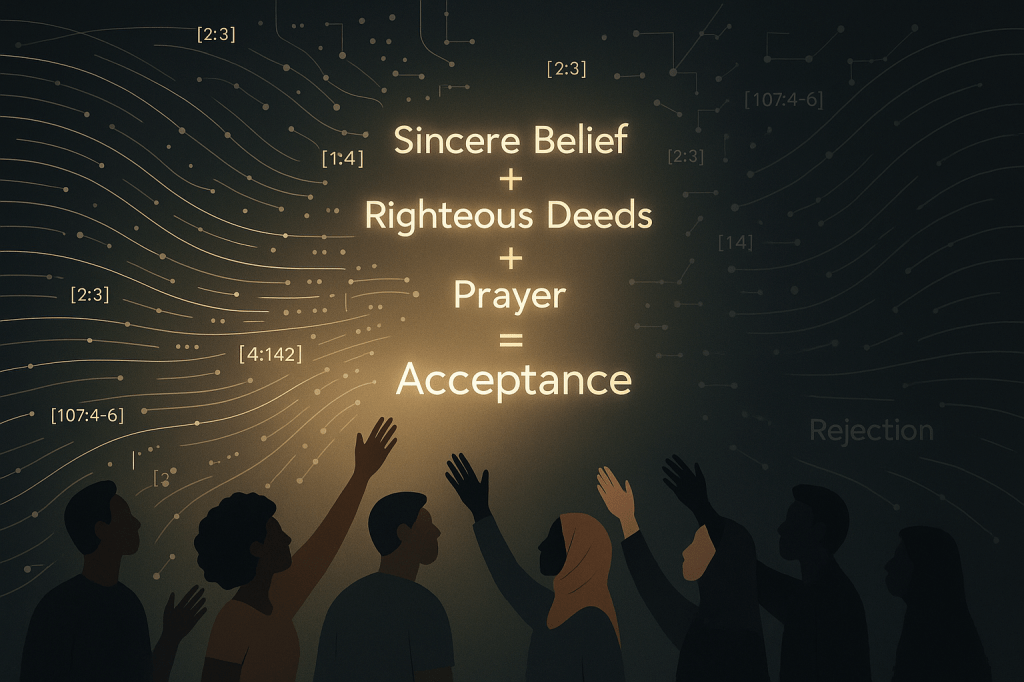
From the Quranic evidence, we can extract a precise formula for divine acceptance:
Sincere Belief + Righteous Deeds + Consistent Prayer = Divine Acceptance
Remove any element, and the formula fails completely. Prayer without belief equals hypocrisy equals condemnation. Belief without consistent prayer equals incomplete submission. Righteous deeds without sincere belief equals performance for human approval, not divine acceptance. All three elements must be present, and they must be authentic.
The hypocrite attempts to manipulate the formula, thinking they can substitute appearance for reality, performance for sincerity, ritual consistency for spiritual transformation. The Final Testament declares this strategy absolutely futile. God sees through every facade, and the mathematical structure of scripture itself testifies to the impossibility of deceiving the divine.
Part 8: Historical Examples and Contemporary Application
The Hypocrites of Every Generation
Hypocrisy is not a problem confined to ancient Arabia. Every generation produces its hypocrites—those who maintain religious appearances while their hearts reject divine authority. In the messenger’s time, hypocrites attended every prayer, participated in community rituals, claimed belief publicly, yet worked against the message privately. Their modern counterparts are equally recognizable.
Today’s hypocrite posts religious content on social media while engaging in unethical business practices. They attend weekly services while gossiping, lying, and breaking promises throughout the week. They memorize prayers while harboring hatred, maintaining grudges, and refusing to forgive. They lecture others about piety while their own lives demonstrate no real submission to divine guidance. Their prayer schedule is impeccable, but their character is corrupt.
The Final Testament’s description of hypocrites as “standing logs” is perfectly applicable to these modern pretenders. They occupy space in religious communities, they are physically present at prayers, they know the right words and the correct postures. But they are spiritually dead—producing no fruit, generating no light, offering nothing of substance. Their religion is entirely performative, designed to maintain social status and self-deception, not to foster actual communion with God.
The Contemporary Test
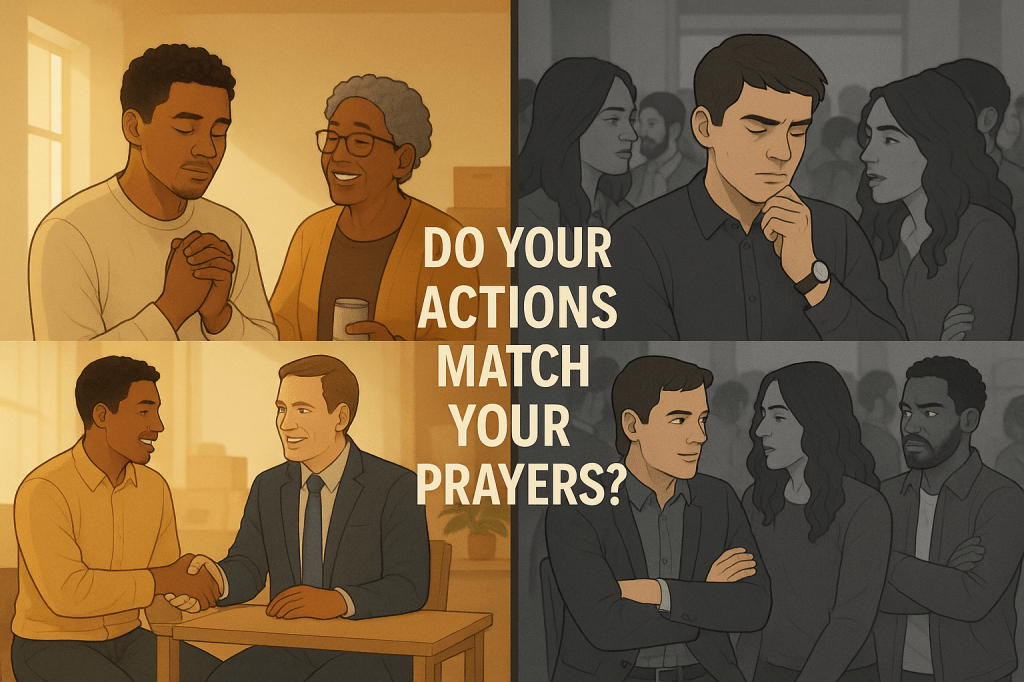
How do you know if your prayers are sincere or hypocritical? The Final Testament provides clear diagnostic criteria. Examine your life when you’re not praying. Do you maintain the same God-consciousness, the same ethical standards, the same commitment to truth? Or do you compartmentalize your religion, treating prayer as a ritual obligation disconnected from the rest of your life?
Ask yourself: Would I pray if no one knew about it? Would I maintain the same religious schedule if there were no social consequences for stopping? Do I ever pray with genuine joy and sense of divine presence, or is it always a burdensome obligation? When I’m criticized, do I immediately become defensive (like the hypocrites who “think that every call is intended against them”), or can I calmly examine whether the criticism is valid?
Most importantly: Has my life changed because of my prayers? Has my character improved? Have I become more truthful, more generous, more patient, more forgiving? If your prayers are not transforming your character, they are not reaching God. You are praying to impress people or to satisfy your own sense of religious identity, but you are not communicating with the Creator.
Part 9: The Path Forward—From Hypocrisy to Sincerity
Honest Self-Assessment
If the criteria in this article have exposed hypocrisy in your own practice, there is a path forward—but it requires brutal honesty. You cannot fix a problem you refuse to acknowledge. The first step is admitting that your prayers may have been hypocritical, that you have been going through motions without genuine submission, that you have been more concerned with appearances than with reality.
This admission is painful. It requires acknowledging that years or decades of prayers may have been rejected, that your religious reputation may be built on false foundations, that you have been deceiving yourself as much as you thought you were deceiving others. But this pain is necessary. The hypocrite’s fundamental problem is self-deception, and you cannot overcome self-deception without first experiencing the shock of recognition when the truth breaks through your defenses.
The Final Testament offers hope even to hypocrites, but only if they repent genuinely. Repentance is not merely feeling sorry or promising to do better—it is fundamental transformation. It means establishing belief in your heart, not just maintaining belief on your tongue. It means praying because you want to connect with God, not because you want to maintain your religious image. It means living consistently with your prayers, aligning every aspect of your life with divine guidance.
The Requirements of Sincere Transformation
To move from hypocritical prayer to sincere submission requires specific steps. First, you must study the Final Testament systematically, not selectively. You cannot pick and choose verses that make you comfortable while ignoring those that challenge your lifestyle. You must encounter God’s word in its entirety, allowing it to transform your understanding.
Second, you must examine every aspect of your life for contradictions between what you claim to believe and how you actually live. Where you find contradictions, you must change your behavior, not rationalize your hypocrisy. If you pray but lie in business, you must either stop praying or stop lying—you cannot do both and expect divine acceptance.
Third, you must develop God-consciousness that extends beyond ritual moments. Prayer is not a spiritual vaccination that allows you to live irreligiously the rest of the time. It is meant to be the most intense expression of a God-consciousness that permeates every moment. When you truly believe that God sees everything you do, hears every word you speak, knows every thought you harbor, your entire life becomes an extension of your prayer.
Fourth, you must be willing to lose your religious reputation if necessary. Many people maintain hypocritical prayers because stopping would create social consequences. But if your concern is social approval rather than divine acceptance, you are praying to people, not to God. The sincere believer would rather be honest about their doubts than maintain a false image of piety.

Part 10: The Choice Before You
No Middle Ground
The Final Testament eliminates all middle ground on this issue. You are either a sincere believer whose prayers are accepted, or you are a hypocrite whose prayers are condemned. There is no third category. You cannot be “mostly sincere” or “working on it” or “better than many others.” God judges hearts with absolute precision, and He knows exactly which category you fall into, regardless of how you deceive yourself or others.
The hypocrite desperately wants there to be a spectrum, a gray area, a range of acceptable sincerity levels. They want to believe that their 60% sincerity is good enough, that their occasional moments of genuine devotion outweigh their predominantly performative worship. The Final Testament offers no such comfort. Partial sincerity is complete hypocrisy. Occasional genuine devotion does not cancel out predominant self-deception.
This binary choice is not cruel—it is clarifying. It removes all ambiguity, all self-deception, all comfortable rationalizations. You know whether your prayers are sincere or not. You know whether you would maintain them without social pressure. You know whether your life reflects your stated beliefs. The question is whether you will admit what you know, or whether you will continue the hypocrite’s game of self-deception.
The Ultimate Question
Before you stand for your next prayer, ask yourself one question: “Who is my audience?” If your answer involves other people—if you pray to maintain your reputation, to avoid judgment, to be seen as religious, to feel good about yourself—then your prayer is hypocritical and you would be better off being honest about your disbelief.
But if your answer is “God alone,” if you can honestly say that you would pray the same way in complete privacy as you do in public, if you can testify that your prayers represent genuine attempts to communicate with your Creator, and if your life consistently reflects the values you express in prayer, then you are among the believers for whom prayer was commanded.
The choice is absolute. The consequences are eternal. Hypocritical prayer does not simply fail to help you—it actively condemns you to the lowest pit of Hell. Sincere prayer does not merely make you feel religious—it connects you to the Creator of the universe and transforms every aspect of your existence.
[2:256] “There shall be no compulsion in religion: the right way is now distinct from the wrong way. Anyone who denounces the devil and believes in God has grasped the strongest bond; one that never breaks. God is Hearer, Omniscient.”
The right way has been made distinct from the wrong way. Sincere belief and hypocritical performance are no longer confused. You know which path you are on. The only question is whether you will admit it and, if necessary, change it before it is too late.
Conclusion: The Irrefutable Verdict
The evidence from the Final Testament is overwhelming and mathematically precise. Prayer is commanded exclusively for believers—those who have established sincere belief in their hearts and whose lives reflect that belief consistently. Hypocrites who pray without belief are not merely wasting their time—they are accumulating evidence against themselves, earning condemnation to the lowest pit of Hell with every insincere prostration.
The distinction between sincere prayer and hypocritical performance is absolute. God knows the secrets of every heart, sees through every facade, and cannot be deceived by correct physical movements or eloquent words. Your prayers are either genuine communication with your Creator, arising from sincere belief and reflected in consistent righteous behavior, or they are theatrical performances for human audiences, disconnected from your heart and contradicted by your life.
There is no middle ground. There are no acceptable levels of partial sincerity. You cannot claim to believe while living in rebellion against divine guidance and expect your prayers to save you. In fact, your hypocritical prayers will condemn you more severely than honest disbelief would have.
The choice is yours. Will you examine your heart honestly and transform your life to match your prayers? Or will you continue the comfortable self-deception of the hypocrite, performing religious rituals while your heart remains distant from God? The Final Testament has made the consequences of each choice crystal clear. Your prayers are either your connection to divine acceptance or your testimony against yourself on the Day of Judgment. There is no third option.


 Quran Only Studies
Leave a comment