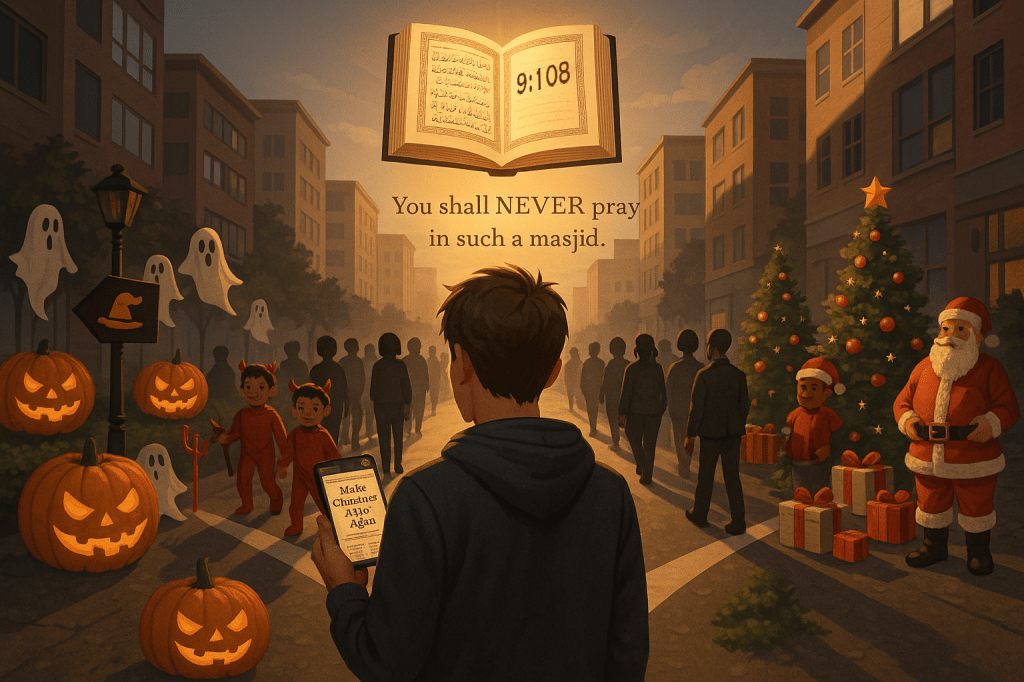
Introduction: The Ultimate Double Standard
Imagine someone who writes an entire article condemning Christmas for its pagan origins, carefully documenting how December 25 derives from Sol Invictus (sun god worship), how gift-giving comes from Saturnalia (Roman festival honoring Saturn), and how evergreen trees trace back to Yule (Germanic pagan festivals honoring Odin and tree spirits). This person concludes definitively: Christians should abandon Christmas because of these idolatrous origins.
Now imagine that same person defending Halloween participation. When confronted with Halloween’s origins in Samhain – a Celtic pagan festival explicitly involving death worship, offerings to appease spirits of the dead, divination rituals, and spirit communication – this person argues that Halloween has been “disjoined” from its pagan origins and can be celebrated as harmless secular fun. The pagan connections don’t matter anymore, they claim, because enough time has passed and people’s intentions are different now.
Finally, imagine this same person ignoring God’s crystal-clear prohibition in the Quran: “You shall NEVER pray in such a masjid” (9:108) – an explicit divine command forbidding believers from praying in masjids where hypocrites gather and practice idol worship. Despite this unambiguous prohibition requiring no interpretation, this person claims it doesn’t “specifically prohibit” praying behind hypocrites, and that believers can use their own judgment about where to pray.
This isn’t a hypothetical scenario. This is Peter, a prominent voice in the “Quran-alone” community, whose contradictory positions on pagan holidays and explicit divine commands expose a fundamental flaw in methodology: selective application of standards based on personal preference rather than consistent Quranic principles.
This article will systematically document Peter’s triple hypocrisy using historical evidence, statistical data, comparative analysis, and most importantly, clear Quranic verses. We will demonstrate that:
- Halloween is MORE explicitly pagan than Christmas today – with 1-2 million Americans actively practicing Samhain rituals involving spirit communication, divination, and death worship
- Peter’s own stated standard condemns Halloween more than Christmas – yet he applies opposite conclusions
- The Quran explicitly prohibits praying in hypocrite masjids – yet this clear command is dismissed while debating holidays that have no Quranic mention
The evidence is documented. The contradiction is undeniable. The hypocrisy is complete.
Part 1: Peter’s Christmas Article – Condemning Pagan Origins
Detailed Analysis of “Make Christmas Pagan Again”
On November 20, 2024, Peter published an article on QuranTalkBlog titled “Make Christmas Pagan Again.” The article presents a comprehensive case against Christmas celebration based entirely on its pagan origins. Let us examine Peter’s own arguments, which he will later contradict when discussing Halloween.
Peter begins by establishing that the Bible provides no birth date for Jesus, noting that Matthew and Luke present “highly contradictory narratives” that are irreconcilable. Neither Mark nor John mentions Jesus’s birth at all. This biblical silence becomes important because it reveals that December 25 was chosen not from scripture, but from pagan calendar calculations.
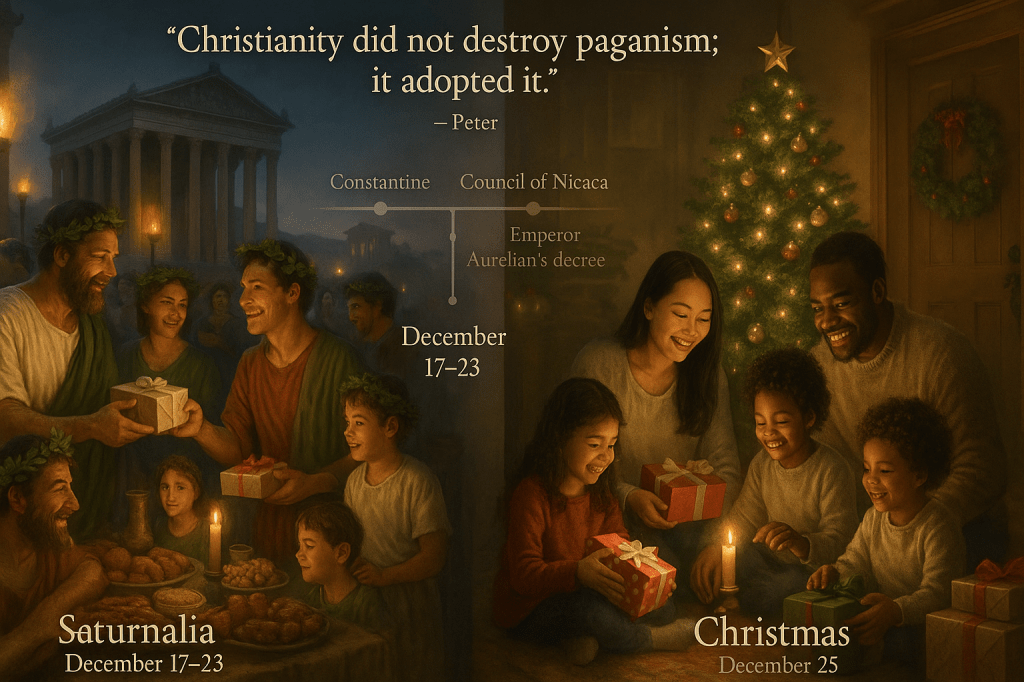
Peter then documents the pagan origins of December 25: “The date was chosen centuries after Christ’s death as a ‘convenient point of convergence between Christian theology and the pagan world.’ December 25 aligns with winter solstice celebrations and was declared by Emperor Aurelian in 274 CE as the feast of Sol Invictus (‘Unconquered Sun’).” In other words, Christianity hijacked the birthday celebration of a pagan sun god.
The article identifies Emperor Constantine’s role in this syncretism: after his vision before the Battle of Milvian Bridge in 312 CE, Constantine embraced Christianity while maintaining associations with Sol Invictus. He promoted the Council of Nicaea in 325 CE, which adopted the term “homoousios” (of one substance) – a concept Peter notes is “not found in scripture” but originates from Gnostic and pagan sources. Constantine’s approach, Peter argues, reflected “political expediency rather than theological necessity.”
Peter’s Key Quote: “Christianity did not destroy paganism; it adopted it.” – Will Durant, quoted approvingly in Peter’s article
Peter then systematically catalogs the pagan elements embedded in modern Christmas:
- Saturnalia (Roman Festival, December 17-23): Featured gift-giving, feasting, and role reversals. Christmas celebrations directly mirror these practices.
- Evergreen Trees and Branches: Norse Yule tradition honoring Odin and tree spirits. Peter identifies these as pagan symbols of eternal life and fertility.
- Yule Logs: Pre-Christian winter festivals worshiping the returning sun.
- Mistletoe and Holly: Druid and Celtic practices. The Druids believed holly’s evergreen nature made it sacred, and they performed rituals harvesting mistletoe with golden sickles, believing it represented the fertility of the Mother Goddess.
- Wreaths: Symbolized the wheel of the year (sun wheel) in pagan cosmology.
- Santa Claus: Parallels with Odin riding his eight-legged horse Sleipnir during the winter solstice wild hunt.
Peter concludes by emphasizing worship “in spirit and truth” (John 4:24), suggesting that pagan-origin celebrations contradict authentic faith. A commenter on his article states definitively: “There is NO Christian symbolism in christmas. All symbolism connected to christmas is of purely pagan origins.”
Peter’s Clear Position: Christmas must be rejected by true believers because its origins are thoroughly pagan, and these origins contaminate the modern practice regardless of participants’ intentions.
Part 2: Halloween’s Pagan Origins – More Explicit Than Christmas
The Celtic Festival of Samhain and Modern Continuity
If Peter prohibits Christmas for pagan origins, we must ask: what about Halloween? The historical evidence reveals that Halloween maintains far more explicit and actively practiced connections to its pagan roots than Christmas. Let us examine the documented facts.
Halloween derives from Samhain, a Celtic pagan festival dating to approximately 500 BCE. Unlike Christmas, whose pagan origins require historical research to uncover, Halloween’s supernatural and occult nature remains obvious to all observers. The Encyclopaedia Britannica defines it as: “Samhain: Celtic Festival, Paganism, Wicca, Halloween, & Bonfires.”
The Core Pagan Beliefs of Samhain
The ancient Celts believed that on Samhain (October 31 to November 1), the boundary between the worlds of the living and the dead became thin, allowing spirits, fairies, and supernatural beings to cross over. This wasn’t merely symbolic – it was (and remains for modern practitioners) an actual belief that the dead can communicate with and visit the living during this time.
The primary practices of Samhain centered on death worship and spirit appeasement. Celtic communities would leave food and drink offerings to placate the spirits traveling the Earth. The souls of deceased family members were believed to return home seeking hospitality, so places were set at tables for the dead. According to historical records: “At Samhain, spirits were appeased with offerings of food and drink to ensure the people and livestock survived the winter.”
Modern Halloween practices directly continue these pagan rituals:
- Trick-or-Treating = Offerings to the Dead: Historical evidence shows that “trick-or-treating may have come from the custom of going door-to-door collecting food for Samhain feasts, fuel for Samhain bonfires or offerings for the aos sí [spirit beings].” Over time, people began dressing as these supernatural beings in exchange for offerings.
- Costumes = Impersonating Spirits: The Celts donned disguises to confuse and ward off evil spirits. People would “impersonate the aos sí, or the souls of the dead, and receive offerings on their behalf.” This protective function remains: children dress as ghosts, demons, witches, and monsters – continuing the tradition of representing supernatural entities.
- Jack-o’-Lanterns = Protective Charms: Originally carved from turnips and filled with burning coals, these lanterns were “said to represent the spirits or supernatural beings, or were used to ward off evil spirits.” Modern pumpkins serve the same symbolic function.
- Divination = Communicating with Spirits: Samhain was considered prime time for divination practices. Nuts and apples were used to foretell the future – finding a ring meant marriage, a coin meant wealth. This practice continues today with tarot readings, fortune-telling, and spirit communication intensifying during the Halloween season.
Pope Gregory III strategically moved the Christian celebration of All Saints’ Day to November 1 in the mid-eighth century to coincide with Samhain, attempting to “Christianize” the pagan festival. However, unlike Christmas where the pagan symbolism has been largely obscured, Halloween’s supernatural themes remain explicit and recognized by all participants.
[2:170] “When they are told, ‘Follow what God has revealed herein,’ they say, ‘We follow only what we found our parents doing.’ What if their parents did not understand, and were not guided?”
This verse directly addresses those who justify Halloween (or any practice) based on tradition rather than divine guidance. The excuse “it’s just what we’ve always done” or “it’s cultural tradition now” holds no weight before God.
Active Pagan Practice Today
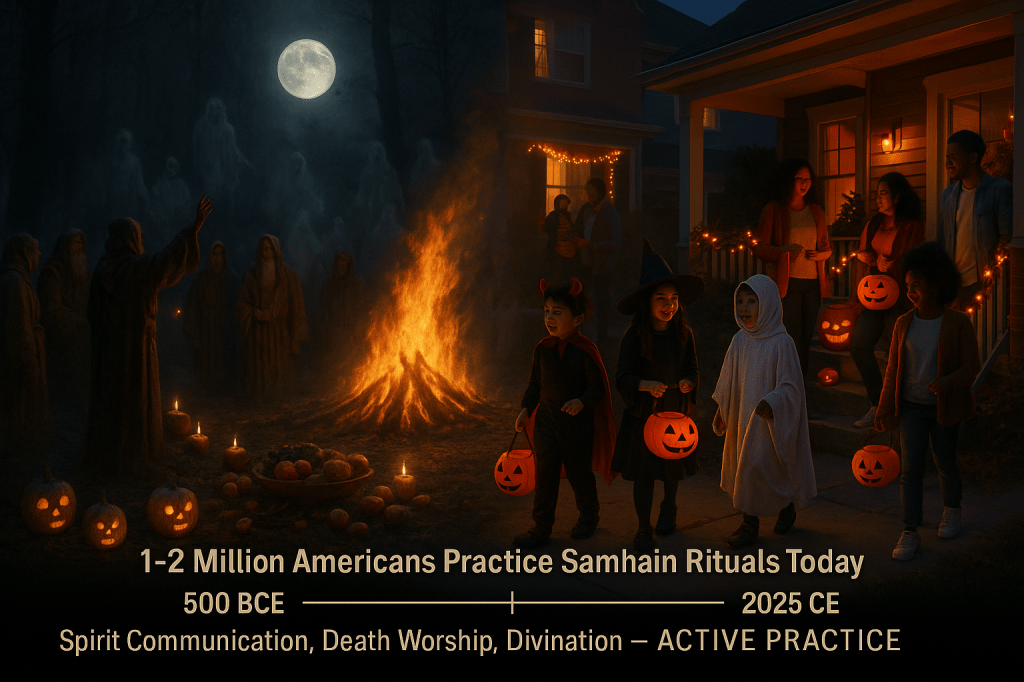
Here is where Halloween diverges dramatically from Christmas: modern religious observance. Statistical evidence shows that 1 to 2 million Americans actively practice some form of witchcraft, paganism, or Wicca, with Samhain recognized as one of the eight major Wiccan sabbats (holy days). These practitioners don’t celebrate Halloween as secular fun – they celebrate it as a genuine religious holiday involving actual rituals.
Contemporary Samhain celebrations among pagans and Wiccans include:
- Ancestor Veneration: Active communication attempts with deceased relatives
- Divination: Tarot readings, rune casting, scrying, and other methods to receive spiritual insights
- Bonfires: Continuing the ancient tradition for protection and ritual purposes
- Spirit Communication: Using divination tools and séances to contact the dead
- Costume Rituals: Dressing in ceremonial garb to honor the boundary between life and death
- Feasting: Ritual meals with places set for deceased ancestors
- Releasing and Renewing Rituals: Letting go of the old year, preparing for the new
One pagan source states: “It is also believed to be a time that the spirits of the dead are most likely to visit and possibly provide insight and guidance.” Another explains: “With the boundary between realms at its most fragile, Halloween became a prime time for divination and seeking spiritual insights.”
The occult industry thrives during Halloween season. Witchcraft supply stores see peak sales. Tarot readings increase dramatically. Séances are held. Ghost hunting reaches its annual height. The Halloween season generates approximately $12 billion in revenue, making it the second-largest commercial holiday after Christmas, but unlike Christmas, it retains explicit supernatural and occult significance that requires no historical research to recognize.
[7:138] “We delivered the Children of Israel across the sea. When they passed by people who were worshiping statues, they said, ‘O Moses, make a god for us, like the gods they have.’ He said, ‘Indeed, you are ignorant people.’”
Even after witnessing God’s miracles – the parting of the sea, the destruction of Pharaoh’s army – the Children of Israel wanted to adopt the pagan practices of surrounding cultures because “everyone else is doing it.” Modern believers wanting to celebrate Halloween despite its explicit pagan and occult nature commit the same error Moses condemned as ignorance.
Part 3: Christmas’s Pagan Origins – Scholarly Research Required
Symbols Reinterpreted Beyond Recognition
To provide fair comparison, let us examine Christmas’s pagan origins with equal thoroughness. Christmas does indeed incorporate multiple pagan festival elements, as Peter’s article correctly documents. However, a critical distinction emerges when we analyze modern practice and public perception.
The Pagan Sources
Christmas borrows from three main pagan festivals:
- Saturnalia (Roman, December 17-23): A festival honoring Saturn featuring gift-giving, feasting, gambling, singing, and role reversals where masters served slaves. Romans exchanged wax taper candles called “cerei” as gifts signifying light returning after the solstice.
- Sol Invictus (Roman, December 25): Emperor Aurelian declared December 25 as the “Birthday of the Unconquerable Sun” in 274 CE. This was explicitly sun god worship celebrating the renewal of light after the winter solstice.
- Yule (Germanic/Norse, Winter Solstice): Early Germanic tribes decorated trees with fruits and candles to honor Odin and appease tree spirits. Evergreens symbolized eternal life and the promise of spring’s return. The Yule log was burned to honor the sun’s rebirth.
Peter is historically correct that Christian leaders strategically aligned Jesus’s birth celebration with these existing pagan festivals. The fourth-century shift allowed Christianity to incorporate popular pagan midwinter traditions while reinterpreting their meaning.
Modern Practice – Secularization and Loss of Religious Meaning
Here is where Christmas diverges from Halloween: modern Christmas has become highly secularized, with pagan symbolism obscured beyond recognition. Statistical evidence from Pew Research demonstrates this dramatic shift:
- 87% of Canadians celebrate Christmas, but only 35% celebrate it as a religious holiday, while 52% celebrate it secularly
- The percentage of Americans describing their Christmas celebrations as “strongly religious” dropped to 35%, down from about 50% in 2005 and 2010
- 26% of those who celebrate Christmas say their celebrations are “not too religious”, representing a 10-percentage-point increase over the past decade
- About half see Christmas mostly as a religious holiday, while one-third view it as more of a cultural holiday
- 80% of non-Christians in America celebrate Christmas, but most view it purely as a cultural holiday
- 70% of Americans cite spending time with family and friends as what they most look forward to, while only 11% cite religious elements
Most crucially: zero modern pagans celebrate Christmas as a religious holiday. No contemporary communities worship Saturn, Odin, or Sol Invictus. The Norse gods have no active devotees who celebrate Christmas as Yule. The Roman sun god has no modern cult performing birthday rituals on December 25.
When you ask the average person what Christmas symbols mean, they respond:
- Trees: “Christmas decorations” or “family tradition” (not “tree spirits” or “honoring Odin”)
- Wreaths: “Holiday decorations” (not “sun wheels” or “completing the cycle”)
- Gift-giving: “Generosity,” “love,” “celebrating Jesus’s birth” (not “honoring Saturn”)
- Holly and Mistletoe: “Pretty decorations” (not “Druid sacred plants with magical powers”)
- December 25: “Jesus’s birthday” or “holiday season” (not “Birthday of the Unconquered Sun”)
Understanding Christmas’s pagan origins requires historical education. It requires reading articles like Peter’s. It requires scholarly research into Roman festivals, Germanic traditions, and Constantine’s political maneuvering. The pagan connections are not obvious, not explicit, and not recognized without investigation.
[6:148] “The idol worshipers say, ‘Had God willed, we would not practice idolatry, nor would our parents, nor would we prohibit anything.’ Thus did those before them disbelieve, until they incurred our retribution. Say, ‘Do you have any proven knowledge that you can show us? You follow nothing but conjecture; you only guess.’”
This verse exposes those who rely on conjecture and guesswork rather than proven knowledge. Peter’s entire argument about Christmas requires historical conjecture about Constantine’s motives, scholarly research into pagan festivals, and connecting dots that modern celebrants don’t even perceive. In contrast, Halloween’s pagan nature requires no research – it’s explicit, obvious, and universally recognized.
Part 4: The Devastating Comparison – Which Holiday Is More Pagan Today?
Applying Peter’s Own Standard
Peter articulated his personal standard for determining whether to participate in practices with pagan origins during a Discord conversation about Halloween. His exact words deserve careful analysis because they reveal the inconsistency at the heart of his position:
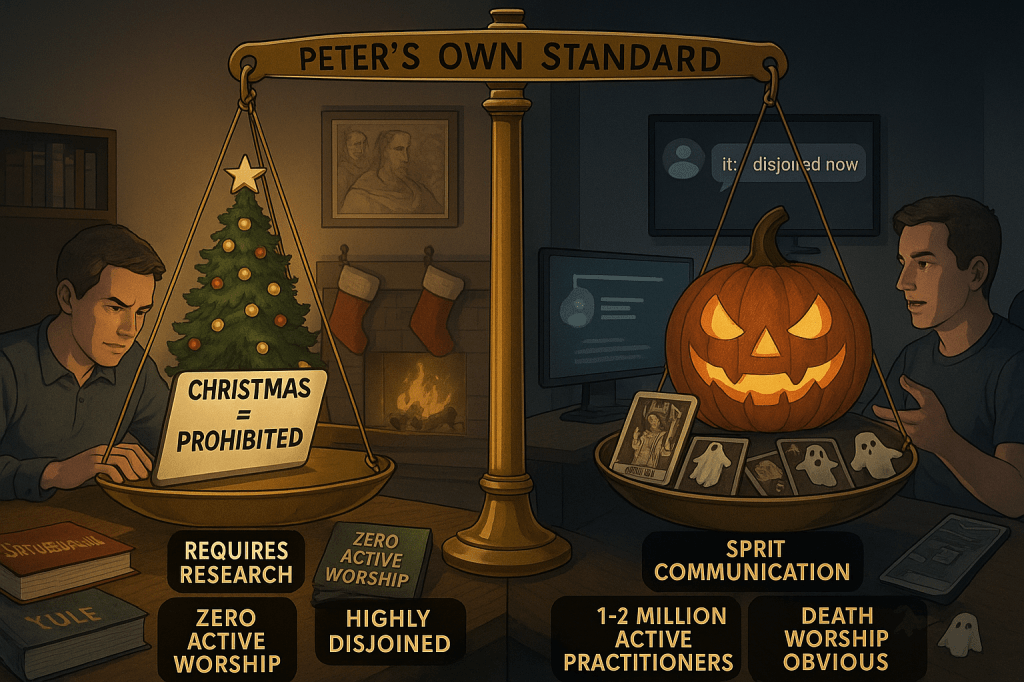
Peter’s Standard: “So many things in modern life has pagan origins – birthday cake, blowing out candles, Olympics, yoga, wedding rings, bridesmaids and groomsmen, names of the months, days, planets, constellations etc. I always ask myself how disjoined is the thing from its pagan origins. If it is still strongly tied with pagan worship or practices carried on today (eg Chrismas in America) then I would refrain. But if the association isn’t recognized unless there is some scholarly research I’m less inclined to be a stickler on it.”
Let us apply Peter’s own criteria systematically to both holidays:
Criterion 1: “How disjoined is the thing from its pagan origins?”
Christmas Analysis:
- Modern celebrants do NOT worship Saturn, Odin, or Sol Invictus
- Modern celebrants do NOT believe trees have spirits that must be honored
- Modern celebrants do NOT perform Druid rituals with holly and mistletoe
- Modern celebrants see the date as Jesus’s birthday or secular tradition, NOT as sun god’s birthday
- Gift-giving is understood as generosity or commemorating wise men’s gifts, NOT as Saturnalia worship
- 35% celebrate religiously (as Jesus’s birth), 52% celebrate secularly (family gathering)
- Verdict: HIGHLY DISJOINED – Requires scholarly research to even recognize pagan connections
Halloween Analysis:
- Explicit death worship themes recognized by ALL participants
- Ghost, demon, witch, and supernatural imagery maintained without reinterpretation
- Costumes still represent spirits and supernatural beings (same function as ancient practice)
- Jack-o-lanterns still understood as warding off evil (protective function retained)
- Divination, tarot, fortune-telling explicitly practiced during season
- 1-2 million practitioners actively celebrate as religious Samhain with full ancient rituals
- Occult industry thrives with peak sales of witchcraft supplies
- Verdict: MINIMALLY DISJOINED – Pagan/occult nature obvious to everyone without any research
Criterion 2: “Still strongly tied with pagan worship or practices carried on today”
Christmas Analysis:
- ZERO people worship Saturn on Christmas
- ZERO people worship Odin or believe in Sleipnir and the wild hunt
- ZERO people worship Sol Invictus or perform sun god birthday rituals
- ZERO pagan religious communities celebrate Christmas as a pagan holy day
- No Saturnalia rituals performed (no role reversals, no gambling as religious practice, no offerings to Saturn)
- Verdict: NOT tied to active pagan worship
Halloween Analysis:
- 1-2 MILLION PEOPLE practice Samhain as active religious celebration
- Spirit communication actively practiced (séances, ghost hunting, contacting dead)
- Divination explicitly performed (tarot, fortune-telling, scrying, rune casting)
- Death worship and ancestor veneration as religious practices
- Wiccan sabbat recognized as one of 8 major holy days
- Bonfires, ritual costumes, offerings to spirits – all continue as religious practices
- Verdict: STRONGLY TIED to active pagan worship TODAY
Criterion 3: “Association isn’t recognized unless there is some scholarly research”
Christmas – Requires Research:
- Average person: “It’s Jesus’s birthday celebration” or “Family tradition”
- December 25: Most think it’s the actual birth date, unaware of Sol Invictus
- Trees: “Christmas decorations” – Connection to Yule and tree spirits unknown
- Wreaths: “Holiday decorations” – Connection to sun wheels and Saturnalia unknown
- Gift-giving: “Celebrating Jesus,” “Generosity” – Connection to Saturnalia requires education
- Verdict: Association NOT recognized without scholarly research
Halloween – Universally Obvious:
- Average person: “It’s about ghosts, witches, demons, death, and supernatural”
- Everyone recognizes the occult/supernatural theme explicitly
- Costumes: Widely known to represent monsters, spirits, scary creatures
- Jack-o-lanterns: Common knowledge involves warding off evil spirits
- No research needed – children understand it’s about “scary” supernatural things
- Verdict: Association IMMEDIATELY recognized by everyone
Peter’s Standard Applied – The Results
By every measure of Peter’s own stated criteria, Halloween should be MORE prohibited than Christmas:
| Peter’s Criterion | Christmas Result | Halloween Result | Which Should Peter Prohibit? |
| “Disjoined from origins” | Highly disjoined (requires research to see connections) | Minimally disjoined (pagan nature obvious to all) | Halloween > Christmas |
| “Strongly tied with pagan worship today” | Zero active worship (no Saturn/Odin devotees) | 1-2 million active practitioners of Samhain rituals | Halloween > Christmas |
| “Association recognized without research” | NO – scholarly research required | YES – universally obvious supernatural/occult theme | Halloween > Christmas |
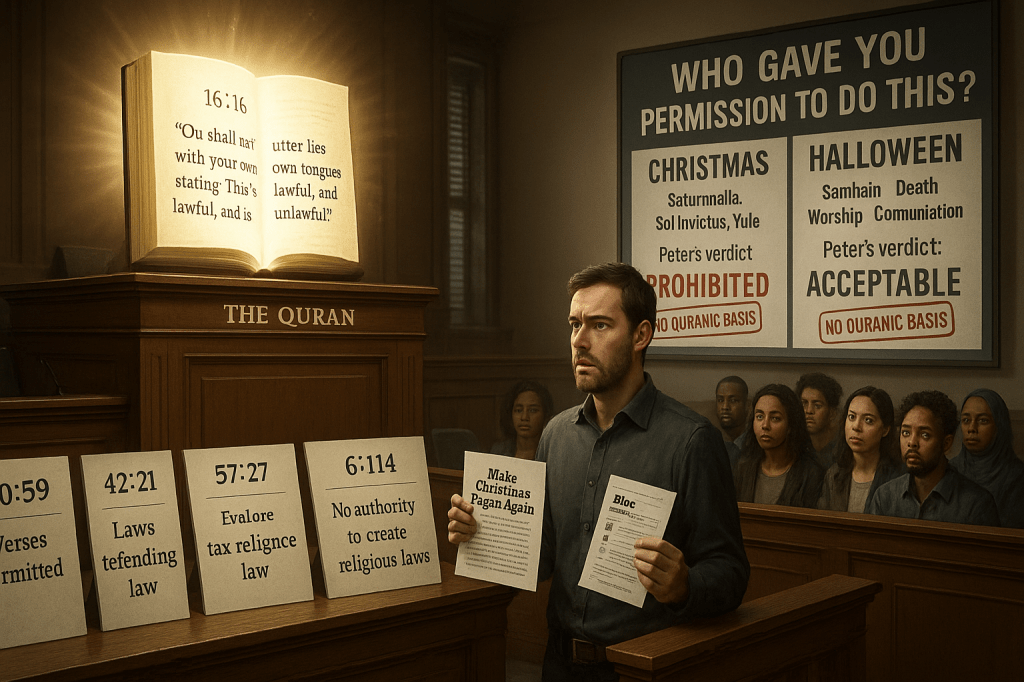
| Peter’s Actual Position | PROHIBITED (wrote article condemning it) | ACCEPTABLE (defended in Discord) | Complete reversal of his own standard |
Peter’s inconsistency is not a minor discrepancy. He applies his standard backwards, prohibiting the holiday that passes his criteria (Christmas) while permitting the holiday that fails every test (Halloween). This is not principled methodology. This is selective application based on personal preference.
[16:116] “You shall not utter lies with your own tongues stating: ‘This is lawful, and this is unlawful,’ to fabricate lies and attribute them to God. Surely, those who fabricate lies and attribute them to God will never succeed.”
When someone creates their own methodology to prohibit Christmas (which God never prohibited) while permitting Halloween (which by their own standards should be more problematic), they are “uttering lies with their own tongues” and fabricating religious laws. God never authorized Peter or anyone else to create personal standards for determining what practices are acceptable based on subjective assessments of how “disjoined” something is from pagan origins.
Part 5: Joseph’s Warning in Verse 40:34 – God Leads Astray Those Who Doubt Clear Guidance
The Foundation Against All Forms of Idolatry
The user highlighted verse 40:34 for good reason – it provides the foundational principle that demolishes Peter’s selective approach to pagan practices. Let us examine this verse in detail and connect it to the Halloween-Christmas hypocrisy.
[40:34] “Joseph had come to you before that with clear revelations, but you continued to doubt his message. Then, when he died you said, ‘God will not send any other messenger after him. (He was the last messenger)!’ God thus sends astray those who are transgressors, doubtful.”
This verse reveals several critical points that directly apply to those who create “personal methodologies” for accepting some pagan practices while rejecting others:
Joseph Came With CLEAR Revelations
Joseph (Yusuf) was sent as a messenger to warn against ALL forms of idolatry and deviation from God’s path. He didn’t come with ambiguous suggestions or personal preferences – he came with “clear revelations” (al-bayyinat). The Arabic root ب-ي-ن (b-y-n) denotes that which is clear, distinct, obvious, and requires no interpretation.
Similarly, God’s messenger Rashad Khalifa came with clear warnings about ALL pagan practices, whether Halloween, Christmas, or any ritual with idolatrous origins. The warning is not ambiguous. It doesn’t require “personal methodology” to determine which pagan practices have been sufficiently “disjoined.” The guidance is clear: avoid ALL practices with idolatrous origins.
People Continued to Doubt Despite Clarity
The verse states they “continued to doubt his message.” The Arabic word شَكٍّ (shakk) indicates persistent uncertainty and questioning of divine guidance that requires no questioning. This perfectly describes those who, when confronted with clear warnings about pagan practices, respond with:
- “But how disjoined is it from its origins?”
- “But what if our intentions are good?”
- “But it’s just secular fun now, right?”
- “But everyone else is doing it…”
- “But I don’t worship the pagan gods, so it’s okay, right?”
These are not genuine questions seeking knowledge. They are expressions of doubt in the face of clear guidance, seeking loopholes and exceptions based on personal preference.
The Claim of Finality
When Joseph died, people said “God will not send any other messenger after him.” This represents human arrogance in determining when God’s guidance is complete and when they can revert to their own preferences. Similarly, those who ignore Rashad Khalifa’s warnings about pagan practices essentially say: “The Quran doesn’t explicitly mention Halloween by name, therefore we can use our own judgment.”
This mirrors the error of Muslims who claim Muhammad was the “last messenger” and therefore reject the Messenger of the Covenant. It’s the same pattern: doubting clear guidance and declaring that God’s warnings have ended, freeing them to follow personal preferences.
God Sends Astray the Transgressors and Doubters
The verse concludes with devastating clarity: “God thus sends astray those who are transgressors, doubtful.” Two Arabic terms are used:
- مُسْرِفٌ (musrif) – Transgressor: Root س-ر-ف means to exceed boundaries, to go beyond limits set by God. Those who create their own standards for what pagan practices are acceptable transgress the boundary of following only God’s revelation.
- مُّرْتَابٌ (murtāb) – Doubter: Root ر-ي-ب indicates one who questions clear commands, harboring suspicions about straightforward guidance. Those who doubt whether pagan origins truly matter or whether they can “neutralize” idolatrous practices exemplify this trait.
Peter, by creating his personal methodology for determining which pagan-origin holidays to prohibit and which to permit, fits both descriptions: he transgresses by legislating where God did not, and he doubts by questioning whether pagan origins actually contaminate practices.
[40:35] “They argue against God’s revelations, without any basis. This is a trait that is most abhorred by God and by those who believe. God thus seals the hearts of every arrogant tyrant.”
The very next verse identifies arguing against clear guidance “without any basis” as especially abhorrent to God. Peter argues that Halloween is acceptable despite its pagan origins – what is his basis? His personal assessment of how “disjoined” it is. This is not revelation. This is not Quranic guidance. This is personal opinion elevated to religious law.
The Direct Application
Verse 40:34 teaches us that doubting clear warnings about idolatry leads to being sent astray. Consider the clear parallel:
- Joseph’s time: People received clear warnings against idolatry, doubted them, claimed no more messengers would come, reverted to pagan practices
- Our time: People receive clear warnings about pagan-origin practices, doubt them, create “personal methodologies,” permit celebrations with idolatrous roots
The pattern is identical. The outcome is predictable. God sends astray those who transgress His boundaries and doubt clear guidance, preferring instead to follow conjecture, personal preference, and the practices of the majority.

Part 6: God’s Absolute Prohibition of Shirk – The Unforgivable Sin
Why Pagan Origins Cannot Be “Neutralized”
To understand why participation in practices with idolatrous origins cannot be justified through “good intentions” or claims of “secularization,” we must understand God’s absolute, uncompromising prohibition of shirk (associating partners with God). This is not a minor issue in the Quran – it is THE defining sin, the only unforgivable offense.
[4:48] “God does not forgive idolatry, but He forgives lesser offenses for whomever He wills. Anyone who sets up idols beside God, has forged a horrendous offense.”
The verse is absolute: God DOES NOT forgive idolatry if maintained until death. Every other sin falls into the category of “lesser offenses” that God may forgive according to His will. But idol worship stands alone as the unforgivable transgression.
The footnote clarifies: “Idol worship is not forgivable, if maintained until death. One can always repent from any offense, including idolatry before death comes (see 4:18 & 40:66).” This means that someone who dies while still engaged in idolatrous practices has committed an unforgivable sin. This is not a light matter that can be dismissed with “but my intentions are pure” or “but I’ve neutralized the pagan meaning.”
[4:116] “God does not forgive idol worship (if maintained until death), and He forgives lesser offenses for whomever He wills. Anyone who idolizes any idol beside God has strayed far astray.”
The repetition of this message in two verses within the same chapter demonstrates its critical importance. The footnote provides a simple, devastating definition: “A simple definition of idolatry: Believing that anything beside God can help you.”
This definition is crucial for understanding why Halloween cannot be “neutralized”:
- Jack-o-lanterns are believed to ward off evil spirits – seeking protection from something other than God
- Costumes are worn to confuse evil spirits – seeking protection through pagan practices
- Offerings are made to appease spirits – seeking favor from supernatural entities other than God
- Divination is practiced to gain knowledge of the future – seeking knowledge from sources other than God
Even if a modern participant claims they don’t literally believe in these things, they are participating in and perpetuating practices that are, at their core, acts of shirk. The practices were created by and for idol worshipers. Their function was and remains to seek help from other than God.
The Gravity of the Sin
[4:48] “Anyone who sets up idols beside God, has forged a horrendous offense.”
The Arabic word إِثْمًا عَظِيمًا (ithman azima) translates to “horrendous offense” or “tremendous sin.” This is the strongest language the Quran uses for any transgression. Not “significant” or “serious” – HORRENDOUS, TREMENDOUS. The offense is described as something forged or fabricated (افْتَرَىٰ – iftara), indicating that idol worship involves inventing lies about God’s nature and creating false pathways to Him.
No Partners Can Be Set Up
Let us examine what the Quran says about those who set up partners or practices beside God:
[2:165] “Yet, some people set up idols to rival God, and love them as if they are God. Those who believe love God the most. If only the transgressors could see themselves when they see the retribution! They will realize then that all power belongs to God alone, and that God’s retribution is awesome.”
This verse describes people who set up rivals to God – things they love or prioritize alongside or instead of God. When someone insists on participating in Halloween despite knowing its pagan origins, they are demonstrating that their desire for cultural participation, family tradition, or “harmless fun” rivals their commitment to pure worship of God alone.
The verse warns that transgressors will realize the truth “when they see the retribution” – too late to change course. They will discover that “all power belongs to God alone” and no pagan practice, no matter how “neutralized” they claimed it to be, held any real significance.
[6:136] “They even set aside a share of God’s provisions of crops and livestock, saying, ‘This share belongs to God,’ according to their claims, ‘and this share belongs to our idols.’ However, what was set aside for their idols never reached God, while the share they set aside for God invariably went to their idols. Miserable indeed is their judgment.”
This verse perfectly describes the mentality of those who try to mix pure worship with pagan-origin practices. They claim: “I worship God (share for God) AND I celebrate Halloween (share for idols).” But the verse reveals the lie: what is set aside for idols never reaches God, while what is supposedly for God ends up serving the idols.
When you participate in Halloween – even with “good intentions” – you’re not combining worship of God with harmless cultural fun. You’re allowing the idolatrous practice to contaminate your worship. The pagan ritual doesn’t become pure because you participate. Rather, your participation becomes contaminated by the pagan origin.
The False Claim of Intercessors
[10:18] “They worship beside God idols that possess no power to harm them or benefit them, and they say, ‘These are our intercessors at God!’ Say, ‘Are you informing God of something He does not know in the heavens or the earth?’ Be He glorified. He is the Most High; far above needing partners.”
Ancient idol worshipers claimed their idols were “intercessors” – mediators that brought them closer to God. Modern practitioners of pagan-origin holidays make similar claims: “It’s about bringing families together,” “It creates community bonds,” “It helps us connect with tradition.” These are false intercessors – practices that supposedly enhance life or bring benefits while requiring participation in rituals with idolatrous origins.
The verse’s response is devastating: Are you informing God of something He doesn’t know? Do you think God needs Halloween or Christmas to bring families together? Do you believe He requires pagan festivals to create community? God is “far above needing partners” – He doesn’t need pagan practices to accomplish His purposes, and He certainly doesn’t approve of their use.
The “Neutralization” Lie Exposed
[29:17] “What you worship instead of God are powerless idols; you have invented a lie. The idols you worship beside God do not possess any provisions for you. Therefore, you shall seek provisions only from God. You shall worship Him alone, and be appreciative of Him; to Him is your ultimate return.”
This verse directly refutes the claim that pagan-origin practices can provide anything valuable. “You have invented a lie” – the lie is that Halloween provides harmless fun, community bonding, childhood memories, or cultural participation. These are lies invented to justify idolatrous practices.
The idols (and practices created to worship them) “do not possess any provisions for you.” Halloween provides nothing. Christmas provides nothing. They are empty practices with idolatrous origins, offering no benefit that God cannot provide through pure worship and halal activities.
[39:3] “Absolutely, the religion shall be devoted to God alone. Those who set up idols beside Him say, ‘We idolize them only to bring us closer to God; for they are in a better position!’ God will judge them regarding their disputes. God does not guide such liars, disbelievers.”
This verse annihilates the “good intentions” argument. Idol worshipers throughout history have claimed they worship idols “only to bring us closer to God” – the same reasoning used to justify Christmas (“celebrating Jesus’s birth”) or Halloween (“harmless family fun”). Their intentions were supposedly good, supposedly aimed at getting closer to God or building family bonds.
God’s response is unequivocal: They are LIARS and DISBELIEVERS. The religion must be “devoted to God alone” – not to God plus pagan practices, not to God with some secular fun on the side, not to God while participating in festivals with idolatrous origins.
God “does not guide such liars, disbelievers.” Those who claim good intentions while participating in practices with idolatrous origins are not guided by God. They are left to wander in their confusion, following conjecture and desire rather than clear revelation.

Part 7: Intent Cannot Override Practice – The Food Offered to Idols Analogy
Why “Good Intentions” Don’t Neutralize Pagan Origins
One of the most common defenses of Halloween participation is: “But my intentions are pure! I’m not worshiping pagan gods – I’m just letting my kids have fun and collect candy.” This argument appears reasonable on the surface, but the Quran systematically demolishes it through the clear analogy of food offered to idols.
The Explicit Prohibition
[2:173] “He only prohibits for you the eating of animals that die of themselves (without human interference), blood, the meat of pigs, and animals dedicated to other than God. If one is forced (to eat these), without being malicious or deliberate, he incurs no sin. God is Forgiver, Most Merciful.”
The verse lists four categories of prohibited food, and the fourth is crucial: “animals dedicated to other than God.” Notice what the prohibition does NOT say:
- It does NOT say “animals dedicated to other than God IF you worship those gods”
- It does NOT say “animals dedicated to other than God IF you believe in the dedication”
- It does NOT say “animals dedicated to other than God UNLESS your intentions are pure”
- It does NOT say “animals dedicated to other than God UNLESS enough time has passed”
The prohibition is absolute: food dedicated to other than God remains forbidden REGARDLESS of the eater’s intentions or beliefs. The contamination comes from the dedication itself, not from whether the eater recognizes or accepts that dedication.
The Same Principle Repeated
[5:3] “Prohibited for you are animals that die of themselves, blood, the meat of pigs, and animals dedicated to other than God… and animals sacrificed on altars.”
Again, the prohibition includes “animals dedicated to other than God” and “animals sacrificed on altars.” The Quran doesn’t add exceptions for good intentions. It doesn’t create loopholes for people who don’t worship the idol themselves. The dedication to other than God makes the food permanently forbidden.
The Devastating Application
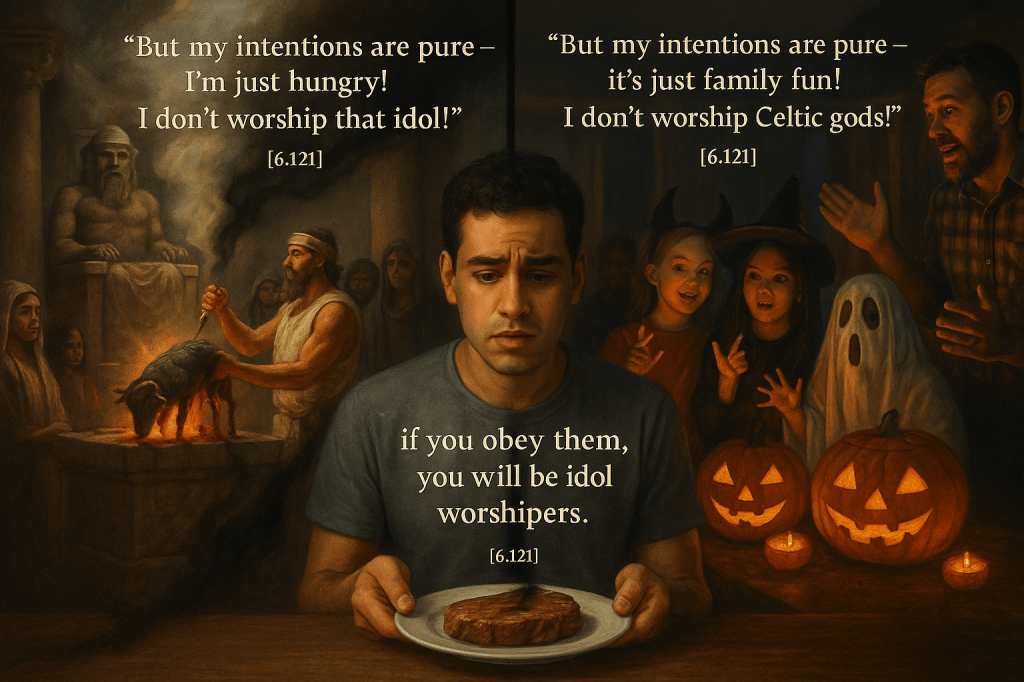
[6:121] “Do not eat from that upon which the name of God has not been mentioned, for it is an abomination. The devils inspire their allies to argue with you; if you obey them, you will be idol worshipers.”
This verse is absolutely critical and destroys the entire “good intentions” argument. Let’s break it down carefully:
“Do not eat from that upon which the name of God has not been mentioned” – Food must be dedicated to God alone. If it’s dedicated to anything else (or not dedicated at all), it’s forbidden.
“for it is an abomination” – The Arabic word فِسْقٌ (fisq) means abomination, flagrant disobedience, wickedness. Not “slightly questionable” or “personally inadvisable” – ABOMINATION.
“The devils inspire their allies to argue with you” – Here’s where it gets devastating. The verse predicts that people will ARGUE about this prohibition. They will say things like:
- “But the food itself is fine – meat is meat!”
- “My intentions are good – I’m just hungry!”
- “The dedication doesn’t matter if I don’t believe in it!”
- “Enough time has passed – the food is neutralized now!”
These arguments come from devils inspiring their allies. The arguments seem reasonable, logical, compassionate even. But they are satanic in origin.
“if you obey them, you will be idol worshipers” – This is the nuclear bomb that obliterates the “good intentions” defense. If you OBEY those who argue that food dedicated to other than God is acceptable, you BECOME an idol worshiper yourself – regardless of your personal beliefs or intentions!
The footnote clarifies: “Dietary prohibitions instituted by other than God represent idolatry.” The same principle applies to ALL religious practices – if humans institute prohibitions or permissions based on their own standards rather than God’s revelation, following them is idolatry.
The Direct Parallel to Halloween
The food analogy applies perfectly to Halloween:
| Food Offered to Idols | Halloween (Festival Dedicated to Pagan Gods) |
| Animal was dedicated/sacrificed to pagan deity | Samhain was dedicated to Celtic death gods and spirits |
| The eater doesn’t worship that deity | The participant doesn’t worship Celtic gods |
| The eater’s intentions are “good” (just hungry) | The participant’s intentions are “good” (just family fun) |
| The food itself is physically normal (meat is meat) | The activities themselves seem normal (costumes, candy) |
| Long time has passed since the sacrifice | Long time has passed since ancient Samhain |
| STILL FORBIDDEN – contamination from dedication | STILL CONTAMINATED – idolatrous origin unchanged |
Just as meat offered to idols remains forbidden regardless of the eater’s intentions, Halloween remains contaminated by its pagan origins regardless of the participant’s intentions. The practice was created for and dedicated to pagan worship. That dedication cannot be “neutralized” by modern participants claiming secular purposes.
What About Christmas?
The same principle applies to Christmas – it too incorporates practices dedicated to pagan deities (Saturn, Sol Invictus, Odin). Peter correctly identifies this problem in his article about Christmas. The food analogy would prohibit BOTH Halloween AND Christmas.
The hypocrisy is that Peter applies the food analogy to Christmas (prohibiting it) but ignores the same logic for Halloween (permitting it). This is inconsistency at its most blatant.
The Role of Conjecture
[6:145] “Say, ‘I do not find in the revelations given to me any food that is prohibited for any eater except: (1) carrion, (2) running blood, (3) the meat of pigs, for it is contaminated, and (4) the meat of animals blasphemously dedicated to other than God.’”
The prohibition is “the meat of animals blasphemously dedicated to other than God.” The Arabic emphasizes that this dedication is blasphemous (فِسْقًا – fisqan) – an act of gross disobedience and corruption.
Halloween was blasphemously dedicated to Celtic pagan deities and death spirits. That dedication was an act of shirk. The modern claim that we can participate while ignoring the dedication is exactly like claiming we can eat idol-offered meat while ignoring the idol worship.
God’s response would be the same: “Are you telling Me that blasphemous dedication can be neutralized by your good intentions? Are you legislating religious law where I have already provided guidance?”
Every Deed Is Recorded
[99:7-8] “Whoever does an atom’s weight of good will see it. And whoever does an atom’s weight of evil will see it.”
Intentions don’t erase actions. If you participate in Halloween, that participation is recorded – the pagan origins, the idolatrous symbols, the death worship imagery, all of it. Your claim that “I didn’t mean it that way” doesn’t erase the record of participating in a festival created for pagan worship.
[3:30] “The day will come when each soul will find all the good works it had done brought forth. As for the evil works, it will wish that they were far, far removed.”
On the Day of Judgment, when people see their Halloween participation recorded alongside the pagan origins and idolatrous practices, will they say “But my intentions were pure”? The verse indicates they will wish these works “were far, far removed” – but it will be too late. The record will show they participated in practices with idolatrous origins, regardless of their claimed intentions.
[6:164] “Say, ‘Shall I seek other than God as a lord, when He is the Lord of all things? No soul benefits except from its own works, and none bears the burden of another.’”
Your participation in pagan-origin practices is YOUR action, YOUR work, YOUR burden. You cannot claim “everyone else was doing it” or “I was following my community’s tradition.” Each soul is judged for its own works. If you participated in Halloween or Christmas despite knowing their pagan origins, that participation will be recorded and judged, regardless of the intentions you claimed.
Part 8: No Authority to “Neutralize” – Following Only Revelation
Who Gave Peter Permission to Create His Own Standards?
Peter has created a “personal methodology” for determining which pagan-origin practices are acceptable and which are not. His standard involves assessing whether something is “disjoined” from its origins and whether the association is recognized without scholarly research. But here’s the fundamental question that destroys his entire approach: Who gave him authority to create this methodology?
God Alone Determines What Is Lawful
[10:59] “Say, ‘Did you note how God sends down to you all kinds of provisions, then you render some of them unlawful, and some lawful?’ Say, ‘Did God give you permission to do this? Or, do you fabricate lies and attribute them to God?’”
This verse directly addresses Peter’s behavior. God sends provisions and establishes what is lawful and unlawful. Then humans come along and create their own standards – “this is lawful (Halloween), this is unlawful (Christmas)” – based on personal assessment rather than divine revelation.
The verse asks two devastating questions:
- “Did God give you permission to do this?” – Did God authorize Peter to create a “personal methodology” for determining which pagan practices are acceptable? No. Did God tell Peter to assess whether things are “disjoined” from their origins? No. Did God give Peter the authority to write articles prohibiting Christmas while defending Halloween? Absolutely not.
- “Or, do you fabricate lies and attribute them to God?” – When Peter claims that Christmas should be avoided but Halloween is fine, is he representing God’s position or his own? Since God never mentioned either holiday and never authorized Peter’s methodology, Peter is fabricating religious laws and attributing them to divine guidance.
[16:116] “You shall not utter lies with your own tongues stating: ‘This is lawful, and this is unlawful,’ to fabricate lies and attribute them to God. Surely, those who fabricate lies and attribute them to God will never succeed.”
This verse could be Peter’s biography. He utters with his own tongue (writes in his article and states in Discord): “This is unlawful (Christmas), and this is lawful (Halloween).” He fabricates these judgments based on personal assessment, not divine revelation. And the verse promises that those who do this “will never succeed.”
Peter might object: “But I’m not claiming divine authority – it’s just my personal opinion!” But that’s precisely the problem. Personal opinions about religious practices have no binding authority. If Peter admits these are just his personal views, then his article prohibiting Christmas becomes meaningless, and his defense of Halloween becomes irrelevant. You cannot write authoritative-sounding articles declaring what people should and shouldn’t do religiously based on “personal opinion.”
The Concept of “Neutralization” Has No Quranic Basis
Peter’s entire argument for Halloween rests on the claim that it has been “disjoined” or “neutralized” from its pagan origins. But where in the Quran does God introduce this concept of neutralization? Where does God say that pagan practices become acceptable after a certain time period or level of secularization?
[57:27] “Subsequent to them, we sent our messengers. We sent Jesus the son of Mary, and we gave him the Injeel (Gospel), and we placed in the hearts of his followers kindness and mercy. But they invented hermitism which we never decreed for them. All we asked them to do was to uphold the commandments approved by God. But they did not uphold the message as they should have. Consequently, we gave those who believed among them their recompense, while many of them were wicked.”
This verse reveals that Christians “invented hermitism which we never decreed for them.” Hermitism (monasticism/asceticism) wasn’t inherently evil – it involved devotion, prayer, and separation from worldly concerns. But it was a HUMAN INVENTION, not divinely decreed, and therefore constituted a deviation from true religion.
If even well-intentioned religious innovations like hermitism are condemned because God didn’t decree them, how much more condemned are human inventions like “neutralization theory” that permit participation in pagan-origin practices? Peter has invented a concept (neutralization/disjoinment) that God never decreed. It’s his own methodology, not divine guidance.
[42:21] “They follow idols who decree for them religious laws never authorized by God. If it were not for the predetermined decision, they would have been judged immediately. Indeed, the transgressors have incurred a painful retribution.”
Those who create religious laws never authorized by God are described as following idols. When Peter creates his “disjoinment methodology” to determine what practices are acceptable, he is functioning as an idol – a source of religious law besides God. Those who follow his conclusions (Halloween is fine, Christmas is not) are following religious laws never authorized by God.
[9:31] “They have set up their religious leaders and scholars as lords, instead of God. Others deified the Messiah, son of Mary. They were all commanded to worship only one God. There is no God except He. Be He glorified, high above having any partners.”
When people accept Peter’s religious determinations (Christmas = prohibited, Halloween = acceptable) despite these determinations having no Quranic basis, they are setting him up as a lord beside God – someone whose religious judgments they follow even without divine authorization.
The Only Valid Source of Religious Law
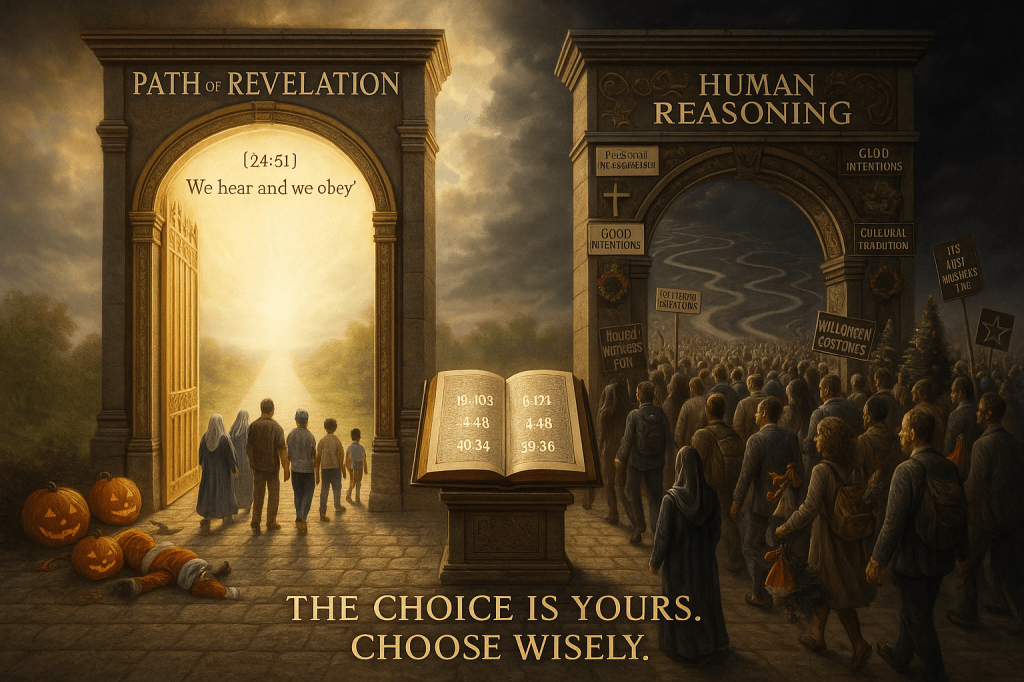
[6:114] “Shall I seek other than God as a source of law, when He has revealed to you this book fully detailed? Those who received the scripture recognize that it has been revealed from your Lord, truthfully. You shall not harbor any doubt.”
The Quran is “fully detailed” (مُفَصَّلًا – mufassala). It contains all the religious guidance we need. We don’t need Peter’s personal methodology to supplement it. We don’t need human assessment of what is “disjoined enough” from pagan origins. God has provided complete guidance, and that guidance does not include permission to participate in practices with idolatrous origins.
[7:3] “You shall all follow what is revealed to you from your Lord; do not follow any idols besides Him. Rarely do you take heed.”
Clear, unambiguous command: Follow ONLY what is revealed. Do not follow idols – including the idol of personal methodology, human reasoning, or scholarly assessment. The verse notes sadly that “rarely do you take heed” – most people will continue following human innovations rather than sticking strictly to revelation.
[33:36] “No believing man or believing woman, if God and His messenger issue any command, has any choice regarding that command. Anyone who disobeys God and His messenger has gone far astray.”
When God issues a command, believers have “no choice.” They cannot respond with “But let me assess whether this is disjoined from its origins” or “But let me create my personal methodology.” The command is: follow what is revealed. The command includes: avoid idol worship and practices with idolatrous origins. There is no choice to debate, modify, or create exceptions based on personal assessment.
Part 9: Lessons from Previous Communities – History Repeats
Following the Errors of Ancestors and Cultures
The Quran extensively documents how previous communities fell into error by following ancestral traditions and adopting practices from surrounding cultures, rather than adhering strictly to divine revelation. These historical lessons provide perfect parallels to the modern Halloween and Christmas debate.
The Excuse of Tradition
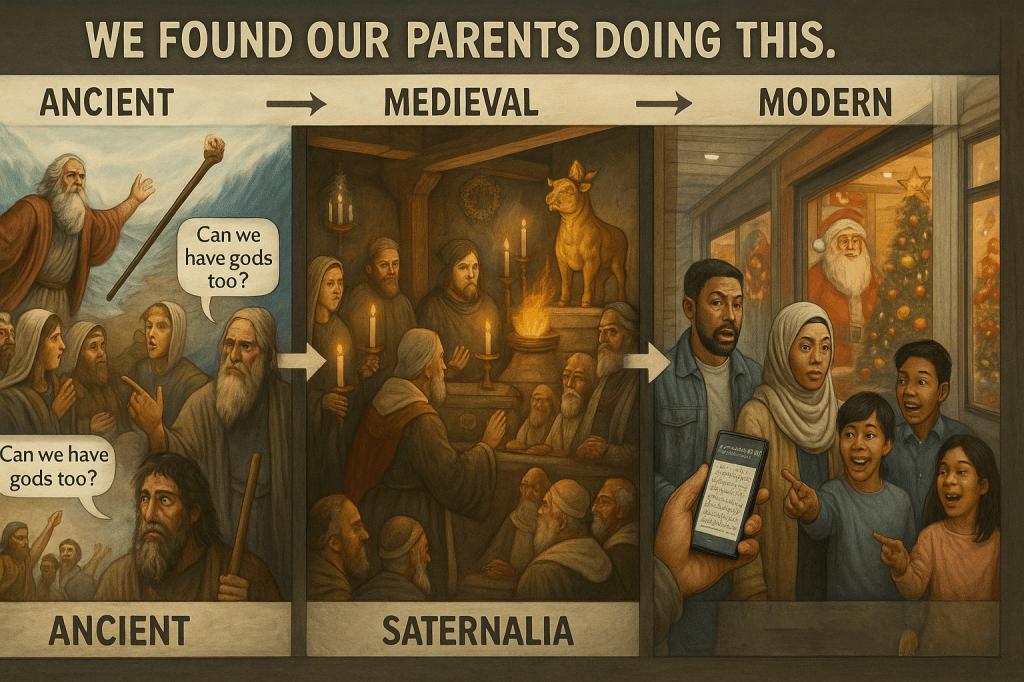
[2:170] “When they are told, ‘Follow what God has revealed herein,’ they say, ‘We follow only what we found our parents doing.’ What if their parents did not understand, and were not guided?”
This verse captures the essence of the “it’s just tradition” defense. When confronted with divine guidance that contradicts cultural practices, people respond: “But this is what we’ve always done! Our parents did it, their parents did it, everyone does it!”
The Quran’s response is devastating: “What if their parents did not understand, and were not guided?” Your parents’ practices don’t validate anything. If they were wrong, following them makes you wrong too. The fact that something is traditional doesn’t make it acceptable to God.
Modern application:
- “Everyone celebrates Halloween – it’s just what we do!” → What if everyone is wrong?
- “Christmas has been a family tradition for generations!” → What if your family tradition contradicts divine guidance?
- “American culture includes these holidays – we’re just participating in our culture!” → What if American culture adopted pagan practices?
The verse exposes the logical fallacy: tradition proves nothing except that errors can be passed down through generations.
[5:104] “When they are told, ‘Come to what God has revealed, and to the messenger,’ they say, ‘What we found our parents doing is sufficient for us.’ What if their parents knew nothing, and were not guided?”
The repetition emphasizes the point. When invited to follow revelation, people claim their parents’ practices are “sufficient” – they don’t need divine guidance because tradition is enough. But what if the tradition itself is rooted in ignorance and misguidance?
Halloween is a perfect example: a tradition rooted in Celtic paganism, death worship, and spirit appeasement. Participating in it because “it’s traditional” is following what parents did, even though what parents did originated in practices that “knew nothing” about worshiping God alone.
[43:22] “The fact is: they said, ‘We found our parents carrying on certain practices, and we are following in their footsteps.’”
[43:23] “Invariably, when we sent a warner to any community, the leaders of that community would say, ‘We found our parents following certain practices, and we will continue in their footsteps.’”
[43:24] “(The messenger) would say, ‘What if I brought to you better guidance than what you inherited from your parents?’ They would say, ‘We are disbelievers in the message you brought.’”
These three verses document a pattern that repeats throughout human history:
- People follow parental practices (“We found our parents carrying on certain practices”)
- Leaders reinforce tradition (“the leaders of that community would say…”)
- Messengers offer better guidance (“What if I brought to you better guidance…”)
- People reject the guidance (“We are disbelievers in the message you brought”)
This perfectly describes the Halloween situation. People follow the practice because “everyone does it.” Community leaders (like Peter) defend it with sophisticated arguments. God’s messenger warns against all pagan-origin practices. People reject the warning, preferring cultural tradition to divine guidance.
The Children of Israel’s Error – Wanting Pagan Practices
[7:138] “We delivered the Children of Israel across the sea. When they passed by people who were worshiping statues, they said, ‘O Moses, make a god for us, like the gods they have.’ He said, ‘Indeed, you are ignorant people.’”
This verse is particularly relevant because it reveals a pattern: even after witnessing undeniable miracles (the parting of the sea, the drowning of Pharaoh’s army, divine protection through the wilderness), the Children of Israel still wanted to adopt the pagan practices they saw around them.
They didn’t say “We want to worship other gods.” They said “make a god FOR US, LIKE the gods they have.” They wanted their own version of what the pagans had – to fit in, to have what others had, to participate in cultural practices they observed.
Moses’s response is instructive: “Indeed, you are ignorant people.” He doesn’t engage their reasoning. He doesn’t debate whether statue worship could be “neutralized” or “disjoined from its origins.” He simply identifies the request as coming from ignorance.
Modern parallel:
- “O Peter, can we celebrate Halloween? Everyone else celebrates it, we want to participate in American culture!”
- “We’re not worshiping Celtic gods – we just want our kids to have fun like other kids!”
- “Make a Quran-approved version of Halloween for us!”
The proper response, following Moses’s example: “Indeed, you are ignorant people. You’re asking for permission to participate in pagan practices because you see others doing them. This request demonstrates ignorance of what pure worship requires.”
[2:93] “We made a covenant with you, as we raised Mount Sinai above you, saying, ‘You shall uphold the commandments we have given you, strongly, and listen.’ They said, ‘We hear, but we disobey.’ Their hearts became filled with adoration for the calf, due to their disbelief.”
Even after agreeing to follow God’s commandments, the Children of Israel’s hearts “became filled with adoration for the calf” – they loved the idol, they wanted to worship like the surrounding cultures worshiped. Their statement “We hear, but we disobey” perfectly captures the attitude of those who acknowledge the warnings about pagan practices but continue participating anyway.
Modern version: “I hear that Halloween has pagan origins, BUT I’m going to celebrate it anyway because it’s just harmless fun.” This is “We hear, but we disobey” in 21st-century language.
Satan’s Deception Through Tradition
[31:21] “When they are told, ‘Follow these revelations of God,’ they say, ‘No, we follow only what we found our parents doing.’ What if the devil is leading them to the agony of Hell?”
This verse reveals the terrifying possibility: what if the tradition you’re following is actually leading you to Hell? The traditions seem innocent, even wholesome – family gatherings, children having fun, community bonding. But what if these innocent-seeming traditions are part of Satan’s deception, leading people away from pure worship?
Satan doesn’t announce his plans. He doesn’t say “Follow me to Hell!” He says “It’s just harmless tradition! Everyone does it! Your parents did it! Don’t be extreme!” And people follow, thinking they’re just participating in cultural practices, unaware they’re being led astray.
[7:28] “They commit a gross sin, then say, ‘We found our parents doing this, and God has commanded us to do it.’ Say, ‘God never advocates sin. Are you saying about God what you do not know?’”
This verse describes people who commit gross sin (الْفَحْشَاءَ – al-fahsha) but justify it through tradition and even claim divine approval. They found their parents doing it, so they assume it’s acceptable to God. Some even claim “God has commanded us to do it” based on nothing more than cultural tradition.
The response is clear: “God never advocates sin. Are you saying about God what you do not know?” When you claim Halloween is acceptable, are you stating this based on Quranic revelation, or based on what you don’t know? When Peter prohibits Christmas, is he conveying God’s prohibition, or saying about God what he doesn’t know?
[6:137] “Thus were the idol worshipers duped by their idols, to the extent of killing their own children. In fact, their idols inflict great pain upon them, and confuse their religion for them. Had God willed, they would not have done it. You shall disregard them and their fabrications.”
Idol worshipers are “duped” – deceived, tricked, fooled. They don’t realize they’re following falsehood. They think their practices are normal, acceptable, even commanded by God. Their idols “confuse their religion” – mixing truth with falsehood, combining pure worship with pagan practices, creating hybrid religions that seem reasonable but deviate from God’s straight path.
Modern believers participating in Halloween and Christmas are being duped in exactly the same way. They don’t see themselves as idol worshipers. They think they’re just normal people engaging in harmless cultural traditions. But their religion has been confused – they’re mixing pure worship of God alone with festivals that originated in pagan worship.
Part 10: The Crystal Clear Command of 9:107-108
God’s Explicit Prohibition – No Room for Interpretation
We have examined pagan-origin holidays in detail, but now we come to the most devastating aspect of Peter’s hypocrisy: while he debates endlessly about Halloween and Christmas (neither of which the Quran mentions), he ignores God’s crystal-clear, explicit prohibition about where believers can pray.
[9:107] “There are those who abuse the masjid by practicing idol worship, dividing the believers, and providing comfort to those who oppose God and His messenger. They solemnly swear: ‘Our intentions are honorable!’ God bears witness that they are liars.”
This verse describes a specific type of masjid – one where people:
- Practice idol worship – setting up partners with God, following religious practices not authorized by Him
- Divide believers – creating sects, denominations, and groups that follow different standards rather than uniting under God’s revelation alone
- Provide comfort to those who oppose God and His messenger – supporting, defending, and welcoming people who contradict divine commands
Notice what these people say: “Our intentions are honorable!” They claim good intentions, pure motives, sincere faith. They might say things like:
- “We’re just trying to build community!”
- “We want to make Islam/submission accessible to everyone!”
- “We’re not being extreme or judgmental!”
- “We’re following our personal understanding of the Quran!”
God’s response to their claimed good intentions: “God bears witness that they are liars.” Their intentions are not honorable. They are lying when they claim pure motives while practicing idol worship and dividing believers.
The footnote is devastating: “*9:107 Any masjid where the practices are not devoted absolutely to God ALONE belongs to Satan, not God. For example, mentioning the names of Abraham, Muhammad, and/or Ali in the Azan and/or the Salat prayers violates God’s commandments in 2:136, 2:285, 3:84, & 72:18. Unfortunately, this is a common idolatrous practice throughout the corrupted Muslim world.”
Any masjid not devoted to God ALONE belongs to Satan. Not to misguided people. Not to well-meaning but mistaken believers. To SATAN. The verse applies to contemporary masjids where idol worship is practiced through mentioning names other than God.
The Unambiguous Command
[9:108] “You shall never pray in such a masjid. A masjid that is established on the basis of righteousness from the first day is more worthy of your praying therein. In it, there are people who love to be purified. God loves those who purify themselves.”
Read those first five words carefully: “YOU SHALL NEVER PRAY IN SUCH A MASJID.”
Not “you should probably avoid if possible.” Not “it’s better if you don’t.” Not “use your personal judgment.” Not “it’s okay if your intentions are good.” Not “it’s fine if you don’t have other options.”
NEVER.
The Arabic is equally clear: لَا تَقُمْ فِيهِ أَبَدًا (la taqum fihi abadan) – “Do not stand in it ever.” The word أَبَدًا (abadan) means “ever,” “forever,” “never.” It’s an absolute prohibition with zero exceptions.
This is one of the clearest commands in the entire Quran. There is no ambiguity. There is no room for interpretation. There is no wiggle room for “personal methodology.” The command is explicit, direct, and absolute.
Peter’s Position – Ignoring the Clear Command
Despite this crystal-clear prohibition, Peter and his community believe that praying behind hypocrites is “not specifically prohibited.” They argue that:
- The verse is about a specific historical masjid in Medina
- It doesn’t apply to modern situations
- People can use their personal judgment about where to pray
- Praying behind hypocrites is acceptable if you don’t agree with their hypocrisy
These are not legitimate interpretations. They are excuses for ignoring a clear divine command. The verse does not limit its application to one historical masjid. It describes characteristics of prohibited masjids – practicing idol worship, dividing believers, opposing God’s messenger – and these characteristics apply to masjids throughout history, including today.
The Ultimate Hypocrisy Exposed
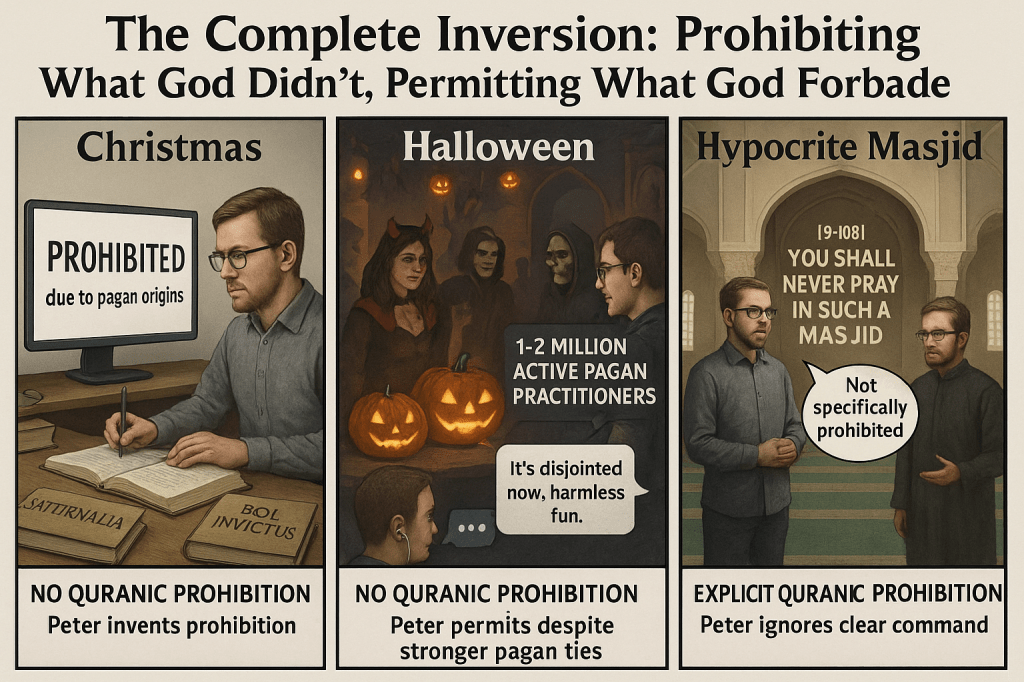
Let us now compare Peter’s positions on three practices:
| Practice | Quranic Status | Historical Origins | Modern Practice | Peter’s Position |
| Christmas | No mention in Quran, no prohibition | Saturnalia, Sol Invictus, Yule (2000 years ago) | Highly secularized, 52% cultural, 0% Saturn worship | PROHIBITED – Wrote entire article condemning it |
| Halloween | No mention in Quran, no prohibition | Samhain (2500 years ago) | 1-2 million active pagan practitioners, explicit death/spirit worship themes | ACCEPTABLE – Defended in Discord as “disjoined” |
| Hypocrite Masjids | “YOU SHALL NEVER PRAY IN SUCH A MASJID” – Explicit divine prohibition | N/A – Direct command from God | Masjids practicing idol worship, dividing believers | ACCEPTABLE – Claims “not specifically prohibited” |
Read that table carefully. Let the absurdity sink in.
Peter:
- Prohibits Christmas (no Quranic prohibition)
- Permits Halloween (no Quranic prohibition, stronger pagan connections than Christmas)
- Permits praying in hypocrite masjids (EXPLICIT Quranic prohibition: “YOU SHALL NEVER”)
He invents prohibitions where God gave none (Christmas), while ignoring prohibitions where God gave explicit command (9:108). This is not just inconsistency. This is complete inversion of divine guidance. This is putting personal judgment above God’s clear commands.
The Questions That Must Be Answered
Peter, and anyone who follows his reasoning, must answer these questions:
- Which is more binding: God’s explicit “YOU SHALL NEVER” or your personal assessment of pagan origins?
- If “You shall never pray in such a masjid” is not specific enough, what level of clarity would be required?
- If God’s clear command can be dismissed through “interpretation,” why can’t your arguments about pagan origins also be dismissed?
- You prohibit Christmas based on pagan origins (no Quranic verse). You permit praying in hypocrite masjids despite explicit prohibition (clear Quranic verse). Who should we follow – you or God?
- If you can declare Christmas prohibited without Quranic authority, how is that different from the very thing 16:116 condemns – uttering lies stating “this is lawful, this is unlawful”?
- Why do you apply strict standards to holidays (analyzing pagan origins) but lenient standards to explicit commands (claiming 9:108 isn’t specific)?
These are not rhetorical questions. They demand answers. The contradiction is complete, documented, and undeniable.
[33:36] “No believing man or believing woman, if God and His messenger issue any command, has any choice regarding that command. Anyone who disobeys God and His messenger has gone far astray.”
God issued a command: “YOU SHALL NEVER PRAY IN SUCH A MASJID.” Believers have NO CHOICE regarding this command. You cannot respond with “But my personal methodology suggests…” or “But I interpret it as…” or “But it’s not specific enough for me.” The command is given. The choice is removed. Disobedience means straying far astray.
Part 11: The Triple Hypocrisy – Summary and Synthesis
Three Simultaneous Contradictions
We have now documented three separate but interconnected hypocrisies in Peter’s position. Let us synthesize them to reveal the complete picture of selective reasoning and arbitrary application of standards.
Hypocrisy #1: Prohibiting Christmas While Permitting Halloween
The Contradiction: Peter writes an entire article condemning Christmas for its pagan origins (Saturnalia, Sol Invictus, Yule), yet defends Halloween despite its arguably stronger contemporary connections to pagan practice (Samhain, 1-2 million active practitioners, explicit death worship and spirit communication).
Peter’s Own Standard Violated: He stated that if something “is still strongly tied with pagan worship or practices carried on today” then he would refrain, but if “the association isn’t recognized unless there is some scholarly research” he’s “less inclined to be a stickler.”
Application of His Own Standard:
- Christmas: Requires scholarly research to see pagan connections + zero active Saturn/Odin worship = By Peter’s standard, should be ACCEPTABLE
- Halloween: Pagan/occult nature obvious to everyone + 1-2 million active Samhain practitioners = By Peter’s standard, should be MORE PROHIBITED than Christmas
- Peter’s Actual Positions: Christmas PROHIBITED, Halloween ACCEPTABLE = Complete reversal of his own stated standard
The Evidence:
- Historical sources document Halloween’s direct continuity with Samhain practices
- Statistical data shows 1-2 million Americans actively practice paganism/Wicca with Samhain as major holy day
- Contemporary practices (divination, spirit communication, death worship) explicitly continue ancient rituals
- Christmas has become highly secularized with no active practitioners worshiping Roman/Germanic gods
- Public recognition: Halloween’s supernatural/occult theme universally obvious; Christmas’s pagan origins require historical research
Quranic Refutation: Verses 2:170, 7:138, and 43:22-24 condemn following ancestral traditions regardless of how common or normal they seem. Verse 39:3 directly refutes the “good intentions” argument, calling those who worship idols to “bring us closer to God” liars and disbelievers.
Hypocrisy #2: Applying Different Standards to Identical Situations
The Contradiction: Peter applies strict analytical standards to Christmas (documenting pagan origins, examining historical evidence, drawing definitive conclusions) while applying permissive, lenient reasoning to Halloween (emphasizing secularization, focusing on intentions, claiming neutralization).
The Same Question, Different Answers:
- Question: “Can a practice with pagan origins be acceptable if enough time has passed and modern participants don’t worship the original pagan deities?”
- Peter’s answer for Christmas: NO – The pagan origins contaminate the practice regardless of modern understanding. Christians should abandon Christmas.
- Peter’s answer for Halloween: YES – The practice has been “disjoined” from its pagan origins. Modern celebration is just secular fun.
The Same Question, Different Answers (Part 2):
- Question: “Does the fact that mainstream culture widely practices something make it acceptable for believers?”
- Peter’s answer for Christmas: NO – The article criticizes how Christianity adopted paganism to make it popular (“political expediency rather than theological necessity”).
- Peter’s answer for Halloween: Implicitly YES – His defense relies partly on how common and culturally accepted Halloween has become.
Quranic Refutation: Verse 10:59 condemns those who render some things lawful and others unlawful without divine permission. Verse 16:116 prohibits uttering lies stating “this is lawful, this is unlawful” to fabricate religious laws. Verse 6:148 refutes those who follow conjecture rather than proven knowledge.
Hypocrisy #3: Ignoring Explicit Commands While Debating Unmentioned Practices
The Contradiction: Peter spends enormous energy debating whether Halloween and Christmas are acceptable (neither mentioned in the Quran) while dismissing God’s explicit command in 9:108: “YOU SHALL NEVER PRAY IN SUCH A MASJID” as “not specifically prohibiting” praying behind hypocrites.
The Hierarchy Inverted:
| Level of Authority | Example | How It Should Be Treated | How Peter Treats It |
| 1. Explicit Divine Command | [9:108] “You shall NEVER pray in such a masjid” | Absolute obedience, no interpretation needed | Dismissed as “not specific enough” |
| 2. Clear Quranic Principles | Avoid all idol worship and practices with idolatrous origins | Applied consistently to all similar cases | Applied selectively (Christmas yes, Halloween no) |
| 3. Personal Reasoning | “My methodology for assessing disjoinment” | Subordinate to revelation, never contradicting it | Elevated above divine commands |
| 4. Cultural Traditions | “Everyone celebrates Halloween” | Rejected when contradicting revelation | Used to justify practices Quran warns against |
Peter has inverted this hierarchy: elevating personal reasoning and cultural traditions above explicit divine commands and clear Quranic principles. This is the definition of following desires rather than revelation.
Quranic Refutation: Verse 33:36 states believers have “no choice” when God issues a command. Verse 6:114 asks “Shall I seek other than God as a source of law?” Verse 42:21 condemns those who “decree for them religious laws never authorized by God.”
The Unified Pattern: Personal Preference Disguised as Methodology
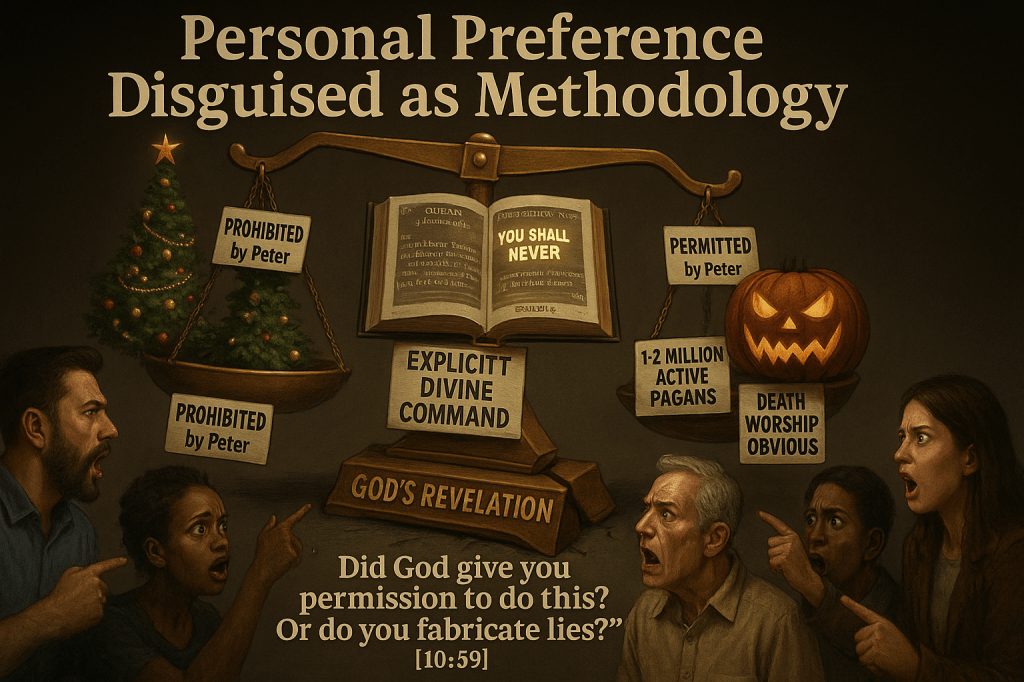
When we examine all three hypocrisies together, a clear pattern emerges: Peter’s positions are determined by personal preference, then justified through selective application of reasoning that sounds principled but is inconsistently applied.
The Evidence of Preference Over Principle:
- Christmas: Peter doesn’t like it → Applies strict standard → Prohibits based on pagan origins
- Halloween: Peter wants to permit it → Applies lenient standard → Permits despite stronger pagan origins
- Hypocrite Masjids: Peter wants to pray there → Dismisses explicit command → Claims prohibition “not specific”
If Peter were following consistent principles, he would either:
- Option A: Prohibit BOTH Christmas and Halloween (if pagan origins matter) + Never pray in hypocrite masjids (obeying 9:108)
- Option B: Permit BOTH Christmas and Halloween (if pagan origins don’t matter) + Never pray in hypocrite masjids (obeying 9:108)
Notice that in BOTH consistent options, the explicit command of 9:108 is obeyed. But Peter follows neither consistent option. Instead, he creates a third option that happens to match his personal preferences: Prohibit Christmas, Permit Halloween, Ignore 9:108.
This is not methodology. This is rationalization.
[6:116] “If you obey the majority of people on earth, they will divert you from the path of God. They follow only conjecture; they only guess.”
The majority celebrates Halloween and Christmas. The majority prays in masjids regardless of whether hypocrites lead them. Following the majority rather than God’s clear commands leads away from His path. This is conjecture and guesswork, not divine guidance.
Part 12: The Path Forward – Consistency with Divine Revelation
Establishing a Quranic Standard for All Practices
Having thoroughly documented Peter’s inconsistencies, we must now establish the correct approach based purely on Quranic revelation. Unlike Peter’s selective methodology, this standard applies consistently to all practices without exception.
The Clear Quranic Position
Foundation Principle #1: God Alone Sets Religious Standards
[6:114] “Shall I seek other than God as a source of law, when He has revealed to you this book fully detailed? Those who received the scripture recognize that it has been revealed from your Lord, truthfully. You shall not harbor any doubt.”
The Quran is “fully detailed” (مُفَصَّلًا). We don’t need Peter’s “personal methodology” to supplement it. We don’t need human assessment of what has been “neutralized.” God’s revelation provides complete guidance.
Foundation Principle #2: Idol Worship in All Forms is Absolutely Prohibited
[4:48] “God does not forgive idolatry, but He forgives lesser offenses for whomever He wills. Anyone who sets up idols beside God, has forged a horrendous offense.”
Idolatry is the only unforgivable sin. This includes participating in practices that were created for and dedicated to idol worship, regardless of modern participants’ intentions.
Foundation Principle #3: Practices with Idolatrous Origins Remain Contaminated
[6:121] “Do not eat from that upon which the name of God has not been mentioned, for it is an abomination. The devils inspire their allies to argue with you; if you obey them, you will be idol worshipers.”
Just as food offered to idols remains forbidden regardless of the eater’s intentions, practices created for pagan worship remain contaminated regardless of modern participants’ intentions. The analogy is perfect and undeniable.
Foundation Principle #4: Explicit Commands Must Be Obeyed Without Exception
[33:36] “No believing man or believing woman, if God and His messenger issue any command, has any choice regarding that command. Anyone who disobeys God and His messenger has gone far astray.”
When God commands “YOU SHALL NEVER pray in such a masjid,” believers have no choice. No personal methodology, no interpretation, no excuses – only obedience.
Consistent Application to Halloween and Christmas
Applying these principles consistently:
Halloween:
- Originated in Samhain, a pagan festival dedicated to death gods and spirits ✓
- Core practices (costumes as spirits, offerings to dead, divination, spirit communication) created for and dedicated to pagan worship ✓
- 1-2 million modern practitioners actively celebrate as pagan religious holy day ✓
- Explicit death worship, supernatural, and occult themes maintained ✓
- Quranic Conclusion: PROHIBITED – Participating means engaging in practices with idolatrous origins, regardless of personal intentions
Christmas:
- Originated in multiple pagan festivals (Saturnalia, Sol Invictus, Yule) dedicated to Roman/Germanic gods ✓
- Core practices (December 25 date, trees, wreaths, gift-giving) borrowed from pagan worship ✓
- Zero modern practitioners worship Saturn, Odin, or Sol Invictus (but this doesn’t neutralize the origins) ✓
- Highly secularized, but origins remain pagan ✓
- Quranic Conclusion: PROHIBITED – Same principle as Halloween: practices with idolatrous origins remain contaminated
Notice the consistency: BOTH are prohibited based on the same clear Quranic principle. We don’t need to assess which is “more disjoined” or which requires more scholarly research. The principle applies equally: practices created for pagan worship remain forbidden, period.
Hypocrite Masjids:
- God explicitly commands: “YOU SHALL NEVER pray in such a masjid” ✓
- Characteristics of prohibited masjids: idol worship, dividing believers, opposing God’s messenger ✓
- These characteristics exist in contemporary masjids (mentioning Muhammad in prayers, sectarian divisions, rejecting God’s Messenger of the Covenant) ✓
- Quranic Conclusion: PROHIBITED – Clear divine command must be obeyed without exception
The Questions That Lead to Consistency
When approaching any practice, ask these questions based on Quranic principles:
- Does God explicitly command or prohibit this practice?
– If yes: Obey without exception (no personal methodology needed)
– If no: Proceed to question 2 - Did this practice originate in or was it dedicated to worship of other than God?
– If yes: Prohibited (same principle as food offered to idols)
– If no: Proceed to question 3 - Is this practice authorized by anything other than God’s revelation?
– If yes: Unauthorized religious innovation, prohibited (verse 57:27)
– If no: Proceed to question 4 - Does this practice contradict any Quranic principle or command?
– If yes: Prohibited
– If no: Permissible by default
Applying this to our three cases:
Halloween:
- Explicit command? No mention in Quran
- Idolatrous origins? YES – Samhain, dedicated to pagan gods and spirits
- Result: PROHIBITED (question 2)
Christmas:
- Explicit command? No mention in Quran
- Idolatrous origins? YES – Saturnalia, Sol Invictus, Yule, dedicated to pagan gods
- Result: PROHIBITED (question 2)
Hypocrite Masjids:
- Explicit command? YES – “YOU SHALL NEVER pray in such a masjid” (9:108)
- Result: PROHIBITED (question 1, no further questions needed)
This is consistent methodology based purely on Quranic principles. No selective application. No personal preferences determining outcomes. Just straightforward application of God’s clear guidance.
What About Other Cultural Practices?
Peter mentioned “birthday cake, blowing out candles, Olympics, yoga, wedding rings, bridesmaids and groomsmen, names of the months, days, planets, constellations etc.” – claiming these all have pagan origins. Let’s apply the same questions:
Birthday Cakes:
- Explicit command? No
- Idolatrous origins? Cake itself has no idolatrous origin (just food); celebration of birthdays not dedicated to pagan gods
- Unauthorized religious practice? No – not a religious practice at all, just cultural celebration
- Contradicts Quranic principles? No
- Result: PERMISSIBLE
Wedding Rings:
- Explicit command? No
- Idolatrous origins? Symbolic jewelry, not dedicated to pagan worship
- Unauthorized religious practice? Not a religious practice, just cultural symbol
- Contradicts Quranic principles? No
- Result: PERMISSIBLE
Olympics:
- Explicit command? No
- Idolatrous origins? Ancient Olympics honored Zeus, but modern Olympics are purely athletic competition
- Unauthorized religious practice? Not a religious practice at all
- Contradicts Quranic principles? No
- Result: PERMISSIBLE
The distinction is clear: practices that were explicitly dedicated to pagan worship as RELIGIOUS CELEBRATIONS remain prohibited. Cultural practices, foods, games, jewelry, calendars – things that weren’t religious worship acts themselves – are permissible.
Halloween and Christmas fall into the first category: they were RELIGIOUS CELEBRATIONS dedicated to pagan deities. They are not just cultural artifacts that happened to exist during pagan times – they were the actual worship practices themselves.
[5:87] “O you who believe, do not prohibit good things that are made lawful by God, and do not aggress; God dislikes the aggressors.”
This verse warns against prohibiting what God made lawful. We are not prohibiting birthday cake, wedding rings, or calendar month names – these were never religious worship practices dedicated to pagan deities. But Halloween and Christmas WERE worship practices, and God has already prohibited practices with idolatrous origins through the food offered to idols principle.
The Call to Sincere Believers
[24:51] “The only utterance of the believers, whenever invited to God and His messenger to judge in their affairs, is to say, ‘We hear and we obey.’ These are the winners.”
The response of true believers is simple: “We hear and we obey.” Not “We hear, but let me create a personal methodology first.” Not “We hear, but it’s not specific enough for me.” Simply: “We hear and we obey.”
- God prohibits idol worship in all forms → We hear and we obey
- God prohibits food offered to idols → We hear and we obey
- God commands “NEVER pray in such a masjid” → We hear and we obey
- God warns against practices with idolatrous origins → We hear and we obey
No debates. No loopholes. No personal methodologies. Just simple, straightforward obedience to clear revelation.
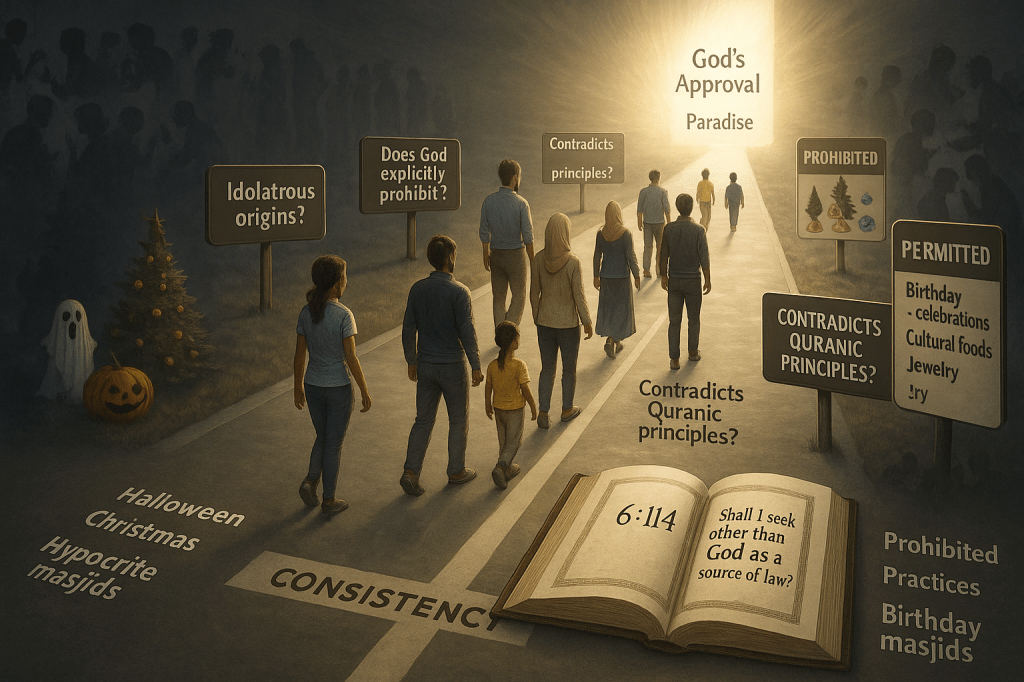
Conclusion: Whom Will You Follow?
The Choice Before Every Believer
This comprehensive analysis has presented undeniable evidence of Peter’s triple hypocrisy. He prohibits Christmas for pagan origins while permitting Halloween despite stronger pagan connections. He applies strict standards to unmentioned holidays while dismissing God’s explicit command about hypocrite masjids. He creates “personal methodology” to legislate religious practice without divine authority.
But this article is not ultimately about Peter. It’s about the choice every believer faces: Will you follow God’s clear revelation, or will you follow human reasoning that contradicts divine commands?
The Evidence Is Complete
Historical Evidence: Halloween and Christmas both have thoroughly documented pagan origins. Halloween derives from Samhain (Celtic death worship and spirit appeasement). Christmas incorporates Saturnalia (Roman), Sol Invictus (sun god worship), and Yule (Germanic tree spirits). These are historical facts, not matters of interpretation.
Statistical Evidence: 1-2 million Americans actively practice paganism/Wicca with Samhain (Halloween) as a major religious holy day. They perform divination, spirit communication, and death worship rituals. Zero people worship Saturn, Odin, or Sol Invictus on Christmas. Halloween maintains far stronger contemporary connections to active pagan practice.
Comparative Evidence: By every measure of Peter’s own stated criteria, Halloween should be MORE prohibited than Christmas. Yet he reaches the opposite conclusion, revealing that personal preference, not consistent methodology, determines his positions.
Quranic Evidence: God explicitly prohibits idol worship (4:48, 4:116), practices with idolatrous origins (6:121 via food analogy), following unauthorized religious laws (10:59, 16:116, 42:21), and praying in hypocrite masjids (9:108). These prohibitions don’t include exceptions for “good intentions,” “neutralization,” or “personal assessment of disjoinment.”
The Three Consistent Positions
There are only three logically consistent positions regarding pagan-origin holidays and hypocrite masjids:
Position A: Strict Quranic Consistency (Correct)
- Halloween: PROHIBITED (pagan origins)
- Christmas: PROHIBITED (pagan origins)
- Hypocrite Masjids: PROHIBITED (explicit command 9:108)
- Basis: Food offered to idols principle applies to all practices with idolatrous origins; explicit commands obeyed without exception
Position B: Lenient Across the Board (Wrong, but at least consistent)
- Halloween: ACCEPTABLE (origins don’t matter)
- Christmas: ACCEPTABLE (origins don’t matter)
- Hypocrite Masjids: PROHIBITED (can’t ignore explicit command)
- Basis: Lenient on origins but still obeys explicit commands
Position C: Peter’s Inconsistent Position (Wrong and contradictory)
- Halloween: ACCEPTABLE (claims neutralization)
- Christmas: PROHIBITED (emphasizes pagan origins)
- Hypocrite Masjids: ACCEPTABLE (ignores explicit command)
- Basis: Personal preference disguised as methodology
Only Position A maintains logical and Quranic consistency. Position B at least applies the same standard to similar cases. Position C is complete hypocrisy – applying different standards to identical situations based on personal preference.
The Questions You Must Answer
Every person reading this analysis must answer these questions honestly:
- Do you believe God’s prohibition of idol worship includes all forms of shirk, including practices with idolatrous origins?
- Do you accept that food offered to idols remains forbidden regardless of the eater’s intentions?
- If yes to #2, do you accept that the same principle applies to holidays dedicated to pagan deities?
- Do you believe that “personal methodology” has any authority to override or supplement Quranic principles?
- Do you believe “YOU SHALL NEVER pray in such a masjid” is sufficiently clear to require obedience?
- Are you willing to follow consistent Quranic principles even when they contradict cultural norms and personal preferences?
Your answers to these questions will determine whether you follow God’s revelation or human innovation. There is no middle ground.
The Two Paths
[7:3] “You shall all follow what is revealed to you from your Lord; do not follow any idols besides Him. Rarely do you take heed.”
There are two paths:
Path 1: Following Revelation
- Obeying explicit commands like 9:108 without exception
- Applying Quranic principles consistently (food analogy applies to all practices)
- Rejecting ALL pagan-origin religious celebrations (Halloween AND Christmas)
- Not creating “personal methodologies” to legislate religion
- Saying “We hear and we obey” when God’s guidance is clear
Path 2: Following Human Reasoning
- Creating personal standards for what commands to obey
- Applying principles selectively based on preference
- Participating in pagan-origin practices with “good intentions”
- Inventing concepts like “neutralization” not found in Quran
- Saying “We hear, but…” followed by excuses and rationalizations
The first path is narrow and few follow it. The second path is wide and many take it. But only the first path leads to God’s approval.
[40:34] “Joseph had come to you before that with clear revelations, but you continued to doubt his message. Then, when he died you said, ‘God will not send any other messenger after him. (He was the last messenger)!’ God thus sends astray those who are transgressors, doubtful.”
We return to where we began. Joseph came with clear revelations against idolatry. People doubted. They transgressed God’s boundaries. They followed their own reasoning. And God sent them astray.
Rashad Khalifa came with clear revelations about God’s Messenger of the Covenant, about avoiding ALL pagan practices, about obeying explicit commands. People doubt. They transgress by creating personal methodologies. They follow their preferences. And God sends them astray.
The pattern repeats through history. The question is: which side will you choose?
The Final Warning
[6:121] “Do not eat from that upon which the name of God has not been mentioned, for it is an abomination. The devils inspire their allies to argue with you; if you obey them, you will be idol worshipers.”
If you obey those who argue that pagan-origin practices are acceptable, you become an idol worshiper – regardless of your intentions. The verse is explicit. The warning is clear.
Peter argues that Halloween is acceptable despite pagan origins. Peter argues that Christmas should be prohibited but applies opposite logic. Peter argues that 9:108’s explicit command isn’t specific enough. These are the arguments of devils’ allies, making practices with idolatrous origins seem reasonable and acceptable.
If you obey these arguments, you will be idol worshipers. Not might be. WILL BE. The verse declares it with certainty.
The Choice Is Yours
[18:29] “Proclaim: ‘This is the truth from your Lord,’ then whoever wills let him believe, and whoever wills let him disbelieve.”
This article has presented the truth based on historical evidence, statistical data, logical analysis, and most importantly, clear Quranic verses. The evidence is complete. The hypocrisy is documented. The choice is yours.
Will you follow God’s clear prohibition of idol worship and practices with idolatrous origins? Will you obey the explicit command to never pray in hypocrite masjids? Will you reject human methodologies that contradict divine revelation?
Or will you follow personal preferences, cultural traditions, and selective reasoning that permits what feels comfortable while prohibiting what doesn’t?
The path of revelation is clear, narrow, and consistent. The path of human reasoning is contradictory, selective, and wide. Choose wisely. Your eternal destination depends on it.
[6:149] “Say, ‘To God belongs the most powerful argument. If He wills, He can guide all of you.’”
To God belongs the most powerful argument. Not to Peter. Not to personal methodology. Not to cultural tradition. To God alone.
Follow His argument. Obey His commands. Reject all forms of idol worship. And you will be among those who are guided.
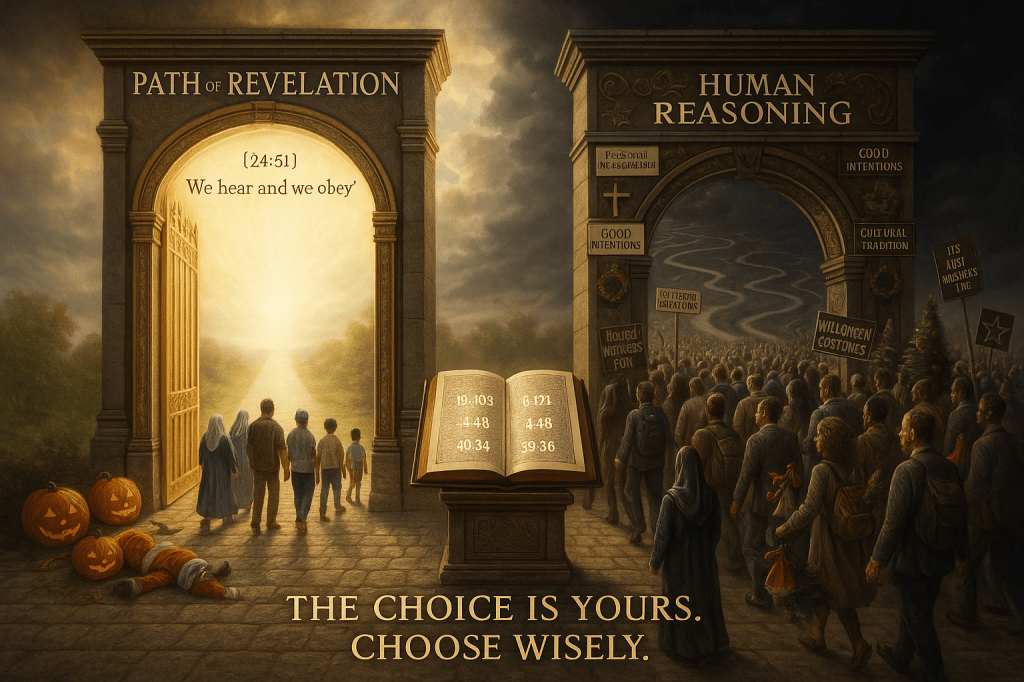


 Quran Only Studies
Leave a reply to Augusto Pernia Cancel reply